






Abstract
As an emerging technology, the efficient and energy conserving process of permanent magnetic drive (PMD) presents high uncertainties. This paper designs a type of Begian–Melek–Mendel (BMM) structure interval type-2 fuzzy logic systems (IT2 FLSs) for PMD process uncertain parameters forecasting. The antecedent, consequent, and input measurements of systems are all selected as the Gaussian type-2 primary membership functions with uncertain standard deviations. Then the backpropagation algorithms are used to tune the parameters of IT2 FLSs. According to the Monte Carlo simulation studies and convergence analysis, the proposed IT2 FLSs are proved to be superior to two corresponding T1 FLSs in generalization ability.
Keywords
Introduction
As an emerging technology, interval type-2 fuzzy logic systems (IT2 FLSs; Hagras, 2007; Hagras and Wagner, 2012) can better cope with the uncertainties in natural languages; therefore, they have been successfully applied to areas like power systems (Chen et al., 2016; Khosravi et al., 2012), financial systems (Bernardo et al., 2013), permanent magnetic drive (PMD; Barkat et al., 2011; Wang and Chen, 2018), hop strip mill (Méndez and Hernandez, 2013), pattern recognition (Mendoza et al., 2009), fault detection (Safarinejadian et al., 2015), intelligent controllers (Biglarbegian et al., 2011a; Hsu and Juang, 2013; Tao et al., 2012), medical systems (Lees et al., 2010), information systems (Niewiadomski, 2010), and edge detection (Castillo and Melin, 2012; Gonzalez et al., 2016). Especially in recent years, IT2 FLSs have been widely used on forecasting activities. Most recent studies on load forecasting show that IT2 FLSs (Khosravi et al., 2012; Khosravi and Nahavandi, 2014) have superiority approximation capability even better than nonparametric neural networks (Barbounis and Theocharis, 2007; Gao et al., 2014; Gusev and Burkovskii, 2013; Mehdi et al., 2016; Pany and Ghoshal, 2015). Furthermore, IT2 FLSs based on optimization algorithms outperform their T1 counterparts on forecasting.
A T2 FLS (see Figure 1) is usually composed of five blocks as fuzzifier, inference, rules, type-reducer, and defuzzifier. Among them, the block of type-reducer acts as the key role. Compared with the T2 FLS, a T1 FLS does not have the block of type-reducer. In a T2 FLS, there must be at least one T2 FS (fuzzy set) in the antecedent or consequent of fuzzy rules. The output of the inference is a T2 FS, and the block of type-reduction (TR) transforms the T2 FS to T1 FS before executing defuzzification.
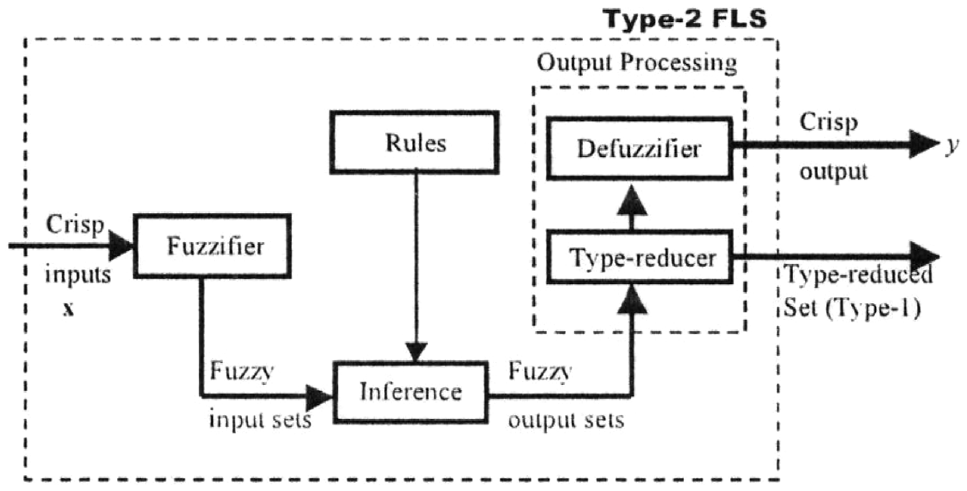
Blocks of a T2 FLS.
T2 FLSs based on Karnik–Mendel (KM) structure (Chen et al., 2018; Chen and Wang, 2017, 2019) are most popular for theoretical studies. However, it is much more complicated for T2 FLSs (Chen et al., 2016; Mendel, 2004, 2013) based on that structure and which may be not suitable for real applications. Recently, IT2 FLS based on Begian–Melek–Mendel (BMM) structure (Biglarbegian et al., 2010, 2011b) is shown to have better stability and robustness (Zhang et al., 2014; Zhang and Wang, 2015) than their T1 counterparts. This paper designs a type of BMM structure-based IT2 FLSs for forecasting. Backpropagation (BP) algorithms are used to optimize the parameters of proposed IT2 FLSs. Furthermore, temperature data for different types of permanent magnets based on the PMD process (Barkat et al., 2011; Wang and Chen, 2018) are employed to study the forecasting problems. Simulation experiments show that the proposed IT2 FLSs are superior to their T1 counterparts on forecasting accuracy.
We organize the rest of this paper as following. The “FLSs” section describes the designed T1 and IT2 FLSs. The “BMM structure-based IT2 FLSs and their BP algorithms” section provides the proposed BP algorithms and their applications on optimizing the parameters of FLSs. Simulation experiments for FLS forecasting approaches are given in the “Simulation studies” section. Finally, the “Conclusion” section is the conclusion and expectation.
FLSs
In this section, we introduce two types of FLS: Mamdani non-singleton T1 FLSs and Mamdani non-singleton T2 FLSs.
Mamdani non-singleton T1 FLSs
For the T1 FLSs, we adopt non-singleton fuzzification, height defuzzification, and the following form of “if–then” fuzzy rules. The four basic blocks are as follows

where
Type-1 non-singleton fuzzifier (Mendel, 2001): Input measurement
Inference: For the T1 input set
The fuzzy relation

Then the T1 fuzzy output set

where ◦ represents the T1 composition operation (Mendel, 2001).
Defuzzifier: Height defuzzifier is selected as following.
The output
BMM structure-based IT2 non-singleton T2 FLSs
For the BMM structure-based IT2 non-singleton T2 FLSs, we design them by means of non-singleton fuzzification, center-of-set TR, and the following form of “if–then” fuzzy rules

where
Type-2 non-singleton fuzzifier (Mendel, 2001): Input measurement
Inference: For the T2 input set

For the

where
Suppose that

Here, we define
For the BMM structure-based IT2 non-singleton T2 FLSs, whose firing set

and

where


Here, we let
For the rule

where
Let

Here, the sign ∫ does not denote the integral operation, but as the union overall admissible.
BMM structure-based IT2 FLSs and their BP algorithms
In this section, we provide how to use the BP algorithms to design and optimize the BMM structure-based IT2 FLSs. Most of the references proposed their optimizations just by showing the process with some datasets, while this paper gives mathematical forecasting formulas for two types of FLSs (Mamdani non-singleton T1 FLSs and BMM structure-based IT2 non-singleton T2 FLSs) to enhance their theory and application process.
Let a collection of
Here, we define the error function as
For the Mamdani T1 non-singleton FLSs, the antecedents and input measurements are all selected as Gaussian T1 MFs. The antecedent MF of T1 FS
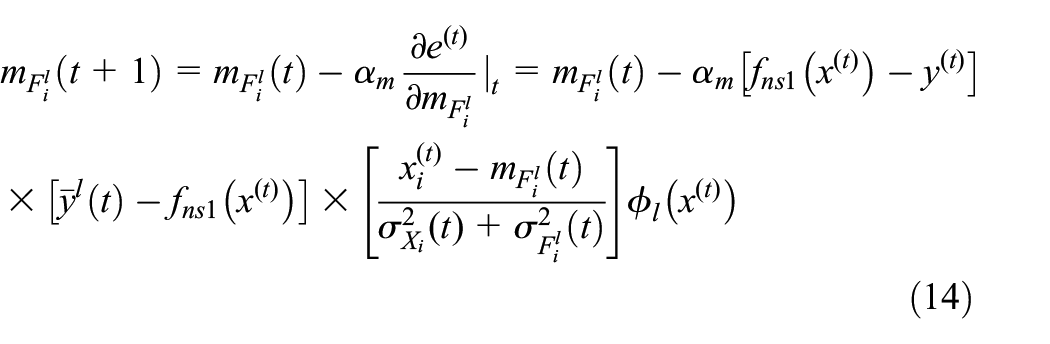


Here,
For the Mamdani non-singleton T2 FLSs with BMM structure, the output of IT2 FLSs is as

where
For further study, we define the specific footprint of uncertainties (FOUs) for MFs. Here, the antecedent primary MF is chosen as the form of Gaussian type with uncertain standard deviation, that is

And the input measurement primary MF is also selected as the form of Gaussian type with uncertain standard deviation, that is

The upper and lower firing strengths of the

where
The general structure of BP algorithms to tune all MF parameters is as

in which

Then all the parameters of Mamdani non-singleton T2 FLSs with BMM structure can be turned by the BP algorithms as the following formulas


where
In the paper, we define two performance indices for evaluating the designed FLSs optimized with BP algorithms. And they are as root mean square error (RMSE; Chen and Wang, 2018) and the mean absolute percentage error (MAPE; Khosravi and Nahavandi, 2014). Then the two formulas are provided as

in which

Simulation studies
Data
Simulation studies employ both PMD samarium cobalt and alnico permanent magnetic temperature data to show the effectiveness of the proposed BP optimized FLSs forecasting approaches. Moreover, noises are added to the data to simulate the affect of uncertainty. Figure 2 provides the schematic view of PMD.
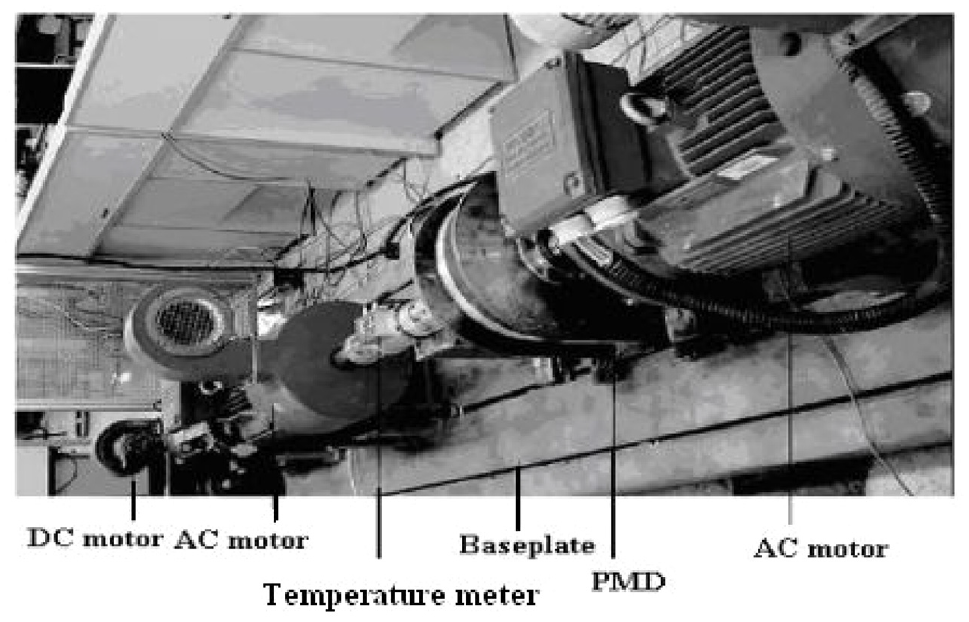
Schematic view of PMD (Chen et al., 2018; Chen and Wang, 2017, 2019).
Simulation setup
First of all, we observe the temperature data of samarium cobalt permanent magnet. As shown in Figure 3, the unit of horizontal axis is millisecond (ms), while the unit of vertical axis is °C. The design and test of FLS forecasters are based on 1000 noisy data points:
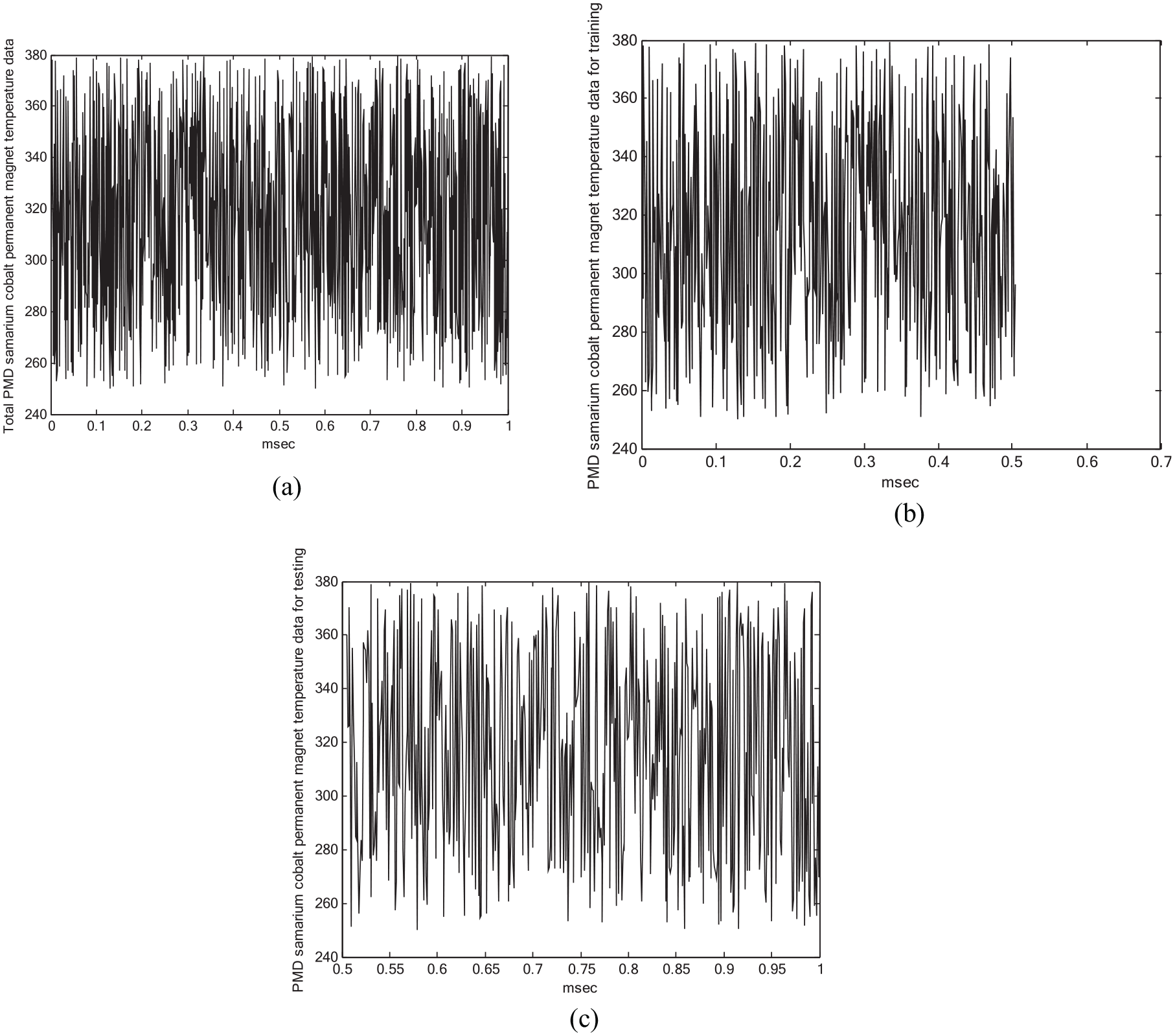
(a) The temperature data of samarium cobalt permanent magnet, (b) training is completed by 500 input–output data pairs generated from
Figure 4 shows the simulation procedure for developing FLS forecasters and verifying their performances. In the paper, every four antecedents
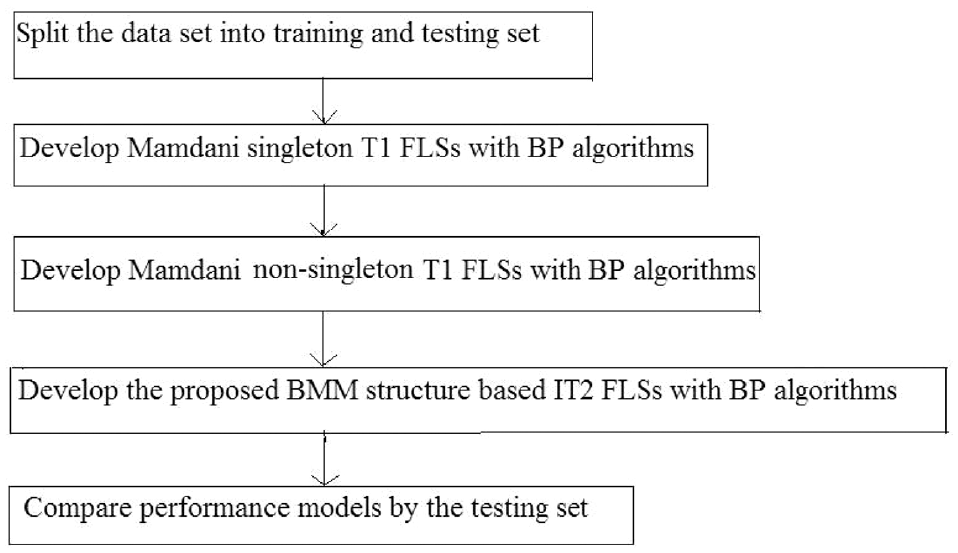
Simulation procedure for developing FLS approaches.
We adopt the first 504 noisy data
Here, Gaussian MFs are selected for the Mamdani singleton T1 FLSs and Mamdani non-singleton T1 FLSs, and Gaussian primary MFs with uncertain standard deviation are selected for the Mamdani non-singleton T2 FLSs with BMM structure (Mamdani denotes the inference type for FLSs). For the Mamdani singleton T1 FLSs, each fuzzy rule is characterized by eight antecedent MF parameters and one consequent parameter. For the Mamdani non-singleton T1 FLSs, each fuzzy rule is characterized by eight antecedent MF parameters, four input measurement MF parameters (the standard deviation for each of the four Gaussian MFs), and one consequent parameter. Therefore, the total numbers of parameters for two types of T1 FLSs are 144 and 208, respectively. For the Mamdani non-singleton T2 FLSs with BMM structure, each fuzzy rule is characterized by 12 antecedent MF parameters (the upper and lower bounds on the standard deviation, and the mean for each of the four Gaussian MFs), 8 input measurement MF parameters (the upper and lower bounds on the standard deviation for each of the four Gaussian MFs), and 1 consequent parameter. So that the total number of design parameters for Mamdani non-singleton T2 FLSs with BMM structure is equal to
Here, we select the product t-norm. After 1000 epochs of BP iterations (for each iteration, 20 times of Monte Carlo simulations (Rezaie et al., 2007) are performed), the simulation graphs of forecasting results are provided as follows (Figures 5–7).
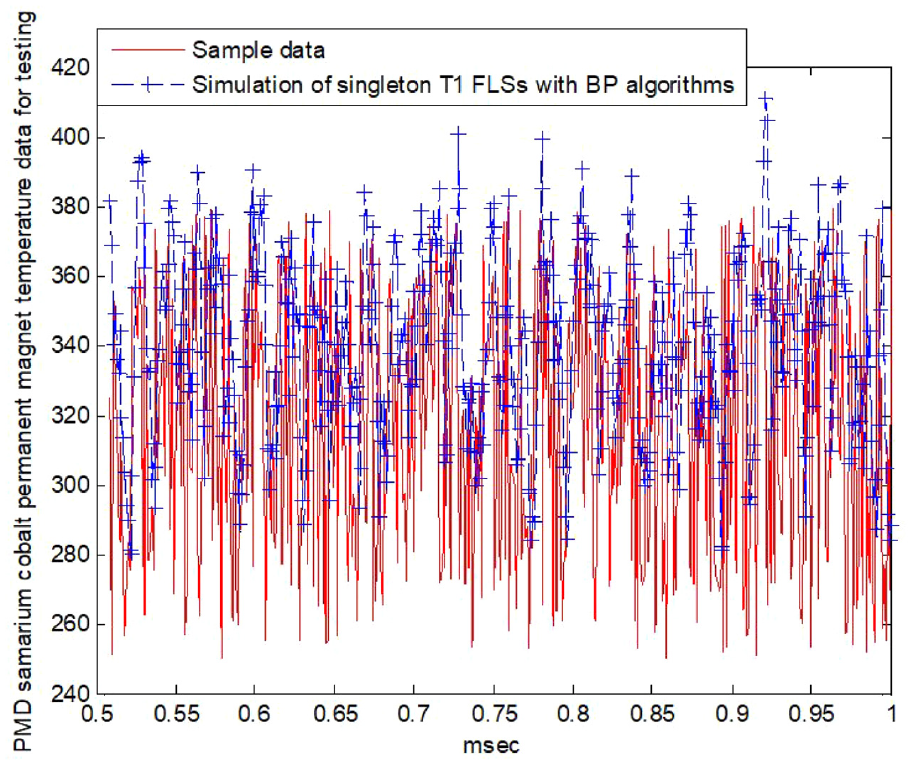
Simulation graph of Mamdani singleton T1 FLSs forecasting for samarium cobalt permanent magnet temperature data.
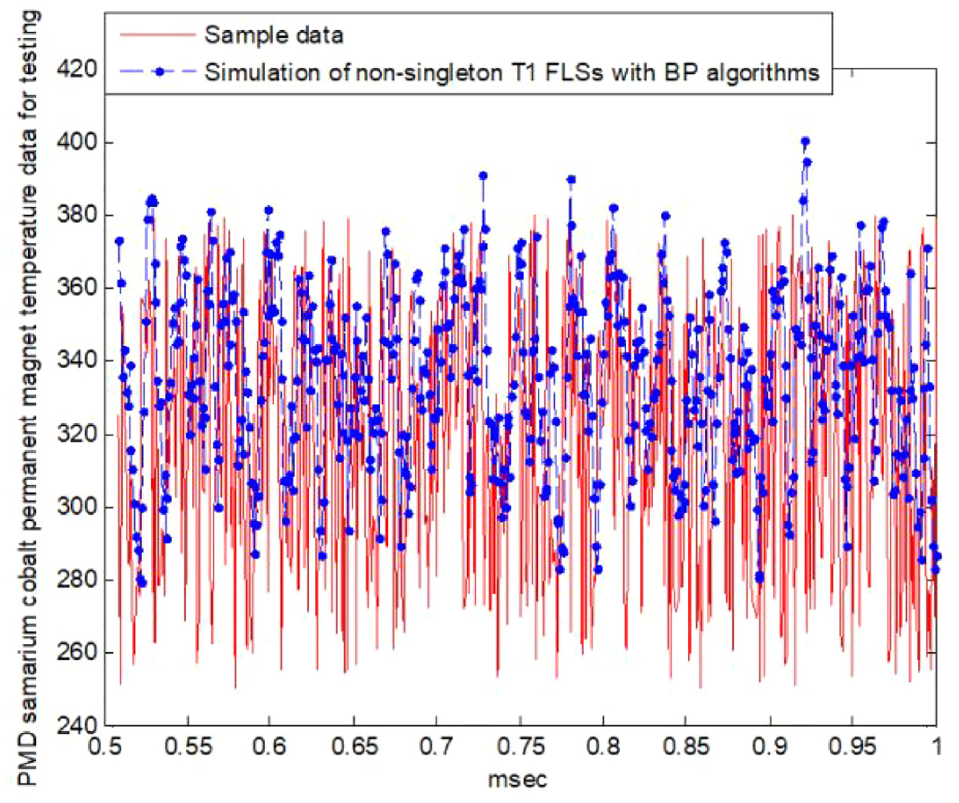
Simulation graph of Mamdani non-singleton T1 FLS forecasting for samarium cobalt permanent magnet temperature data.
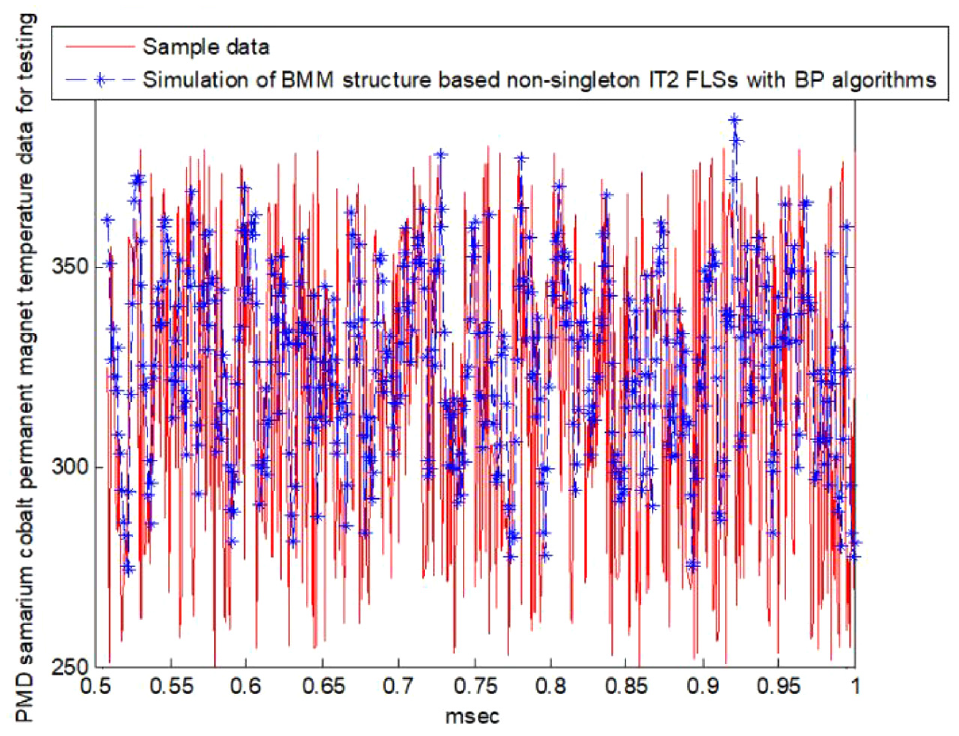
Simulation graph of Mamdani non-singleton T2 FLSs with BMM structure forecasting for samarium cobalt permanent magnet temperature data.
Next, let us consider the temperature data of alnico permanent magnet as the second case. As shown in Figure 8, the design and test of FLS forecasters are based on another 1000 noisy data points:
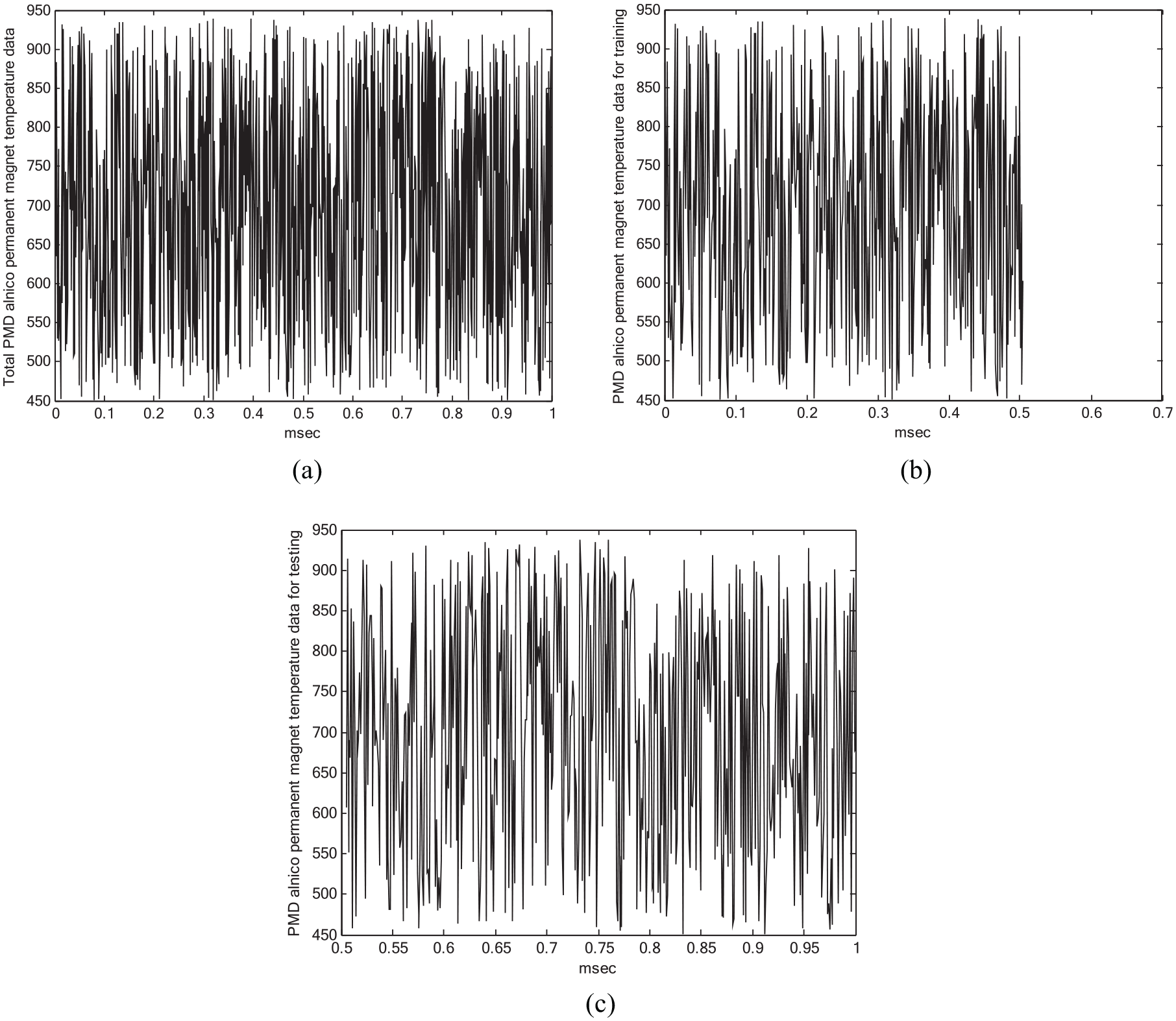
(a) The temperature data of alnico permanent magnet, (b) training is completed by 500 input–output data pairs generated from
After 1000 epochs of BP iterations (for each iteration, 20 times of Monte Carlo simulations are performed), the simulation graphs of forecasting results are given in Figures 9–11.
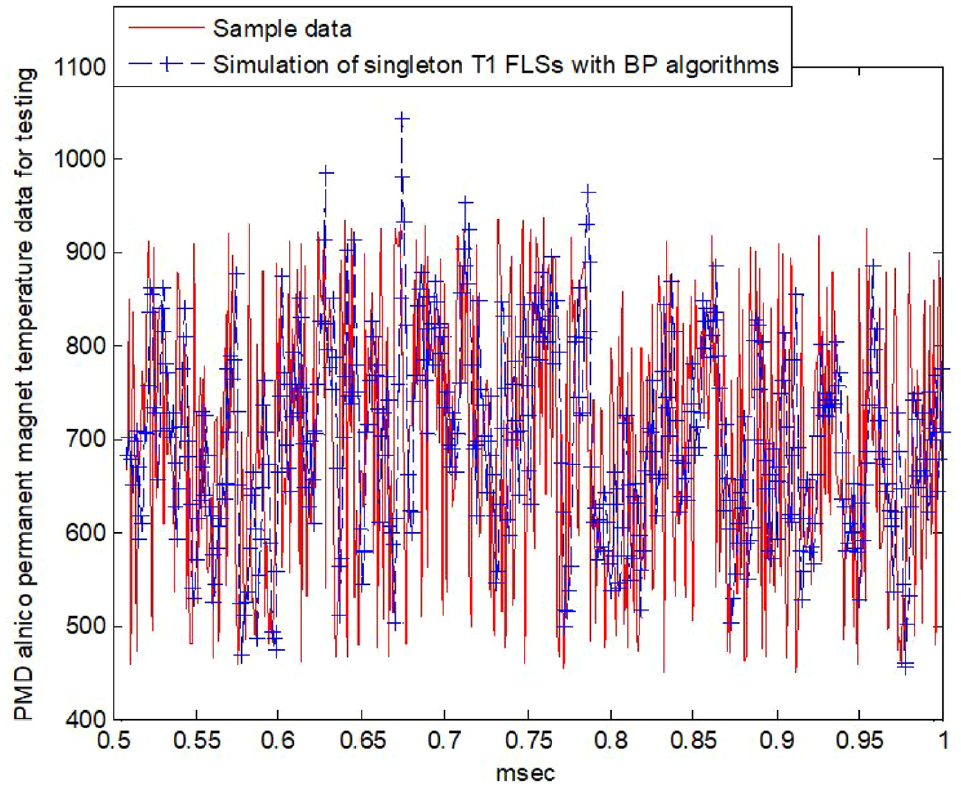
Simulation graph of Mamdani singleton T1 FLS forecasting for alnico permanent magnet temperature data.
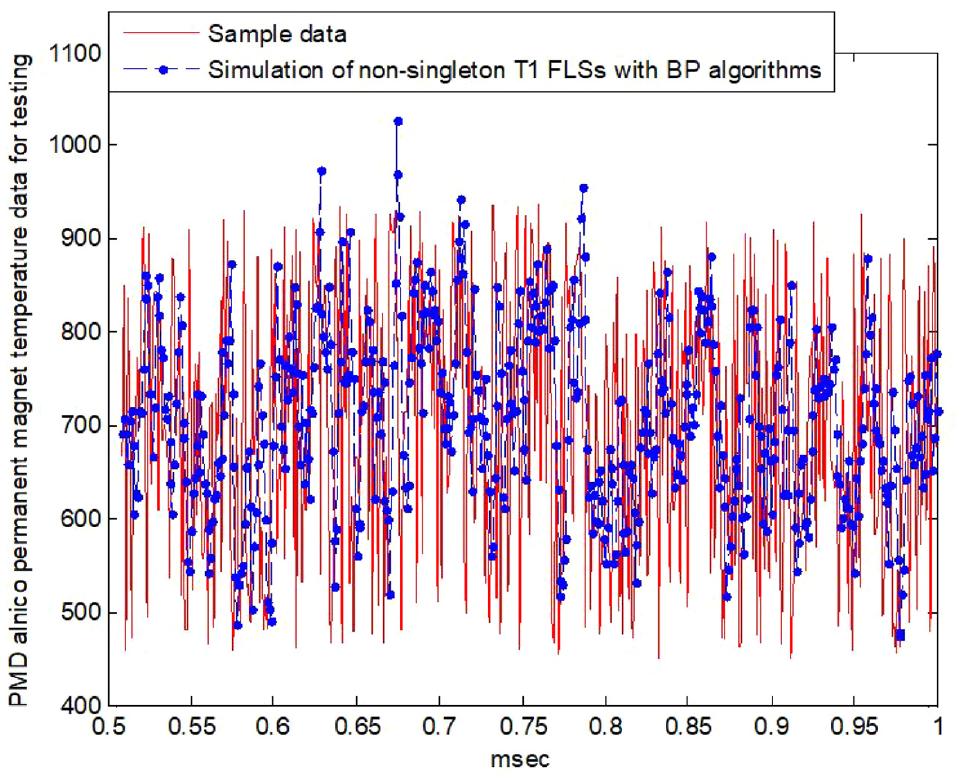
Simulation graph of Mamdani non-singleton T1 FLS forecasting for alnico permanent magnet temperature data.
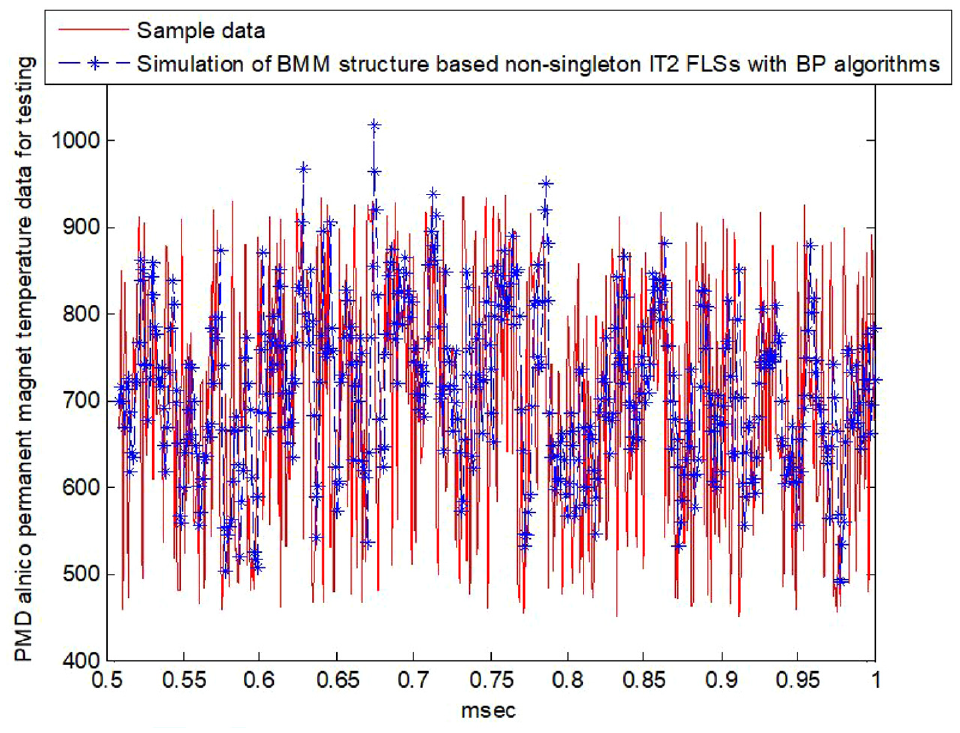
Simulation graph of Mamdani non-singleton T2 FLSs with BMM structure forecasting for alnico permanent magnet temperature data.
For these three types of FLS forecasters, all the parameters are tuned by the BP algorithms. Training and testing are performed simultaneously according to 1000 epochs. In order to measure the performances of three types of FLS forecasters comprehensively, we take the average of the values of these RMSEs and MAPEs in terms of 20 Monte Carlo simulations; then the mean of
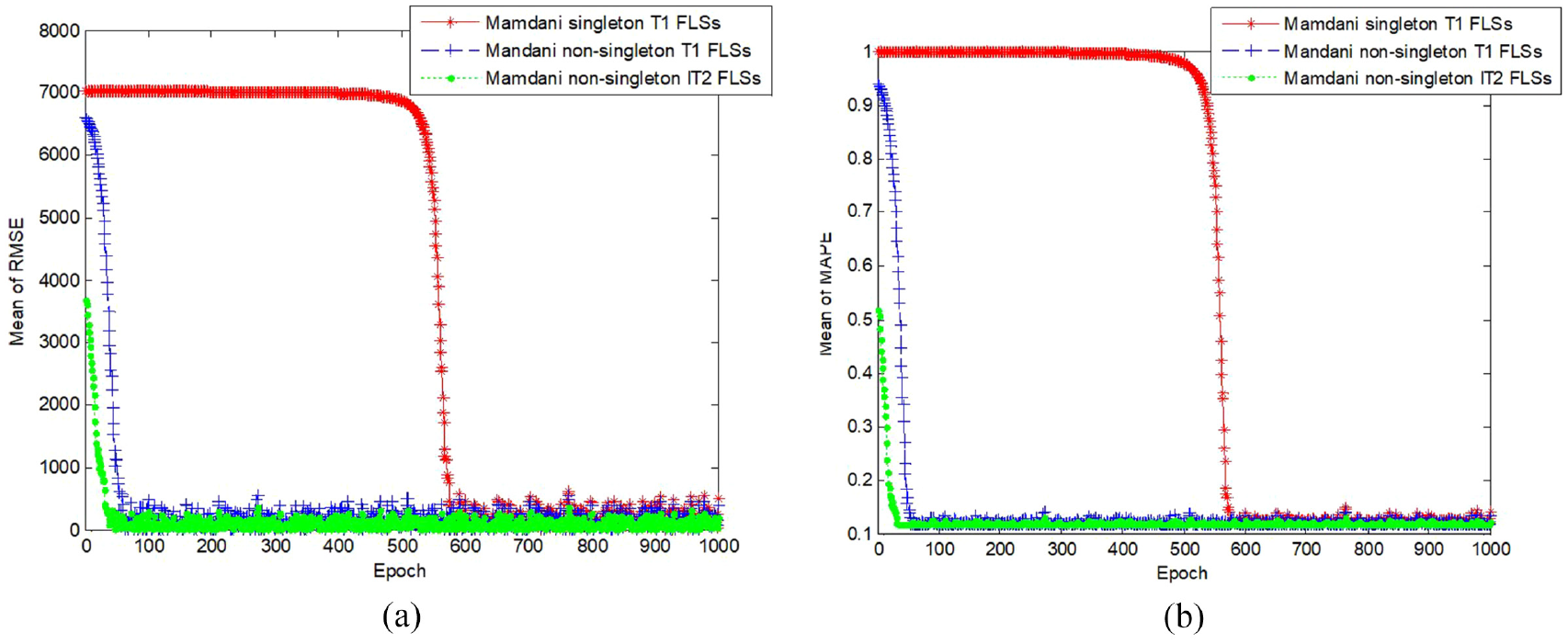
Mean of RMSE and MAPE for case 1: (a) RMSE and (b) MAPE.
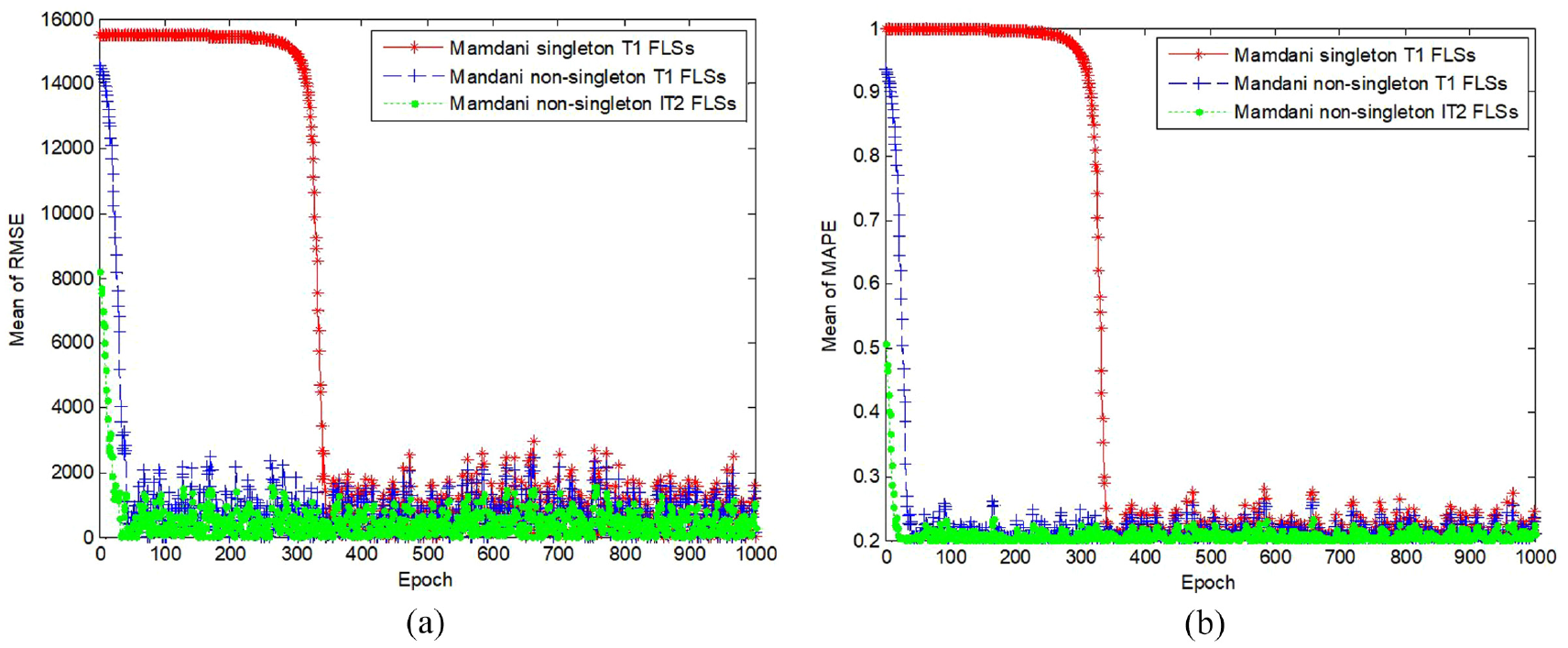
Mean of RMSE and MAPE for case 2: (a) RMSE and (b) MAPE.
Simulation result analysis
Observing from the case of samarium cobalt permanent magnet temperature data (see Figures 5–7 and 12), we can find the following:
As for the three types of Mamdani-type FLSs (singleton T1 FLSs, non-singleton T1 FLSs, and non-singleton IT2 FLSs with BMM structure), the graphs of average of RMSEs are all first monotone decreasing and then approach relatively convergence points (in the process of 1000 epochs of iteration, 20 times of Monte Carlo simulations).
The graphs of average of MAPEs are all first monotone decreasing and then approach relatively convergence points (in the process of 1000 epochs of iteration, 20 times of Monte Carlo simulations).
For the above-defined two error indices, the proposed non-singleton IT2 FLSs with BMM structure outperform singleton T1 FLSs and non-singleton T1 FLSs. Furthermore, the IT2 FLSs obtain the fastest convergence speed.
Observing from the case of alnico permanent magnet temperature data (see Figures 9–11 and 13), we can find the following:
As for the three types of Mamdani-type FLSs, the graphs of RMSE are all first monotone decreasing and then approach relatively convergence points (in the process of 1000 epochs of iteration, 20 times of Monte Carlo simulations).
The graphs of average of MAPEs are all first monotone decreasing and then approach relatively convergence points (in the process of 1000 epochs of iteration, 20 times of Monte Carlo simulations).
As there may exist more uncertainties for this case, the data fluctuation ranges are comparatively larger than the former case. For the above-defined two error indices, the proposed non-singleton IT2 FLSs with BMM structure outperform singleton T1 FLSs and non-singleton T1 FLSs. In addition, the IT2 FLSs obtain the fastest convergence speed.
Based on the above analysis, we can obtain strong evidences that the proposed BP optimized IT2 FLSs with BMM structure are better choice for forecasting than both singleton T1 FLSs and non-singleton T1 FLSs. Especially for forecasting problem with uncertainties, it is reasonable to conclude that Mamdani-type IT2 FLSs with BMM structure may have stronger flexibility and approximation ability than their T1 counterparts. However, it is much more difficult to design and apply IT2 FLSs as the number of degrees of freedom is greater than T1 FLSs. Forecasting studies by designing and applying IT2 FLSs is more applicable than T1 FLSs.
Conclusion
The paper designs a type of non-singleton IT2 FLSs according to the BP algorithms. We choose the antecedents, consequents, and input measurement primary MFs of fuzzy rules as Gaussian type with uncertain standard deviations. Simulation studies and convergence analysis based on the datasets of samarium cobalt and alnico permanent magnet temperature are used to show the reliability of the proposed BP optimized Mamdani-type IT2 FLSs with BMM structure. Compared with two types of Mamdani-type T1 FLSs, the forecasting performances of Mamdani-type IT2 FLSs are better. So it is reasonable to design and optimize high-level FLSs by evolutionary algorithms for real applications.
There are so many interesting works lie ahead, including studying the center-of-set TR (Khanesar et al., 2017) of T2 FLSs, initializing the search space partition for centroid TR algorithms (Chen, 2019a, 2019b; Chen et al., 2020; Chen and Wang, 2018; Greenfield and Chiclana, 2013; Li et al., 2018; Liu and Mendel, 2011; Mendel and Liu, 2013; Ontiveros-Robles et al., 2017; Wu, 2013), investigating global optimization algorithms such as simulated annealing and ant colony optimization for optimizing the parameters of T2 FLSs, and further developing and deploying T2 FLSs on forecasting, control, and fuzzy identification problems (Castillo et al., 2016, 2019; Cervantes and Castillo, 2015; Gaxiola et al., 2016; Hernandez et al., 2015; Ontiveros-Robles et al., 2018; Tong and Li, 2010, 2014) affected by uncertainties. Future studies will be primarily focused on T2 FLS design and applications.
Footnotes
Acknowledgements
The author is very grateful to Professor Jerry Mendel, who has provided the author some valuable suggestions.
Declaration of conflicting interests
The author(s) declared no potential conflicts of interest with respect to the research, authorship, and/or publication of this article.
Funding
The author(s) disclosed receipt of the following financial support for the research, authorship, and/or publication of this article: The paper is sponsored by the National Natural Science Foundation of China (No. 61973146, No. 61773188, No. 61903167, and No. 61803189), the Youth Fund of Education Department of Liaoning Province (LJKQZ2021143), the Doctoral Start-up Foundation of Liaoning Province (No. 2021-BS-258), and the Talent Fund Project of Liaoning University of Technology (No. xr2020002).
