






Abstract
In this paper, a model-free robust adaptive control scheme with finite-time convergence based on time-delay control is proposed for anti-sway and positioning control of two-dimensional underactuated overhead cranes. First, the whole overhead cranes system is simplified to an ultra-local model for time delay estimation (TDE). TDE brings a direct and effective model-free property but also an estimation error. Second, a sliding mode disturbance observer is designed to estimate and compensate for the TDE error. Third, sliding mode control (SMC) is used to enhance the robustness of the controller. An adaptive integral sliding surface is then designed to accelerate the sliding surface convergence rate and shorten the convergence time. To further optimize the selection of parameters, the parameter estimation is integrated to enhance the performance of model-free control. In the final analysis of the simulation, data yield that the introduction of parameter estimation increases the control performance by more than 20% on average, and the above facts verify the effectiveness of the scheme. Finally, the stability of the closed-loop control system is analyzed by using Lyapunov stability theory, and the effectiveness and robustness of the control scheme are verified through computer simulation results.
Keywords
Introduction
With the rapid development of logistics and transportation industry, overhead cranes have become the most widely used and numerous lifting machines due to their high load-carrying capacity, low energy consumption, and simple operation (Tho et al., 2021). The level of their operating capacity determines the transportation efficiency of a terminal. Overhead cranes are subject to many external disturbances causing unnecessary payload swing. In port terminals loading and unloading operation, overhead cranes are required to transport payloads quickly and to ensure that payload swing is eliminated immediately at the end of the transport process. The ability to accomplish the above control requirements is based on the basis of being able to build an accurate mathematical model (Gu and Xu, 2020). However, the mathematical model of the overhead cranes system is nonlinear, underactuated, and subject to unknown parameter variations and external disturbances. It is difficult to build an accurate mathematical model of the overhead cranes. Therefore, it is important to develop control schemes that do not depend on an accurate mathematical model of the overhead cranes control system (Sun et al., 2021).
For the controller design of overhead cranes, many scholars have conducted relevant research and achieved great results. The representative control methods mainly include input shaping control (Alghanim et al., 2019; Maghsoudi et al., 2019), command smoothing (Huang et al., 2015), energy optimal control (Sun et al., 2018), robust control (Golovin and Palis, 2019), adaptive control (Qian et al., 2019), SMC (Gu and Xu, 2020), and so on. The above control methods are highly dependent on known mathematical and nominal models of the system. However, the overhead cranes system is complex nonlinear, strongly coupled. The internal parameters of the overhead cranes may regenerate during operation. It is difficult to achieve high-accuracy modeling of the system. Therefore, model-based control methods have some limitations.
In order to reduce the dependence on the model, the model-free control (MFC) method was developed. The MFC method implies that the model information of the controlled object, including the structural and parametric information of the model, is not required in the controller design. Only the input and output information of the system is required in the controller design. Model-free adaptive control (MFAC) has formed a theoretical system with specific framework structure (Wang et al., 2016a, 2016b). Currently, the MFAC method is not easy for system state variables to converge asymptotically. Some scholars proposed intelligent proportional–integral–derivative (PID) algorithm. Intelligent PID algorithm provides new ideas for the study of control methods (Mustafa et al., 2019), but influence of external disturbances of the system is failed to consider. Approximation-based control method is often used to estimate unknown dynamic parameters (Aboserre et al., 2021; Chwa, 2017). The accuracy of the estimated parameters is somewhat influenced by the dimensionality of the controlled object and the complexity of external disturbances. Fuzzy logic and neural networks are also widely used for the approximation of unknown dynamic parameters (Wang et al., 2017). The weights are trained using approximation rules, and the convergence of the estimated weights to the actual states takes a long time (Kim et al., 2021). The limitation deteriorates the real-time performance of the control process. It is worth noting that, time delay estimation (TDE) method is simple, easy to implement, and capable of estimating nonlinear functions. TDE develops the most suitable and efficient estimation mechanism for unknown systems with nonlinearities, unknown uncertainties and external disturbances (Han et al., 2020a).
TDE can combine with robust control technology in the design of the controller (Ahmed et al., 2021). TDE output is then combined with fuzzy logic robust controller (Yu et al., 2022). This control method enables fast convergence of tracking errors and robustness to disturbances and parameter uncertainties. An augmented adaptive sliding mode controller based on TDE was proposed (Yadegari et al., 2022). An adaptive TDE was introduced to decrease the estimation errors and avoid serious chattering. Sliding mode control (SMC) is also used in MFC with its insensitivity to parameter changes and strong robustness to external disturbances. SMC method has some disadvantages, such as chattering phenomenon. The chattering phenomenon is usually suppressed by some reaching law design (Tong et al., 2020). Second-order SMC theory (Ding et al., 2021; Wang et al., 2017) is also used to solve chattering phenomenon. Sliding mode surface consists of an arrival phase and a sliding mode phase. After the state variables reach the sliding surface, the controller is robust to system parameter changes and external disturbances. SMC method is sensitive to noise and parameters uncertainty during the arrival phase. And when the parameters uncertainty and disturbances are getting large, the switching gains of SMC need to be large enough to achieve better robustness (Chwa, 2017), and excessive large switching gains may lead to greater chattering phenomenon. And insufficient switching gains may also affect the robust performance of the controller. Therefore, integral SMC (Utkin and Shi, 1996) has been proposed. Integral SMC eliminates the arrival phase so that the system variables trajectory always starts from the sliding surface.
In addition, the TDE accuracy directly affects the control effectiveness of the system. To address the problem of estimated accuracy, a model-free approach with algebraic estimation is introduced (Fliess and Join, 2013). The algebraic estimation approach achieves fast, non-asymptotic estimation of the state, but suffers from large control signal noise. An extended state observer (ESO; Han et al., 2020b) is used to expand the unknown part into the system state variables to improve the estimation accuracy. However, the ESO has many parameters and these parameters are difficult to rectify. Many study results have shown that disturbance estimation based on sliding mode disturbance observer (SMDO; Gu and Xu, 2020) is a practical and efficient observation method.
Most existing TDE schemes usually use constant gains (Wang et al., 2020a). But when time-varying dynamics occur during the operation of the controlled object, constant gains do not produce satisfactory performance. There are many scholars working on optimization algorithms to solve the tuning gains. An optimal design of a non-fragile PID controller is designed by applying a constrained genetic algorithm as a powerful optimization technique to determine the optimal gains of the PID controller (Elsisi, 2021). Online adaptive estimation rate of variables can be considered to improve control performance (Abbaker et al., 2020). An optimal predictive control algorithm based on a new improved intelligent technique is design for the nonlinear model to adapted to disturbances and internal parameter changes (Elsisi, 2020).
Motivated by the above work, a model-free robust control scheme with finite-time convergence based on TDE is proposed for overhead cranes. The main contributions of this work are summarized as follows: (a) a new MFC framework (TDE-SMDO-AISMC) is proposed for overhead cranes system. Compared with the model-based approach (Chwa, 2017), framework eliminates the mathematical modeling process. This controller framework is designed to achieve asymptotic convergence effectively. (b) A new adaptive integral sliding surface that combines the underactuated characteristics of the actual overhead cranes is designed. The designed adaptive integral sliding surface well eliminates the arrival phase, so that the system trajectory always starts from the sliding surface and effectively eliminates the chattering phenomenon to accelerate sliding rate and shorten convergence time. (c) A SMDO is designed. The observer estimates and compensates for the time delay error as an external disturbance. The compensation term takes the same form as the sliding mode switching term to provide a basis for achieving finite-time convergence. (d) The
The rest of the paper is organized as follows: The system model and problem formulation section develops a mathematical model of the overhead cranes and the control requirements to be achieved. In the main results section, the entire framework of the MFC scheme is constructed for the overhead cranes system and the stability analysis of the closed-loop system is established. The effectiveness of the proposed approach is demonstrated by the results of the simulation part. Finally, we conclude this work in the conclusion section.
System model and problem formulation
According to Lagrange–Euler’s law, the equations of the overhead cranes can be described as follows (Gu and Xu, 2020)
where
Due to the complex working environment of the actual overhead cranes system, system state
where
The control objective of this paper is to drive the trolley to the desired position while eliminating the swing angle of the payload in the presence of a series of internal parameter variations and uncertain disturbances. This control objective can be mathematically described as follows
where
Controller design
In this paper, M-TDE-SMDO-AISMC controller is constructed based on TDE control, adaptive integral sliding mode, SMDO, and the
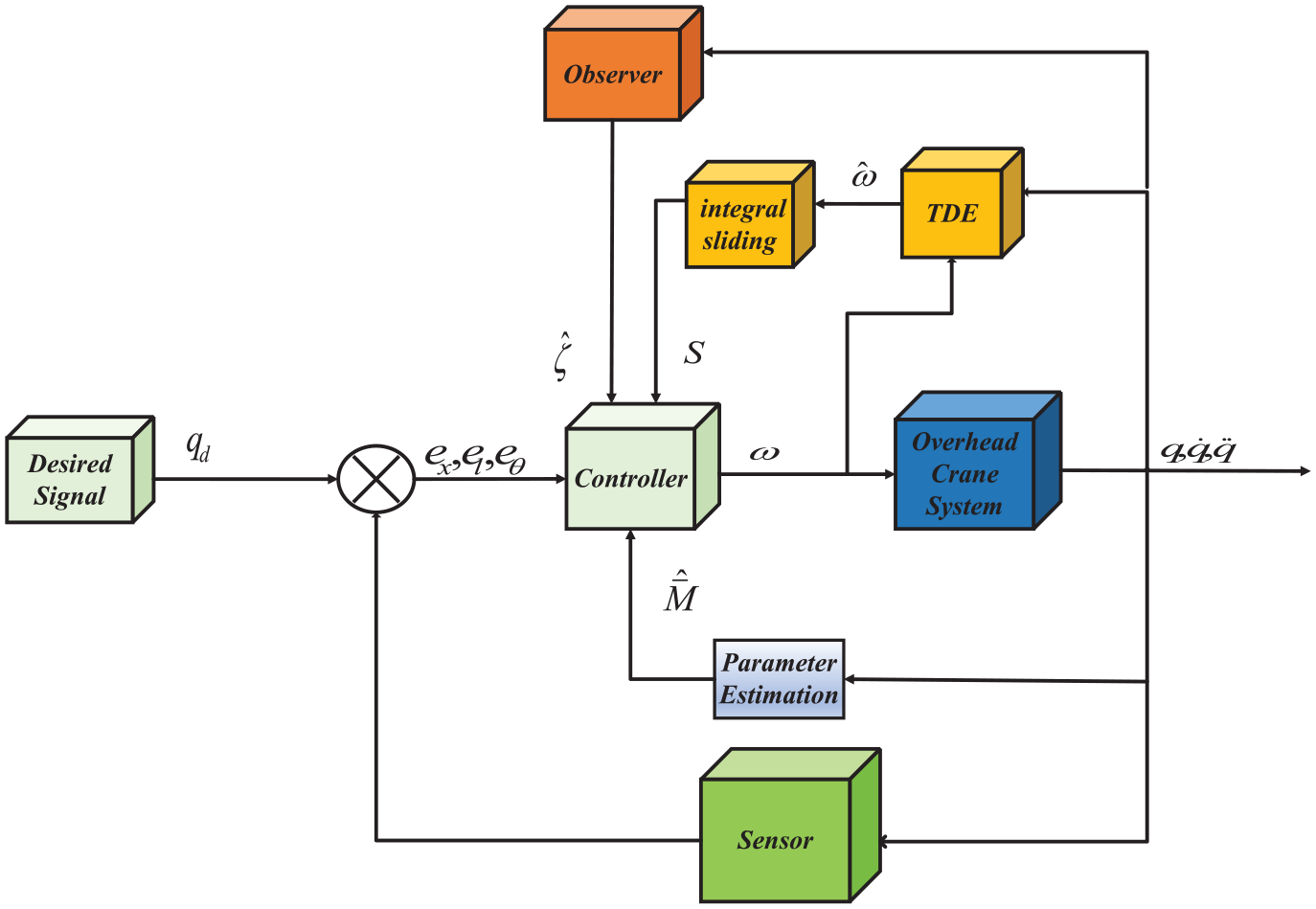
Control structure block diagram.
TDE-SMDO-AISMC controller design
Since
Integral sliding mode controller (ISMC)
where
The objective of this paper is to develop a control scheme based on integral SMC such that the state variable
Based on the above error definition, the integration sliding surface S can be chosen as
where
where
Taking the derivative of equation (9), we obtain
Combining the above and selecting the new reaching law as the switching control term, the final control rate is obtained as
where
where
SMDO
Considering the influence of parameter changes on the system, this paper combines the advantages of model-free sliding mode control to achieve high precision control of the overhead cranes system. The model-free sliding mode control does not depend on the accurate model of the system and has good robustness. And consider the advantages of the SMDO with small chattering and high observation accuracy. Motivated by the idea (Gu and Xu, 2020), an improved SMDO is proposed and used to design the M-TDE-SMDO-AISMC controller. To suppress the disturbances effectively, the disturbance compensation term for the time delay error is
where
where
The MFC scheme based on TDE suffers from TDE error. The existence of the time delay error will affect the control performance of the controller. In order to eliminate the effect of TDE error, the time delay error considered as an external disturbance and the corresponding SMDO is designed to compensate for it.
In summary, the controller designed in this paper is shown as follows
Stability analysis
where
It can be shown from Assumption 1 that the derivative of the time delay deviation can be written as
where
Define the vector
Deriving the above vector r
Writing this in the form of a matrix multiplication, we obtain
where
Considering the following Lyapunov function
where
Deriving equation (23)
where
From the fact that
According to Lemma 1, the observer error dynamics is stable in T for a finite time and the system can converge in a finite time. The expression of convergence time can be described as
From the finite-time convergence theorem of Lemma 2, it is known that
TDE-SMDO-AISMC controller
In order to speed up the response of the controller, the gain of the integration sliding surface is adaptively designed.
Adaptive Integral sliding mode controller (AISMC)
In order to improve the response speed of the controller, the adaptive design integral sliding mode surface is designed. The update law of adaptive gain can be chosen as the following equation
where
Large gains can suppress the unknown upper bound disturbance, but it can also aggravate the chattering phenomenon of the sliding mode controller. To solve the problems caused by the unknown external disturbance and chattering phenomenon, an adaptive switching gain is designed
An adaptive gain consisting of a sliding mode surface is designed to compensate for external disturbances. The rate of change of the gain is related to the different disturbances. When there are no disturbances, the gains change slowly. When disturbances are present, the gains change more rapidly. In this paper, the partial effects of sensor information processing time and information transmission time are considered as external disturbances from equation (1). Controllers optimized for various delay times were designed.
Stability analysis
where
Taking the time derivative of the above Lyapunov function, we obtain
Substituting the control forces into equations (41) and (42) and combining equation (36), if
Then, consider the Lyapunov function of whole system
Taking the time derivative of equation (45), from equations (43) and (43), we yield
By designing suitable initial values for the parameters and by using an adaptive integral sliding surface, the system variable may run from the sliding mode surface
To prove finite-time convergence, choose another Lyapunov function
Equation (26) and equation (27) show that the parameters related to the convergence time are not related to the adaptive coefficients. Therefore, the convergence time does not change. However, the transient performance can be improved due to the use of adaptive parameters
According to Lyapunov stability criteria, the sliding surface

Block diagram of TDE-SMDO-AISMC controller.
M-TDE-SMDO-AISMC controller design
parameter estimation based on recursive least squares algorithm
In this section, the recursive least squares derivation steps for the recursive forgetting factor of
Discretizing the above equation
Furthermore, rewrite it in the form of a vector as follows
Considering the following indexing functions
where
where
Differentiating the above equation, let the derivative be zero to find the optimal solution
With
Substituting
Let
Since
In summary, the following expressions can be obtained
Since
Separating out the variable
In this section, for the control channel gain in the extremely ultra-local model, the RLS algorithm is used to resolve the online estimation law. The online estimation expressions are defined in equation (62). According to the principle of RLS algorithm, the P1(k–1) cannot be zero to ensure that the RLS can effectively track the time varying parameters.
M-TDE-SMDO-AISMC controller design
In the previous section, an online estimation expression based on recursive forgetting factor recursive least squares algorithm is derived. Combining the AISMC design method proposed in the previous section and the discretization of the online estimation expression, the MFC method with
An MFC method is proposed by combining a discrete model-free controller, a discrete time delay estimator, and an
Due to the complex working environment, the operation of the overhead crane is affected by internal parameters and external disturbances. The designed controller has certain assumptions about the disturbances. However, the disturbances of the actual working environment are different from the assumptions. Based on this, the verification of the control performance of this controller is first simulated in the MATLAB/Simulink environment. Later, we will work on the relaxation of the disturbance conditions.
Simulation
In the MATLAB/Simulink environment, the effectiveness of the proposed control scheme was simulated for the relevant overhead cranes system to verify the effectiveness of the scheme. Case1: In order to verify the performance of the designed model-free controller, the controller proposed above is compared with classical PID control (Wang et al., 2020b) and TDE-IPID control (Wang et al., 2020a). In the simulation, the parameters of the overhead cranes are chosen as follows:
where

Simulation results of three controller in case 1: (a) trolley position, (b) rope length, (c) swing angle, and (d) control force.
Time to steady state for state quantities under three controllers.

The simulation results of the three controllers are shown in Figure 3. Trolley with the PID control scheme can be driven to the desired position in 7.5 s. The rope length can reach the desired length in 9.0 s. The swing angle of the payload gradually converges to 0 after 5.5 s. Meanwhile, it is found that the oscillation of the PID can be diminished by parameter adjustment in the simulation. However, the time for the trolley to reach the desired position increases greatly and the payload swing angle takes longer time to converge to 0. There is no oscillation phenomenon in TDE-IPID controller. However, the trolley is driven to the desired position in 7.0 s. The length of the rope can reach the desired length in 6.7 s. The payload swing angle converges to 0 after 7.5 s with some oscillations, and the maximum amplitude of the payload swing angle is given a large value. The controller proposed in this paper makes the trolley converge to the desired position in 4.0 s. The rope reaches the expected length in 3.6 s. The convergence of trolley position and rope length is fast and there is no overshoot. The swing angle of the payload can converge to 0 within 3.6 s. The MFC scheme proposed in this paper does not require system model information and has an observer to compensate the time delay error and a sliding mode scheme to improve the robustness. The above scheme ensures the effectiveness of this controller. The results show that the proposed controller has good control performance. Case 2: In order to verify the finiteness of the proposed controller, it is compared with other controllers to verify. The controller proposed above is compared with ESO control (Xu et al., 2021). The simulation results are shown in Figure 4. The time for the system state quantities to reach steady state is given in Table 2.
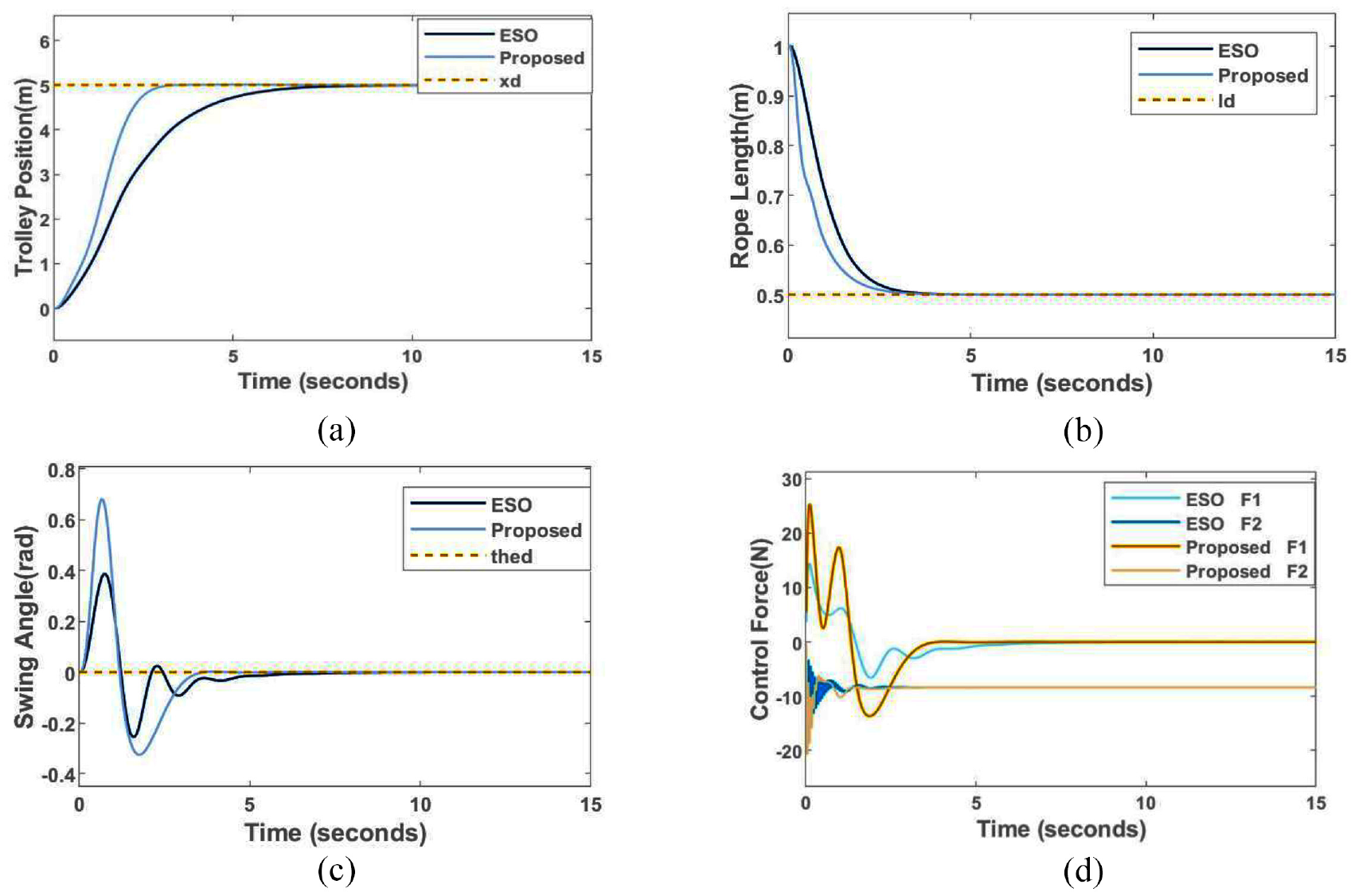
Simulation results of three controllers in case 2: (a) trolley position, (b) rope length, (c) swing angle, and (d) control force.
Time to steady state for state quantities under three controllers.

ESO: extended state observer.
The simulation results of the three controllers are shown in Figure 4. The trolley with ESO control scheme can be driven to the desired position within 8.6 s. The length of the rope can reach the desired length in 4.7 s. The payload swing angle converges to 0 after 7.9 s with some oscillations. TDE-SMDO-AISMC controller proposed in this paper makes the trolley converge to the desired position in 4.0 s. The rope reaches the expected length in 3.6 s. The swing angle of the payload converges to 0 in 3.6 s. The proposed controller is the best result among the three controllers. The results show that the proposed controller has good control performance. The traditional ESO method uses an observer to estimate the lumped disturbances. However, the state equation established by the ESO method does not have the same structure as the state equation of the original system. The difference in structure leads to the necessity to idealize the disturbances in estimating the lumped disturbances. In this paper, the proposed method uses TDE to estimate the lumped disturbances, and then uses the observer to compensate for the disturbance estimation error. The proposed method greatly reduces the difficulty of disturbance estimation and makes the control method proposed in this paper more effective. Case 3: To verify the observation performance of the SMDO and the ability of the controller to suppress disturbances. The following two groups of disturbances are selected for simulation verification. Data 1: Selection of different trolley masses
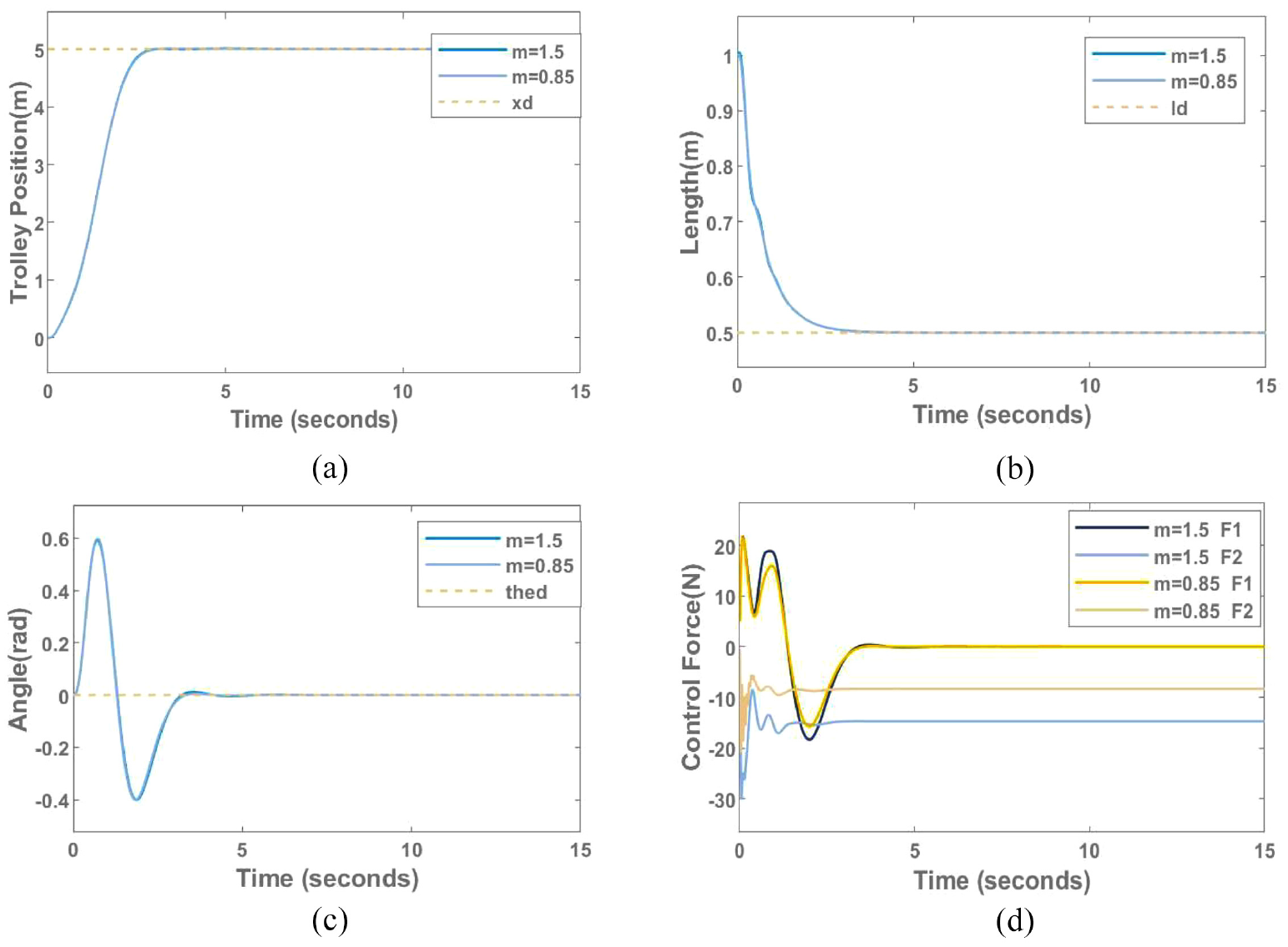
Simulation results under different m: (a) trolley position, (b) rope length, (c) swing angle, and (d) control force.
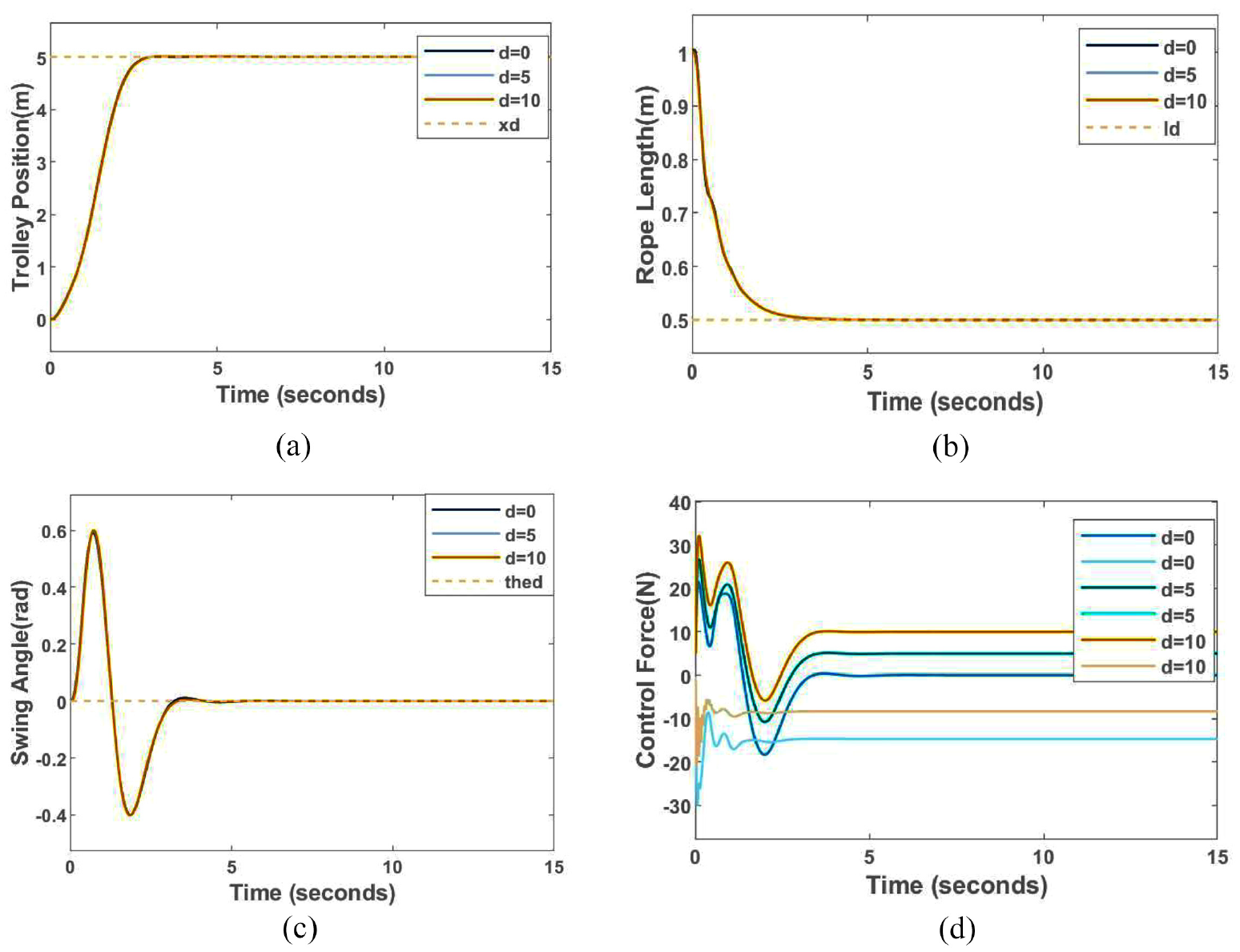
Simulation results under different d: (a) trolley position, (b) rope length, (c) swing angle, and (d) control force.
The controller proposed in this paper makes the trolley converge to the desired position in 4.0 s. The rope reaches the expected length in 3.6 s. The payload swing angle can converge to 0 at 3.6 s. The control simulation effect of the controller is shown in Figures 4 and 5. It can be clearly seen from the graphs that the control effect of the controller does not differ much under different disturbance conditions. Therefore, the designed SMDO and controller can effectively suppress the disturbance. Case4: To verify the performance of the proposed M-TDE-SMDO-AISMC, the proposed M-TDE-SMDO-AISMC is simulated with TDE-SMDO-AISMC under the mentioned disturbances. Other control parameters are consistent with case 1. The simulation results are shown in Figure 7. The time for the system state quantities to reach steady state is given in Table 3.
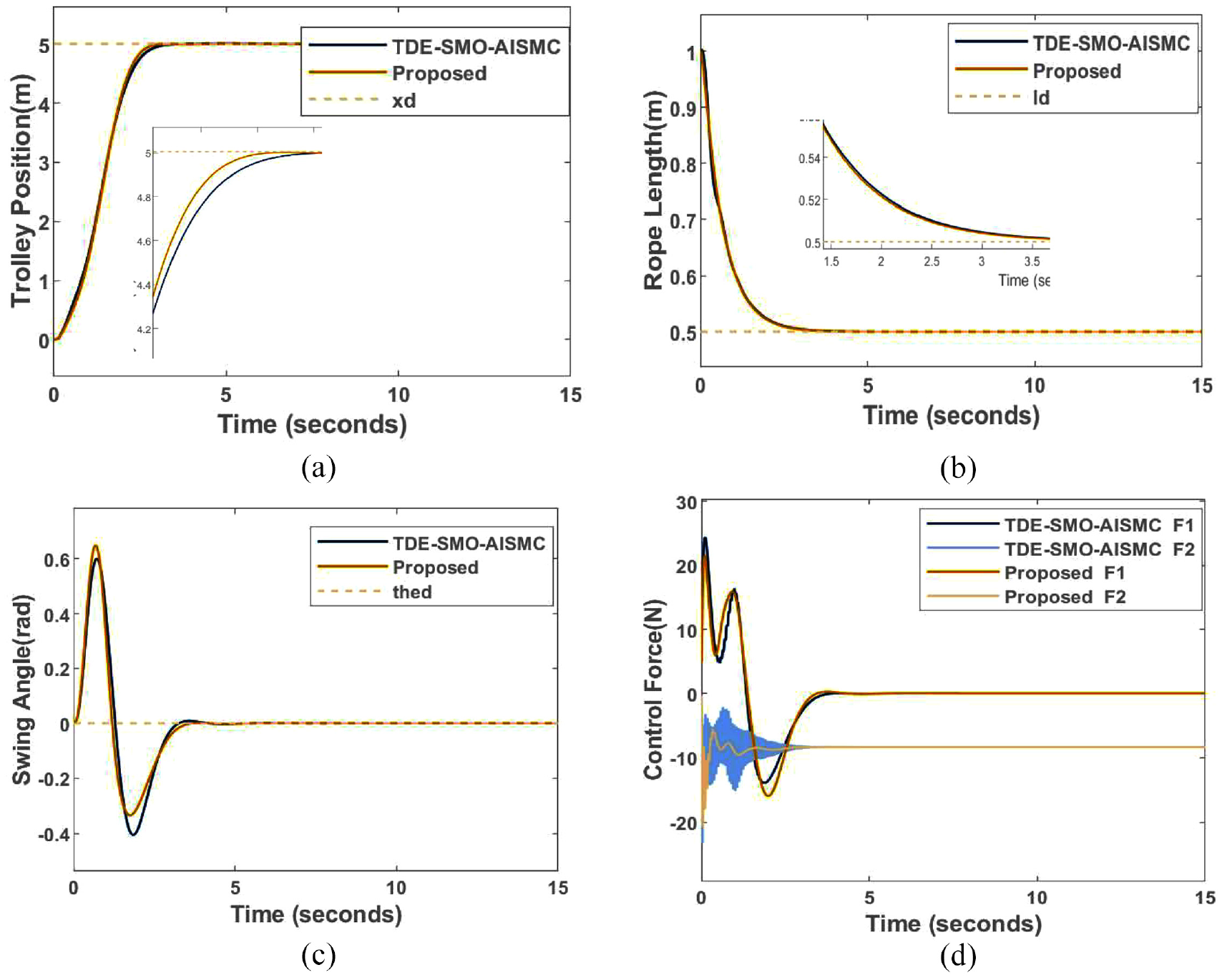
Simulation results under different controllers: (a) trolley position, (b) rope length, (c) swing angle, and (d) control force.
Time to steady state for state quantities under two controllers.

The simulation results for the two controllers are shown in Figure 6. Both the M-TDE-SMDO-AISMC and TDE-SMDO-AISMC controller trolleys can be driven to the desired position. From the analysis in Table 3, the time to reach steady state for the M-TDE-SMDO-AISMC controller is improved by 25% relative to the time to reach steady state for TDE-SMDO-AISMC controller. During the rope length control process, the steady-state time of the M-TDE-SMDO-AISMC controller is improved by 13.9% compared to the steady-state time of TDE-SMDO-AISMC controller. The payload swing angle converges to 0. The steady-state time of the M-TDE-SMDO-AISMC controller is slightly longer than that of TDE-SMDO-AISMC controller. However, the process of swing angle reduction is accelerated and the swing angle oscillation is smaller in the process of reaching the steady state.
Conclusion
This paper investigates the control problems of overhead cranes control systems for which accurate mathematical models cannot be obtained. A TDE method is used to transform the dynamics model of overhead cranes into an ultra-local model. TDE-SMDO-AISMC controller is proposed based on the idea of SMDO and adaptive integral sliding mode control. This achieves excellent model-free characteristics. Finally, it is demonstrated that the sliding mode variables and observer errors of the system can converge to 0 in finite time by constructing a quadratic Lyapunov function. The effectiveness of the scheme is demonstrated by simulation. The main body of the controller proposed in this paper is composed of TDE. However, considering that the overhead cranes system transfers information through the network in the control process, the information transfer process of networked control will have time delay and data packet loss. Whether TDE method will bring bad influence to the information transfer is well worth considering. With the rapid development of sensor technology, overhead cranes control process state information not only can be obtained using a single sensor but also can be considered in combination with information fusion technology to obtain a more accurate amount of state. The above ideas are also only considered in terms of obtaining more accurate state quantities; there are many feasible aspects to achieve better control effects. In our future work, our goal will be to work on the implementation of the above ideas and expand the application of this approach in controlling a range of nonlinear underactuated systems.
Footnotes
Declaration of conflicting interests
The author(s) declared no potential conflicts of interest with respect to the research, authorship, and/or publication of this article.
Funding
The author(s) received no financial support for the research, authorship, and/or publication of this article.
