This paper examines a finite-time command-filtered backstepping control proposed for a class of strict-feedback nonlinear systems with input delay and time-varying asymmetric full-state constraints. The existing control method either ignores the effect of input delay or converges asymptotically in infinite time. A command-filtered backstepping design is used to decrease computational burden. A first-order Levant differentiator is employed to replace the command filter for estimating the virtual control signals in finite time. The time-varying asymmetric barrier Lyapunov function (TVABLF) and command-filtered backstepping design are applied to alleviate the significant challenges caused by the backstepping approach and full-state constraints. A novel finite-time delay compensation mechanism is proposed to remove the impact of input delay. The closed-loop signals are proved to be practical bounded. Simulation results are provided to demonstrate the effectiveness of the proposed control scheme.
Backstepping control, which has been widely used in practical nonlinear dynamic processes, is an effective way to design a controller (Arefi et al., 2015; Li et al., 2017; Liu et al., 2017a; Yu et al., 2018b; Zhao et al., 2016). In classical backstepping, virtual control signals are repeated differentiations of the control law design, which leads to a heavy computational burden called “the explosion of complexity” (Liu et al., 2014). To deal with this challenge, dynamic surface control (DSC) is investigated by introducing first-order low-pass filters, which estimate the virtual control laws in the backstepping design (Li et al., 2010; Tong et al., 2011; Zhang and Ge, 2008). However, DSC does not consider any issues of error compensation caused by the filters (Yu et al., 2018a).
The command-filtered backstepping approach, which introduced command filters to approximate the derivative of the virtual control signals, was first proposed by Farrell et al. (2009). Dong et al. (2012) extended it to the adaptive case for strict-feedback systems. Unlike DSC, error compensation signals are used in command-filtered backstepping to reduce the error caused by the command filters (Yu et al., 2020). Based on this approach, Yu et al. (2015) considered adaptive fuzzy output feedback control with observers for uncertain nonlinear systems. In Wang et al. (2021a, 2021b), an adaptive neural network controller was developed using command-filtered backstepping for a class of nonlinear systems with input nonlinearities and asymmetric time-varying output constraints. It should be noted that the above approaches cannot handle the situation when state constraints are required.
Barrier Lyapunov function (BLF; Tee et al., 2009), extremum-seeking control (DeHaan and Guay, 2005), and model predictive control (Mayne et al., 2000) are the methods that deal with nonlinear systems with state constraints. Log-type BLF and log-type integral barrier Lyapunov function (IBLF) are combined with adaptive control to deal with state constraints (Cui et al., 2020; Liu et al., 2018, 2021b; Wang et al., 2021a). Li et al. (2019b) constructed a neural network–based controller for a class of strict-feedback nonlinear systems with state constraints and input delay. An observer-based adaptive controller was designed for a nontriangular nonlinear system with full-state constraints by Zhang et al. (2021). However, the methods mentioned above were proposed for nonlinear systems with constant constraints. Nonlinear systems with time-varying asymmetric state constraints are dealt with effectively by the time-varying asymmetric barrier Lyapunov function (TVABLF) (He et al., 2017; Liu et al., 2017b; Mishra et al., 2021; Yang et al., 2020). It is worth noting that the nonlinear mapping method (Guo and Wu, 2014; Yan et al., 2022; Zhang et al., 2017; Zhao et al., 2020), which transfers the original nonlinear system with constraints to an equivalent one without constraints, is also an efficient way to handle nonlinear systems with time-varying asymmetric state constraints. Li et al. (2019a) designed an adaptive neural controller for nonlinear systems with time-varying full-state constraints.
Time delay is a classic control problem that often exists in practical engineering (Kim et al., 2016; Li et al., 2021). It can lead to poor system performance and system instability. The control problem of time delay has attracted the attention of many researchers (Li et al., 2019b; Liu et al., 2014; Wang et al., 2015; Xia et al., 2019, 2020, 2021a; Zhao et al., 2016). Xia et al. (2021a, 2021b) designed an event-triggered filter for delayed discrete-time Markovian jump systems, which utilized the Lyapunov–Krasovskii function to eliminate the effect of time delay. The effect caused by input delay was transferred to an intermediate variable by employing the Pade approximation in Li et al. (2019b). Zhou et al. (2022) introduced a novel auxiliary system to remove the impact of input delay. As far as we know, the problem of the finite-time command-filtered backstepping tracking control of strict-feedback nonlinear systems with input delay and time-varying full-state constraints has not been addressed well.
Following the above observations, we aim to tackle the issue of finite-time command-filtered control for strict-feedback nonlinear systems with input delay and time-varying asymmetric full-state constraints. To the best of the authors’ knowledge, information about finite-time control for nonlinear systems with input delay is limited. This may be due to the inherent difficulties of designing a finite-time input delay compensated mechanism. In this paper, a finite-time input delay compensated mechanism is constructed and combined with the finite-time command-filtered backstepping technique, which ensures that the tracking error converges to a small neighborhood of the zero in finite time. The main contributions are summarized as follows:
A novel finite-time delay compensation mechanism is proposed to reduce the impact of input delay.
Wang et al. (2021a) and Cui et al. (2020) have previously only focused on constant symmetric state constraints, but this paper considers the influence of time-varying asymmetric state constraints in the design process.
By utilizing the finite-time command-filtered technique, the explosion of complexity problem is avoided, and the tracking error can converge to a small neighborhood of the zero in finite time.
This paper has been organized as follows. Section “System description and preliminaries” will address the formulation of the problem and preliminaries. In section “Controller design,” the design and analysis of control systems are presented. The simulation result is provided to demonstrate the approach in section “Simulation results,” while section “Conclusion” contains the conclusions.
System description and preliminaries
Consider the following class of nth nonlinear systems with input delay and saturation
where is the system states vector with . is the system output; ; and stand for the known bounded smooth functions; presents the input delay. The saturated input is defined as
Remark 2. Compared with previous works (Liu et al., 2021a, 2021b; Mishra et al., 2021; Zhao and Song, 2020), which considered time-varying state constrained systems, the effect of input delay is not taken into account. Therefore, the system studied is more general and relevant to the practical engineering context. The effect of input delay is transferred to an intermediate variable (Xing et al., 2021; Zhou et al., 2022) or estimated by an auxiliary system (Li et al., 2019b; You et al., 2019), but it cannot converge in finite time.
The saturation is nonlinear and unsmooth because of the sharp corner at . To solve this problem, smooth function is applied to approximate the nonlinear saturation function (Wen et al., 2011; Zhou et al., 2017)
The control objective of this paper is to design a finite-time controller for nonlinear systems equation (1), and the desired tracking signal is tracked pre-eminently by system output . Meanwhile, the time-varying asymmetric state constraints are not violated, that is, , where and are the time-varying functions.
The control objective can be implemented in the following assumptions and lemmas.
Assumption 1. (Yu et al., 2018a). The origin and initial condition are included in an open set . In system (1), , , , , , and are bounded in the closed set , where and , and with and are the known positive constants.
Assumption 2. (Liu et al., 2017b). Constants and satisfy and , and the time-varying functions and , and their first and second derivatives are bounded and smooth.
Assumption 3. The desired tracking signal and its first derivative are the bounded, smooth, and known functions, and two functions satisfy and , where is a positive constant.
Remark 3. Assumption 1 is a common assumption in a tracking control problem (Li et al., 2019b; Ren et al., 2010; Yu et al., 2018a). Assumptions 2 and 3 are sufficient conditions to prove the effectiveness of the control approach.
Remark 4. Classical backstepping requires the time derivative of the desired tracking signal in each step to compute the time derivative of the virtual control signal. It means the desired tracking signal and its nth derivative should be available and bounded. Here, the virtual control signals and their first derivative are estimated by the first-order Levant differentiator, which will be introduced later, and availability has been relaxed.
Lemma 3. (Yu et al., 2005). For any real numbers , , and , an extended Lyapunov condition of finite-time stability can be given as , and the settling time can be given as
Lemma 4. (Yu et al., 2018a). Consider the system . If a continuous function exists, which satisfies with {\epsilon_1} \gt 0, , , and , then the trajectory of the system is practical finite-time stable, and the residual set of the solution of system is given by
where . The convergence time is bounded as
The first-order Levant differentiator (Levant, 1998, 2003) is introduced as follows
where is the input signal, and and are the design parameters. The following lemma satisfies if and are chosen properly.
Lemma 5. (Levant, 1998, 2003). If and are chosen properly and the input of differentiator (10) does not have input noise, the following equalities hold
and the solutions of the differentiator have finite-time convergence.
Lemma 6. (Levant, 1998, 2003). If the input noise satisfies , the following equalities satisfy in finite time if and are chosen properly
where , , and are the positive constants dependent on and in differentiator (10).
Remark 5. According to Assumption 1, functions and on are Lipschitz. Lemmas 5 and 6 describe the different conditions when the differentiator has input noise or not, respectively. It should be noted that the scheme for choosing parameters and was given in Levant (2003).
A novel finite-time input delay compensation mechanism is proposed to remove the impact of the input delay, which is defined as follows
where and . and are the positive designed parameters that will be described later.
Lemma 7. The input delay compensation mechanism in equation (13) can guarantee that all states are practical finite-time stable. The settle time is bounded as
where and .
Proof. Choose the Lyapunov function as
The derivative of is
According to Assumption 1, Lemma 2, and Young’s inequality, equation (16) can be obtained
Then, if we choose suitable parameters such that and , states will achieve practical finite-time stability from Lemma 4. will converge to the region in finite time , .
Remark 6. Consider system (1) and input delay compensation mechanism (13) and the term , the actual control signal will be employed to eliminate the impacts of the input delay . It should be emphasized that the auxiliary system for input delay given in Zhou et al. (2022) can only guarantee that the system is bounded. The input delay compensation mechanism in equation (13) can guarantee that the signals in the system are finite-time stable.
Controller design
In this section, the finite-time command-filtered backstepping control method will be proposed for system equation (1) with time-varying asymmetric full-state constraints.
Define the tracking error as
where is the output of the first-order Levant differentiator, with the virtual controller as input. The formulation of the first-order Levant differentiator has been introduced as follows
Furthermore, the compensated tracking error signals are constructed as
where and is the error compensation signal with .
Consider the TVABLF
where is a positive constant to ensure that the virtual control signals and their nth derivative is available. and will be described later along with . The is defined as
Remark 7. In classical TVABLF, is required to ensure the virtual control signals and their nth derivative are available. In this paper, availability has been relaxed using the first-order command filter to estimate the virtual control signals. It also reduces the computational burden.
Step 1. Based on in equation (20), the derivative of is
Construct the TVABLF as
Then, the derivative of is
where .
Construct a virtual control signal and a compensating signal as
where is a time-varying gain. , , , and are the positive design parameters to be constructed. , where and are the positive odd integers. By submitting equations (27) and (28) into equation (26), we can obtain
Using Young’s inequality, the following inequalities hold
Theorem 1. Consider the closed-loop nonlinear system equation (1) under Assumptions 1–3. The controller (equation (44)), the virtual controllers (equations (27) and (35)), error compensation signals (equations (28), (36), and (45)), and input delay compensation mechanism (equation (13)) have the following results:
1. All internal signals in the closed-loop system are semi-globally uniformly ultimately bounded and converge to a small neighborhood of the zero in finite time.
2. The asymmetric time-varying states constraints are never violated.
Since , it can be proved that is bounded in finite time.
Choose the Lyapunov function of the error compensation signal as follows
The derivative of is
From Lemmas 5 and 6, can be achieved in finite-time . According to , for , we have
where , , , and . Choosing suitable and to make and , will achieve finite-time stability based on Lemma 3. Then, we obtain when . From equations (20) and (50), we have . For , the tracking error will satisfy
From equations (18), (20), and (52), and are bounded and . Once and , we can obtain . Since is a function of , , , , , , , and , it can be concluded that is bounded, so a constant satisfies . From , we can infer that with and . By mathematical induction, the boundedness of and can be obtained, and the boundedness of state can be proved that with and , where . Thus, all signals in the closed-loop system are bounded, the system output tracks the desired tracking signal pre-eminently, and the asymmetric time-varying system states constraints are not violated.
Construct the Lyapunov function candidate
Taking the derivative of yields
Let , , , and , then equation (58) can be rewritten as
Thus, all internal signals in the closed-loop system are semi-globally uniformly ultimately bounded and converge to a small neighborhood of the zero in finite time.
Remark 8. From equation (50), we can obtain some direction on how to pick the control parameters. We need to decrease and to reduce the radiuses of the region of tracking errors. Thus, the tracking errors can be made arbitrarily small. Moreover, from equation (55) and Lemma 7, it can be seen that the convergence rate of the error compensating system and the input delay compensating system can be guaranteed by larger and , respectively. However, large and will result in a larger . Therefore, more simulations are required for choosing the control parameters and balancing the control performance.
Remark 9. To the best of the authors’ knowledge, there is a drawback and a limitation of the proposed method in the paper. Higher system order requires more control parameters to be adjusted. Moreover, the proposed method requires that all system states should be measurable, which will be further improved in future work.
Simulation results
In this section, two simulation results are provided to show the effectiveness of the proposed approach. The proposed method in this paper will be compared with the method in Zhou et al. (2022). It should be noted that the method in Zhou et al. (2022) cannot handle the system with time-varying asymmetric state constraints.
Example 1. Denote and are the yaw angle and yaw angular rate of the airship, respectively. The simplified model of the stratospheric airship with input delay is given as follows (Miao et al., 2016)
where denotes the airship inertia of z-axis moment, is the damping associated with the yaw rate, and represents the yaw moment control. The parameters’ values refer to Wang et al. (2010, 2018).
Denote , , and , then equation (60) can be rewritten as
where and . The desired tracking signal is given as . The system state variables are and limited in and , where , , and . The input delay is chosen as . The bound of the input saturation is set as .
For simulation, all design parameters are taken to be , , , , , , , and . are chosen as the initial values of system states.
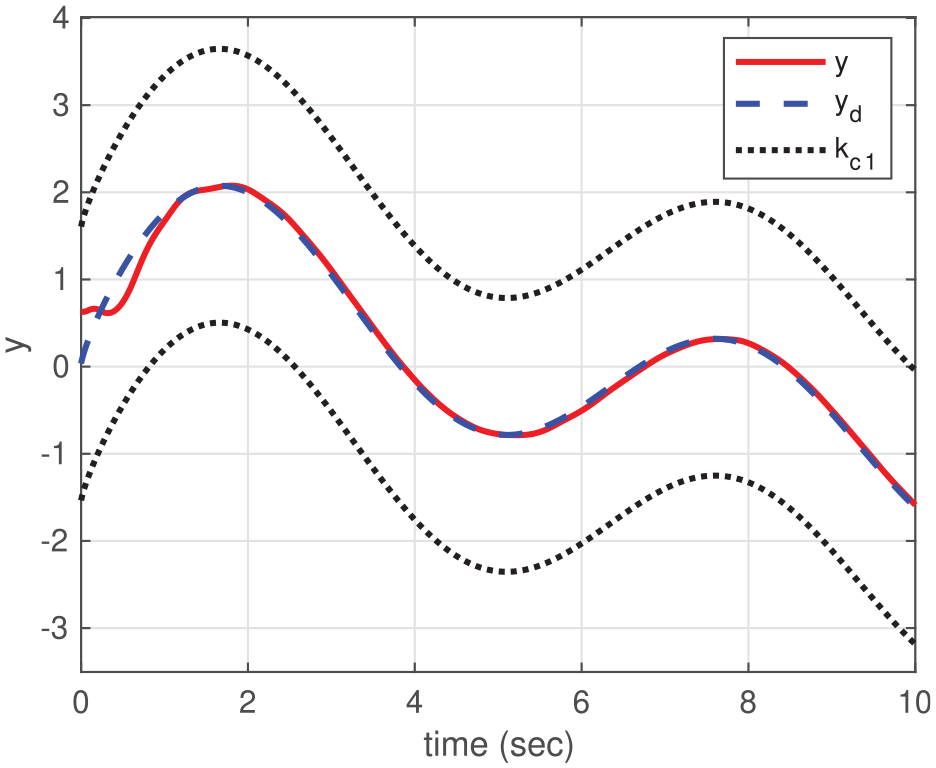
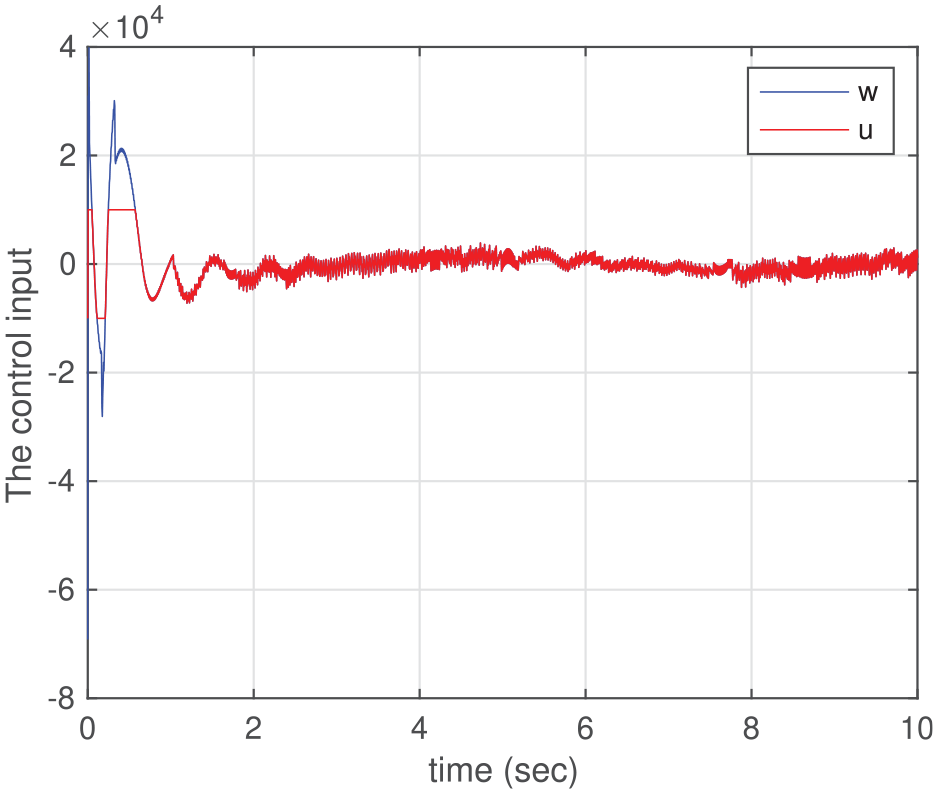
Note that Figure 1 shows the tracking trajectories under this method. It can be clearly seen that the method given in this paper can make the system output follow the desired tracking signal in finite time and satisfy the constraint. Figure 2 shows the tracking trajectories with the same parameters under the method given in Zhou et al. (2022). The tracking errors based on the two different methods are given in Figure 3. Compared with two methods, it can be seen that the method in this paper has faster convergence rate. Figure 4 shows the trajectories of the state and its constraint interval. The trajectories of the system input and controller signal are shown in Figure 5.
Example 2. Consider the following fourth-order nonlinear systems with input delay
with constraints interval under the method given in this paper.
System input and controller signal.
The initial conditions are chosen as . The desired tracking signal is given as . The system states are constrained as with , , , , , and . The input delay is chosen as . The bound of the input saturation is .
For simulation, the control parameters are taken to be , , , , , , , , , , , , and for finite-time command-filtered controller. The other parameters are designed as , , and .
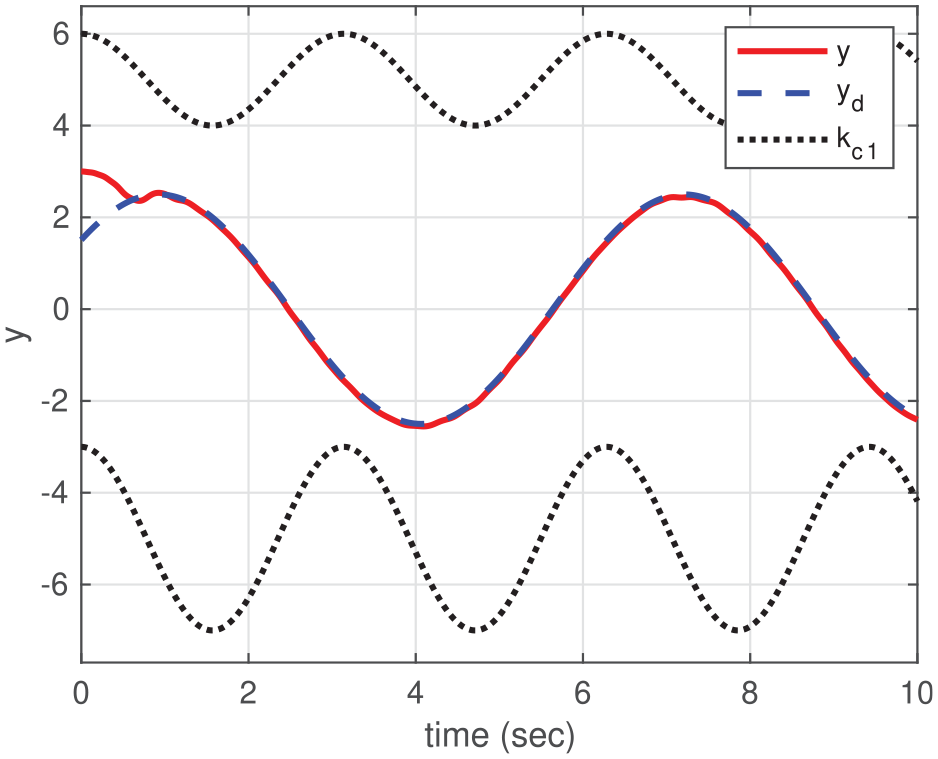
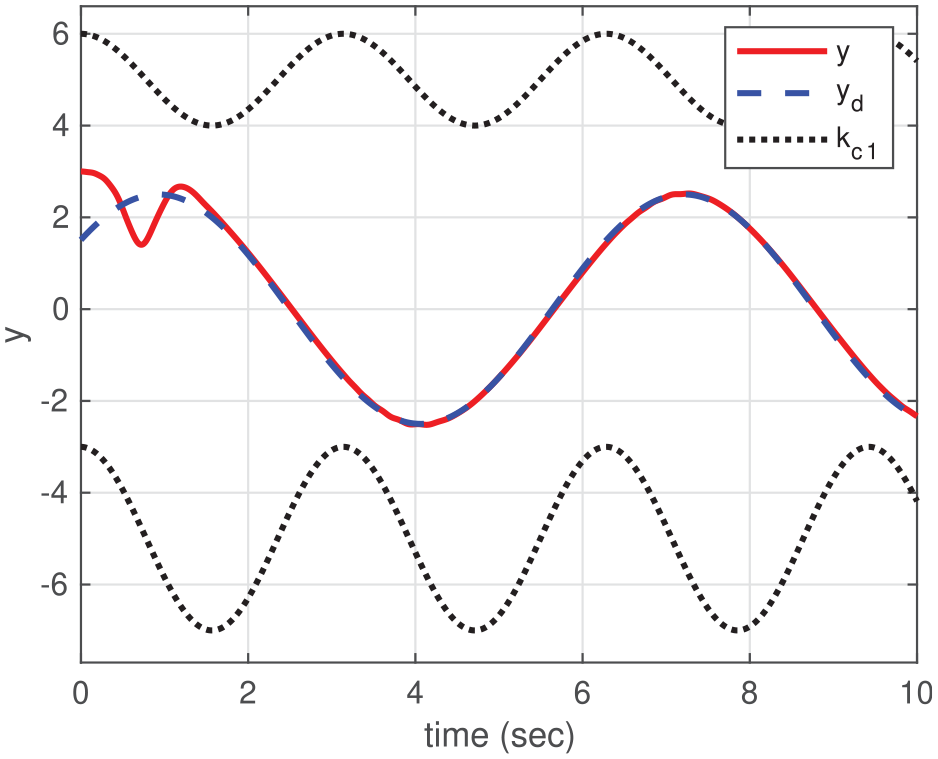
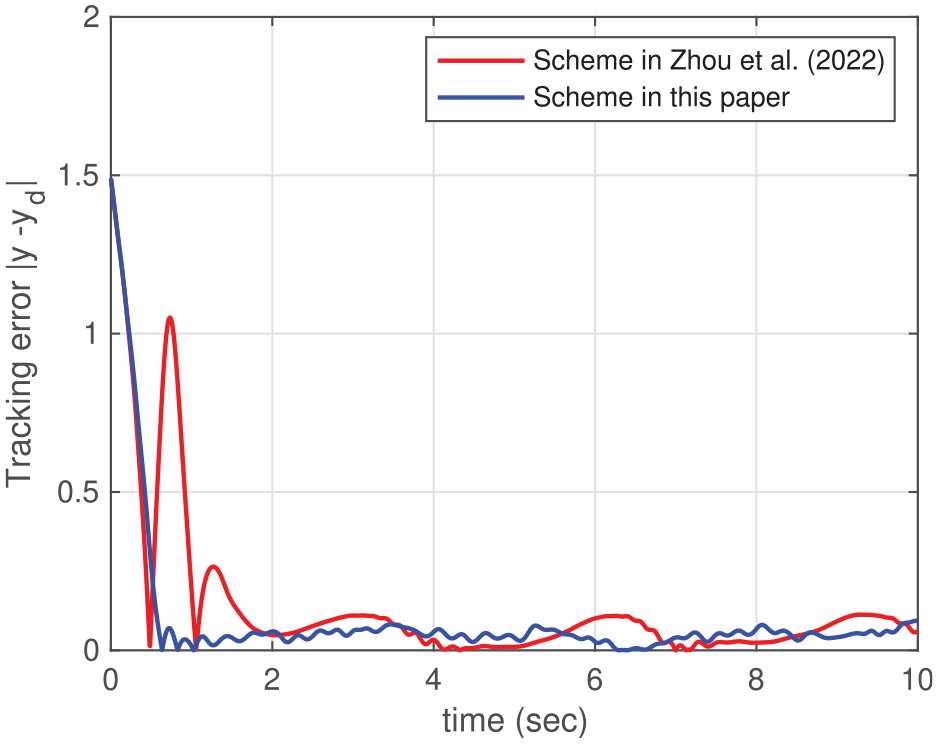
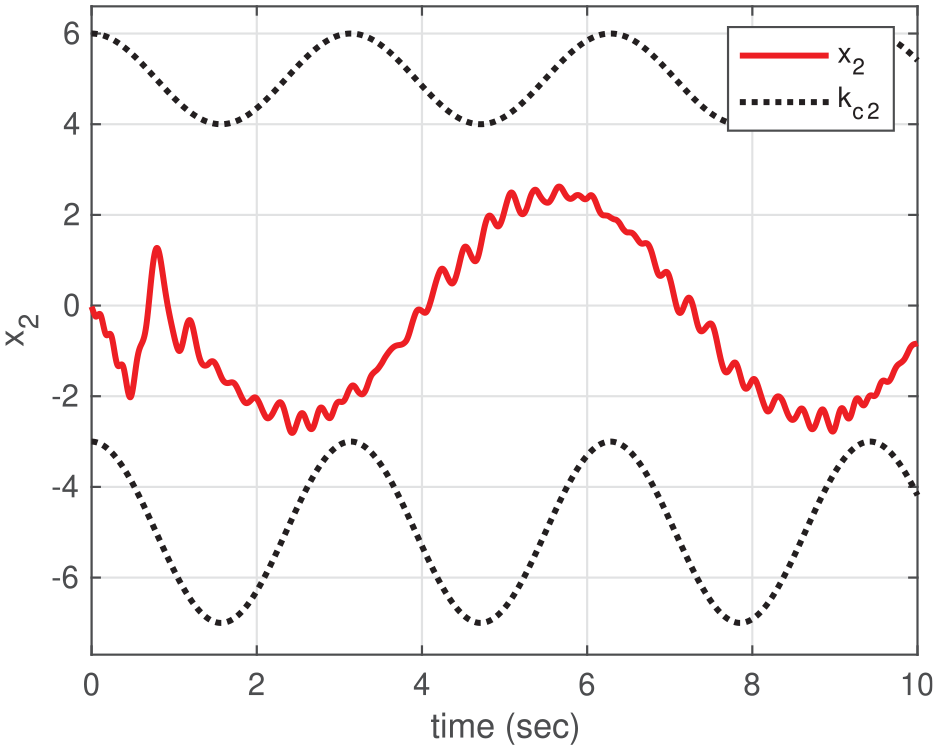
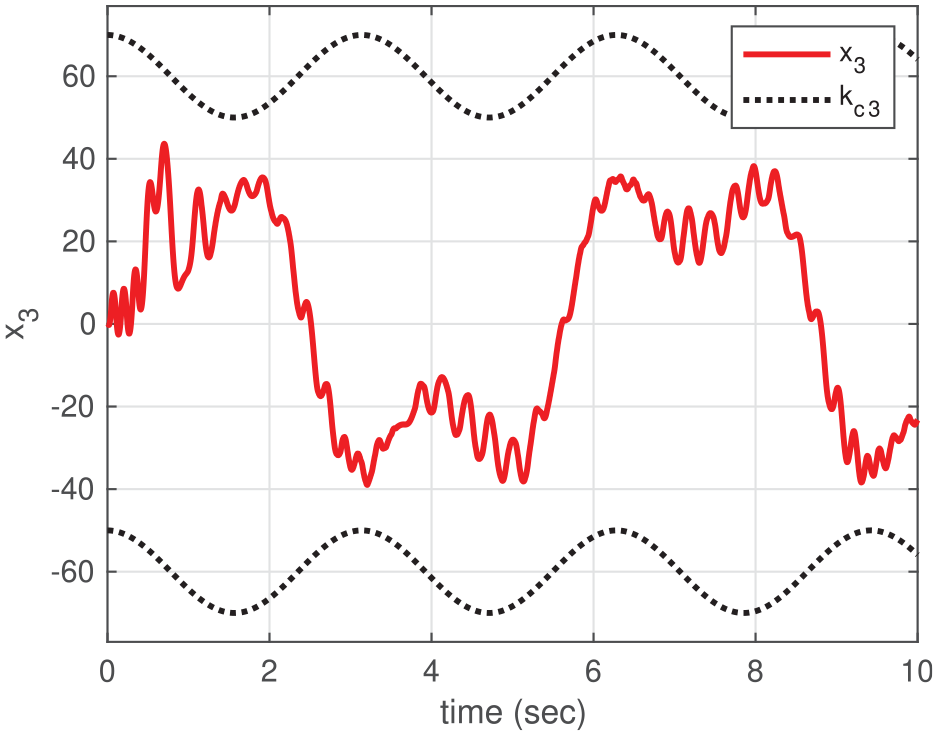
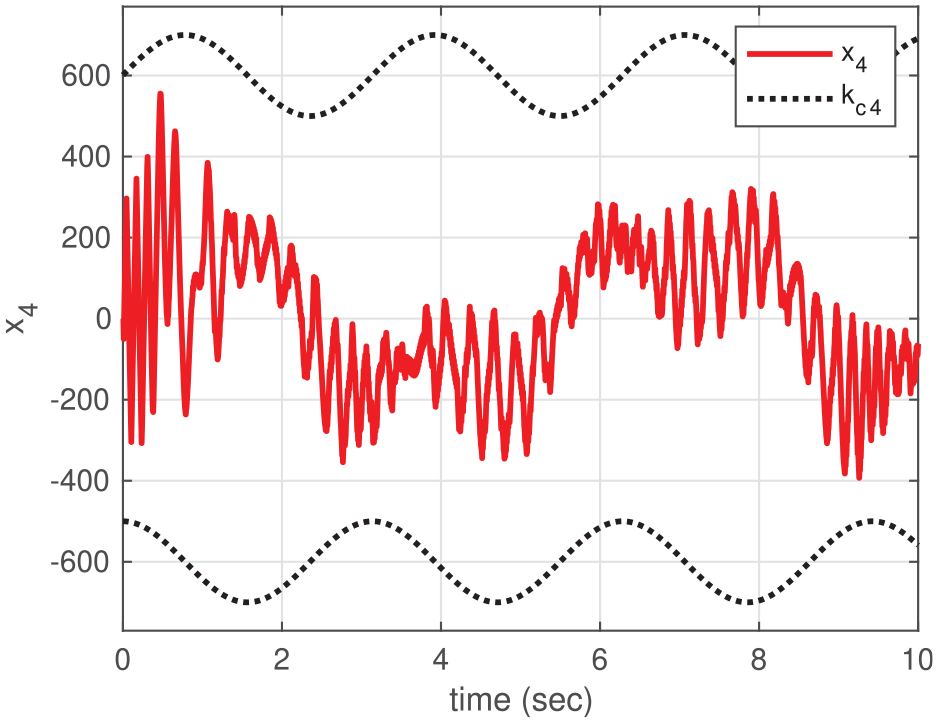
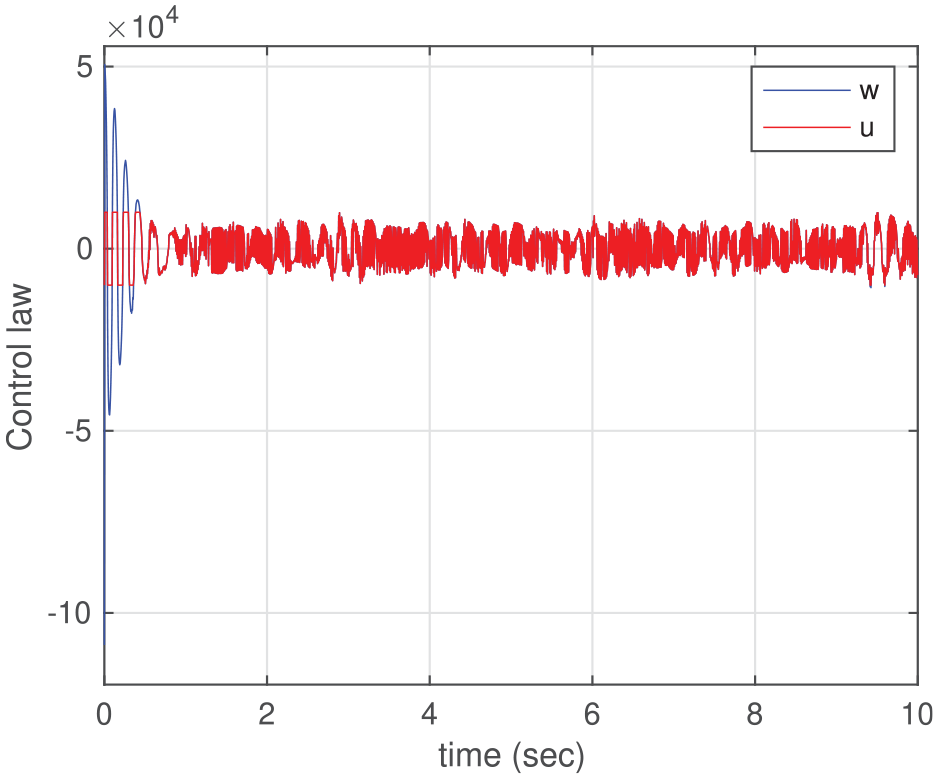
The simulation results of this example are given in Figures 6–12. The tracking trajectories under the method given in this paper are shown in Figure 6. It can be seen that the proposed method can make the system output follow the desired tracking signal in finite time, and the constraint is not violated. The tracking trajectories with the same parameters under the method given in Zhou et al. (2022) are shown in Figure 7, and the tracking errors based on the two different methods are given in Figure 8. It could be observed that the proposed method has a faster convergence time than the method in Zhou et al. (2022). Figures 9–11 show the curves of the constrained system states , , and , respectively. It is obvious that the state constraints are not violated. The trajectories of the system input and controller signal are shown in Figure 12.
Remark 10. From Figures 3 and 8, we can conclude that the proposed method has a faster convergence rate. However, from Figures 5 and 12, the control signals are noisier, which can degrade tracking performances when the system has smaller input saturation.
with constraints interval under the method given in this paper.
with constraints interval under the method given in this paper.
with constraints interval under the method given in this paper.
System input and controller signal.
Conclusion
This study has developed a finite-time command-filtered backstepping control for a class of strict-feedback nonlinear systems with input delay and time-varying asymmetric full-state constraints. The TVABLF has been introduced to handle the issue of time-varying asymmetric full-state constraint. The command-filtered backstepping method is utilized to avoid “the explosion of complexity.” A new finite-time delay compensation mechanism is introduced to remove the impact of input delay. The proposed control method will be extended to nonlinear mapping and multi-input-multi-output nonlinear systems in the future.
Footnotes
Declaration of conflicting interests
The author(s) declared no potential conflicts of interest with respect to the research, authorship, and/or publication of this article.
Funding
The author(s) disclosed receipt of the following financial support for the research, authorship, and/or publication of this article: This work was supported, in part, by the National Natural Science Foundation of China (nos 51906141 and 62073216).
ORCID iD
Qiming Lin
References
1.
ArefiMMJahed-MotlaghMRKarimiHR (2015) Adaptive neural stabilizing controller for a class of mismatched uncertain nonlinear systems by state and output feedback. IEEE Transactions on Cybernetics45(8): 1587–1596.
2.
CuiBXiaYLiuK, et al. (2020) Finite-time tracking control for a class of uncertain strict-feedback nonlinear systems with state constraints: A smooth control approach. IEEE Transactions on Neural Networks and Learning Systems31(11): 4920–4932.
3.
DeHaanDGuayM (2005) Extremum-seeking control of state-constrained nonlinear systems. Automatica41(9): 1567–1574.
4.
DongWFarrellJAPolycarpouMM, et al. (2012) Command filtered adaptive backstepping. IEEE Transactions on Control Systems Technology20(3): 566–580.
5.
FarrellJAPolycarpouMSharmaM, et al. (2009) Command filtered backstepping. IEEE Transactions on Automatic Control54(6): 1391–1395.
6.
GuoTWuX (2014) Backstepping control for output-constrained nonlinear systems based on nonlinear mapping. Neural Computing and Applications25(7): 1665–1674.
7.
HeWHuangHGeSS (2017) Adaptive neural network control of a robotic manipulator with time-varying output constraints. IEEE Transactions on Cybernetics47(10): 3136–3147.
8.
HuangXLinWYangB (2005) Global finite-time stabilization of a class of uncertain nonlinear systems. Automatica41(5): 881–888.
9.
KimJJoeHYuSC, et al. (2016) Time-delay controller design for position control of autonomous underwater vehicle under disturbances. IEEE Transactions on Industrial Electronics63(2): 1052–1061.
LevantA (2003) Higher-order sliding modes, differentiation and output-feedback control. International Journal of Control76(9–10): 924–941.
12.
LiDChenCLPLiuYJ, et al. (2019a) Neural network controller design for a class of nonlinear delayed systems with time-varying full-state constraints. IEEE Transactions on Neural Networks and Learning Systems30(9): 2625–2636.
13.
LiDPLiuYJTongS, et al. (2019b) Neural networks-based adaptive control for nonlinear state constrained systems with input delay. IEEE Transactions on Cybernetics49(4): 1249–1258.
14.
LiHWangLDuH, et al. (2017) Adaptive fuzzy backstepping tracking control for strict-feedback systems with input delay. IEEE Transactions on Fuzzy Systems25(3): 642–652.
15.
LiTSWangDFengG, et al. (2010) A DSC approach to robust adaptive NN tracking control for strict-feedback nonlinear systems. IEEE Transactions on Systems, Man, and Cybernetics, Part B: Cybernetics40(3): 915–927.
16.
LiYQuFTongS (2021) Observer-based fuzzy adaptive finite-time containment control of nonlinear multiagent systems with input delay. IEEE Transactions on Cybernetics51(1): 126–137.
17.
LiuLGaoTLiuYJ, et al. (2021a) Time-varying IBLFs-based adaptive control of uncertain nonlinear systems with full state constraints. Automatica129: 109595.
18.
LiuYJGongMLiuL, et al. (2021b) Fuzzy observer constraint based on adaptive control for uncertain nonlinear MIMO systems with time-varying state constraints. IEEE Transactions on Cybernetics51(3): 1380–1389.
19.
LiuYJLuSTongS (2017a) Neural network controller design for an uncertain robot with time-varying output constraint. IEEE Transactions on Systems, Man, and Cybernetics: Systems47(8): 2060–2068.
20.
LiuYJLuSLiD, et al. (2017b) Adaptive controller design-based ABLF for a class of nonlinear time-varying state constraint systems. IEEE Transactions on Systems, Man, and Cybernetics: Systems47(7): 1546–1553.
21.
LiuYJLuSTongS, et al. (2018) Adaptive control-based barrier Lyapunov functions for a class of stochastic nonlinear systems with full state constraints. Automatica87: 83–93.
22.
LiuYJZhangYQLiuL, et al. (2021c) Adaptive finite-time control for half-vehicle active suspension systems with uncertain dynamics. IEEE/ASME Transactions on Mechatronics26(1): 168–178.
23.
LiuZLaiGZhangY, et al. (2014) Adaptive neural control for a class of nonlinear time-varying delay systems with unknown hysteresis. IEEE Transactions on Neural Networks and Learning Systems25(12): 2129–2140.
24.
MayneDRawlingsJRaoC, et al. (2000) Constrained model predictive control: Stability and optimality. Automatica36(6): 789–814.
25.
MiaoJZhouJNieY, et al. (2016) Yaw controller design of stratospheric airship based on phase plane method. Chinese Journal of Aeronautics29(3): 738–745.
26.
MishraPKDharNKVermaNK (2021) Adaptive neural-network control of MIMO nonaffine nonlinear systems with asymmetric time-varying state constraints. IEEE Transactions on Cybernetics51(4): 2042–2054.
27.
RenBGeSSTeeKP, et al. (2010) Adaptive neural control for output feedback nonlinear systems using a barrier Lyapunov function. IEEE Transactions on Neural Networks21(8): 1339–1345.
28.
TeeKPGeSSTayEH (2009) Barrier Lyapunov functions for the control of output-constrained nonlinear systems. Automatica45(4): 918–927.
29.
TongSCLiYMFengG, et al. (2011) Observer-based adaptive fuzzy backstepping dynamic surface control for a class of MIMO nonlinear systems. IEEE Transactions on Systems, Man, and Cybernetics, Part B: Cybernetics41(4): 1124–1135.
30.
WangCCuiLLiangM, et al. (2021a) Adaptive neural network control for a class of fractional-order nonstrict-feedback nonlinear systems with full-state constraints and input saturation. IEEE Transactions on Neural Networks and Learning Systems. Epub ahead of print 8 June 2021. DOI: 10.1109/TNNLS.2021.3082984.
31.
WangHLiuXLiuK, et al. (2015) Approximation-based adaptive fuzzy tracking control for a class of nonstrict-feedback stochastic nonlinear time-delay systems. IEEE Transactions on Fuzzy Systems23(5): 1746–1760.
32.
WangKLiuXJingY (2021b) Adaptive finite-time command filtered controller design for nonlinear systems with output constraints and input nonlinearities. IEEE Transactions on Neural Networks and Learning Systems. Epub ahead of print 18 June 2021. DOI: 10.1109/TNNLS.2021.3083800.
33.
WangXLFuGYDuanDP, et al. (2010) Experimental investigations on aerodynamic characteristics of the Zhiyuan-1 airship. Journal of Aircraft47(4): 1463–1468.
34.
WangYZhouPChenJA, et al. (2018) Finite time attitude tracking control of an autonomous airship. Transactions of the Institute of Measurement and Control40(1): 155–162.
35.
WeiYZhouPFWangYY, et al. (2019) Adaptive neural dynamic sutface control of a stratosphetic airship with time-varying full state constraints and disturbances. In: Proceedings of the 2019 Chinese Control Conference (CCC), Guangzhou, China, 27–30 July 2019, pp. 2489–2495. New York: IEEE.
36.
WenCZhouJLiuZ, et al. (2011) Robust adaptive control of uncertain nonlinear systems in the presence of input saturation and external disturbance. IEEE Transactions on Automatic Control56(7): 1672–1678.
37.
WuYWangQDuanD, et al. (2020) Neuroadaptive output-feedback trajectory tracking control for a stratospheric airship with prescribed performance. The Aeronautical Journal124(1280): 1568–1591.
38.
XiaWLiYLiZ, et al. (2021a) Resilient filtering for delayed Markov jump neural networks via event-triggered strategy. International Journal of Control, Automation and Systems19(10): 3332–3342.
39.
XiaWXuSLuJ, et al. (2020) Reliable filter design for discrete-time neural networks with Markovian jumping parameters and time-varying delay. Journal of the Franklin Institute357(5): 2892–2915.
40.
XiaWXuSLuJ, et al. (2021b) Event-triggered filtering for discrete-time Markovian jump systems with additive time-varying delays. Applied Mathematics and Computation391: 125630.
41.
XiaWZhengWXXuS (2019) Event-triggered filter design for Markovian jump delay systems with nonlinear perturbation using quantized measurement. International Journal of Robust and Nonlinear Control29(14): 4644–4664.
42.
XingXLiuJYangC (2021) Adaptive neural control of a class of uncertain state and input-delayed systems with input magnitude and rate constraints. IEEE Transactions on Systems, Man, and Cybernetics: Systems. Epub ahead of print 23 August 2021. DOI: 10.1109/TSMC.2021.3103276.
43.
YanWZhouPXieW, et al. (2022) Event-triggered adaptive output-feedback control for nonlinear state-constrained systems using tangent-type nonlinear mapping. Asian Journal of Control24: 2189–2201.
44.
YangBXiaoWYinH, et al. (2020) Adaptive neural control for multiagent systems with asymmetric time-varying state constraints and input saturation. International Journal of Robust and Nonlinear Control30: 4764–4778.
45.
YouFChenNZhuZ, et al. (2019) Adaptive fuzzy control for nonlinear state constrained systems with input delay and unknown control coefficients. IEEE Access7: 53718–53730.
46.
YuJShiPZhaoL (2018a) Finite-time command filtered backstepping control for a class of nonlinear systems. Automatica92: 173–180.
47.
YuJShiPDongW, et al. (2015) Observer and command-filter-based adaptive fuzzy output feedback control of uncertain nonlinear systems. IEEE Transactions on Industrial Electronics62(9): 5962–5970.
48.
YuJShiPLinC, et al. (2020) Adaptive neural command filtering control for nonlinear MIMO systems with saturation input and unknown control direction. IEEE Transactions on Cybernetics50(6): 2536–2545.
49.
YuJZhaoLYuH, et al. (2018b) Fuzzy finite-time command filtered control of nonlinear systems with input saturation. IEEE Transactions on Cybernetics48(8): 2378–2387.
50.
YuSYuXShirinzadehB, et al. (2005) Continuous finite-time control for robotic manipulators with terminal sliding mode. Automatica41(11): 1957–1964.
51.
ZhangHLiuYWangY (2021) Observer-based finite-time adaptive fuzzy control for nontriangular nonlinear systems with full-state constraints. IEEE Transactions on Cybernetics51(3): 1110–1120.
52.
ZhangTGeS (2008) Adaptive dynamic surface control of nonlinear systems with unknown dead zone in pure feedback form. Automatica44(7): 1895–1903.
53.
ZhangTXiaMYiY, et al. (2017) Adaptive neural dynamic surface control of pure-feedback nonlinear systems with full state constraints and dynamic uncertainties. IEEE Transactions on Systems, Man, and Cybernetics: Systems47(8): 2378–2387.
54.
ZhaoKSongY (2020) Neuroadaptive robotic control under time-varying asymmetric motion constraints: A feasibility-condition-free approach. IEEE Transactions on Cybernetics50(1): 15–24.
55.
ZhaoKSongYChenCP, et al. (2020) Control of nonlinear systems under dynamic constraints: A unified barrier function-based approach. Automatica119: 109102.
56.
ZhaoXYangHKarimiHR, et al. (2016) Adaptive neural control of MIMO nonstrict-feedback nonlinear systems with time delay. IEEE Transactions on Cybernetics46(6): 1337–1349.
57.
ZhouQLiHWuC, et al. (2017) Adaptive fuzzy control of nonlinear systems with unmodeled dynamics and input saturation using small-gain approach. IEEE Transactions on Systems, Man, and Cybernetics: Systems47(8): 1979–1989.
58.
ZhouYWangXXuR (2022) Command-filter-based adaptive neural tracking control for a class of nonlinear MIMO state-constrained systems with input delay and saturation. Neural Networks147: 152–162.