It is essential for the diversity of operation targets during the underwater manipulator’s task. The joint friction, the time-varying characteristics of physical parameters, and inaccurate measurement of the dynamic bring trouble of model uncertainty. For these problems, a model reference adaptive impedance controller is proposed to achieve the manipulator flexible operation. The desired impedance model is designed for the outer loop force tracking, and the model reference adaptive impedance controller is employed for the inner loop. At the same time, the adaptive law is designed based on the operation space position and the desired position of the desired impedance model output. To eliminate the time-varying characteristics of physical parameters, a new bounded-gain-forgetting adaptive law is designed to compensate the uncertain error between the manipulator model and estimate model. It is ensured that the closed-loop manipulator dynamic is consistent with the desired impedance model, correspondingly the manipulator end operation force tracking the standard force signal is realized, and the desired position error of the end position of the manipulator to the desired impedance model output asymptotically converges to zero. The simulation experiment of a two-degree-of-freedom manipulator is implemented on the Matlab/Simulink platform. The results show that the designed controller has good force–position tracking asymptotical convergence ability under the uncertain dynamic, and the controller has robustness and stability performance.
The underwater manipulator plays an important role of the operation-type underwater robot, and its performance determines the operation capability of the underwater robot (Sivčev et al., 2018). At present, the development and utilization of marine resources and its key technology is becoming more and more mature. Consequently the underwater manipulator has been more and more widely employed in the Underwater Vehicle Manipulator Systems (UVMS) (Youakim and Ridao, 2018). With the improvement of operation precision requirements, the underwater manipulator is no longer a simple opening and closing control (Zhou et al., 2020), and the vulnerability of the operating object and the firmness of the grasping process must be considered (Yang et al., 2020). The underwater manipulator has the characteristics of diversity of operating targets and has the problem of poor operability. If the operation force is too large (Rani et al., 2019), it easily causes irreversible mechanical damage to the grasped biological sample (Zhekov and Atanasov, 2021). While if the force is too small, it will cause the grasped biological sample to slide or even escape (Zhekov and Atanasov, 2021), resulting in failure to grasp (Shen et al., 2020). What is more, the underwater manipulator has nonlinear characteristics (Zhong et al., 2020), and there are uncertainties in physical parameters and joint friction, which brings uncertainty to the reliability of the manipulator control (Heshmati et al., 2018).
Therefore, the stable and compliant for the grasped biological sample of the manipulator is one of the key steps to realize the intelligent harvesting operation (Han et al., 2020). Under the premise of ensuring stable grasping of the target, the underwater manipulator avoids damage to the grasping target and achieves a flexible grasping. The core of compliant control is the position control of free space and the force control of the grasping process, which belongs to force control (Duan et al., 2018) and position control category (Huynh et al., 2019). Robot force control and position control include impedance control (Martín-Martín et al., 2019), admittance control (Keemink et al., 2018), and force/position hybrid control (Wang et al., 2021). Many scholars have proposed many methods to achieve intelligent grasp of manipulator or robot compliant operation in underwater or no-underwater environment. The low-level position/force control structure with robust control strategies for an underwater manipulator is proposed to achieve force control under outer disturbance (Duan et al., 2018). The motion and force control with a linear force error filter is proposed to deal with the larger inertia and many more inaccurate position sensors and actuators of the underwater system (Taira et al., 2021).
In a nutshell, the hybrid force/position control decomposes the operation space into a position subspace and a force subspace so that the position and contact force can be controlled independently and concisely according to the needs of the task (Duan et al., 2018). The impedance control is an indirect control of the contact force by specifying the robot end-effector position and the desired dynamic relationship between the end-effector and the environment (Kumar et al., 2011). Compared with force/position hybrid control, the impedance control is more robust to uncertainties and disturbances and can provide a stable transition process from free motion to constrained motion (Xu, 2014). In addition, the impedance control can also obtain easily adjustable dynamic balance response and wide control bandwidth (Boaventura et al., 2015). Therefore, the impedance control is very suitable for many different kinds of robotic contact tasks (Lee and Buss, 2008). In the process of impedance control, the main factors affecting the accuracy of force tracking include the position accuracy of the robot’s force control direction and the performance of the impedance control method.
Unlike the force/position hybrid control method, which directly and explicitly controls the force and position, the impedance control adjusts the relationship between force and motion by changing the desired stiffness, damping, and inertia of the robot, and realizes the compliant control of the robot (Heinrichs et al.,1997). Many scholars have utilized the impedance control approach to realize the precise force control of the robot end-effector. Kaixian Ba proposed a kind of nonlinear model-based variable impedance parameter controller to improve the control accuracy compared with the traditional position-based impedance controller (Ba et al., 2020). A novel adaptive impedance control with time-delay estimation and a disturbance observer was proposed to provide an accurate compensation for uncertainties and torque disturbances and to mimic the movement behavior of the user (Brahmi et al., 2021). A computed-torque impedance control approach for robotic-assisted mold polishing is designed in the study by Ochoa and Cortesão (2021). An impedance control method is designed to the controller of a conventional robotic manipulator to allow compliant operation and safe manipulation of a spacecraft docking mechanism (García et al., 2019). Stolfi et al. (2017) proposed a combination of proportional–derivative (PD) control and impedance control for the problem of noncooperative target capture so that the end-effector can behave like a mass-spring-damper system no matter how the base moves. Aiming at the undesired contact force and relative motion after the collision between the service system and the service object, Uyama proposed an impedance control method that adjusts the impedance parameters with reference to the restitution coefficient (Uyama et al., 2011). The above impedance control methods have achieved relatively good control effects for specific problems or specific application scenarios. Mojtaba Sharif proposed nonlinear impedance control approach to make the closed-loop dynamics similar to the reference model to achieve the position tracking to the desired reference position, and the next the approach extends to the teleoperation therapist–patient robot system (Sharifi et al., 2014).
The manipulator is a strong coupled and nonlinear system, and the operation force is difficult to measure accurately. As a result, the classical impedance control strategy cannot continue to meet the requirement of the target force tracking. The adaptive impedance control overcomes the dependence on the dynamics model and environmental parameters, and reduces the force tracking error by actively adjusting the adaptive gain adjustment control loop when the robot interacts with the environment. An adaptive robot impedance control method is formed by adjusting the control parameters. Elaheh Arefinia developed a robust adaptive model reference impedance controller for an -link robotic manipulator to handle the system uncertainties (Arefinia et al., 2017). A unified motion/force/impedance approach for unknown contact environments is proposed by robust model-reaching control with dynamic trajectory adaptation to achieve the compromise between motion tracking and force tracking in the paper by Lin et al. (2021b). Penglei Dai proposed a sliding mode impedance approach to achieve the desired contact force tracking (Dai et al., 2020). A novel operational space robust controller based on sliding mode control and model predictive control is proposed to guarantee motion tracking and actuation constraint (Nicolis et al., 2020). An adaptive impedance control strategy for apple-harvesting robot compliant grasping is proposed based on the analysis of grasping modes to reduce the mechanical damage of apples (Ji et al., 2021). A nonlinear model reference adaptive bilateral impedance controller with adaptive estimate law is proposed to improve the robot–human compliant ability in a multi-degree of freedom (DOF) tele-robotic system (Sharifi et al., 2017).
With the development of intelligent control and the increasing demand for compliance control tasks, the intelligent control method is combined with the traditional impedance control method to achieve the goal of robot compliance control. Le liang proposed a novel method of inner/outer loop impedance control based on natural gradient actor-critic reinforcement learning to compensate the nonlinear dynamics term to improve the computational efficiency of the system (Liang et al., 2021). An adaptive fuzzy impedance control for robotic manipulators based on finite-time command filtered method to improve the security and compliance of physical human–robot interaction has been proposed in the study by Lin et al. (2021a,b). The powerful nonlinear fitting function of the neural network can be used to compensate for many uncertain factors, such as the uncertainty of the robot dynamic model, the uncertainty of the impedance parameters, and the unknown working environment so as to improve the control accuracy and efficiency of the robot. An adaptive neural controller with an admittance adaptation method is proposed to achieve joint tracking, adjust admittance parameters, and achieve the optimal interaction behavior with unknown environmental dynamics (Yang et al., 2018). The intelligent impedance control based on adaptive wavelet neural network approach is developed to enhance the efficiency of tracking the desired force and interaction with varying unknown environment (Hamedani et al., 2021). The new fuzzy adaptive method (Chiang and Wu, 2007), optimal control method (Qian et al., 2020a), state estimation approach (Qian et al., 2020b), and other adaptive control method (Chang et al., 2019) are also employed to achieve target tracking with model uncertainty (Cheng et al., 2022).
Aiming at the problem of model uncertainty caused by joint friction and physical parameter measurement errors during the operation of the underwater manipulator, the paper proposes a model reference adaptive impedance control to realize the compliant operation of the manipulator. The proposed controller takes the impedance control outer loop and the position control inner loop as the core, and sets the desired grasping force and desired position, respectively. The controller is based on the bounded-gain-forgetting adaptive estimation law, and the controller based on the adaptive law and sliding mode variable is designed to realize the approximation of the desired impedance model by the closed-loop dynamic model of the manipulator, and it achieves the operation force tracking the target force signal and the end position of the manipulator converges gradually and uniformly to the reference position of the desired impedance model output. A force tracking controller based on the constant mass of the joint manipulator and the time-varying joint mass is designed on the Matlab/Simulink platform, and the effectiveness of the designed controller is verified by force and displacement tracking. This paper is organized as follows: In section “System formation,” the preliminary related knowledge of the manipulator dynamic and kinematic and corresponding manipulator properties are presented. The robust adaptive controller design in detail with desired impedance and sliding mode surface function is carried out under dynamic known and dynamic unknown for the desired force tracking in section “The controller design.” The new controller with a bound-gain-forgetting adaptive law is designed to compensate the uncertain error of the manipulator model in section “The adaptive law design with dynamic error.” The simulation experiment of a two-DOF manipulator is implemented to verify the controller on the Matlab/Simulink platform in section “Simulation verification.” Finally, the conclusions of this paper are summarized in section “Conclusion.”
System formation
The joint space nonlinear dynamic model of the manipulator system with DOF can be described as follows (Wang et al., 2022)
where , , and represent the displacement, velocity, and accelerated velocity of the joint space, respectively. , , , and denote positive definite inertia matrix, the matrix of centripetal and Coriolis torques, gravitational torque, and the friction torque of the manipulator, respectively. It is assumed that the friction torque of the manipulator mainly comes from the internal joint friction which can be expressed as , in which and represent the sticky coefficient and the Cullen coefficient of friction, respectively. is the control input torque, that is, the driving force of the manipulator joint rotation. is the manipulator’s operating force to the target, and it is assumed that can be measured by the tactile force sensor. The mapping relationship between the operation space position and joint space position of the manipulator is expressed as (Yang et al., 2019)
where is the function between the joint position in the joint space and the end-effector position in the operation space. Supposing and have the same dimension, that is, the manipulator joint is nonredundant so that Jacobin array is a nonsingular matrix. Substituting the second and third item of equation (2) into (1), the dynamic equation of the manipulator in the operation space can be expressed as (Izadbakhsh et al., 2020)
According to equations (1) and (3), the relationship of the dynamic matrices and vectors between the joint space and the operation space is expressed as (Perez-Ibarra et al., 2018)
Generally, the dynamic of the nonlinear -link manipulator system has the following properties:
Property 1. The inertia matrix is a symmetric positive definite matrix and there exists positive constant and satisfying where is the identity matrix of approximate dimension.
Property 2. The matrix and are skew-symmetric (Hua et al., 2013)
Property 3. The Jacobin array and its inverse array are bound, that is, there exist and satisfying and , respectively, where denotes the Euclidean norm.
Property 4. Depending on the unknown parameters, the dynamic model of the manipulator can be linearized as (Sharifi et al., 2018)
where and are the arbitrary known vectors, is the system regression matrix composed of the system’s known coordinate variables and their derivatives, and is a constant vector containing unknown parameter information of the dynamic.
The controller design
Impedance model
The impedance control makes the manipulator end-effector achieve the purpose of compliant motion by adjusting the desired impedance model. The adaptive law is added to the impedance control so that the manipulator’s operating force can track the standard force with the robust performance under uncertain external condition. A second-order reference model can be established between the set standard force, the tactile force at the end-effector of the manipulator, the end-effector speed, and the acceleration. The reference model is called the desired impedance model. To realize the tracking of the operating force of the manipulator to the standard force signal, the impedance control model can be designed as
where the matrices and are the desired impedance parameters, which are expressed as the desired inertia and damping matrices of the manipulator, respectively. is the contact force between the manipulator end-effector and the operating object, and is the reference desired position in operation space standing for the response of the desired impedance model equation (6). In the second-order desired impedance model system, the reference position which is considered as the manipulator position tracking target is obtained by setting the deviation between the target force and the operating force, and the matching between the target force and the operating force is achieved by adjusting the manipulator position with the designed controller.
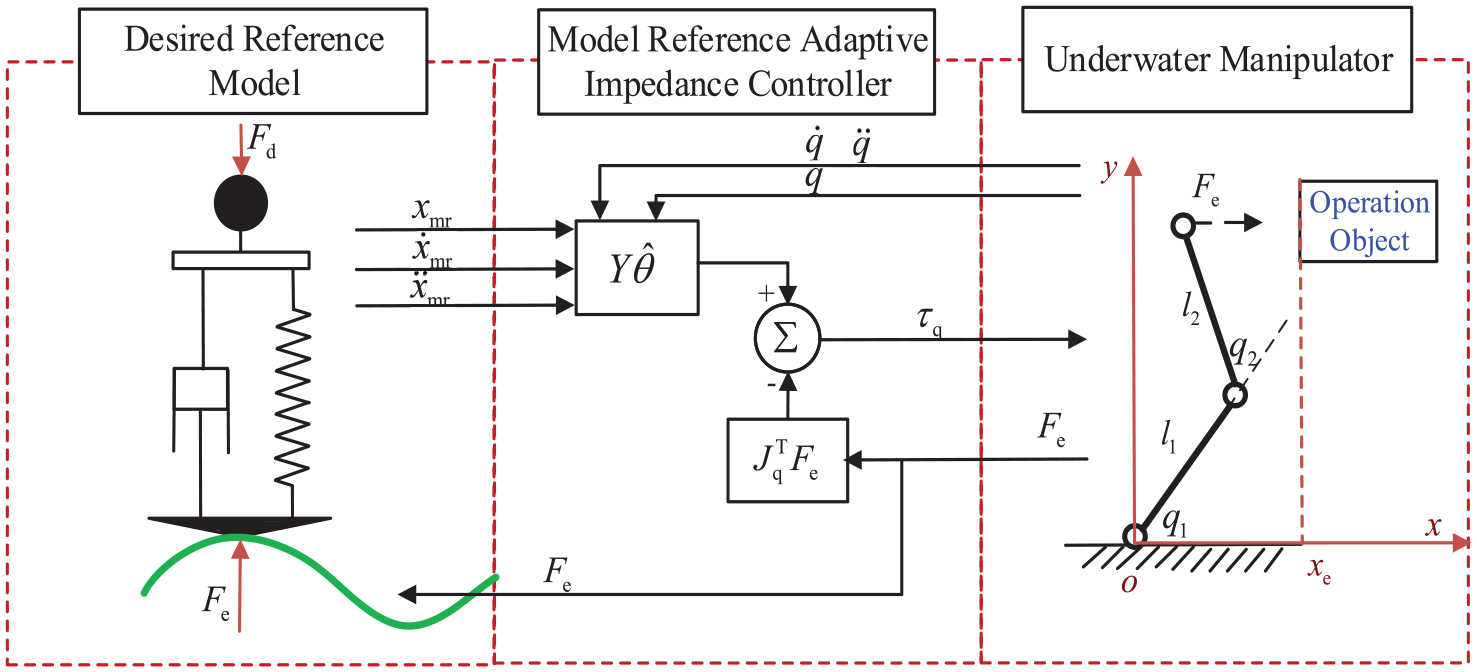
When the system of the steady-state is satisfied, and will be asymptotically approaching to 0, which satisfies the equilibrium of impedance equation (6). The desired impedance model is designed according to the set target force and the actual operating force, and the reference position output by the desired impedance model is used as the position tracking target in the manipulator operating space. The sliding mode function based on the reference position and the actual position error is designed, and the adaptive law is designed according to the sliding mode function to realize the design of the model reference adaptive controller. Using the stabilization characteristics of the model reference adaptive controller, the outer loop can track the standard tactile force signal and the inner loop can track the reference position of the desired impedance model. The overall structure of the model reference adaptive control is shown in Figure 1.
The whole control system.
The controller design with known dynamic
To realize the tracking of the spatial position of the underwater manipulator end-effector to the desired position of the reference impedance, the sliding mode function is designed here as
where is a positive definite matrix which denotes the sliding mode coefficient, is the difference between the manipulator end-effector end position and the impedance model position response , and can be expressed as , correspondingly , . The reference velocity vector is defined as
Combining equations (7) and (8), can be rewritten as . In the operation space, taking the derivative with respect to the time of equation (7) and left multiplying , we can obtain
Suppose the manipulator dynamic parameters , , , and are all known and can be completely measurable, the operation controller can be designed as
Theorem 1. Suppose the dynamic actual parameters , , , and in equation (3) of the -link manipulator are fully known, the sliding mode surface function is chosen as equation (7), the controller is chosen as equation (11), the closed loop dynamic is global stability and the trajectory tracking converges to the sliding surface ( as ), and the end-effector position globally converges to the desired position ( as ).
where is a positive matrix and obviously can be concluded. Taking the derivative of time for and applying the skew-symmetric Property 2, we can obtain
According to the positive definite matrix of , we can conclude the system is asymptotical convergence. With according to equation (14), we can get and has an upper bound which can be concluded; as a result, is also a bounded vector. To verify the uniform continuity performance of , taking the derivation of with respect to time , we can conclude
Since is bounded, and are also bounded according to equation (7). If the desired reference position and are bounded, and are both bounded because of ; as a result, is also bounded in terms of the bounded and . is also bounded according to equation (14) and is bounded. It can infer uniform continuity and so that is monotonically decreasing and has the maximum value, correspondingly according to Barbalat’s lemma (Slotine and Li, 1991). can be concluded and as .
The controller design with unknown dynamic
Since the real model parameters of the manipulator cannot be obtained, , , , and are the corresponding estimated values of the manipulator parameters, respectively. According to nominal model controller equation (11), the controller under the operation space can be designed as
According to equation (4), the new controller can be redenoted in joint space which is expressed as
The angle and length of the joints of the manipulator are known, that is, the Jacobian matrix is a known quantity. As a result, and are known parameters which can be expressed as (Sharifi et al., 2017)
According to Property 3, controller equation (18) can be rewritten as
where is the regression matrix derived from the linearization of the manipulator equation and is the estimated value of the uncertain parameter which is designed as
where is a positive definite diagonal matrix.
Theorem 2. Suppose the dynamic parameters , , , and of the -link manipulator are unknown, the sliding mode surface function is chosen as equation (7), the manipulator controller is chosen as equation (20), the adaptive law is chosen as equation (21), the closed loop dynamic is global stability and the trajectory globally tracking converges to the sliding surface ( as ), and the end-effector position globally converges to the desired position ( as ).
Proof. Since is a positive definite diagonal matrix, substituting controller equation (20) into basic dynamic equation (1), combining the manipulator Property 1, according to adaptive law equation (21), the closed-loop dynamic can be expressed as
where demonstrates the error between the estimated value of the uncertainty item and the true value. To prove the control stability of the manipulator system and the asymptotic convergence ability of force-displacement tracking, the Lyapunov function is designed as
where is a positive definite diagonal matrix, is a positive matrix, and obviously can be concluded.
Taking the derivative of time for and applying the skew-symmetric Property 2, we can obtain
Since and are positive definite matrix, can be concluded and equation (24) guarantees . According to Lyapunov’s stability theorem, the global stability with proposed controller equation (20) is achieved. Taking the derivative of time for , we can conclude
This implies that is bounded because , , , and are all bounded. Thus, is uniformly continuous. Using Barbalat’s lemma (Slotine and Li, 1991), it is proved that and consequently , with . As a result, the manipulator end-effector position converges to the desired position of the response of the second-order impedance model.
Remark 1. The operation object is assumed as passive system which cannot supply the energy to affect the stability of the manipulator system positively. The desired impedance model of the outer loop achieves the operation force tracking the desired force signal; at the same time, the inner loop with the adaptive law achieves the manipulator position tracking the reference position of the desired impedance output. The controller with adaptive law makes the closed-loop dynamic of the manipulator similar to the desired impedance model beside force and position asymptotic convergence.
The adaptive law design with dynamic error
The adaptive law of is an estimation of the uncertain parameters of the manipulator and has robust performance against the uncertainty brought by noise and disturbance to the system. However, if the uncertain parameters are time-varying, is conservative in the estimation of uncertain parameters. To overcome the uncertainty caused by joint friction in the complex underwater environment, a conformity adaptive law of bound-gain-forgetting factor based on the error of the manipulator model is designed.
The adaptation law namely composite adaptation is designed with the prediction error in addition to the tracking error which is formulated as sliding performance expressed as equation (7). The prediction error is defined as the error between the manipulator actual dynamic and the estimated model dynamic . However, and are hard to calculate because of the inaccurate measurement of joint acceleration . To eliminate the uncertainty caused by the difficulty in the measurement of the acceleration term , referring to papers Arefinia et al. (2017) and Slotine and Li (1991), a filtering algorithm can be utilized to eliminate the acceleration term from the manipulator dynamic. The first-order filtering algorithm for the dynamic is designed whose Laplace form is expressed as (Slotine and Li, 1991)
where of which is the filter bandwidth. By applying the filter in the manipulator dynamic and convolving the two sides of the dynamic equation of the manipulator in equation (1), respectively, we can obtain
Utilizing integration by parts, the left side of equation (27) can be rewritten as
Therefore, it is not necessary to measure the acceleration term to calculate . The left side of equation (27) can be rewritten as a new regression matrix form
Equation (29) is the first-order filtering form of the linearization parameters of the dynamic model of manipulator equation (1). can be achieved by filtering the right side of the mathematical model of the manipulator, which can be described as
What is more, in equation (29) can be directly obtained by the filter calculation of the linear regression matrix and can be expressed as . Therefore, can be obtained directly through the measurable variables and without , which is also the main reason for employing the first-order filter to achieve the filtering calculation. Supporting that is an estimate of the uncertain parameter , correspondingly, the estimate of can be written as
where is the estimate of . So the prediction error in filtered performance can be rewritten as
According to a new type of regression matrix equation , the prediction error can be reexpressed as
where . Referring to Slotine adaptive law approach (Slotine and Li, 1991), the bounded-gain-forgetting composite adaptive law can be designed as
where is called a bounded positive definite adaptive gain matrix and is called a uniform positive definite weighting matrix, which represents the importance of the adaptive law to the parameter information . is represented as
where is a positive constant and is an identity matrix. The adaptive controller is realized by the bound-gain-forgetting hybrid adaptive law, and the exponential forgetting least squares gain update law is defined as
where the variable forgetting factor is set as
where and are the positive constants, which denote the maximum forgetting rate, and gain matrix norm pre-specifies upper bounds. Substituting equation (37) into (36), combining inequality , can be written as
Choosing guarantees positive definite. From equation (38) for any , we have , that is, . According to equation (37), we have . With and equation (37), we can obtain which is bounded.
Remark 2. The variable forgetting factor means that when is small, only can be considered and other factors of the forgetting factor can be ignored. When increases, the forgetting speed will decrease. When reaches a certain norm, it stops forgetting. Since a larger implies too fast forgetting, the choice of also represents a trade-off between the speed of parameter tracking and the vibrancy of the estimated parameters. is called a least squares estimator with the forgetting factor, or a bounded-gain-forgetting estimator.
Theorem 3. Suppose that the -link degree manipulator dynamic with uncertainty equation (1), the terminal sliding mode function is chosen as equation (7), the controller is designed as equation (20) with adaptive law equation (34) and adaptive update rate equation (36) or equation (39), the manipulator trajectory tracking gradually converges to the sliding mode surface , and the end-effector position asymptoticly converges to the reference position of the desired impedance model ( as ).
Proof. Considering a Lyapunov candidate as follows
where is called a bounded positive definite adaptive gain matrix, is also a positive matrix, and obviously can be concluded. Taking the time derivative of , utilizing the skew-symmetric Property 2, we can obtain
Substituting the adaptive law equation (36) and variable forgetting factor equation (37) into (41) above yields
Since and are positive definite, with any , choosing and can be concluded from equation (43). The positive definite of and guarantees that is bounded with . We can obtain , and are all bounded; as a result, and are all bounded if and bounded with sliding function in equation (7). The bounded and implies the bounded and with and because and are full ranked matrix; thus, is a bounded matrices. Furthermore, the bounded , , , and guarantee the bounded . is also bounded because of . Correspondingly, the bounded can be concluded with the bounded , , and the equation ; what is more, the bounded guarantees the bounded . The bounded can be obtained according to the bounded , , and as well as the full ranked in relation to so that and are both positive definite. and are uniform positive definite gain matrices. To apply Barbalat’s theorem, the uniform continuity of is needed to check to keep the bounded . By differentiating with respect to time , is obtained as
Since , , , , , , , , , , , and are all bounded, is also bounded according to equation (45) and is uniformly continuous. Using Barbalat’s lemma (Slotine and Li, 1991), it is proved that and consequently and as .
Simulation verification
To verify the effectiveness and validity of the proposed controller, the simulations are set up on the Matlab/Simulink platform. Due to the complex underwater environment, the underwater manipulator still mainly employs a clamp-type simple structure or a single-DOF translational clamping of the workpiece. Based on the simple structure character, the plane two-link rotating structure is utilized as the object of the underwater manipulator, and the simulation model diagram is shown in Figure 2
The control structure diagram of the whole system.
Referring to the paper by Yang et al. (2015) and Liu et al. (2014), the physical parameters of the manipulator are set as kg, kg, and m. The designed impedance parameters in equation (1) are considered as , , and . The adaptive law parameters are designed as , , and for the filter bandwidth parameter. The inertial motion parameters are set as , , , and . In the manipulator dynamic system, the inertia matrix of equation (1) can be formulated as , where each element is denoted as
in equation (1) can be denoted as , and each element can be expressed as
and also the gravity torque vector is formulated as
where , representing the gravity acceleration. The regressor matrix can be expressed as , and each element can be given as
What is more, the Jacobian matrix in equation (1) is defined as , where each element can be denoted as follows
The underwater manipulator has the viscous friction and the Coulomb friction torque which are related to the internal joint friction. Therefore, the dynamic term in equation (1) can be considered as the function of joint velocity which can be expressed as
where the unit of is .
In the operation process, the slave manipulator tracking the master manipulator’s movement is divided into free space movement and the constrained movement according to the slave manipulator contacting with the operation object. Only the influence of the movement position on the x-axis direction is considered. When the slave manipulator is in contact with the operation object within the critical position, the interactive force can be considered as a passive linear spring force model, and the interactive force can be expressed as
where indicates the contact critical position of slave manipulator with the environment and indicates the stiffness coefficient of the target to be grasped. When , the slave manipulator’s movement is in the free space state; however, when , the manipulator’s end tip contact with the environment can be seen, which generates the tactile force.
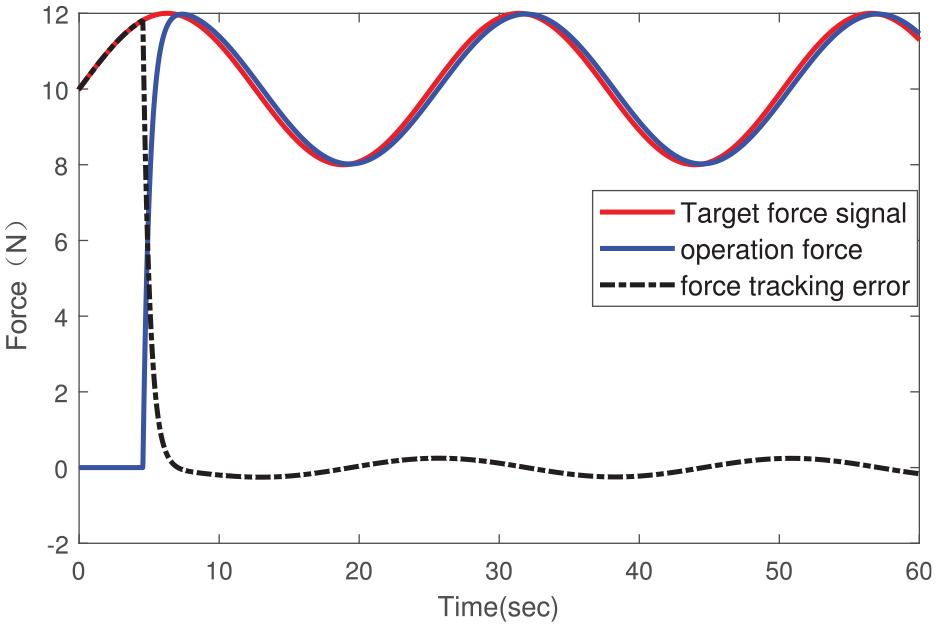
The controller equation (20) and the adaptive law equation (34) with update law equation (39) are applied in the simulation process. In the first simulation, it is assumed that the operator only applies force in the x-axis direction of the operating space, and the stiffness coefficient of the operating object in the x-axis direction is N/m, and no force is applied in the y-axis direction. The target force signal is set as a sinusoidal signal, denoted as , and the simulation time is set to 60 seconds, and the force and position tracking curves and adaptive law curve are shown in Figures 3–8.
The curves of manipulator operating force tracking standard sinusoidal force signal.
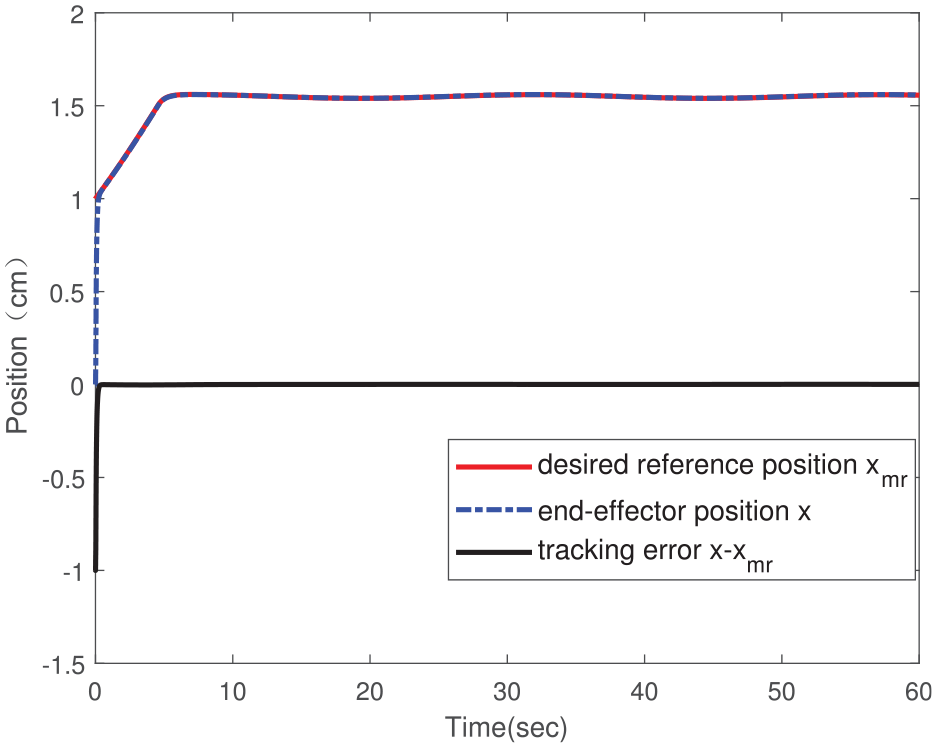
The manipulator end-effector tracking the impedance model reference position curves with standard sinusoidal force signal.
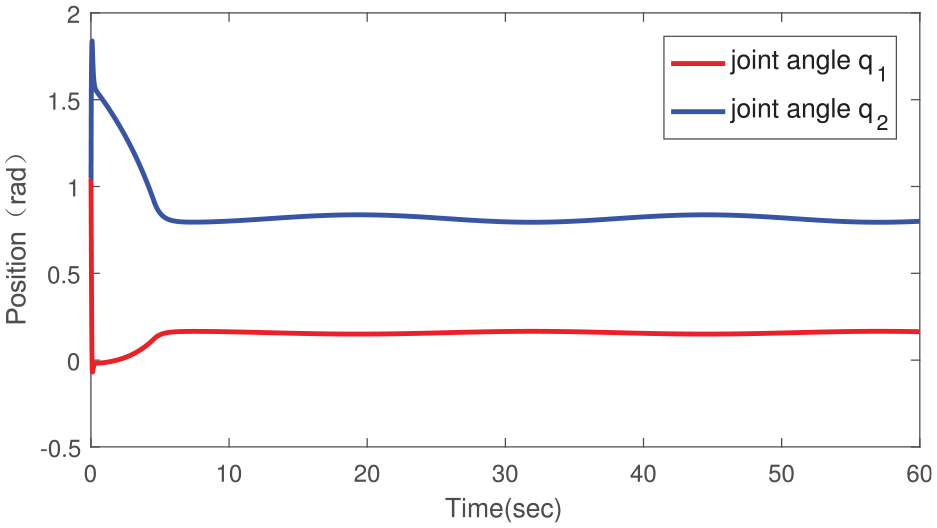
The curves of the manipulator joint position with standard sinusoidal force signal.
The curves of the manipulator joint position velocity.
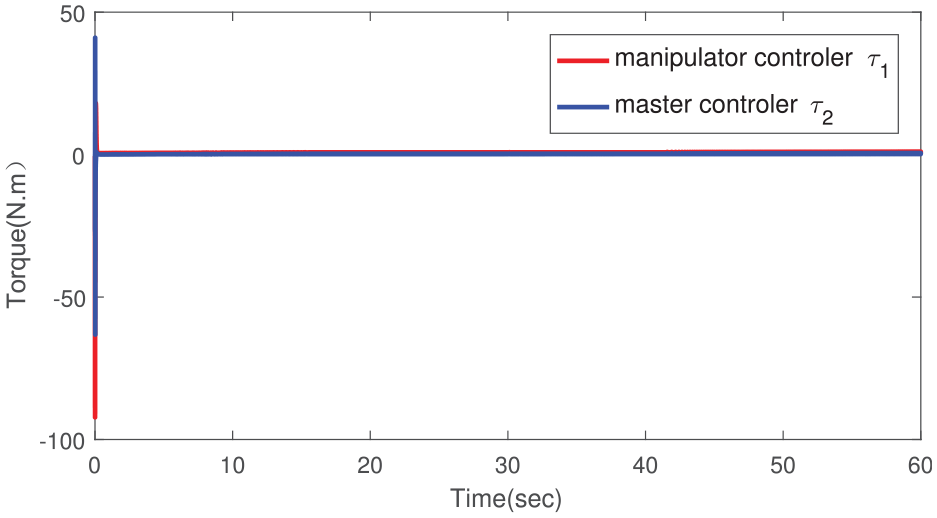
The manipulator input torque curves.
The uncertain parameter estimation curves with standard sinusoidal force signal.
The simulation results verify the effectiveness of the force tracking performance with the proposed controller under unknown dynamic caused by joint friction and inaccurate measurement. As shown in Figures 3–5, the manipulator end-effector operation force can track the target set force value, while the manipulator end-effector position tracks the reference desired position of the response of the desired impedance model. In both free space motion and constrained motion in contact with the target, the manipulator can ensure the tracking of the reference position of the desired impedance model output, and the operating force at the end of the manipulator is consistent and equal to the standard force. The initial position of the manipulator is in a free position that is not in contact with the operation target. When the tracking desired position moves to 1.5 cm, the interaction with the operation target is realized. At this time, the desired position is still tracked. At this time, the manipulator starts to track the target force until the tracking force error gradually converges at 0. According to Figure 8, the internal uncertainty adaptive law of the manipulator compensates the uncertainty of its own model, which satisfies the robust stability characteristics.
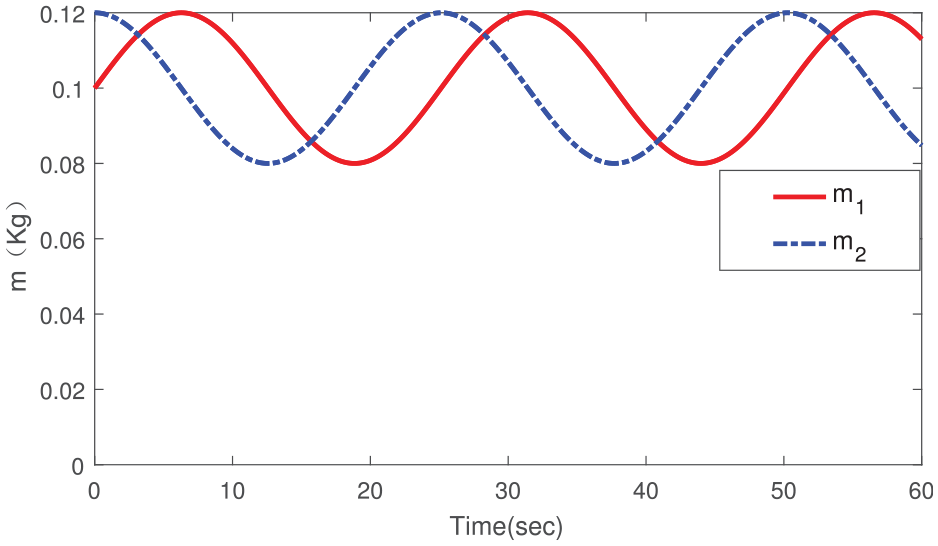
To verify the robust performance of the designed controller and the tracking performance under the uncertainty of the model, considering the complex environment, the mass perturbation characteristics of the manipulator are added to verify the effect of the controller. During the simulation, the manipulator mass is designed as a function of time , which are expressed as and , respectively (Figure 9). is designed as square wave signal and the signal’s amplitude is chosen as 20 N with 30-second period and 50% duty cycle. The simulation operation time is 60 seconds, and the simulation conclusions are demonstrated in Figures 10–13.
The curves of the manipulator joint weight change.
The curves of manipulator operating force tracking standard square wave force signal.
The manipulator end-effector tracking the impedance model reference position curves with standard square wave force signal.
The curves of the manipulator joint position with standard square wave force signal.
The uncertain parameter estimation curves with standard square wave force signal.
It can be clearly concluded from Figures 10–13 that the proposed adaptive impedance controller still guarantees the asymptotic convergence characteristics of the reference position of the desired impedance model in the spatial position of the manipulator under the condition of gradual change of the manipulator quality. Under the condition of model gradient and system uncertainty caused by joint friction, the designed adaptive controller ensures the tracking of the target force. During the transition process of the manipulator from free space to constrained space, the force control has good compliance performance, but there is a small fluctuation in the control position, which does not affect the actual position tracking. The tracking effect makes the grasping force and tracking position without overshoot and realizes the characteristics of protecting grasped samples. The adaptive law estimates the uncertain parameters, realizes the compensation for the uncertainty of the model, and satisfies the robust performance.
To verify the advancement and effectiveness of the designed controller (new controller), the proportional–integral–derivative (PID) controller was employed in the force tracking control simulation to compare to the new controller. The manipulator model and the force applying performance are the same with primary simulation. The PID controller parameters are set as , , and . The compared force tracking curves of the sine wave and square wave signals are shown in Figures 14 and 15.
The sine wave force tracking curves with new controller and PID controller.
The square wave force tracking curves with new controller and PID controller.
By comparing Figures 14 and 15, it can be obviously concluded that the response with the new controller is smoother than the response with the PID controller. It has the characteristics of fast response and no static error with the proposed controller and avoids the property of the oscillation response.
Conclusion
To realize the diversity of target grasping of the underwater manipulator and the flexibility control to adapt to the unknown underwater environment, an adaptive impedance control approach is proposed based on the traditional impedance control method. The proposed adaptive impedance controller takes the impedance control outer loop and the model reference adaptive position control inner loop as the core, and realizes the outer loop manipulator operating force to track the desired force signal, and the inner loop manipulator operating space position to the desired impedance output reference position tracking. An adaptive law based on the operation space position and the output expected position of the impedance model is designed. At the same time, to eliminate the time-varying characteristics of physical parameters, a new bound-gain-forgetting adaptive law is designed to compensate the uncertain error of the manipulator model. The closed-loop dynamic model of the manipulator is realized to approximate the desired impedance model. The Lyapunov function and Barbalat’s lemma are employed to prove that the manipulator operation force tracks the target force signal and the manipulator operation position is asymptotically and uniformly converged to the reference position response of the desired impedance model. The simulation experiment of the two-DOF manipulator is implemented on the Matlab/Simulink platform, and the effectiveness of the designed controller is verified. The results show that the designed controller guarantees the force tracking of manipulator end-effector to the target force signal and the position tracking to the desired reference position response of the desired impedance model.
Footnotes
Acknowledgements
The authors are grateful to the editor and anonymous reviewers for their valuable suggestions that helped in improving the initial version of the manuscript. The authors would like to express their appreciation to the referees for their helpful comments and suggestions.
Declaration of conflicting interests
The author(s) declared no potential conflicts of interest with respect to the research, authorship, and/or publication of this article.
Funding
The author(s) disclosed receipt of the following financial support for the research, authorship, and/or publication of this article: This work was supported by the National Natural Science Foundation of China (NSFC) (grant nos.61903126 and 52177039) and Henan Province Scientific and Technological Project of China (grant nos. 212102210197, 202102210094, and 212102210145).
ORCID iD
Jianjun Zhang
References
1.
ArefiniaETalebiHADoustmohammadiA (2017) A robust adaptive model reference impedance control of a robotic manipulator with actuator saturation. IEEE Transactions on Systems, Man, and Cybernetics: Systems50(2): 409–420.
2.
BaKXMaGLYuB, et al. (2020) A nonlinear model-based variable impedance parameters control for position-based impedance control system of hydraulic drive unit. International Journal of Control, Automation and Systems18(7): 1806–1817.
3.
BoaventuraTBuchliJSeminiC, et al. (2015) Model-based hydraulic impedance control for dynamic robots. IEEE Transactions on Robotics31(6): 1324–1336.
4.
BrahmiBDriscollMBojairamiIKE, et al. (2021) Novel adaptive impedance control for exoskeleton robot for rehabilitation using a nonlinear time-delay disturbance observer. ISA Transactions108: 381–392.
5.
ChangXYangCXiongJ (2019) Quantized fuzzy output feedback Hinf control for nonlinear systems with adjustment of dynamic parameters. IEEE Transactions on Systems Man and Cybernetics: Systems49(10): 2005–2015.
6.
ChengFNiuBZhangL, et al. (2022) Prescribed performance-based low-computation adaptive tracking control for uncertain nonlinear systems with periodic disturbances. IEEE Transactions on Circuits and Systems II: Express Briefs69(11): 4414–4418.
7.
ChiangCWuC (2007) Observer-based adaptive fuzzy sliding mode control of uncertain multiple-input multiple-output nonlinear systems. In: 2007 IEEE international fuzzy systems conference, London, 23–26 July, pp. 1–6. New York: IEEE.
8.
DaiPLuWLeK, et al. (2020) Sliding mode impedance control for contact intervention of an i-auv: Simulation and experimental validation. Ocean Engineering196: 106855.
9.
DuanJGanYChenM, et al. (2018) Adaptive variable impedance control for dynamic contact force tracking in uncertain environment. Robotics and Autonomous Systems102: 54–65.
10.
GarcíaJGonzalezDRodríguezA, et al. (2019) Application of impedance control in robotic manipulators for spacecraft on-orbit servicing. In: 2019 24th IEEE international conference on emerging technologies and factory automation (ETFA), Zaragoza, 10–13 September, pp. 836–842. New York: IEEE.
11.
HamedaniMSadeghianHZekriM, et al. (2021) Intelligent impedance control using wavelet neural network for dynamic contact force tracking in unknown varying environments. Control Engineering Practice113: 104840.
12.
HanLTangGXuR, et al. (2020) Tracking control of an underwater manipulator using fractional integral sliding mode and disturbance observer. Transactions of the Canadian Society for Mechanical Engineering45(1): 135–146.
13.
HeinrichsBSepehriNTrumpAT (1997) Position-based impedance control of an industrial hydraulic manipulator. IEEE Control Systems Magazine17(1): 46–52.
14.
Heshmati-AlamdariSBechlioulisCPKarrasGC, et al. (2018) A robust interaction control approach for underwater vehicle manipulator systems. Annual Reviews in Control46: 315–325.
15.
HuaCYangYGuanX (2013) Neural network-based adaptive position tracking control for bilateral teleoperation under constant time delay. Neurocomputing113: 204–212.
16.
HuynhBPWuCWKuoYL (2019) Force/position hybrid control for a hexa robot using gradient descent iterative learning control algorithm. IEEE Access7: 72329–72342.
17.
IzadbakhshAKhorashadizadehSGhandaliS (2020) Robust adaptive impedance control of robot manipulators using Szász–Mirakyan operator as universal approximator. ISA Transactions106: 1–11.
18.
JiWZhangJXuB, et al. (2021) Grasping mode analysis and adaptive impedance control for apple harvesting robotic grippers. Computers and Electronics in Agriculture186: 106210.
19.
KeeminkAQKooijHVStienenHA (2018) Admittance control for physical human–robot interaction. The International Journal of Robotics Research37(11): 1421–1444.
20.
KumarNPanwarVSukavanamN, et al. (2011) Neural network based hybrid force/position control for robot manipulators. International Journal of Precision Engineering and Manufacturing12(3): 419–426.
21.
LeeKBussM (2008) Force tracking impedance control with variable target stiffness. IFAC Proceedings Volumes41(2): 6751–6756.
22.
LiangLChenYLiaoL, et al. (2021) A novel impedance control method of rubber unstacking robot dealing with unpredictable and time-variable adhesion force. Robotics and Computer-Integrated Manufacturing67: 102038.
23.
LinGYuJLiuJ (2021a) Adaptive fuzzy finite-time command filtered impedance control for robotic manipulators. IEEE Access9: 50917–50925.
24.
LinYChenZFYaoB (2021b) Unified motion/force/impedance control for manipulators in unknown contact environments based on robust model-reaching approach. IEEE/ASME Transactions on Mechatronics26(4): 1905–1913.
25.
LiuXTaoRTavakoliM (2014) Adaptive control of uncertain nonlinear teleoperation systems. Mechatronics24(1): 66–78.
26.
Martín-MartínRLeeAMGardnerR, et al. (2019) Variable impedance control in end-effector space: An action space for reinforcement learning in contact-rich tasks. In: 2019 IEEE/RSJ international conference on intelligent robots and systems (IROS), Macau, China, 3–8 November, pp. 1010–1017. New York: IEEE.
27.
NicolisDAlleviFRoccoP (2020) Operational space model predictive sliding mode control for redundant manipulators. IEEE Transactions on Robotics36(4): 1348–1355.
28.
OchoaHCortesãoR (2021) Impedance control architecture for robotic-assisted mold polishing based on human demonstration. IEEE Transactions on Industrial Electronics69(4): 3822–3830.
29.
Perez-IbarraJCSiqueiraAAGSilva-CoutoMA, et al. (2018) Adaptive impedance control applied to robot-aided neuro-rehabilitation of the ankle. IEEE Robotics and Automation Letters4: 185–192.
30.
QianWLiYZhaoY (2020a) New optimal method for l2-lHinf state estimation of delayed neural networks. Neurocomputing415: 258–265.
31.
QianWXingWFeiS (2020b) Hinf state estimation for neural networks with general activation function and mixed time-varying delays. IEEE Transactions on Neural Networks and Learning Systems32(9): 3909–3918.
32.
RaniMKumarNSinghPH (2019) Motion/force control scheme for electrically driven cooperative multiple mobile manipulators. Control Engineering Practice88: 52–64.
33.
SharifiMBehzadipourSVossoughiG (2014) Nonlinear model reference adaptive impedance control for human–robot interactions. Control Engineering Practice32: 9–27.
34.
SharifiMBehzadipourSSalariehH, et al. (2017) Cooperative modalities in robotic tele-rehabilitation using nonlinear bilateral impedance control. Control Engineering Practice67: 52–63.
35.
SharifiMBehzadipourSSalariehH, et al. (2020) Assist-as-needed policy for movement therapy using telerobotics-mediated therapist supervision. Control Engineering Practice101: 104481.
36.
SharifiMSalariehHBehzadipourS, et al. (2018) Beating-heart robotic surgery using bilateral impedance control: Theory and experiments. Biomedical Signal Processing and Control45: 256–266.
37.
ShenZZhongHXuE, et al. (2020) An underwater robotic manipulator with soft bladders and compact depth-independent actuation. Soft Robotics7(5): 535–549.
38.
SivčevSColemanJOmerdićE, et al. (2018) Underwater manipulators: A review. Ocean Engineering163: 431–450.
StolfiAGasbarriPSabatiniM (2017) A combined impedance-pd approach for controlling a dual-arm space manipulator in the capture of a non-cooperative target. Acta Astronautica139: 243–253.
41.
TairaYSagaraSOyaM (2021) Motion and force control with a linear force error filter for the manipulator of an underwater vehicle-manipulator system. Artificial Life and Robotics27(1): 90–106.
42.
UyamaNHiranoDNakanishiH, et al. (2011) Impedance-based contact control of a free-flying space robot with respect to coefficient of restitution. In: 2011 IEEE/SICE international symposium on system integration (SII), Kyoto, Japan, 20–22 December, pp. 1196–1201. New York: IEEE.
43.
WangGWangXWangY, et al. (2021) Kinematics analysis of a four-legged heavy-duty robot with a force–position hybrid control servo actuator in a parallel-executed cylinder system. Mechanical Sciences12(2): 735–749.
44.
WangHPengJZhangF, et al. (2022) High-order control barrier functions-based impedance control of a robotic manipulator with time-varying output constraints. ISA Transactions129: 361–369.
45.
XuQ (2014) Robust impedance control of a compliant microgripper for high-speed position/force regulation. IEEE Transactions on Industrial Electronics62(2): 1201–1209.
46.
YangCPengGLiY, et al. (2018) Neural networks enhanced adaptive admittance control of optimized robot–environment interaction. IEEE Transactions on Cybernetics49(7): 2568–2579.
47.
YangCYaoFZhangM, et al. (2020) Adaptive sliding mode PID control for underwater manipulator based on Legendre polynomial function approximation and its experimental evaluation. Applied Sciences10(5): 1728.
48.
YangYGeCWangH, et al. (2015) Adaptive neural network based prescribed performance control for teleoperation system under input saturation. Journal of the Franklin Institute352(5): 1850–1866.
49.
YangZPengJLiuY (2019) Adaptive neural network force tracking impedance control for uncertain robotic manipulator based on nonlinear velocity observer. Neurocomputing331: 263–280.
50.
YouakimDRidaoP (2018) Motion planning survey for autonomous mobile manipulators underwater manipulator case study. Robotics and Autonomous Systems107: 20–44.
51.
ZhekovZAtanasovN (2021) Modelling and control of 2-dof underwater manipulator in presence of disturbances. In: 2021 international conference automatics and informatics (ICAI), Varna, 30 September–2 October, pp. 333–336. New York: IEEE.
52.
ZhongHShenZZhaoY, et al. (2020) A hybrid underwater manipulator system with intuitive muscle-level sEMG mapping control. IEEE Robotics and Automation Letters5(2): 3198–3205.
53.
ZhouZTangGHuangH, et al. (2020) Adaptive nonsingular fast terminal sliding mode control for underwater manipulator robotics with asymmetric saturation actuators. Control Theory and Technology18(1): 81–91.