






Abstract
In this article, the issue of adaptive event-triggered tracking control is investigated for time-delay nonlinear systems with input saturation and external disturbances. In the whole process of control design, the radial basis function neural networks are utilized to approximate uncertain nonlinearities. To estimate the unknown states, a neural network-based observer is constructed. Pade approximation method is adopted to eliminate the effect of input delay. A smooth non-affine function is introduced to replace input saturation, and an auxiliary variable is employed to obtain the actual control input. An event-triggered strategy is designed to reduce the utilization of communication and computation resources. Moreover, the command filtering technique is applied to handle the issue of “explosion of complexity” in the conventional backstepping method. The designed controller can assure that all the signals in the closed-loop system are semi-globally uniformly ultimately bounded. Therefore, the proposed event-triggered neural control scheme can not only save network resources, but also improve the robustness of the system by dealing with input constraints and external disturbances. Finally, two simulation examples are given to verify the availability and feasibility of the designed controller.
Introduction
In the past few decades, since nonlinear terms inevitably appeared in practical engineering field, how to solve this problem has attracted extensive attention. In this case, fuzzy logic systems (FLS) (Li et al., 2014; Ling et al., 2019; Liu et al., 2016a; Ma and Ma, 2020) and neural networks (NNs) (Bai et al., 2019; Doudou and Khaber, 2021; Li et al., 2019; Zerari et al., 2018) were presented to approximate uncertain parameters or unknown functions. In practice, limited by the complexity of the system itself and some external conditions, the state variables of the system are often immeasurable or partly measurable only. To solve this problem, the observers are usually combined with the approximators. Therefore, adaptive fuzzy observers (Fu et al., 2018; Zhang et al., 2020) and neural network observers (Chen et al., 2017; Tong et al., 2020) were constructed.
The backstepping method is one of the most powerful tools to solve the numerous problems in the field of nonlinear control (Ba et al., 2019; Liu et al., 2016b; Sun and Guo, 2014; Tong and Li, 2011). In Ba et al. (2019), with the aid of neural networks and backstepping method, a fixed-time adaptive neural control scheme was presented for a class of uncertain nonstrict nonlinear systems. In Tong and Li (2011), an adaptive fuzzy backstepping control approach was considered to handle the problem of unknown dead zones and immeasurable states. Unfortunately, in conventional backstepping method, the multiple differentials of virtual signals will cause the issue of “explosion of complexity” in each step of the controller design process. In Liu et al. (2019), Yangand D and Yue (2018), Shi et al. (2019), the dynamic surface control (DSC) technique was developed to reduce the expansion of the differential terms by introducing the first-order filters in backstepping framework. However, the DSC technology does not address the errors caused by the filters, which may degrade the performance of the system. In Yu et al. (2018), Li (2019), Wang et al. (2021), and Hou and Tong (2017), compared with the DSC technology, the command filtering technology not only employed the command filters to solve the problem of “explosion of complexity,” but also introduced compensation signals to deal with the errors generated by the filters. In this paper, we will further investigate the problem of input constraints in nonlinear systems.
It is a common phenomenon that input constraints exist in many nonlinear systems. Input delay and saturation are two forms of input constraints, which will affect the quality of control or even make the system unstable. In Li et al. (2018) and Han et al. (2021), the Pade approximation method was used to deal with input delay. The advantage of this method is that the input delay can be eliminated by introducing an intermediate variable and constructing a feasible coordinate transformation. In Wang et al. (2020), a novel auxiliary system was constructed to handle the adverse influence caused by input delay. In Chen et al. (2016) and Wang et al. (2019), an anti-saturation function was constructed to compensate for the magnitude and rate of saturation. However, the usage of network resources has not been considered in the above-mentioned references, which may increase the burden of communication bandwidth.
In many practical applications, time-triggered control usually leads to a waste of network resources in Zhang et al. (2021) and Chen et al. (2014). Thus, how to reduce the communication frequency between the controller and actuator has received more and more attention. Event-triggered strategy was proposed as an important method to solve the aforementioned problem in Yu and Li (2021), Xia et al. (2021), Gao et al. (2020), Ma et al. (2019), Liu et al. (2021), and Zhu et al. (2020). Different from conventional time-triggered control, the event-triggered strategy considers the behavior of the system rather than depending on real-time solely, so it has more advantages in saving communication and computation resources. In Yu and Li (2021), with the aid of the DSC technique and simplified barrier Lyapunov function, an adaptive fuzzy event-triggered control (ETC) strategy was constructed to deal with tracking error constrained and unknown dead-zone in a class of non-strict feedback systems. In Xia et al. (2021), an observer-based event-triggered adaptive fuzzy control mechanism was designed for stochastic nonlinear systems to handle the problem of unknown control directions and the unmeasured states.
In the view of issues discussed above, the input constraints and the waste of network resources often occur in practical engineering systems. Therefore, how to handle these adverse factors to maintain the stability of the system is the main purpose of this paper. The motivation of this paper is summarized as follows:
Due to the existence of input constraints, the actual controller cannot be obtained at the current time in the process of the controller design. In Chen et al. (2016) and Wang et al. (2020), an auxiliary system and an anti-saturation function were used to overcome the difficulties of input delay and saturation, respectively. However, to the authors’ best knowledge, the problem of dealing with input delay and saturation simultaneously still needs to be further investigated.
In conventional time-triggered scheme, the transmissions of feedback signals and the updates of control signals are real-time, so it often leads to a waste of communication and computation resources. Therefore, how to incorporate event-triggered mechanism into controller to save network resources is a complex work.
Motivated by the above investigations, this paper is committed to presenting a novel state observer-based event-triggered trajectory tracking controller for time-delay nonlinear systems with input saturation and external disturbances. The highlighted contributions of this article are presented as follows:
In this paper, compared with Li et al. (2019) and Liu et al. (2016b) without considering input constraints, a new coordinate transformation is introduced to solve the difficulties caused by input delay and saturation simultaneously. In addition, with the help of Lyapunov stability theorem, the designed controller can ensure the boundedness of all the signals in the closed-loop system.
Compared with DSC technique in Ling et al. (2019) and Liu et al. (2019), the designed controller based on the command filtering technique not only overcomes the drawbacks of “explosion of complexity” in conventional backstepping method, but also effectively compensates for the errors caused by the filters.
In this paper, compared with Chen et al. (2014) and Zhang et al. (2021) by using time-triggered method to handle with relevant problems, an event-triggered relative threshold mechanism is incorporated into controller to alleviate the burden of network resources greatly. Moreover, a neural network-based observer is constructed to estimate the unknown states, which is more general for practical systems.
This article is organized as follows. In the second section, the problem statement and preliminaries are given. In the third section, control scheme design and stability analysis are presented. In the fourth section, two simulation examples demonstrate effectiveness and superiority of the proposed control strategy. The conclusion of this paper is presented in the fifth section.
Problem statement and preliminaries
Model construction
Consider a class of strict-feedback time-delay nonlinear systems with input saturation and external disturbances as
where
where
where
In addition, if inequality (5) is satisfied, the signals of the system (1) are semi-globally uniformly ultimately bounded (SGUUB).
Radial basis function neural network (RBFNN)
For any smooth function
where
The basis function vector
where
Input delay and saturation
We introduce Pade approximation approach to tackle the problem of input delay. One has
where
Then, the intermediate variable
Based on the inverse Laplace transformation, (11) can be rewritten as
where
Thus, the system (1) can be transformed as follows
Taking the saturation restriction into consideration, the system input
where
From Zerari et al. (2018), it is shown that there exists a sharp corner when
Then,
where
The auxiliary variable
Finally, the nonlinear system (13) can be rewritten as
Control scheme design and stability analysis
In this section, an observer-based event-triggered adaptive neural control scheme for nonlinear systems with input constraints and external disturbances is presented. To understand the proposed control scheme, a block diagram of event-triggered adaptive neural control scheme is illustrated in Figure 1.

Adaptive event-triggered neural control scheme.
Neural observer design
In this section, a neural observer will be designed to estimate the unknown state of system (1). By using the formula (7), the unknown continuous nonlinear function
where
Then, a neural observer is constructed as follows
where
Based on (20) and (21), the observer error equation can be obtained as follows
where
To evaluate the performance of the state observer (21), the following Lyapunov function is chosen as
The derivation of
With the aid of Lemma 2 and Assumption 2, we can get the following inequalities
From (24) to (27), we have
where
Controller design
At first, a new coordinate transformation is given
where
where
In order to eliminate the filter errors, we introduce the following auxiliary system
where
The compensated error signals are defined as
Select the Lyapunov function as follows
where the design parameter
Based on (28) and (33), the derivation of
By using Young’s inequality, one has
Then, the virtual controller
From (35) to (38), one yields
Select the Lyapunov function as follows
where the design parameters
Based on (40), the derivation of
By using Young’s inequality, one has
Then, the virtual controller
From (42) to (45), one yields
where
Differentiating
Select the Lyapunov function as follows
where the design parameter
Based on (50), the derivation of
From (47), we can obtain
Substituting (52) to (51), one has
As
By using Young’s inequality, one has
Then, the virtual controller
Substituting (55)–(57) into (54), one has
Then, according to
Stability analysis
Inserting (60) into (59) yields
where
We can deduce from (61) that the states
For the error compensation system (31), we select the Lyapunov function as follows
The derivation of (62) is calculated as
According to Lemma in (Li, 2019), the output
By using Young’s inequality, one has
Inserting the inequality
where
From (65), the conclusion can be drawn that the states
Simulation examples
In this section, two simulation examples are given to demonstrate the applicability of the presented control scheme.
where
In the simulation, the parameters are given as
The simulation results are shown in Figures 2–8. Figure 2 describes the trajectories of

System output

State variable

State variable

The input

Adaptation parameters of Example 1.

Time intervals of triggering events of Example 1.

Triggering numbers of Example 1.

Single-link robot arm.
Its dynamics satisfy the following equation form
where
Define
where the input delay is chosen as
The parameters are given as
The simulation results are plotted in Figures 10–16. The output tracking performance is displayed in Figure 10. The trajectories of states
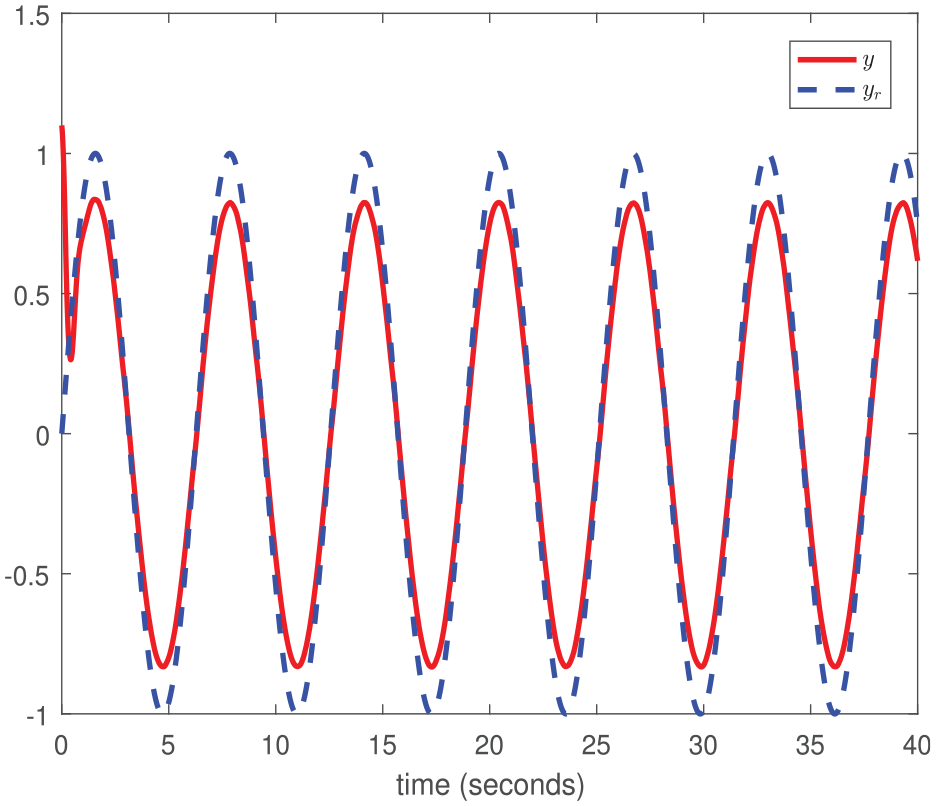
System output
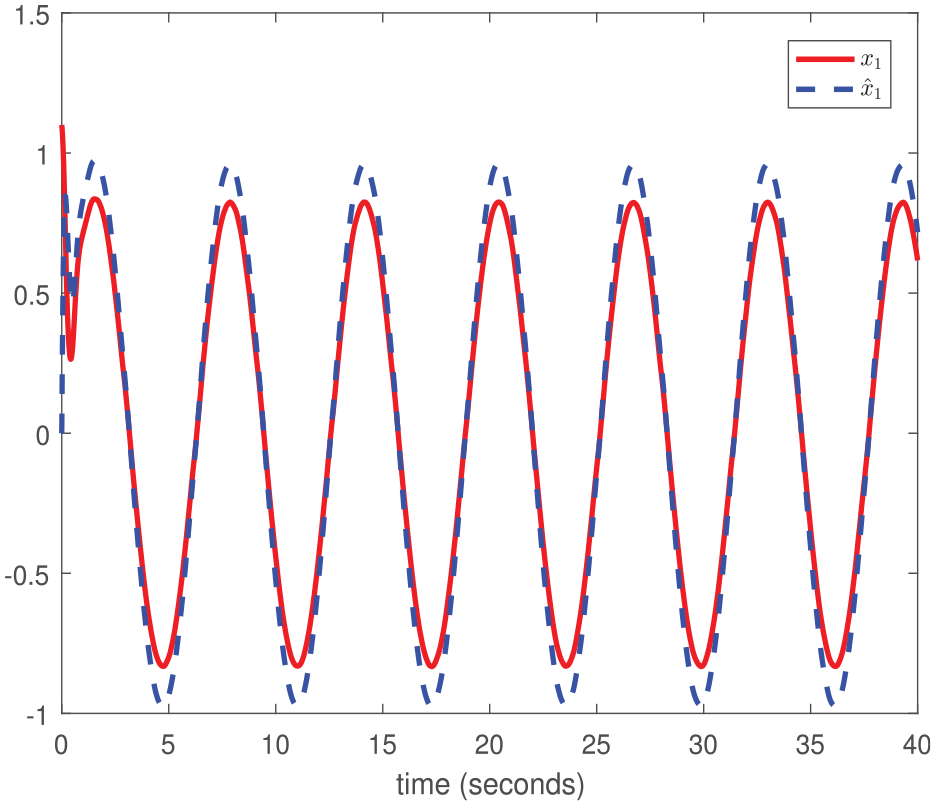
State variable
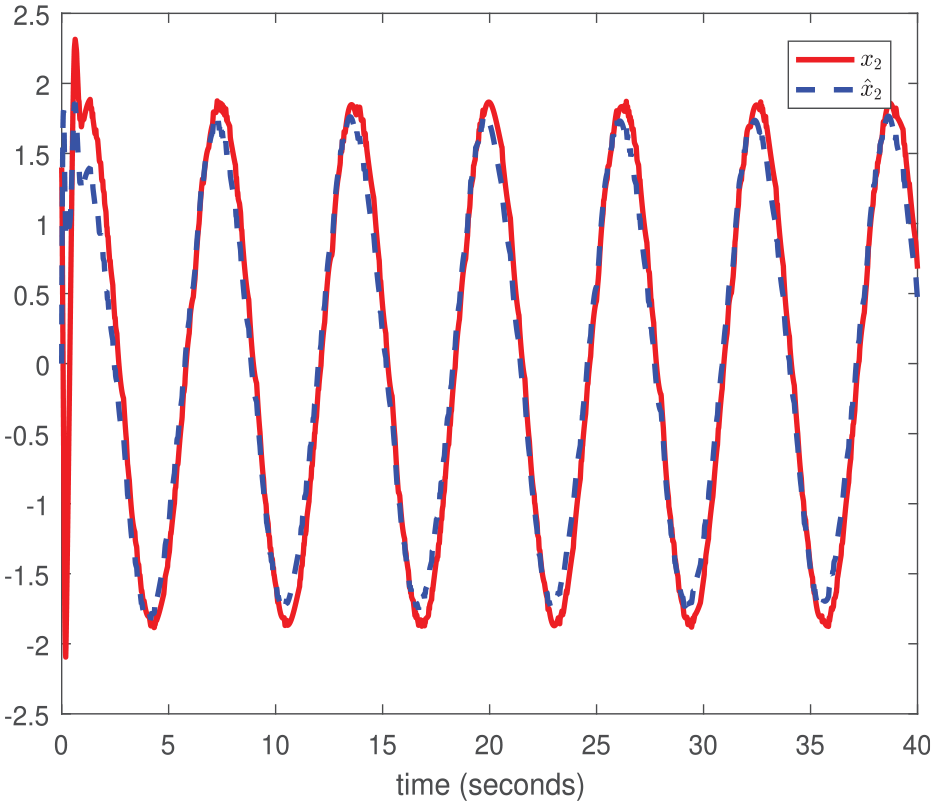
State variable
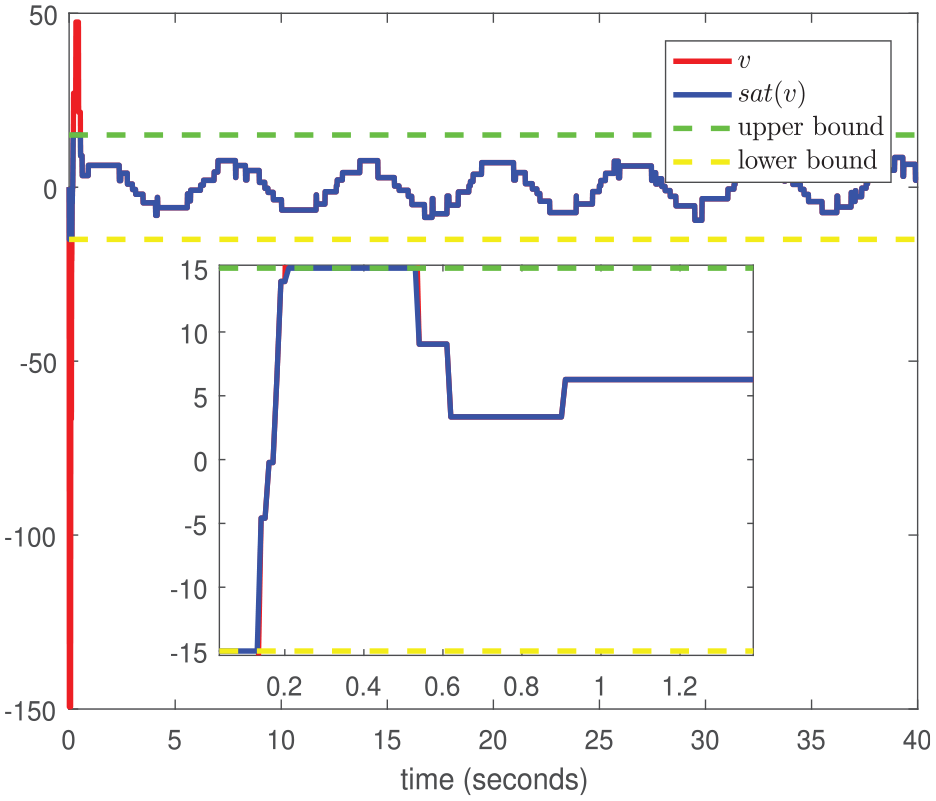
The input
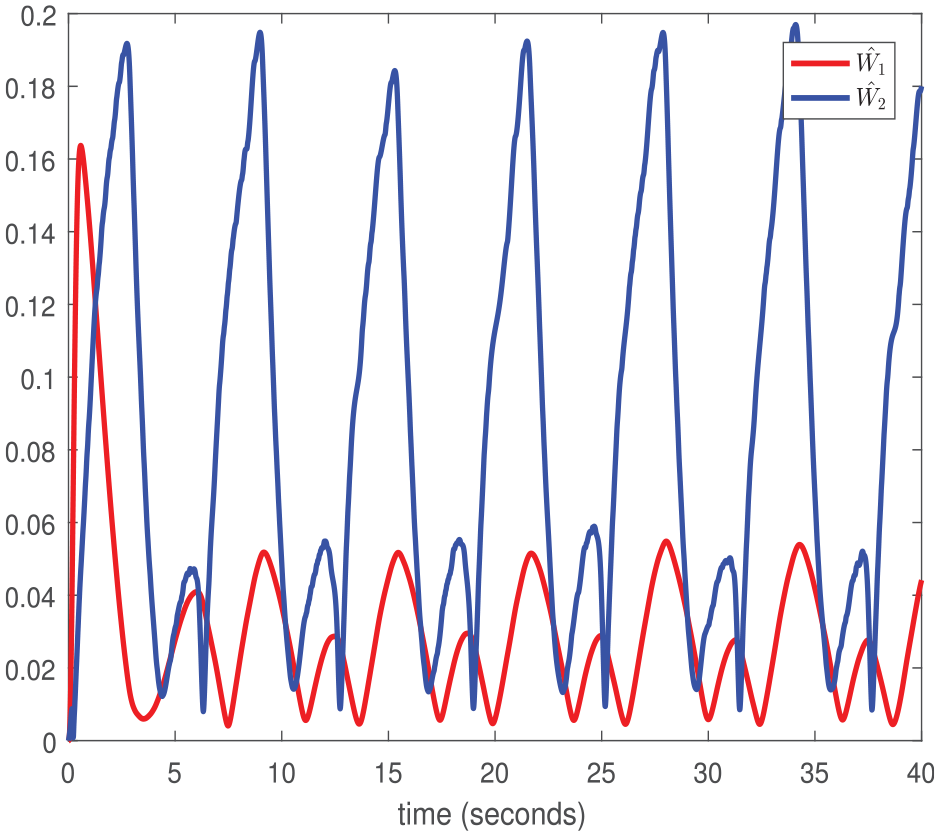
Adaptation parameters of Example 2.
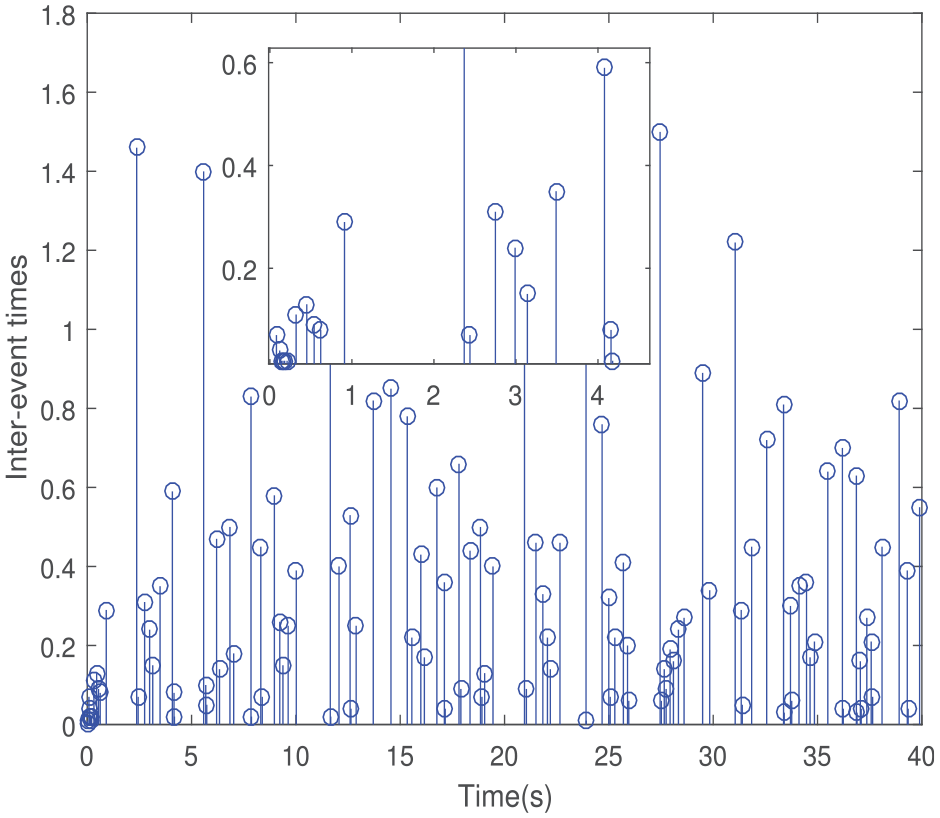
Time intervals of triggering events of Example 2.
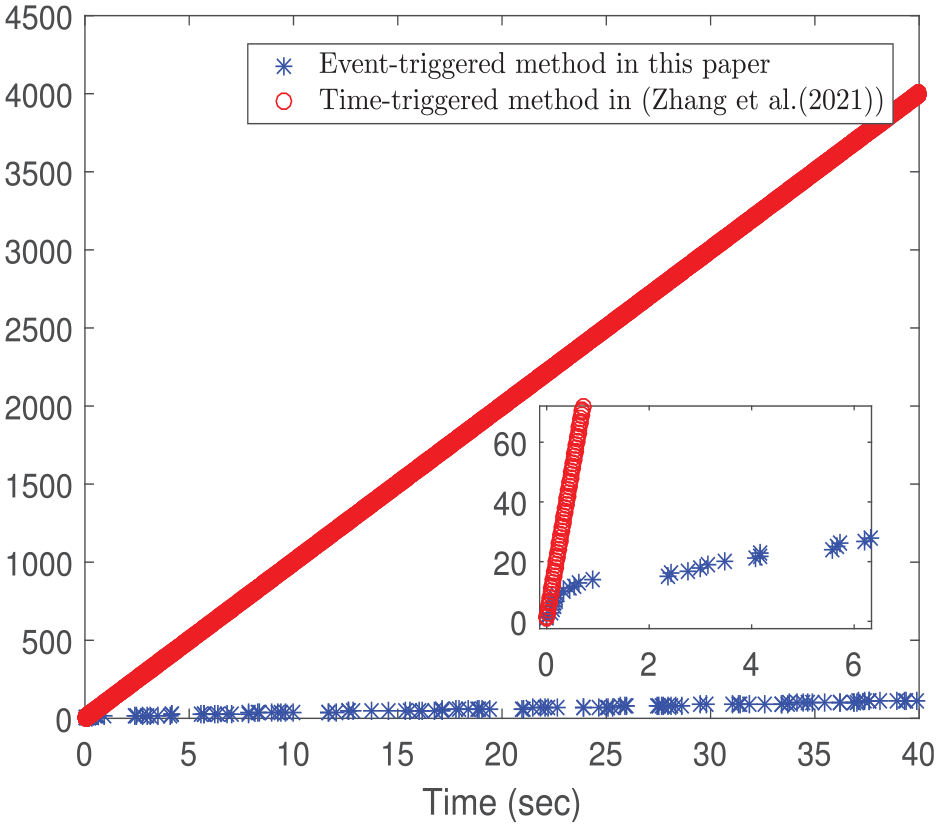
Triggering numbers of Example 2.
Conclusion
An observer-based event-triggered adaptive neural tracking control approach has been presented for time-delay nonlinear systems with input saturation and external disturbances in this research. The nonlinear terms have been approximated by applying the RBFNNs. The ETC mechanism has been proposed to alleviate the burden of network resource. With the help of the command filter technology, the adverse effects of “explosion of complexity” in the conventional backstepping method have been eliminated. The Pade approximation method has been introduced to eliminate the influence of input delay. In addition, a smooth non-affine function and an auxiliary variable have been applied to deal with the problem caused by input saturation. The main features of this article are summarized as follows: (1) the burden of network resources is alleviated; (2) the problem of “explosion of complexity” is addressed; (3) the closed-loop system is SGUUB. Finally, two simulation examples have demonstrated the effectiveness and superiority of the proposed control strategy. In the future work, the finite-time adaptive event-triggered tracking control problem for switched nonlinear systems with input constraints and time-varying delays will be further considered.
Footnotes
Declaration of conflicting interests
The author(s) declared no potential conflicts of interest with respect to the research, authorship, and/or publication of this article.
Funding
The author(s) disclosed receipt of the following financial support for the research, authorship, and/or publication of this article: This work is supported by Natural Science Research Project of Jiangsu Higher Education Institutions under Grant 22KJB510028.
