







Abstract
This paper investigates the consensus of impulsive coupled networked delay systems (NDSs) under edge-based attacks. First, an edge-based attack model is established, which is asynchronous and can change the states of nodes. Next, according to the number of edges allowed to be attacked at a time instant, the edge-based attack is divided into two cases. For each case, the sufficient condition is given to guarantee the system consensus against the edge-based attacks. Then, by considering a special type of edge-based attacks on the NDSs with star topology, a less conservative consensus criterion is obtained. Finally, two numerical examples are given to verify the correctness of the obtained results.
Introduction
In recent years, networked systems (NSs) have attracted much attention due to their wide application in pattern recognition (Hoppensteadt and Izhikevich, 2000), image encryption (Wei et al., 2019), and so on. Consensus, as one of the basic and important properties of NSs, has attracted more and more researchers’ interests (Qi et al., 2021; Ren et al., 2022).
It is well known that nodes in NSs are usually coupled through communication channels, and appropriate coupling schemes are beneficial to achieving some good properties such as consensus (Guo et al., 2015; Sun et al., 2022; Wu and Chen, 2008; Yu et al., 2019). According to existing works, there are mainly two common ways of nodes coupling: continuous-time coupling, which often requires continuous transmission between nodes (Li et al., 2018, 2022b; Yang et al., 2015); and impulsive coupling, which is activated only at some discrete time instants. In comparison, the impulsive coupling has the feature of less energy consumption (Yang, 2001). The investigation of impulsive coupling has attracted the interest of some scholars in recent years. For example, in Chen et al. (2019), the consensus of NSs is analyzed through the appropriate choice of impulsive coupling strength. To realize the consensus of linear NSs, literature by Wang et al. (2017) introduces a stochastic impulsive coupling protocol. By designing the control gain of coupled impulsive control strategy, it is shown that the consensus of multi-agent system is achieved in Zhang et al. (2020) and Zhu et al. (2020).
In real NSs, the network communication environment is not absolutely safe. Instead, it is often subject to all kinds of cyberattacks, which may destroy the consensus of the network. There have been some investigations on cyberattacks in recent years (Beg et al., 2019; Fawzi et al., 2014). According to existing research, cyberattacks can be roughly divided into three categories: denial-of-service (DoS) attacks, which make some information transmission between nodes unavailable (Befekadu et al., 2015); replay attacks, which maliciously duplicate the information transmitted between nodes (Chen et al., 2018); and deception attacks, which infuse false data in information transmission (Xie et al., 2011). To the best of the authors’ knowledge, when investigating these attacks, most existing works tend to study cyberattacks in systems with a single node (Liu et al., 2022b; Wakaiki et al., 2020). Although there are some exceptions that consider the case of multiple nodes, they often assume that all nodes are attacked simultaneously (Wang et al., 2022). However, such results are sometimes difficult to apply since many real NSs have large number of nodes. Real examples include neural network systems, social communication networks, and traffic systems. Therefore, when the network scale is relatively large, attacking all the nodes of the network at the same time requires huge energy consumption and is difficult to achieve. As a contrast, it seems easier for the hackers to attack only part of the network. However, such attacks have not been fully studied.
The spatial distribution of nodes and the communication links between nodes make it possible for both nodes and edges to be attacked. The corresponding attacks are called node attacks and edge attacks, respectively (He et al., 2022). Because of the important role of communication channels (or edges) in NSs, edge-based attacks have attracted much interest of scholars. It is known that edge-based attacks are often asynchronous, which makes it possible for attackers to attack part of the network. To be specific, each edge in the network topology is attacked by an individual attacker, whose strategy is independent of others. In addition, the above mentioned classic cyberattacks inject false data into the network during information transmission to destroy the system, but system states are not directly changed. Different from the the above mentioned synchronous launching of cyberattacks, this paper is devoted to the study of asynchronous edge-based attacks that can directly affect the state of the system.
In real NSs such as neural network and biological network, time delay phenomenon is universal. The existence of time delay affects the performance of the system. Hence, it is necessary to take time delay into account (Li et al., 2019; Lu et al., 2022; Song et al., 2021). There exist a lot of work on investigating NSs with time delays. For example, the NSs studied in Li et al. (2022a) consider input delay and time-varying communication delays simultaneously. In Zhang et al. (2022), both stochastic deception attacks and time delay are considered in the network model. It is shown that the time delay plays a negative role for the consensus of coupled networks. In Ni et al. (2022), the consensus problem of the multi-agent systems under DoS attacks is studied. In Jiang et al. (2020), it is shown that the delay in impulses has double effects, that is, it can stabilize an unstable system or destroy a stable system under the corresponding conditions. When the time delay is within the specified upper and lower bounds, Qiu et al. (2023) provide the conditions for the system to achieve consensus against DoS attacks. Although both attacks and time delays are considered in the literature mentioned above, it should be pointed out that the attacks occured are synchronized for all the nodes or edges. Hence, the consensus of NSs under asynchronous attacks and time delays simultaneously is still an open problem.
In NSs, the neighboring nodes will interact with each other through edges. On one hand, the open communication environment makes edges vulnerable to attackers. The asynchrony and flexibility of edge-based attacks make them ubiquitous in large-scale practical systems such as traffic network systems (He et al., 2022). On the other hand, the time delay of the node itself will affect the dynamics of the node, and then affect the consensus of the whole system. Therefore, the investigation of edge-based attack strategy is important to maintain the desired performance of the system with time delay. Although there have been some interesting works about cyberattacks in NSs (Liu et al., 2022a; Persis and Tesi, 2015), few of them have been devoted to analyzing the effect of edge-based attacks on the consensus of impulsive coupled networked delay systems. As with many other attacks, the edge-based attacks usually have a negative impact on the consensus of NSs. Inspired by Xu et al. (2020) and Maity and Tsiotras (2022), this paper will focus on the influence of the edge-based attacks for the consensus of an NS. Up to now, there is not much literature to analyze edge attacks because the asynchronous nature of edge-based attacks brings challenges to the analysis process. This paper establishes a new edge-based attack mode and proposes two attack strategies. It is shown that as more information is known about the attackers, the easier and more accurately we can deduce the intensity of the attacks the system can tolerate.
Based on the above analysis, this paper studies the consensus of impulsive coupled NDSs under edge-based attacks. The contributions of this paper are as follows:
In this paper, the new edge-based attack models are established, which do not require all nodes to be attacked at the same time. It is worth mentioning that this paper divides the attacker’s strategy into two situations. In one case, only one edge is attacked at the impulsive coupling time instants, and in the other case, multiple edges are allowed to be attacked simultaneously.
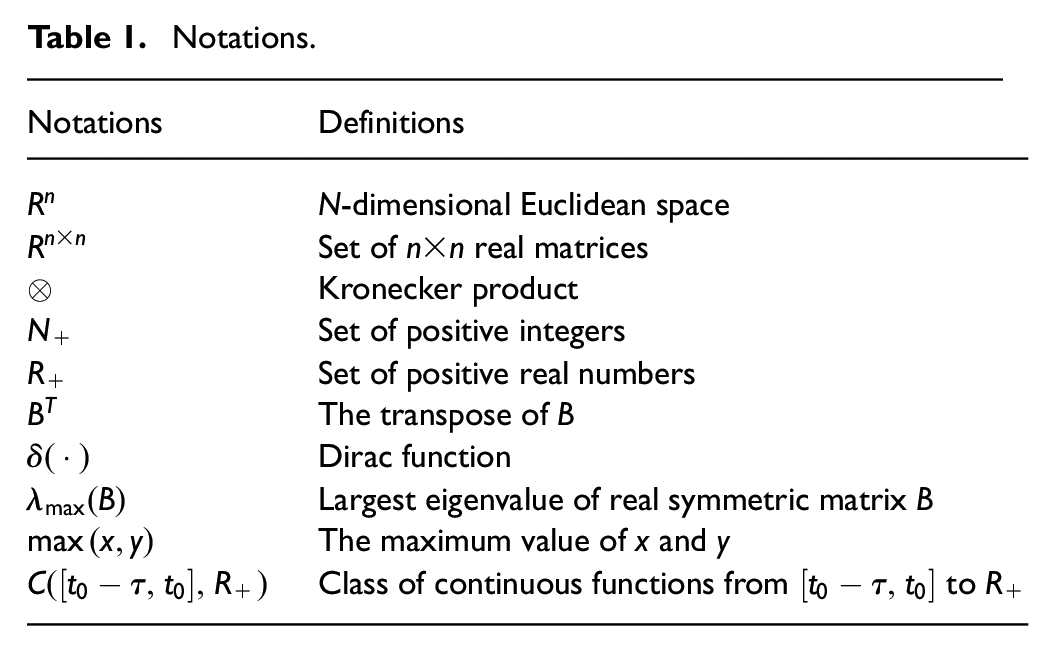
The effect of edge-based attacks is analyzed, and two sufficient conditions are given for the consensus of the impulsive coupled delay system against edge-based attacks, respectively. Furthermore, the less conservative consensus criteria is derived by applying the general result to a typical star networks. Table 1 summarizes the meaning of notations used in this article.
Notations.
Model description
We consider the following NDSs with

where
Let

where
Recall that coupling is activated only at discrete time instants
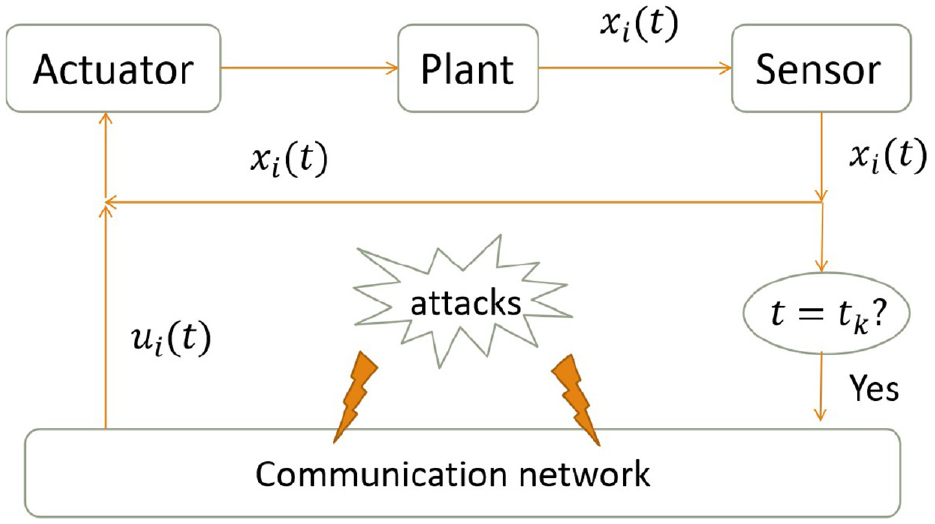
Block diagram of impulsive coupled NSs.
Suppose there is an attacker on each edge. Each attacker has its own attack strategy and is independent of the others. The purpose of edge-based attack is to undermine the consensus of the system. Hence, for node

For edge
Under edge-based attacks (3) and impulsive coupling (2), system (1) can be rewritten as
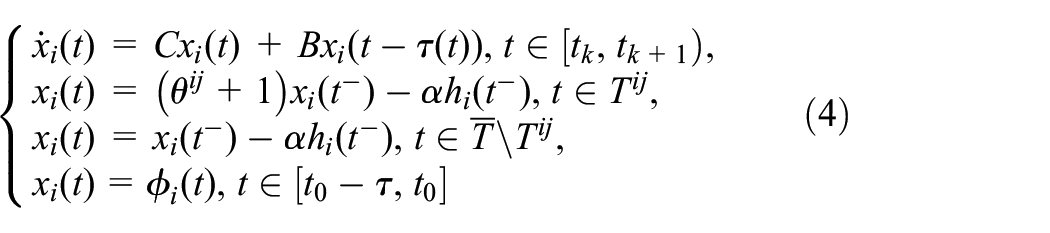
where

Further, system (4) can be written in the following form

Let
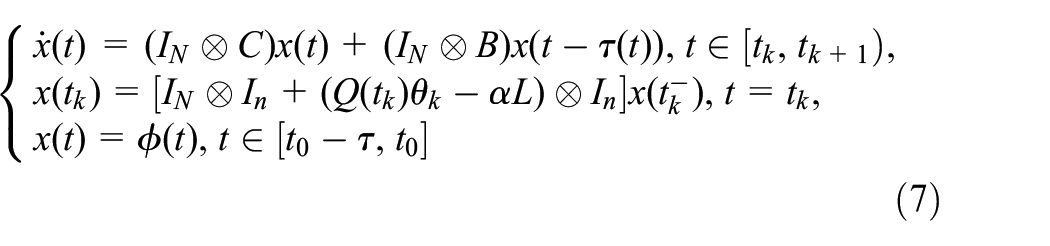
where
Main results

where

where
Proof. Construct the Lyapunov function

when
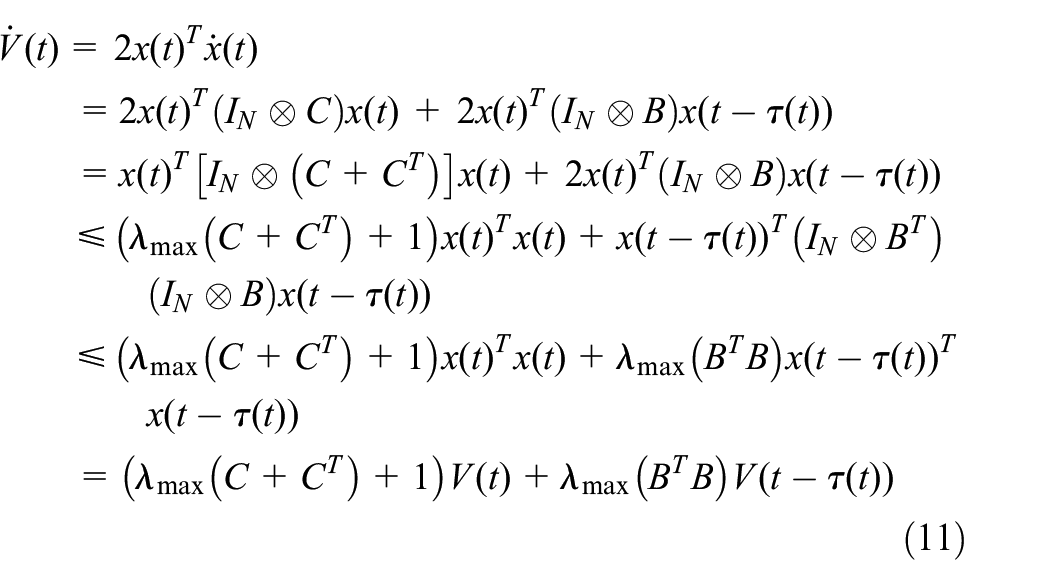
when
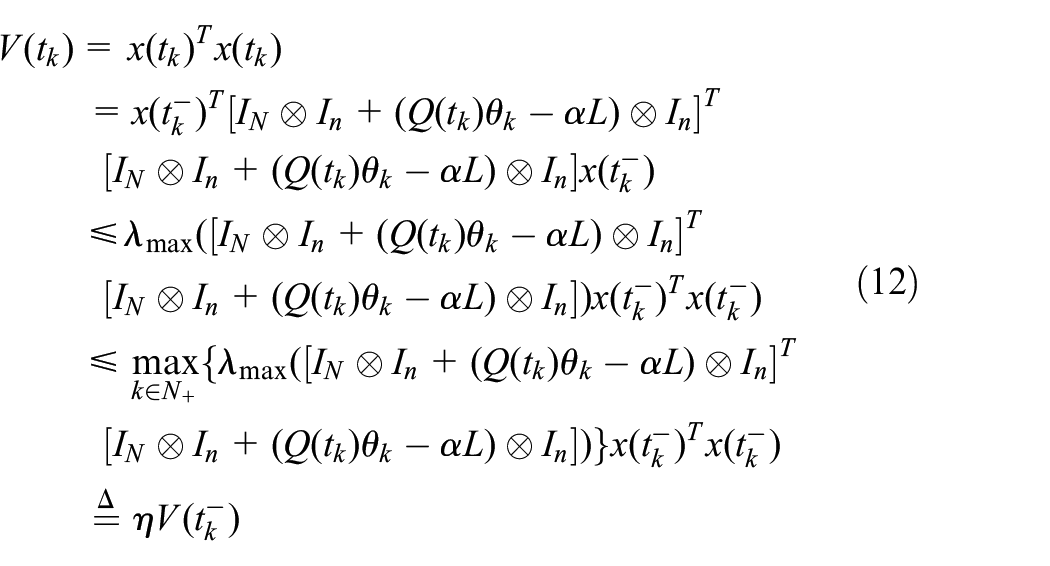
where
Combining equations (10), (11), and (12), we have
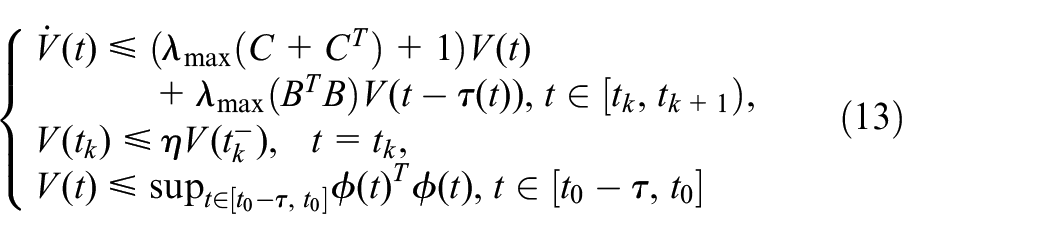
In the following, we will apply comparison principle to prove the theorem. Given
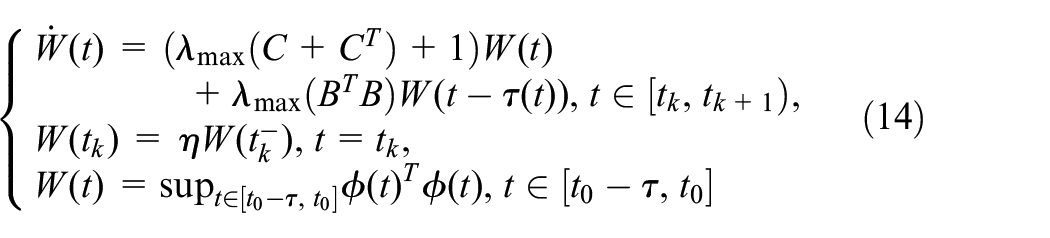
By the comparison principle, one has

The solution of system (14) is as follows
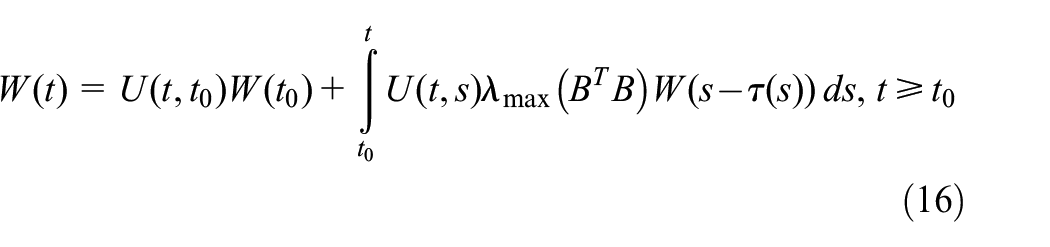
where

where
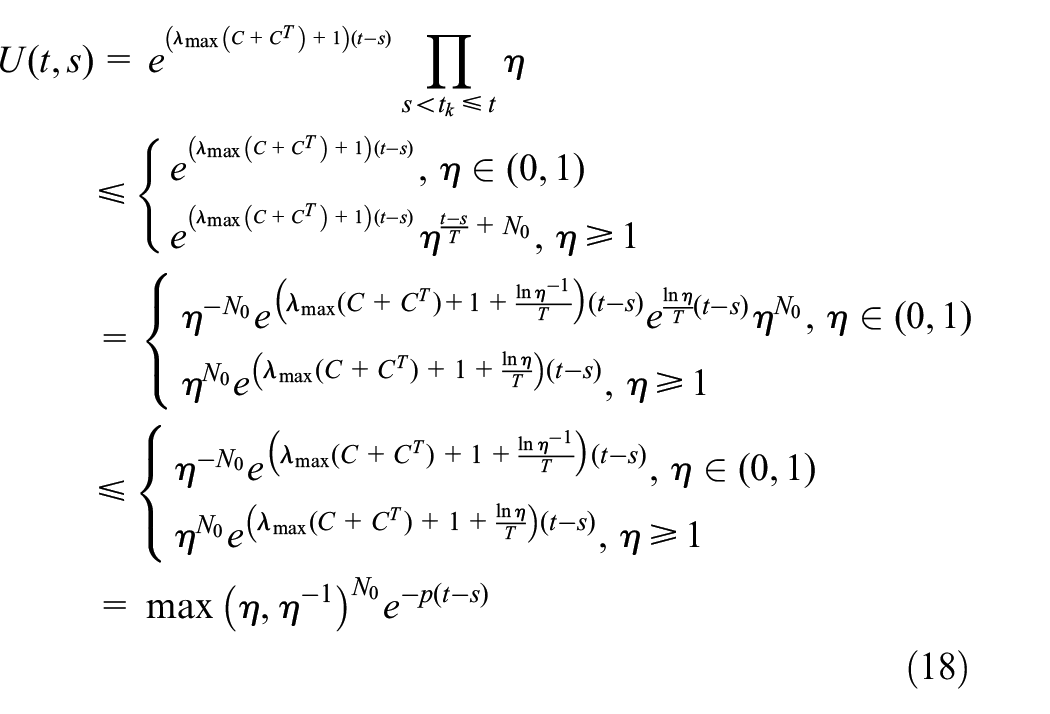
where
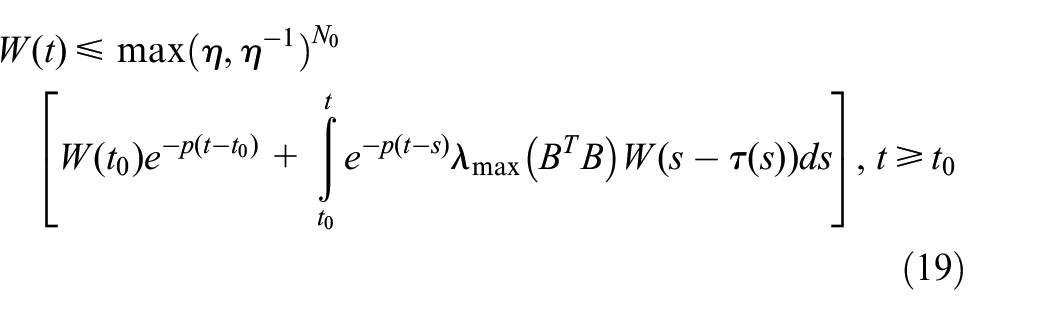
When

where
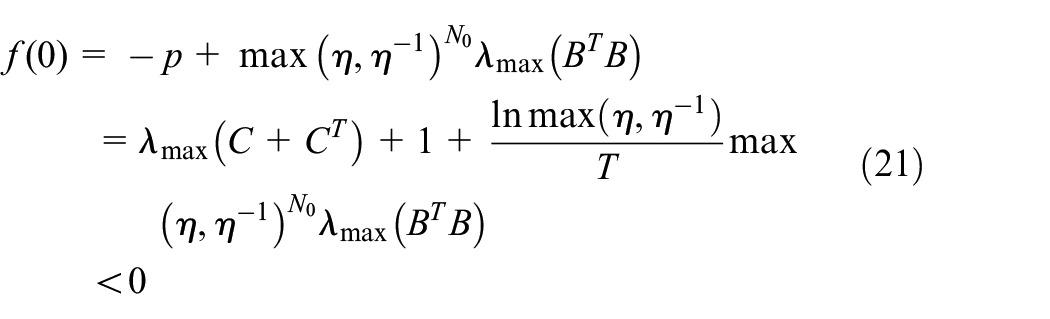
On the other hand,
Next, we prove that the following inequality is true

Assume equation (22) is not true. By equation (20) and

and

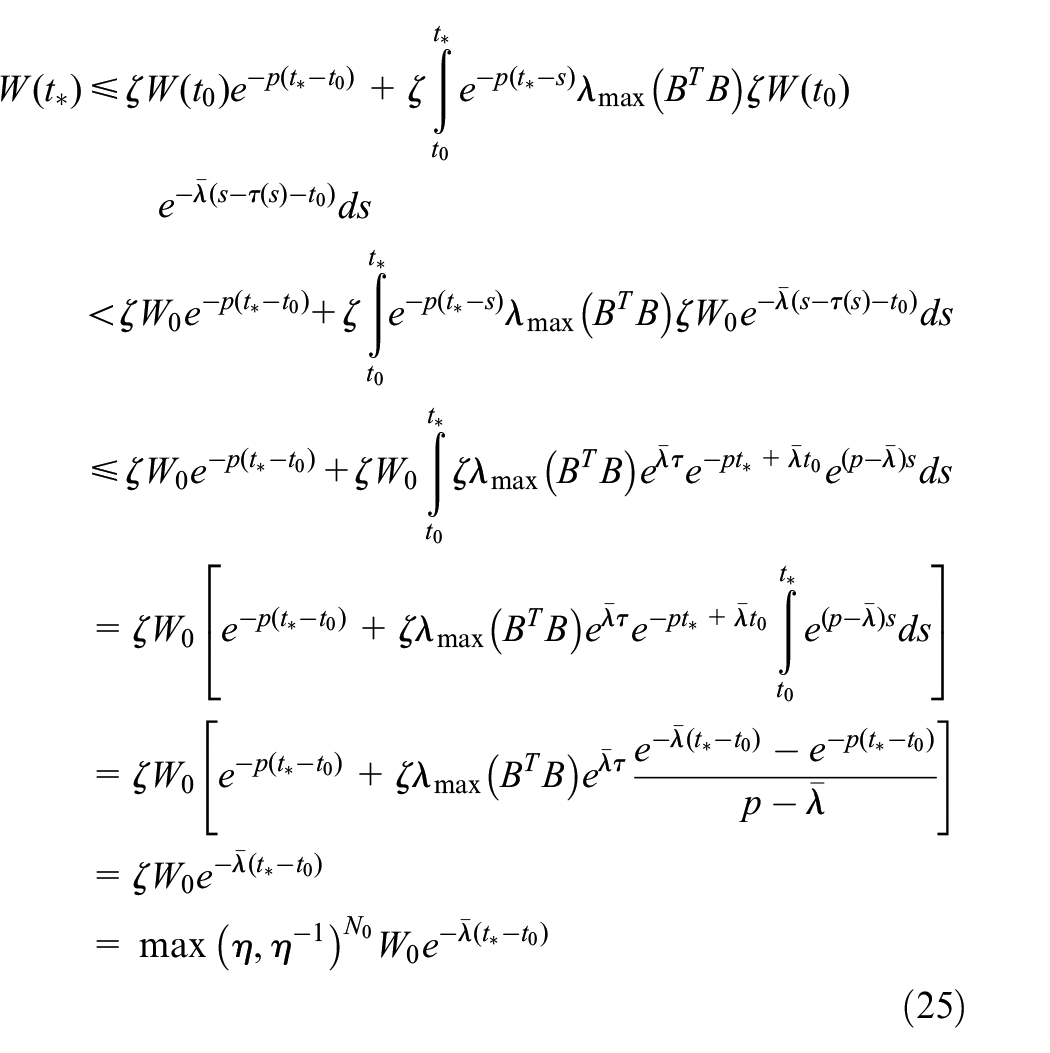
Denote
where

By

Hence, one has

Further, we have

where
Proof. When

where

Hence, it can be obtained that

Here,
In Theorem 1, it has been proved that system (1) can achieve consensus under certain conditions. However, it is required that at most one edge is attacked by an attacker at each impulsive coupling time instant. In the following, we shall consider a more general case where attackers are allowed to attack the multiple edges simultaneously. It should be addressed that the state of the node will produce greater mutations if this node suffers several attacks at the same time.

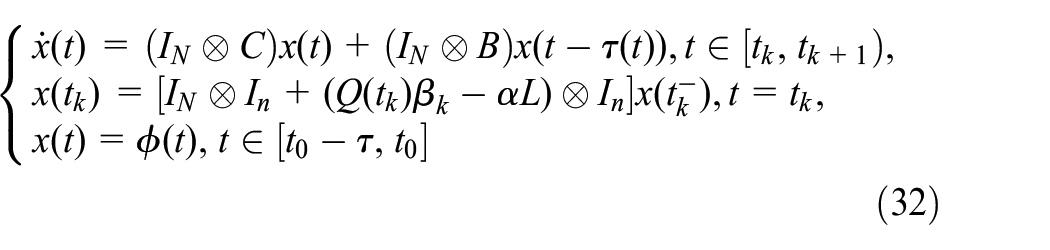
Similar to the previous section, we also introduce the function
where
Based on the above analysis, the following Theorem 2 can be obtained.

where
The proof of this theorem is similar to the proof of Theorem 1. Hence, it is omitted here.
As discussed in Remark 5, the estimation of
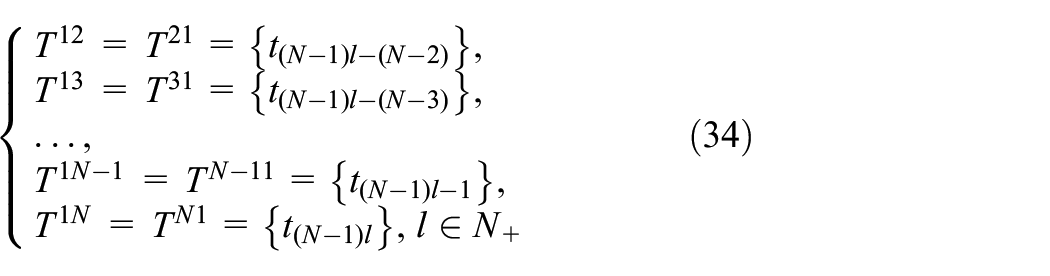
Consider NDSs with
and

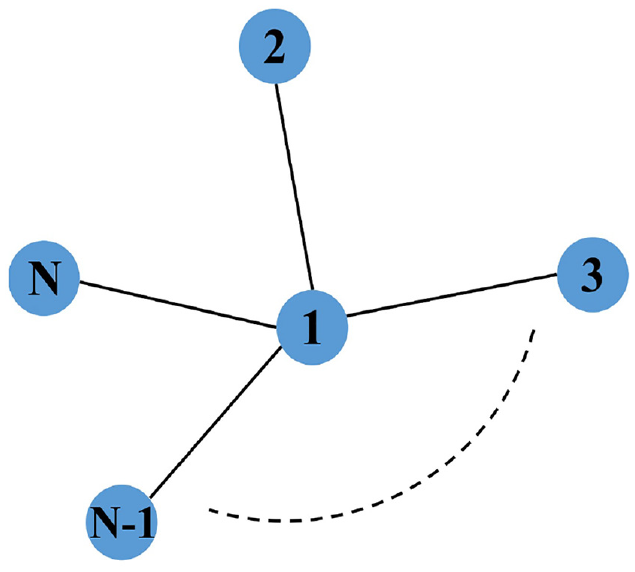
The structure of a star network.

where
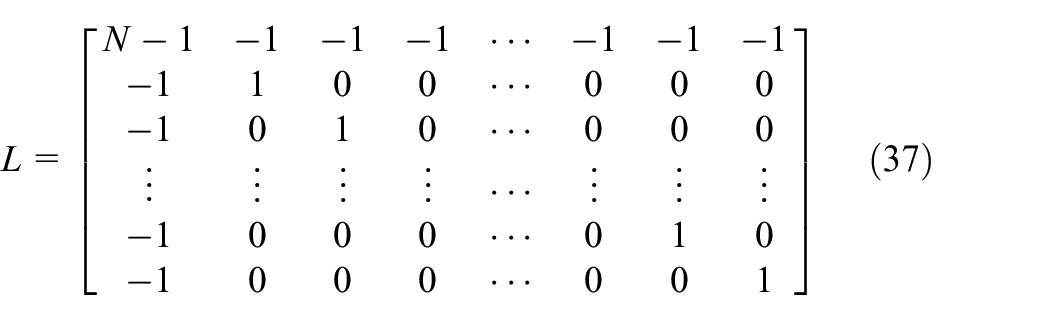
Proof. The Laplacian matrix
According to Assumptions 1 and 2, the dynamics of the system can be written as follows
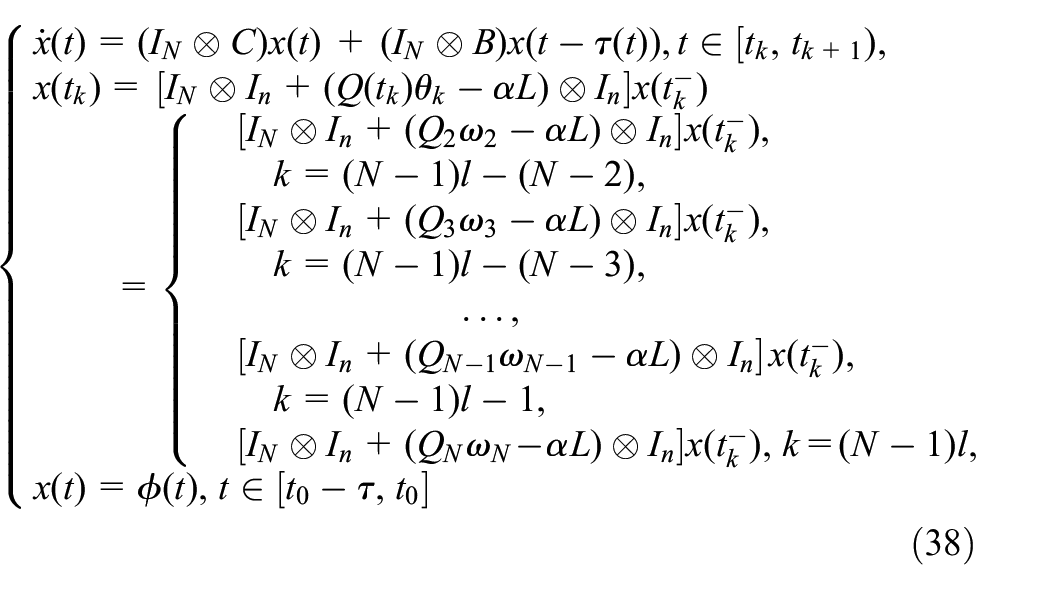
where
Construct the Lyapunov function
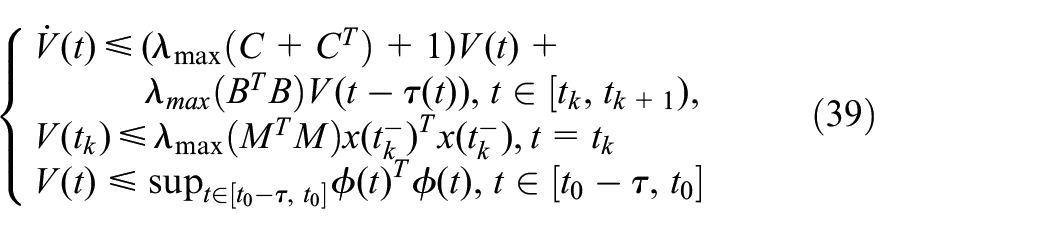
where
In the following, we will calculate
where
According to the semidefinite property of matrix

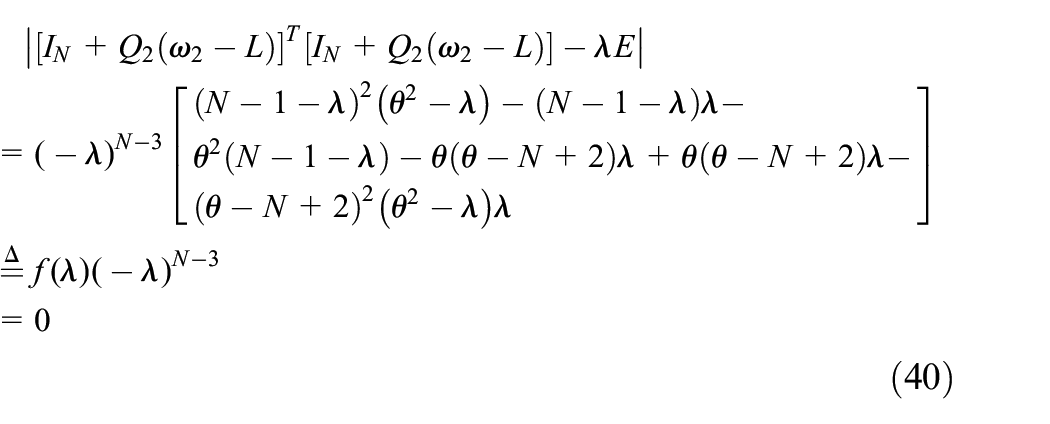
where

By equations (41) and (42), equation (39) can be rewritten as
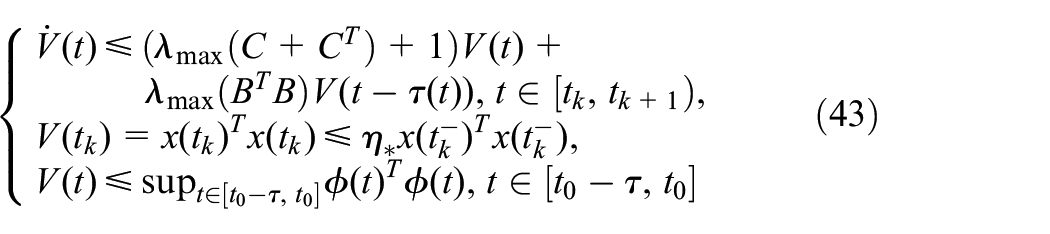
where
Numerical simulation

Select the attack sequence as shown in Figure 3, where
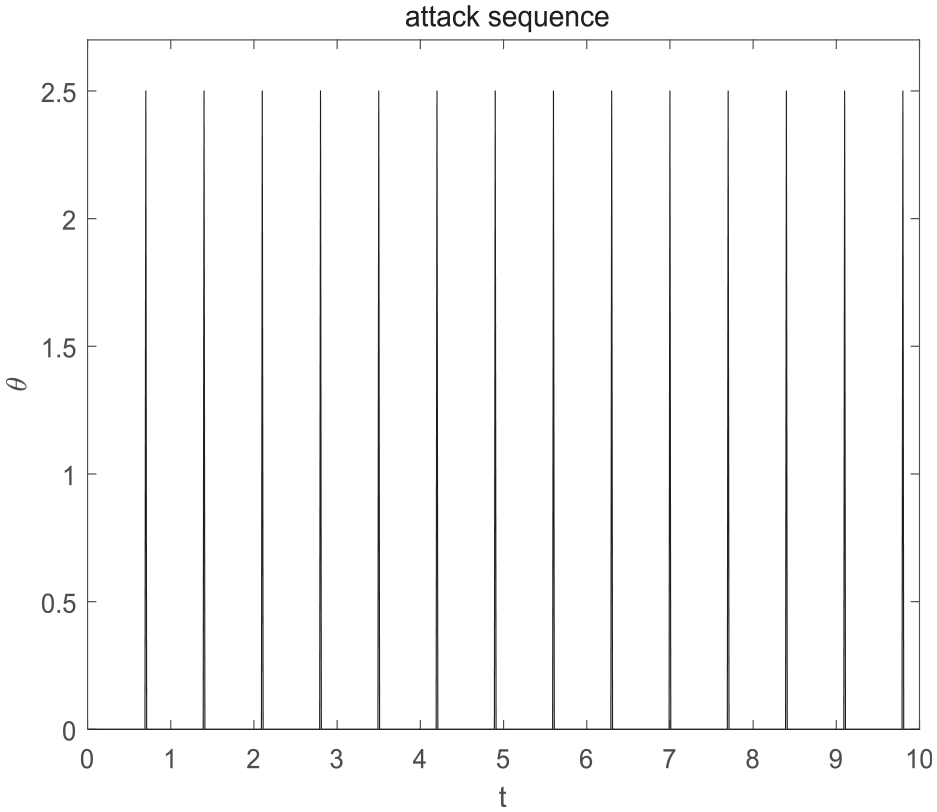
The attack sequence with
By simple computation, it can be obtained that
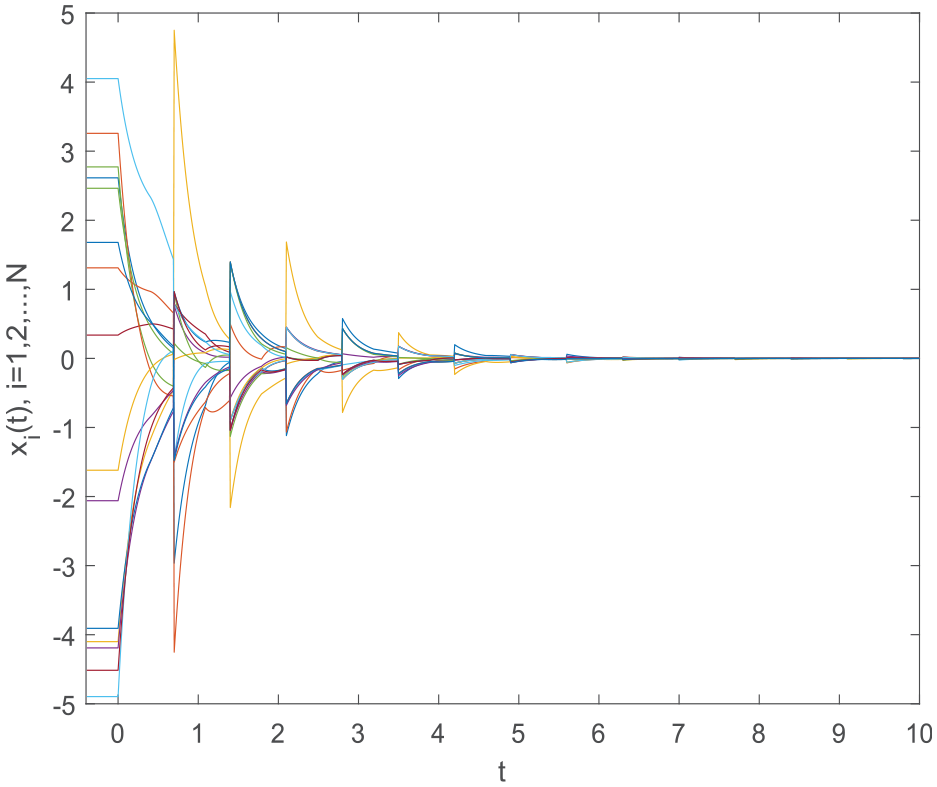
The trajectories of all nodes under the attack sequence with
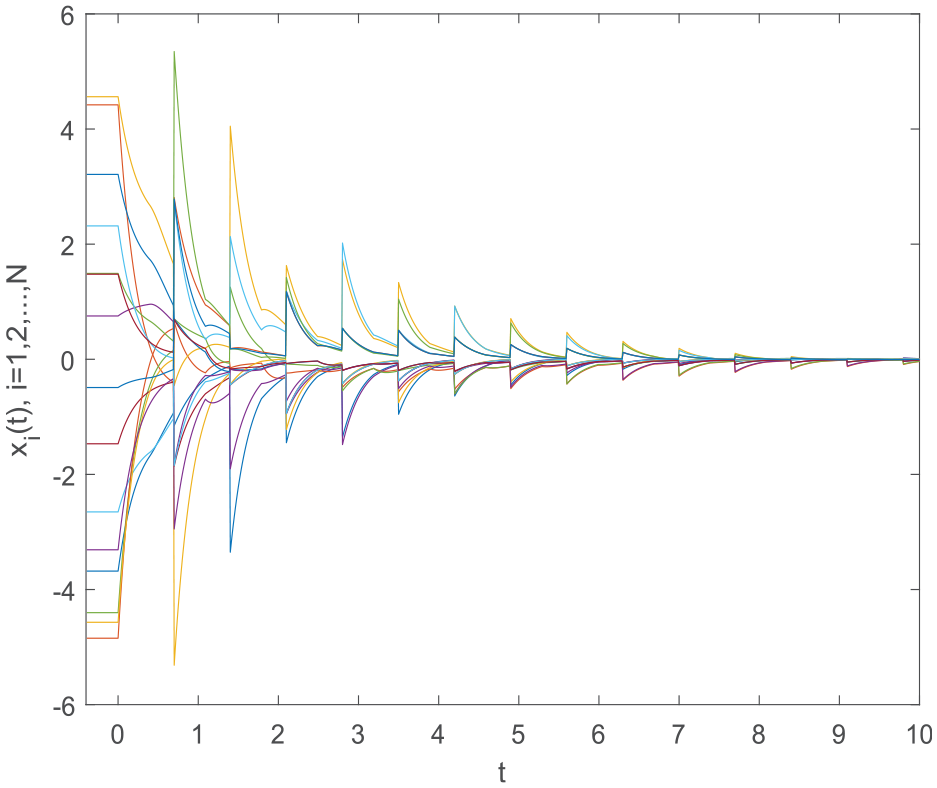
The trajectories of all nodes under the attack sequence with
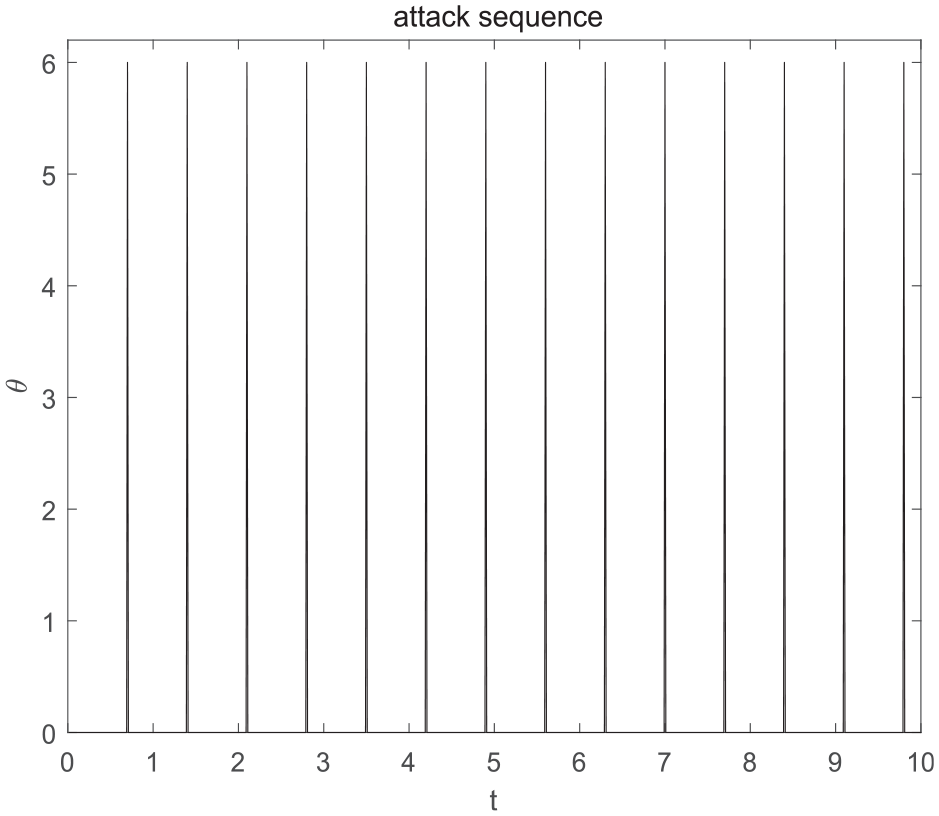
The attack sequence with
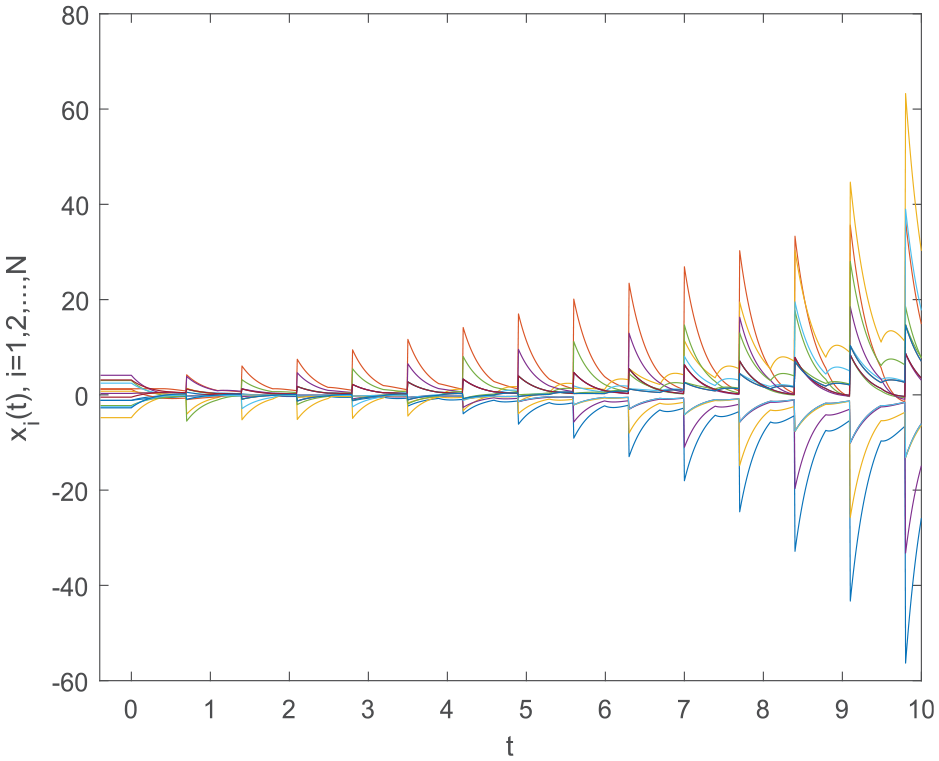
The trajectories of all nodes under the attack sequence shown in Figure 6.
To test the effect of time delay
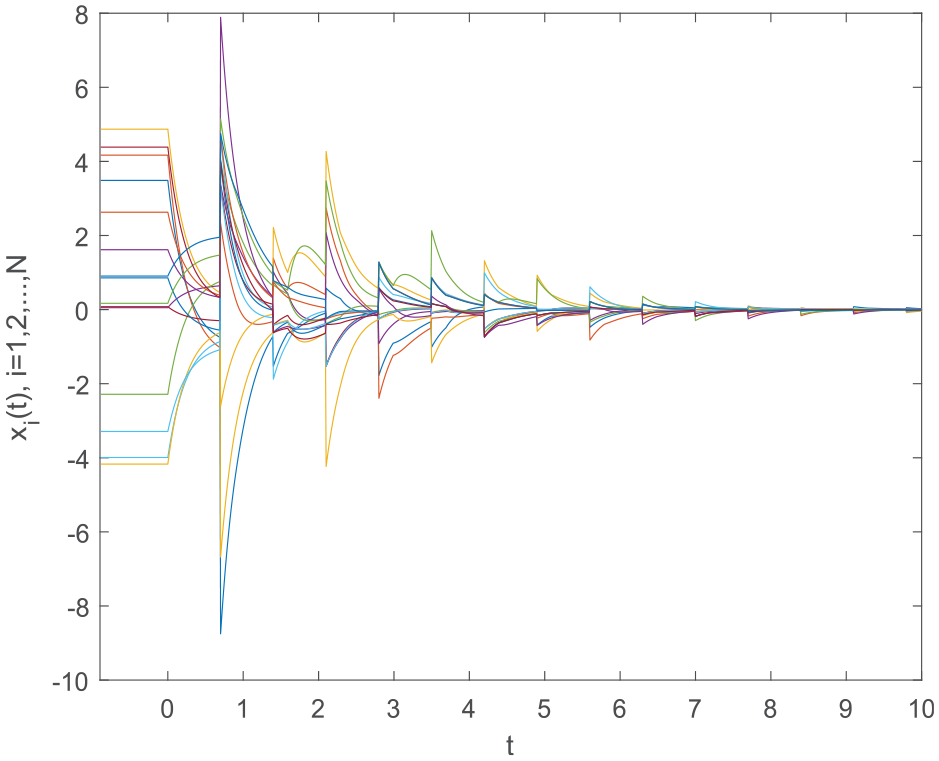
The trajectories of all nodes under the attack sequence shown in Figure 3 and
Select
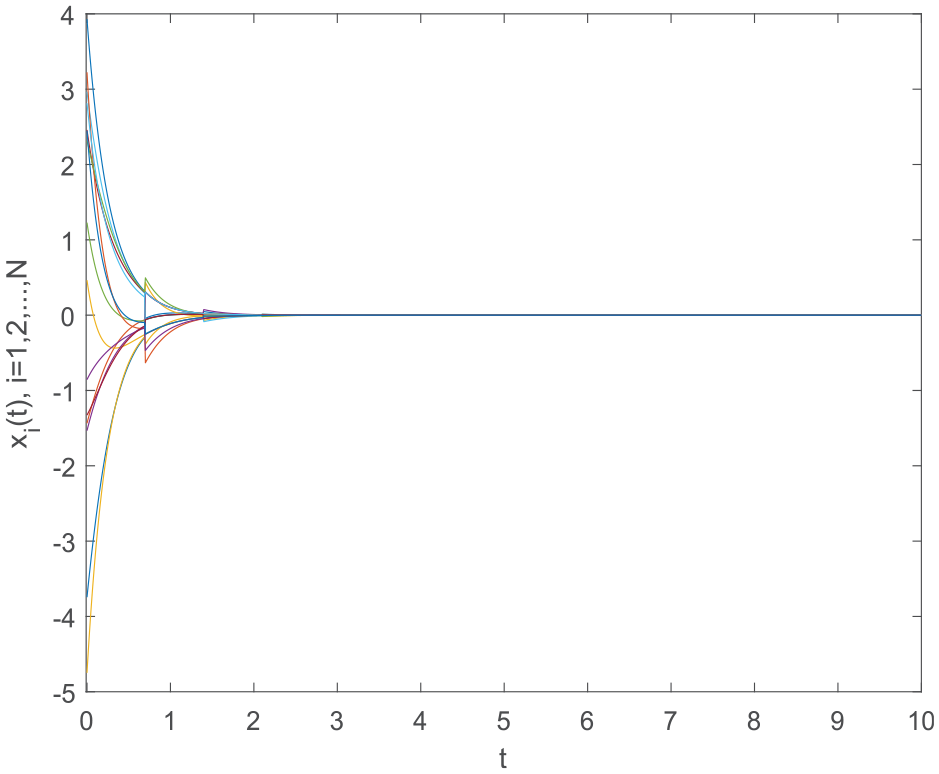
The trajectories of all nodes under the attack sequence shown in Figure 3 and
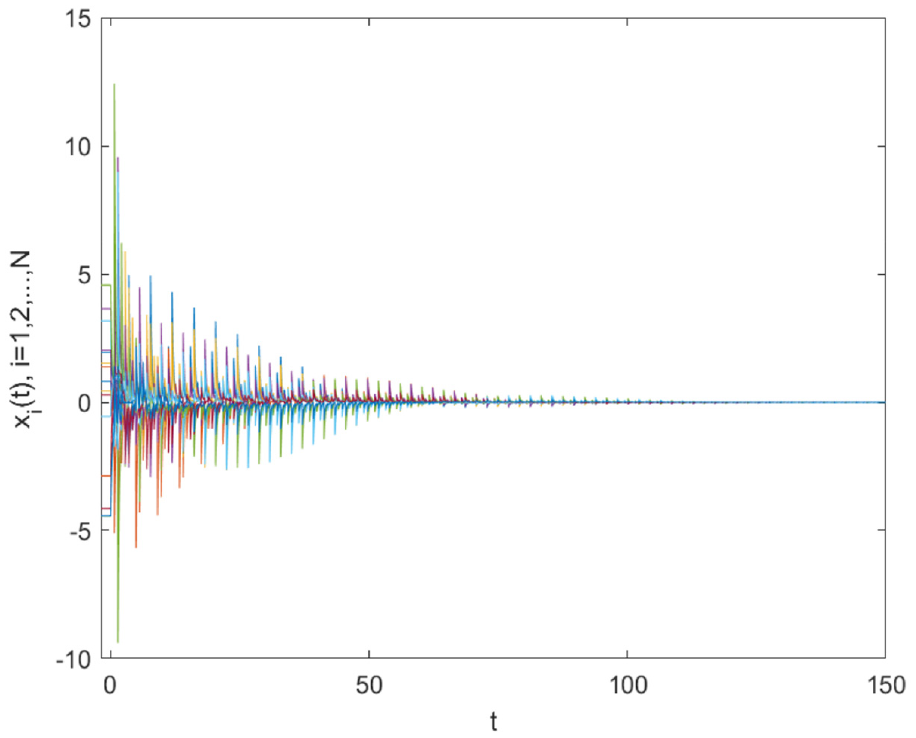
The trajectories of all nodes under the attack sequence shown in Figure 3 and
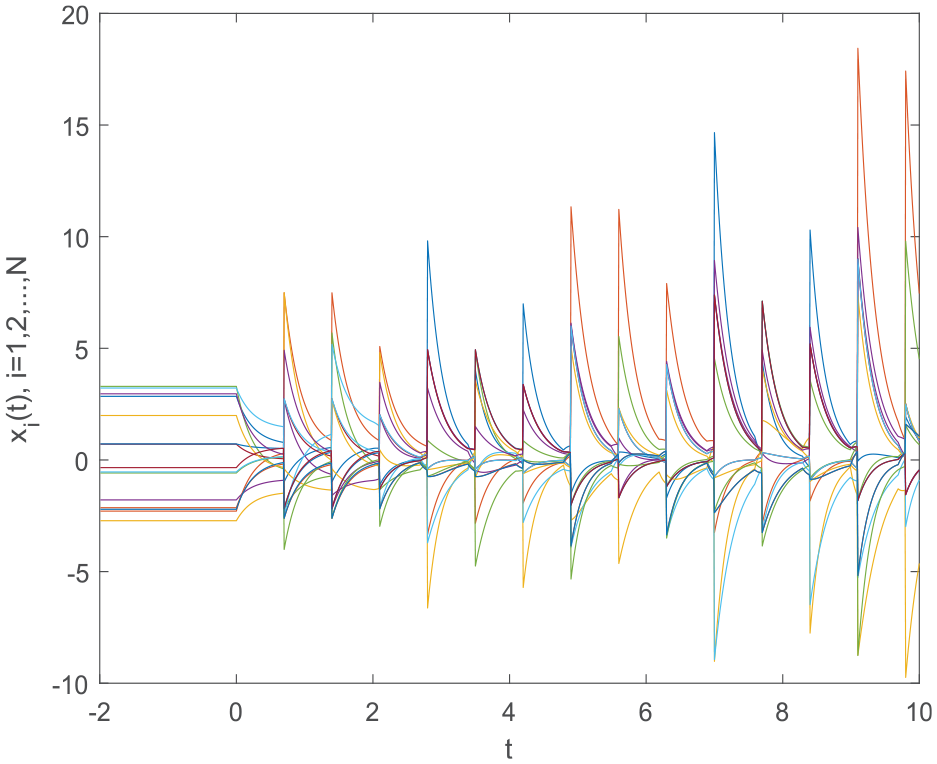
The trajectories of all nodes under the attack sequence shown in Figure 3 and
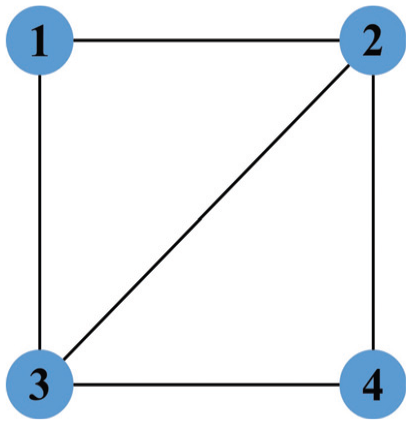
The structure of the network in Example 2.
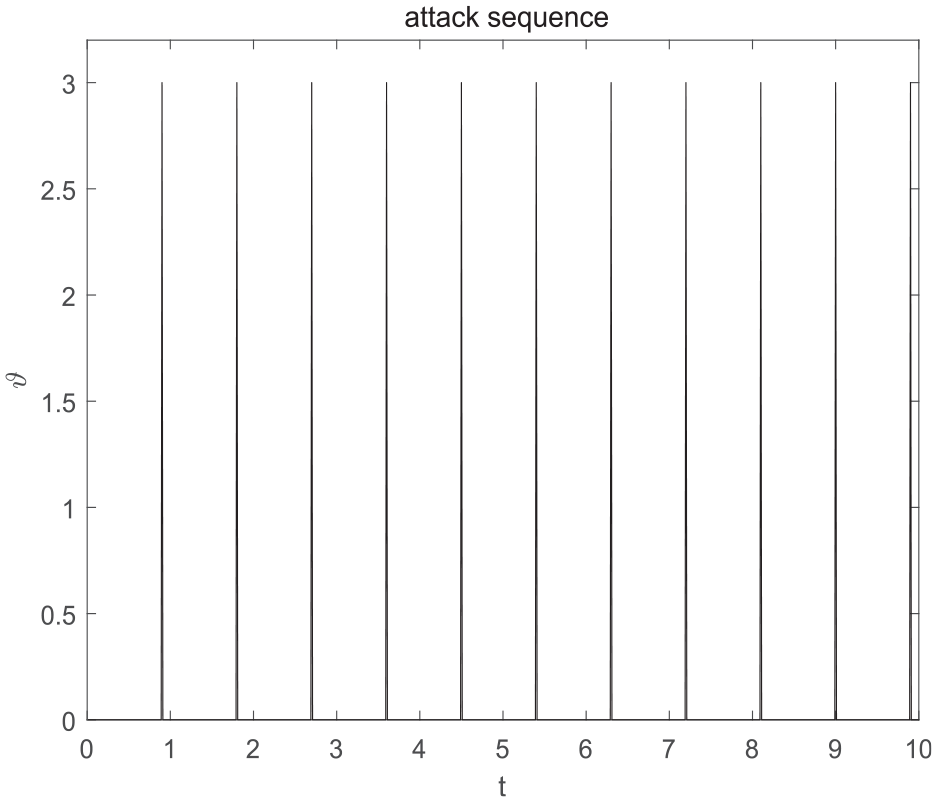
The attack sequence with
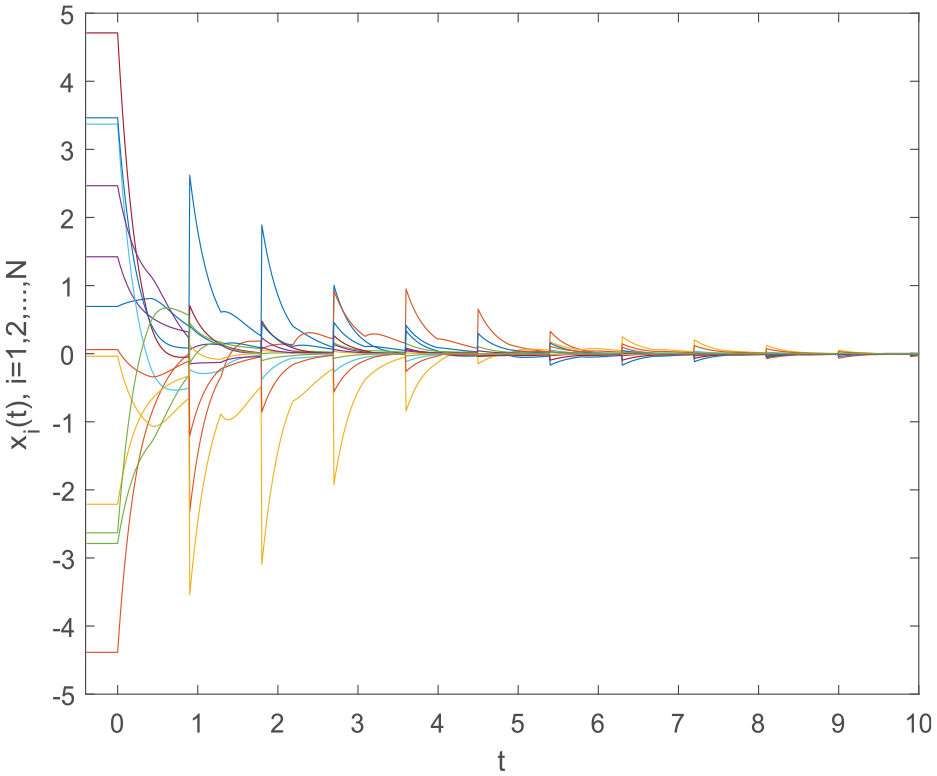
The trajectories of all nodes under the attack sequence shown in Figure 13.
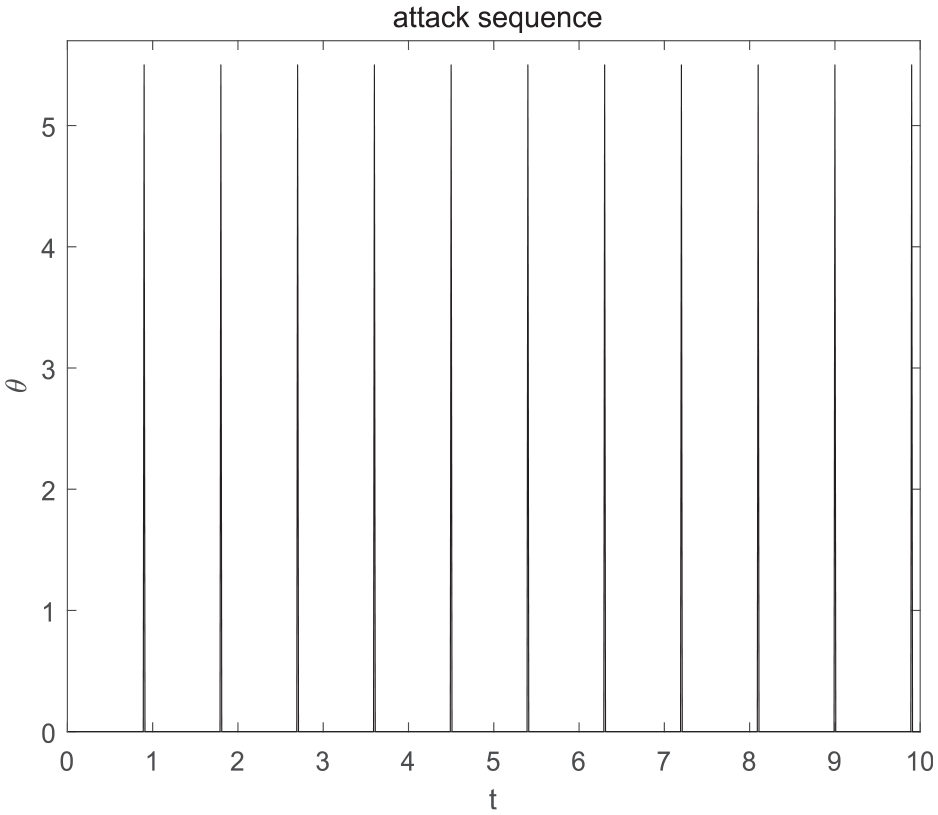
The attack sequence with
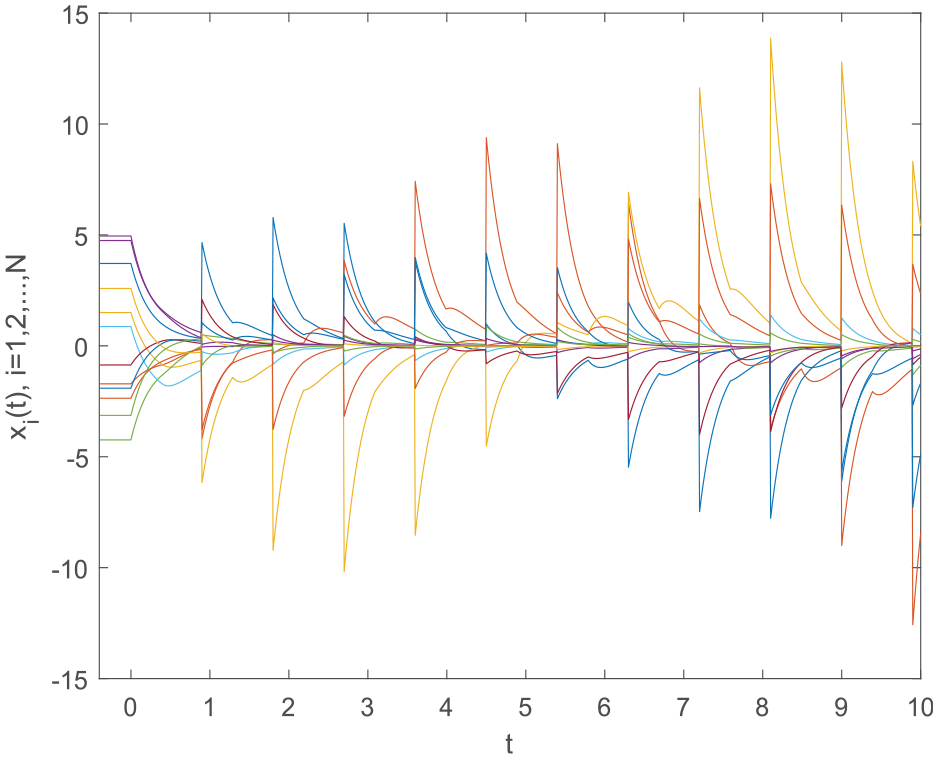
The trajectories of all nodes under the attack sequence shown in Figure 15.
To test the effect of coupling gain
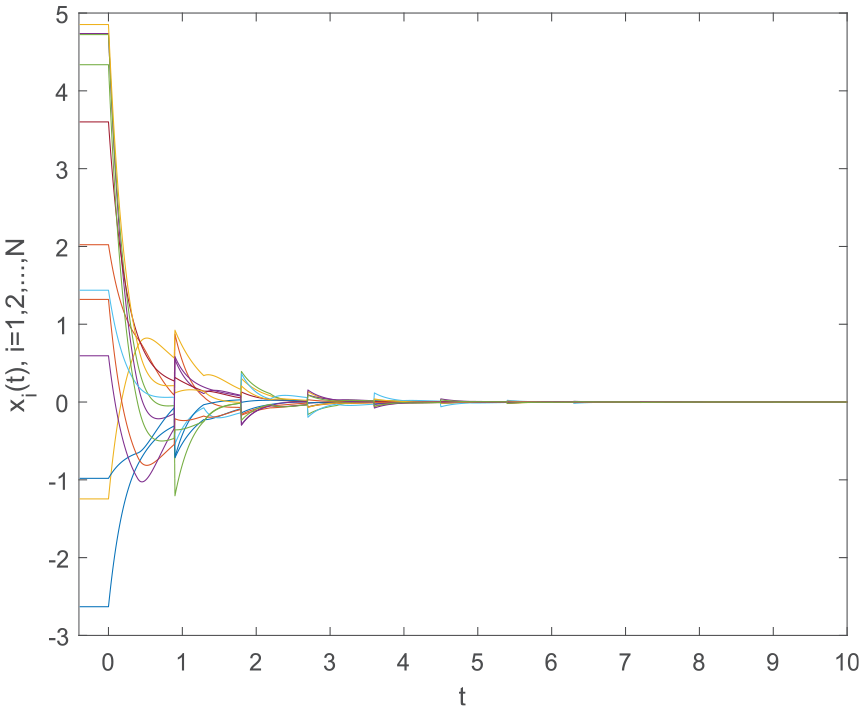
The trajectories of all nodes under the attack sequence shown in Figure 13 and
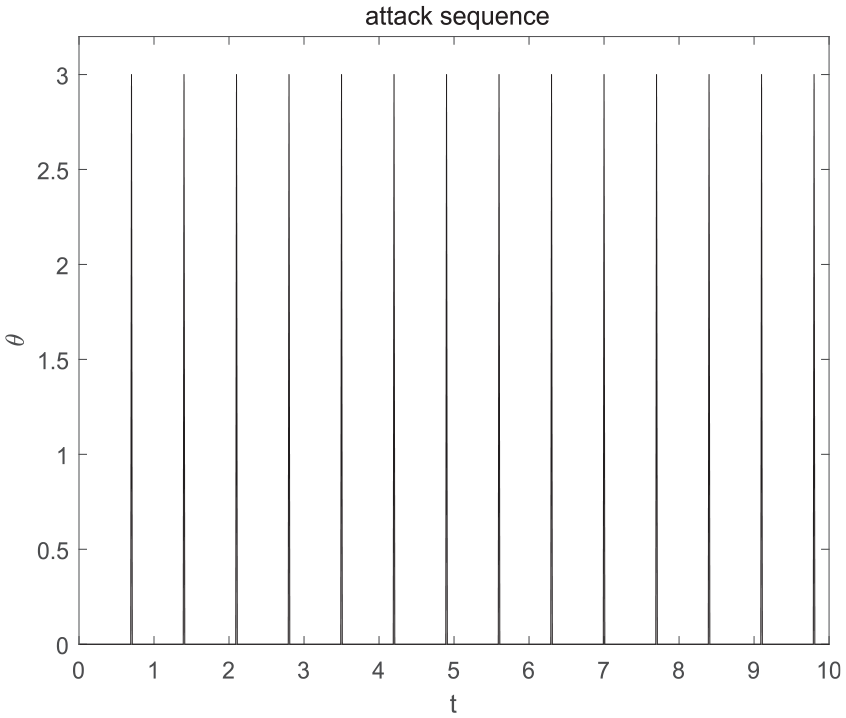
The attack sequence with
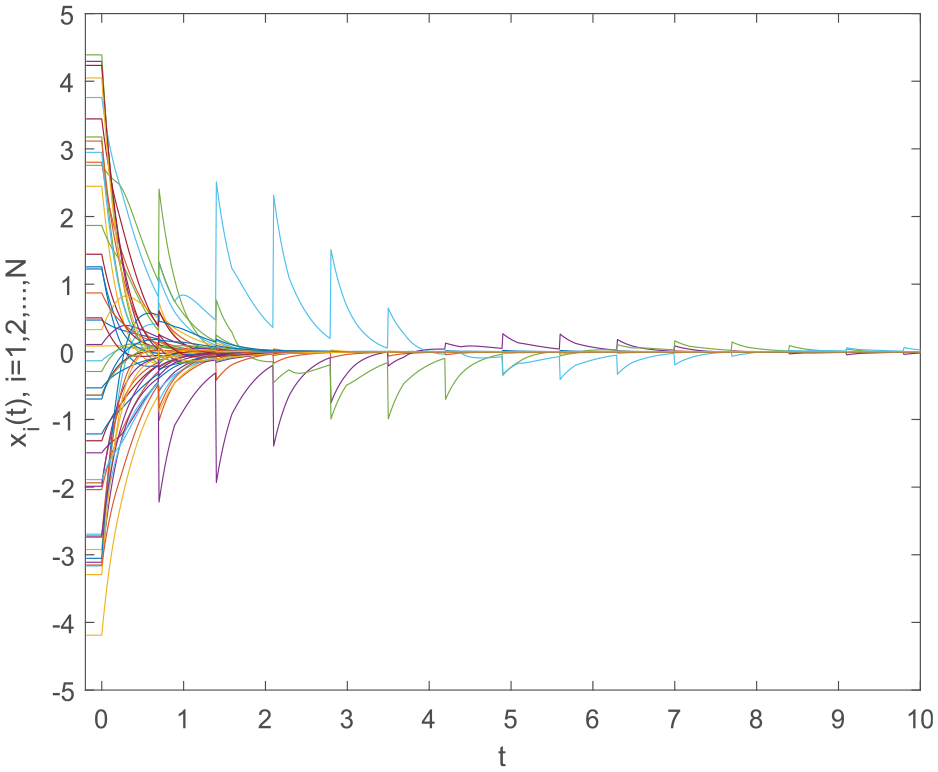
The trajectories of all nodes under the attack sequence shown in Figure 18.
Conclusion
This paper has studied the consensus of impulsive coupled NDSs under edge-based attacks. The attack here can not only change the state of system nodes but also is asynchronous, which is different from most previous works. The attack strategies are divided into two cases, that is, only one edge is attacked and multiple edges are allowed to be attacked at one impulsive coupling time instant. By investigating the two cases of edge-based attacks, sufficient conditions for system consensus are given, respectively. In addition, the results have been applied to special edge-attacked NDSs with star network topology and a less conservative consensus criterion is obtained. Finally, the correctness of the results are illustrated by three numerical examples. In the future, we will take communication delays into account in the networked delayed systems. In addition, it is also interesting to consider communication delays and other types of asynchronous attacks including DoS attacks and deception attacks in NSs.
Footnotes
Declaration of conflicting interests
The author(s) declared no potential conflicts of interest with respect to the research, authorship, and/or publication of this article.
Funding
The author(s) disclosed receipt of the following financial support for the research, authorship, and/or publication of this article: This work was supported by the National Natural Science Foundation of China (grant number: 61503115).
