







Abstract
This paper addresses the problem of event-triggered control for networked control systems (NCSs) under stochastic denial-of-service (DoS) attacks. A Markov DoS attack model with uncertain probabilities is proposed to describe the impact of the current DoS attack occurrence on the subsequent step while considering the randomness and uncertainty of attack probabilities. Moreover, a DoS-attack-dependent event-triggered mechanism (DADETM) is designed dependent on the occurrence of DoS attacks to avoid ineffective triggering behavior during DoS attacks active period. The DADETM is only triggered during the DoS attacks sleep period, thereby saving communication resources. Subsequently, the controller under DADETM is designed and sufficient conditions ensuring asymptotic mean-square stability of the closed-loop system are derived by utilizing the piecewise Lyapunov functions (PLFs). Finally, the effectiveness of the proposed method is demonstrated through simulations of a networked double-sided linear switched reluctance machine (DLSRM) system.
Keywords
Introduction
With the advancement of network communication and computer technologies, networked control systems (NCSs) have become a prominent research focus in the field of industrial control (Shaukat et al., 2018). Due to the advantages of ease of maintenance, and efficient information transmission, NCSs have been widely applied in many practical areas in recent years, such as smart grids, automotive manufacturing, and military systems (Dong and Kim, 2014; Zhuang et al., 2025). However, the complex network structures and numerous control devices have also introduced significant challenges, such as security threats (Wang et al., 2019; Zhang and Zheng, 2018) and limited network transmission resources (Li and Chen, 2019). These challenges may not only degrade the performance of NCSs but also result in system instability.
Network attack is a critical factor compromising network security, constituting one of the most significant challenges faced by NCSs (Shen et al., 2019). Generally, network attacks can be categorized into deception attacks (Ding et al., 2018b; Ge et al., 2019; Pasqualetti et al., 2013) and denial-of-service (DoS) attacks (Lu and Yang, 2018; Qu and Zhao, 2023; Zhang and Feng, 2021; Zhang et al., 2020). Deception attacks operate by injecting false data, thereby compromising the accuracy of the data. DoS attacks compromise network functionality by flooding the communication channel with redundant data, effectively blocking the transmission of normal data packets. Due to the simplicity of the required conditions and the high destructive potential, DoS attacks have become one of the most threatening types of network attacks. To facilitate the study of security control issues under DoS attacks, current research employs various methods to describe the occurrence of DoS attacks. In Wang and Feng (2023), the occurrence of DoS attacks is modeled using Bernoulli variables. In De Persis and Tesi (2015), the attack situation is described using the frequency and dwell time of DoS attack sequences. However, the aforementioned mathematical models lack consideration of the impact of the current state of DoS attacks on future occurrences. Befekadu et al. (2015) employ a fully known probabilistic Markov model to describe the random interference of DoS attacks on data packets within the system. However, due to the unpredictability and complexity of DoS attacks, it is infeasible to fully track the occurrence of each attack step. To address this issue, this paper proposes a probabilistic uncertain Markov model to characterize the occurrence patterns of DoS attacks.
On the contrary, to save communication resources, the event-triggered mechanism has been proposed in Tabuada (2007). Unlike traditional systems transmitting data at fixed intervals, event-triggered mechanism determines the instant of information transmission based on desired objectives. This strategy allows signal transmission only when certain predefined event-triggered conditions are met, which significantly reduces the amount of transmitted data and thus saves communication resources (Ding et al., 2016, 2018c; Han and Lian, 2022; Li et al., 2019). Currently, there has been a significant amount of researches focused on determining suitable event-triggered conditions (Wang et al., 2025). For instance, Yang et al. (2020) establishes an event-triggered condition by determining whether the relative sampling error exceeds a designed threshold, while Liu et al. (2024) introduces an adaptive threshold combined with a weighted average of previous triggering instants to determine the occurrence of triggering events. However, most of these event-triggered conditions focus on the considering system, neglecting the impact of DoS attacks. Consequently, the typical event-triggered control approaches are no longer fully effective under such attacks, and event-triggered mechanism needs to be redesigned to address the challenge of DoS attacks.
Some studies have explored the design of event-triggered mechanisms for NCSs under DoS attacks. A resilient event-triggered communication scheme is proposed in Ni et al. (2024) and Peng et al. (2017), which allows for a certain level of packet loss caused by DoS attacks. Considering the characteristics of DoS attacks, Zhang et al. (2024) introduces a switching-like event-triggered mechanism (SETM) that adjusts the triggering conditions based on the occurrence of DoS attacks, thereby enhancing communication efficiency while ensuring system stability. However, in the above studies, the triggering signals emitted from the event generator cannot be transmitted normally through the communication channel due to the disruption caused by DoS attacks, rendering the “active” state of the event generator to be ineffective for the system. This phenomenon may result in waste of communication resources.
Based on the above discussions, this paper investigates the issue of event-triggered control for NCSs under DoS attacks. A DoS-attack-dependent event-triggered mechanism (DADETM) is established for NCSs to ensure the stability of the system under stochastic DoS attacks and to reduce the waste of communication resources. The main contributions of this paper are as follows:
A Markov model with uncertain transition probabilities is introduced to model stochastic DoS attacks, which does not require precise knowledge of the attack occurrence probabilities. Moreover, a new DADETM is proposed by taking into account the characteristics of DoS attacks, which is only triggered during the DoS attacks sleep period, reducing the waste of communication resources under DoS attacks active period. The event generator adjusts its operating mode based on acknowledgment character (ACK) signals generated by detecting the occurrence of DoS attacks.
A piecewise Lyapunov function (PLF) is constructed based on the characteristics of stochastic DoS attacks modeled by a Markov chain, and sufficient conditions are established to ensure the asymptotic mean-square stability (AMSS) of the system, while the controller under DADETM is designed.
The remainder of this paper is organized as follows. In section “NCSs under stochastic DoS attacks,” we describe the framework of NCSs subject to stochastic DoS attacks. In section “DADETM,” the DADETM based on the ACK detection mechanism is formulated. In section “Main results,” the main results of this paper are derived, including the derivation of sufficient conditions to ensure the AMSS of the closed-loop system under stochastic DoS attacks, as well as the corresponding controller design based on the DADETM. In section “Illustrative examples,” the effectiveness of the proposed method is demonstrated through a simulation. Finally, the conclusions are given in section “Conclusion and future work.”
Notations
In this paper, the transpose of a matrix A is denoted as
NCSs under stochastic DoS attacks
Considering the discrete-time system described as follows:

where
The framework of the NCSs under stochastic DoS attacks is illustrated in Figure 1. DoS attacks can block the transmission of signals to the controller. Considering the randomness and complexity of DoS attacks, the state on the communication channel under DoS attacks is modeled as follows:

where
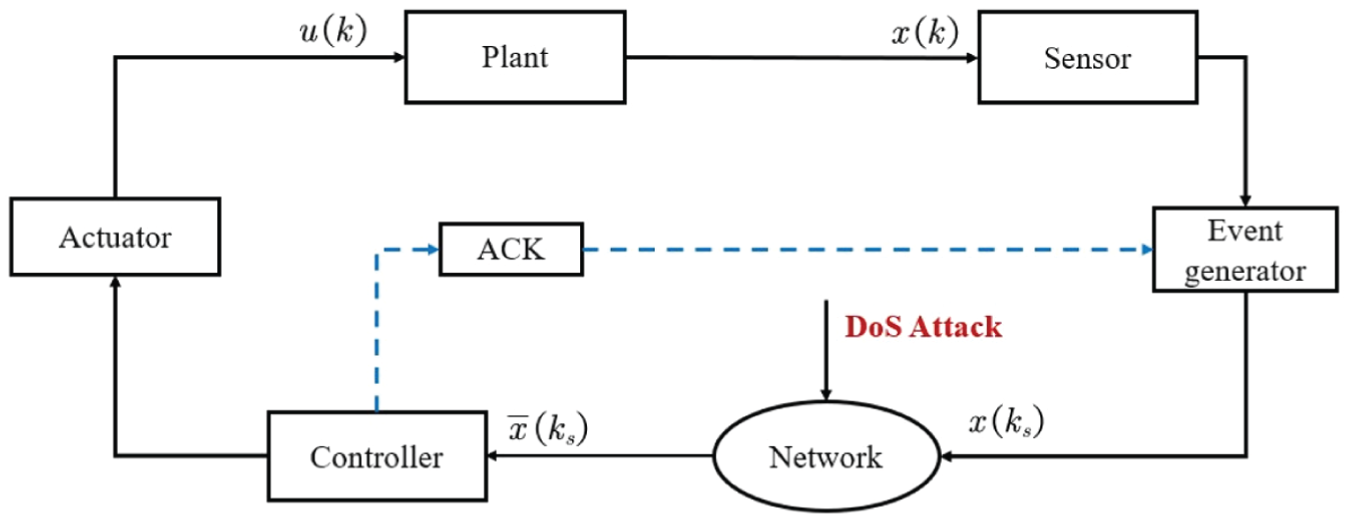
The framework of the system under stochastic DoS attacks and DADETM.
The stochastic DoS attacks are described by the stochastic process

where
Thus, it is assumed that the probability

where


Based on the above considerations, the controller for stochastic DoS attacks modeled by a Markov chain is designed as follows:

Then, the NCSs under stochastic DoS attacks, which are modeled as a Markov chain, are described as follows:

DADETM
DoS attacks can block communication channels and lead to packet loss. According to Coutinho et al. (2023), the transmission of triggered signals to the controller is disrupted during the active period of DoS attacks, thereby causing ineffective triggering behavior in the system.
To avoid invalid triggering when the DoS attack is active, this paper designs the DADETM considering the characteristics of DoS attacks and aiming at mitigating the associated wastage of triggering resources. In this framework, the event-triggering behavior is activated only when DoS attacks are detected, with DoS attacks identification achieved through an ACK mechanism.
At each transmission instant, the ACK mechanism detects whether packet loss is caused by DoS attacks. The ACK signal is defined as follows:

In DADETM, if ACK = 1, the DoS attack is in the sleep period, and the event generator checks whether the triggering condition is satisfied. If ACK = 0, the DoS attack is in the active period, and no triggering behavior occurs in the event generator.
DADETM is described as follows:

where

The data transmission instants under the DADETM.
Furthermore, after the termination of a DoS attack, the event generator still relies on the triggering instants from the previous sleep period for judgment, which introduces latency in the triggering condition. Hence, the event generator is configured to trigger once immediately after the termination of DoS attacks, allowing the controller to promptly update its data and thereby mitigating the impact of DoS attacks on the system.
The controller based on the DADETM is written as follows:

Based on the above analysis, combining equations (8), (10), and (11), the closed-loop NCS model is rewritten as follows:

Considering whether the attack occurs or not, then, (12) can be further expressed as follows:



holds for all

Main results







where
Illustrative examples
In this section, a networked DLSRM system is considered to thoroughly demonstrate the validity of the proposed theoretical results. The networked DLSRM system is presented in reference Qiu et al. (2016), and the coefficient matrix of the state equation for the system is as follows:

For the networked DLSRM system under stochastic DoS attacks, we consider
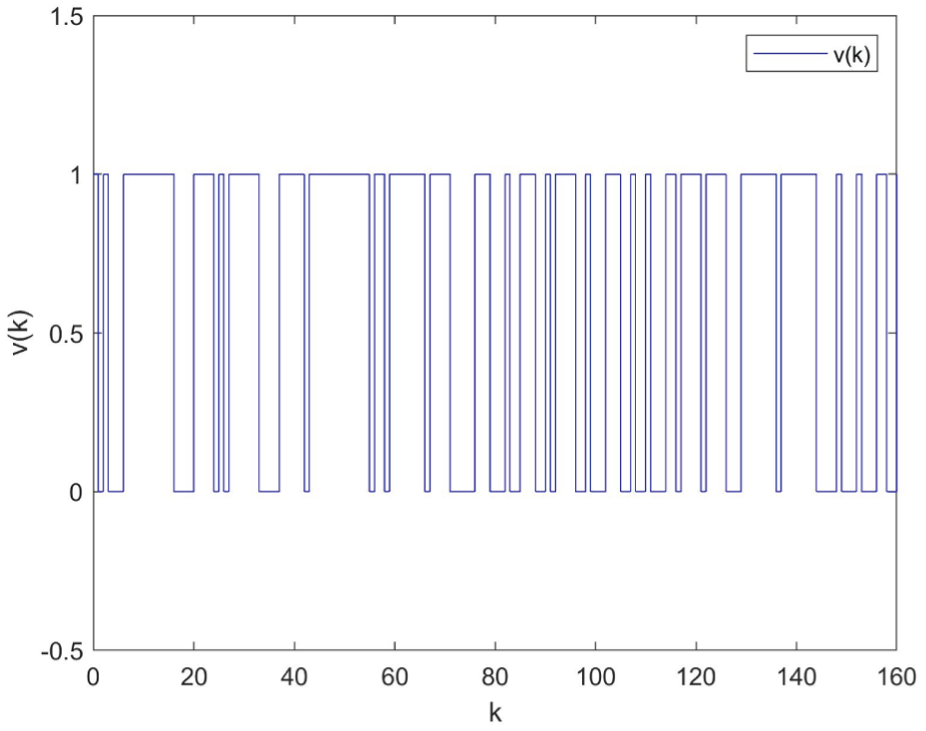
Stochastic DoS attacks modeled as a Markov chain.
By the conditions of Theorem 1, the controller gain K and the event-triggered weighting matrix Ω can be calculated as:

Meanwhile, the matrices

With the initial state of the system is
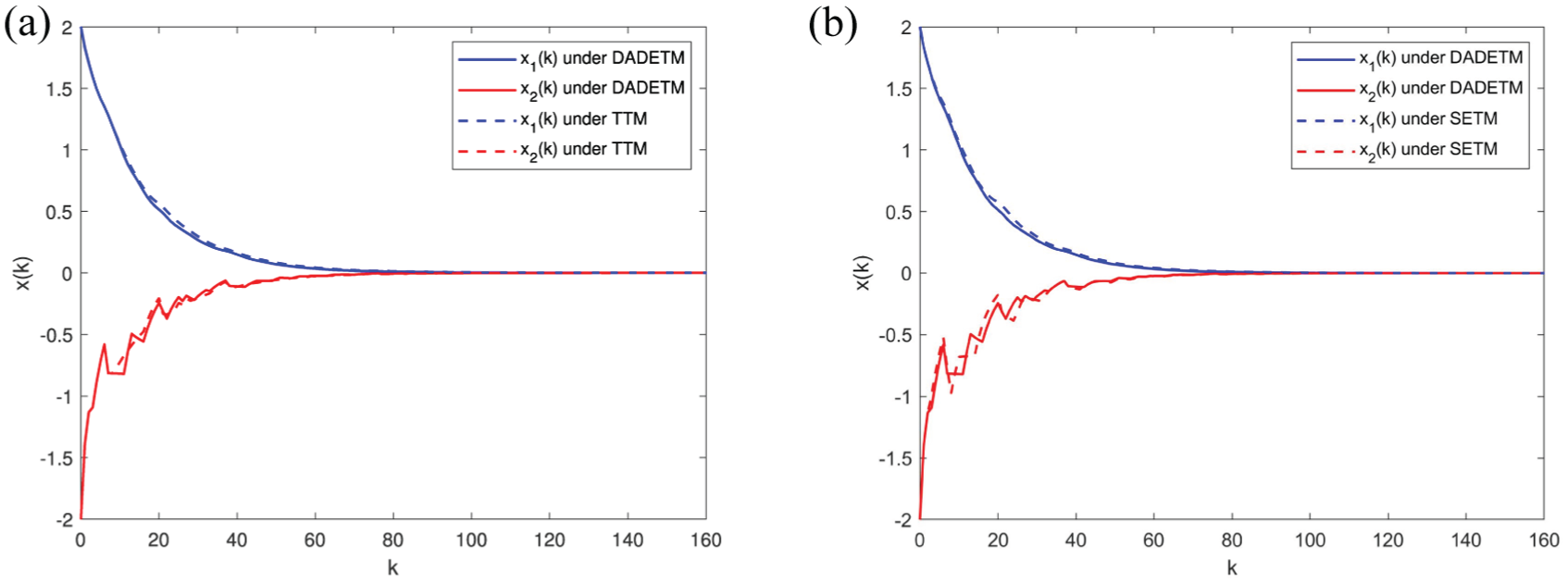
State trajectories under stochastic DoS attacks with different triggering mechanisms. (a) DADETM and TTM. (b) DADETM and SETM.
By adopting the proposed DADETM, the release intervals are shown in Figure 5, in which the triggering number is 52. It can be observed that no release instants occur during the active periods of DoS attacks, thereby reducing the number of triggering events.
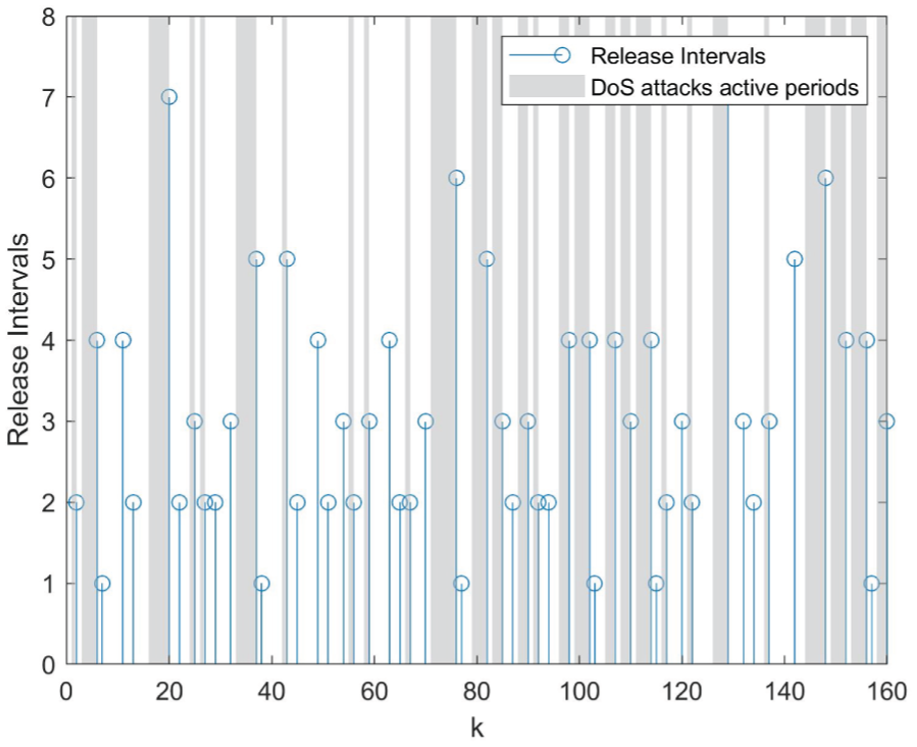
Release intervals under DADETM.
To further demonstrate the effectiveness of the proposed DADETM, we compare it with the time-triggered mechanism (TTM) and the SETM proposed in Peng and Sun (2020).
The TTM exchanges information over the communication network in a periodic manner. In contrast, the SETM adopts an ACK detection mechanism to dynamically adjust the triggering variable μ based on the occurrence of DoS attacks. Specifically, the triggering variable is set to
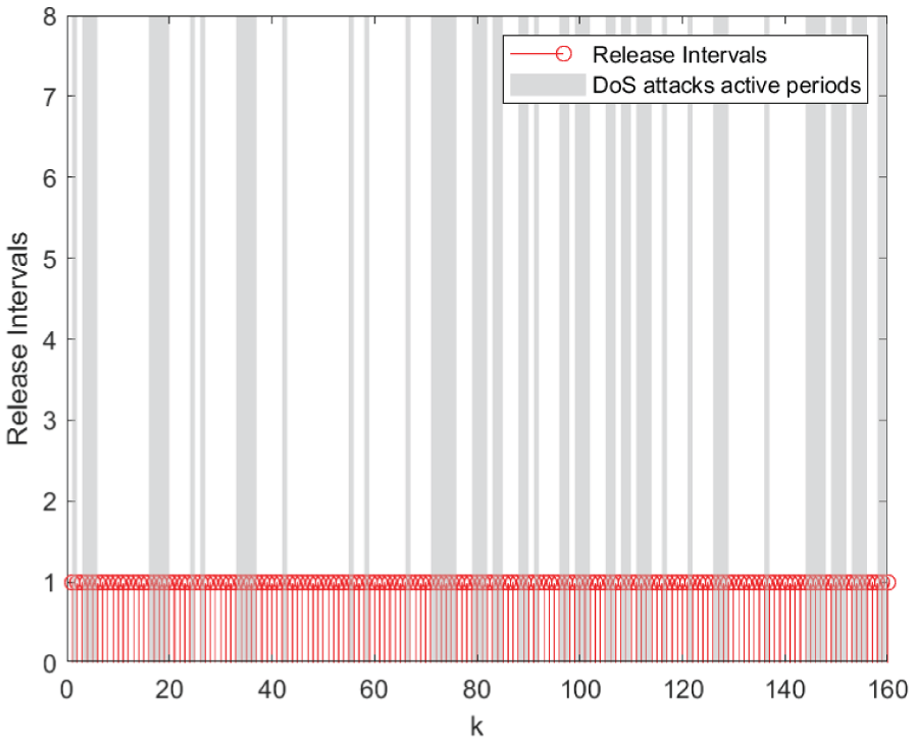
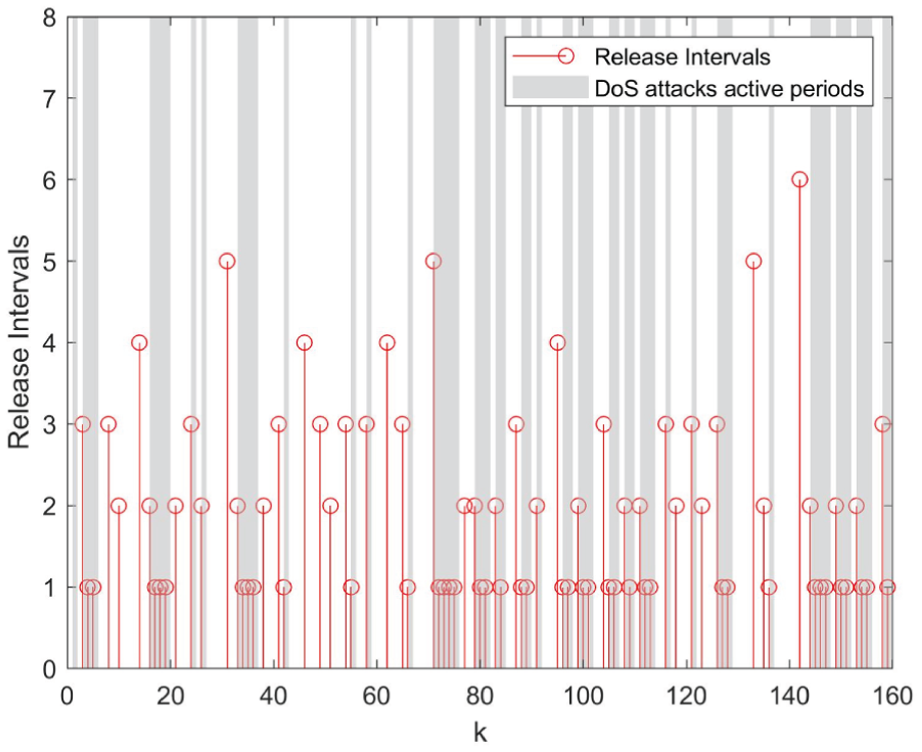
The state trajectories under TTM and SETM are plotted with dashed lines in Figure 4(a) and (b), respectively. As shown in Figure 6, TTM results in a triggering number of 160. For SETM, Figure 7 shows that the triggering number is 82.
Release intervals under TTM.
Release intervals under SETM.
From Figures 4–7, it can be observed that the state trajectories under the three methods are nearly identical. However, compared with TTM, the DADETM significantly reduces the triggering number, resulting in a 67.5% saving in communication resources (
Furthermore, by fixing the triggering variable
Comparison of triggering numbers with triggering variable values

Conclusion and future work
This paper addresses the security control of NCSs under stochastic DoS attacks by utilizing DADETM. A probabilistic uncertain Markov model is employed to describe the occurrence of DoS attacks, accurately reflecting their randomness and uncertainty. Moreover, a controller is designed within the framework of the DADETM. The proposed DADETM determines triggering instants based on predefined conditions only during the sleep period of DoS attacks, while completely avoiding any triggering behavior during the active period. DADETM effectively eliminates ineffective triggering during the DoS attacks active period, thereby significantly preventing the wastage of triggering resources. Finally, the effectiveness of the proposed theory is verified by applying a DLSRM system.
There are still some issues that merit further investigation. The DADETM can be enhanced by designing an adaptive law to adjust the triggering parameter based on the characteristics of DoS attacks or variations in system states. In addition, the potential presence of false positives and false negatives in the ACK detection mechanism should be taken into account. Future work will also aim to extend the proposed method to systems with partially measurable states.
Footnotes
Appendix A
Considering the following PLF:
First, considering the case
where
Then:
where
Similarly, when
Defining
Next, considering another case with
where
where
where
Based on Lemma 1 and (31), we consider the case as follows.
First, considering the case where
where
By applying the Schur complement lemma and pre- and post-multiplying (33) by
Similarly, it can be derived that when
By applying the Schur complement lemma and pre- and post-multiplying (34) by
Then, based on (33), (34), and Lemma 1, it can be concluded that:
Under condition (17),
(17) is equivalent to
First, considering the case when DoS attacks do not occur at time k, that is, let
where ζ represents the total duration of DoS attacks from time 0 to k, and ϖ represents the switching frequency of DoS attacks occurring from time 0 to k.
For the other scenario, when the attack occurs at time k, one can obtain the similar result.
Considering
Based on (18), it derives that:
In sequel, one has:
Considering the worst case with
Due to the fact that:
where
Therefore, combining (19) and Definition 1, the system (13) is AMSS, and the controller gain K and the event-triggering weighting matrix Ω can be determined as follows:
Thus, the proof is completed.
Acknowledgements
This work is supported in part by the National Natural Science Foundation of China under grant 62003124 and in part by the Natural Science Foundation of Hebei Province under grants F2024202009 and F2025202043.
Declaration of conflicting interests
The authors declared no potential conflicts of interest with respect to the research, authorship, and/or publication of this article.
Funding
The authors received no financial support for the research, authorship, and/or publication of this article.

Data availability statement
Data sharing not applicable to this article as no datasets were generated or analyzed during the current study.