






Abstract
This paper investigates the input-to-state stability (ISS) problem for a type of time-varying nonlinear systems with random delayed impulses. On the basis of the Lyapunov method, it provides sufficient conditions to obtain the ISS properties by indefinite Lyapunov functions with time-varying conditions. Besides, the mixed effect of random and delayed impulse is also fully considered. On this basis, we examine the ISS issue for impulsive systems in two different scenarios. One scenario is that the impulsive intensity is random, and the impulsive intensity is limited by the average impulsive interval (AII) and the mode-dependent average impulsive interval (MDAII). The other scenario is that the impulsive intensity is random, and the impulsive density satisfies certain stochastic conditions. Finally, two examples are provided to test the validity of the stability criterion proposed.
Introduction
Hybrid systems, consisting of combinations of continuous and discrete dynamic systems, have examined their importance in control systems. Impulsive systems, as a type of hybrid system, consist of instantaneous state jumps and continuous time dynamic systems. There are a very wide range of applications for impulsive systems, such as multi-agent systems (Gu et al., 2026; Xiao et al., 2025), synchronization of complex dynamic networks (Liu and Li, 2026; Wan et al., 2025; Zhang et al., 2024), and Markov jump systems (Hua et al., 2025, 2022; Wu et al., 2024). During the course of development, systems naturally generate random factors (Hu and Mu, 2022) while also inevitably being subject to random disturbances from the external environment. Indeed, networked multi-intelligence systems can be susceptible to random disturbances at certain moments (Tang et al., 2016). In fact, qualitative description of impulses can limit to some extent the application of impulsive systems. In some dynamic networks, sampling delays occur at certain impulsive instants due to disturbances in the transmission process, which leads to the fact that the current state of the system will depend on the historical state of the sampling point (Cui et al., 2022; He et al., 2025). Currently, most of the existing research on impulsive systems still focuses on deterministic impulsive signals (Hespanha et al., 2008) or impulsive signals conforming to specific distributions (Tang et al., 2020; Teel et al., 2014). However, in the practical applications, not all impulses can satisfy specific regulations. In addition, during the transmission of impulsive information, time delay is unavoidable. For example, in communication security systems based on impulsive synchronization, both transmission and sampling involve time delay (Khadra et al., 2005). Therefore, it makes sense to consider random delayed impulses. Recently, the paper by Gao et al. (2025) analyzed the stability of impulsive systems with stochastic delayed impulses.
Stability analysis has been among the main concerns in the area of impulsive systems. The notion of input-to-state stability (ISS) was first proposed by Sontag (1989), and many excellent works have emerged under this concept since it portrays well how external inputs and initial values affect the stability of systems (Hua et al., 2023, 2021; Liu et al., 2022; Zheng and Zhu, 2025). In particular, for impulsive systems with stable and unstable impulsive effects, the article by Lu et al. (2010) proposes the use of the average impulsive interval (AII) approach to deal with the ISS problem. The concept of AII implicitly limits the average impulsive interval at which impulsive behavior occurs to a fixed interval, which limits the effects of different impulses to some extent. However, when jumping from different impulsive modes to the same impulsive mode, the resulting average impulsive intervals may vary due to the complexity of the impulsive behavior. Considering the different impulsive modes and the conservatism in the AII method, the literature (Xie et al., 2019) used the method of the mode-dependent average impulsive interval (MDAII) to establish the stability criterion for impulsive system. Besides, the time-delay effect can also have an impact on the stability of the system. With the development of impulse control theory, we know that the time delay exists not only in the part of the system under study (De La Sen and Luo, 2003) but also in the part of the impulse. The impulse that contains time delay is sometimes referred to as delayed impulse. This impulse describes a phenomenon where the impulsive transient is dependent on the historical state of the impulsive system. In the paper by Liu et al. (2011), hybrid time-delayed systems under delayed impulses were investigated.
From previous studies, we know (Wu et al., 2016a) that it is of interest to study the coefficients of the time-varying Lyapunov differential operator. Up to now, most of the available results investigating the effect of impulses on ISS in a stochastic infinite-dimensional system are still based on Lyapunov functions with constant rate coefficients. For example, the paper by Zhang and Zhu (2019) studied the ISS problem with deterministic delayed impulses, where the Lyapunov differential operators have constant coefficients. Although Tang et al. (2020) assessed the effect of random impulses on ISS, the Lyapunov differential operator’s coefficients are constant coefficients. However, the hypothesis of the Lyapunov differential operator coefficients being constant has not always held in reality. Owing to fluctuations in the performance of the system, the Lyapunov function’s rate coefficients may be time-varying (Liu, 2012), meaning that the evolution over time may be positive or negative (Ning et al., 2012; Peng and Zhang, 2010; Wu et al., 2012; Zhou, 2017). Recently, ISS and iISS of nonlinear systems with time-varying rate coefficients of the Lyapunov function have been considered in Ning et al. (2012) and Zhou (2017). The article by Liu et al. (2022) presents ISS properties of nonlinear systems with delayed impulses in which the coefficients of the Lyapunov differential operator are time-varying.
Inspired by the above-mentioned studies, the primary aim of this paper is to investigate the ISS properties of continuous time-varying nonlinear systems with random delayed impulses. The major content of this paper is shown as follows:
In this paper, the Lyapunov function is uncertain, that is, the Lyapunov function has time-varying rate coefficients, which is more common than constant coefficients. In addition, we also consider the influence of delayed impulses on the stability of the system, which was ignored in Tang et al. (2020).
We examine the ISS problem of nonlinear impulsive systems in two different cases. The first case considers random impulsive intensities and deterministic intervals by using AII and MDAII. The second case is that both impulsive intensities and impulsive intervals are random.
Some easily verifiable conditions have been established to facilitate ISS testing of nonlinear time-varying systems with random delayed impulses.
The rest of this paper has the following structure: Section “Problem formulation and preliminaries” presents some essential definitions and concepts. In section “Main results,” we assess the ISS problem for dynamical systems with random impulsive intensities and deterministic instantaneous impulses, and the ISS problem is treated with the consideration that the impulsive intensities and instants are random at the same time. Section “Simulation examples” gives two examples of our results and verifies the validity of our work. Section “Conclusions” summarizes the research in this paper.
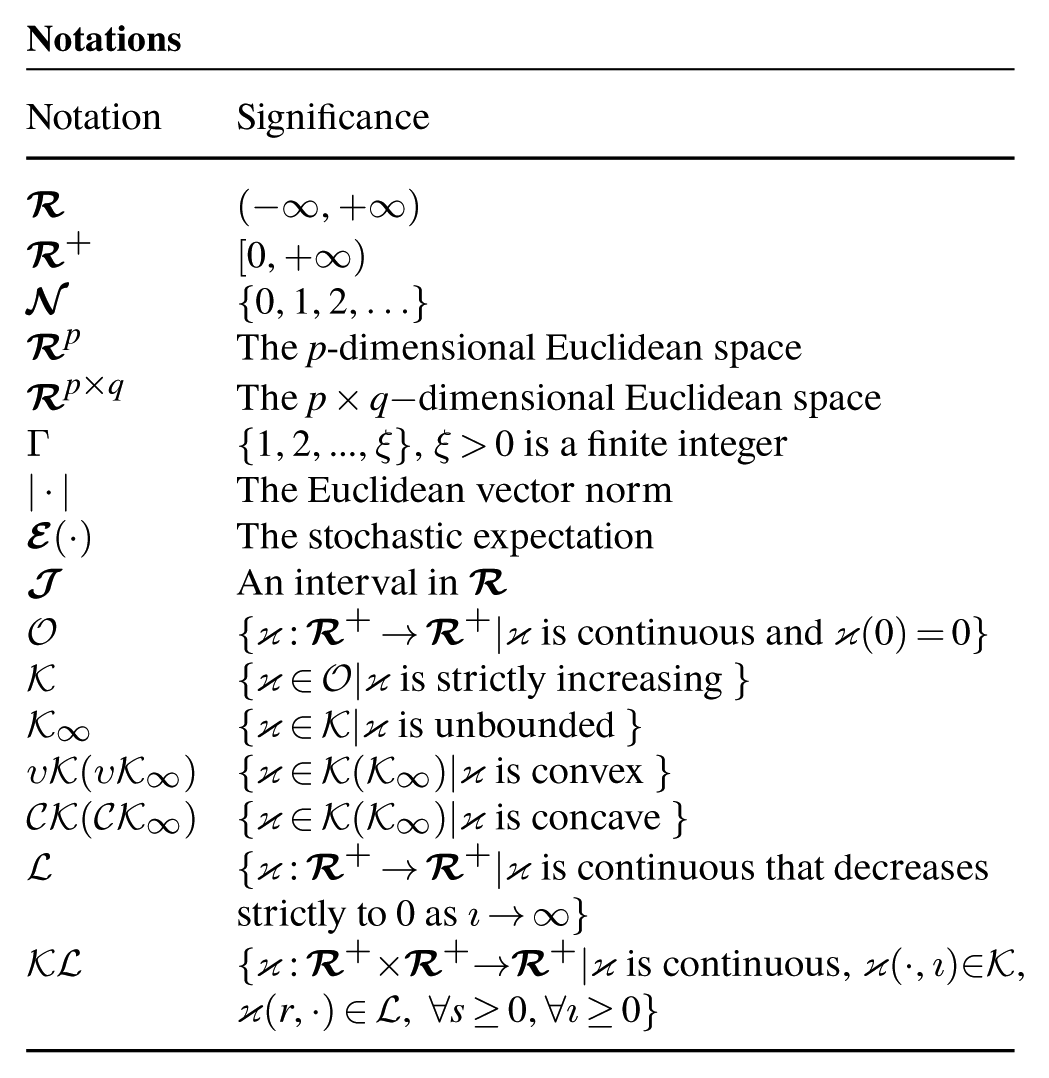
Problem formulation and preliminaries
Throughout this paper, the following nonlinear time-varying systems with random delayed impulsive systems are considered:
where
Then, the system (1) with random delayed impulses is called ISS.
where
that is, there exist constants
where
1. if there is
where
2. if for the ith kind of impulsive intensity of the impulsive effects, there exist
where
Main results
ISS with only random impulsive intensities
where
Then, the nonlinear time-varying system (1) with the random delayed impulses is ISS.
and
where
Part I: In this part, the following inequality will be proved by mathematical induction for all
Step
Thus, we obtain the inequality (8) for
Step
Since
Step
From condition
Thus, when
Part II: The ISS of the system (1) is presented in this part. Therefore, for any
where
Based on Definition 3 of
where
and
In addition, from Assumption 1, Assumption 2, and Lemma 1, it is easy to obtain
From inequalities (16) and (15), we can conclude that
where
and
Based on condition
which means that
where
ISS with random impulsive intensities and impulsive densities
The impulsive instant
And the impulsive density
The impulsive intensity is a random variable, which is defined in Assumption 1.
The impulsive intensity
holds. So,
where
(H′4) (a) there are constants
(b)
(H5)
Then, the nonlinear time-varying system (1) with the random delayed impulses is ISS.
where
According to (a) of condition
In addition, it is easy to obtain, from condition
where
From inequalities (21) and (22), we can conclude that
Based on the condition
where
Comparison with some existing ISS schemes. a
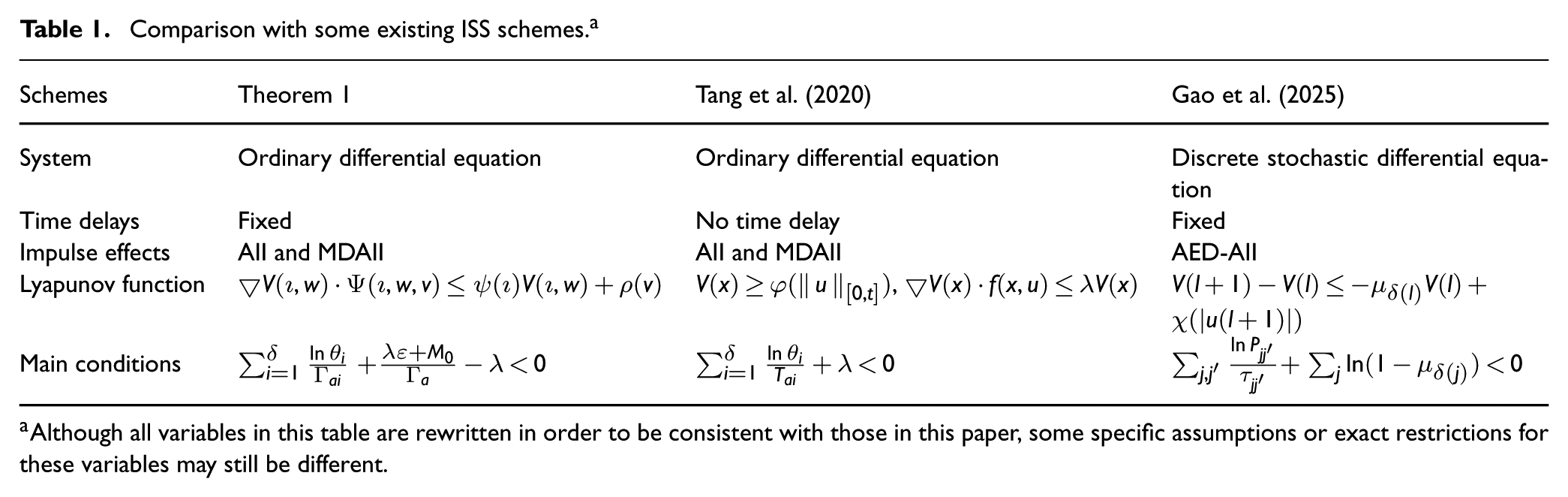
Although all variables in this table are rewritten in order to be consistent with those in this paper, some specific assumptions or exact restrictions for these variables may still be different.
Simulation examples
where
Constructing
It means that
we know that
The impulsive intensity is revealed in Figure 1. As we can see, the intensity of impulses is random. We let the random variable
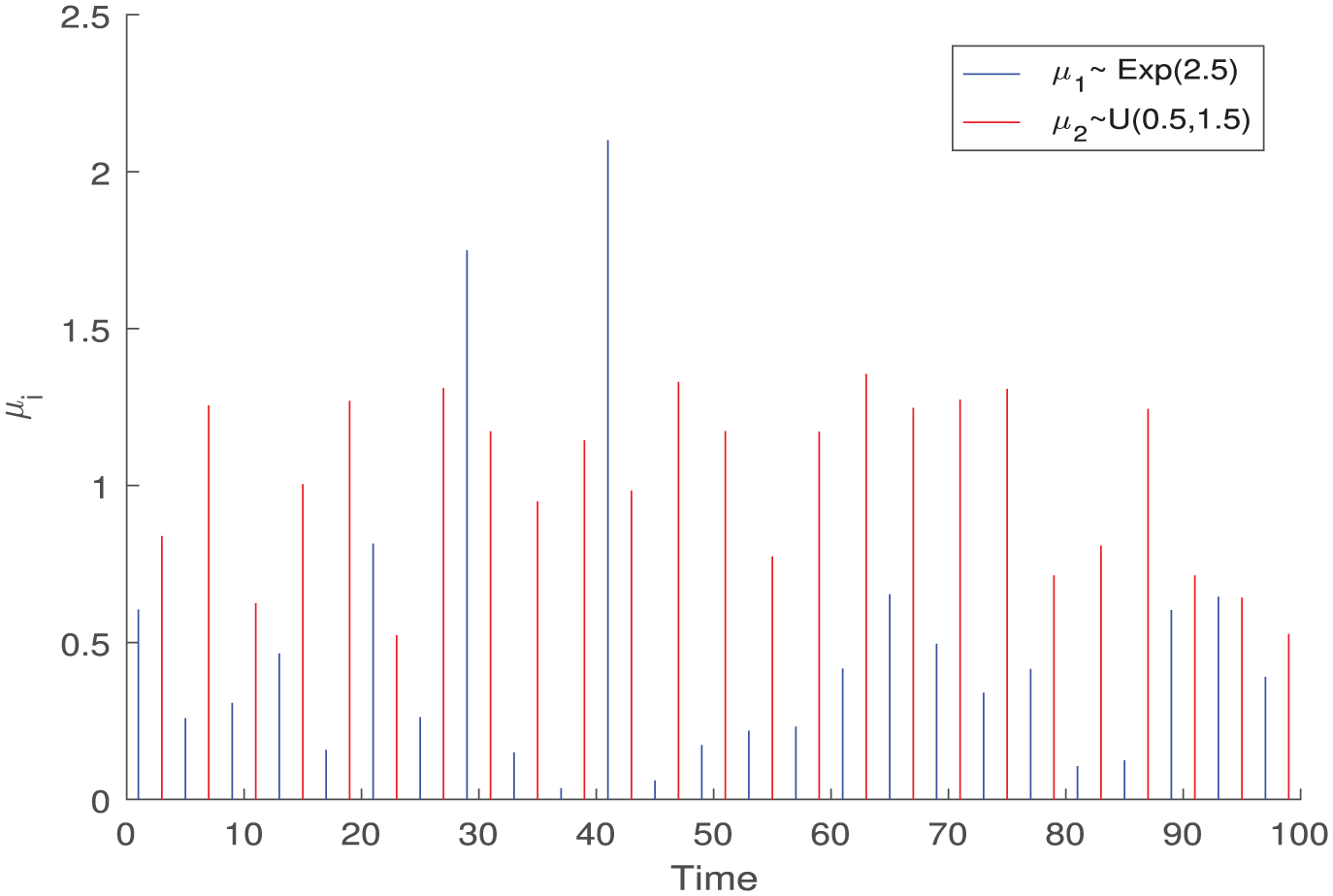
The second type of random impulses.
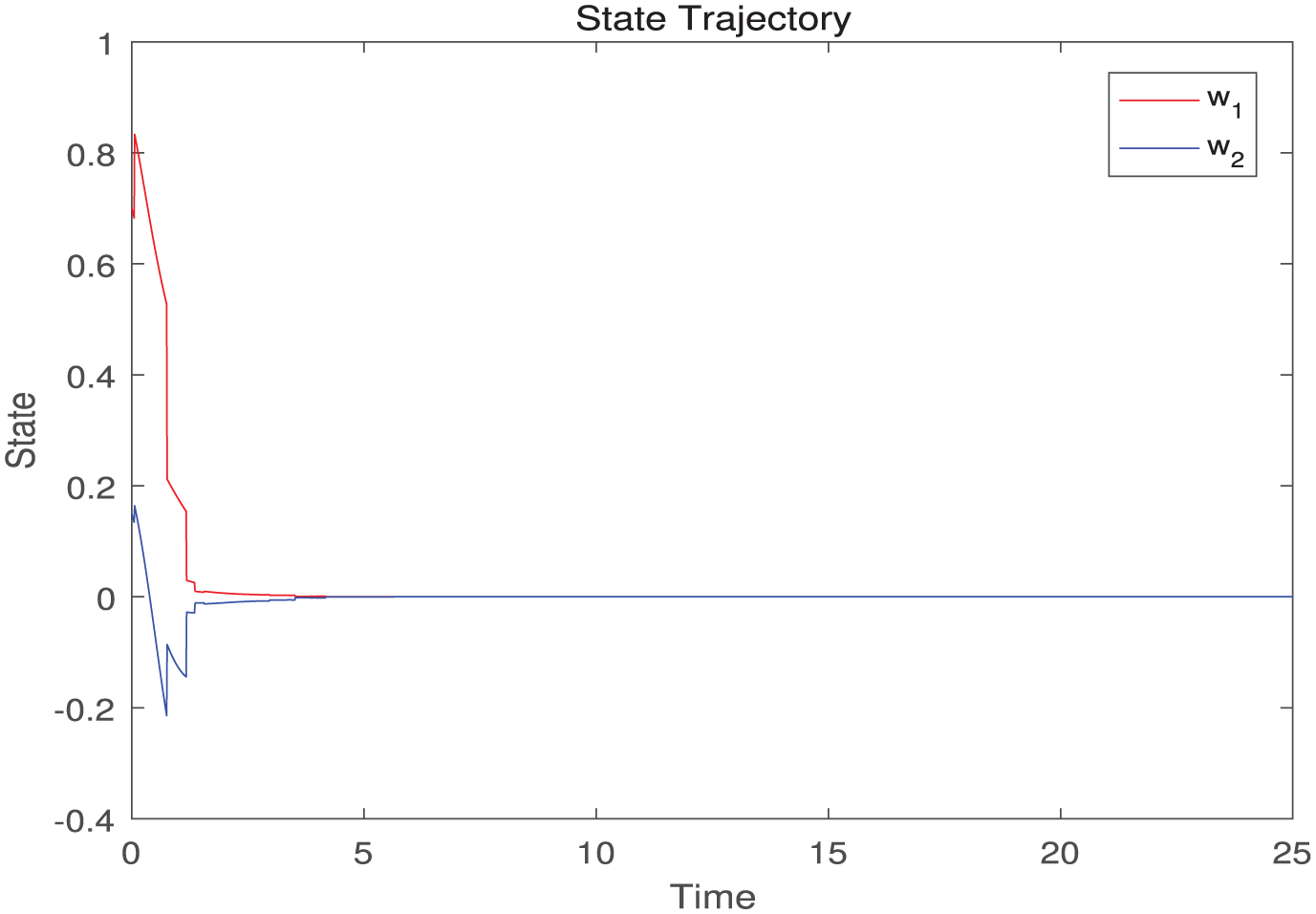
That is, all conditions of Theorem 1 are fulfilled. Then, according to Theorem 1, it follows that the system (1) is ISS. After that, we show the trajectories of the states with the input
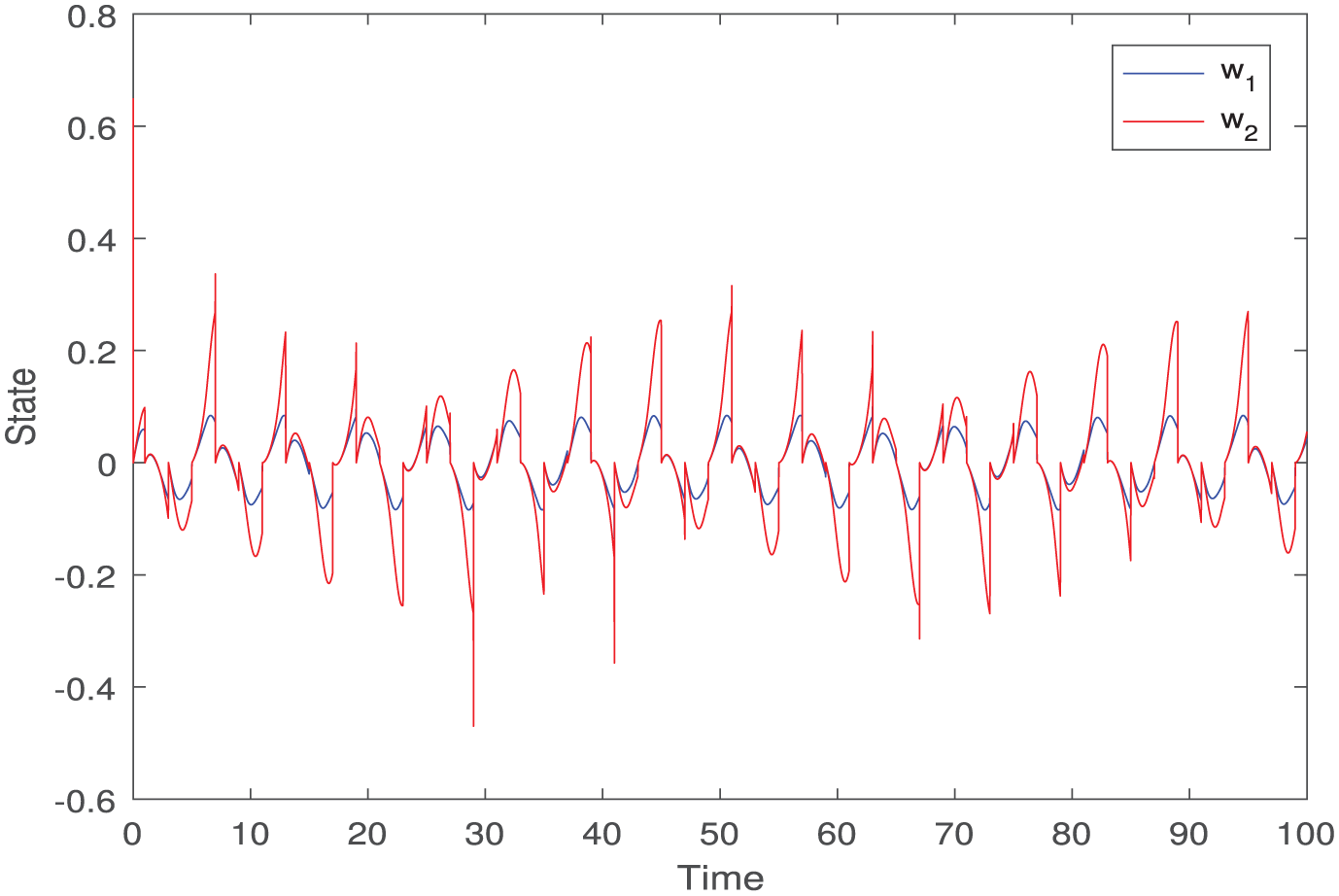
The trajectory of state
where
Constructing
It means that
where
The impulsive density and the impulsive intensity are revealed in Figures 3 and 4, respectively. As we can see, the density and intensity of impulses are random.
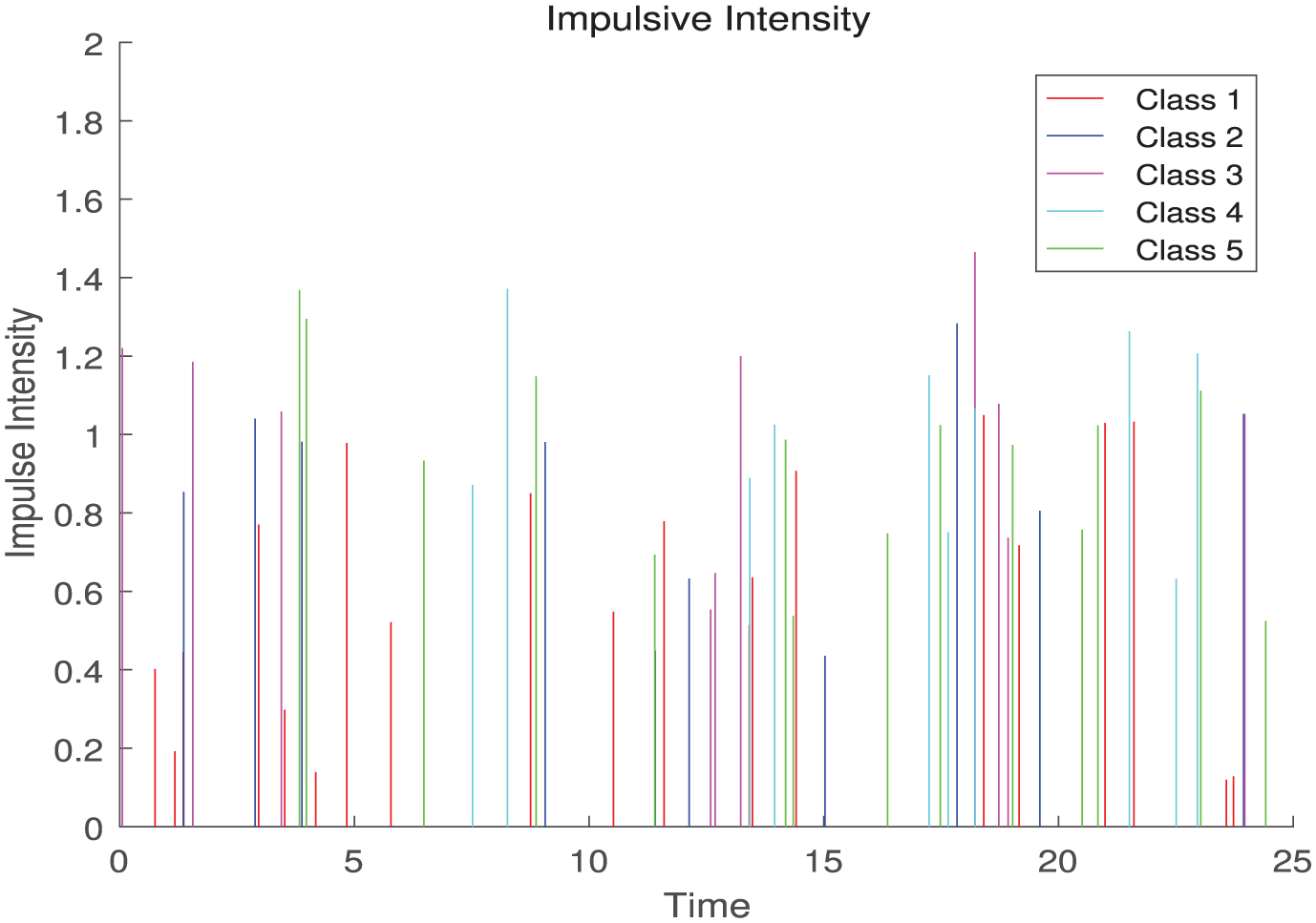
Random impulsive intensity.
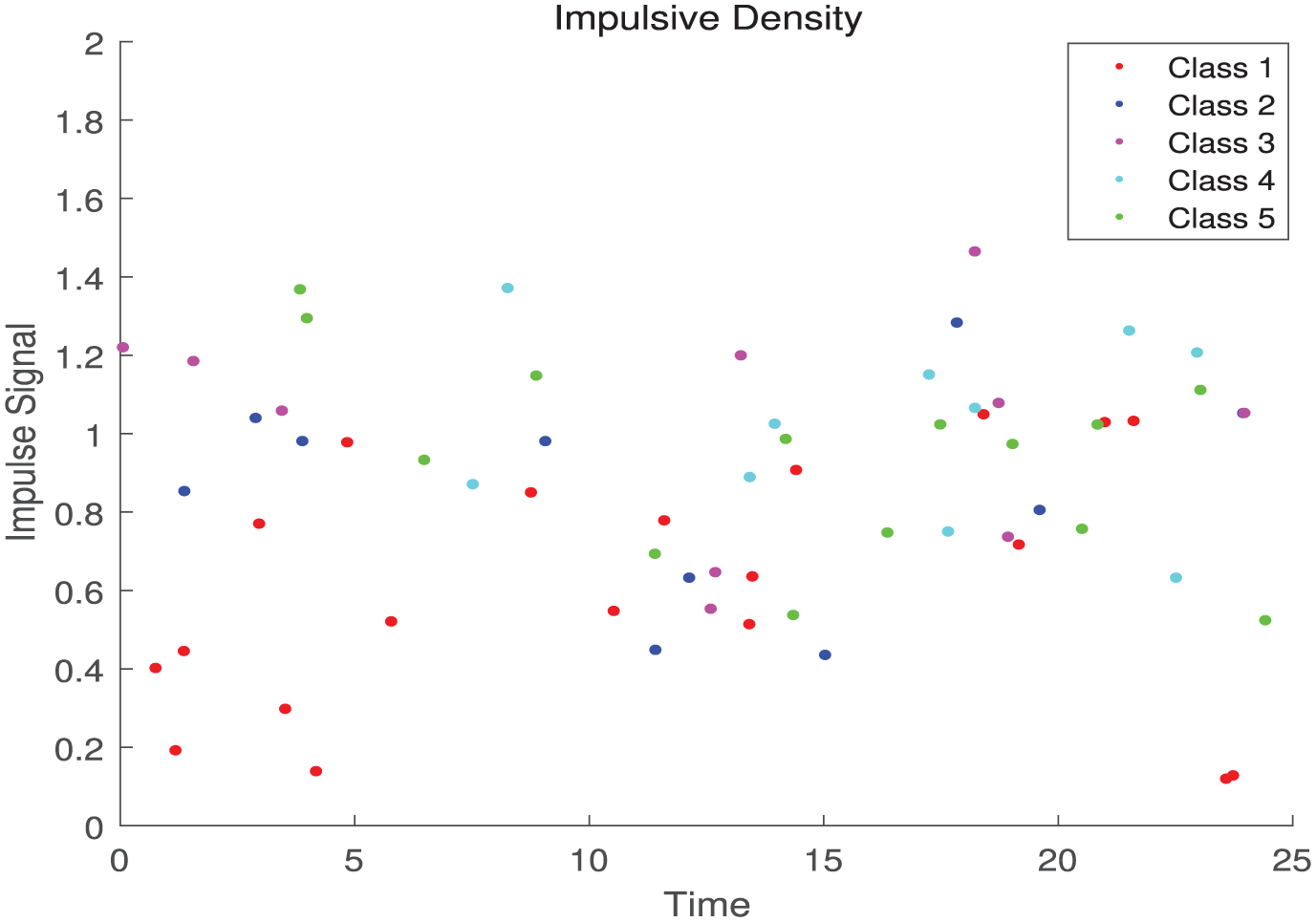
Random impulsive density.
It can be calculated that
That is, all conditions of Theorem 2 are fulfilled. Hence, based on Theorem 2, it follows that the system (1) is ISS. Afterwards, we show the states
The trajectory of state
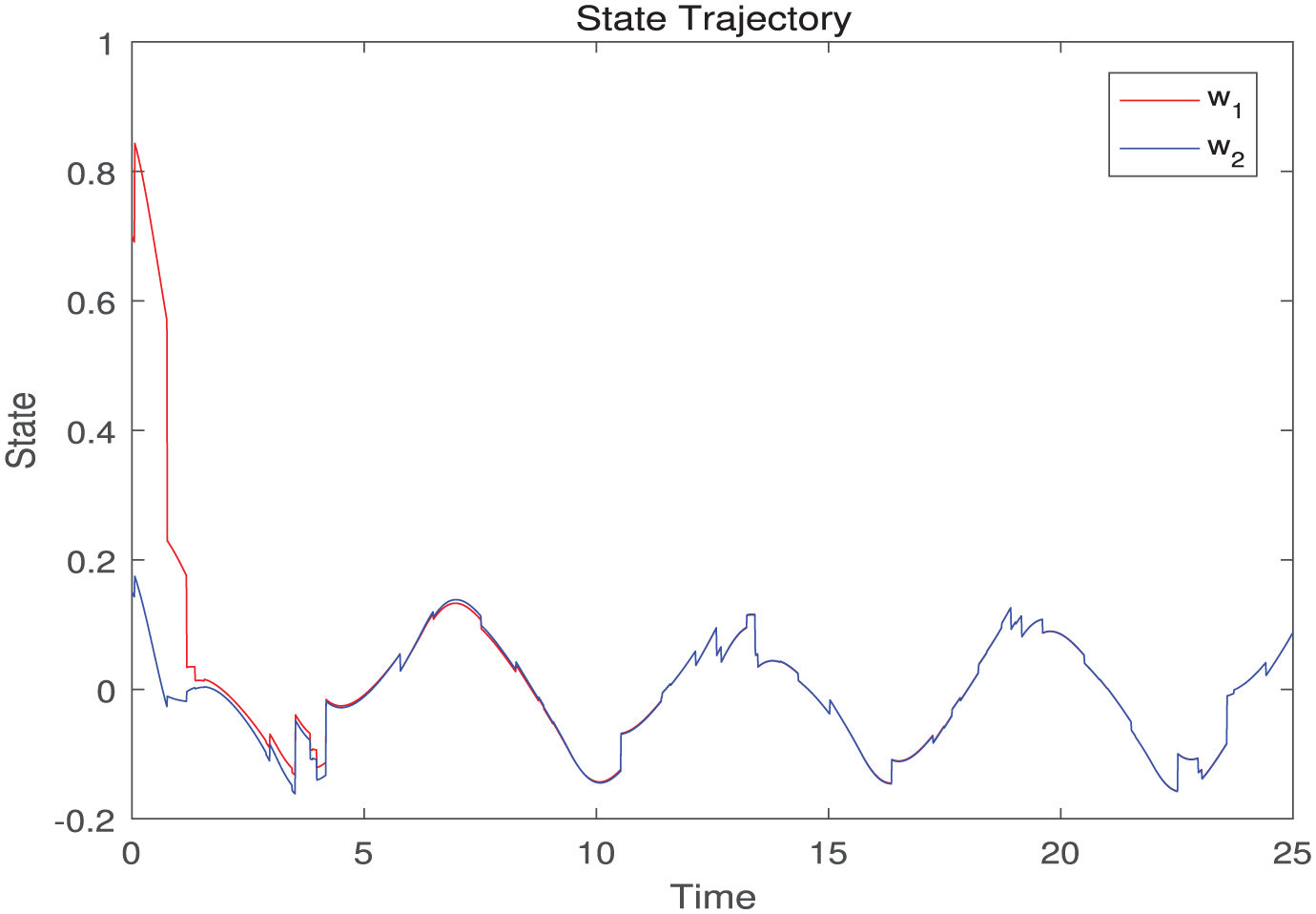
The trajectory of state
Conclusions
This paper investigates the ISS properties of nonlinear time-varying systems with random delayed impulses based on the Lyapunov-type functions with indefinite derivatives. We examine the effect of delayed impulses with random impulsive intensities on ISS when they occur at the fixed impulsive instant and at the random impulsive instant, respectively. It is shown that ISS is guaranteed in both cases under the conditions we give. Two numerical examples verify the correctness of the results. Throughout this paper, the delayed impulse remains fixed, and it would be interesting to investigate the direction in which the delayed impulse is random in the future.
Footnotes

Funding
The authors disclosed receipt of the following financial support for the research, authorship, and/or publication of this article: This work was supported by the National Natural Science Foundation of China (62103231 and 62173139) and the Support Plan for Outstanding Youth Innovation Team in Shandong Higher Education Institutions under grant 2022KJ184.
Declaration of conflicting interests
The authors declared no potential conflicts of interest with respect to the research, authorship, and/or publication of this article.
Data availability statement
Data sharing is not applicable to this article, as no datasets were generated or analyzed during the current study.