






Abstract
A hierarchical fast fixed-time formation-control scheme is proposed for high-speed aircraft with heterogeneous aerodynamic effectiveness under angle-of-attack (AoA) saturation. To address the coupled challenges of rapid convergence, heterogeneous aerodynamic effectiveness, and strict input constraints, a hierarchical control framework is developed, consisting of a virtual formation controller, a tracking differentiator (TD)-assisted actual controller with dynamic gain adaptation, and an auxiliary saturation compensator. Lyapunov analysis establishes an initial-condition-independent fixed-time convergence bound for the nominal unsaturated design, with the switched-exponent structure providing the common fast mechanism. Under AoA saturation, the auxiliary compensation design guarantees bounded fixed-time convergence of the saturation-related tracking errors, yielding practical fixed-time-like formation convergence of the full closed-loop system. Numerical simulations further verify formation achievement under different geometries, demonstrate faster transient response than the compared fixed-time and finite-time baselines, show smoother exit from saturation with reduced peak transient deviations, and show reduced post-saturation oscillation for less capable aircraft through dynamic gain adaptation.
Keywords
Introduction
Formation flight has received sustained attention because of its potential in cooperative aerospace missions (Pang et al., 2025; Quan et al., 2023; Wang et al., 2024, 2025). For high-speed aircraft, however, coordinated manoeuvres become substantially more difficult due to extreme operating conditions, actuator constraints, and vehicle heterogeneity. In practice, three issues are particularly coupled: heterogeneous aerodynamic capability may destabilize weaker members under a uniform controller, strict angle-of-attack (AoA) limits create a discrepancy between designed and realizable control actions, and the operational scale requires rapid convergence with low sensitivity to initial errors.
Asymptotic and finite-time methods (An et al., 2022; Enjioa et al., 2020; Jia et al., 2020) are not fully suitable for this setting because their settling time depends on initial conditions. Fixed-time control removes this dependence (Polyakov, 2012), and the unified framework in Xiao et al. (2021) further facilitates its analysis and design. In high-speed aircraft formation control, fixed-time methods have been used not only for direct formation stabilization (Wu et al., 2023; Zhang et al., 2020) but also in conjunction with additional coordination mechanisms such as time synchronization and event-triggered communication (Xing et al., 2026; Yin et al., 2025), and under practical constraints including obstacle avoidance and input quantization (Lv et al., 2023; Zhang et al., 2023). Most of these designs, however, are still based on constant exponents. Although such a structure preserves the fixed-time property, it may not distribute control effort efficiently across different error regimes. This motivates the use of fast fixed-time control, which introduces switched exponents to improve the transient process (Tian et al., 2020), and its effectiveness has also been demonstrated on connected vehicles (Zheng et al., 2023), trans-medium aircraft (Liu and Meng, 2023), and underwater robots (Liu et al., 2025). This makes it attractive for high-speed formation tasks that require both rapid and predictable convergence.
Besides the time-performance requirement, high-speed formation control must also account for capability differences among aircraft. Heterogeneous coordination has been studied for unmanned aerial vehicle (UAV) formations (Cui et al., 2025; Hung et al., 2024; Liu et al., 2020), unmanned underwater vehicle (UUV)/autonomous underwater vehicle (AUV) systems (Mazare et al., 2023; Yuan et al., 2018), and unmanned aerial vehicle-unmanned ground vehicle (UAV-UGV) cooperative missions (Cheng et al., 2023; Xiao et al., 2025; Zou et al., 2025). By contrast, high-speed aircraft formation controllers are still typically developed for homogeneous agents. In this setting, applying a uniform controller to aircraft with different aerodynamic effectiveness can easily create performance imbalance, especially because the control inputs are nonlinearly related to the AoA and bank angle.
Input saturation is a further complication in high-speed flight, where the AoA must remain strictly bounded for flight safety (Li et al., 2015). If ignored, the resulting mismatch can invalidate nominal convergence (Liu et al., 2024a). Smooth approximation approaches have been studied (Wang et al., 2014; Wen et al., 2011), whereas auxiliary compensation strategies have been developed (Gao et al., 2017; Min et al., 2021). Related auxiliary-system ideas have also appeared in constrained platforms such as robotic systems (Fan et al., 2024; Liu et al., 2024b), UAVs (Liu et al., 2023), and unmanned surface vessels (USVs) (Duan et al., 2024). Nevertheless, saturation and heterogeneity are still largely treated separately, and their combination in heterogeneous high-speed formations remains insufficiently addressed.
Under this hierarchical realization setting with hard AoA limits, the choice of the time-performance framework also deserves clarification. Predefined time (Jiménez-Rodríguez et al., 2018; Li et al., 2025) and prescribed time (Song et al., 2017; Zhang et al., 2026) provide stronger time-specification capabilities than standard fixed-time control. In the present hierarchical setting, however, the upper-layer virtual commands must be realized through lower-level attitude and AoA realization dynamics under hard AoA limits, so adopting predefined-time or prescribed-time schemes would require additional consistency between the imposed upper-layer requirement and the lower-layer realizability. This would make both the inter-layer design and the closed-loop analysis considerably more involved. By contrast, the adopted fast fixed-time framework already provides the required initial-condition-independent convergence property while remaining more tractable for integration with the lower-level realization and saturation-compensation mechanisms.
Motivated by these considerations, this paper develops a fast fixed-time hierarchical formation-control framework for high-speed aircraft with heterogeneous aerodynamic effectiveness. It is intended to address three coupled requirements in a unified manner: predictable fast convergence, heterogeneous control authority, and strict AoA saturation. In the existing high-speed formation literature, conventional fixed-time designs (Lv et al., 2023; Wu et al., 2023; Xing et al., 2026; Yin et al., 2025; Zhang et al., 2020, 2023) provide an important basis for rapid formation regulation, but they are mostly built on constant exponents; most related formation controllers (An et al., 2022; Jia et al., 2020; Lv et al., 2023; Wu et al., 2023; Xing et al., 2026; Yin et al., 2025; Zhang et al., 2020, 2023) also do not explicitly incorporate AoA saturation compensation or capability-aware gain adaptation under strict AoA limits. Rather than addressing dynamic-model-level heterogeneity (Cheng et al., 2023; Liu et al., 2020; Mazare et al., 2023; Xiao et al., 2025; Yuan et al., 2018; Zou et al., 2025), the present work considers actuator/effectiveness-level heterogeneity and handles it through a simple gain-adaptation mechanism integrated into the same saturation-constrained hierarchical framework. Accordingly, the proposed design combines a switched-exponent outer-loop controller, AoA-saturation compensation, and gain adaptation within one hierarchical structure. Under nominal unsaturated conditions, the nominal design admits an initial-condition-independent fixed-time convergence bound, with the switched-exponent structure providing the common fast mechanism; under AoA saturation, the auxiliary compensation mechanism drives the saturation-related tracking errors into a bounded residual set within a fixed time, so that the full closed-loop system exhibits practical fixed-time-like formation convergence.
The main contributions of this paper, in comparison with existing works, are delineated as follows:
A fast fixed-time hierarchical formation-control framework is proposed for high-speed aircraft formations. Under nominal unsaturated conditions, it guarantees an initial-condition-independent fixed-time convergence bound for the formation errors, unlike asymptotic and finite-time schemes (An et al., 2022; Enjiao et al., 2020; Jia et al., 2020), while the adopted switched-exponent structure provides the common fast mechanism of the hierarchy.
A dynamic gain adaptation mechanism is introduced to handle actuator/effectiveness-level heterogeneity under strict AoA limits. By adjusting the controller gains according to each aircraft’s aerodynamic effectiveness and available AoA margin, it improves adaptability for less capable members within the same hierarchical framework.
An auxiliary AoA saturation compensator is co-designed with the controller to counteract saturation-induced disturbances in both the longitudinal and horizontal channels. Following the auxiliary system philosophy (Gao et al., 2017; Min et al., 2021), it improves the use of limited control authority and supports practical fixed-time-like formation convergence in the presence of persistent AoA saturation, that is, convergence to a bounded residual set within a fixed time.
The remainder of this paper is organized as follows. Section “Problem statement” introduces the preliminaries and problem formulation. The controller design and stability analysis are detailed in Section “Controller design.” Simulation results are presented in Section “Simulation results,” followed by conclusions in the last section.
Nomenclature
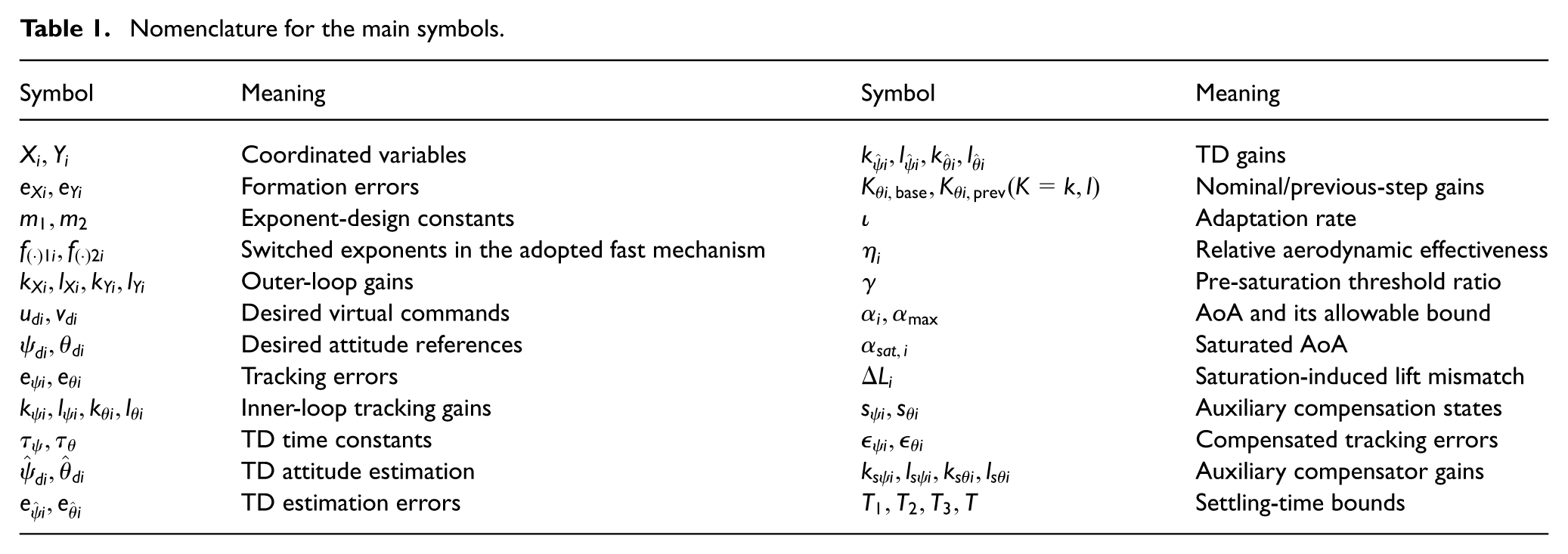
For readability, only the main symbols repeatedly used in the control design are summarized in Table 1.
Nomenclature for the main symbols.
Problem statement
Model description
Each high-speed aircraft is described in the space rectangular coordinate system Oxyz, where the Oz-axis is aligned with the target direction, the Oy-axis is vertical, and the Ox-axis is determined by the right-hand rule. Earth rotation and ground curvature are neglected. The aircraft dynamics are:
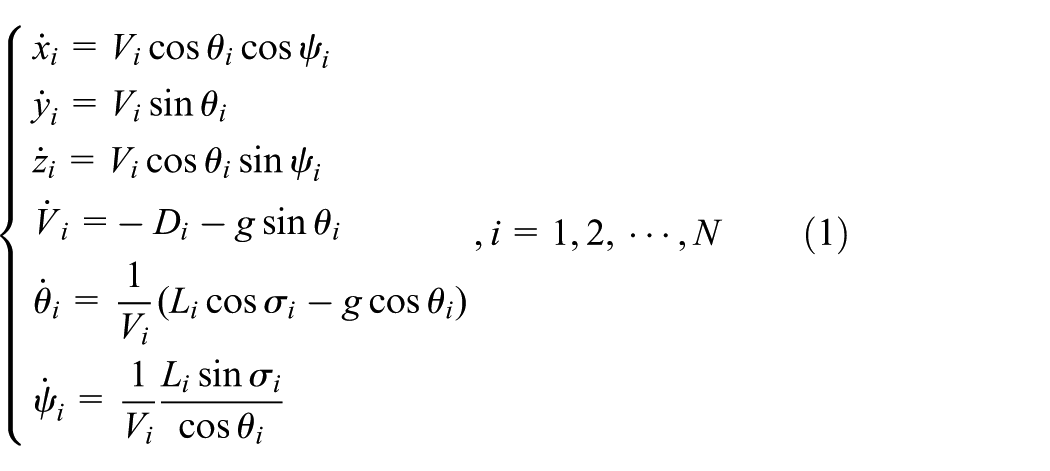
where

where
Graph theory
The information exchange among the heterogeneous aircraft is described by a directed graph
Control objective
This paper aims to design a distributed control strategy for a heterogeneous group of high-speed aircraft to achieve and maintain a specified geometric formation under AoA constraints. Under nominal unsaturated conditions, the formation controller is designed such that the formation errors satisfy an initial-condition-independent fixed-time convergence objective, with the adopted switched-exponent structure providing the common fast mechanism.
Define the coordinated variables for the horizontal and longitudinal motion as

for every aircraft, where T denotes the initial-condition-independent fixed-time bound associated with the nominal unsaturated formation error dynamics.
When AoA saturation is present, exact convergence of the full closed-loop system to zero cannot in general be guaranteed for arbitrarily large initial errors under hard input limits. Therefore, besides the nominal objective in (3), the control goal is to suppress the saturation-induced mismatch so that the relevant tracking errors enter a bounded neighbourhood within a fixed time.
Controller design
Figure 1 summarizes the proposed hierarchical controller. The outer loop generates formation-related virtual commands, while the inner loop realizes them through tracking differentiator (TD)-assisted tracking in the attitude and AoA channels; gain adaptation and auxiliary compensation are further introduced to handle aerodynamic heterogeneity and AoA saturation.
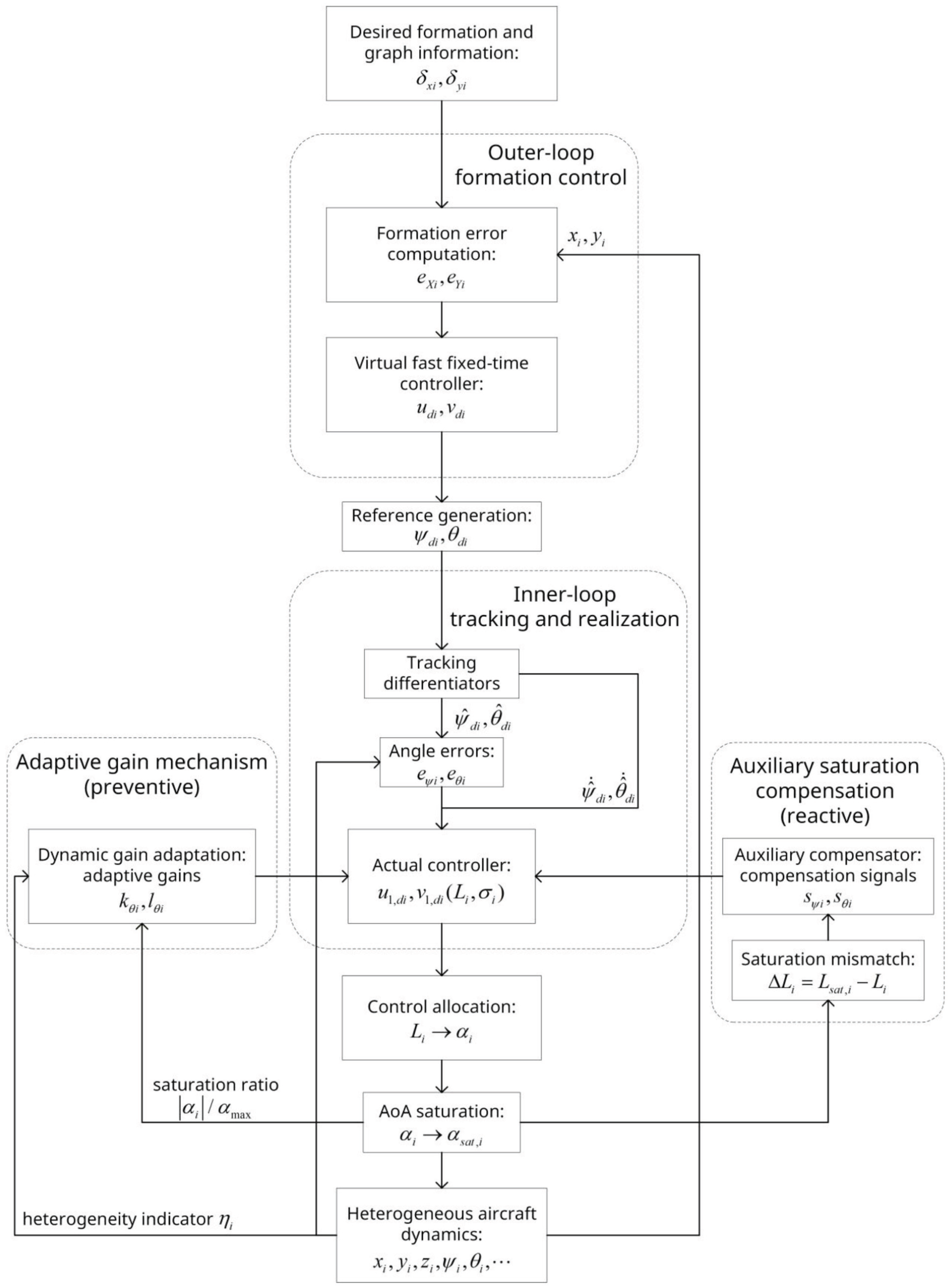
Overall block diagram of the proposed formation-control scheme.
Virtual controller design
Within the hierarchical framework, the virtual controllers are introduced for the coordinated variables:

where
Define the formation error of each aircraft as:
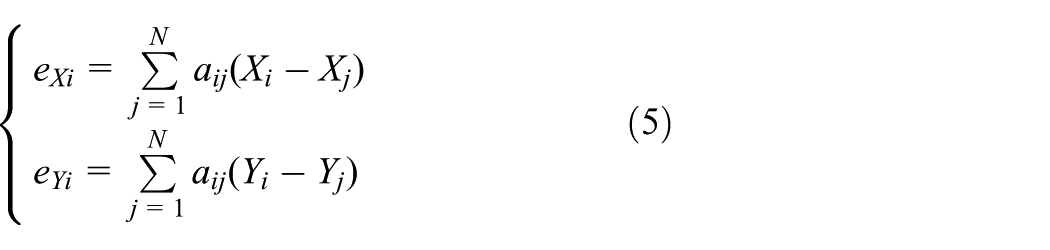
or compactly:

Here,
The following lemmas provide theoretical foundations for controller synthesis.

where

Guided by these results, the virtual controllers are chosen as:

where
It suffices to analyse the horizontal plane, since the longitudinal plane is analogous. With (9), the dynamics of

where
Consider the following Lyapunov function candidate:

where
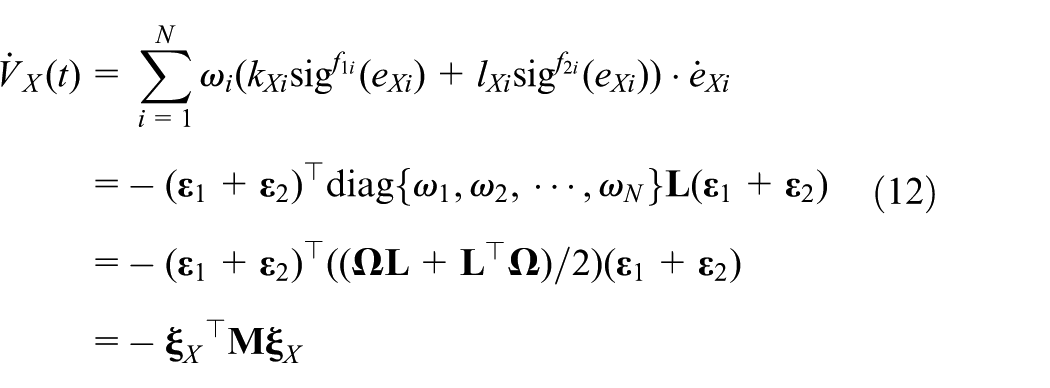
where
The key graph-theoretic point is to exclude the consensus null space of
Since the communication topology is strongly connected, there exists a positive vector
Because

Hence, if

For any

Substituting (15) into (12) yields:
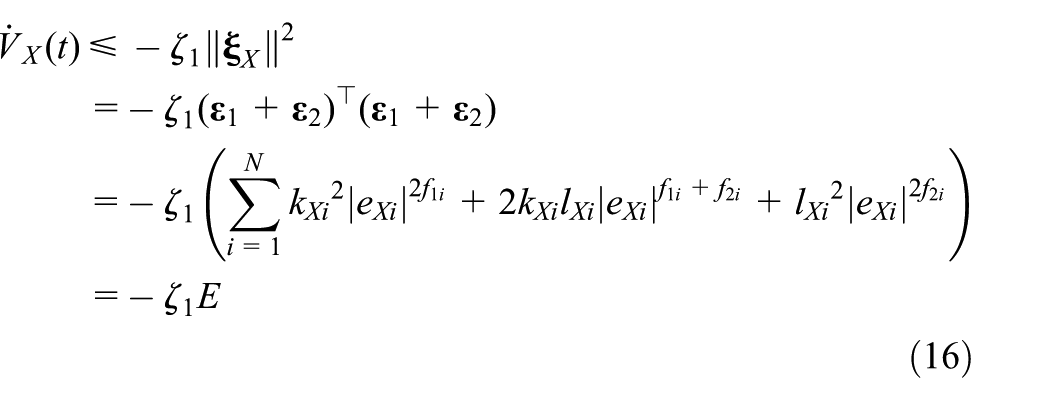
The remainder term E will be regrouped in Step 3 to obtain a comparison form compatible with Lemma 1.
Introduce three auxiliary groups

Comparing this result with the remainder term E in (16) yields:

where
Hence, from (16) and (18):

Define
Now define

Similarly, for

There exist positive constants

or equivalently:

where
Equation (23) is in the switched-exponent comparison form of Lemma 1, where the dominant decay term varies with the error regime through switched exponents rather than constant ones. Therefore,

Since
Theorem 1 establishes the outer-loop convergence property of the proposed hierarchical design; the actual command realization is addressed next.
Actual controller design
The actual controllers

Define the tracking error as

Hence, choose the control input:

where
To avoid explicit differentiation of

where
Using the TD estimate, redefine the heading tracking error as

A parallel procedure is applied to the longitudinal motion. The desired signal of

a corresponding TD is implemented:

where

where
To account for heterogeneous aerodynamic effectiveness and the remaining AoA margin, the gain

where

Differentiating

Applying Lemma 1,
The derivatives
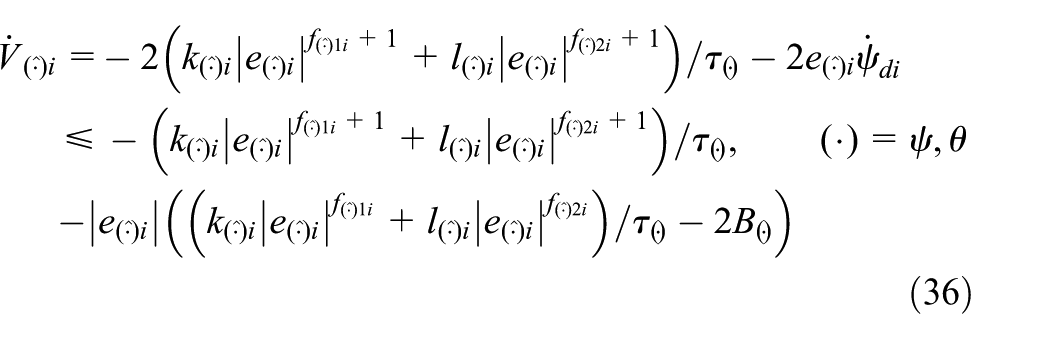
If

From Lemma 1,

Generally, the total convergence time of all error signals has an upper bound:

■
With appropriately chosen controller and TD parameters, the command-realization errors can be made arbitrarily small within fixed time.
Finally, the actual control inputs

Since
Compensator of input saturation
In practice, the commanded AoA is constrained by the flight envelope,

This gives the saturation-induced lift mismatch:
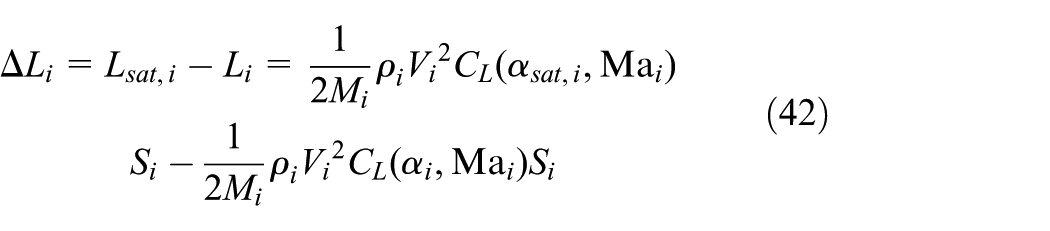
To absorb this saturation-induced mismatch in the command-realization layer, auxiliary compensation states

where
Define the compensated tracking errors as:

Their dynamics satisfy:
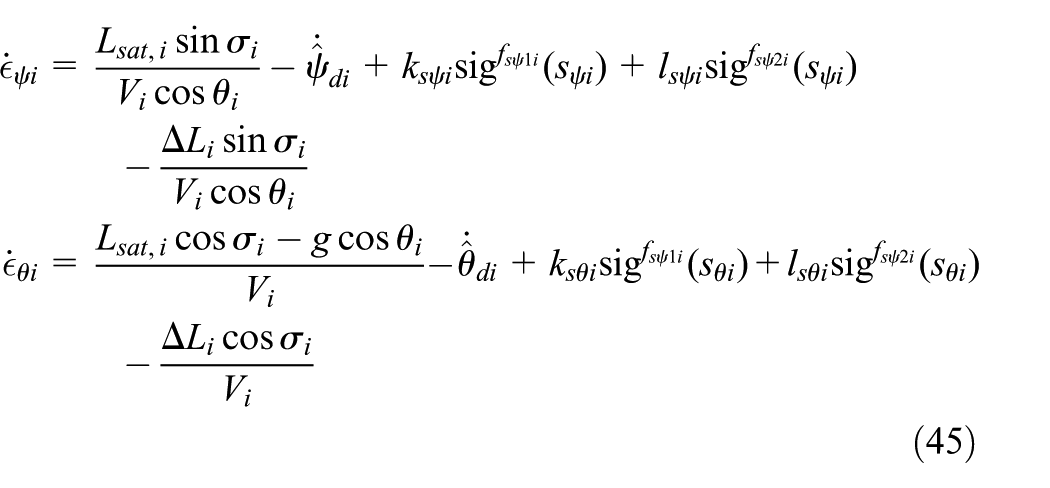
The auxiliary actual control inputs are redesigned as:
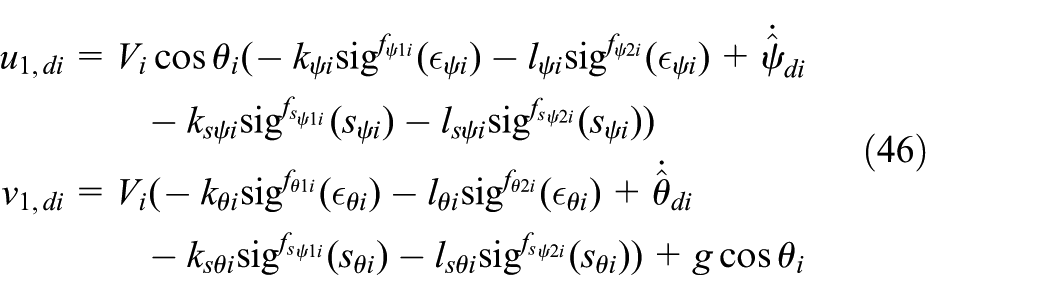
where
The actual controllers

Consider the Lyapunov candidates:

Then:

By the same argument as in Theorem 2,
For the auxiliary states, define:

Assuming the saturation disturbance
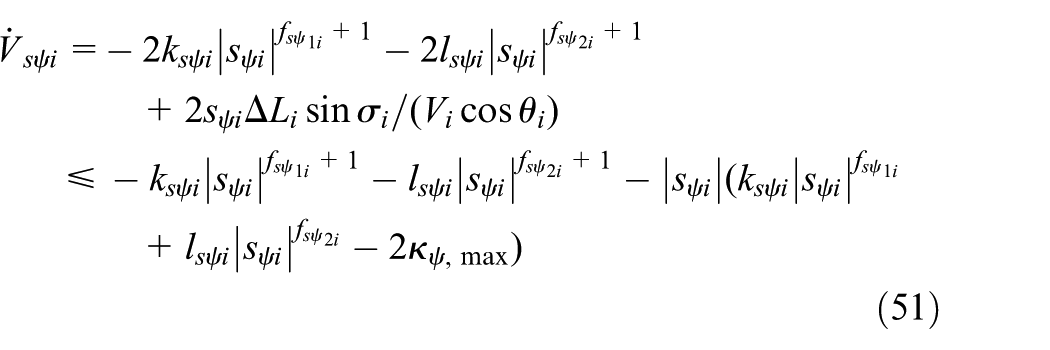
Defining

if

A symmetric analysis applies to
Simulation results
This section presents numerical simulations of four heterogeneous high-speed aircraft under the communication topology in Figure 2. Aircraft 1 and 2 are air-breathing hypersonic vehicles (Parker et al., 2007), while aircraft 3 and 4 follow the CAV-H model (Phillips, 2003). The aircraft models and associated parameters of aircraft 1–2 and 3–4 follow Parker et al. (2007) and Phillips (2003), respectively, and aircraft 1 and 2 are taken as the reference aircraft. The bank angle is limited by
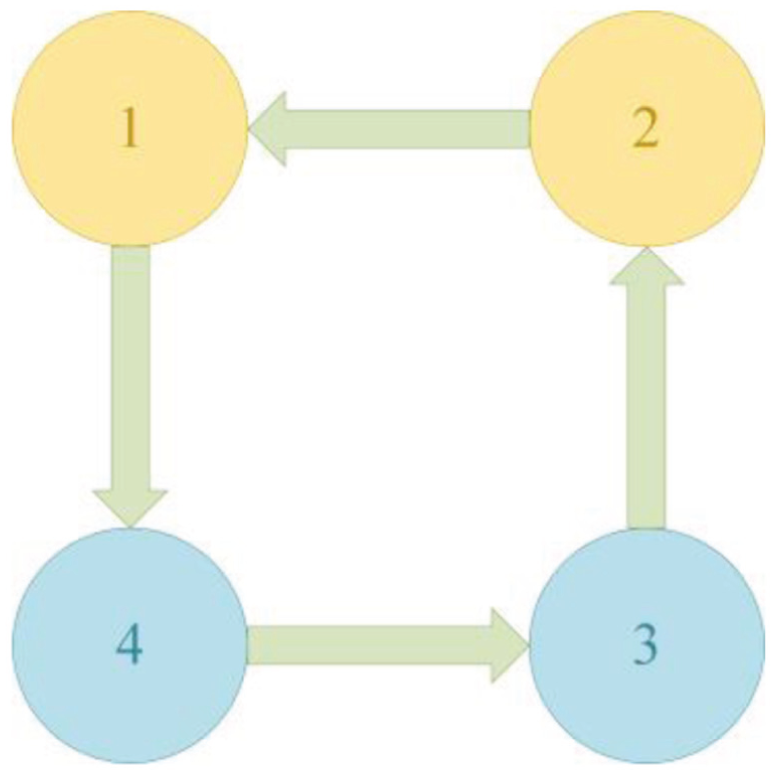
Communication topology of high-speed aircraft.
The simulations are organized into two parts: (1) validation under different desired formations; and (2) comparison studies, including representative fixed-time and finite-time baselines as well as ablation tests on the auxiliary compensator and the dynamic gain adaptation mechanism.
The nominal initial conditions are set as:
Different formation configurations
The adaptability of the proposed controller is evaluated under two formation geometries listed in Table 2. Figures 3 and 4 show the corresponding 3D trajectories, control inputs, position states, and formation errors, with Case 1 on the left and Case 2 on the right.
Cases of desired formation configurations
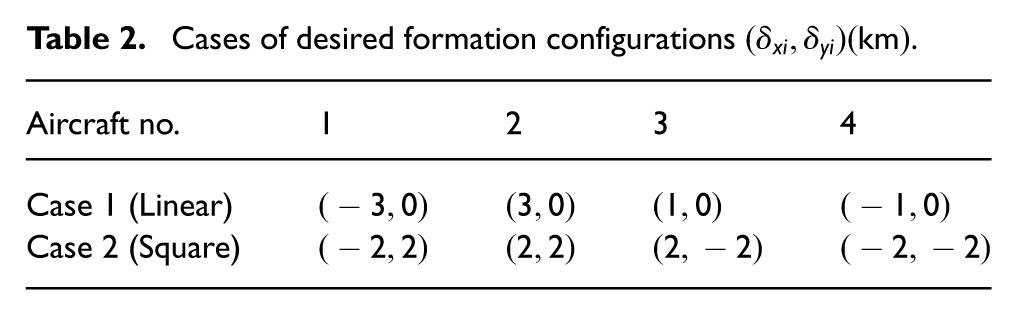
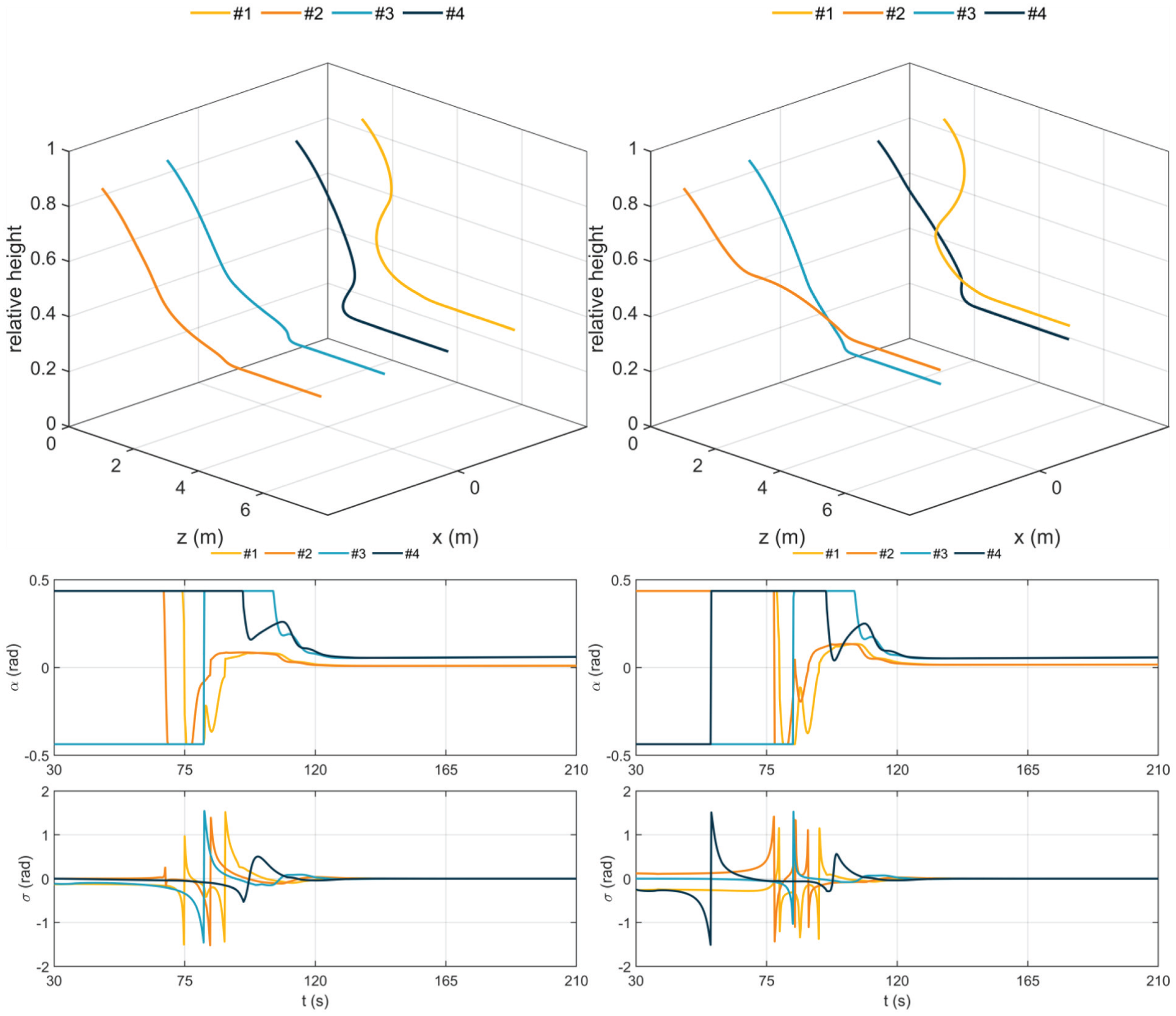
3D trajectories and control inputs.
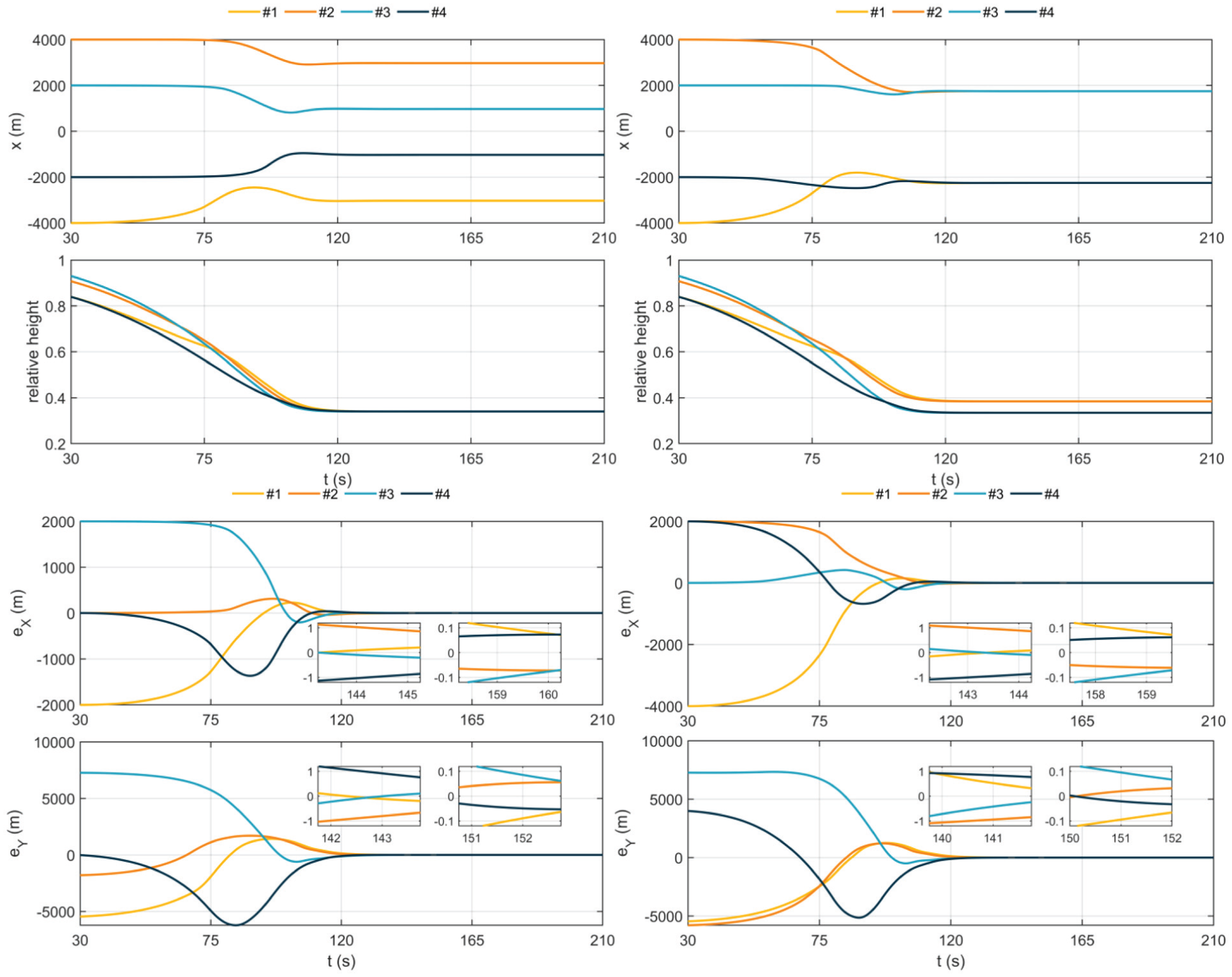
Positions and formation errors.
In both test cases, the heterogeneous system successfully achieves and maintains the desired formations. The formation errors
Comparison simulations
This section demonstrates the effectiveness of the proposed method through comparative simulations. The studies are conducted from three aspects: (1) comparison with representative fixed-time and finite-time baselines; (2) ablation on the auxiliary compensator; and (3) ablation on the dynamic gain adaptation mechanism for heterogeneity. Unless otherwise stated, all compared methods are tested under the same parameter settings, formation configuration, initial conditions, and input constraints.
Comparison with fixed-time/finite-time baselines
Comparative simulations are conducted among the proposed method (M1), the conventional fixed-time controller (Zhang et al., 2020) (M2), and the finite-time comparison controller from the same study (M3) under the two formation configurations in Section “Different formation configurations.” Since Zhang et al. (2020) provide the most relevant existing baseline for the present framework, it is selected as the reference for comparison. Specifically, M2 uses the conventional fixed-time structure with constant exponents in the two power terms, whereas M3 uses the finite-time comparison structure from the same study. The virtual controller of M2 and M3 are given by:

and

respectively, instead of (9). The actual controller, TD, and auxiliary compensator are also redesigned correspondingly. As shown in Section “Different formation configurations,” the proposed method reaches the 1 and 0.1 m formation-error levels at approximately 145 and 160 seconds in both geometries. Accordingly, these two rounded times are adopted here as representative reference instants for comparative evaluation. The simulation results are presented in Figure 5 (Case 1 on the left and Case 2 on the right) and summarized in Table 3.
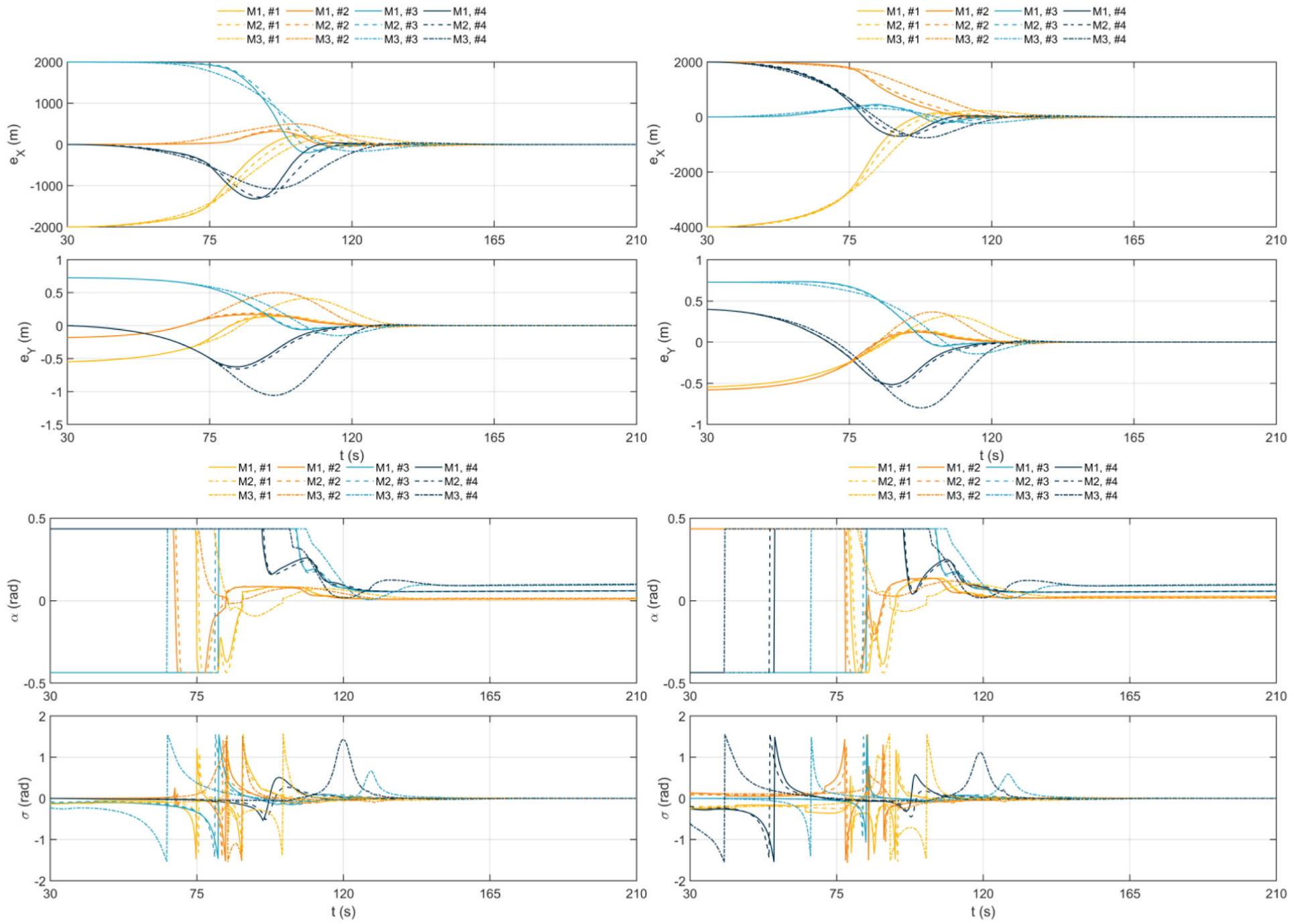
Formation errors and control inputs.
Maximum value of
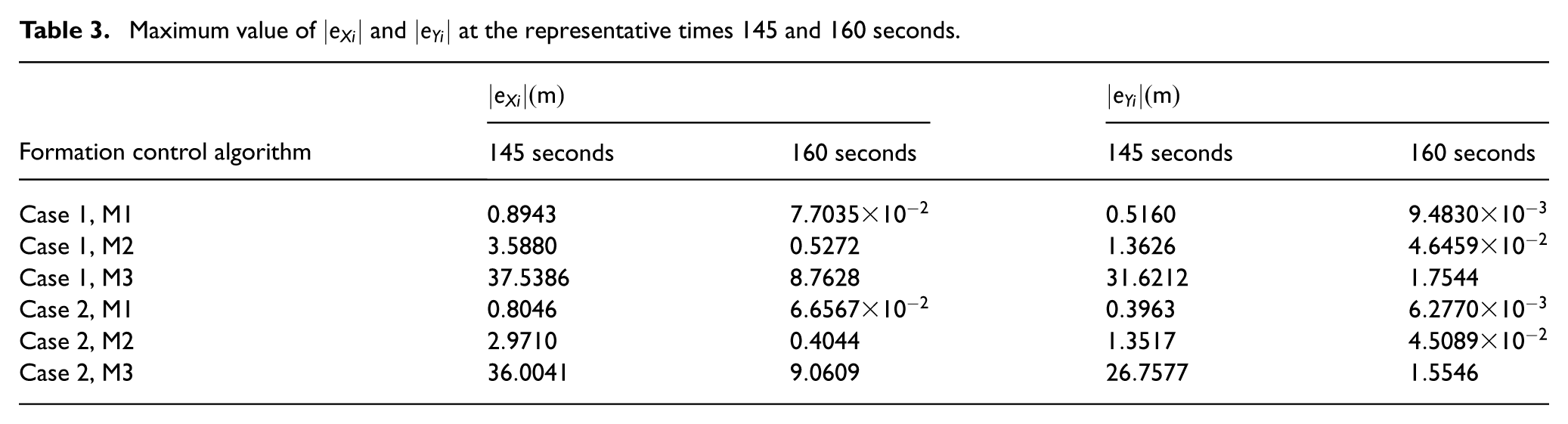
At the beginning of the manoeuvre, all three methods operate in a deeply saturated regime, so their effective control magnitudes are similarly limited by the AoA bounds. As the errors decrease, M3 provides weaker feedback for the remaining relatively large errors and therefore exhibits slower error decay and larger overshoots than the two fixed-time-based methods.
Focusing on the fixed-time controllers, M1 and M2 show similar last exit times from deep saturation under the same formation scenarios and AoA bounds. However, the error difference is already clear at the two reference instants: M1 has reached the corresponding 1 and 0.1 m error levels, whereas M2 still exhibits noticeably larger errors in both formation cases (Table 3). This reflects the transient advantage brought by the adopted fast mechanism. Overall, M1 retains the basic advantages of fixed-time control while achieving faster error reduction than M2.
Ablation on the auxiliary compensator
To isolate the effect of the proposed auxiliary compensator, comparative simulations are conducted between the full method (M1) and its uncompensated counterpart (No-AC) under the same parameter setting, where No-AC is obtained by removing the auxiliary AoA saturation compensator while keeping the remaining controller structure unchanged. Two test cases are examined: Case 1 uses the standard initial conditions (Case 1 in Section “Different formation configurations”), while Case 2 features a larger initial height difference:
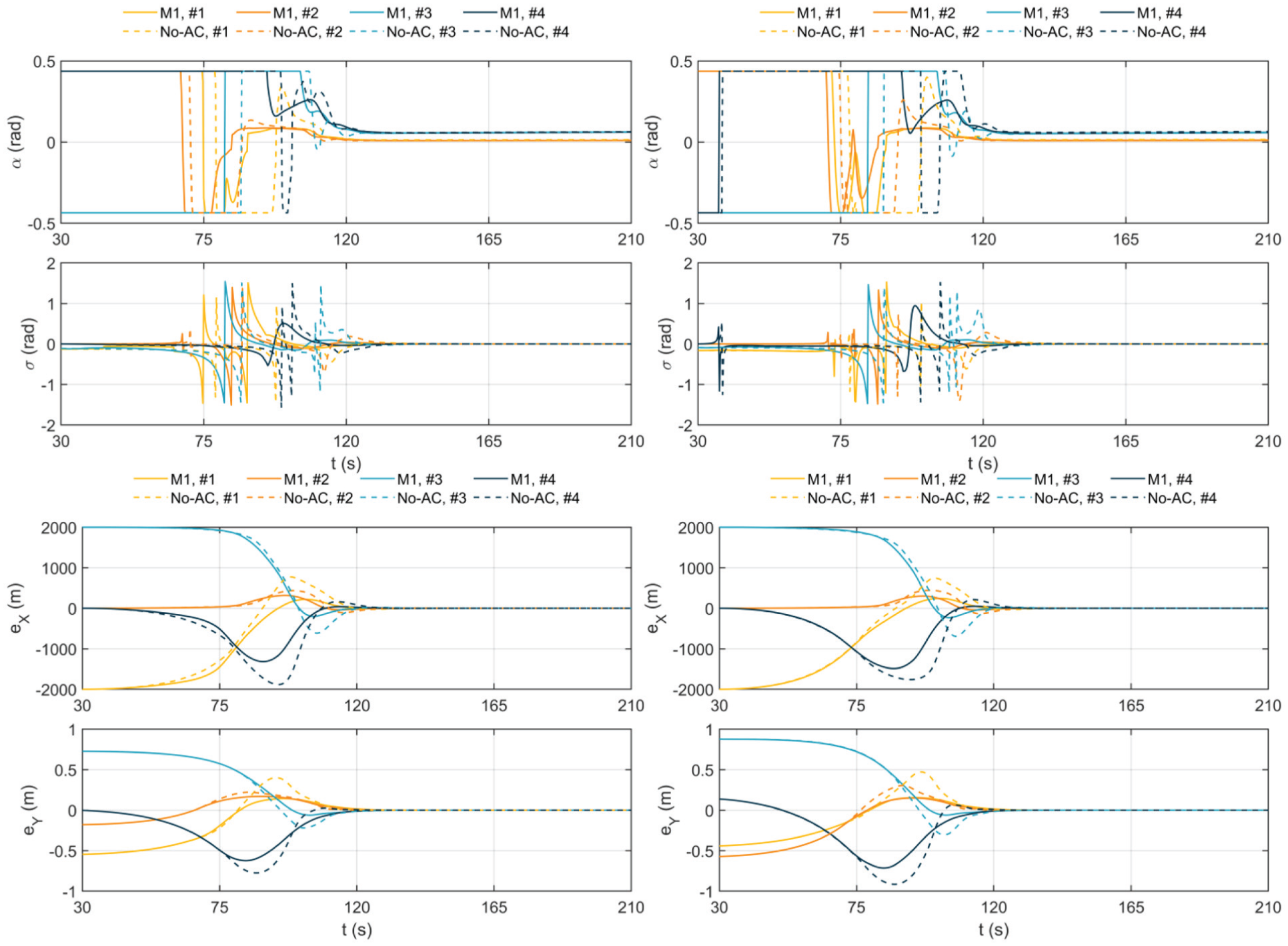
Control inputs and formation errors.
Under input saturation, the uncompensated system (No-AC) changes the AoA rapidly within the saturation bounds, leading to pronounced oscillations. In contrast, M1 reduces the AoA oscillation amplitude and enables a smoother exit from saturation, which is especially clear in Case 2 with larger initial errors. The effect is further quantified through the peak transient deviations of the formation errors. As a representative example, for aircraft 4 the deviation is reduced in Case 1 from 1883.42 to 1317.15 m in
Ablation on the dynamic gain adaptation
To evaluate the effect of the proposed dynamic gain adaptation under actuator-level heterogeneity, comparative simulations are conducted between the full method (M1) and its fixed-gain counterpart (No-GA) under the same parameter setting, where No-GA removes the gain adaptation mechanism while keeping the remaining controller structure unchanged. The two methods are evaluated under the formation configurations in Section “Different formation configurations.” This subsection focuses on the oscillatory behaviour and performance balance of the less capable aircraft after saturation release.
The results show a clear benefit of the dynamic gain strategy. As shown in Figure 7, the control inputs (AoA) for the less capable aircraft (3 and 4) under M1 exhibit markedly reduced oscillation when exiting saturation compared with No-GA. The gains of these aircraft are reduced as their inputs approach saturation and are gradually restored after release. Thus, the adaptation mainly reshapes the saturation-near transient without changing the underlying switched-exponent controller form.
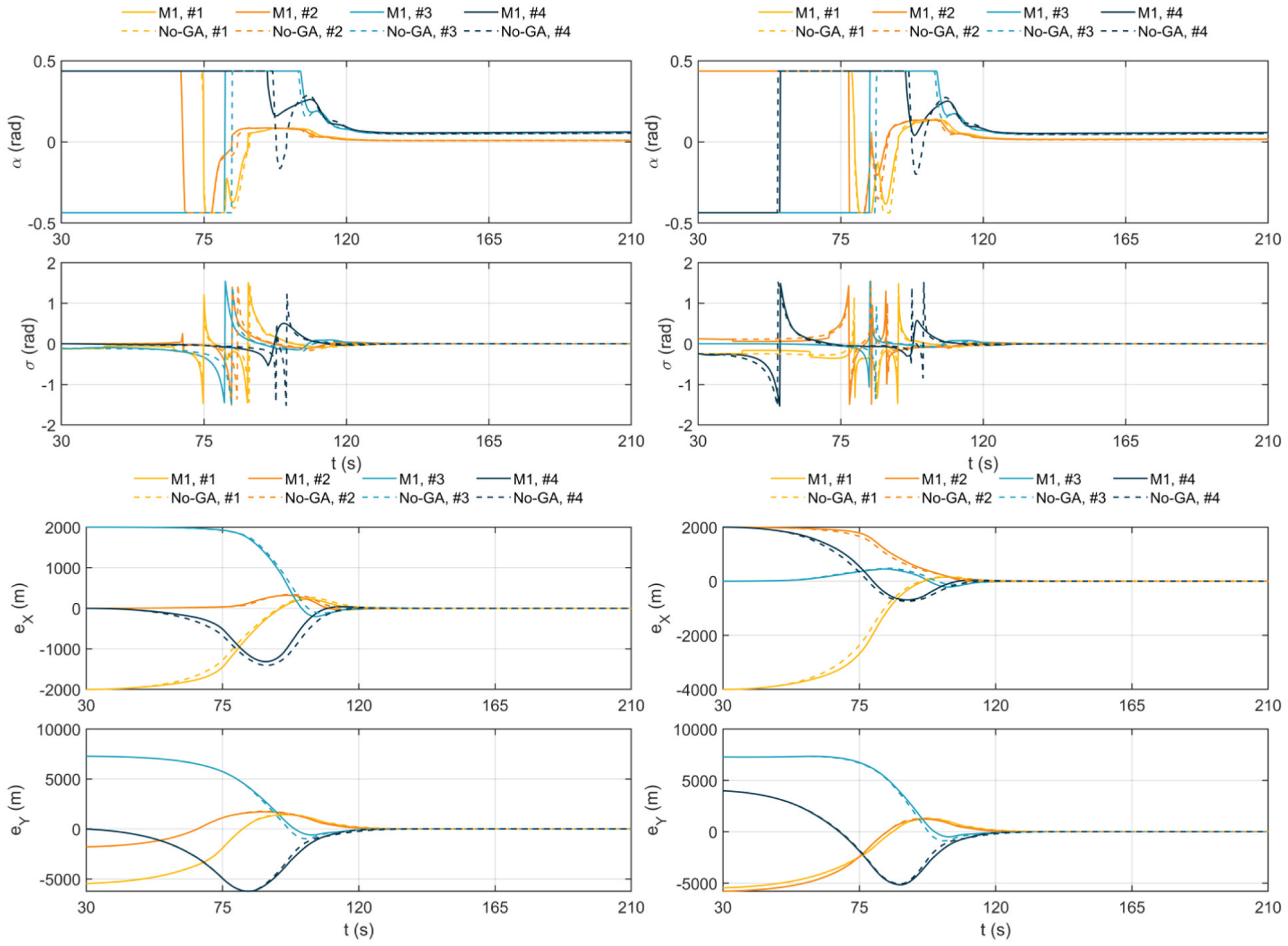
Control inputs and formation errors.
To quantify the oscillation reduction effect, we evaluate the cumulative AoA variation after each less capable aircraft’s own last exit from saturation, defined as the accumulated absolute change in AoA over the remaining time interval. This post-saturation metric is used because the input is strongly constrained before release, whereas the influence of gain adaptation on oscillation suppression is more directly reflected afterwards. For aircraft 3 and 4, the cumulative AoA variation is reduced in Case 1 from
Overall, the gain adaptation and the auxiliary compensator act at different stages: the former is preventive, whereas the latter reacts after saturation-induced mismatch appears.
Conclusion
This paper proposes a hierarchical fast fixed-time formation-control framework for high-speed aircraft with heterogeneous aerodynamic effectiveness subject to strict AoA constraints. The design combines a switched-exponent outer-loop controller, TD-based command realization, a preventive dynamic gain adaptation law, and an auxiliary saturation compensator.
Lyapunov analysis establishes an initial-condition-independent fixed-time convergence bound for the nominal design, with the switched-exponent structure providing the common fast mechanism. For the saturated closed-loop system, the auxiliary compensation mechanism drives the saturation-related tracking errors into a bounded neighbourhood within a fixed time, so that the overall formation process exhibits practical fixed-time-like convergence.
Numerical simulations verify the formation performance under different geometries and show faster transient response than the compared fixed-time and finite-time baselines, together with smoother behaviour under saturation and reduced oscillation for less capable aircraft.
It should also be noted that the present study is developed under a fixed communication topology and an ideal assumption of delay-free command realization for the lower-level attitude and actuator dynamics. More realistic communication imperfections and actuator-realization effects would require corresponding extensions of the present fixed-time analysis, especially in the graph-dependent outer-loop error dynamics and in the command-realization layer. Future work will therefore consider switching or time-varying communication topologies, intermittent packet loss and communication delays, as well as more detailed command realization for the lower-level attitude and actuator dynamics and more complex aerodynamic uncertainties.
Footnotes
Appendix 1

Ethical considerations
This article does not contain any studies with human or animal participants.
Consent to participate
There are no human participants in this article and informed consent is not required.
Funding
The authors received no financial support for the research, authorship, and/or publication of this article.
Declaration of conflicting interests
The authors declared no potential conflicts of interest with respect to the research, authorship, and/or publication of this article.
Data availability statement
Data sharing is not applicable to this article as no datasets were generated or analysed during the current study.