






Abstract
Learning-based controller design methods, such as reinforcement learning and learning-based Lyapunov control, face significant challenges when applied to complex control tasks. Reinforcement learning methods typically demand substantial interaction data during initial training, often exhibiting slow convergence, high sample complexity, and unsafe exploration. Conversely, learning-based Lyapunov control methods, while providing formal stability guarantees, generally require a pre-existing, stable controller or expert demonstrations to bootstrap the learning process, which is often unavailable for novel control problems. To address this fundamental bottleneck, this article proposes a model-based rapid initialization method for neural network controllers. The core idea is to circumvent the need for prior expert knowledge or real-world interaction data. Instead, we leverage the system model to synthesize datasets that inherently satisfy Lyapunov stability conditions. A neural network policy is then trained via supervised learning on this synthetic data, yielding an initially stable controller. This policy serves as a high-quality starting point for subsequent fine-tuning via reinforcement learning or learning-based Lyapunov control methods, significantly improving sample efficiency and safety. We validate the proposed method through a challenging case study: image-based visual servoing control for high-speed multicopter interception. Both simulations and physical experiments demonstrate that the trained policy, without any online reinforcement learning fine-tuning, enables successful interception at a final speed of 15 m/s on a real quadcopter platform.
Introduction
In recent years, an increasing number of studies have utilized learning-based methods to address control issues (O’Connell et al., 2022; Tutsoy and Barkana, 2021). The advancement of reinforcement learning (RL) has made significant contributions to the application of neural network controllers in the field of robot control (Huang et al., 2023; O’Connell et al., 2022; Wang et al., 2023). Although these research findings demonstrate the outstanding performance brought by neural network controllers, the lack of strict stability guarantees makes these methods difficult to apply in safety-critical scenarios. Particularly, before the neural network controller reaches an ideal state, the iterative training process of the neural network controller may lead to dangerous consequences. To overcome this lack, Lyapunov stability methods (Lyapunov and Walker, 1994) in control theory are integrated with learning-based approaches to provide a definitive analytical and design framework. In the studies by Han et al. (2020) and Du et al. (2023), the Lyapunov function is utilized as a critic function to assess policy performance. In Chow et al. (2018) and Chow et al. (2019), Lyapunov stability conditions are used as additional constraints to guarantee system stability. Ganai et al. (2023) and Chang and Gao (2021) develop the target control policy by incorporating a Lyapunov function into the reward function. Compared to Quan et al. (2025), Shen and Quan (2025), and Liu et al. (2025), these studies incorporate Lyapunov conditions into the RL framework in a relatively straightforward method.
The research in Quan et al. (2025), Shen and Quan (2025), and Liu et al. (2025) proposes learning the Lyapunov function and its derivative (referred to as the D-function) from expert demonstration data while adhering to stability constraints, thus facilitating the development of a control policy that inherently ensures Lyapunov stability. These learning-based Lyapunov control (LLC) methods offer formal stability assurances for the target policies and yield favorable outcomes. However, two key issues limit the application of LLC methods. (1) In order to ensure that the trained policy can be applied in practice, the datasets used in the training process should encompass the region of interest (RoI) (Dai et al., 2021; Dawson et al., 2023), which is exceedingly challenging before obtaining an available control policy. The sparsity of the sampled datasets makes the training process of the neural network challenging. (2) A more critical issue is that a common prerequisite for LLC methods is the availability of a stable expert controller or demonstration trajectories to guide the learning process or to learn a valid Lyapunov function.
These two key issues create a circular dependency: designing a stable expert controller for a complex task is often the very problem we aim to solve with learning-based methods. Furthermore, even in RL, a stable initial policy is highly valuable to mitigate the issues of poor initial exploration and sample inefficiency (Shen and Quan, 2025). This leads to a fundamental yet often overlooked challenge in learning-based control: How can we efficiently obtain an initial, stable control policy for a novel task without relying on pre-existing expert knowledge or costly, potentially unsafe, real-world exploration? While traditional control theory may theoretically build such controllers, it requires extensive domain knowledge and iterative tuning, particularly for systems with high-dimensional perception and complex dynamics.
To bridge this gap created by the two issues, this article introduces a novel, rapid initialization method for neural network controllers that requires neither expert demonstrations nor real-world interaction data. Our key insight is that for robotic systems, an approximate dynamic model is often easier to obtain than expert policies or large-scale real-world data. Leveraging this model, we systematically generate state-action datasets that are guaranteed to satisfy Lyapunov stability conditions by construction. A neural network policy is then trained via supervised learning to mimic these stabilizing actions. The resulting policy provides a provably stable starting point for any learning-based control method (RL or LLC). The main contributions of this work are as follows:
A model-based, data-free framework is proposed to quickly generate stable initial policies without relying on experts or real-world trials.
We validate our method through a high-speed (15 m/s) multicopter interception case study, providing a complete pipeline and demonstrating successful real-world intercepts without any online adaptation.
It is important to note that the primary goal of this method is to efficiently bootstrap a usable, stable policy with satisfactory baseline performance. Further refinement for optimal performance can subsequently be achieved by combining it with RL or LLC techniques.
The article is organized as follows: (1) Section ‘Problem formulation’ outlines the coordinate systems and mathematical models employed in the case study. (2) Section ‘Policy generation method’ shows the rapid methodology for training neural network policies, firstly. Then, the proposed method is applied to the case study of image-based visual servoing control for the multicopter interception. (3) Section ‘Stability verification and simulations’ validates the stability of the trained policies by the almost Lyapunov condition (Liu et al., 2020). Meanwhile, the simple simulation results are given. (4) Section ‘Experiment’ presents the experimental result of the trained policies implemented on quadcopter platforms.
Problem formulation
In this article, the proposed method will be used to obtain the image-based visual servoing policy for multicopter interception. The policy is a neural network with the target position in the image plane coordinates as the input. Here, the desired position of the target point is the center of the image plane (Yang et al., 2025b; Yang and Quan, 2020).
Coordinate systems and models
This article uses five coordinate systems, which are the Earth-fixed coordinate system (EFCS), the body coordinate system (BCS), the gimbal camera coordinate system (GCCS), the strapdown camera coordinate system (SCCS), and the image coordinate system (ICS), as shown in Figure 1. The positive orientation adheres to the right-hand principle. The Earth-fixed coordinate axes
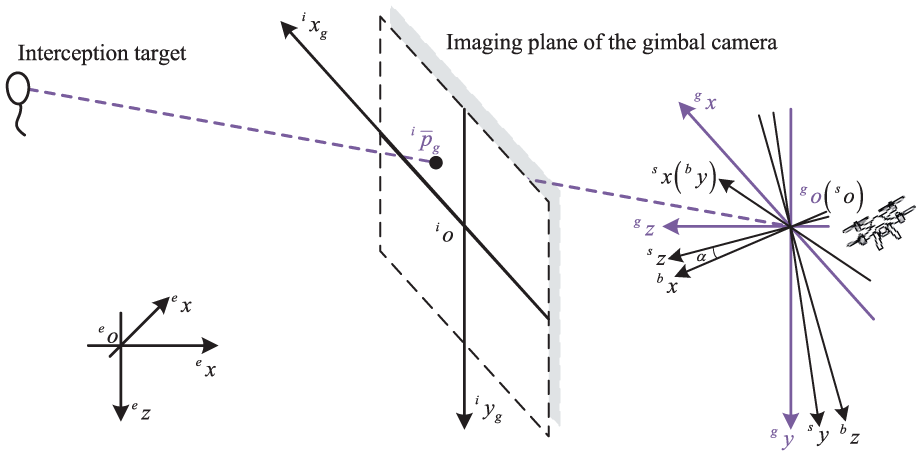
Description of coordinate systems in the multicopter interception problem. The left superscript indicates the abbreviation of the coordinate system, where the letter ‘g’ represents the gimbal camera coordinate system, the letter ‘e’ represents the Earth-fixed coordinate system, the letter ‘s’ represents the strapdown camera coordinate system, and the letter ‘b’ represents the body coordinate system. The installation angle of the strapdown camera is α. The dashed rectangle represents the imaging plane of the camera.
Assuming that the coordinate of the interception target in the ICS of the strapdown camera is denoted as

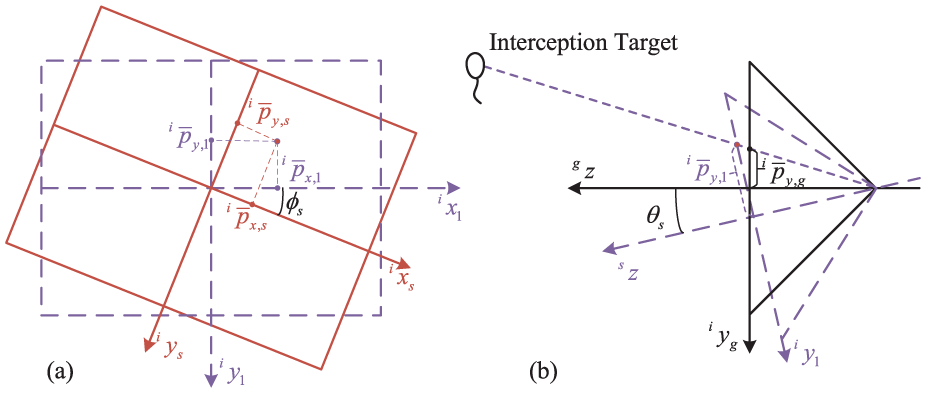
Geometric relationship between the target point’s coordinates in the strapdown camera image and its coordinates in the gimbal camera image. (a) Temporary coordinates after roll angle
According to Figure 2(b), the coordinate in the ICS of the gimbal camera is derived as

Then,

where

The dynamics of the target point

where the image Jacobian matrix



where the image Jacobian matrix

and

Control strategy
In order to accomplish the interception mission with the multicopter, the strategy employed in this research is as follows: The multicopter is made to fly at a designated velocity
Policy generation method
In this section, the method to generate a neural network policy for interception will be introduced. First, the policy design process will be briefly described. Second, a neural network policy used for object interception is designed and trained in detail. Finally, the almost Lyapunov condition (Liu et al., 2020) is adopted for control stability verification.
Policy training method
Initialization
Controller designers should create a randomly initialized neural network policy

where
Candidate D-function calculation
Based on the control object, design a Lyapunov function

Dataset construction based on Lyapunov conditions
For all the given

where η is a positive number,
The datasets

are composed of all the number of data point
Training neural network
with
Train

where k is the training epoch and N represents the number of data items in the datasets
The real-world data-free policy training framework has been presented in this subsection. The control policy
Training of interception policy
Initialization
Model (9) is selected for the neural network policy design. The system state vector is

However, only

This study employs a standard feed-forward neural network architecture, which is well suited to learning the static state-to-action mapping required by our policy. The network’s width and depth were determined through experimental tuning. The network configuration consists of an input layer with three neurons and an output layer comprising a single neuron. The architecture incorporates three hidden layers, each containing 16 neurons. The hyperbolic tangent (
Candidate D-function calculation
The key to completing the interception task is to make the target position in the gimbal camera image tend towards the image center, that is,
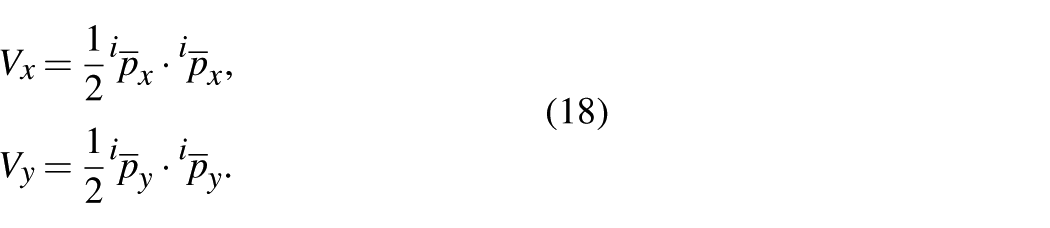
The final Lyapunov function is

If
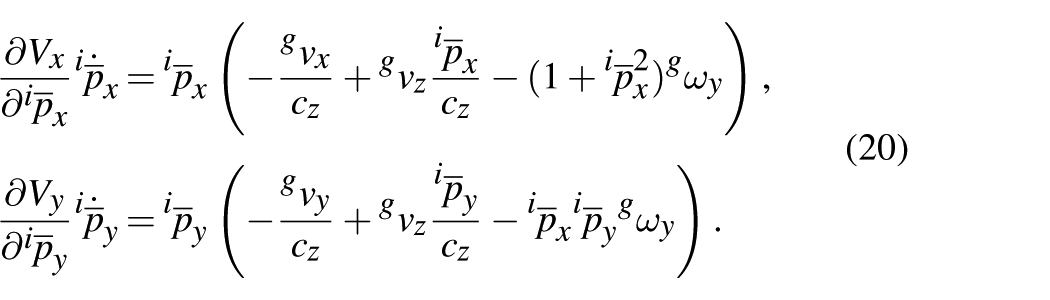
Let
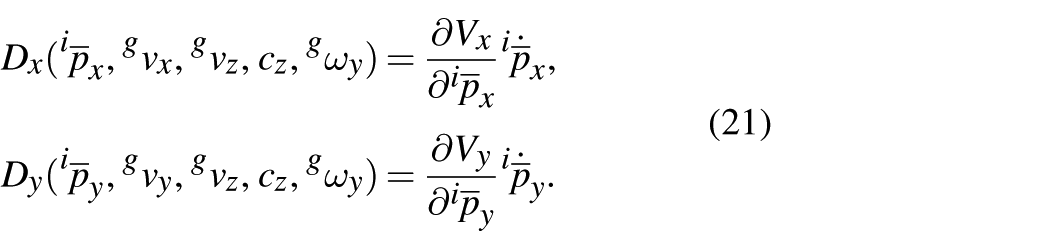
Dataset construction based on Lyapunov conditions
The conditions that the datasets need to satisfy are shown in equation (13), where

and

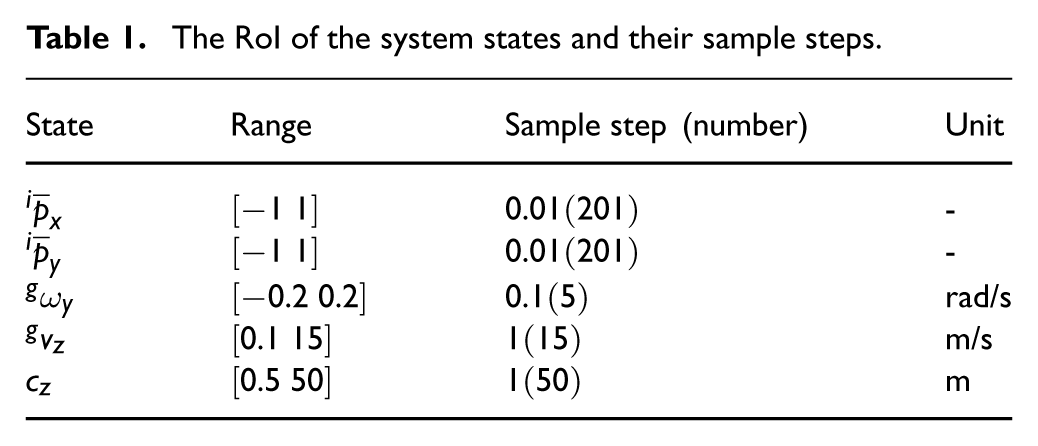
To ensure that the synthesized dataset is evenly dispersed over the RoI, uniform sampling is used to determine sampling points for each state. The RoI of the states and their sample numbers used in this study are shown in Table 1, where
The RoI of the system states and their sample steps.
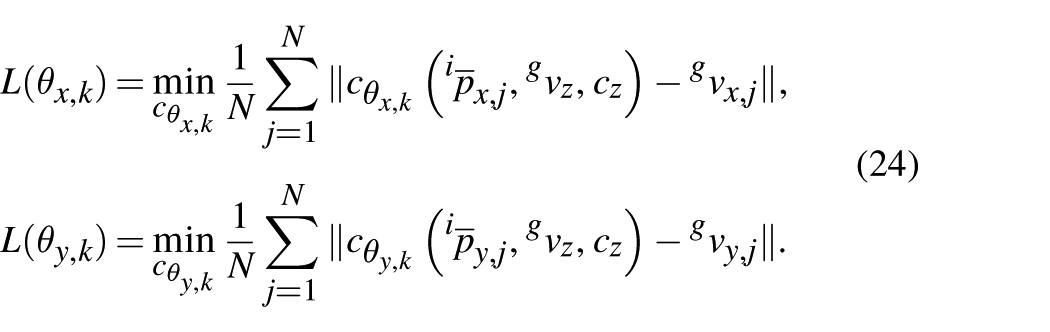
Training neural network
and
The neural network policies
The control policies
Stability verification and simulations
Before deploying the trained neural network policy, its stability is verified using the almost Lyapunov conditions (Liu et al., 2020), which have also been adopted for stability analysis in Chang and Gao (2021) and Dawson et al. (2022). The neural network controller synthesized by the proposed method cannot be proven to be stable analytically. The approach presented in Liu et al. (2020) for nonlinear systems relaxes the classical Lyapunov stability condition by allowing the derivative of the Lyapunov function to be non‑negative over a sufficiently small set of states, while still guaranteeing system stability. In this work, states within the RoI, as shown in Table 1, are intensively sampled, and the sign of
Verifying almost Lyapunov conditions
The verification of the almost Lyapunov conditions is achieved by the sample-based method. First, we need to intensively resample the states within the RoI as shown in Table 1 to construct state datasets. Based on these datasets, we then calculate the derivative of the Lyapunov function:

where
The results of equation (25) are decided by multiple state inputs. To facilitate the presentation and verification of the results, some relatively unimportant states are fixed here. Let
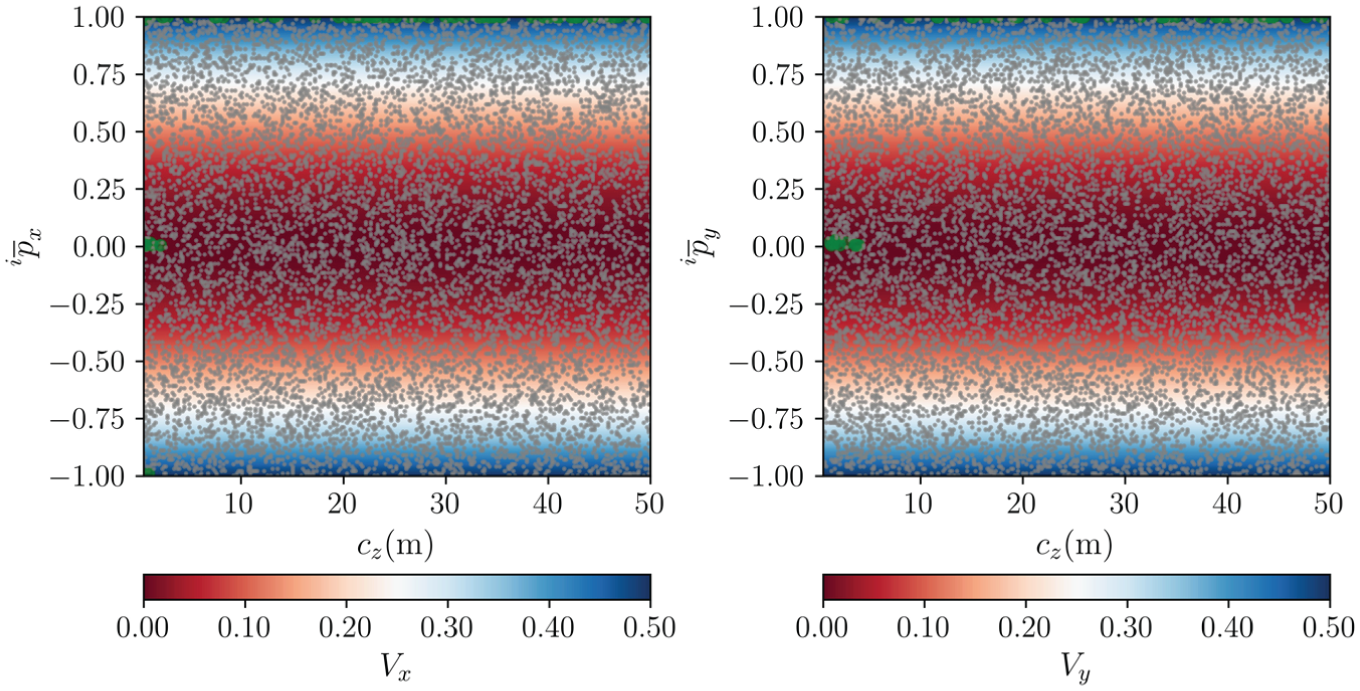
The region of attraction for the interception system with the trained neural network policy when
Considering a more general case, the pixel distance of the target from the center of the image coordinate system is defined as

As shown in Figure 4, assuming that the object distance is much greater than the focal length, the image distance is approximately equal to the focal length. Then, the following relationship exists:

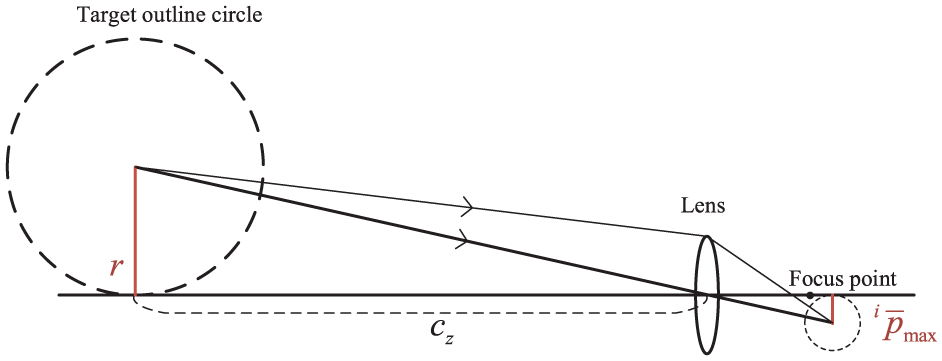
Geometric condition for stationary target interception. Assuming the target is stationary, to achieve target interception, the relationship between the target size and the distance of the target from the center of the camera image.
In this context, r denotes the radius of the inscribed circle of the intercepted target’s contour,
Let

Equation (28) denotes that when the distance from the camera to the target object is 1 m, if the target’s distance from the center of the camera’s image coordinate system,
Simplified simulation
To verify the policies, we employed a simplified simulation model assuming instantaneous execution of velocity commands by the multicopter. In the study, a neural network controller for
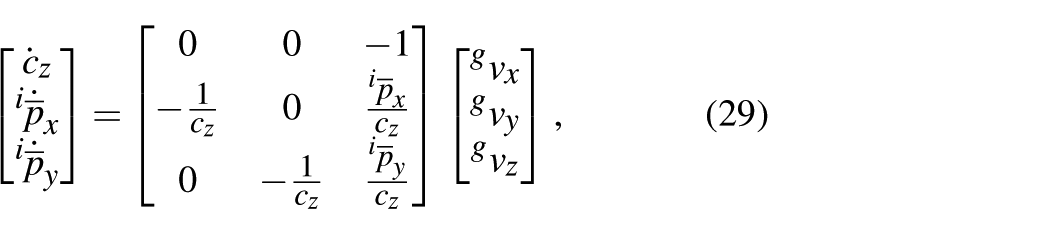
where
The two top plots in Figure 5 present the simulation results under different initial states. Purple regions indicate coordinates where
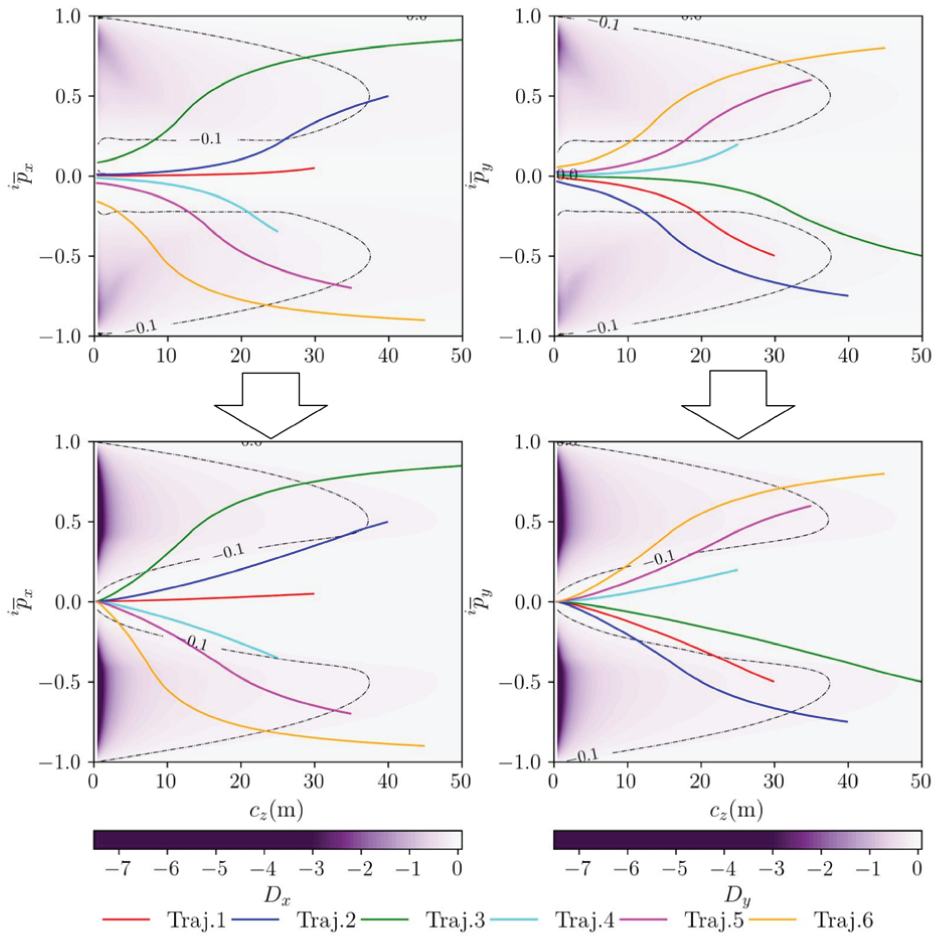
Simulated flight trajectories comparing a non-fixed (top) and a fixed (bottom)
In the design of section ‘Training of interception policy’0.0, the neural network policies
Experiment
Quadcopter setup
We validated the interception policies on a quadcopter. The neural network policies are run on the onboard computer
1
at 30 Hz, and a yolo-v5 target recognition instance equipped with the 1280×720@10 Hz camera is also run on the onboard computer at 10 Hz. The target coordinate in the ICS of the strapdown camera, namely
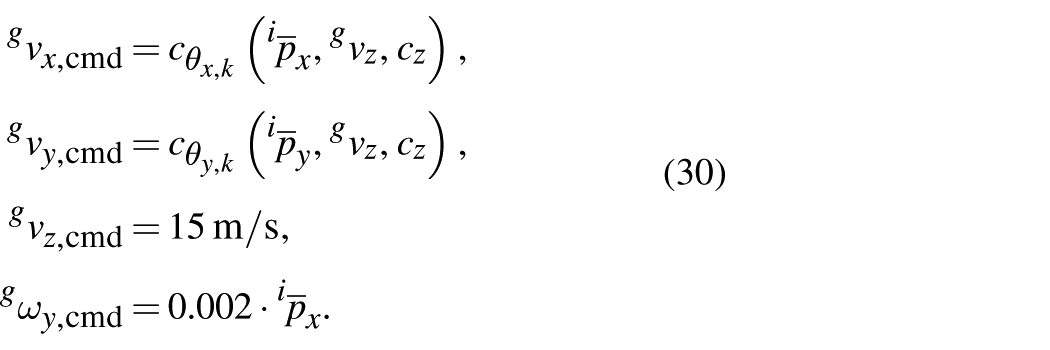
where
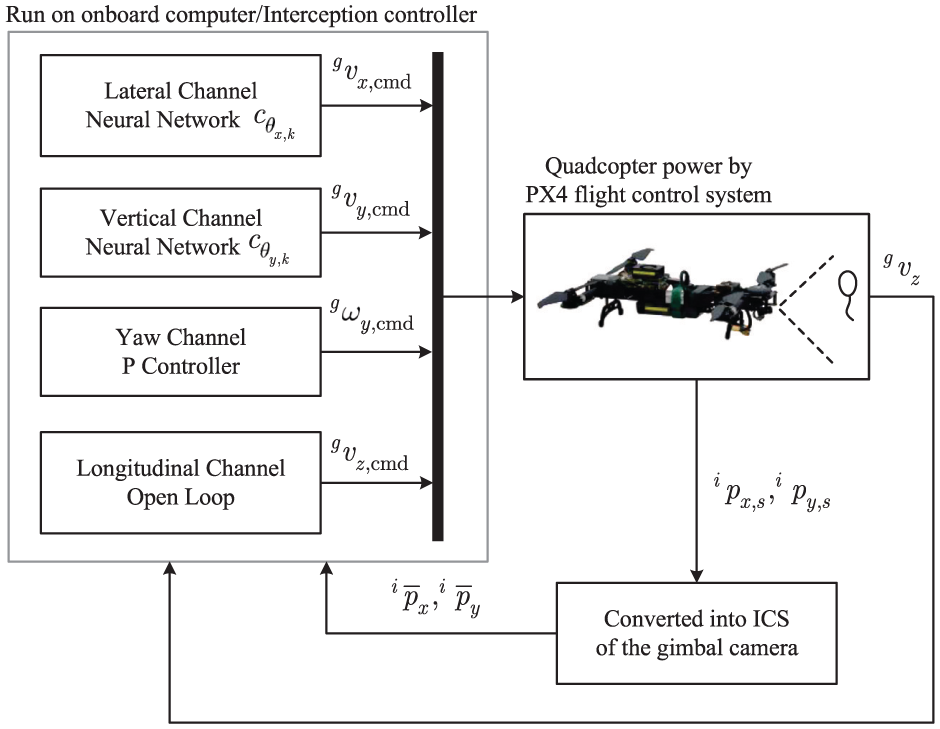
Architecture of the neural network–based interception control system for a quadcopter.
The quadcopter has a total mass of
Experimental result
Figure 7 presents the video snapshots captured by the strapdown camera during the flight, covering the images from the moment the quadcopter just entered the interception flight state until the moment it was about to hit the target. When the interception state was just entered, due to the change in pitch attitude, the target appeared on the upper edge of the image. In the subsequent images, the target gradually moved towards the center of the image. The first four subplots in Figure 8 show velocity commands issued by the onboard computer and the actual response. The last two subplots in Figure 8 track two metrics during interception: (1) the bounding box area of the target in image space (represented by red boxes in Figure 7) and (2) the values of
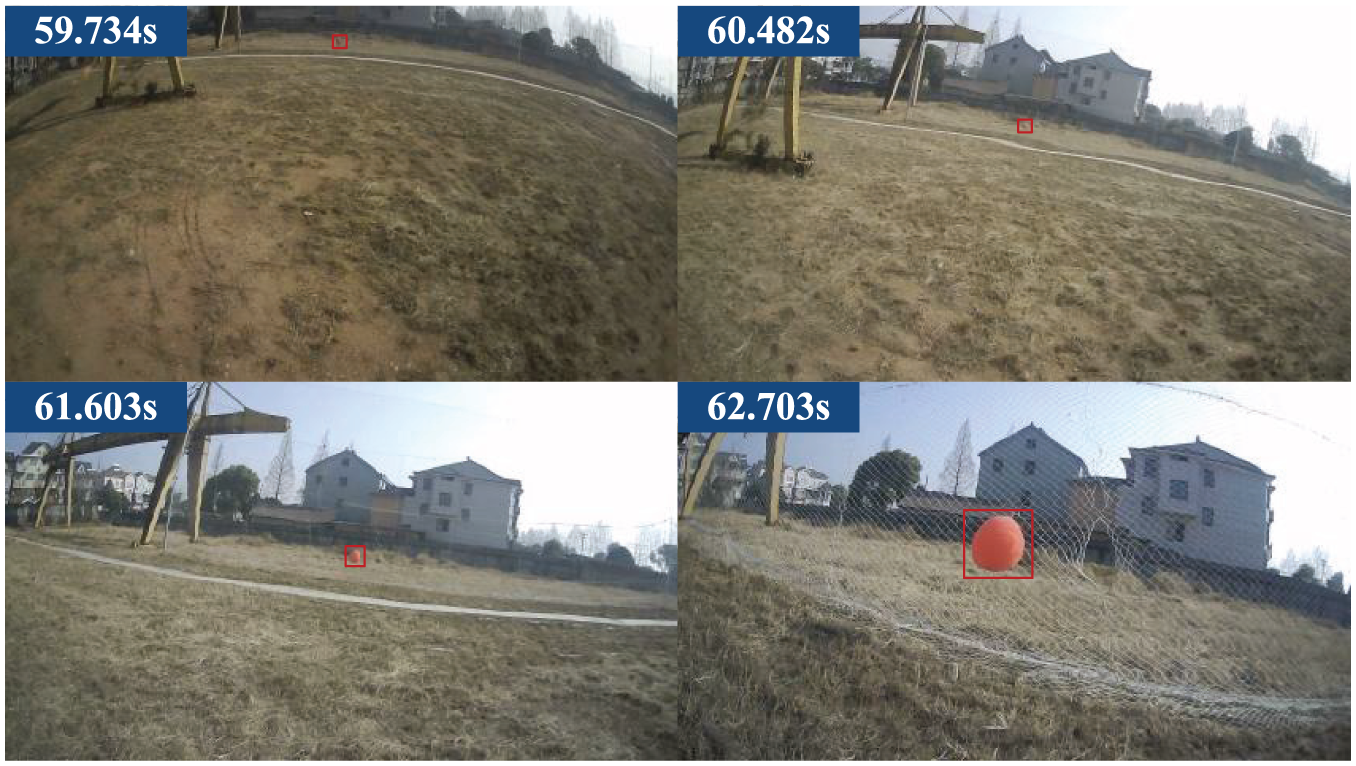
Video screenshots from the strapdown camera of the quadcopter during the experiment. Each screenshot is labeled with the video timestamp. See supplemental video.
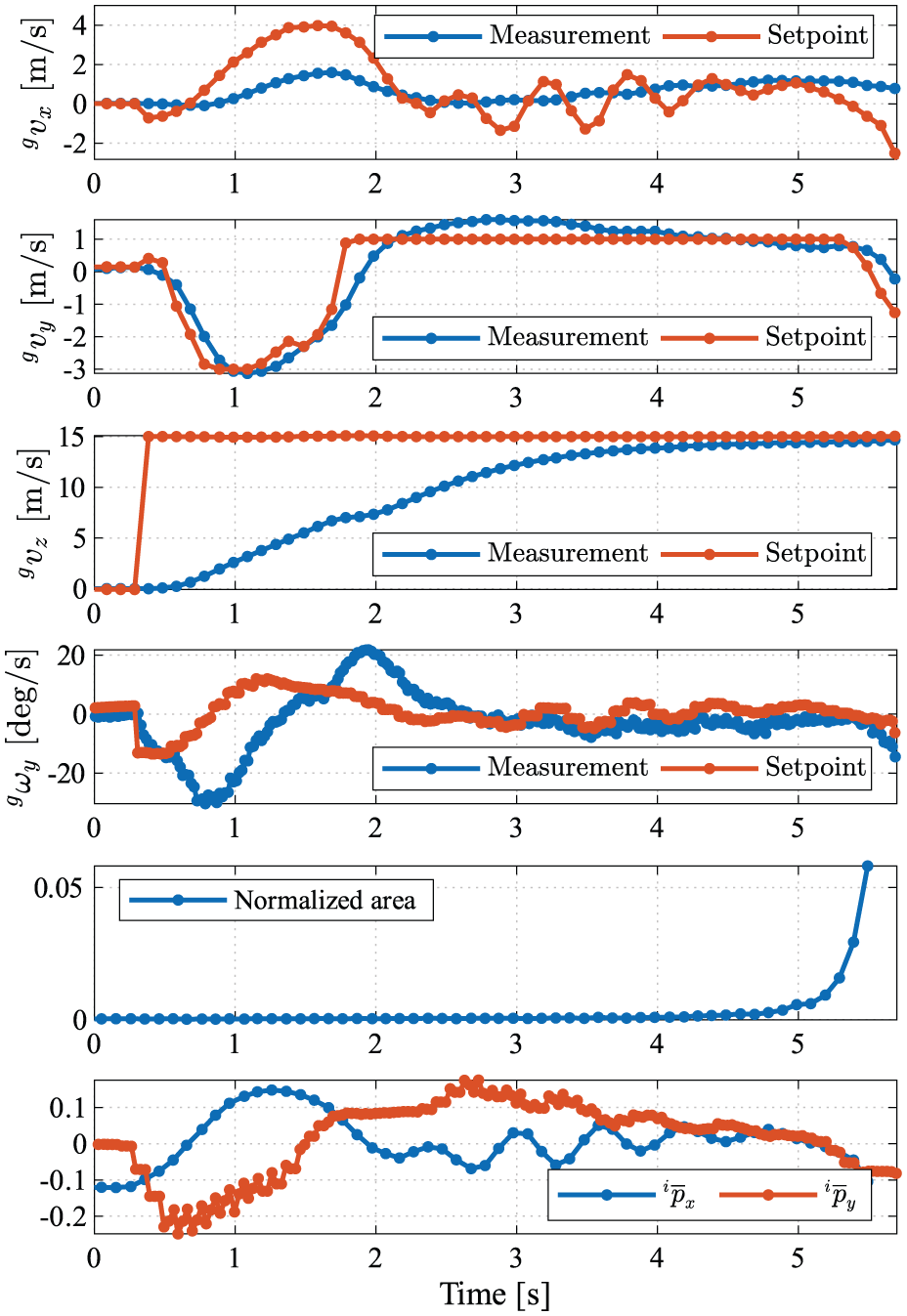
The response of the quadcopter to the command from the onboard computer.
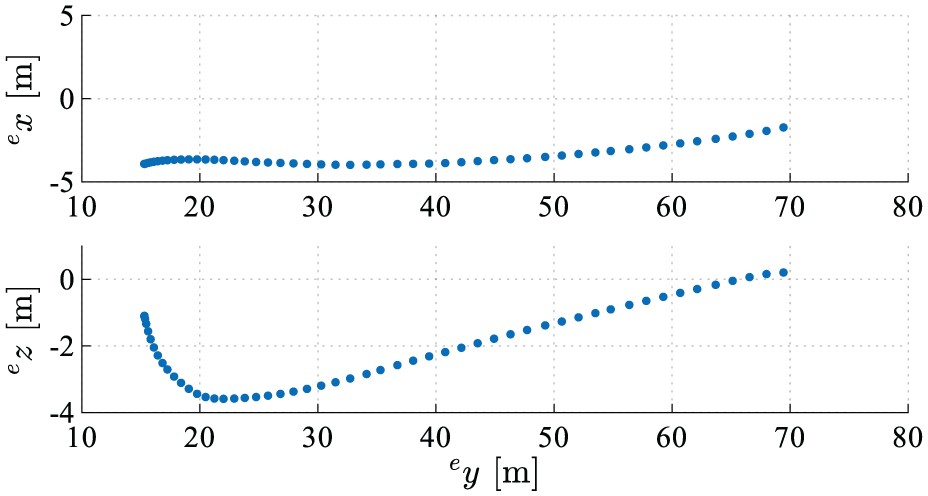
Scatter trajectory of the quadcopter during interception.
In the previous stability verification, we did not take into account the changes in yaw angular velocity, thus focusing more on the relationship between the changes of
The trained interception control policies successfully executed missions at target speeds during deployment. This confirms our method’s ability to rapidly develop the mediocre control policy via offline training using only a posteriori knowledge and synthetic datasets without real flight data.
Summary of results
This study proposed and validated a novel fast initialization method for neural network controllers. The primary experimental findings are as follows. First, the method successfully generated a stable initial control policy offline using only synthetic datasets constructed from the system model, without requiring real-world flight data. Then, when deployed on a quadcopter platform for an image-based visual servoing interception task, the trained policy achieved a final successful interception velocity of 15 m/s. Finally, the controller effectively guided the target from the edge of the image plane toward its center, as evidenced by the video snapshots and the convergence of the normalized image coordinates
Discussion and conclusion
The proposed rapid initialization method provides a pathway to obtain a stable initial neural network policy without real-world interaction data. However, the performance and robustness of this policy in real-time deployment are inevitably influenced by various uncertainties inherent in practical engineering systems. Acknowledging and analyzing these uncertainties is crucial for understanding the limitations of the current approach and guiding future improvements.
In control systems, uncertainties generally originate from internal system characteristics and external disturbances. For our image-based visual servoing application on a multicopter, these can be categorized as follows: (1) Parametric uncertainties: These arise from inaccuracies in the system model parameters used for dataset generation. In our case, this includes the object distance
These uncertainties affect the control system at multiple levels. (1) Training phase discrepancy: The synthetic datasets
In summary, this method addresses the cold-start problem in learning-based control by providing a stable initial policy without requiring prior interaction data. Simulations and experiments of image-based visual servoing for the multicopter interception validate the method’s effectiveness. While the method’s offline, model-based nature inherently limits robustness against real-world uncertainties, the initialized policy serves as a high-quality starting point for subsequent fine-tuning via RL or LLC to enhance its performance and robustness, which is one of the future works. Another future work will incorporate comprehensive models and advanced neural networks (e.g. RNNs) to enhance robustness.
Supplemental Material
Footnotes
Acknowledgements
A preprint (Ke et al., 2025) of this work is available online  .
.
Ethical considerations
This article does not contain any studies with human or animal participants.
Funding
The authors disclosed receipt of the following financial support for the research, authorship, and/or publication of this article: This work was supported by the Zhejiang Province Human Resources and Social Security Department (grant number ZJ2025198).
Declaration of conflicting interests
The authors declared no potential conflicts of interest with respect to the research, authorship, and/or publication of this article.
Data availability statement
Data sharing is not applicable to this article as no data sets were generated or analyzed during the current study.
Supplemental material
Supplemental material for this article is available online.