







Abstract
An area in need of study in child language acquisition is that of complex multilingual contexts in which there is little language separation by interlocutor or domain. Little is known about how multilingual children use language to construct their identities in each language or in both languages. Identity construction in monolingual contexts has been examined closely using a community of practice model, with case studies of adolescents and teenagers. Language is viewed as social practice, as individuals use language to actively construct a shared community of practice. This study examines multilingual children’s (ages 6–12) lexical and phonological choices in two of their languages, Light Warlpiri and Warlpiri, that share many lexical items and most nominal morphology. The children’s choices contribute to language differentiation and in some instances drive language differentiation further than adult speech does. The motivation is captured in a community of practice model.
Keywords
Introduction
An area in need of study in child language acquisition is that of complex multilingual contexts in which there is little language separation by interlocutor or domain (e.g. O’Shannessy, 2008; Simpson & Wigglesworth, 2008; Zentella, 1997). Little is known about how children maintain language separation when two or more languages or varieties share structures and forms, or when code-switching between languages is very frequent. Yet these are common bilingual contexts (cf. Poplack, 1980; Poplack & Meechan, 1995; Treffers-Daller, 1994; Zentella, 1997). In addition there is little work on how bilingual and multilingual children use language to construct their identities in each language or in both languages. Identity construction in monolingual contexts has been examined closely using a community of practice model, with case studies of adolescents and teenagers (Bucholtz, 1999; Eckert, 1989, 2000; Eckert & McConnell-Ginet, 2007). In this model language is viewed as social practice, as individuals use language choices to actively construct a shared community of practice, and themselves as members.
In the present article, the community of practice model is exploited to analyze lexical and phonological choices of multilingual children. The participants (aged 6–12 years) speak Light Warlpiri and Warlpiri, languages that share about one third of lexical items and most nominal morphology (O’Shannessy, 2005, 2009, 2013). A generalized linear mixed effects analysis (glmer in R package lme4) (Bates, Maechler, Bolker, & Walker, 2014) is used to examine the effect of language type (Warlpiri vs. Light Warlpiri) and age (children, young and middle-aged adults) on the relative frequency of alternating forms used in the community, specifically four pairs of words and two pairs of nominal suffixes. The children’s choices of shared items contribute to language differentiation and in some instances drive language differentiation further than adult speech does. It is argued that the processes can be captured in a community of practice model, in which the children are actively constructing themselves as members of two interacting communities of practice.
In the next section relevant literature on language differentiation in bilingual first language acquisition is reviewed, followed by literature on children’s learning of sociolinguistic skills, and the community of practice model. The third section provides background information about the language acquisition environment and the languages in focus in this study. The fourth section describes the methods of the study, the fifth the results, and in the sixth section the results are discussed and conclusions drawn.
Children’s bilingual language differentiation and developing sociolinguistic competence
Language differentiation in bilingual first language acquisition
The language learning context of bilingual first language acquisition (BFLA) is that two languages are used in regular communication with children from birth, or very soon after (de Houwer, 2005, p. 31). Most of the early literature on BFLA focuses on children’s language production to ascertain the nature of their mental representations of the two languages they are acquiring. The question is whether the representation is initially that of one unified system, (Arnberg & Arnberg, 1992; Imedadze & Uznadze, 1967; Redlinger & Park, 1980; Vihman, 1985; Volterra & Taeschner, 1978), or of two systems (de Houwer, 1983, 1990, 1995, 2009; Genesee, 1989; Genesee & Nicoladis, 2007; Genesee, Nicoladis, & Paradis, 1995; Lanza, 1992, 1997a, 1997b, 2004; Mishina-Mori, 2005; Nicoladis & Genesee, 1997a). By now, the model of a child having a psychological representation of two systems from very early in development has considerable support, at least in terms of morphosyntactic development (de Houwer, 1983, 1990, 1995, 2009; Genesee, 1989; Genesee & Nicoladis, 2007; Genesee et al., 1995; Lanza, 1992, 1997a, 1997b, 2004; Nicoladis & Genesee, 1997a), and to some extent for phonological development (Deuchar & Quay, 1998, 1999, 2001; Johnson & Lancaster, 1998). Some important studies show that even at the one word stage, bilingual children use their two languages differently in different contexts, by using more items from one language with one parent, and more from the other with the other parent, when each parent typically speaks one language to the child (Genesee, 1989; Genesee et al., 1995; Kehoe, 2015; Lanza, 1992, 1997a, 1997b).
Much of the research to date has been undertaken in contexts in which the languages are easily differentiated, for example English and French (Genesee, 1989; Genesee et al., 1995), or English and Norwegian (Johnson & Lancaster, 1998; Lanza, 1992, 1997a, 1997b), and the input is fairly clearly separated in terms of interlocutor and context, for instance, at home with a parent, with visitors, at school, and so on. There have been relatively few studies in which there is less clear separation in the input to children (de Houwer, 2005; Simpson & Wigglesworth, 2008), although it is not an uncommon learning situation (de Houwer, 2005; Deuchar & Quay, 1999; Zentella, 1997). Studies of parental mixing of languages have mostly involved the use of two clearly distinct languages, and compare the parental input to the children’s language mixing in their production (Juan-Garau & Perez-Vidal, 2001; Lanza, 1997b; Mishina, 1999; Mishina-Mori, 2000; Nicoladis & Genesee, 1997b; Schlyter, 1987). Most studies find some structural similarity in the mixing of parents and of children, and also that sociolinguistic and pragmatic factors play a role in how and when the children mix languages. These studies are usually set in communities in which use of the target language involves little, but some, code-switching (the use of two or more languages in a single interaction). Although parents may code-switch to some extent, a lack of language mixing is considered to be the community norm in these contexts. In other words, the default learning context in the bilingual acquisition literature is that bilingual adult speakers speak two unmixed languages and that this is the target for the children, although Genesee (2003) argues that the acquisition field should not take such a narrow view. In contrast, there is some literature on bilingual and multilingual communities in which borrowing and code-switching are considered to be the norm (Cheng & Butler, 1989; Denison, 1992; Kamwangamalu, 1989; O’Shannessy, 2011; O’Shannessy & Meakins, 2012; Rahim & Haroon, 2003; Simpson & Wigglesworth, 2008; Valle, 2000). Research attention to multilingual contexts is increasing, and trilingual children show similar strategies when learning three languages as has been shown when two are learned. One trilingual child made language choices according to the language used to address her, her interlocutor’s proficiency, and the social context (Quay, 2008), and another produced translation equivalents in three languages at a similar stage to that seen in bilinguals (Montanari, 2010). Despite this work, although many children grow up learning two dialects of a language from birth, there is little acquisition work in this context. In discussing children’s acquisition of two dialects of Dutch, Cornips (2014) stresses that children may produce forms and structures of more than one dialect in appropriate contexts, and that researchers should be sensitive to this when assessing children’s language development.
Acquisition of sociolinguistic competence
Sociolinguistic approaches view language use as social action, constituting and constructing the users’ identities, which are often fluid. Sociolinguistic competence involves understanding how to manipulate linguistic resources to perform social actions and in turn how to interpret the social actions of others. Linguistic resources may include multiple languages or dialects, different styles within a language, alternate phonological or grammatical features, or differences as a consequence of changes taking place within a single language. In some cases, local linguistic norms are changing; in others, linguistic variation is more stable. But in every interactional environment there is variation of form and structure.
Children learn to produce the same kinds of phonological variation as adults do by age 3–4 years (Roberts, 1997a; Roberts & Labov, 1995; Smith, Durham, & Fortune, 2007), and can alternate between syntactic structures in two dialects at age 4–6 years (Cornips, 2014). When there is a phonological change in progress, 4- to 5-year-old children have been seen to produce an incoming pattern, part of a change in progress, more often than their parents do, and so can be agents of linguistic change (Roberts, 1997b). In contexts in which there is considerable variation, children may regularize the variable input they receive (Jourdan, 2009; Kerswill & Williams, 2000; O’Shannessy, 2013, in press-b), or produce variants from dialects spoken by their peers but not their parents (Kerswill & Williams, 2000).
Interactional approaches have found that young children can interpret and produce speech styles that change according to gender and social power, for instance by altering their pitch, word choices, clause structure, and level of indirectness, depending on the role they are playing (e.g. Andersen, 1990; Cook-Gumperz & Scales, 1996; Odato, 2013; Shatz & Gelman, 1973). Bilingual children aged 2–3 years use the same kinds of linguistic strategies to repair conversational breakdowns as do monolingual speakers of one of the languages (Comeau, Genesee, & Mendelson, 2010).
A community of practice model has been valuable for examining language and social organization among teenagers and adolescents, documenting social identity practices performed through language (Bucholtz, 1999; Eckert, 1989, 2000; Eckert & McConnell-Ginet, 2007). The community of practice model was adapted from Lave and Wenger’s (1991) and Wenger’s (1998) concept of learning as an embodied sociocultural practice, and was taken up by Eckert and McConnell-Ginet (1992) to explore the complex interactions of language, gender, and sexuality (Eckert & McConnell-Ginet, 2007). The community of practice construct emphasizes the integration of individual agents as participants and learners within, and connected to, a sociocultural arena (Lave & Wenger, 1991, p. 50), as they negotiate the ‘social production of meaning’ (Wenger, 1998, p. 49). Here meaning refers to the meaningfulness of everyday experience. The practices in which participants engage create coherence in a community, through three core aspects. These are mutual engagement, including shared activities and the complexity of relationships; a joint enterprise, negotiated by the participants, but not necessarily explicitly; and a shared repertoire of ‘ways of doing things’, including stories, actions, and discourses (Wenger, 1998, pp. 77–78). Participants’ actions are situated in a social and historical context, and aspects of the context may be explicit or implicit, including language use, relationships, and conventions. Participants learn and demonstrate their membership of a community of practice through negotiation (including contestation) and performance of the locally relevant aspects of the community (Wenger, 1998, pp. 136–137). Learners (for instance, in the context of this article, language learners) are involved in ‘legitimate peripheral participation’ (Lave & Wenger, 1991) as they gradually enact more of the practices of the community.
Language is one of many social practices, used dynamically by speakers to construct their identities, which involves ‘negotiating the meanings of our experience of membership in social communities’ (Wenger, 1998, p. 145). As Bucholtz (1999, p. 209) explains ‘identities emerge in practice, through the combined effects of structure and agency. Individuals engage in multiple identity practices simultaneously, and they are able to move from one identity to another.’ Examples of language variation interacting with identity construction include high school communities of Jocks and Burnouts (Eckert, 1989, 2000; Eckert & McConnell-Ginet, 2007), and Nerd Girls (Bucholtz, 1999). Jocks and Burnouts were groups of high school students who oriented to institutional academic life and non-institutional non-academic life, respectively. They used variants of a sound change in progress at the time to construct themselves as members of each group (Eckert, 1989, 2000). Bucholtz (1999) shows how a group of high school girls display membership of their local social group through topics of talk, lexical choices, and ways of interacting, involving demonstration of their competence as members of this group. Positive identity practices show membership of a group, while negative identity practices show distance from other groups (Bucholtz, 1999, 2001).
In this article the community of practice construct is applied to a group of multilingual children whose language learning context is very complex. It is argued that the community of practice construct captures the fluid identity practices of the children and explains the lexical and phonological choices they make in two of their languages. These choices index their communities of practice, simultaneously constituting greater language differentiation.
Bringing language differentiation and child sociolinguistic skills together
In general the literature on bilingual acquisition, and most of the work on the acquisition of sociolinguistic skills, assumes that children target the language production and understandings of adults in their community, in a mostly stable language environment, even though some variation is apparent. Yet in many contemporary Indigenous contexts language change is taking place rapidly, there is a great deal of variation in the acquisition environment, and children have been shown to play a pivotal role in the change. For instance, one of the languages in focus in this article, Light Warlpiri, has emerged within about the last 35 years (O’Shannessy, 2012, 2013), and young children were the main agents of change in its development (explained below in next section). Similar rapid change has been shown elsewhere (McConvell & Meakins, 2005). This article shows how the children in this community tune into subtle sociolinguistic distributions of elements, and in some instances drive language differentiation further than their parents do. The drive for increased differentiation between languages is explained through a community of practice model.
Social lives and languages in the community
The study is set in a small, remote Indigenous community in northern Australia, called Lajamanu. The language learning context in the community is complex, with the following languages present: Warlpiri, a Pama-Nyungan language (Hale, Laughren, & Simpson, 1995; Laughren, Hoogenraad, Hale, & Granites, 1996; Nash, 1986; Simpson, 1991), Aboriginal English (Eades, 1993, 2013; Harkins, 1994; Malcolm, 2013a, 2013b; Malcolm & Kaldor, 1991), some Kriol (an English-lexified creole) (Hudson, 1983; Munro, 2004; Sandefur, 1979, 1986, 1991), standard and nonstandard varieties of Australian English (Burridge & Mulder, 1998; Cox, 2012), and Light Warlpiri (O’Shannessy, 2005, 2012, 2013). Aboriginal English and Kriol share some features which are present in Light Warlpiri, so it is not always possible to state categorically whether the features are derived from Aboriginal English, Kriol or both languages. Adults over the age of approximately 35 speak Warlpiri as their primary language, also speak varieties of English, including Aboriginal English, and possibly some Kriol, and code-switch between the languages frequently. Adults below the age of about 35, and all children, speak a newly-emerged mixed language, Light Warlpiri (O’Shannessy, 2005, 2012, 2013), as their primary language, and also learn Warlpiri. As they grow up they add varieties of English and possibly some Kriol to their repertoires. The children are spoken to mostly in Light Warlpiri by their primary carers, other young adults, and other children, but any of these speakers may switch into Warlpiri, or occasionally, English. Older adults mostly speak to children in Warlpiri with code-switching into varieties of English, in a distinct Baby Talk register (Laughren, 1984; O’Shannessy, 2012).
The community has a population of approximately 600, and is situated 557 km from the nearest town, Katherine. The community is the product of forced relocation of Warlpiri from their traditional lands to the current site in 1948–1949 (Berndt & Berndt, 1987, p. 264; Rowse, 1998, p. 147). There is a bus service available for occasional travel to Katherine, and limited flight services. Families often travel by car to three other Warlpiri communities, the closest being 592 km away, to interact with Warlpiri family and participate in sports and traditional ceremonies. Children attend the local government primary school, at which the language of instruction is mostly English. There have been English–Warlpiri bilingual education programs for periods of time since the early 1980s, but currently there is very little time given to instruction in Warlpiri. There is limited post-primary education available, and most youth spend some time at high school in Darwin, about 900 km away. Light Warlpiri is not spoken in the other Warlpiri communities.
Children grow up with a great deal of autonomy in how they spend their time. In general, community and home life takes place in the front yards of people’s houses and in shared community areas; families spend relatively little time indoors. Intergenerational and multi-age interactions are typical, and children spend time with peers and adults of all ages. Children also spend considerable amounts of time playing in multi-age peer groups. Extensive peer-group interactions are believed to have played a role in the development of the mixed language, Light Warlpiri (O’Shannessy, 2012, 2013).
Light Warlpiri developed in the 1970s–1980s as a result of several factors coinciding. When the current 25–35 years age group of young adults were children, they were spoken to in Warlpiri with code-switching into Aboriginal English and/or Kriol in a Baby Talk register (O’Shannessy, 2012, 2013). When using the Baby Talk register, adults code-switched in a particular pattern, and that pattern was internalized by the children as a single code. Motivations for perceiving the pattern as a single code include that the input pattern was very consistent, and that children spent a lot of time interacting in groups with other children, and modeled their speech styles on each other. As they conventionalized the pattern into a regularized system, they added morphosyntactic innovations in the verbal component, making the code clearly distinct from Warlpiri–English/Kriol code-switching as practiced by older speakers. That cohort of children are now adults aged 25–35, and all children born since then speak the new code, Light Warlpiri, as their primary language.
Structurally, Light Warlpiri combines elements of Warlpiri and varieties of English (including Aboriginal English) and/or Kriol in a typologically unusual manner. The verbal structure is mostly from varieties of English and/or Kriol, but with the innovations mentioned earlier, which differ from the structures of the source languages (O’Shannessy, 2013). In contrast, the nominal structure is almost entirely from Warlpiri, in the form of suffixes for case and other functions. Lexical items are drawn from all sources, with approximately one third of words from Warlpiri, one third from varieties of English and/or Kriol, and one third from either source. Example (1) shows a Light Warlpiri sentence. Constructed examples from Kriol in (2) and Warlpiri in (3) are given for comparison. Elements from Warlpiri are in italics, and those from non-Warlpiri sources are in plain font.
(1) dat man -ing i =m teik -im kurdu -pawu ngurra -kurra (Light Warlpiri) (ERGstoryLA59_2010) (2) det olmen bin deik -im -bek det biginini la im kemp (Kriol, constructed
1
) (3) ngula wati -ing -ø -ø ka -ngu kurdu -pawu ngurra -kurra (Warlpiri, constructed) ‘The man took the little child home.’
In (1), the verb teik-im ‘take-transitive’ is originally from English with a transitive suffix shared by Aboriginal English and Kriol. The verbal auxiliary i-m ‘3sg-nonfuture’ is an innovation, with the word shape from Aboriginal English/Kriol im ‘3sg’ but a different grammatical analysis, in which the i ‘3sgS’ and -m ‘nonfuture’ are separate, meaningful components. The noun phrase dat man ‘dem man’ is from Aboriginal English/Kriol. Two noun phrases with case suffixes are from Warlpiri, kurdu-pawu ‘child-diminutive’ and ngurra-kurra ‘home-allative’, along with an ergative case suffix, -ing ‘ergative’. Diagnostics of each language lie in the verbal complex – Warlpiri has a Warlpiri verb and auxiliary (e.g. Granites & Laughren, 2001; Hale, 1982; Hale et al., 1995; Nash, 1982, 1986; Simpson, 1991), and Light Warlpiri has an innovative verbal structure derived mostly from varieties of English and Kriol, with some elements from Warlpiri and some innovations (O’Shannessy, 2005, 2013).
Language use in the community is fluid. Light Warlpiri speakers switch into Warlpiri, and vice versa. The motivations for the switches are difficult to pin down, but I have observed that as Light Warlpiri speakers grow older they tend to speak Warlpiri more often, even though Light Warlpiri remains their primary language. Child speakers, also, may switch, and some children speak Warlpiri more often than do others, for instance those from families in which Warlpiri is spoken more frequently. Children are also spoken to in Warlpiri more as they grow older.
The children see Light Warlpiri as a type of Warlpiri, and varieties of English (and possibly Kriol) as a type of English. There are three clear pieces of evidence that they see Warlpiri and Light Warlpiri as distinct, yet related, linguistic systems. First, they name them differently – they refer to Warlpiri as Yurntumu stail ‘Yuendumu style’ and Light Warlpiri as Lajamanu stail ‘Lajamanu style’. The label ‘Light Warlpiri’ is a translation of how older speakers talk about young people’s speech – they call it Warlpiri rampaku, ‘Warlpiri weak/light’. The Warlpiri talk about language as being strong or weak/light – strong language is traditional language with few borrowings from English and with complex constructions, while weak/light language contains borrowings, possibly code-switches, and fewer complex constructions. Second, they use the languages differently. In a language task in which I asked a group of children to play a card game that involved saying a sentence about an action depicted in pictures on a card, the children sometimes depicted the action using Warlpiri, but talked about the mechanics of the game to each other using Light Warlpiri. In other words they used Warlpiri for the formal, structured, core task of the game, and Light Warlpiri for their informal talk that was not core to the task. Example (4), sequential utterances from the game, illustrates this.
(4) a. Child 1: wati ka -ø nyina -mi rarralykaji -wana man ‘A man is near a car.’ (Warlpiri) b. Child 2: na walku
‘No, nobody has it.’ (Light Warlpiri) c. Child 3: one card fo me e a card for me ‘A card for me, eh!’ (Aboriginal English, to researcher) d. Child 4: nyarrpara nyarrpara where where ‘Where? Where?’ (Light Warlpiri) e. Child 2: na she get already Jupi ‘No, she got it already, Jupi.’ (Light Warlpiri) f. Child 3: ngaju -ng na a =rra get -im ma card 1 ‘It’s my turn, now, I have to get my card.’ (Light Warlpiri) g. Child 3: yu =m get -im nyurru firs waya ngaju -janga 2 ‘You got yours first, you’re done, ahh, [wait until] after me.’ (Light Warlpiri) (ERGcard4Kids)
In (4a), one child produces a sentence in Warlpiri that depicts the action represented on a card. In (4b) and (4d–g) three children discuss in Light Warlpiri whose turn it is to pick up another card. (4c) is spoken to me in Aboriginal English. In (4d) only Warlpiri words occur, and since there is no verbal element in the utterance it cannot be categorized on the basis of that line alone as either Light Warlpiri or Warlpiri, but is categorized as Light Warlpiri because it is part of a sequence of Light Warlpiri utterances.
The use of each code for a different purpose within the overall context of the game shows that the children are aware of the two linguistic systems and see them as indexing, in this instance, formality and informality. The third piece of evidence is that the children sometimes admonish their carers for speaking to them in Warlpiri rather than in Light Warlpiri in a casual context, saying that ‘we speak Lajamanu stail here’. This suggests that Light Warlpiri is viewed as the appropriate language of interaction between carers and children in familial contexts in this community, in contrast to Warlpiri.
The young adults and children form a community of practice of Light Warlpiri speakers. Their common endeavor is being young Warlpiri from this community, as opposed to older Warlpiri speakers and to Warlpiri from other communities. At the same time, they are part of a larger community of practice of all Warlpiri speakers. As a Light Warlpiri community of practice, they share the way of speaking that they call Lajamanu stail, and by speaking in this manner they continuously construct themselves as a distinct community of practice within the larger group. One way of constructing themselves as a group is to make Light Warlpiri increasingly distinct from Warlpiri – although the two languages have different verbal subsystems, they share a great deal of lexicon and almost all nominal grammar. Previous work has shown that although the case subsystems of the two languages are the Warlpiri subsystems, Light Warlpiri speakers are in the process of reducing the variation of suffix forms in Light Warlpiri, such that they are now very conventionalized and there is increasingly less overlap with those in Warlpiri. For example, the ergative case form in Light Warlpiri has two variants –ng/-ing ‘ergative’, while in Warlpiri several forms are used (-ngku/i, -ngu/i, -rlu/i, -ng), conditioned by word length and vowel harmony (O’Shannessy, 2005, 2013). Light Warlpiri speakers make case form choices in each language that make the two languages more distinct, and Light Warlpiri more systematic. In this article I show that their lexical choices also serve to make the two languages more distinct, and that these choices are emerging as indexes of Light Warlpiri and Warlpiri communities of practice.
The indexes of the two communities of practice are very subtle, yet child speakers tune into, and reinforce, them, from at least age 6. (The data reported on here do not represent younger children.) In addition, in some instances the children are leading the distinction between indexical forms. There is a complex interplay between the children’s targeting and reproducing adult patterns, and pushing language differentiation further.
Methods
Participants
Participants in the study are children and adults from Lajamanu community. There are 51 children, 32 girls and 19 boys, with ages ranging from 5;10 to 12;10, with two periods of data collection, 2005 and 2010. The child data were collected by the author.
All of the adults are women, in two age groups – 13 with approximate ages 20–35 years, and 8 with approximate ages 40–50 years. The 20–35 age group speak Light Warlpiri, Warlpiri, and varieties of English (and possibly Kriol), and the middle-aged group speak Warlpiri and varieties of English (and possibly Kriol). All adults are women because in this context it is appropriate for the researcher, as a woman, to work with women, and much less so to work with men. The data were collected from adults in 2005 and 2008 by the author and Warlpiri research assistants.
Materials
Several culturally appropriate picture books (O’Shannessy, 2004) were created as stimuli for story telling. Some of the books were originally designed to elicit overt transitive subjects for a different study, but in fact a wide variety of grammatical constructions are produced when a story is told. Others did not focus on particular elicitation structures. One book was produced by a Warlpiri artist (Egan, 1986), and the words removed, since the pictures are sufficiently detailed to elicit an interesting story. The pictures were printed in color in A4 size, laminated, and made into books.
Procedure
Permissions were obtained from the children’s carers, the Central Land Council, the local Community Council, Warlpiri teachers at the local school, and the Northern Territory Department of Education. Recordings took place in the house in which the researcher was staying at the time, in a school building, or in a quiet outdoor area in the community. Participants looked through the books, held them and turned the pages themselves, and told the story. Some participants told the stories in only one language, Light Warlpiri or Warlpiri, and some told them once in each language, with two weeks between recordings and the order of the languages counter-balanced. To cue the children into one language or the other, they first watched a short video of a different story in either Warlpiri or Light Warlpiri, and were asked to speak like the story-teller they had just heard. Children told the stories to the researcher, and adults told them either to the researcher or to a Warlpiri research assistant. Recordings were made as video (2005) or audio (2008 and 2010). Adults were paid a small amount, and children were given a sandwich and an ice cup or an orange. Each family was given a copy of their children’s stories on CD or a USB drive (2010).
Analysis
All of the stories were transcribed by the author, sometimes with the help of a Warlpiri research assistant, in CHAT format, using the CLAN program (MacWhinney, 2000). Morpheme breaks were entered into the transcriptions manually by me. The frequency of selected items was calculated initially using a Python script, 2 then by extracting clauses in TextWrangler. The frequency counts were analyzed using a logistic regression mixed model, specifically ‘glmer’ in the ‘lme4’ R package (Bates et al., 2014), appropriate for categorical outcomes and predictors. A random effect for speaker is included in the analyses, because a single speaker may produce more than one token of a word, and the model takes this into account. Fixed effects, or predictors, are language (Warlpiri or Light Warlpiri), and age (children, young adults or middle-aged adults).
Lexical items were chosen for quantitative analysis based on observations during recording and transcribing the data, and on the criteria that there are alternations that can, or do, occur in texts in both languages with the same referential meaning and function. For example, Warlpiri has near-synonyms for ‘dog’, jarntu and maliki. It was noticeable that one of them seemed to be used in Warlpiri stories but not in Light Warlpiri stories. Accordingly, those two words were selected for quantitative analysis. Another example is that to express the concept of ‘fire’, both the Warlpiri word warlu ‘fire’, and the English word fire can occur in either Warlpiri or Light Warlpiri texts. Also included are some frequently occurring suffixes derived from Warlpiri that have two pronunciations. The diminutive suffix, -pardu ‘diminutive’, can be produced as -pardu or -pawu (originally a Baby Talk form but now used by speakers of all ages). Another suffix, an intensifier derived from Warlpiri, -nyayirni, is pronounced by younger speakers as -nyayirni or -nyayirn. The frequencies of these forms are analyzed. In addition, one word pair is chosen that does not show the same kind of differentiation, to illustrate that not all items perform this function, only some. Four word pairs and two suffix pairs are analyzed here. The list is not exhaustive, but serves to illustrate Light Warlpiri speakers’ lexical and phonological choices as indexes of their communities of practice. The pairs chosen are interchangeable in terms of referential meaning and function in the texts in which they occur.
Results
The aim of each analysis is to compare the frequency of occurrence of particular lexical or morphological items in elicited narratives told by two groups of adults, and children, in each language, Warlpiri and Light Warlpiri. The item pairs under analysis are given in Table 1.
Item pairs chosen for quantitative analysis.
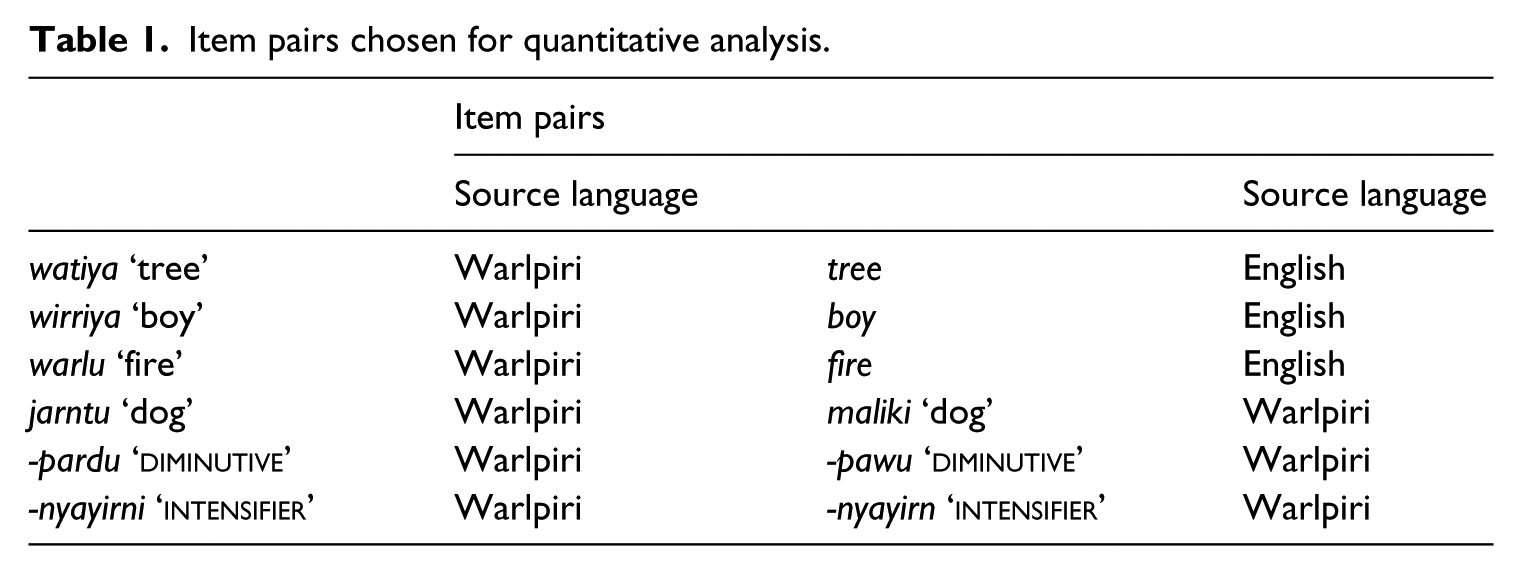
As seen in Table 1, some comparisons are between two Warlpiri items, for instance, the near-synonyms jarntu ‘dog’ and maliki ‘dog’, and alternate pronunciations of suffixes, -pardu and -pawu ‘diminutive’, and -nyayirni and -nyayirn ‘intensifier’. Others are between a Warlpiri word and an approximate English translation equivalent, for instance, wirriya ‘boy’ and English boy. The results are divided into three groups – first, an item pair whose distribution does not differ between languages, in either adult or child speech; second, item pairs that show different distributions in each language and the child speakers produce each of the two words at approximately equal rates to the adults’ production; and third, item pairs that show different distributions in each language and the child speakers’ production of the two words differs from that of the adults.
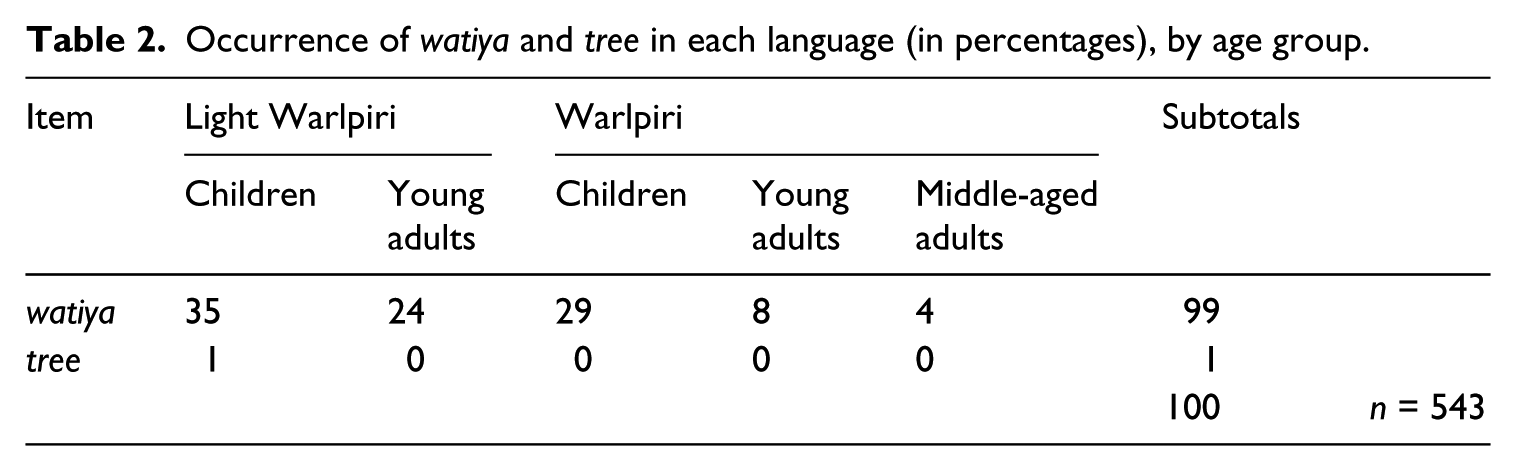
The first comparison is of items that do not differ in frequency between languages, watiya ‘tree’ and tree. Each of the following tables gives the relative frequency of each of the items being compared, by language and age group. The percentage value is a percentage of the sum of all occurrences of both words. (Note that the statistical analyses were not run using percentage data.) For example, in Table 2 there are 543 tokens of either watiya ‘tree’ or tree. Of these, 35% of occurrences are of watiya and are in the children’s Light Warlpiri texts, and 29% are in the children’s Warlpiri texts. It is clear from Table 2 that tree rarely occurs in texts in either language, by any age group, and that watiya ‘tree’ occurs frequently in both languages. No statistical analysis is needed here, and there is no differentiation between languages. This pair of items is included to demonstrate that not all translation pairs are used to differentiate between languages.
Occurrence of watiya and tree in each language (in percentages), by age group.
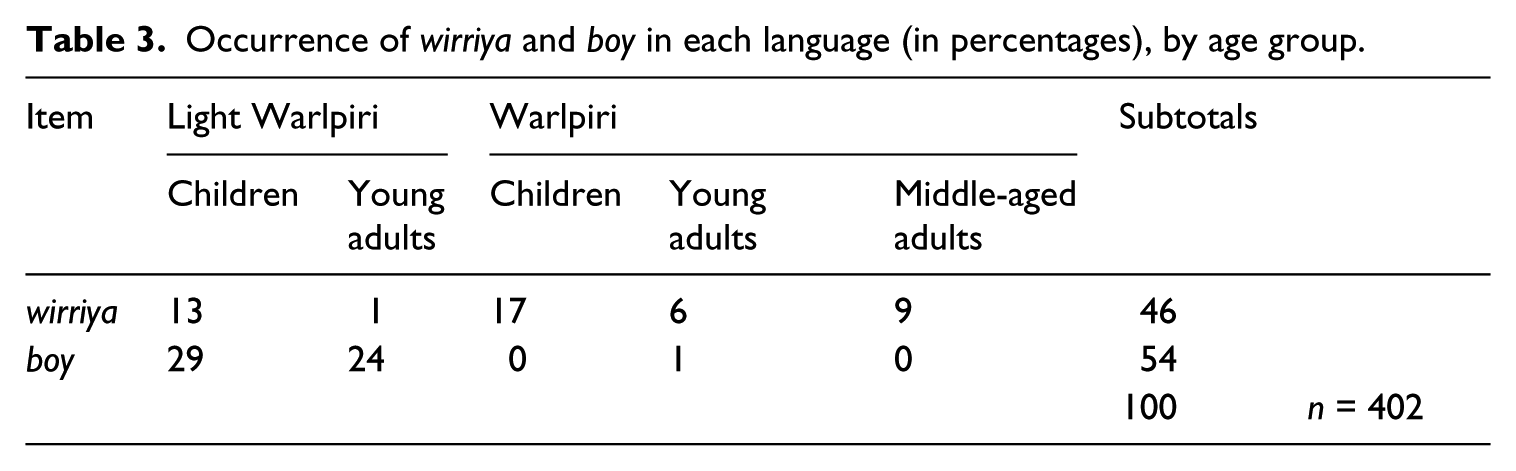
The next example involves a word pair that differs in frequency in each language, but each word is produced in the same relative amounts by children and adults. The words are wirriya ‘boy’ and English boy. Percentages of occurrences are given in Table 3. In Table 3 we see that both words appear in both languages, but wirriya ‘boy’ occurs more often in Warlpiri texts (β = 21.8, z = 4.3, p < .001), and boy rarely occurs in those texts. The frequency of the two items differs between languages, although they can occur in both, especially in the speech of younger adults and children. In this comparison there is a difference of language but not of age, suggesting that the children tune into the differential distributions of the items in each language, even though both words can appear in either language.
Occurrence of wirriya and boy in each language (in percentages), by age group.
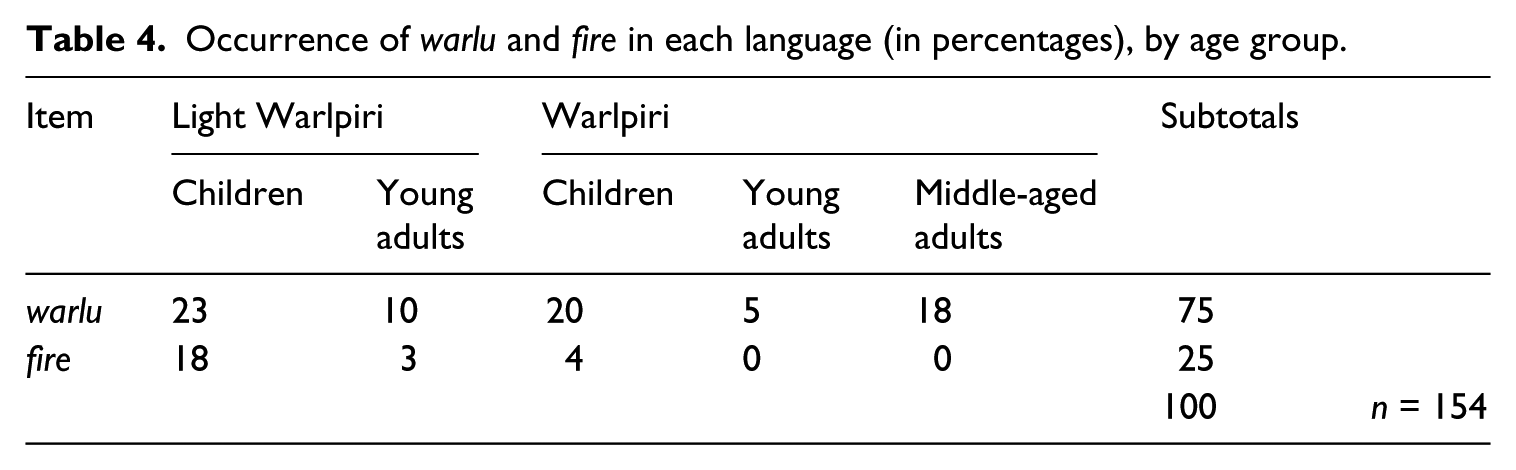
The following comparison is also of words that have different frequencies in each language, warlu ‘fire’ and English fire. The percentage frequencies are given in Table 4. Table 4 shows that both words are used in both languages, but adults only use warlu in Warlpiri texts, not the English word fire. However zero frequencies should be interpreted with caution, as it might be that a particular item would occur in a larger sample. With that in mind, zero frequency is an indication that the item is dispreferred in that context, relative to the alternate. The only significant difference is that of language – warlu is used more often in Warlpiri texts (β = 3.33, z = 2.76, p = .006). In other words, the two words are distributed differently in each language – warlu is used most often in Warlpiri texts, while both words occur in Light Warlpiri texts.
Occurrence of warlu and fire in each language (in percentages), by age group.
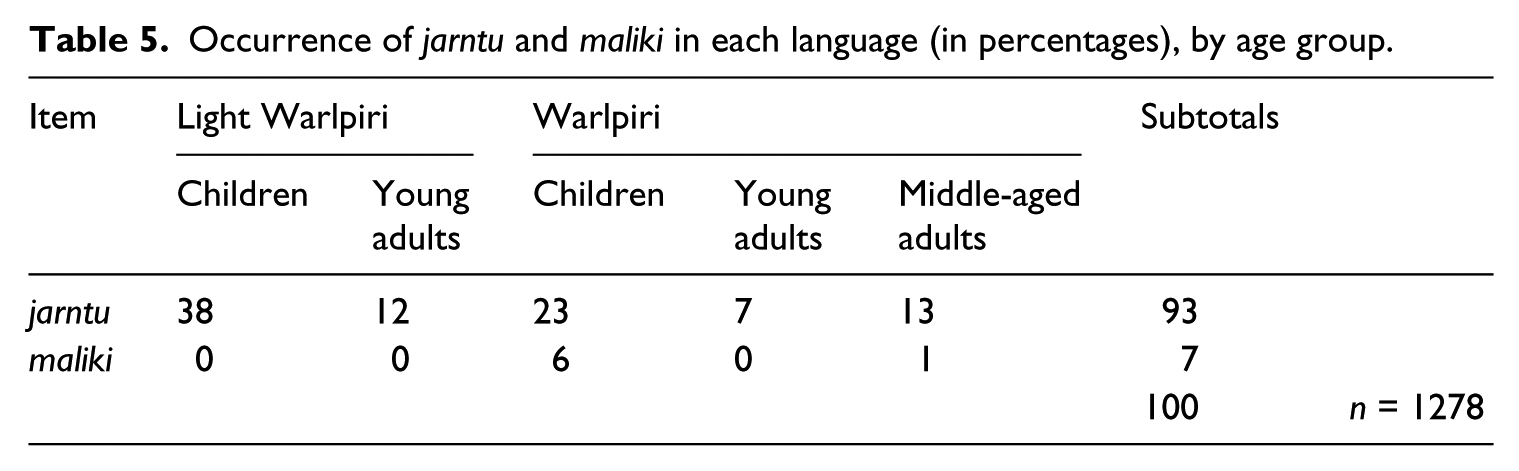
The next comparison is of words which are both derived from Warlpiri, but have differing frequencies in Warlpiri and Light Warlpiri. These are two words for ‘dog’, jarntu and maliki. The two words are near-synonyms, because jarntu has additional meanings of ‘companion’ that maliki does not have, but in the contexts of the stimuli stories they have the same meaning, of ‘dog’. Table 5 gives the relative frequency of each, by language and age group. In Table 5 we see that jarntu is favored in both languages (β = 4.61, z = 2.78, p < .001), and appears in 93% of occurrences of either item. In contrast, maliki does not occur in Light Warlpiri texts, and of its 7% of occurrences overall, 6% of them are from children when speaking Warlpiri. The children cue into the adults’ choices when speaking Light Warlpiri, by always using jarntu and not using maliki (but note the caveat mentioned earlier regarding zero frequencies).
Occurrence of jarntu and maliki in each language (in percentages), by age group.
The final comparisons are of suffix forms that show frequency differences between languages and between age groups. First are forms of the diminutive suffix, -pardu and -pawu, and then of the intensifier suffix, -nyayirni and -nyayirn. Table 6 gives the frequency percentages of -pardu and -pawu.
Occurrence of -pardu and -pawu in each language (in percentages), by age group.
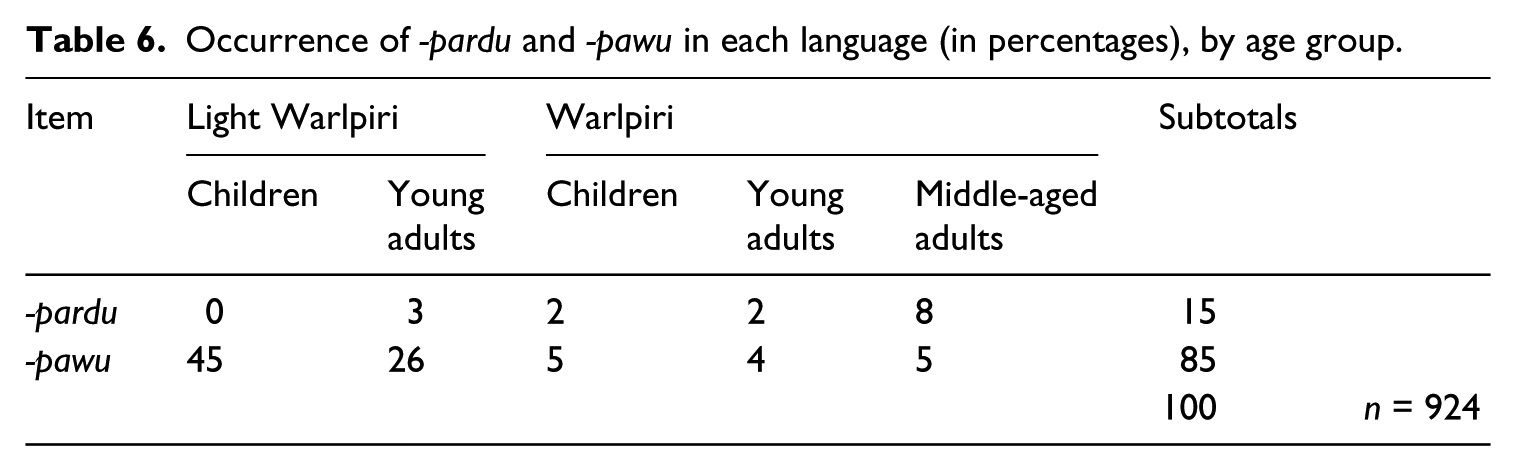
As shown in Table 6, the -pawu pronunciation occurs more often in Light Warlpiri than in Warlpiri (β = −2.39, z = 3.71, p < .001). Additionally, there are differences between age groups – children use the -pawu form more often than adults do (β = 2.05, z = 2.59, p = .01).
Frequency percentages of the intensifier suffix, -nyayirni and -nyayirn, are given in Table 7.
Occurrence of -nyayirni and -nyayirn in each language (in percentages), by age group.
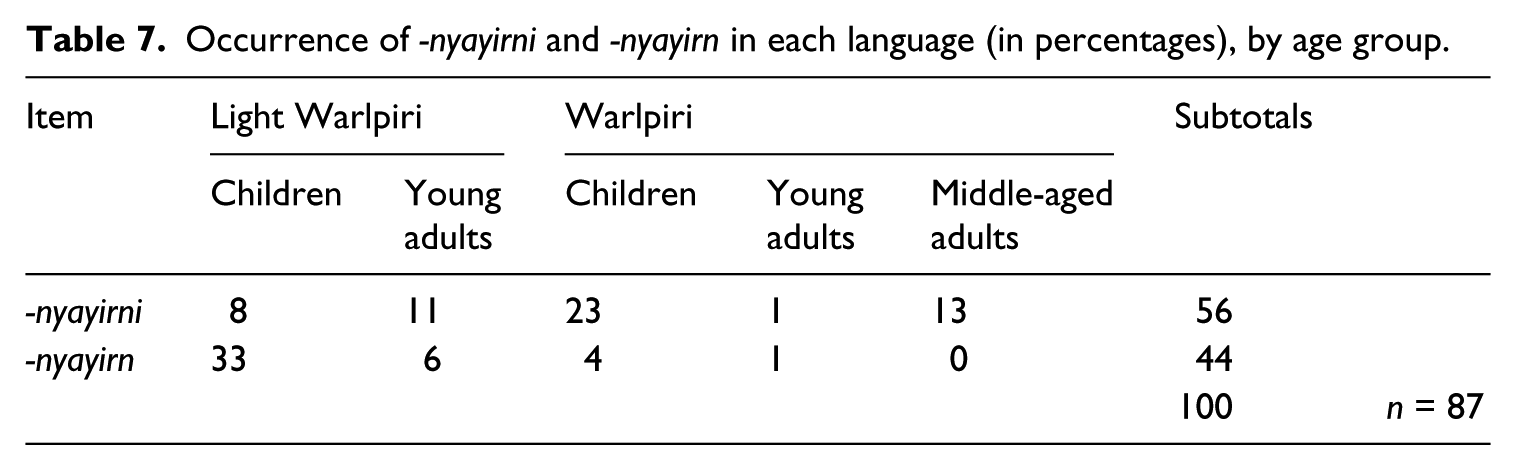
The analysis shows that the suffix has the form -nyayirn more often in Light Warlpiri texts, and -nyayirni more often in Warlpiri texts (β = 319.9, z = 2.35, p = .02). There is an interaction of language and age, as children use the -nyayirn form more often than adults do in Light Warlpiri (β = −302.3, z = −2.22, p = .03).
Discussion
The quantitative analyses of six pairs of items show that frequencies of occurrence differ between Light Warlpiri and Warlpiri, and this presents an intriguing picture in terms of language differentiation. Although the two languages share case suffix forms and about one third of the lexicon, the two languages clearly differ in their verbal structures, and the case forms are also distributed differently in each language (O’Shannessy, 2005, in press-a, in press-b). The item pairs chosen for analysis here are interchangeable in terms of referential value and function in the context of the texts, and either can or do occur in both languages, yet some have very different frequency distributions in each language. The question is: what is the motivation for the different distributions?
Light Warlpiri speakers are members of two interacting communities of practice, those of Light Warlpiri speakers within the larger group of Warlpiri speakers. The driving force for the different distributions of variant forms is to index and continuously construct those communities of practice. Some lexical choices index Light Warlpiri, for example the English-derived words fire and boy, while others index Warlpiri, for instance, warlu ‘fire’ and wirriya ‘boy’. The child speakers tune into these distinctions in adult speech and reproduce them in their own speech. By doing so they reinforce the items’ value as indexes of membership of a Light Warlpiri or Warlpiri community of practice. Warlpiri has long had high social status in the eyes of Warlpiri and non-Warlpiri, while speaking Light Warlpiri does not. Warlpiri is the language of a long, highly valued oral tradition of cultural knowledge, some of which is embodied within the language itself. Being a knowledgeable Warlpiri elder involves knowledge of Warlpiri language and culture. Speakers are used to non-Warlpiri people in research and other roles seeking to record and learn Warlpiri (e.g. Hale, 1973, 1982, 1983, 1992; Hale et al., 1995; Laughren, 2002; Laughren et al., 1996; Nash, 1986; Simpson, 1991; Swartz, 1991), but no outside attention was given to the emerging speech styles of younger people until recently (O’Shannessy, 2005). There are many written materials in Warlpiri, including the Bible, Warlpiri is taught in schools, and is spoken when interacting with Warlpiri from other communities. It is within this context that Light Warlpiri speakers may wish to demonstrate their competence as members of the wider Warlpiri-speaking community of practice.
While Light Warlpiri does not have high social status, it is valued by its speakers in their everyday interactions. When the Warlpiri in Lajamanu community were involuntarily relocated, and the community was formed, they were geographically removed from the everyday norms of interaction shared by the other communities, and were not able to visit those communities often due to poor roads and lack of communication modes and transport. Even in the late 1990s households did not have telephones, for example, and there was no bus service available until a few years ago. Conversely, travel to the Kriol-speaking area to the north was relatively more accessible. The relocation surely played a role in the emergence of Light Warlpiri, as people were in a context of language contact (O’Shannessy, 2012, 2013). In Wenger’s terms, Light Warlpiri is the means of the speakers’ ‘negotiated response to their situation and thus belongs to them in a profound sense, in spite of all the forces and influences that are beyond their control’ (Wenger, 1998, p. 77). When speaking Light Warlpiri, the children produce some items in frequencies that go beyond those of adult speech, for example, -pardu vs. -pawu ‘diminutive’, and -nyayirni vs. -nyayirn ‘intensifier’. This is evidence that the children use their choices of items to actively construct their communities of practice.
While there was no significant statistical difference between age groups in the jarntu–maliki ‘dog’ analysis, most occurrences of maliki were in children’s texts. Each choice of maliki in a Warlpiri text acts to construct the speaker as a competent Warlpiri speaker, demonstrating components of language knowledge beyond that exhibited within Light Warlpiri. In a similar manner to how the Nerd Girls (Bucholtz, 1999) show their competence as members of their community of practice, Light Warlpiri-speaking children demonstrate their competence as members of the Warlpiri community of practice as well as that of Light Warlpiri. Interestingly, in a set of narratives told about the same stimuli used in this study, the oldest speakers in the community, aged 60 plus, rarely used the word maliki, and favored jarntu, suggesting that maliki is not heard frequently by the children, even in the speech of older speakers. But maliki occurs in narrations of culturally important stories by older speakers, and is used in other Warlpiri communities where speakers are thought of as speaking strong Warlpiri, and occurs in Warlpiri books read in the school, most of which were made in one of the other communities. 3 A dialectal conditioning of use of maliki in southern communities and jarntu in northern communities is now being applied to a distinction between Warlpiri and Light Warlpiri. This is an example of fractal recursivity (Irvine & Gal, 2000), in which a dichotomy that is meaningful in one context comes to be applied in another. By choosing maliki over jarntu (for ‘dog’), when speaking Warlpiri, the children are indexing their competence in Warlpiri, even though they do not hear it frequently in the speech of adult Warlpiri speakers in Lajamanu. The children’s choice of maliki in Warlpiri and jarntu in Light Warlpiri reinforces the value of these words as indexes of each community of practice. Another set of near-synonyms derived from Warlpiri shows a similar pattern. Of three words that mean ‘monster’, kuuku, jarnpa, and juju, only kuuku occurs in Light Warlpiri texts, while all three words occur in Warlpiri texts. Indexical value similar to that for maliki is applied to the use of jarnpa or juju over kuuku (for ‘monster’). Over time the distributions of the two sets of items may differ more, leading to a greater distinction between the languages overall.
In summary, two of the languages spoken by children in one complex multilingual Indigenous community in northern Australia are Light Warlpiri and Warlpiri, which share lexicon and nominal morphology, although they are clearly different in their verbal structures. Of the elements that can occur in both languages, Light Warlpiri speakers make lexical and phonological choices that show differentiation between the languages; for example, they use the English word boy when speaking Light Warlpiri but the Warlpiri word wirriya ‘boy’ when speaking Warlpiri. Children cue into these subtle distinctions from at least age 6. In addition, the children take this differentiation further than adults do with some items. The motivation for this differentiation is that these items index the speakers’ construction and membership of interacting communities of practice, that of Light Warlpiri and Warlpiri speakers.
Footnotes
Acknowledgements
Sincere thanks to child and adult members of Lajamanu community for their participation. Sincere thanks also to the University of Melbourne School of Languages and Linguistics, and Humanities Research Centre, Australian National University, for my being a guest at each department in 2015 while working on the article.
Funding
Funding was gratefully received from the University of Michigan Linguistics Department, Office of Research (Awards 6473, 24058), and College of Literature, Science and the Arts (Awards UDC0170758, JE0005518983) and the National Science Foundation (Award 1348103).