






Abstract
The study investigated morphosyntactic abilities and semantic-pragmatic competence in 24 children with developmental dyslexia aged 7 -12 years. Morphosyntactic abilities were investgated in a direct object clitic production task, semantic-pragmatic competence in a quantifier comprehension task. Children with dyslexia produced fewer clitics than their age controls and vocabulary controls. Ten children with dyslexia scored less than 1.5 SD below the mean score of an additional group of 89 children of the same age, selected across a range of oral and reading abilities. No difference was found in quantifier comprehension. These findings suggest that a large number of children with dyslexia are likely to be affected by SLI, although not diagnosed, and the authors recommend language assessment, including assessment of clitic production, when children are referred for dyslexia. By capitalizing on theories that see SLI as a deficit in the processing of complex aspects of linguistic relations, the authors argue that the production of clitics is particularly challenging because of their syntactic and morphosyntactic complexity.
An important challenge in clinical linguistics is the description of clinical markers of Specific Language Impairment (SLI). A clinical marker of SLI is a linguistic behavior that identifies children with SLI as language impaired (sensitivity) and non-language impaired children as such (specificity) (Rice & Wexler, 1996). Research in this field has primarily investigated linguistic abilities in young preschool children, with the aim of identifying SLI early, mainly motivated by the effectiveness of early clinical treatments (McLean & Woods-Cripe, 1997; Smith-Lock, Leitao, Lambert, & Nickels, 2013). However, many children fail to be identified as having SLI in the preschool years and their language difficulties emerge dramatically at school, when they start learning to read and write. This is an age at which available standardized grammar proficiency tests might lose sensitivity. For this reason, and since it has been observed that some linguistic problems are long lasting in children with SLI (Clegg, Hollis, Mawhood, & Rutter, 2005; Kerschensteiner & Huber, 1975; Records, Tomblin, & Freese, 1992; Stothard, Snowling, Bishop, Chipchase, & Kaplan, 1998; Tomblin, Zhang, Buckwalter, & O’Brien, 2003; Weiner, 1974), research has recently focused on older children in the search of persistent clinical markers for late identification. This is particularly important, considering the fact that there is an overlap between SLI and Developmental Dyslexia (dyslexia, henceforth) (Bishop & Snowling, 2004; Cantiani, Lorusso, Perego, Molteni, & Guasti, 2013; Catts, 1993; Catts, Adlof, Hogan, & Weismer, 2005; Flax et al., 2003; McArthur, Hogben, Edwards, Heath, & Mengler, 2000) and that a diagnosis of dyslexia does not generally include an evaluation of oral language abilities. For instance, this happens in Italy, probably due to the unavailability of sensitive standardized tests for older children. Thus, it is important to describe persistent clinical markers useful for late identification to face the problem of SLI under-identification. In fact, a large number of children who have received a diagnosis of dyslexia and whose language abilities have never been evaluated, or have been evaluated with diagnostic tools that are not sensitive enough, might be affected by a mild SLI.
Within SLI, some areas are particularly affected and deficits are persistent, while other areas are relatively preserved. As extensively observed (see Leonard, 1998), grammatical morphology is a particularly vulnerable area and deficits are persistent. In this area, the diagnostic accuracy and persistency of a clinical marker depends on the language. For instance, while in English the omission of tense marking is a reliable and persistent clinical marker (Rice & Wexler, 1996), in Italian it is the omission of direct object clitic pronouns (Arosio, Branchini, Barbieri, & Guasti, 2014; Bortolini et al., 2006). Among areas of strength, it has been observed that semantic and pragmatic abilities are relatively preserved and just develop with a slower pace in children with SLI with respect to age-matched peers. For instance Arosio, Pagliarini, Perugini, and Guasti (submitted) report no problems in the comprehension of the logical meaning of sentences containing existential and universal quantifiers and a mild deficit in rejecting under-informative statements containing existential quantifiers, which, however, depends, on the age of the children with SLI.
In our study, we evaluated the production of direct object clitics (clitics, henceforth), whose failure is a persistent clinical marker of SLI for older Italian speakers, and we also investigated the comprehension of quantifiers, an ability reported as relatively preserved in Italian children with SLI. Twenty-four Italian monolingual children with a diagnosis of dyslexia (mean age 9;3) and 137 typically developing controls matched for age and lexical abilities participated in our study. Children with dyslexia did not have reported or diagnosed language deficits. The evaluation of clitic production and quantifier comprehension aimed at (1) identifying linguistic deficits in children with dyslexia whose language deficits might fail to be identified by available diagnostic tests, and (2) evaluating analogies and differences in the linguistic profiles of children with dyslexia and children with SLI.
Grammatical deficits in dyslexia
Syntactic deficits have been reported in children with dyslexia. According to these studies a number of children with dyslexia have grammatical deficits analogous to the ones described in SLI. For instance, some studies report problems with verb agreement marking (Cantiani et al., 2013; Joanisse, Manis, Keating, & Seidenberg, 2000; Rispens & Been, 2007; Rispens, Roeleven, & Koster, 2004), with past verb –ed marking (Joanisse et al., 2000), with the understanding of passive sentences (Leikin & Assayag-Bouskila, 2004; Reggiani, 2010) and relative clauses (Arosio et al., submitted; Bar-Shalom, Crain, & Shankweiler, 1993; Byrne, 1981; Casalis, Leuwers, & Hilton, 2013; Leikin & Assayag-Bouskila, 2004; Mann, Shankweiler, & Smith, 1984; Smith, Macaruso, Shankweiler, & Crain,1989; Stein, Cairns, & Zurif, 1984). Though these studies underline analogies between oral language deficits in SLI and dyslexia, more recent descriptions of different dyslexia subtypes, apparently not impaired in oral language skills (Castles, Bates, & Coltheart, 2006; Castles & Coltheart, 1993; Friedmann & Lukov, 2008), suggest that a better and more sophisticated evaluation of oral language abilities in dyslexia is in order. By investigating the production of clitics in children with dyslexia, our study challenges the problem of SLI under-identification: in the absence of available tests for late diagnosis of SLI, poor readers with an unrecognized SLI are usually identified as only having dyslexia, they do not receive an appropriate speech-language pathology intervention and, in order to achieve literacy, they use compensatory strategies and materials whose success presupposes typically developing oral language abilities (consider for instance the use of e-reading systems and audiobooks).
Moreover, by additionally studying oral comprehension of sentences containing quantifiers, our study considers language skills in different domains in the search of areas of strength, besides weakness, useful for better understanding the relation between dyslexia and SLI.
The production of direct object clitics in Italian
In Italian clitics are realized as unstressed monosyllabic morphemes and their position depends on the finiteness of the verb. They appear in a preverbal position when the verb of the sentence is finite, realizing an uncanonical S(ubject) O(bject) V(erb) word order as in (1). When the verb is not finite, clitics appear on the verb in a postverbal position as shown in (2).
(1) Il bambino lo lava (2) Il bambino ha detto di lavarlo The child CL3SM washes The child has said to wash_CL3SM
The child is washing him The child said to wash him
Morphologically, clitics are marked for person, number and gender and, when the tense of the sentence is the present perfect, the past participle on the verb agrees in number and gender with them, as in (3) and (4).
(3) Il bambino lo ha lavato (4) Il bambino la ha lavata The child CL3SM has washedSM The child CL3SF has washedSF
The child has washed him The child has washed her
At the pragmatic level, clitics denote discourse topics (like all pronouns), whose referents have been already introduced in the discourse.
In Italian typically developing (TD) children, clitics are produced starting from age 2 years and they are optionally omitted up to age 4 years. Children rarely make morphological errors, never realize clitics in a wrong position or replace them with tonic pronouns (Caprin & Guasti, 2009; Guasti, 1993/1994; Leonini, 2006; Moscati & Tedeschi, 2009; Schaeffer, 2000).
Italian school and preschool children with SLI frequently fail to produce clitics. Younger children consistently omit them, producing an ungrammatical sentence where the internal argument of the verb is not overtly realized (Bortolini et al., 2006; Leonard & Bortolini, 1998; Leonard, Bortolini, Caselli, McGregor, & Sabbadini, 1992). Older children substitute them with an overt full noun phrase (determiner plus noun), producing a pragmatically infelicitous grammatical sentence. Examples of omission and substitution with a full NP are given in (5) and (6).
(5) * Il bambino Ø prende Ø The child Ø catches Ø
* The child catches
(6) ? Il bambino prende la farfalla
? The child catches the butterfly
While omission is a good clinical marker of SLI in young Italian speaking children (Bortolini, Caselli, Deevy, & Leonard, 2002; Bortolini et al., 2006), substitution is a good clinical marker at least until age 9 years (Arosio et al., 2014).
The production of clitics in TD children and children with SLI have been cross-linguistically investigated. Studies with languages where the verbal past participle agrees with the clitic report occasional clitic omission in young TD children and persistent problems with their production in children with SLI (among many, Italian: Arosio et al., 2014; Bortolini et al., 2006; Dispaldro, Caselli, & Stella, 2009; Leonard & Bortolini, 1998; Leonard et al., 1992; French: Audollent & Tuller, 2003; Jakubowicz, Nash, Rigaut, & Gerard, 1998; Pérez-Leroux, Pirvulescu, & Roberge, 2011; Zesiger et al., 2010; Catalan: Gavarró, 2012). Data concerning languages without past participle agreement are more controversial. Some studies report optional omissions in early TD and problems in SLI (Greek: Mastropavlou, 2006; Smith, Edwards, Stojanovik, & Varlokosta, 2008; Smith et al., 2008; Tsimpli, 2001; Tsimpli & Stavrakaki, 1999; Zachou, 2013; Spanish: Bedore & Leonard, 2001, 2005; Castilla & Pérez-Leroux, 2010; De la Mora, 2004; Larrañaga & Guijarro-Fuentes, 2012); some other studies report relatively unproblematic production in both TD and SLI (Greek: Manika, Varlokosta, & Wexler, 2011; Stavrakaki & Chrysomallis, 2011; Spanish: Gavarró, Torrens, & Wexler, 2010; Wexler, Gavarró, & Torrens, 2004). Although these discrepancies might depend on differences found in the different studies (severity of the language impairment, age and different methods of measuring production), the fact that we find differences in the data from languages without past participle agreement, but not in languages with past participle agreement, might well depend on differences in the pronominal systems of these two language families. For instance, Stavrakaki and Chrysomallis (2011) argue that clitic production in these two language families can have different underlying syntactic derivations, since clitics can be base generated in Greek but not in French.
A number of accounts of clitic omission in early TD and of clitic production problems in SLI have been proposed over the years. According to pure phonological accounts, capitalizing on the work of Gerken (1991, 1994, 1996), clitics are omitted in early TD because they are prosodically realized as unfooted weak syllables occurring in a preverbal position and they do not fit a metrical foot production template made up of a strong syllable optionally followed by a weak syllable, used by young children in their first utterances (Bortolini & Leonard, 1996; Leonard, 1998). According to this account, while TD children develop their prosodic skills producing unfooted weak syllables and are able to phonetically realize clitics, SLI cannot and persistently omit them. A representational variant of a pure phonological account argues that children can easily grammaticalize phonologically salient morphemes and claims that clitics are omitted in early TD and in SLI since they are phonologically weak elements with short duration that are not prone to straightforward grammaticalization. According to this account (Leonard’s Surface Hypothesis – Leonard, 1998), while omission is a temporary phenomenon in TD, it is persistent in children with SLI because limitations in the processing of non-salient phonological inputs make it difficult for clitics to be grammaticalized.
Purely prosodic accounts of clitic omission has been shown to be problematic by a number of studies, with different languages reporting asymmetries in the production of clitics, definite articles and reflexive clitics, all morphemes typically realized by unfooted weak syllables. According to these studies children have fewer problems in the production of reflexives and definite articles (Audollent & Tuller, 2003; Bedore & Leonard, 2001; Gavarró, 2012; Jakubowicz et al., 1998; Smith et al., 2008; Zesiger et al., 2010).
According to Wexler’s (1998, 2003) unique checking constraint (UCC), clitic omission depends on a constraint on the determiner phrase (DP) agreement checking operation that requires a D feature of a DP to be checked against only one functional category (DPs can check agreement once) in young children; while UCC is overtaken in TD children, it persists in children with SLI. According to this proposal clitic omission is expected in languages with verbal participle agreement (where agreement with the clitic is checked twice) but not in languages without it (where agreement with the clitic is only checked once) (Gavarró et al., 2010; Wexler et al., 2004).
While omission is cross-linguistically well attested in languages with participle agreement, data concerning languages without participle agreement are controversial (as we observed, some studies report no problems while others report omission) (Bedore & Leonard, 2001, 2005; Castilla & Pérez-Leroux, 2010; Castilla, Pérez-Leroux, & Eriks-Brophy, 2008; Fujino & Sano, 2002; Gavarró et al., 2010; Jacobson & Schwartz, 2002; Manika et al., 2011; Mastropavlou, 2006; Tsimpli & Stavrakaki, 1999; Wexler et al., 2004; Zachou, 2013). For the UCC account, beside the described differences that should be further investigated in future in the search of corroboration, the asymmetry in the production of clitics and reflexive clitics described in studies with languages with participle agreement is a fact that UCC needs to cope with.
More recently, some studies have proposed accounts of clitic omission in SLI inspired by theories that see SLI as a deficit in the processing of complex aspects of linguistic relations (van der Lely, 1998, 2005). According to these proposals the production of clitics is particularly challenging because it requires the accomplishment of complex morphosyntactic operations (Arosio et al., 2014) ending up in a syntactic configuration where an argumental chain from the subject surface position to the internal verb phrase subject position crosses the chain from the clitic to VP internal object position (Zesiger et al., 2010). According to these accounts, asymmetries in the production of clitics and reflexive clitics depend on the different underlining syntactic structures that sentences with clitics and reflexives have: while clitic structures are derivationally more complex with subject and object chains crossing, reflexive structures, according to analyses assuming operations affecting the VP internal theta-role (cf. Chierchia, 2004; Grimshaw, 1982; Reinhart, 1996; Wehrli, 1986), are derivationally less complex and do not involve argumental crossing chains.
The comprehension of quantifiers in Italian
In order to examine the semantic competence of children with dyslexia and to investigate their ability to compute and evaluate additional unsaid content associated to linguistic utterances, we analyzed the comprehension of sentences containing quantifiers in subject position, as in (7) and (8) below.
(7) Qualche mela è nelle scatole (8) Tutte le mele sono nelle scatole Some apple is in-the boxes All the apples are in-the boxes Some apples are in the boxes All apples are in the boxes
In order to understand the meaning of sentences like (7) and (8), we need to know the set relations denoted by the quantifiers qualche ‘some’ and tutte ‘all’.
1
For instance, while in (8) the quantifier tutte ‘all’ requires the set of things that are apples to be a subset of things that are in the boxes, in (7) the quantifier qualche requires the intersection between the set of things that are apples and the set of things that are in the boxes to be a non-empty set. However, it has been observed that this might not be enough. In fact, adult Italian speakers consistently reject (7) as a description of a situation in which all the apples are in the boxes, even though this situation fulfills the literal meaning of qualche (the intersection between the set of things that are apples and the set of things that are in the boxes is non-empty in this situation). What adult Italian speakers intend to convey by the use of (7) is (9): (9) Qualche mela è nelle scatole, ma non tutte Some apple is in-the boxes, but not all
Some apples are in the boxes, but not all
In the linguistic literature, the additional unsaid content that not all apples are in the boxes is called scalar implicature since some and all are expressions that are members of the same entailment scale, where all is higher in the scale than some because (8) entails (7) (Horn, 1972). According to pragmatic analyses of scalar implicatures (Grice, 1975, 1989; Horn, 1972) the unsaid content is derived from reasoning on the speaker’s intentions: the hearer assumes the speaker used the strongest statement for which he/she had evidence (see Sauerland [2011] and references found therein for a short overview of facts and theories).
Typically developing 5-year-old Italian speakers have no problems in the comprehension of the stronger quantifier tutti ‘all’, for which there is not a pragmatically associated unsaid content, but they fail to reject under-informative qualche ‘some’ statements, i.e. they accept qualche statements like (7) as a description of a situation in which all apples are in the boxes. Interestingly, children tend either consistently to accept these statements or consistently to reject them (Foppolo, Guasti, & Chierchia, 2012; Guasti et al., 2005). However, it has been shown that differences in the experimental tasks modulate this difficulty and that Italian speaking children reach adult-like performance at 6/7 years also in those tasks in which the stronger alternatives, that should be considered in the derivation of an implicature, are less salient.
Concerning children with SLI, Katsos, Roqueta, Estevan, and Cummins (2011) reported that Spanish speaking children between 4 and 9 years of age had problems with both the logical and the pragmatic meaning of quantifiers. However, in this study, children with SLI were not homogeneous with respect to their linguistic deficits and to their age, since some SLI children were still in the age range in which TD children also have problems with implicatures. Arosio et al. (submitted) investigated the comprehension of quantifiers using Katsos et al.’s task in an homogeneous group of school age Italian speaking children with SLI, with a severe morphosyntactic deficit, and found no problems in the comprehension of the logical meaning of qualche ‘some’ and tutte ‘all’, and only a marginal delay in the younger SLI children in rejecting under-informative use of qualche. Analogously, Gavarró and Lite (2015) found that the comprehension of the universal quantifiers tots ‘all’ and cada ‘each’ is not compromised in young speakers of Catalan with SLI. To our knowledge, no study has investigated the comprehension of SOME and ALL statements in children with dyslexia.
Our study
Given the rationale for our study described above, in our research we investigated clitic production and quantifier comprehension in a group of Italian monolingual children who received a diagnosis of dyslexia and whose spoken language abilities are reported as age appropriate, according to available standardized tests. Given the described overlap between dyslexia and SLI and the fact that problems in clitic production are a high sensitive and persistent clinical marker of SLI in Italian, we predict that some bad readers who participated in our study will fail in clitic production and will therefore classified as SLI. Moreover, since Italian children with SLI have problems in clitic production but only mild problems in the comprehension of quantifiers (only mild and limited to under-informative SOME statements), we expect participants to have no problems in quantifier comprehension.
Method
Participants
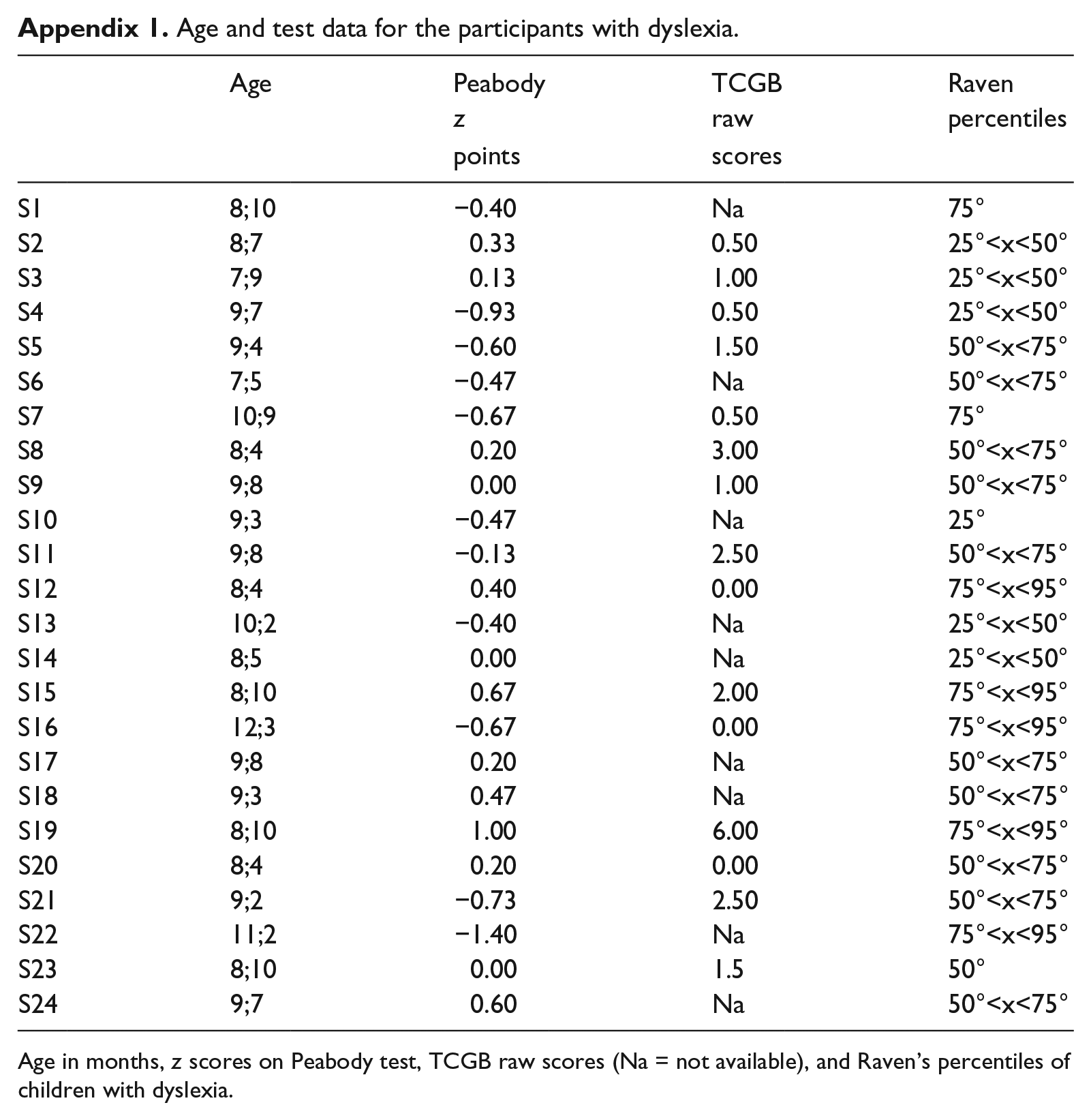
Twenty-four Italian monolingual children with a diagnosis of dyslexia (six females, mean age 9;3, SD 12 months, range 7;5–12;3) and 137 TD children participated in our study. Forty-eight TD children participated as matching controls while 89 participated as a reference group for the evaluation of individual differences of children with dyslexia in the clitic production task. Children with dyslexia and their matching controls were tested on a clitic production task and in a quantifier comprehension task. They were also tested on the receptive vocabulary test Peabody - Test di Vocabolario Recettivo (this is the Italian version of the Peabody Picture Vocabulary Test by Dunn and Dunn; 2000) and on the Raven’s Colored Progressive Matrices test (Raven, Court, & Raven, 1998; Italian norms by Belacchi, Scalisi, Cannoni, & Cornoldi, 2008), in order to have a standardized measure of their lexical and non-verbal cognitive abilities. In order to take part in the study, children with dyslexia had to score 2 SD below the mean for their age/class of education in reading speed or accuracy of words or pseudo-word reading (as assessed by the test Prova di Lettura di Parole e di Nonparole included in the Batteria per la Valutazione della Dislessia e della Disortografia Evolutiva DDE-2 by Sartori, Job, & Tressoldi, 2007). Children with dyslexia were recruited from clinical speech centers in the area of Pavia and Lodi (Italy), they were diagnosed as having dyslexia on standard criteria (ICD-10; World Health Organization, 2004) and they were receiving a dyslexia therapy service. They had no diagnosed or reported oral language problems or hearing deficits. No standardized test evaluating receptive grammar abilities was available for Italian speaking children older than 8 years at the time of the testing; however, 15 children with dyslexia were administrated the Test di Comprensione Grammaticale per Bambini (TCGB; Chilosi & Cipriani, 1996), in order to have a measure of their grammar proficiency. This is a grammar comprehension test employing a picture selection task similar to the English Test for Reception of Grammar (TROG) by Bishop (1983) and has referenced norms up to 8 years. Raw scores of children tested in the TCGB were at ceiling. Children with dyslexia also obtained scores within normal range at the Peabody test (individual data of the dyslexia participants are reported in Appendix 1).
Children with dyslexia were matched to two groups of TD matching controls: one group of 24 TD children of the same chronological age (± 6 months; CA control group) and one group of 24 TD children with the same raw scores on the Peabody (± 5 points; vocabulary age [VA] control group). We provided a VA control group because although children with dyslexia had age appropriate scores at the Peabody test, a one-way ANOVA revealed a significant difference between scores on the Peabody for the children with dyslexia and their CA controls, F(1, 23) = 11.62, p = .0024. Children with dyslexia were individually matched to TD peers; gender matching was also observed. TD children had no diagnosed or reported oral language problems, reading or writing problems, they were not receiving clinical services and had age appropriate scores at the Peabody test. One-way ANOVAs revealed no differences between the dyslexia group and the CA controls regarding age, F(1, 23) = 0, p = 1, and Raven scores, F(1, 23) = 3.24, p = .0849; no difference were detected between the dyslexia group and the VA controls regarding Peabody scores, F(1, 23) = 0.01, p = .9212, and Raven scores, F(1, 23) = 0.09, p = .7669. All children had age appropriate non-verbal IQ (IQ>85 on Raven). Group data of the children with dyslexia and the TD groups are presented in Table 1.
Mean age in years (SD in months), means of raw scores and z scores on the Peabody test, and means of raw scores on the Raven’s in children with dyslexia and TD control groups.
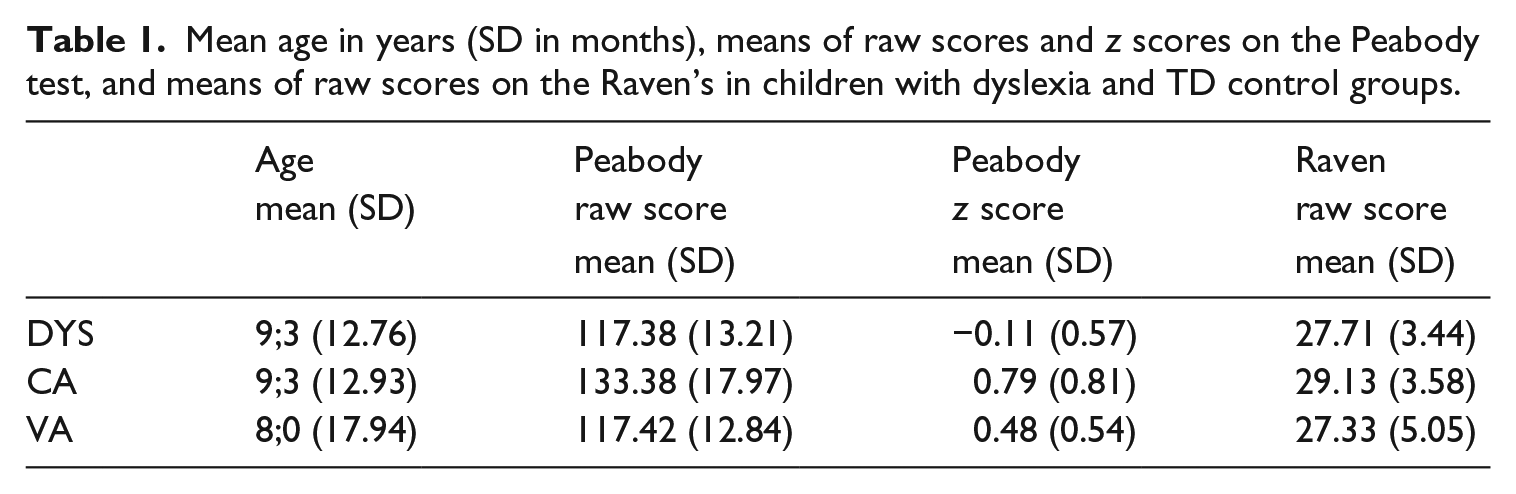
Scores on the TCGB were at ceiling for the tested children in the dyslexia group and their raw scores on the Peabody were age appropriate. Thus, according to available standardized tests evaluating language proficiency in Italian, the children participating in our study do not have any language difficulties. However, as our statistical analyses reveal, children in the dyslexia group have lower scores on the Peabody. This can be seen as a sign that children in the dyslexia group might have grammatical problems, unidentified by available grammatical tests, that might have consequences for their lexical knowledge. In order to additionally investigate the severity of the language problems in children with dyslexia, we compared their individual scores on the clitic production task to the mean score of an additional large reference group (RG group) of 89 Italian monolingual children of the same age (M = 8;10, SD = 0.98 months, age range 7;5–12;0). Children from the RG group were randomly selected regardless of their oral language abilities, reading skills, general non-verbal cognitive abilities and psychological conditions. Data of clitic production from the randomly selected large group of children of the same age provided norms for evaluating individual performances of children from the dyslexia group.
Parents, educators and speech therapists were informed of the aims and results of the study. Informed consent was collected from children’s parents before the testing began. The study was approved by the Ethics Committee of the University of Milano-Bicocca according to the standards of the Helsinki Declaration 1964.
Elicitation of clitics
The production of third person singular object clitics was tested using the elicitation task by Arosio et al. (2014). During the task, children heard descriptions of pictures presented on the PC monitor and were asked questions aimed at eliciting sentences containing a clitic pronoun. We elicited eight simple present sentences containing a third singular clitic as in (1) and eight present perfect sentences containing a third singular clitic (with past participle agreement) as in (3). Half of the clitics were masculine, half were feminine. All verbs in the task used were transitive.
Comprehension of quantifiers
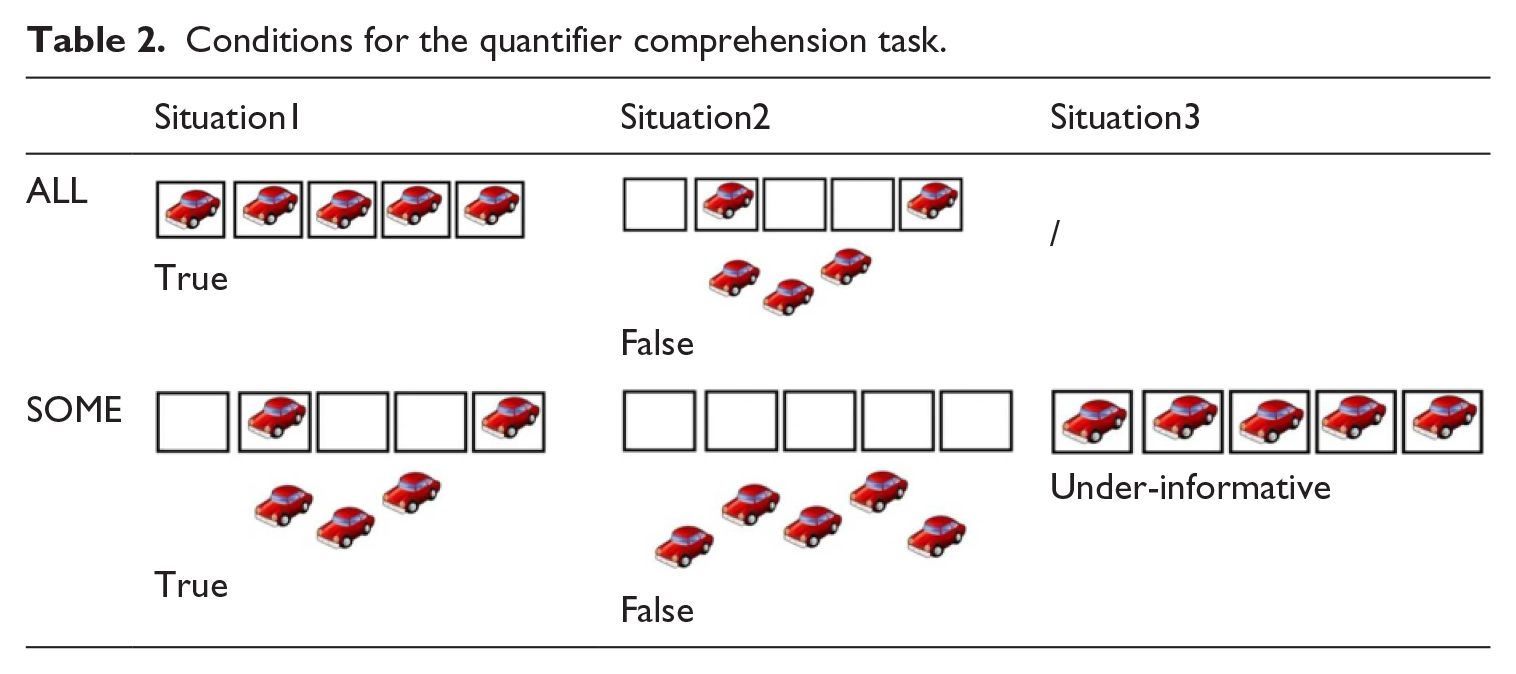
We investigated SLI children’s comprehension of intransitive sentences containing a quantified subject by making use of a shortened version of Katsos et al.’s (2011) Cavegirl and Boxes task. We tested the comprehension of sentences containing the quantifier tutti ‘all’ and the quantifier qualche ‘some’ as in (7) and (8). Sentences containing the quantifier tutti were logically true or false with respect to a given situation; sentences containing the quantifier qualche were logically true or false with respect to a given situation and also logically true but pragmatically under-informative with respect to the situation. We tested three items per condition as presented in the Table 2. Items were presented in random order after five familiarization items including sentences with numerals (three apples are in the boxes).
Conditions for the quantifier comprehension task.
Results
Clitic elicitation task: Response classification
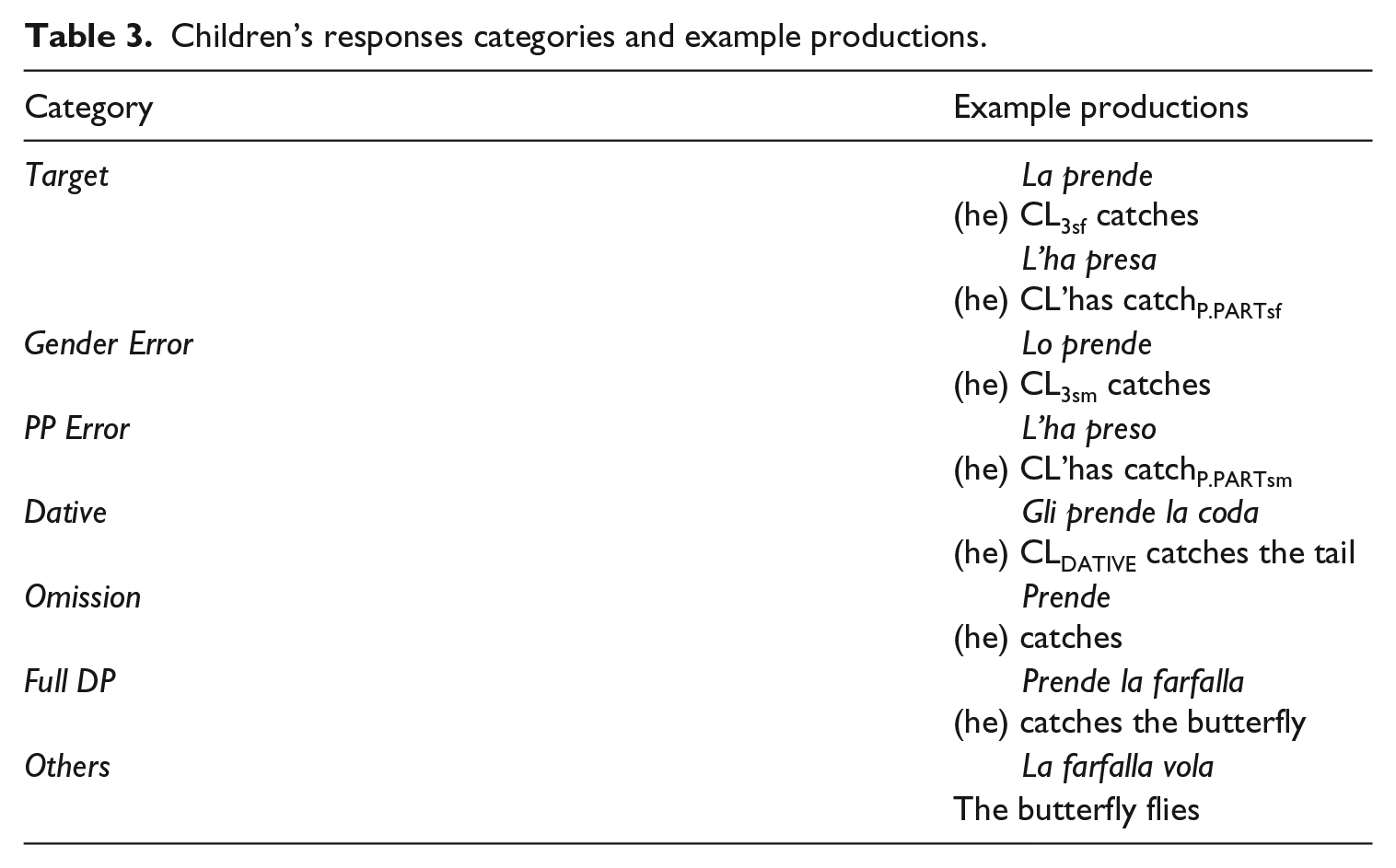
Children’s productions were classified into seven different categories. They were considered as Target when they were target responses (i.e. children produced a sentence containing a clitic with the correct morphology and a present perfect sentence with a past participle with the correct morphology). Present perfect sentences with a past participle with the correct gender and number morphology were classified as Target when they contained the correct uncontracted form of the clitic (Lo ha preso) or the contracted form (L’ha preso). Sentences containing a clitic with the wrong gender morphology were classified as Gender Error and sentences in the present perfect containing a contracted form of the clitic and the past participle with the wrong morphology as PP Error. Grammatical sentences containing a dative clitic instead of a clitic were classified as Dative. Sentences were classified as Omission when the direct object of the verb was omitted (omission of the clitic or full DP), which is ungrammatical in Italian. Sentences with a full DP object (determiner plus noun) instead of a clitic were classified as Full DP. Productions not fitting in any of the previous categories were classified as Others. All productions were digitally recorded and scored by two experimenters; discrepancies were resolved by discussion. A list of children’s responses categories together with response examples is given in Table 3.
Children’s responses categories and example productions.
Clitic elicitation task: Analyses of the use of clitics
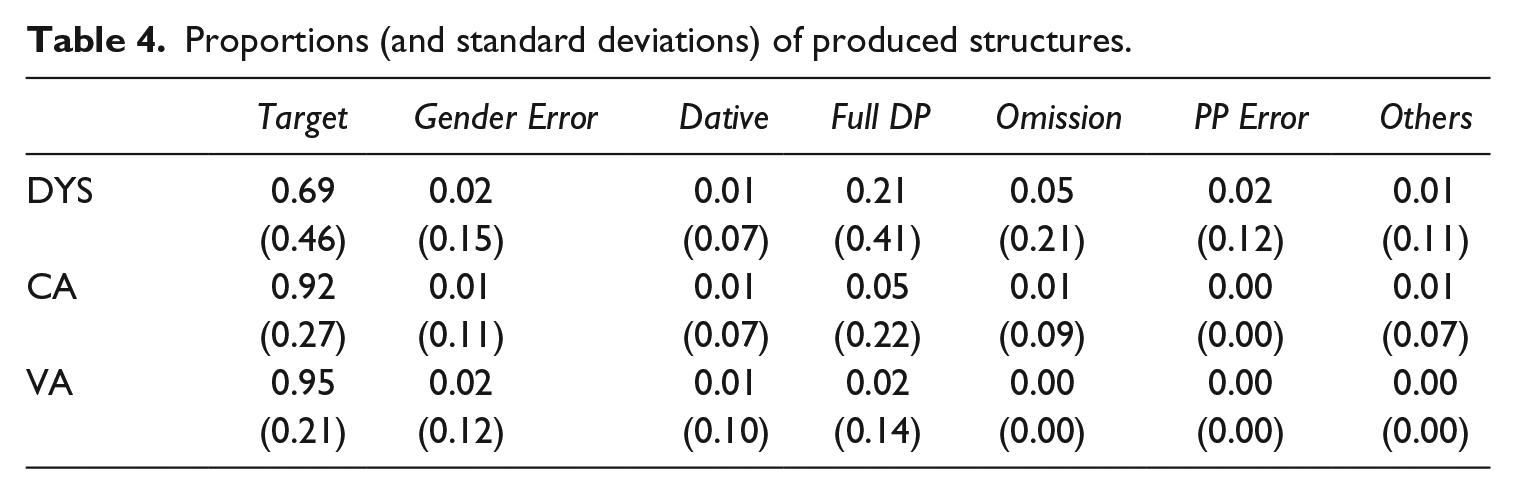
Proportions of categories of responses of children with dyslexia and control groups are reported in Table 4. As we can observe, contrary to CA and VA controls, children with dyslexia produced a lower proportion of Target structures and tend to produce a full DP in its canonical postverbal position instead. Rates of Omission, Dative, Gender Error, PP Error and Others are very low.
Proportions (and standard deviations) of produced structures.
Differences between groups were analyzed in two different pairwise comparisons: (1) dyslexia group versus CA group and (2) dyslexia group versus VA group. For each response category (Target, Gender Error, Dative, Omission, Full DP, PP Error, Others) we carried out repeated measures logistic regression analyses in a mixed model, with Group (dyslexia versus TD), Sentence Type (present versus present perfect) and Clitic Gender as fixed factors, Subject and Items as random factors, and productions of response categories as a binomial dependent variable. We used a backward elimination procedure to compare the goodness of fit of the models with the Group factor (Baayen, 2008). All statistical analyses were run using R (version 2.13.1; R Core Team, 2013) and the LanguageR package (version 1.4; R Core Team, 2013; Baayen, 2011) for mixed modeling.
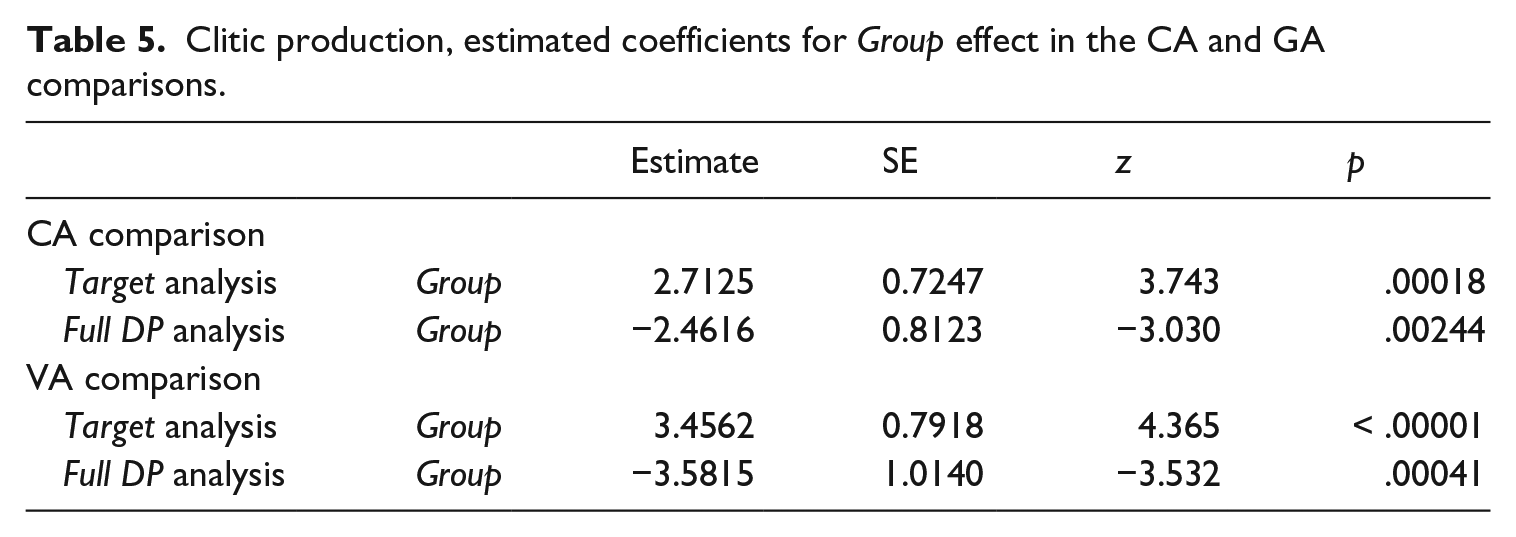
As shown by the coefficients reported in Table 5, CA children and VA children produced significantly more Target structures and fewer structures with Full DP instead of a clitic than dyslexia children did. We did not find any effect of Sentence Type, any effect of Clitic Gender nor any interaction between these factors and Group. All groups used 100% contracted forms of clitics in present perfect target sentences and they did not produce any simple present sentence instead of a target present perfect one. We did not find any effect of children’s age or any interaction between age and groups in any response category.
Clitic production, estimated coefficients for Group effect in the CA and GA comparisons.
Given these results, we additionally investigated individual differences by comparing individual scores of children with dyslexia in the production of target structures to the mean score of children from the RG group. As we said, children from the RG group were randomly selected regardless of their oral language abilities, reading skills, general cognitive abilities and psychological conditions. The use of the RG group aimed at evaluating individual scores of the dyslexia participants with respect to the mean score of the large randomly selected population (89 children). Children in the RG group produced target structures in the clitic elicitation task in 94% (SD = 16) of the trials. According to this reference mean score, 10 children with dyslexia scored less than 1.5 SD below the mean score of the RG children, five children scored less than 3 SD below the mean. Notice that this means that 10 children are in the 7th percentile of the normal distribution of scores in the RG group, five of them in the 2nd percentile. This indicates a severe deficit in clitic production in the dyslexia population and suggests that a large number of children with dyslexia might have a severe language deficit that is not identified by standardized grammar proficiency tests available for Italian school age children.
Quantifier comprehension task: Analyses
Proportions of response accuracy in the quantifier comprehension task for the dyslexia group and TD controls are presented in Table 6.
Proportions (and standard deviations) at the quantifier comprehension task.
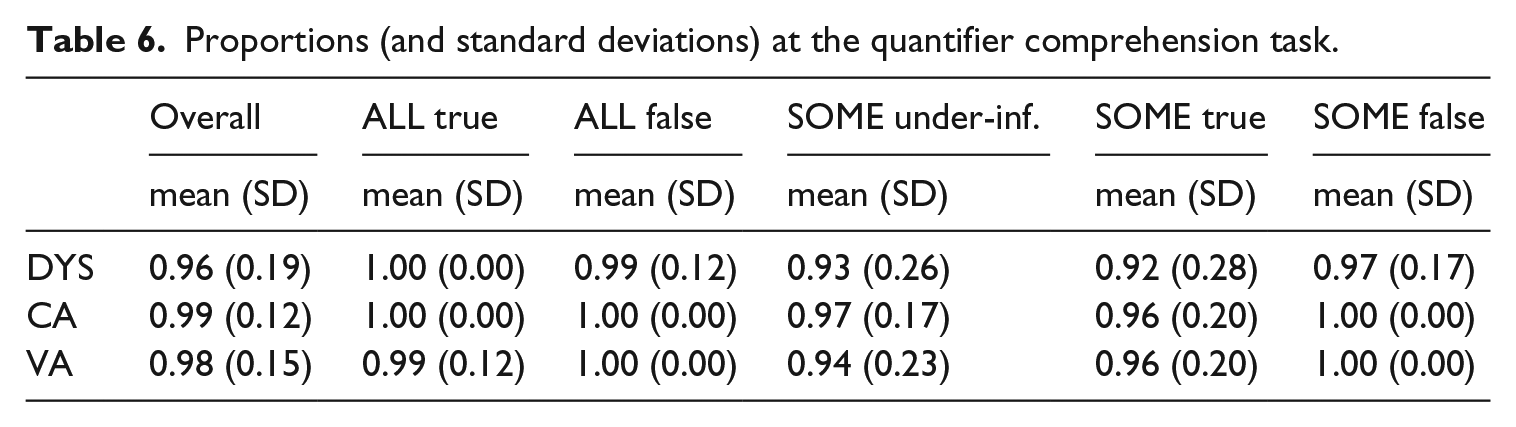
As we can observe, all children were at ceiling in the comprehension of the logical meaning of ALL and SOME statements and in the comprehension of under-informative SOME statements. Statistical analyses with a logistic regression in a mixed model (Baayen, 2008) did not reveal any effect of group or quantifier type. No effect of age was found on comprehension accuracy nor any interaction between age, group and quantifier type. This suggests that children with dyslexia have no problem with the comprehension of quantified sentences and reject under-informative SOME statements, as TD controls do.
Discussion
Our study shows that children with a diagnosis of dyslexia, who have no reported or diagnosed language deficits, have severe morphosyntactic deficits affecting the ability to produce clitics. In fact, as shown by the individual analysis, 10 out of 24 children with dyslexia scored less than 1.5 SD below the mean score of a randomly selected reference group of children of the same age and fall in the 7th percentile of the distribution of their scores. This indicates that diagnostic tests for Italian, used for SLI identification, are not sensitive enough for a late identification of language disorders and that a large number of children with dyslexia undergo SLI under-identification in Italy. This result, together with the results of the Arosio et al.’s (2014) study with school aged children with SLI, indicates that problems in clitic production are a good clinical marker of SLI in Italian, with very high sensitivity and good specificity, even at later ages. Analogously to the error pattern described for older children with SLI by Arosio and colleagues, school aged children with dyslexia tend to produce a corresponding full DP in the canonical postverbal position instead of a clitic, contrary to younger children with SLI, who tend to omit the clitic and the internal argument of the verb (Bortolini et al., 2006). The production of a full DP instead of the clitic has been reported in SLI studies with Spanish (De la Mora, 2004) and Greek (Stavrakaki & van der Lely, 2010; Zachou, 2013) in older children; the relative absence of omissions, together with the tendency to use of a full DP described in these studies might depend on the fact that older school aged children with SLI know that the internal argument of a transitive verb should be overtly realized in these languages, but they cannot do so consistently with a clitic.
By capitalizing on theories that see SLI as a deficit in the processing of complex aspects of linguistic relations (van der Lely, 1998, 2005) we argue that clitic production in SLI is particularly challenging because of the syntactic and morphosyntactic complexity, likely coupled with the prosodic complexity. In fact, unlike full DPs, clitics are realized in an uncanonical preverbal position, that is associated to a non-local thematic assignment (in Italian canonical word order is SVO while clitics occur in an SOV order in finite sentences). While full DPs check case features covertly at LF (logical form) (Chomsky, 1992), according to Belletti (1999) Italian clitics are merged as verb complements and have a strong accusative feature that needs to be checked overtly, in the syntax, by moving to a dedicated projection called AgrOP, before LF. This additional complex morphosyntactic movement generates an uncanonical SOV syntactic configuration with the formation of an argumental chain from the subject surface position to the internal VP subject position that crosses the chain from the clitic to VP internal object position (Zesiger et al., 2010) as shown in (10).

Studies with SLI have shown uncanonical word orders with crossing argumental chains, as the one found in (10), to be particularly challenging. For instance, children with SLI have particular problems in the production of object relative clauses (Cipriani, Chilosi, Bottari, & Pfanner, 1998; Contemori & Garraffa, 2010; Jensen De Lopez, Sundahl Olsen, & Chondrogianni, 2014; Novogrodsky & Friedmann, 2006; Schuele & Dykes, 2005; among others), in the production of object WH-questions (Stavrakaki, 2002; van der Lely, 1998; van der Lely & Battell, 2003, among others) and in the production of passive constructions (Leonard, Wong, Deevy, Stokes, & Fletcher, 2006; Stavrakaki, 2001). 2
While our study confirms that that clitic production is a persistent challenge for children with language disorders and is useful for late identification of SLI in children with dyslexia, it suggests that logical abilities and abilities to derive scalar implicatures are spared.
Footnotes
Appendix
Age and test data for the participants with dyslexia.
| Age | Peabody | TCGB | Raven | |
|---|---|---|---|---|
| z | raw | percentiles | ||
| points | scores | |||
| S1 | 8;10 | −0.40 | Na | 75° |
| S2 | 8;7 | 0.33 | 0.50 | 25°<x<50° |
| S3 | 7;9 | 0.13 | 1.00 | 25°<x<50° |
| S4 | 9;7 | −0.93 | 0.50 | 25°<x<50° |
| S5 | 9;4 | −0.60 | 1.50 | 50°<x<75° |
| S6 | 7;5 | −0.47 | Na | 50°<x<75° |
| S7 | 10;9 | −0.67 | 0.50 | 75° |
| S8 | 8;4 | 0.20 | 3.00 | 50°<x<75° |
| S9 | 9;8 | 0.00 | 1.00 | 50°<x<75° |
| S10 | 9;3 | −0.47 | Na | 25° |
| S11 | 9;8 | −0.13 | 2.50 | 50°<x<75° |
| S12 | 8;4 | 0.40 | 0.00 | 75°<x<95° |
| S13 | 10;2 | −0.40 | Na | 25°<x<50° |
| S14 | 8;5 | 0.00 | Na | 25°<x<50° |
| S15 | 8;10 | 0.67 | 2.00 | 75°<x<95° |
| S16 | 12;3 | −0.67 | 0.00 | 75°<x<95° |
| S17 | 9;8 | 0.20 | Na | 50°<x<75° |
| S18 | 9;3 | 0.47 | Na | 50°<x<75° |
| S19 | 8;10 | 1.00 | 6.00 | 75°<x<95° |
| S20 | 8;4 | 0.20 | 0.00 | 50°<x<75° |
| S21 | 9;2 | −0.73 | 2.50 | 50°<x<75° |
| S22 | 11;2 | −1.40 | Na | 75°<x<95° |
| S23 | 8;10 | 0.00 | 1.5 | 50° |
| S24 | 9;7 | 0.60 | Na | 50°<x<75° |
Age in months, z scores on Peabody test, TCGB raw scores (Na = not available), and Raven’s percentiles of children with dyslexia.
Declaration of conflicting interests
The author(s) declared no potential conflicts of interest with respect to the research, authorship, and/or publication of this article.
Funding
The author(s) received no financial support for the research, authorship, and/or publication of this article.