






Abstract
Drawing on community-based speech data representing Canadian English, this study operationalizes a number of structural measures to track the evolution of relative clause constructions (RCCs) in the speech of 4 to 12-year-old children, effecting additional comparisons with a commensurate adult baseline variety. Embedded in a comparative sociolinguistic framework, quantitative analyses reveal the structural diversity of RCCs in the speech of children and adults, belying any expectation that vernacular RCCs adhere closely to the ‘prototype’ constructions that figure prominently in the experimental literature. Constructional parallels in the RCCs produced by older children and adults are interpreted as evidence of children’s attunement to distributional regularities and frequency effects in the community-based speech to which they are exposed, whereas structural discontinuities between those groups confirm that the acquisition of RCCs is developmentally protracted. Key findings of the study indicate that systematic quantitative analysis of community-based speech data can leverage new insights into the structural expansion of RCCs in middle to later childhood and suggest that children’s sensitivity to particular constructional preferences in ambient adult speech shapes their acquisition of English RCCs.
Keywords
Introduction
Much of the foundational literature on the acquisition of relative clause constructions (hereafter, RCCs) has been heavily preoccupied with investigating the difficulties encountered by pre-school children in processing and comprehending relative clauses (de Villiers et al., 1979; Goodluck & Tavakolian, 1982; Sheldon, 1974). 1 A complementary line of inquiry that has gained traction over the last few decades, inspired by usage-based investigations of language acquisition (see Diessel, 2004, Diessel & Tomasello, 2000; Tomasello, 2003), concerns the steadily increasing number of studies that address young children’s production of relative clauses in naturally occurring speech (see Arnon, 2011; Brandt et al., 2008; Chen & Shirai, 2015; Ozeki & Shirai, 2007, 2010). But with several notable exceptions (Dasinger & Toupin, 1994; Jisa & Kern, 1998; Oetting & Newkirk, 2011; Romaine, 1984, 1986), few production-based studies have extended the purview of investigation beyond early infancy to older, school-aged populations. As a result, there is currently limited empirical evidence relating to structural (dis)continuities between older children’s RCCs and those used by younger children. A similar dearth of information relates to the developmental processes by which older children achieve adult-like mastery of RCCs, as inferred from systematic quantitative and structural parallels exhibited by children in relation to adults’ use of RCCs in natural speech production data gathered in community-based settings. In the research reported here, I contribute to these lines of inquiry by carrying out systematic quantitative analyses of RCCs in vernacular discourse, the relatively spontaneous speech style deemed by sociolinguists to yield ‘the most systematic data for linguistic analysis’ (Labov, 1984, p. 29).
Adopting a variationist sociolinguistic approach (Labov, 1984), the current study targets native Canadian anglophones aged between 4 and 12 and compares RCCs in community-based child and adult speech. This sociolinguistic approach, closely allied to usage-based frameworks of analysis (Poplack & Torres Cacoullos, 2015, p. 267), has the capacity to shine a light on later language development. Specifically, the primary goals of the investigation are to (a) examine how children in different age cohorts expand their ability to produce RCCs, in line with predictions made by usage-based models (Diessel, 2004; Diessel & Tomasello, 2000); (b) explore the sensitivity of the expansion process to the community-based speech patterns to which children are exposed; and (c) evaluate the extent to which children’s use of RCCs becomes more adult-like with maturation, as gauged from comparisons of children’s use of those constructions with their counterparts in a commensurate adult baseline variety.
In the following sections, I first contextualize the research focus in relation to the pertinent experimental and usage-based literature addressing children’s acquisition of RCCs. I subsequently describe the data on which the study is based before detailing methodological and coding procedures. I then present the results of the investigation. This is followed by a discussion of the contribution of the major results to elucidating the key objectives of the research. The conclusion offers avenues for further inquiry.
Background
Much early experimental research investigated young (⩽5-year-old) children’s comprehension of relative clauses according to the two key parameters of embeddedness and focus. Embeddedness refers to the syntactic role in the matrix clause of the antecedent head noun phrase (NP) modified by the dependent relative clause, whereas focus refers to the grammatical function or role of the relativized noun phrase in the relative clause. Manipulation of those parameters yields four major structural configurations, as shown in (1) to (4) (adapted from Sheldon, 1974; Tavakolian, 1981), with the first letter in parentheses indicating the embedding of the relative clause in either a main clause subject or object, and the second referring to either a subject or object relative clause:
1. the sheep knocks down the rabbit that stands on the lion [OS]
2. the horse hits the sheep that the duck kisses [OO]
3. the dog that jumps over the pig bumps into the lion [SS]
4. the dog that the pig jumps over bumps into the lion [SO]
Experimental manipulation of the parameters illustrated in (1) to (4) highlighted children’s problems in understanding different structural sequences, prompting a number of possible processing explanations (see de Villiers et al., 1979; Sheldon, 1974; Tavakolian, 1981). But the ‘tangled web of conflicting findings and alternative interpretations’ (Bowerman, 1979, p. 292) that emerged from early experimental research raised the possibility that potential methodological confounds in experimental design and testing procedures could have underestimated or mis-represented children’s grammatical knowledge of RCCs.
A primary criticism leveled at early experimental designs concerns the extent to which canonical ‘textbook’ RCCs incorporated into testing stimuli accurately reflect children’s experience of the types of RCCs that they routinely encounter and, crucially, use (Ambridge & Lieven, 2015, p. 498). Inspection of test sentences constructed for experimental purposes reveals that these typically depict RCCs as biclausal sequences in which the relative clause post-modifies the subject or object NP of a main clause containing lexically-specific noun phrases as well as an intentional agent, a transitive verb, and an affected patient, as in (1) to (4) above (Brandt, 2011, p. 65; Diessel & Tomasello, 2000, p. 136). Drawing on natural language data from four young English-speaking children aged 1;9 to 5;2, Diessel and Tomasello (2000) were among the first to turn this received wisdom on its head. Examination of the early RCCs that young English-speaking children spontaneously produce revealed that incipient relative clauses diverge structurally from those regularly included in experimental stimuli. Children’s incipient relative clauses tend to modify either the predicate nominal of a copular clause, as in (5), or, less often, an isolated head noun, as in (6) below, both reproduced from Diessel (2004, p. 131): 2
5. Here’s a tiger that’s gonna scare him
6. A meal dat (sic) you eat
The matrix clause in examples such as (5) is low in transitivity and contributes very little in terms of propositional content, essentially resulting in a RCC that encodes a single proposition (i.e. a tiger is going to scare him). In terms of information structure, presentational RCCs produced by young children routinely assert new and unfamiliar information about the head noun in the matrix clause (Diessel, 2004, p. 133), whereas RCCs concocted for the purposes of experimentation tend to encode presupposed information.
According to usage-based approaches (Ambridge & Lieven, 2015), English-speaking children’s emergent relative clauses have their origins in limited-scope constructions involving simple slot-and-frame schemas (e.g. here’s a [X] that [Y]/there’s a [X] that [Y]; see Ambridge & Lieven, 2015, p. 498). Maturation is reported to witness an incremental process of clause expansion involving the gradual emergence of a network of wider-scope and more complex RCCs bearing the hallmarks of semantically full-fledged biclausal sequences (Brandt et al., 2008, p. 326; Diessel, 2004, p. 142).
The question of how more complex and functionally diverse RCCs used by older children are related to their lower-scope precursors acquired in early infancy remains insufficiently explored. A small number of studies report that later childhood and adolescence witness structural and functional developments in the use of RCCs. Instructive in this regard are studies tracking the functional expansion of RCCs in a narrative discourse (Jisa & Kern, 1998). Focusing on French-speaking monolinguals sub-divided into four age groups (5-, 7-, and 10-year-olds, as well as adults), Jisa and Kern (1998, p. 647) note, for example, that across all ages, children use a larger percentage of intransitive verbs and fewer transitive predicates in subject relative clauses than adults.
A restricted body of sociolinguistic research has considered RCCs in the speech of children over the age of 5. Oetting and Newkirk (2011) examine RCCs in the discourse of 4 to 6-year-olds, subdivided between speakers of African American English and Southern White American English. Oetting and Newkirk (2011) do not explicitly address age-related trends per se in their data, but they demonstrate that although children show cross-dialect similarities in their relative-clause marking strategies, they also evince dialect-specific tendencies. An important take-home message of Oetting and Newkirk’s (2011) study is that usage-based accounts of the acquisition of RCCs can be enriched by taking into account community-based patterns that reflect speakers’ prior experience with those constructions (see also Poplack & Torres Cacoullos, 2015).
The importance accorded to community-based speech data is clearly foregrounded in Romaine’s (1984, 1986) sociolinguistic investigation of RCCs in the speech of 24 Edinburgh school children sub-divided into 3 age cohorts: 6-, 8-, and 10-year-olds. Of particular relevance to the goals of the present study is the attention dedicated by Romaine (1984, 1986) to age-related developments in the marking of relative clauses in preadolescence; systematic comparisons of experimental and observational findings regarding the acquisition of relative clauses; and the contextualization of RCC distributional patterns in relation to major predictions about relative-clause formation strategies cross-linguistically (Keenan & Comrie, 1977).
Acknowledging the existence of a tripartite relativization system in mainstream varieties of English involving the alternation among relativizer that, a WH-relativizer (most commonly who), and a null or zero relative marker, as exemplified in (7) to (9), Romaine (1984, 1986) notes that the relativizers that and zero (represented by Ø) were more frequent in the Edinburgh child data than competing WH-relativizers:
7. the pears that I eat have to be kind of like softish (OCLC/001/13236) 3
8. he had two friends who pranked him a lot (OCLC/012/17490)
9. I forget most of the museums Ø we went to (OCLC/003/14250)
In terms of relativizer choice, distributional patterns in child speech were closely aligned with the observed relativizer preferences used by Edinburgh adults. From a developmental perspective, the Edinburgh school children were increasingly inclined to reduce their use of the zero marker as they aged, exhibiting a greater reliance on overt relativizers instead. With regard to the parameters of embedding and focus, all three age groups examined by Romaine (1984, 1986) showed a preference for right-branching (i.e. OS and OO) relative clauses over center-embedded (i.e. SS and SO) ones. Romaine’s (1984, 1986) findings mark a striking departure from the results of earlier experimental research on relative-clause comprehension, where young children aged between 3 and 5 were reported to perform badly on OS relative constructions, but scored considerably better on SS ones (see Sheldon, 1974; Tavakolian, 1981). These disparate findings highlight an important disjunction between the results of comprehension- and production-based investigations of RCCs in children’s speech.
With regard to the accessibility of NPs in different syntactic positions to relativization (Keenan & Comrie, 1977), Romaine’s (1984, 1986) results broadly support the tendency for children to produce more subject relative clauses than non-subject ones, yielding the following hierarchy based on the decreasing likelihood of the relativization of different syntactic roles: Subject > Object > Oblique > Genitive. While such findings are potentially indicative of the cognitive burden putatively imposed by more complex filler-gap dependencies in relative clauses lower down the hierarchy, this inference also has to be weighed against the role of input frequency in the acquisition process. For example, languages such as Finnish, in which oblique relative clauses are reportedly frequent in child-directed speech, result in an early preference for that type of construction in the naturalistic discourse of young children (see Kirjavainen & Lieven, 2011).
Given that the role of input in the acquisition of RCCs is most extensively documented in the case of pre-school children (Diessel, 2004), it remains unclear how adult input affects syntactic development in later childhood (see Huttenlocher et al., 2002, p. 338). Accordingly, an innovative component of the current study involves the inclusion, and analysis, of a community-based adult comparison variety to probe the patterning, frequency, and structural biases of RCCs in the adult community repertoire.
In the following sections, I describe the data and analytical methods that underpin the comparative sociolinguistic framework adopted in the present study.
Data
The data were digitally recorded from child and adult speakers of Canadian English between 2008 and 2014. All the speakers included in the study had English as their first-acquired and primary language, as determined from language background information collected at the outset of the study. All the speakers had either been born in, or were long-time residents of, the Canadian National Capital Region. The major characteristics of the corpora incorporated into the present study are summarized in Table 1.
Characteristics of the Data used for the Current Study.
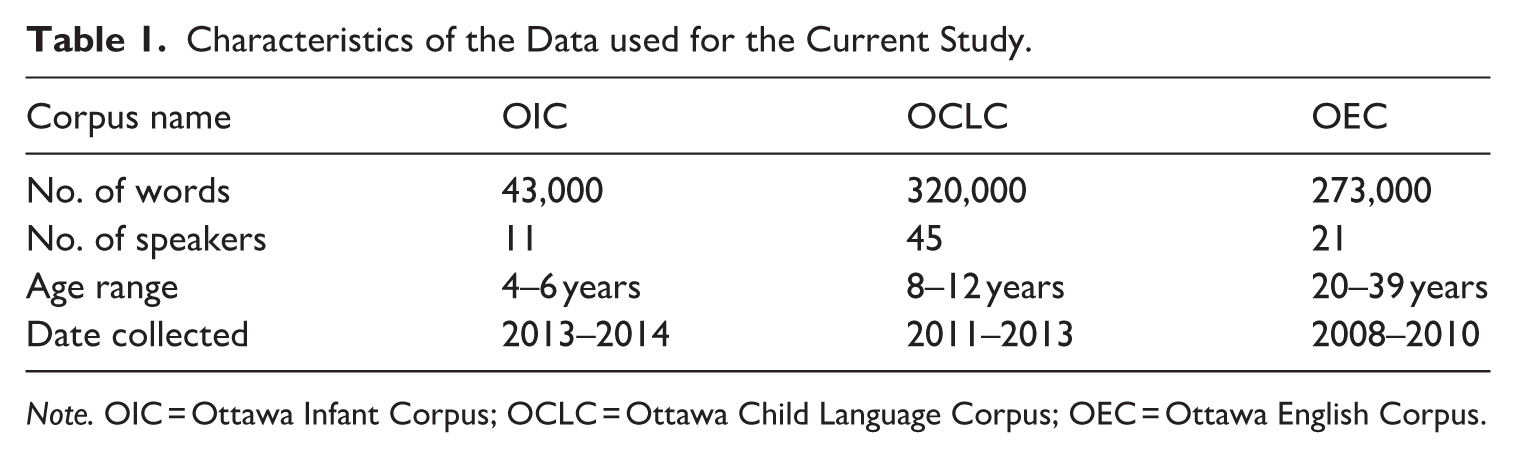
Note. OIC = Ottawa Infant Corpus; OCLC = Ottawa Child Language Corpus; OEC = Ottawa English Corpus.
The adult speech data come from 21 individuals aged between 20 and 39, who belong to the Ottawa English Corpus (OEC). These data amount to some 273,000 words of running discourse, all of which was transcribed in its entirety.
The preteen corpus, referred to here as the Ottawa Child Language Corpus (OCLC), is also based on fully transcribed natural speech data and comprises some 320,000 words. This corpus was obtained from 45 children recorded between 2011 and 2013 by adult research assistants in two elementary schools located in the Ottawa-Gatineau metropolitan area. The children were sub-divided into 2 age cohorts: 8 to 9-year-olds and 11 to 12-year-olds. In the sociolinguistic literature, the 8 to 12 age span is said to be characterized by children’s transition away from parental linguistic influences, with systematic adjustments subsequently made in the direction of the linguistic usage of the peer group and older children (Kerswill, 1996; Labov, 2001). The same age interval also witnesses children’s growing awareness of, and orientation toward, the vernacular patterns of the broader speech community to which they belong (see Labov, 2012, p. 266). The working assumption adopted in the present study is that even though the adult baseline variety factored into the research design does not represent speech explicitly addressed to the 8 to 12-year-olds themselves, it can be construed as an appropriate community-based reference point representing the variable, yet systematic, linguistic patterns to which the children are exposed.
Both the adult and child recordings were obtained using a sociolinguistic interview protocol (Labov, 1984) incorporating conversational modules (addressing, for example, family relationships, hobbies and pastimes, and amusing/scary experiences) that are designed to elicit lengthy extracts of relatively spontaneous speech. No other data-elicitation instruments were used, giving speakers free rein to express themselves as they pleased, including the use of forms and constructions that are not prescriptively ratified.
I also make use here of a smaller corpus, the Ottawa Infant Corpus (OIC), based on recordings collected from children in the 4;1 to 6;4 age range (average age = 5;2). These fully transcribed recordings were collected in the Centre for Child Language Research at the University of Ottawa between 2013 and 2014. 4 The OIC data are based on free speech, amounting to some 43,000 words, produced by 11 children recorded individually while engaged in unstructured play sessions with adult research assistants. Although the insights afforded by this dataset are necessarily tempered by the restricted number of RCCs that the youngest children produced, the OIC enables the structural properties of RCCs in the speech of younger and older children to be systematically compared, with a view to identifying potential developmental changes.
Method
The linguistic focus here is on adnominal restrictive relative clauses in child and adult discourse. Following Huddleston and Pullum (2002, p. 1,035), restrictive relative clauses are construed as ones which delimit the denotational reference of the head nominal they modify, as in (7) to (9) above. Other types of relative clauses (e.g. non-restrictive relative clauses, free or headless relative clauses, and adverbial relative clauses) were explicitly excluded from the analysis. All restrictive relative clauses, whether introduced by an overt or null relative marker (see examples 7–9), were identified in the data by means of multiple read-throughs of the computerized transcriptions, checking tokens against the original digital audio files, where necessary, and discarding incomplete and disfluent tokens. All restrictive RCCs extracted from the datasets detailed in Table 1 were subsequently coded for a number of structural and semantic variables.
A primary variable concerns the nature of the relative marker (or relativizer) used to introduce a restrictive relative clause (i.e. that, zero, or a WH-marker, including who, which, whose and, very occasionally, what).
Another primordial factor considered here concerns the syntactic role of the relativized NP. To explore this parameter, relative clauses in which the relativized element is the subject of the relative clause (10) were distinguished from direct object (11), oblique (12), and genitive relatives (13):
10. we found this bird that kept on following us (OCLC/002/13435)
11. I deleted all our old movies Ø we had (OCLC/003/14336)
12. we went to see a movie that she was scared of (OCLC/037/1534)
13. and the guy whose arms get bitten off (OCLC/019/11498)
These distinctions enable the differential accessibility of NP positions to relativization to be explored. As formulated by Keenan and Comrie (1977), the noun phrase accessibility hierarchy predicts that syntactic positions that are lower down the hierarchy (i.e. oblique and genitive) will be more difficult to relativize, and correspondingly less frequent, than those further up the hierarchy (i.e. subject and object).
To explore the effects of embeddedness and focus on the RCCs produced by children and adults, each token was coded for one of the four major structural configurations (i.e. OS, OO, SS, and SO) illustrated in (1) to (4) above, taking into account the syntactic role of the antecedent NP in the matrix clause (i.e. main clause subject or object) as well as the syntactic role of the relativized NP in the embedded relative clause, distinguishing subject from object relative clauses. To account for all the RCCs in the data, two additional structural configurations were considered in conjunction with the parameters of embeddedness and focus. These include subject relatives, as in (14), and object relatives, as in (15), modifying a predicate nominal (PN), indicated by [PN-S] and [PN-O] respectively:
14. there’s a lot of boys that live on the street [PN-S] (OCLC/014/18183)
15. but there’s certain rules that the guys have made up [PN-O] (OCLC/031/10009)
It is widely recognized that the animacy of the head nominal in which the relative clause is embedded modulates young children’s ability to process relative clauses (Macdonald et al., 2020). Research by Mak et al. (2002) indicates that subject relatives commonly modify animate heads, whereas object and oblique relatives most frequently modify inanimate heads. To explore whether these associations are robust in natural speech production data elicited from children of different ages, possibly reflecting distributional patterns in ambient adult discourse, animate head nouns (16–17) in RCCs were systematically distinguished from inanimate ones (18–19):
16. there’s a lot of boys that live on the street (OCLC/014/18183)
17. but I have a few friends that we always contact on Christmas and stuff (OCLC/006/15333)
18. And those are the books Ø I like to read (OCLC/028/4463)
19. it’s when there’s like a song that goes with it (OCLC/003/13854)
To ascertain the extent to which more complex RCCs emerge and gradually compete with their low-scope precursors as children mature, the coding protocol was tailored to discriminate between a range of matrix clause construction types found in the data. These include matrix clauses incorporating semantically light verbs (e.g. the copular verb be) that are low in transitivity (see Fox & Thompson, 2007), as well as other verb types embodying much richer semantic specifications, ostensibly constituting ‘full-fledged’ matrix clauses (Diessel, 2004, p. 142). Specifically, separate codes were applied to existential-there constructions (20), it-cleft constructions (21), other copular constructions (22), stative-possessive constructions (23), with all remaining verb types in the matrix clause grouped within a distinct category (24). In addition, relative clauses that modify lone head NPs, as in (25), which are not part of any main clause construction (see Fox & Thompson, 2007), were allocated a separate code, as these are claimed to feature among the earliest RCCs that children produce (Diessel, 2004):
20. there’s just a lot of movies that I like (OCLC/001/13133)
21. well it was actually my friend that got it for me (OCLC/007/15870)
22. but I’m the only one that fell asleep (OCLC/018/11739)
23. I have a theme that I have to teach every week (OEC/003/885)
24. she would yell at people who weren’t there (OEC/024/9741)
25. like typical stuff Ø you do (OEC/013/4933)
Another key parameter relates to potential developmental changes in the argument structure of RCCs. With maturation, it is claimed that the proportion of transitive relative clauses produced by children increases (Diessel, 2004, p. 139). To detect the presence of age-affiliated changes in argument structure, RCCs in the child and adult data were coded according to whether the matrix clause (where present) and the relative clause each contained either a transitive, intransitive, or copular verb. This protocol yielded many different combinations, partially illustrated in (26) to (28), with additional combinations listed in Table 8.
26. I forget most of the museums Ø we went to [
27. and there’s this other guy who really hates him [
28. like we didn’t live in the house Ø we live in now [
Results
Relative Markers
Table 2 provides a distributional breakdown of the relative markers used by the comparison groups. As a first observation, the choice marker for introducing relative clauses in all groups is that, although this marker decreases proportionally with age, suggesting that other markers make progressive incursions into the relativizer system. Of particular note is the finding that the 11 to 12-year-old children and the adults make somewhat greater use of the zero relativizer than the younger age groups. This finding is at variance with the age-correlated reduction in the use of the zero variant documented by Romaine (1986, p. 26) in the speech of 6 to 10-year-old Edinburgh schoolchildren.
Distribution of Relative Markers in the Child and Adult Data.
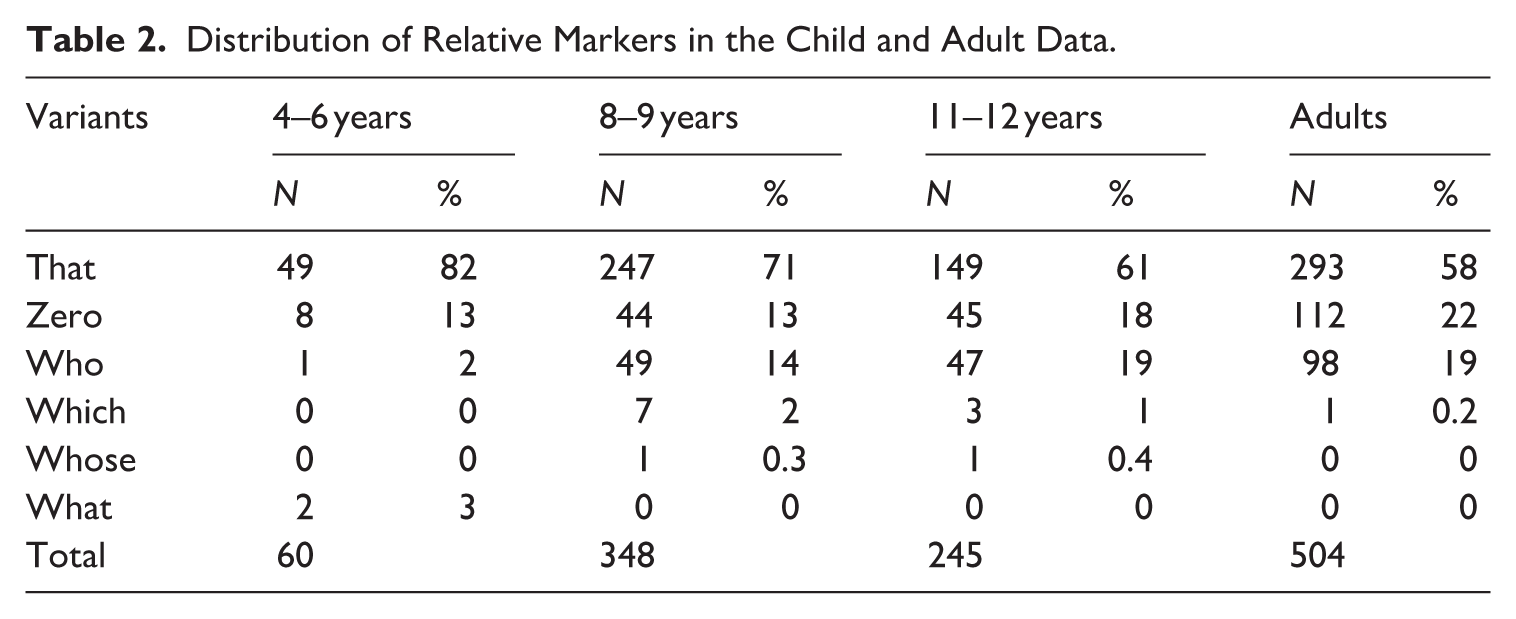
In stark contrast with its sparse occurrence in the speech of 4 to 6-year olds, relativizer who clearly has a foothold in the paradigm used by the 8 to 9-year-olds, and gently increases in frequency in the speech of the 11 to 12-year-olds, where its overall rate matches what is found in the adult community baseline. The WH-relativizers which and whose, unattested in the data representing the youngest children, occur only rarely in the other comparison groups. Of particular interest is the complete absence of whose from the adult dataset and only single occurrences of that marker in the speech of the 8 to 12-year-olds. Further inspection of the child data reveals the use of alternative structures that operate as ‘genitive equivalents’ to whose, involving periphrastic constructions that encode a possessive function, as shown in (29) to (30):
29. Yeah, so like, I have a friend who his brother’s gone to Italy (OCLC/041/1192)
30. I saw one that his tail was like this big (OCLC/002/13755)
In view of the reported difficulty of relativizing syntactic positions lower down the noun phrase accessibility hierarchy (Keenan & Comrie, 1977), children’s use of constructions that are functionally equivalent to whose may initially invite a developmental explanation. Militating against that interpretation, however, are reports that ‘analytic genitives’ constructed with a possessive determiner, as in (29) to (30), are well documented in the dialectal and colloquial English used by adults (Hermann, 2003, pp. 143–144) in addition to being attested in the history of the English language (Jespersen, 1927, p. 110), allowing speakers to circumvent the difficulties of using a case-marked relative pronoun such as whose.
Conspicuous in the speech of the 4 to 6-year-olds are sparse instances of what used as an adnominal relativizer, as exemplified in (31), produced by a child aged 4;7:
31. there’s really fun rides what we get to go on always (OIC/002/480)
Drawing on cross-linguistic evidence, Lust et al. (2026, p. 31) argue that headless relativization, exemplified in (32), provides a developmental precursor to the emergence of lexically headed relative clauses. Following Lust et al.’s (2026) line of reasoning, the use of what in examples such as (31) is possibly influenced by its use in headless RCCs, considered by Lust et al. (2026) to have early developmental primacy:
32. No they say, ‘Oh man! I’ll play better next time.’ That’s what they say (OIC/001/059)
Further support in favor of a developmental motivation for the selection of what in examples such as (31) resides in the data from the other comparison groups. In more than 1,000 tokens of RCCs produced by older children and adults belonging to the same speech community, there is not a single instance of what used as an adnominal restrictive relativizer.
Notwithstanding isolated instances of what as a restrictive relative marker in the speech of the youngest children, it is important to stress that this age group did not otherwise use headed relative clauses that were structurally anomalous in relation to those in the adult baseline variety. Indeed, the youngest children (average age = 5;2) successfully produced headed relative clauses somewhat earlier than the 6 to 8 age range identified by Lust et al. (2026, p. 116) as the period in which headless and headed relative clauses are claimed to exhibit a high degree of structural accuracy in the acquisition process.
Syntactic Role of the Relativized NP
Table 3 shows the distribution of relative clauses in the child and adult corpora according to the syntactic role of the relativized NP. In each group, the frequency with which different syntactic positions are relativized accords with the key predictions associated with the noun phrase accessibility hierarchy (Keenan & Comrie, 1977). In all groups, subject NPs are the most accessible to relativization, accounting for at least half the tokens in the child data.
Distribution of Relative Clauses According to the Syntactic Role of the Relativized NP in the Child and Adult Data.
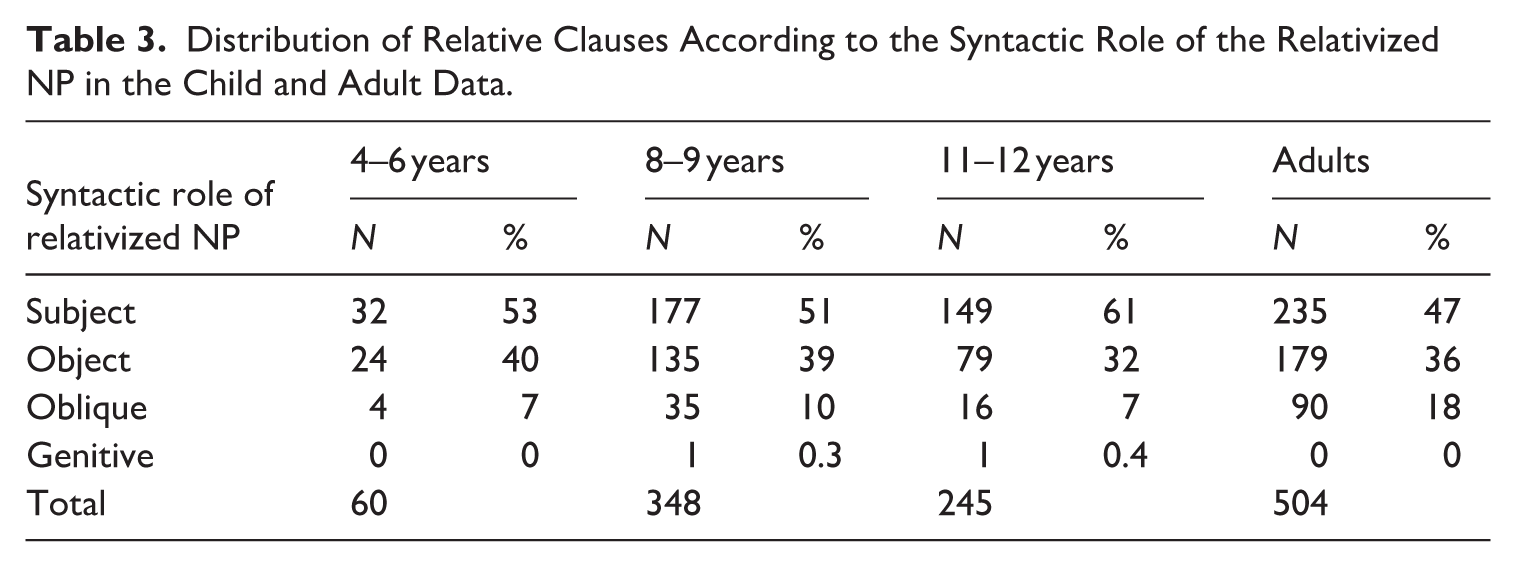
Setting aside exceptionally rare instances of genitive relatives (N = 2/1,157) marked by whose, both children and adults are least inclined to produce oblique relative clauses, although these account for a larger proportion (18%) of relative clauses in adult discourse vis-à-vis child speech (9%, averaged for the 8 to 12-year-olds). This suggests that their status as complex constructions renders oblique relatives more challenging for children to produce. This result aligns with Kim and O’Grady’s (2016) finding that English- and Korean-speaking children have significantly greater difficulty in producing oblique relative clauses than direct object ones. Further evidence from English supporting this interpretation emerges from a comparison of the distribution of subject, object, and oblique relative clauses in the aggregated 8 to 12-year-old child data with the corresponding rates in the adult baseline (see Table 3). This comparison returns a statistically significant result, with a small effect size (X2 (2, N = 1,097)=21.891, p < .001, V = 0.141), provisionally indicating that children’s use of oblique relative clauses does not reflect adult-like mastery even by late preadolescence.
RCC Types in Relation to the Syntactic Roles of the Head NP and the Gap
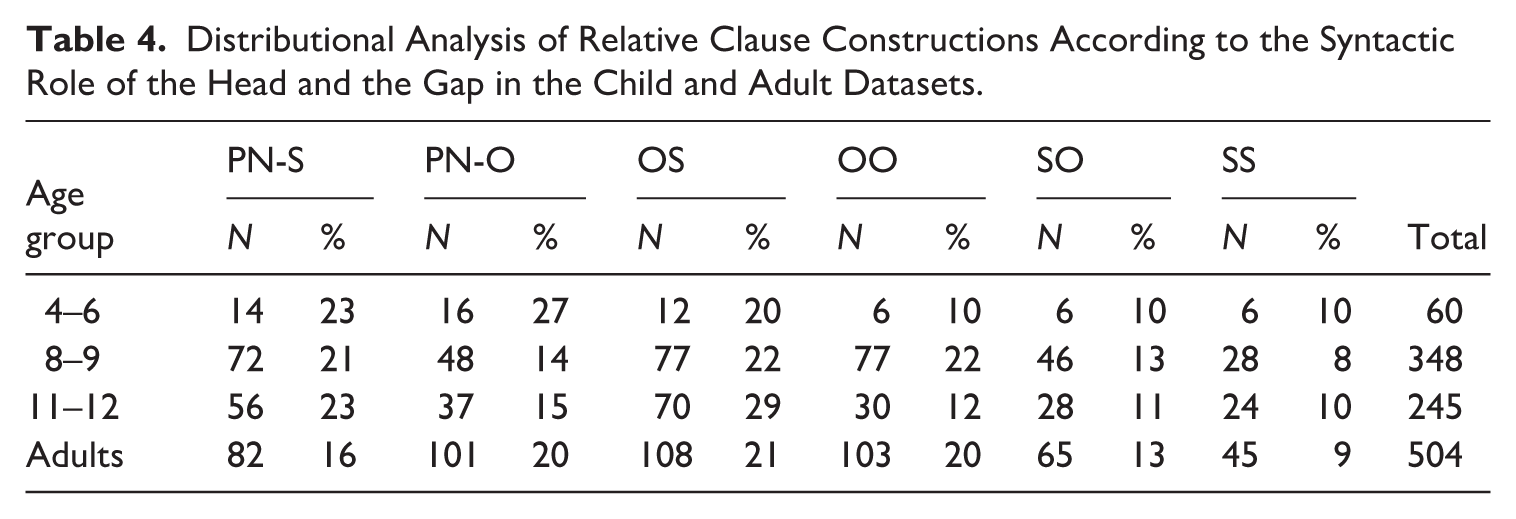
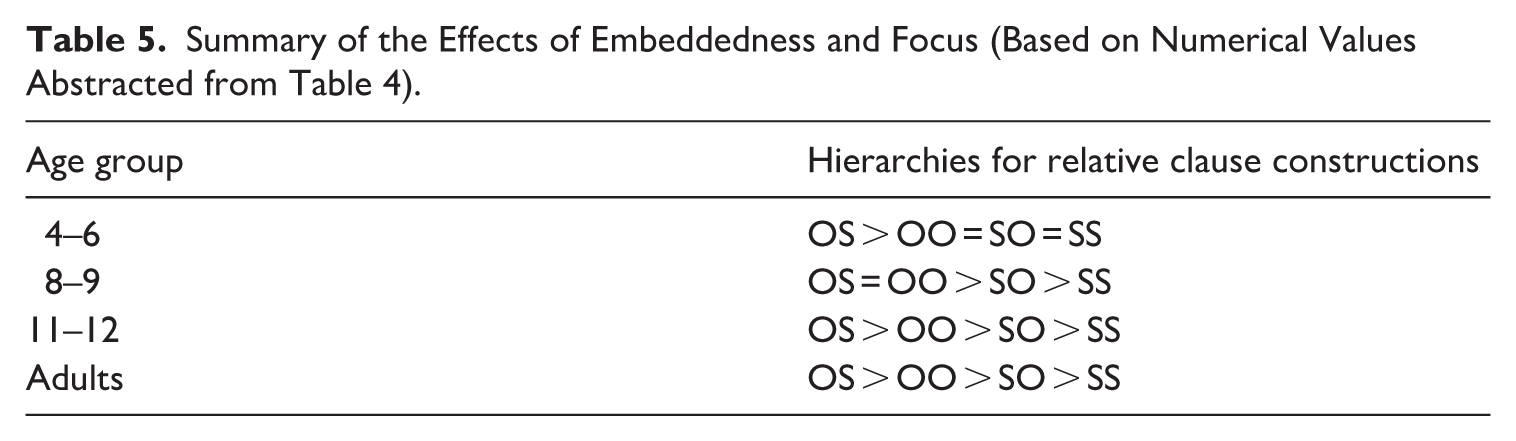
Consideration of the factors of embedding and focus provides further insights into developmental processes affecting RCCs. Table 4 presents a distributional analysis of RCCs according to the syntactic role of the antecedent head NP (including predicate nominals) modified by the relative clause, as well as according to the syntactic role of the relativized NP. Table 5 provides a summary of the effects of embeddedness and focus.
Distributional Analysis of Relative Clause Constructions According to the Syntactic Role of the Head and the Gap in the Child and Adult Datasets.
Summary of the Effects of Embeddedness and Focus (Based on Numerical Values Abstracted from Table 4).
A first important finding is that half (N = 30/60) of the relative clauses produced by the youngest children post-modify the predicate nominal of a copular matrix clause (see Diessel, 2004), which, as per usage-based accounts (Diessel & Tomasello, 2000, 2005), qualify as propositionally simple RCCs. Comparisons with the corresponding distributional information from the older children and adults reveal that those construction types, although proportionally less salient, remain highly productive nonetheless, accounting for more than one third of the tokens produced by those groups. Although the restricted quantity of data from the 4 to 6-year-old children mitigates any definitive claims that can be made about the status of those constructions in their speech, as well as the effects of embeddedness and focus on their production of relative clauses, comparisons with older children indicate that early to middle childhood (i.e. between the ages of 4 and 9) is the locus of evolving complexity in RCCs.
The youngest children share with all other comparison groups, including the adults, a quantitative preference for right-branching OS constructions. Subject-embedded relative clauses (i.e. SO and SS types), as in (33) from a child aged 4;1, are uncommon in that age group, with the youngest children tending to embed subject relatives in lone NPs, resulting in what resembles a topic-comment structure (see Romaine, 1984), as in (34) from a child aged 4;2:
33. only thing Ø we did the morning (sic) was to go eat some cookies from- from my brother’s birthday (OIC/004/147)
34. someone that’s hurt or sick (OIC/003/014)
The aversion to center-embedded relative clauses apparent in the child data is equally discernible in the adult data. The relative infrequency of those constructions in spontaneous speech data is likely due to a conspiracy of factors, including the general cognitive costs incurred by nested structures (Gibson, 1998), as well as the preference in natural discourse for postponing ‘heavy’ linguistic units to the end of the clause (Arnold et al., 2000).
To summarize, comparison of the adult and the aggregated 8 to12-year-old child data in Table 4 returns a statistically significant, but weak, effect (X2 (5, N = 1,097) = 11.436, p = .043, V = 0.102). Conversely, when this comparison is restricted to embeddedness and focus, no significant effect emerges. This result would seem to suggest that the 8 to12-year-old children and the adults share a broadly similar hierarchical preference for the four different RCC types depicted in Table 5. The existence of these shared patterns bolsters the inference that in English, a head-initial language with post-nominal relative clauses, children are sensitive to statistical regularities associated with particular relative clause configurations in the community-based input they receive, ultimately leading to the entrenchment of specific syntagmatic sequences in their discourse (Frizelle & Fletcher, 2014, p. 259).
Animacy Effects of the Head NP
Further evidence that children are sensitive to the statistical properties of ambient community-based speech emerges from the analysis of animacy effects of the head NP modified by the relative clause, as displayed in Table 6.
Animacy of the Antecedent Head NP in Subject and Non-Subject Relative Clauses in the Child and Adult Datasets.
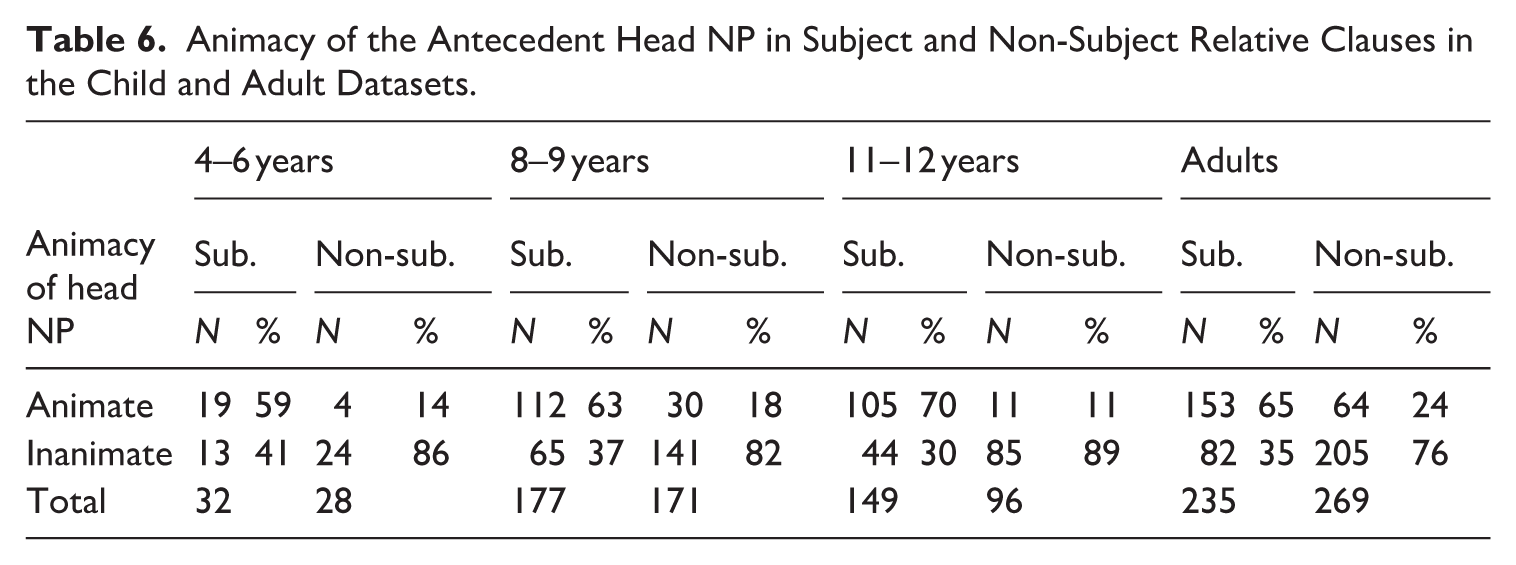
For each age group, statistical evaluation reveals a significant effect relating to the animacy of the antecedent head NP according to whether it hosts a subject or non-subject relative clause: 4 to 6-year-olds: X2 (1, N = 60) = 12.843, p < .001 φ = .463; 8 to 9-year-olds: X2 (1, N = 348) = 75.309, p < .001, φ = .465; 11 to 12-year-olds X2 (1, N = 245) = 81.555, p < .001, φ = .577; adults: X2 (1, N = 504) = 87.32, p < .001, φ = .416. In each speaker cohort, subject relative clauses show a distinct preference for animate heads, whereas non-subject relative clauses typically modify inanimate antecedent NPs. Furthermore, as indicated by the phi coefficients, the effect size is relatively strong in each group. The strength of these probabilistic associations, even in the speech of the youngest children, suggests that animacy-based constraints are acquired early. The importance of the semantic feature of animacy in children’s subject and non-subject relatives is paralleled by an equally strong association in adult discourse, suggesting that children’s sensitivity to highly conventionalized patterns in community-based speech has a direct bearing on the acquisition of animacy effects.
Matrix Clause Construction Types
Closer inspection of matrix clause construction types in which the relative clause is embedded, as shown in Table 7, affords additional insights into structural affinities and differences in child and adult speech, illuminating further developmental trends in the data.
Distribution of Matrix Clause Construction Types in the Child and Adult Datasets.
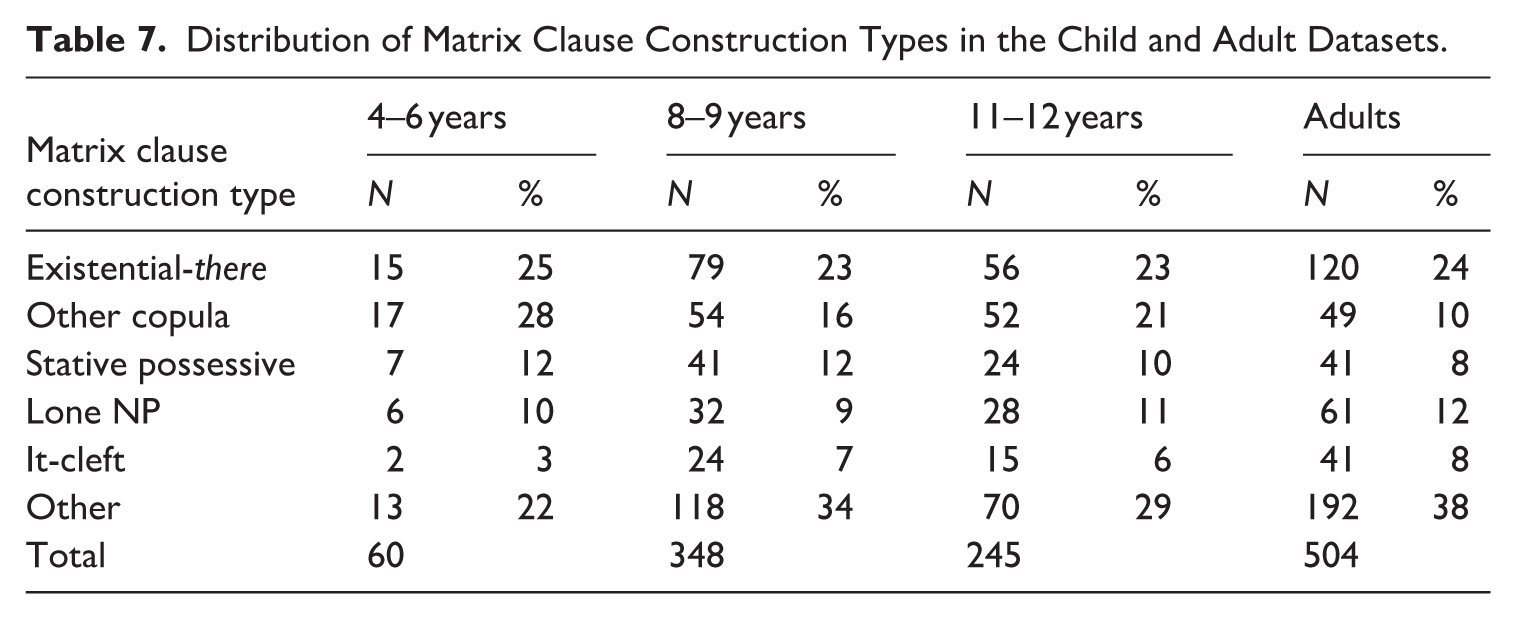
Corroborating usage-based investigations of relativization (Diessel, 2004), relative clauses in the speech of the 4 to 6-year-olds predominantly modify main-clause constructions that are considered to be low in semantic content (56% based on the aggregated data for existential-there, other-copula, and it-cleft constructions). A further 12% modify stative-possessive constructions and 10% modify lone NPs, also considered to be low in semantic content. The ‘other’ category, comprising ‘full-fledged’ matrix clauses in usage-based accounts (see Diessel, 2004, p. 132), which denote a semantically independent state of affairs, are in the minority in the data from the 4 to 6-year-olds. Proportionally, this category expands in the speech of the 8 to 12-year-olds. Although this category is moderately larger still in the adult data, accounting for 38% of main clause construction types, it is striking that matrix clauses which are low in semantic content remain quantitatively preponderant in adult discourse too.
In brief, evidence of an expansion in the use of main clause constructions containing richer semantic specifications is most salient when the 4 to 6-year-olds are compared with the 8 to 9-year-olds, yet again implicating early to middle childhood as the locus of incremental developments in the structural complexity of the main clause. Statistical assessment reveals no significant difference between the 8 to 9 and 11 to 12-year old children with respect to the distribution of matrix clause construction types, but comparison of the aggregated data from the 8 to 12-year-olds with the adult baseline variety returns a significant, albeit weak, effect (X2 (5, N = 1,097) = 20.291, p = .001, V = 0.136). This finding supports the contention that the older (8 to 12-year-old) children analyzed here closely approximate, but do not yet faithfully reproduce, adult-like patterns in their use of matrix-clause constructions hosting relative clauses.
Argument Structure of the Matrix Clause and Relative Clause
Variable argument structure in RCCs offers yet another measure with which to calibrate evolving structural complexity in children’s use of those constructions. Transitive clauses, unlike copular and intransitive ones, include an additional argument, leading to the assumption that they are more complex, and consequently only increase with age (Diessel, 2004; Diessel & Tomasello, 2000). The evidence in the data for an age-correlated expansion in the use of transitive relative clauses is modest. The proportion of transitive relative clauses used by 4 to 6-year-olds is 48%. There is a minor increase to 54% in the speech of the 8 to 9-year-olds and an additional increase to 58% in the 11 to 12-year-olds, but this subsequently falls to 53% in the adult baseline variety.
Consideration of the argument structure of both the matrix and the embedded relative clause, as depicted in Table 8, helps to refine the analysis. The 8 to 12-year-old children and the adults share the same three top-tier configurations (highlighted in Table 8 with bolded font), which are ranked similarly. In all four comparison groups in Table 8, the numerically dominant pattern involves a semantically light copular main clause modified by a transitive relative clause, likely reflecting the discourse-functional utility of that particular configuration for putting the relative clause predication into focus (Wiechmann, 2015, p. 132). RCCs comprising two transitive clauses, of the type encountered in experimental stimuli (see Lust et al., 2026, pp. 58–59), are the second-ranked combination in the speech of the 8 to 12-year-old children and adults, but account for less than 25% of the data in each of those groups. Predictably, RCCs comprising two transitive clauses are least commonly used by the 4 to 6-year-old children. RCCs containing a copular matrix clause and an intransitive relative clause are proportionally more frequent in the speech of the youngest children, reflecting a preference for that configuration in children’s early presentational RCCs (Diessel, 2004, p. 116).
Argument Structure of the Main and Relative Clauses in Child and Adult Data.
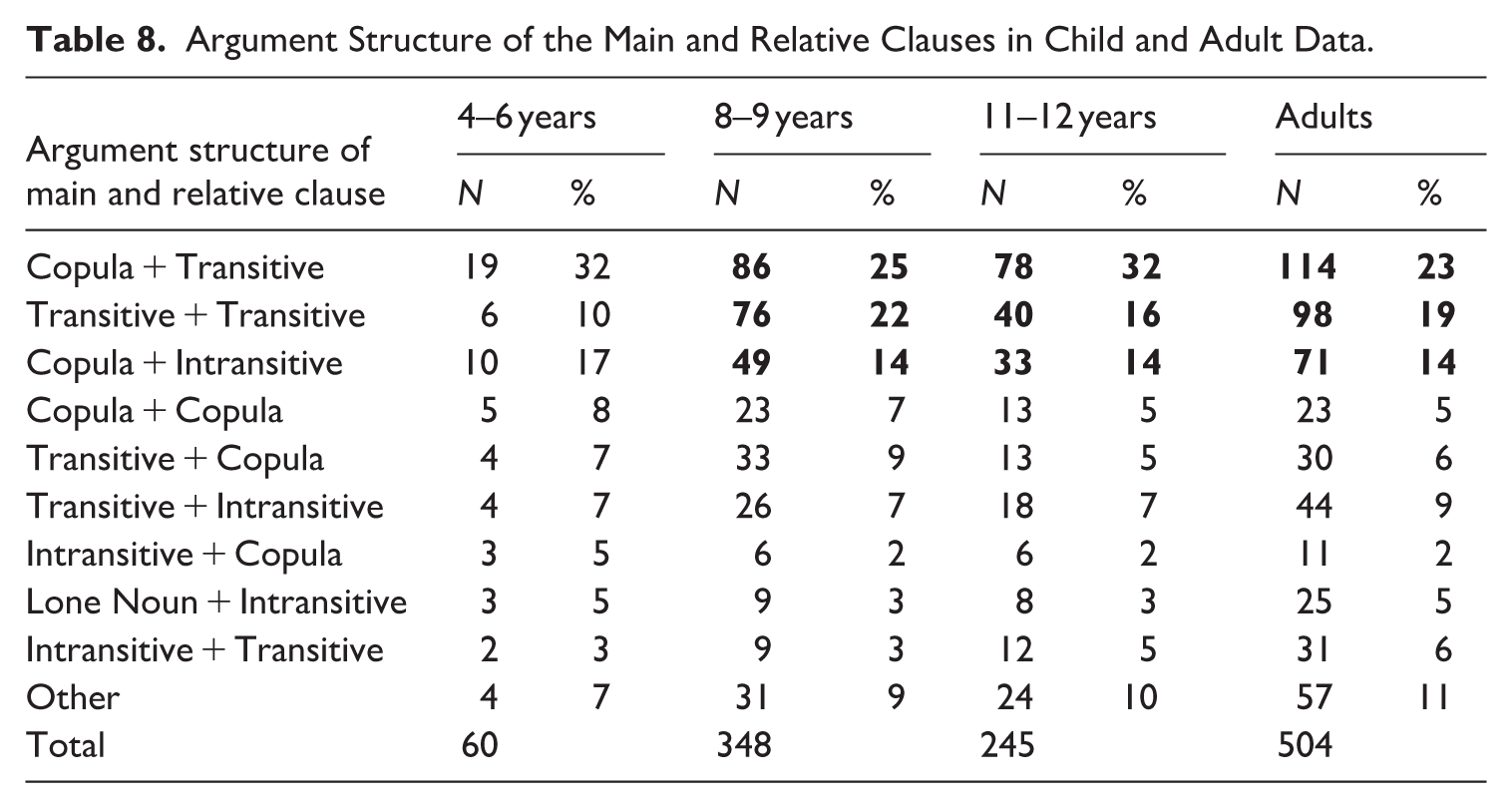
Statistical assessment of the distributional information displayed in Table 8 reveals no significant differences between the 8 to 9- and 11- to 12-year-old children, or between their aggregated data and the corresponding adult baseline, indicating a relatively close match between the argument structure of RCCs in preadolescent and adult usage. To the extent that generalizations can be extrapolated from the restricted data representing the 4 to 6-year-olds, the evidence in Table 8 indicates that the age interval between 4 and 9 witnesses an expansion in the use of RCCs comprising two transitive clauses. 5
Discussion and Conclusions
The specific strengths of a sociolinguistic approach, showcased in the current study, reside in its capacity to engage with the inherent variability characteristic of authentic community-based speech, privileging structures that arise from choice rather than from (forced) elicitation, thereby enhancing the ecological validity of key findings.
What have the comparative components of this approach revealed? One overarching finding is that RCCs produced by 4 to12-year-old children and, crucially, adults bear only an indirect relationship to the ‘prototypical’ RCCs that populate much of the early experimental literature addressing the acquisition of relative clauses. In each comparison group, RCCs comprising two clauses encoding a semantically independent state of affairs are outnumbered by a network of related constructions in which the matrix clause is informationally ‘light’, contributing very little semantic content. This structural variability is a defining characteristic not just of child speech production, but of adult speech too. As suggested by Diessel and Tomasello (2000, 2005), failure to confront this variability by focusing exclusively on RCCs deemed ‘prototypical’ would run the risk of generating an incomplete and inaccurate account of the developmental trajectory of those constructions in actual speech.
To what extent do children in different age cohorts expand their ability to produce RCCs? Although the paucity of data from the 4 to 6-year old children necessitates cautious interpretation of the results for that age group, on several measures (e.g. syntactic role of the head and the gap in RCCs; matrix clause construction type; argument structure of the matrix and relative clause), the age interval between 4 and 9 is recurrently implicated as a period that witnesses increments in the structural complexity of RCCs, in line with the general hypothesis of clause expansion adumbrated in the usage-based literature (see Diessel, 2004; Diessel & Tomasello, 2000, 2005).
To what extent do the distributional and constructional biases in children’s use of RCCs reflect sensitivity to structural patterns and frequency effects in community-based adult production data? Sensitivity to animacy constraints of the head NP in subject and non-subject relative clauses, clearly instantiated in the speech of the youngest children and exhibiting correspondingly robust effects in the older age groups, provides compelling indications that children are finely attuned to the probabilistic patterns in the community-based speech to which they are exposed. Distributional parallels between the RCCs used by older (8 to 12-year-old) children and those used by adults, as revealed by a series of measures (e.g. effects of embeddedness and focus; argument structure of RCCs), further suggest that frequency effects in ambient adult speech influence the entrenchment of particular structural configurations in children’s discourse. This finding is congruent with usage-based claims that statistical regularities in the input are tracked by children’s learning mechanisms (see Hutton & Kidd, 2011) and shape their emergent grammars.
A key issue confronted by the research reported here hinges on whether the older children included in the investigation exhibit adult-like mastery of RCCs. The incorporation of a community adult benchmark variety into the research design enabled this issue to be confronted empirically. Notwithstanding the many structural similarities in the RCCs used by older children and adults, the results by no means warrant the conclusion that their production systems are identical. A case in point concerns oblique relative clauses, which occur at visibly lower rates in the child data vis-à-vis the adult baseline. Granted, oblique relative clauses are comparatively infrequent in the adult benchmark too, but their asymmetrical distribution in child and adult discourse provisionally suggests that preadolescent children’s general cognitive resource capacities may be insufficiently developed to enable them to use those constructions to the same extent as adults. Also relevant in this regard are recent advances in cognitive neuroscience indicating that the ability to process complex sentences is correlated with evolving brain structure and develops slowly, reaching maturation only in later childhood (Skeide et al., 2016, p. 2,135).
It is clear, however, that a fuller understanding of asymmetries in children’s production of different relative clause types cannot be achieved without paying due attention to typological differences between languages and the role of the input in the acquisition process. As mentioned earlier in the case of Finnish (Kirjavainen & Lieven, 2011), the frequency of oblique relatives in the input to which children are exposed appears to play a key role in the acquisition process. In a similar vein, Ozeki and Shirai’s (2007, pp. 261–262) analysis of five Japanese-speaking pre-school children revealed that subject, object, and oblique relative clauses were produced at approximately commensurate rates in their discourse, reflecting similar distributions in the adult input variety.
Additional findings that warrant investigation concern age-related differences in the marking of relative clauses. Witness the fact that the relative marker who, exceedingly rare in the speech of the 4 to 6-year-olds analyzed here, only shows parity with adult rates in the speech of the oldest children, the 11 to 12-year-olds. Moreover, disparities between the results documented here and those reported by Romaine (1984, 1986) in relation to relative marker choice (e.g. patterns in the use of the zero relativizer) should caution researchers against ignoring the implications of how community-specific patterns of variation shape the acquisition process. This is an area that would benefit from increased dialogue between sociolinguists and researchers specializing in first-language acquisition.
In conclusion, although the results reported here broadly support the hypothesis that children transition from highly stereotypical RCCs in early infancy to more abstract and complex constructions in later childhood, further research is needed to illuminate the intermediate steps and processes by which children relate new, more complex RCCs to the ones they already know. A particularly fertile line of inquiry that lies beyond the confines of the current investigation concerns the potential impact of schooling on children’s use of RCCs, particularly those constructions considered to be more syntactically complex. One outstanding question that bears further investigation is whether children’s induction into literacy practices, concomitant with the onset of mandatory schooling, operates as a driver of syntactic growth (see Huttenlocher et al., 2002), possibly augmenting children’s exposure to, and use of, semantically full-fledged biclausal RCCs (see Romaine, 1986, p. 30).
Footnotes
Acknowledgements
I am very grateful to the children and the adults who took part in this study, as well as to the many research assistants who helped with data collection. I also extend my thanks to Prof. Tania Zamuner, the director of the Center for Child Language Research, University of Ottawa, for access to laboratory space. Many thanks to the journal editor and to two reviewers for their immensely helpful comments.

Ethical Considerations
The research project on which this article is based was conducted with the approval of the Social Sciences and Humanities Research Ethics Board (REB), University of Ottawa (file no. #05-10-06).
Consent to Participate
The research was conducted with the informed consent of human participants and was carried out in full compliance with the stipulations of the Tri-Council Policy Statement: Ethical Conduct for Research Involving Humans (TCPS 2).
Author Contributions
Funding
The author disclosed receipt of the following financial support for the research, authorship, and/or publication of this article: This research was generously supported by a Standard Research Grant (410-2010-2182) to the author from the Social Sciences and Humanities Research Council of Canada in relation to the project entitled Grammatical Trajectories of Change in Preadolescence.
Declaration of Conflicting Interests
The author declared no potential conflicts of interest with respect to the research, authorship, and/or publication of this article.
Data Availability Statement
The data analyzed in this study may be made available on request from the author. The data are not publicly available in accordance with the informed consent guidelines provided to the participants.