






Abstract
Personal narratives, stories about past personal experiences, are closely associated with social, academic, and mental health outcomes. Despite their importance, few validated assessment tools are available for Speech-Language Pathologists (SLPs) to assess personal narrative abilities. To address this gap, the Global Talking About Lived Experiences in Stories (TALES) Network developed a standardized protocol designed to support cross-cultural and cross-linguistic comparisons. This study examines the feasibility of the Global TALES protocol for eliciting personal narratives from Canadian predominantly English- and French-speaking children and compares their narrative performance across four components of discourse processing derived from the Linguistic Underpinnings of Narrative in Aphasia (LUNA) framework: linguistic, propositional, macrostructure planning, and pragmatic. Using the French or English version of the Global TALES protocol, personal narratives from 40 typically developing children aged 9 to 10 years were collected: 20 English speaking and 20 French speaking. Narrative measures included verbal productivity, lexical diversity, and syntactic complexity at the linguistic level; local coherence at the propositional level; context and chronology at the macrostructure planning level; and narrative topics and theme at the pragmatic level. The Global TALES protocol successfully elicited personal narratives across both language groups (70%–100% across the 6 prompts), and no significant differences were found between groups across all 4 discourse components of the LUNA framework, with inter-rater reliability ranging from 72.5% to 94.3%. These findings support the promise of the Global TALES protocol as a clinically relevant tool for SLPs wanting to assess personal narrative skills, alongside a comprehensive framework, while allowing for cross-linguistic and cross-cultural comparisons.
Keywords
Introduction
Communication is a basic human right that enables individuals to share their experiences, connect with others, and make sense of the world (McLeod, 2018). Sharing past personally experienced events (i.e. personal narratives), in particular, plays an important role in social interactions. More than 50% of children’s conversations have been shown to consist of personal narratives (Preece, 1987), making them essential to cementing relationships with friends and family members, developing one’s sense of self, and building and strengthening shared memories. Personal narratives have also been shown to support classroom participation as well as academic and vocational outcomes (Westby & Culatta, 2016).
Personal narratives play an important role across cultures (Westerveld & Nelson, 2023). This is of particular relevance to speech-language pathologists (SLPs), given the growing number of children around the world who speak more than one language (Piccardo, 2018) and the challenge of differentiating between children who present with language differences (i.e. because of cultural and/or linguistic variations) versus language disorders (i.e. because of a neurodevelopmental disorder learning any language) (Bedore & Peña, 2008). Over- and under-identification of children with developmental language disorder (DLD) can result in both inappropriate early intervention efforts and significant long-term negative socioemotional and academic implications for children who require support but do not receive it (McGregor, 2020).
Global TALES Protocol to Elicit Personal Narratives
Research has shown that analysis of children’s personal narratives may be used as an authentic language assessment tool, as it offers a comprehensive and rich sample of a child’s functional language skills representative of daily communication (Westerveld & Nelson, 2023). However, few tools and methods have historically been available to SLPs wanting to evaluate these skills. Having identified the importance of personal narratives as a way to assess the language skills of children across cultures and speaking different languages, members of the Child Language Committee of the International Association of Communication Sciences and Disorders founded a special interest group in 2018, called the Global Talking About Lived Experiences in Stories (TALES) Network, to address this gap in research and practice. This resulted in the development of the Global TALES protocol, which consists of six scripted prompts for eliciting personal narratives, each about a different emotion or experience: a time the child was excited, worried, annoyed, proud, had a problem they had to solve, and about something important that happened to them (Westerveld et al., 2022).
The global TALES Network currently includes over 50 researchers, speaking over 20 languages, from 26 different countries, who are investigating children’s use of personal narratives. The protocol has been applied primarily to school-aged children in a number of countries, speaking a range of languages, including Israel (Hebrew and Arabic; Ferman & Kawar, 2023), Belgium (Duch; Van Vreckem et al., 2023), Turkey (Turkish; Yaşar Gündüz et al., 2026), Ireland (English; Lyons et al., 2023), India (Hindi; Srivastava et al., 2023), Iceland (Icelandic; Einarsdóttir & Þráinsdóttir, 2023), Greece (Cypriot Greek and Greek; Theodorou et al., 2023) and Croatia (Croatian; Kuvač Kraljević et al., 2023). The protocol has been used to compare personal narratives of 10-year-old children from East Asian cultures (i.e. Korea, Taiwan, and Hong Kong) with those of English-speaking children from Western cultures (i.e. the United States, Australia, and New Zealand) (Westby et al., 2023), showing promising potential for cross-cultural comparisons (see also Westerveld et al., 2026). However, few studies have yet been conducted cross-linguistic comparisons with children coming from the same country (Ferman & Kawar, 2023; Theodorou et al., 2023). This knowledge is essential for SLPs and researchers seeking to understand how linguistic, cultural, and other individual factors may influence children’s personal narratives (Berman, 2001), and represents a critical step toward accurately identifying children with DLD within increasingly plurilingual societies (Bedore & Peña, 2008; Piccardo, 2018). Using the Global TALES protocol, this exploratory cross-linguistic study aims to describe and compare personal narratives produced by predominantly English- and French-speaking children from Canada.
Analyzing Personal Narratives
Producing personal narratives is a highly complex skill that draws on linguistic (e.g. vocabulary, grammar, pragmatics), cognitive (e.g. executive functioning, memory), and social-cognitive abilities (e.g. theory of mind) (Johnston, 2008; Reese et al., 2011). To produce a coherent personal narrative, a narrator must select and retrieve an event from memory, organize it within a coherent structure, select appropriate vocabulary, and construct syntactically correct utterances, while also monitoring the listener’s perspective to ensure clarity and shared understanding (Reese et al., 2011). This complexity is highlighted in a recent systematic review of more than 200 papers published since 1980, which identified more than 900 different measures for personal narrative assessment (Gupta et al., 2026). This wide range of narrative measures underscores the need for a unified, coherent, and comprehensive analytic approach that can be used by both SLPs and researchers to support cross-linguistic and cross-cultural comparisons.
The Linguistic Underpinnings of Narrative in Aphasia (LUNA) framework (Dipper et al., 2021), originally developed to characterize spoken discourse in adults with aphasia, proposes that discourse production involves four interdependent components of processing: linguistic, propositional, macrostructure planning, and pragmatic. While initially designed to illuminate the processes involved in discourse production (and reasons for breakdown) in adult clinical populations, this framework is applicable to the assessment of personal narratives in children as it captures the multi-level complexity required to convey past personal experiences across the lifespan (Gabaj et al., 2025a; Gupta et al., 2026). Specifically, the LUNA framework reflects how children must coordinate a range of skills of discourse processing to produce coherent and complete personal narratives. Recent research has further demonstrated that narrative measures derived from the LUNA framework are sensitive to identifying children with DLD across all four LUNA components (Gabaj et al., 2024, 2025a, 2025b).
Linguistic-level analysis of personal narratives focuses on vocabulary and morphosyntax, with verbal productivity, lexical diversity, and syntactic complexity listed as common measures (Dipper et al., 2021; Justice et al., 2006). Verbal productivity reflects narrative length and is typically assessed using the total number of communication units (total number of C-units TNU) (Justice et al., 2006; Westerveld et al., 2022) defined independent clauses with their modifiers (Loban, 1976). Lexical diversity refers to the variety of words used to convey the personal narrative, such as with the calculation of the number of different words (NDW; Ratner et al., 2024). Syntactic complexity can capture both the length and accuracy of utterances produced in a narrative (Winters et al., 2022), with length often measured using mean length of utterance in words (MLUw; Hernandez et al., 2024; Ramos et al., 2022). Using the Global TALES protocol, TNU, MLUw, and NDW have been shown to be useful for characterizing language samples from 10-year-old Irish-speaking (Lyons et al., 2023) and Icelandic-speaking children (Einarsdóttir & Þráinsdóttir, 2023). NDW has been found to be sensitive in differentiating Dutch-speaking children aged 11 to 16 with and without dyslexia (Van Vreckem et al., 2023), while MLUw was found to be sensitive in differentiating Croatian-speaking children with and without DLD (Gabaj et al., 2024).
The propositional component reflects the real-time decision-making processes involved in selecting, organizing, and linking conceptual elements to produce connected utterances within a narrative (Dipper et al., 2021; Gabaj et al., 2025a; Slobin, 1996). In personal narratives, this component relies on processes such as event sequencing and utterance planning to organize a story into propositions with meaningful temporal and causal relationships (Gabaj et al., 2025a; Kuvač Kraljević et. al., 2023). A key measure at this level is local coherence, which refers to the conceptual connection and logical flow maintained between utterances (Van Leer & Turkstra, 1999), also found to be sensitive in differentiating children with and without DLD (Gabaj et al., 2025a).
The macrostructure planning component is responsible for establishing the overall structural framework of the personal narrative, which involves selecting the appropriate organizational schema, such that the content forms a coherent and informative whole (Dipper et al., 2021; Kelly & Bailey, 2012). This component requires the use of structural elements (e.g. setting, problem, and outcome) essential for maintaining the overall coherence and organization of the narrative (Mandler, 1987; Stein & Glenn, 1979). To capture coherence components in personal narratives, the Narrative Coherence Coding Scheme (NaCCS) can be used, with dimensions of context (i.e. orienting the narrative in time and space) and chronology (i.e. relating narrative components along a temporal timeline) serving as measures of macrostructure planning (Gabaj et al., 2025a; Reese et al., 2011). In a large-scale exploratory study involving 417 monolingual 10-year-old children from 21 language/cultural groups, significant main effects of language/cultural group were found for both context and chronology measures (Westerveld et al., 2026), indicating sensitivity to cross-linguistic and cross-cultural variations.
Finally, the pragmatic level is responsible for deciding what to say and how to say it based on the social context, requiring the narrator to consider environmental, interpersonal, and interactional factors that influence how discourse will be interpreted (Dipper et al., 2021). These factors can include assumptions about shared knowledge or the context in which the discourse is delivered (e.g. at home vs. at school). The analysis of personal narrative topics (i.e. the what) can offer important insights into the cultural and social contexts that may influence storytelling (Westby et al., 2023). For instance, research comparing 10-year-old children from East Asian and Western English-speaking cultures found that cultural norms, such as collectivist versus individualistic values, influenced the topics of their personal narratives (Westby et al., 2023). The pragmatic level can also be examined through the analysis of theme (i.e. the how), which refers to the extent to which the narrative stays on topic, provides sufficient development, and includes a resolution that reflects the meaning of the event for the speaker (Reese et al., 2011). In the previously mentioned large-scale exploratory study by Westerveld et al. (2026), the theme scores using the NaCCS showed the greatest number of between-group differences.
Canadian Context and Importance of Cross-Linguistic Comparisons
In the Canadian context, both French and English are official languages, and a significant proportion of the population can speak more than one language, with many households using languages other than English and French in addition to the official languages (Statistic Canada, 2023). English and French are both considered subject–verb–object languages (Lambrecht, 2010), with the core sentence elements following the same canonical order (Vinay & Darbelnet, 1995). The two languages are similar in the placement of auxiliary verbs, direct and indirect objects, and in their use of passive constructions. However, they differ in the positioning of adverbs, adjectives, negation, and pronouns (Burchell et al., 2023). Using fictional narratives and conversational samples (collected in English), Burchell et al. (2020) compared Grade 2 English-stream students to those enrolled in French-immersion programs (English-speaking children learning French at school). Results showed an advantage for English-stream students on measures of syntactic complexity for fictional narratives, suggesting that morphosyntactic abilities may be more influenced by language exposure. Their conversational samples focused on topics such as family, school, friends, hobbies, and pets, and were analyzed qualitatively using the Canadian Language Benchmarks (Gauthier, 2019). While both language groups performed relatively similarly in their use of functional (ideas and imagination) and sociocultural knowledge, English-stream students showed an advantage in grammatical knowledge (Burchell et al., 2020). To our knowledge, no study to date has yet compared the personal narrative skills of predominantly English- and French-speaking children within a Canadian context.
Using the Global TALES protocol, Theodorou et al. (2023) reported significant linguistic-level differences (syntactic complexity) between Cypriot Greek-speaking and Standard Modern Greek-speaking children, but no differences at the macrostructure planning level. Although there is evidence that sharing personal stories is universal (Westerveld et al., 2026; Westerveld & Nelson, 2023), the ways in which children utilize their language skills across all four components of the LUNA framework may differ. Beyond linguistic analysis, components of macrostructure planning (such as context and chronology) and pragmatics (such as topic choice and theme) have been found to be influenced by language and/or culture in previous studies (Ferman & Kawar, 2023; Westerveld et al., 2026). In previous work, Canadian English-speaking and French-speaking groups performed similarly across all three dimensions of the NaCCS (i.e. context, chronology, and theme) when responding to the happy, angry, and problem prompts (Westerveld et al., 2026). The present study builds on this research by conducting a more fine-grained analysis of all four LUNA components across all prompts combined. Data from typically developing children speaking different languages within the same country are particularly valuable for cross-linguistic research (Berman, 2001), as they can provide benchmarks for identifying and supporting children with DLD in plurilingual contexts, such as in Canada.
Study Aim and Objectives
This exploratory cross-linguistic study investigates the feasibility of using the Global TALES protocol in 9- to 10-year-old predominantly English- and French-speaking typically developing (TD) children from Canada and compares their personal narrative performance across all four components of the LUNA framework. Five specific research objectives guide this study:
To determine whether the Global TALES protocol successfully elicits personal narratives from predominantly English- and French-speaking children in a Canadian context.
At the linguistic level, to compare the two language groups on measures of verbal productivity, lexical diversity, and syntactic complexity.
At the propositional level, to compare the two language groups on a measure of local coherence.
At the macrostructure planning level, to compare the two language groups on measures of context (time and space) and chronology (temporal ordering of events).
At the pragmatic level, to compare the two language groups on measures of narrative topics and theme (maintenance, elaboration).
Based on previous research using the Global TALES protocol (Westerveld et al., 2022, 2026), and given that children are coming from similar cultural backgrounds and comparable educational contexts (Westby et al., 2023), we hypothesized that the Global TALES protocol would be successful in eliciting personal narratives in both languages, with similar performances at the propositional, macrostructure planning, and pragmatic levels. However, given dissimilarities in morphosyntax for English and French languages and previous work (Burchell et al., 2020; Theodorou et al., 2023), group differences are expected to emerge at the linguistic level for syntactic complexity.
Methods
Ethics and Consent
This study received ethics approvals from the Research Ethics Board at the University of Alberta (ID #Pro00135494). Caregivers of all participants completed and signed an informed written consent form prior to participating in the research. In addition, participants provided verbal consent prior to data collection.
Participants
A total of 42 TD children from diverse socioeconomic backgrounds were recruited across three provinces in Canada: Alberta, British Columbia, and Quebec. Recruitment occurred principally through social media and personal and professional networks. To be included in the study, participants had to (a) be aged between 9;0 and 10;11; (b) be enrolled in a school where English or French is the language of instruction, and (c) receive at least 80% of total language exposure to French or English (based on parental report). Children presenting with neurodevelopmental conditions associated with language difficulties, such as autism or hearing impairment, were excluded, as were those who had received speech and/or language therapy, which resulted in the exclusion of two participants. Our final sample consisted of 40 children, comprising 20 English-speaking (Mean age in years = 10.1, Standard deviation [SD] = 0.6) and 20 French-speaking children (Mean age in years = 9.7, SD = 0.7). A summary of the sociodemographic information collected through a parental questionnaire is presented in Table 1. The two language groups were comparable across all sociodemographic measures, including age (t = 1.276, p = .105), biological sex (X2 (2, N = 40) = 0.100, p = .752), school socioeconomic status (X2 = 1.040, p = .595), parental level of education of the responding parent (X2 = 2.222, p = .695), family income (X2 = 1.458, p = .834), performance relative to peers in the language of instruction (English or French) (X2 = 3.259, p = .353) and performance relative to peers in math (X2 = 1.833, p = .608).
Participants’ Sociodemographic Information.
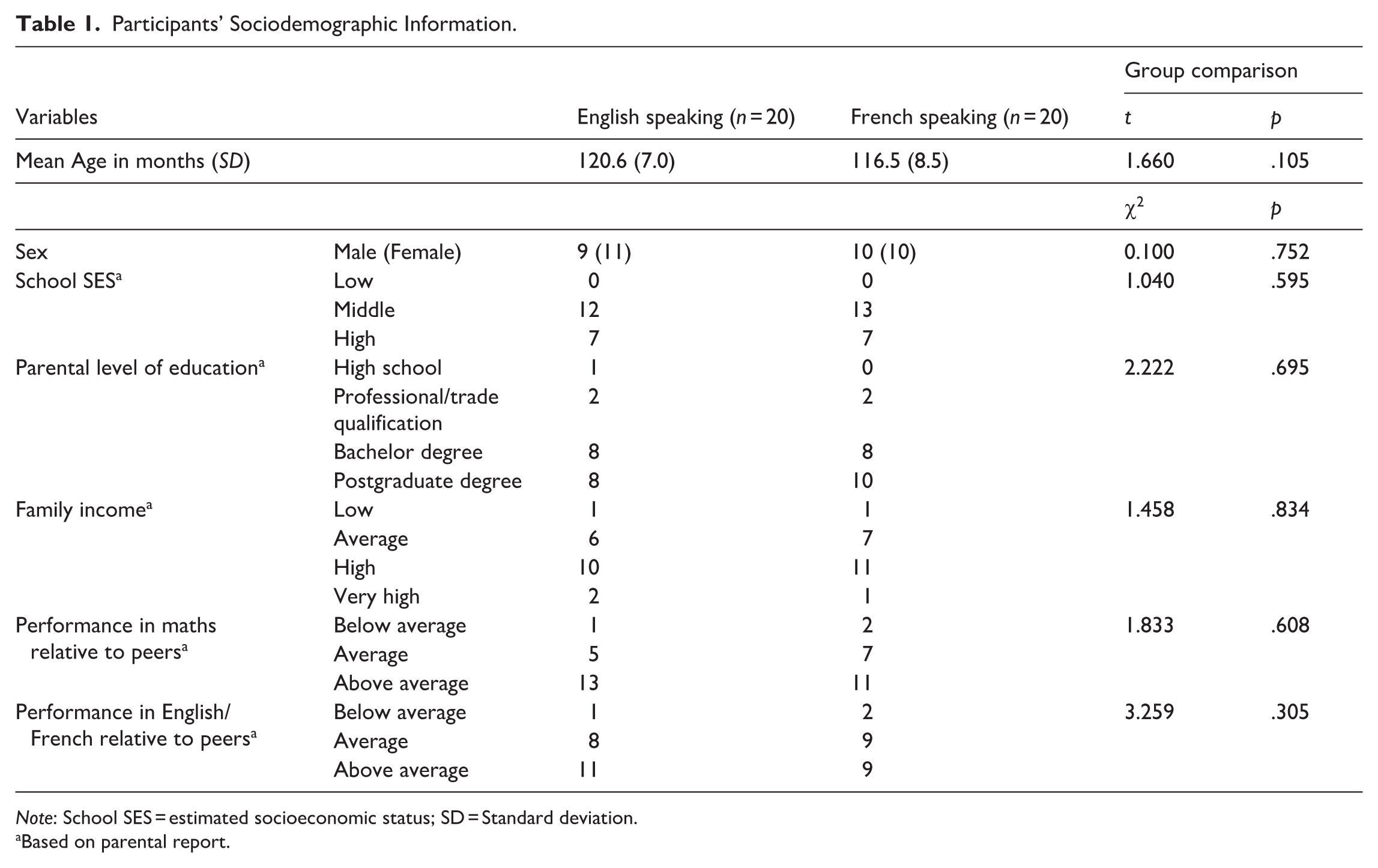
Note: School SES = estimated socioeconomic status; SD = Standard deviation.
Based on parental report.
Children’s language exposure and proficiency were measured using an adapted Language Experience and Proficiency Questionnaire (Marian et al., 2007), which evaluates bilingual and multilingual language profiles and has been validated in various languages, including English and French (Kaushanskaya et al., 2020). This questionnaire requires parents to report their child’s language exposure in percentage (at home and school) and language proficiency across 4 domains (speaking, listening, reading, and writing) using a 10-point scale from 0 (no proficiency) to 10 (mastery). Children’s language exposure and proficiency in English or French across all four domains are reported in Table 2. In terms of language proficiency, no significant differences were found between the two language groups across all four domains (speaking: t = 0.658, p = .515; understanding: t = 0.000, p = 1.00; reading: t = 1.00, p = .105; writing: t = 1.540, p = .132). In addition, all children were exposed to their dominant language (English or French) before 1 year of age, with no significant differences in age of exposure (in months) between groups (English speaking: Mean age in months = 1.68, SD = 4.06; French speaking: Mean age in months = 0.60, SD = 2.68; t = 0.987, p = .165). Of note, many children were also exposed to additional languages. Specifically, parents of 50% (10/20) of English-speaking children and 80% (16/20) of French-speaking children reported exposure to at least 1 additional language. In the English-speaking group, these included French (n = 6), French and Yoruba (n = 1), German (n = 1), Malayalam (n = 1), and Tamil (n = 1). In the French-speaking group, additional languages included English (n = 15) and Spanish (n = 1).
Participants’ Language Exposure and Language Proficiency.
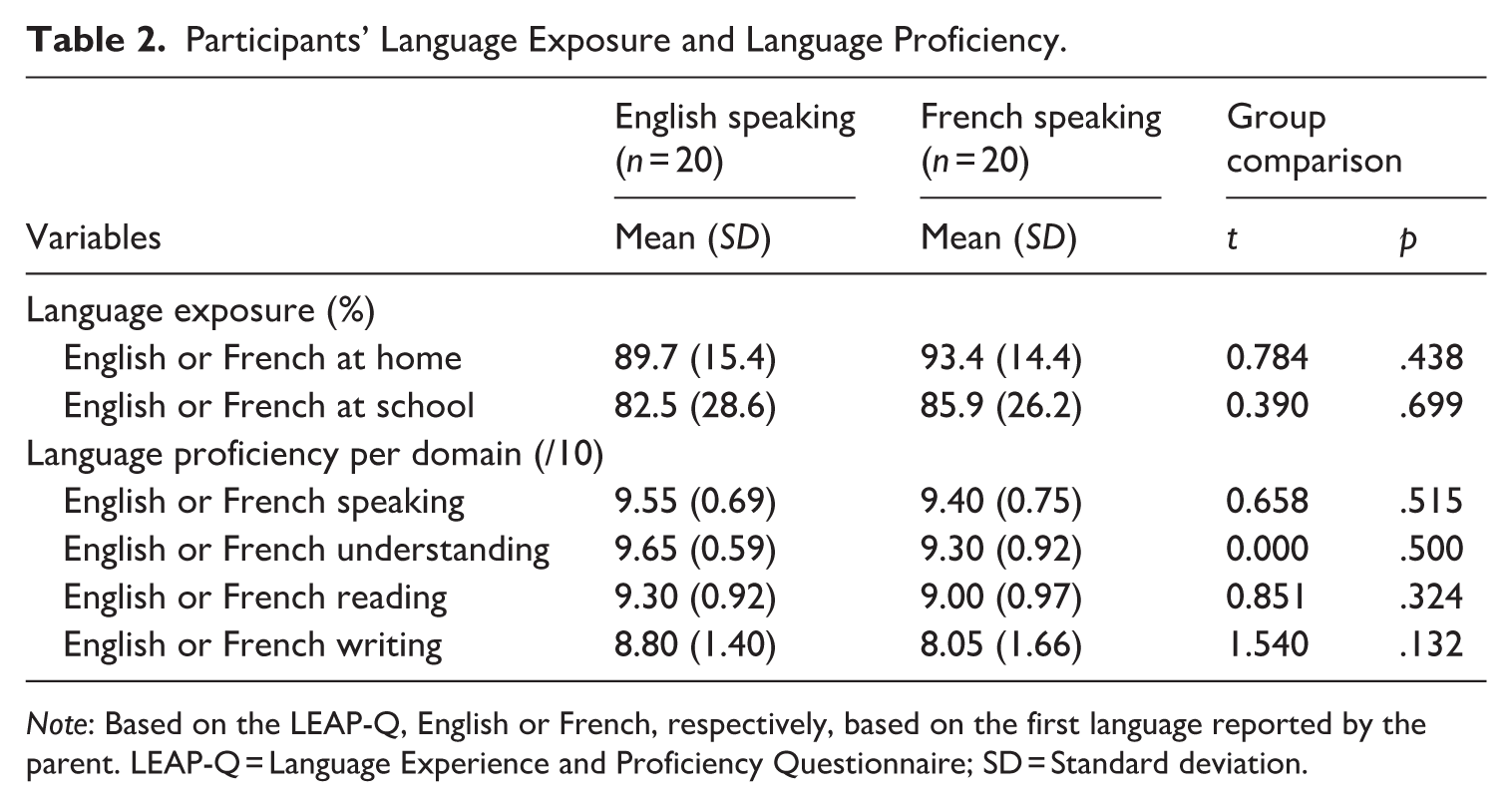
Note: Based on the LEAP-Q, English or French, respectively, based on the first language reported by the parent. LEAP-Q = Language Experience and Proficiency Questionnaire; SD = Standard deviation.
Global TALES Protocol
The Global TALES protocol is a personal narrative elicitation tool specifically developed to conduct cross-cultural and cross-linguistic comparison (see Westerveld et al., 2022). Children are asked to tell a personal story in response to each prompt without being shown model stories or pictures, an approach intended to reduce linguistic and cultural bias. Using emotion- and situation-based prompts, children are asked to tell a story related to their personal experiences. If the elicited narrative is short or the child does not respond, the follow-up prompts and directions in the protocol can be used (see detailed protocol and procedures freely available at the OSF link). The children were asked to “tell a story about a time when they . . . ” in response to each of the following six prompts: (a) felt excited or really happy; (b) felt worried or confused; (c) felt annoyed or angry; (d) felt proud; (e) had a problem and had to fix it; and (f) experienced something important. For each prompt, the examiner used a scripted follow-up prompt if the child did not respond. If the child provided only one or two sentences, the following neutral encouragement was allowed: “Can you tell me more?” All protocol prompts were read aloud by the examiner in a set order, with a written version of the prompts presented simultaneously to the participants on a computer.
The English version of the protocol was translated into French by the first author of the study (native French-speaker SLP), and reviewed by a native French-speaker graduate student in speech-language pathology following the recommendations of Westerveld and Nelson (2023). Particular care was taken to preserve the intent of the original prompts while selecting words to evoke familiar concepts. The French version of the protocol has been made available for free at the OSF link (https://osf.io/ztqg6/).
Procedure
Children were assessed in a quiet location either in person (27.5% of the sample) or online via Zoom (72.5% of the sample), based on the previous feasibility of tele-assessment for assessing personal narratives in school-aged children (Ferman & Kawar, 2023). All assessments consisted of only one task (the English or French version of the Global TALES protocol) and lasted approximately 15 to 20 min. The protocol was administered by trained English- or French-speaking research assistants or graduate students in speech-language pathology. All sessions were audio recorded for transcription and analysis purposes. Demographic data was collected through an online questionnaire completed by the parents prior to the appointment.
Transcription and Analysis
All samples were initially transcribed by trained English- or French-speaking research assistants or graduate students in speech-language pathology, using Systematic Analysis of Language Transcript (SALT), as per previous studies (Einarsdóttir & Þráinsdóttir, 2023; Westerveld et al., 2022; Yaşar Gündüz et al., 2026) and SALT conventions (Miller et al., 2024). To ensure reliability and consistency of the transcription and analysis with data collected in other countries and reported in Westerveld et al. (2022), all samples were checked for transcription accuracy and conventions by the first and third authors. Children’s utterances were segmented into communication units (C-units), defined as independent clauses with their modifiers (Loban, 1976). All unintelligible words, hesitations, mazes, rephrasing, and personal or extraneous comments such as “I don’t know” were excluded from the analyses; elliptical responses were counted as separate C-units. All reformulations, repetitions, false starts, and filler words (e.g. uhm) were placed in parentheses and not included in the analyses.
Personal Narrative Elicitations
Children’s responses to the protocol prompts were only included in the analysis if they met the criteria for a personal narrative, which was defined as containing at least two restricted, that is, time-bound, narrative clauses (NC) (Gabaj et al., 2024; Labov, 1972). Stories with fewer than two NCs were not classified as a personal narrative. For example, in response to the angry prompt, a child responded: “When my brother gets mad at me. And he’s like chasing me and stuff. And I’m running away trying to lock myself in the room.” This was not considered a personal narrative because it did not meet the minimum requirements to be considered a personal narrative, such as two or more temporal clauses that could be placed in a sequence. Therefore, responses to each prompt were classified as a personal narrative, a personal narrative, or no response. Only responses classified as personal narratives were included in the analyses.
Measures
For both language groups, personal narratives were analyzed across the four components of the LUNA framework, as summarized in Table 3. For the linguistic component, verbal productivity was assessed using the TNU, lexical diversity with the NDW, and syntactic complexity using the MLUw, all computed on SALT. For each participant, scores for TNU, NDW, and MLUw were calculated by averaging values obtained across all six prompts.
Four Components of the LUNA Framework, Personal Narrative Skills Represented, and Measures Used in this Study.
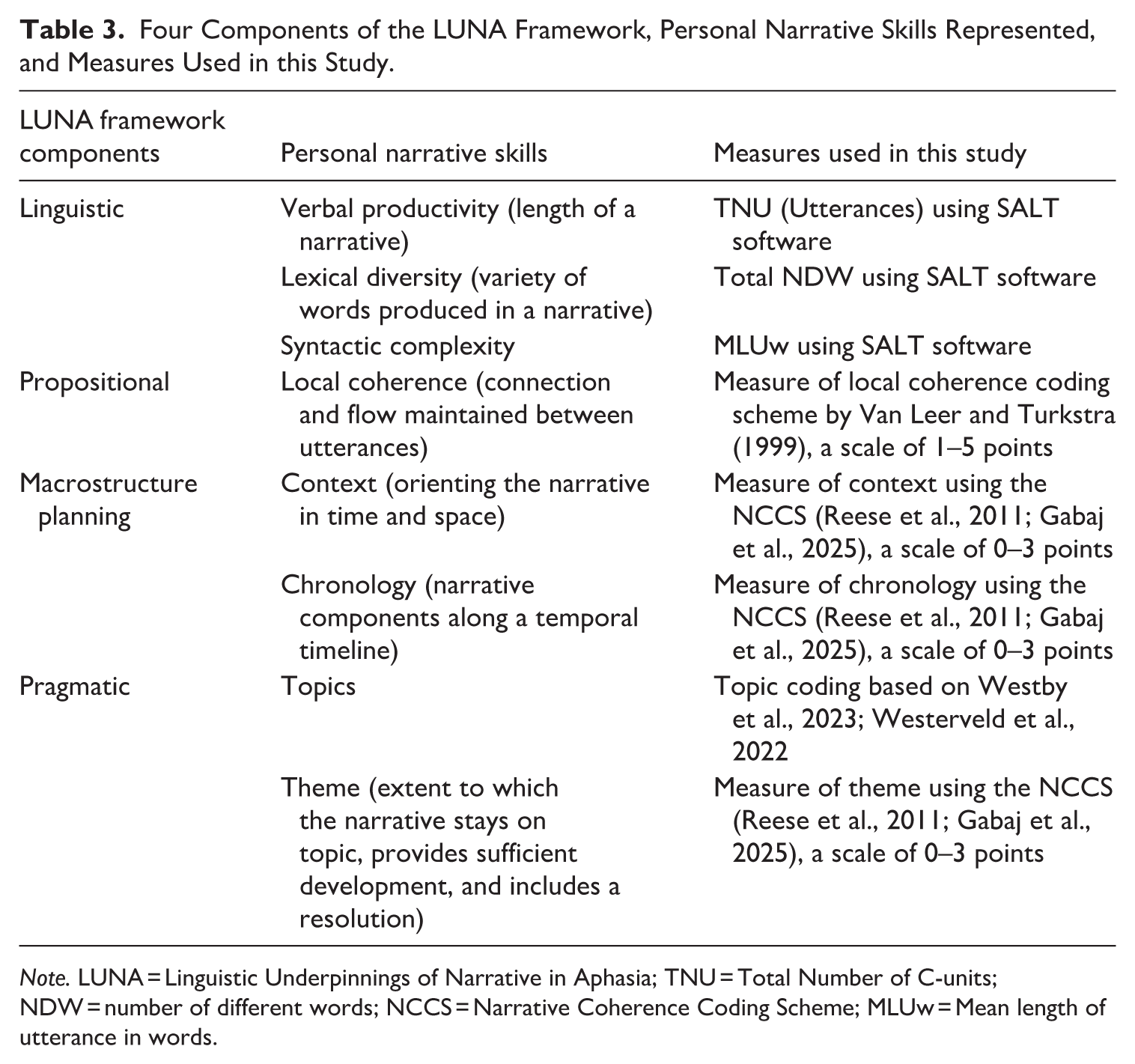
Note. LUNA = Linguistic Underpinnings of Narrative in Aphasia; TNU = Total Number of C-units; NDW = number of different words; NCCS = Narrative Coherence Coding Scheme; MLUw = Mean length of utterance in words.
For the propositional component, local coherence was assessed using a 5-point scale created by Van Leer and Turkstra (1999), also employed in a study using the Global TALES protocol (Gabaj et al., 2025a). Local coherence reflects the extent to which each utterance is meaningfully connected to the immediately preceding utterance. All utterances except the first, both complete and incomplete, were rated on a scale from 1 to 5 by the first author. A score of 1 was assigned when the utterance was unrelated to the preceding content or incomprehensible in context, whereas a score of 5 was given when an utterance was fully related to the content of the preceding utterance. Criteria and illustrative examples of local coherence from both French and English narratives collected in this study are provided in the Supplemental Materials. For each personal narrative, a mean score for local coherence was calculated. Interrater reliability was assessed on 10% of the transcripts independently scored by the second author, using an intraclass correlation coefficient (ICC). Reliability was good, with ICC(3,1) = .87, 95% Confidence interval [CI] [0.83, 0.91], p < .001. For each participant, scores for local coherence were calculated by averaging values obtained across all six prompts.
The macrostructure planning component was assessed using two dimensions of the NaCCS (Reese et al., 2011): context, which reflects the inclusion of orienting time and place information, and chronology, which reflects the temporal ordering of events in the narrative. Each narrative was rated on a 4-point Likert scale (0 to 3 points) using the updated rubrics developed by Gabaj and colleagues (2024), freely available online (https://osf.io/ztqg6). For context, a score of 0 was given when no time and place information was provided, whereas a score of 3 was assigned when both time and place were explicitly specified (i.e. specific location and specific time mentioned in the narrative). For chronology, a score of 0 indicated the absence of chronological information, while a score of 3 indicated the use of three or more sentences ordered chronologically with appropriate temporal markers. All personal narratives were independently scored for context and chronology by the first and second authors. Inter-coder agreement was calculated as percent agreement, with 91.3% obtained for context and 92.8% for chronology. Discrepancies were discussed by the two coders until consensus was reached. Scoring criteria and illustrative examples from both French and English narratives collected in this study are provided in the Supplemental Materials. For each participant, scores for context and chronology were calculated by averaging values across all six prompts.
Finally, the pragmatic component was analyzed for narrative topics (Westby et al., 2023; Westerveld et al., 2022) and theme (Reese et al., 2011; Westerveld et al., 2026). Topics, which are considered precursors to the theme, are explicit elements of the narrative and reflect responses to who, when, and why questions (Westby et al., 2023). In contrast, the theme captures the extent to which the narrative remains on topic, provides sufficient development for the emotional point to be clear, and includes a resolution tied to the meaning of the event, accompanied by affective and evaluative information (Westerveld et al., 2026). For topic analysis, all personal narratives were entered in a spreadsheet and independently categorized by the second and third authors using previously established categories (Westby et al., 2023; Westerveld et al., 2022). Inter-coder agreement, calculated as percent agreement, ranged from 72.5% (angry prompt) to 92.5% (happy prompt). Disagreements were resolved through discussion until a consensus was reached. For the angry prompt, given the large number of topic categories and lower inter-coder agreement, conceptually similar topic categories were collapsed. Specifically, irritating behaviors (physical), inappropriate physical behaviors, and physical aggressions were categorized under “inappropriate physical behaviors,” while bullied/bossed/teased/mean treatment/criticizing, lying/cheating/tricking, and irritating behaviors (verbal) were grouped under “inappropriate verbal behaviors.”
Theme scores were rated using a 4-point scale (0–3 points) based on the updated NaCCS rubrics (Gabaj et al., 2025a; Reese et al., 2011). Scores reflected both the degree of thematic development and the use of narrative devices. A score of 0 indicated no clear theme and no narrative devices, whereas a score of 3 was awarded to narratives with clear thematic elaboration, causal relationship, a personal evaluation or reaction, and a resolution. Personal narratives were independently scored by the first and second authors, with inter-coder agreement of 94.3%. All coding discrepancies were resolved through discussion between the two coders. Scoring criteria and examples from both French and English samples are provided in the Supplemental Materials. Topic frequencies were calculated per prompt for both language groups, whereas scores for the theme were calculated by averaging values across all six prompts.
Data Analysis
All analyses were performed using IBM SPSS Statistics 26 for Mac. (IBM Corp., Armonk, NY, USA). Standard descriptive statistics (means and standard deviations) were first used to summarize scores across all measures for each participant in both language groups. Normality of the data was assessed using the Shapiro–Wilk test. Given the relatively small sample size within each language group and the violation of normality for some measures (e.g. MLUw in the English-speaking group), nonparametric analyses were selected. Mann–Whitney U tests were used on all linguistic, propositional, and macrostructure planning measures. Effect sizes were calculated using the absolute value of r, classified as small (⩾0.1), medium (⩾0.3), or large (⩾0.5) (Cohen, 1988; Fiel Peres, 2026). Fisher’s exact test was used for the analysis of topics at the pragmatic level.
Results
To determine whether the six prompts were effective in eliciting personal narratives, the successful elicitation of personal narratives per prompt (categorized as personal narrative, not a personal narrative, or no response) was calculated and compared between language groups. The elicitation results for each language group in response to the six prompts are presented in Figure 1. Fisher’s exact tests were conducted to examine the relationship between language group (English/French) and elicitation results per prompt. There were no significant associations between group and number of successful elicitations across all prompts: happy (p = 1.000), angry (p = .716), problem (p = .661), worried (p = .605), important (p = .184), and proud (p = 1.000). Taken together, these findings suggest that both language groups responded with similar response rates across all prompts, with a majority of children producing a personal narrative in response to the prompts.
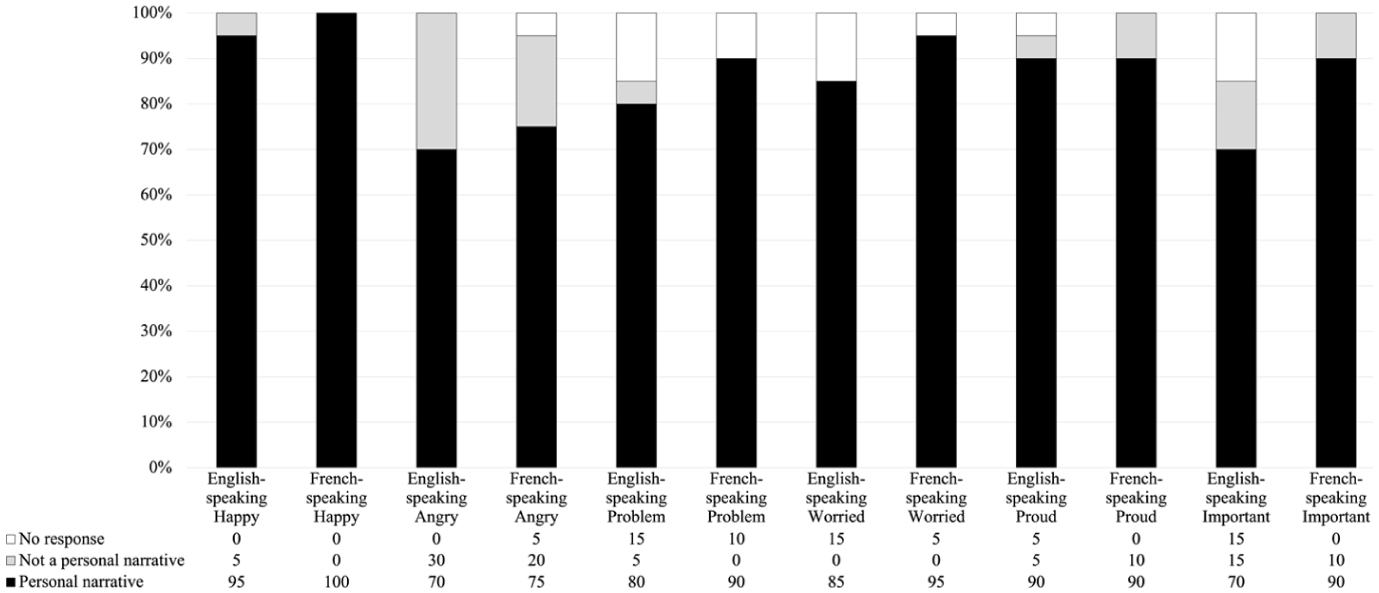
Percentage per elicitation results for each language group in response to the six prompts.
Linguistic-level measures across all six prompts for both language groups are presented in Table 4. Mann–Whitney U tests revealed no significant group differences across any measure when all prompts were combined on average, with negligible to small effect sizes. English-speaking (M = 13.9, SD = 4.7) and French-speaking children (M = 14.6, SD = 8.4) obtained comparable mean scores for TNU (U = 174.0, Z = −0.703, p = .482), MLUw (English-speaking: M = 9.3, SD = 2.7; French speaking: M = 8.0, SD = 1.4; U = 134.0, Z = −1.785, p = .074), and NDW (English speaking: M = 61.6, SD = 14.6; French speaking: M = 63.6, SD = 21.7; U = 197.0, Z = −0.081, p = .935). Effect sizes were negligible for NDW (r = 0.01) and small for TNU (r = 0.11) and MLUw (r = 0.28). Overall, these findings suggest that the two language groups demonstrated comparable linguistic performance across prompts.
Linguistic Measures for Both Language Groups Combining all Six Prompts.
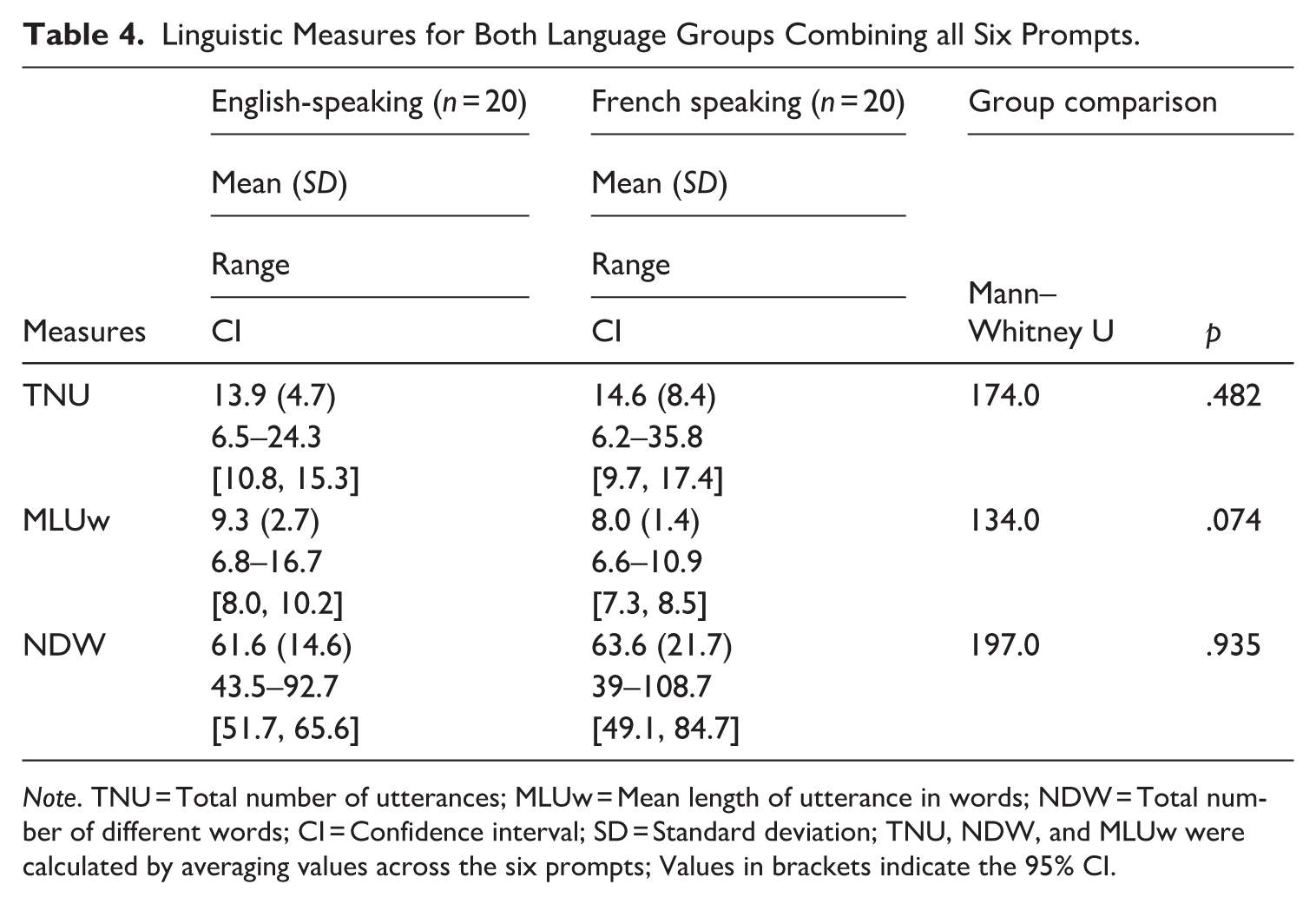
Note. TNU = Total number of utterances; MLUw = Mean length of utterance in words; NDW = Total number of different words; CI = Confidence interval; SD = Standard deviation; TNU, NDW, and MLUw were calculated by averaging values across the six prompts; Values in brackets indicate the 95% CI.
At the propositional level, local coherence measures across all prompts for both language groups are presented in Table 5. Mann–Whitney U tests revealed no significant group differences across the local coherence measure when all prompts were combined on average, with English-speaking children (M = 4.1, SD = 0.4) and French-speaking children (M = 4.1, SD = 0.3) obtaining comparable mean scores (U = 196.5, Z = −0.095, p = .925). The effect size was also negligible (r = 0.01). Overall, these findings suggest that the two language groups demonstrated largely comparable local coherence performance across prompts.
Propositional Measure for Both Language Groups Combining all Six Prompts.
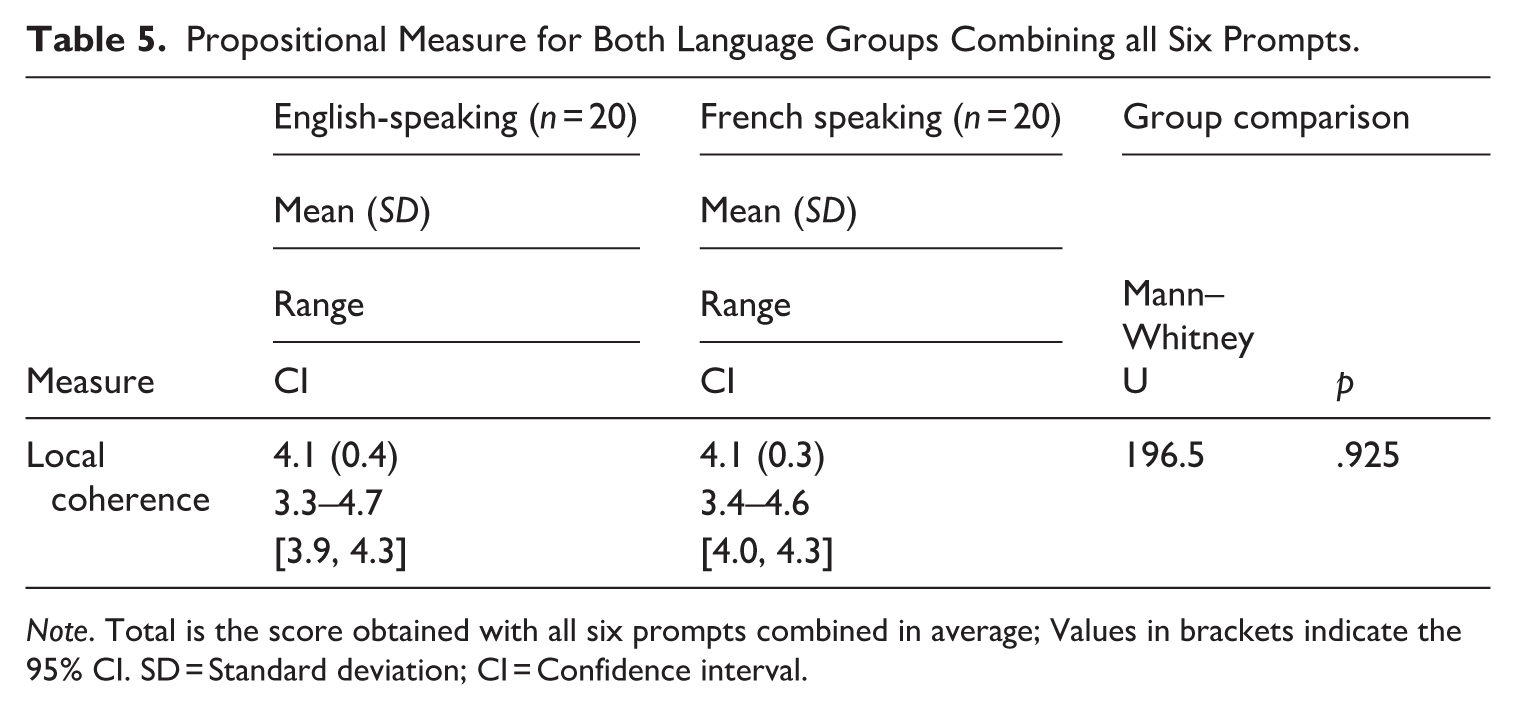
Note. Total is the score obtained with all six prompts combined in average; Values in brackets indicate the 95% CI. SD = Standard deviation; CI = Confidence interval.
Macrostructure planning level measures for context and chronology across all prompts for both language groups are presented in Table 6. Mann–Whitney U tests revealed no significant group differences for either context (English-speaking: M = 1.6, SD = 0.5; French speaking: M = 1.4, SD = 0.5; U = 164.0, Z = −0.982, p = .326) or chronology measures (English-speaking: M = 2.5, SD = 0.4; French speaking: M = 2.5, SD = 0.4; U = 184.5, Z = −0.421, p = .673). Effect sizes were negligible for chronology (r = 0.07) and small for context (r = 0.16). Overall, these findings suggest that the two language groups demonstrated comparable macrostructure planning performance across prompt types.
Macrostructure Planning Measures for Both Language Groups Combining all Six Prompts.
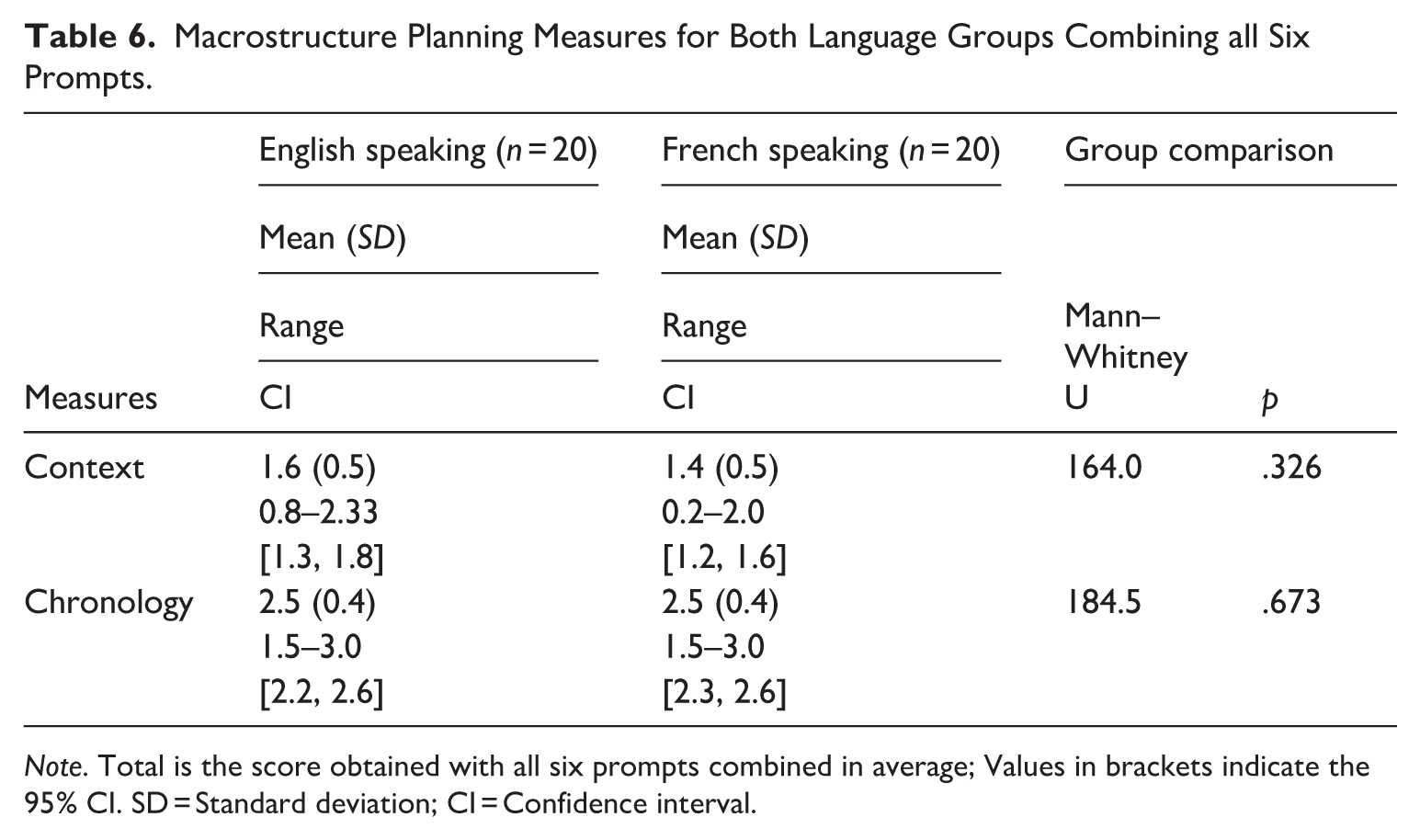
Note. Total is the score obtained with all six prompts combined in average; Values in brackets indicate the 95% CI. SD = Standard deviation; CI = Confidence interval.
At the pragmatic level, topic and theme measures for each language group are presented in Tables 7 and 8, respectively. To compare the topics produced by the two language groups, Fisher’s exact tests were conducted to examine the association between language groups (English/French) and the frequency of topics produced by participants. For the happy prompt, a significant association was observed between language group and topic distribution (p = .016), with the topic “Getting an item” occurring in a significantly higher proportion among English-speaking children than French-speaking children. No significant associations were found between language group and topic distribution for the worried (p = .474), angry (p = .962), problem (p = .082), important (p = .261), or proud (p = 1.000) prompts. Moreover, Mann–Whitney U tests indicated no significant differences between language groups for theme, with English-speaking (M = 1.7, SD = 0.4) and French-speaking (M = 1.7, SD = 0.3) children obtaining comparable mean scores (U = 185.5, Z = −0.395, p = .693), with negligible effect size (r = 0.06). Overall, these findings indicate that the two language groups demonstrated comparable theme scores and largely similar topic distributions across prompts.
Pragmatic Measures of Topics for Both Language Groups Across all Six Prompts.
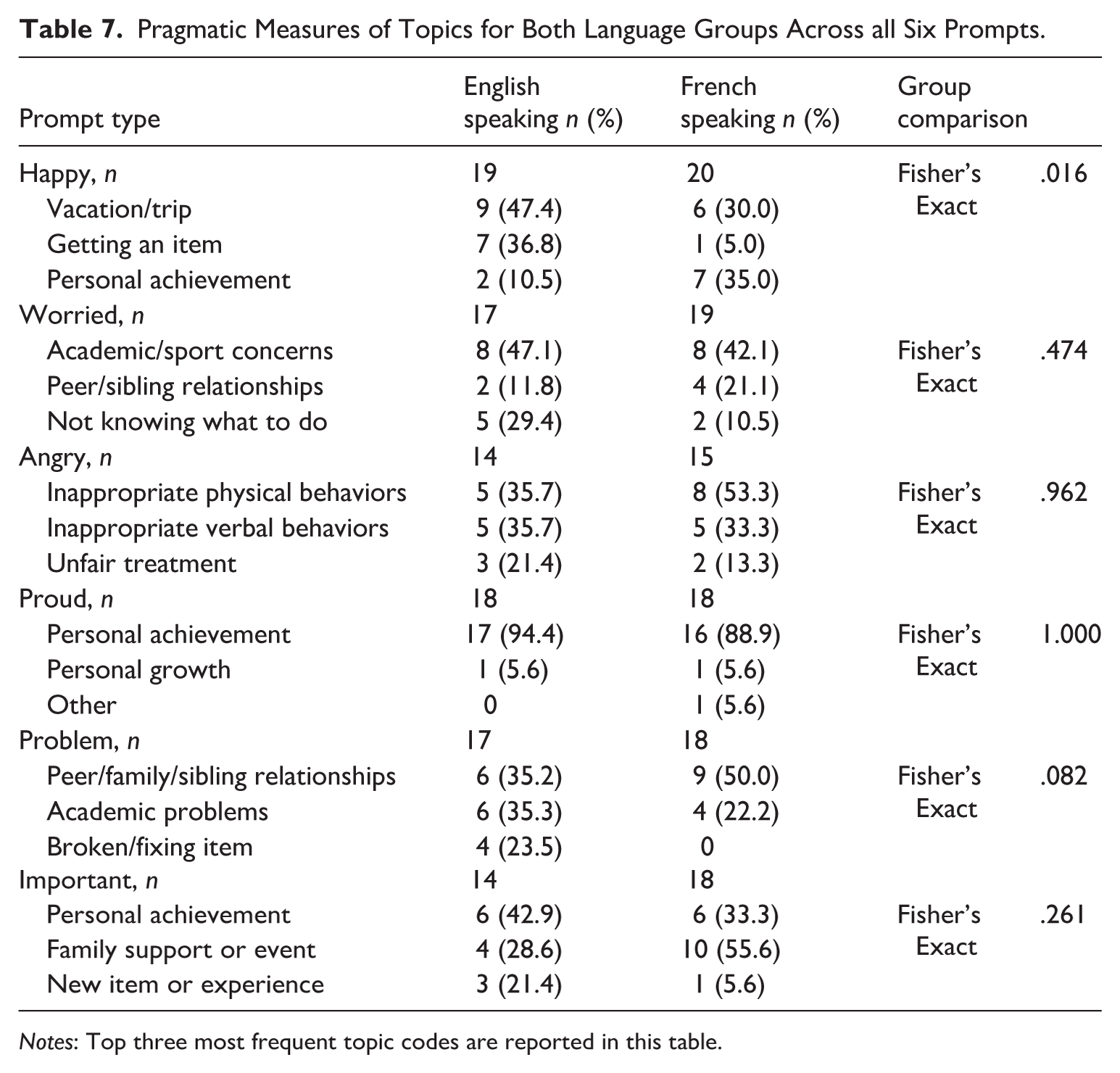
Notes: Top three most frequent topic codes are reported in this table.
Pragmatic Measure of Theme for Both Language Groups Combining all Six Prompts.
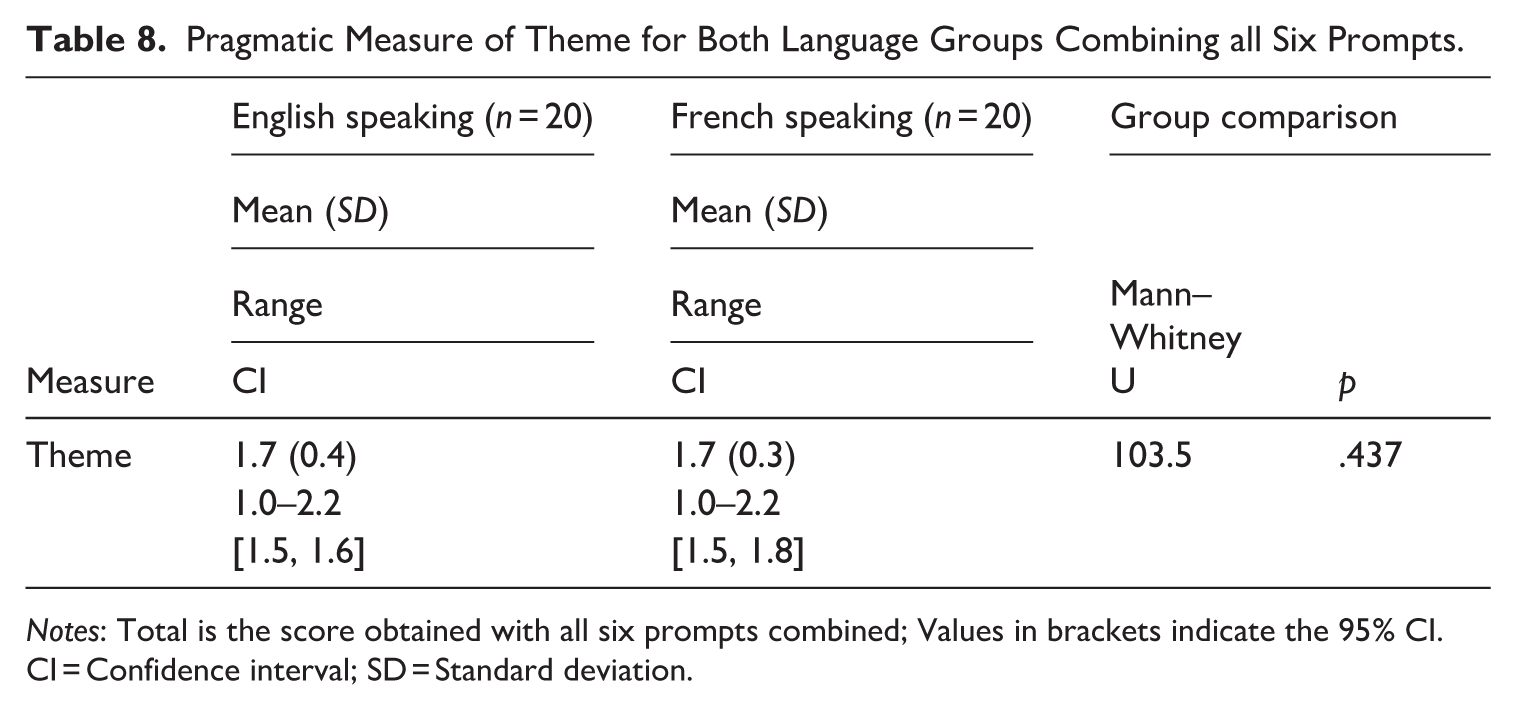
Notes: Total is the score obtained with all six prompts combined; Values in brackets indicate the 95% CI. CI = Confidence interval; SD = Standard deviation.
Discussion
This exploratory cross-linguistic study applied the LUNA framework to compare personal narrative performance of 9- to 10-year-old predominantly English- and French-speaking children from Canada using the Global TALES protocol (Westerveld et al., 2022). Personal narrative skills were examined across the linguistic, propositional, macrostructure planning and pragmatics components (Dipper et al., 2021; Gabaj et al., 2024, 2025a, 2025b). Results support the feasibility of the protocol in the Canadian context, with high response rates (70%–100%), and report no significant difference between language groups on narrative measures across all four components, with negligible to small effect sizes and inter-rater reliability ranging from 72.5% to 94.3%. The high response rates are consistent with studies conducted in other countries (Einarsdóttir & Þráinsdóttir, 2023; Theodorou et al., 2023; Yaşar Gündüz et al., 2026), supporting the promise of the Global TALES protocol as a clinically relevant tool for SLPs from around the world wanting to assess personal narrative skills (Westerveld et al., 2022, 2026; Westerveld & Nelson, 2023).
At the linguistic level, the similar syntactic complexity performance observed across the two language groups was contrary to our initial hypothesis, with effect sizes ranging from negligible to small. This finding contrasts with prior evidence suggesting greater morphosyntactic complexity in French relative to English (Burchell et al., 2023; Lambrecht, 2010; Vinay & Darbelnet, 1995), as well as prior results from fictional narrative tasks (Burchell et al., 2020). However, linguistic measures such as syntactic complexity, semantic diversity, and verbal productivity have also been shown to vary by discourse genre, with personal narratives typically eliciting less complex language than fictional narratives, but more complex than conversational samples (Westerveld & Vidler, 2016). Importantly, the two language groups in the present study were comparable across all sociodemographic characteristics, language exposure, and language proficiency measures, factors known to influence linguistic performance (Paradis, 2011). In addition, differences in syntactic complexity may not be apparent at the age of participants in this study (9–10 years), consistent with recent work suggesting that MLU alone may not always provide a comprehensive picture of children’s syntactic knowledge (Frizelle et al., 2018). Finally, the LUNA framework incorporates a broad range of linguistic measures for this component (Dipper et al., 2021). Including more fine-grained indices of syntactic complexity (e.g. clausal density and percent grammatical utterances) as well as semantic measures that have been recommended in recent research (Frizelle et al., 2018; Hernandez et al., 2024; Ratner et al., 2024) may help future studies to provide a more comprehensive characterization of syntactic and semantic complexity across different language groups.
At the propositional level, local coherence scores, assessed using the 5-point scale developed by Van Leer and Turkstra (1999), were similar across the two language groups, with a negligible effect size. This finding aligns with expectations, given comparable levels of language exposure and language proficiency measures across groups. When compared with previously reported data, mean local coherence scores for both the English‑ and French‑speaking groups (M = 4.1; SD = 0.4 and 0.3, respectively) seemed at the lower end of the range reported for TD 10-year-old Croatian-speaking children (4.27–5.00, Gabaj et al., 2025a). The reliability of the local coherence scale was good (ICC of .87), although further improvements could be achieved through more explicit scoring criteria to enhance inter-rater consistency. These findings highlight the need for greater cross‑linguistic validation of local coherence measures, as well as more clearly defined scoring systems.
At the macrostructure planning level, context and chronology scores were also comparable across language groups, with negligible to small effect sizes, and mean scores of 1.6 (SD = 0.5) (English speaking) and 1.4 (SD = 0.5) (French speaking) for context, and 2.5 (SD = 0.4) (both language groups) for chronology. These findings extend previous results reported based on the happy, angry, and problem prompts (Westerveld et al., 2026) by demonstrating that comparable performance is maintained across both language groups when all six prompts are combined. Scoring examples for both local coherence and NaCCs measures drawn from the French and English samples provided in Supplemental Materials may help guide future studies by providing more consistent application of the rubrics for cross-linguistic and cross-cultural research. Importantly, given that narrative macrostructure measures in fictional narratives have been shown to differentiate children with DLD from TD peers in plurilingual contexts (Winters et al., 2022), measures for both the propositional and macrostructure planning components show promising clinical applications (Gabaj et al., 2025a; Gabaj et al., 2025b).
At the pragmatic level, the most frequently occurring narrative topics were similar to those reported by Westby et al. (2023), commonly associated with Western English-speaking cultures. For instance, in response to the problem prompt, children most often described peer and sibling relationships, consistent with data from Australia, New Zealand, and the United States (Westby et al., 2023). However, for the happy prompt, a difference emerged between language groups in topic distribution, with the topic “Getting an item” occurring in a higher proportion among English-speaking children, suggesting potential cross-linguistic differences. One possible explanation is that this difference may reflect subtle variations in children’s everyday experiences of certain events across linguistic, cultural, or educational contexts. For example, differences in classroom practices, family routines, or culturally valued experiences may shape which events children perceive as important to share. Notably, “Getting an item” was also ranked as the highest or second-highest frequent topic in a number of countries, including Australia, Brazil, and Israel (Westerveld et al., 2022). From an intervention perspective, examining children’s personal narrative topics may be clinically meaningful, as it provides insight into what children consider important to share. Finally, the theme scores, comparable across language groups with mean values of 1.9 (SD = 0.9) and 1.7 (SD = 0.5) for English- and French-speaking children, respectively, fell within previously reported ranges for this dimension using the NaCCS (Westerveld et al., 2026). These values reflect relatively low performance on this rubric at this age (on a maximum score of 3), consistent with its recommended application across the lifespan (Reese et al., 2011), and reflect the complexity of sharing past personal experiences at the pragmatic level (i.e. such as staying on topic, providing sufficient information for shared understanding, etc.).
While Canada is characterized by significant linguistic diversity (Statistic Canada, 2023), the finding of broadly similar narrative performances between predominantly English- and French-speaking groups may reflect the shared educational and sociocultural context in which Canadian children develop their narrative skills. In Canada, language exposure occurs across multiple environments, including family, schooling, media, and community contexts (Filiatrault-Veilleux et al., 2025; Moore et al., 2018). This plurilingual context, combined with access to a similar school curriculum regardless of language of instruction, may support comparable opportunities for narrative development, thereby reducing the likelihood of finding cross-linguistic differences at the group level. In addition, many children in both groups were exposed to additional languages, further reflecting the plurilingual nature of the Canadian context. For instance, 50% of children in the English-speaking group and 80% of those in the French-speaking group had exposure to at least one additional language, most commonly French and English, respectively. Future research should aim to collect detailed language exposure data across different contexts (e.g. home, school, and community) and to compare children across diverse educational and geographical settings (e.g. across countries) to better disentangle the relative contributions of language, culture, and education.
Limitations and Future Directions
This exploratory study has several limitations that should be acknowledged. First, the sample size was relatively small, which limited statistical power and reduced the generalizability of the findings. Second, recruitment occurred across a large geographic territory in Canada, which may also have introduced variability related to regional, cultural, or educational differences that were not examined in this study. Finally, language status was determined based on a parental report; the inclusion of other direct language assessments would have been useful for confirming typical language abilities of the sample. Future large-scale investigations are now needed and should aim to include a larger and more linguistically diverse sample, especially bilingual children, to further examine the role of language exposure in shaping personal narratives. Expanding the sample to include children across a broader age range would also allow for cross-sectional developmental comparisons. In addition, extending this work to children with DLD is a critical next step to identify which of the narrative measures from the LUNA framework show better discriminant validity across different languages (Gabaj et al., 2025a; Gupta et al., 2026; Winters et al., 2022). Finally, future research should explore whether AI-based tools can support the scoring of these measures in ways that are both accurate and culturally sensitive, which would facilitate their integration into everyday clinical practice for SLPs.
Conclusion
While fictional narratives have often been used to assess language abilities in multilingual populations (Ortiz et al., 2024; Simon-Cereijido & Gutiérrez-Clellen, 2009), personal narratives may offer additional insights into their socioemotional development, identity formation, and pragmatic language use (Westby et al., 2023; Westerveld & Nelson, 2023). As rich and ecologically valid language samples, personal narratives provide valuable data for both SLPs and researchers as a culturally responsive alternative to decontextualized testing (Bedore & Peña, 2008; Pavelko et al., 2016; Ramos et al., 2022). Employing a comprehensive framework that integrates multiple narrative measures may improve differentiation between language differences and language disorders, while also supporting the monitoring of change in response to intervention. Additional cross‑linguistic research using the Global TALES protocol alongside a comprehensive framework such as the LUNA is essential to improving our understanding of how linguistic, cultural, and individual factors shape personal narrative development.
Supplemental Material
sj-pdf-1-fla-10.1177_01427237261460563 – Supplemental material for Applying the LUNA Framework and Global TALES Protocol for Analyzing Personal Narratives in a Cross-Linguistic Study of Predominantly English and French-Speaking 9-10-Year-Olds from Canada
Supplemental material, sj-pdf-1-fla-10.1177_01427237261460563 for Applying the LUNA Framework and Global TALES Protocol for Analyzing Personal Narratives in a Cross-Linguistic Study of Predominantly English and French-Speaking 9-10-Year-Olds from Canada by Pamela Filiatrault-Veilleux, Tegan Hryciw, Sidus Ang and Marleen F. Westerveld in First Language
Footnotes
Acknowledgements
The authors are grateful to all the children, parents, and research assistants who contributed to the data collection and supported this study.

Ethical Considerations
This study has been reviewed for its adherence to ethical guidelines by a Research Ethics Board at the University of Alberta (ID #Pro00135494).
Consent to Participate
Parents and legal guardians signed informed consent regarding publishing data.
Author Contributions
Funding
The authors disclosed receipt of the following financial support for the research, authorship, and/or publication of this article: This study was supported by a New Investigator grant from the Faculty of Rehabilitation Medicine at the University of Alberta, awarded to the principal investigator, Dr. Pamela Filiatrault-Veilleux.
Declaration of Conflicting Interests
The authors declared no potential conflicts of interest with respect to the research, authorship, and/or publication of this article.
Data Availability Statement
All data and materials, as well as software applications, comply with field standards. Data are available upon request from the authors.
Supplemental Material
Supplemental material for this article is available online.
References
Supplementary Material
Please find the following supplemental material available below.
For Open Access articles published under a Creative Commons License, all supplemental material carries the same license as the article it is associated with.
For non-Open Access articles published, all supplemental material carries a non-exclusive license, and permission requests for re-use of supplemental material or any part of supplemental material shall be sent directly to the copyright owner as specified in the copyright notice associated with the article.
