







Abstract
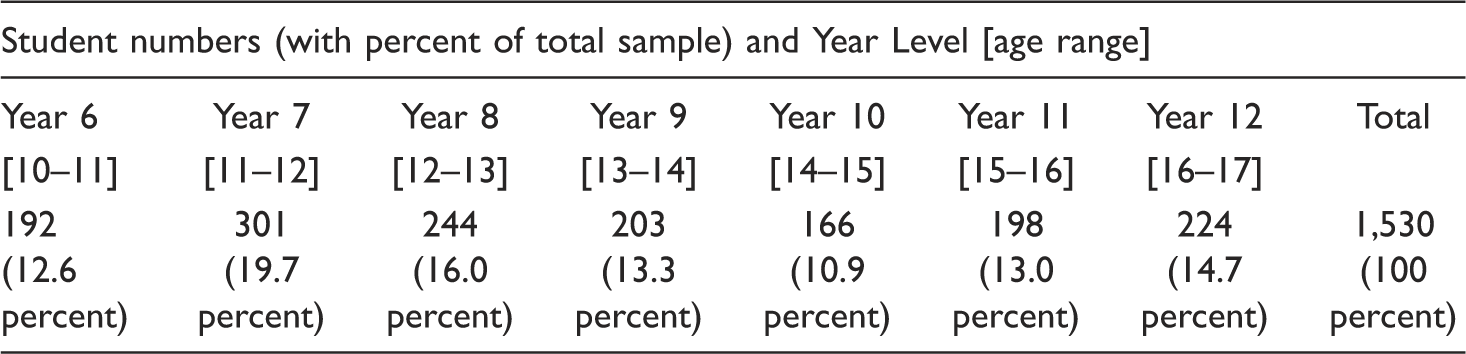
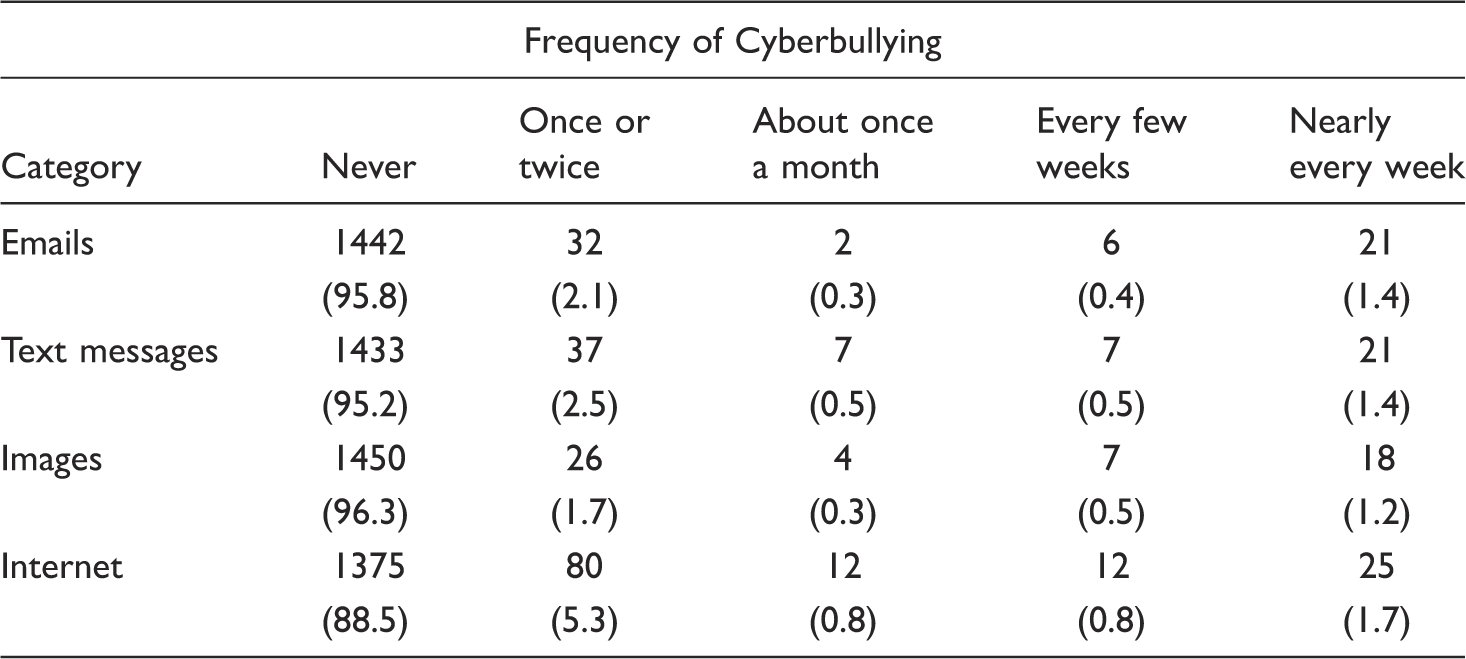
The prevalence and nature of electronic forms of bullying (cyberbullying) was investigated among 1,530 primary and secondary school aged male students (Years 6 to 12; 9-18 years, chronologically) in Sydney and Brisbane, Australia. Findings revealed that victimization via the Internet was the most common form of cyberbullying with 11.5 percent of students reporting at least one experience of it during the school year. A significant main effect was found, with junior secondary school students (Years 8 to 10) the most likely to be victimized in this manner. With regard to the cyberbullying of others, the Internet was again the most commonly employed method, with 8.5 percent of students reporting using it. A main effect was evident between year levels for all four forms of cyberbullying investigated. The transmission of electronic images was the least reported form of cyberbullying experienced (4.8 percent) and the least frequently perpetrated form of cyberbullying (3.7 percent), which is less than the only other study conducted reporting such data. These findings are discussed in the light of the relatively limited cyberbullying research undertaken to date.
Bullying is a complex multidimensional phenomenon (Kyriakides, Kaloyirou & Lindsay, 2006), the adverse consequences of which are well documented (Rigby & Griffiths, 2011), including for example introverted personality, poor self-concept, helplessness, emotional problems and particularly, depression, anxiety and suicidal ideation, as well as loneliness, isolation, social phobia, and school refusal (Alikasifoglu, Erginoz, Ercan, Uysal & Albayrak-Kaymak, 2007; Boulton, Smith & Cowie, 2010; Due, Holstein, Lynch, Gabhain, Currie, Scheidt, et al., 2005; Newman, Holden & Delville, 2005; Shin, 2010; Tenenbaum, Varjas, Meyers & Parris, 2011; Wei & Jonson-Reid, 2011; Woods & White, 2005).
Substantial research has established the prevalence of bullying around the world, and also identified it to be a cross-cultural phenomenon (see Tenenbaum et al., 2011). For example, over 40 percent of adolescents in Northern Ireland claim to have been bullied (McGuckin, Cummins & Lewis, 2008), while 37 percent of German primary school students claim to have been victims of bullying (Von Marees & Petermann, 2010). In Asian regions, including Japan, Korea, China, and Taiwan, high prevalence rates of victimization have also been reported (see Koo, Kwak & Smith, 2008; Wei, Johnson-Reid & Tsao, 2007). Similar figures have been reported by Australian students with approximately 40 percent indicating they have been hit, pushed, picked on, or isolated (Murray-Harvey, Slee & Taki, 2010).
Although the phenomenon of bullying in schools has been a major focus of international research for some 25 years (see Andreou & Bonoti, 2010; Cheng, Chen, Ho & Cheng, 2011; Nation, Vieno, Perkins & Santinello, 2008; Rigby, 2008; Scheithauer, Hayer, Petermann & Jugert, 2006) relatively little is known about the more insidious form known as cyberbullying. Smith, Mahdavi, Carvalho, Fisher, Russell, and Tippett (2008) highlighted the emergence of electronic technologies in recent years, particularly mobile phones and the Internet, along with the increasing penetration of networked computers as enhancing the potential for this type of bullying. Indeed, the growing availability, ease of access to, and willingness to use, these technologies for bullying is viewed as providing for greater levels of invasiveness, reaching a wider audience, and preserving anonymity on the part of the perpetrator (Campbell, 2005; Kowalski & Limber, 2007; Pearce, Cross, Monks, Waters & Falconer, 2011).
Research conducted in countries such as Serbia, UK, USA, Korea, Turkey, Italy, and Australia clearly shows that approximately 90 percent of school-aged students access the Internet at home with over 50 percent reporting daily use (Cassidy, Jackson & Brown, 2009; Popović-Ĉitić, Djurić & Cvetković 2011; Ybarra, Mitchell, Wolak & Finkelhor, 2006; Yoon, Bauman, Choi & Hutchinson, 2011). Furthermore, research findings indicate that many young people interact in cyberspace using other electronic arenas. World-wide, studies reveal that most school-aged students now own their mobile phone and this increases with age (see Cassidy et al., 2009; Popović-Ĉitić, Djurić, et al., 2011). In Australia, 83 percent of 12 to 18 years olds own mobile phones (23 percent of 6 to 13 year olds, and 55 percent and 65 percent of 12 to 13 year old boys and girls, respectively) (Mathews, 2004). Teachers and administrators have recognized student’s use of information and communication technology, particularly in their social interactions via the expanding use of electronic communication in school classrooms (Beran & Li, 2004; Li, 2006). If educators, administrators and authorities are to take appropriate action against this type of bullying then more research is necessary to develop as comprehensive an understanding as possible.
Cyberbullying
Cyberbullying can be briefly defined as “sending or posting harmful or cruel text or images using the Internet or other digital communication devices” (Willard, 2003; p. 1). More recent definitions have been more comprehensive; for example, Shariff and Strong-Wilson (2005; cited in Shariff, 2008, p. 30) defined cyberbullying as comprising “covert psychological bullying, conveyed through the electronic media such as cell phones, weblogs and web sites, online chat rooms, MUD rooms (Multi User Domains where individuals take on different characters) and Xangas (on line personal profiles where some adolescents create lists of people they do not like)”. Smith et al. (2008) highlighted that cyberbullying is the intentional use of electronic forms of contact repeatedly and over time against a victim who cannot easily defend him or herself. While agreeing with these definitions, David-Ferdon and Hertz (2007) and Kowalski and Limber (2007) added that cyberbullying comprises a repeated use with the intention to cause harm or emotional distress.
Although computers, the Internet, mobile phones and other new media technologies may have a beneficial impact on student’s learning and interactions, they can also act as a medium through which students engage in malevolent behaviours (Shariff, 2008). Indeed Popović-Ĉitić, et al. (2011) argued that increasing accessibility and the growing use of electronic technologies by children has provided opportunities for traditional bullying to transcend real life and cross into the virtual world of communication. Furthermore, such technologies add “to the arsenal of strategies that can be employed by bullies in order to harm others” (Popović-Ĉitić, et al., 2011, p. 2). Moreover, as pointed out by Parris, Varjas, Meyers, and Cutts (2011), bullying in the cyberworld is a virtual space that is difficult for adults to monitor students’ actions.
Nevertheless, research into cyberbullying is still relatively embryonic (Smith et al., 2008), and there are (compared to traditional bullying), only a few studies reporting the prevalence of this behaviour (Popović-Ĉitić, et al., 2011). In a review of 14 studies conducted in the UK, the USA, Australia, and Canada, Kraft (2006) summarised world-wide trends as varying between 10 and 42 percent for victimization and between 6 and 33 percent for cyberbullying.
In the UK, Charlton, Panting, and Hannan (2002) reported that up to 25 percent of children experienced cyberbullying. In 2002, the National Children’s Home reported similar rates for 11 to 19 year olds, while in 2003 Oliver and Candappa (2003) suggested that 4 percent of 12 to 13 year olds had received nasty text messages. In a large scale study of 11,000 students covering the years 2002-2005, Noret and Rivers (2006) reported that 6 percent had received nasty or threatening text messages, with girls reporting more than boys. In what appears to be the most recent UK study, Smith et al. (2008) found that between 5 percent and 10 percent of 11 to 16 year olds had been cyberbullied via mobile phones, with the use of SMS and calls being the most frequently cited methods.
In the USA, 15 percent of school students are Internet bullies while 7 percent are the targets of Internet bullying according to Ybarra and Mitchell (2004). In the south eastern and north western USA, Kowalski and Limber (2007) found that while 78 percent of Grades 6, 7 and 8 students had no experience of cyberbullying, 11 percent said they had been victims and 4 percent said they were perpetrators. Of the 11 percent, two-thirds had been bullied through instant messaging ‘at least once’ and over half had used this at least once to bully others. Approximately one-fifth also reported being victims of bullying through chatrooms, emails, and websites.
In a large scale Internet based study of 1,378 under 18 year olds (Mean age 14.8 years) Hinduja and Patchin (2008) found that 32 percent of boys and 36 percent of girls reported having been victims of cyberbullying, whereas 18 percent of boys and 16 percent of girls reported harassing others while on-line. No significant differences were evident between males and females who reported being perpetrators or victims of cyberbullying, which is contrary to the gender differences often reported in traditional methods of bullying.
In Australia, 10 percent of adolescents have reported receiving threatening messages on their mobile phone. While 46 percent say they adhere to school rules regarding usage of mobile phones, 32 percent admit to using their mobile phone to SMS friends during class time (Mathews, 2004). Campbell (2005) also found that 11 percent of Year 8 students (13 year olds) were perpetrators of cyberbullying and 14 percent identified themselves as victims of cyberbullying. In Western Australia, Nathan (2009) surveyed 132 Grades 5 to 7 primary school aged students (70 females and 62 males) and found that cyberbullying was the least reported method of bullying with approximately 80 percent of participants reporting never to have used it. Of the children who had used electronic modes to bully others, sending threatening or hurtful text (SMS) messages was the most frequently cited (almost 20 percent).
In Sweden, Slonje and Smith (2008) examined the responses of 360 12 to 20 year olds to a survey on cyberbullying. Overall 9 percent had been cyberbullied in school (16.2 percent outside of school) and 9 percent had cyberbullied others in school (10.5 percent outside of school). Picture/video clip (4.8 percent) was the most frequently cited cyberbullying mode received by victims whereas email (5.2 percent) was most frequently used by bullies.
In summary, Kowalski and Limber (2007) argued that the studies conducted attest to the ‘wired culture’ in which contemporary adolescents operate. The electronic venue which has evolved provides opportunities for young people to interact either positively or negatively. Consequently, educators and associated professionals such as school psychologists need to develop a comprehensive understanding of the cyberbullying experiences of their students if they are to initiate effective policies and practices to counter and prevent cyberbullying in schools (Cassidy et al., 2009). Thus, given the evidence demonstrating the link between the ever increasing use of technology and bullying, continued international research into this significant problem is crucial.
Method
Participants and settings
Number and Percentage of Students by Year Level
Instrumentation
The Boys Bullying at School Questionnaire (BBSQ: Sakellariou, 2006) was administered to all participants as part of a larger study on bullying. The BBSQ comprises 33 items to which participants respond using a series of possible responses (e.g., Yes/No; Never, Sometimes, Often, Always; “I have not received a threatening email, only a little upset, fairly upset, very upset”). Of the 33 items, nine originated from the Olweus Bully/Victim questionnaire (Olweus, 1986, 1989, 1996), an instrument used extensively in the study of bullying (Houndoumadi & Pateraki, 2001; Nansel et al., 2001). These questions measured aspects of friendship (e.g., number of friends and contact with friends at recess), the nature of bullying (i.e., type of bullying and the year level of bullies), and the likelihood of student and teacher intervention into bullying. Nine items were also taken from The Life at School Survey (Ahmed, 1996) an instrument initially developed to survey bullying in primary schools in Canberra, the capital city of Australia. The nine items measured prevalence of victimization and bullying, duration of victimization, student’s reasons for victimization and teacher interest in stopping bullying.
Twelve items were also developed by the first author from the existing literature to examine the incidence and impact of cyberbullying. Of the 12 items, 4 items pertained to the frequency of threatening or hurtful emails, SMS messages, images via the Internet or mobile camera phone, or messages via the Internet sent to the participant by other students. Participants responded on a five point scale anchored by the words “Never”, “Only once or twice”, “About once a month”, “Every few weeks”, or “Nearly every week”. Four questions asked participants the frequency with which they had sent another student at their school threatening or hurtful emails, SMS messages, images via the Internet or mobile camera phone, or the Internet. Participants responded on the same five point scale as described above. Three questions pertained to how upset participants were by receiving threatening or hurtful emails, SMS messages, or images or messages via the Internet or mobile camera phone. Participants responded on a four point scale namely: “I have not received a threatening/hurtful email/text message/image/Internet chatline”; “Only a little upset”, “Fairly upset”, and “Very upset”. Finally, one question asked participants how upsetting it was to receive threatening or hurtful emails, text messages, or messages on the Internet compared to face-to-face bullying. Participants responded on a six point scale: “I have not received a threatening/hurtful email/text message/image/Internet chatline”, “It is not upsetting at all”, “It is just as upsetting as face-to-face bullying”, “It is less upsetting than face-to-face bullying”, “It is more upsetting than face-to-face bullying”, and “I can’t compare”. The internal reliability of the 12 items was calculated using Cronbach’s alpha. The overall alpha being .86 (range .83 to .91) indicated very good reliability. This present research reports the findings from the 12 items pertaining to cyberbullying.
Procedure
Prior to the research being conducted approval was obtained from the Human Research Ethics Committee of the administering institution. The first author then made contact by telephone with the principals of three randomly selected primary and six randomly selected high schools to explain the purpose of the research and to describe how the outcomes of the research might assist schools to understand bullying and develop more effective prevention strategies. Of the nine schools, the principals of three expressed an interest in participating in the research. These three principals were subsequently contacted by the first author at which time they were asked if they would invite their teachers to be involved. The teachers agreed to assist in the research. Letters of introduction, information sheets and consent forms were then forwarded via the teachers to all parents of boys in Grades 5 to 12 asking permission for their son to participate in the study. After a one week period a positive return response rate of 90 percent was obtained from parents willing to allow their son(s) to participate.
Prior to the dissemination of the BBSQ, students were informed about the nature of the study and assured of confidentiality and anonymity. They were provided with the following definition of (cyber) bullying in school: We call it bullying when someone repeatedly hurts or frightens someone weaker than themselves on purpose. Cyberbullying occurs when someone sends or posts harmful or hurtful text or images using the Internet or other digital communication devices. Remember that it is not bullying when two young people of about the same strength have the odd fight or quarrel. Bullying can be done in different ways: By hurtful teasing, threatening actions or gestures, name-calling or hitting or kicking.
Slightly different administration procedures were employed for the primary school students compared to the secondary students. Primary students completed the questionnaires while sitting at their desks in their classrooms with both the researcher and class teacher present. The class teacher did not play a part in the administration of the questionnaire and was present simply for class supervision. Initially, the researcher outlined the purpose of the study to the students and then read out to them a standard set of instructions as contained on the cover of the questionnaire. The definition of bullying was also read out to the students and anonymity of responses and the need for honest answering was stressed. Primary school students took approximately 25-minutes to complete the questionnaire.
The administration of the questionnaires for secondary school students varied according to their year level. In both Brisbane and Sydney, students in Years 8 to 10 completed the questionnaires during individual class time. Years 11 and 12 students completed the questionnaire individually in their weekly form meeting, that is, as one large group. For all secondary school year levels the purpose of the study was explained and students were then directed to read the instructions carefully and to note the definition of bullying. (These were not read to them as had been done for the primary students.) Again the researcher remained present during the administration to answer questions. Secondary school students took approximately 15-minutes.
Results
Prevalence of cyber victimization
Number and Percentage (in parentheses) of Students Reporting Victimization by Various Electronic Means
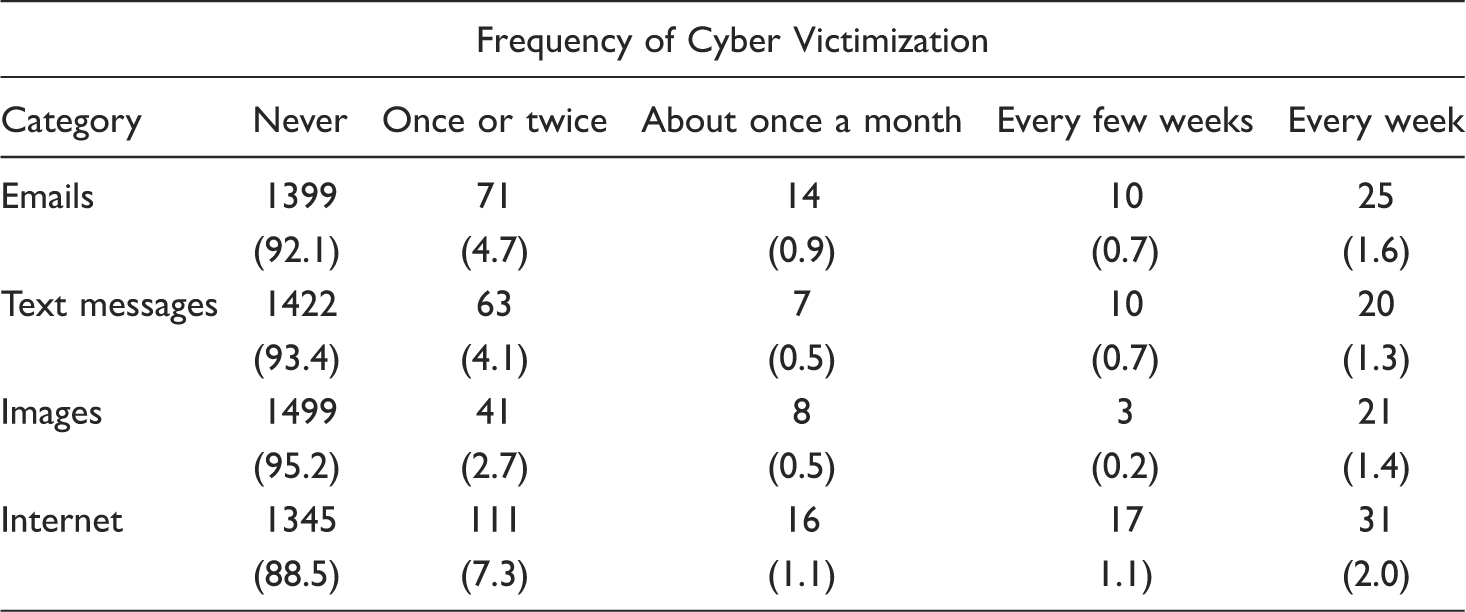
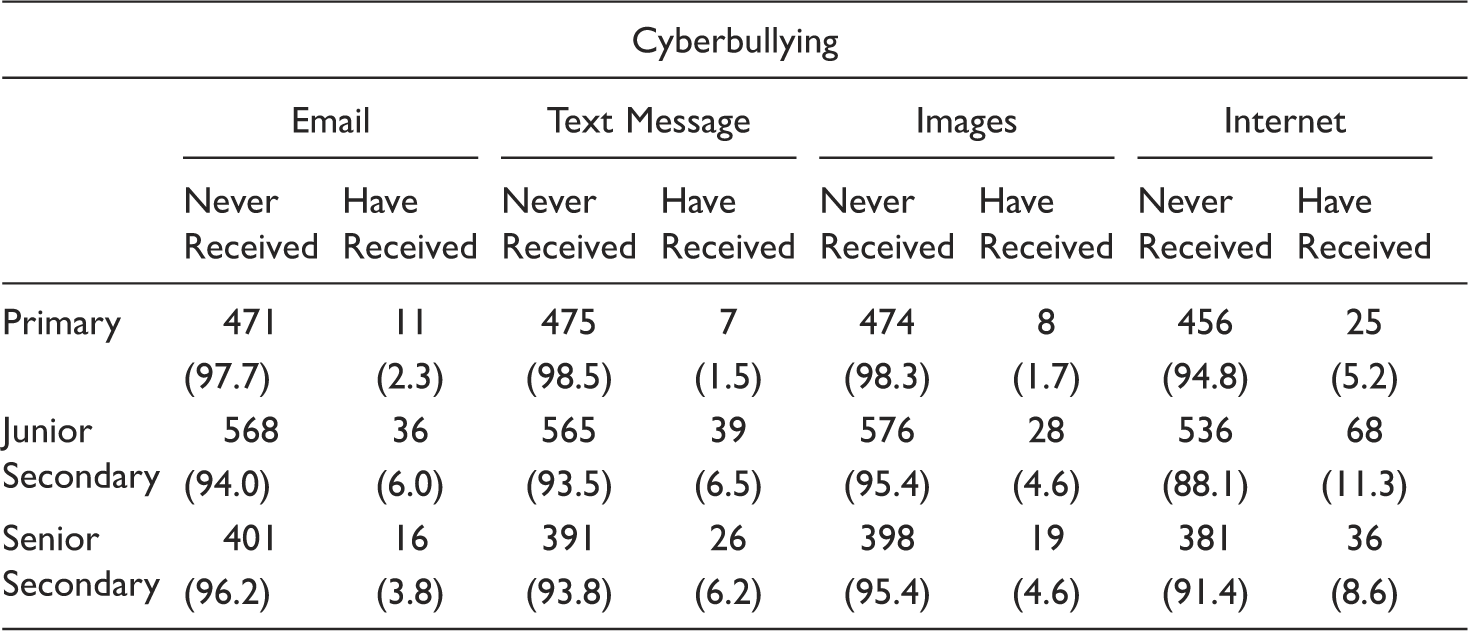
Aggregated student responses (i.e., students who have not experienced and students who have experienced the four modes of bullying) and aggregated year levels (i.e., primary: Years 6 and 7; junior secondary: Years 8 to 10; and senior secondary: Years 11 and 12) were also examined. Chi-square tests revealed significant year level differences in cyber victimization by text message χ2 = 16.59, df = 2, p < .001. Specifically, junior secondary school participants were victimized significantly more often (9.2 percent) than expected compared to the primary (3.1 percent) and senior secondary school (6.9 percent) students. Victimization by the three other forms of cyberbullying across the aggregated year levels did not reach statistical significance.
Prevalence of cyberbullying
Number and Percentage (in parentheses) of Students Reporting Bullying Others by Electronic Means
Aggregated Number (and Percentage) of Students Reporting Being Bullied by Electronic Means by School Year Grouping
Distress and cyberbullying
Students who reported being victimized via cyberbullying (i.e., receiving threatening or hurtful emails, SMS messages or comments via the Internet) were asked to indicate the level of distress it caused. Fifty-two percent of those who had received threatening or hurtful emails indicated they were ‘only a little upset’ by it, whereas 28 percent indicated being ‘very upset’. Similarly, 52 percent and 29 percent of those who had received threatening or hurtful SMS messages indicated being ‘a little upset’ and ‘very upset respectively. Of those students receiving threatening or hurtful comments via Internet chat lines, 62 percent indicated they were ‘only a little upset’ while 18.3 percent indicated being ‘very upset’.
Students who reported being victimized via cyberbullying were also asked to compare the level of distress caused by cyberbullying with that of face-to-face bullying. Approximately 22 percent of these students did not find electronic forms of bullying upsetting at all in comparison to face-to-face bullying while 28.6 percent found it less upsetting than face-to face bullying. However, approximately 15 percent of students reported finding cyberbullying more upsetting than face-to-face bullying with nearly 30 percent finding cyberbullying ‘just as upsetting’ or ‘more upsetting’ than face-to-face bullying.
Discussion and Implications
As highlighted earlier, only limited research has examined the prevalence of cyber victimization and the cyberbullying of others by electronic means (Popović-Ĉitić, et al., 2011; Smith et al., 2008), particularly in Australia. This is somewhat surprising given that over 80 percent of Australian 12 to 18 year olds and over 20 percent of 6 to 13 year olds own mobile phones (Mathews, 2004) and that the vast majority of young people regularly access the Internet (Ybarra et al., 2006). Moreover, the “increased Internet enabled world where blogs, social networking and instant messaging are used as a means of personal interaction” (Hinduja & Patchin, 2008, p. 130) illustrates why such a phenomenon and its adverse consequences are consistently highlighted by the media.
Given the range of, accessibility to, and young people’s willingness to use the array of electronic media currently available, why is it that cyberbullying is not so widespread in relation to traditional forms of bullying? In the present research, approximately 90 percent of male students reported that they had never been bullied through any of the electronic media. Just over 11 percent reported being victimised via the Internet, about 8 percent by email and 6.6 percent via SMS text messaging. These data overall are highly similar to recent evidence showing that cyberbullying is the least reported form of bullying among Western Australian Grade 5 to 7 primary school aged students with 80 percent never having used it (Nathan, 2009). Moreover, in Western Australia, as in the present research, SMS messages-to-others was the most frequently cited mode of cyberbullying.
Although comparing the present cyberbullying data to the general prevalence rates of traditional bullying is difficult due largely to the variety of definitions and measures used (Cheng et al., 2011; Espelage & Swearer, 2003), it does seem they are generally lower than those reported in most countries. For example, data obtained from 123,227 11–15 year olds (across 28 countries) reveal rates of victimization via traditional bullying running from a low of 5.1 percent for girls and 6.3 percent for boys in Sweden to a high of 38.2 percent for girls and 41.4 percent for boys in Lithuania (Due et al., 2005). Other large scale research (see Glover, Gough, Johnson & Cartwright, 2000) revealed that almost 50 percent of students have experienced damage against their belongings, 17 percent have had money taken from them and 12 percent their clothing damaged. In Australia, the extensive research of Rigby and colleagues throughout the 1990s (see Rigby, 2008) revealed up to 19 percent of boys and 14 percent of girls aged between 10 and 17 years are bullied at least once per week. Although these findings question Li’s (2006) contention that bullying has gone digital, the high rates of variability in traditional bullying across studies make meaningful comparisons with the present findings difficult. What it does suggest, however, is that educators must remain vigilant rather than being swept along with the current popular belief that advances in the electronic media has made traditional forms of bullying less prevalent and less damaging.
With reference to comparisons with rates of cyberbullying reported in other studies, the present findings are highly similar to the 10 percent reported by Mathews (2004) and the 5 percent to 10 percent reported by Smith et al. (2008). On the other hand, they are strikingly lower than the 25 percent reported by Charlton et al. (2002), and the 32 percent of boys and 36 percent of girls reported by Hinduja and Patchin (2008). Then again they are higher than the 4 percent (Oliver & Candappa, 2003), 6 percent (Noret & Rivers, 2006) and 7 percent (Ybarra & Mitchell, 2004) also found in surveys. It may be, as in research pertaining to traditional bullying, that the use of different definitions and instruments contribute to these disparities in the findings.
It is not surprising that Years 8 to 10 (13-15 years chronologically) students in this present study received significantly more bullying text messages (9.2 percent) than the other age groups because over 80 percent of Australian 12 to 18 year olds own mobile phones and delinquent activity peaks between 13 and 16 years of age (see Carroll, Houghton, Durkin & Hattie, 2009). This compares favourably with Campbell (2005) who reported that 14 percent of Year 8 students (13 year olds) were victims of cyberbullying and 11 percent were perpetrators of cyberbullying. It is also in line with Slonje and Smith (2008) who found that the 12–15 year olds in their study were cyber bullied significantly more than the 16 to 20 year olds. Overall, the present findings support Slonje and Smith’s (2008) suggestion that cyberbullying is more of an acute problem during the compulsory years of schooling rather than the later years when academic attainment becomes more of a focus.
Only one other study to date has investigated bullying via the transmission of electronic images and therefore the present findings provides further insight into an increasingly popular medium among young people (Slonje & Smith, 2008). Although being the least frequently occurring form of cyberbullying in this present study (∼3.5 percent), 1.4 percent of participants reported being a victim to it and 1.2 percent to using it on a weekly basis. This overall rate is slightly lower than the overall 4.8 percent (8.6 percent of lower secondary school participants) reported by Slonje and Smith (2008), but as Slonje and Smith pointed out, figures may be underreported because victims may not be fully aware that the images are being circulated to others. Furthermore, because the number of persons viewing the circulated images is also unknown, particularly if the images are uploaded to a website, the true extent of the frequency of this form of bullying may be even less reliable.
Implications for educators and allied professionals
Although only male school aged students participated in the present research the findings have a number of implications for children, parents, educators and the allied professions. If effective strategies are to be developed to prevent increases in cyberbullying then more research is necessary, particularly that which examines different aspects of cyberbullying. Given that cyberbullying provides anonymity, the motivations of those who perpetrate such acts must also be investigated. Why do individuals bully others through cyber-means which delays direct gratification (Smith et al., 2008)? According to the findings from interviews conducted with young people suspended from school because of their bullying (Nathan, 2009), cyberbullying allows bullies to create a fear of apprehension among their victims particularly by sending SMS threats late at night so that they (i.e., the victims) find it waiting for them the next morning prior to school. This delayed gratification is highly reinforcing to the bullies because of the suspense it creates, which in turn permits the bullies to further enhance their reputation by not openly admitting to the victim it was them (Nathan, 2009).
Adult awareness about the nature of cyberbullying, its consequences and what actions can be mobilised to prevent and address it is therefore extremely important. This applies to educators and parents in both school and home settings (Choi & Cho, 2012). Raising awareness about cyberbullying so that it is more readily recognised requires professional development for teachers and parents. This may be a role in which educational psychologists can take the lead, in addition to the design and development of collaborative interventions which involve teachers, parents and children. Encouraging a collaborative process might ensure that the reporting of cyberbullying by children and adolescents is more open and that any approaches to dealing with it are more consistently applied. This latter point is crucial given that cyber bullies seem to actively seek to create delayed apprehension and fear among victims. Educational psychologists must therefore become more knowledgeable not only about cyberbullying, but also the role it plays in the lives of young people who seek a specific social identity and reputation (see Carroll et al., 2009; Nathan, Houghton, Tan & Carroll, 2011).
Finally, adult supervision over the use of the electronic media in school and at home must also be carefully considered. Schools may need to modify policies and procedures with regard to student’s use of technology, including access to and use of mobile telephones during the school day. This latter point may be particularly important in the light of Mathews’ (2004) findings that 60 percent of Australian males and females do not adhere to school rules over mobile phone use, and 32 percent admit to using their mobile phones/SMS messaging during class time.
Parents must also consider their supervisory role if the malevolency associated with cyberbullying is to be countered. Although there has been reference made to a digital generation gap whereby children teach parents about technology (Ribak, 2001), according to Snider (2004) parents need to take back the power to control the technology. Research shows that teacher supervision reduces the incidence of face-to-face bullying (Campbell, 2005) and so research is warranted again with teachers in the school setting (as well as with parents in the home setting) to determine whether such supervision might effectively reduce the incidence of cyberbullying.
In conclusion, we reiterate that this present research has its limitations, primarily the inclusion only of male students; nevertheless, it has demonstrated that cyberbullying poses a significant problem among this particular population. As Kowalski and Limber (2007) pointed out, the potential audience for cyberbullying is limitless. This not only enhances the notion of repeated-bullying but also adds to the misery of the victims. Moreover, that the increased sophistication of technologies allows cyber bullies to transmit electronic images or upload them to websites to potentially huge audiences further compounds the impact of this kind of bullying (see Smith et al., 2008). Clearly, further research into aspects of cyberbullying is necessary given that school-aged students’ access to new technologies is likely to increase in the future.