







Abstract
With China’s rapidly developing economy and increasing urbanization, many adults from rural areas migrate to urban areas for better paid jobs. A side effect of this migration is that parents frequently leave their children behind (left-behind children). This research investigated left-behind children’s and non-left-behind children’s psychological, behavioral, and educational functioning. Survey participants included 1,708 adolescents (54.8% female; mean age = 15.03 ± 1.93 years) from rural areas in Central China. Additionally, 32 left-behind children and 32 head teachers were interviewed. Data indicated that in comparison to non-left-behind children, left-behind children were at a disadvantage in regard to emotional adjustment (i.e. lower life satisfaction, lower self-esteem, and higher depression), but fared better in educational adjustment (greater school engagement). Mitigating factors which positively influenced outcomes of certain subgroups of left-behind children included the presence of one parent, increased parental contact, and shorter length of time since parental migration. Information gathered from interviews with LBC also indicated adverse effects of parent absence on children’s development. Teachers identified education measures and support offered to left-behind children and reported difficulties in communicating with parents. Based on this study’s findings, and considering the perspective of educators, implications for school-based interventions are explored.
Keywords
Since the end of the 1970s, China’s economy has rapidly expanded due to policy reform and opening up to international trade markets (Jaggi, Rundle, Rosen, & Takahashi, 1996; Morrison, 2014). This economic growth has also promoted the process of urbanization, creating a significant influx of rural surplus laborers who pour into cities looking for better jobs. These individuals leave their rural homes and become migrant workers. This massive rural-to-urban migration constitutes the largest migration in human history (Zhang, 2004). Unfortunately, because of long work hours in the city, destitute living conditions, insufficient income, and the restrictions associated with the binary system between China’s rural and urban areas, many migrant workers are forced to leave their children behind in their rural hometown (Luo, Wang, & Gao, 2009).
Parents leaving children behind while one or both of the parents migrate for work is also very common in other countries, such as Japan (Carandang, Sison, & Carandang, 2007; Edillon, 2008; Melgar & Borromeo, 2002), the Philippines (Reyes, 2008), and Mexico (Bryant, 2005; Reyes, 2008; Tarroja & Fernando, 2013; Yeoh & Lam, 2007). In China, many children are left in their rural hometown by their parents (one or both) who are hunting for more lucrative work in urban areas. These children are defined by Chinese scholars as left-behind children (LBC) (Luo et al., 2009; Zhao & Shen, 2010).
In recent years, China’s migrating population has increased dramatically. Simultaneously, the number of LBC has also increased dramatically. Based on the results of China’s Sixth National Population Census, nationwide, there were approximately 69.7 million LBC. The vast majority of China’s LBC, 61 million, live in rural areas. In fact, rural LBC account for 87.5% of China’s total number of LBC and 21.9% of China’s total number of children (Duan, Lu, Guo, & Wang, 2013).
Beyond sharing some common vulnerabilities with unattended and disadvantaged children living in other countries around the world, China’s rural LBC also face additional challenging situations. China’s dual rural-urban system makes it especially difficult for children to migrate with their parents. Because of the serious imbalance of regional economic development, rural LBC are commonly faced with difficulties associated with low socioeconomic status and the shortage of educational resources.
However, similar to other countries’ LBC, the large number of China’s LBC continues to be considered a fairly small proportion of the massive population base. This topic has not been adequately researched, nor have these children’s needs been adequately addressed (Liu & Wang, 2010; Luo et al., 2009).
By placing this topic in a world-wide context, understanding the development and relevancy of China’s LBC may contribute to advancing research in the broad overarching field of understanding disadvantaged children’s needs. Ultimately this knowledge will assist in identifying and providing appropriate support to address LBC’s needs and perhaps the needs of children in other contexts who have been ‘left behind’. The present study aims to describe China’s rural LBC in terms of basic characteristics of children’s psychological development and how LBC’s present situations relate to and affect their education and social-emotional well-being.
Additionally, research is needed to address serious concerns associated with LBC. For example, due to the lack of parental supervision and care, elevated rates of suicide and sexual abuse are reported for China’s rural LBC (Zhou, Wang, & Hong, 2010). The media’s criticism of these situations not only exposes LBC’s frequent exposure to malignant events, but also to the family’s and community’s failure to provide adequate supervision of LBC. The media’s spotlight on these issues brings the topic of LBC to the visible forefront, fueling criticism aimed directly at Chinese society (Shen, 2009).
In addition to concerns related to failed supervision of LBC, psychological research is keenly interested in the effect of long-term parent-child separation and the ensuing maladjustment of children’s social development. Previous studies in other countries and cultures have indicated that paternal absence is correlated with children’s maladjustment (Amato & Keith, 1991; Carandang et al., 2007; Cronk, Slutske, Madden, Bucholz, & Heath, 2004). For example, one research study conducted in China found that left-behind girls were more likely to be unhappy, to contemplate suicide, and to consider leaving home (Gao, Li, Kim, Congdon, Lau, & Griffiths, 2010). Researchers in other countries, such as Indonesia and Mexico, who explored the impact of transnational migration, also found impeded social and psychological development among LBC and a higher incidence of mental disorders (Aguilera-Guzman, de Snyder, Romero, & Medina-Mora, 2004; Hugo, 2002).
Therefore, regardless of whether parents’ migration occurs within-country or transnationally, research indicates that separation from parents appears to negatively impact LBC’s development and adjustment (Wen & Lin, 2012; Zhao, Liu, & Zhang, 2013). Hence, from an applied frame of reference, it is of practical significance to explore LBC’s development from a psychological and educational perspective, focusing on the relationship between the child’s individual development and their environment. Investigating these aspects of child development will assist educators in better understanding LBC’s needs, helping guide intervention efforts and helping identify and implement teaching strategies aimed at strengthening both healthy psychological development and academic achievement.
In China, the family migrant statuses include non-migrant family, one-parent migrant family, and both-parent migrant family. Another aspect to consider is who offers supervision and care in the absence of one or both parents. Caregivers of LBC are divided into five groups: (a) parent who did not migrate—typically the mother; (b) grandparents; (c) kith and kin (extended family); (d) older sibling; and (e) no caregiver in situations where LBC care for themselves (typically adolescent LBC). Other factors which are commonly considered by researchers include the length of time since parental migration (Wei & Chen, 2010), frequency of parental contact (Chen & Xie, 2007), and economic support from parents (Wang, Hu, Shen, 2011).
Research questions
The following questions will be explored in this study: (a) when taking into account the migrant statuses and demographic characteristics of China’s rural LBC, what are the differences in how parental migration impacts these groups?; (b) what aspects of child development are affected by parental migration?; (c) how do LBC describe their living situation and challenges?; and (d) what is the role of school-based education in regard to LBC’s development?
Previous research indicates that key areas of children’s development include emotional adaption; behavioral development; participation in school activities (school engagement; Fredricks, Blumenfeld, & Paris, 2004); and social relationships (Attili, Vermigli, & Roazzi, 2010; Lin, Fan, Li, & Pan, 2010; McLanahan & Sandefur, 1994; Xiang, 2007; Zhou, Sun, Liu, & Zhou, 2005). In order to examine aspects of rural LBC’s emotional adjustment, this study investigated the following emotions: Loneliness, depression, and happiness. Additionally, self-esteem was examined to determine whether being left behind influences children’s feelings of self-worth.
Children’s problem behaviors were also investigated because difficulties with behavioral adjustment negatively impact both physical and mental health (Fang, Zhen, & Lin, 2001; Qu & Zou, 2009). Previous research indicates that limited parental monitoring is closely related to an increase in children’s problem behaviors (Beck, Boyle, & Boekeloo, 2003; Diclemente, Wingood, & Crosby, 2001; Unnever, Cullen, & Travis, 2003), so this study investigated whether LBC whose parent(s) migrated exhibit more problem behaviors than non-LBC. In addition, parent-child relationships and peer relationships—identified as important social relationships—are the main source of adolescents’ daily interaction and have a profound influence on adolescent psychological adaptation (Attili et al., 2010; Zhao et al., 2013; Zou, 1998).
In a recent nationwide study of Chinese children and adolescents the above indicators were used to describe the basic characteristics of psychological development (Dong & Lin, 2011). These indicators are well represented in the existing research base. The present study, using the method of psychological measurement, examined the similarities and differences between LBC and children living in non-migrant families. More specifically similarities and differences were investigated in the following areas: Psychological aspects, behavioral aspects, educational outcomes, and social relations.
In order to further understand perceptions of LBC’s personal lived experiences and education status, 32 LBC and 32 head teachers were interviewed. The quantitative and qualitative data gathered from this research were considered and used as a basis for making recommendations to assist educators in more adequately meeting LBC’s social-emotional, behavioral, and educational needs.
Method
Participants
A total of 1,708 adolescents (54.8% female, mean age = 15.03 years; SD = 1.93) from two junior high schools (contributing 42.3% of total participants) and two high schools (contributing 57.7% of total participants) were asked to complete an anonymous questionnaire. Participating schools were located in rural areas of Central China.
Of the adolescents who participated, 600 were non-left-behind children (non-LBC) and 1,108 (64.9%) were LBC. Of the LBC participants, 547 (49.4%) were from families of both-parent migration and 561 (50.6%) were from families with one-parent migration.
To supplement information gathered from the questionnaire data, 32 LBC and 32 head teachers who worked with this study’s participants were interviewed. These 32 students were selected according to their gender, migrant status, and school performance: 16 boys and 16 girls; 16 from one-parent migration family and 16 from both-parents migration family; and 11 with good school performance, 11 with moderately good school performance, and ten with poor school performance.
The 32 head teachers were selected from participating classrooms; their mean age was 38.3 years; and their mean number of years teaching was 17.2 years. However, six teachers reported having less than six years of teaching experience. Minimally, all interviewed teachers had an undergraduate college degree.
Measures
Loneliness was assessed with Children’s Loneliness Scale (Asher & Wheeler, 1985; Bagner, Storch, & Roberti, 2004). The scale consists of 24 items: 16 scored items and eight additional items related to participants’ interest. These eight items were intended to help relax the participants when answering questions and were not included in the scored items. Ten of the 16 items were reverse scored, and were transformed before the data were analysed. Participants recorded their responses on a five-point Likert scale, ranging from 1 (always true) to 5 (not at all true). The scale’s eight items are internally consistent (Cronbach’s α = 0.90; Asher & Wheeler, 1985; Bagner et al., 2004).
Children’s depression was assessed with the Chinese version of the Children’s Depression Inventory (CDI; Kovacs, 1992; Yu & Li, 2000). Children were asked to endorse one of three descriptions that best applied to him or her during the last 2 weeks (e.g. ‘I feel like crying every day’; ‘I feel like crying many days’; ‘I feel like crying once in a while’). In this study, the scale contained 26 items, and participants’ responses were scored on a three-point Likert scale ranging from 0 (option which described the least often occurring) to 2 (option which described the most often occurring). Based on previous data describing the CDI, the 26 items are internally consistent (Cronbach’s α = 0.91).
In addition to a single question (‘Do you feel your life is happy in general?’), life satisfaction was measured with the revised Student’s Life Satisfaction Scale (SLSS; Huebner, 1991; Huebner, Suldo, & Valois, 2003). Items were rated on a six-point Likert scale ranged from 0 (low) to 5 (high). This scale’s internal consistency is considered adequate (Cronbach’s α = 0.76; Kovacs, 1992; Yu & Li, 2000).
Self-esteem was measured on a ten-item scale, the Self-Esteem Scale (SES; Rosenberg, 1965, 1979; Schmitt & Allik, 2005). However, the eighth item was deleted because of its low validity for Chinese participants (Tian, 2006). The participants’ responses were reported on a four-point Likert scale, ranging from 1 (strongly disagree) to 4 (strongly agree). This scale’s internal consistency is considered adequate (Cronbach’s α = 0.84; Baumeister, Campbell, Krueger, & Vohs, 2003; Rosenberg, 1965, 1979; Rosenberg, Schooler, Schoenbach, & Rosenberg, 1995).
Problem behaviors were captured by asking the participants to rate each statement as to how often they participated in the described behavior. Questions included asking the student whether or not they participated in socially unacceptable behaviors (e.g. smoking, bingeing on alcohol, or other socially unacceptable behaviors). On this measure, response options range from 1 (not at all) to 4 (very often). This measure included 16 items and has an acceptable reliability (Cronbach’s α = 0.76; Fang, Li, & Dong, 1996).
School engagement was assessed with a scale of five items. To each of the five items, participants responded with either a 1 (Yes) or 2 (No). Adolescents reported whether or not they followed school rules, followed classroom rules, enjoyed homework, enjoyed going to school, and answered questions in class. Internal reliability of this measure is considered low (Cronbach’s α = 0.46; Wen & Lin, 2012).
Peer relationships were measured by peer nomination of peer rejection and acceptance. Students were asked to nominate three of their classmates that they liked most and three of their classmates that they liked least. Then, the total number of ‘like most’ and ‘like least’ obtained for each child was divided by the total number of students in the class. Proportion of positive nomination minus proportion of negative nomination indicates social preference and the higher the score, the greater the child’s popularity. This method of assessing peer relationships is commonly used in Chinese research studies (Zhao et al., 2013).
Parent-child cohesion was measured by the father-child cohesion (Cronbach’s α = 0.65) and mother-child cohesion (Cronbach’s α = 0.65) subscales of the Family Adaptation and Cohesion Evaluation Scale (Joh, Kim, Park, & Kim, 2013; Olson, Sprenkle, & Russell, 1979). This portion of the test consisted of two parts (father scale and mother scale) with similar items. Responses were on a five-point Likert scale and ranged from 1 (mostly disagree) to 5 (mostly agree). Examples of the statements included, ‘My father/mother are supportive to each other in difficulties’; ‘My father/mother feel intimate to each other’.
Demographic variables included gender (male or female) and education level (junior high school or high school). Additionally adolescents were described as either an only child or one of several children. The participant’s birth order was also designated. Finally, to assess each LBC’s specific family situation, children were asked to respond to four questions. These questions included parental migration status (one-parent migration, both-parent migration, and no-parent migration); length of time since parent’s migration; relationship to primary caregiver; and frequency of parental contact.
Procedure
Data were collected during spring 2013. Data were collected from two age groups: (a) middle school students from the 7th and 8th grades and (b) high school students from the 10th and 11th grades. More specifically, four classrooms from each of the identified grades in each rural school were randomly selected. Altogether, 32 classrooms were selected. Cluster surveys were used and participants answered anonymously. All questionnaires were administered in school classrooms and were collected on site. Prior to participants agreeing to participate (assent), information about the purposes of the survey and confidentiality of responses were explained. Students were informed that there were no correct or incorrect answers. Extra support was provided for students who had difficulty completing the surveys.
To gather additional information, 32 LBC, one student from each of the 32 classrooms, participated in an interview. The interview consisted of questions regarding the participating adolescent’s perception of current life and the changes since their parent’s or parents’ migration. Additionally, 32 teachers, one from each participating class, were asked to participate in an interview about their education methods when instructing LBC, and the difficulties teachers and LBC faced in regard to schooling.
Results
Demographics
Descriptive statistics reported in means and percentages.
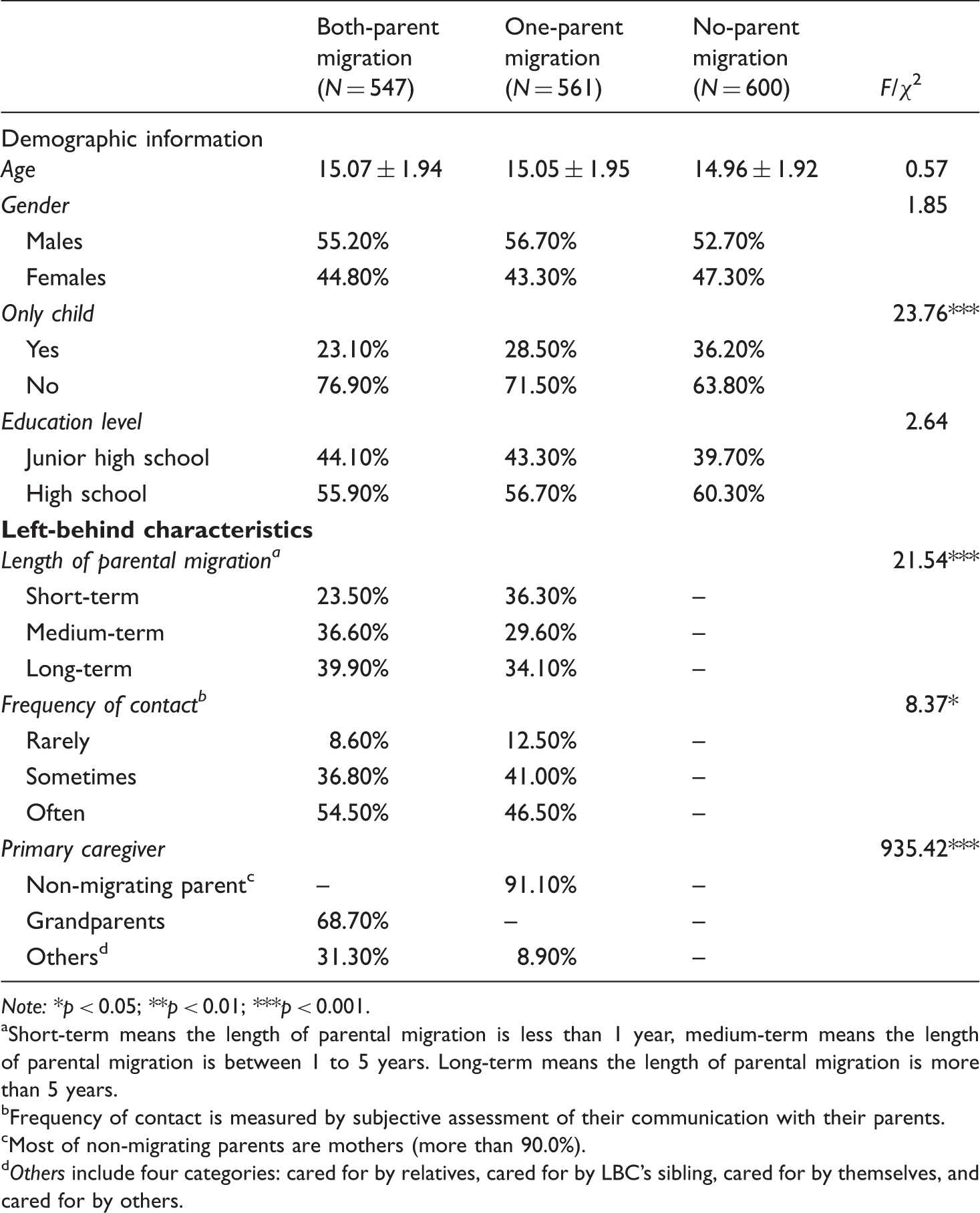
Note: *p < 0.05; **p < 0.01; ***p < 0.001.
Short-term means the length of parental migration is less than 1 year, medium-term means the length of parental migration is between 1 to 5 years. Long-term means the length of parental migration is more than 5 years.
Frequency of contact is measured by subjective assessment of their communication with their parents.
Most of non-migrating parents are mothers (more than 90.0%).
Others include four categories: cared for by relatives, cared for by LBC’s sibling, cared for by themselves, and cared for by others.
In regard to migrant status, there were significant differences between children of both-parent migration and children of one-parent migration on the following variables: Length of time since parental migration, frequency of contact, and identity of primary caregiver. Children of both-parent migration experienced a longer length of time since parental migration than children of one-parent migration. Among LBC, adolescents generally reported having contact with their migrating parent(s). Most LBC reported they ‘often’ had contact with their parents. In particular, children of both-parent migration reported often having contact with their parents. The majority of both-parent migration children were raised by their grandparents. Most children of one-parent migration were raised by the remaining parent who did not migrate.
Psychological development of LBC and their counterparts
MANOVA of all children on migrant status, education level, and gender (N = 1,708).
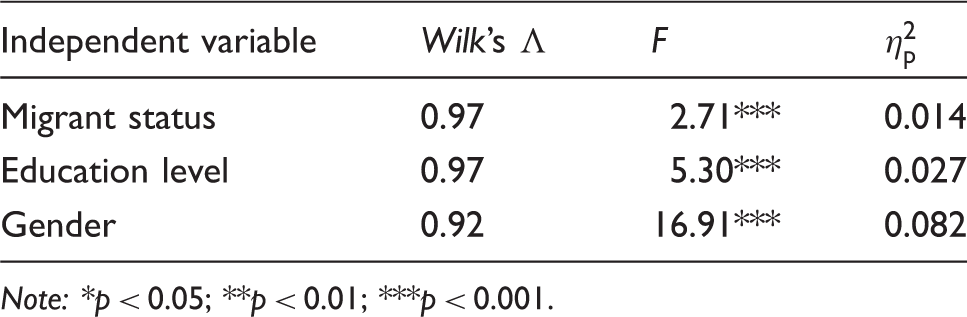
Note: *p < 0.05; **p < 0.01; ***p < 0.001.
ANOVA of variables of all children on migrant status, education level, and gender (N = 1,708).
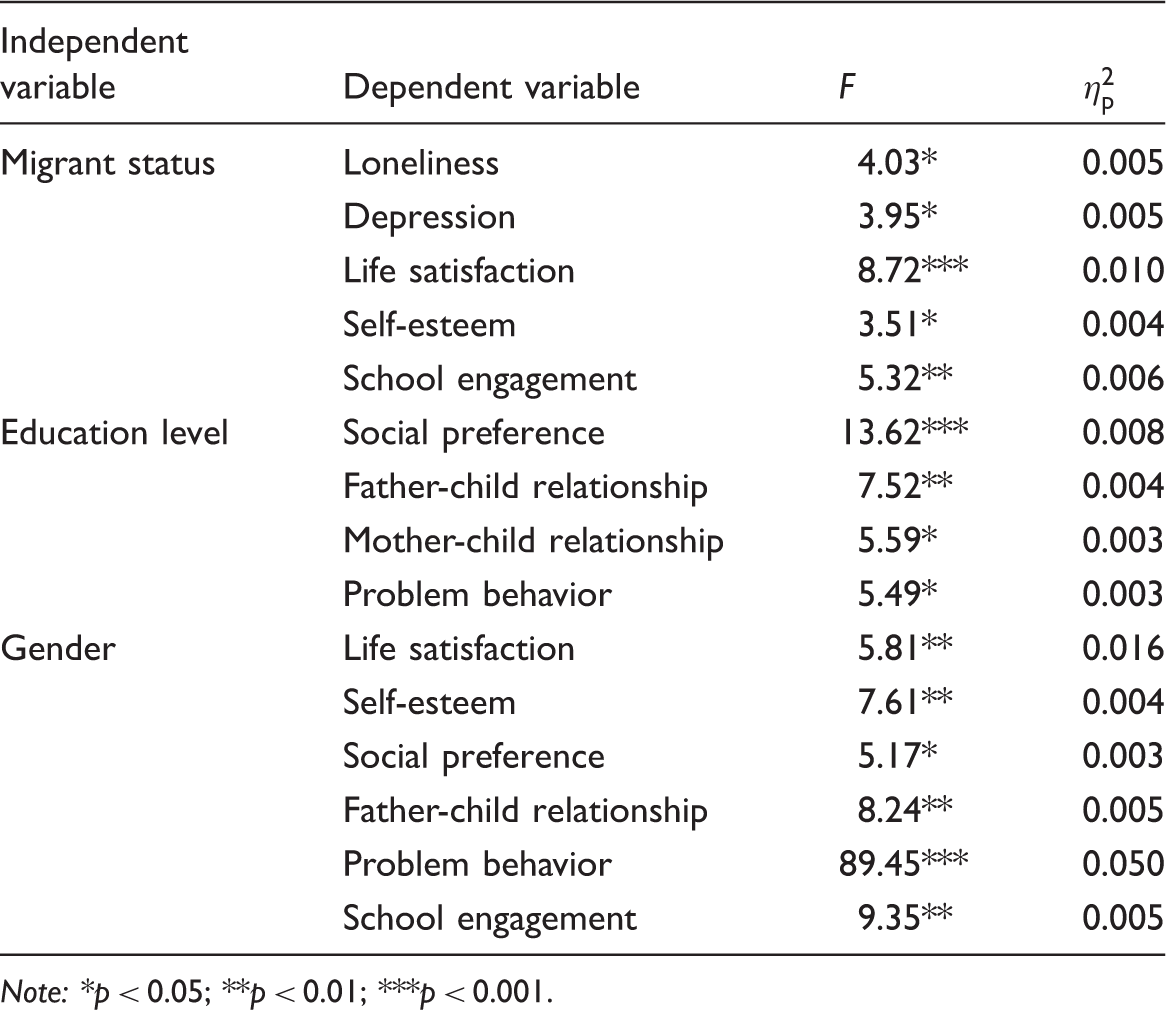
Note: *p < 0.05; **p < 0.01; ***p < 0.001.
Results of post-hoc tests indicated that children with both parents who migrated had lower scores on life satisfaction (p < 0.001) and self-esteem (p = 0.008) than non-LBC. Similarly, children with one parent who migrated had lower scores on life satisfaction than non-LBC (p = 0.009). Children with both parents who migrated reported higher levels of depression than non-LBC (p = 0.006). However, LBC with one parent who migrated (p = 0.001) or both parents who migrated (p = 0.003) engaged in more school activities than non-LBC.
Post hoc tests indicated age differences in children’s perceptions. Overall, students in high school reported higher scores on social preference (p < 0.001), father-child cohesion (p = 0.006), mother-child cohesion (p = 0.018), and problem behaviors (p = 0.019) than students in junior high school.
Post hoc tests revealed gender differences. Boys reported higher self-esteem (p = 0.006), stronger father-child cohesion (p = 0.004), and more problem behaviors (p < 0.001). Girls reported higher levels of life satisfaction (p = 0.016), social preference (p = 0.006), and school engagement (p = 0.002).
Comparisons among LBC subgroups
In order to more thoroughly investigate the effects of migration status on LBC, multivariate analysis of covariance (MANCVOA) was employed simultaneously to assess group differences in all dependent variables, considering caregiving type, length of parental migration, and frequency of parental contact while controlling two key demographic characteristics, school and gender. No interaction effect was found between independent variables and covariates.
In regard to LBC’s caregiving type, more than 85% of LBC were cared for either by their grandparents or their non-migrating parent. The remaining 15% of LBC children were categorized into four caregiving types, with the subgroups’ sizes ranging from 4.1% to 9.5% of the total LBC group. Thus in this study, we merged these four subgroups into a new category (‘other’) and this subset was not included in the remaining analyses. Further, after testing for differences between the non-analysed category (‘other’) and the analysed category (those children brought up by a single parent or grandparents) on all dependent variables, no differences were found.
MANCOVA of differences among left behind children (LBC) based on differences in migrant status.
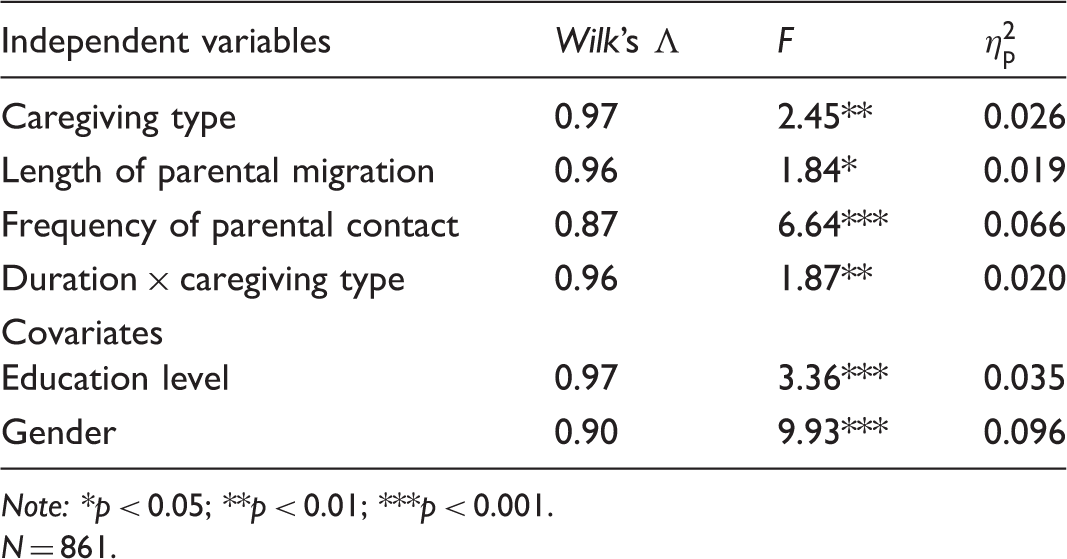
Note: *p < 0.05; **p < 0.01; ***p < 0.001.
N = 861.
The findings suggest that the main effects by caregiving type, length of parental migration, and frequency of parental contact were significant, as well the interaction between the length of parental migration and the caregiving type (Table 4). Further analyses revealed significant differences between one-parent caregiving and grandparent-caregiving when considering LBC’s self-esteem, F (1, 851) = 4.00, p = 0.046,
Continuing with the results listed in Table 4, when considering the length of parental migration, significant group differences were noted on life satisfaction, F (2, 851) = 5.19, p = 0.006,
When considering the amount of parental contact, there were significant group differences reported on the following variables: Loneliness, F (2, 851) = 12.69, p < 0.001,
Post-hoc test comparisons revealed that LBC who were brought up by the non-migrating parent reported higher scores on self-esteem (p = 0.046) and mother-child relationship (p < 0.001) than those who were brought up by grandparents. Long-term LBC reported lower life satisfaction scores than medium-term LBC (p = 0.001). However, Owever, on social preference, medium-term LBC reported lower scores than short-term LBC (p = 0.016).
In regard to the contact frequency, results showed that LBC who often had contact with their migrant parent(s) felt less lonely and depressed than LBC who sometimes (p < 0.001) and rarely (p < 0.001) had contact with migrant parent(s). LBC who sometimes had contact with their migrant parent(s) were less depressed than LBC who rarely had contact (p < 0.001).
On life satisfaction, self-esteem, father-child cohesion and mother-child cohesion, LBC who often had contact with their migrated parents fared better than those LBC who sometimes (p < 0.001) and rarely (p < 0.001) had contact. On father-child cohesion (p = 0.029) and mother-child cohesion (p = 0.049), LBC who sometimes had contact with their parents fared better than LBC who rarely had contact. In comparison to LBC who rarely had contact with their migrant parents, school engagement was significantly better for children who often had contact with their migrant parent (p = 0.005) and for LBC who sometimes had contact (p = 0.046). Simple effect analysis for the interactive effects revealed that long-term LBC performed better on school engagement than those medium-term LBC (p = 0.035) and short-term LBC (p = 0.004), particularly if they were brought up by their grandparents.
LBC’s perceptions of life
Based on interviews, on the whole, LBC reported holding negative perceptions of life changes after parental migration. Most of them (69%) perceived that their current life was different from life prior to their parents’ departure. The main reported change was the harmful effect on the parent-children relationship. For example, care from and communication with migrated parent(s) decreased. Estrangement from migrated parent(s) was either initiated or exacerbated following their departure. On the contrary, after the parents migrated a few LBC reported increased communication with parent(s).
During their interviews, several LBC indicated that they become tougher and more sensible and thoughtful after their parent(s) migrated. However, whether LBC perceived parental migration as positive or negative, the vast majority reported prominent feelings of missing parents and being lonely. LBC commonly reported not wanting their parents to migrate for work and also reported feeling greater happiness when living together with their parents.
In regard to perceptions of their current situation, 56% of LBC indicated that learning was the most important aspect of their current life, followed by family relationships (28%) and friendships with peers (16%). However these aspects of life were both the source of their support and also the source of their dissatisfaction. When asked if LBC preferred to stay at school or at home, half preferred to stay at home and half preferred to stay at school. Each environment had particular benefits and drawbacks. At home, they felt freer, they felt emotionally supported, and they did not feel academic pressure. At school, with their fellow classmates and teachers, LBC reported feeling less lonely. Most LBC reported being dissatisfied with their current life because of interpersonal relationship problems, parent absence, and academic difficulties.
In the interviews almost all of LBC reported having at least one friend. LBC stated that friends made them feel happy. More specifically, friends helped each other with daily life issues and with learning activities; friends shared feelings; friends accompanied and encouraged each other when experiencing difficulties.
From LBC’s point of view, teachers were very kind and supportive. Almost all LBC realized the important role teachers played in regard to students’ academic guidance. Almost one-third of LBC said that their teachers not only took care of students’ daily academic needs, but also taught them how to be ‘human’.
Teachers’ perceptions of LBC’s education
According to information gathered from 32 teachers’ interviews, schools have engaged in action to help LBC. Almost half of teachers (41%) reported that each term their schools archive records for LBC. Nearly one-third of teachers reported feeling an obligation to take responsibility for helping LBC in class and, beyond school, making more home visits for LBC. A few teachers (16%) reported that their schools provided a living subsidy for LBC. Additionally, one-fourth of teachers indicated that specific campus activities were developed for LBC, such as themed activities, safety and security education, and psychological counseling. Teachers also indicated that schools provided phone cards for LBC to promote LBC-parent communication.
In regard to how teachers educate LBC, almost half of teachers (44%) reported keeping close contact with students’ parents (including grandparents). Teachers indicated that they ‘communicate with left-behind students more’ and take more responsibility for ‘LBC’s extracurricular life’. About one-third of teachers indicated that they paid extra attention to LBC. However, in opposition to the majority of teachers’ input, one teacher emphasized that all students should be treated equally without discrimination or favoritism.
For most teachers, the greatest difficulty in the process of educating LBC is communicating with LBC’s parents. Another major concern for teachers includes expressing concerns about LBC’s challenging personal characteristics, such as being intractable and having a mistrustful attitude towards the teacher. Teachers expressed feeling powerless to address LBC’s challenging attitudes and behaviors. Moreover, a few teachers pointed out the difficulty posed by the insufficient integration of and cooperation between the LBC’s school education and family life.
Thus, based on these educational challenges, teachers also offered some advice. Nearly one-in-four teachers suggested that children should not be left behind, or minimally one parent should stay at home to take care of the children. A similar number of teachers reported the need for teachers to offer LBC more supportive care and encouraging praise. Teachers also stressed the importance of increasing communication between parents and teachers, as well as between parents and children.
Additionally, approximately one-in-five teachers reflected on the healthy development of LBC and the necessary ingredients to support this health development. Teachers cited the need for a combination of LBC’s family support, adequate school education, and support from community/government welfare.
Discussion
In rural China, parents frequently migrate to urban areas in search of employment. This move often necessitates leaving their children behind. This study conducted in two junior high schools and two senior high schools found significant developmental differences between rural left-behind children (LBC) and non-LBC. LBC experienced less life satisfaction than non-LBC. LBC with both-parent migration report being more depressed and having a lower self-esteem than non-LBC. These findings indicated that rural parents’ migration had an overall negative impact on LBC’s mental health, particularly when both parents migrated. Findings based on this study’s quantitative data (surveys) and qualitative data (interviews) are consistent with previous studies (Jia & Tian, 2010; Sun, Zhou, Wang, & Fan, 2010; Zhou et al., 2005).
However, in contradiction with the previous findings of Wen and Lin’s (2012) study, in the current study LBC reported a higher level of school engagement and adaptation. LBC reported enjoying school activities, doing their homework, and following school rules. This finding was somewhat unexpected. Possibly in this study LBC were more disadvantaged and underwent more stressful life events than non-LBC (Liu & Wang, 2010), and to counter these challenges, LBC may have had more intense motivation to do well in school, to earn good marks, and to become more involved in school activities. Additionally, these findings may be related to the participating schools’ quality of care provided by classroom teachers and the quality of peer relationships unique to the participating schools. These supportive qualities may not be similar across China’s rural schools and communities. Therefore, data collected in different schools and communities may not align with the findings of this study.
Age and gender
The role of two variables—education level (age) and gender—was noteworthy, but an interaction between these two variables and migrant status was not found. However, in comparison to younger LBC (junior high school students), older LBC (high school students) reported better peer relationships and parent-child relationships. On the other hand, problem behaviors of high school students were significantly greater in comparison to younger LBC. This may be related to older LBC’s enhanced self-awareness and increased academic frustration (Greene, Krcmar, Walters, Rubin, & Hale, 2000; Siegel & Scovill, 2000). Additionally, older students’ school boarding life further weakened parental monitoring and also gave adolescents certain freedoms to independently navigate the cost of living. Moreover, with increasing age and awareness, adolescents naturally become more fully engaged and involved in the complexities of society. This independence and increased freedom might also underlie older LBC’s escalating behavior problems (Shaffer & Kipp, 2010).
Gender differences were found in LBC’s problem behavior and social relations. In comparison to girls, boys exhibited more problem behaviors, lower levels of school engagement, and worse peer relationships. On the other hand, boys reported better relationships with their fathers and higher levels if self-esteem. Overall, these gender differences were consistent with previous studies (Fan, Fang, Liu, & Liu, 2009; Fan, Su, Gill, & Birmaher, 2010; Sun et al., 2010; Wen & Lin, 2012).
This study’s findings were also related to parenting style and social expectations in Chinese culture (Shaffer & Kipp, 2010). Therefore, educators should take into consideration the different developmental stages of youth in educational practice and the type of challenges which are specific to the gender of LBC.
Migrant status and caregivers
This study also found that different migrant conditions might cause different effects in LBC. Overall, LBC who were cared for by one parent fared better than those who were cared for by grandparent(s). LBC brought up by one parent had a more intimate relationship with their mother and reported higher levels of self-esteem than children brought up by grandparent(s). As previously indicated, more than 90% of LBC who were cared for by the remaining non-migrating parent were brought up by their mother. Additionally, previous research conducted by Zhao, Shen, and Liu (2008) found that mother’s support had a positive influence on LBC’s self-esteem.
LBC who were cared for by their mothers reported receiving more of their mother’s support. The mother’s care of LBC was positively related to the individual child’s self-esteem and also with a stronger mother-child relationship. Therefore, in the process of raising a child the important role of parent (especially mother) is not easily replicated by a substitute caregiver, such as a grandparent.
Duration of separation and parental contact
Medium-term LBC had the highest score on life satisfaction and peer acceptance (social preference). Possibly, in comparison to short-term and long-term LBC, medium-term LBC may better cope with and adapt to separation from their parents. In addition, there was an interesting interaction between length of parental migration and caregiving type. For adolescents who were brought up by a grandparent, LBC who had a longer separation from the migrated parent actually reported better school engagement.
Generally speaking, the long-term LBC with both-parent migration (and who were brought up by grandparents) struggled with the most disadvantages and often appeared to show the weakest adaptation to healthy development. However, in this study, LBC who experienced long-term separation from their parents and who were brought up by a grandparent presented the highest school engagement. This might reflect a positive coping style of these LBC who seemingly demonstrate greater resilience in a school environment.
Among the left-behind characteristics investigated in this study, the frequency of parental contact had the broadest impact on LBC’s adaption. Parental contact was beneficial to LBC’s mental health. Children who had the most frequent contact with their parents suffered less with loneliness and depression and reported the highest life satisfaction and self-esteem. In regard to social relationships, father-child cohesion and mother-child cohesion were strongest in the group of LBC who had the most frequent contact with their parents. However, based on frequency of contact with LBC’s parents, in regard to peer relationships, there was no significant difference between groups.
Sufficient contact with parents may also improve LBC’s school engagement. Adolescents who rarely had contact with their migrated parents performed the worst on school engagement. These results were consistent with previous research (Su, Li, Lin, Xu, & Zhu, 2013). LBC’s communication with parents and children’s level of disclosure with parents appears to facilitate LBC receiving social support, which enhances healthy emotional adaptation (Chaudoir & Fisher, 2010). Su et al. (2013) also found that high levels of parental communication is one of the strongest protective factors of satisfaction with school and life in general, ultimately related to children’s overall happiness and well-being. Thus, frequent contact with parents helps promote LBC’s positive mental health and social adaptation.
In the children’s interviews, based on the LBC’s perception of their own lives, most children reported becoming alienated from their parents following their parents’ migration for work. This alienation appears to have the greatest effect on children impacted by parental migration, and subsequently a direct cause of children’s loneliness in their parents’ absence. According to the ‘ecological model of rural LBC’s psychological development,’ suggested by Zhao and Shen (2010), the proximal factor (such as single parent’s migration or both parents’ migration) and the distal cause/outcome (such as parent-children relationship) in left-behind environment were differentiated. The distal factors may, through certain proximal factors, contribute to LBC’s development. As a result, in the condition where parents migrate for work and leave their children behind, interventions must focus on improving the LBC-parent relationship, helping enhance parent-child communication and building family cohesion.
School engagement and relationships
Ultimately, educational intervention efforts must focus on encouraging and promoting LBC to actively adapt to their challenging situation. Primarily, LBC’s dissatisfaction in life was associated with academic pressure, problems in family relationships, and difficulties in peer relationships. Therefore, school educators and mental health workers should consider these three aspects as they identify school-based strategies to improve LBC’s life satisfaction and academic progress. Interestingly, this research study’s data indicate that half of LBC like staying at home, while the other half prefer staying at school where they can associate with their peers.
Home and school are the two most important places where children and adolescents develop relationships and personal skills related to life satisfaction. Indeed, peers play an important role in children’s socialization. Even when bullied, children’s loneliness can be alleviated by associating with a supportive friend (Sun et al., 2010).
Adolescents who had no ‘best friend’ reported feeling greater loneliness than those who had a ‘best friend’ (Zou, 1998). Research indicates that the quality of adolescents’ friendship is highly correlated with increased self-esteem and sense of self-value, lower levels of depression and anxiety, and social adjustment (Berndt & Keefe, 1995; Hartup, 1996). Friends help care for LBC on a daily basis and accompany them during school and outside of school. Additionally, friends are available to assist LBC with school assignments. Many LBC reported being happy when they were together with friends. This study’s findings were in line with previous research which found that good peer relationships help alleviate children’s loneliness (Sun et al., 2010; Zhou, Zhao, Chen, Jiang, & Hundley, 2003). The compensation of peer relationship is very important, especially because these relationships act as a protective factor for LBC’s adaptation to the school environment.
School support of LBC
All LBC expressed having a positive attitude towards their teachers. They considered their teachers to play an important role in guiding and improving student learning, providing a daily lift, and helping students develop good character. Above all, it is of critical importance for adolescents to develop emotional intimacy and warmth that ensures good communication between peers and with caring adults. Peers and teachers provide companionship for LBC and serve as guides in day-to-day school life. Based on this study’s data, school is an important place for LBC’s social development.
According to the teacher interviews, teachers’ frontline role in education allowed them to understand the difficulties in educating LBC. The greatest challenge was in bridging the gap between the school’s role in education and the family’s role in education. For example, teachers reported having difficulty communicating with LBC’s parents and perceived that LBC did not have sufficient parent support. Thus, teachers stressed the importance of increasing the communication between parents, teachers, and children. In this way, schools’ and parents’ combined efforts would better support LBC’s educational and social-emotional needs, creating a school environment that nurtured LBC’s learning and healthy development.
Limitations of current research
Considering that Cronbach’s α was low for the measurement of School Engagement (Cronbach’s α = 0.46), we should explain whether it affects our confidence in interpreting data from this measurement. First of all, Cronbach’s α is a special case of intra-class correlation coefficient (ICC), comparable to a two-way random model ICC (McGraw & Wong, 1996; Weir, 2005). Thus, when the correlation of items’ correlation was low, α would be weakened. School Engagement was a variable that measured the degree of students’ school activity engagement (e.g. ‘Do you like being obedient to school discipline?’). These events often had high incidence rate, so the distribution of these data was skewed, which weakened the item correlation. Second, although these items all belong to one category, each presented item may occur independently from the other items, therefore this traditional estimate of internal consistency may not have been an appropriate measure to judge this measure’s reliability and whether these items measured what they purported to measure (Kim, Conger, Elder, & Lorenz, 2003). Previous researchers have also addressed similar concerns with using Cronbach’s α (Kim et al., 2003; Straus & Kantor, 2005). Third, Cronbach’s α typically increases with an increased number of items. In our research, there were only five items in this scale, thus limiting the scale’s α.
Last but not least, Cronbach’s α has been criticized as underestimating true reliability (Peterson & Kim, 2013). In fact, Turner and Wheaton (1995) declared that a measure may be valid even if α is zero. Thus we have reason to believe that the school engagement measure’s low reliability is not an indication of the measure’s validity. However, we urge caution in drawing conclusions from this aspect of our data.
Implications for improving prevention and intervention efforts
In line with previous research, our findings support the need for assistance and intervention systems for LBC. Educators and parents must play an important role in providing interventions to address LBC’s educational and social-emotional needs. The following seven interventions are recommended and further discussed in the following sections: (a) improve school leadership and management; (b) improve education on the school and classroom level; (c) strengthen school mental health education services; (d) build stronger coalitions between family and school; (e) provide a supportive and caring foundation; (f) support current and future education and (g) increase outside support of LBC. In order to bring about positive change, these recommended interventions should be integrated and complementary.
Improve school leadership and management
In view of the high proportion of left-behind students in rural schools, school leadership must consider and provide accommodations for LBC and strengthen the school’s management to ensure the daily care and personal safety of LBC. In addition, according to the needs of some migrated family with good income, the school might consider charging a suitable fee to improve the school’s boarding dietary standard and accommodations for children. Moreover, if it is possible, arrange life coaching teachers and teaching tutors to assist the management and education of LBC. In the long run, school administrators should pay close attention to the quality of education, try to improve teacher quality, and provide training opportunities (such as psychological counseling training). Strong academic courses, caring teachers, and a supportive school environment help LBC enjoy school and adapt to their challenging family circumstance.
Improve education on the school and classroom level
First, optimize the educational content. Increase the content such as agriculture, science, technology and other practical technology to help children grasp survival skills prior to graduating from junior high school. Second, adjust the course structure. Strengthen the LBC’s survival, safety, and legal education, and improve their self-respect, self-reliance, discipline consciousness and legal knowledge. Third, enrich the extracurricular life of students, especially for the LBC. Entertainment activities increase peer interactions, and offer opportunities to strengthen shape healthy personality. Fourth, mobilize teachers, youth-league members, young pioneers and other students to help LBC by pairing LBC with supportive students to ease stress and encourage psychological adjustment.
Strengthen school mental health education services
As mental health and psychological well-being of LBC are often neglected (Luo, Wang, & Gao, 2009), it is necessary to publicly promote psychoeducational activities and to regularly provide psychological consultation activities. These efforts will be helpful in preventing potential psychological crises in disadvantaged LBC. It is important to establish a psychological counseling room and to encourage students to accept psychological counseling services which will help provide additional social support and enhance LBC’s emotional adjustment. For children with serious psychological problems, psychological teachers should conduct tracking observations and offer supportive services to address challenging issues, track progress, and then summarize the effect of the relevant intervention measures.
Build stronger coalitions between family and school
Family supports (both from parents and the primary caregiver) are very important for LBC. Programs should be well designed to strengthen family ties before and following migration. We suggest offering supportive training for parents. Parent-teacher and parent-child communication is critical. Parents should strengthen the exchange and communication with their children and keep in touch with their children’s temporary caregiver. Likewise, in a coordinated effort parents and caregivers must regularly communicate with LBC’s teachers.
Provide a supportive and caring foundation
Remind parents, caregivers, and teachers to frequently offer LBC more supportive sentiment. Demonstrate concern for LBC’s well-being and provide character education to further strengthen social relationships and social skills.
Support current and future education
Even though migrating parents are not present to give learning guidance during their absence, parents must always encourage their children’s studying and build children’s confidence in their ability to learn and study. Parents should avoid extreme reactions to their children’s educational progress—negligence and limited expectations for the children’s academic achievement or, on the other hand, exerting too much pressure for children to achieve unrealistic academic goals. Head teachers may take more responsibility for LBC’s school involvement by providing special activities, establishing routine home visits, and holding teacher-parent meetings when parents are home during the holidays.
Increase outside support of LBC
Finally, it is worth noting that interventions organized and funded outside of schools are also very important in supporting LBC. Concrete actions must be taken with support from government organizations, community and private enterprises, universities, international communities, and so forth. For example, to compensate for the lack of national fiscal capital investment in rural schools, local governments may try to change the investment system of funding rural education, possibly running a school with subsidized funding from the community and government. One option, public welfare organizations can organize well-educated caring volunteers to set up a Chinese Pioneer Union, providing strong academic courses and offering supervised activities for LBC, even extending beyond the typical school hours. Additional options include offering parent hotlines or a website with family counseling services. In order to improve resource utilization, these services can be set up in targeted local areas or expanded nationwide and offered to individuals from all walks of life. Additionally, with available internet and technology, LBC and migrated parent(s) should be able to communicate more frequently, countering LBC’s feelings of loneliness.
Conclusion
Parental migration in China’s rural areas appears to be a common situation for many adolescents (Duan & Zhou, 2005; Zhou et al., 2005). Additionally, the negative impact of parent migration on LBC’s psychological development and social adaptation is extensive. Understanding the common challenges facing LBC, educators and parents must strategically identify and implement interventions to address these needs, fostering better outcomes for LBC.
Footnotes
Funding
This work was supported by the National Social Science Fund Project of China (Grant No. 11&ZD151) and the National Natural Science Foundation of China (Grant No. 31400887).