







Abstract
Although personal and environmental correlates of adolescents’ happiness have been found, the temporal direction of these relationships is less known. The present study explored the longitudinal and reciprocal relationships between self-esteem, school adjustment, and happiness during secondary school years in South Korea. Longitudinal data of 2,351 adolescents from three time points (Grades 7, 9, and 11) were drawn from the Korean Children and Youth Panel Survey (KCYPS) and were analyzed using autoregressive cross-lagged modeling. The results indicated that inter-individual differences in self-esteem, school adjustment, and happiness were moderately stable from Grades 7 to 11. Self-esteem and happiness, and self-esteem and school adjustment reciprocally predicted each other over time. The effects of self-esteem on happiness and school adjustment two years later were stronger than the reverse direction of effects. School adjustment and happiness were only indirectly interrelated through self-esteem over time. These longitudinal relationships did not differ between genders. The implications of the findings for future research and adolescent interventions are discussed.
Keywords
From a positive psychological perspective, there has been growing attention on the positive aspects of adolescent development. In this line of research, adolescents’ happiness has been found to be not only the desired outcome in itself, but also an important predictor of positive development, in areas such as health, productivity, and pro-social behaviors (De Neve et al., 2013; Park, 2004; Proctor et al., 2009). While a substantial body of research has examined personal and environmental correlates of happiness, these are mostly cross-sectional studies. The longitudinal relationships between happiness and other variables have been less examined in regard to adolescence, especially beyond American samples (Proctor et al., 2009).
The transition to middle school occurs with developmental changes from childhood to adolescence and demands adjustment to new school environments, including teacher-student relationships, peer relationships, and academic challenges (Shoshani & Slone, 2013). Thus, this transitional period deserves specific research attention. Studies have documented that levels of happiness tend to decline during secondary school years (Park, 2005; Uusitalo-Malmivaara, 2014). Changes in self-view and school environment could contribute to the decrease in adolescents’ happiness over the secondary school years (Cho, 2016; Park, 2005; Uusitalo-Malmivaara, 2014).
Self-esteem has been examined as a personal asset related to positive outcomes. Research evidence has consistently supported the close relationship between self-esteem and happiness (Baumeister et al., 2003; Diener & Diener, 1995; Lyubomirsky et al., 2006). Schools are a central part of adolescents’ lives. Environmental factors such as schools should be considered to promote adolescent happiness (Lambert et al., 2014). Adjusting well to a new school environment may be important for students to feel self-worth and happy. In reverse, self-esteem and happiness may also serve as psychological resources that help adolescents adjust to secondary school. However, the temporal and reciprocal relations among self-esteem, school adjustment, and happiness have not yet been examined. This study aimed to explore whether and to what extent self-esteem, school adjustment, and happiness are stable and, after controlling for stability effects, have reciprocal relationships with one another during secondary school years, using three-wave data from a nationally representative sample of adolescents in South Korea. This study also explored whether these longitudinal relations differ between genders in light of inconsistent previous findings regarding gender differences in the relationships between happiness, self-esteem, and school adjustment (e.g., Kong & You, 2013; Moksnes & Espnes, 2013; Povedano-Diaz et al., 2020; Zhang & Leung, 2002).
Happiness
Happiness, across various definitions, has been regarded as a subjective perspective, rather than objective living conditions. Veenhoven (1994) defined happiness as “the degree to which an individual evaluates the overall quality of his/her life-as-a-whole positively” (p.106). Happiness is often represented by subjective wellbeing (SWB), which consists of the cognitive judgment of one's life (i.e., life satisfaction) and the preponderance of positive affect against negative affect (Diener, 1984). Life satisfaction, a component of SWB, has been used as a proxy for happiness in many studies. Rather than proposing the components of happiness, Lyubomirsky and Lepper (1999) suggested that individuals can define happiness on their own and accordingly make a judgment of whether they are happy or unhappy. In the present study, happiness denotes an individual's subjective judgment of the degree to which one's overall life is happy (Kim et al., 2006).
Not only is happiness a goal pursued in life by most people, but meta-analytic evidence of cross-sectional, longitudinal, and experimental research has shown that happiness leads to successful outcomes encompassing social relationships, income, work performance, health, and community involvement (Lyubomirsky et al., 2005). Moreover, a review of 141 empirical studies has suggested that happiness is related to important social, emotional, and behavioral aspects of adolescent development (Proctor et al., 2009). Personal and ecological assets contribute to adolescents’ happiness. For example, optimism, school connectedness, and support from neighborhood, parental support, and peer relationships predicted adolescents’ life satisfaction in Oberle et al.’s (2011) study using multilevel modeling.
Self-esteem and happiness
Self-esteem refers to “an individual's subjective evaluation of her or his overall worth as a person” (Donnellan et al., 2011, p. 738). Individuals with high self-esteem are satisfied with what they are, think of themselves as worthy, accept their strengths and weaknesses, and are willing to grow (Rosenberg, 1965). Self-esteem has been predictive of various life outcomes (Swann et al., 2007) and has been consistently positively associated with happiness (Baumeister et al., 2003; Lyubomirsky et al., 2006) and life satisfaction (Gilman & Huebner, 2003; Miller et al., 2019). Subjective happiness and self-esteem were closely correlated among retired employees (r = .58), yet happiness and self-esteem were distinguished, in that they showed different patterns of relationships with other variables (Lyubomirsky & Lepper, 1999). Diener and Diener (1995) reported a correlation of.47 between self-esteem and life satisfaction in a sample of college students in 31 nations; the strength of correlation differed depending on culture. The association between self-esteem and life satisfaction was stronger in individualistic countries than in collectivistic countries, possibly because people in individualistic cultures focus more on their own personal attributes to evaluate their lives (Diener & Diener, 1995). On the other hand, in Farruggia et al.’s (2004) cross-cultural study, positive self-esteem was more strongly related to depressed mood among Korean and U.S. adolescents than Chinese and Czech adolescents, which is not explained by individualistic versus collectivist cultures.
Several studies have shown that self-esteem mediates the relationship between predictors and happiness. For example, self-esteem mediated the relationship between social support and life satisfaction (Kong & You, 2013) and between extraversion and happiness (Tan & Lee, 2017). Though these studies posit that self-esteem contributes to happiness as a mediator, they did not examine the temporal relationship between the variables. Some longitudinal studies have suggested that self-esteem precedes happiness. Marcionetti and Rossier (2021) found a unidirectional effect of prior self-esteem on subsequent life satisfaction among Swiss adolescents, but they did not examine the opposite path from life satisfaction to self-esteem. Similarly, Moza et al. (2019) found that self-esteem precedes rather than follows happiness among Romanian college students. On the other hand, in Kim and Nho’s (2020) longitudinal study of Korean multicultural adolescents, a reciprocal relationship was found between self-esteem and life satisfaction, and the effect of self-esteem on life satisfaction was stronger than the reverse.
School adjustment, self-esteem, and happiness
Many adolescents face challenges, such as increasing academic demands (Young et al., 2012) and reduced personal relationships with teachers (Eccles et al., 1991), in adjusting to the secondary school environment. School transitions impact adolescents’ self-concepts, emotions, and behaviors. Students’ self-esteem and competence beliefs about math, English, and social domains were found to decline following the junior high school transition (Wigfield & Eccles, 1994). Benner and Graham (2009) observed that U.S. urban adolescents experienced heightened anxiety, loneliness, and school absence, as well as decreased grades, as they transitioned to high schools. They further found that girls, compared to boys, tended to have more adjustment difficulties after the transition.
In South Korea, adolescents transition to middle school from 6-year elementary school and make another transition to 3-year high school after 3-year middle school. The secondary education period could be challenging for Korean adolescents, in light of the heavy emphasis on academic achievement and highly competitive college entrance exams in South Korea (Lee, 2006). Thus, it is important to consider school experiences when examining Korean adolescents’ positive development during secondary education.
The concept of school adjustment has expanded beyond academic performance to encompass multiple aspects (Henry et al., 2009). Overall, studies have considered peer relationships, relationships with teachers, and school-related behaviors and attitudes as important aspects of school adjustment. For instance, Herndon et al. (2013) defined school adjustment as attitudes and behaviors pertaining to learning in the classroom and positive interaction skills with peers and teachers. In the Korean context, Lee (2005) conceptualized school adjustment as four components: schoolwork (i.e., academic competence and values), relationships with friends, relationships with teachers, and school life (i.e., compliance with school rules and a positive attitude toward school). Lee's concept of school adjustment was empirically supported in a sample of Korean middle school students (Lee & Kim, 2008). In line with the components identified in previous studies, in this study, school adjustment signifies school learning, relationships with teachers, relationships with friends, and compliance with school rules.
Studies have demonstrated significant associations between school adjustment-related variables and happiness. Arslan et al. (2020) found that Time 1 (T1) school belonging predicted Time 2 (T2) life satisfaction among 10-15 aged adolescents in Turkey, but they did not examine the reverse path from life satisfaction at T1 to school belonging at T2. Some studies have shown the reciprocal relationships. Stiglbauer et al. (2013) found reciprocal effects over time between positive school experiences and affective well-being among Austrian secondary school students. Datu and King (2018) used two-wave data from Filipino high school students and confirmed that life satisfaction and negative affect were reciprocally related to academic engagement.
School adjustment has also been found to be related to self-esteem, but there have been conflicting findings about the direction of their relationship. Baumeister et al. (2003) argued that self-esteem is influenced by school performance rather than influencing school performance. On the other hand, some other studies have reported that self-esteem contributes to school outcomes. For example, self-esteem was predictive of first-year academic and social adjustment to university (Friedlander et al., 2007). Emotional health self-esteem, as rated by a teacher, in Grades 1 through 3 predicted high school adjustment even after controlling for achievement at Grades 1 to 3 (Carlson et al., 1999). In Sihn et al.’s (2012) cross-sectional study, Korean middle school students’ relationships with parents, friends, teachers, and neighbors affected self-esteem, which in turn affected happiness, and in turn, school adjustment. Self-esteem also had a direct effect on school adjustment.
Gender differences
Findings have been inconsistent as to whether there are gender differences in the relationships between happiness, self-esteem, and school adjustment. The relationship between self-esteem and the composite score of domain life satisfaction was weaker among women than men in China, partially because women might devalue the importance of self-esteem given their lower self-esteem than men (Zhang & Leung, 2002). In contrast, the association between self-esteem and life satisfaction was invariant across genders among Norwegian adolescents (Moksnes & Espnes, 2013) and Chinese college students (Kong & You, 2013). Heffner and Antaramian (2016) showed that life satisfaction was more strongly linked to grade point averages in middle school girls than boys and more strongly related to boys’ future aspirations and goals than that of girls. On the other hand, Povedano-Diaz et al. (2020) found no gender differences in the relationships among adolescents’ life satisfaction, family and classroom environment, and self-concept.
Present study
The present study examines the longitudinal and reciprocal relationships among happiness, self-esteem, and school adjustment using three-wave data from middle to high schools in a nationally representative sample of adolescents in South Korea. This study also explores whether gender differences exist in these relationships. Unlike many existing cross-sectional studies, this longitudinal study aims to shed light on the temporal direction and relative strength of the relationship between these variables during secondary school years in Korea. The following research questions (RQ) were examined: (1) Are self-esteem, school adjustment, and happiness stable over time from 7th grade to 11th grade among adolescents in South Korea? (2) What are the cross-lagged relations between self-esteem, school adjustment, and happiness over time from 7th grade to 11th grade? (3) Are there differences in the stability and cross-lagged relations of self-esteem, school adjustment, and happiness across gender?
Method
Participants
The data in the present study were from the first (2010), third (2012), and fifth (2014) waves of the Korean Children and Youth Panel Survey 2010 (KCYPS 2010), conducted by the National Youth Policy Institute from 2010 to 2016. In the KCYPS, the sample was recruited nationally using stratified multi-stage cluster sampling, and the sample for Wave 1 was surveyed annually. This study analyzed the data from a total of 2,351 Korean adolescents: at Wave 1 (first year of middle school = Grade 7), 1,175 boys and 1,175 girls; at Wave 3 (third year of middle school = Grade 9), 1,140 boys and 1,119 girls (retention rate 96.1%); and at Wave 5 (second year of high school = Grade 11), 1,067 boys and 1,024 girls (retention rate 88.9%). The results of the logistic regression indicated that whether or not adolescents responded to the survey at W3 or W5 was not predicted by levels of self-esteem, happiness, or school adjustment at W1. (ps > .05). Girls were more likely not to respond to the survey at W3 (OR = 1.612 [95% CI: 1.044, 2.489]), p = .031) or W5 (OR = 1.480 [95% CI: 1.136, 1.928]), p = .004). The proportion of girls in respondents at each wave, however, remained between 49.0% to 50.0%.
Measures
Happiness
The KCYPS 2010 measured happiness using Kim et al.’s (2006) three-item scale. This scale was developed and validated to measure adolescents’ happiness as one of the Korean youth development indicators. The internal consistency of the scale was .747 among 1,965 college students (Kim et al., 2006). The items are rated on a four-point Likert scale (1 = strongly agree; 4 = strongly disagree). Reponses were reverse-coded such that a higher score indicated higher happiness. Items are “I think my life is happy,” “I have little to worry about,” and “I enjoy my life.” The alpha coefficient of the scale in the current study was .814 for Wave 1, .815 for Wave 3, and .780 for Wave 5.
Self-esteem
The KCYPS measured self-esteem using the Korean-translated version of Rosenberg’s (1965) Self-Esteem Scale. The items are rated on a four-point Likert scale (1 = strongly agree; 4 = strongly disagree). Negatively worded items were reverse-coded, such that higher scores indicated higher levels of global self-esteem. Sample items include “On the whole, I am satisfied with myself.” Of the 10 items, Item 8 (“I wish I could have more respect for myself”) was not used in this study. The alpha coefficient increased by .020-.034 across the waves when this item was deleted. Lee et al. (2009) also found that this item lowered the internal reliability of the Korean version of the self-esteem scale. Similarly, Schmitt and Allik (2005) revealed that the factor loadings of Item 8 were negative in five countries and below .30 in eight out of 53 countries, including South Korea. The problematic factor loading of Item 8 was also found in Farruggia et al.’s (2004) cross-cultural studies. The alpha coefficients for each wave in the current study were .873 (Wave 1), .847 (Wave 3), and .878 (Wave 5).
School adjustment
The KCYPS measured school adjustment using 20 items adopted and revised from Min’s (1991) school adjustment scale. The scale consists of four dimensions: learning activities, compliance with school rules, relationships with peers, and relationships with teachers. Each subscale contains five items rated on a four-point Likert scale (1 = strongly agree; 4 = strongly disagree). Reponses were reverse-coded such that a higher score indicated higher school adjustment. Items include “I am well aware of what I have learned in class (learning activities),” “I keep my turn in the school restroom or the cafeteria (school rules),” “I go well with my classmates (peer relationship),” and “I feel comfortable talking to my teacher (teacher relationship).” Three domain-representative parcels (Graham & Tatterson, 2000) were created so that each parcel contained one or two items from each of the four domains of school adjustment. The alpha coefficients for each wave in the current study were .852 (Wave 1), .865 (Wave 3), and .860 (Wave 5).
Data analysis
Data were analyzed using SPSS (version 23.0; SPSS Inc., Chicago, IL, USA) and AMOS 23.0. Missing data were handled using full information maximum likelihood (FIML) estimation. FIML method uses all available data in order to estimate the model without imputing data (Enders, 2001). The autoregressive cross-lagged (ARCL) model was employed to examine the autoregressive effects (RQ1) and cross-lagged effects (RQ2). The autoregressive effect represents the stability of inter-individual differences in a variable over time, as it indicates the amount of variance in the variable accounted for by the prior level of the variable after controlling for the effects of other variables at a prior time point (Little, 2013). A cross-lagged effect signifies the amount of a variable's variance accounted for by the prior levels of the other variable after controlling for autoregressive effects (Little, 2013). Additionally, a possible mediation effect was tested using the Monte Carlo method, which performs comparably to other interval construction methods (e.g., bootstrapping) and can be conducted quickly with summary data only (Preacher & Selig, 2012). A multi-group analysis was performed to examine the gender differences in the model (RQ3). Because the chi-square statistic tends to be overly sensitive to a model with a large sample size, the model was judged to fit the data well based on the comparative fit index (CFI), Tucker and Lewis index (TLI), and root mean square error of approximation (RMSEA).
Results
Preliminary analysis
Table 1 presents the descriptive statistics, t-test results, and correlations for the study variables. All correlations were significantly positive (ps < .001). Correlations between self-esteem and happiness ranged from .24 to .65; those of self-esteem and school adjustment ranged from .19 to .42; and school adjustment and happiness ranged from .12 to .36. The t-test results indicated that the means of happiness at all waves and self-esteem at W1 and W3 were higher in boys than girls. Conversely, school adjustment was higher in girls than boys at W3 and W5. The study variables are normally distributed as their skewness ranged from -.25 to .19 and kurtosis ranged from -.29 to .76.
Descriptive statistics, t-values, and correlations for study variables.
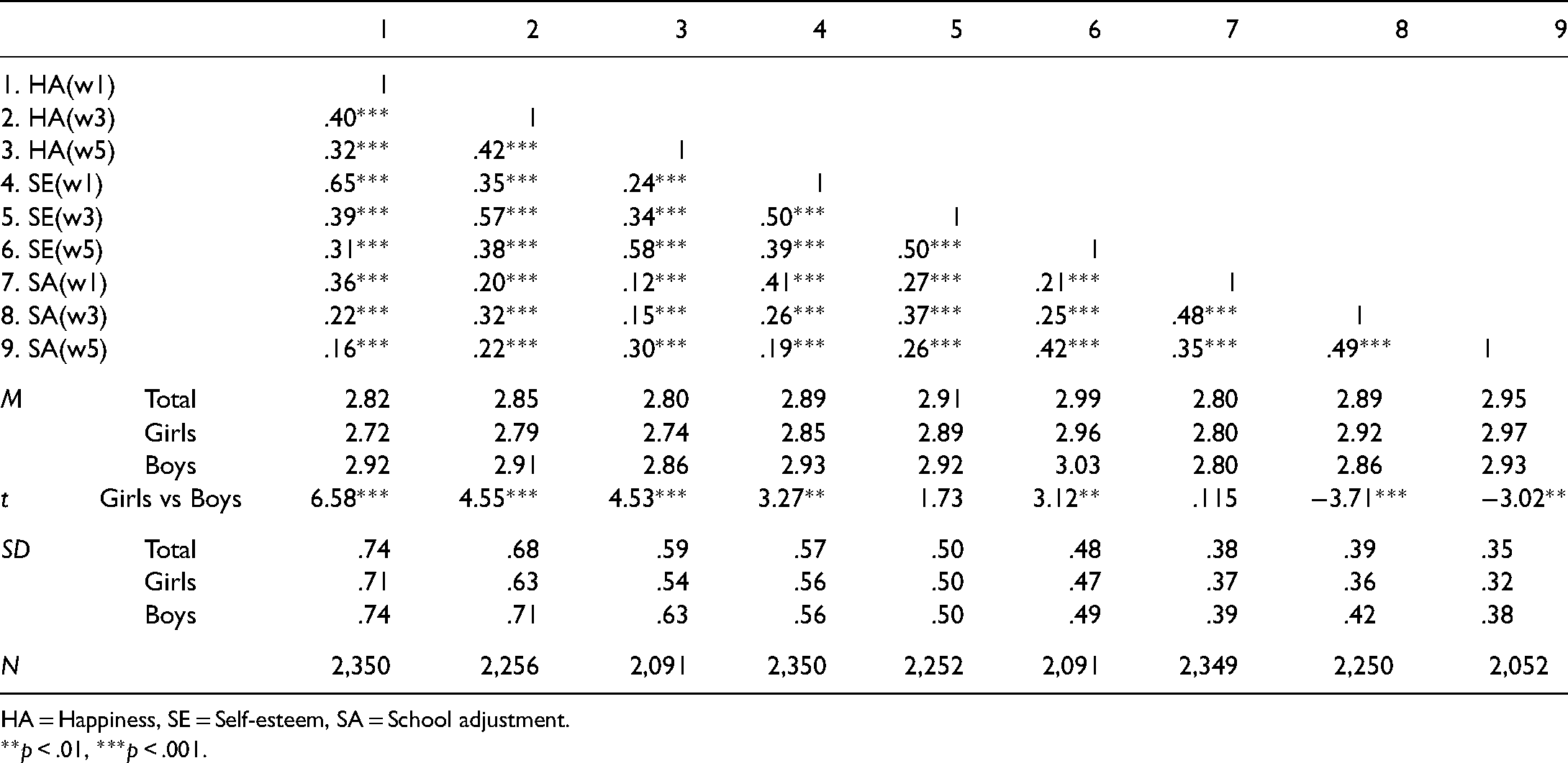
HA = Happiness, SE = Self-esteem, SA = School adjustment.
p < .01, ***p < .001.
The stability and cross-lagged relations of self-esteem, school adjustment, and happiness
The ARCL model was employed to examine the autoregressive stability effects and cross-lagged effects of self-esteem, school adjustment, and happiness. A series of tests of metric invariance, path invariance, and error covariance invariance over time were conducted, in order to determine whether the constructs were measured similarly across time points. Given that the chi-square statistic is sensitive to sample size, the model was judged to fit the data equally well compared to the prior model when a change in CFI was less than .01 (Cheung & Rensvold, 2002; Little, 2013).
Table 2 presents the results of the invariance tests across time. The unconstrained model (M1) was first tested and fit the data well. Equality constraints were then imposed on factor loadings for self-esteem (M2), school adjustment (M3), and happiness (M4) across the three time points. No or negligible changes in CFI indicated that the factor loadings of each variable were invariant across time. The autoregressive coefficients (M5-M7) and cross-lagged coefficients (M8-M13) were sequentially constrained to be equal across time. Lastly, equality constraints were imposed on the covariances of errors across time (M14-M16). Significant changes in CFI between the models were not found, supporting the invariance of autoregressive coefficients, cross-lagged coefficients, and error covariances. Model 17 is the final model in which non-significant cross-lagged paths were deleted.
Factorial invariance tests of the autoregressive and cross-lagged panel model.
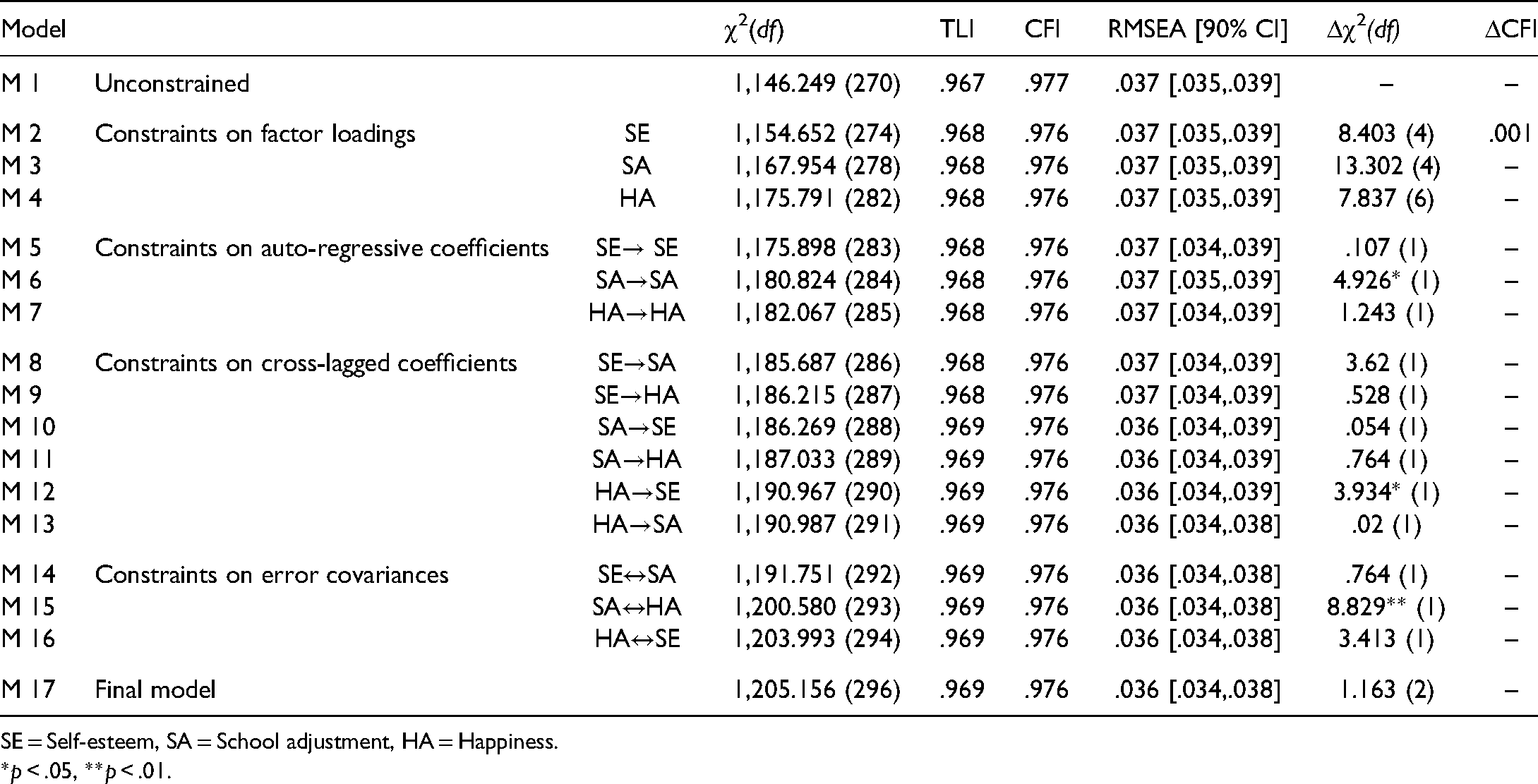
SE = Self-esteem, SA = School adjustment, HA = Happiness.
*p < .05, **p < .01.
As shown in Figure 1, the autoregressive coefficients for happiness (βs = .340 and .339), self-esteem (βs = .480 and .451), and school adjustment (βs = .481 and .531) in Model 17 were all positive and significant. This suggests the temporal stability of happiness, self-esteem, and school adjustment from Grade 7 until Grade 11 (RQ1). Regarding RQ2, self-esteem and happiness had significant cross-lagged effects. Self-esteem and school adjustment had a significant but small cross-lagged effect on each other. These results indicate that self-esteem and happiness, and self-esteem and school adjustment predicted each other over time. The cross-lagged paths between school adjustment and happiness were not significant. The ARCL model accounted for 23.6% (happiness at Grade 11) to 34.2% (self-esteem at Grade 9) of the variance in the variables.
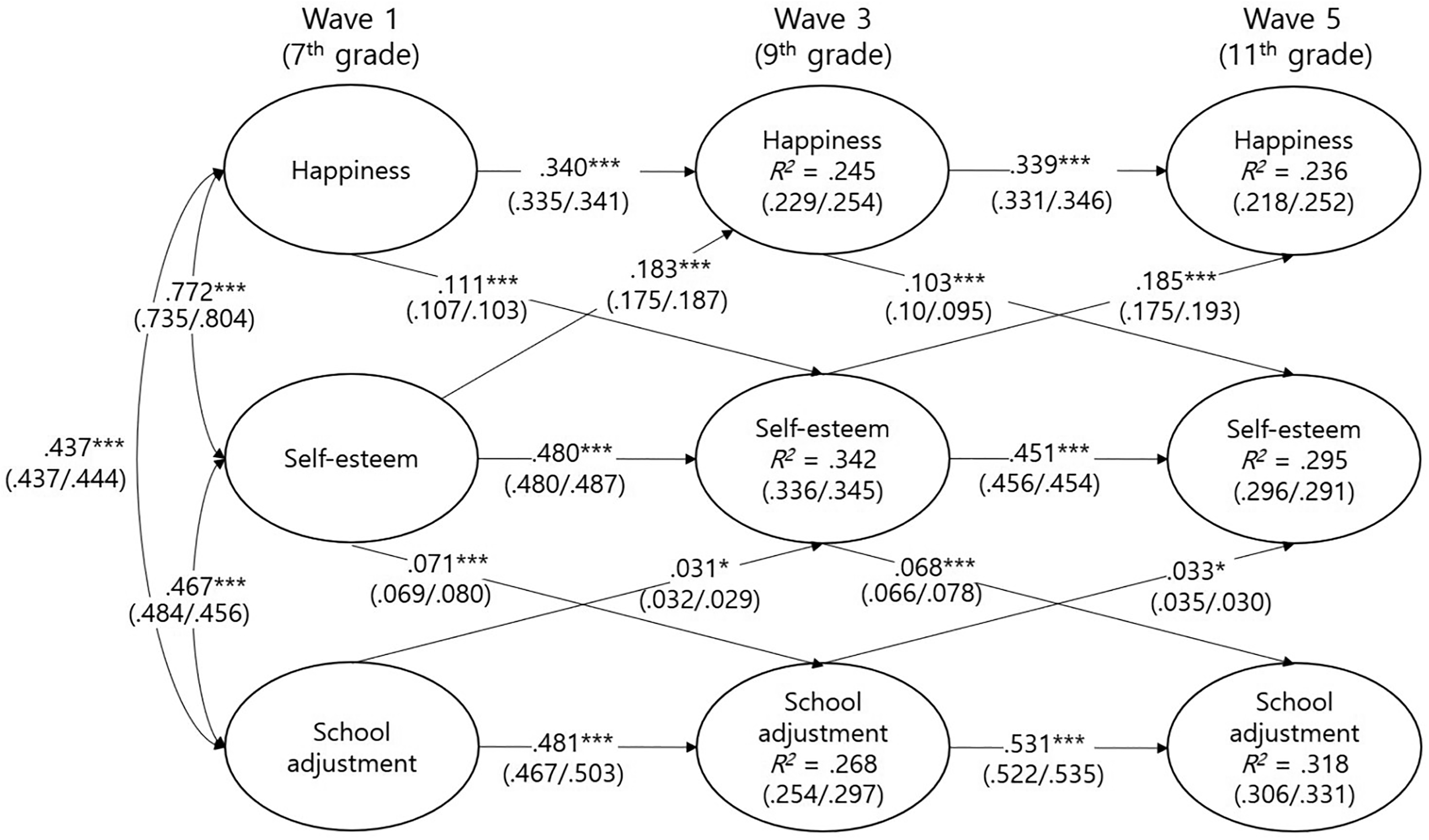
Autoregressive and cross-lagged effects between happiness, self-esteem, and school adjustment note. *p <
Additionally, in order to explore an indirect relationship between happiness and school adjustment, the longitudinal mediation effect of self-esteem was tested using the Monte Carlo method. Relevant unstandardized path coefficients (i.e., a predictor at W1 → self-esteem at W3, self-esteem at W3 → an outcome at W5), and their asymptotic variances and covariance were entered into a Monte Carlo calculator (Selig & Preacher, 2008) to estimate a 95% confidence interval (CI) from the distribution of 20,000 simulated indirect effects. The results indicated that the mediating effect of self-esteem (W3) on the path from happiness (W1) to school adjustment (W5) was significant (unstandardized 95%CI: .0016, .0065; unstandardized b = .004, standardized β = .008). The mediating effect of self-esteem (W3) on the path from school adjustment (W1) to happiness (W5) was also statistically significant (unstandardized 95%CI: .0011, .0168; unstandardized b = .008, standardized β = .006).
Gender differences in longitudinal relationships between variables
A multi-group analysis was performed to test whether autoregressive effects and the cross-lagged effects of happiness, self-esteem, and school adjustment differ between girls and boys. First, a series of invariance tests were conducted for each gender group, from M1 with no constraints to M16 with constraints on factor loadings, autoregressive and cross-lagged paths, and error covariances over time (see boys’/girls’ M1 and M16 in Table 3). The results confirmed that factor loadings, paths, and error covariances were invariant over time for each gender, as indicated by CFI differences between the adjacent models being less than.01.
Fit indices for group invariance tests.
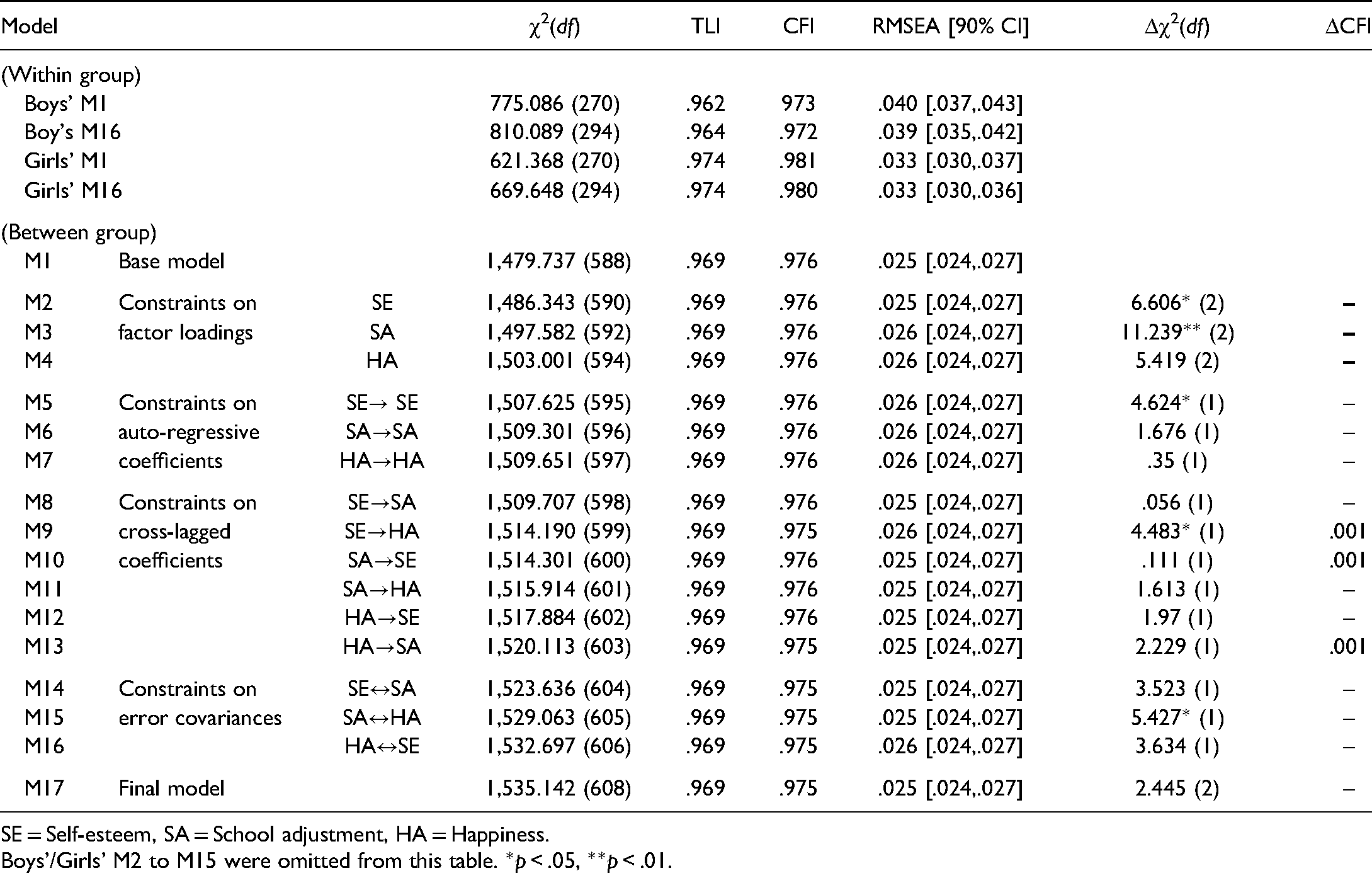
SE = Self-esteem, SA = School adjustment, HA = Happiness.
Boys’/Girls’ M2 to M15 were omitted from this table. *p < .05, **p < .01.
Based on this result, the group invariance was tested sequentially. The baseline model (M1), in which the corresponding factor loadings, paths, and error covariances were constrained to be equal over time, but not across gender, fitted well to the data. Equality constraints were then imposed sequentially on factor loadings (M2-4), auto-regressive paths (M5-7), cross-lagged paths (M8-13), and error covariances (M14-16) between genders. No or negligible changes in CFI between adjacent models indicated that paths and error covariances did not differ between boys and girls over the three waves (RQ3). M17 represents the model that deleted non-significant cross-lagged paths between school adjustment and happiness. The path coefficients of M17 for boys and girls are presented in parentheses in Figure 1.
The longitudinal mediation effects of self-esteem in M17 were tested using the Monte Carlo method for boys and girls, respectively. The results indicated that the mediating effect of self-esteem (W3) on the path from happiness (W1) to school adjustment (W5) was significant for both boys and girls (unstandardized 95%CI: .0017, .0063; unstandardized b = .004, standardized β = .008). The mediating effect of self-esteem (W3) on the path from school adjustment (W1) to happiness (W5) was also significant for boys and girls (unstandardized 95%CI: .0029, .0141; unstandardized b = .008, standardized β = .006).
Discussion
To expand upon previous cross-sectional and unidirectional findings, this study aimed to examine the longitudinal and reciprocal relationships between self-esteem, school adjustment, and happiness in a nationally representative sample of adolescents in South Korea from Grades 7 to 11. The findings suggested that the level of each of self-esteem, school adjustment, and happiness predicted itself at later time points and that the relationships between the variables were reciprocal over time either directly or indirectly.
First, significant autoregressive effects indicate that individual differences in self-esteem, school adjustment, and happiness are moderately stable across the three waves. Happiness (βs = .34), compared to school adjustment (βs = .48, .53) and self-esteem (βs = .48, .45), was less stable from Grade 7 to Grade 9, and in turn, to Grade 11. This result aligns with prior findings that happiness has a stable part but also fluctuates in response to circumstances (Joshanloo, 2019; Lucas & Donnellan, 2007). Shifting school environments, as well as biological, relational, and psychological changes of adolescents (e.g., puberty, romantic relationship, and identity exploration), might contribute to fluctuations in their happiness (Salmela-Aro & Tuominen-Soini, 2010). The higher stability of self-esteem than happiness found in this study corresponds to previous findings (e.g., Marcionetti & Rossier, 2021). Trzesniewski et al. (2003) demonstrated that self-esteem is highly stable but not static over time and more changeable during childhood and early adolescence than late adolescence and adulthood. Similarly, the moderate stability of self-esteem in the present study suggests that self-esteem is relatively stable but can change over the period from Grades 7 to 11. The stability of school adjustment was similar to that of self-esteem, indicating that students’ adjustment to school in the beginning year of middle school (i.e., Grade 7) has positive effects on the 9th and 11th grades of school adjustment.
Second, significant reciprocal effects were found between self-esteem and happiness, even after controlling for their autoregressive effects. This contrasts with some previous findings of a unidirectional effect of self-esteem on happiness (Marcionetti & Rossier, 2021; Moza et al., 2019). The present results indicate that students who regard themselves highly are likely to be happy after two years, and that their happiness can also lead to subsequent high self-esteem during the period from Grade 7 to Grade 11. More specifically, the effect of self-esteem on subsequent happiness (βs = .18) was stronger than that of happiness on subsequent self-esteem (βs = .10, .11). Park (2005) reported that satisfaction with the self was the most important domain of life in predicting overall life satisfaction among high school students in Korea and argued that perception of the self is important for adolescents not only in individualistic cultures but also in collectivist cultures such as Korea. The present results also indicate that feeling good about oneself serves as an important resource for the happiness of Korean adolescents. Wood et al. (2003) revealed that adolescents with high self-esteem tend to savor their positive affect whereas those with low self-esteem tend to dampen it. Such regulation of affect may be conducive to happiness. The buffering role of self-esteem against psychological distress (Eisenbarth, 2012; Greenberg et al., 1992) may also contribute to happiness. In the opposite direction, happy emotional states may promote adolescents’ self-esteem by broadening their cognitive flexibility (Fredrickson, 2004), and thus, by enabling them to find opportunities to grow in the face of adversity and to accept their strengths and weaknesses.
Third, the association between self-esteem and school adjustment was reciprocal. It appears that adolescents with higher self-esteem are likely to adjust to school better after two years, and that higher levels of school adjustment can also foster self-esteem two years later. This is contrary to Baumeister et al.’s (2003) conclusion that self-esteem has little effect on subsequent school performance and interpersonal relationships. In fact, the present results revealed that self-esteem had a greater effect on subsequent school adjustment (βs = .07) than the effect of school adjustment on subsequent self-esteem (βs = .03), when school adjustment was measured as relationships with teachers and peers, learning attitudes and behaviors, and school rule compliance. Their reciprocal effects were, however, weaker than the relationship between self-esteem and happiness.
Fourth, school adjustment and happiness did not have direct cross-lagged effects on each other. This result is different from Stiglbauer et al.’s (2013) findings of reciprocal relationships between school experiences and affective well-being among Austrian secondary school students. This inconsistency might be due to the different operationalizations of school experience and happiness between the two studies. Another important difference is that the present model included self-esteem, whereas Stiglbauer et al., examined the bivariate relationship. In the current study, school adjustment at Grade 7 was indirectly related to happiness at Grade 11 through self-esteem at Grade 9. It appears that when students successfully adjust to middle school in their first year (Grade 7), they are likely to feel good about themselves at Grade 9, and in turn, feel happy at Grade 11. This result is similar to the finding that self-esteem mediates the path from academic achievement to SWB in school among Chinese elementary students (Yang et al., 2019). The reversed paths from happiness at Grade 7 to school adjustment at Grade 11 through self-esteem were also significant in the present study. When students feel happy at Grade 7, they may feel good about themselves at Grade 9. Building on their high self-esteem, students are likely to develop better relationships with teachers and peers, have positive learning attitudes, and follow school rules at Grade 11. The indirect effects through self-esteem were very small, but could be meaningful given that it has a mediating effect over four years, after controlling for autoregressive effects.
Lastly, multi-group analysis revealed that the stability of inter-individual differences in each of self-esteem, happiness, and school adjustment from Grade 7 to Grade 11 is similar between boys and girls. Cross-lagged effects in the ARCL model were also similar between genders. This indicates that the degree to which self-esteem and happiness predict each other and the degree to which self-esteem and school adjustment predict each other over time is the same between boys and girls.
Implications for practice
The significant autoregressive effects of school adjustment, self-esteem, and happiness suggest that early intervention on these variables in the first year of middle school may help adolescents maintain high levels of school adjustment, self-esteem, and happiness until Grade 11. Further studies are necessary to examine the stability of these variables before secondary school. The stronger effects of self-esteem on happiness and school adjustment than in the opposite direction imply that self-esteem can be a worthy target of intervention early in secondary school years to promote happiness and school adjustment for adolescents. Consistent with this, meta-analytic results of 116 studies (Haney & Durlak, 1998) indicated that interventions targeting self-esteem or self-concept in children and adolescents were more effective in improving behaviors, personality functioning, and academic performance than interventions primarily targeting other variables (e.g., academic achievement or social skills). While self-esteem predicted subsequent happiness and school adjustment equally in boys and girls, self-esteem at Grade 7 and Grade 9 were higher in boys than girls in the present study and previous studies (Bleidorn et al., 2016; Kling et al., 1999; Moksnes & Espnes, 2013). Educators need to pay attention to possible differences in levels of self-esteem between girls and boys.
School-based interventions can be implemented to improve students’ self-esteem. School-based meditation programs, for example, have been found to increase self-esteem as students gain accepting and non-judgmental attitudes (Wisner et al., 2010). Encouraging students to identify and use their strengths could also promote their self-esteem (Wood et al., 2011) and happiness (Proctor et al., 2011), which can create a virtuous circle to enhance school adjustment. However, given the relatively weak relationship between self-esteem and school adjustment, in addition to boosting self-esteem, further efforts are necessary to assist students in better adjusting to school. Teachers and practitioners may also need to help students translate their adaptive school experiences into positive self-views in order to facilitate students’ happiness.
Limitations and future research
Some limitations of this study should be noted. First, this study was conducted among adolescents in South Korea across Grades 7 to 11. Future studies need to examine whether the present findings can be applied to other cultures as well as beyond this period of adolescence. Second, the measurement interval in this study was determined to be two years, because the panel data used in this study measured self-esteem every one or two years. The life events that occurred during the measurement interval might have confounded the relationships between the variables. Future researchers can re-examine the variables’ associations at intervals of one year or less, especially given that most Korean schools organize new classes every year and students accordingly would have to adjust to new homeroom teachers and classmates every year. Third, the current study measured happiness based on students’ evaluations of the degree to which their lives are happy, enjoyable, and less worried. Further studies are needed to explore whether the current findings can be applied to different operationalizations of happiness, such as SWB.
Conclusion
Strengths of this study include the examination of the reciprocal rather than unidirectional relationships between the variables over time while controlling for stability effects. The current findings indicate that self-esteem, school adjustment, and happiness all serve as antecedents and outcomes of one another, either directly or indirectly, among secondary school girls and boys in South Korea. It should be noted that the cross-lagged effects of self-esteem on happiness and school adjustment were stronger than the effects of happiness and school adjustment on subsequent self-esteem and that self-esteem mediated the longitudinal association between school adjustment and happiness. These findings support the importance of interventions that foster Korean adolescents’ self-esteem. Building self-esteem in adolescents may be conducive to their happiness and adjustment to middle and high schools, and adolescents’ growing happiness and successful school life can serve as sources of self-esteem.
Footnotes
Availability of data and material
The data is open to the public and available at the NYPD Youth and children Data Archive, https://www.nypi.re.kr/modedg/contentsView.do?ucont_id=CTX030012&menu_nix=E95ij424
Declaration of conflicting interests
The author declared no potential conflicts of interest with respect to the research, authorship, and/or publication of this article.
Funding
The author received no financial support for the research, authorship and/or publication of this article.
