







Abstract
This study analyzed how social and emotional competencies evolved according to adolescents’ involvement in bullying, and whether gender influenced social and emotional competencies’ development. Five-hundred-fourteen students (Mage = 12.71; SD = 1.09) were assessed through self-reports at three different time points for one year. Results showed that students involved in the three analyzed bullying roles displayed a more negative trajectory in all but one social emotional competence analyzed compared to students not involved in bullying. The exception was students who bullied others for responsible decision making. Additionally, gender differences were only found in self-esteem trajectories; boys displayed a more pronounced decrease. In larger classes, students displayed higher levels of self-control, social awareness and responsible decision-making. These results showed that reduced social and emotional competencies were a consequence of bullying involvement for every bullying role analyzed.
Introduction
Bullying has been defined as a set of intentional aggressive behaviors characterized by an imbalance of power and repetition over time (Olweus, 1993). Bullying is a pervasive problem among children and adolescents worldwide (Nansel et al., 2004; Smith et al., 2019), and it may assume several forms, including physical, verbal, relational, or cyber (Yang et al., 2013). Given that the association between bullying and poor psychosocial adjustment is remarkably similar across countries (Nansel et al., 2004), bullying could be considered a critical issue for the health and well-being of youth internationally (Hymel & Swearer, 2015; Yang et al., 2013). Experiences of bullying victimization and perpetration have been associated with psychopathology such as depression (Yang et al., 2013), and other internalizing problems (Coelho & Sousa, 2018a; Gini et al., 2017). Bullying also affects social and emotional development, victims of bullying have displayed lower self-esteem than non-victims (vanGeel et al., 2018) and emotional problems have been associated with more victimization (Busch et al., 2015). Additionally, bullying also greatly affects the school environment contributing to lower academic achievement and higher dropout rates (Cornell et al., 2013).
However, although students´ participation in bullying roles has been studied longitudinally (Salmivalli et al., 1999), several authors (Coelho & Sousa, 2018b; Stavrinides et al., 2010; Zych et al., 2018) concluded that there is a lack of longitudinal studies that address the relationship between bullying and social and emotional competencies. There are clear benefits for obtaining longitudinal data, because it clarifies if low social and emotional competencies make students more prone to being victimized, if involvement in bullying negatively impacts students’ social and emotional competencies, or if there is a reciprocal role in this process.
Social and emotional competencies and bullying
Presently, in the field of social and emotional competencies, the social and emotional learning (SEL) framework has garnered a lot of attention, with over 500 articles published over the last 20 years (Collaborative for Academic, Social, and Emotional Learning, 2015). Furthermore, SEL has been shown to be an effective component in comprehensive bullying prevention interventions (Cook et al., 2010). CASEL (2015; p. 5, line 2–7) has defined SEL as “the process through which children and adults understand and manage emotions, set and achieve positive goals, feel and show empathy for others, establish and maintain positive relationships, and make responsible decisions”, and it has organized social and emotional competencies into five interrelated key competencies: Self-awareness, self-management, social awareness, relationship skills, and responsible decision making. Different social and emotional competencies have been shown to either protect or promote children’s involvement in bullying (Busch et al., 2015; Cook et al., 2010).
Self-esteem
A key element in self-awareness is self-esteem, which was defined by Rosenberg (1965) as “a favourable or unfavourable attitude toward the self” (p. 15). Most studies found that victims of bullying tend to have lower self-esteem than non-victims (Coelho & Sousa, 2018b; Kokkinos & Panayiotou, 2004; vanGeel et al., 2018), and that victimization had long lasting negative effects on self-esteem (vanGeel et al., 2018). The relationship between perpetrating bullying and self-esteem is less clear (vanGeel et al., 2018); some authors (Coelho & Sousa, 2018b; Kokkinos & Panayiotou, 2004) concluded that students who bully others displayed lower self-esteem than students not involved in bullying. However, other studies found that students who bully others reported above-average self-esteem (Salmivalli et al., 1999), or found no significant differences in self-esteem between students who bullied others and non-involved students (Seals & Young 2003). Due to the lack of longitudinal studies, it is unclear if being victimized decreases one’s self-esteem, or if student with low self-esteem are more likely to be targeted as victims.
Self-control
Gresham et al. (2011) defined this competency as the “ability to monitor and/or restrain emotional reactions in social situations”. Some authors (Busch et al., 2015; Jenkins et al., 2016; Unnever & Cornell, 2003) concluded that a lack of emotion management and self-control makes middle school students more prone to being bullied by their peers and that students with lower self-control are more likely to bully their classmates.
Social awareness
Given that social awareness consists of understanding other people, empathy, compassion and norms (CASEL, 2015), it is reasonable to assume that low levels of social awareness could lead children to act more hostile and aggressive in social situations, including bullying others. Social and empathetic awareness has been shown to help prevent bullying (Jenkins et al., 2016; Stavrinides et al., 2010; vanNoorden et al., 2015). Greater awareness of others’ feelings may not only allow students to treat each other with respect, but also cause them to intervene and stop bullying situations (vanNoorden et al., 2015). However, there is a lack of longitudinal studies focusing on the relationship between bullying involvement in specific bullying roles and social awareness.
Relationship Skills
According to Zych et al. (2018), relationship skills make it possible to initiate and maintain positive interpersonal relationships, to respect social norms, and include good communication skills. It is a crucial competence for analyzing bullying, because bullying does not exist in a vacuum, it is influenced by the broader environment, in which the peer group and friendships play an important role (Barboza et al., 2009). Therefore, the ability to make and keep friends successfully is an important protective factor against being bullied (Rodkin & Hodges, 2003). However, several studies concluded that bullied children tend to have fewer friends (Rodkin & Hodges, 2003), that victims and bully-victims consistently displayed poorer relationships with classmates (Nansel et al., 2004), and that students who bullied others displayed more peer problems (Busch et al., 2015).
Responsible decision making
Responsible decision making, according to CASEL (2015), involves a reflexive consideration of different choices, specifically considering the wellbeing of self and others. Among the few studies analyzing the relationship between responsible decision making and bullying, Zych et al. (2018) reported that bully-victims had lower levels of responsible decision making than victims and non-involved students.
Individual characteristics
Gender differences
There are some differences between genders in social and emotional competencies. Several studies (Coelho & Sousa, 2018b; Jenkins et al., 2016) found that girls reported greater social awareness scores than boys. Also, substantial differences between genders have been found for bullying perpetration (Coelho et al., 2016; Cook et al., 2010; Nansel et al., 2004; Smith et al., 2019). All these studies concluded that boys were more frequently perpetrators of bullying than girls. Furthermore, there is also a classical difference in bullying patterns identified by Olweus (1993), with physical bullying being most common among boys (Cook et al., 2010; Hymel & Swearer, 2015), while more indirect forms of bullying (rumor spreading, social exclusion) were most common among girls (Olweus, 1993).
For victimization, gender differences are not so consistent (Cook et al., 2010; Smith et al., 2019). Some studies (Coelho et al., 2016; Yang et al., 2013) concluded that boys were more likely to be victims than girls. However, there are also studies that did not identify gender differences in victimization (e.g., Cook et al., 2010), or that reported that boys were more frequently victims of bullying (Smith et al., 2019). Furthermore, Unnever and Cornell (2003) considered that boys who had high self-control could be at added risk for victimization, because they were not sufficiently assertive or aggressive in their behavior to discourage students who bully others from targeting them. In contrast, for girls, self-control was consistently seen as a positive social quality (Unnever & Cornell, 2003).
Age differences
It has long been established in the literature that there is a universal decline in bullying perpetration and victimization with increasing age (Coelho et al., 2016; Hymel & Swearer, 2015; Smith et al., 2019). Smith et al. (2019) in a large study including five large cross-national data bases also concluded that the preponderance of boys being perpetrators and victims reduces in early adolescence for perpetration and mid-adolescence for victimization. Consistent with the international literature, in Portugal, victimization was also found to decrease in higher grades of middle school, from 13.7% for 12-year olds to 7.6% for 14-year-olds (Coelho et al., 2016). Therefore, it is important to include age as a covariate.
Classroom characteristics
The most salient context in which bullying takes place in adolescence is schools, and bullying takes place more commonly among classmates (Garandeau et al., 2019; Sentse et al., 2015). Classrooms are social settings of which students are involuntary members, where they spend most of their time at school and interact with other students daily (Sentse et al., 2015). This is particularly noticeable in Portugal, where students stay with the same group of students all throughout the school day. In line with this circumstance, a considerable amount of the variance found in bullying was due to class characteristics (Coelho & Sousa, 2018b). Among class characteristics, classroom size has been associated with difference in bullying and victimization prevalence (Garandeau et al., 2019); smaller classrooms have been associated with a higher prevalence of bullying and victimization and larger classes have been associated with denser social networks (Scholte et al., 2010). It is also worth mentioning the Coelho and Sousa (2018a) found that larger classes were associated with higher levels of self-control and social awareness.
Present study
Previous research has focused on analyzing the differences in social and emotional competencies that co-occur with bullying and victimization, and few studies used longitudinal data to analyze the relation between bullying and its predictors (Sentse et al., 2015; Zych et al., 2018). Given that bullying poses a substantial threat to the later social–emotional development of victims (Zych et al., 2018), the use of longitudinal data will clarify if differences in social and emotional competencies between students involved in different bullying roles and those not involved predict involvement in bullying, and if bullying involvement negatively affects social and emotional competencies.
Therefore, the present study employs a multilevel longitudinal design to analyze the evolution of students’ social and emotional competencies (as conceptualized by CASEL, 2015) during one school year, according to their involvement in bullying and if gender influence this evolution, while accounting for socioeconomic status, grade and class size. Three research questions, with corresponding hypothesis (when possible) were formulated. Research Question 1: Do students who are victims of bullying display lower levels of self-esteem than students who are not involved in bullying? Based on research (Coelho & Sousa, 2018b; Kokkinos & Panayiotou, 2004; vanGeel et al., 2018), it is hypothesized that students who are victims of bullying will display lower levels of self-esteem than students not involved in bullying (Hypothesis 1). Due to limited longitudinal research in this area, the second and third research question are exploratory with no hypothesis; Research Question 2: Will there be gender differences in the development of students' social and emotional competencies during the time analyzed?; and Research Question 3: Will students involved in any bullying role display a more pronounced decrease in every social and emotional competence analyzed, when compared to students not involved in bullying?
Method
Participants
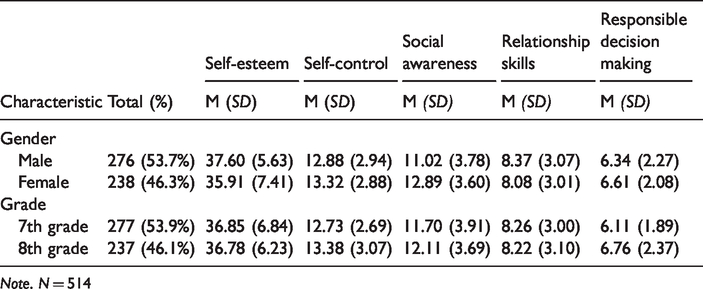
The sample was a convenience sample of 514 middle school students (7th and 8th graders at time 1), from 28 classes in six public middle schools in the district of Lisbon. Students were aged between 11 and 15 years (Mage = 12.71, SD = 1.09). The sample consisted of 258 boys (54%) and 220 girls (46%). Classes varied in size, ranging from 15 to 25 students (M = 18.36; SD = 3.16). Classes were extremely homogeneous in terms of ethnicity (99.1% of students were Portuguese, the remainder Brazilian) and socioeconomic status (ranging from 36.2% to 40.3% of students per school received free or reduced-price school meals, FRSM). Additional information about the participants is displayed in Table 1. Regarding attrition, nine students did not participate in the second assessment due to having moved to a school outside the school grouping, while the same occurred to an additional 18 other students in the third assessment. Furthermore, fourteen parents opted out of having their youth participating, so they were not included in the sample.
Social and emotional competencies across gender and grades.
Note. N = 514
Procedure
The present study was approved by the Psychology for Positive Development Research Center. Data collection took place in three different moments; in time 1 (T1, October 2013) demographical information and the initial social and emotional competencies were collected; in time 2 (T2, March 2014) the mid-school year levels of social and emotional competencies were gathered; and in time 3 (T3, October 2014) the final levels of social and emotional competencies and bullying roles were assessed (because the questionnaire assessing bullying asks for information regarding the previous school year). Both T1 and T3 were less than a month after the start of the respective school year (2013/14 and 2014/15). Evaluation took place after obtaining authorization from school boards, as well as passive consent from parents, consistent with national legislation. Participants completed the questionnaires in their regular classroom setting, in the presence of their teachers and, in all evaluations, the questionnaires were administered by one of four educational psychologists who were conducting a screening process for inclusion in a Social and Emotional Learning program at Time1; only Control Group students were included in T2 and T3. The psychologists explained the study procedure, read questionnaire instructions aloud, reassured students of the confidential nature of the study, and assisted participants who required help. Students took roughly 30 minutes to fill out the questionnaires per classroom. If a student was not present during that class, the psychologist returned the following week (n = 14).
Measures
Social and emotional competencies
The Social and Emotional Competencies Evaluation Questionnaire (QACSE; Coelh et al., 2015) was used. This self-report instrument for adolescents (11 to 16 years) consists of 39 items. In this study we used four of the questionnaire’s six subscales: self-control (7 items such as “I talk and argue my points calmly, without getting angry”; α = .73; .72 in the present sample); social awareness (7 items such as “I try to help students who are rejected by the group”; α = .87; .85 in the present sample); relationship skills (7 items such as “When problems occur my students turn to me for advice”; α = .71; .74 in the present sample); and responsible decision making (4 items such as “I ponder several alternatives before making a decision”; α = .87; .82 in the present sample). The items are presented as statements to be rated on a four-point scale (A = never; B = sometimes; C = frequently and D = always). The instrument’s concurrent and convergent validity was established in Coelho et al. (2015).
Self-esteem
We used the global self-esteem scale (Portuguese version; Fontaine, 1991) of the Self-Description Questionnaire-II (SDQ-II; Marsh, 1990). This scale allows the evaluation of global self-worth. The scale consists of 10 items (e.g., “Overall, I have a lot to be proud of”) rated on a five-point scale (1 = false; 2 = mostly false; 3 = nor true or false; 4 = mostly true; 5 = true). Five of these items are presented as negative statements and are reverse scored. The scale’s internal consistency has been shown to be adequate for both the original and Portuguese version, with Cronbach’s α of .88 and .82 respectively (.84 in the present sample).
Bullying
The bullying scales of the Bullying and Cyberbullying Behaviours Questionnaire (QCBC; Coelho et al.Coelho et al.,, 2016) were used. The QCBC (Coelho et al., 2016) is a 34-item self-report measure intended to assess bullying and cyberbullying behaviors. It includes four items where students are given a definition of bullying (i.e., frequent, power differential, and negative intent), and asked to rate on five-point scale (1 = Never to 5 = Always) the frequency of bullying, victimization, defending and fear of being bullied. The QCBC also includes two subscales that assess two different participant role behaviors in bullying, bullies and victims; both subscales (each containing eight items) assess the frequency of experiences by asking participants to report how often the behaviors described in each item occurred during the previous school year. The victimization subscale describes experience of being a victim of bullying (e. g., “I was hit, kicked or pushed hard”). The bully subscale described bully behaviors (e. g., “I spread rumors or doubtful stories”). Both scales were scored on a five-point scale (1 = Never happened; 2 = Once or twice during the school year; 3 = 2 to 3 times a month; 4 = Once a week; 5 = Several times a week). Exploratory and confirmatory factor analysis results have supported the two-factor structure of the QCBC in a sample of 1039 middle school students (Coelho et al., 2016). The internal consistency alpha coefficients reported were .77 for the Bully subscale (.80 in the present sample) and .79 for the Victim subscale (.83 in the present sample).
Data analysis
Students were classified as victims of bullying or students who bullied others if they rated the item describing victimization (or bullying) three or more and, simultaneously, rated one of the eight victim (or bully) behaviors as having occurred at least two to three times a month during the previous school year. Students were classified as bully-victims if they filled these criteria for both roles. The criteria for cut-off points follows Solberg and Olweus (2003).
Students from the same class have a much higher probability of providing highly correlated responses (Heck et al., 2013). So, given the hierarchical and clustered nature of the study dataset, we used hierarchical linear modeling in MLwiN 2.36. Three-level models were used, the three measurements were nested within 514 students, which were nested within 28 school classes. To test our research hypotheses, a series of models were created for each outcome (these are available in the Supplemental Materials). First, an unconditional model (Model 0) with no predictors was run to analyze between-class variance. Time was added next assess within-individual variation. Next, gender and bullying role (victim, bully, bully-victims or non-involved) were entered as explanatory variables at the child level. Bullying roles were dummy coded (0 = victims, 1 = bullies, 2 = bully-victims, 3 = not involved, and all comparisons were made with the non-involved students’ group. For the fourth model, classroom level variables (FRSM, grade and class size) were entered as co-variates at the class level, FRSM and class size were grand-mean centered. In the final model, a series of cross-level interactions terms were specified using dummy coding, these cross-level interactions included Gender*Time and Bullying Role ∗ Time (for each of the bullying roles).
Results
Descriptive statistics and intraclass correlations
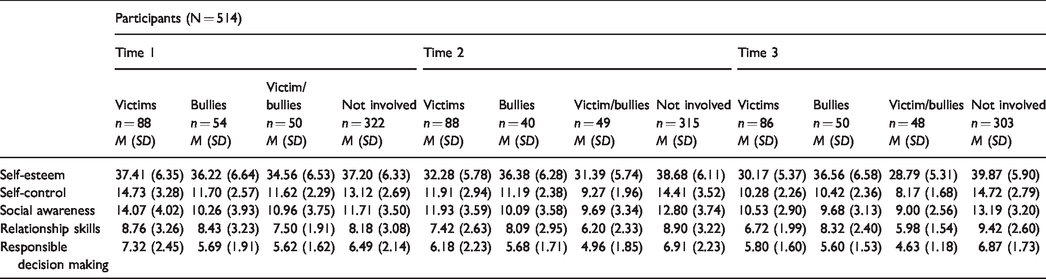
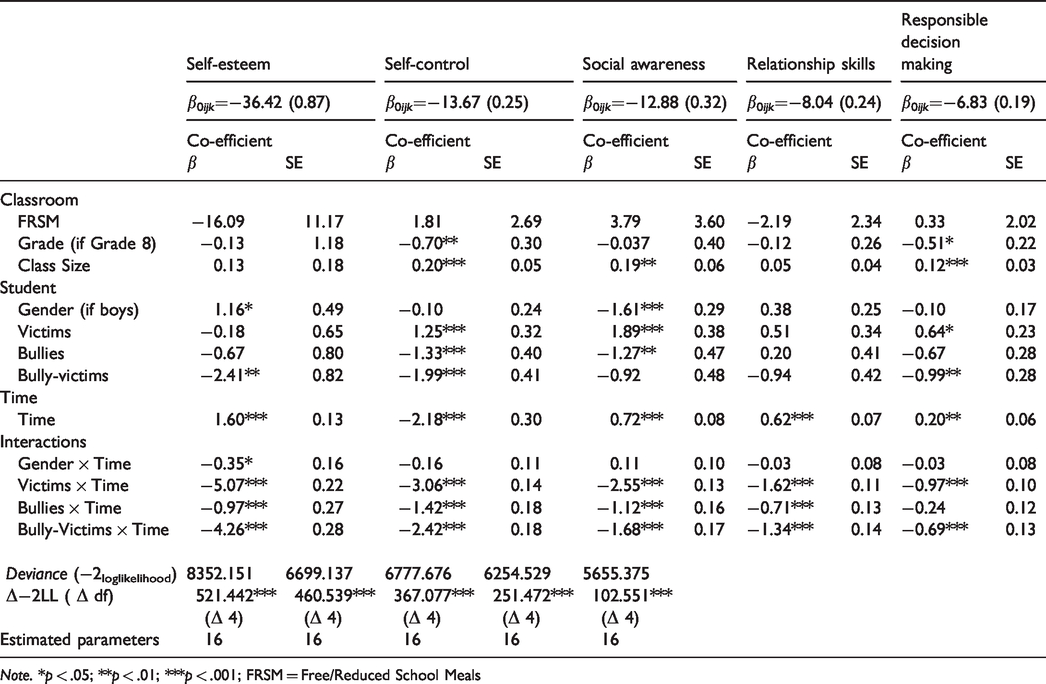
In the total sample, 17.1% of the students were victims of bullying, 10.5% of students bullied other students, and 9.7% were bully-victims. Boys bullied other students (13% vs. 7.6%) and were also bully-victims (11.2% vs. 8%) more frequently than girls, whereas girls were more frequently victims than boys (22.7% vs. 12.3%). All students’ bullying roles were similar across grades. These results are, therefore, in line with previous studies conducted in Portugal with students of the same age group (Coelho & Sousa, 2018a, 2020), which found that between 16.6% and 23.1% of students reported having been victimized, and that between 10.6% and 12.1% of students admitted that they had bullied other students. The descriptive statistics for the social and emotional competencies per bullying role are displayed in Table 2, whereas the final models for Social and Emotional Competencies are displayed in Table 3.
Descriptive statistics – social and emotional competencies per bullying role.
Multilevel model analysis final models for social and emotional competencies.
Note. *p < .05; **p < .01; ***p < .001; FRSM = Free/Reduced School Meals
Self-esteem
As seen in Table 3, several predictors remained significant after adjusting for Level 1 (within-individual), Level 2 (between-individuals) and Level 3 (between-classes) variables. Time was statistically significant; students showed an increase in self-esteem throughout the analyzed period. Among individual predictors, both gender (boys displayed higher initial levels of self-esteem) and involvement in bullying as a bully-victim (bully-victims displayed lower initial levels of self-esteem than non-involved students) were also statistically significant. All cross-level interactions were significant; between time and gender (boys displayed more pronounced decreases than girls), as well as between time and involvement with bullying in every analyzed role; victims of bullying, students who bullied other students and bully-victims displayed more pronounced decreases than non-involved students in self-esteem throughout the analyzed period. Altogether, the individual- and class-level predictors and the cross-level interactions accounted for 17.6% of between-individual variance and 19.9% of between-class variance in self-esteem.
Self-control
Time was a statistically significant predictor of self-control; students showed an decrease in self-control throughout the analyzed period. Among between-individual variables, bullying roles were significant predictors of self-control; students who bullied others and bully-victims, on the other hand, had lower initial levels of self-control than non-involved students, whereas victims had higher initial levels of self-control than non-involved students. As for class-level variables, grade and class size were also significant predictors of self-control; 7th graders and students from larger classes displayed higher levels of self-control. Furthermore, all cross-level interactions between both time and bullying roles were also significant; students involved in an analyzed bullying role displayed more pronounced decreases in self-control than non-involved students. Altogether, the between-individual and between-class level variables explained, respectively, 24.6% of the between-individual variance and 77% of the between-class variance in self-control.
Social awareness
After adjusting for all predictors, time was a statistically significant predictor of social awareness (Table 3); students’ social awareness increased during the analyzed period. Several individual variables were also significant, namely gender and bullying roles; students who bullied others and bully-victims displayed lower initial levels of social awareness than non-involved students, whereas girls and victims had higher initial levels of social awareness than boys and non-involved students (respectively). Additionally, class size (a class-level variable) was also a significant predictor of social awareness; students from larger classes displayed higher levels of social awareness. Finally, cross-level interactions showed that students involved in every bullying role analyzed displayed a significantly more pronounced decline in social awareness than students not involved in bullying during the analyzed time. Altogether, the between-individual, between-class level variables and the cross-level interactions explained, respectively, 12.9% of the between-individual variance and 66.1% of the between-class variance in social awareness.
Relationship skills
The only statistically significant predictors were time (relationship skills increased during the analyzed period), and the cross-level interactions between bullying roles and time; student involved in every bullying role (as victims, students who bullied others, or bully-victims) displayed more pronounced decreases than non-involved students. The final model showed a decrease of 5.8% in between-individual variance and 73.2% in between-classes variance over the model without predictors.
Responsible decision making
After adjusting the models for all predictors, time was a significant predictor of responsible decision making; during the analyzed period responsible decision making increased. Regarding individual predictors, two bullying roles emerged as significant predictors of responsible decision making; students who bullied others and bully-victims had lower initial levels of responsible decision making than non-involved students. Additionally, grade and class size (class-level variables) were also significant predictors of responsible decision making; 7th graders and students from larger classes displayed higher levels of responsible decision making than 8th graders and students from smaller classes. Two cross-level interactions between time and bullying roles also emerged as significant statistically; students who were victims and bully-victims displayed significantly more pronounced decreases in responsible decision making when compared to students not involved in bullying. Altogether, the class- and individual-level variables explained 8.8% of the between-individual variance and 61.9% of the between-class variance in responsible decision making.
Discussion
The present study employed a multilevel longitudinal design to analyze whether students’ involvement in bullying roles impacted the development of students’ social and emotional competencies over one school year, and if there were gender differences in the development of those competencies. And indeed, regarding the third research question, which was central to the study; the results showed that students involved in three analyzed bullying roles displayed a more negative trajectory than non-involved students in all but one social and emotional competence analyzed. The only exception was for responsible decision making, where students who bullied others did not display a more pronounced decrease than non-involved students. Therefore, the results confirmed that bullying thoroughly affects the social and emotional competencies of students involved in different bullying roles, which is line with previous longitudinal bullying studies (Busch et al., 2015; Stavrinides et al., 2010).
Regarding the first hypothesis, it was not supported by the results of the present study, because no differences in self-esteem were found between students who were victims of bullying and students not involved in bullying. Therefore, the present study’s results contradicted previous studies which had concluded that students who were victims of bullying displayed lower levels of self-esteem than non-involved students (Coelho & Sousa, 2018b; Kokkinos & Panayiotou, 2004; vanGeel et al., 2018). Furthermore, students who were victims of bullying displayed a similar trajectory to students who bullied others and bully-victims, with more pronounced decreases in self-esteem than students not involved in bullying throughout the analyzed period. The longitudinal nature of the present study is the most likely explanation for the contradiction with previous results (following Barboza et al, 2009), i.e., the more pronounced decrease in self-esteem for students who were victims of bullying might explain the lower levels of self-esteem revealed by students who were victims of bullying in several cross-sectional studies.
Regarding the second research question, when gender differences in the development of social and emotional competencies were analyzed, the only statistically significant difference occurred in self-esteem; boys displayed a more pronounced decrease throughout the analyzed period. As such, the results of the present study are mostly in line with the only study which analyzed longitudinal gender differences in the relationship between a social and emotional competency and bullying roles. In this study, Busch et al. (2015) also found no gender differences in the evolution of pro-social behavior for students who had been victims or perpetrators of bullying. Once again, the results highlight the importance of a longitudinal approach to analyze the relationship between bullying roles and social and emotional competencies. Most studies which reported differences between genders in social and emotional competencies are cross-sectional (Coelho & Sousa, 2018b; Jenkins et al., 2016; Unnever & Cornell, 2003) and, therefore, reflect differences between genders in a fixed point in time. In the present study, the results also showed gender differences in initial self-esteem (boys had higher levels than girls) and social awareness (girls had higher levels than boys).
Additionally, when analyzing the third second research question, and taking into account that the present study followed students for one year, its results contribute to disentangle some contradictions between different studies regarding the relationship between bullying roles and social and emotional competencies. The results of the present study support the interpretation that the lower social and emotional competencies for students involved in different bullying roles, reported in several cross-sectional studies, may be already a result of their involvement in bullying roles. As such, the results are aligned with previous research that established that prior involvement in bullying operated against the development of empathy (Stavrinides et al., 2010). This is particularly noticeable for students who have been victims or bully-victims. Students who reported being involved in one of these roles reported a more pronounced decrease in all but one social and emotional competency. However, the results of the present study did not support authors (e.g., Sentse et al., 2015) who suggested that some students that bully others obtained certain social prestige from dominating the peer groups. Students who bullied other did not display initial differences in relationship skills but displayed a more pronounced decrease in this competency than non-involved students.
Furthermore, in three social and emotional competencies (self-control, social awareness and responsible decision making) class size was a statistically significant predictor of the competency, a result that is in line with Coelho and Sousa (2018b). There are two possible explanations for the differences in self-control and social awareness in larger classes. The first possible explanation is that, in larger classes, students need to adapt to larger and more diverse groups of peers, which requires them to control their social interactions more actively, probably leading to increased self-control. The second possible explanation is that larger classes lead to denser social networks (as proposed by Scholte et al., 2010), which may lead to higher levels of social awareness.
The results of the current study should be considered in future bullying prevention efforts because students who were victims of bullying possessed higher levels of some social and emotional competencies (such as self-control, social awareness and responsible decision making) than non-involved students. Therefore, students who display higher levels of these competencies may face greater risks of victimization, something that was not possible to find previously in cross-sectional studies.
Limitations
Although the present study employs a longitudinal approach, something that is recommended by several authors (Coelho & Sousa, 2018b; Sentse et al., 2015; Zych et al., 2018), there are several limitations that must be acknowledged. The main limitation is that results are based solely on students’ self-reports. Even though Hymel and Swearer (2015) have concluded that, for bullying, self-reports are economical, efficient and give youth a voice in the assessment process, because they tap into the perceptions of both students who bullied others and students who were victims of bullying, this methodology also has several weaknesses: it can be vulnerable to self-presentation strategies or influenced by social desirability and memory biases (Hymel & Swearer, 2015). Therefore, future studies should include peer-reports and teacher reports, even though teachers may be less aware of bullying incidents than students.
Additionally, the sample only included students from public schools which might further limit the generalization of its results. Consequently, classes were very homogeneous regarding SES status, which limited the relevance of FRSM as a class-level variable. However, this limitation should be viewed in the light of the Portuguese school system, where 87.6% of middle school students attended public schools (Direção Geral de Estatísticas da Educação e da Ciência, 2019).
Future studies
Future studies should include further points in time, encompassing more school years to understand if those involved in bullying continue to experience a drop in their levels of social and emotional competencies, how long it takes for them to reach a bottom level, or if students who stop being involved in these situations recover to their previous levels of social and emotional competencies. Also, other possible classroom-level characteristics should be analyzed longitudinally because they are likely to be relevant. For instance, the classroom climate of moral engagement, because participants who were classified as non-involved in bullying might actually be witnesses of bullying who might, or not, intervene, to help their classmates (Thornberg & Jungert, 2014).
Supplemental Material
sj-pdf-1-spi-10.1177_0143034321988972 - Supplemental material for A multilevel analysis of the influence of bullying participant roles upon the trajectories of adolescents’ social and emotional competencies
Supplemental material, sj-pdf-1-spi-10.1177_0143034321988972 for A multilevel analysis of the influence of bullying participant roles upon the trajectories of adolescents’ social and emotional competencies by Vítor Alexandre Coelho and Marta Marchante in School Psychology International
Footnotes
Declaration of conflicting interests
The author(s) declared no potential conflicts of interest with respect to the research, authorship, and/or publication of this article.
Funding
The author(s) received no financial support for the research, authorship, and/or publication of this article.

Supplemental material
Supplemental material for this article is available online.
Author biographies
References
Supplementary Material
Please find the following supplemental material available below.
For Open Access articles published under a Creative Commons License, all supplemental material carries the same license as the article it is associated with.
For non-Open Access articles published, all supplemental material carries a non-exclusive license, and permission requests for re-use of supplemental material or any part of supplemental material shall be sent directly to the copyright owner as specified in the copyright notice associated with the article.
