







Abstract
This study examined publication output, authorship patterns, citation impact, and international representation across 45 years of articles published in School Psychology International (SPI) and across available years of International Journal of School & Educational Psychology (IJSEP). SPI showed a long-term, relatively stable growth trajectory in articles published per year, with modest fluctuations, whereas IJSEP exhibited a more variable pattern, peaking in articles published in 2019 before declining somewhat. Authorship became increasingly collaborative over time, with the average number of authors per article rising steadily in SPI and remaining consistently higher in IJSEP. SPI articles received higher average citations per article than IJSEP, although citation rates per year were similar across journals. Highly cited SPI articles were predominantly quantitative and focused on bullying and victimization, whereas IJSEP's highly cited articles were more often expository and focused on teacher experiences, professional issues, and student well-being. Across journals, highly cited articles frequently emphasized positive psychology, but none resulted from international collaborations. International collaboration was more prevalent in IJSEP (22.0%) than SPI (15.2%). Across journals, 81 countries were represented by first authors, with increasing international representation driven largely by co-authorship. Although authorship was historically dominated by those from Western European and North American countries, recent declines in rates of authors from these regions—particularly among first authors—suggest a shift toward broader international engagement.
Keywords
This study has its origins in our goal to describe important features of key publications, including journal articles, books, and journals, in school and educational psychology. 1 Recent research (e.g., Karakaya-Ozyer, 2025; Parra-Martinez et al., 2023) has highlighted the quantitative and qualitative features of some leading journals in fields adjacent to school psychology because bibliographic database coverage has expanded and sophisticated analytic methods have emerged. These innovations and the increased access to them by researchers allow for (a) a more comprehensive evaluation of journal publications than could be feasibly conducted via manual review of journal issues as well as (b) a more extended analysis of available data about them. Given these trends, we intended to highlight the full publication history of at least one of the primary generalist journals in school psychology (Floyd, 2018; Hulac et al., 2025).
We were also moved to document international engagement efforts to produce scholarship (Begeny et al., 2021) across decades of publications. Following the rigorous documentation of 45 peer-reviewed, scholarly journal outlets devoted to school and educational psychology in the late 2010s by Begeny et al. (2019), we identified two primary generalist journals that explicitly (a) referred to school psychology or school and educational psychology and (b) included the word international in their titles. 2 As our first step in a multi-study approach to advance the understanding of the literature published in journals highlighting international school and educational psychology, we selected School Psychology International (SPI) and International Journal of School & Educational Psychology (IJSEP) for evaluation.
We begin with a description of the history of SPI and IJSEP, provide an overview of related systematic literature reviews and bibliometric analyses of articles from these journals, and spotlight three studies examining international authorship patterns. Then, we describe the results of a comprehensive analysis of every article published across these journals from 1979 through 2024. In doing so, we advance prior research (in part, by examining earlier publications and more recent publications) and offer recommendations for advancing international engagement in school psychology scholarship.
History of the Journals
Both SPI and IJSEP had their origins in the International School Psychology Committee (ISPC). Emerging from the combined efforts of Calvin Catterall and Frances Mullen, the ISPC was formed in 1972 through the American Psychological Association's Division of School Psychology. Within a year's time, a partnership was formed with the National Association of School Psychologists to support the ISPC (Fagan & Wise, 2007). Among other accomplishments, members of the ISPC promoted the publication of SPI in 1979. After a decade of growth, including offering an annual colloquium, a newsletter, and a journal promoting its key goals, the ISPC was transformed into the International School Psychology Association (ISPA) with the approval of a constitution and bylaws in 1982 (Fagan & Wise, 2007; ISPA, 2025; Oakland, 1993). In 1983, SPI became the official journal of ISPA.
Since its inception, SPI has published continuously. Its editors-in-chief included Ludwig Lowenstein (from England), Robert (Bob) Burden (from England), Caven Mcloughlin (from South Africa and the USA), Amity Noltemeyer (from the USA), and Sally Grapin (from the USA). Unable to complete contract negotiations with SPI's publisher, ISPA contracted with Taylor & Francis to initiate the publication of IJSEP in 2013. The journal's first editor-in-chief was Rik D’Amato (from Macau, China, and the USA) and its subsequent editors have been Gertina van Schalkwyk (from Macau, China) and Tamika La Salle-Finley (from the USA). Beginning in 2013, both SPI and IJSEP published articles 3 highlighting school and educational psychology across the globe.
Systematic Literature Reviews and Bibliometric Analysis Featuring SPI and IJSEP
In the context of a rapidly advancing body of research examining publications in school and educational psychology, our introduction primarily focuses on systematic literature reviews and bibliometric studies 4 that have analyzed features of articles published in SPI and IJSEP. It is evident that researchers have completed numerous studies targeting SPI's articles. However, because IJSEP is a newer journal, it has only recently been included in such studies.
Systematic Literature Reviews
According to Donthu et al. (2021), “systematic literature reviews, such as domain-, method-, and theory-based reviews, encapsulate the acquisition, arrangement, and assessment of the extant literature using systematic procedures … which are typically carried out manually (e.g., content and thematic analyses) by scholars” (p. 287). Numerous domain-based literature reviews have featured articles published in SPI that have examined English language learners (Albers et al., 2009) and LGBTQ youth (Abreu et al., 2022; Thomas et al., 2023), autism spectrum disorder (McClain et al., 2018; Mckenney et al., 2015); and spirituality and religiosity (Parker et al., 2021). Considering articles from both SPI and IJSEP, Grant et al. (2022) examined research from a decolonial framework, Flood et al. (2024) examined self-care research, Goldie et al. (2025a) examined racism research broadly, Grapin and Goldie (2026) examined research studying racism and school climate, Grapin et al. (2025) examined research studying antisemitism, and Goldie et al. (2025b) examined research studying racism and graduate students. Furthermore, at least five recent systematic literature reviews featuring SPI have been method-based reviews. For example, Begeny et al. (2018a) considered causal-experimental research, Radley et al. (2020) considered single-case research, McClain et al. (2021) considered meta-analytic studies, Sabnis et al. (2023) considered qualitative studies, and Wang et al. (2024) highlighted mixed methods studies.
Other systematic literature reviews used a comprehensive multifaceted framework to describe articles published in SPI. For example, Strein et al. (2003) classified articles published in SPI and other journals across 5 years (1994–1998) into 18 categories. They found that most SPI articles addressed psychopathology and personality development (27.1%), professional issues (16.9%), multicultural issues (15.3%) and general education (10.2%). Little et al. (2011) classified articles published in SPI across 22 years (1990–2011) into 11 categories based on NASP's (2010) Model for Comprehensive and Integrative School Psychological Services. Most articles (33.1%) fell into their “other” category. Considering the substantive categories, 21.3% of articles primarily addressed legal, ethical, and professional issues, and 16.4% addressed prevention and responsive services.
Bibliometric Studies
Donthu et al. (2021) defined bibliometric studies as “the application of quantitative techniques (i.e., bibliometric analysis—e.g., citation analysis) on bibliometric data (e.g., units of publication and citation)” (p. 286). Furthering this definition, bibliometric studies typically analyze large quantities of data obtained from databases, such as Web of Science and PsycINFO, that cannot be feasibly addressed through manual analysis. They typically address not only numbers of publications and citations that are generated from publications but also references that authors include in their publications and keywords associated with publications (Rousseau et al., 2018). In the context of bibliometric studies, citations refer to instances in which other authors include mention of a publication (e.g., a journal article) in their own publications, and references refer to authors including publications in their reference sections of articles published in a targeted journal or journals. Analyzing citations and references are two ways to examine the impact that a publication and its authors have had on a field.
At least seven bibliometric studies have included articles from SPI; one of these studies also included IJSEP. Frisby (1998) analyzed reference sections of articles published in SPI, six other journals associated with the field of school psychology, and 15 additional journals across five years (1990–1994). He found that, across reference sections and journals, articles from SPI were cited 3,661 times, which was the second lowest value across his study's 22 journals. Liu and Oakland (2016) employed the Web of Science database to examine the history of the use of the term “school psychology” (and its variants) in the professional literature. Among other findings, they reported that SPI was the fourth most productive journal in producing articles addressing school psychology. SPI contributed to 6.7% of the articles in their corpus. Liu and Oakland also found that SPI articles were cited, on average, 5 times, but no SPI article was among their top 30 most highly cited articles. More recently, Hernández-Torrano and Ho (2021) reported that SPI published 719 articles across 2000 to 2019 in the Web of Science category of educational psychology, which ranked SPI fifteenth of the 60 journals included in that category in 2019. They reported, on average, 2.9 authors per SPI article.
Using the Web of Science database, Jennings et al. (2008) considered 470 articles published in SPI from 1995 through 2007. Their citation analysis revealed that the most cited books across articles in SPI included Best Practices in School Psychology III (Thomas & Grimes, 1995, with 28 citations) and Bullying at School: What We Know and What We Can Do (Olweus, 1993, with 28 citations). The Handbook of School Psychology (Gutkin & Reynolds, 1990) was also cited 21 times. As noted previously, Little et al. (2011) focused on articles published in SPI across 22 years; they targeted all articles analyzed by Jennings et al. (2008) and also articles from nine additional years. They employed the PsycINFO database and reported that the SPI published 671 items during this period. About a third of SPI's articles (32.3%) had zero citations. Across an array of results, they reported that the most highly cited SPI articles were Hoover et al. (1992), Huebner (1991), Bracken and Barona (1991), and Craig, Pepler et al. (2000b).
Drawing on the Web of Science database and considering SPI and four other school psychology journals, Price et al. (2011) examined 562 articles published in SPI beginning with issues published in 1994 through most issues published in 2009. These articles yielded 1,434 citations and an average of 2.6 citations per article, which was the lowest of the journals considered; 45% of SPI articles had zero citations. Craig, Pepler et al. (2000b) was tied for the 32nd most highly cited article and also tied for the second most highly cited article published between 1999 and 2009. Updating Price et al., McNicholas et al. (2022) employed three reference databases and 10 other school psychology journals (including IJSEP). Considering results from one of the databases (Scopus), SPI published more than 1,300 articles that yielded 17,845 citations across its history. The average citation per article was 13, and only 18% of articles had zero citations. IJSEP published more than 250 articles. Its average citation per article was 3, and only 31% of articles had zero citations. SPI published six of the 100 most highly cited articles across school psychology journals and across time: Li (2006, ranked #10), Huebner (1991, ranked #16), Craig, Pepler et al. (2000b, ranked #25), Hoover et al. (1992, ranked #47), Bracken and Barona (1991, ranked #67), and Craig, Henderson et al. (2000a, ranked #83). IJSEP produced no highly cited articles.
Considering International Engagement in Publishing in SPI and IJSEP
Given this study's goal of better understanding international engagement in scholarship, we draw out additional key findings from Jennings et al. (2008) and Little et al. (2011) addressing the affiliations of authors of articles appearing in the targeted journals. We also highlight a more recent and comprehensive study that primarily focused on author affiliations across international school and educational psychology journals by Begeny et al. (2018b). From analysis of SPI articles, Jennings et al. found that first and contributing authors hailed from 55 countries, which was at least 34 more countries than evident across any of the five comparison journals in school psychology they considered. First and contributing authors from the USA produced 38.5% of the articles, followed by authors from England (7.2%), Israel (4.9%), Australia (4.7%), and Canada (4.3%). Jennings et al. also reported that approximately 10% of SPI articles involved international collaboration. Little et al. (2011), from their 22-year analysis of SPI articles, found that first and contributing authors hailed from 57 countries. Consistent with findings from Jennings et al., most authors were from the USA (39.9%), England (13.6%), Israel (5.5%), Canada (4.6%), and Australia (4.5%). Little et al.'s results revealed that 8.9% of the articles they reviewed stemmed from international collaborations. 5
In the most comprehensive study of author affiliations across eight international school and educational psychology journals from 2002 through 2016, Begeny et al. (2018b) considered 571 articles published in SPI. Across all eight journals and the 4,456 articles they reviewed, they identified first and contributing authors from 109 countries. The vast majority of first authors of SPI articles (78.3%) were from countries classified by the United Nations (UN, United Nations Department for General Assembly and Conference Management, 2025) as Western European and North American Group (WEOG) 6 countries, which included authors from the USA (31.2%), Great Britain (10.7%), and Canada (5.6%). Relatively few authors were from Asia-Pacific Group (15.8%), African Group (3.3%), Eastern European Group (0.5%), and Latin American and Caribbean Group (0.5%). Very similar values by UN group and country were evident when considering first and contributing authors. Compared to seven other prominent journals associated with school and educational psychology, SPI yielded the highest—and notably higher—percentages of first and contributing authors (> 20%) from countries outside of Western Europe and North America.
Purpose of the Study
With our goal of examining key publications in school and educational psychology and interest in documenting international engagement efforts to produce scholarship (Begeny et al., 2021), we endeavored to describe patterns evident across 45 years and the full history of articles published in SPI and also feature, for both descriptive and comparative purposes, the full history of articles from IJSEP. To our knowledge, no other study we reviewed has examined the full history of articles (through 2024) appearing in these journals. In fact, we identified no other study that has examined their articles for longer than a 22-year period (see Little et al., 2011).
The earliest years of publication of SPI have not been integrated into recent studies, many of the most comprehensive studies of SPI have not been updated since the late 2010s, and they did not consider articles from IJSEP. Furthermore, to advance understanding in this area, we endeavored to center international considerations—especially country affiliations—in our analysis and presentation of results. Because very few prior studies covered a broad enough period to engage in analysis of trends across time, it is unknown how international engagement in publishing in SPI and IJSEP has changed across their years of publication. As a result, we offer the following research questions:
How many articles were published in SPI and IJSEP (through 2024), and what were these journals’ annual publication rates and patterns of publications across time? What were the patterns of citations across articles by journal? Which SPI and IJSEP articles were most highly cited, who authored them, what types of articles were they, and what content did they feature? How many authors contributed to articles published in SPI and IJSEP, how many co-authors contributed to articles, and which authors contributed the greatest number of articles to these journals? Which references were most commonly included in articles published in SPI and IJSEP?
To better understand international engagement in scholarship, we offer these research questions about the affiliations of authors of articles published in SPI and IJSEP:
From authors contributing the most articles to SPI and IJSEP, what were the national affiliations of these authors, and how often did these authors engage in international collaborations in the articles they published in SPI and IJSEP? What percentage of SPI and IJSEP articles stemmed from international collaborations, and has the frequency of international collaborations changed across time? How many countries have been represented across first and all contributing authors contributing to SPI and IJSEP, and has the number of countries represented changed across time? Which UN regions, subregions, and regional groups were most frequently represented by first and all contributing authors? Have publication patterns across first and all contributing authors from prominent global regions changed across time?
Method
Database
Data were drawn from the Scopus database. Hosted by Elsevier, this database indexes more than 29,000 journals and includes more than 100,000,000 records, including books and conference proceedings. It primarily addresses publications in the social sciences, health sciences, physical sciences, and life sciences. Scopus indexes articles from SPI and IJSEP from their inaugural issues in 1979 and 2013, respectively. Therefore, this study highlighted every article published from those inaugural years through 2024.
Procedures
Article Information
On October 27, 2024, the first author searched Scopus to identify all articles published in SPI and IJSEP. They entered each journal title (with quotation marks around the title) in the search bar, exported results to CSV files, and reviewed them using Excel spreadsheets. Spreadsheets were reviewed for completeness and accuracy against hard copies of the first 12 issues of SPI as well as the websites associated with each journal. Duplicate and errant articles were deleted, mojibake (garbled or gibberish text due to encoding errors) was corrected, and missing information was inserted. Because six articles from the third volume and second issue of SPI were missing, authors, titles, years of publication, pagination information, and abstracts for these articles were entered into the spreadsheet based on reviews of the articles. Citation counts for the six articles appearing in the third volume and second issue of SPI were treated as missing. On January 2, 2025, information about articles published near the end of 2024 (but not included in the spreadsheet from October 2024) and citation count data (though 2024) for all articles were downloaded from Scopus and integrated into the spreadsheets that included corrected data. Articles appearing in the final issues of SPI and IJSEP during 2024 were confirmed based on review of journal websites.
Analysis
Using the Scopus database, names and affiliations of article authors as well as article titles, citation count data, and years of publication were analyzed. Furthermore, all references cited by the journal articles were analyzed. As noted previously, no citation count data for articles published in the third volume and second issue of SPI were available. There were otherwise limited missing data for most variables; many cases of apparent missing data were due to actual absence of information (e.g., no affiliation listed for an author and no references included in an erratum, corrigendum, or letter). Bibliometric analyses, unless otherwise noted, were completed within the R package Bibliometrix 5.1.0 (Aria & Cuccurullo, 2017). All graphing was completed using ggplot2 (v. 4, Wickham, 2016).
For each journal, the top 100 most frequent contributing authors, all references cited by journal articles, and all countries associated with first authors were exported by Bibliometrix to Excel spreadsheets and ranked by frequency counts. The top 100 journal articles for each journal were ranked by citation counts. For contributing authors, the first author identified duplicate entries and merged them as necessary. When the lists of the top 10 most productive authors were obtained for each journal, the first author reviewed their affiliation information from Scopus and totaled their articles with international collaborations.
To ensure that authors received credit for articles published in their birth surname (a.k.a., “original surname,” “pre-marriage name,” or “maiden name”) and subsequent surname (a.k.a., “married name”), the first and the last authors identified hyphenated surnames and searched for each component part of that surname and then engaged in a multi-stage process to identify women authors. Based on the lowest frequencies of articles from the top 10 most productive authors for each journal (e.g., 10 articles for SPI and five articles for IJSEP), they (a) identified the number of articles that would need to be doubled to enter the top 10 for each journal (e.g., five for SPI and three for IJSEP, which are half or slightly more than half of the 10 for SPI and five for IJSEP), (b) completed web searches for each author (by last name and first initial, along with the name of each journal in quotation marks), (c) identified the gender of each author (based on pronouns evident on personal websites; see Fitzpatrick et al. 2023), (d) listed all women authors with first names and surname, and (e) reviewed personal websites, online curriculum vita, and Google Scholar pages for all identified women (16 for SPI and 22 for IJSEP) to document any variation in surnames or any evidence of a name change across their publications. There was one instance of an author whose publication record included a change in surname. Following review of the SPI and IJSEP spreadsheets that listed all authors, we found no articles from SPI or IJSEP published under this author's original surname.
The first author reviewed journal articles and references for errors (e.g., misspelling of an author's name or word in a title) and variation in formatting and wording (e.g., book titles that included and did not include subtitles in references). Journal article entries and references were combined across entries as necessary. Country designations were based on Scopus affiliation metadata. For example, in accordance with Scopus indexing practices, Hong Kong, Macau, and Taiwan were treated as distinct affiliation entities and counted separately from mainland China. Using ChatGPT, countries were classified into five continental regions (Africa, the Americas, Asia, Europe, and Oceania) and subregions in accordance with the UN Statistics Division geoscheme (2025) and, to be consistent with Begeny et al. (2018b), also classified according to five UN Regional Groups of Members States (2025), including the African Group, the Asia-Pacific Group, the Eastern European Group, the Latin American and Caribbean Group, and WEOG. Initial classifications by UN region, subregion, and group were reviewed, corroborated, or corrected by the fifth author and first author. There was 100% agreement in classifications for UN region and subregion across countries and journals. For the UN group, agreement was 87.5% (kappa = .83) across countries for SPI and 86.4% (kappa = .82) across countries for IJSEP. Discrepancies were primarily due to initial errors in assigning Eastern European Group countries to the WEOG as well as inconsistencies in classification of non-sovereign or non-UN entities.
Coding of Highly Cited Articles
For the top 10 most highly cited articles from each journal, the first and fourth authors reviewed these 20 articles in PDF. Following procedures from McNicholas et al. (2022), articles were first coded by article type: empirical research (quantitative and qualitative research), expository, or other (Bliss et al., 2008; Price et al., 2011; Strein et al., 2003). Quantitative research articles were coded as causal-experimental (including at least one independent and dependent variable where the independent variable was manipulated), causal-comparative (including at least one independent and dependent variable where the independent variable was not manipulated), meta-analysis, correlational, or descriptive. When multiple methods were employed, the method by which the most sophisticated causal mechanisms could be inferred (as indicated by the order of listing in the prior sentence, with causal-experimental representing the highest level of experimental control) was coded (Bliss et al., 2008). Qualitative research articles were coded as either ethnography (an in-depth description of the culture of a group or people) or case study (an intensive analysis of individuals, organizations, or events). Expository articles were coded as reviews, theoretical, or professional development articles; editorials; commentary, comments, reaction articles or letters to the editor; assessment instrument reviews; book reviews; obituaries; historical articles; and award addresses. Article content was coded as assessment, intervention, consultation, professional issues (addressing the roles and responsibilities of practitioners, graduate training programs, and supervision), explicative (addressing two variables or phenomena and their relations in an abstract or theoretical manner), or other (Aylward et al., 2007; Price et al., 2011).
Following a meeting to review the coding frameworks, during the training phase, the first and fourth authors coded, for calibration, 10 articles that were previously identified as the top nine as well as the eleventh-most-highly cited article by McNicholas et al. (2022). None of these articles were from SPI or IJSEP. 7 All discrepancies in coding from prior coding by McNicholas et al. were discussed. After coders exceeded the a priori criterion level of 80% accuracy during the training phase, they independently coded the 20 articles included in this study. To reduce confounding due to coder drift and fatigue, they were assigned random orders of these articles. Following independent coding, inter-rater agreement was 90% for article type, 70% for research method and article subtype, and 85% for content area. Values of 90% and higher indicate very strong agreement, values 80% to 89% indicate acceptable agreement, and values 70% to 79% indicate marginal agreement (Neuendorf, 2017). Kappa was .83 for article type, .59 for research method and article subtype, and .77 for content area. Values of .81 and higher indicate almost perfect agreement, values .61‒.80 indicate substantial agreement, and values .41‒.60 indicate moderate agreement (Landis & Koch, 1977). All discrepancies in coding were resolved through discussion, and results from consensus coding are presented.
Results
Publication Patterns
SPI and IJSEP published a combined total of 1,932 articles from 1979 through 2024. SPI published 1,537 articles, and IJSEP published 395 articles. Figure 1 presents articles published per journal per year and across journals. From 2013 to 2024, SPI and IJSEP published a combined 848 articles, which equals more than 70 articles, on average, a year (SD = 9.0). Combined totals ranged from 50 in 2024 to 80 in 2019.
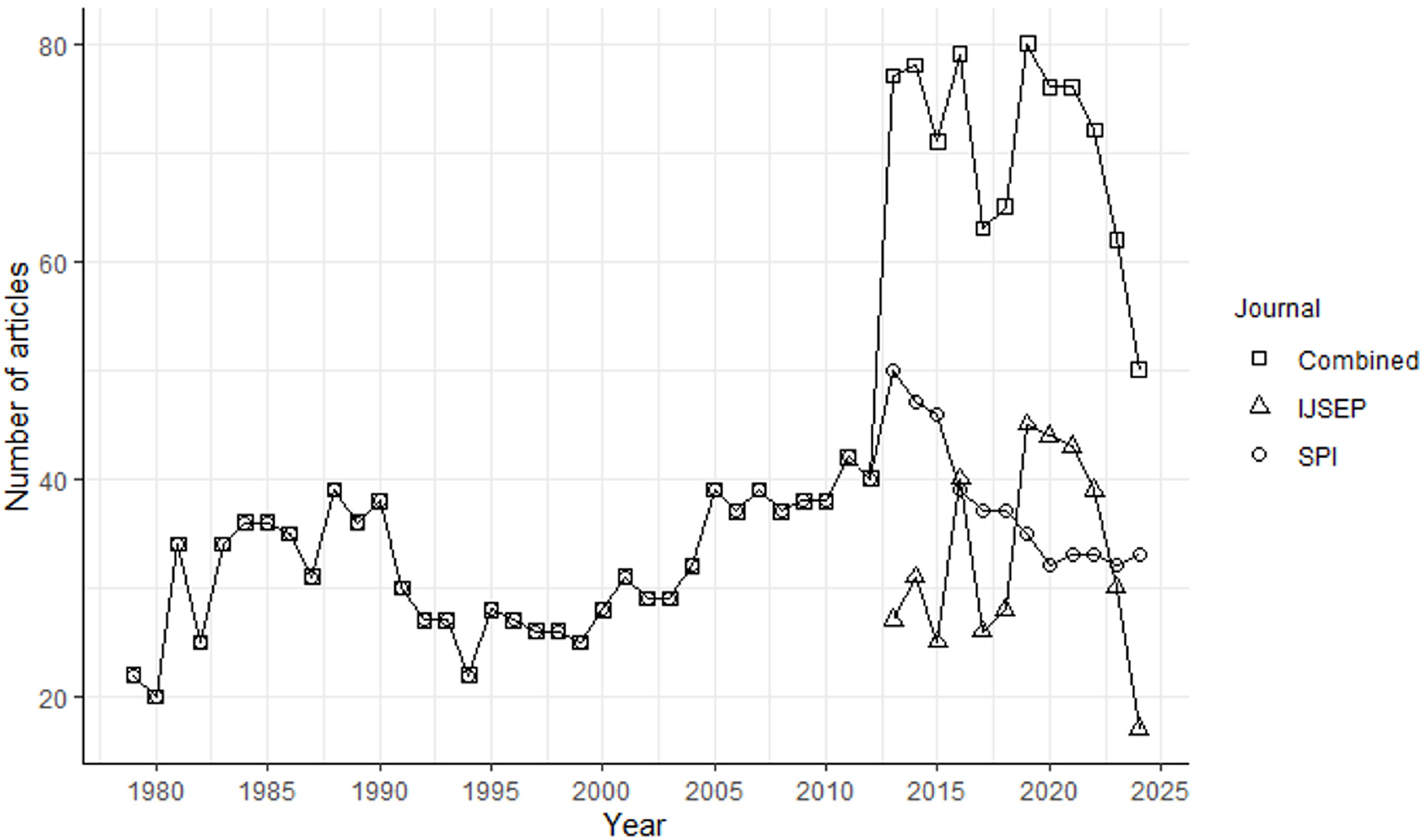
Number of Articles Published by Journal and Across Journals by Year from 1979 to 2024.
SPI published 22 articles during its first year (1979) and its lowest number (20) in its second year. SPI exhibited a relatively stable publication trajectory, with gradual increases (and annual growth rate of 0.9) punctuated by modest fluctuations. From the early 1980s through the early 1990s, SPI showed an overall rise followed by a temporary decline in the mid-1990s. Beginning in the late 1990s and early 2000s, articles per year increased steadily, reaching a local high in the early-to-mid 2010s (50 articles in 2013), after which articles per year declined slightly and then stabilized at a moderate level through the most recent years. On average, it published 33.4 articles per year (SD = 6.6).
IJSEP published 27 articles in its first year (2013). Its fluctuating pattern across years featured a peak with 45 articles in 2019 that was followed immediately by similar numbers of articles and later by a pronounced decline, including its lowest number (17) during 2024. On average, it published 32.8 articles per year (SD = 8.9). Its annual growth rate was −4.1, which is due primarily to the 17 articles published in 2024.
Citations by Journal and Most Highly Cited Articles
SPI articles generated an average of 19.2 citations per article and an average of 1.2 citations per article per year. A total of 4.6% of SPI's articles generated zero citations. IJSEP articles generated an average of 8.2 citations per article and an average of 1.1 citations per article per year. A total of 17.8% of IJSEP's articles generated zero citations. 8
The most highly cited articles for SPI and IJSEP are included in Tables 1 and 2, respectively. Huebner (1991) was the most highly cited article across journals and across time, and it was followed by Li (2006). The tenth most cited article from SPI generated more than double the citations of the most highly cited article from IJSEP (Shankar et al., 2016). Wendy Craig was first author on two of the most highly cited articles in SPI, and Linda Reddy was first author on two of the most highly cited articles in IJSEP. For SPI, four articles were published by Canadian authors, three articles were published by US authors, and three articles were published by UK authors. For IJSEP, seven articles were published by US authors, and authors from Canada, Greece, and Norway published one article apiece. It was not apparent that any highly cited article was the result of an international collaboration.
The Highest Ranked Articles Published in School Psychology International by Citation Frequency.
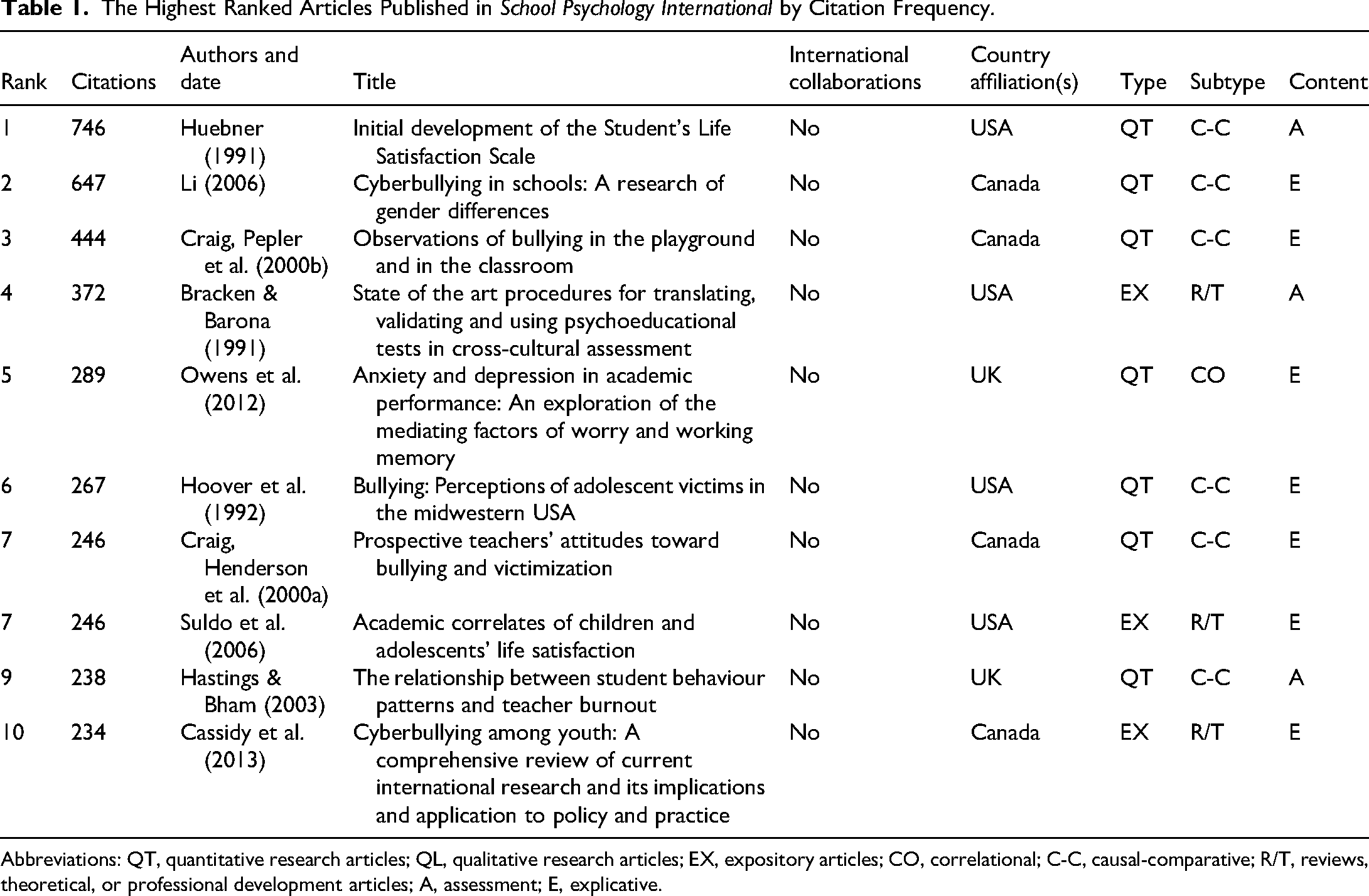
Abbreviations: QT, quantitative research articles; QL, qualitative research articles; EX, expository articles; CO, correlational; C-C, causal-comparative; R/T, reviews, theoretical, or professional development articles; A, assessment; E, explicative.
The Highest Ranked Articles Published in International Journal of School & Educational Psychology by Citation Frequency.
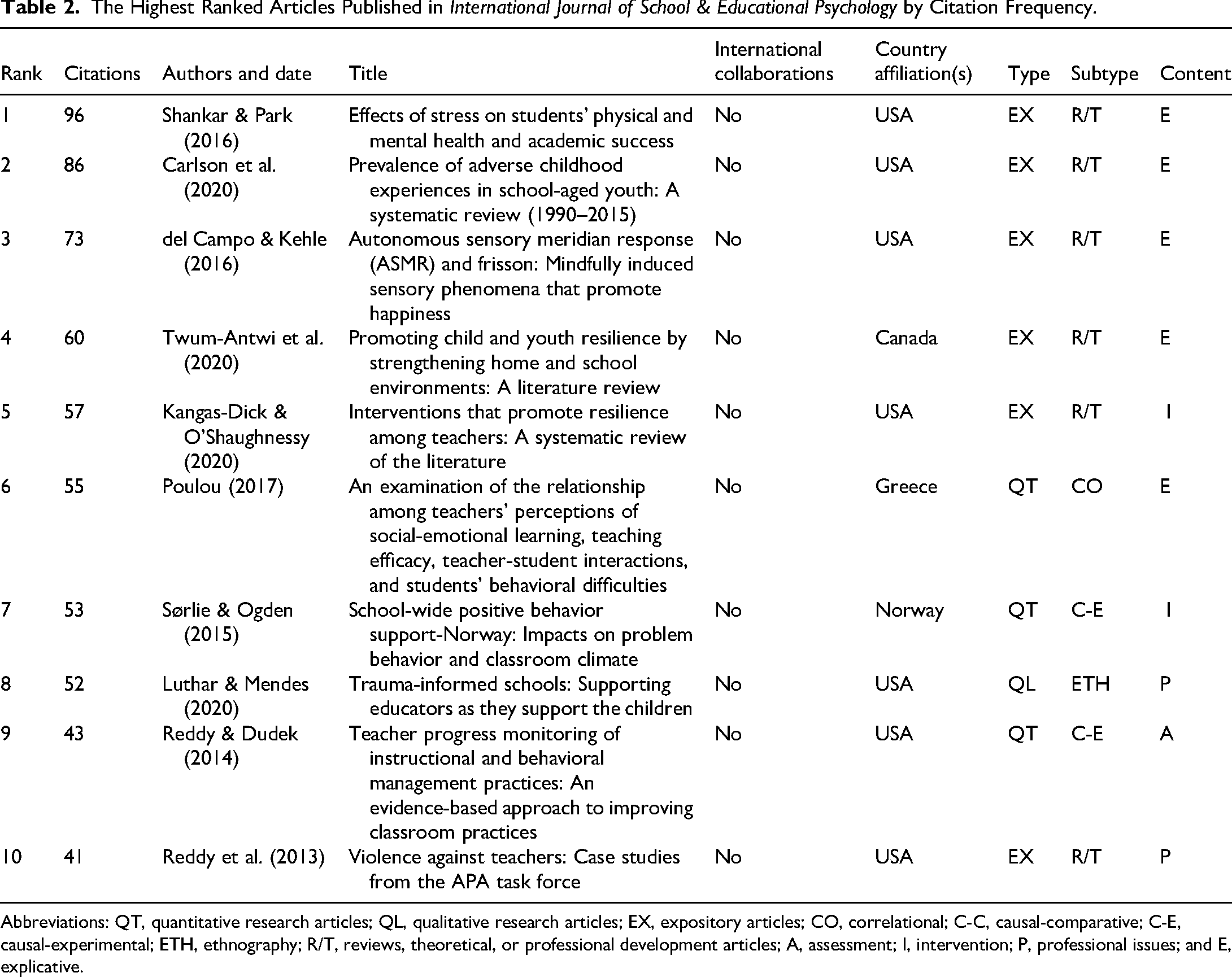
Abbreviations: QT, quantitative research articles; QL, qualitative research articles; EX, expository articles; CO, correlational; C-C, causal-comparative; C-E, causal-experimental; ETH, ethnography; R/T, reviews, theoretical, or professional development articles; A, assessment; I, intervention; P, professional issues; and E, explicative.
Among the most highly cited articles from SPI, most (70%) were quantitative, and the others were expository (30%). Quantitative articles presented correlational (n = 1) and causal-comparative (n = 6) research. All three expository articles were review, theoretical, or professional development articles. Regarding content coding, 70% were explicative, and 30% focused on assessment. For IJSEP, more than half of its highly cited articles were expository (60%); others were quantitative (30%) and qualitative (10%). All expository articles were review, theoretical, or professional development articles. Quantitative articles presented correlational (n = 1) and causal-comparative (n = 2) research. The qualitative article was an ethnographic study. When coding for content, 50% were explicative, and others focused on professional issues (20%), intervention (20%), and assessment (10%).
Patterns of topics across highly cited articles were readily apparent. For SPI, five of the ten most highly cited articles focused on bullying and victimization of students. For IJSEP, four articles focused on the experiences and skills of teachers; one article that focused on teachers (Hastings & Bham, 2003) was also evident in SPI's highly cited articles. Across both journals, four articles focused on positive psychology (including life satisfaction, happiness, and resilience); in fact, the most cited article by Huebner (1991) focused on this topic. To the contrary, a focus on student stress, trauma, and other adverse experiences was prominent across three of the most highly cited IJSEP articles. Only one article focused primarily on issues uniquely affecting international research (Bracken & Barona, 1991), and only two articles’ titles referenced a country (the USA; Hoover et al., 1992, and Norway; Sørlie & Ogde, 2015).
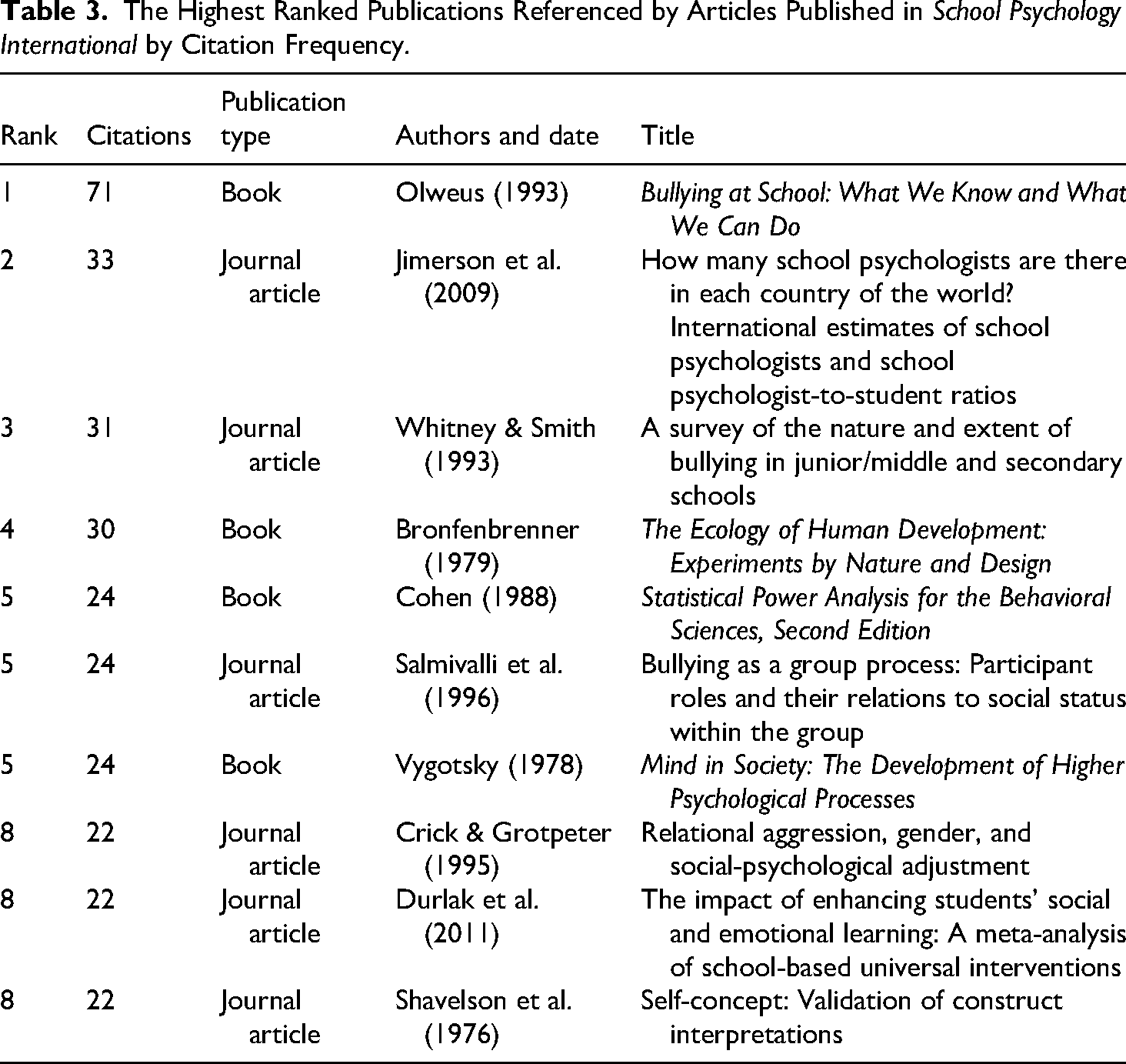
Most Frequently Cited References
There were 53,390 references included in articles from SPI and 21,377 references in articles from IJSEP. As evident in Table 3, the most frequently referenced publications in SPI were released during the 1990s or earlier. The most frequently cited one was a book addressing bullying (Olweus, 1993), and three journal articles focusing on aggression and bullying (Crick & Grotpeter, 1995; Salmivalli et al., 1996; Whitney & Smith, 1993) were also frequently cited. Two highly cited books focused on psychological theory, including ecological theory (Bronfenbrenner, 1979) and socio-cultural theory (Vygotsky, 1978), and another book focused on statistical power (Cohen, 1988). Highly cited journal articles featured estimates of school psychologists from across the globe (Jimerson et al., 2009), results of a meta-analysis of interventions (Durlak et al., 2011), and an evaluation of self-concept (Shavelson et al., 1976).
The Highest Ranked Publications Referenced by Articles Published in School Psychology International by Citation Frequency.
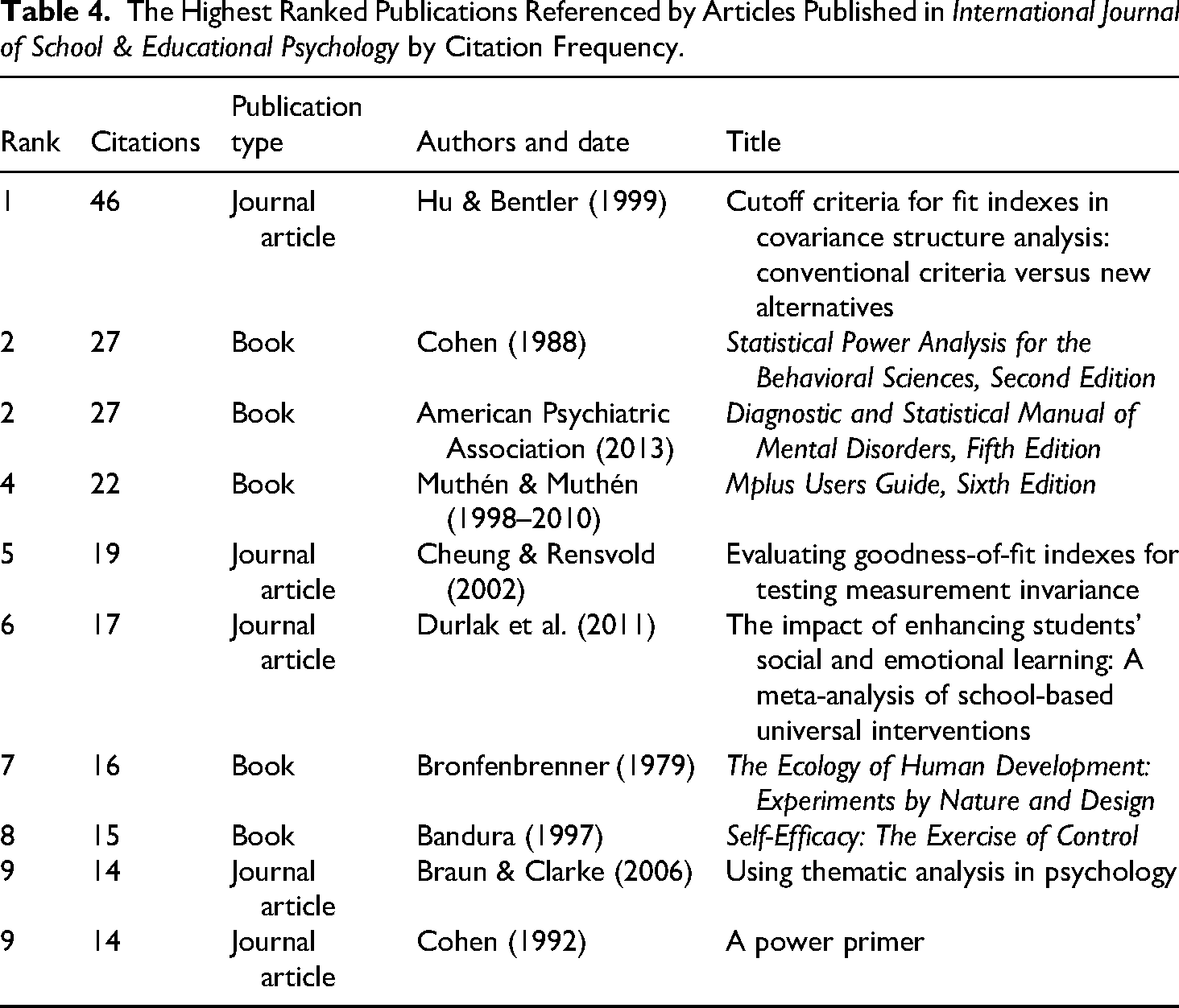
As evident in Table 4, the most frequently referenced publications in IJSEP were released during the 1990s or afterward. Like SPI, Cohen (1988), Bronfenbrenner (1979), and Durlak et al. (2011) were frequently referenced. The most highly cited article offered criteria for evaluating fit of structural equation models (Hu & Bentler, 1999), and another focused on fit statistics employed during measurement invariance testing (Cheung & Rensvold, 2002). Three books focused on quantitative and qualitative analysis (Braun & Clarke, 2006; Cohen, 1992; Muthén & Muthén, 1998–2010). The Diagnostic and Statistical Manual of Mental Disorders, Fifth Edition (American Psychiatric Association [APA], 2013) was tied for the second most highly cited publication.
The Highest Ranked Publications Referenced by Articles Published in International Journal of School & Educational Psychology by Citation Frequency.
Authorship Patterns
There were 2,767 different authors who published in SPI, and there were 3,726 author appearances (all inclusive). On average, there were 2.4 authors per SPI article. As evident in Figure 2, the number of contributing authors increased monotonically (from 1.5 authors per article from 1980–1984) and steadily, in five-year increments, across the 45 years of review to a peak of 3.3 authors per article from 2020–2024.
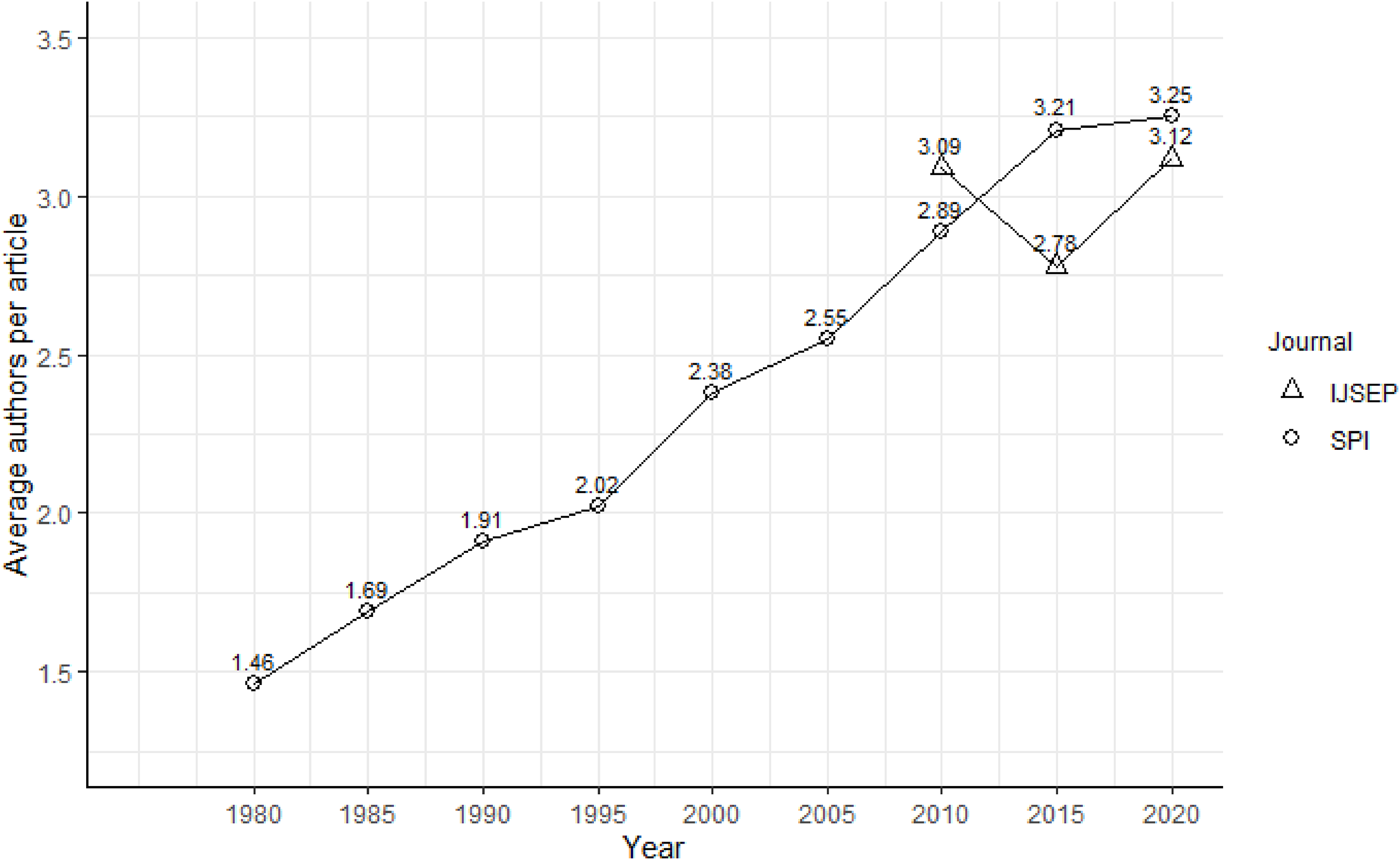
Average Number of Contributing Authors per Article by Journal in Five-Year Intervals from 1980 to 2024.
Considering individual authors, Tom Oakland published 27 articles in SPI from 1985 to 2012. In 18 cases (66.7%), he was first or sole author. His primary affiliations were with US institutions, and in 16 cases (59%), he engaged in international collaboration. Oakland was followed by Ludwig Lowenstein, SPI's inaugural editor-in-chief, who published 24 articles. He was sole author across his articles published between 1979 and 1985. His affiliations were always in the UK, and no evidence of international collaborations was apparent across his articles in SPI. Shane Jimerson and Tom Kehle, both with primary affiliations in the USA, published 14 articles. In nine cases (64%), Jimerson engaged in international collaboration, and in two cases (14%), Tom Kehle engaged in international collaboration. With primary affiliations in the USA, E. Scott Huebner published 13 articles, and he did not engage in an international collaboration across SPI articles. Both Melissa Heath, with primary affiliations in Canada, and Linda Theron, with primary affiliations in South Africa, published 11 articles. In three cases (23%), Heath engaged in an international collaboration, and in six cases (55%) Theron did so. Three authors (Peter Farrell, Henry Janzen, and Caven Mcloughlin) published 10 articles. Farrell had a primary affiliation in the UK, Janzen in Canada, and Mcloughlin in the USA. Farrell and Mcloughlin engaged in two international collaborations across SPI articles (reflecting 20% of their SPI articles), and Janzen engaged in one (representing 10% of her SPI articles).
There were 948 different authors who published in IJSEP, and there were 1,179 author appearances (all inclusive). On average, there were 3.0 authors per article. Like with SPI in its final three 5-year periods, the average number of authors per article was 3.1, 2.8, and 3.1, respectively (see Figure 2).
Considering individual authors, Gertina van Schalkwyk, IJSEP's second editor-in-chief, published 15 articles in IJSEP from 2013 to 2021, including five articles in 2019. With primary affiliations in the Macao and South Africa, van Schalkwyk engaged in two international collaborations (13%) across IJSEP articles. Melissa Bray, with an affiliation in the USA, published 11 articles. She engaged in one international collaboration (17%). Both Bonnie Nastasi and Marley Watkins published seven articles, and both Gary Canivez and Michael Furlong published six articles. Five others (Rik D'Amato, Amy Briesch, Stéphane Duchesne, John Kranzler, and Frank Worrell) published five articles. With primary affiliations in the USA, Kranzler engaged in zero international collaborations, and Canivez and Worrell each engaged in one international collaboration (representing 17% of Canivez's articles and 20% of Worrell's articles), Nastasi engaged in two international collaborations (33%), Watkins and Briesch engaged in three international collaborations (representing 43% of Watkins's articles and 60% of Briesch's articles), and Furlong engaged in four international collaborations (67%) across IJSEP articles. With affiliations in China and the USA, D’Amato did not engage in international collaborations evident in IJSEP articles, but Duchesne, with a primary affiliation in Canada, engaged in two international collaborations (40%) evident in IJSEP.
International Collaborations and Representation of Countries, Regions, and Groups
International Collaborations
Across years, for SPI, 15.2% of articles stemmed from international collaborations, and for IJSEP, 22.0% of articles stemmed from international collaborations. 9 As evident in Figure 3, considered across five-year periods 10 beginning in 1980 (with SPI's second volume year), the percentage of articles reflecting international collaborations ranged from 1.8% to 20.1% for SPI and from 21.4% to 26.5% for IJSEP. Longitudinal trends indicate that SPI exhibited a non-monotonic (i.e., neither consistently decreasing or increasing) but overall upward trajectory across the observed periods, characterized by low and stable values in earlier periods (mostly < 5% before 2000), a period of rapid increase beginning in the early 2000s, and subsequent stabilization with modest fluctuation. In contrast, IJSEP displayed consistently higher values (> 20%) but greater short-term variability, with no monotonic trend across the periods examined.
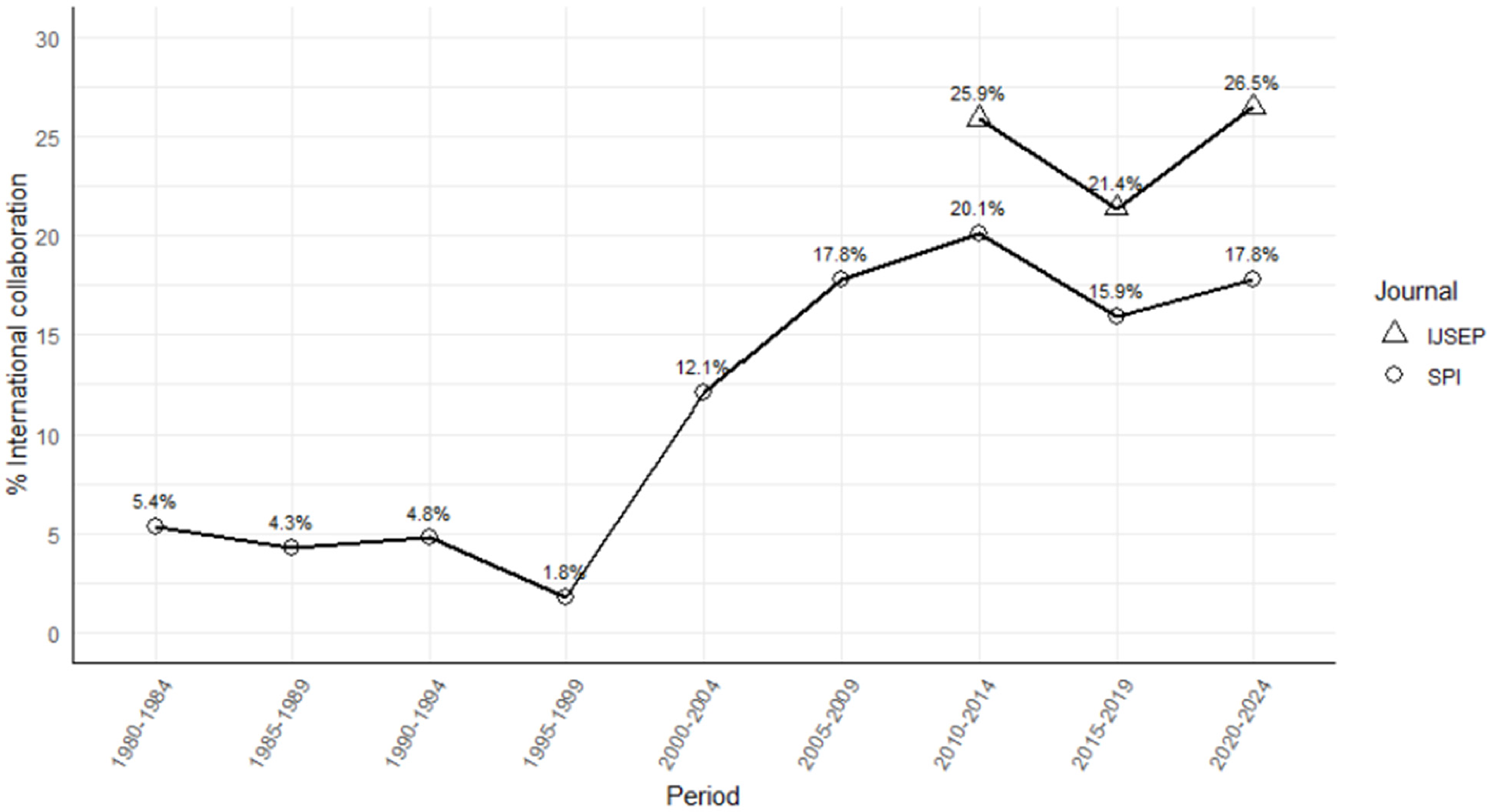
Percentage of Articles that Stemmed from International Collaborations by Journal in Five-Year Increments from 1980 to 2024.
Affiliations by Country
When considering the first authors of manuscripts across years, they hailed from 74 countries for SPI and 56 countries for IJSEP. Across journals, 81 countries were represented. As evident in Table 5, for both journals, 36.3% of first authors of SPI articles and 45.4% of articles from IJSEP were from authors from the USA. Authors from the UK ranked a distant second for both journals in terms of frequency of first authors. They composed 12.5% of SPI first authors and 4.6% of IJSEP first authors. Canadian authors were ranked third for SPI and tied for third for IJSEP; they accounted for only 5.0% and 2.8% of first authors, respectively, by country. For SPI, authors from Israel and Australia contributed to 4.7% and 4.5% of articles, and authors from China and South Africa contributed to 3.7% and 3.4% of articles. For IJSEP, authors from Greece and Macao were at 2.8% and tied for third place. All other countries associated with first authors accounted for 2% or fewer articles.
The Highest Ranked Country Affiliations of First Authors by Frequency Across Years.
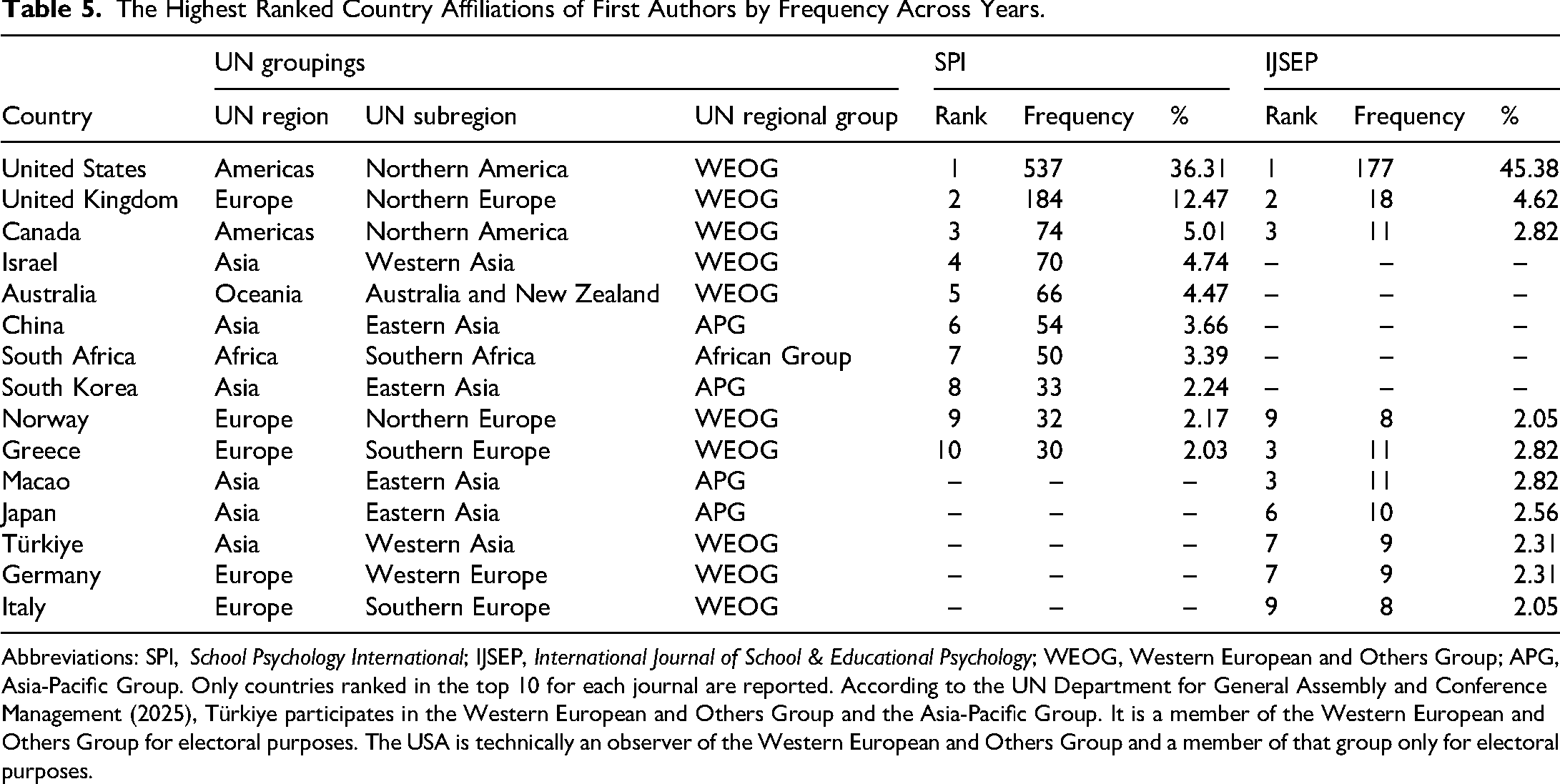
Abbreviations: SPI, School Psychology International; IJSEP, International Journal of School & Educational Psychology; WEOG, Western European and Others Group; APG, Asia-Pacific Group. Only countries ranked in the top 10 for each journal are reported. According to the UN Department for General Assembly and Conference Management (2025), Türkiye participates in the Western European and Others Group and the Asia-Pacific Group. It is a member of the Western European and Others Group for electoral purposes. The USA is technically an observer of the Western European and Others Group and a member of that group only for electoral purposes.
When considering the total number of unique countries represented by first authors across five-year periods beginning in 1980, for SPI, the range was 13 countries (1990–1994) to 40 countries (from 2010- 2014). For IJSEP, the range was 20 countries (2010–2014) to 45 countries from 2020–2024. As evident in Figure 4, SPI demonstrated long-term increases with substantial volatility, including periods of contraction and recovery, whereas IJSEP exhibited rapid and monotonic growth in international representation by country.
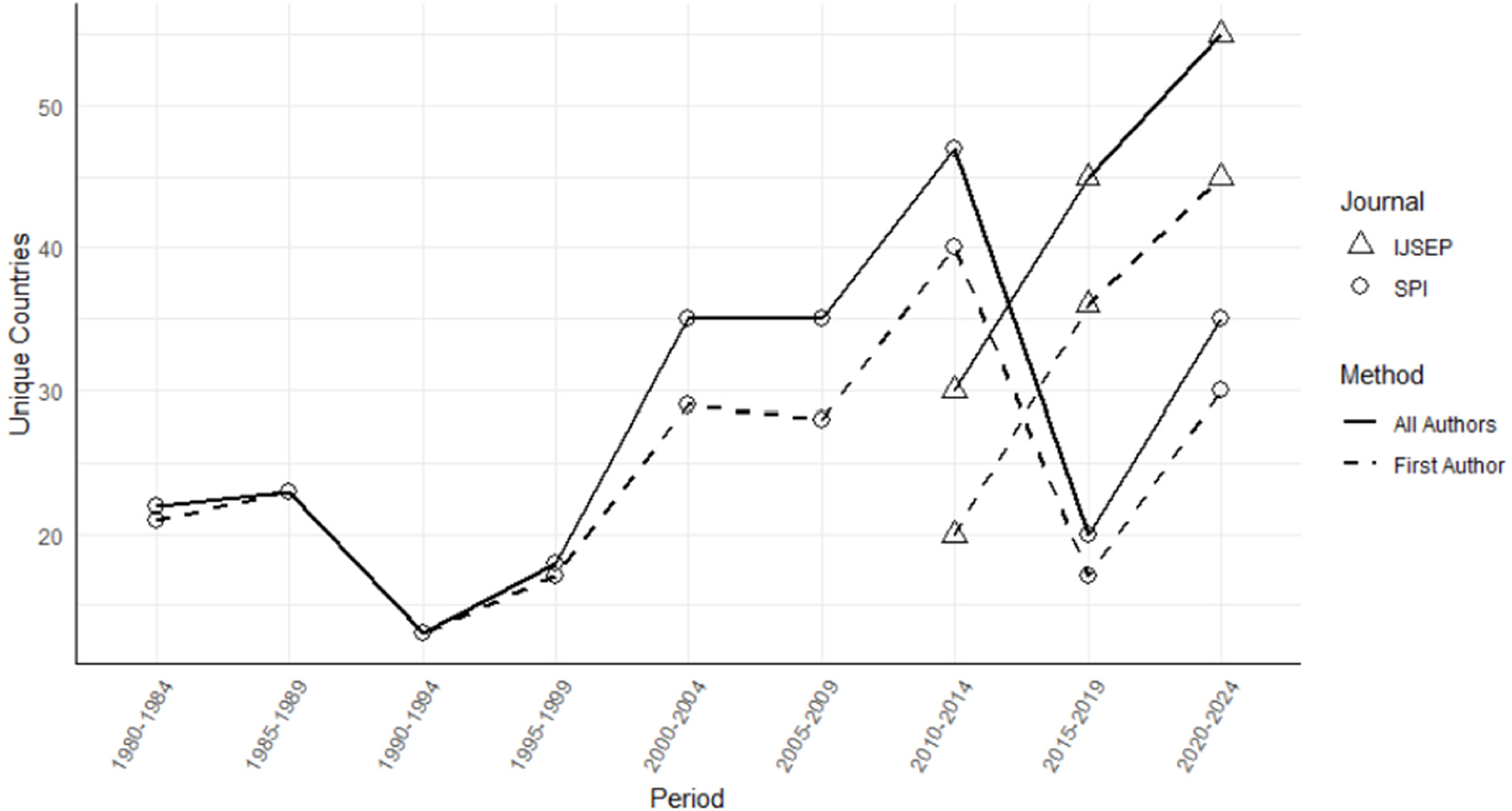
Unique Countries Represented Across Articles, for First Authors and All Authors, by Journal in Five-Year Increments from 1980 to 2024.
Considering the increase in the number of contributing authors for SPI across time and the relatively stable high numbers of authors for IJSEP (see Figure 2), it is not surprising that country counts based on all contributing authors typically exceeded those based on first authors (see Figure 4). For SPI, the range was 30 countries (from 1990–1994) to 55 countries (from 2010–2014). For IJSEP, the range was 20 countries (from 2010–2014) to a peak of 45 countries from 2020 to 2024.The gap between all-author and first-author counts was most pronounced for SPI during peak periods, and it has been consistently wide across IJSEP's years of publication. These comparisons suggest that international representation in authors was often driven by co-authorship rather than lead authorship alone.
When we also considered the variation in the number of articles published in both journals across time, including the trend toward more articles published each year by SPI, we were able to gauge the depth of representation of contributing authors across countries. As evident in Figure 5, the average number of countries represented per article was close to baseline levels (1.0). Notably, a similar pattern is evident in Figure 3, which presents the percentage of international collaborations. SPI exhibited a non-monotonic but overall upward trajectory across the observed periods, characterized by low and stable values in earlier periods (<1.1 countries before 2000), a period of rapid increase beginning in the early 2000s through 2019, and a peak of 1.2 countries per article. In contrast, the average number of countries represented across authors began with a peak for IJSEP, declined rapidly, and stabilized. During 2020–2024, both journals shared similar averages (at 1.15 for SPI and 1.17 for IJSEP).
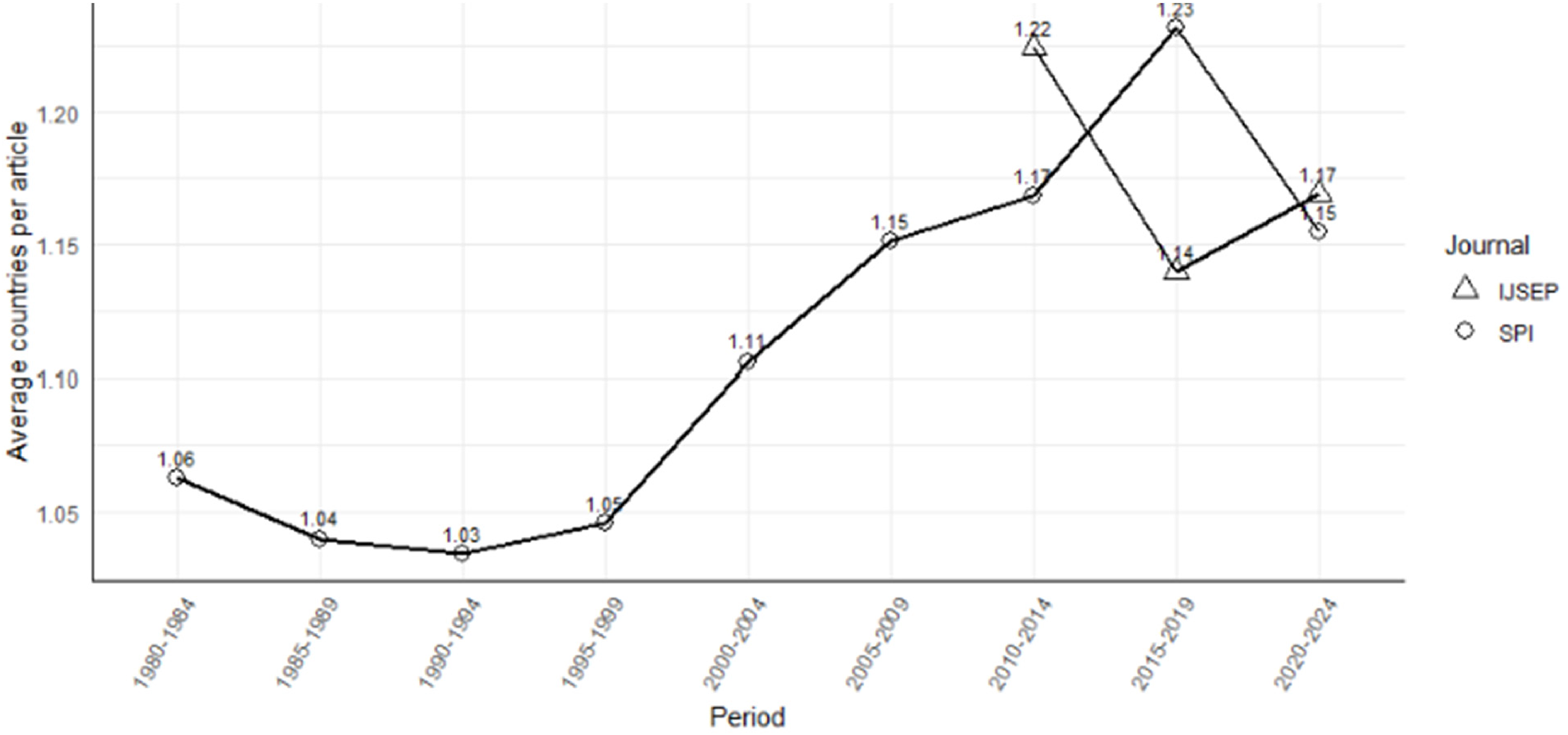
Average Number of Countries Represented by All Authors per Article by Journal in Five-Year Increments from 1980 to 2024.
Affiliations by UN Region, Subregion, and Regional Group
First authors contributing to SPI were most frequently (42.5% of total) from the Americas. The vast majority (97.3%) were from North American subregion and the WEOG. Other authors in the Americas region (2.7%) spanned the South America, Central America, and the Caribbean subregions and from countries composing the Latin American and Caribbean regional group. A total of 28.1% of first authors were from Europe, and 28 countries were represented. Of authors from this region, most (60.7%) were from the Northern Europe subregion. Most (64.3%) were from the WEOG, and the others were from the Eastern European Group. A total of 19.4% of first authors were from the Asia region, and 25 countries were represented. Most authors (50.3%) were from the Eastern Asia subregion, and most (54.9%) were from the Asia-Pacific Group. (Exceptions were Israel and Türkiye, which are classified as part of the WEOG, and Hong Kong and Taiwan, which are not UN member states and are not classified as with a UN regional group.) A total of 0.05% first authors were from two countries in the Oceania region, Australia and New Zealand subregion, and the WEOG. A total of 0.04% of first authors were from eight countries that composed the African region and the African Group regional group. Most authors (78.8%) were from the Southern Africa subregion.
For IJSEP, 49.8% of first authors were from the Americas, and seven countries were represented. Most (96.9%) were from the North America subregion and the WEOG. Other authors from this region spanned South America and Central America and the Latin American and Caribbean Group. A total of 22.8% of first authors were from Europe, and 21 countries were represented. Most (41.6%) were from the Northern Europe subregion. The vast majority (85.4%) were from the WEOG; others were from the Eastern European Group. A total of 21.8% of first authors were from the Asia region, and 22 countries are represented. Most authors (80.0%) were from the Asia-Pacific regional group. (Again, those not included were Israel, Türkiye, and Hong Kong.) A total of 34.1% of these authors were from Western Asia, and 32.9% were from Eastern Asia. Across all first authors, 2.8% were from the African region and the African Group, and four countries were represented. Most authors (54.6%) were from the Southern Africa subregion. Finally, 2.8% of first authors were from Oceania region and the Australia and New Zealand subregion.
Longitudinal Changes in Representation
For SPI, first authors from 24 WEOG countries contributed to 79.1% of articles, and for IJSEP, first authors from 18 WEOG countries contributed to 74.6% of articles. When considering the percentage of authors from WEOG countries across five-year periods beginning in 1990, it is clear that WEOG countries dominated authorship in both journals for several decades. As evident in Figure 6, Panel A, across both first authors and also all corresponding authors, WEOG representation exceeded 80% of articles from 1990 through 2009 for SPI and from 2010 through 2019 for IJSEP. However, there are pronounced declines in WEOG representation in recent years—especially for SPI. Its WEOG representation was 55.1% for first authors and 67.5% for all authors from 2020 to 2024. For IJSEP, it was 67.5% for first authors and 72.9% for all authors.
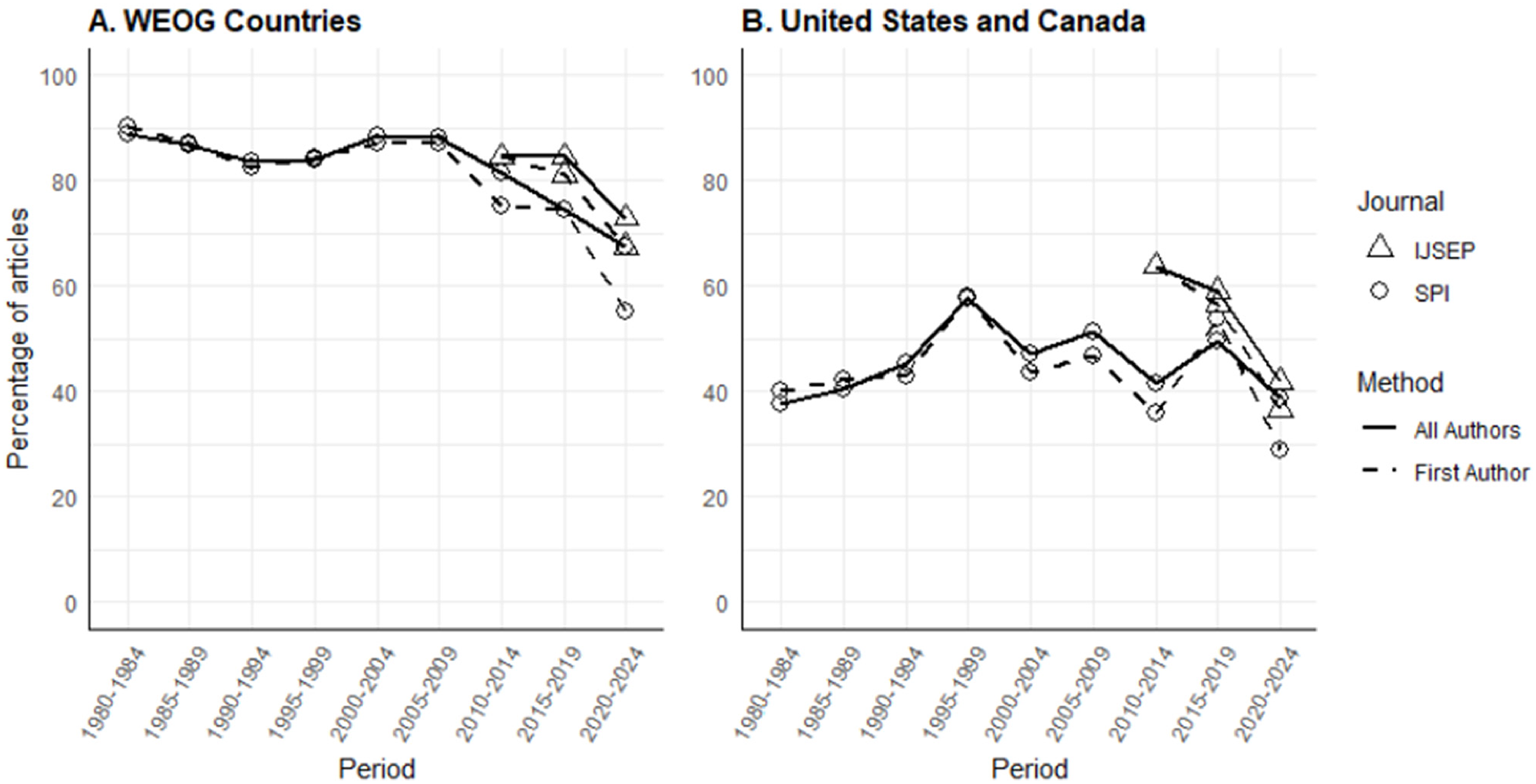
Percentage of Articles by First Authors and All Authors from Western European and Other Group Countries and North American Countries by Journal in Five-Year Increments from 1980 to 2024.
For SPI, first authors from North American countries (the USA and Canada) contributed to 41.3% of articles, and for IJSEP, first authors from North American countries contributed to 48.2% of articles. As evident in Figure 6, panel B, longitudinal trends for SPI indicate that North American representation increased through the 1990s, peaked around the turn of the century, and generally declined (with moderate variation across years). For IJSEP, North American representation began with a peak and declined monotonically. In 2020–2024, North American representation for SPI was 28.8% for first authors and 38.7% for all authors, and for IJSEP, it was 36.7% for first authors and 41.8% for all authors. The downward trend in North American authorship contributed substantially to broader decline in WEOG representation (see Panel A).
Discussion
This study drew on advances in indexing school psychology journals like SPI and IJSEP and the availability of longitudinal bibliometric data across 45 years and both journals. These features allowed the study to move beyond documenting international presence across authors in snapshots of time toward evaluating the depth and structure of international engagement in scholarship across decades. Collectively, the current findings are highly consistent with prior bibliometric and systematic reviews documenting SPI's central role in producing international scholarship and the historical dominance of WEOG authors while also extending this literature by demonstrating recent declines in regional concentration, increased international collaboration, and a shift toward more globally distributed co-authorship.
Publication Patterns and Citations
SPI and IJSEP published 1,930 articles from 1979 through 2024. Given SPI's 34 years of publishing before the first issue of IJSEP was published, it was not surprising that 80% of those articles were published in SPI. Whereas SPI's rate of growth was relatively stable, IJSEP's articles per year declined from highs in 2019, 2020, and 2021 to a low of 17 articles in 2024. Hernández-Torrano and Ho (2021) documented consistently increasing numbers of articles published per year across educational psychology journals, and it is not clear to us what led IJSEP to publish its lowest number of articles per year in 2024.
It is not surprising that SPI articles have generated a higher average number of citations due to the journal's much longer publication history. In comparison to prior reports of citations of SPI and IJSEP articles (e.g., Little et al., 2011; McNicholas et al., 2022), the average citations per article was notably higher and the number of articles with zero citations was notably lower. These results are probably the result of the inclusion of the earliest of SPI's articles, broader database coverage (in Scopus) of publications likely to cite these journals, and a more expansive influence of both journals in the professional literature (see Begeny et al., 2019; Floyd, 2018).
Some highly cited articles from SPI were featured in prior studies. Huebner (1991) was the most highly cited article in this study, the second most highly cited article identified by Little et al. (2011), and the sixteenth most highly cited article by McNicholas et al. (2022). Additionally, Li (2006) was the second most highly cited article in this study and the tenth most highly cited article by McNicholas et al. Craig, Pepler et al. (2000b) and Craig, Henderson et al. (2000a) were ranked third and tied for seventh place, respectively, in this study. Similarly, Craig, Pepler, et al. was the fourth most cited article by Little et al., in a tie for the thirty-second most cited article by Price et al. (2011), and the twenty-fifth most cited article by McNicholas et al. Bracken and Barona (1991) was the fourth most highly cited article in this study, the third most highly cited article identified by Little et al., and the sixty-seventh most highly cited article by McNicholas et al. Hoover et al. (1992) was the sixth most highly cited article in this study, the most highly cited article identified by Little et al., and the forty-seventh most highly cited article by McNicholas et al. This consistency in identifying highly cited articles in SPI across time and across studies is remarkable.
Thought-provoking patterns were apparent across the highly cited articles. Most (60%) addressed explicative content (versus assessment, intervention, or consultation). SPI's most highly cited articles were most often quantitative and reflected causal-comparative research, but IJSEP's highly cited articles were most often expository articles and included mostly explicative content. A total of 70% of the highly cited articles from SPI were quantitative, which parallels Strein et al.'s (2003) 62.7% of articles reporting original research. A similar match in percentages was evident for expository articles across these studies. Many of the topics that were the foci of the most highly cited articles, including bullying and victimization, the experiences and skills of teachers, and positive psychology, were also noted by McNicholas et al. (2022) as prominent across school psychology's citation classics. Furthermore, in the context of our focus on international engagement in scholarship, it is notable that none of the 20 most highly cited articles we identified stemmed from an international collaboration. Only five countries were represented across them. US and Canadian authors contributed four-fifths of these articles.
It is to be expected that authors of articles published in SPI and IJSEP commonly cited books and other articles focusing on foundational theories and constructs, features of human development, and statistical analysis. Aggression and bullying were also commonly featured in these publications. Consistent with results from the 18-year analysis of SPI's articles completed by Jennings et al. (2008), the current study identified Olweus (1993) as the most highly cited article across journals. In contrast to Jennings et al., Best Practices in School Psychology III (Thomas & Grimes, 1995) and Handbook of School Psychology (Gutkin & Reynolds, 1990), were not highly cited across either journal. No edition of Best Practices was cited more than three times, and no edition of Handbook was cited more than four times. Although 70 chapters from Best Practices and 52 chapters from Handbook were cited, no chapter was cited more than six times. Although the most cited references tended to address common—if not universal—themes in schools and in research, only one highly cited article (Jimerson et al., 2009) explicitly mentioned international school psychology. This article was also the only highly cited reference published in SPI or IJSEP to be identified. Considering our focus on international engagement, no highly cited reference included a country or region in its title.
Authors and International Representation
Several thousand authors contributed to SPI, IJSEP, or both, and the number of contributing authors has increased steadily and substantially across time (see also Hernández-Torrano and Ho, 2021). Tom Oakland authored the most articles appearing in SPI, and Gertina van Schalkwyk authored the most articles appearing in IJSEP. Although Oakland and Jimerson (from SPI's most productive authors) and Bray, Briesch, Canivez, and Worrell (from IJSEP's most productive authors) were previously identified as highly productive authors in school psychology (Grapin et al., 2013; Hulac et al., 2025), no person included among the most productive authors in this study was included in both prior studies. Both Huebner and Reddy contributed two highly cited articles. Huebner was the most frequent contributor to citation classics (McNicholas et al., 2022), and Huebner and Reddy had previously been identified as highly productive authors (Grapin et al., 2013; Hulac et al., 2025). Although most of these frequent contributors were primarily based in the USA, some were from Canada, Macao, the UK, and South Africa. Most of these authors also engaged in international collaborations across their SPI and IJSEP articles. Theron, Briesch, Jimerson, and Furlong engaged in international collaborations across more than half of them.
Earlier studies (Jennings et al., 2008; Little et al., 2011) documented that approximately 8% to 10% of articles published in SPI involved international collaboration. The current findings substantially extend this research by identifying higher rates of international collaboration (15.2% for SPI and 22.0% for IJSEP) across time. In particular, increases in international collaborations across SPI's history suggested a meaningful expansion of international engagement over time, particularly since the early 2000s. For comparison, Hernández-Torrano and Ho (2021) documented that 16% of articles were internationally collaborative in their analysis of a larger corpus of educational psychology journals.
For SPI, first authors hailed from 74 different countries, and for IJSEP, they hailed from 56 countries. Most notably, first authors across both journals represented 81 countries, which is the approximate estimate for the number of countries that employ professionals within school and educational psychology (Jimerson et al., 2009). Prior research (Jennings et al., 2008; Little et al., 2011) documented that SPI authors hailed from 55 to 57 countries. Increasing international representation by first authors of SPI articles was also evident across time (especially from 2000 through 2014). Disaggregating first-author and all-author country counts, the present study advances prior research that relied primarily on aggregate affiliation counts, revealing that internationalization has been driven largely by co-authorship rather than lead authorship—a nuance not previously documented. Given Begeny et al.'s (2018b) identification of authors from 109 countries in their journal corpus and Hernández-Torrano and Ho's (2021) identification of authors from 114 countries, there is work to increase international representation that remains to be done for the editors of SPI and IJSEP.
Begeny et al. (2018b) reported that nearly 80% of first authors publishing in SPI were affiliated with WEOG countries; more than 35% were from North America. Importantly, however, the present analyses demonstrate that WEOG and North American dominance have declined markedly in recent periods, particularly for first authors. This temporal shift represents a key extension of prior work, which did not capture the post-2016 period. Similarly, the observed declines in WEOG and North American authorship align with calls in the literature to critically examine the persistence of scholarship centered on Western, educated, industrialized, rich, and democratic (WEIRD) countries (Henrich et al., 2010) while also providing empirical evidence that such dominance may be weakening. We wonder if some of these results—especially from the most recent period of review (2020–2024)—are the result of increasing focus on the importance of internationalization in some prominent publications in school psychology during the late 2010s (e.g., Begeny, 2018; Begeny et al., 2019).
Limitations and Future Directions
At least five limitations should be acknowledged. First, our bibliometric study primarily produced results that are quantitative in nature. Our procedures included qualitative coding of highly cited articles and distillations of themes, but we did not complete an in-depth literary analysis of the 45 years of articles published across SPI and IJSEP. We also acknowledge that although our coding agreement across all 20 targeted articles ranged from acceptable to strong, our lowest agreement for the research method and article subtype coding was only moderate (κ = .59). This finding means that making fine-grained distinctions among methodological categories associated with these articles was challenging and that results, while not problematic, might not be consistent across studies of this type. Future researchers can extend our research findings to achieve a richer understanding of these and other journals, and they should consider improving the coding procedures for the research method and article subtypes. Second, although our data are both extensive across two journals and also longitudinal, most of our analyses were descriptive, and we relied on visual inspection and frequency-based trends in our time-series analysis. Thus, the study cannot identify causal mechanisms underlying changes in articles published per year, international collaborations, authorship patterns, or regional representation. Future research should study how intentional interventions systematically affect these variables.
Third, although Scopus provided full coverage of all articles from SPI and IJSEP (barring one issue of SPI), and it provides detailed information about author affiliations (Pranckutė, 2021), it does not catalog the full range of publications that may have cited articles from SPI and IJSEP. In particular, its coverage may underrepresent scholarship from regions where journals, particularly parts of Africa, Latin America, and Asia (see Asubiaro et al., 2024). As a result, our citation analysis may underestimate total citations per article by not fully representing citations from all countries and researchers. Some errors in the database (not involving citations) were also evident, and efforts were made to correct errors and impute missing data (Donthu et al., 2021). Furthermore, we employed some conventions from Scopus in our analysis that are noteworthy. For example, we treated Hong Kong, Macao, and Taiwan as distinct affiliation entities, and this decision affects country counts, regional distributions, and collaboration metrics and limits comparability with studies using UN-aligned country classifications.
Fourth, our methods may misrepresent scholarly identity and overestimate substantive collaboration. We used country classifications based on author affiliations from Scopus data, and this approach does not capture authors’ nationality, training background, migration history, or transnational identities. As a result, analyses of “international” representation may oversimplify complex scholarly trajectories and global mobility patterns. In particular, Begeny et al. (2021) stated that “one's geographic work affiliation (e.g., within a country in North America or Western Europe) does not mean the scholar has or does not have substantial international experience or a deep knowledge about cultural diversity issues across borders” (p. 226). Furthermore, international collaboration inferred from co-authorship may overestimate substantive collaboration. This approach cannot distinguish between deep, reciprocal collaborations and more limited forms of involvement (e.g., data access or secondary analysis), but it is fair to say that it potentially overstates the depth of international engagement.
Finally, a small part of our study employed citation counts that have limitations. For example, citation counts do not necessarily reflect the quality of construction, rigor of design, or impact significance of an article. Citation counts can also be influenced by factors such as author traits, self-citation practices of authors, and coercion of authors by editors and reviewers to cite articles in their journals. Generally, citation counts structurally favor older articles and research from well-established WEOG and North American institutions. Consequently, citation analyses may undervalue newer publications, regionally grounded scholarship, and work published in non-dominant research traditions. To extend understanding of the scholarly influence of articles, future bibliometric research should consider using complementary metrics, such as alternative impact indicators like downloads, views, and mentions on social media and news platforms.
Recommendations for Advancement of International Engagement in Scholarship
Taken together, our results indicate that recent gains in internationalization in SPI and IJSEP have been driven primarily by collaborative authorships rather than lead authorships, underscoring the need for author-, editor-, and reviewer-level strategies that promote equitable leadership, contextual sensitivity, and structural support for scholars from underrepresented regions. In this section, we followed Begeny et al.'s (2021) organization of recommendations for (a) scholars striving to publish in SPI and IJSEP and similar journals and (b) editors and reviewers of SPI, IJSEP, and similar journals. Interested readers should also explore Begeny (2018), Begeny et al. (2019), Begeny et al. (2021), Begeny et al. (2024), Bernardo et al. (2018), and Wang et al. (2020).
Recommendations for Authors
Our results demonstrated that international collaborations remain at low to modest levels—even across two prominent journals that endeavor to highlight international school and educational psychology research. We encourage authors, from the USA and across the globe, to pursue substantively reciprocal international collaborations. Given that international diversity in both journals is often driven by co-authorships rather than lead authorships, we should prioritize collaborations that involve shared conceptual development, analytic decision-making, and authorship equity rather than nominal international inclusion. To achieve this goal, authors should tap into interdisciplinary and cross-regional networks. As suggested by Begeny et al. (2021), authors can identify collaborators through international conferences, prominent publications featuring both international authors and international research, and related disciplinary journals, recognizing that impactful international scholarship often emerges outside traditional school psychology silos.
Given the persistent concentration of first authors from the USA, North America, and the WEOG countries, despite broader participation across all authors, authors should attend to contextual and positionality considerations. The asymmetry evident from our findings highlights that, when entering into and enhancing collaborative and international relationships, authors should reflect on power, reciprocity, and positionality in cross-national work. Begeny et al. (2021) recommended that authors engage in transparent discussions about how local knowledge, Indigenous perspectives, and contextual expertise can inform study design and interpretation.
Despite representation from 81 countries across both journals, first authorship remains disproportionately concentrated, suggesting linguistic and structural barriers to lead authorship. Thus, authors should address linguistic barriers strategically and ethically and leverage emergent technologies to advance their manuscript development (see Begeny et al., 2021; Chetwynd, 2024). Authors writing in a non-dominant language of publication should seek discipline-specific literacy brokers, emulate journal-appropriate rhetorical styles (without plagiarism), and use institutional or journal-provided writing supports when available. Similarly, a widening gap between first-author and all-author country counts suggests that authors should clarify authorship roles early in collaborations. To reduce inequities and misunderstandings, they should explicitly negotiate timelines, responsibilities, and authorship order at the outset of international projects, particularly when collaborators differ in institutional power or language fluency.
Because authors from the WEOG countries dominated authorship for decades, concerns about overreliance on Western-derived theories may also be evident. Thus, we suggest that authors justify the international relevance of research questions and constructs. Broadly, they should develop research projects and write manuscripts that explicitly address whether focal theories, measures, or interventions are culturally specific or plausibly generalizable, particularly when the projects originate from WEOG or North American contexts.
Recommendations for Editors and Reviewers
Variability across periods of analysis and the delayed rise in SPI's international collaboration indicates that structural barriers that go beyond individual author choices might be at play. We acknowledge that our results cannot disentangle editorial policy effects from field-wide changes in training, globalization, or funding, and we offer these aspirations for journal editors and reviewers that are consistent with Begeny et al. (2018b, 2021). Our documentation of the long-standing dominance of authors from North America and the WEOG, with only recent declines, suggests that editors should actively encourage submissions from underrepresented regions to accelerate international engagement. Editors should signal openness to geographically diverse scholarship through special issues, targeted calls, and explicit statements valuing non-WEOG contexts, replication studies, and culturally grounded frameworks. The disparities between first-author and all-author representation by country implies that international scholars may contribute without leading manuscripts—an issue mentoring could address. Editors should consider offering writing-for-publication resources, mentoring programs, or access to volunteer literacy brokers, especially for scholars facing linguistic or structural barriers to publication.
Our demonstration of regional patterns in authorship suggests that limited representation in gatekeeping roles may constrain publication from non-WEOG contexts, so editors should recruit board members and reviewers with demonstrated experience in non-WEIRD contexts while avoiding tokenization and recognizing that geographic affiliation alone does not equate to cultural competence (see Begeny et al., 2018b; Wang et al., 2020). After selecting their board members, editors should acknowledge and mitigate structural inequities in peer review by encouraging reviewers to reflect on implicit biases related to geography, theory origin, and epistemology and recognize how they may perpetuate discrimination against international scholars and limit internationalization. Similarly, because the highly cited articles we identified were overwhelmingly WEOG-based and rarely international collaborations, suggesting potential structural reinforcement of dominant paradigms, editors should encourage reviewers to evaluate the methodological and statistical rigor evident in manuscripts independently of Western theoretical traditions or stylistic norms, particularly when evaluating qualitative, mixed-methods, or context-specific studies. Finally, the steep drop in first authorship across North American and WEOG countries in recent periods coincides with increased geographic diversity, so editors should continue to de-emphasize language proficiency in editorial decisions. Reviewers and editors should focus on conceptual contributions, methodological soundness, and contextual insight rather than penalizing authors for non-native English expression when meaning is clear.
Conclusions
Our bibliometric analysis demonstrated the substantial contributions of the two journals that have a primary focus on international school psychology. SPI and IJSEP have published almost 2,000 articles across time and have routinely offered 70 or more articles each year. Based on citation metrics, most of these articles are influencing scholars in the field, and some of them appear to have been highly impactful. Furthermore, evidence of increasing international engagement in scholarship is apparent. Calvin Catterall, Frances Mullen, others associated with the ISPC; foundational contributors to the emergence of the ISPA; the inaugural and subsequent editors of SPI and IJSEP; and thousands of authors of articles published across the journals should be very proud of what has been made manifest across these journals and across time.
Footnotes
Authors Note
Artificial intelligence tools were used in a limited, supportive role during manuscript preparation. Specifically, AI was used as a coding partner to assist with cleaning and modifying analysis code and refining data visualizations, to support brainstorming during manuscript development, and for copyediting to improve clarity and readability. All analytic decisions, interpretations, and final content were determined by the authors, who take full responsibility for the work. We appreciate the support of Dr. Tom Fagan for allowing us to review his collection of hard copies of early issues of SPI and IJSEP.
ORCID iDs
Funding
The authors received no financial support for the research, authorship, and/or publication of this article.
Declaration of Conflicting Interests
The authors declared no potential conflicts of interest with respect to the research, authorship, and/or publication of this article. However, the manuscript cites a book that one author edited, (Floyd, 2018), for which he receives royalties from the publisher. Some may consider our citing this book to be a financial conflict of interest. In addition, Randy Floyd currently serves on the editorial board of SPI.
Data Availability Statement
This research focused on proprietary data from a commercial database (Scopus) rather than living subjects. Thus, it is considered exempt by the University of Memphis Institutional Review Board. These data cannot be made publicly available because they are proprietary.
Notes
Author Biographies
 for more information.
for more information.
for more information.
is a graduate student in the doctoral program in School Psychology at the University of Memphis. Her research interests include ethical teacher preparation and practice, the development of oral and silent reading fluency, and dialectical practices to support literacy instruction.