







Abstract
The performances of combined cooling, heating and power (CCHP) system are greatly dependent on its design, operation strategy and thermal and electric demands. This paper illustrates how the use of a genetic algorithm can provide speedy optimization, by applying it to two styles of buildings operated in different operation strategies. The primary energy consumptions of CCHP system following electric demand management (EDM) and thermal demand management (TDM) are firstly analyzed respectively. Then, sixteen hypothetical buildings are constructed to represent various energy demands. Primary energy saving (PES), annual total cost saving (ATCS), and CO2 emission reduction (CO2ER), are weighted to evaluate the integrated performances of CCHP system in comparison to separation production system. Finally, the optimized CCHP system for sixteen scenarios using GA are compared.
Keywords
Introduction
CCHP system is a booming technology because of the outstanding energy efficiency, reduced environmental emissions, and relative independence from centralized power grids. It has been widely recognized as a key alternative for the world to meet and solve energy-related problems, such as increasing energy demands, increasing energy cost, energy supply security, environmental pollution, and climate change.1–6 CCHP system has been introduced in China to various kinds of buildings such as hotel, office, and hospital. 7
A good CCHP system must achieve economical saving, but more importantly must achieve real energy saving as well as reducing the emission of pollutants. In order to improve the performance of CCHP system, a large number of researchers studied CCHP systems from various aspects including model,8–18 optimization,16,18–25 operation strategy,12,16,23 feasibility analysis,19,26–36 multi-criteria evaluation,4,5,37 etc. The performance of CCHP system is greatly dependent on its operation strategy and the characteristic of energy demands of building.12,38–40 Two of the simplest operation strategies are to run prime mover in accordance to either electric or thermal demand. Cardona and Piacentino 38 referred to these two styles as electric demand management (EDM) and thermal demand management (TDM). The choice between EDM and TDM is usually governed by the load level of prime mover as well as a few extraneous circumstances such as the ability to sell back electricity to grid, the purchased price of electricity from grid, and the price of fuel.
CCHP systems are inherently complex and not easy to be optimized. This paper illustrates how the use of a GA can provide speedy optimization, by applying it to two buildings operated in either of two modes and evaluated on four different criteria (16 cases in all). Section “CCHP system” analyzes the primary energy consumptions of CCHP system following EDM and TDM and presents the evaluation criteria. Section “Energy demands of buildings” constructs 16 scenario buildings to represent the different characteristic of energy demands. Section “Results and discussion” optimizes the CCHP systems and discusses the performances.
CCHP system
In order to measure the benefits achieved by CCHP system in comparison to SP system, a SP system is selected as a reference system. The general structures of SP system and CCHP system are shown in Figure 1. The energy demands of building include: (1) electric energy use for lights and equipments,
E
(kWh); (2) cooling demand for space cooling,
Qc
(kWh); and (3) heating demand for space heating and domestic hot water,
Qh
(kWh).
General structures of reference SP system and CCHP system.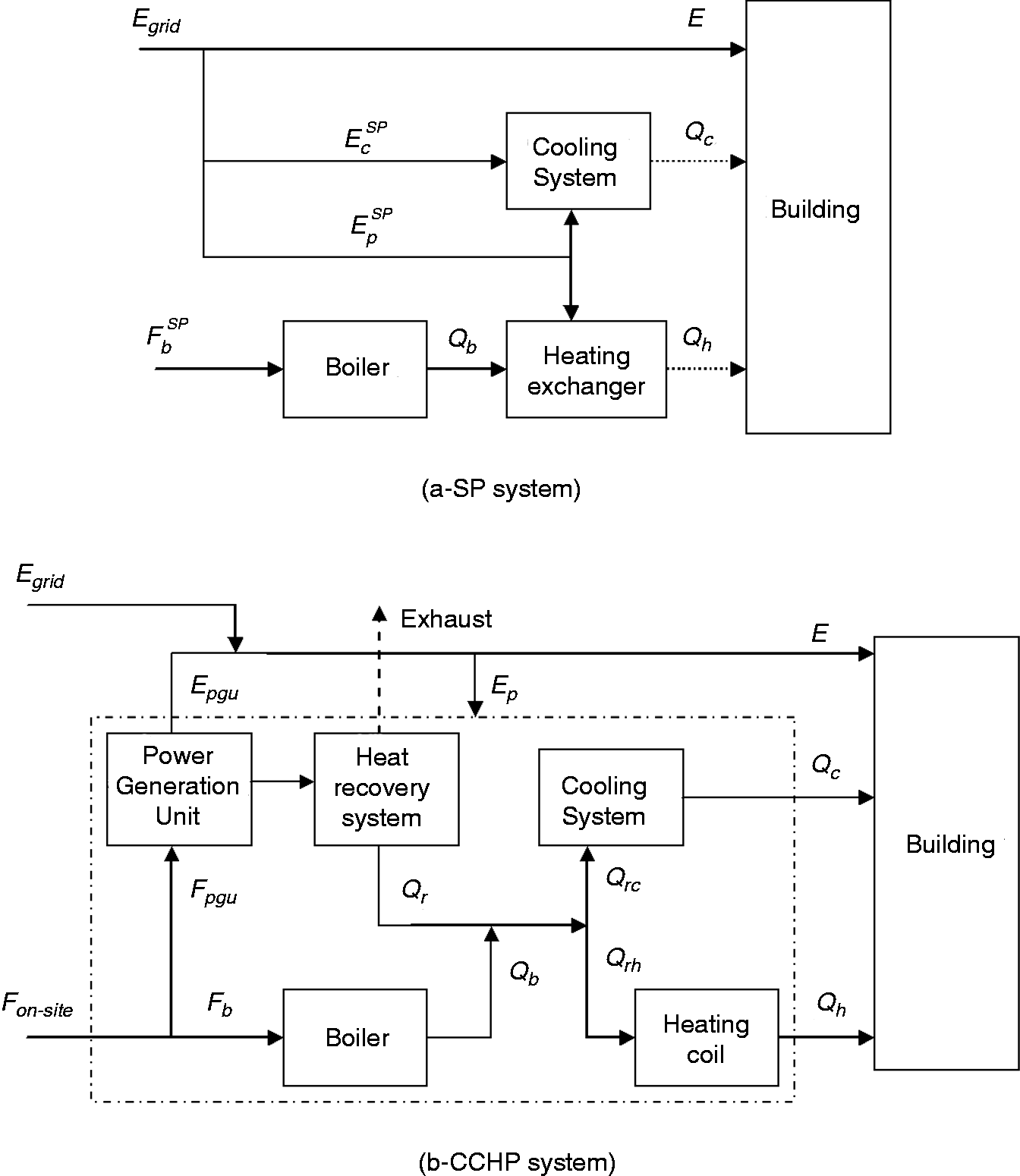
In the SP system, the cooling system adopts electric chiller, the heating system utilizes gas boiler, and the electricity for the building and the electric chiller comes from the local centralized power grid.
The CCHP system consists of a power generation unit (PGU), a waste recovery system, a back-up boiler, a cooling system, and a heating system. The PGU is driven by natural gas to produce the electricity needed by the building. The high-temperature exhaust gas from the PGU is recovered to accommodate the thermal load for cooling in summer and heating in winter. The cooling system adopts absorption chiller to utilize the recovered heat. If the recovered heat does not completely satisfy the application needs, the back-up boiler can be used to supplement the additional heat. Similarly, when the amount of electricity from the PGU is not enough to the building, the additional electricity comes from the grid. Contrarily, the excess products could be stored or sold to other users when there are excess heat or electricity produced by the CCHP system. However, it is important to mention here that the excess products from the CCHP system are dissipated directly, and their energy saving and economic saving are not considered into the independent CCHP system. Consequently, the CCHP system must reduce another excess product when it satisfies one kind of energy demands of building.
During the following analysis of CCHP system, some important assumptions are followed:
The minimum technical limit of CCHP system is neglected. The CCHP equipments can operate anywhere between 0% and 100% of its rated capacity, and ramping rate for load adjustment is not included. The CCHP system is assumed to be 100% reliable. The efficiency drops of CCHP equipments at part load operation are neglected to simplify the analysis and calculation. The sales of surplus heat or electricity form CCHP system are prohibited.
Primary energy consumption of SP system
Aimed to satisfy the energy demands of building, the primary energy consumed by the SP system in Figure 1(a) can be calculated as:

Primary energy consumption of CCHP system
The CCHP system usually operates following either electric or thermal demand. The operation strategy determines the performance of CCHP system directly. Herein, the two operation modes, EDM and TDM, are employed to compare the performances of CCHP system.
EDM operation mode
The maximum input fuel energy of the PGU is assumed to
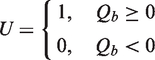
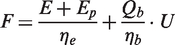
The operating condition and the primary energy consumption are expressed as follows:

If Test condition A = True then


If Test condition A = False then

TDM operation mode
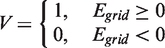
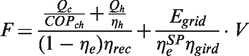
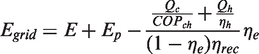
The PGU operates according to the thermal demand of building in TDM mode so that the input fuel energy is determined by the thermal load. Similarly, the recovered heat from the PGU is just to satisfy the thermal demand when the input fuel energy is less than the maximum capacity. The generated electricity is provided to the building and the distribution system. When the electricity is not enough, the additional electricity comes from the grid. When the thermal load is more than the maximum recovered heat, the additional heat is supplemented by the back-up boiler. Therefore, the CCHP system would not exhaust excess heat in TDM operation mode while the excess electricity may be exported.
Similarly, the operating condition and the primary energy consumption are expressed as follows:

If Test condition B = True then
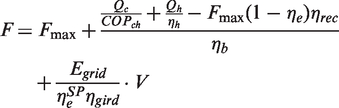

If Test condition B = False then
Evaluation criteria of CCHP system
To measure the benefits achieved by the CCHP system in comparison to the SP system from energy, economy, and environment, the following criteria are used.
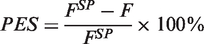
primary energy saving (PES) PES is defined as the percentage of the saving energy of the CCHP system in comparison to the SP system to the energy consumption of the SP system. It is written as:
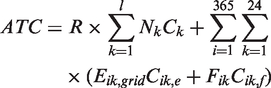
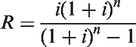
annual total cost saving (ATCS) The annual total cost including annual capital cost and operation cost, is calculated to:
CO2 emission reduction (CO2ER) The amount of CO2 emission from the CCHP system can be estimated to12,41



Energy demands of buildings
General description of the simulated buildings using DesT.
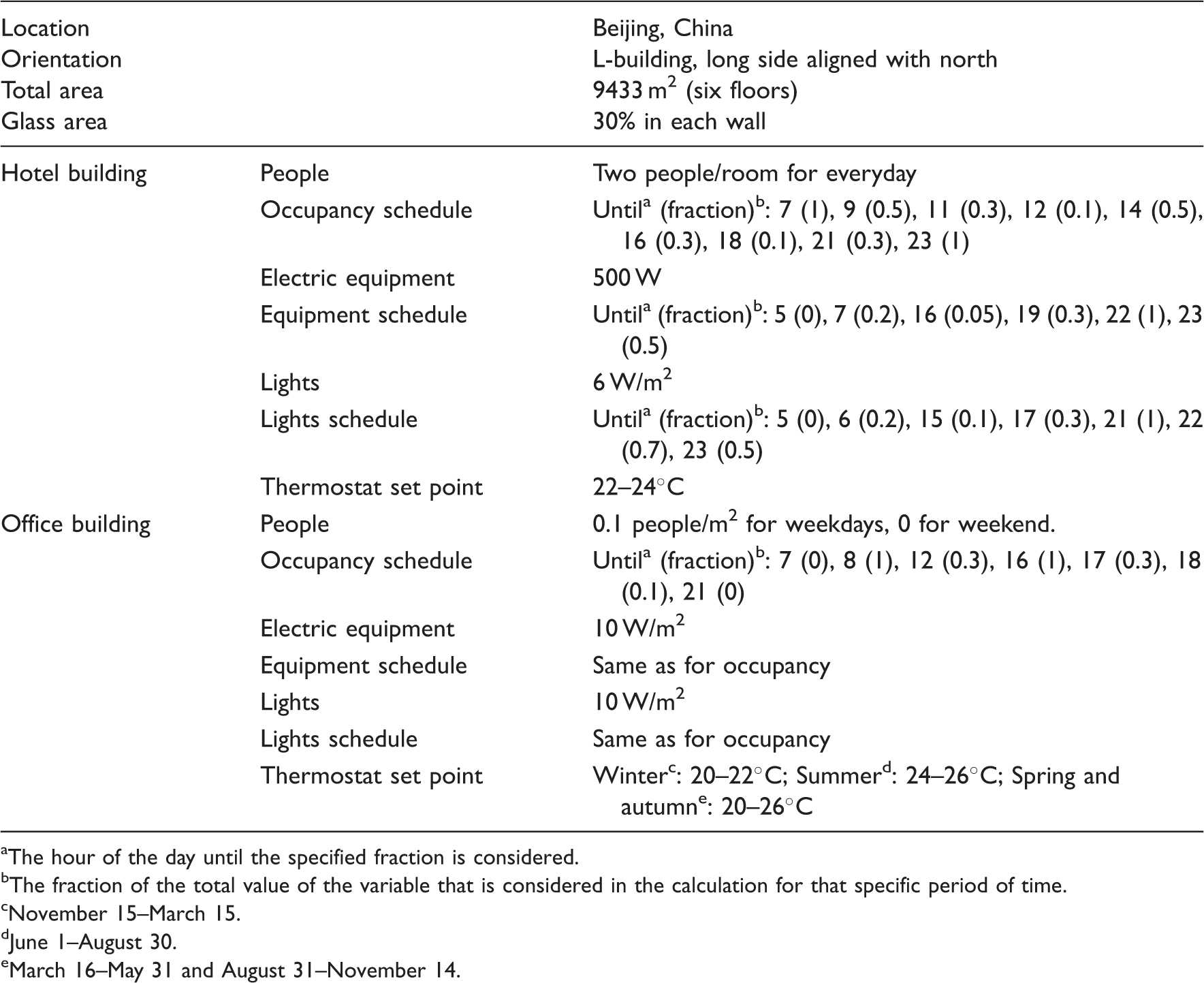
The hour of the day until the specified fraction is considered.
The fraction of the total value of the variable that is considered in the calculation for that specific period of time.
November 15–March 15.
June 1–August 30.
March 16–May 31 and August 31–November 14.
The annual energy demands of the simulated buildings.
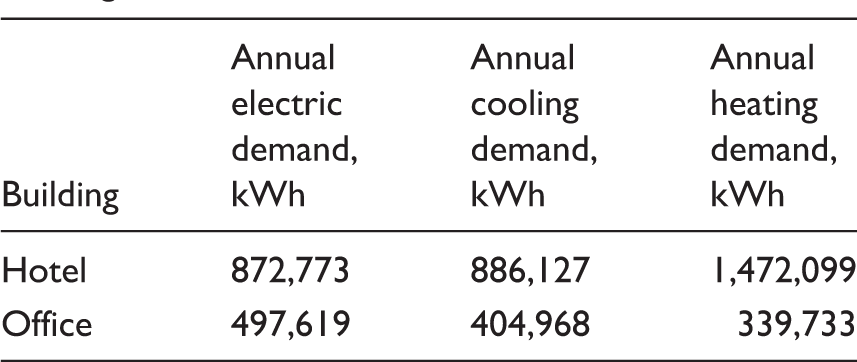
The energy demands of the buildings are shown in Figures 2 and 3. To show the energy characteristic of the buildings, the energy curves in typical days are shown in Figure 2. The typical day is defined to the representative day when the characteristic of energy demands of building can be reflected and demonstrated. Here, 18 January 18 and 2 August when the heat load and the cooling load are the maximum, respectively, are selected to represent the corresponding typical days in winter and summer. In Figure 2, (a) represents in winter and (b) represents in summer. The daily energy demands and the cumulative curves are displayed in Figure 3, where (a) represents the daily energy demands and (b) represents the cumulative curves. It is notable that the energy demands in typical days are only used to show the characteristic of the buildings in Figure 2, while the calculation and analysis are based on the annual energy demands in Figure 3.
The hourly energy demands of buildings on the typical day in winter and in summer. The daily energy demands in all-year and the energy demands cumulative curves of buildings.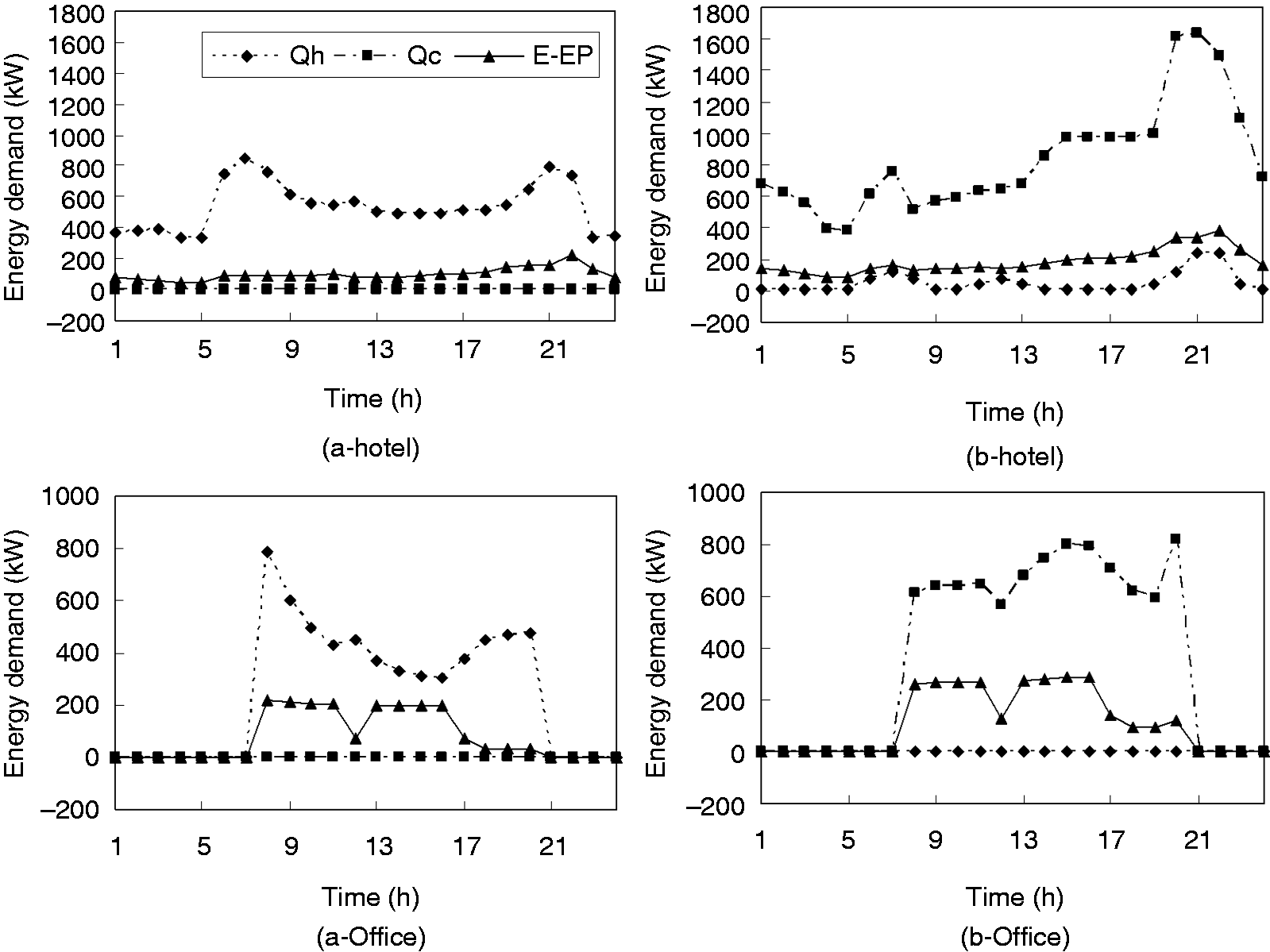
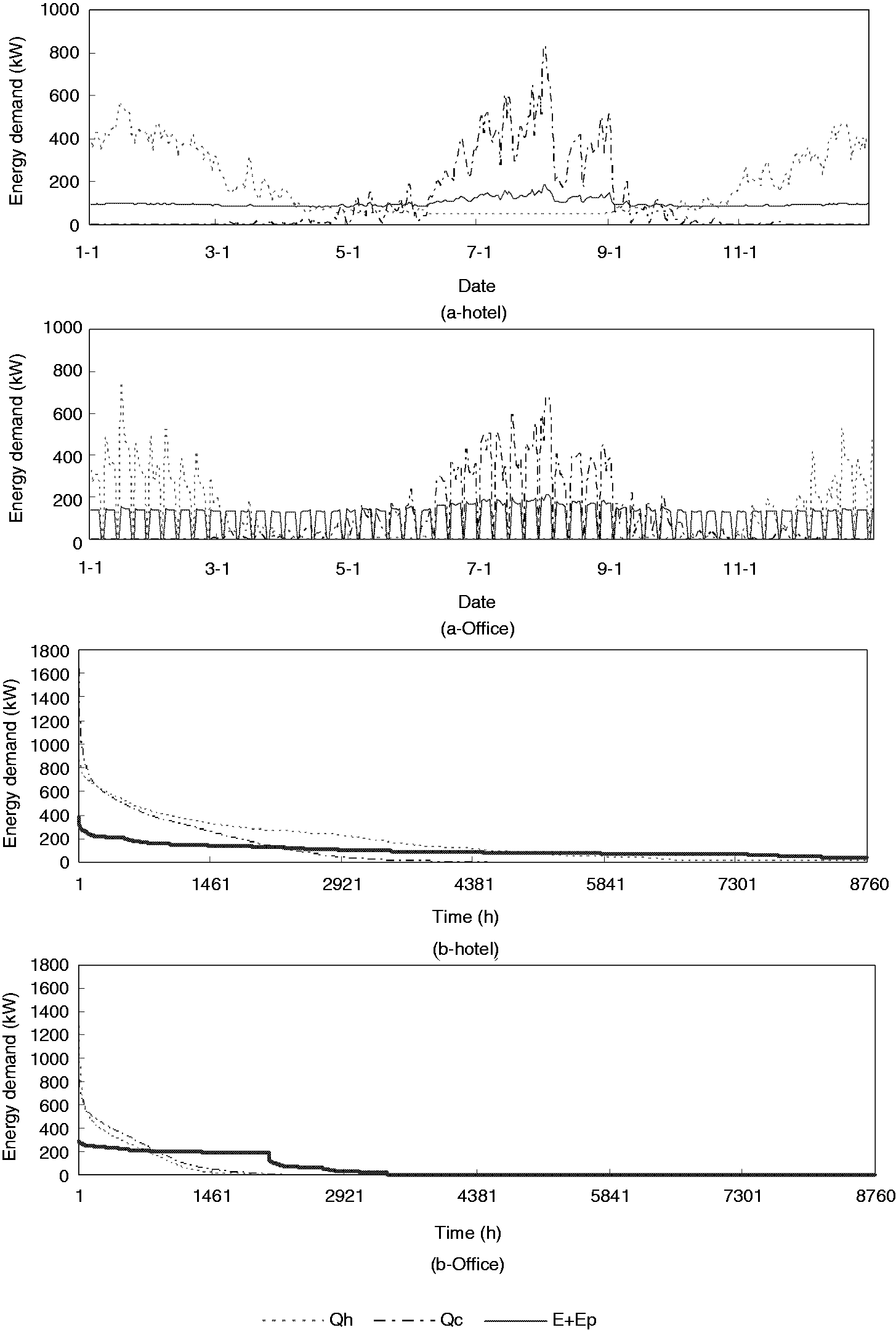
From these profiles in Figures 2 and 3, the hotel has the following characteristics: (1) There needs heat to produce domestic hot water during the entire year; (2) The daily electric demand is stable relatively and is less than the heating and cooling loads; (3) The daily heating and cooling loads both fluctuate more greatly than the daily electricity demand; (4) The cooling peak is greater than the heating peak because of the hot climate in Beijing; and (5) In spring and autumn, the three energy demands for cooling, heating, and electricity are almost same and they fluctuate only between a little range.
The following characteristic of the office building can be derived: (1) The daily electric and cooling demands are stable relatively; (2) The daily heating load fluctuates more greatly than the electric and cooling demands; (3) The heating peak is greater than the cooling peak; and (4) In spring and autumn, the electric demand is more than the heating and the cooling.
The comparison between the two buildings can derive the following characteristics: (1) The energy consumption of the hotel is continuous while the office’s is intermittent. There are energy demands of the hotel during the entire year while the office does not need energy supply at non-working time and on weekend; and (2) the ratio of electricity to heating or cooling of the office building is greater than that of the hotel.
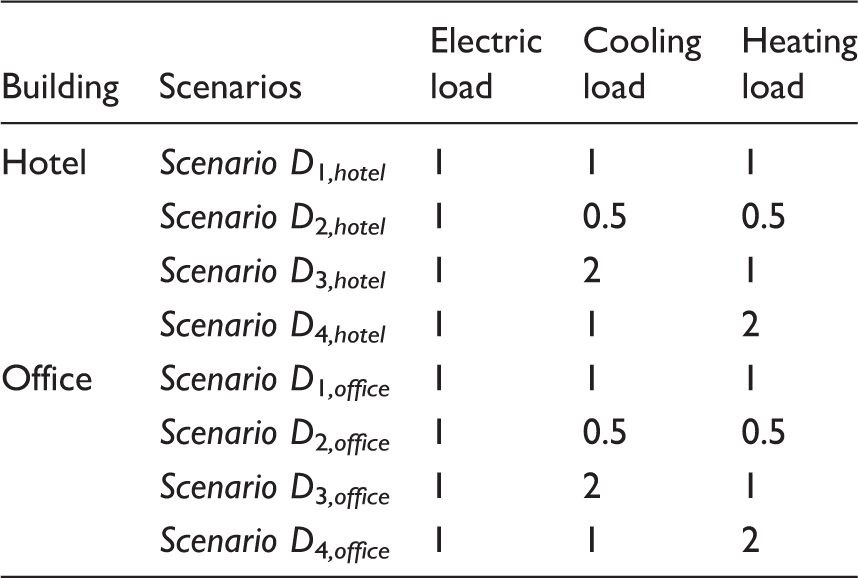
Aimed to compare more different buildings, some load scenarios are assumed. Each of load scenarios is represented by an “energy demand vector” composed of a triplet of the form

In order to point out the impact of the energy demands on the CCHP system’s performance, the scenarios in Table 3 are analyzed and compared. Based on the basic energy demands in Figure 2, the following scenarios with respect to the hotel are discussed:
Energy demand vectors of load scenarios. The ratios of thermal demand to electric demand of buildings.
Similarly, the following scenarios with respect to the office building are defined and listed in Table 3.

Results and discussion
Optimization results

Input values employed for the energy used calculations for SP system and CCHP system.
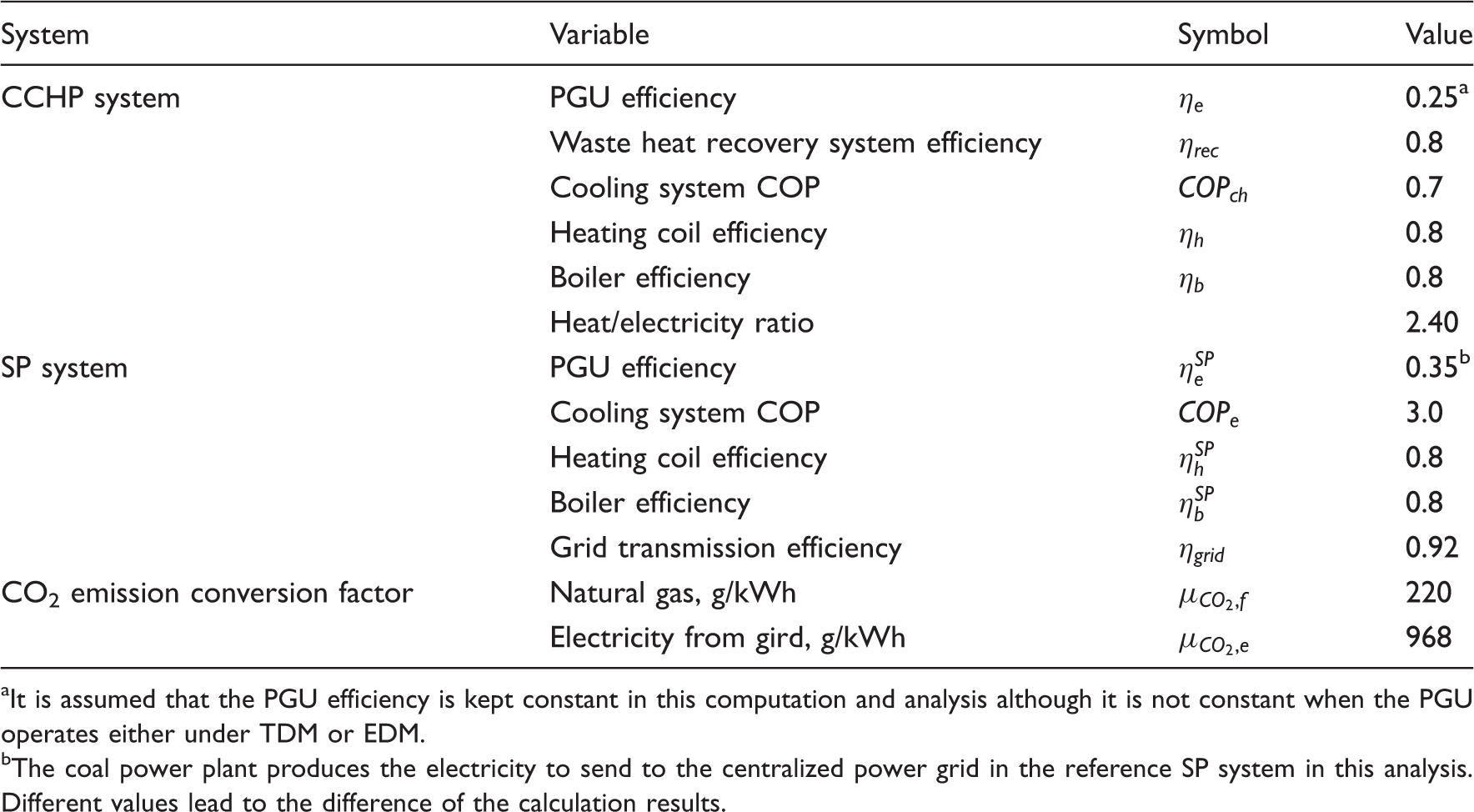
It is assumed that the PGU efficiency is kept constant in this computation and analysis although it is not constant when the PGU operates either under TDM or EDM.
The coal power plant produces the electricity to send to the centralized power grid in the reference SP system in this analysis. Different values lead to the difference of the calculation results.
Unit price of the facilities. 24

The date of unit price is 2008.
Unit price of electricity and natural gas.24

The date of unit price is 2008.
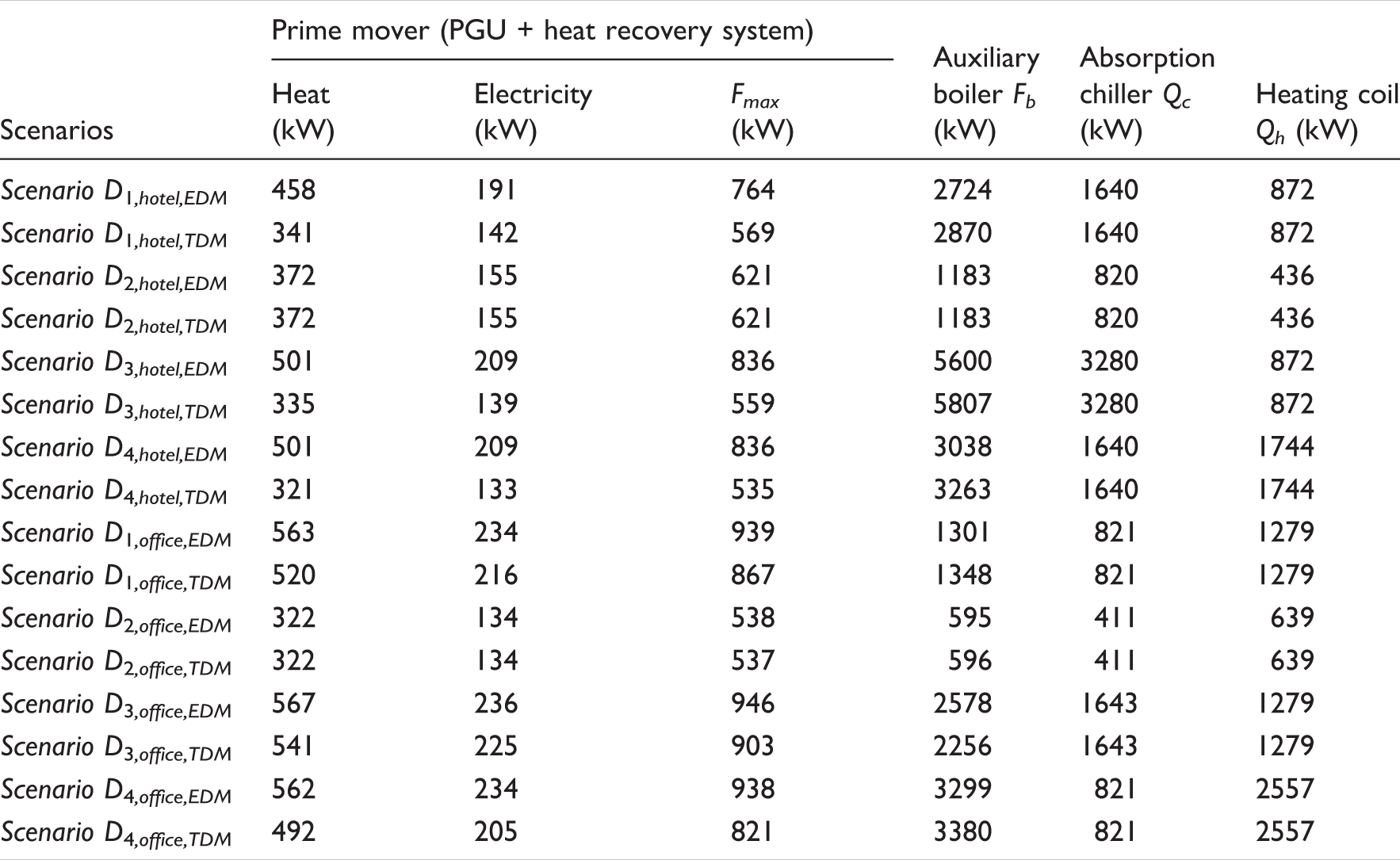
The optimal capacities are listed in Table 8, which shows that the capacity of the PGU in EDM mode is greater than or equal in TDM mode. Herein, it is assumed that the optimal capacities are just the installation capacities. The investment costs are summarized into Figure 4. It can be found that the investment costs of CCHP system in EDM mode and TDM mode for each scenario are almost equivalent, and the EDM mode is a little higher than or equal the TDM mode. The investment cost changes of scenarios of the hotel and the offices with the build energy demands are similar. When the cooling demand of the building is the main consumption, the investment cost will increase dramatically and the investment cost of scenario D3 is the highest. When the heating load of the building increase, the investment cost of CCHP system increase smoothly and the difference between D1 and D4 is not large.
The investment costs of CCHP systems in EDM and TDM operation modes. The capacities of equipments in CCHP systems.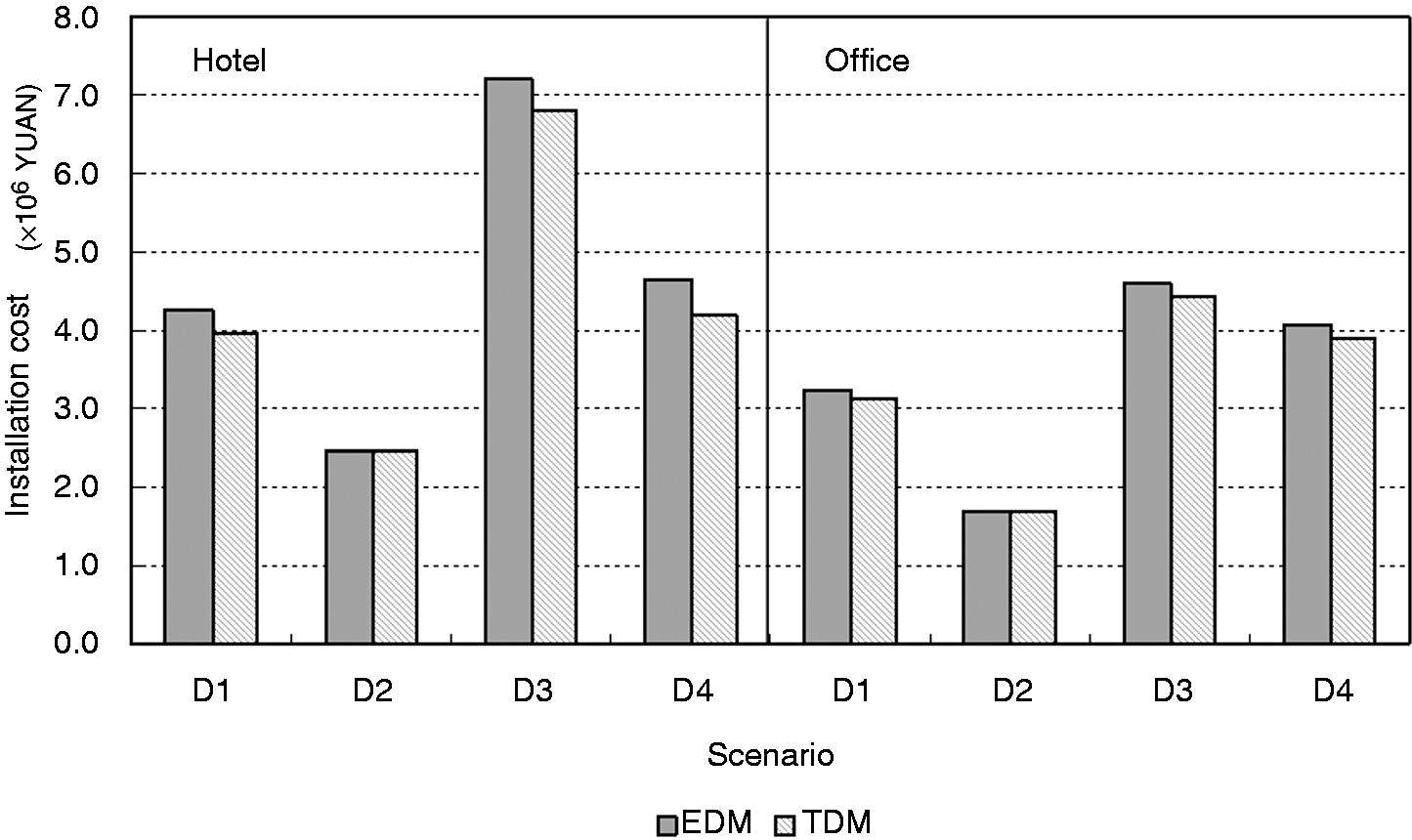
Performance analysis
The energetic, economic, and environmental performances and the integrated performances for the 16 scenarios are calculated and displayed in Figure 5, where (a) represents the performances in EDM operation mode and (b) represents the performances in TDM operation mode.
Annual performance of the CCHP systems in comparison to the SP systems for different buildings in EDM and TDM operation modes.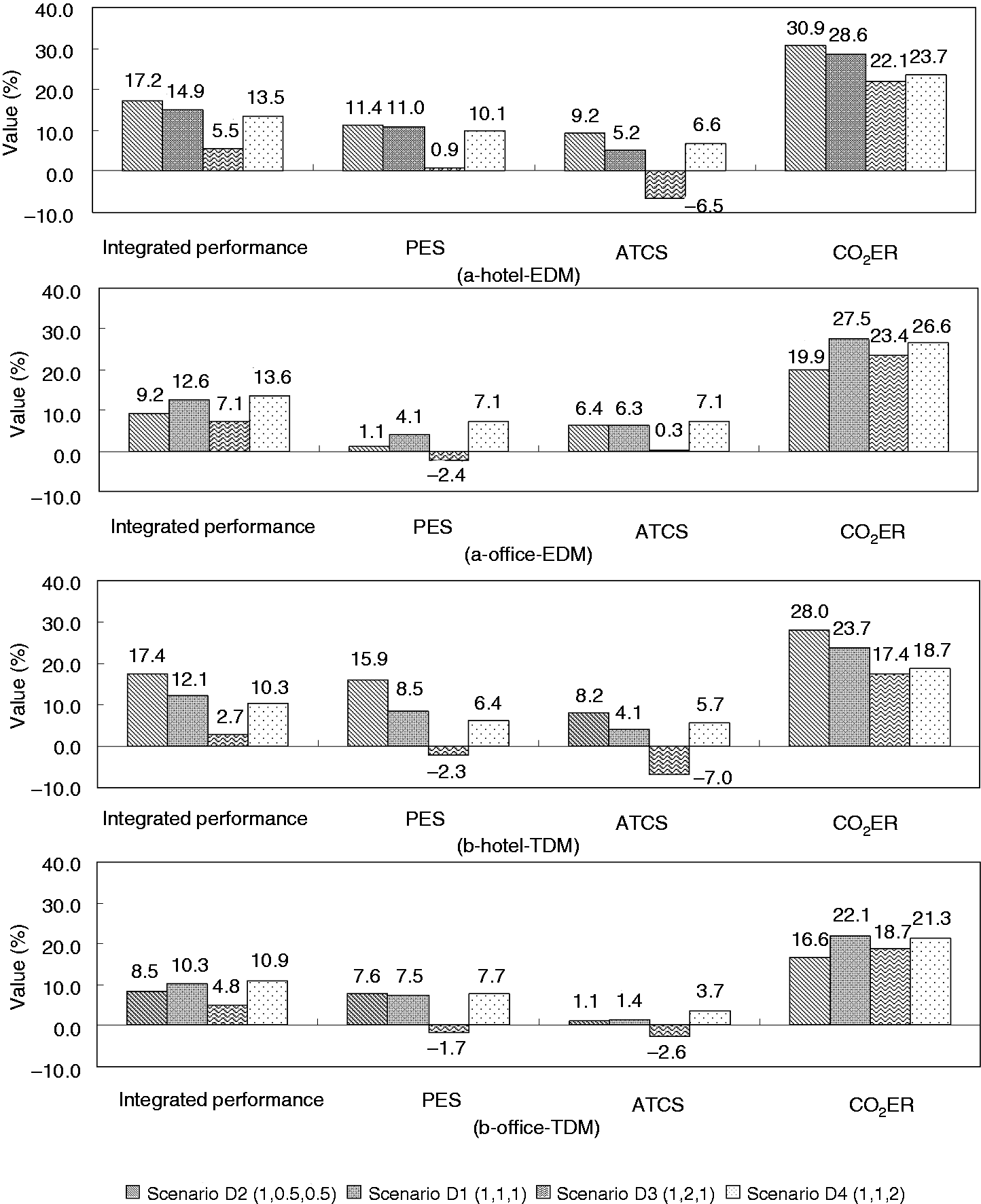
The average values of PES, ATCS, CO2ER, and the integrated performance of the CCHP systems for all of scenario buildings in the two different operation modes are 5.8%, 3.1%, 23.1%, and 10.6%, respectively. It is known that the CO2ER of the CCHP system in comparison to the SP system is the most outstanding. The average performances for all of scenario buildings in EDM mode are 5.4%, 4.3%, 25.3%, and 11.7% while the corresponding performances in TDM mode are 6.2%, 1.8%, 20.8%, and 9.6%, respectively. It can be found that the performance in EDM mode is better than in TDM mode except to the PES. Similarly, the average performances of CCHP systems for the hotel scenarios are 7.7%, 3.2%, 24.1%, and 11.7% while the performances of the office scenarios are 3.9%, 3.0%, 22.0%, and 9.6%, respectively. It can be concluded that the CCHP system is more suitable to the hotel building than the office building.
When Scenario D1 is compared with Scenario D3, it can be found that the performances of CCHP systems for hotel and office decrease with the increase of cooling load. For example, the PES, ATCS, CO2ER, and the integrated performance for the hotel in EDM mode decrease 10.1%, 11.7%, 6.5%, and, 9.4%, respectively. There are even some negative values in Scenario D3, which means that the CCHP system cannot achieve real benefit in comparison to the SP system. Especially, the increasing of cooling load of building would not save primary energy and cost in TDM operation mode. When the PGU runs in TDM mode and the annual ratio of heat to electricity of Scenario D3 is greater than that of the PGU, 2.40, the excess electricity is produced by the PGU in order to satisfy the thermal demand. It is noted that the PES and the ATCS of Scenario D3 hotel in TDM mode are less than the office’s because the difference between the heat/electricity ratio of hotel and the PGU is greater than the difference between the office’s and the PGU. From the whole comparison, the PES, ATCS, CO2ER, and the integrated performance of the CCHP system for the two buildings in the two modes averagely decrease 9.2%, 8.2%, 5.1%, and 7.4%, respectively, when the cooling load increases by 100%. The primary energy consumption of the CCHP system will more markedly increase. The decreasing range of the CO2ER is the least when the building needs more cool.
When Scenario D1 is compared with Scenario D4, it is seen that the performances of CCHP systems for hotel decrease with the increase of heating load while the performances of office increase. It is because that the heat/electricity ratio of hotel is larger than that of the PGU while the office’s ratio is less than that of PGU. For Scenario D1, increasing appropriate heating demand will improve the utilization efficiency and there are not excess energy consumption to satisfy the energy demand. Additionally, the change trends differ when the building needs more heat or more cooling. When the heating load is doubled, the PES and the ATCS of the CCHP systems for the two buildings in the two operation modes averagely decrease 0.1% and 1.5%, respectively, while CO2ER and the integrated performance increase 0.4% and 2.9%, respectively. Compared to the changes, 9.2%, 8.2%, 5.1%, and 7.4%, when the cooling increases, it can be seen that the impact of the cooling load on the saving performance is greater than the heating load. It is mainly determined by the COP difference between electric chiller and absorption chiller. When both the cooling load and the heating load decrease, the performance difference between Scenario D1 and Scenario D2 is similar to the difference between Scenario D1 and Scenario D4.
Additionally, the capacities of CCHP systems in EDM and TDM operation modes are compared. From Table 8, it can be found that the capacity of the PGU in EDM mode is greater than or equal in TDM mode. Taken Scenario D1 as an example, the performance in EDM is better than in TDM mode except the PES in office (the explanation about the PES in office can be found in the latter section). The CO2 emission factor of electricity from grid is greater than the supplemental gas. Consequently, the CO2ER in EDM mode is greater than in TDM mode. The economic cost with the capacity of the CCHP system is vaulted relationship. 44 The ATCS begins to increase with the increase of capacity, reaches the maximum, and then decreases. The capacity in EDM mode is greater than in TDM mode and the ATCS in EDM mode is also greater than in TDM mode, which means that the optimal capacity locates the decreasing curve. Furthermore, the impacts of thermal demand of building on CCHP performance in EDM and TDM operation modes are compared. The impact in TDM mode for the hotel is greater than in EDM mode while the office is just contrary to the hotel. The reason is that the heat/electricity ratio of hotel is greater than that of PGU while the ratio of office is less.
When the components of the integrated performance in Figure 5 are compared, it can be noted that there are some negative values in these 16 scenarios while the CCHP system always reduces CO2 emission in comparison to the SP system. The outstanding CO2ER is the result that the CO2 emission factor of gas is less than that of electricity from grid. From equations (18) and (19), it can be found that the CCHP system reduces CO2 emission only when 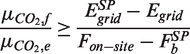
The left part is the ratio of CO2 emission factors of fuel and electricity produced by the SP system. The right part is the ratio of electricity consumption’s difference of the CCHP system and the SP system and fuel difference. The CCHP system can really exhaust less CO2 than the SP system only when the inequation in equation (22) is satisfied. After the input fuel and the electricity grid are determined, the left part is then fixed and unchanged. Therefore, the operation strategy of the CCHP system and the energy demands of building mainly influence the environmental benefit achieved by the CCHP system in comparison to SP system.
To show the performances of CCHP system more clearly, Scenario D1 of hotel and office is selected to analyze the monthly performances. The monthly varieties of PES, ATCS, CO2ER, and the integrated performance of CCHP system are displayed in Figure 6, where (a) represents EDM mode and (b) TDM mode.
Monthly performance of the CCHP systems in comparison to the SP systems for hotel and office in EDM and TDM operation modes.
When the performances of the hotel between EDM and TDM are compared, the trends of these performance curves are almost same, and they fluctuate with the ratio of heat to electricity. The trends of the PES and the CO2ER of the two operation modes are similar except to the ATCS. In summer, the primary energy consumption and the CO2 emission both are the most during the entire year and the energetic and environmental performances of CCHP system is the worst. Especially, there are some negative values of the PES in the summer, which means that the CCHP system cannot really save energy in comparison to the SP system. The ATCS during the transitional seasons is the lowest. From the comparison of annual performance, the corresponding difference between EDM and TDM are 2.5%, 1.1%, 4.9%, and 2.8%. It can be concluded that EDM mode of CCHP system for the scenario hotel is better than TDM mode.
When the performances of Scenario D1 office between EDM and TDM are compared, the trends of these curves are also almost same. Only there is a little difference in the PES variations. But the performance curves of the office are very different to that of the hotel. The ATCS and the CO2ER in the transitional seasons are the worst while the PES in the summer is the worst. From the comparison of annual performance, the corresponding difference between EDM and TDM are −3.4%, 4.9% 5.4%, and 2.3%. From the integrated performance of CCHP system, it can be also concluded that EDM operation mode is better than TDM. But the CCHP system in TDM mode for the office saves less energy than in EDM mode.
Similar to the fact that the CO2ER of CCHP system is the most outstanding in Figure 5, it can be seen the curves of the monthly CO2ER are located on top of other performance curves and the environmental benefit achieved by the CCHP system is the greatest. Because the emission factor of the CCHP system is much less than that of electricity produced by the SP system, the CCHP system always reduces CO2 emission in comparison to the SP system for the 16 scenarios. When the monthly performance for the hotel and the office is compared, the benefits achieved by the CCHP system in comparison to the SP system from energy, economy, and environment are much different. The performance is closely related to the energy demands’ characteristic of building and the heat/electricity ratio. Generally, the adoption of the CCHP system in winter is more profitable to save primary energy and reduce CO2 emission.
Discussion on the excess products from CCHP system
The excess products of CCHP systems for the 16 building scenarios.
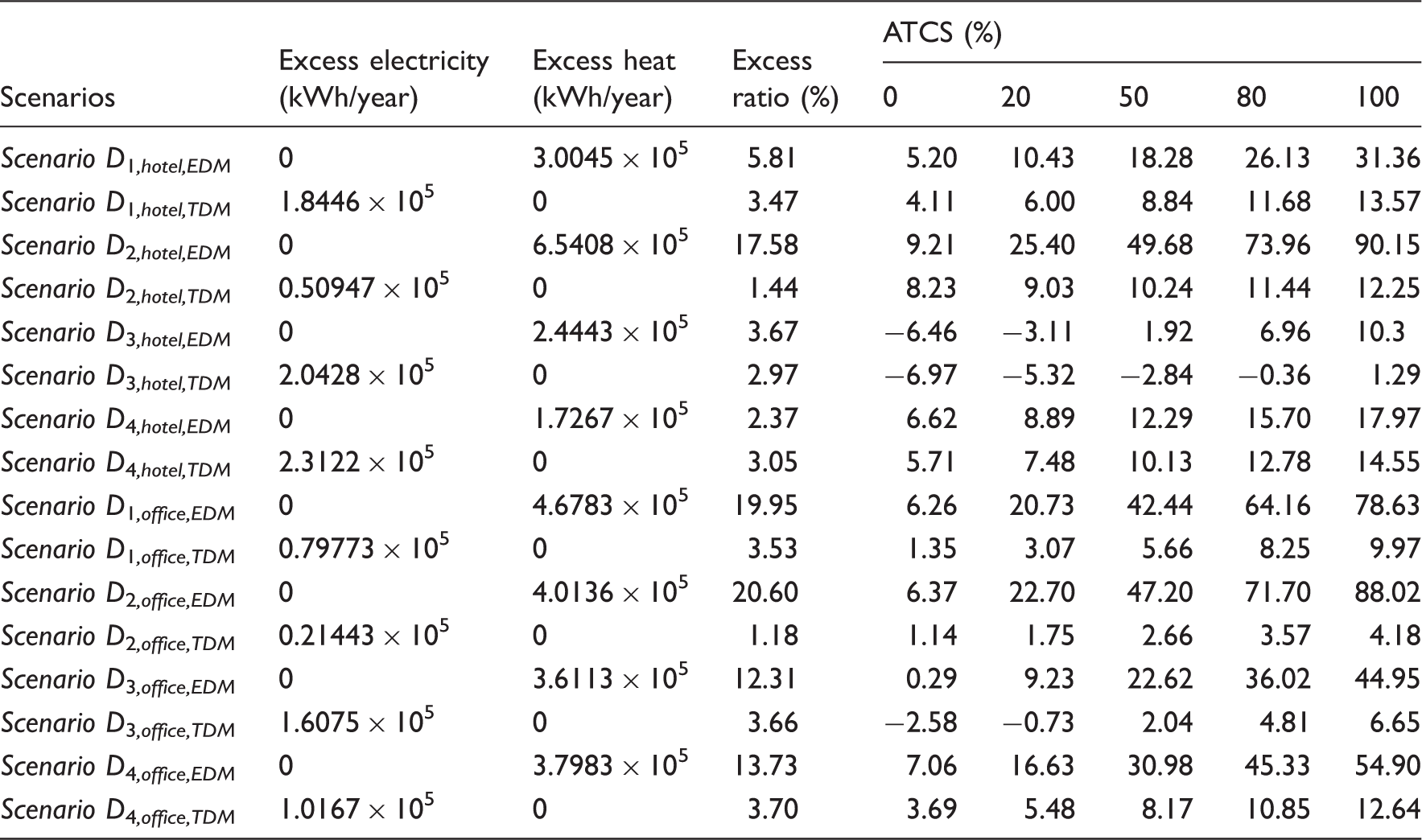
The cost of heat is calculated to 1.379 Yuan/kW, and the selling price of the electricity is same as the buying price in Table 7. However, the selling price is usually lower than the buying price. Aimed to discuss the impact of the selling price on the ATCS, the selling prices of excess products are 20%, 50%, 80%, and 100% of buying price. The ATCS of these 16 scenarios are recalculated and shown in Table 9. It can be seen that the ATCS increases with the increase of the selling price, and especially the increasing extent in EDM operation mode is greater than in TDM mode. Some negative ATCS values change to be positive when the excess products can be sold back to grid or other heat users, such as Scenario D3. Therefore, the energy policy allowing the electricity generated by the CCHP system to be sold back to the grid, and the technologies storing the excess electricity or heat are helpful to improve the performance of CCHP system.
Discussion on the different weights in GA optimization procedure
The above performance analysis is based on the optimization results in GA. Moreover, the weights in the objective function, equation (21), influence the optimization results directly. If the different importance is paid attention to the three characteristics including energy, economic, and environment, the performances of CCHP systems for different building will be different largely. To find the impact of the weights on the performance, Scenario D1 of the hotel and the office in two operation modes is selected to analyze and discuss.
The optimization results, the investment costs, and the performances of CCHP systems when the criteria weights are different are summarized in Table 10. It can be found that the PGU capacities are different largely when the weights are different, especially the PGU capacity with others when the economic characteristic is the most important. Compared the data in Table 10, it can be seen that the optimal PGU capacities from the energetic and environmental aspects are both larger than that from the economic criteria. When the energy-saving and CO2-emission-reduction are paid more attention than the economic performance, the higher investment is required and the ATCS of CCHP system in comparison to SP system is the minimum. Therefore, the PGU capacity should not too large from the point of the investment cost. The investment cost increases with the increase of the installation capacity of PGU and the relationship is shown in Figure 7. The investment cost changes almost linearly with the PGU capacity no matter which mode the PGU runs.
The relationship between the PGU capacity and the investment cost of Scenario D1. The capacities, installation costs and performances of CCHP systems when the optimization objective functions are different.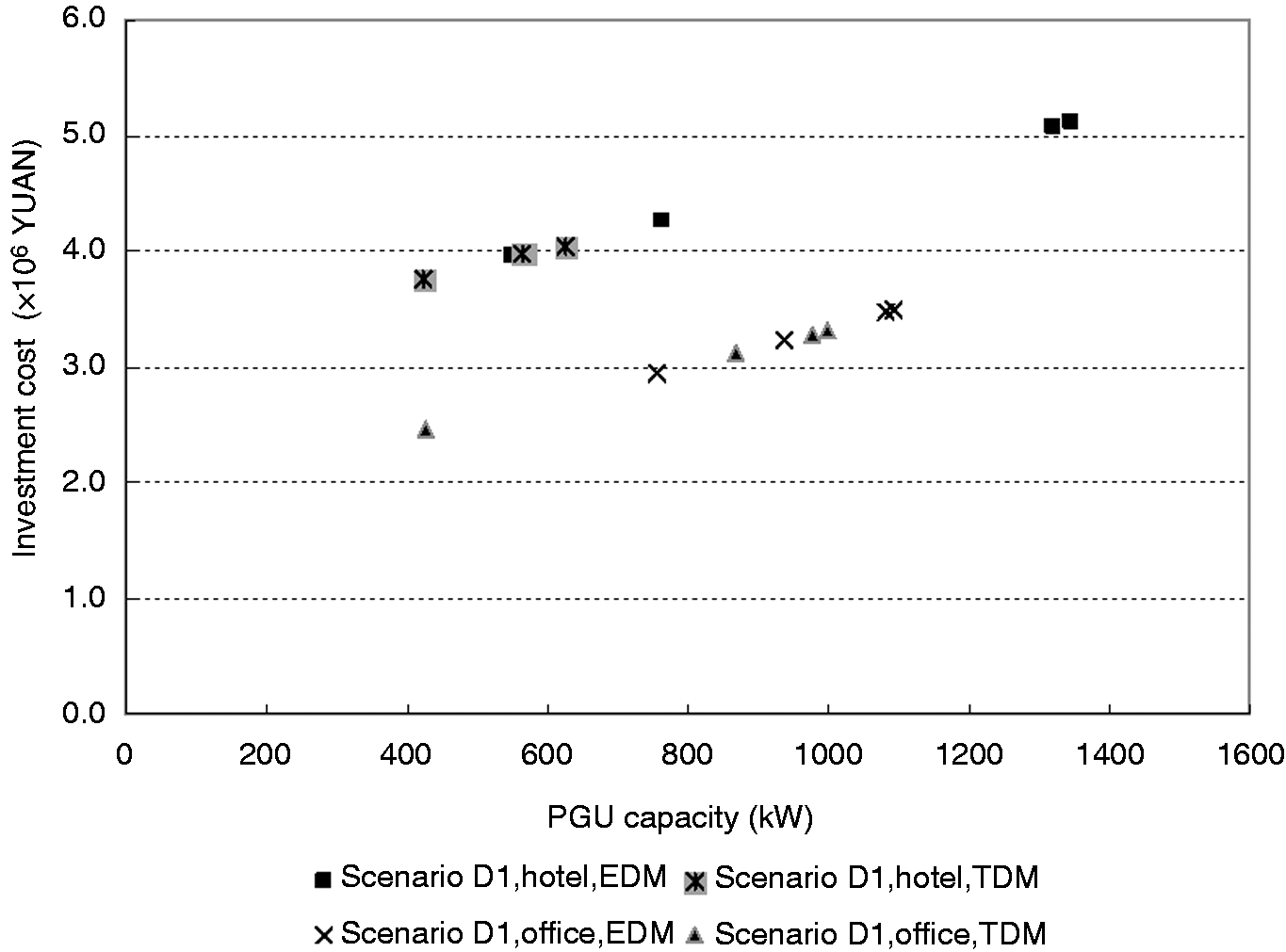
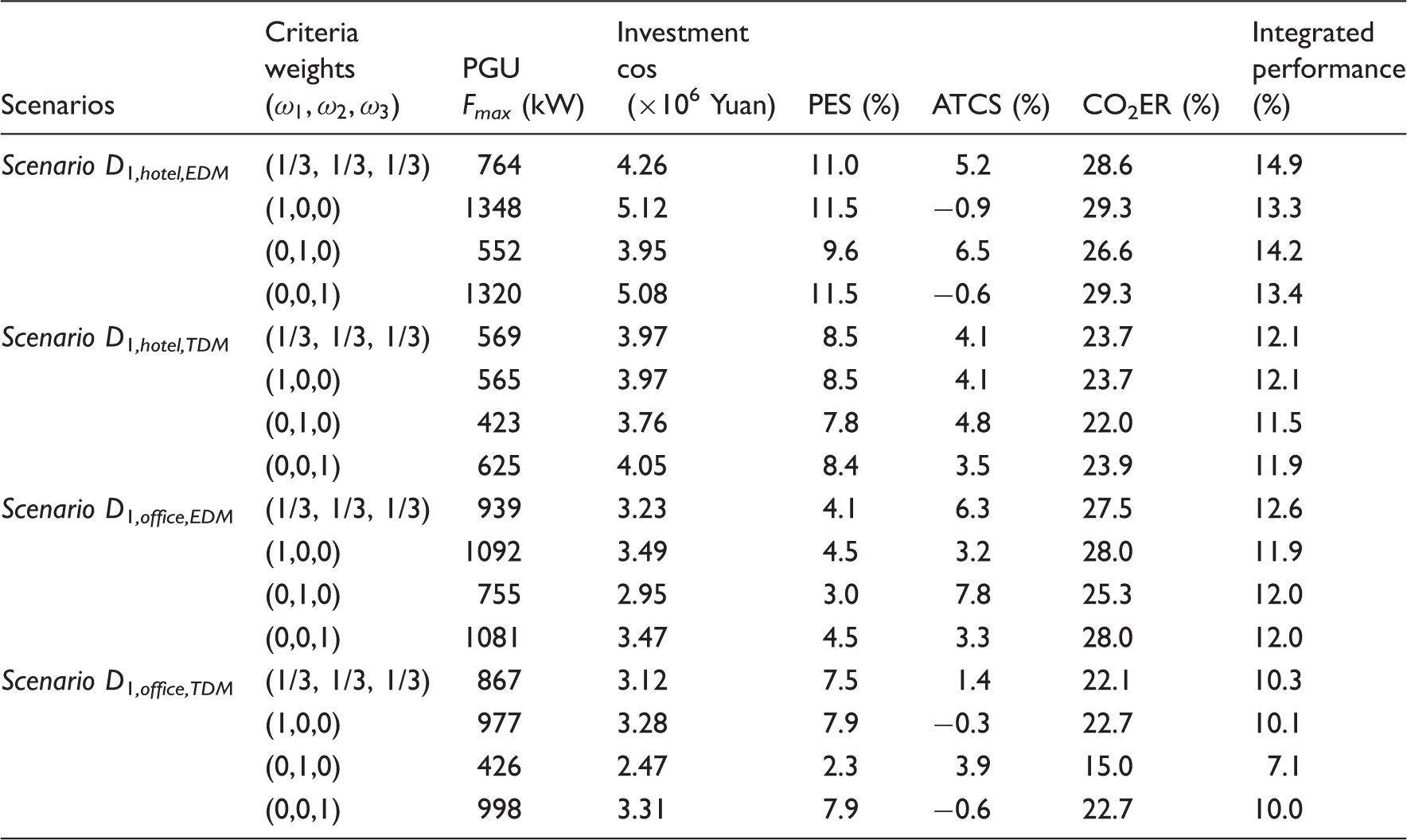
Although the optimal capacities are largely different and the investment cost are also different, but there is a little difference between the integrated performances of CCHP system in comparison to SP system. The maximum difference of the integrated performance between the economic optimization and the integrated optimization reaches 3.2%, and others generally are less 1.0% except to the difference between the integrated optimization and the energetic optimization. As a whole, the environmental potential is the most remarkable and the economic performance is the lowest and even there is no economic benefit between these three characteristic benefits of CCHP system in comparison SP system.
Conclusion
This paper presented performance analysis and comparison of CCHP systems optimized by GA for different buildings. This analysis leads to the following conclusions that are more applicable to the PGU unit with a heat/power ratio of 2.4.
GA is a valid optimization method for CCHP system that needs no initial information and searches the global optimization solution. GA operates parallel from multi-points, overcomes the search blindness, and accelerates the search speed. The GA optimization method can be extended to cover some of the omissions mentioned above as long as the calculation of the fitness function is able to be finished.
The performance of CCHP system is greatly related to the ratio of cooling load to electric demand and the ratio of heating load to electric demand. The appropriate ratio of heat to electricity of building is helpful to improve the performance of CCHP system when the excess electricity is not allowed to be sold back to grid in EDM operation mode or the excess heat is directly exhausted in TDM operation mode.
The optimal operation mode of CCHP system is determined by many factors, such as the technical parameters of CCHP system, the energy demands of building, and the price of energy. The optimal capacity of CCHP system in EDM mode is greater than in TDM mode. Consequently, the capital cost in EDM mode is more. The excess ratios in EDM mode of scenarios having lower ratio of heat to electricity are much larger than in TDM mode, which would not really save the primary energy. When the excess products could be sold to other users, ATCS in EDM operation mode is greater than in TDM operation mode.
The optimal result and the performance change with the criteria weights in the optimization procedure of CCHP system. Generally, the environmental potential of CCHP system in comparison SP system is the most remarkable, and the economic performance is the lowest between these three characteristic benefits. The investment cost increases with the increase of the installation capacity of PGU. When the cooling demand of the building is much more than the heating demand, the investment cost will increase dramatically.
Footnotes
Acknowledgements
The authors wish to express their gratitude to the anonym referees for remarks and suggestions that improved this paper significantly.
Funding
This research has been supported by the Fundamental Research Funds for the Central Universities (13MS95), Beijing Natural Science Foundation (3122028), Special Funds for Excellent Doctoral Dissertation of Beijing (20121007901), and Hebei Natural Science Foundation (E2012502002).
Declaration of conflicting interests
None declared.