







Abstract
Yangtze Region of China has high temperature in summer and low temperature in winter, with high humidity most of the year. The conventional household air conditioner cannot control temperature and humidity separately. Recently, the research on temperature and humidity independent control mainly focused on large-scale buildings; however, study on small-scale buildings throughout the year was limited. This paper introduces a novel household air-conditioning system suits for small-scale buildings in hot-humid climate region, named coupled radiation panels with household replacement fresh air (RP&HRFA) system, which could independently control the temperature and relative humidity of the indoor air. The RP&HRFA system can be operated in five different modes so as to be adaptive to different weather conditions all year round. In this paper, an experimental study under three operating modes, namely, summer, transitive season A, and winter B, were carried out. The overall and local thermal comfort indexes of the system were investigated under stable experiment operation conditions. The experimental results indicated that these indexes basically met the requirements of ISO7730 and ANSI/ASHRAE Standard 55-2010.
Introduction
With the rapid development of economy and urbanization, people’s requirements on indoor environment are no longer limited to proper temperature, but more emphasis on comfort and health. In Yangtze Region of China, the outside relative humidity level is very high throughout the year. In Shanghai, the annual average relative humidity ranges from 75% to 80%, sometimes reaches 95–100% in the rainy season. 1 Therefore, controlling indoor humidity level within an appropriate range in such region is very important since it directly affects occupants’ thermal comfort and indoor air quality.
In the conventional air-conditioning system, dehumidification and cooling are achieved by cooling the temperature of supply air below its dew-point which is deemed to be energy waste. In recent years, the temperature and humidity independent control (THIC) air-conditioning system has received widespread attentions in nonresidential buildings for its advantages on energy-saving and indoor thermal comfort. One of the THIC system is using high-temperature cooling source and radiation panels or dry fan coin units to handle sensible load, and using the fresh air which is processed to a relatively low humidity level by air dehumidifiers to deal with latent load. Radiation panels cooling/heating system has been widely used in recent years.2–4 However, when using radiation panels cooling/heating for air conditioning, in order to introduce fresh air into indoor environment, an additional ventilation unit with dehumidification to avoid condensation phenomenon and to reduce indoor humidity level is needed. As a consequence, combined radiation cooling/heating panels and ventilation systems using liquid desiccants or dehumidification rotating wheel have been studied.5–8 However, such THIC systems were suitable for large commercial buildings with large regeneration equipment.9,10 For small-scaled residential buildings, cooling dehumidification utilizing direct expansion air-conditioning system showed advantages of simpler, more flexible, and generally less cost to own and maintain.11,12
On the other hand, with the rapid development of THIC systems, its control effectiveness on indoor environment has also been investigated. Zhao et al. 13 presented a field test on the THIC air-conditioning system in office building. The results showed that the system could provide a comfortable indoor environment even in very hot and humid climate. A combined system of chilled ceiling, displacement ventilation, and desiccant dehumidification applied in an office building in Beijing was estimated using mathematical model by Hao et al. 5 Simulated results showed that in comparison with a conventional all-air system, the combined system achieved better indoor environment. Qi and Deng 14 developed a multi-input multi-output control strategy for simultaneously controlling the indoor air temperature and humidity in an experimental direct expansion air-conditioning system. Test results showed that the indoor air temperature and humidity could be controlled independently with adequate control sensitivity and accuracy. However, these previously studies only considered the THIC system on indoor environmental conditions, i.e. air temperature and humidity only, rather than indoor thermal comfort characteristics. On the other hand, they mainly focused on summer, and did not consider various weather conditions all year round.
A coupled air-conditioning system named coupled radiation panels with household replacement fresh air (RP&HRFA) handling unit, which independently control the temperature and humidity of indoor air, with functions of ventilation, cooling, dehumidification, heating, and heat recovery, has been developed. The RP&HRFA system can be operated in five different modes so as to be adaptive to different weather conditions all year round. In this paper, an experimental study of the RP&HRFA system under three operating modes, namely, summer, transitive season A and winter B, has been carried out, and the indoor thermal comfort for occupants using the system experimentally has been evaluated and reported. Firstly, the systematic principle of this RP&HRFA system and the system operational modes are introduced. Secondly, the overall and local thermal comfort indexes, and the experimental conditions for assessing the indoor thermal comfort are detailed. Finally, the calculated indoor thermal comfort indexes based on the experimental results are reported.
The RP&HRFA system
The operating principle of the RP&HRFA system
Based on the characteristics of high humidity throughout the year in the Yangtze Region of China, the RP&HRFA system, which handled the sensible heat load and latent heat load separated, was developed. The systematic diagram of this system is shown in Figure 1.
Schematic diagram of the RP&HRFA air-conditioning system.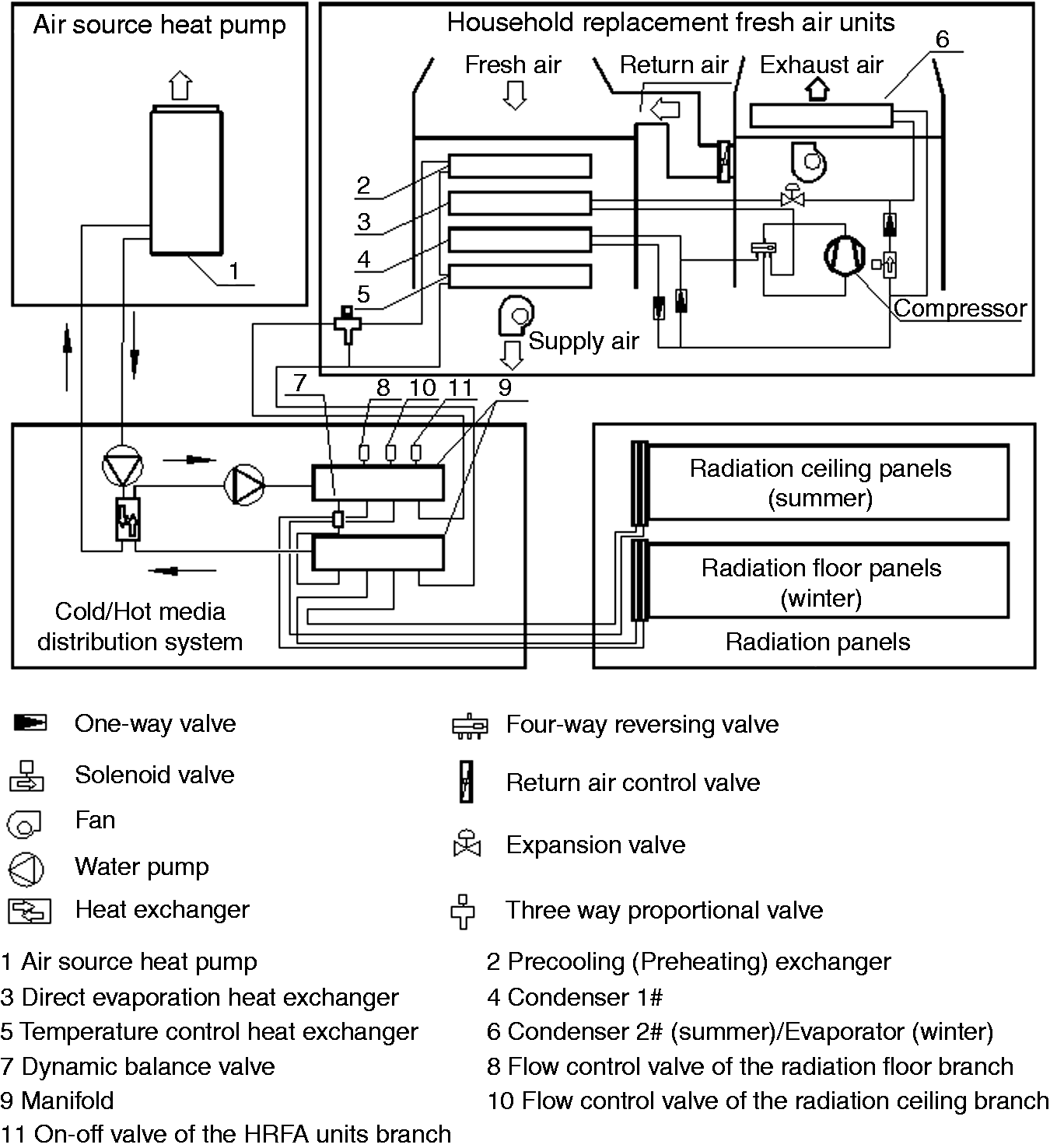
The sensible heat handling system, which consisted of the air source heat pump (ASHP) unit, radiation panels and the cold/hot media distribution system, undertook most of the indoor sensible heat load. Because the sensible heat load was independently processed, the temperature of supply water of sensible heat treatment system could be set to 18℃ in summer, comparing with 7℃ in conventional air-conditioning system.
The latent heat handling system dealt with the total heat load of fresh air, indoor latent heat load, and the rest part of the indoor sensible heat load. It was also in charge of the removal of CO2 and peculiar smell by introducing fresh air. It consisted of household replacement fresh air (HRFA) unit, ASHP unit, and cold/hot media distribution system. The ASHP unit was used to precool the inlet air and maintain supply air temperature. Dehumidification function was mainly performed by HRFA unit under refrigeration mode. The HRFA unit consisted of a standard heat pump system, supply fan, exhaust fan, precooling/preheating exchanger, and return air control valve. The supply air duct and the exhaust air duct were connected by the return air control valve. The working condition in cooling and heating mode of the HRFA unit is illustrated in Figure 2. As seen, in refrigeration mode, the condenser 1# and condenser 2# can work in parallel by switching off the solenoid valve, or condenser 1# work alone by switching on the solenoid valve. In heat pump mode, condenser 2# in refrigeration mode become evaporator, which can realize heat recovery from exhaust air. In order to realize dehumidification under very high humid climate, the HRFA unit adopted fresh air and return air mixture with variable return air rate method by using the return air control valve. As seen in Figure 1, the total return air was divided into two parts: one part of the return air was exhausted to the outside after passing the condenser 2# to recover cold energy; the other part was mixed with the fresh air firstly, then passed the precooling exchanger, direct evaporation (DX) heat exchanger, condenser 1#, the temperature control heat exchanger, and finally, return to the indoor environment.
The working condition in cooling and heating mode of the HRFA unit.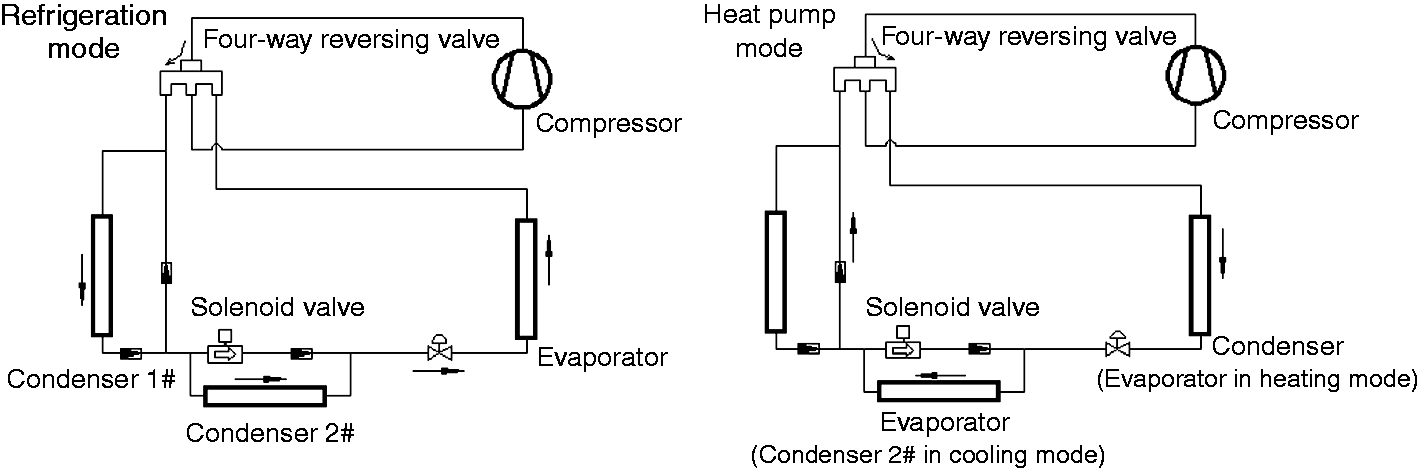
The system operating modes
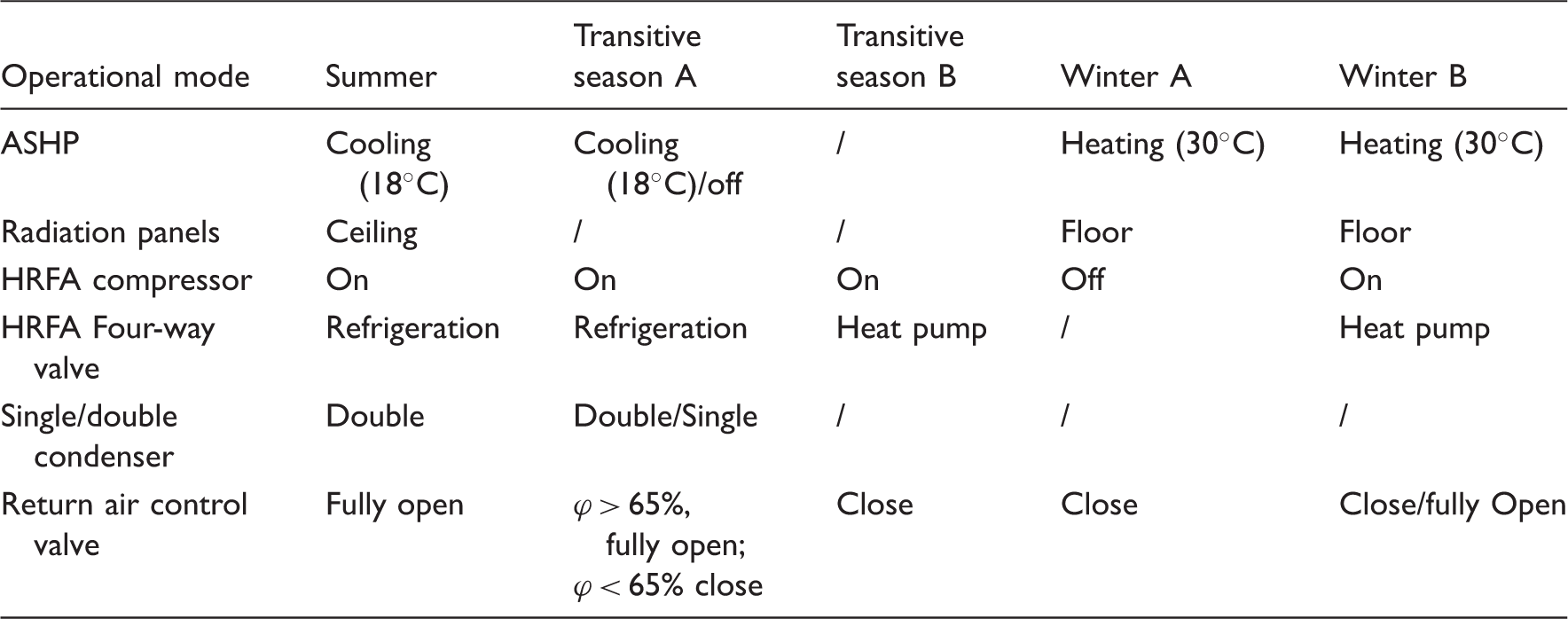
According to the characteristics of the climate in Yangtze Region, the RP&HRFA system can be operated under five operating modes, as shown in Table 1. The working condition and the temperature and humidity control method are detailed as follows:
(1) Mode 1: summer (2) Mode 2: transitive season A (3) Mode 3: transitive season B (4) Mode 4: winter A (5) Mode 5: winter B System operating modes and its corresponding climate ranges. The setting supply air temperature in winter A and winter B.
When the outdoor temperature is higher than 30℃, the RP&HRFA system is operated in summer mode. The setting indoor temperature and the supply water temperature of radiation ceiling panel are 25–26℃ and 18℃, respectively, and the setting indoor RH range is 50–65%. High temperature cold source of the system is provided by the ASHP unit. Most indoor sensible cooling load is handled by the radiation ceiling panels through the intermittent control of the water flow passing through the radiation panels by on–off control of the flow control valve (10 in Figure 1) with a 2℃ deadband. The fresh air total cooling load, indoor latent cooling load, and the rest part of the indoor sensible cooling load are undertook by the HRFA unit with double condensers. In order to maximize the dehumidification capacity, the return air control valve is fully opened. The compressor of the HRFA units controls the indoor RH by on–off running. When indoor RH is higher than 65%, the compressor is running to dehumidification; when the indoor RH is lower than 50%, the compressor is off, while the supply fan and the exhaust fan are still working. The supply air temperature and condensation prevention control are realized by regulating the water flow rate passing through the precooling/preheating exchanger and temperature controlling exchanger, with condensation prevention control as the priority. When the surface temperature is monitored lower than the dew point, the three-way proportional valve is fully open; when the surface temperature is monitored higher than the dew point, the three-way proportional valve is controlled by a PID controller to regulate the supply air temperature.
When the outdoor temperature is between 20℃ and 30℃, the RP&HRFA system is operated in transitive season A. The setting indoor temperature, the supply water temperature of radiation ceiling panel, and the setting indoor RH range are the same as those in summer mode. Unlike in the summer mode, the radiation ceiling panels are not working. In this mode, when the outdoor temperature is between 25℃ and 30℃, the refrigeration cycle of the HRFA unit works with double condensers, and the supply air temperature is maintained at about 20℃ regulated by the three-way proportional valve controlled by a PID controller. When the outdoor temperature is between 20℃ and 25℃, the outdoor temperature is appropriate, whereas the relative humidity level is still high. At this time, the system treats the air for noncooling dehumidification. The ASHP unit is turned off, the refrigeration cycle of the HRFA unit runs with single condenser (1#), and the supply air temperature is maintained at about 25℃. If the outdoor relative humidity level is higher than 65%, the return air control valve is fully opened to meet the demand of dehumidification, and vice versa.
When the outdoor temperature is between 14℃ and 20℃, the system is operated in the mode of transitive season B. Under this mode, temperature control is not necessary, and the setting indoor RH range is the same as that in summer mode. At this time, the system heats the air, and with the increase of the indoor air temperature, the air relative humidity is reduced to the thermal comfort requirements. Both of the ASHP and the radiation panels are turned off, the HRFA unit is operated under heating mode, undertakes all the fresh air and the indoor total heat load. The return air control valve is closed.
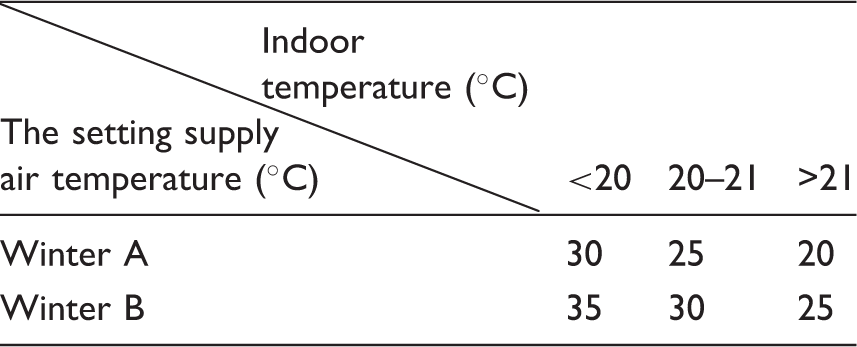
When the outdoor temperature is between 5℃ and 14℃, the system is operated in the mode of winter A. The setting indoor temperature and the setting supply water temperature of radiation floor panels are 20℃ and 30℃, respectively. Low temperature heat source is provided by ASHP unit, and most indoor heat load is handled by the radiation floor panels, whose control method is the same as that in summer mode. The fresh air is heated by the hot water flowed through preheating exchanger and the temperature control heat exchanger of the HRFA unit. The setting supply air temperature is varied with the indoor temperature, as shown in Table 2, which is regulated by the three-way proportional valve controlled by a PID controller. The compressor of the HRFA unit is turned off, and the supply fan and the exhaust fan are turned on. The return air control valve is closed. Under winter mode, although the outdoor RH may be high, the moisture content is low because of low outdoor air temperature. Therefore, humidity control is not considered under winter mode.
When the outdoor temperature is lower than 5℃, the system is operated in the mode of winter B. The setting indoor temperature and the setting supply water temperature of radiation floor panels are the same as those in winter A. The differences between winter B and A are that, in winter B, the system heating ability is increased by running the HRFA unit under heating mode, and the return air control valve could be opened under extremely cold weather in order to control the supply air temperature by reducing the fresh air flow. Under this mode, the temperature control method is the same as winter A mode. The setting supply air temperature is shown in Table 2.

Running conditions of the components in the RP&HRFA system for each operational mode.
Thermal comfort indexes selection and the experiments
Thermal comfort indexes
Thermal comfort has a great influence on the health and productivity of building occupants. Two indexes, PMV–PPD, proposed by Fanger15,16 have been widely used and accepted for field assessment of thermal comfort.11,17–19 The two indexes can be evaluated by


Fanger’s PMV–PPD thermal comfort model is normally applicable to sedentary or near sedentary physical activity levels. In this experimental study, occupants were assumed to seated with slight activity in an air conditioned space served by a RP&HRFA system, which could be considered as being in a sedentary physical activity level, therefore, Fanger’s PMV–PPD thermal comfort model could be adopted as a base model.
To facilitate the calculation of the two indexes, the following assumptions were used:
The metabolic rate (M) for seated occupants with slight activity was 1.1 met (65 W/m2).
22
The rate of mechanical work accomplished (W) was 0 met. The clothing normally worn by occupants provided a thermal insulation (I
cl
) of 1.0 clo (1 clo = 0.155 m2·K/W) in winter B, 0.57 clo in summer, and 0.61 clo in transitive season A.
21
Additional thermal resistance by the seat was 0.15 clo,
23
and the human body surface temperature after dressing could be obtained from ASHRAE 2009.
24
In addition, draft sensation, temperature difference between head and ankle, and surface temperature of radiation panels must be considered in determining conditions for acceptable thermal comfort.
20
Therefore, these three indexes were selected to assess the local indoor thermal discomfort. Index of the predicted percentage of people dissatisfied due to draft (DR) was adopted to assess the discomfort of draft sensation caused by t, v, and Tu according to ASHRAE Standard 55-2010,
20
the calculation method of DR can be obtained by

Experimental conditions
The experiments were carried out in an actual office, measuring at 7 m (L) ×6 m (W) × 2.7 m (H). In these experiments, the fresh air outlets were arranged near the outside window on the floor, whereas the air inlets were placed near the inside wall on the ceiling. Figure 3 shows arrangement of the measuring points and the positions of air outlets and air inlets.
Arrangement of measuring points in the indoor environment.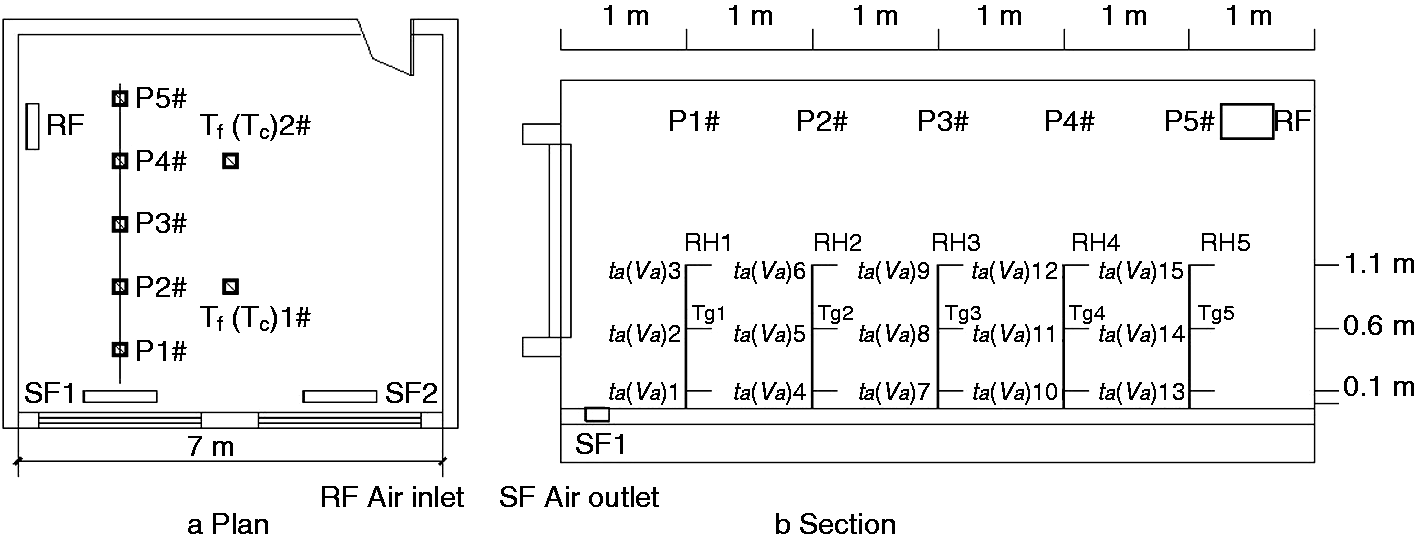
Instrumentation
There were totally five measuring points in the environmental laboratory, as holders P1#–P5# shown in Figure 3. At these five measuring points, indoor air dry-bulb temperature (t a ) was measured using thermocouple thermometer (of ±0.1℃ accuracy) and indoor air velocity (v a ) was measured using air velocity transducer (of ±0.03 m/s accuracy) at three different levels, i.e. 0.1, 0.6, and 1.1 m above the floor level for sedentary occupants, according to ASHARE Standard 55-2010. 20 Indoor air relative humidity (RH) was measured using humidity sensor (of ±2% accuracy) at 1.1 m above the floor level. On the other hand, the surface temperature of radiation ceiling/floor panels (T c /T f ) was measured using thermocouple thermometer (of ±0.1℃ accuracy) on the surface of the ceiling and the floor, respectively, and the globe temperature (T g ) using five black globe thermometers (of ±0.1℃ accuracy) were measured at 0.6 m level at these five measuring points as shown in Figure 3.
Results and discussion
The measurement results of three different operating cases
Case 1: As shown in Figure 4, the outdoor dry-bulb temperature was 31.2–32.2℃ and the outdoor RH level (ϕ) was 65.3–69.7%, according to Table 1, the RP&HRFA system was operated in summer mode. The measured average indoor dry-bulb temperature varied at the range of 25.8–26.1℃, the average indoor RH level varied at the range of 49.6–50.5%. The averaged globe temperature was 25.1℃, and the averaged indoor air velocity was 0.34 m/s.
Measured outdoor and indoor dry-bulb temperature and RH in Case 1.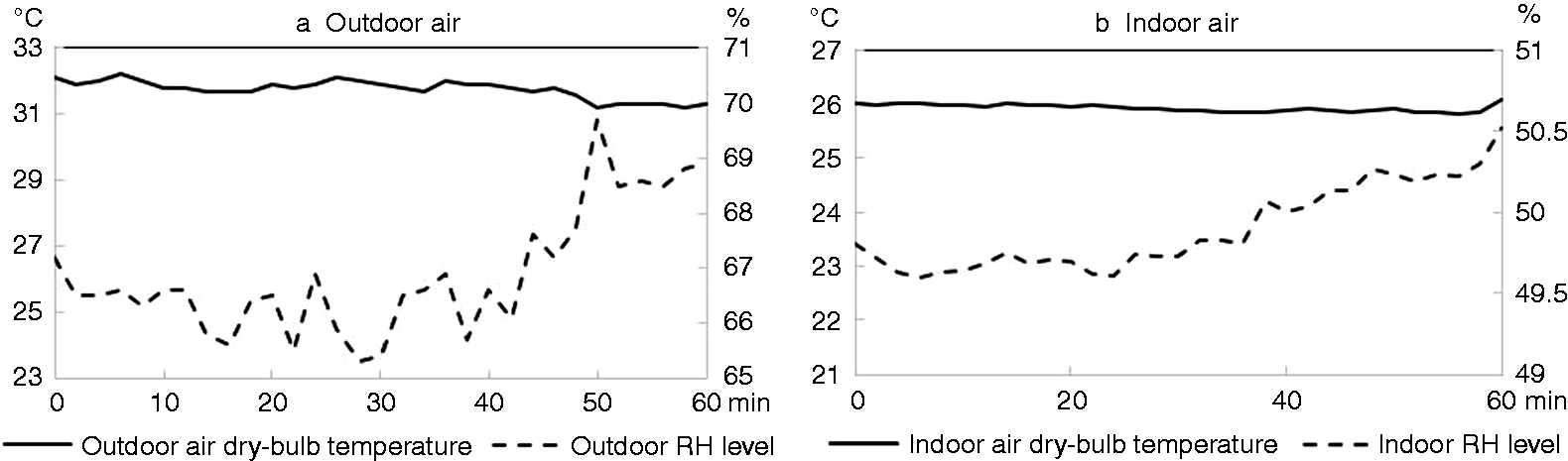
Case 2: As shown in Figure 5, the outdoor dry-bulb temperature was 26.5–26.8℃ and the outdoor RH level (ϕ) was 65.2–70.5%. According to Table 1, the RP&HRFA system was operated in transitive season A mode, thus the supply air temperature was controlled at about 20℃. The measured average indoor dry-bulb temperatures varied at the range of 26.5–26.7℃, and the average indoor RH level varied at the range of 55.6–58.5%. The averaged globe temperature was 26.3℃, and the averaged indoor air velocity was 0.34 m/s.
Measured outdoor and indoor dry-bulb temperature and RH in Case 2.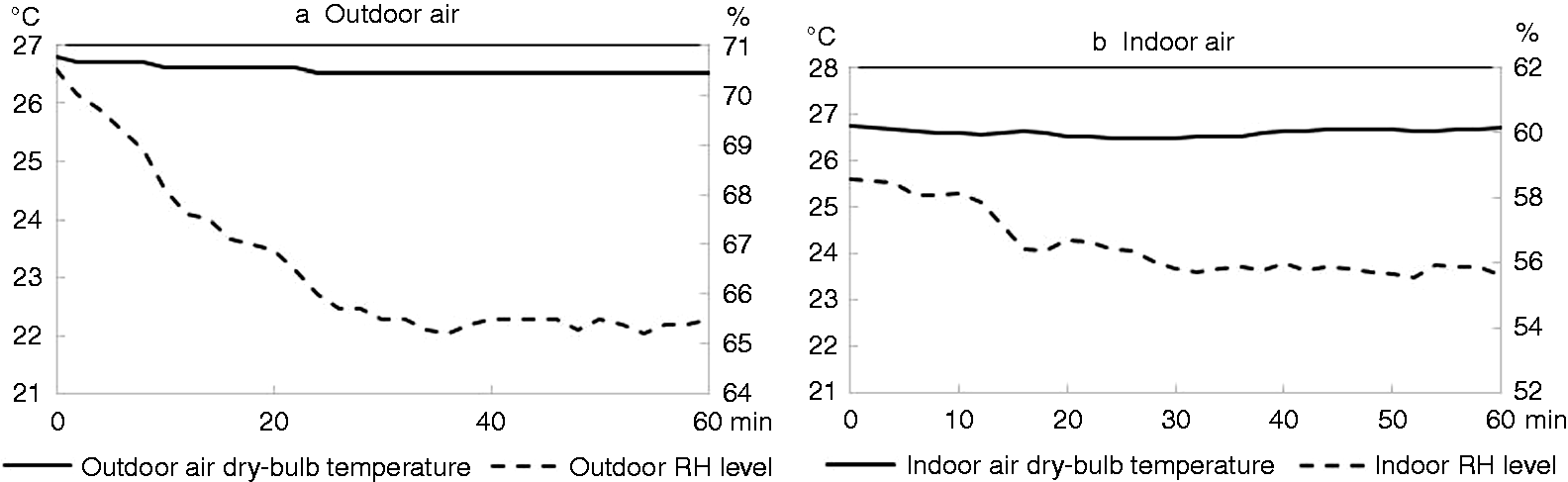
Case 3: As shown in Figure 6, the outdoor dry-bulb temperature was 4.7–4.8℃ and the outdoor RH level (ϕ) was 84.4–87.6%, according to Table 1, the RP&HRFA system was operated in winter B mode. The measured average indoor dry-bulb temperature varied at the range of 20.3–20.5℃, the average indoor RH level varied at the range of 30.7–31.1%, the averaged globe temperature was 20.8℃, and the averaged indoor air velocity was 0.34 m/s.
Measured outdoor and indoor dry-bulb temperature and RH in Case 3.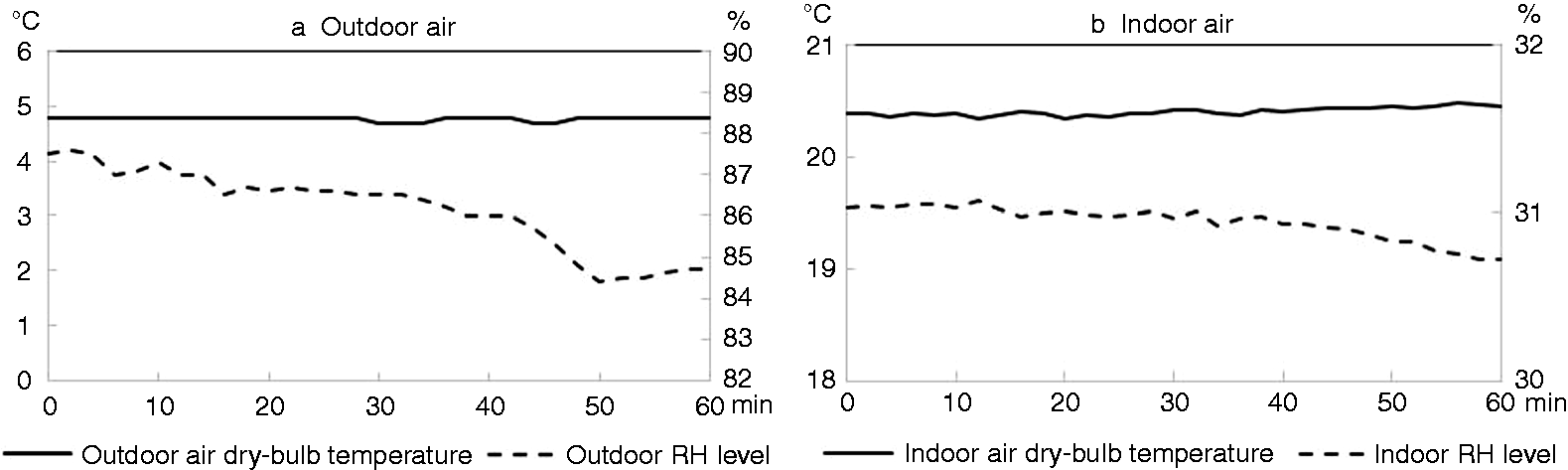
Overall thermal comfort
In this part, the indexes of overall thermal comfort of these three cases were evaluated based on the average measurement results of the test hour, as shown in Figures 7 and 8.
The calculated PMV values for sedentary occupants in Cases 1 to 3. The calculated PPD values for sedentary occupants in Cases 1 to 3.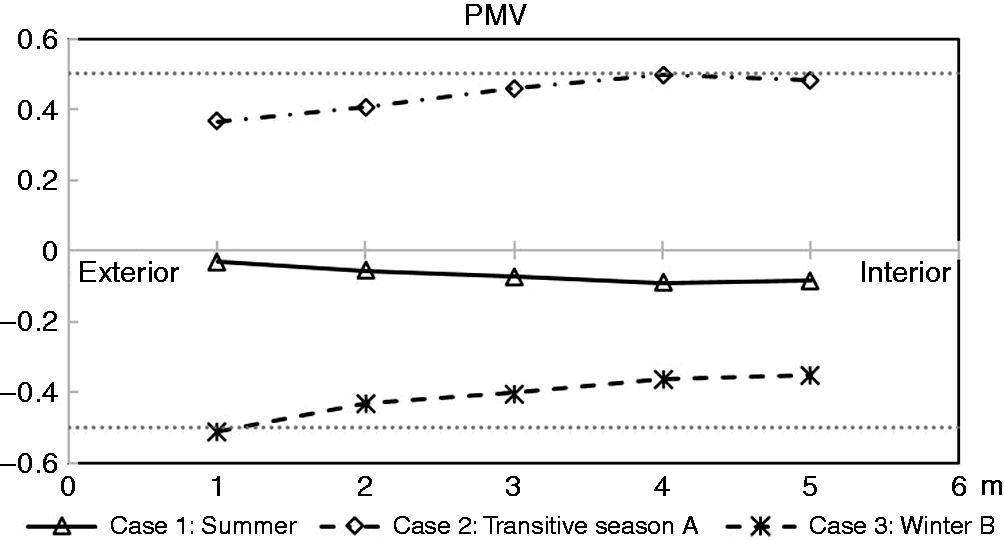
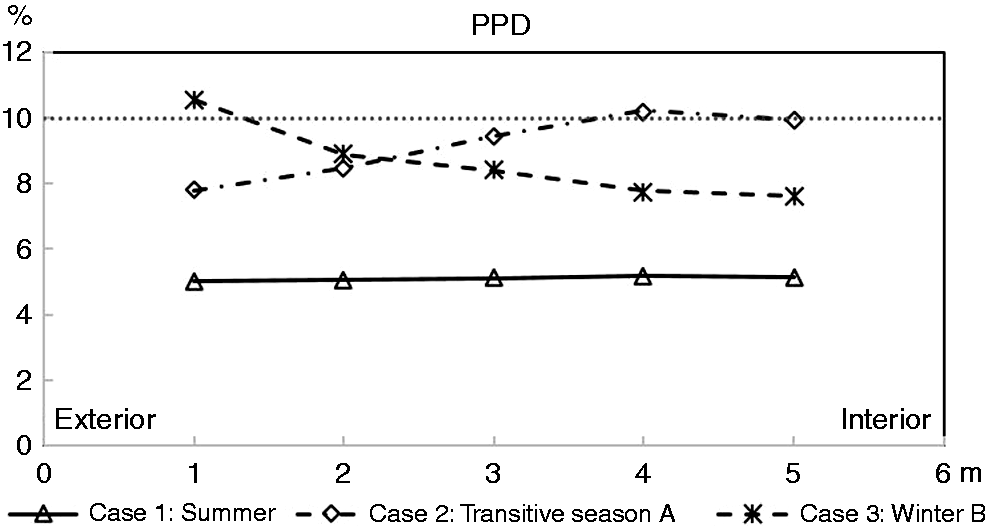
PMV–PPD results
With the availability of all measured and calculated parameters, the two thermal comfort indexes, PMV and PPD, were evaluated using equations (1) and (2). Figures 7 and 8 show the PMV and PPD values for seated occupants with slight activity, respectively. As seen in Figures 7 and 8, in Case 1, the PMV values were between −0.09 and −0.03, and the PPD values were between 5.0% and 5.2% in summer mode. In Case 2, the PMV values were between 0.36 and 0.50, and the PPD values were between 7.8% and 10.2% in transitive season A. In Case 3, the PMV values were between −0.51 and −0.35 and the PPD values were between 7.6% and 10.5% in winter B. Therefore, these PMV and PPD values of the RP&HRFA system were basically inside the target range on the cases of summer, transitive season A and winter B.
Uniformity of the PMV indexes along the depth direction
As seen from Figure 7, the maximum differences of PMV values along with the depth direction of the room were 0.06 in summer, 0.13 in transitive season A, and 0.16 in winter B, from exterior wall to interior wall (P1#–P5#), respectively. Therefore, the horizontal thermal sensation was basically uniform.
Therefore, the experimental results showed that the overall thermal comfort of the RP&HRFA system basically met the requirements of ISO7730 21 and ANSI/ASHRAE Standard 55-2010. 20 Moreover, the PMV values were uniform along the depth direction of the room.
Local thermal discomfort
Draft sensation
As shown in Figure 9, the average percentage dissatisfied due to local discomfort from draft (DR) for seated occupants with slight activity was low, about 11.6–12.0% in summer, 10.5–11.4% in transitive season A, 19.4–21.0% in winter B, which basically met the requirements in Table 5.2.4 of the ANSI/ASHRAE Standard 55-2010
20
that DR should be <20%.
The predicted percentage of people dissatisfied due to draft (DR) for sedentary occupants along the depth direction of the room.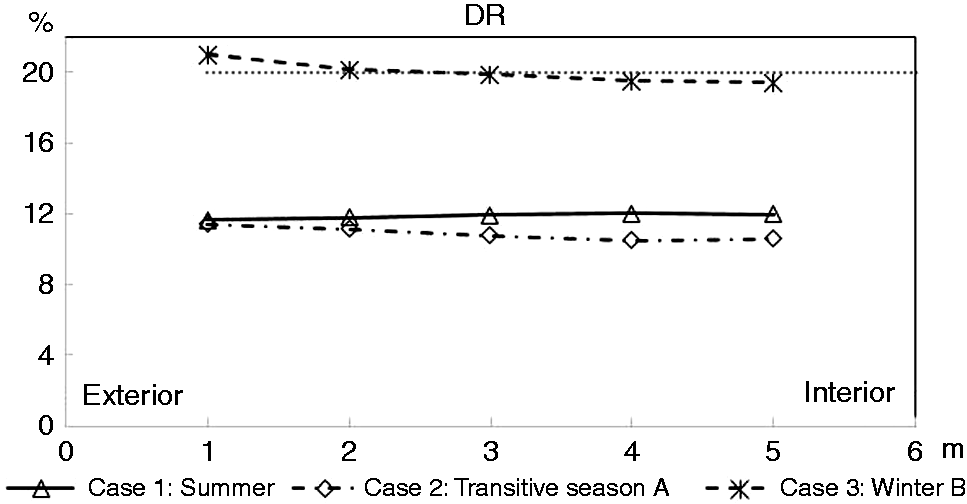
Indoor vertical temperature difference
Temperature differences between head and ankle at 1.1 m and 0.1 m.
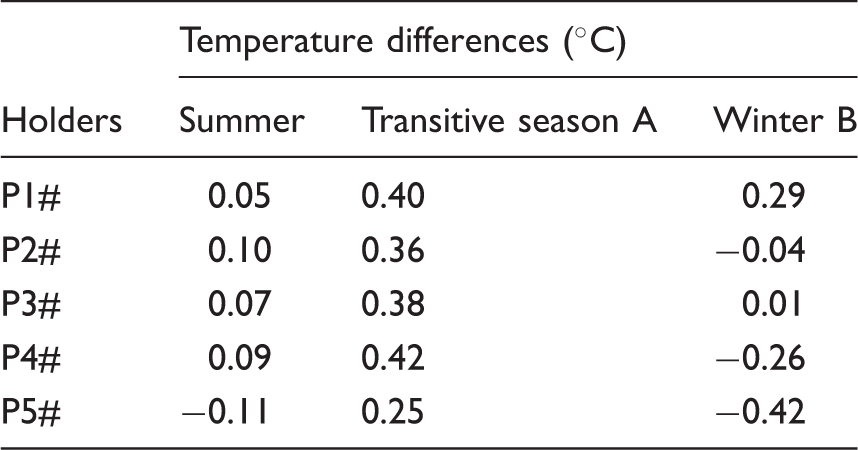
The temperature of radiation plate surface
To avoid overheating, the radiation floor surface temperature should be noticed. As show in Figure 10(b), the surface temperature of radiation floor was measured about 25℃ in winter B, which met the requirement of 19℃ and 29℃ when the floor was wooden and people indoor worn light shoes.
20
Condensation is also a consideration when design the radiation panels. As shown in Figure 10(a), in summer condition, the surface temperature of radiation panels cooling ceiling was 2.5℃ higher than the average dew point temperature of the indoor air.
Radiation ceiling/floor surface temperature.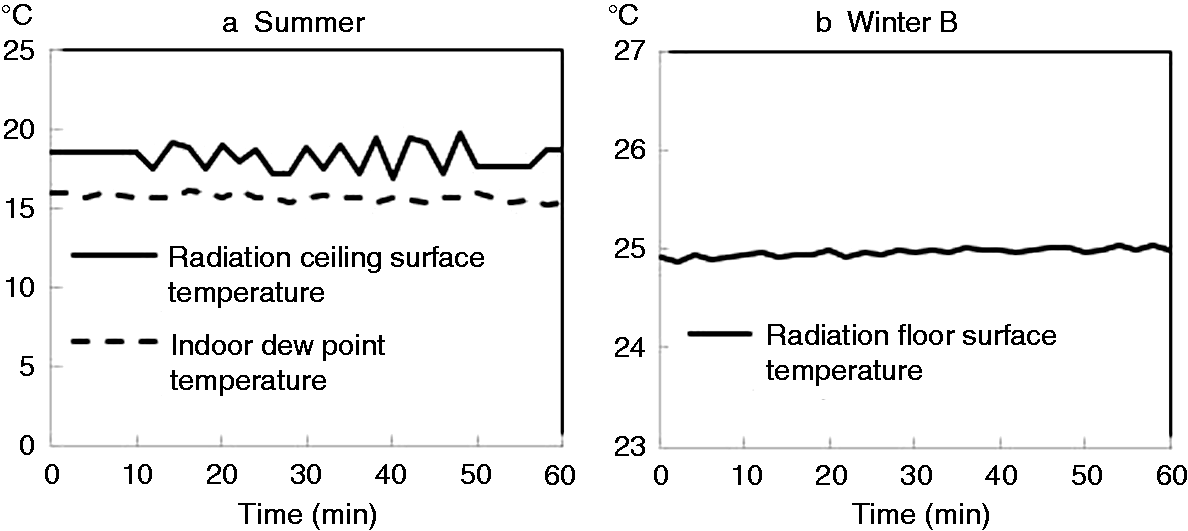
According to the above experimental data, the local thermal discomfort of this RP&HRFA system met the requirements of ANSI/ASHRAE Standard 55-2010.
Conclusions
A novel household air-conditioning system, named RP&HRFA, which can be operated in five different modes so as to be adaptive to different weather conditions all year round, has been developed in this paper. The indoor thermal comfort for occupants using the RP&HRFA system experimentally has been evaluated and reported under three operating modes, namely, summer, transitive season A and winter B. The experimental results would lead to the following conclusions:
The PMV–PPD values obtained in the experiment indicated that this RP&HRFA system could provide an acceptable overall thermal comfort of indoor environment for occupants in summer, transitive season A and winter B modes. The draft sensation, head and ankle temperature difference, radiation plate surface temperature based on the experimental data showed that this RP&HRFA system could provide an acceptable local thermal discomfort of indoor environment for occupants in summer, transitive season A and winter B modes. The surface temperature of radiation cooling ceiling panels in summer condition of the experiment was 2.5℃ higher than the average dew point temperature of the indoor air, which could effectively prevent the condensation of the radiation ceiling.
In this research, only temperature control is considered in winter, however, based on the experimental results, the indoor RH may drop to 30% sometimes, which may also causes uncomfortable for occupants. Therefore, further work should be directed to considering the method of humidity control method in winter. On the other hand, the energy consumption of this novel system also affect its application in buildings, therefore, the further work may cover looking into the annual total energy consumption and the comparison with normal air-conditioning system.
Footnotes
Conflict of interest
None declared.
Funding
The authors wish to acknowledge the funding sponsored National Natural Science Foundation of China (Project No. 51406119), Shanghai Sailing Program of Shanghai Committee of Science and Technology, China (Project No. 14YF1410000), the Hujiang Foundation of China (Project No. D14003).