







Abstract
Bioclimatic architecture strategies and solar active systems contribute strongly to the reduction of building energy demand and achieving thermal comfort for its occupants over the whole year. This paper deals with the study of the energy performance improvement of a pilot bioclimatic house located in Algiers (Algeria). First, a series of experimental measures are conducted during cold period to show the effect of passive and active solar gains on the improvement of the indoor air temperature of the house. Then, a dynamic model of a solar heating system coupled with a bioclimatic house has been developed using TRNSYS software and validated with experimental data. The validated model has been used to establish the energy balance of the pilot bioclimatic house without solar heating system and to compare them to those of a conventional house. Finally, the improvement of the energy balance of the pilot bioclimatic house has been done by passive and active ways. The passive one includes the increase of south facing windows size and the use of night cooling with the use of shading device in summer. The active one consists of the integration of a solar heating system. Furthermore, an environmental study has been performed. The experimental results show that the energy requirements of a pilot bioclimatic house are very low which is suitable for the use of solar heating system in building. The simulation results show that the application of bioclimatic strategies is a better way to provide thermal comfort in summer and decrease the space heating energy demand of the house with 48.70%. The active solar system will cover 67.74% of the energy demand for heating of the house. These energy savings generate a significant reduction in CO2 emissions.
Introduction
Today, at the national and international level, buildings are one of the biggest consumers of energy; this is due notably to the population growth and urban planning. In addition, recent statistics indicates that, in Algeria the residential sector is responsible for over 40% of final energy consumption. 1 This implies that the building sector has a great potential for energy saving. Thereby, the integration of solar passive designs, also called bioclimatic designs in buildings construction, can reduce greatly the energy requirements for heating and cooling spaces. 2 These designs include thermal insulation envelope of the house, efficient glazing, adequate size, and orientation of the openings of the house, and night ventilation.3–8 Furthermore, renewable energy systems can be installed in buildings to meet an important part of the building energy requirements, 9 especially in rural areas where the space is available. Undoubtedly, the solar heating system (SHS) is increasingly adopted in the preparation of domestic hot water (DHW) and heating. 10 This concept has a number of advantages over conventional heating systems. It saves heating in living and work spaces, since it is integrated into the building envelope. In addition, the system does not produce noise nor drafts and does not use ducts. Note that such a system is a low-temperature heating system having a uniform temperature distribution. 11
Algeria enjoys a favorable geographical location that offers one of the highest solar potential in the world, which is very suitable for solar system applications. 12 Thus, to improve energy efficiency in order to replace fossil fuels used in the building sector, many actions have been undertaken.
The development of thermal regulation of residential buildings including three Algerian building codes:
The DTR C3-2 (Thermal regulation of residential buildings-calculating methods for determining building heat losses). This Regulation Technical Document (DTR) provides to professionals in the building, evaluation methods of thermal winter losses. The regulation requirement on which this DTR is based consists of limiting the heat loss of housing by fixing a threshold not to be exceeded (called the reference losses). Respecting this threshold should allow saving 20 to 30% on energy consumption for heating homes without achieved at the expense of occupant's comfort. The calculation methods presented in this DTR C3-2 are simple, validated, and sufficient in theory to find qualified technical solutions. Of course, it is up to the designer to perform in borderline, cases more precise calculations (using simulation software operating in dynamic mode).
13
The DTR C3-4 (Thermal regulation of residential buildings – calculating methods for determining building heat gains). This DTR includes the rules for calculating the heat input was for residential buildings by fixing the methods for determining the heat gain of buildings, as well as the method of ascertaining of conformity to thermal summer regulation of buildings.
14
The DTR C3-31 (Thermal regulation of residential buildings – natural ventilation of residential premises). This DTR allows to define the general principles that regulate the design of the installation for natural ventilation and provide the calculation methods necessary for sizing them. Nevertheless, this DTR does not address the exhaust combustion products of gas appliances, or smoke extraction systems (smoke evacuation in case of fire).
15
The implementation of these attractive regulations, according to the estimations, will reduce the energy needs of new housing on the order of −40% for heating and cooling requirements. 16
The Algerian government has adopted a law No. 04-09 of 14 August 2004 for the promotion of renewable energy within the framework of sustainable development. Also, an ambitious program relating to renewable energy was adopted in 2011. This program consists of installing up to 22,000 MW of power generating capacity from renewable sources until maturity 2030, of which 12,000 MW will be destined to meet the domestic electricity demand and 10,000 MW destined for export. This last option depends on the availability of a demand that is ensured on the long term by reliable partners as well as attracting external finance.
17
A pilot project of 600 houses with high-energy performance (HEP) was launched, in which are integrated in all processes allowing significant energy savings through the use of construction techniques falling within bioclimatic architecture (allowing to reduce energy consumption related to home heating and cooling by about 40%). There are plans to develop the solar water heating system to gradually replace the conventional system. In parallel, several million low-energy bulbs on the marked will be distributed.
18
Mediterranean Energy Efficiency in the Construction sector (MED-ENEC Project). In the framework of this project, a pilot bioclimatic house has been built for demonstrating the integrative approaches for energy conservation in the building and use of renewable energies in this sector.
19
Some studies investigate the energy performance of the pilot bioclimatic house during summer and others during winter. Mokhtari et al.
20
have performed numerical simulations via TRNSYS software. The temperatures obtained are compared to experimental measurements performed during two campaigns (summer and winter). The comparison of the results shows that measured and simulated temperatures are in agreement. The environment of simulation TRNSYS is most frequently used for study concerning thermal aspects in buildings. The indoor temperatures in the summer period show that the internal air temperatures are satisfactory, because they are located in the thermal interval of comfort. This allows to conclude that the insulation and a good thermal inertia of the pilot bioclimatic house's walls generate a reasonable thermal environment in the summer period without using air conditioning systems. In winter period, it is noted that temperatures of the internal environment of the pilot bioclimatic house is stable. This is explained by the effect of insulation and thermal inertia of the walls. But it is noted that in winter, the temperatures are somewhat low (discomfort); the means of curing this problem, is the use of renewable energies, in particular a solar heating installation. With this solution, one will always remain in the context of energy rationalization and environmental protection. The results of this study show that it is possible to achieve energy savings in summer and winter. Imessad et al.
19
presented a thermal analysis of the pilot bioclimatic house in summer period. Dynamic simulations using TRNSYS software and experimental data are used to achieve this goal. The obtained results demonstrate that cooling energy demand is more affected by thermal transmittance values than by the envelope thermal mass. Also, it is found that the combination of both natural ventilation and horizontal shading devices improves thermal comfort for occupants and significantly reduces cooling energy demand. The authors proposed recommendations for the optimum overhang length for windows which are located in the south facade.
The main aim of this paper is to investigate the energy performance improvement of a pilot bioclimatic house under Mediterranean climate conditions. For this purpose, a series of experiment measures during cold period of year are conducted, and dynamic simulations using TRNSYS software are performed. The validated TRNSYS model is used to estimate and improve the energy balance of the house. The contribution of bioclimatic strategies (increased windows sizes and night cooling) and an SHS in the improvement of the energy performance of the house is established. Furthermore, an environmental impact in terms of CO2 emissions is performed.
Description of the building and building service systems
Building characteristics
The model under consideration is a pilot bioclimatic house depicting a low-energy house with 90 m2 net floor area (Figure 1). It was built as part of the MED-ENEC project in partnership with the Renewable Energy Development Centre (CDER) and National Centre for Studies and Research Integrated Building (CNERIB), while meeting the Algerian code on building requirement.
The pilot bioclimatic house (facades South and East).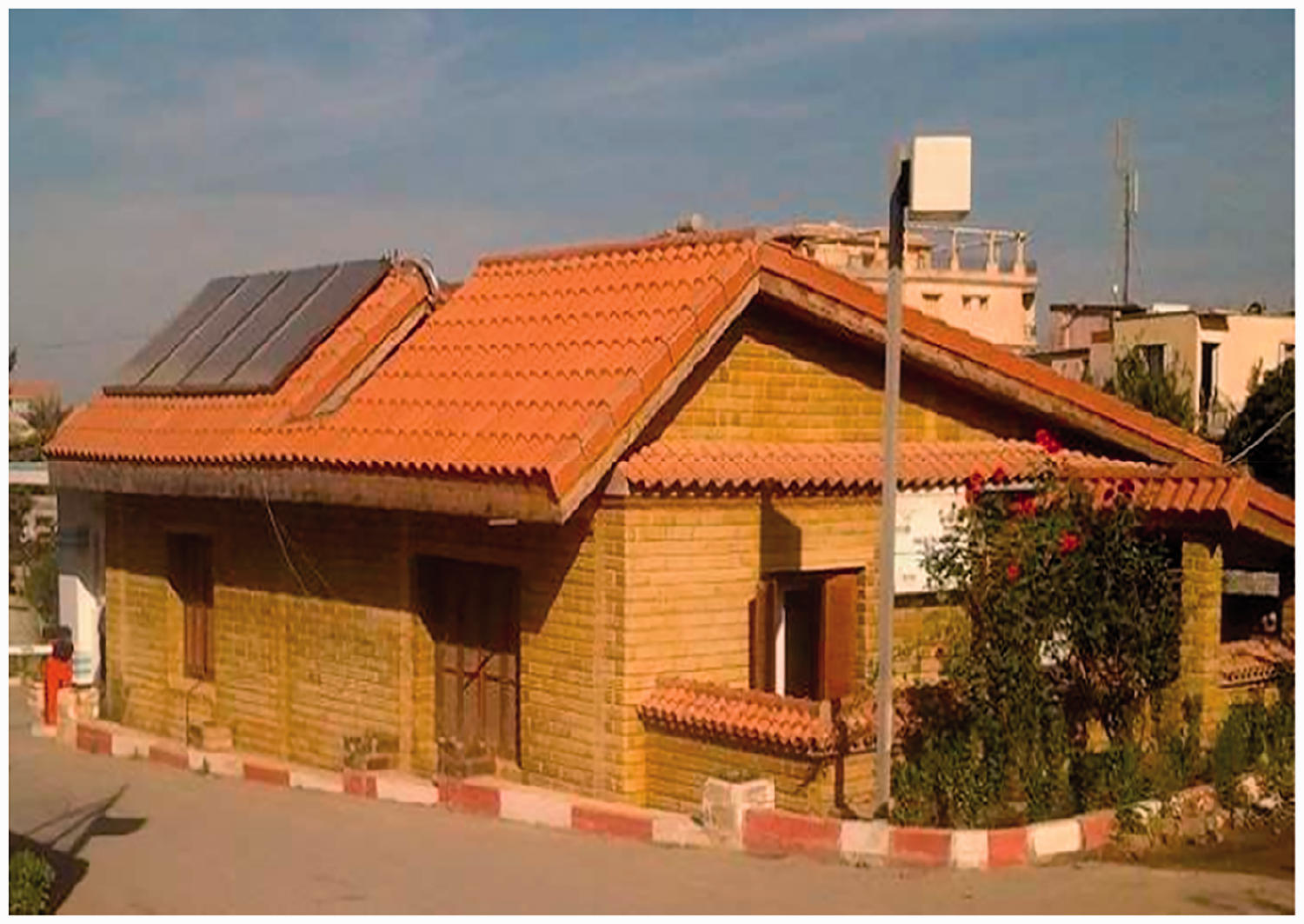
Note that the pilot house has a bioclimatic design. This building design takes into account climate and environmental conditions to help accomplish achieve optimal thermal comfort inside. The term bioclimatic design appeared in the English speaking literature on thermal comfort in the works of Olgyay.
21
Bioclimatic design, by definition, satisfies the needs of human beings (thermal, luminous, and acoustics). It considers climatic conditions, by using techniques and materials available in the region and attempting to integrate the building with its surroundings. Moreover, bioclimatic design based on considerations related to building physics, which is the ability to allow sunlight, heat, and airflow through the building envelope, when necessary, at certain moments of each day and month of the year.
22
That is why the house is oriented along East–West axis to collect more solar radiation in winter. There are four thermal zones: living room, two bedrooms, and kitchen, as shown in Figure 2. The living room and bedroom have a large south-facing window that allows a passive solar thermal heating the house in winter. The house's walls are stabilized earth blocks (SEB). Its external walls and the floor are well insulated using expended polystyrene (EPS), double glazing, and shading devices. An overhang is used for windows facing south to avoid direct solar radiation during the summer period. Moreover, this house is equipped with a SHS for the production of DHW and heating the entire space.
Plane view of the pilot bioclimatic house.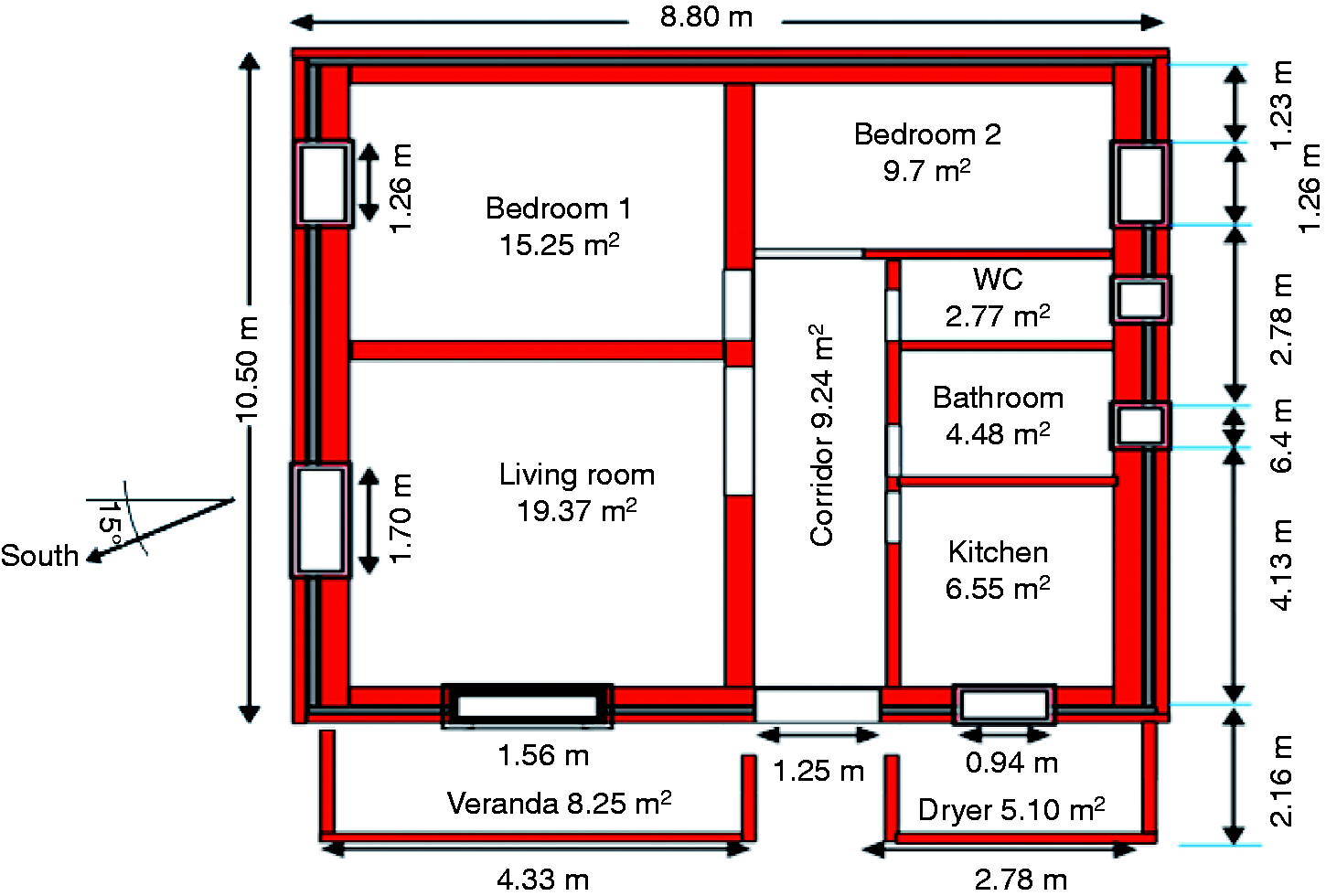
Construction properties for pilot bioclimatic house and conventional house.
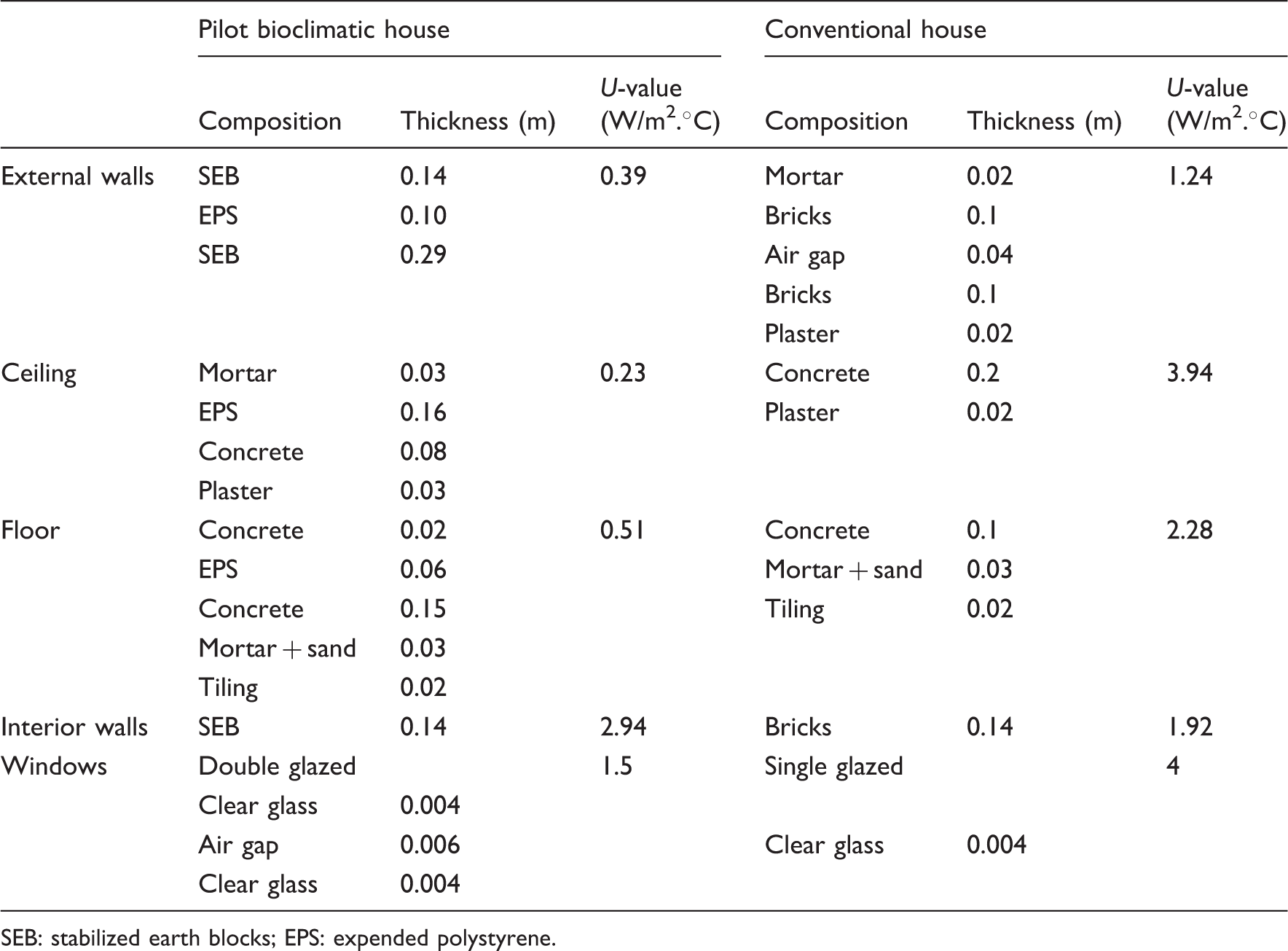
SEB: stabilized earth blocks; EPS: expended polystyrene.
It is useful to mention that, in the majority of housing in the Algiers region, building materials are similar to those of the traditional house considered in Table 1. The U-values of the pilot bioclimatic house's wall are consistent with those of Imessad et al. 19 and Mokhtari et al. 20
Description of the SHS
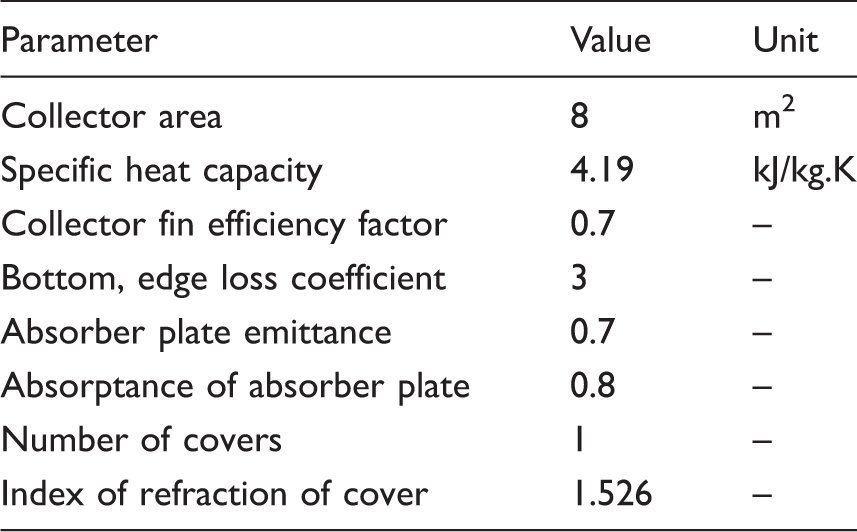
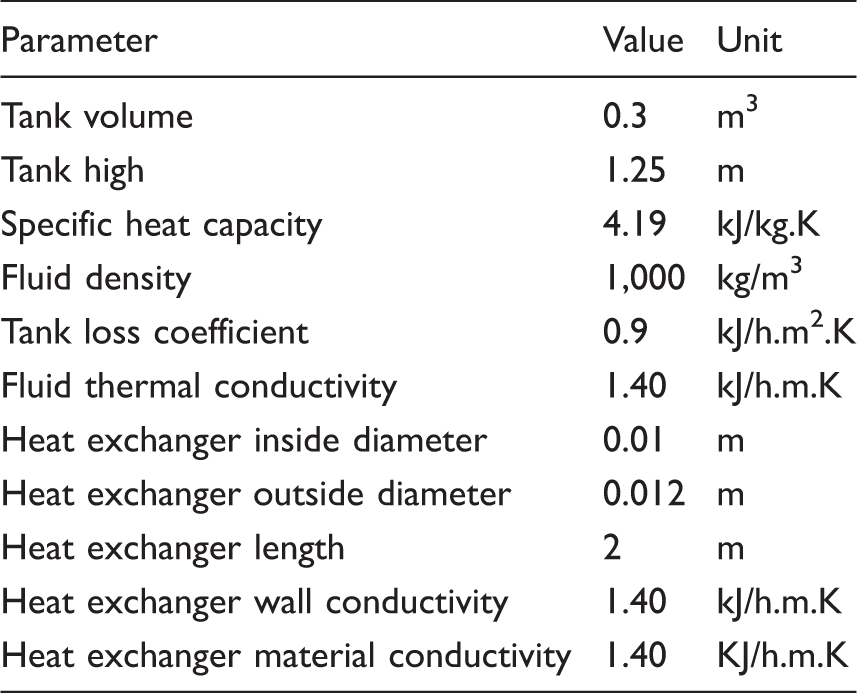
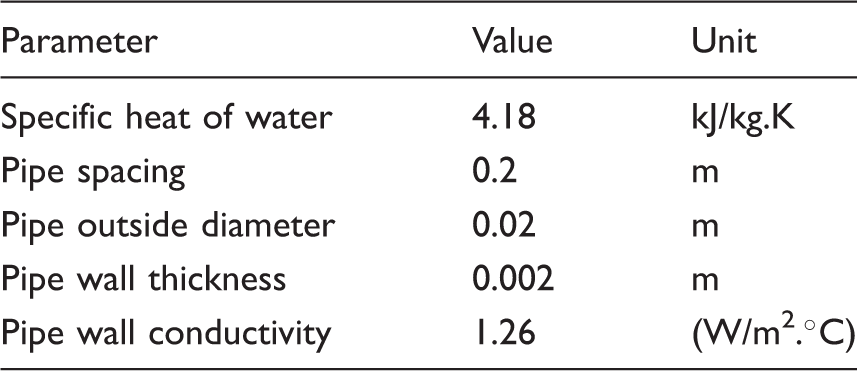
The main components of the SHS are shown in Figure 3. These elements are solar collectors (1) installed on the top of the pitched roof (of 45°) and depending on the geographic latitude of the site, the hot water tank (2), and the under floor heating (7). The operating principle of the SHS can be summarized as follows: The three-way valve (5) is under the control of a differential controller (6) in the pumping station. Note that priority is given to the load (space heating). Thus, the system operates as a direct solar floor (DSF). The collectors array is directly connected to the heating floor; the concrete slabs combine functions of the space heating and of heat exchanger. The water heated in the solar collector flows through the heating floor and then flows back to the solar collector. It should be noted that if the temperature of the unfavorable zone of the house, which is controlled by a thermostat (3) located on the ground floor, is higher than the set-point temperature, the hot water is oriented toward the storage tank for DHW preparation. The single pump (4) of the system starts only when two conditions are available. The outlet temperature of collectors is higher than the temperature of unfavorable zone of the house or higher than the water temperature at the bottom of the tank. The cold water coming from the main water supply of the city enters at the bottom of the storage tank. A tempering valve (8) is used to enable the control of DHW temperature at around 45℃ at the user-end. An auxiliary heater is used to ensure proper water temperature for DHW. The characteristics of the thermal collector, storage tank, and floor heating system are presented in Tables 2 to 4, respectively.
Sketch of the solar heating system. Characteristics of the thermal collector. Characteristics of the storage tank. Characteristics of the heating floor system.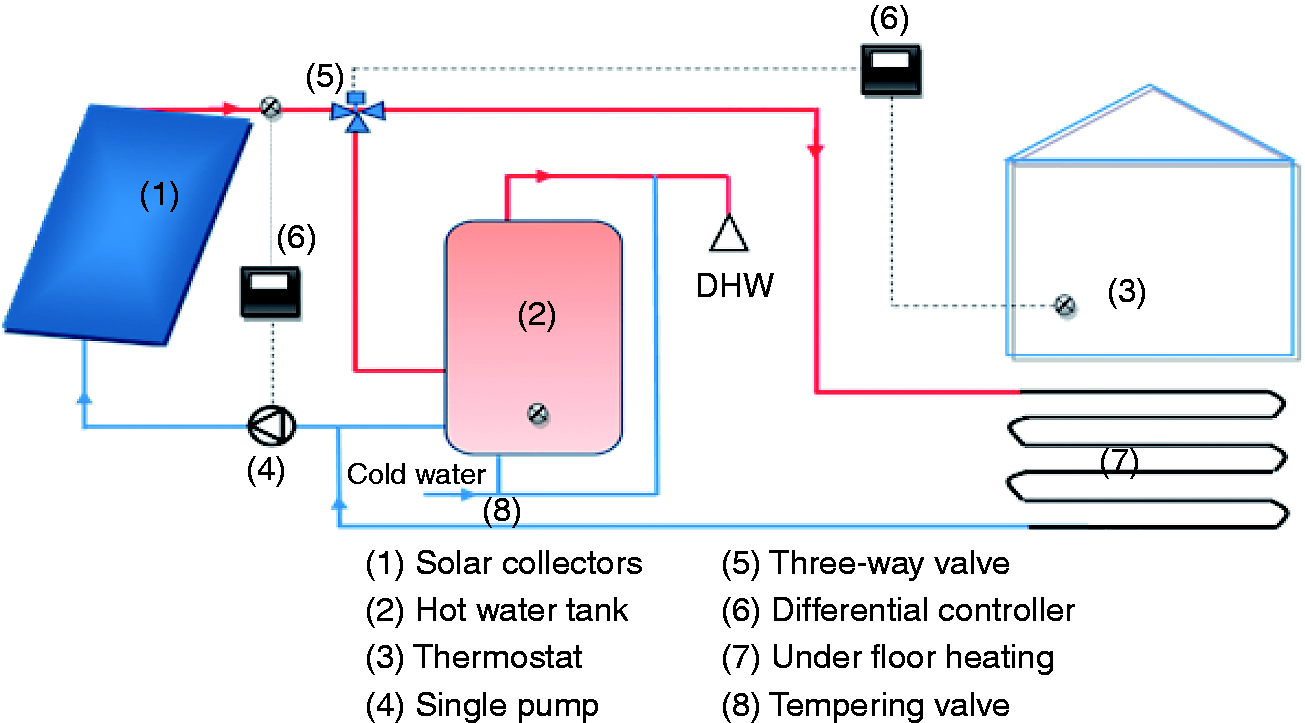
Methods
Weather data analysis
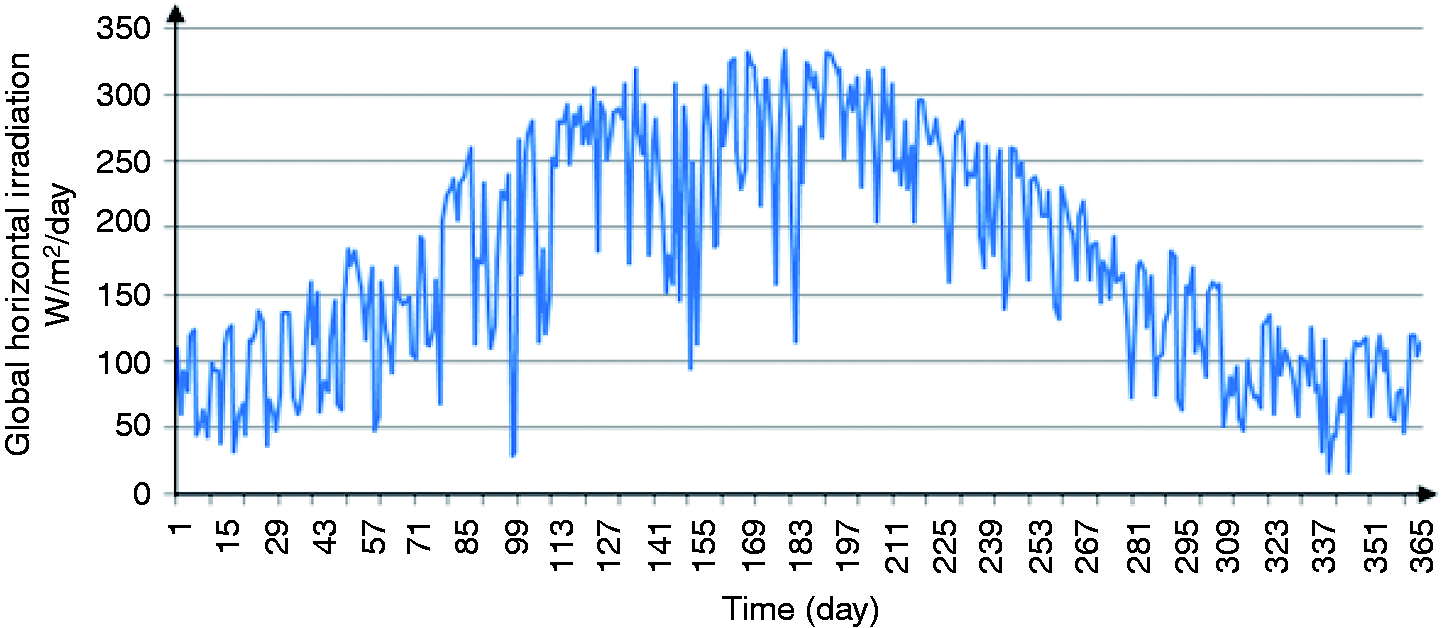
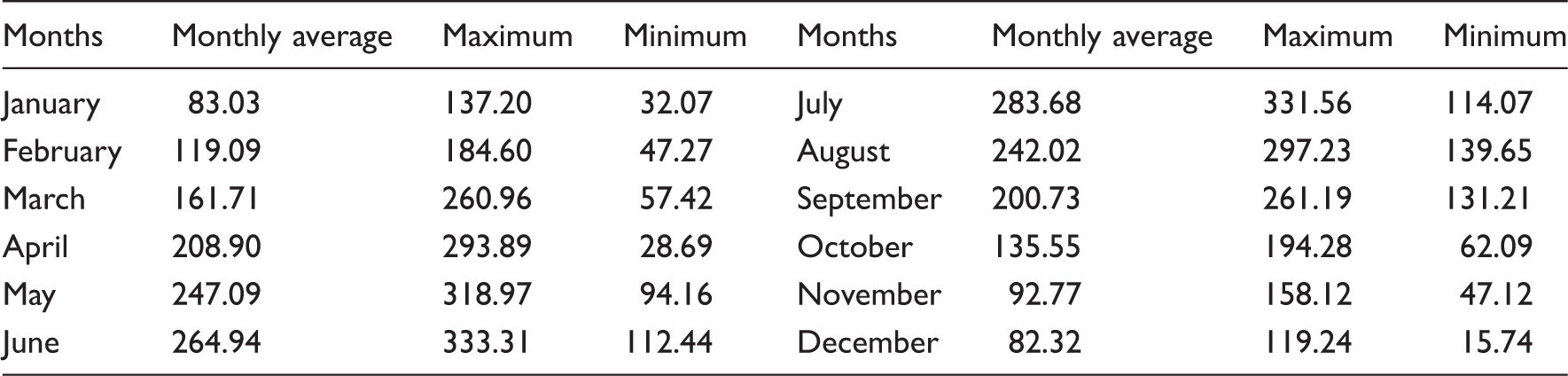
The energy performance of a house is strongly dependent on the climate conditions where this house is located. It should be noted that Algiers (latitude 36° 10′ N, longitude 03° 00′ E) is a site located in a climatic coastal marine area that enjoys a particularly temperate climate due to the moderating influence of the sea. The location is characterized by cold winters temperature and frequent rain with overcast skies. Summers, on the other hand, are hot and humid with small diurnal temperature ranges. Figures 4 and 5 provide meteorological data representative of Algiers in terms of temporal evolution of temperature and global horizontal solar radiation. For more details, Tables 5 and 6 provide maximum, minimum, and monthly average temperatures and global horizontal solar radiation.
Evolution of hourly ambient temperature. Daily evolution of global horizontal radiation. Monthly average, maximum and minimum temperatures. Monthly average, maximum and minimum global horizontal solar radiation.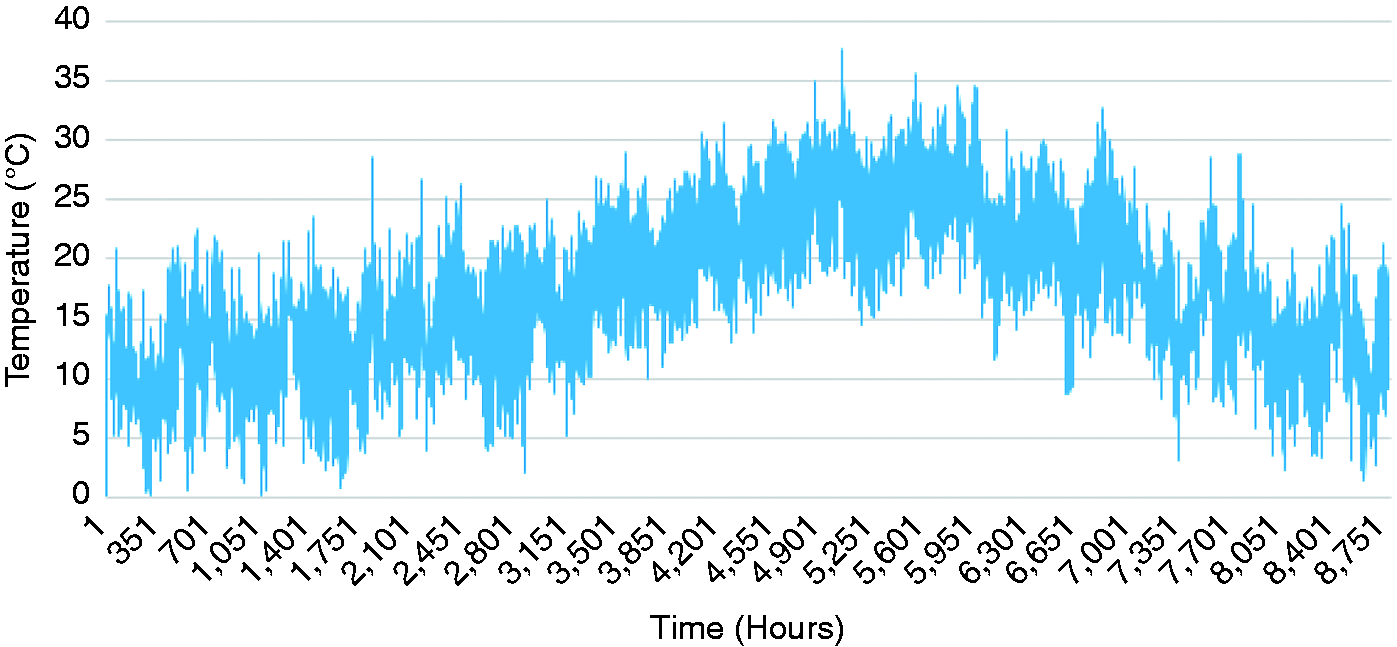
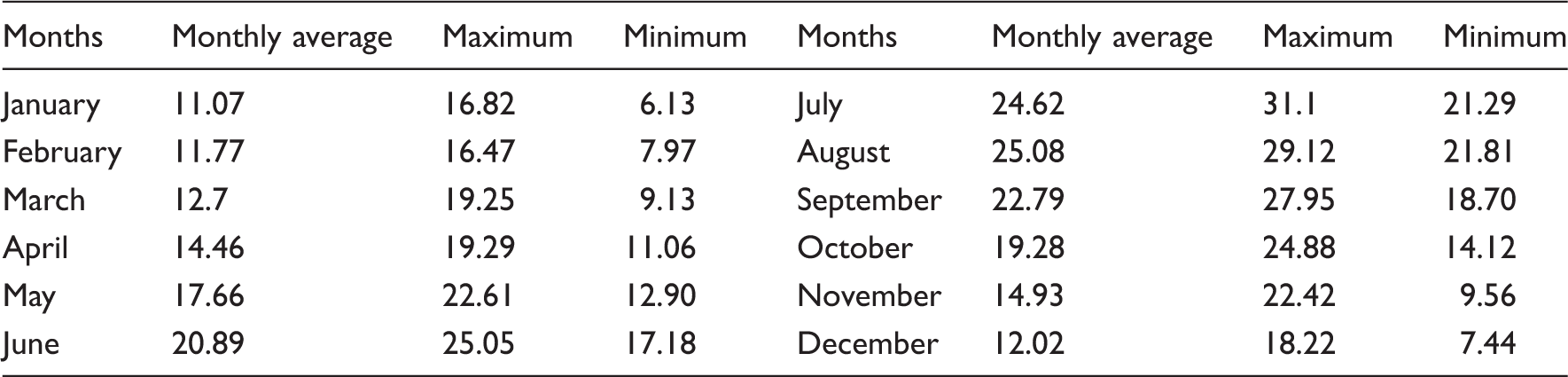
The outside temperature has a natural variability that is typical of the climate in general (seasonal and day cycles). This variability will result in a substantially sinusoidal variation of the temperature. For a period beyond one year with a time step equal to 1 h, Figure 4 depicts the hourly variations of the outside temperature.
It is noted that the general appearance of the temperature variation follows a bell-shaped distribution starting from the minimum value of 0.28℃ recorded in January until a peak value of 37.88℃ during July, which is considered to be the hottest month of the year. Then, the temperatures will start to drop until reaching low values at the end of the year.
The global irradiation on horizontal surface has been collected each 30 min, Figure 5 shows a typical example of a daily radiation sequence received on a horizontal surface at Algiers site during one year. For every 24 h, solar radiation reaches up a minimum and a maximum, since the intensity of solar radiation varies from day and night.
From Table 6, it was observed that the pace of change of these values increases during the first months of the year (January to April), remains slightly stable during the summer period from June to mid-September when the days are longer for which the solar radiation is more intense, and then starts to decrease until end of the year (December). Note that the measures of ambient temperature and global horizontal radiation agree with the 22-year average of the NASA SSE model, 23 with slight deviation of 1℃.
Simulation model description
Model of the house
The house, with an SHS, is simulated using the TRNSYS code,
24
as a multi-zone building (Type 56) having a radiant floor defined as an active layer of the ground between the ground level and basement.


The air mass flow rate, Q [kg/s], is a simple function of the pressure drop, P [Pa], across the opening. From literature, the exponent value n should be between 0.5 and 1.0. It should be noted that large openings are characterized by values very close to 0.5, while values near 0.65 have been found for small crack-like openings. 25
Model of thermal collector
Type 73 is the theoretical flat plate solar collector model adopted to model the performance of solar collectors. The thermal performance of the total collector array is determined by the number of modules in series and the characteristics of each module. The energy collection of each module in an array of 

Model of storage tank
The fully mixed storage tank, with immersed serpentine heat exchangers, is modeled by Type 60 from the standard TRNSYS library. The energy balance of the fully mixed storage tank can be expressed as follows:

Substituting each term of this equation, the change in storage tank temperature for the time step is given by

Experimental study approach
Data acquisition
Equipments used for data acquisition.
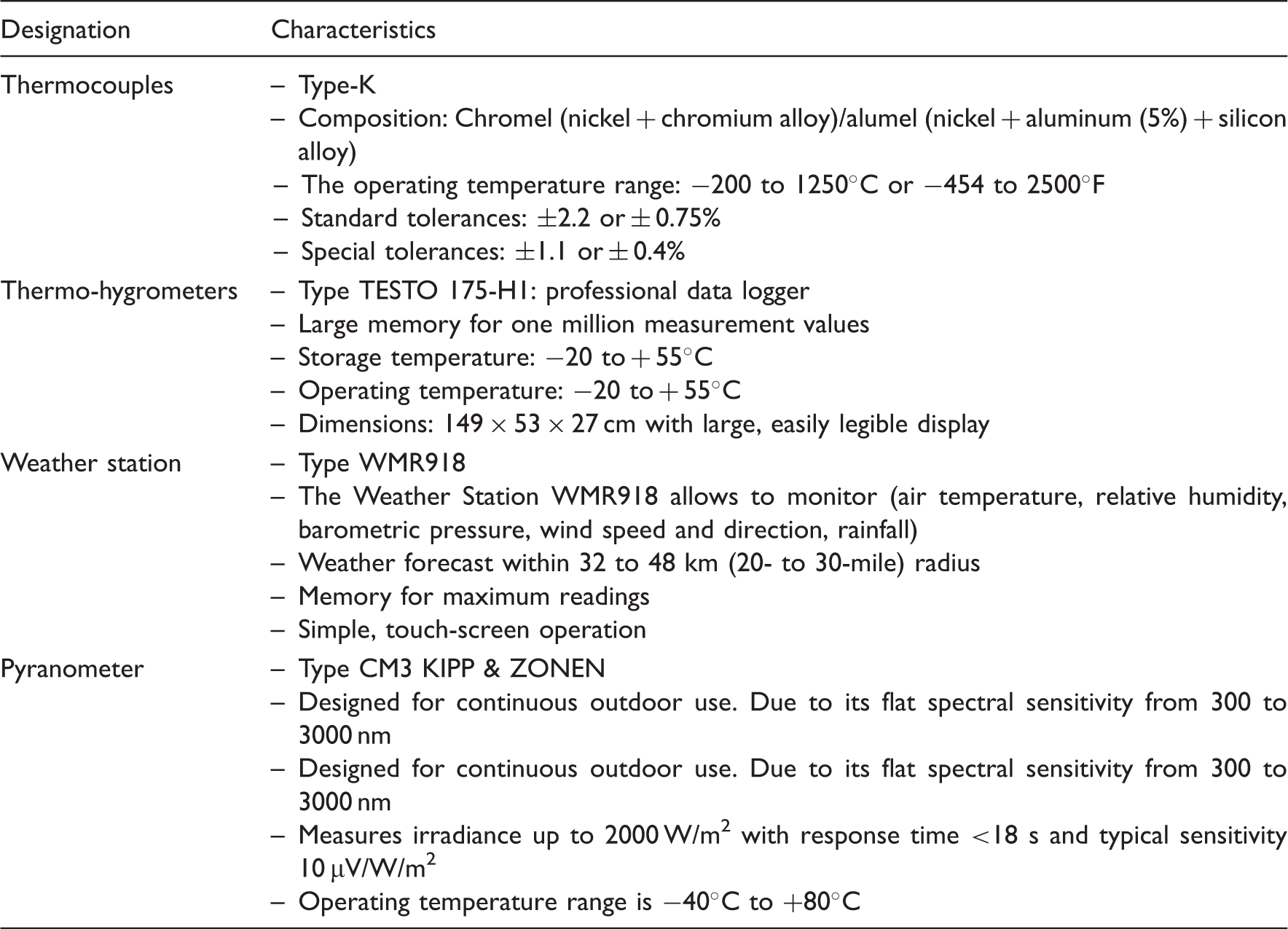
Figure 6 illustrates a sketch of the acquisition system used to study the thermal behavior of the studied pilot bioclimatic house.
Sketch of the acquisition system.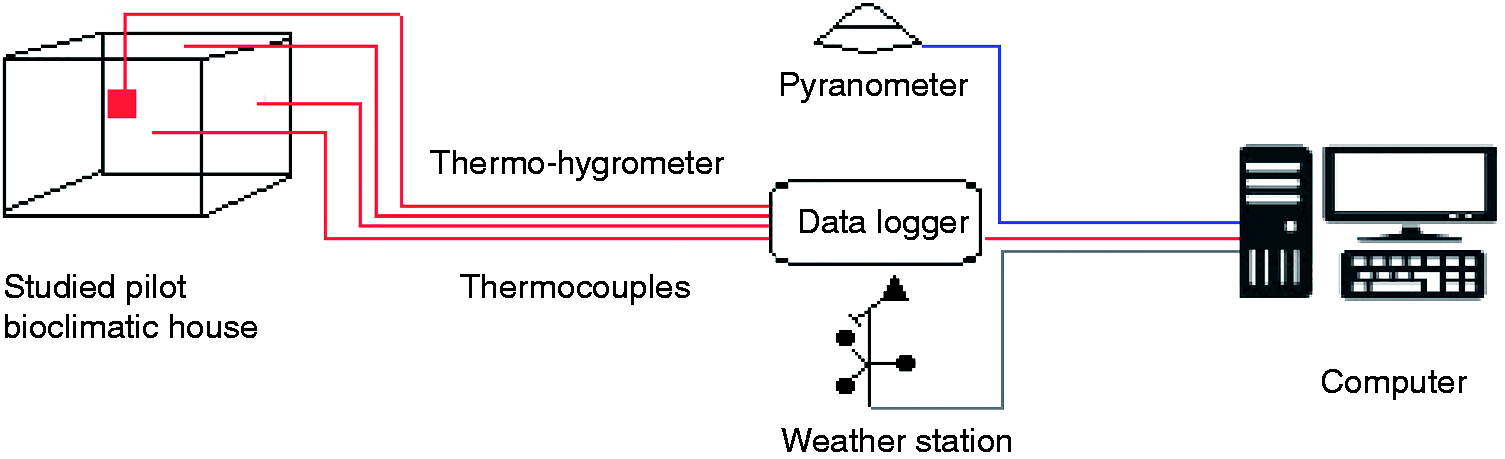
Experimental study results
Effect of bioclimatic strategies
In this section, a field experiment has been carried out to study the impact of bioclimatic strategies on thermal behavior of the pilot bioclimatic house without using the heating system.
Figure 7 illustrates the outdoor air temperature changes and the global solar radiation of horizontal flat surface of the thermal collector slope (45°) during four days in December (21–24 December 2012). An evolution has been presented with a step time of 30 min.
Variation of the outdoor temperature and solar radiation during the monitored period.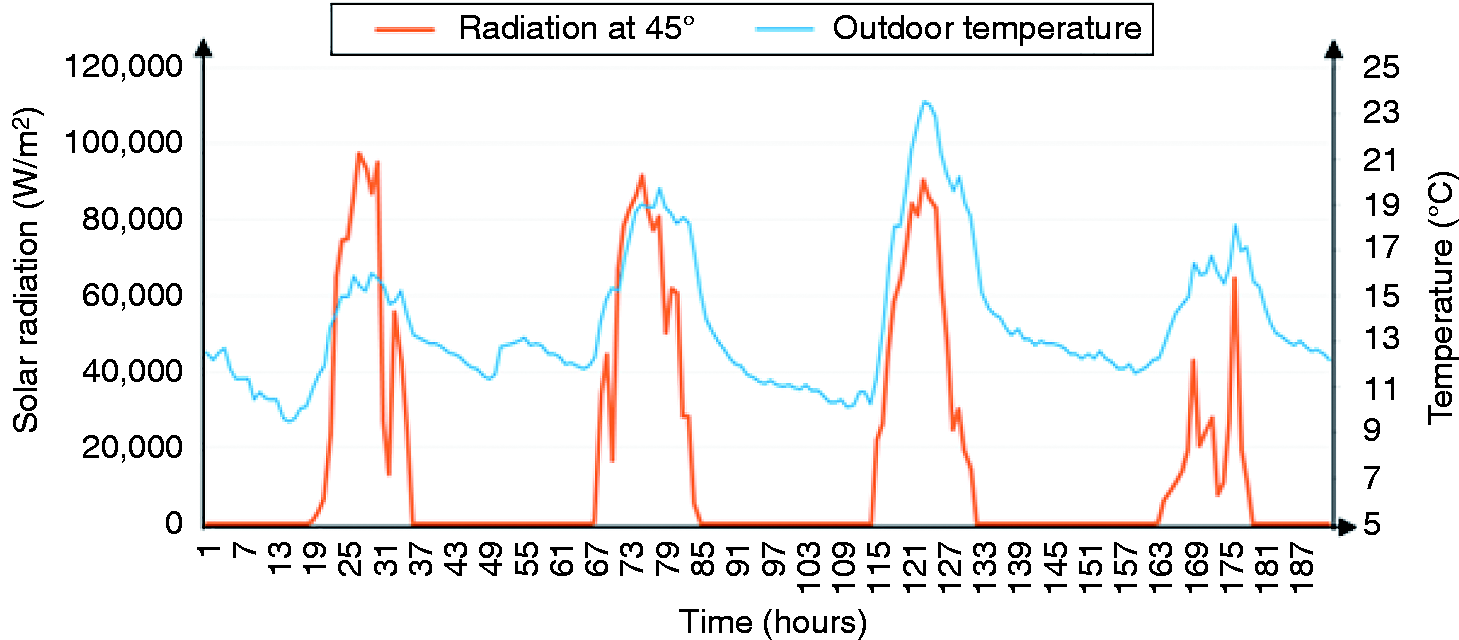
Note that December is one of the coldest and wettest months of the year in Algeria. Thereby, the intensity of solar radiation is considerably reduced by the presence of clouds. It seems obvious that solar radiation plays a significant role in the design of solar systems, because its impact is substantial on the outlet temperature of the heat transfer fluid circulating in the solar thermal collector. It directly collects the heat from solar radiation to heat the fluid. A review of Figure 7 allows to note that the last day is less sunny than the three first days, and it clearly appears that the solar irradiation is significant during the monitored period. Note that the energy intercepted by a collector is maximum when the collector plane is perpendicular to the solar radiation at noon. The maximum solar irradiation during the monitoring period varies between 980 W/m2 in the first day and 600 W/m2 in the last day. The average outside temperature measured during the monitored period is of 13.78℃, with a minimum value of 9℃ and a maximum of 24℃ with temperatures peak between 12 am and 15 pm. However, a large daily fluctuation can be noticed on the outside, and up to13℃. In addition, indoor air temperature conditions may have large daily variations depending on the level of thermal insulation and thermal mass of building envelope. In order to investigate the effectiveness of the passive solar building design (with large windows facing south and high thermal insulation), a field measurement has been carried out on the pilot bioclimatic house during the monitored period.
Figure 8 shows the evolution of internal and external surfaces temperatures of south facing wall of the building from 21 to 24 December 2012 during which period the heating system is shut off. It has been observed that the southern outer wall exhibits significant fluctuations. Comparatively, the internal temperature of the mass walls remains stable for the heating season. In addition, the horizontal shading (eaves) set above southern facing windows inhibits the solar radiations during summer while allowing them to pass through, during winter. Thereby, it contributes to its energy-saving performance throughout the year. In Figure 8, we see that the internal wall temperature is stable at 15℃ throughout the monitored period in spite of the large fluctuations of the outside facing of the wall which are between 10℃ and 3.5℃ among the day and night, which matches with the results of Mokhtari et al.
20
These authors analyzed south wall interior's temperature of this pilot bioclimatic house for winter season, from 11 to 15 January. It was found that the evolution of this temperature during 18 h varies between 15.1℃ and 15.3℃. This is explained by the effect of the insulation and the significant thermal inertia of the walls. Besides, the mass wall construction has the ability to store the absorbed solar heat during the peak time and shifts it at night.
27
Variation of wall surfaces temperatures during the monitored period.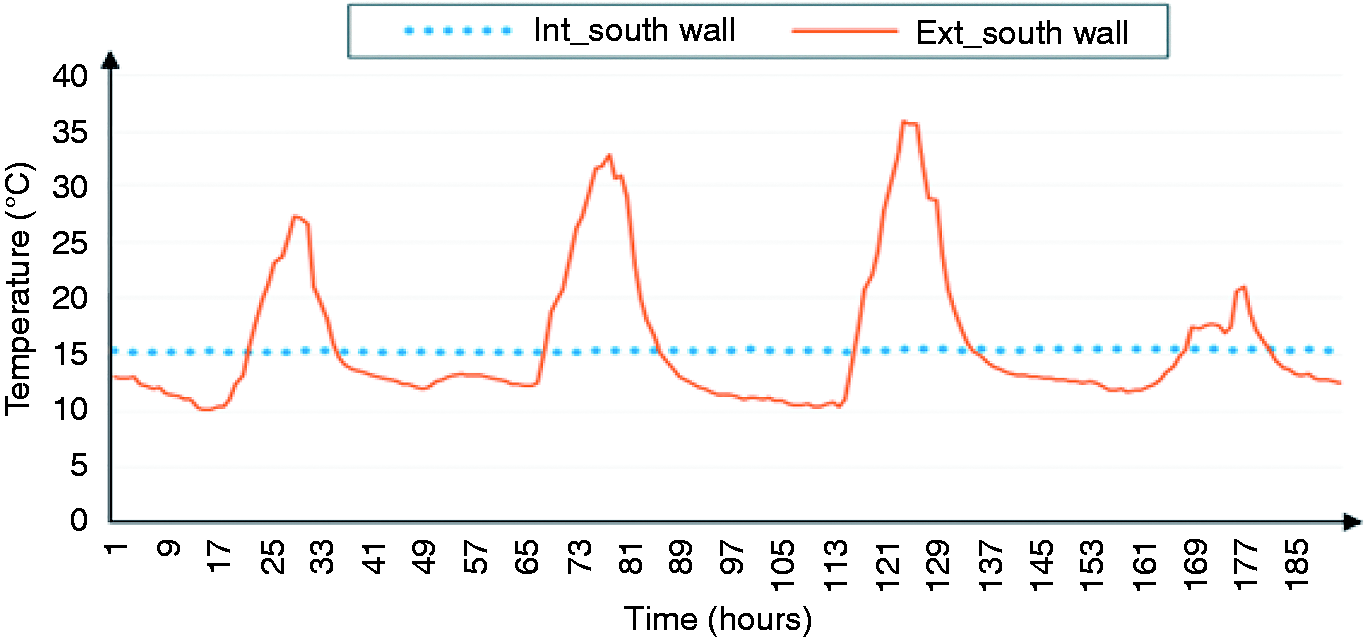
Also, it was found that the thermal insulation and thermal mass are effective in stabilizing the daily fluctuations in the temperature of the surface of the inner wall, and they reduce therefore the indoor air temperature fluctuations, which greatly improves the quality of indoor air.
Figure 9 presents the hourly variation of measured interior air temperature in the living room and bedroom 2 of the house. This variation shows the effect of the room placement inside the house and south-facing windows on the indoor thermal comfort. The experimental results presented in this figure highlight the effect of building orientation on the internal temperature of living room and bedroom 2. The ambient temperature measured during this monitored period varies between 2℃ as a minimum value and 21℃ as a maximum value. Note that a great daily fluctuation can be noticed externally, reaching up to 16℃. The living room, due to its placement in the south side of the house and a large glass area facing south, has a temperature slightly higher than bedroom 2. Therefore, the indoor air temperature in the living room reaches 17.5℃ in daytime and stays higher than 16℃ in night time. The small fluctuations of indoor temperatures compared to outdoor fluctuations are strongly related to both insulation and high thermal mass characteristics of the building envelope. Concerning bedroom 2, since the solar gain is absent, it is found that air temperatures are lower than that of the living room, and the indoor temperature decreases from day to day (from 15℃ to 13.5℃). Missoum et al.
1
investigated the effect of orientation on the annual heating and cooling needs of a house located in the North-West of Algeria. Their results show that the total energy needed to provide comfort throughout the year when the house is oriented North/South is greater when the house is oriented East/West. Note that, in the design stage, a simple orientation of the East/West home, with the longest side facing south, can save a significant percentage of the energy. These results are consistent with our findings and reveal a significant effect of wall orientation on the temperature inside such a pilot bioclimatic house. Moreover, it is found that the integration of energy efficiency measures using the passive method (insulation, high thermal mass, south orientation) allows to reduce the internal temperature fluctuation of this pilot bioclimatic house.
Variation of interior temperature in pilot bioclimatic house during the monitored period.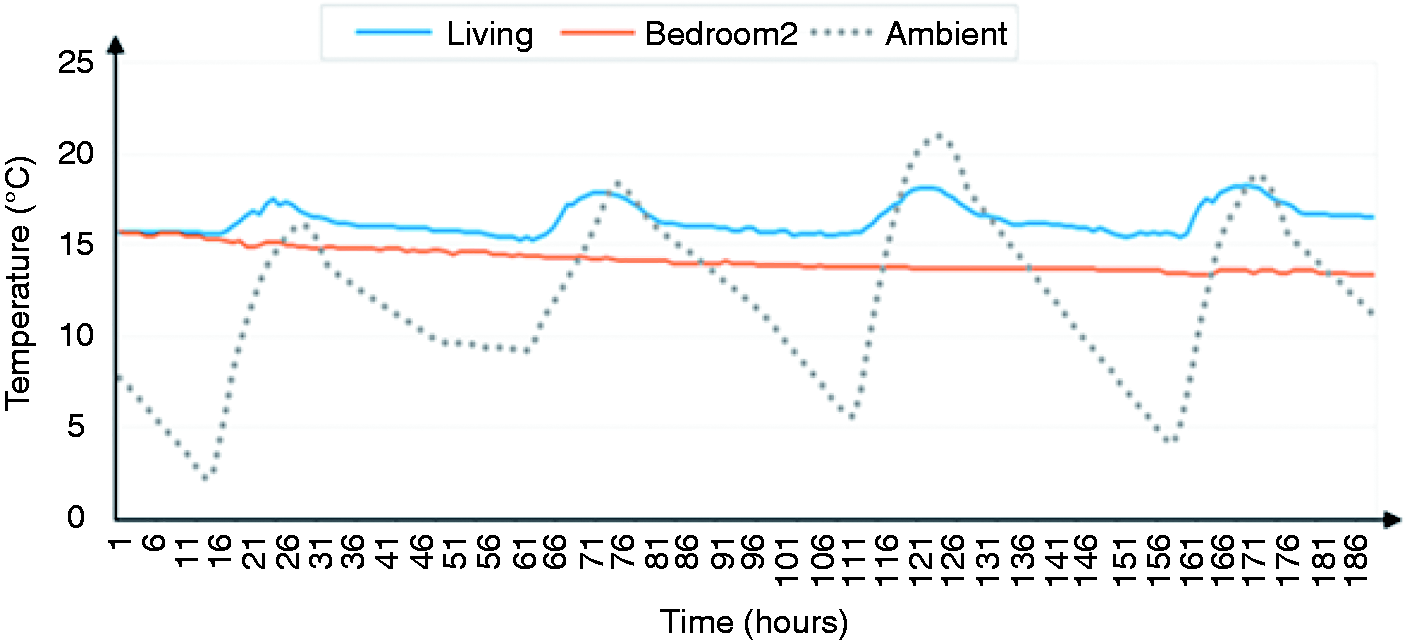
Effect of the SHS
In order to investigate the effectiveness of active solar thermal system, a field experiment was carried out on the pilot bioclimatic house during the monitored period. During this period, the heating floor is activated during the first two days in bedroom 2 and during the last two days in bedroom 1.
Figure 10 shows the measured indoor temperature in bedrooms 1 and 2 provided by the heating system. It should be noted that bedroom 1 is in south orientation, and the second bedroom has a north orientation. During the monitored period, the windows are kept closed from 21 to 22 December, and the heating floor system is operated for bedroom 2 only, whereas during the last two days, this system is only operated for bedroom 1. During the first two days, the indoor air temperature of bedroom 2 reaches about 16.5℃ to 18℃. During the last two days, the indoor air temperatures in bedroom 1 are in the range of 16.25℃ to 19.5℃. During the four days of the monitored period, the heating system is activated for the same number of hours for each of two bedrooms. The indoor air temperature of the two bedrooms increases, but bedroom 1 has a temperature slightly higher than that of bedroom 2. This is due to the south orientation of its window. In addition, we note that bedroom 2 has an air temperature lower than bedroom 1, because of the north orientation of its window.
Effect of the floor heating on the interior air temperature during the monitored period.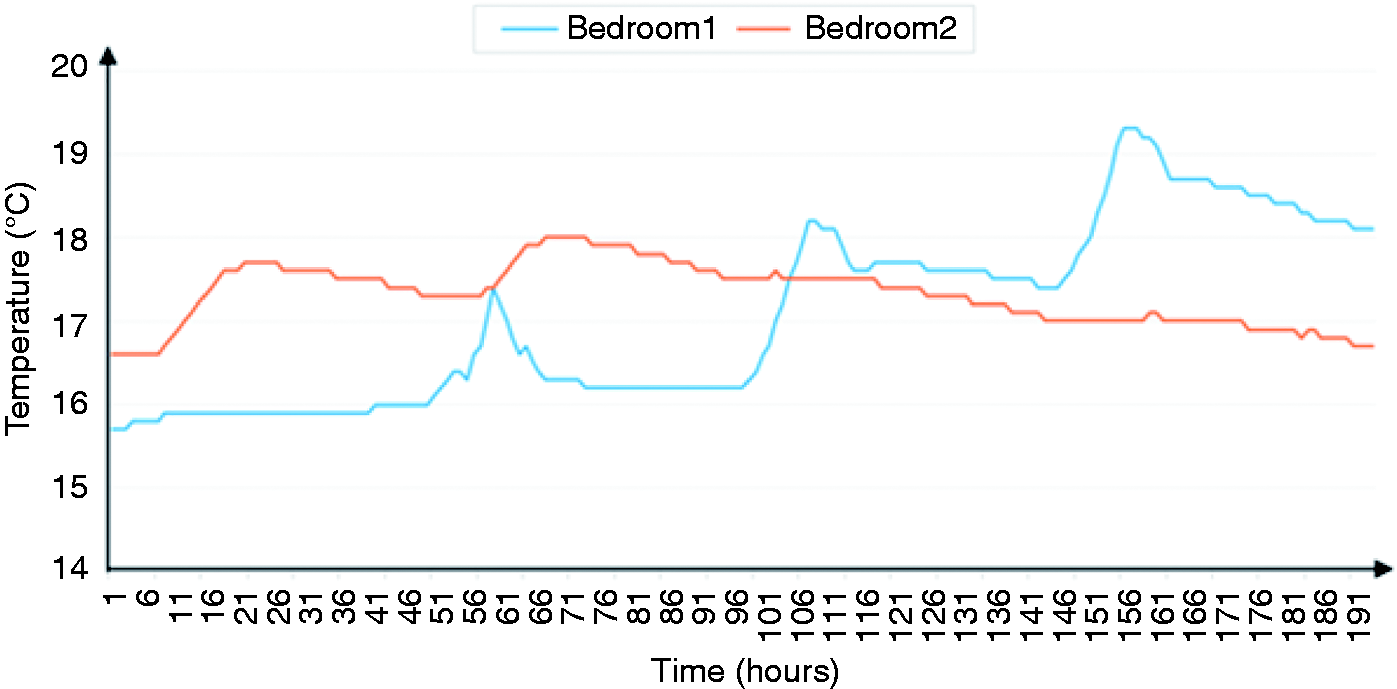
To assess our results, we compared them with those obtained by Imessad et al. 28 who evaluated the internal temperature of the two bedrooms for seven days in the winter period (from 19 to 26 March 2014). During this monitored period, it has been found that the temperature of bedroom 2 varies from 17.5℃ to 19℃, while it ranges from 18℃ to 19.9℃ for bedroom 1. This is related to the fact that bedroom 1 is facing south while bedroom 2 is facing north. Through what has been found, we can state that our findings and those obtained by Imessad et al. 28 for the same rooms evaluated are in accordance, the slight shift of values being due both to the period and the evaluation duration. It can be seen that, a significant energy saving for heating can be achieved when a high thermal mass, optimal insulation and passive solar gain (south orientation) are applied. This energy saving may be even greater with an active solar gain which is a DSF.
Figure 11 shows the average tank temperature changes during the monitored period. It can be seen that the temperature in the storage tank does not exceed 16℃. As the interior air temperature of the unfavorable zone remains less than 20℃, all the collected heat from the thermal collector is intended to the floor heating to meet the space heating demand.
Average tank temperature during the monitored period.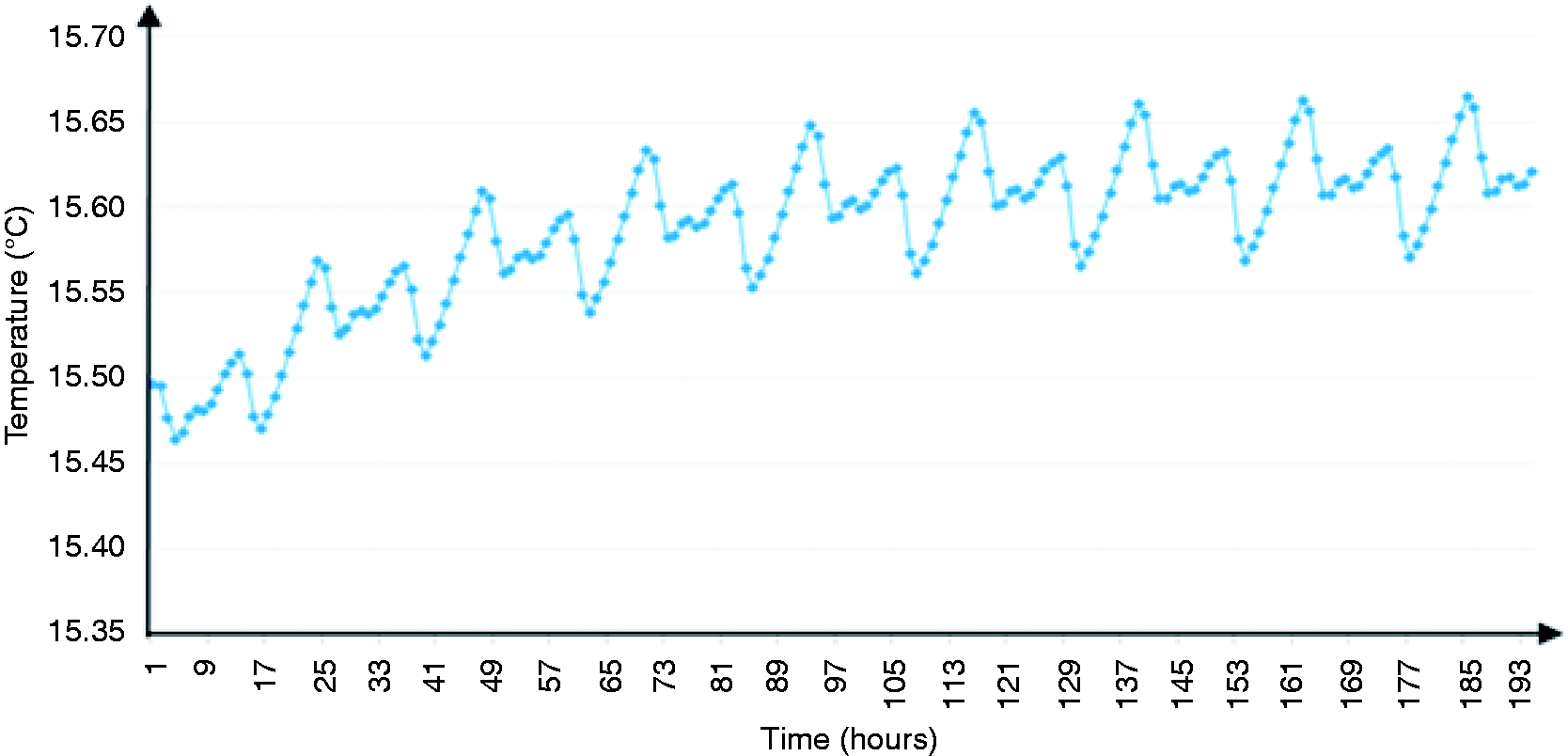
These results are compliant with the principle of operation of a heating system by DSF. 29
Simulation results
Validation of the model
A TRNSYS model of an SHS supplying a pilot bioclimatic single-family house was validated by recording the indoor air temperature evolution of different zones of the studied house. The recorded outside air temperature and solar radiation at 45° are used as input data for TRNSYS. The model precision is checked by providing the deviation that is given in the following relationship
30

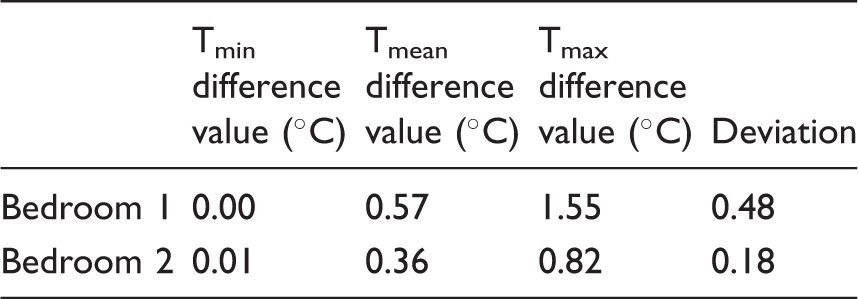
Figure 12 shows a comparison between the measured indoor temperature and that obtained through simulation for four days in December (from 21st to 24th day of 2000) of the entire follow-up period. The comparison is performed for the temperature inside bedrooms 1 and 2. Note that December is selected as it is considered one of the coldest months of the year in Algeria. The average outside temperature measured during the period is of 8℃, with a minimum value of 2.5℃ and a maximum of 20.3℃. A large daily fluctuation can be noticed on the outside, and up to 15℃. As it can be seen (Figure 12), bedroom 1 has a temperature very close to the recommended neutral temperature for winter period. It is found that indoor temperature of bedroom 1 exhibits an average value of 16℃ when the outdoor temperature reaches 2.5℃. As for bedroom 2 which has a north facing wall, it has a lower temperature than that of bedroom 1. It should be noted that the small fluctuations of indoor temperatures compared to outdoor fluctuations are strongly related to both insulation and high thermal mass characteristics of the building envelope. Qualitatively, the simulated temperature remains faithful to the experimental evolution. Otherwise, the model successfully reproduces the thermal behavior of the two bedrooms. In examining Table 8, it is clear that there is a good agreement between the experimentally monitored data and simulation results. Based on the presented results, we can state that the developed model is able to predict correctly indoor thermal conditions and the energy consumption, since simulation results corroborate experimental results.
Measured and simulated temperatures of the interior air of the two bedrooms. Deviation and temperatures values.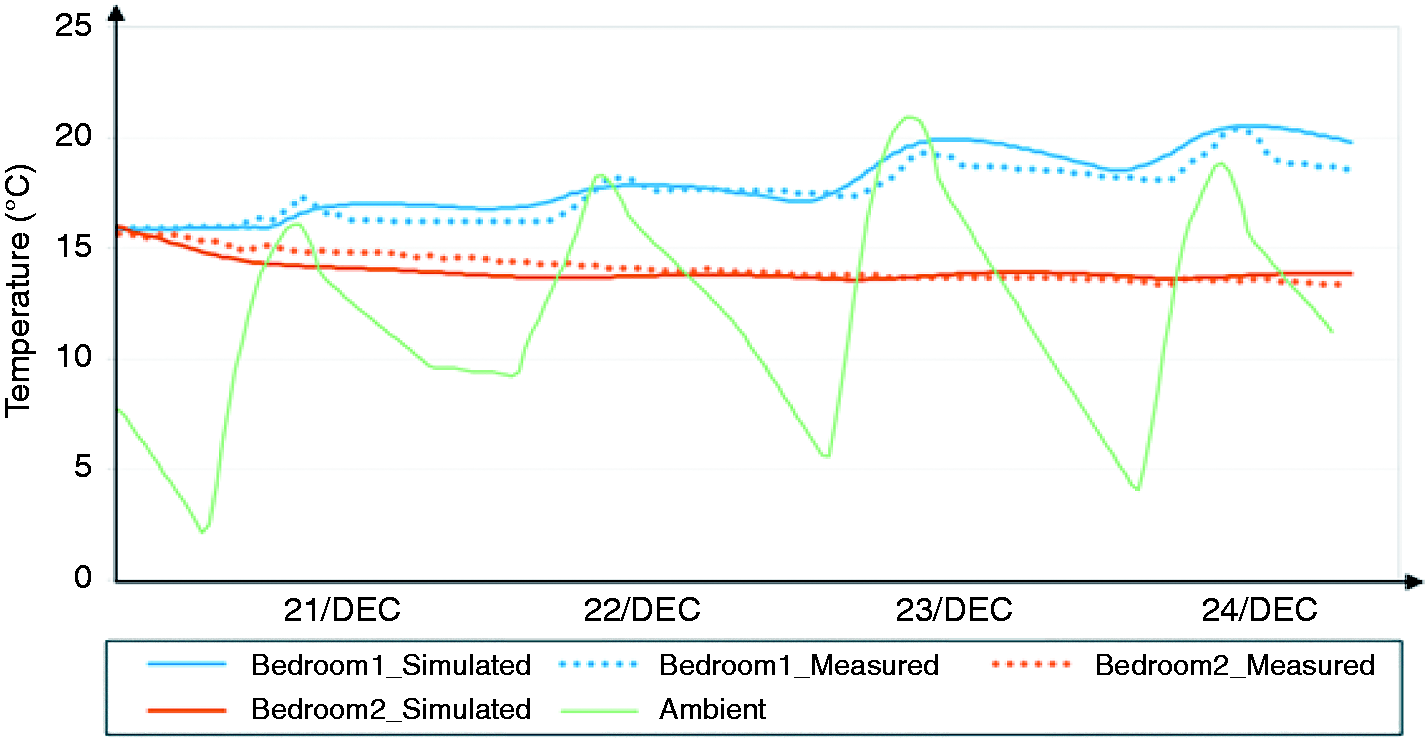
Energy balance analysis
In order to show the effect of bioclimatic design on the energy performance of a house, we compare the energy demand between two identical houses, with conventional wall construction for the first and a bioclimatic design for the second. The resulting monthly energy demand for both houses is shown in Figure 13. In this figure, blue and orange histograms show the heating needs of the conventional house and the pilot bioclimatic house, respectively.
Monthly energy requirements of the conventional and pilot bioclimatic house.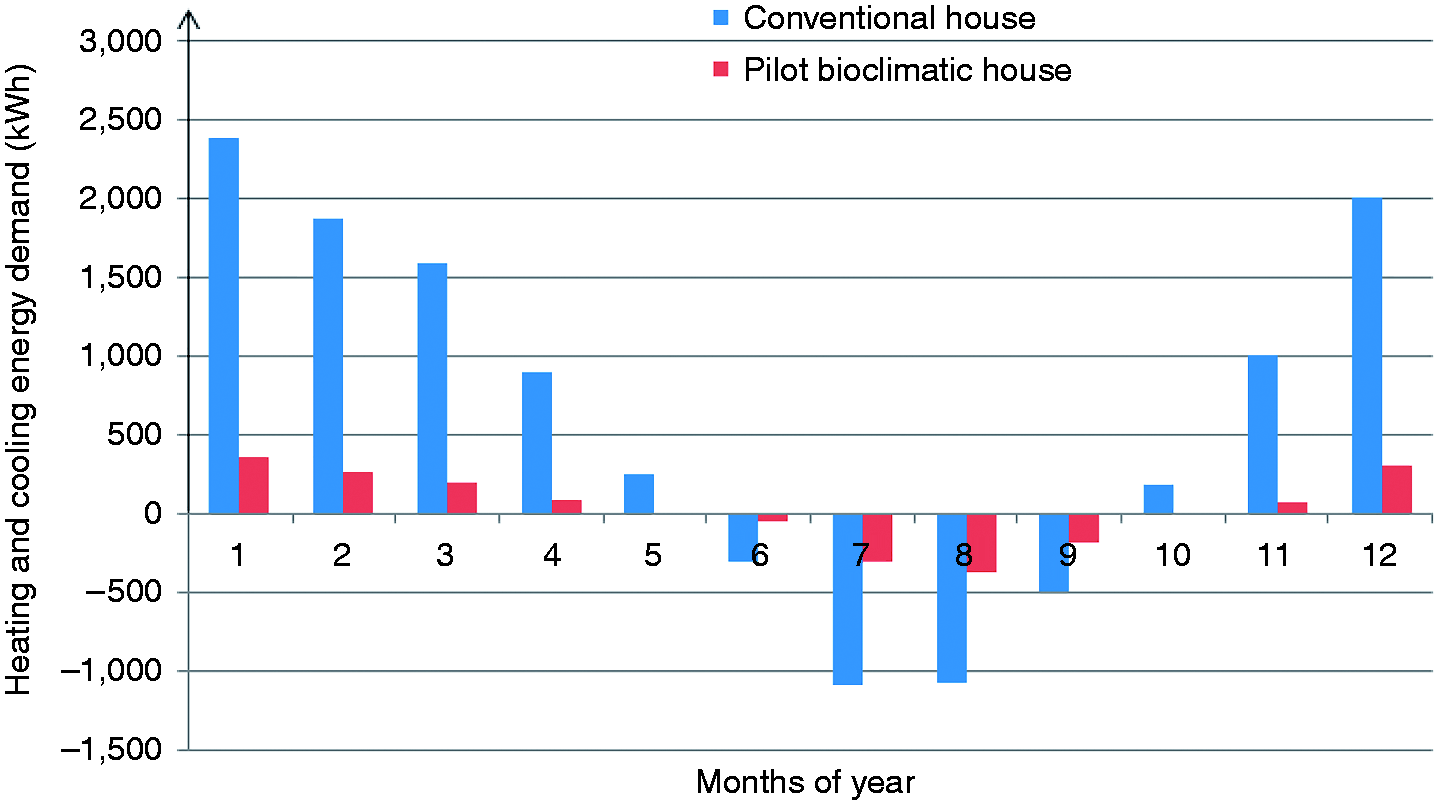
We note that the monthly energy demand of the conventional house is quite important. For example, its heating requirements are about 230 and 140 kWh/m2 year for May and October, respectively. As for the pilot bioclimatic house, it does not need heating during those two months. Such an observation is mainly due to conventional materials used in the construction of the conventional house. Note that monthly energy demand of the pilot bioclimatic house is quite low, and this is due to the excellent insulation of the pilot bioclimatic house, which does not allow the indoor heat discomfort. Recall that the negative heating needs of both types of house actually represent the demand for air conditioning (cooling), for the months of June, July, August and September. To demonstrate the importance of the passive technical conditioning agreed in the bioclimatic design, Fezzioui et al. 31 proposed a simulation of the thermal behavior of several operational houses in the Maghreb climate. The data of annual needs for heating and cooling of houses with modern and traditional architecture (bioclimatic design), show that traditional architecture significantly reduces the heating/cooling requirements of houses located in the northern, central, and the southern parts of Algeria. The results shown in Figure 13 confirm that, the integration of bioclimatic design can be an effective way to reduce energy demand, especially during the offseason. Obviously, heating and cooling energy demand is considerably reduced both by the insulation and high thermal mass characteristics of the building envelope.
Figure 14 depicts a comparison between annual energy demands of the two houses for the heating and cooling demand. The drawn histograms represent the heating demand, cooling demand, and the total annual energy demand, respectively. The blue histograms represent annual energy demand (kWh) of conventional house, while the red histograms represent annual energy demand (kWh) of the pilot bioclimatic house. The total annual demand for the conventional energy house is 13,105 kWh of which 10,148 kWh for heating and 2957 kWh for space cooling. However, in the case of pilot bioclimatic house, the total annual energy demand is only 2259 kWh, with a reduction of about 82%. Likewise, the annual energy demand for space heating is 1398 kWh and for space cooling is 861 kWh, with a reduction of 86% and 71%, respectively. Although the design and layout remain the same between the two houses, the difference between the energy balance is very important. This is due to mass walls, insulation of the envelope, and solar heat gain through fenestrations that contribute to reduce energy demand for heating in winter, and for cooling during a summer period.
Annual energy requirements of the conventional and pilot bioclimatic house.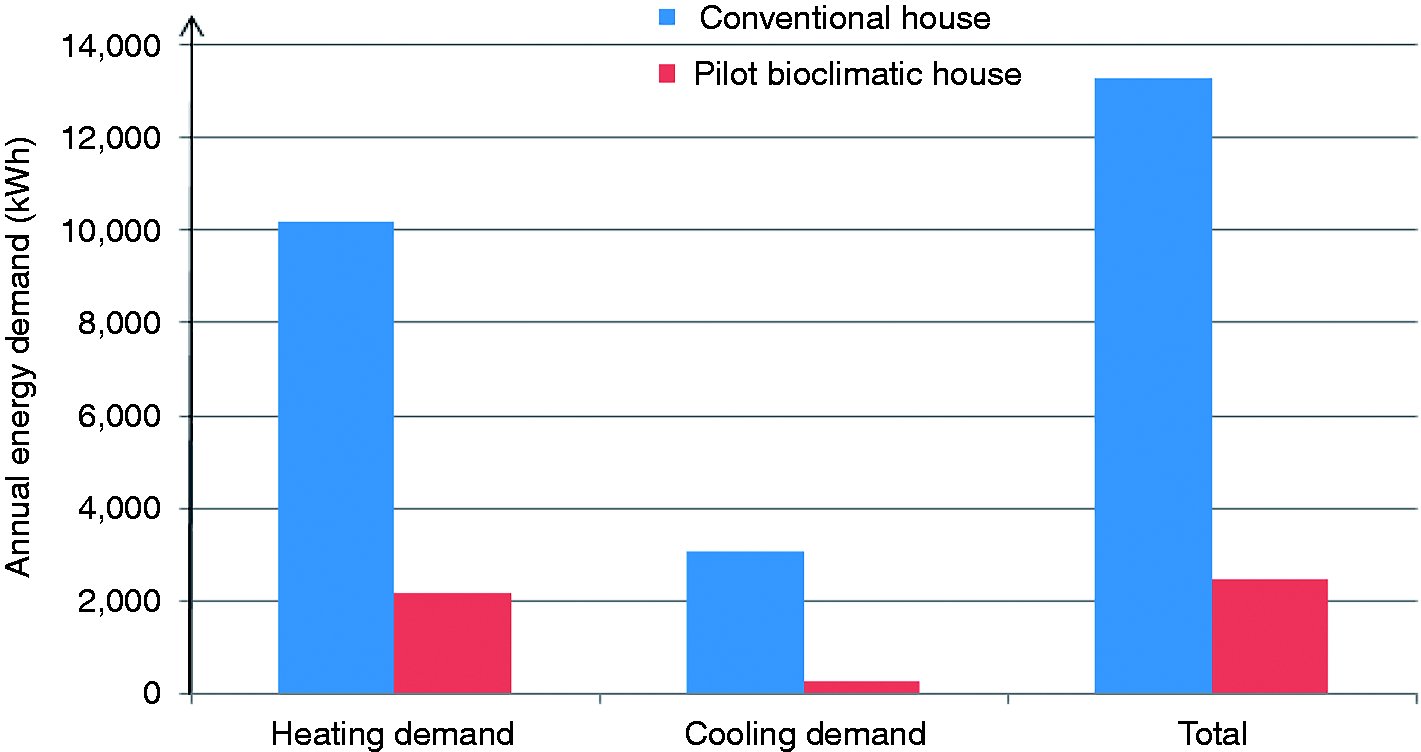
Thermal comfort improvement
To further improve the thermal comfort in the pilot bioclimatic house, a parametric study is performed to highlight the effect of the increase of window size facing south on the space heating demand, the effect of solar protections, and night cooling on space cooling demand.
Effect of window size
In order to study the effect of windows' size facing south on energy demand of the pilot bioclimatic house, different window-to-wall-ratios (WWR) ranging from 10% to 90% are considered.
As can be seen from Figure 15, the heating requirement decreases rapidly from 1764 to 719.2 kWh, while the WWR increase from 10% to 50%. This can be due to the fact that the large amount of useful solar heat gain is produced by the windows which are located in the south facade. After this value of WWR, the decrease in the heating demand becomes lower. Therefore, the optimal WWR of 50% for south facing is considered in this study. The WWR may have opposite effects by increasing solar gain and daylight duration during winter, which would be beneficial, but could lead to overheating during summer.
32
Therefore, increasing the size of the windows of the southern facade by 50% compared to original window sizes cannot be done without the imperative presence of external shading device in summer (to prevent overheating in summer) and provides significant energy savings in space heating demand by reducing the total energy needs of 48.70%. The increase of the cooling demand due to the window size increase is easily avoided by using shading devices. The issue of properly sizing the overhangs windows for this pilot bioclimatic house has been studied by Imessad et al.
19
We also note that to benefit from the solar radiation in the heating season, an increase of window area facing south improves natural lighting of home, especially in rural areas where sunscreens are absent.
Effect of window size on the heating energy demand.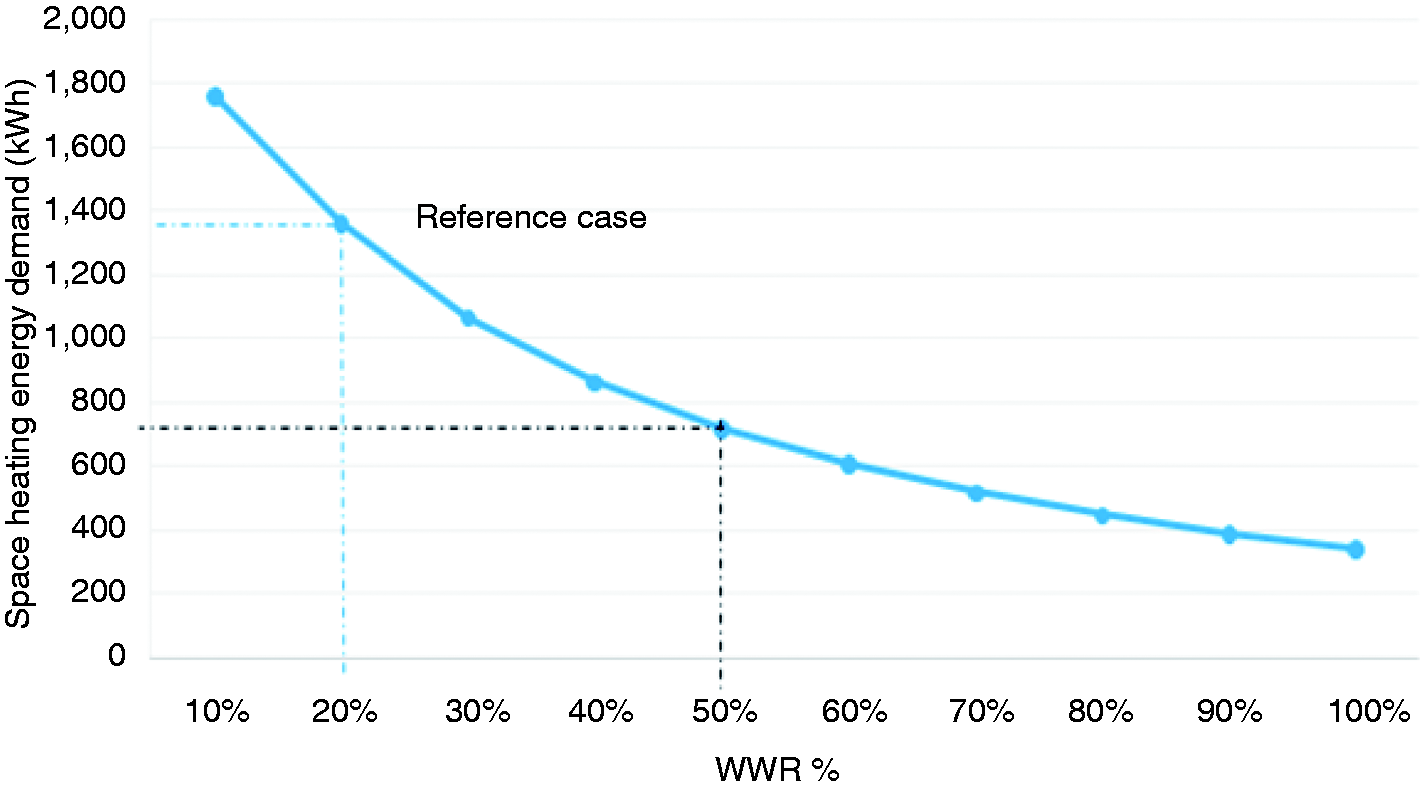
Effect of the night cooling and shading devices
To provide more improvement in the thermal comfort in summer, the effect of the night cooling associated with the use of solar protections (shading devices) is studied. For night cooling, we consider that the house is naturally ventilated by opening the windows during the night and closing them during the day. This approach takes advantage of the fresh air from the outside during the night by opening windows, thereby reducing the temperature of the indoor air and the temperature of the building structure.
Shading devices, such as an overhang, should be designed so that their positions can be adapted to the season of the year.
33
According to Florides et al.
34
increasing the solar protection provided by overhang, and the annual cooling demand decreased as the heating demand increased. In this paper, we use long projecting horizontal overhangs that can be folded back or removed in winter.
35
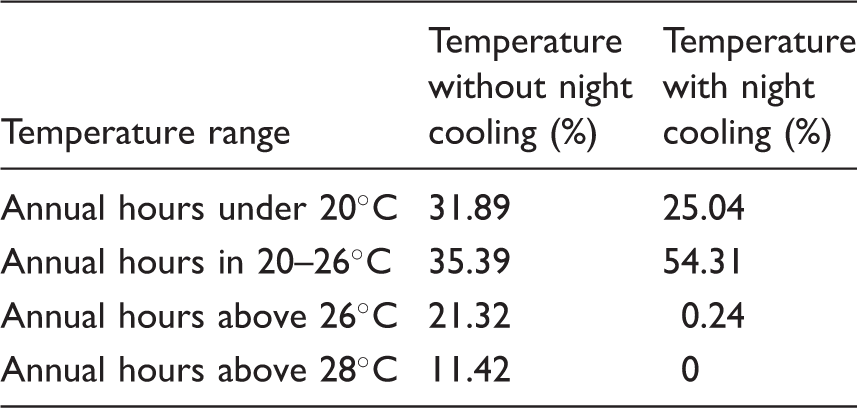
As a result, the house is completely shaded in summer and benefit from solar radiation in winter. Figure 16 shows a comparison between the numbers of hours in different temperature ranges during the cooling season. It can be seen that the use of solar protection and night cooling allow a significant improvement of thermal comfort inside the house during the hot months of the year.
Thermal comfort in summer.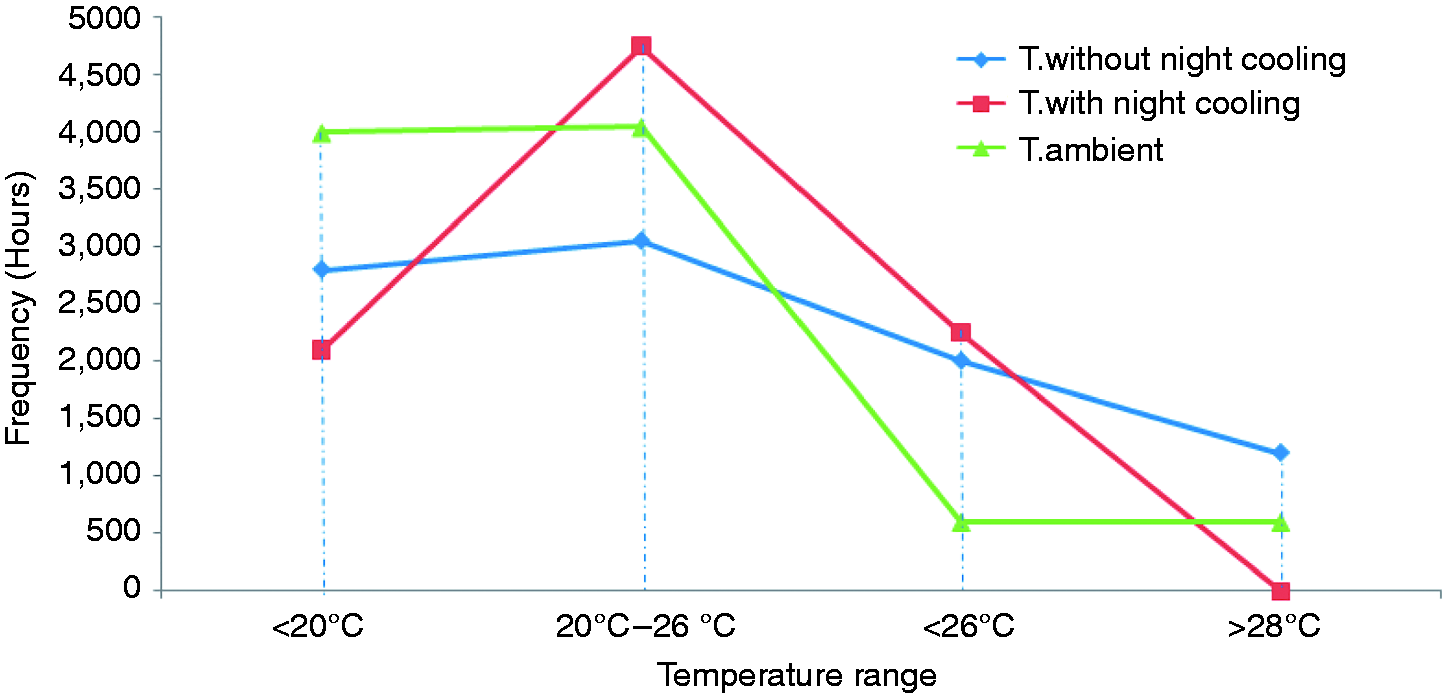
Indoor thermal comfort in the pilot bioclimatic house with and without night cooling.
Contribution of SHS
In order to study the impact of DSF on the annual energy needs of the pilot bioclimatic house, a dynamic simulation is carried out for one year. Figure 17 depicts the space heating energy demand of the house with and without using the DSF.
Energy demand of the house with and without DSF.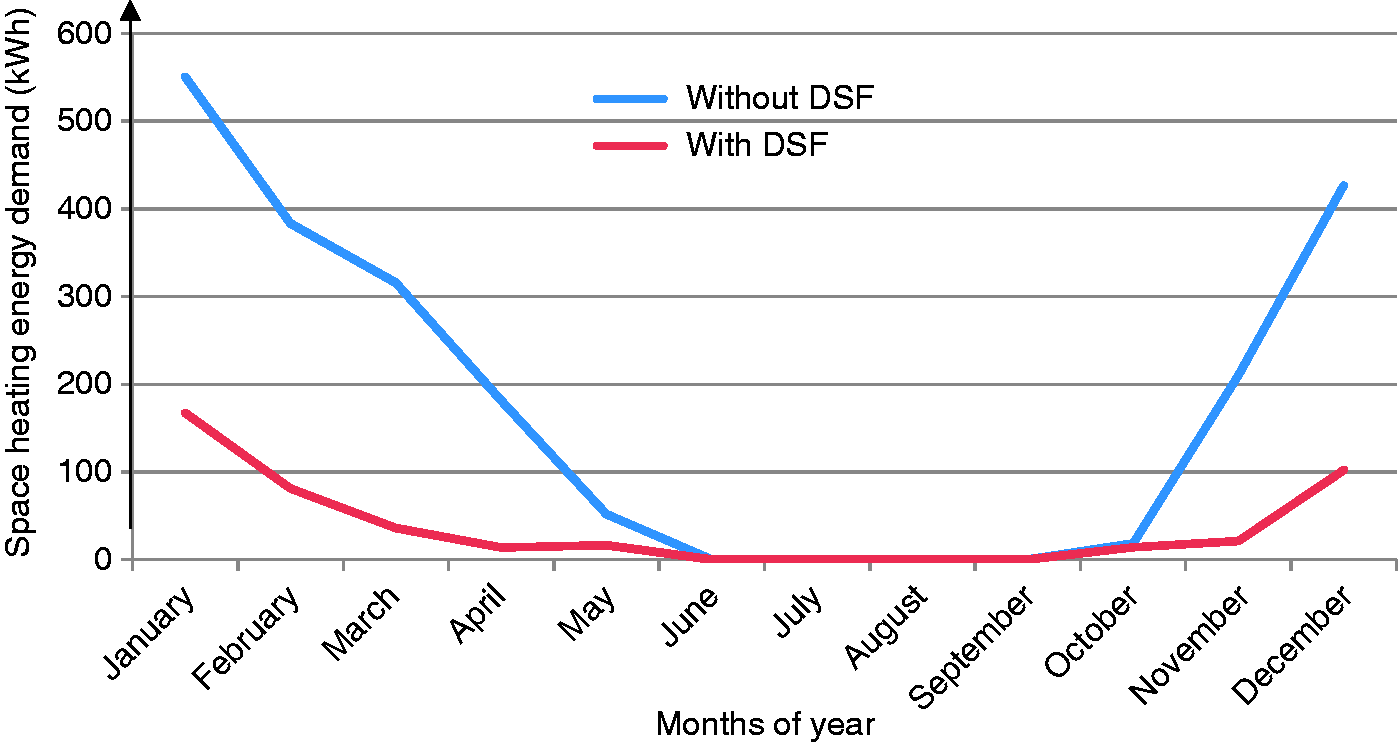
The DSF is associated with the reduction of energy needs for heating during cold weather and can therefore be considered as an energy-saving system. This system with low operating temperature level seems optimal for heating buildings having high thermal inertia. The advantage of the DSF is that an additional solar tank is not used, since the collected solar energy is stored directly in the ground to heat the building and to improve thermal comfort. The wide gap between curves (Figure 17) shows that the energy demand for heating the pilot bioclimatic house is significantly decreased by adopting a DFS system. Indeed, the total energy required to provide the amount of heat required throughout the year is about 1398 kWh when the house is simulated without DSF, and about 451 kWh when it is simulated with DSF. Note that the use of a DFS system will cover 67.74% of the energy demand for heating of the house. Consequently, it can be concluded that the use of a DSF system will cover a significant portion of energy needs for heating while remaining in the context of energy rationalization and environmental protection.
The analysis of energy saving through the use of a DSF in an experimental cell of 40 m2 has been studied by Mokhtari et al. 36 The well-insulated unit, consisting of two rooms of the same dimension is located in Oran, in the north of Algeria; the results show that the use of DFS has allowed savings of 69% for heating throughout the year. These results, similar to those found in our study, confirm that the usefulness of adopting the technique of DSF in Algerian climate is very promising.
Environmental impact
It should be noted that reducing the energy consumption of a building by installing more energy efficient fixtures or onsite renewable energy systems will reduce its greenhouse gases (GHG) emissions due to the reduction in its energy demand.
37
In order to evaluate the reduction of negative environmental impact due to the use of passive and active solar systems in the pilot bioclimatic house, the GHG emissions reduction needs to be computed. The primary GHG emissions from building operation include carbon dioxide (CO2), nitrous oxides (N2O), methane (CH4), and ozone (O3). These gases can be represented in equivalent quantities of CO2 emissions using their global warming potential factors that are developed by the Intergovernmental Panel on Climate Change (IPCC).
38
The simplified calculation of CO2 emission,
39
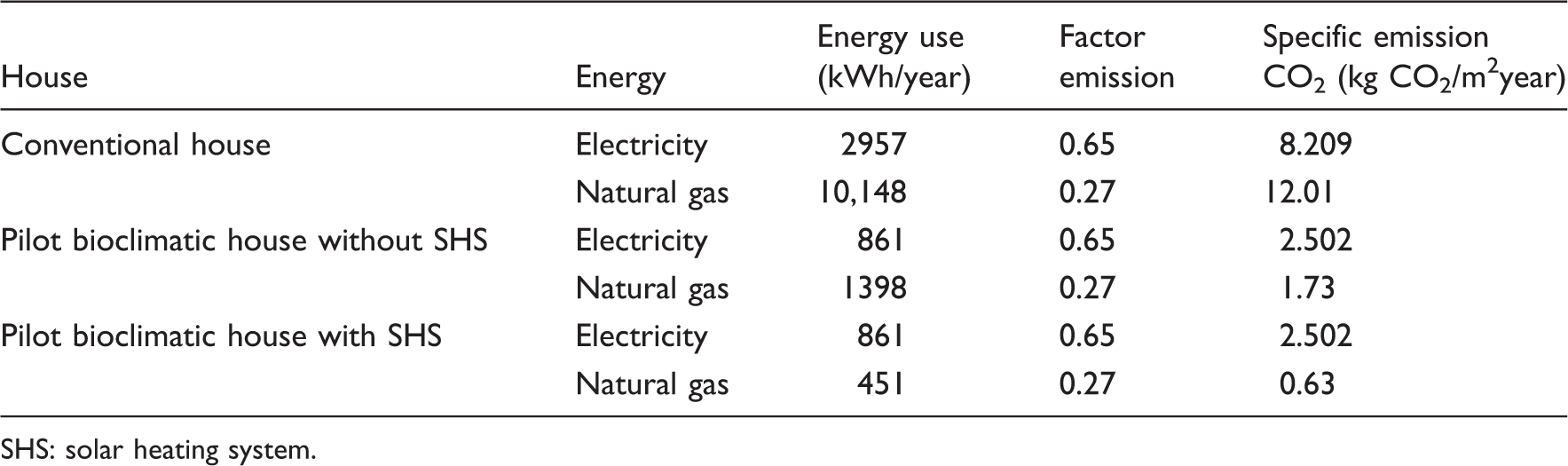
applied to this part, does not take into account the total energy used during the housing life cycle. In other words, all energy is used for the production of building materials, transportation, and recycling after demolition of the dwelling. Note that the specific-CO2 emissions are calculated based on the annual consumption of electricity and natural gas. The following average conversion factors from electricity to CO2 emissions and from natural gas to CO2 emissions are used.
0.65 kg of CO2/kWh of electricity consumed. 0.27 kg of CO2/kWh of gas consumed.
The CO2 emissions of a dwelling are regarded as an indicator of the quality of its design, as well as its architectural thermal quality. In the framework of this study, the environmental assessment conducted (Figure 18) showed clearly the difference between the CO2 emissions of the three cases of the house. The histograms present the specific emissions of CO2 for the conventional house, pilot bioclimatic house without SHS and pilot bioclimatic house with SHS, respectively. These histograms show specific emissions for the electricity consumed (orange part) and the specific emissions for the natural gas consumed (blue part). The CO2 emissions of the conventional house present an amount seven and five times greater than the pilot bioclimatic house for natural gas and electricity emission, respectively; major difference between a conventional house and a pilot bioclimatic house without SHS is primarily due to the choice of materials for construction and insulation. This allows reducing energy consumption for heating and cooling. Also, windows allowing to enjoy sunshine and thereby to consume less electricity (for lighting) could be an element of choice. Note that, during its life cycle, the pilot bioclimatic house would allow a significant reduction of the environmental impacts of CO2 emissions, in particular, the global warming potential and exhaustion of the abiotic resources. Boukli Hacene and Chabane Sari
40
make a comparison between the environmental impact of an ecological and conventional house in the city of Tlemcen (in the north western Algeria). Their results show that the conventional house has a specific emission amount of 8.75 that is seven times greater than the ecological house for natural gas and electricity, respectively. The climatic conditions, type of materials used in construction, and the surface of the houses studied can explain the difference between these results and our findings. However, we can state that our results remain consistent with those of Boukli Hacene and Chabane Sari.
40
Finally, the difference between a pilot bioclimatic house with and without SHS is due to the appropriate choice of heating system. Indeed, the SHS is a passive system that can heat the entire house, emit a homogeneous temperature in the house, and heat the sanitary water tank of the house while using a clean, and free energy, which is the solar energy.
Environmental balance of the pilot bioclimatic house and conventional house. Comparison between the specific emissions of pilot bioclimatic house with and without SHS and conventional house.39 SHS: solar heating system.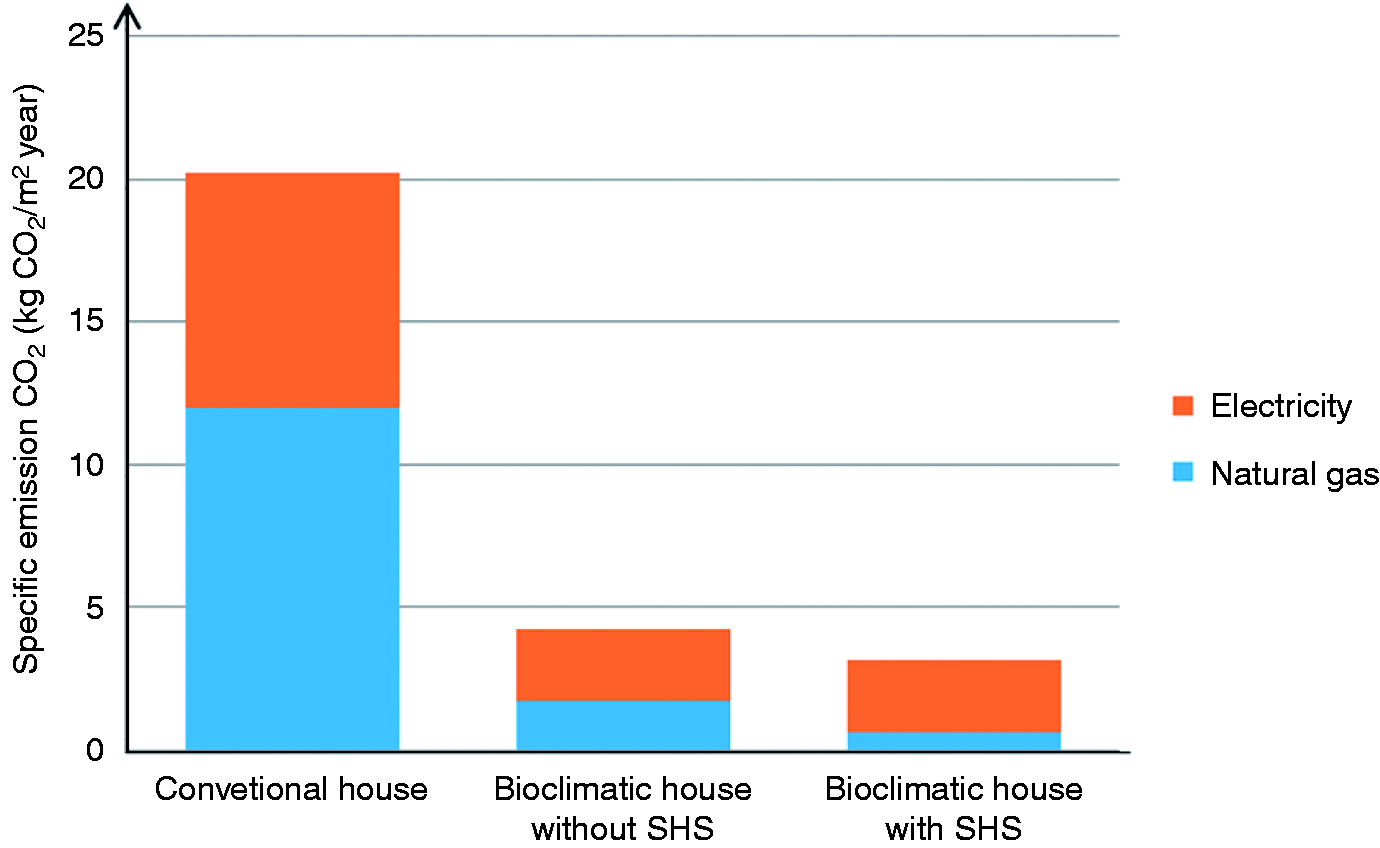
Conclusion
The aim of this paper was to investigate the energy performance improvement of a pilot bioclimatic house located in Algiers (Algeria). A dynamic model of an SHS coupled with a bioclimatic design has been studied both experimentally and numerically. The experimental results show that some key building parameters (bioclimatic strategies) improve the thermal comfort (especially indoor temperature) and reduce energy consumption in the building. We have already investigated the impact of thermal inertia, orientation, thermal insulation, and double-glazing windows. The simulation results show that in comparison with a conventional house, the energy demand of a pilot bioclimatic house is very low. Therefore, it seems suitable for solar system applications. It has been found that the annual energy requirement of the conventional and pilot bioclimatic house is 13,105 kWh and 2259 kWh, respectively. Furthermore, the increase of the window's size of the south façade with 50% reduces the annual space heating demand of the house with 48.70% and night cooling strategy associated with the use of shading device can contribute to reduce the cooling load of buildings and to improve the thermal comfort of occupants. The advantage of the direct solar system is that an additional solar tank is not used since the collected solar energy is directly stored in the floor for heating the interior of building. In this study, the heating system can cover 67.74% of the space heating requirement. The environmental assessment clearly showed the difference between the CO2 emissions of a conventional house and a pilot bioclimatic house. This difference is mainly due to the choice of material for insulation, which leads to the reduction of energy consumption for heating and cooling. Finally, we can state that the conjunction of different passive heating and cooling techniques such as insulation, thermal mass, window shadings, night ventilation, and the SHS can be an effective strategy in terms of energy saving and indoor thermal comfort.
Footnotes
Declaration of conflicting interests
The author(s) declared no potential conflicts of interest with respect to the research, authorship, and/or publication of this article.
Funding
The author(s) received no financial support for the research, authorship, and/or publication of this article.