







Abstract
Double-deck elevators are a very efficient mode of transport, especially in high rise buildings. This is due to the fact that they reduce the number of stops in a round trip (leading to a smaller value of the round trip time hence a higher handling capacity) and take up less space of the core of the building leading to high space usage efficiency. This paper provides a comprehensive treatment of the double-deck elevator traffic calculations. It derives an exact set of equations to find the value of the round trip time under incoming traffic conditions, for the cases of equal and unequal floor populations. Moreover, equations have also been derived for two performance coefficients. The first coefficient is called the passenger transfer efficiency coefficient and is representative of the time taken by passenger to alight from the double-deck elevator. The second coefficient is called the coincidental stopping coefficient and is representative of the stopping efficiency. All the results from the equations have been verified using the Monte Carlo simulation method. The method of stepwise verification has been used in order to verify the equations. Under stepwise verification, the equations are derived in stages and each stage is verified against the results from the Monte Carlo Simulation method. The paper ends by suggesting methods of dealing with two of the irregular conditions. Namely two cases are discussed: the case where the number of floors above the main entrance is odd; and the case where the floor heights are unequal and the rated speed is not attained in one double floor journey.
Keywords
Introduction
Double-deck elevators offer a very efficient means of moving people within buildings. 1 By placing two conventional single deck elevators one on top of the other and attaching them rigidly, shaft space is saved. Passengers board both decks at the same time, whereby passengers heading to an odd floor board the lower deck and passenger heading to the even floors board the upper deck. The elevator then moves two floors at a time. Once a stop is made, passengers alight simultaneously from the upper and lower decks to the even and odd destination floors, respectively.
There are three sources of efficiency that arise from using double-deck elevators:
The effective number of stops is reduced due to the fact that the potential number of floors is halved (N/2 instead of N). This reduces the value of the round trip time and thus increases the handling capacity. The passenger boarding and alighting time is reduced due to simultaneous boarding and alighting of passengers on the two decks. Due to the fact that the two elevator cars are mounted on top of each other, the car capacity is increased without increasing the core space usage.
Double-deck elevators are mainly used in two broad applications2,3
They are effective as shuttles between the ground floor and sky lobbies. The efficiency arises from the fact that there are only two stops (or three stops), thus reducing the value of the round trip time. The elevator car capacity in such situations is made relatively large. They are currently increasingly being used in low- and medium-rise buildings in cases where the floor populations are relatively high. For example, double-deck elevators can be very effective in buildings with more than 250 persons per floor.
Barney 2 presents a comprehensive list of the double-decker installation around the world and their applications. Siikonen 4 presents the equations for the expected number of stops (S) and the highest reversal floor (H) for the case of equal and unequal populations and derives a parameter for the passenger transfer efficiency. Genetic algorithms have been widely applied in elevator traffic control systems, examples of which can be found in literature.4–7 More specifically, Sorsa et al. 8 use genetic algorithms to achieve optimal control of double-deck elevators.
Two pieces of work on double-deck elevator formulae are given by Kavounas 9 and Peters.10,11 Kavounas derives a formula for the highest reversal floor and the expected number of stops. The results from these equations will be later compared with the equations derived in this paper. Peters10,11 presents the formulae for the general case under Poisson arrival conditions. However, it is difficult to carry out comparison with the results in these papers as they do not present any closed form equations (instead, calculations that they present are iterative and require computer implementation).
However, the published research in the area of double-deck elevator does not address the following three points:
No mathematical formula has been derived for the passenger transfer efficiency (i.e. the quantification of the benefits of simultaneous passenger alighting at the destination floors). One of the main aims of this paper is to derive a formula for the passenger transfer efficiency. This is critical in enabling the correct calculation of the round trip time. Although a figure of merit has been previously introduced by Kavounas,
9
no clear derivation has been given to justify it. This paper introduces a detailed derivation of the figure of merit for coincidental stopping for the cases of equal and unequal floor populations. In this paper, it is denoted as the coincidental stopping coefficient (CSC) to distinguish it from the other coefficient introduced in this paper related the passenger transfer efficiency, and denoted as PTEC. Although this parameter is not part of the round trip time calculation, it is used as an indication of the feasibility of using double-deck elevator systems in buildings. No verification has been carried out to ensure the accuracy of the derived equations. This paper presents a methodology of verifying the derived equations by using the Monte Carlo Simulation method (MCS) and gives two numerical examples.
The Assumptions and numbering conventions section introduces some necessary assumptions and numbering conventions used in this paper. The Derivation of the equations for the expected number of stops (s) in a round trip section presents the derivation of the equations for the expected number of stops for the cases of equal and unequal floor populations. Deriving the equations for the highest reversal floor, H section presents the derivation of the equations for the expected value of the highest reversal floor for the cases of equal and unequal floor populations. The passenger transfer efficiency coefficient section introduces the concept of the passenger transfer efficiency and derives equations for the PTEC for the cases of equal and unequal floor populations. The Coincidental stopping coefficient section repeats the same process for the CSC whereby the equations are also derived for the cases of equal and unequal floor populations. The effects and importance of the PTEC and the CSC are discussed in The effect of the PTEC and CSC on the double-deck elevator operation and the system efficiency section. The final round trip time equation and a numerical example section presents a numerical example to verify the derived equations and compares the results with those presented by Kavounas. 9 Two special cases section suggests a methodology to deal with two special cases: the case of an odd number of occupant floors and the case of rated speed not attained in one double-floor journey. Conclusions are drawn in the subsequent section.
Assumptions and numbering conventions
In this section, some of the assumptions are clearly stated as well as the numbering notation for the building.
It is necessary to clearly state some of the assumptions that will be made within this paper and provide some background required for the derivations.
Throughout this paper, it will be assumed that a single pair of entrances is used for boarding. There is only one pair of entrance floor, which is in effect a single entrance scenario. Each passenger can only enter the building through one floor: the odd entrance for odd destination occupant floors and the even entrance for even destination occupant floors.
It will also be assumed that all traffic is incoming traffic. Incoming traffic is traffic that originates at an entrance floor and terminates at an occupant floor. This is not an unreasonable assumption to make. The reason for this is that double-deck elevators are usually operated in double-deck mode under incoming traffic conditions during which they are most efficient. The design of double-deck elevators is still based on the morning incoming traffic (up peak traffic). It is usual to operate double-deck elevators in single deck mode outside peak hours. Under single deck mode, one of the decks is deactivated and the other deck serves passengers as a single deck.
It is also necessary to define the concept of a twin pair of floors, one of which is odd and the other even. This concept is critical to all the derivations that will follow within various sections in this paper. A twin pair of floors is, as the name implies, consecutive floors at which the double deck will make a simultaneous stop and deliver passengers. For brevity in the analysis below, the pair of twin floor will be simply referred to as twin floors. The lower floor will be assumed to be the odd floor and given the subscript o for odd; the upper floor will be assumed to be the even floor and given the subscript e for even. A general overview of the arrangement of a building that is served by double-deck elevators is shown in Figure 1.
General overview of a building served by double-deck elevators, showing the numbering convention used.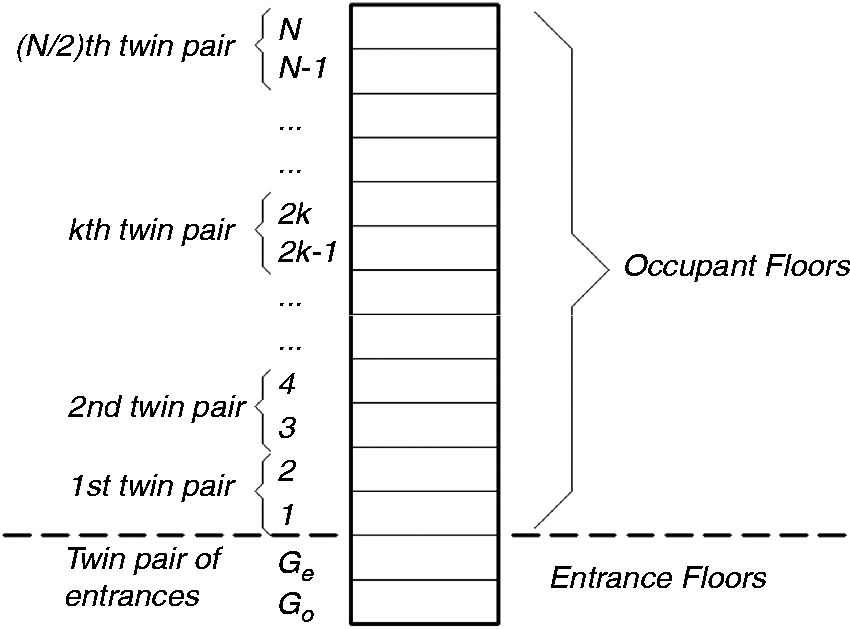
It will also be assumed that the number of occupant floors is even. This is the most efficient arrangement. However, some notes are given towards the end of this paper as to how the case of an odd number of occupant floors can be addressed.
For the simplicity of deriving the round trip time, it will be assumed that the rated speed is attained in one double floor journey (whereby the double-deck elevator traverses a distance equal to twice the height of one single floor) and that the floor heights are equal.
Derivation of the equations for the expected number of stops (S) in a round trip
For completeness, the formulae for the expected number of stops are derived for the two cases of equal and unequal floor populations for the case of incoming traffic only.
The case of equal floor populations
Each passenger (whether on the even deck or odd deck) has only N/2 choices (rather than N choices) as there are only N/2 odd floors and N/2 even floors.
Each passenger (whether heading to an odd floor or an even floor) can select one of N/2 choices (as there are in total N/2 odd floors and N/2 even floors all with equal floor populations). Thus, the probability of a specific passenger (whether going to an odd or even floor) heading to a certain floor is (assuming equal floor populations)

Thus, the probability of a specific passenger not going to a floor is

The probability that there are no passengers heading to an even floor is (remembering that passenger choices are independent)

The same result applies to the probability of no passengers heading to the odd floor of the pair of twin floors and the probability of no passengers from the even deck heading to the even floor of the pair of twin floors. These two events are independent. Thus, the probability of both events taking place is the product of the two probabilities

So the probability of a stop taking place at a specific pair of twin floors is the complement of the quantity above

The expected number of stops in a round trip is effectively the sum of all of these probabilities from the N/2 twin pairs of floors.

The result is identical to that presented in Siikonen. 4
The case of unequal floor populations
The total population of the even floors shall be denoted as Ue and the total population of the odd floors shall be denoted as Uo. For the general case, these two populations are not necessarily equal. The occupant floors will be numbered starting from 1 (for the lower floor of the first twin pair of floors), 2 (for the upper floor of the first twin pair of floors), and then 3 and 4 for the next twin pair of floors upto N−1 and N for the topmost twin pair of floors.
It is first necessary to find the probability of the double-deck elevator not stopping at the kth twin pair of floors. The probability of an odd deck passenger going to a certain floor is

Thus, the probability of an odd deck passenger not going to a floor is
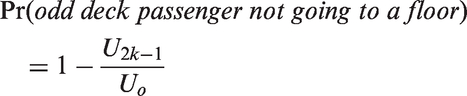
Thus, the probability of none of the odd deck passenger heading to a certain floor is
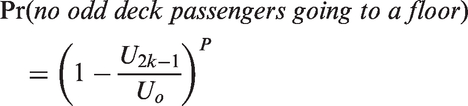
The same approach can be used to show that the probability of none of the even deck passengers heading to a certain floor
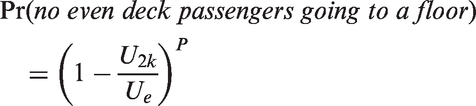
For there not to be a stop at the kth twin pair of floors then there should be no passengers heading to the even floor of the kth twin from the even deck passengers and there should be no passengers heading to the odd floor of the kth twin from the odd deck passengers. As these two events are completely independent, then the probability of them taking place is simply equal to their product, as shown below.
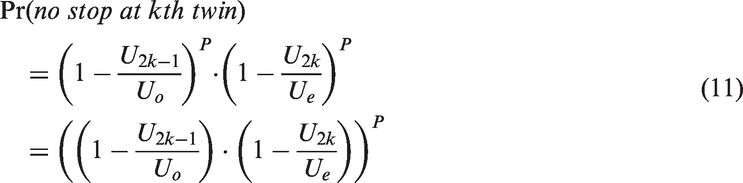
Thus, the probability of a stop taking place the kth twin pair of floor is

The expected number of stops is effectively the sum of all of these probabilities from the k twin pair of floors.

Deriving the equations for the highest reversal floor, H
In this section, the equations for the highest reversal floor in a round trip are derived. The highest reversal floor is denoted as H and is the highest floor that is attained (on average) in a round trip. It is a necessary component in the calculation of the round trip time.
In the context of double-deck elevators, it is necessary to introduce two representations of the highest reversal floor: Hsingle and Hdouble. Hsingle is the average value of the highest reversal floor and has units of single floors and will also be denoted as H. Hdouble is the average value of the highest reversal floor in units of double floors.
For the purpose of deriving the average value of the highest reversal floor, it is more convenient to first derive an equation for Hdouble and then convert it to Hsingle. This is reason for using these two different representations.
The next section derives the equation for the case of equal floor populations, and the subsequent section derives the equation for the case of unequal floor populations.
The case of equal floor populations
The equation for H can be derived using the conventional equation for H for single deck elevators, shown in equation (14) below.

In order to adapt this equation to the double-deck arrangements, the building is effectively first converted into a building with half the number of floors above the main entrance, whereby each floor is a double height floor. However, there are potentially 2·P passengers selecting destinations. This in effect represents an elevator car that has twice the number of passengers. Thus the effective value of N is N/2 and the effective value of P is 2·P. The value of H thus obtained is based on a building with double height floors. Hence, the subscript Hdouble is used.

In order to convert from Hdouble to Hsingle, the result is simply multiplied by 2 as shown in equation (16) below.

The result is also identical to that presented in Siikonen. 4
The case of unequal floor populations
In this section, the equation for the highest reversal floor for the case of unequal floor populations is derived. A method similar to that presented in Al-Sharif 12 will be used. Interested readers are advised to refer to it for more details.
It can be shown that the probability of not travelling above the kth twin pair of floor is the product of two probabilities (two independent events): the probability of not travelling above the kth twin pair of floors due to an odd deck passenger and the probability of not travelling above the kth twin pair of floors due to an even deck passenger. Due to the unequal floor populations, it is necessary to derive a term for the odd floor and a term for the even floor separately.

The probability of not travelling above the (k−1)th twin pair of floors can be found by substituting (k−1)th in place of k in equation (17)

Thus the probability of the kth twin pair of floors being the highest reversal double floor is the difference between the two quantities in equations (17) and (18).
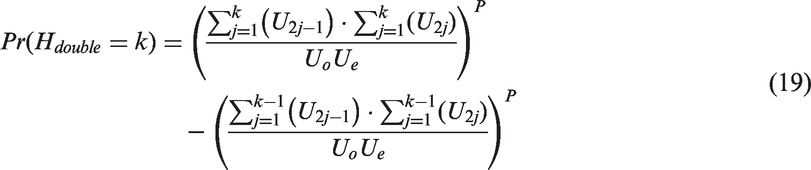
The highest reversal floor is the sum of the product of each twin pair of floors and the probability of it being the highest reversal floor.
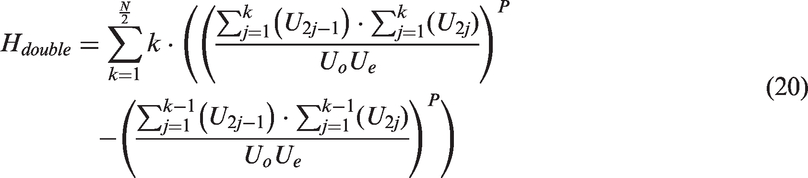
Expanding and simplifying gives the final result

In order to evaluate the highest reversal floor in units of single floors, the quantity is simply multiplied by 2

The passenger transfer efficiency coefficient
This parameter is unique to double-deck elevator systems (or to multiple deck systems in general). It is a measure of the efficiency of the passenger transfer time (i.e. boarding and alighting). There are two phases of passenger transfer in any elevator: boarding time and alighting time.
Based on a single pair of entrances, passenger transfer efficiency during boarding is not a concern (noting that it is assumed that all the traffic is incoming only). It is assumed that all P passengers for each deck (i.e. the upper deck and the lower deck) start boarding at the same time and finish boarding at the same time. Thus, there is no wasted time and full efficiency is automatically attained.
However, the issue of passenger transfer efficiency is more of a concern during alighting. As there are many occupant pairs of floors (that will act as destinations for passengers), it is likely that different numbers of passengers are destined for the odd and even floors of the same stop. The most efficient scenario would take place in a double-deck elevator when an equal number of passengers from the two decks alight at the same stop. In this case, it can be stated that there is no wasted time, as there is no wasted waiting time at one deck while one or more passengers are alighting from the other deck.
For example, if at one of the double-decker stops, five passengers alight from the upper (even) deck and one passenger alights from the lower (odd) deck, then the actual alighting time is equal to the time required for the five passenger to alight from the upper deck. The difference between the numbers of passengers intending to alight at this stop has effectively caused a loss of time. Had the number of passengers intending to alight been equal (i.e. three passengers for the upper deck and the three passengers for the lower deck), then the total alighting time would have been only equal to the time required for three passengers to alight, resulting in a saving equal to the time required by two passengers to alight. It is this efficiency (or inefficiency) that this parameter aims to capture. The formula for the case of equal floor population will be derived in the next sub-section, whereas the formula for the case of unequal floor populations is derived in the following sub-section.
The case of equal floor populations
In order to derive a formula for the PTEC, it is necessary to find an expression for the probability of the number passengers destined for the odd floor of the twin pair of floors being equal to i and the passengers destined for the even floor of the twin pair of floors being equal to j.
Each of these events shall be denoted as A and B respectively, as follow A is the event under which i passengers are destined for the odd floor of the pair of twin floors. B is the event under which j passengers are destined for the even floor of the pair of twin floors.
For each of these events, the probability distribution function is effectively a binomial distribution (i.e. a passenger can either head or not to a certain floor). For each deck, it is assumed that P passengers will board the deck in each round trip at the main entrance.
It is now necessary to find the probability of i specific passengers going to a floor. This implies that other P-i passenger did not go to that floor. The probability of the joint event is the product of the two probabilities

This can then be applied to the odd floor of the twin floors and the even floor of the twin floors as shown in the two equations below. (It is implied that if i specific passengers go the floor then P-i passengers will not without the need to explicitly state it in the formula).


As the two events are independent, then the combined event whereby i specific passengers head to the odd floor and j specific passengers head to the even floor of the twin pair of floors is

In the terminology used in the derivations so far, the term specific passengers has been used. This emphasises the fact that the derivation involves a specified set of i passengers and a specific set of j passengers. But the event will take place if any combination of i passengers in the odd deck are destined for the odd twin floor and if any combination of j passengers in the even deck are destined for its twin even floor. There are a number of different ways in which i passengers can be picked out of a total of P passengers and a number of different ways in which j passengers can be picked out of P passengers in even deck. These are in effect combinations and standard formula for combinations can be used as shown in the following equation
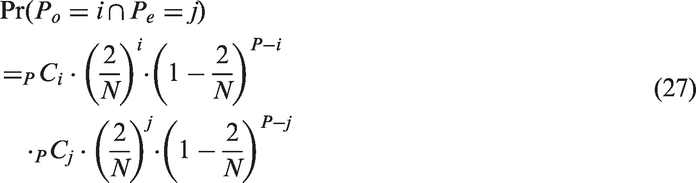
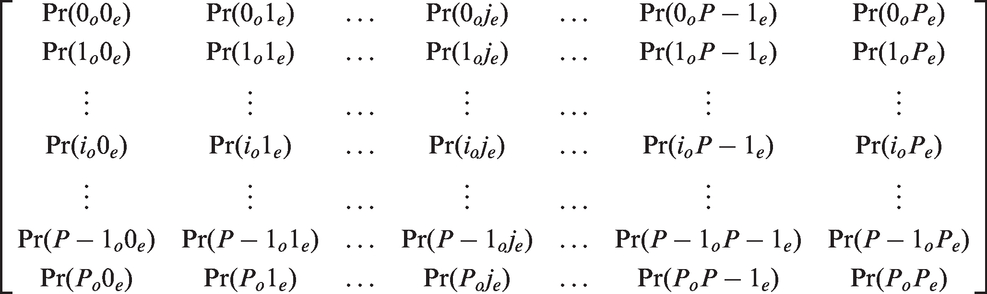
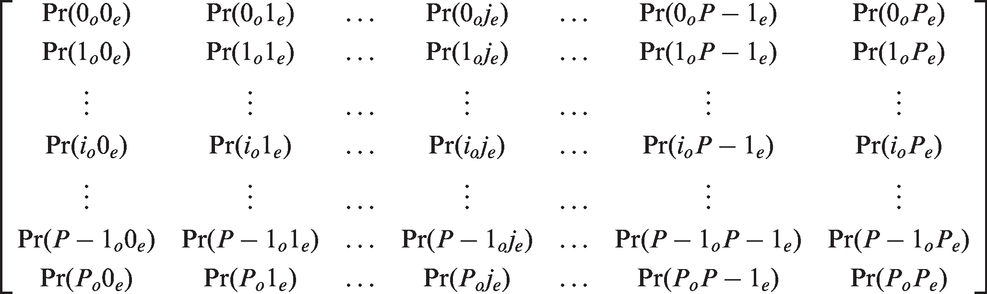
This equation is now used to populate a dedicated matrix as shown below. The row index represents number of passengers heading to the odd floor of the twin pair of floors and the column index represents the number of passengers heading to the even floor of the twin pair of floors. The matrix is a P+1 by P+1 square matrix, as it is important to include the possible case whereby there are no passengers alighting from either deck.
It is worth noting the following points about the different areas of this matrix:
The diagonal elements of the matrix represent the cases where the numbers of passengers destined for each of the odd and even floors of the twin are equal. For example, Pr(3o3e) is the probability of three passengers being destined to the odd floor of the twin pair of floors and the three passengers destined to the even floor of the same twin pair of floors.
The upper triangle of the matrix (i.e. above the diagonal as shown in the matrix below.) represents the cases where the number of passengers destined for the even twin floor is larger than the number of passengers destined to the odd floor of the twin pair of floors. In other words
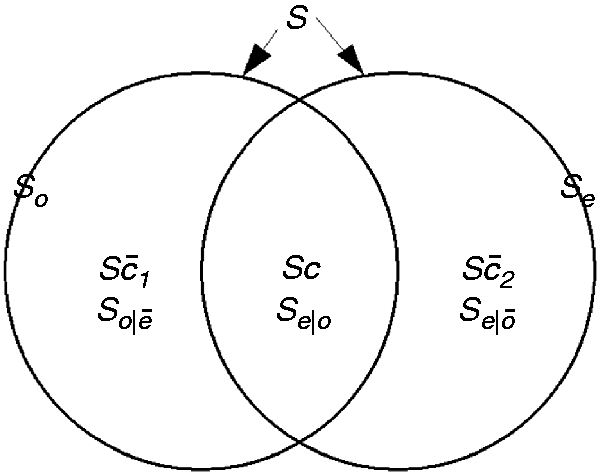
Venn diagram representation of the different categories of stops. The lower triangle of the matrix (i.e. below the diagonal) represents the cases where the number of passengers destined to the odd twin floor is larger than the number of passengers destined to the even twin floor. In other words


The next step is to find the expected maximum number of passengers alighting. Use will be made of the three areas of the matrix: one equation will be developed for the upper triangle of the matrix, one for the diagonal of the matrix and one for the lower triangle of the matrix.
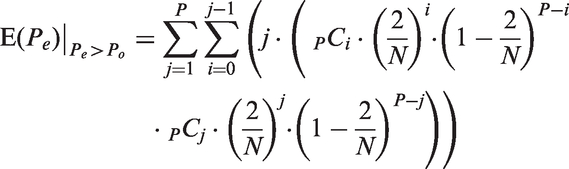
The expected value of the maximum number of passengers alighting at each stop for the even number of passenger can be found by summing the product of the probability of each number of passengers alighting by their number from the upper triangle of the matrix. The limits of the summations ensure that the number of passengers alighting on the upper (even) deck is larger than the passengers alighting from the lower (odd deck).
The same is repeated for the lower triangle of the matrix as shown in the equation below
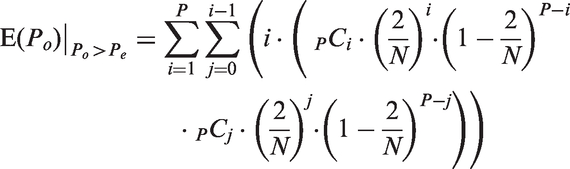
Equations (28) and (29) contain two terms: one involves the number of passengers alighting at the even floor and the other the number of passengers alighting at the odd floor.
As for the diagonal terms, there is only one summation and the index runs from 1 to P (the case where both Pe and Po are zero is disallowed, as there would not be a stop in the first place if there are no passengers heading to either floor of the twin).

Combining all the three cases, it is possible to evaluate the expected value of the maximum number of passenger alighting per twin pair of floors. The expected value is the summation of the three contributions to the expected value in the three cases.

However, there are N/2 twin number of floors, where N is the total number of floors above the main entrance. Thus, the expected value of the maximum number of passengers alighting in a round trip is
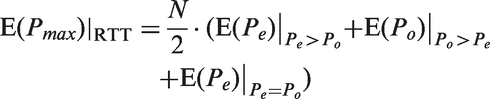
Finally, the PTEC is the ratio between the expected value of the maximum number of passengers alighting in each round trip divided by the number of passengers per deck.

The case of unequal floor populations
As for the case where the floor populations are unequal, a similar approach can be followed. It will be assumed that the total population of the even floors is Ue and the total population of the odd floors is Uo. The occupant floors will be numbered starting from 1 (for the lower floor of the first twin pair of floors), 2 (for the upper floor of the first twin pair of floors), and then 3 and 4 for the next twin pair of floors upto N−1 and N for the topmost twin pair of floors. For the kth twin pair of floors, the first step is to sum up all the items from the upper triangle of the matrix
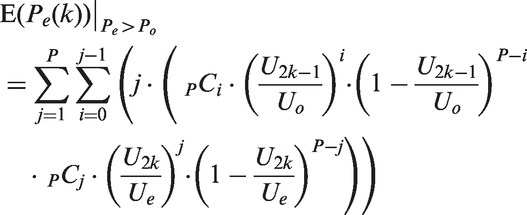
The same is repeated for the lower triangle of the matrix as shown in the equation below.
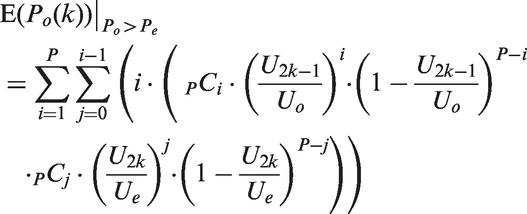
As for the diagonal terms, there is only one summation and the index runs from 1 to P (the case where both Pe and Po are zero is disallowed, as there would not be a stop in the first place if there are no passengers heading to either floor of the twin).
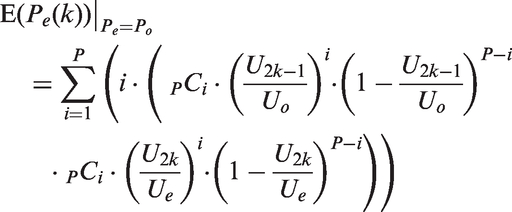
Combining all the three cases, it is possible to evaluate the expected value of the maximum number of passengers alighting for the kth twin pair of floors.

The overall expected value of the maximum number of passenger alighting is the summation over all the twin pairs of floors.
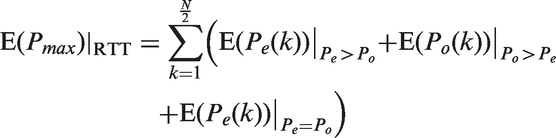
The analysis assumes that N is an even number, so that N/2 is an integer. The index k runs from 1 to N/2, which is the total number of twin pairs of floors.
The PTEC can be calculated as the ratio of the expected value of the maximum number of alighting passengers per round trip by the number of passengers per deck (P). The value below applies to the general case of unequal floor populations.

Coefficient presented by Siikonen
Siikonen derived a coefficient for passenger transfer loading. 4 The derivation will be presented below:
The probable number of stops equals to
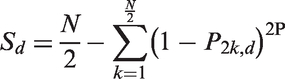
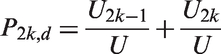
The probable number of stops for upper deck only equals to
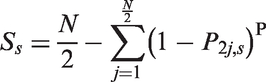
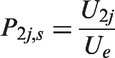
Then, the total passenger transfer time will equal
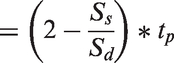
This equation assumes that inefficiencies will occur in both alighting and boarding, whereas in this paper the authors have assumed that inefficiency only takes place in alighting and not in boarding. Siikonen also assumes that the population of every twin pair of floor is equal (i.e. the population of the even floor of the twin pair is equal to the population of the odd twin pair) so that the numbers of stop for single deck for odd and even are equal.
Coincidental stopping coefficient
One of the measures of the efficiency of the double-deck elevator operation is the CSC, referred to as CSC. In this section, a formula for calculating the CSC will be derived. However, it is first necessary to define what coincidental and non-coincidental stops are.
A coincidental stop is defined as a stop in which passengers alight from both the upper and lower decks. A non-coincidental stop is a stop during which passengers alight from one of the decks but not the other. During a non-coincidental stop, the doors of the one of the decks will not actually open during the stops while passengers are alighting from the other deck. This can lead to frustration for the passengers on the deck that has no alighting passengers, and it is customary to reassure them using an automated message asking them to be patient while passengers are alighting from the other deck.
The CSC is the ratio of the average number of coincidental stops in a round trip to the average number of all stops (i.e. coincidental and non-coincidental) in a round trip.
Coincidental stops play an important role in improving the efficiency of the double-deck elevator operation as they help to reduce the number of stops in a round trip, thus reducing the average value of the round trip time and improving the handling capacity of the system.
A number of parameters are defined below. denotes the expected number of stops in a round trip; denotes the expected number of coincidental stops in a round trip; denotes the expected number of non-coincidental stops in a round trip; denotes the expected number of stops (both coincidental and non-coincidental) in a round trip that are caused by passengers on the even deck; denotes the expected number of stops (both coincidental and non-coincidental) in a round trip that are caused by passengers on the odd deck; denotes the expected number of non-coincidental stops in a round trip caused by passengers on the even deck (with no passenger to the odd twin floor); denotes the expected number of non-coincidental stops in a round trip caused by passengers on the odd deck (with no passenger to the even twin floor).
The different categories of stops are shown on a Venn diagram shown in Figure 2.
Some of the areas in the figure are explained in more detail below: is the probability of the non-coincidental stops that take place, where only passengers from the odd deck alight (and no passengers from the even deck alight). is the probability of the non-coincidental stops that take place, where only passengers from the even deck alight (and no passengers from the odd deck alight). is the number of stops where passengers from both decks alight, which is the same as a coincidental stop.
The derivation of the equation of the CSC for the case of equal floor populations is carried out in the next section (Deriving the equation for the CSC for equal floor populations section). The case of the unequal floor populations is addressed in the following section (Deriving the equation for the CSC for unequal floor populations section).
Deriving the equation for the CSC for equal floor populations
The expected number of coincidental stops in a round trip is equal to the difference between the total even stops and the non-coincidental stop caused by even passengers

Equally, it could be equal to the difference between the total odd stops and the non-coincidental stops caused by odd passengers

The expected number of non-coincidental stops is the sum of the non-coincidental stops caused by even passenger and the non-coincidental stops caused by odd passengers

Assuming equal floor populations, it is clear that the expected number of non-coincidental stops caused by even deck passengers is equal to the non-coincidental stops caused by odd deck passengers

Substituting equations (43) in (42) gives the important result

But the expected number of total stops in a round trip is the sum of the expected number of coincidental and the expected number of non-coincidental stops in a round trip

Substituting equations (40) and (44) into equation (45) gives

Rearranging equation (46) gives the important result

It is now possible to find an equation for both terms on the right-hand side of equation (47). S is the expected value of the number of stops and it results from the choices made by 2·P passengers (all odd and even passengers in the two decks) who can select any one of N/2 floors (N/2 odd floors choices for the odd deck passengers and N/2 even floors choices for the even deck passengers). So it is possible to use the classical equation for the expected number of stops by substituting N/2 in place of N and 2·P in place of P.

Se is the expected value of the number of stops and it results from the choices made by P even deck passengers. The P passenger can select any one of N/2 even floors. So it is possible to use the classical equation for the expected number of stops by substituting N/2 in place of N and keep P as it already is.

Substituting equations (48) and (49) into equation (47) and using equation (44) give
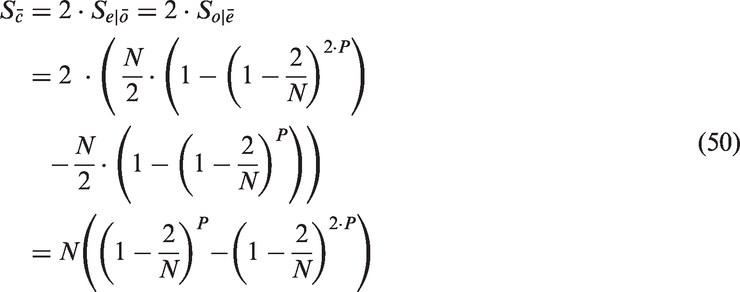
But

Substituting equations (48) and (50) into equation (51) and simplifying gives

An alternative method to derive the formula for the CSC for the case of equal floor populations is to directly derive the formula for the expected value of the number of coincidental stops in a round trip.
For a coincidental stop to take place, there has to be a stop at the odd floor of the twin pair of floor and a stop at the even floor of the twin pair of floors. These two events are independent, so the probability of both taking place is simply equal to the product of the two probabilities
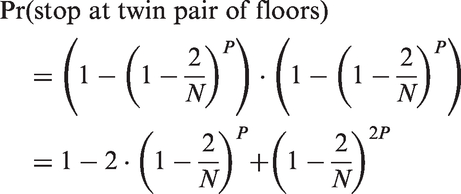
Adding up this probability for all the N/2 twin pair of floors gives the expected value of the number of coincidental stops in a round trip
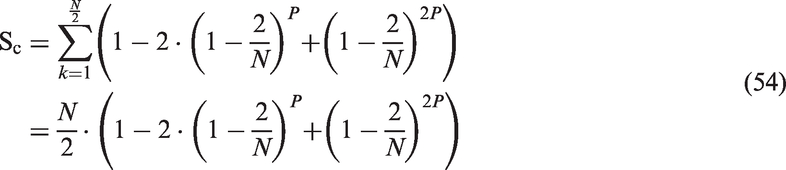
Dividing the expected value of the coincidental stop in a round trip by the expected number of stops in a round trip gives the CSC

Simplifying and re-arranging gives


The CSC parameter can vary from 0 to 1 and a value of around 0.6 is usually expected. The larger the value of this parameter, the better the stopping efficiency of the system and the smaller the value of the round trip time.
Deriving the equation for the CSC for unequal floor populations
As for the case where the floor populations are unequal, a similar approach can be followed. For a coincidental stop at the kth twin floor, it must have been caused by an odd deck passenger heading to the odd floor of the kth twin pair of floors and an even deck passenger heading to the even floor of the kth twin pair of floors. As these two events are independent, the probability of such an event taking place is simply equal to their product as shown below
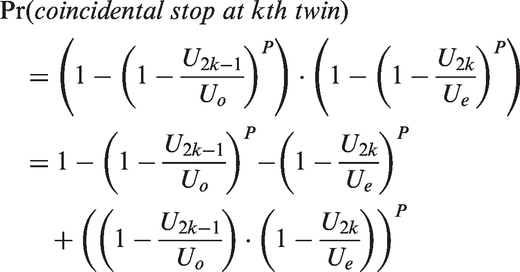
The expected value of the coincidental number of stops is the sum of all of the probable number of stops at each of the twin pair of floor, running from 1 to N/2.
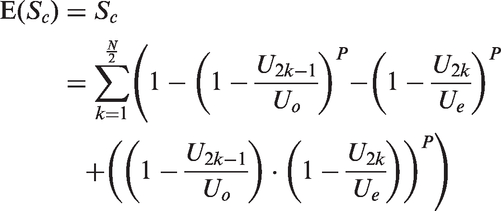
By dividing the result from equation (59) by the result from equation (13), the CSC for the case of unequal floor populations is obtained.

The effect of the PTEC and CSC on the double-deck elevator operation and the system efficiency
Coincidental stops help reduce the actual number of stops that a double-deck elevator makes in a round trip. The PTEC has an effect on the effective passenger transfer time once the elevator has stopped. A value of PTEC which is nearer to 1 indicates good passenger transfer efficiency. A value of PTEC nearer to 2 indicates poor passenger transfer efficiency. The two coefficients together will affect the overall double-deck round trip time and thus the efficiency of the operation of the double-deck system and ultimately justify the use of a double-deck elevator in a certain elevator traffic system design for a certain building.
With the advent of destination group control systems,13–17 it is expected that an improvement in the value of the CSC will be achieved. This can be calculated using methods similar to the IOB method presented in Al-Sharif et al. 18
The final round trip time equation and a numerical example
A numerical example is given in this section to illustrate the use of the equations derived in this paper. The results from the equations are verified against the results from the Monte Carlo Simulation (MCS) method.19–21
The classical round trip time for single deck elevators22,23 can be applied to double-deck elevators (incorporating the newly introduced PTEC parameter)

Replacing 2·Hdouble with Hsingle and assuming that tp = tpi = tpo, results in the final round trip time equation shown below
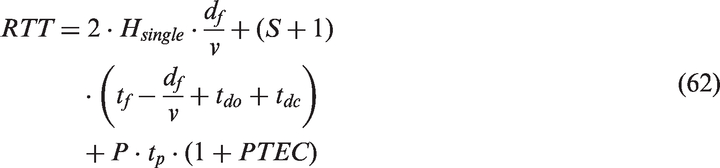
Equation (62) makes the following assumptions
A single pair of entrances. Rated speed is attained one double floor journey (i.e. 2·df) where df is the height of a single floor. Equal floor heights. Incoming traffic only.
Equation (62) is used in the following example in order to illustrate the use of the equations and verify the results against the Monte Carlo Simulation method. A building has a single dual entrance and 20 occupant floors above the main entrance (denoted as L1 to L20). The building population is 2280 people and the floor populations are equal. All floors have an equal height of 4.5 m (df = 4.5 m). The double-deck elevator is rated at 12 passengers per deck.Example 1
The following parameters are to be used for the door, the passenger transfer, and the kinematics
Door opening time :2 s Door closing time: 3 s Passenger transfer time: 1.2 s Rated speed :2.5 m/s Rated acceleration:1 m/s2 Rated jerk :1 m/s3.
Example 2
Results from the numerical example with comparison.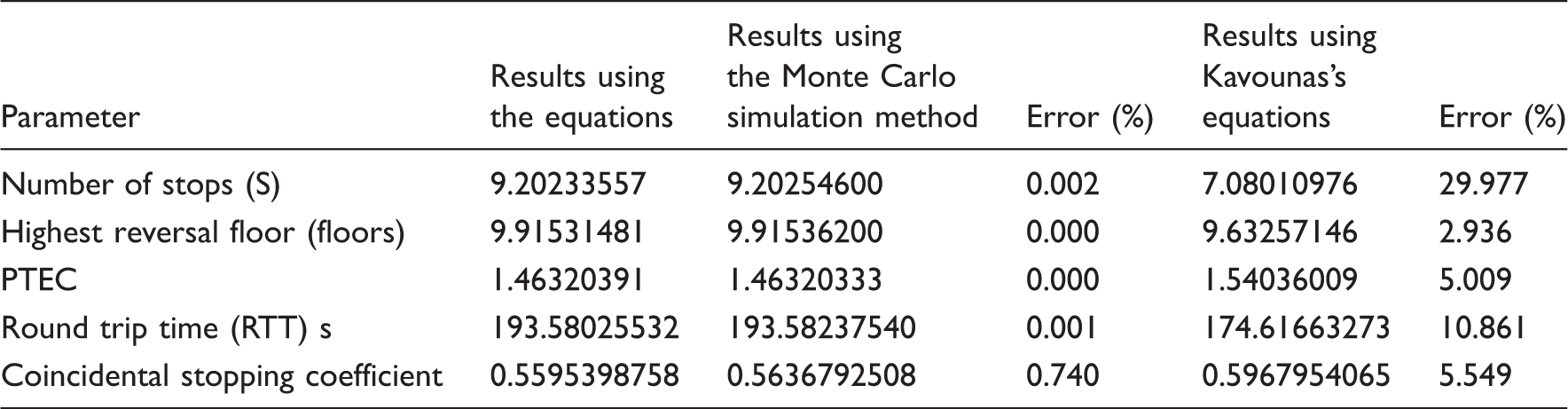
The distribution of the building population.
Results from the numerical example with comparison.
Two special cases
The following special cases have not been dealt with in the main text. This section provides suggestions regarding possible ways to deal with them.
A building with an odd number of occupant floors
It is possible that the building in which the double-deck elevators are to be installed has an odd number of occupant floors (as opposed to an even number). There are two ways to deal with such a building depending on the final intended control strategy.
In this case, we assume that there is enough space to allow the lower deck to make a stop at the topmost odd floor, with sufficient space in the elevator shaft for the upper deck of the double-deck elevator to rise without hitting the top of the elevator shaft. So any passenger destined to the topmost odd floor just boards the lower deck as normal. The double-deck elevator travels to the topmost odd floor and the lower deck doors open and the passengers alight. Obviously, there will not be any passengers heading to the fictitious even floor above and hence the doors will not open. In order to be able to calculate the round trip time, the equations are based on a fictitious building with an even number of floors with the topmost floor unoccupied. In effect, a dummy even floor is being added to the calculation. As we are able to deal with the situation of unequal floor populations, the round trip time can be evaluated assuming that we have an even number of occupant floors after assigning a zero population to the top most fictitious even floor. The other case is where insufficient space is available above the topmost floor to accommodate the upper deck of the double-deck elevator. In this case, the elevator will not be able to travel to a level which allows the lower deck to make a stop at the topmost floor (which in this case is an odd floor). Passengers heading to the topmost floor will have to board the upper deck (rather than the lower deck) despite the fact that they are heading to an odd floor. To address this case, two amendments must be made to the calculations. First, it is necessary to change the designation of the topmost physical floor from an odd floor to an even floor and insert a fictitious odd floor under it with zero population. Second, the topmost journey length will be in this case the height of one single floor (as opposed to the height of a double floor as it the case for all of the other twin pairs of floors).
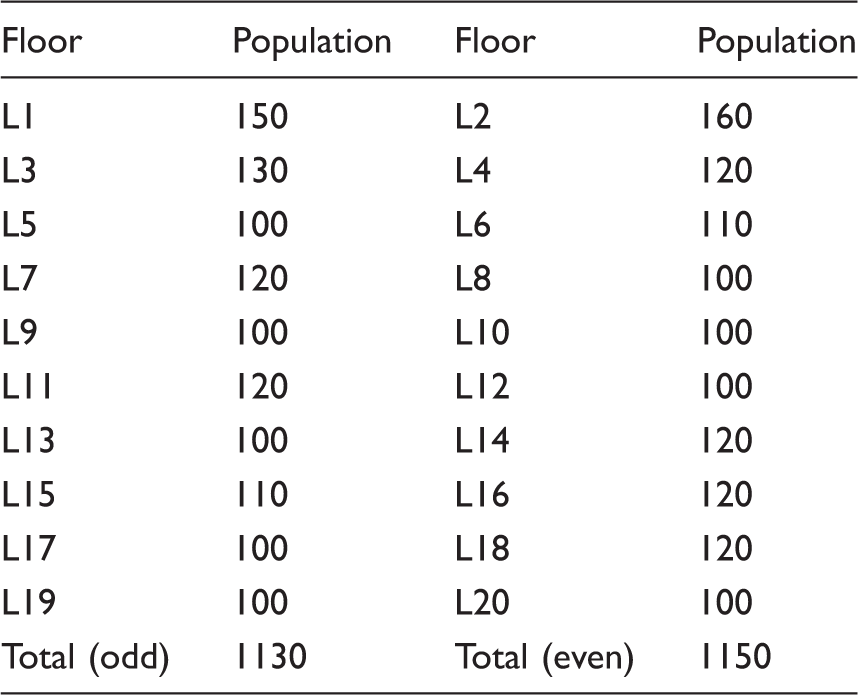
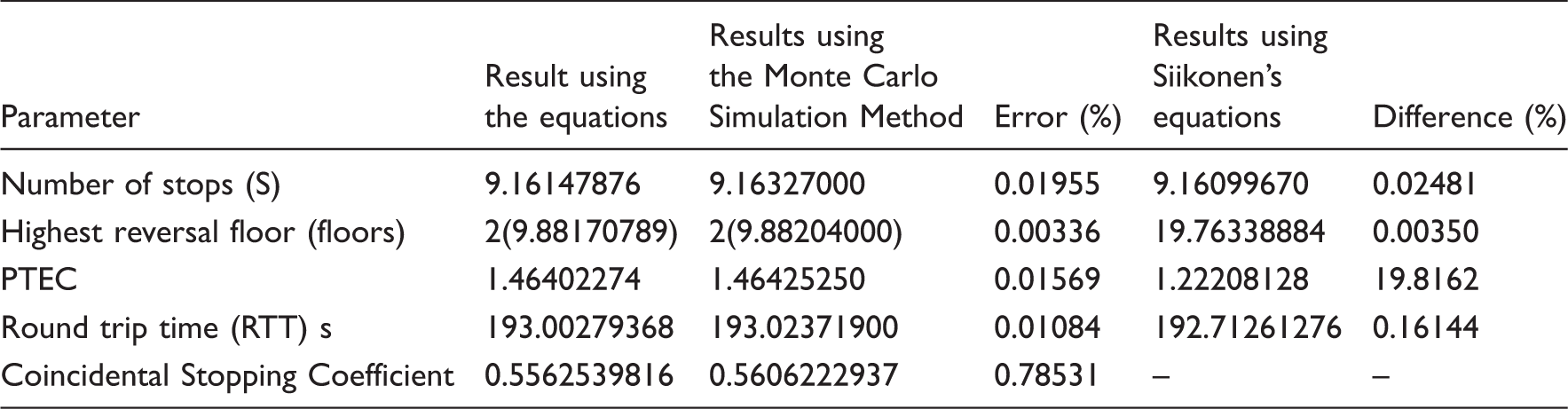
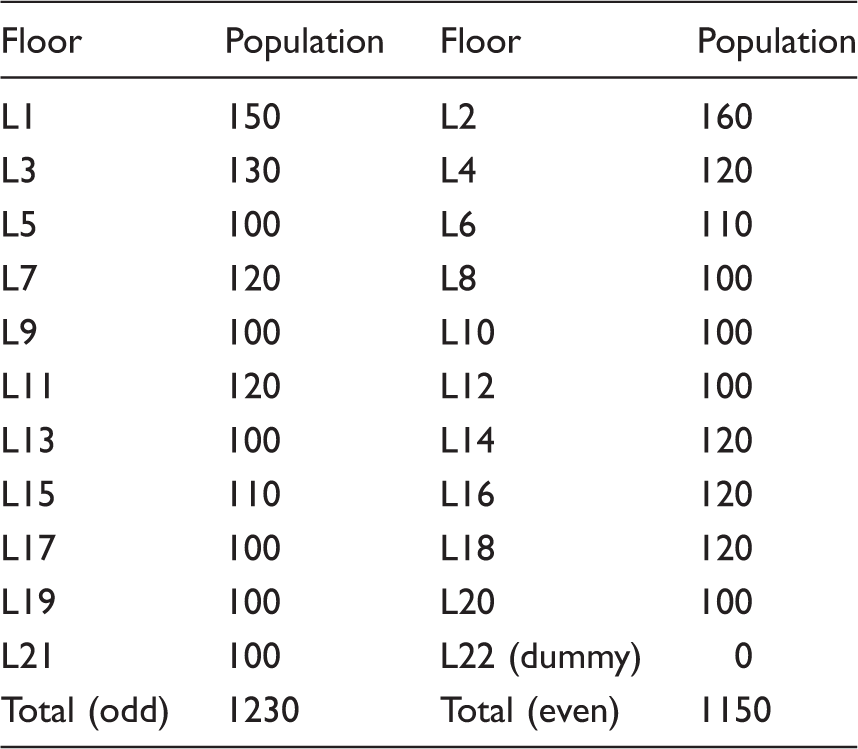
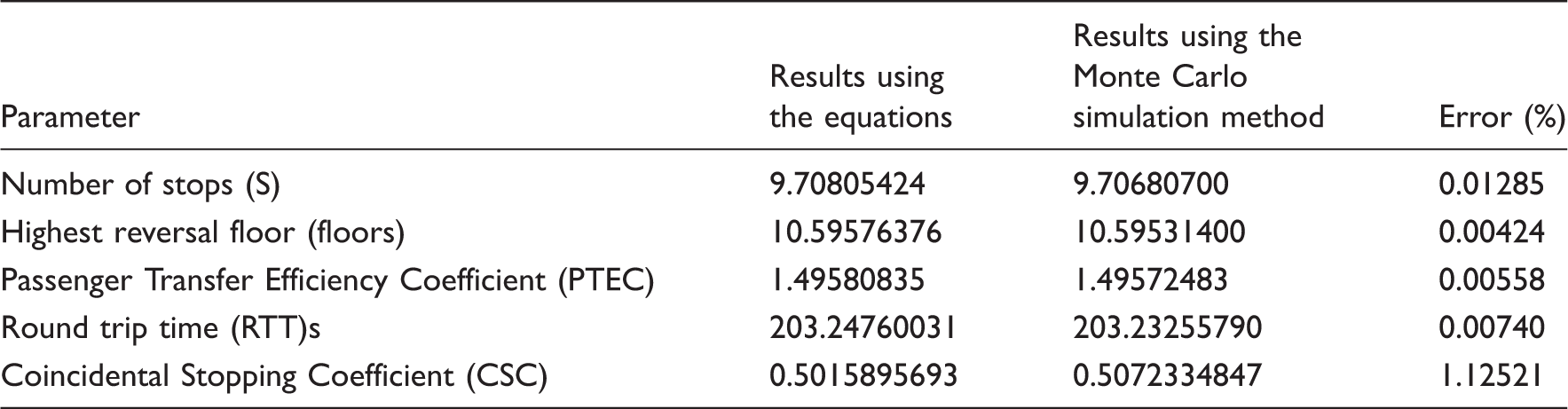
The equations presented in this paper to deal with the case of unequal floor populations can be used to address the case in a) above. A numerical example is given below. It is assumed that sufficient space is available above the topmost floor in order to accommodate the upper deck of the double-deck elevator. This allows the double deck to serve the topmost odd floor with the lower deck. In such a case, it is possible to simply assume an additional even dummy floor above the topmost floor and assign a zero population to it.Example 3
The distribution of the building population.
Results from the numerical example with comparison.
Different floor-to-floor heights and rated speed not attained in one double-floor journey
In order to deal with these two special conditions, it is necessary to resort to finding a weighted sum of the up time and a weighted sum of the down time. The weighted sum of the up time can be easily done by finding the probability of every possible journey from the main entrance upwards and multiplying the probability by the time it would take. The sum of all of these products is the up travelling kinematic time. The weighted sum of the down time can be carried out by simply assuming that the car goes up as far as H floors and then finding the time it would take traverse a journey of H floors back to the ground floor.
The equations can be amended in order to deal with the situation. The round trip time equation is arranged such that the kinematic components are separated from the door times and the passenger transfer times.
The up kinematic time is effectively evaluated as weighted averages of the time taken by each possible journey in the up direction multiplied by the probability of it taking place. The same can be applied to the down kinematic time. This is explored in detail for the case of single deck elevator systems in Al-Sharif et al. 24 for the case of incoming traffic and more comprehensively in Al-Sharif and Abu Alqumsan 25 for the general traffic case.
Conclusions
Equations have been derived for the expected number of stops and the highest reversal floor for double-deck elevator systems for the cases of equal and unequal floor populations. A new parameter has been introduced that measures the efficiency of the passenger transfer time and denoted as the PTEC. It is used in the round trip time to provide an accurate measure of the passenger transfer time. The PTEC has been derived for the cases of equal and unequal floor populations. Derivations have also been presented for the CSC for the cases of equal and unequal floor populations.
The derived equations have been verified using the Monte Carlo Simulation method in two numerical examples, with excellent agreement.
The case of an odd number of floors above the main pair of entrances is discussed and two possible solutions given for the case where sufficient space is available for the lower deck to serve upper-most odd floor and the case where no space is available.
Further work is needed in order to deal with the case of unequal floor heights and rated speed not attained in one double floor journey. A number of suggestions have been given whereby a weighted average is used to calculate the up kinematic travelling time and the down kinematic travelling time. This is the subject of current research by the authors.
Further work
The work in this paper is currently being enhanced and expanded in the following areas:
The verification that was carried out in this paper compared the analytical equations with the results from the Monte Carlo Simulation method. It is possible that the same error has been introduced in the assumptions in both methods. Thus, the next step in the verification would be to compare these results with the results from simulation or even from the operation of double-deck elevators in a real building. Another area of further work is the study of the effect of the destination group control algorithm on the value of the round trip time. This could benefit from the concept of the idealised optimal benchmarks (IOB) in Al-Sharif et al.
18
The equations derived in this paper were based on incoming traffic conditions only. Further work will be carried out to cover the case of mixed traffic conditions (i.e. incoming, outgoing, inter-floor).
Footnotes
Declaration of conflicting interests
The author(s) declared no potential conflicts of interest with respect to the research, authorship, and/or publication of this article.
Funding
The author(s) received no financial support for the research, authorship, and/or publication of this article.