







Abstract
How capital openness influences the wage-setting process is a topic that has been discussed extensively in the literature on European industrial relations. One well-known hypothesis asserts that high capital openness induces employers to de-coordinate the wage-setting process, if wage costs have been under poor control. This article provides a critical review of the hypothesis, arguing that it holds only if governments can provide flexible accommodating policies for employers during the period of institutional transition. If such policy options are not available, which is true when governments are committed to European monetary integration, the hypothesis does not hold. This claim is tested with a Boolean qualitative analysis of 11 European countries, focusing on the periods from the 1970s to early 2000s.
How capital openness influences the wage-setting process is a topic that has been discussed extensively in the literature on industrial relations in developed Europe. One well-known hypothesis, here called the hypothesis of capital openness, asserts that high capital openness induces employers to de-coordinate the wage-setting process, if wage costs have been poorly controlled. Good examples include Denmark, Ireland, Italy, and the UK around the early 1980s, where the wage-setting process was more fragmented and individualized after certain periods of wage-pushed inflations (Due et al., 1995; Ferrera and Gualmini, 2000; Hall, 1986: 100–136; Hardiman, 1988: 80–120, 217–239). The hypothesis, however, has been challenged by other opposing experiences from Europe (Regini, 2000). Despite high capital openness, in no other country did poor wage performance result in the change of de-coordination. Furthermore, even those countries with previous experience of de-coordination did not make the same choice when they encountered similar economic challenges in recent periods. 1
How can we reconcile these contradictory experiences? First, we can abandon the hypothesis of capital openness, and explore alternative causes which could have produced the breakdown in the early 1980s. Alternatively, we can contextualize the hypothesis, and explore under what circumstances the effect of capital openness holds and under what circumstances it does not. This study takes the second approach. Focusing on the mediating role of European monetary integration, we assert that the hypothesis holds only if a country is not committed to the integration process.
The rationale runs as follows. Employers adopt the strategy of de-coordination when they suffer from high wage costs. By making the wage-setting process more fragmented and individualized, employers will be better able to save wage costs by increasing market discipline against unions (Crouch, 1995; Soskice, 1990; Traxler, 2003: 3). One problem with this hypothesis, however, is that such a disciplinary effect is realized only in the long run, while wage costs can even increase during the period of institutional transition. This happens because de-coordination initially invites myopic militant responses from many unions who are now free of previous collective guidelines. Especially for those unions with strong organizational power, de-coordination provides a golden opportunity to maximize short-term wage gains without being constrained by the macroeconomic consequences of their militancy.
Given this unsatisfactory performance along the path to de-coordination, employers’ capability to stay with their choice depends heavily on the availability of external economic assistance. Governments’ macroeconomic accommodation plays a crucial role in this regard. With such an option available, employers will maintain their position because governments provide flexible policy benefits to compensate for the rising wage costs during the transition. The situation however changes if such an option is not available. Employers will suffer seriously from the disturbances accompanying the change of de-coordination. They will eventually withdraw from their attempt regardless of its long-term expected benefits. According to our study, this scenario prevails when governments are committed to anti-inflationary monetary integration.
Before advancing to the main analysis, a few remarks should be in order to situate our study in the broad context of related studies. First, we build on a major tradition of the de-coordination literature, which explores the cases of de-coordination that are driven by employers. Several causes have been presented for the changes, which include European economic integration (Ryner, 2002; Streeck, 1998; Streeck and Schmitter, 1991), the shift in the production paradigm from Fordist mass-production to flexible specialization (Pontusson and Swenson, 1996) and post-industrialization and diversification of the job structure (Garrett and Way, 1999). Overall, these changes led to the decline of classic social democracy and the weakening of unions’ power vis-a-vis employers’ (Streeck, 1993). Employers were then expected to exploit their favorable situation to abolish the European model of central wage coordination and strengthen market discipline against unions (Thörnqvist, 1999; Traxler, 2003). 2
We revisit this literature by focusing on the role of economic integration. In particular we pay close attention to the financial aspect of the process, which has been discussed mainly in relation to the notion of capital openness. 3 Conventional wisdom has asserted that a high level of capital openness brings more power to employers by making them more mobile across national borders. This in turn enables employers to seek a market-oriented solution to address their wage problem. Our analysis presents a more nuanced approach. While high capital openness indeed motivates employers to push for de-coordination, their attempt does not always end in success. We find an exogenous variable intervenes in the causal process. Operating through the logic of monetary integration, the variable presents a counterbalancing mechanism whereby even powerful employers reconsider their attempts at de-coordination. Overall, capital openness loses its strong effect in the case of full-fledged financial integration.
This article is organized as follows. In the next section, we provide the definition of the dependent variable. We then review various studies of capital openness, summarizing them in a conjunctural hypothesis that capital openness promotes de-coordination in interaction with the performance of the existing wage-setting system. Next, we discuss why the hypothesis holds only in a limited context where governments can provide flexible accommodating policies. Our claim is tested in a sample of 11 European countries, covering the period from the 1970s to the early 2000s. We employ a Boolean dichotomous analysis, and support it with supplementary historical evidence.
Definition of the dependent variable
In the literature of European industrial relations there are two competing approaches to capturing the defining characteristics of the wage-setting process. One looks at the level of centralization, focusing on the extent to which industrial actors or governments produce certain hierarchically binding wage settlements (Golden et al., 2006; Iversen, 1999: 47–57). The other approach pays more attention to the level of coordination, which broadly refers the degree to which wages are set by common guidelines which operate beyond individual companies. Here centralization is considered important, but only as one of various ways in which wages are broadly coordinated. A high level of coordination therefore can be achieved not only by central wage agreements or government statutory guidelines (as examples of centralization), but also by informal pattern-setting led by certain sub-national industrial sectors (Kenworthy, 2001; Traxler et al., 2001: 149–161).
Which of these two conceptualizations provides a better ground of research may not be answered unequivocally. Rather, the choice should depend on the purpose of a given study. Our study adopts the coordination-based approach because we are broadly interested in the degree that wages are set beyond a narrow market discipline at company level. In the same vein, de-coordination is defined as fragmentation and individualization of the wage-setting process, whereby wages are set freer of collective guidelines.
A few remarks should be in order for conceptual clarity. There are two competing approaches to understanding the term coordination. In the first (Nickell et al., 2005; Soskice, 1990), it is closely associated with the intention of participating actors, especially unions’ commitment to collective wage restraint. Researchers then measure the commitment by referring to actual wage outcomes, assuming that a strong commitment will produce successful wage moderation. While highlighting some important aspect of wage-setting coordination, this approach suffers from the following shortcomings. First, the motivations of participating actors are defined too narrowly. While some coordinative efforts surely aim at wage moderation, others can seek collective wage push as illustrated by the syndrome of union-pushed wage inflation in the 1970s. Which of these two motivations will prevail may not be answered a priori, but instead has to be explained with specific causal accounts. Second, the measurement lacks analytic clarity. It presents an indirect indicator of coordination by relying on a certain expected outcome of the concept. This however opens wide the possibility of measurement error, depending on the severity of third-factor intervention between the cause and the effect (Kenworthy, 2001).
The other approach addresses these problems by proposing an alternative concept and measurement. Kenworthy (2001) provides one widely accepted solution in this regard. He defines coordination as an institutional phenomenon, that is, a regularized form of interactions where industrial actors are involved with diverse motivations. To measure this regularity, he pays close attention to certain patternized characteristics of the wage-setting process, such as government arbitration, voluntary pattern-setting, peace obligation, and bargaining coverage. He then produces five discrete stages of institutionalized coordination, which range from free company-level bargaining without any upper-level guidance (the score of 1) to weak nation/sector-wide coordination (the score of 2), moderate nation/sector-wide coordination (the scores of 3 and 4), and strong nationwide coordination (the score of 5). This way, Kenworthy presents a motivation-free measure of coordination. He also deals with the concept directly by referring to its explicit characteristics. Appreciating these improvements, we adopt his approach to wage-setting coordination.
The hypothesis of capital openness
Many influential studies which explored the effect of capital openness on the wage-setting process were carried out in the 1990s. The term capital openness was defined broadly as the extent to which capital owners can (re)locate their assets freely across the national border, as exemplified by the liberalization of cross-border financial transactions (Quinn, 1997). Among the major questions raised was if the European wage-setting model – which had been characterized by a high degree of intra-and inter-industry coordination – could survive the pressure of high capital openness (Molina and Rhodes, 2002; Ryner, 2002; Streeck, 1998; Streeck and Schmitter, 1991). Increasing mobility provided employers with great power resources vis-a-vis unions. Employers would then use their power to de-coordinate the wage-setting process, expecting that a new market-oriented system would produce higher and speedier returns by exposing unions to greater market discipline. 4 Over a period of heated debates (Garrett, 1998; Kurzer, 1993; Scharpf, 1991), however, a consensus emerged among scholars that the ultimate effect of capital openness would vary depending on the configurations of domestic political economy (Traxler, 1995; Traxler et al., 2001). Several causal accounts were presented to explain these interactive effects, which can be summarized in the following approaches.
In a performance-driven approach, the performance of aggregate cost control was an important factor to mediate the effect of capital openness. Good performance would encourage employers to stay with the status quo of the wage-setting system, whereas poor performance would motivate them to use their power to seek a change. Good examples include Denmark (Due et al., 1995; Iversen and Thygensen, 1998), Ireland (Hardiman, 1988), Italy (Ferrera and Gualmini, 2000) and the UK (Hall, 1986: 100–136; Scharpf, 1991) around the early 1980s, where the events of de-coordination had been all preceded by union-led wage militancy throughout the 1970s.
To address this problem, employers were given two logically possible solutions (Soskice, 1990). First, they could improve unions’ commitment to wage restraint within the existing framework of coordination. Alternatively, they could seek a change toward de-coordination as a market-oriented solution for wage control. According to Crouch (1995), the second option was more attractive to employers. Given the fact that the existing institution had already failed in addressing the wage problem, employers were less willing to seek a solution within the same institutional framework. Instead, they were more interested in a fresh approach, whereby they could save wage costs by increasing market discipline against militant unions (Traxler, 2003: 3).
Focusing on the Nordic experiences and especially the Swedish breakdown as an ideal typical case, other studies provided alternative perspectives to de-coordination. In one line of the studies, economic performance was considered important but from a different angle. Rather than emphasizing the issue of aggregate cost control, the studies paid more attention to the functional fit between the wage-setting system and the production regime. From this perspective, the reason that Swedish employers pushed for de-coordination of solidaristic bargaining was because of some functional pressure arising from their production system. Namely, they were experiencing a shift from Fordist standardized production to diversified quality production, which could be successful only if wages were to be set flexibly across industrial sectors depending on productivity (Pontusson and Swenson, 1996). Meanwhile, another line of studies took a more political approach by placing more emphasis on the role of power struggles between LO (Swedish unions’ peak confederation) and SAF (the employers’ peak confederation). Back in the 1970s, LO initiated a series of offensives against the employers’ prerogative on capitalist ownership and management. Entering the 1980s, SAF – who became more powerful in the wake of internationalization – responded with a series of counter-offensives, which ultimately led to decentralization of the solidaristic wage-setting system (Huber and Stephens, 1998; Wallerstein and Golden, 2000).
Given the interest of this article in searching for a more generalizable hypothesis regarding the effect of capital openness, we find the explanation based on aggregate wage costs has the greater appeal. Its empirical references are drawn from various places in developed Europe, as briefly alluded to above. The alternative hypotheses, which are centered on power struggle and the production regime, do not have such a merit. Instead their applicability is virtually limited to the Swedish experience up until the mid-1980s. Looking at Ferner and Hyman’s edited volumes on European industrial relations (Ferner and Hyman, 1992, 1998), in no other countries have unions launched such frontal attacks on the fundamental interests of capitalist employers. Also, central wage agreements in most European countries, even including Sweden since the mid-1980s, have allowed substantial room for lower-level flexibility in concluding final wage settlements – as illustrated by frequent use of productivity pay and temporary opt-out (Due and Madsen, 2008: 514; Rhodes, 2001; Traxler, 1995). All this evidence suggests that the Sweden-specific factors for de-coordination would not play an important role if examined in a broad European context.
In light of the discussion so far, we have reached a general hypothesis of capital openness: high capital openness motivates employers to de-coordinate the wage-setting process if wage costs have been under poor control. We assert that this hypothesis is still insufficiently specified. Focusing on the mediating role of European monetary integration, we claim that the hypothesis holds only if governments are not committed to the integration process. The next section explains why this should be the case.
Capital openness with the monetary commitment
One notable feature of monetary integration is that it produces a strong pressure for tight wage moderation (Crouch, 2000; Hassel, 2006). With the commitment to officially or virtually fixed exchange rates, governments place themselves in a situation where they do not engage in active macroeconomic accommodation for domestic economic actors. Arbitrary devaluation is eliminated from the list of feasible policy options. Fiscal/monetary stimulation is also made difficult – although not impossible in the short run – because of a broad consensus that sound fiscal/monetary policies constitute an essential condition for sustaining monetary integration. What all these constraints mean to employers is that any shocks in wage costs can no longer be buffered by active compensatory policies. The situation becomes even more challenging if employers have already suffered from a malfunctioning wage-setting system. There, any continued trend of wage militancy will lead to further deterioration of the already weak business activities. Worried by profit squeeze, employers will therefore strive hard to find a good solution for cost control (Baccaro, 2003; Hanke and Rhodes, 2005; Hassel, 2003).
The mediating effect of the monetary commitment
What will be the implications of this economic pressure for the hypothesis of capital openness? The answer appears to be evident. Given that the existing wage-setting system has failed in controlling wage costs and the cost of the failure has also become expensive, employers will push for de-coordination as a disciplinary solution for cost control. One problem with this prediction however is that it focuses only on the long-term benefit of market discipline (Calmfors and Driffill, 1988; Crouch, 1995; Soskice, 1990), while not considering any short-term disturbances that the change may trigger. Depending on how painful the transition will be, it is always possible that employers reconsider their decision for de-coordination.
Of crucial importance are how long the transition will take and what the movement of wage costs will look like during the period. If the transition takes no time and wage costs thus fall immediately, de-coordination will bring the best outcome for employers. Even if the transition takes time, employers will find no additional burden if wage costs do not worsen. If the transition takes time and wage costs also worsen, however, employers will face a serious challenge. They will be increasingly anxious about the costs they have to pay for their preferred institutional change. Among these three conceivable scenarios, employers will like the first two best. With no additional cost for transition, they will be able to complete the task of de-coordination just as predicted by the hypothesis of capital openness. But the problem here is that, as discussed in detail in the next section, the assumptions of these scenarios do not square well with the reality of industrial relations. Institutional transition does take time and wage costs will also increase during the period. This leaves employers only the third scenario. There, we find that the government’s commitment to monetary integration makes the situation even more challenging to employers, ultimately inducing them to withdraw from their decision for de-coordination regardless of its long-term expected benefits.
The rationale for this reversion runs as follows. Employers in this scenario have suffered seriously from the chronic problem of wage militancy. Wage costs now increase even higher, following their decision for de-coordination. Worse, they have to bear these costs all by themselves because governments can no longer convey active compensatory policies because of the policy constraints from Europe. Under these circumstances employers will develop a broad sense of economic vulnerability. Pressed with the fact that their financial burden has reached an unprecedented level at a time when there is no active policy buffer available, employers will find themselves faced with a daunting financial challenge. Such a sense of urgency then makes employers more short-sighted in dealing with their wage problem. They will be more eager to reduce the burden immediately and also become more impatient in evaluating their chosen solution. Not surprisingly, employers will soon lose interest in staying with the course of de-coordination. Despite its long-term prospects, de-coordination has so far brought only a disappointing outcome. Nor is there a clear sign that the performance will improve soon. Alternatively, employers will find more attractive the option of withdrawing from their decision. While there is no certainty that this reversion will possibly lead to a better long-term solution to their wage problem, employers will surely be able to enjoy some immediate improvement by saving the transition costs that they have paid so far.
Meanwhile, the story is quite different if governments are not committed to monetary integration and thus retain flexible policy tools, such as fiscal/monetary easing and currency devaluation. 5 True, these policies can hardly be fully compensatory. As widely agreed in the literature of political business cycles, any artificial policies aiming at macroeconomic accommodation facilitate inflation expectation from the general public, which eventually weakens the effectiveness of those policies (Alesina et al., 1997). Likewise, expansionary policies following de-coordination will become less effective as unions update their inflation expectation when placing their wage demands. But government policies can make a real difference if implemented on a short-term basis. First, governments have clear informational superiority over unions because it takes considerable time for the latter to update their expectation. The rigidity of wage contracts in Europe – which usually last for two or three years – further delays the unions’ response by requiring them to wait until their contracts expire even if they find a clear sign of inflation.
Under these circumstances, employers will find the effort for de-coordination entails little burden during the transition period. Although wage costs have indeed increased, employers feel as if their financial situation has not worsened. They also feel relieved that governments can always intervene if things go wrong. In the absence of a serious sense of urgency and insecurity, employers will therefore take a longer-term approach to their market-oriented solution. They will continue the experiment as long as they believe in the ultimate benefits of market discipline and also do not find any better long-term alternative to it.
De-coordinated wage competition
Now the remaining issue to be discussed is if there is any reasonable ground for the concern about poor wage performance along the path to de-coordination. This is the question that Traxler and Hassel raised in their previous works (Hassel, 2006; Traxler, 1995, 2003). Existing studies were not of great help to the authors because they were primarily interested in the long-term equilibrium performance of wage-setting institutions (see Iversen [1999: 17–38] and Traxler and Kittel [2000] for good summaries). Considering that the short-term performance should not be analyzed in the same way as the long-term one, the authors then developed an explanatory framework dedicated to certain specific issues which could arise at the time of institutional fluidity. In particular they emphasized that the force of market discipline may not work as expected during the transition period. While employers may rely on disciplinary measures (such as threat of firing) to control high wage costs, unions will nonetheless continue their militancy expecting that they will protect jobs at least for a while by relying on their organizational power. Given that European industrial relations have rested on a certain level of union mobilization and that the union power will not evaporate immediately following the change of de-coordination, union militancy will pose a serious challenge for a considerable time.
Building on this general insight, we present a more concrete mechanism of wage militancy. We in particular pay close attention to the role of sub-national union actors who are now free of previous collective guidelines. Crucially important are those strong large-sized unions who can push for militancy while resisting the threat of firing from employers. Previously, the potential of these unions was somewhat underexploited because the upper-level union leadership – regardless of how effective they were – were concerned that the egoistic behaviors of those unions would easily spread to wage inflation by triggering nationwide wage competition. In the new system, however, those unions are far less constrained by such a macroeconomic concern. They are instead given a golden opportunity to focus on their short-term wage gains.
It is not difficult to understand that the unions will take a maximalist approach in their wage negotiations. Such militancy will then spread to other unions as a good reference point for fair wages (Traxler, 1995; Walsh, 1993). True, these latter unions may not enjoy such strong power, meaning that they would be concerned with the possibility that wage militancy could jeopardize their jobs. They nonetheless are pressed to join in the wage syndrome because of some grassroots pressure from their militant members who are sensitive to the wage developments in other bargaining units and also hold an optimistic view that union solidarity will protect jobs against employers’ threat.
The situation will be further complicated if general productivity is distributed disproportionately across economic sectors (Traxler and Kittel, 2000), specific skills are under limited supply (Walsh, 1993), or there is a sizable public sector which is not fully exposed to market competition (Garrett and Way, 1999). Not only can the unions in more productive, skills-scarce, or protected places claim higher wages without difficulty, but other unions in less favorable situations are pressed to keep up with the rising wage expectation imported from their counterparts. Unless all these problems are resolved simultaneously, which may not be an easy task, the wage-setting process will be put under real stress for a prolonged period.
Boolean dichotomous analysis
So far we have theorized a compounded hypothesis of capital openness, which explains the occurrence of de-coordination by relying on a certain conditional logic (necessary or sufficient) which involves multiple explanatory variables. More specifically, existing studies have asserted that high capital openness presents a sufficient condition for de-coordination if joined by poor wage performance. But we argue that the causal mechanism is not yet fully specified until we consider another mediating variable, which is the government commitment to monetary integration. In this section we employ Boolean QCA (qualitative comparative analysis) to test this claim in a larger than small-N setting. Designed for probabilistic causality, statistical analysis is not suited to testing this type of conditional causality. Small-N analysis may do better, but it suffers from restriction on the sample size.
The Boolean analysis is implemented in the following way. First, it begins with dichotomous measurement of the independent and dependent variables, which is normally backed up by some qualitative justifications. The sample size usually falls between the tens and thirties, depending on data availability and the researcher’s knowledge on individual cases. The analysis then produces a so-called truth table, whereby the presence or absence of the dependent variable is linked to various combinations of the independent variables. Checking if all these combinations are theoretically exhaustive and also do not produce any contradictory outcome (namely, each combination of the independent variables must produce one of the dichotomous outcomes, but not both), the analysis then moves onto the next stage where the researcher derives a parsimonious logical expression out of the empirical associations.
At this stage, Boolean algebra plays a crucial role. It builds on the dichotomous measurements presented in the truth table, and produces a certain necessary/sufficient type of logical relation among the variables by linking them with the logical ‘and (×)’ and ‘or (+)’ terms. The relation should be deterministic in the sense that it must hold for all cases without any exception. Applying this general idea to our analysis, we first eliminate all redundant independent variables whose presence or absence does not make a difference on the dependent variable. We then process the remaining variables by employing the following Boolean algorithms. Whenever we find a sufficient type of logical relation, we express it by identifying an independent variable (if the outcome was produced solely by the variable) or a list of independent variables linked together with the ‘and (×)’ terms (if the outcome was produced jointly by the variables). Should we find more than one sufficient relation, we link them together with the ‘or (+)’ terms to produce the final expression of the necessary and sufficient relationship among the variables (Hicks et al., 1995; Ragin, 1987).
Let us note that the Boolean approach is not free of potential problems. First, the validity of dichotomous measurements can be compromised by arbitrary determination of cut-offs. Also, the logical relationship identified by the Boolean logical induction still remains ‘associational’ in the sense that it does not reveal the real causal mechanism lying behind it (Rueschemeyer and Stephens, 1997). To address these problems, we complement the Boolean analysis with detailed historical accounts of the sample countries. In doing so, we confirm that the dichotomous measurements are not arbitrarily produced and the relation among the variables also has firm historical grounds.
Sampling and measurement
We now present a sample of developed European countries to be used in the Boolean analysis. In particular we adopt the following selection criteria. First, the countries must have had their EU membership by the 1990s. This requirement reflects the fact that European integration until those years was mainly an agenda among developed Western European countries. Second, the countries should be covered by pooled time-series data, publicly available, which provide comparable quantitative measures for the dependent and independent variables. The first criterion led to a pool of 14 European countries: Austria, Belgium, Denmark, Finland, France, Germany, Greece, Ireland, Italy, the Netherlands, Portugal, Spain, Sweden, and the UK (Luxembourg drops out because it is too small for comparison). The second criterion eliminated Greece, Portugal and Spain from the sample.
With these countries at hand, we now present the following dichotomous measures for the dependent and independent variables. For each of the measures, we provide a certain decision rule for making a qualitative judgment regarding the configuration of the variable of interest (if capital openness was high or not, if de-coordination occurred or not, etc.). Beginning with the dependent variable, we utilize Kenworthy’s measure for wage-setting coordination to decipher de-coordination led by employers. As discussed previously, he focuses on certain institutional characteristics of wage coordination, such as government arbitration, pattern-setting, peace clauses, bargaining coverage, etc., and produces discrete time-series data which run from the score of 1 (as no coordination) to 5 (as the highest coordination). Notice that Traxler et al. (2001: 149–161) also present a measure by focusing on similar institutional aspects of wage coordination. Their measure, however, is not considered here because the data structure is categorical and thus eliminates the possibility of ordered comparison.
From Kenworthy’s data, we sort out a steady trend of de-coordination which goes beyond short-term fluctuations. This approach makes sense, considering that all the independent variables appearing in our study – capital openness, monetary commitment, the trend of wage performance – have some institutional or structural characteristics, whose effects are realized in the long run with a steady trend of the dependent variable. Ideally, this trend can be identified if Kenworthy’s data exhibit a unidirectional change from a high to low score during the period of analysis (whose specific years are determined exogenously by the constellations of the independent variables). We then refer to previous expert studies to confirm that the change was indeed driven by employers. If the data series do not exhibit such a clear trend, however, we take one of the two following options. If the data show a steady trend of increase or do not change at all, we consider that no de-coordination happened. If the data fluctuate without exhibiting a clear pattern of unidirectional change, we consult with previous expert studies. We then conclude that de-coordination happened only if those studies provide supportive qualitative evidence beyond the fluctuation of the quantitative data.
Turning next to the independent variables, capital openness is measured by Quinn’s index for foreign exchange liberalization (Quinn, 1997). The data run from a score of 0 to 4, reflecting the severity of taxation and legal/administrative regulation on foreign currency exchanges. More specifically, a score of 0 represents complete control of the exchanges, where currency transactions are rarely approved or, even if approved, all received foreign currencies must be surrendered to the government authority. A score of 1 represents quasi-complete control in which currency exchanges are approved occasionally, but on the condition of surrendering all receipts to the authority or paying heavy taxes. With a score of 2, currency exchanges are approved more frequently, but actual transactions are still under serious restriction due to heavy taxation. With the score of 3, the situation changes significantly. Now currency exchanges are subject to no approval as long as they are taxed moderately. With a score of 4, no approval is required. Nor will there be any meaningful taxation.
In light of the description of the data, we choose the score 3 as the cut-off for high capital openness. With only moderate or little taxation on foreign currency exchanges, along with no requirement for legal/administrative approval, capital owners will be better able to (re)locate their assets across the national border. According to Quinn’s dataset, a majority of the sample countries (Belgium, Denmark, France, Germany, Italy, and the Netherlands) had already reached or surpassed the threshold by the end of the 1960s. Ireland (IMF, 1976: 245–248) and the UK (IMF, 1980: 420–422) joined the group in 1975 and 1979 respectively by liberalizing outward direct investments; Austria reached the cut-off in 1977 by liberalizing inward direct investments (IMF, 1977: 51–55); and Sweden (IMF, 1981: 393–397) and Finland (IMF, 1990: 160–163) reached the point in 1980 and 1989 respectively by liberalizing both inward and outward direct investments.
Next, we measure the commitment to monetary integration by referring to the country’s participation in any anti-inflationary European monetary regime, whereby it fixes the national currency officially or virtually to a foreign base currency. Among the 11 sample countries, Austria, Germany, and the Netherlands began their commitment by forming a core monetary group in the early 1970s, following the collapse of the Bretton Woods system. Belgium was also a part of the group, but its commitment was not as steadfast until the turn of 1980 (Hemerijck et al., 2000; Kurzer, 1993: 159–163, 217–243). Entering the second half of the 1980s, other European countries began to join in the group. Some countries, such as Denmark, France, and Ireland, did so in an explicit aspiration to join in the emerging EMU. Finland, Sweden, and the UK remained outside the EMS, but could still coordinate their macroeconomic policies successfully with other EMS countries (Eichengreen, 2008). Lastly, Italy joined the group in 1990 by tightening the margin of lira fluctuation in the EMS, from the exceptional 6% to the standard 2.25% (OECD, 1991: 11–18).
The next independent variable, the performance of wage cost control, is measured by a combination of several aggregate indicators. We first look at some wage cost data and evaluate them with reference to the overall business climate of the country examined. The rationale runs as follows. Suppose businesses are running well. Then unions will push for a relatively high wage increase without worrying about their jobs. Employers will also consider the militancy as acceptable because their businesses are still thriving. In this situation we cannot consider the lack of wage moderation as an indication of poor cost control. The situation however changes if the business climate turns poor. Employers now can hardly afford generous wage costs. Wages must be tightly controlled. Any failure in this task will clearly indicate that wages are under poor control.
Building on this insight, we adopt the following two indicators of wage costs: the overall wage increase in all private sectors net of inflation and productivity, and the annual workday losses per 1000 workers. The former is drawn from several editions of OECD Economic Outlook and the OECD online database (stats.oecd.org/wbos/Default.aspx), and the latter is drawn from Huber et al.’s Comparative Welfare States Data Set (Huber et al., 2004). These indicators then are evaluated with reference to two quantitative measures of the business climate, i.e. the real GDP growth (evaluated at the German mark) and the unemployment rate – all drawn from Huber et al.’s dataset. Here the point of interest is what the shape of the wage cost indicators will look like when the growth is low and unemployment is high. The situation suggests that employers have some serious difficulty in investing their resources and hiring workers. To address this problem, both cost indicators must be controlled tightly.
One challenge to this measurement, however, is how to define the thresholds for those aggregate indicators. How low should growth remain? How high should unemployment remain? To deal with these difficulties, how low should wage increases and workday losses be maintained? These questions can only be answered with a relative term. For this purpose, we adopt the following decision rule. Wage costs are under poor control if (1) the macroeconomic indicators remain worse than the European average but (2) the cost indicators are not maintained better than the European average. In all other cases, wage costs are not poorly controlled.
Let us acknowledge this decision rule is not free of potential measurement errors. The challenge arises from the fact that we attempt to produce qualitative judgment out of continuous data. Still, the situation is relatively clear for the poor performing countries, where all macroeconomic indicators are in poor shape but the cost indicators do not help because they remain either worse than the European average or only mixed around the average. Also clear is the situation with the best performing countries whose indicators are all better than the European averages. But a decision could be potentially controversial for the cases of moderate performers. It might be that the macroeconomic indicators are in poor shape while the cost indicators are in better shape. Alternatively, both macroeconomic and cost indicators could be in mixed shape. While we still do not regard these cases as an illustration of poor wage control, one may challenge our judgment by calling them borderline cases. We deal with this potential problem by setting up another truth table which classifies all these moderate cases into the category of poor performers. We then check if this change makes any difference to the original result of the Boolean analysis.
The results of the Boolean analysis
Table 1 presents the truth table which summarizes the dichotomous measurements discussed so far (detailed justifications of the measurement scores and the periods of analysis are provided in the next section). The variable of High capital openness was given the score of 1 if the average of Quinn’s capital liberalization index was equal to or greater than the score of 3 during the period of analysis. Monetary commitment was given 1 if governments were committed to monetary integration. Poor wage performance was given 1 if wage costs were controlled poorly. The dependent variable, Decrease of wage-setting coordination, was given 1 if employers succeeded in de-coordination. Note that the analysis does not cover the post-2000 period, although it starts from fairly early years. This reflects the fact that Kenworthy’s data do not cover those recent periods. To alleviate this weakness, we later present in note 11 the results of a brief supplementary analysis which covers the first half of the 2000s. We discuss the trends of the dependent and independent variables, utilizing the same or alternative data sources. We confirm that our claim is still supported even in this extended period.
The truth table for the Boolean analysis.
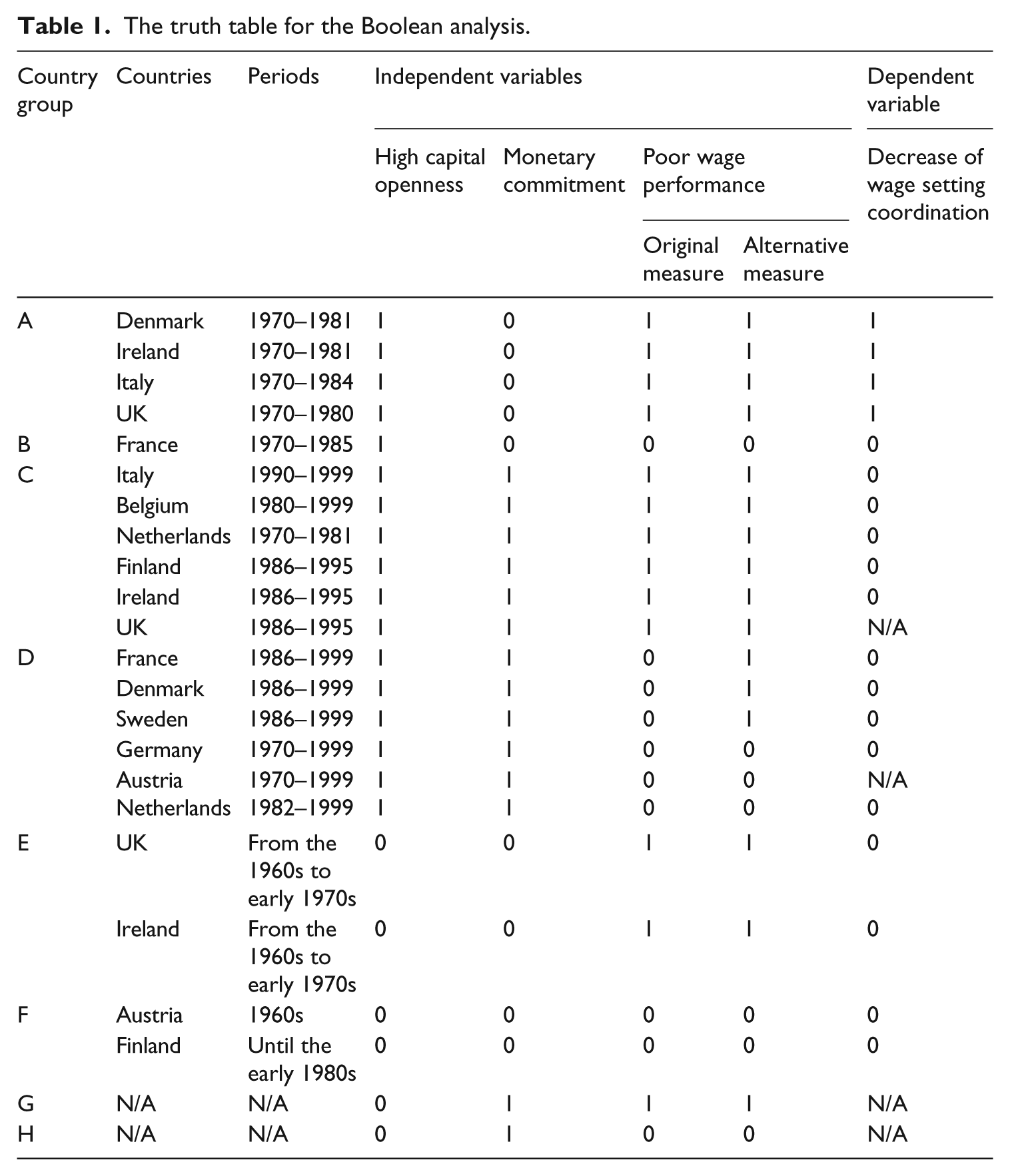
Table 1 presents a total of 21 cases out of the 11 sample countries. Groups A to D have 17 cases in which the level of capital openness all remained high. From these 17, Austria and the UK drop out due to certain issues regarding the dependent variable (discussed later). The cases with low capital openness are examined with the groups E and H, but not as extensively as groups A to D. This is because the cases were drawn mostly from the pre-1970 period, except for Finland, for which only limited data are available.
Notice that groups G and H are empty. This suggests the difficulty of combining strong monetary commitment and low capital openness, which makes good sense to us on the following grounds. Governments in this context adopt a fixed exchange rate system while they maintain considerable restrictions on cross-border capital transactions. Then the Mundell–Fleming theorem suggests that governments will be able to keep their exchange rates without giving up their policy autonomy for macroeconomic accommodation (Frieden, 1991). Although these expansionary policies will surely produce an inflationary pressure, the theorem continues, restriction on capital exit will help governments defend their exchange rates. In the long run, however, the system cannot sustain itself. Domestic inflations under fixed exchange rates will eventually deteriorate the balance of payments by reducing exports and increasing imports. To deal with this challenge, governments will have two possible options: domestic deflation or currency depreciation. With the former, they can correct the balance of payments without foregoing fixed exchange rates. But the solution entails considerable adjustment costs by causing significant job losses and sluggish growth. Concerned with the potential social and political implications of this economic turmoil, governments will search for a less costly solution. Here currency depreciation (and thus withdrawal from fixed exchange rates) will just do the job by boosting price competitiveness in a way not to necessitate serious economic sacrifices.
We now turn to the empirical associations of the dichotomous variables presented in Table 1. As we find, de-coordination occurred only in group A where capital openness remained high, wages were poorly controlled, and governments were not committed to monetary integration. If any of these conditions failed to be satisfied, which was true in groups B to F, de-coordination did not occur. Given that all these combinations of the variables are theoretically exhaustive and also do not produce any contradictory outcome, we reach the following Boolean expression for a sufficient condition: DECREASE OF WAGE SETTING COORDINATION = HIGH CAPITAL OPENNESS × POOR WAGE PERFORMANCE × monetary commitment, in which the upper-case letters denote the presence of the variables and the lower-case letters denote their absence. While this result certainly does not exhaust all possible routes to de-coordination, it does provide a good support for the claim of this study, that the combined effect of high capital openness and poor coordination holds only if the government is not committed to monetary integration. The result also remains robust even if tested with an alternative measure of Poor wage performance, as discussed previously in the measurement section.
Qualitative justification of the Boolean analysis
In this section we provide real historical grounds for the result of the Boolean analysis. We first present detailed justifications of the dichotomous measurements, and then provide a supplementary comparative analysis of two selected sample countries to trace out the actual causal process. We will focus on groups A to D, in which the level of capital openness remained high. This is justifiable considering that our study is primarily interested in the conditional effects of high capital openness. Space limitations also make it difficult to discuss in detail those other cases of low capital openness which do not carry as much analytic importance. 6
The cases without monetary commitment: The measurements
The discussion starts with groups A and B in which capital openness remained high and governments were not committed to monetary integration. Here the scores of Quinn’s index were equal to or higher than 3 throughout the periods (Denmark, France, and Italy), or had been lower but reached at least that level before their wage-setting systems changed (Ireland and the UK). Our analysis covers these cases within the range of 1970 to 1985. The starting year reflects data availability. The end year reflects the fact that none of the countries had begun their monetary commitment until around the mid-1980s (see the previous measurement section). Within the range of coverage, a specific end year was chosen by checking if the event of de-coordination happened in any of the countries examined. If so, the end year was when the change took place. If not, however, the end year was set to be 1985. This periodization helps highlight the constellations of the independent variables in the run-up to the decision for de-coordination.
The upper section of Table 2 presents detailed information regarding the dependent and independent variables for groups A and B. Given that the measurement scores for capital openness and monetary commitment are already known in the measurement section, we focus on Kenworthy’s coordination data and the wage performance data. Looking first at Kenworthy’s data, we find the level of wage-setting coordination decreased from the status quo of the 1970s in all countries except for France. In Denmark and Ireland, the data exhibited a clear unidirectional change toward de-coordination, which all took place in 1981. In Denmark centralized government mediation broke down and was replaced with a new system of industry-level coordination (Due et al., 1995; Wallerstein and Golden, 2000). The Irish centralized system also collapsed in the same year and was replaced with a system of company-level bargaining, where the public sector and large private companies played a role of weak pattern-setters for other private sectors (Hardiman, 1988; O’Brien, 1981).
The quantitative indicators for selected variables.
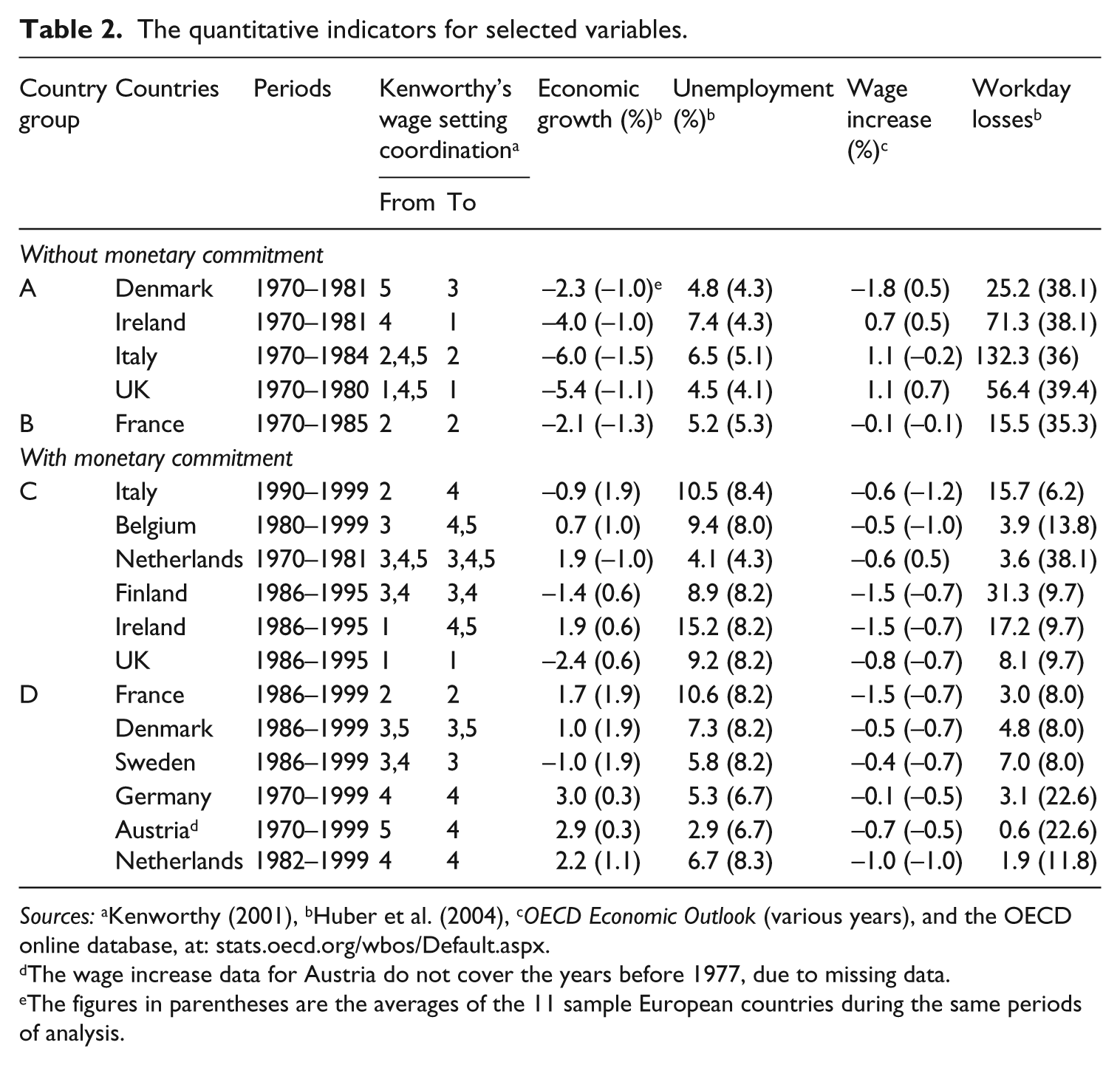
Sources: aKenworthy (2001), bHuber et al. (2004), cOECD Economic Outlook (various years), and the OECD online database, at: stats.oecd.org/wbos/Default.aspx.
The wage increase data for Austria do not cover the years before 1977, due to missing data.
The figures in parentheses are the averages of the 11 sample European countries during the same periods of analysis.
Italy and the UK, meanwhile, present a more complicated picture because Kenworthy’s data did not exhibit a clear pattern of de-coordination. The score for the starting and ending years was the same in the countries (‘2’ for Italy and ‘1’ for the UK), while there existed some spikes in between. For Italy, this reflects that the traditional company-level bargaining, which had been coupled with strong legal/administrative regulations, was interrupted by two short-lived episodes of centralized wage coordination in the late 1970s and the early 1980s. For the UK, there were a series of government interventions and tripartite income pacts during 1966 to 1979, which were adopted as an alternative to the traditional company-level bargaining. (In this sense, the score of ‘1’ in the beginning of the 1970s should be considered exceptional for the entire period.)
Expert studies however tell us that when the experiments with central coordination were over, the restored system of company-level bargaining exhibited a more de-centralized flavor than before. In the UK, Thatcher’s victory in 1979 led to a wage-setting system in which many un-unionized workers negotiated their wages directly with their managers, thereby bypassing the traditional procedure of union-based collective bargaining (Edwards et al., 1998; Waddington, 2000). In Italy, the company-level tier also began to assume a more prominent role in the national wage-setting system. Employers from the private sectors played a crucial role in this process, as illustrated by their repeated challenge to scala mobile – a wage indexation formula which provided the nationwide floor for wage increases (Regalia and Regini, 1998).
As seen in Table 2, all these events of de-coordination were closely associated with the failure of wage moderation. First, the economy was in poor condition in all cases. Looking at the trends of GDP growth and unemployment in group A, they all remained worse than the average of the 11 sample countries (shown in the parentheses). Note that the Danish figures did not look too bad. But the problem with the country was that its economy was declining sharply as it approached the end of the 1970s. Economic growth and unemployment – which had been 0.5% and 2% in the first half of the decade – now worsened to −4.8% and 7.5% in the second half, which were clearly worse than the European average. Despite these macroeconomic difficulties, wage costs in none of the four countries were controlled tightly. Wage increases and workday losses were all higher than the European average. Again, the Danish case seemed to present a different picture. Besides the workday losses, however, the low wage increase was mainly due to a series of wage freezes in the late 1970s, which were introduced by the parliament following unions’ refusal of the state mediators’ wage proposals. From the viewpoint of Danish employers, the unions were not yet committed to cooperation (Iversen and Thygensen, 1998).
Meanwhile, France, from group B, represents a case of no de-coordination. The economic condition in the country was not too bad in the 1970s and early 1980s. While economic growth was lower than the European average, unemployment was slightly better. Also, wage increases were at the average level and workday losses were even lower than the average. Under these circumstances, there was no urgent need for changing the status quo of the wage-setting system. The sense of the French crisis began to spread only around the mid-1980s, when the inefficiency of the state-led economy became evident but the socialist reflation failed to address the problem (Levy, 1999: 23–56).
The cases with monetary commitment: The measurements
Turning next to groups C and D, their configurations were different from the previous cases. With regard to the level of capital openness, there was no difference because Quinn’s index was all higher than or equal to 3. But governments were now all seriously committed to monetary integration. Note that the timing of the commitment varied across the countries, which was reflected in the different start years of analysis as shown in Table 2. But the commitment itself was in all cases strong enough to eliminate active macroeconomic accommodation out of feasible policy options.
We begin by examining group C, where employers suffered seriously from the failure of wage cost control. In Italy and Belgium, GDP growth and unemployment were both worse than the European average, while the cost indicators were not controlled tightly. The Netherlands seemed to present a different picture because all macroeconomic and cost indicators were in good shape. But this was true only on the surface because most of the indicators were worsening sharply as the end of the 1970s approached. From 1979 (when the Dutch government realized the economic problem was so serious that it decided to respond with ultra-austerity policies [Visser, 1990]) to 1981 (the last year before the pact of Wassenaar), the averages for GDP growth and unemployment were −0.7% and 6.1%, respectively. These figures were not only worse than the European averages of 0.5% and 5.8% during the same period, but also significantly worse than the country’s overall averages of the 1970s, which had been 2.8% and 3.4%, respectively. Wage costs however were never controlled tightly. Although strike activities remained low, overall wages were on a sharp increase (Visser, 1998). Note that the wage data for the period 1979–1981 are of little use here because the wages in these years were set via a parliamentary wage freeze. Alternatively, a comparison of the wage trends between the first and second halves of the 1970s will provide a better perspective. During that time the wage figure worsened from −0.2% to 0.8%, whereas the European trend was improving from 1.5% to −0.2%.
In Finland, Ireland, and the UK, the macroeconomic indicators also remained in poor shape until the first half of the 1990s, although they all recovered well thereafter (Baccaro, 2003; Kauppinen, 2000; Rhodes, 2000). In the UK, both growth and unemployment were worse than the European average. The Finnish figures had been good until the late 1980s, but worsened sharply around 1990 due to the Soviet meltdown and the banking sector crisis (Kauppinen, 2000). Growth and unemployment, which had been 1.9% and 4.5% in the second half of the 1980s, were now −4.7% and 13.3% in the first half of the 1990s. These figures were clearly worse than the European averages of −0.6% and 8.9% during the same period. In Ireland, unemployment was the worst in Europe. Although the growth figure looked better, this did not reflect the reality of the economy because the growth at that time was driven by foreign-investment companies which did not have a close tie with the Irish domestic sectors (OECD, 1983: 15–19). Despite these macroeconomic difficulties, the wages in none of these three countries were controlled tightly. As seen in Table 2, the Finnish and Irish figures were in mixed shape. The British figures were just around the average.
A striking finding here is that not in any of the countries from group C did the poor performance result in de-coordination of wage-setting institutions. Instead the level of coordination either stayed around the status quo or even increased toward nationwide coordination. In Italy, the decentralized bargaining till around 1990 was recentralized with non-binding tripartite talks (Ferrera and Gualmini, 2000; Regini and Regalia, 1997), which is well supported by the change of Kenworthy’s score from 2 to 4. In Belgium, the industry-level bargaining since the second half of the 1970s (as measured by the score of 3) was replaced in 1981 with a combination of direct government intervention and industry bargaining, as shown by the scores of 4 and 5 (Arcq and Pochet, 2000). In the Netherlands, industry-level bargaining and government intervention coexisted until 1982 (as measured by the scores of 3, 4, and 5), but then was replaced with another industry-level system coupled with non-binding central agreements (Van Ruysseveldt and Visser, 1996; Visser and Hemerijck, 1997: 81–113). In Finland, the industry bargaining system along with non-binding central guidance (as measured by the scores of 3 and 4) continued, but with an increasing emphasis on peaceful wage moderation (Kauppinen, 2000; Kauppinen and Waddington, 2000). In Ireland, company-level bargaining with weak pattern-setting was recentralized with a series of binding/non-binding tripartite social pacts, as measured by the change of scores from 1 to 4 and 5 (Baccaro, 2003). Finally in the UK, the combination of collective and individual negotiations at the company level continued without change (Waddington, 2000).
Turning next to group D, the economic situation was better than the previous cases of group C. In France, Denmark, and Sweden, the macroeconomic and cost indicators were all in mixed shape. Germany had performed better in the pre-Reunification era, but its performance came close to the European level as it entered the 1990s. Except for the workday losses of 1.1 days, which still resoundingly beat the European average of 5.4 days, all other indicators were around the average level. The GDP growth was 2.8% (higher than the average of 1.9%), unemployment was 8% (lower than the average of 8.7%), and wage increases were −1.0% (higher than the average of −1.2%). Consistent with these economic trends, in none of the four countries did employers make a serious attempt at de-coordination. In France, company-level bargaining which had been coupled with legal/administrative regulations continued (Goetschy, 1998). In Germany, the traditional industry-level bargaining system also continued despite some short-lived tensions in the metal sector (Thelen, 2000). In Denmark and Sweden, after the transition to industry-level bargaining in the early 1980s, employers did not attempt further de-coordination (Dolvik and Martin, 2000; Due et al., 1995). Note that the Swedish figures do seem to challenge this evaluation. The declining trend, however, simply reflects the fact that the Swedish transition to industry-level bargaining took a relatively long time. Since the initial attempt of decentralization in the early 1980s, wages in Sweden had been set by an alternation between industry-level bargaining (measured by the score of 3) and non-binding central bargaining (with the score of 4), until industry-level bargaining was finally established in the early 1990s (Kjellberg, 1998).
Finally, Austria and the post-1982 Netherlands exhibited the best cases of economic performance. Austria boasted all better figures than the European average. The Dutch figures were also close to this pattern, except for wage increases, which stayed around the average level. Not surprisingly, there was no attempt at de-coordination led by employers in these countries. Note again the Austrian figures look contradictory to this evaluation. In fact there was a move towards de-coordination in 1983, when the traditional central bargaining system was replaced with a new industry-level system. This event, however, is not relevant for our hypothesis because it was driven by unions, not by employers. (Refer to Traxler [1998] to see how the internal debates in the Austrian labor movement led to this change.)
Comparative historical analysis: The UK vs the Netherlands
The discussion so far has presented detailed justifications of the dichotomous measurements used by the Boolean analysis. This section adds further validity to the analysis by providing some historical background to the empirical associations exhibited by the variables. We focus on groups A and C, where employers suffered seriously from the failure of cost control. But the final results were different: de-coordination occurred in group A, while no equivalent change was found in group C. We find that government monetary commitment played an important role in determining these diverse outcomes.
We begin with group A where governments were not committed to monetary integration. There, employers responded to the wage problem by embarking on the project of de-coordination. Although this effort did not meet with their expectations because wage costs rose even higher during the transition, employers nonetheless could stick by their decision because governments provided various short-term policies to help them out. Initially, governments adopted non-accommodating policies, which they crafted in response to the wage-pushed inflations of the 1970s. But they gave up the position as they found that wage costs continued to increase, putting the already weak businesses into a more fragile situation.
Given space limitations, we cannot trace the causal process for all sample cases in group A. Instead we choose one case which best suits the task. The UK stands out in this regard because it exhibited the most dramatic reversal of the government’s position regarding accommodation, which then helps highlight the role of government policies effectively in the transition dynamics. 7 More specifically, we examine the British case from around the time when Thatcher came into power in 1979. Her victory led to a fundamental change in British industrial relations. Not only were the central incomes policies of the 1970s replaced with company-level bargaining, but the wage-setting process itself was ‘de-collectivized’ in the sense that wage negotiations began to bypass the union-based bargaining system (Howell, 2005). 8 The new government also expressed strong commitment to monetarist austerity, whereby it emphasized strong sterling and fiscal/monetary restriction as the major policy objectives. All these initiatives were deemed necessary in the fight against wage inflation which had been the major source of the profit squeeze in the 1970s (CBI, 1982: 14–17; Miller et al., 1983). Employers were fully supportive of the efforts, expecting that the combination of market discipline and non-accommodation would send unions a clear message that wage militancy would no longer be tolerated (CBI, 1979: 4).
These policy initiatives however did not meet expectations. De-coordination provoked an unintended consequence of wage increases pushed for by deregulated wage negotiators. Unions and un-unionized workers in skills-scarce manufacturing sectors played a key role in the process (Brown and Walsh, 1991; Traxler, 1995), whereby they exported their militancy to other economic sectors and then triggered a wave of wage competition (Walsh, 1993). 9 Government’s restrictive policies did not help either. Despite the success in holding down public sector wages, they had little effect in moderating wage competition in the private sector (EIRR, 1984; Hall, 1986: 100–136). Instead, the austerity policies added further difficulty to businesses because now employers had to bear the burden of rising wage costs all by themselves. The situation was even more challenging in the tradable manufacturing sector, where employers had already been suffering seriously from the loss of competitiveness in the European product market (Middlemas, 1991: 241; Pollard, 1992: 380–381, 386).
With all these challenges in the course of de-coordination, British employers changed their position and began to solicit their government for accommodating policies. While blaming high wage costs as the fundamental problem in the British economy, the CBI (the peak national confederation for British employers) made it clear that the situation was unnecessarily exacerbated by restrictive macroeconomic policies (CBI, 1981: 28; EIRR, 1983). To alleviate the stress, sterling should be allowed to fall flexibly. Monetary/fiscal contraction should also be relaxed to allow lower interest rates and better credit supply (Miller et al., 1983). The CBI even considered the possibility of withdrawing from free company-level bargaining and returning to the previous national incomes policies. With this change, they expected that they would be better able to calm down union militancy by putting major unions under the control of national guidelines (Middlemas, 1991: 249–250).
Finally, due to these tensions, the Conservative government switched its position to accommodation. Employers’ complaints then quietened down. In particular, Thatcher changed her position in the areas of monetary and exchange rate policies (Hall, 1986: 100–136). From 1981 to 1985, sterling fell by as much as 20% against the German mark, which was greater than the 16% average of the 11 European countries in our sample. Monetary policies also changed. Among the key issues was the choice of the monetary target indicator as a reference point of total monetary supply. Initially, the target was set at M3, which included both cash and other credit instruments. By the mid-1980s, the focus shifted toward cash in circulation, allowing the credit side of monetary supply to expand without government supervision (Pollard, 1992: 384).
Meanwhile, the story was quite different in group C, where governments were committed to monetary integration. Employers, as in group A, attempted de-coordination to tackle their wage problem. But the transition was very painful because governments could not compensate for the rising wage costs by implementing active accommodating policies. Employers then withdrew from their attempt, either returning to the status quo ante or seeking further coordination as a second-best solution for cost control.
Space limitations again do not allow us to engage in a full discussion of all sample cases in group C. We instead focus on one ideal case which presents the best context for hypothesis testing. We choose the Dutch case on the grounds that the government had already established a strong reputation for monetarism by the time employers attempted the change to de-coordination. Other countries meanwhile were in the middle of establishing such a reputation when their employers attempted similar changes. This difference arguably placed the Dutch government in a more effective position in sending employers a clear message of non-accommodation – which, we assert, played a crucial role in the transition dynamics of de-coordination. 10
Looking more closely at the Dutch case, the government started austerity policies in the early 1970s. At that time the Dutch guilder was virtually fixed to the German mark and, as a result, monetary policies were also put under tight restrictions – although fiscal policies retained some flexibility in order to mitigate the strong deflationary bias inherent in those monetary/currency policies. The intention of the government was clear: to combat the wage-pushed inflations plaguing the Dutch economy (Visser and Hemerijck, 1997). The Dutch wage-setting system had been mired in wage militancy since the mid-1960s. The situation was further complicated by the presence of an automatic wage indexation formula, which guaranteed a certain minimum level of wage increases for all Dutch workers. Initially, the formula was introduced to protect workers’ real purchasing power against inflation, but it became a major source of wage inflation by taking into consideration not only the past inflation trend but also future expectations in calculating the national floor for wage increases (Visser, 1998).
The government’s effort to address this wage problem, however, was not successful. It turned out that the Dutch unions would not change their years-long tradition of militancy simply due to the threat of austerity. Pressed by a continued profit squeeze, employers then decided to tackle the wage problem by reforming their ill-functioning wage-setting system. The key issue was the automatic wage indexation formula. Blaming it for the profit squeeze throughout the 1970s (Bakker, 1999), employers made clear their intention to abolish it at the bipartite central wage talks in 1976. The unions were displeased and the talks soon collapsed. Although negotiations were resumed at industry and company levels, none of these efforts was successful because of the same issue of wage indexation. Furious unions, especially those from the manufacturing and construction sectors (EIRR, 1977a), organized a wave of industrial action (EIRR, 1977b). Workday losses, which had remained on average at 139,000 days during 1971–1976, now soared to 247,000 days in 1977 (Huber et al., 2004). Wages also rose higher than initially expected. At the central talks in 1976, which had collapsed due to the issue of the indexation formula, employers had proposed a 4% wage increase (EIRR, 1977a). But they now saw increases of between 7.5% and 8.5% in most industrial sectors, along with various side payments such as an increase in holiday bonus, an increase in industry pension benefits, reduction of the minimum age for early retirement, etc. (EIRR, 1977c).
Despite these rising labor costs, the Dutch government was clearly not interested in accommodation. It had already established a hard reputation for macroeconomic austerity since the early 1970s. Beginning with 1976, the government further tightened its fiscal position by noting that flexible budgeting – which had been in place for years to fend off the possibility of deflation – led to the accumulation of sizable public debts (Hemerijck et al., 2000). Entering 1977, the Dutch government went even further by announcing a mandatory plan for price control, whereby the government authority made it difficult for producers to increase the prices of their products in the domestic market even if they were pressed by rising production costs. While this policy was justified on the general grounds of price stability, the real message was clear. It was the responsibility of employers to take control of wage costs. If they failed, they would have to pay for it (EIRR, 1977a).
With all these unfavorable developments following the decision for de-coordination, Dutch employers finally withdrew from their attempt at de-coordination (Visser, 1990). The wage indexation formula was fully restored. Employers then began to seek an alternative solution to the wage problem. Aided by an increasingly cooperative attitude on the part of the unions, their efforts eventually led to the revival of national wage talks as a means to stable cost management. The historic tripartite pact of Wassenaar in 1982 marked the success of this new approach (Visser and Hemerijck, 1997). 11
Conclusion
In this study we explored the relationship between capital openness and wage-setting coordination in developed European countries. We summarized previous studies into a conditional hypothesis, that capital openness induces employers to de-coordinate the wage-setting process if wage costs have been under poor control. We demonstrated that the hypothesis holds only if governments are not committed to monetary integration. If committed, the hypothesis does not hold. Overall, we find capital openness loses its effect in the case of fully-fledged financial integration.
Broadly speaking, our finding contributes to one of the major innovations in contemporary studies of European industrial relations: the paradigm shift from the de-coordination literature to the literature of ‘competitive corporatism’ (Rhodes, 2001). Responding to the pessimism of European corporatism, espoused by the earlier literature (Streeck, 1998; Streeck and Schmitter, 1991), the latter has demonstrated that the coordinative form of macroeconomic governance still remains feasible in Europe (Avdagic et al., 2011; Fajertag and Pochet, 2000; Hamann and Kelly, 2011). While there has been an overall shift in the power relations between employers and unions and, as a result, the emphasis in wage deals has shifted toward cost containment and productivity away from fair wage distribution, the studies find that central negotiations have continued to play an important role in providing effective guidelines for the national wage-setting process (Baccaro, 2003; Hassel, 2003, 2006). Underlying this development is the challenge from European monetary integration and, in particular, elimination of government active accommodation. This constraint, according to the studies, has put all industrial actors in a vulnerable economic situation and ultimately promoted central wage coordination as a stable mechanism of cost management – an alternative to free market discipline as predicted by the de-coordination literature.
We contribute to this general assessment by improving our understanding of a certain aspect of the adjustment process. In particular, we explore how monetary integration has weakened the merit of market discipline in the process. Along with the question of how monetary integration has increased the merit of collective concertation, this is a question which has to be answered carefully to achieve full understanding of the revived interest in coordination. Yet, existing studies have paid primary attention to one side of the causal process, whereby they link the challenge of economic vulnerability to the pressure of cooperation, while not providing rigorous discussion on why the economic challenge would make the option of market discipline less attractive. In this regard, they have presented only a general idea that de-coordination may entail a considerable period of disturbances, so employers – the main promoter of de-coordination – will not risk the uncertainty (Hassel, 2006; Perez, 2002). While building on this insight, we provide an initiative toward a more refined understanding of the issue. Focusing on the context of one of the major hypotheses in the de-coordination literature, i.e. the hypothesis of capital openness, we present a concrete causal mechanism whereby even powerful employers lose their interest in the option of de-coordination when their governments are committed to European monetary integration.
Footnotes
Funding
This research received no specific grant from any funding agency in the public, commercial or not-for-profit sectors.