







Abstract
This article seeks to explain the cross-national variations in the tendency of employers to under-declare salaries by paying formal employees an undeclared (‘envelope’) wage in addition to their official declared salary. Analysing the prevalence, size and nature of envelope wage payments across 10 East-Central European countries using data from a 2007 Eurobarometer survey, envelope wage payments are found to be less common, smaller and more likely to be for extra work in wealthier, less corrupt and more equal nations with higher levels of taxation, social protection and effective redistribution via social transfers. The theoretical and policy implications are then discussed.
Keywords
Introduction
The starting point of this article is a small literature on the ‘dark side’ of employers’ illicit wage practices which has been seldom addressed in the business ethics literature. This literature draws attention to how some formal employers under-declared salaries by paying their formal employees not only a declared official salary but also an additional undeclared ‘envelope’ wage which is hidden from, or unregistered by, the state for tax and social security purposes (Karpuskiene, 2007; Meriküll and Staehr, 2010; Neef, 2002; Sedlenieks, 2003; Williams, 2007, 2008, 2009a, 2009b, 2009c, 2009d, 2009e, 2009f; Woolfson, 2007; Žabko and Rajevska, 2007). These envelope wage payments by formal employers to formal employees are the subject matter of this article. Until now, although it has been shown that there are significant variations across nations in the prevalence, size and nature of envelope wage payments (Meriküll and Staehr, 2010; Williams, 2009a, 2009b, 2010), little attempt has been made to explain these cross-national variations. Here, in consequence, three possible explanations are evaluated critically, namely that envelope wages are: simply a legacy of underdevelopment (modernization perspective); due to high taxes, state corruption and burdensome regulations and controls (neoliberal perspective); or a result of inadequate state intervention in work and welfare arrangements which leaves workers less than fully protected (structuralist perspective). The aim of this article is to evaluate critically these rival explanations in terms of their validity when analysing the cross-national variations in the prevalence, size and nature of envelope wage payments across East-Central European countries.
To achieve this, the first section of the article reviews the existing literature on the prevalence, size and nature of envelope wage payments followed by various theoretical perspectives that might explain the cross-national variations in this illicit wage arrangement. To evaluate the validity of these competing explanations, the second section reports the methodology of the 2007 Eurobarometer survey here used to analyse the cross-national variations in the prevalence, size and nature of envelope wage payments and the validity of the competing perspectives in East-Central Europe. The third section then reports the findings. Revealing that envelope wage payments are less common, smaller and more likely to be for extra work in wealthier, less corrupt and more equal societies with higher levels of taxation, social protection and redistribution via social transfers, the final section reviews the implications of these findings for explaining both the cross-national variations in envelope wage payments and how they might be tackled.
Explaining envelope wage payments: A literature review
The notion that an employment relationship might be simultaneously both formal and informal has been seldom considered. Formal employment is paid work declared to the state for tax, social security and labour law purposes, while informal employment is in all respects the same except that the paid work is wholly hidden from, or unregistered by, the state for tax, social security and/or labour law purposes (European Commission, 2007a; ILO, 2002; Williams and Windebank, 1998). Over the past decade or so, however, this dichotomous depiction of employment relationships as either formal or informal has started to be contested. A small tributary of literature studying informal employment in East-Central Europe has begun to reveal that formal employers sometimes under-declared salaries by paying their formal employees both an official declared salary as well as an additional undeclared salary, or what is termed an ‘envelope wage’ which is hidden from, or unregistered by, the state for tax and social security purposes. Such studies of the tendency to pay envelope wage payments have been conducted in Estonia (Meriküll and Staehr, 2010), Latvia (Meriküll and Staehr, 2010; OECD, 2003; Sedlenieks, 2003; Žabko and Rajevska, 2007), Lithuania (Karpuskiene, 2007; Meriküll and Staehr, 2010; Woolfson, 2007), Romania (Neef, 2002), Russia (Williams and Round, 2007) and Ukraine (Round et al., 2008; Williams, 2007).
Until now, these studies have been either small-scale qualitative surveys or more extensive surveys but of a single country. For instance, at one extreme is a study in Lithuania of one single person who received envelope wage payments from his formal employer, albeit a cause celebre (Woolfson, 2007), whilst another study in the city of Riga in Latvia reports 15 face-to-face interviews (Sedlenieks, 2003). More extensive surveys include a study of 600 households in three Ukrainian localities (Williams, 2007), and a study of 313 households in three districts of Moscow in Russia (Williams and Round, 2007). Neither of the latter, however, are representative national surveys. The only known cross-national representative survey is one reporting 900 interviews in Estonia, Latvia and Lithuania (Meriküll and Staehr, 2010). This, however, was conducted between 1998 and 2002 at an early stage in the post-Soviet transition process.
Although these are not extensive surveys of nationally representative samples, they nevertheless indicate the widespread use of this illicit wage practice in East-Central Europe. For example, in Ukraine, 30% of formal employees in the three localities reported receiving an undeclared envelope wage from their formal employer in addition to their official declared salary (Williams, 2007), whilst in the Moscow survey, this figure was 65% and the envelope wage ranged from 20 to 80% of their gross wage (Williams and Round, 2007). Analysing the discrepancies between the results of labour force and employer surveys in Latvia, meanwhile, the OECD (2003) reveal that 20% of formal employees in the private sector received envelope wages from their formal employer.
Why, therefore, do employers under-declare the salaries of their employees? The main reason is to evade their full social insurance and tax liabilities. However, it is also useful when seeking to make people redundant. By withholding the envelope wage component of their salary, formal employers can encourage formal employees they no longer wish to employ to voluntarily quit their formal job, meaning that employers can evade social costs such as redundancy pay. Indeed, anecdotal evidence in qualitative studies suggests that employers in East-Central Europe do indeed use the withdrawal of envelope wages as a tool for persuading employees to voluntarily leave their jobs (Hazans, 2005; Round et al., 2008).
Such explanations for the use of envelope wages, however, do not explain the cross-national variations in the prevalence, size and nature of envelope wage payments. One way forward in this regard is to evaluate critically the relationship between the prevalence, size and nature of envelope wage payments and the broader socioeconomic environment. This can be done by evaluating critically the validity of the contrasting theoretical perspectives that have been proposed to explain the cross-national variations in the prevalence of wholly informal employment (Williams and Round, 2007, 2008), namely: the ‘modernization thesis’, which simply purports that informal work practices decrease as economies modernize and develop; the ‘neoliberal’ thesis, which argues its prevalence is a direct result of high taxes, public sector corruption and state interference in the free market; and the ‘structuralist’ thesis, which proposes its pervasiveness is the result of inadequate levels of state intervention in work and welfare provision which leaves workers unprotected. Each is here considered in turn.
Modernization thesis
During the twentieth century, a widespread belief was that as economies modernized and developed, the formal economy would replace the informal economy, which was seen as a residue or remnant from some pre-modern mode of production. The belief was that the informal economy is more extensive in less modern and developed economies and that it would disappear with modernization. The continuing prevalence of informal employment in countries is therefore a signal of their ‘backwardness’ and ‘underdevelopment’, whilst formal employment is seen to be a signal of ‘progress’ and ‘development’ (Geertz, 1963; Gilbert, 1998; Lewis, 1959; Packard, 2007).
Applying this to evaluating the cross-national variations in envelope wage payments, it can be suggested that in less developed economies, measured in terms of GDP per capita or personal purchasing power, there will be a higher prevalence of envelope wages paid for regular employment and that the portion of the total gross wage received as an envelope wage will be higher than in more developed economies. To explore its validity, the following hypothesis can be tested:
Hypothesis 1: The prevalence and size of envelope wage payments will be greater in less developed economies measured in terms of their GDP per capita or personal purchasing power.
Neoliberal thesis
Over the past few decades, however, this view of a linear trajectory of economic development has begun to be questioned. The recognition that informal work is extensive and even growing relative to formal employment in many global regions (Buehn and Schneider, 2012; Feld and Schneider, 2010; ILO, 2002, 2011; Jütting and Laiglesia, 2009; OECD, 2002; Rodgers and Williams, 2009; Schneider et al., 2010) has resulted in the view that informal work is a residue more commonly found in less developed countries being rejected and new explanations sought for its prevalence and growth even in developed nations.
For those of a neoliberal persuasion, the argument has been that many engaged in informal employment are making a rational economic decision to voluntarily exit the formal economy in order to avoid the high taxes, corruption in the state system and the burdensome regulations that increase the cost, time and effort associated with formal employment (e.g. Becker, 2004; De Soto, 1989, 2001; London and Hart, 2004; Nwabuzor, 2005; Sauvy, 1984; Small Business Council, 2004). From this neoliberal perspective, therefore, the prevalence and size of envelope wage payments would be explained to result from high taxes, corruption, over-regulation and state interference in the free market and in consequence, such a practice would be more prevalent in countries with higher taxes, corruption and levels of state intervention in work and welfare systems and the consequent solution would be to pursue tax reductions, reduce corruption and state interference in the free market in order to reduce such an illicit wage arrangement. To explore the validity of this neoliberal explanation, therefore, the following hypothesis can be tested:
Hypothesis 2: The prevalence and size of envelope wage payments will be greater in countries with higher tax rates, greater public sector corruption and higher levels of state interference in the free market.
Structuralist thesis
For structuralists meanwhile, informalization is the result of too little rather than too much state intervention in work and welfare arrangements. Viewing informalization as an inherent component of accumulation practices in late capitalism and a key facet of the downsizing, subcontracting and outsourcing arrangements emerging under deregulated global capitalism, informal work practices are seen to provide businesses with a production channel to attain flexible production, profit and cost reduction (Amin et al., 2002; Castells and Portes, 1989; Davis, 2006; Gallin, 2001; Hudson, 2005; Sassen, 1996; Slavnic, 2010). In this new production regime, in consequence, the full-employment/comprehensive formal welfare state regime of the Fordist and socialist era is disappearing and a new post-Fordist and post-socialist regime of deregulation, liberalization and privatization is emerging alongside the erosion of collective representation (Amin et al., 2002; Castells and Portes, 1989; Fernandez-Kelly, 2006; Sassen, 1996). As Meagher (2010: 11) puts it, ‘Informal economic arrangements … have entered into the heart of contemporary economies through processes of subcontracting … and diminishing state involvement in popular welfare and employment.’
From this structuralist perspective, therefore, the prevalence and size of envelope wages are a result of the lack of state intervention in work and welfare provision, including social protection and social transfers, and in consequence, this envelope wage practice would be more prevalent in countries with relatively low levels of state intervention in work and welfare arrangements (Davis, 2006; Gallin, 2001; Slavnic, 2010). To resolve this illicit wage arrangement, moreover, the solution would be to pursue greater state intervention in work and welfare arrangements. To evaluate the validity of this structuralist explanation, therefore, the following hypothesis can be tested:
Hypothesis 3: The prevalence and size of envelope wage payments will be smaller in those countries with higher tax rates, greater levels of social protection and redistribution via social transfers.
To evaluate these hypotheses in relation to explaining the cross-national variations in the prevalence, size and nature of envelope wage payments, attention now turns to testing their validity in the context of East-Central Europe.
Methodology: Examining envelope wage payments in East-Central Europe
To evaluate the cross-national variations in the prevalence, size and nature of envelope wage payments and their relationship to the broader economic environment of countries, one of the few cross-national comparative studies of this wage arrangement will be used, namely the 2007 Eurobarometer survey of undeclared work, which included an analysis of the prevalence, size and nature of envelope wage payments in 10 East-Central European countries belonging to the European Union, namely Bulgaria, Czech Republic, Estonia, Hungary, Latvia, Lithuania, Poland, Slovakia, Slovenia and Romania (European Commission, 2007a; TNS Infratest et al., 2006). Some 10,171 face-to-face interviews were conducted in these 10 East-Central European economies using a multi-stage random (probability) sampling method, with sampling points drawn with probability proportional to population size and population density according to the Eurostats NUTS II (or equivalent) and the distribution of the resident population in terms of metropolitan, urban and rural areas. Further addresses (every nth address) were subsequently selected by standard ‘random route’ procedures from the initial address. At the household level, meanwhile, the ‘closest birthday rule’ was used to select a respondent.
This face-to-face interview procedure adopted a graduated approach, commencing with attitudinal questions on participation in undeclared work, followed by questions on whether they had received undeclared goods and services. Questions then turned to the issue of whether those who were formal employees had received an additional envelope wage from their formal employer; and finally, questions were asked regarding their supply of undeclared work. Given the focus here on envelope wages, attention is paid to the questions asked on this issue. First, those who reported that they were formal employees were asked, ‘Sometimes employers prefer to pay all or part of the regular salary or the remuneration for extra work or overtime hours cash-in-hand and without declaring it to tax or social security authorities. Did your employer pay you all or part of your income in the last 12 months in this way?’ Second, and in order to comprehend the nature of envelope wage payments, they were asked, ‘Was this income part of the remuneration for your regular work, was it payments for overtime, or both?’ Third, they were then asked to estimate the percentage of their gross yearly income from their main job received as an undeclared envelope wage and fourth, they were asked whether they were happy to receive a portion of their salary as an envelope wage.
Although previous studies have described the findings of this Eurobarometer survey with regard to the commonality of envelope wage payments in East-Central Europe (Williams, 2008, 2009a, 2009c, 2009d) as well as South-East Europe (Williams, 2010) and the Baltic region (Williams, 2009b), these have been purely descriptive reports. No attempt has been so far made to explain the cross-national variations in the prevalence, size and nature of envelope wage payments. Here, therefore, by combining additional data sets on cross-national variations in the broader economic environment within which envelope wage practices occur, such as the level of GDP per capita, tax rates, levels of social protection and the degree of state redistribution via social transfers, the competing explanations set out above can be critically evaluated. This article, in other words, for the first time begins to explain the cross-national variations in the prevalence, size and nature of envelope wage payments, rather than simply describing the presence of this phenomenon.
To test the validity of these competing theorizations, official data sources have been used to seek statistical indicators of the various characteristics each theorization purports have an influence on envelope wage payments, such as the level of GDP per capita, tax rates and levels of social protection and redistribution via social transfers for 2007, the same year as the Eurobarometer survey (European Commission, 2011; Eurostat, 2007, 2010, 2013a, 2013b, 2013c). The only indicators taken from unofficial sources are, first, the perceptions of public sector corruption, taken from Transparency International’s corruption perceptions index for 2007 (Transparency International, 2013) and second, evidence on the quality of state bureaucracy taken from the International Country Risk Guide (ICRG, 2013).
To analyse the relationship between the prevalence, size and nature of envelope wage payments and the various characteristics of the broader economic environment that competing theorizations assert are influential, and given the small sample size of 10 countries and lack of necessary controls to include in a multivariate regression analysis, it is only possible here to conduct bivariate regression analyses of the relationship between the prevalence, size and nature of envelope wage payments and different individual characteristics of the wider economic environment. Nevertheless, and as will be shown, this produces some meaningful findings regarding the validity of the different theoretical perspectives.
Findings: Explaining envelope wage payments in East-Central Europe
Of the 10,171 face-to-face interviews conducted in these 10 East-Central European economies for the 2007 Eurobarometer survey, 4164 participants reported that they were in formal employment. Of these 4164 formal employees, one in eight (482 employees in total) reported receiving an envelope wage payment from their formal employer during the year preceding the interview. Extrapolating from this, the intimation is that some 8 million formal employees in these 10 East-Central European countries had received envelope wages in the year prior to the survey.
The prevalence, size and nature of envelope wage payments, however, are not everywhere the same. As Table 1 displays, there are marked cross-national variations in the prevalence of envelope wage payments, ranging from 23% of formal employees in Romania reporting that they have received an envelope wage in the 12 months prior to the survey to just 3% of formal employees in the Czech Republic. Neither is the size of envelope wage payments everywhere the same. Although some 38% of the gross wage was received as an undeclared envelope wage by those receiving envelope wages in the 10 countries as a whole, there are marked variations in the proportion of the gross wage received as an envelope wage, ranging from 86% in Romania to 14% in the Czech Republic. Indeed, using Spearman’s rank correlation coefficient due to the non-parametric nature of the data, Figure 1 displays a strong correlation between the varying prevalence of envelope wage payments across countries and the varying proportion of gross income received as an envelope wage (rs = .878**). In countries where under-declared salaries are a more common practice, those receiving envelope wages receive a higher proportion of their gross salary on an undeclared basis than in countries where under-declared salaries are less prevalent.
The prevalence, size and nature of envelope wage payments in East-Central Europe.
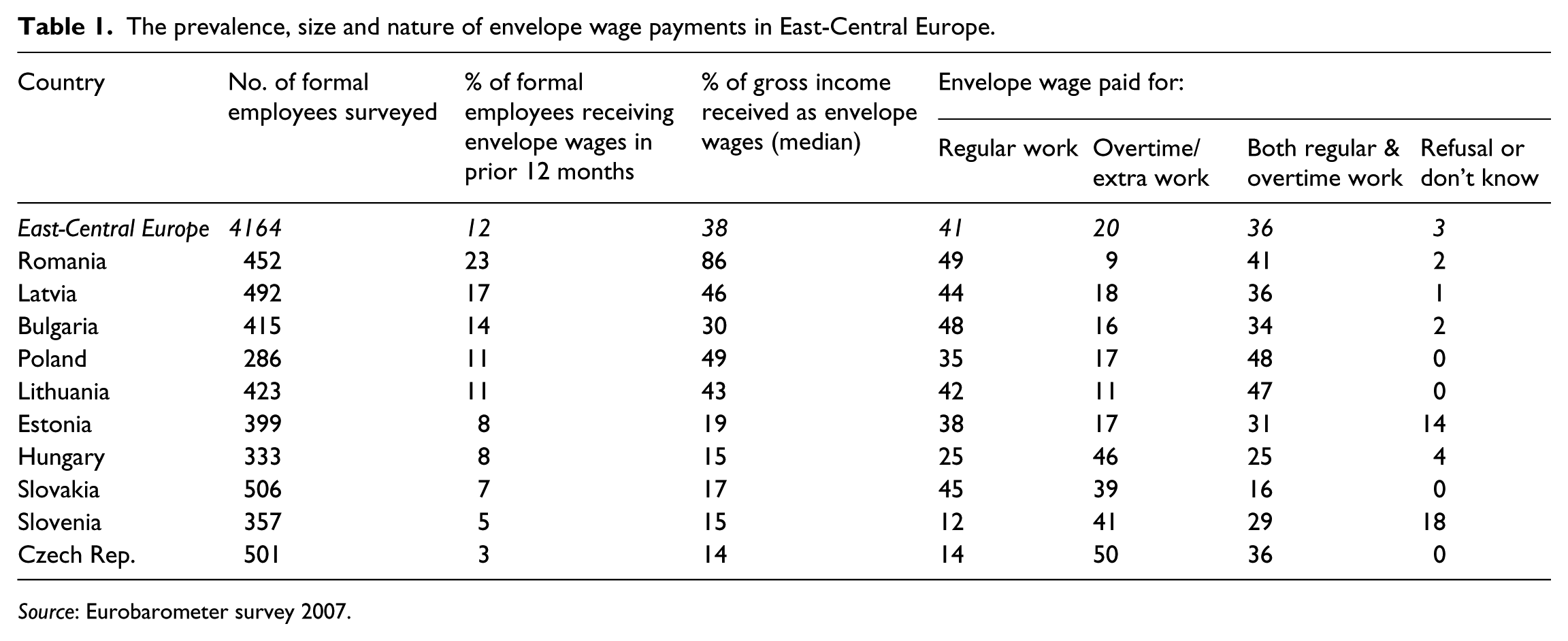
Source: Eurobarometer survey 2007.
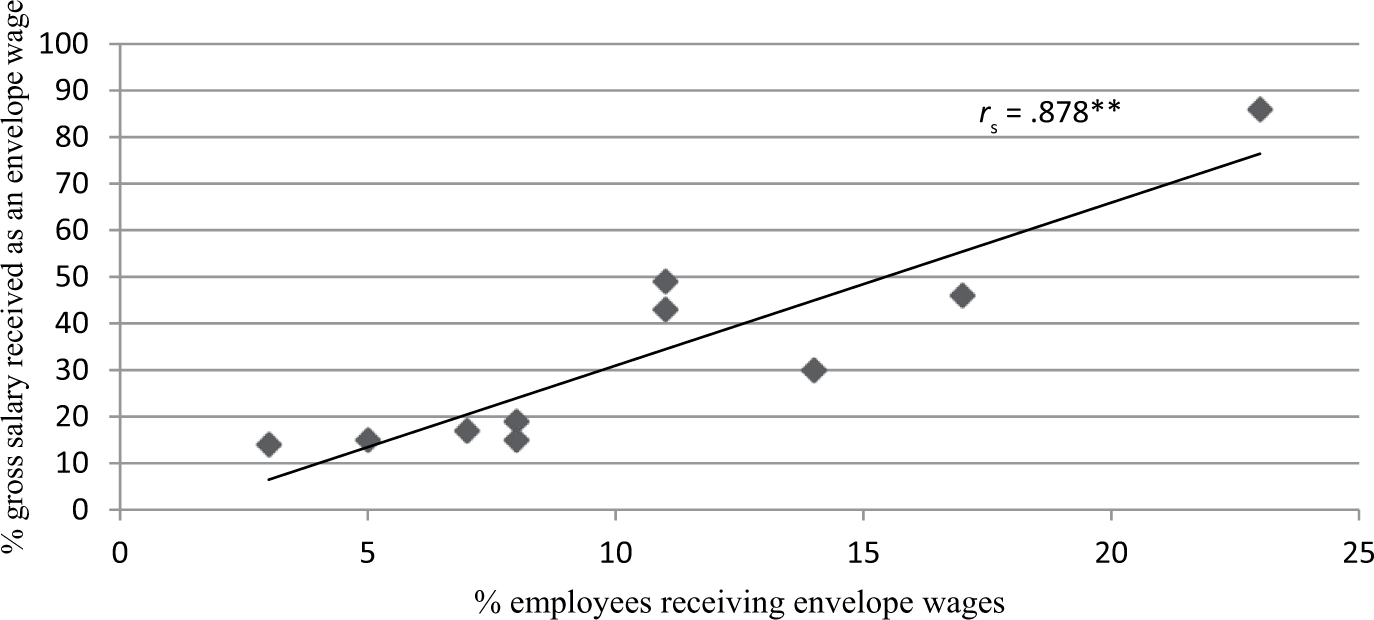
Relationship between prevalence and size of envelope wage payments.
Neither is the nature of these envelope wage arrangements the same in all 10 countries. As Table 1 reveals, across all 10 countries, some 41% of those paid envelope wages receive it for their regular work, 20% for overtime/extra work and 36% for both their regular work and overtime/extra work. However, there are marked cross-national variations. In Romania, for example, just 9% of those receiving envelope wage payments are paid this additional undeclared wage for overtime/extra work conducted, meaning that the vast majority of envelope wage payments are paid for regular work, whilst in countries such as the Czech Republic and Hungary, some 50% and 46% of envelope wage payments are for overtime/extra work. As Figure 2 reveals, there is a strong correlation between the percentage of formal employees receiving envelope wage payments and the type of activity for which envelope wage payments are received (rs = −.789**). The direction of this relationship is that in countries in which higher proportions of formal employees receive envelope wages, such envelope wage payments are more likely to be paid for their regular employment.
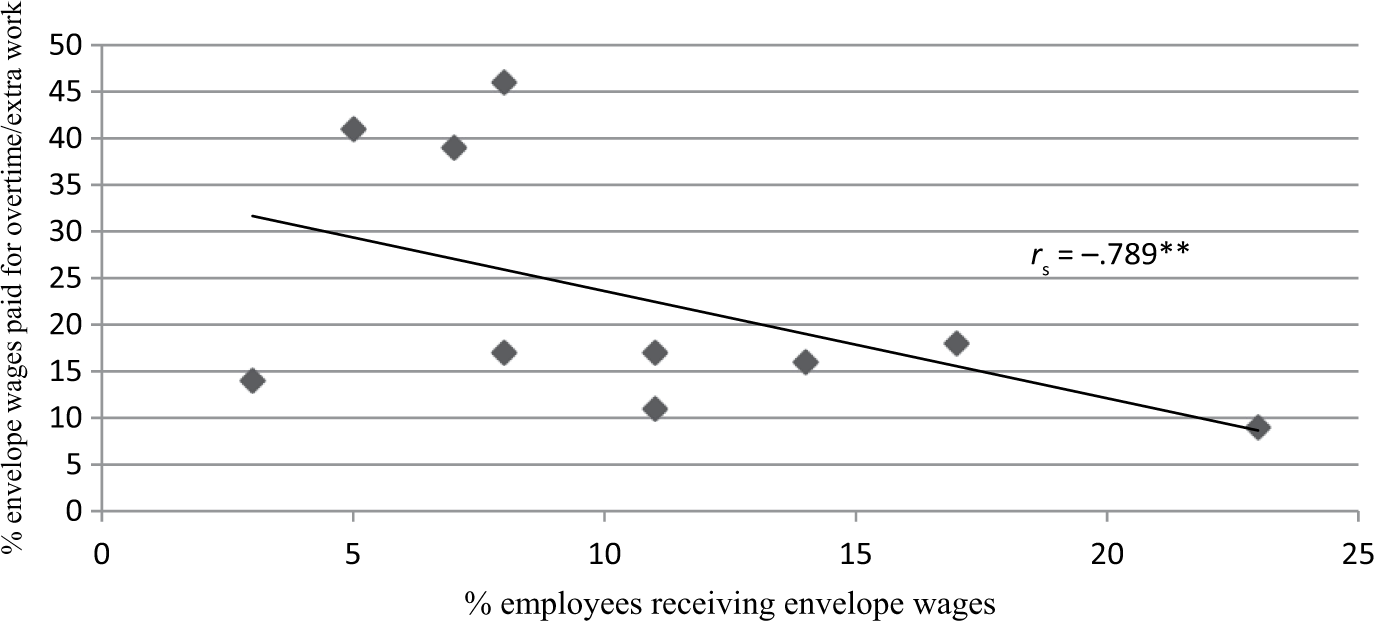
Relationship between prevalence and nature of envelope wages.
On the one hand, therefore, there are East-Central European countries in which this is an extensive practice, paid to employees more for their regular hours and it amounts to on average around one-half of formal employees’ wages (i.e. Bulgaria, Latvia, Lithuania, Poland and Romania). On the other hand, there are East-Central European countries where envelope wages are less common, paid more for overtime or extra work and amount on average to just one-fifth of employees’ gross wage (i.e. Czech Republic, Slovenia, Slovakia, Hungary and Estonia).
How, therefore, can the cross-national variations in the prevalence, size and nature of envelope wage payments be explained? Is it simply the case that the prevalence and size of envelope wage payments are lower in more developed economies as the modernization thesis suggests? Or is it the case, as neoliberals suggest, that the prevalence and size of envelope wage payments are greater in countries with higher tax rates, greater public sector corruption and higher levels of state interference in the free market? Or conversely, are the prevalence and size of envelope wage payments smaller in countries with higher tax rates, greater levels of social protection and redistribution via social transfers? Here, each of the hypotheses will be evaluated in turn. This will allow conclusions to be reached on the validity of the modernization, neoliberal and structuralist explanations regarding envelope wages.
Envelope wages and modern developed economies
To evaluate the modernization thesis, the relationship between the prevalence of envelope wages and GDP per capita (European Commission, 2011) across these East-Central European countries in 2007 can be analysed. As Table 2 reveals, and again using Spearman’s rank correlation coefficient due to the non-parametric nature of the data, there is a strong, significant relationship between the cross-national variations in the prevalence of envelope wages and the cross-national variations in the levels of GDP per capita (rs= −.884**). As Figure 3 graphically portrays, envelope wage payments are less prevalent in countries with higher levels of GDP per capita. There is also a strong relationship between countries with higher levels of GDP per capita and both the proportion of gross income workers receive from envelope wage payments (rs = .827**) and whether envelope wage payments are for overtime/extra work conducted (rs = −.818**). Envelope wage payments are not only less prevalent but also a smaller proportion of workers’ total gross income and more likely to be paid for overtime/extra work conducted in countries with higher levels of GDP per capita.
Relationship between prevalence, size and nature of envelope wage payments and the broader socioeconomic environment: bivariate analyses using Spearman’s rank correlation coefficient (rs).

*significant at .05 level, **significant at .01 level.
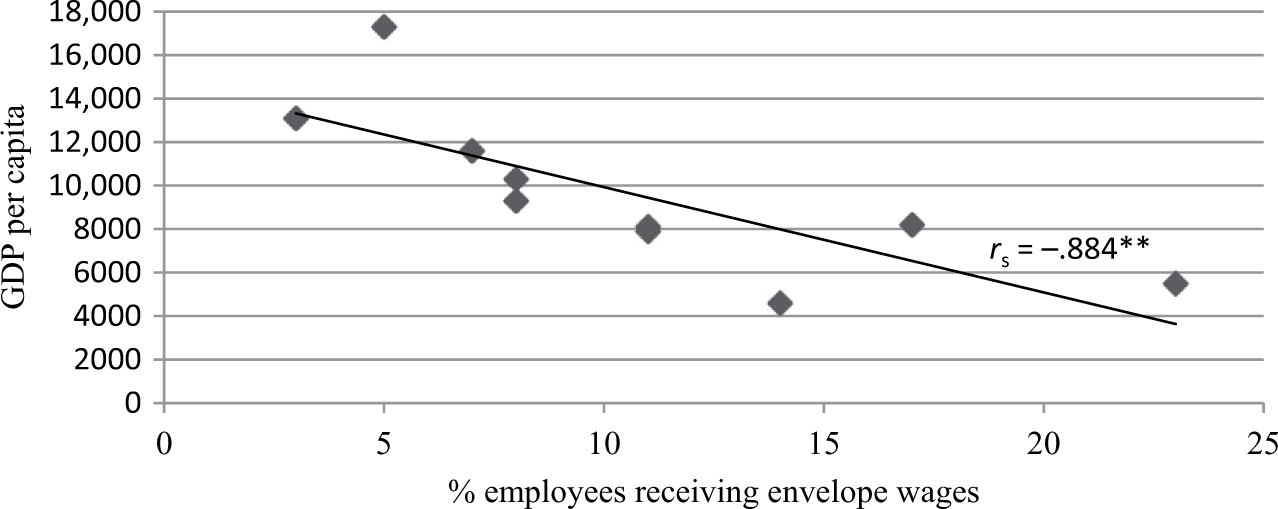
Relationship between GDP per capita (in euros) and prevalence of envelope wages.
Given that GDP per capita does not recognize the differences in the cost of living between countries, whether these strong relationships hold when analysing purchasing power standards (PPS) can be evaluated (Eurostat, 2013a). Again, there is a strong correlation between PPS and not only the prevalence of envelope wages (rs = −.896**) but also the proportion of income received through envelope wages (rs = −.806**) and whether the payments are for overtime/extra work conducted (rs = .717*). The higher the PPS in a country, the less prevalent are envelope wage payments, the smaller is the proportion of the gross wage paid via envelope wages and the more likely is such a payment to be made for overtime/extra work conducted rather than for regular employment.
Another proxy indicator of modern developed economies is the institutional strength and quality of the state bureaucracy. In the International Country Risk Guide (ICRG), a 0–4 scale is used to evaluate the quality of bureaucracy in a country where 4 is high and 0 is low. Countries with a high quality state bureaucracy have the strength and expertise to govern without drastic changes in policy or interruptions in government services – a bureaucracy that is autonomous from political pressure and where there is an established mechanism for recruitment and training. Countries with low quality state bureaucracy are those in which a change of government is traumatic in terms of policy formulation and day-to-day administrative functions (ICRG, 2013). The finding is that there is a strong correlation between the quality of the bureaucracy and the prevalence of envelope wage payments (rs = −.708**), the size of the envelope wage payments (rs = −.802**) and their nature (rs = .822**). The higher the quality of state bureaucracy, the less prevalent are envelope wage payments, the smaller they are as a proportion of gross income and the more likely they are to be paid for overtime/extra work rather than for regular employment. As such, the modernization thesis is confirmed that more developed countries with higher levels of GDP/capita, PPS and better quality bureaucracies are economies in which envelope wages payments are less prevalent, smaller and mostly for extra work/overtime. Future research might analyse whether these relationships hold when a wider range of countries and global regions are analysed.
Envelope wages, tax rates and corruption
Is, therefore, the neoliberal explanation also valid that the prevalence of envelope wages results from high taxes, corruption and state interference in the free market? To evaluate the relationship with tax rates, implicit tax rates (ITR) on labour can be analysed, which is a summary measure of the average effective tax burden on the income of employed labour (Eurostat, 2010). This is the sum of all direct and indirect taxes and employees’ and employers’ social contributions levied on employed labour income, and then divided by the total compensation of employees. The finding is that there is a strong statistically significant correlation between the ITR on labour and not only the prevalence of envelope wages across countries (rs= −.872**) as Figure 4 displays, but also the size of the envelope wage payments (rs = −.842**) and the nature of envelope wage payments (rs = .827**). However, the direction of this relationship is that the higher the average effective tax burden on employed labour, the lower is the prevalence of envelope wage payments, the smaller is the proportion of the gross wage paid via envelope wages and the more likely are such payments to be made for overtime/extra work. The perhaps surprising finding from a neoliberal perspective, therefore, is that lower tax rates measured by the ITR on labour are not correlated with a lower prevalence of envelope wage payments. Instead, quite the inverse is the case.
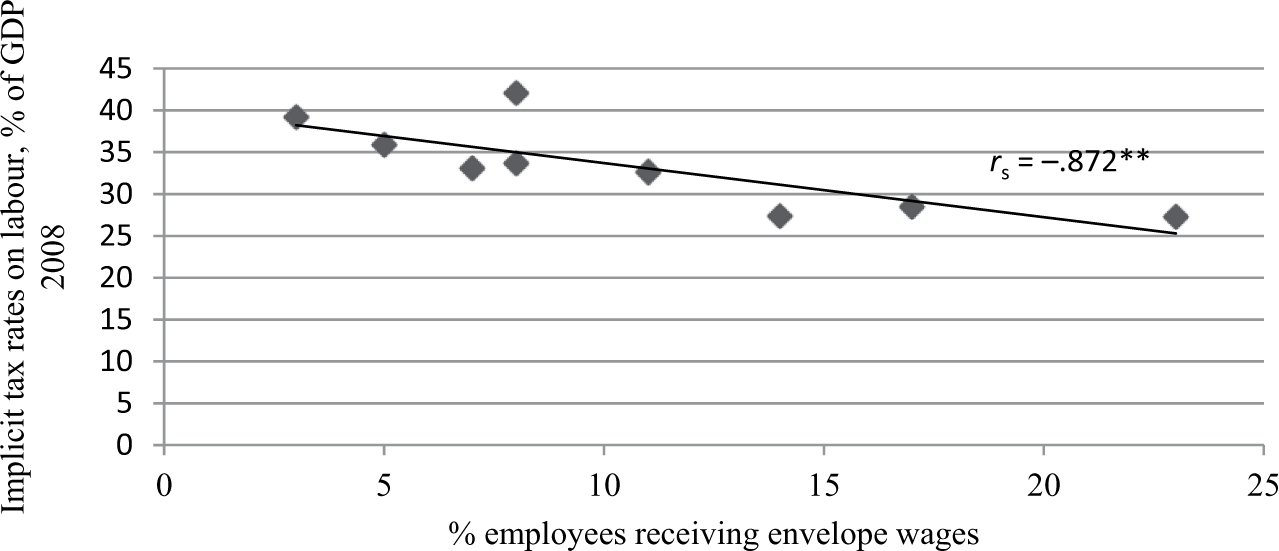
Relationship between implicit tax rates on labour and prevalence of envelope wages.
This relationship, however, might purely be a result of analysing ITRs on labour income. To evaluate whether other measures of tax rates produce different findings, the correlation between envelope wages and total tax revenue (excluding social contributions) as a percentage of GDP is analysed. Total tax revenue here includes: all taxes on production and imports (e.g. taxes enterprises incur such as for professional licences, taxes on land and building and payroll taxes), all current taxes on income and wealth (including both direct and indirect taxes) and all capital taxes. The finding is that there is no significant correlation between cross-national variations in total tax revenue as a proportion of GDP and cross-national variations in the prevalence, size or nature of envelope wage payments (rs = .049, rs = −.115, rs = .109 respectively). No evidence is found, therefore, to support the neoliberal thesis that envelope wage payments are greater when tax rates are higher and that the consequent remedy is to reduce tax rates.
Turning to the neoliberal assertion that envelope wages are more prevalent where there is greater public sector corruption, Transparency International’s 2007 Corruption Perceptions Index (CPI) is examined here (Transparency International, 2013). This is a composite index of perceptions of public sector corruption that draws on 14 expert opinion surveys and scores nations on a 0–10 scale, with zero indicating high levels and 10 low levels of perceived public sector corruption. The finding is that there is a strong correlation between the level of public sector corruption and the prevalence of envelope wage payments (rs = −.804**) as portrayed in Figure 5, the size of the payments as a proportion of the gross wage (rs = −.802**) and whether such payments are paid for overtime or for regular employment (rs = .713**). The higher the perceived level of public sector corruption, the more prevalent are envelope wage payments, the higher is the proportion of gross income received through envelope wage payments and the more likely is it to be paid for regular employment rather than for overtime/extra work.
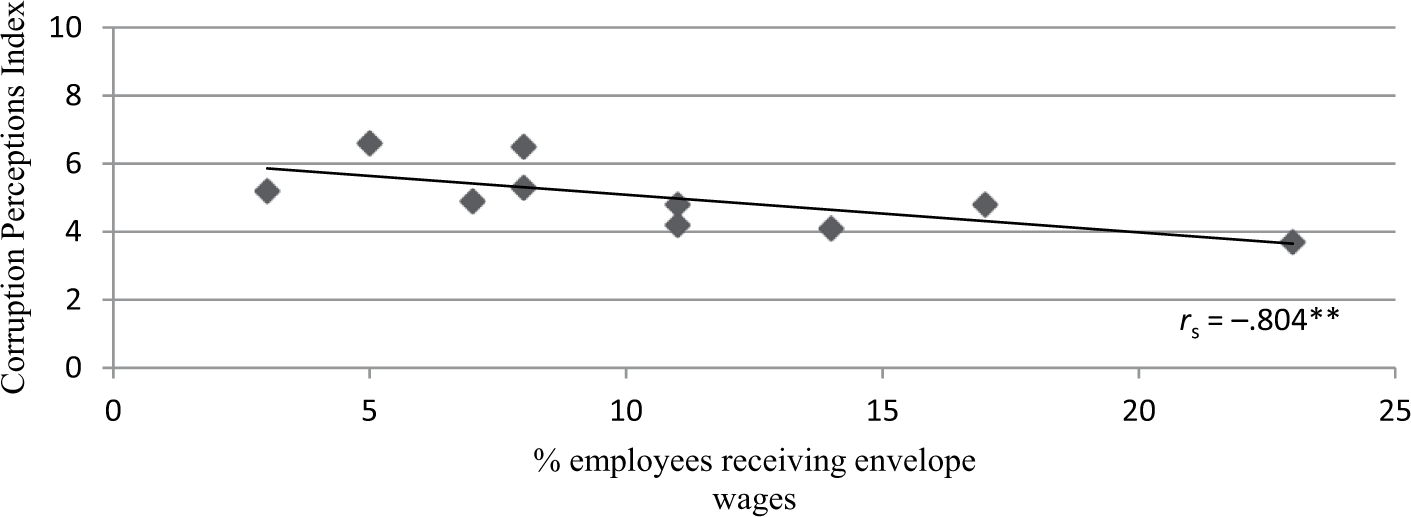
Relationship between Corruption Perceptions Index and prevalence of envelope wages.
Reviewing the neoliberal thesis, therefore, there is no evidence that envelope wage payments are correlated with higher tax levels. Indeed, if anything, quite the opposite is the case. Greater levels of public sector corruption, however, are correlated with higher levels of envelope wage payments, as suggested by neoliberals, and greater levels of corruption are also correlated with an increase in the proportion of one’s gross wage received in the form of envelope wages and the proportion of envelope wages paid for regular work rather than for overtime. Is it also the case, therefore, that envelope wages are more prevalent in nations with greater levels of state interference, as neoliberals assert? Or is it that the prevalence of envelope wages decreases in nations with greater state intervention in work and welfare arrangements, as the structuralist perspective asserts?
State intervention and envelope wages
To start evaluating these contrasting views of the relationship between envelope wage payments and state intervention, the correlation between envelope wage payments and the levels of state social protection expenditure (excluding old age benefits) as a proportion of GDP (European Commission, 2011) can be analysed. A statistically significant correlation is identified: the greater the level of social protection expenditure, the lower is the prevalence of envelope wage payments (rs = −.832**) as displayed in Figure 6, the smaller is the proportion of the wage packet received through envelope wages (rs = −.729*) and the more likely are envelope wages to be received for overtime/extra work than for regular employment (rs = .723*). On this indicator of state intervention, therefore, support is found for the structuralist rather than neoliberal explanation. In regulatory environments in which there is greater social protection of citizens, envelope wage payments are less prevalent, their size is smaller and their nature less intimately embedded in employment relations.
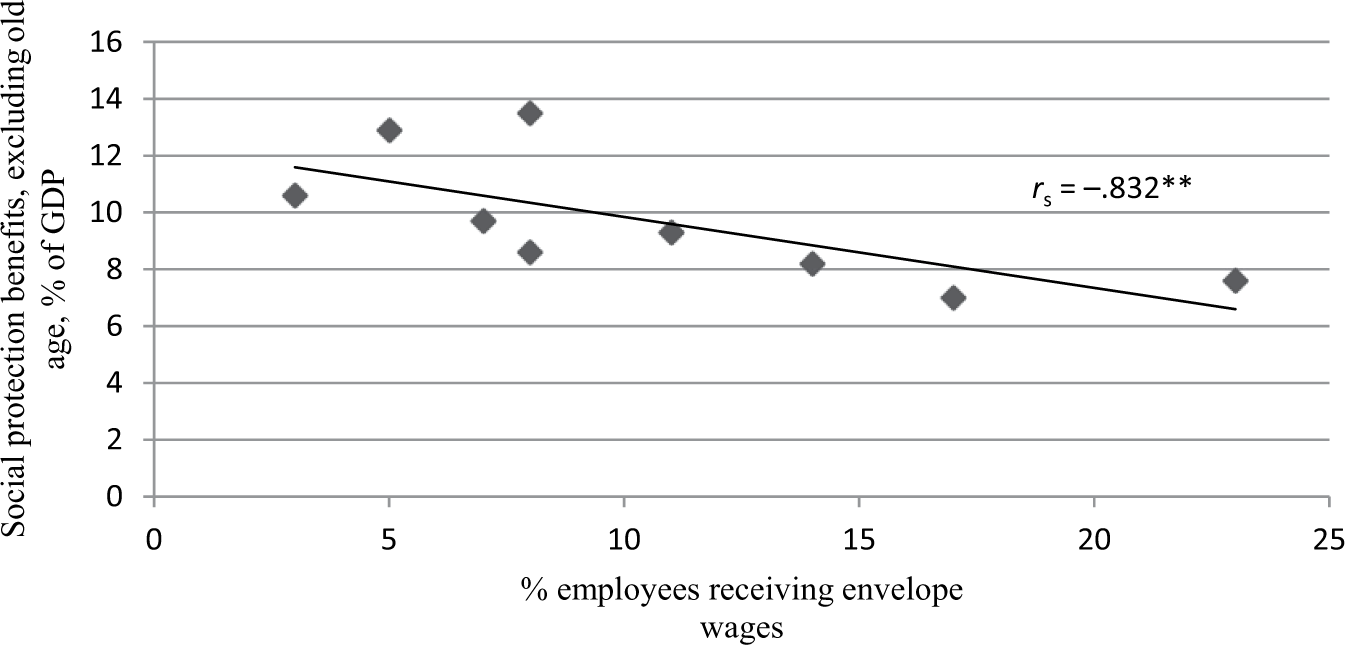
Relationship between social protection benefits and prevalence of envelope wages.
Is it also the case that envelope wage arrangements are correlated with variations in the level of spending on labour market interventions to correct disequilibria, explicitly targeted at groups of the population with difficulties in the labour market, such as those who are unemployed, in employment but at risk of involuntary job loss, and inactive persons currently excluded from the labour force but who would like to join the labour market but are somehow disadvantaged (Eurostat, 2011)? No significant correlation is identified between the cross-national variations in the proportion of GDP spent on labour market policy measures and the cross-national variations in the prevalence of envelope wages (rs = −.360), size of envelope wage payments (rs = −.104), or nature of envelope wage payments (rs = .559). Akin to tax rates, therefore, there is no support for the neoliberal explanation that government interference is correlated with the cross-national variations in envelope wages. Neither, however, is support found for the structuralist perspective.
There is, however, a significant correlation between state intervention to reduce the proportion of the population at risk of poverty, using social transfers, and the prevalence, size and nature of envelope wage payments. Here, the percentage of the total population at risk of poverty is defined as persons with an equivalized disposable income below the risk-of-poverty threshold, which is set at 60% of the national median equivalized disposable income, after social transfers (Eurostat, 2013b). A strong correlation is identified between the proportion of the population at risk of poverty across countries and the varying prevalence of envelope wage payments (rs = .890**), the size of envelope wage payments (rs = .685**) and the nature of the payments (rs = −.614*). The higher the proportion of the population at risk of poverty, the higher is the prevalence of envelope wage payments, the more likely they are to be paid for regular employment and the greater is the proportion of the gross wage that is received via envelope wage payments.
However, are envelope wages less prevalent and smaller in states that intervene to reduce the proportion of the population at risk of poverty, using social transfers? To answer this, the effectiveness of state redistribution via social transfers is analysed. Here, the poverty level is again defined as the proportion of the population with an income below 60% of the national median income, and then the reduction in percentage points of poverty after social transfers is calculated to determine the effectiveness of state redistribution (European Commission, 2011: Table 3). The finding is a strong, statistically significant correlation: the more effective is state redistribution via social transfers in reducing poverty, the less prevalent are envelope wage payments (rs = −.817**) as displayed in Figure 7, the smaller they are (rs = −.697**) and the more likely they are to be paid for overtime (rs = .705*).
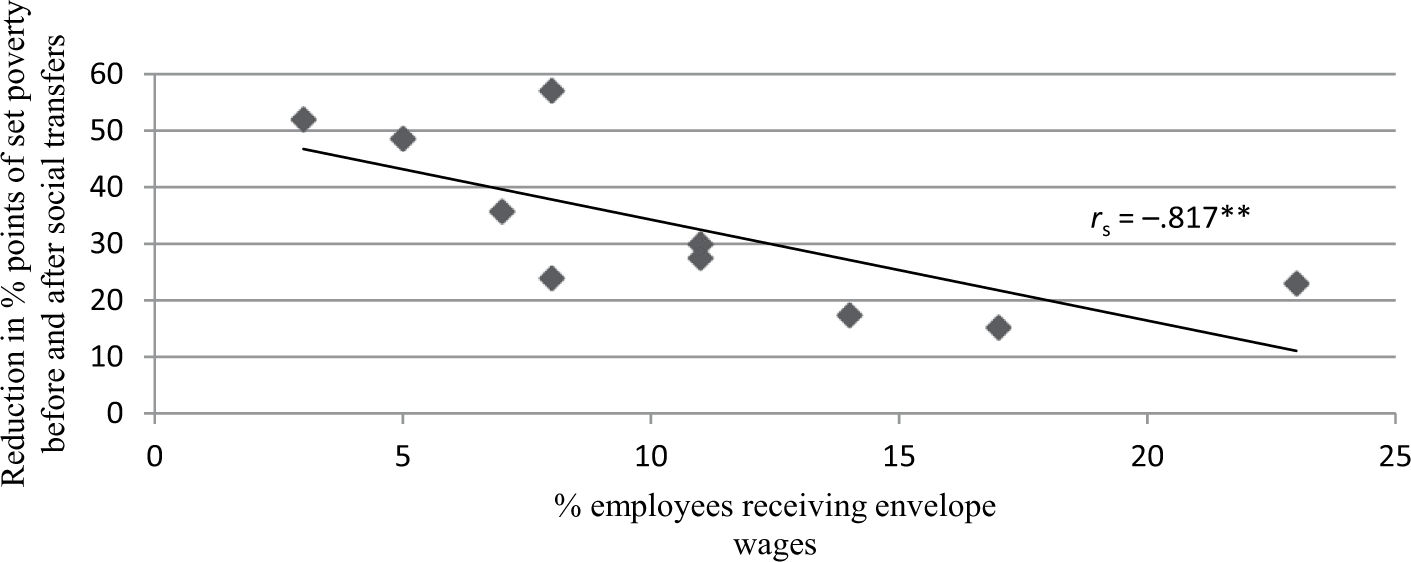
Relationship between impacts of state redistribution and prevalence of envelope wages.
The outcome is that the prevalence, size and nature of envelope wage payments are closely associated with the level of equality in societies. Analysing the inequalities in the distribution of income (Eurostat, 2013c), measured by evaluating the ratio of total income (by which is meant equivalized disposable income) received by the 20% of the population with the highest income (top quintile) to that received by the 20% of the population with the lowest income (lowest quintile), a strong correlation is identified between inequalities in the distribution of income and the prevalence of envelope wage payments (rs = .933**), the size of such payments (rs = .782**) and the nature of the payments (rs = −.823**). The more equal is the society in terms of the distribution of income, the less prevalent are envelope wage payments, the smaller they are as a proportion of gross income and the more likely they are to be paid for overtime/extra work rather than for regular employment. This is further reinforced when the correlation between the level of equality in a society, as measured by the Gini-coefficient (European Commission, 2011), and the prevalence, size and nature of envelope wages is analysed. There is a strong correlation: the more equal is the society the less prevalent are envelope wage payments (rs = .813**) as portrayed in Figure 8, the smaller they are as a proportion of gross income (rs = .760*) and the more likely they are to be paid for overtime/extra work rather than for regular employment (rs = −.720*).
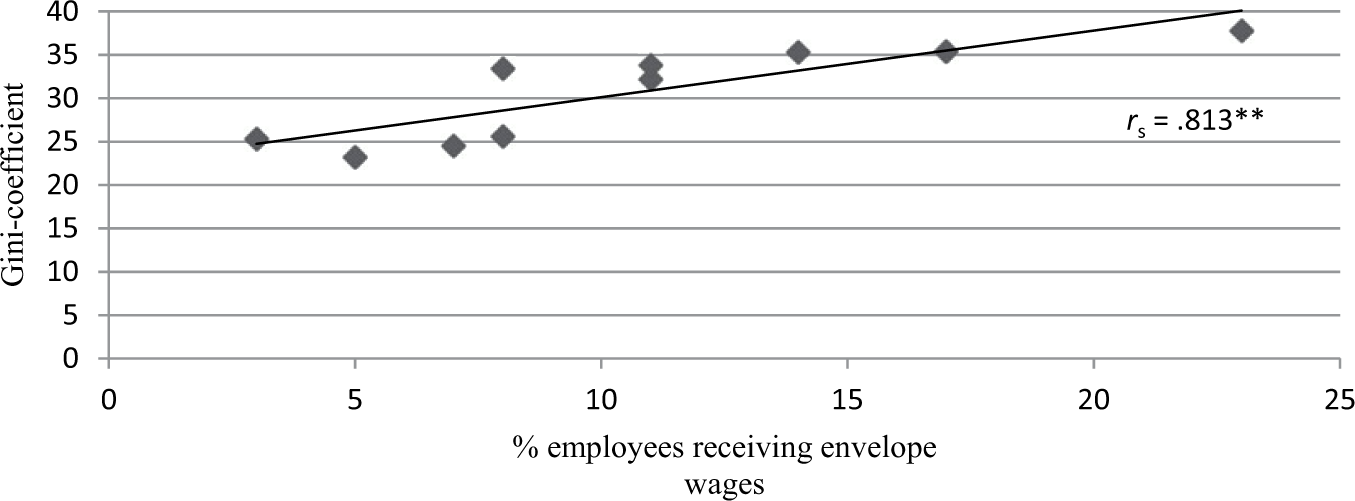
Relationship between Gini-coefficient and prevalence of envelope wages.
Conclusions
This article has evaluated critically competing explanations for the cross-national variations in envelope wage payments: the ‘modernization’ thesis, which simply purports that envelope wage payments decrease as economies develop; the ‘neoliberal’ thesis that envelope wages are a direct result of high taxes, corruption and state interference in the free market; and the ‘structuralist’ thesis that envelope wage payments are the outcome of inadequate levels of state intervention to protect citizens. To evaluate these rival theoretical perspectives, their validity when explaining cross-national variations in the prevalence, size and nature of envelope wage payments in East-Central Europe has been analysed. Reporting evidence from a 2007 Eurobarometer survey on 10 East-Central European countries, the finding is that in more developed, less corrupt and more equal societies possessing higher levels of taxation, social protection and effective redistribution via social transfers, envelope wage payments are less prevalent, smaller as a proportion of gross income and more likely to be paid for overtime/extra work rather than for regular employment. This, as will now be discussed, has both theoretical and policy implications.
In theoretical terms, this finding suggests that so far as East-Central Europe is concerned, the neoliberal thesis is not valid that envelope wages are a product of high taxes and too much state interference. Instead, quite the opposite has been found. In East-Central Europe, and confirming the structuralist perspective, the finding is that envelope wages are a direct by-product of under-regulation and that it is in nations where there are higher levels of taxation, social protection and effective redistribution via social transfers, that the prevalence of envelope wage payments is lower, smaller and mostly for overtime/extra work. It does remain the case, however, and as the modernization thesis asserts, that in more developed economies measured in terms of GDP per capita, PPS and the quality of the bureaucracy, envelope wage payments are less prevalent, smaller and mostly for overtime/extra work, as do nations in which perceptions are that public sector corruption is lower, as the neoliberal thesis intimates.
The clear theoretical implication, therefore, is that no one existing theoretical explanation suffices. Instead, a synthesis is required. Here, therefore, what is here termed a new ‘neo-modernization’ theorization is proposed. This recognizes the validity of the modernization thesis that GDP per capita, purchasing power standards and the quality of state bureaucracy, the neoliberal argument that state corruption and the structuralist explanation that state intervention in labour markets and welfare provision are all strongly correlated with cross-national variations in the prevalence, size and nature of envelope wage payments. Indeed, this ‘neo-modernization’ thesis certainly explains the greater prevalence and size of envelope wage payments largely for regular employment in Romania, Latvia, Bulgaria, Poland and Lithuania, which are generally less wealthy and less equal societies with higher rates of public sector corruption and lower levels of taxation, social protection and state redistribution via social transfers, relative to countries such as the Czech Republic, Slovenia and Slovakia. Whether this relationship holds when other global regions are evaluated as well as when time-series data are analysed for individual countries could usefully be explored in future research. Given that this 2007 Eurobarometer survey was conducted before the economic crisis, a future study might evaluate whether this ‘neo-modernization’ thesis remains similarly applicable during the current economic crisis. The fact that the 2007 Eurobarometer survey has been replicated in 2013 provides the data for this to be evaluated once they becomes available.
This relationship between envelope wage payments and the modernization of work and welfare arrangements also has clear policy implications for protecting workers from receiving under-declared salaries. It suggests that the pursuit of lower taxes and deregulation, as advocated by neoliberals, is not the way forward. Instead, reducing this illicit wage arrangement requires a modernization of work and welfare by addressing public sector corruption, improving the quality of the bureaucracy and through raising taxation, higher expenditure on social protection, coupled with the introduction of effective redistribution via social transfers so as to construct more equal societies. Again, whether the same finding emerges regarding the changes required when other global regions are investigated, as well as whether it remains valid when time-series data are analysed for individual countries, requires further research.
In sum, a strong correlation has been identified between envelope wage payments and the modernization of work and welfare arrangements. What is now required is for this to be applied longitudinally within countries as well as to other global regions, in order to evaluate whether the relationship holds. If this article stimulates such further research, then it will have achieved its objective. If this also leads to recognition and investigation of the broader modernization of work and welfare required to tackle such illicit wage arrangements, then it will have achieved its broader intention. What is certain, however, is that the neoliberal remedy of decreasing taxes and minimizing state interference seems likely to only worsen the problem of illicit undeclared envelope wages, rather than ameliorate it.
Footnotes
Acknowledgements
I would like to thank the Employment Analysis division of DG Employment and Social Affairs at the European Commission for providing access to the 2007 Eurobarometer database on envelope wages so that the analysis in this article could be undertaken. The normal disclaimers of course apply.
Funding
This research received no specific grant from any funding agency in the public, commercial, or not-for-profit sectors.