







Abstract
Whereas social theorists, qualitative investigators and survey-based analysts suggest advanced economies are increasingly characterized by managerial job insecurity, database and questionnaire researchers propose relatively stable tenure rates for managers. This article aims to make sense of this ambiguity. First, following interviews with managers in Japan, the UK and the USA, the authors offer support for the ‘global convergence’ thesis, through data reflecting greater job insecurity generated by comparable and recurrent corporate restructuring. Second, considering research suggesting relative stability in managerial tenure rates, the authors argue that their findings – signifying increased insecurity – can be explained in terms of the ‘perceptual politics’ of US-style shareholder capitalism impinging, hegemonically, upon occupational sensibilities. Third, in conclusion, they suggest that everyday managerial experience can be understood in light of corporations purposively instilling a perceptual ‘insecurity message’ in managers, essentially as part of a tangible control strategy directed at the inexorable ratcheting-up of management productivity demands globally.
Keywords
Introduction
Social theorists, qualitative researchers and survey-based investigators alike have argued that advanced economies are characterized by job insecurity due to increased competitive pressures, and that corporations are seeking greater flexibility leading to ever more precarious managerial careers (Beck, 2000; Burchell et al., 1999; Cappelli, 1999; Giddens, 1998; Maertz et al., 2010; Sennett, 1998; Standing, 2011). In contrast, other studies – based for example on database investigations or large-scale questionnaire studies – point to continuity in managerial job tenure, and hence to a corporate environment of relative employment security (Doogan, 2005; Fevre, 2007; Green, 2006; Kalleberg, 2011; Turnbull and Wass, 2001). Given such seemingly confusing findings and messages, it can be argued that there appears to be a degree of ambiguity in the literature on managerial job security. The question underpinning this study, therefore, is why is there so much reported job insecurity among managers when a good deal of the economic data suggest relatively stable managerial employment environments?
The research presented here attempts to add substance to this debate by reporting findings from an interview-based study of managers in the US, UK and Japan. The article therefore adds a number of contributions. Much of the evidence previously presented relies on quantitative, survey-based analyses which provide extremely useful data but do not ask (or answer) the why question in a way that this qualitative study does. Further, the article concentrates upon managers who, as a number of authors have noted, have been an occupational group who have witnessed a significant growth in job insecurity (Green, 2006). Also, the article offers this analysis in international comparison. In particular, it presents information on levels of occupational security/insecurity experienced by managers whose firms have undertaken various forms of corporate restructuring. In the face of the ambiguity that characterizes much discussion of managerial insecurity, we suggest a convergence of managerial experiences across the three countries studied – in the direction of greater job uncertainty brought about by reduced career confidence, fewer promotion opportunities and greater work intensification.
Our data also suggest, however, a need to qualify this basic convergence argument. We note, in particular, that significant differences exist across the age spectrum of the American, British and Japanese managers consulted, and notably of younger employees showing greater acceptance of – or possibly resignation to – the occupational effects of corporate restructuring, and notably regarding task escalation, increased levels of responsibility and extensive unpaid working hours. Controversially, our interview-based evidence – from board members to junior managers – suggests corporations globally are engendering a culture of job insecurity as a means of extracting ever greater levels of productivity from their managerial workforces. This argument is developed, initially, by addressing the literature on managerial job security as it relates to our national case studies; subsequently by discussing findings from qualitative interview-based research; and finally by considering evidence from our enquiry in the light of previous research before arriving at a series of conclusions.
Managerial job security
We first look at some high-profile theoretical literature on work and employment. Beck (2000), for example, argues that consumerism has replaced work as the dominant ideology of the ‘risk society’. The broad implication is that uncertainty, due to globalization, is endemic. Giddens (1998) meanwhile is broadly positive about the liberating effects of such change, arguing that this could bring positive benefits for employees who would experience rewarding work free from the ‘dead hand’ of a job for life. Sennett (1998), however, is extremely pessimistic about the ‘corrosive’ effects of such change, arguing that emerging organizational forms, and their employment outcomes, are instrumental in producing the breakdown of security (Mythen, 2005). Similarly, Cappelli (1999) argues that such insecurity essentially reflects the ‘dark side’ of attempts by employers to increase organizational ‘flexibility’. These various messages – and others concerning for example the ‘truth about managers’ (Osterman, 2009), the ‘precariat’ (Standing, 2011) or the ‘last good job’ (Aronowitz, 2001) – appear symptomatic of a reversion to the pre-1945 pattern of work, where jobs were more marginal, particularly for the labouring classes (see Jacoby, 1985).
Job insecurity is also signalled in empirical studies underpinned by a survey-based approach. In Burchell et al.’s (1999) study of white-collar staff, for example, senior executives stated that workers can be discarded easily, leading to a distinct lack of trust and job security. Burchell et al. were unequivocal in suggesting that ‘job insecurity is now higher than at any point in the past thirty years’ (1999: 60). They also suggest the spread of job insecurity has ‘widened’ to encompass a growing proportion of non-manual workers, and that within this category the biggest ‘losers’ have been professional workers, who between 1986 and 1997 went from being the ‘most secure’ occupational group to the ‘most insecure’. Further, they argued that job security was the most important concern for these white-collar workers, as confirmed by recent surveys (Felstead et al., 2007; Van Wanrooy et al., 2013).
Similarly, in a Canadian survey, Burke and Nelson (1997) noted that 90% of firms no longer offered ‘job security’, while Heckscher (1996) in the US pointed to a general collapse of workplace morale. Interestingly, Maertz et al. (2010), using large-scale US data, noted that survivors of downsizing incidents were more likely to feel a greater sense of insecurity than other workers. And in the UK, studies by Beynon et al. (2002) and Worrall et al. (2000) confirmed job loss and a decline in open-ended employment contracts, although White et al. (2004) argued that the ‘flattening’ of UK firms has been ‘short-lived’ and internal labour markets were making a comeback, as were career jobs.
Much of this evidence appears, therefore, to point to increased feelings of job insecurity for workers and managers alike, with this often tied to dissatisfaction with the work environment generally. In part, this is reflective – at least in liberal market economies (such as the US and UK) – of the greater ‘marketization’ of employment relations. That is, of moves toward more ‘open’ forms of employment based on market forces and heightened competition, and associated with relatively weak labour institutions, standards and regulations (Fullerton and Wallace, 2005; Kalleberg, 2011).
However, Fevre (2007) argues persuasively that the claim of ‘endemic’ insecurity is a myth and based on unsubstantiated ‘nightmare’ employment scenarios – ones that posit a radical new environment of ‘flexibility’ and ‘constant change’, as popularized by Giddens, Sennett and other high-profile sociologists. Fevre uses a number of datasets to dismiss the notion of employment insecurity and argues further that a common misconception is to conflate numerical flexibility, and in particular part-time work, with job insecurity. Fevre notes that part-timers may frequently have long-term employment, and that temporary workers – often held up as ‘insecure’ – can often later become permanent employees.
Doogan (2005, 2009), meanwhile, uses average tenure data – initially for the UK and subsequently for Western Europe and the US – to suggest that long-term employment (LTE) of 10 years plus actually increased in the 1990s, for both men and women (see also Rodrigues and Guest, 2010). For example, long-term tenure rates (10 years plus) actually increased in both the US and Europe (from 28.1% of the workforce in 1991 to 28.5% in 2002 for the US, and from 37.6% to 40.3% for Europe over the same period: Doogan, 2009). Later data confirm this, in the US, for example, long-term tenure had increased to 33.2% by 2016 (Bureau of Labor Statistics, 2016). This is also confirmed for a cross-section of countries (including Japan) as documented by a number of studies (Auer and Cazes, 2003; Gallie, 2013; Kambayashia and Kato, 2016; Kersley et al., 2006; White et al., 2004). Littler and Innes (2004) also consider this issue in their analysis of managerial downsizing. Despite widespread reports of corporate shrinkage and redundancies, they argue that managerial numbers appear to have increased in many advanced economies. This they ascribe inter alia to: mergers and acquisitions, moving into new markets, managers being rehired by small and medium sized companies, or simply through the re-titling of staff as ‘managers’.
Elsewhere, Green (2006) used a variety of survey-based studies in reporting on job security in the UK, US and Germany. He argued that although ‘confidence in the continuity and progress of employment is a core element of work life’ there is currently ‘no doubting the baleful effects of uncertainty’ (2006: 126). However, he went on to question whether, despite exceptional media interest, such data reflect genuine changes in the labour market. Green points to a number of other significant developments in this respect: including, inter alia, fiscal squeezes; the commercialization of the public sector; political acceptance of mass unemployment; the widespread decline of trade union influence; and the entrenchment of employment protection regulations (see also Kalleberg, 2011). Green finds no secular increase in job insecurity in either the UK or US, but adds important caveats: notably that while blue-collar workers had traditionally experienced high levels of job insecurity, from the 1990s this also impacted on white-collar workers, and that this led to a general increase in ‘precarious’ work. For the UK, Green (2006) found those working in fully or partly foreign-owned organizations were increasingly insecure, which he ascribed similarly to the impact of global competition. Moreover, for Green the literature suggests an increasing role for competition at the intra-firm level, with perceptions of uncertainty being brought about by recurrent fears among managers of takeover by foreign concerns.
For the US, Kalleberg (2011: 98), drawing upon a review of empirical evidence, argues that ‘job stability has declined in the US since the mid 1970s’, especially for ‘previously advantaged groups such as white collar workers and prime aged males’ (see also Farber, 2007, 2008; Fligstein and Shin, 2004; Kalleberg and Marsden, 2011; Mishel et al., 2009; Osterman, 2009). He suggests that decline in employee tenure is ‘especially pronounced around older white men’, the group that had been ‘the most protected by internal labor markets in the past’ (2011: 46). Kalleberg argues that what makes the insecurity issue problematic is that it contrasts with notions of shared prosperity. In other words, whereas workers had become accustomed to job security, there was also growing uncertainty on the part of employers due to the pervasive influence of globalization and technological change (see Maertz et al., 2010).
Finally, while for Japan the evidence appears less ambiguous, this is not wholly so. Matanle (2003) for example suggests that the average size of large Japanese firms has remained fairly stable in recent times and consequently there is little evidence for a ‘decline’ in job stability among core workers (see also Kambayashia and Kato, 2016). However, while the number of core (or ‘regular’) employees in Japan grew between 1987 and 2007, as a percentage of the overall workforce the figure dropped significantly (see Imai, 2011). Elsewhere, Dore (2009) has noted a gradual shift from a ‘stakeholder’ to a ‘stock market’ economic model in Japan, with an associated emphasis on capital accountability – rather than traditional forms of employee development – and the emergence of restructuring approaches such as downsizing and delayering (see Ahmadjian, 2016; Ahmadjian and Robinson, 2001; Ahmadjian and Yoshikawa, 2013). In Japan, white-collar, and especially public sector employees have been disproportionally affected by such developments (Chuma, 2002), with this reflected in the rise of the service sector and the deregulation of the Japanese labour market post-1990 (Chatani, 2008; Genda, 2005; Inagami, 2004; Keizer, 2010; Mouer and Kawanishi, 2005; Sako, 2006; Witt, 2006). Nevertheless, the image that remains is of relative job security, and especially for the careers of male managers in large firms remaining institutionally resilient (Inagami and Whittaker, 2005).
Research and methodology
This article contributes therefore to the debate on managerial job security through reporting findings from a comparative study of US, UK and Japanese corporations. Above we have reviewed an extensive literature on managerial job security, albeit one that at first sight appears ambiguous. While interview- and survey-based investigations frequently point to greater occupational uncertainty among managers, large database enquiries often suggest relatively stable employment environments. Contributing to this debate, we offer in-depth, qualitative research in the form of an interview-based study suggesting nationally converging perceptions of increased job insecurity – often linked to recurrent corporate restructuring – but with personal perceptions diverging according to age and experience.
Our empirical research is aimed primarily at explaining perceptions of managerial job security in an era of widespread corporate change. Specifically, our study presents evidence concerning changes to the way managerial work is experienced. The research is part of a broader international-comparative, study of management work undertaken initially for the Economic and Social Research Council. The aim is to analyse the work experiences of managers in large private and public sector organizations in the early 21st century and to assess the degree of interdependence between job insecurity and organizational reforms in an era of internationalized investor capitalism. The first, Economic and Social Research Council, phase took place from 2002 to 2006 with the investigation continuing from 2006 to 2010 under funding from the universities of Cardiff and Manchester. From 2010 the project received further funding, from the National Institute for Health Research, for a study of managerial work in the health sector. Finally in 2015, the project received further support still, from the Lord Alliance Strategic Research Investment Fund, to allow earlier sample organizations (in Japan, the UK and the USA) to be revisited, so as to document changes in trends in the intervening period, this representing the final stage of the project.
Data analysed in this article are drawn from the international comparative phases of the research, and thus from semi-structured interviews with a range of employing organizations (N = 18) in the US, UK and Japan. Thirteen of these organizations were private sector and five public sector (see Table 1). Data presented are in the form of direct quotations from 39 interviews with senior and middle managers in these organizations. A relatively small number of senior managers were drawn mainly from the human resources function, while middle managers were drawn from a range of functions. Our middle managers ranged from younger employees, some relatively new to the organization/industry, to older ones with several decades’ service in a firm. As a general rule we use the term ‘younger’ to refer to managers of less than 30 years of age, and ‘experienced’ to those over; albeit acknowledging this is a crude and basic differentiation, but one possibly sufficient for the general arguments we make. The actual type, level and number of interviewees who contributed to the case evidence are presented in the national findings. The interviews on which the analysis is based were ones in which issues of job uncertainty arose among a larger interview-based dataset concerning changing organizational forms. Interviews typically ranged from 60 to 90 minutes and were conducted exclusively on-site at the sample corporations. Visits to these organizations were made both pre- and post- the global financial crisis of 2008–2009. In addition, relevant documentary and economic data were collected for each organization, while informal interviews were conducted with academics in the US and Japan on issues relevant to the study. Table 1 lists the (anonymous) organizations cited in the article, including details of approximate headcount and core activities. Interviews in Japan took place either in English or Japanese and one of the research team was a native Japanese speaker.
Sample organizations.
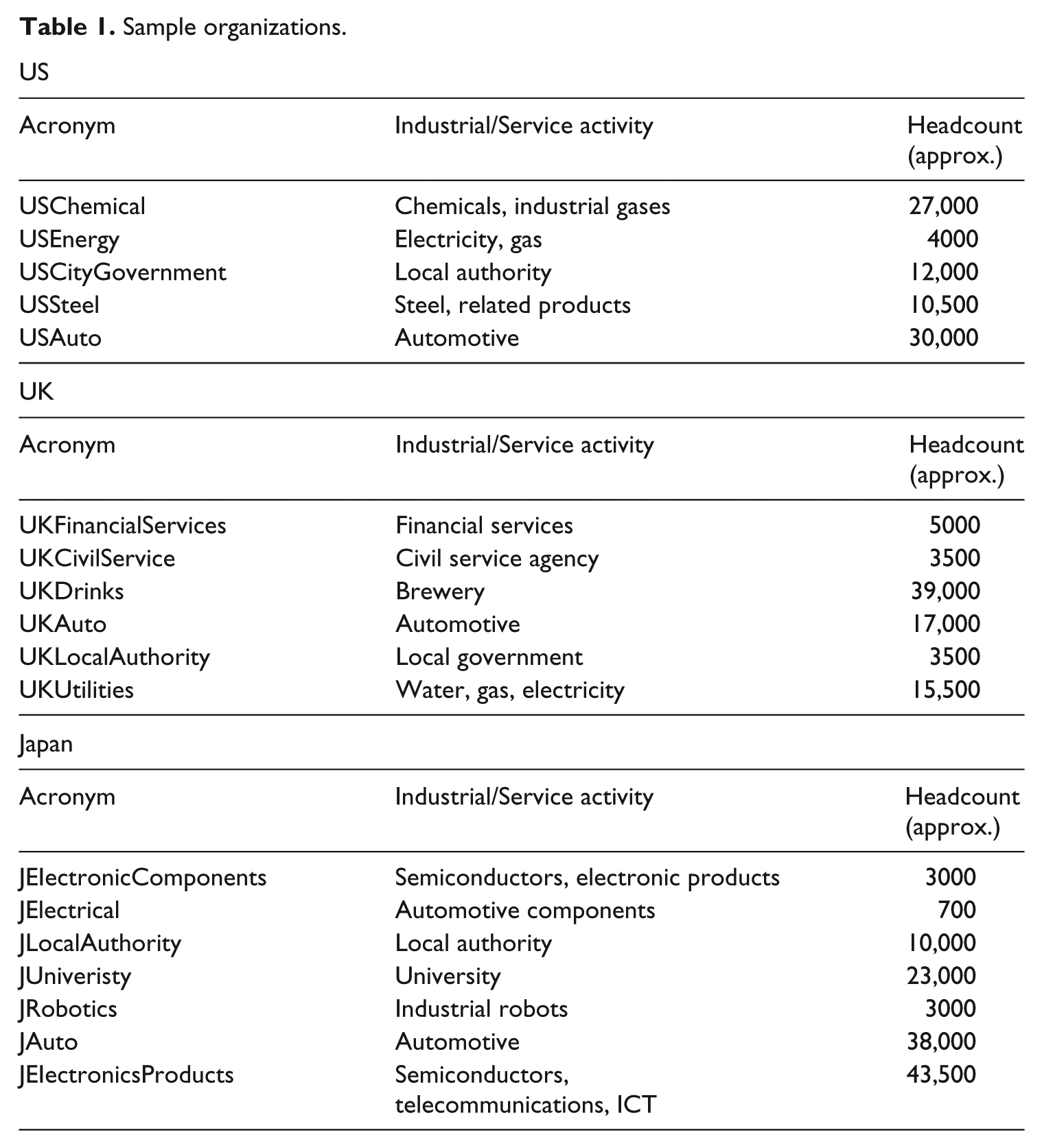
The organizations researched were intended to represent a cross-section of major industrial, commercial and public sector employers. The objective was to offset criticism that the organizational forms literature too often focuses on narrow, limited and possibly atypical segments of the ‘new’ service-based economy. Thus the organizations researched represented private and public sectors, manufacturing and service operations, and modern and mature products. Methodologically, rather than collect data ‘at a distance’ – for example, via a formal questionnaire – our approach was to ‘get inside’ these organizations and interview managers personally (Brannick and Coghlan, 2007; see also Bartunek and Louis, 1996).
Finally the process of data analysis was that of traditional interpretation of interview-based information (see Turner, 1972; Van Maanen, 2011; Watson, 1994, 2011). This involved identification of interpretive themes by the researchers rather than coding data through computer-based software. Important themes arising from the interviews were identified from the researchers’ analysis of transcripts followed by cross-checking of themes in small group discussions. This reflected a theoretically ‘grounded’ (Glaser and Strauss, 1967) approach to data analysis based on the inductive emergence of conceptual categories. We argue that this method is closely aligned with the key ontological and epistemological assumptions of ‘interpretive’ forms of organizational enquiry (Bryman and Bell, 2011; Hassard and Wolfram Cox, 2013).
Data and findings
Our data suggest that perceptions of job insecurity were widespread across the majority of organizations researched, irrespective of whether they operated in the private or public sector. Perceptions of job insecurity and occupational uncertainty often appeared related to organizational restructuring in one way or another. Most of the organizations we researched – chosen from corporate lists and public sector databases – had experienced some form of recent restructuring, with delayering being broadly indicative of managerial work intensification, as fewer managers had a broader range of tasks to accomplish. In addition, the types of organizational restructuring we encountered were often practised within a context of corporate downsizing through widespread headcount reduction.
Faced with such turbulent corporate scenarios, issues of job insecurity were reported by managers across the samples of managers, industries and countries we investigated. However, not all of the managers we interviewed expressed responses to such corporate changes in ostensibly negative or critical terms. Many informants – often younger or less experienced managers – seemed either to welcome or at least be reconciled to factors such as increased responsibility, work intensification and long working hours. Differences such as these among managers in our sample corporations can only be fully appreciated, we feel, through interpretive research based on a rich, in-depth and qualitative dataset.
In the following sections, managers from our three economies explain therefore how perceptions about their current work experiences were formed in the light of widespread corporate restructuring and increasing perceptions of job insecurity. In particular they describe how decisions on restructuring, generally taken at the apex of large corporations, came to affect them in terms of the meanings they attach to work, their perceptions of occupational well-being, and their views on employment futures – or put another way, by an increasingly hegemonic form of ‘perceptual politics’. It is important to note that the data presented reflect the general tenor of responses we gleaned from our analytically ‘grounded’ thematic investigation, rather than such information being extracted purposively by ‘cherry-picking’ from a large number of interviews.
Managers in the United States
As Jacoby (1985) noted, from the Second World War until around 1980 large US firms had been characterized by buoyant internal labour markets and relatively stable levels of employment. In comparison to the current environment, this was a relatively secure period for workers and managers alike. In our interviews with US managers in the 21st century, this contrast between a perceived ‘golden age’ of stable postwar employment and the instability of contemporary experience was a much repeated theme.
USAuto
This contrast was nowhere more prevalent than in interviews at the giant car maker USAuto, where research was conducted at corporate headquarters and a manufacturing plant in the Mid-West. At the corporate HQ, a senior HR manager explained to us how managerial headcount had been ‘significantly reduced’, with structural layers removed and large-scale redundancies made. Meanwhile at the manufacturing plant we found significant levels of managerial stress, managing with fewer resources, and of increased workloads and long working hours. Given this context, the managers we interviewed had mixed feelings about their job security – ones they often linked to changes in corporate politics. As a mid-career manager explained, this was particularly so in an era when new corporate philosophies were regularly being proselytized by senior executives:
I’ve worked at several plants throughout USAuto – I’ve been in about six assembly plants and a stamping plant and held various engineering and staff positions. And the same message is given over and over again, regardless of the organization, whether or not it’s stamping, vehicle assembly, engine assembly, or engineering – it’s that the middle [management] ground has been left on the dock as the ‘lean’ [i.e. lean production/management] boat has sailed away.
The onset of ‘lean’ management (see Womack and Jones, 1996) practices at the plant had resulted in significant rounds of headcount reduction for both salaried and hourly-paid staff. In the two or three years immediately prior to our visit the plant had reduced its salaried personnel from 240 to 109. Similarly the headcount for hourly-paid employees had been reduced from around 1800 to 1200, with fears of more reductions to follow. In light of this, another experienced middle manager drew upon themes that would also be discussed by UK middle managers in explaining how, for example:
My career has stalled, it’s stalled because of the changes in the way we’re managing business now. Like there are a lot fewer jobs to go into … If I had one of my sons sitting here and he was in the business for four years or five years and he was asking me ‘what do I do?’, then I would tell him to start looking somewhere else. If you want to get promoted you start jumping companies.
Another interviewee was a late career quality manager who, although employed by USAuto for most of his working life, recounted that this had ‘not been an easy journey’. The central message appeared to be that while uncertainty is not a particularly new phenomenon in capitalist America, it is certainly far more pronounced now than in the past. To make the point, he offered an insightful resume of his time with the corporation:
Hired as an hourly employee, worked hourly for I’m going to say a year and a half. Took a supervisory job, worked on that for three or four years. Was bounced around the plant for a while, and then laid off for 11 months. Came back to work for a couple of months over a two year period. At that point I realized I’d better get my education, because things were not going to be the same when I went back to work. So I came back to USAuto and was told by someone I particularly trusted, and who had taken me under his wing, that if I could find another job I should take it.
He went on to explain more broadly how:
It’s not been very good these last few years and so if we look at the whole motivation side, as well as reward and recognition, it’s not been easy. And recognition by way of compensation has been very low, and recognition by way of promotional opportunities, career development and people movement has been very low. These things have kind of eroded our morale base. I think it’s all rooted in the tough economic climate. The work hasn’t necessarily gone away; the number of people has reduced and so there’s more work for the rest of us to do.
USEnergy
The utilities corporation, USEnergy, emerged from an original state-based concern in northern USA. It underwent significant change during the takeover of a major gas producer in the area, a restructuring process accompanied by a considerable number of redundancies. In addition, over a nine-year period the company had reduced its managerial layers from 12 to five, lowered its job security expectations, limited fringe benefits and increased managerial workloads. In its latest restructuring exercise 200 managerial and supervisory posts had been lost.
As an experienced middle manager with an engineering background explained, these losses were highly skewed toward ‘supervising engineers, supervisors and a few non-represented (non-union) people’, the suggestion being that the corporation ‘pretty much stayed away from senior management and engineer positions’. During our interview this manager described how USEnergy had informed colleagues they were to be made redundant – which was by an email message ruling that ‘in one hour a number of employees would receive their severance options’. When asked about his perceptions of job security, this manager commented that his only defence against the corporation potentially making him redundant was by always ‘working to capacity’, for the ‘threat of job loss was ‘ever-present’:
I pretty much work on the premise that at any given time they could come up with some reason why I shouldn’t be here. Well it’s certainly a motivator, OK. I mean I kind of operate on the basis that I try and make it pretty darn clear that I’m working to my capacity and not taking anything for granted.
Another experienced USEnergy middle manager, originally from a private sector firm, explained in a rather market-savvy way the logic of a shift from a relatively stable culture, pre-takeover, to what had become a far more insecure environment post-takeover:
Well, why would you buy somebody [the gas company] if you’re not going to engender any efficiencies? They put the two organizations together and you had people looking over their shoulders at each other. Who’s going to survive? For sooner or later something’s going to happen.
USChemical
Another large corporation, USChemical, had undergone a similar programme of headcount reduction through various forms of redundancy programmes, sell-offs and outsourcing agreements. Under various restructuring exercises delayering had reduced the number of organizational strata from 13 to five. Managers interviewed reported far fewer promotion opportunities, together with work–life balance pressures and considerable work-related stress. In a frank discussion, the corporate HR director described the organizational politics behind such restructuring, which represented what he defined as a ‘necessary move’ from a traditional ‘entitlement culture’ to a new ‘performance culture’ and thus away from the firm being a ‘corporate welfare state’. In the process, the corporation had installed a ‘rank and yank’ performance monitoring system, based on the ‘20-70-10’ system, with the bottom 10% performers in any year potentially facing redundancy. The HR director, who suggested he had been hired largely because he was a former HR executive at General Electric – and thus a ‘rank and yank specialist’ – explained the recent restructuring process. In so doing, he often took recourse to various forms of ‘management speak’ terminology:
It’s been a tough road and you know the journey is not over, right? Nor is the competitive battle, if you will. And the last quarter of last year, the first quarter of this [year] shows some great signs. And so you begin to see now a much leaner, much less costly, much more agile company beginning to emerge. And you know one of the things that I watch as a senior HR leader is that, through all of that downsizing, right, and all that kind of trauma and pain, were we able to preserve a culture that can respond, now that we have some hot products and pretty big opportunities? Probably what I feel best about is if I kind of hung it tomorrow and said I’m kind of done with this, time to go do something else, I would feel that my biggest accomplishment was to get the organization through the pain that we had to go through – which was awful quite frankly and absolutely no fun to be in HR when you have to take out that number of people. Now the question is does the workforce, the team, the leadership have the stamina to continue the battle, because it’s been so hard and only time will answer that question.
As the interview progressed, it became clear that in the corporate HR director’s mind there was little or no contradiction in promoting harsh human resources policies at the same time as avowing a corporate philosophy of ‘dignity and respect for the individual’. In USChemical’s logic, ‘dignity and respect’ was linked to the firm maintaining its status as a non-union employer. In this view, the corporation might announce mass redundancies but felt that those made redundant would understand the reasons why and accept them (despite this firm having a very chequered corporate past):
The other couple of things that we always kept in mind is this is a non-union company right, and for 75 years that’s been a tenet of this company – to be able to treat people as individuals with dignity and with respect. And so keeping that value in your mind and saying that’s something we want to preserve long term now. So how do we go about this in a way that we treat the people as well as we possibly can on the way out and yet make sure that those who survive also look at that and go, you know, I could be next, and if I am at least I know I’ll be treated fairly and so I’m going to give it my best to turn this thing around. So that was always a consideration for us as well. We felt it was important to transition the leaving employees to their future as fast as we could.
USSteel
At a relatively new company for the sector, USSteel, a younger middle manager confirmed the perception discussed earlier that job insecurity was now a ‘fact of life’. Once again we found rehearsed a view – seemingly common in liberal-market corporations – of managerial job security residing in the ‘actions of the individual’ rather than bolstered by planned career development systems or the cultural traditions of a welfare-minded employer. As this manager explained:
Well I would say that it’s changed because I think a broad view of society now is that everybody’s in a state of flux, everybody’s not sure of anything, and so I think that helps the concept that really job security is in you as an individual – in what your abilities are, your health and your holistic being, and then, within the company, is the company generating profits. So all activities should be geared towards making a profit now as well as in the future.
Public sector
Finally at our one public sector organization, USCityGovernment, while some concerns over job uncertainty and work intensification were raised – concerning the transfer of activities to the private sector – discussions with a senior HR manager and a younger middle manager suggested these were nothing like the volume or intensity of those identified by managers in US industrial corporations. Indeed, the discussion of such issues at USCityGovernment could almost be characterized as relaxed, or even indifferent. We were made aware however of the city’s atypical social and political culture – described to us variously as ‘progressive’, ‘tolerant’ or ‘geeky’. It was also suggested to us on more than one occasion that the information we received from USCityGovernment would probably have been of a qualitatively different nature if gleaned from another major US city, especially one with a predominately industrial economic heritage.
Managers in the United Kingdom
Historically, the post-Second World War UK economy is characterized by relative managerial job security (Green, 2006). During the present century, however, significant feelings of job insecurity were expressed by managers across our sample of firms. This has been the case either side of the financial crisis and consistently within the recent period of enhanced globalization.
UKDrinks
The highly successful multinational brewer, UKDrinks, for example, had undertaken drastic headcount reduction in recent times. Moreover, the HR director described what would not be a unique theme to emerge in our study – of senior management threatening plant closure as a political lever for securing acquiescence to planned restructuring. He outlined a recent history of recurrent downsizing and how headcount had dropped from several thousands to the low hundreds in a relatively short time, a significant driver being technological change across production areas. Although the recent history of the firm had seen radical cutbacks in personnel, he explained how the next proposed round of restructuring would reduce the workforce by half again:
We’re talking at the moment about just over 300 people [remaining]. But through these proposals, we’re aiming to reduce this to about 140 core roles. We’ll probably end up with about 170 actual heads on site.
A young middle manager we spoke to had very much taken on board this threat from the senior management team of further cutbacks and possible plant closure. Indeed, in the following passage he seemed to reinforce discursively the HR director’s message in terms of what this might mean for his own career:
There’s no guarantee that jobs will be here in three or four years’ time. And so everyone’s starting to worry, because the sense is beginning to dawn that the site may not have a long-term future – certainly not a future in its present form.
Despite the site being the firm’s historical headquarters, representing a national institution, and widely used in ‘heritage’ marketing, when faced with this seemingly successful and largely hegemonic narrative, middle managers felt increasingly insecure about their work and workplace. This narrative was apparently made ‘concrete’ for middle managers by senior managers regularly raising the spectre of transferring all of the site’s production to another production site in the British Isles – if ‘efficiencies could not be made’ – despite this appearing in many ways a counter-intuitive proposal. Middle managers’ reflections on this issue frequently made reference to their own specific circumstances, and notably in terms of age and financial prospects in relation to peers. As an experienced middle manager explained:
I mean I’m unusual in the sense that I’m fairly well on track to take severance terms. If I wasn’t, if I was five or six years younger, I would certainly be in a different camp. I would certainly be in a much more challenging position.
This manager rehearsed the company’s political mantra of the site being in a ‘difficult’ business situation and thus in ‘need of change’. In so doing he touched on a theme that would be echoed regularly in our sample organizations: that an era when generations of family members might work for the same paternal, benevolent and welfare-oriented employer – a reflection of so-called welfare capitalism (Jacoby, 1997) – was well and truly at an end. This he felt was especially true for those managers involved in production activities in multinational corporations such as UKDrinks.
Downsizing and insecurity, however, had wider cultural implications for managers. Another experienced middle manager at UKDrinks highlighted a problem suggesting that, in contrast to the ‘traditional redundancy notion of LIFO’ (Last In, First Out), dedicating your career to one employer could actually make you ‘more vulnerable’ when restructuring occurred. This was especially the case when many qualifications were industry-based and thus not of particular value when seeking roles of equivalent status in other sectors:
You know people who had worked hard in this company all their lives, who had studied, some of them have degrees, they’d have brewing qualifications, and then you get to this position and there’s nothing. They can’t see any way up through all that.
Differences in age-related expectations were highlighted by another experienced UKDrinks middle manager. He spoke of what amounted to a cultural shift whereby recent recruits no longer had the same long-term career aspirations of managers who had joined decades before. Indeed, for personal career strategies this he felt amounted to a ‘paradigm shift’ between younger and more experienced managers. With 20 years’ service, this manager felt he was possibly ‘in the space between two extremes of [job] stability and instability’. Another experienced manager at UKDrinks expanded on this by deploying a metaphor that would be used by a number of our managers in the UK and US – that the politics of corporate restructuring had resulted in managers being constantly forced to play ‘a game of “musical chairs”’:
I feel much more insecure now than I did when I joined. And I’ve been through three, four [restructuring] plans. It’s a bit like musical chairs, the music stops and you grab a chair. But the chairs are becoming fewer and fewer, and whenever the music stops people are frightened. There is a lot of soul searching going on.
UKAuto
Another multinational in the United Kingdom, UKAuto, had also undergone significant restructuring, involving both downsizing and delayering. In an extremely candid interview, the HR director described the corporation’s deployment of a lean production philosophy and the ‘negative consequences’ it had engendered for management morale. He described what he took to be the corporation’s current thinking behind recent rounds of restructuring – that ‘the bottom line is the bottom line’. Indeed, he explained how the latest restructuring exercise had been the source of ‘much managerial stress’, and notably in that one managerial tier had been reduced by almost half, leading to significant work intensification for those who remained and poorer prospects in terms of future management development:
The basic rationale is saving f’ing money. People doing higher jobs for less money. This delayering has taken out what I call the key developmental grades. It’s all about the money. There were 33 managers here – now there are only 18 … They [i.e. younger middle managers] have enormous stress. It doesn’t matter too much to me, I’m an old fart, an old hand, I know my way around and I’ll be gone in a year or so. But I feel really sorry for them.
Similarly, on being asked a kindred question on whether a managerial career with UKAuto was a ‘stable’ one, an experienced UKAuto middle manager offered a very succinct reply: ‘Stability? Yeah there isn’t any.’ He went on to offer the equally succinct metaphor that ‘we’re only as good as our next engine’.
While many managers focused on the day-to-day affairs of the plant, others reflected on the wider political context and how this affected the firm and ultimately their jobs. A young engineering manager offered reflections on the auto industry and particularly threats arising from ‘low cost competition’, another theme regularly rehearsed by senior management in internal communications. She echoed concerns about major auto manufacturers increasingly sourcing components from economies offering low labour rates. Like managers at UKDrinks, she discussed the possibility of firms like UKAuto relocating production to the BRIC (Brazil, India, Russia and China) countries, for ‘there’s a lot of fear about low cost producers overseas’.
This theme of wider economic threat was developed by another young UKAuto manager we interviewed. Rather than overseas production or international sourcing, however, he discussed threats from takeover by a hypothetical foreign competitor. In so doing, he rehearsed a narrative expressed regularly by many younger managers – the key to security was now ‘you and your CV’, rather than any residual paternalism on the part of an employer:
Eighteen months ago I was a worried about the future of the company, because we were making a significant loss in Europe. We seem to have turned that round. But in terms of personal job security I’ve always felt secure because I felt that if redundancies were to be made then I probably wouldn’t be too high up the list, given that I’m a young manager. If the company were to be taken over … then again I’d hope that I’d be retained by the new company. But if the worst came to it, I think my CV’s strong enough for me to be able to get a job elsewhere.
UKUtilities
Another of our sample companies, UKUtilities, had a ‘complicated’ recent history. Formerly a public organization, it was now competing in the private sector, and thus under the purview of regulators and with recurrent concerns over pricing policies. Despite a reputation for ‘stability’, a senior manager described an environment of increased pressures and work intensification. In his view job insecurity was now ‘a fact of life’ for middle managers, even in such an ‘established’ operation as UKUtilities. This was another major theme emerging from our interviews: that the insecurity of middle managerial employment was becoming a tacit phenomenon, and notably so for younger managers.
A young middle manager expressed similar concerns to interviewees at UKAuto with regard to the context of the managerial working environment, and specifically that UKUtilities might be a target for a hypothetical overseas competitor, the potential upshot being that his job may be at stake or he may be faced with a major upheaval in his private life:
Insecurity is a fact of life and it does increase stress, but it’s something that people have got to learn to live with. And the biggest worry for me I guess is that increasingly businesses are getting taken over. And if we got taken over then it’s [a case of] will people survive? And it might be a big German competitor. So even if they thought that I was a good person it might be that the opportunities were in Berlin and not in [his city].
Another young manager expressed similar views, and like many younger UKUtilities colleagues did so by suggesting the key to career success was now a ‘personal’ one – a situation where managers had to ‘take their chances’, for employment futures lay largely ‘in their own hands’. The culture he described at UKUtilities appeared more opportunistic and speculative than nurturing and developmental: reflecting an emphasis on ‘strong performance appraisals’ and having a ‘robust CV’ in case of ‘unforeseen circumstances’. He also noted that he was ‘constantly considering alternative avenues for employment’ in case ‘another restructuring event occurred’:
You have to take chances and take responsibility for your own career and your own life. So I think I’ll be happy working here for now. But I think it’s completely in my own hands when I choose not to work here. I hope I do a good enough job, to make sure that the decision ultimately stays in my hands and isn’t taken by somebody else.
This attitude of taking responsibility for one’s own career was echoed by an early-career accounting manager, who also mentioned the ‘ever-present threat’ of takeover, that ‘insecurity was rooted in modern management practices’, and implicit in ‘turbulent economic environments’:
I don’t think anybody working in this day and age ever feels a hundred percent secure. We’re a listed company and could get taken over tomorrow … We’d be the first people to go. I am comfortable though that my [contract] notice period is six months. I just think we live in times where job security no longer exists.
UKFinancialServices
Another organization experiencing significant restructuring was UKFinancialServices. As a multinational finance house, much of its corporate restructuring resulted from expansion, and thus adding to its already large portfolio of businesses. A mid-career marketing manager reinforced themes emerging from our research by graphically outlining her recent employment history, and how the threat of takeover had been a very real experience personally. She offered insight into the precariousness of the modern corporate environment, as explained in this description of the termination of her previous employment by another UK financial services firm:
Well they closed down and because it was now owned by [multinational bank] they literally shut the company down overnight. Nobody knew it was coming. It was literally a case of arriving in the office and coming in to an announcement that the company was closed. And when you’ve got a family, that kind of stability is important. Absolutely devastating, devastating – because I’m the only earner in the family and suddenly, with no warning, I’m out of a job. And then of course trying to cope with managing a team; at that time I had a team of 12 people who were all young. One was newly married, and one had just moved house. And I applied for absolutely everything and anything that was within the radius of the area I wanted to work in. But of course we’d got 200 other marketing people looking for jobs in the same area at the same time. I had 24 job interviews in three months. So it was a case of literally going for everything and registering with every agency. And it became a job in itself actually finding a job.
On explaining how ‘destructive’ the uncertainty characterizing the modern employment environment can be, she rehearsed a theme raised by other managers we interviewed – that perceptions of the employee–organization relation had taken a jolt in the light of recent restructuring experiences. As her previous employer had a ‘lengthy history’ and ‘solid reputation’ she was not prepared for this ‘institution’ to be dissolved so suddenly. Like other interviewees, she now always kept ‘one eye open’ for positions available in the external labour market in case of restructuring exercises and ‘out-placement’. This she felt was always a threat given the trend for managers to have to ‘re-apply for their own jobs’ during restructuring programmes, as had happened to her recently. Indeed, any manager in financial services who was ‘complacent about job security’ she felt ‘was simply a fool’.
Public sector
Other UK case sites researched included two public sector organizations: a local authority and a civil service agency. In recent years, UKLocalAuthority had shrunk in terms of overall employment levels – in part through voluntary redundancy, early and reduced retirement, but also by outsourcing to private or ‘third-party’ providers (as with USCityGovernment earlier). Nevertheless, despite managers generally articulating lower levels of concern about job security than their private sector counterparts, they still raised issues of a critical nature. This was reflected in a succinct quote from a young middle manager, who suggested she was increasingly ‘learning the ropes’ of the modern management environment and also how: ‘I have to learn to take the knocks and run with the change, and accept that my next job might not give me the same satisfaction that this one did.’
Similarly, having taken a management position at a relatively young age, a now mid-career colleague in the housing department suggested he had personally ‘never experienced a sense of job security’, notably because the local authority had so regularly engaged in ‘dropping then later rehiring managers’:
I don’t feel that secure, I never have felt secure, you know with coming into senior management [early]. You know, I was twenty-fiveish, twenty-eight, and you know that organizations have slimmed down over time, but even councils, and sometimes they’ve dropped a few managers and then three years later they’re recruiting for more.
Finally, at UKCivilService there was anxiety expressed by managers when the organization had moved from being an integral part of the civil service to a quasi-autonomous body. Similar to managers at UKLocalAuthority, the feeling was that significant change was always in the offing and that this again was largely a situation of ‘musical chairs’. For example, as one experienced middle manager suggested, ‘mass’ feelings of job insecurity had emerged over fears of privatization some years earlier. In the end, however, this had not been realized, with the result that those who ‘sat tight’, rather than ‘jumped ship’, were proved the wiser:
I think that civil service jobs have always been traditionally fairly safe. Obviously we went through a stage where there was all this talk about privatization, and we had to do all these marketing testing exercises. So there were lots of things going on that provoked a mass sense of insecurity, because nobody knew quite what was going to happen … That was a difficult time.
Managers in Japan
While potential threats to job security were reflected in the accounts of managers in all three countries, they were perhaps most striking in Japan, given that the much vaunted ‘lifetime employment’ (LTE) system has long been synonymous with a stylized national employment scheme, albeit in large corporations (Hamaaki et al., 2012; Ishida and Sato, 2011).
Although Matanle (2003) suggests that job security, as exemplified by a generic notion of ‘lifetime’ employment, has significant normative embeddedness in Japanese society, the strains of slow growth in the Japanese economy in recent decades, plus intensified global competition, have all modified the system in two important respects: first, fewer workers per organization are covered by lifetime employment, and organizations have undergone recruitment freezes or reduced graduate recruitment considerably while increasing recruitment of ‘atypical’ employees and ‘mid-career’ managers. Second, the longevity of lifetime employment has been cut, either by encouraging early and voluntary retirement or introducing a ‘cut-off’ age for LTE; thereafter, managers are retained within the organization but without employment perks such as seniority wages and the like.
Given such developments, the managers we interviewed in Japan responded to the new employment environment in two main ways: on the one hand, there was a degree of ambiguity regarding the concept of job security vis-a-vis wider economic changes; and on the other, there was often a sense of resignation to changes that were assumed to be taking place generally in society. In a sense such responses reflected Doogan’s (2005) notion of ‘manufactured uncertainty’ in modern Japanese society.
JElectrical
An experienced middle manager at the JElectrical, for example, noted the major social shifts affecting traditional employment systems, but with a sense of ambivalence in suggesting that, for Japan:
Recently society is changing very quickly, so you have to catch up with the changes. Like in the past, you just had to do the routine work and you would get promoted automatically. But these days if you do just the routine work it’s not enough for you to be successful, for the company expects you to give them some added value. So you have to be creative and give ideas. But at the same time if you are very independent and don’t care about everybody else then that’s not so good. … And you also have to be cooperating with other people, so you need both aspects, both characteristics.
Another experienced JElectrical middle manager offered similar views, but by making direct reference to lifetime employment in a discussion that suggested how unusual it was, traditionally, for managers to move between corporations in mid-career. He noted:
Personally I don’t feel insecure about my life, but society itself, not just the company, is changing. Because in the past lifetime employment was commonplace and [for a corporation] to adopt a person in middle age, I mean the middle of their work age, is very, very rare.
This manager continued by suggesting that his remarks were set admittedly in the context of ‘much reduced promotion prospects for the salaryman’. Indeed, as the discussion developed, he offered more concrete explanations of social and organizational changes, and notably with regard to those affecting the traditional Japanese management seniority system:
That’s because in the past, because of the seniority system, everybody became kacho [section manager] and then everybody had to become a bucho [general manager]. So a lot of people became a bucho and the company used to like to create a new division for that person to be able to be a bucho, or they had to create a new position. But that has changed, they don’t do that anymore.
JAuto
Such changes to the surety and security of managerial promotion were linked by some managers to an increased sense of work intensification. An experienced middle manager with the giant automotive manufacturer JAuto explained this in respect of two sub-assembly plants of the corporation. Similar to evidence from the US and UK, this discussion revolved around roles being expanded and efficiencies made, here in connection with a merging of positions at the two sites:
So I have two examples of the expanding scope of responsibilities, especially in terms of people in a management position in administration sections. And so previously in [city] there was an engine plant with 2000 employees, and next to [city] at [town], about 10 kilometres away from the [city] plant, there was another plant with 300 employees. And at [town] they were involved in exclusive work for JAuto. So there used to be a personnel manager for each of the plants. However with the new change one personnel manager had to oversee the personnel affairs at both. And the same can be said about other positions – like our company has a position of manager who oversees the use of water, electricity, gas and other aspects of the energy section. And there used to be that kind of manager at each plant, but now just one manager has to oversee energy at both plants.
JElectronicsProducts
Similar sentiments were expressed in corporations from other industrial sectors. A senior HR manager at the large communications corporation JElectronicsProducts, for example, suggested that lifetime employment could no longer be guaranteed unless employees ‘performed well’. He described the onset of an era in which corporate information was available ‘more openly’ and that talented, often younger, employees now understood their ‘market worth’ far better than in the past. This he argued was potentially to their advantage in terms of increasing personal employment prospects. Again the narrative of employment security residing increasingly in the ‘individual’ rather than the corporation was rehearsed:
So if you say that’s about job insecurity, or the sense of insecurity, yes that may be true. But it’s not just about our company – it’s about all the companies in Japan. Unlike in the past, when the company supported all the workers and provided support to all the workers, now it has to be made clear to all working people that there are no guarantees just because they work for the company. So in that sense people are already aware that their jobs are not guaranteed until they reach retirement age. But on the other hand, for high performing people, a sense of security may have increased because, compared with the past, corporate information has become more openly available. So a high performing or talented person – a sales engineer, for example – would now know their value and know that even without this company they may be able to survive somewhere else.
An experienced middle management colleague, like many of the managers we spoke to, offered a simple metaphor to explain the changing nature of the Japanese employment environment. Unlike those of ‘musical chairs’ or ‘swings and roundabouts’ – cited recurrently by managers in the US and UK – for Japan the symbol was instead of the traditional promotion ‘conveyor belt’ slowly ‘grinding to a halt’:
In the past people were so dependent on the company, and it was like they were on a conveyor belt and then if they just stand still it will automatically transport them to the upper ranks of the company. But the situation now is that they have to support the company – each one has to work to boost the company. Of course even though we have undergone some changes there are some employees who are not quite aware of the changes and not quite ready for the changes.
This theme of the Japanese workforce becoming progressively more ‘mobile’ and of corporations being willing increasingly to hire ‘mid-career’ employees was expanded upon in greater detail by another experienced JElectronicsProducts middle manager:
The issue is faced by many companies in Japan and so all the companies are aware of the importance of increasing the mobility of the workforce. Therefore many are now considering hiring more mid-career people instead of in the old way where Japanese companies only hired people right out of high school or university. So in order to change, the company is making new policies. The rate of mid-career hires within our company used to be less than 10% about 10 years ago, but now it has increased to 30%. In the past the very talented people, who the company really wanted to keep, never left the company – but they do now.
JElectronicComponents
At another electronics corporation, JElectronicComponents, a senior manufacturing manager developed this argument further by describing how many younger managers actually no longer wished to be employed by the same company for life. He raised the issue of the changing nature of employee ‘loyalty’, and how this was moving inexorably from devotion to the company to allegiance to an individual’s profession, or else greater concern for one’s own professional skills. Such sentiments echoed similar expressions by younger managers in the US and UK, as this manager explained:
Loyalty to the company per se has actually declined for a while. When we had the lifetime employment system people were used to sticking with that company rather than getting jobs or particular skills or professions elsewhere. But that has changed. Instead of being loyal to the company people nowadays are becoming more loyal to their jobs or skills or the occupations they choose.
He went on to suggest more concretely:
So we see situations where young people get a job with a company but are not given the job that they wanted. So he expects to get an assignment at another company and does not really care which big company he works for – what he wants is the job. So therefore in the past people tended to stick to big name firms and thought their life was assured once they got into a big company. However that kind of thing has changed so that the trend is quite obvious, especially for younger people, because in Japan younger people have many opportunities to change jobs.
JRobotics
The engineering corporation JRobotics also experienced similar changes to its employment environment. Specifically the firm had progressively downsized its workforce, with such practices reflecting the trend for managers and other employees again to seek potential employment outside the corporation. Reminiscent of sentiments expressed in the US and UK, the JRobotics senior HR manager explained:
And so for several years JRobotics has slimmed down its personnel, and our basic policy is to leave it to the choice of an individual employee … For several years we have indeed reduced the number of new hires, and the total workforce at JRobotics is now only around 3000. But on a traditional trajectory we should have hired 70 or 80 [new staff] a year, but for several years we have only been hiring about 30 people every year.
Public sector
Such changes were not confined to private sector corporations in Japan. Two organizations in our Japanese sample were from the public sector – a local authority and a university. Yet in many ways they had both experienced similar forms of organizational restructuring to their private sector counterparts. Our interviewees at the local authority, for example, suggested the organization had deployed a number of mechanisms to decrease headcount. Specifically they had reined back recruitment levels, introduced an early retirement scheme, and outsourced a number of functions to the private sector. Such measures, however, had brought with it a new employment demographic within the authority, as this experienced middle manager at JLocalAuthority explained:
Traditionally the government anticipated the natural rate of retirement and so they had a plan; that is, hiring for the new employees according to the number of retirees every year. But the numbers of new hires have been to cut down to half compared to the number of the ones that are retiring. So in that way headcount reduction has been possible.
Despite evidence of headcount reduction and reduced promotion opportunities, job insecurity among managers was nevertheless considered less of an issue in the public sector than the private. Another experienced JLocalAuthority middle manager explained how, for example:
The level of insecurity is not as high as for the private sector. In Japan the system is different from that of Britain, because Japanese law guarantees public sector workers a right to work. And jobs are guaranteed, even for those public sector workers whose jobs have been commissioned to the private sector. What we do is that we try to reduce the number of employees in a well-planned manner.
Finally, the situation at JUniversity, a relatively new institution, was somewhat different again. Because of policies designed to make the organization more financially independent, there had been moves to develop more of a private sector employment ethos, with allied changes to contractual arrangements. As one of the younger middle managers we spoke to in Japan explained:
We’re going through a sort of quasi-privatization of our university. For some new universities, academics are now on five-year contracts. Basically they’ve made us quasi-autonomous financially. The state will still fund us, but this will go down year on year and we will have to make up the shortfall in student fees and R&D and so on.
Finally an experienced middle manager colleague at JUniversity suggested, rather openly, that in his opinion such policies and practices were actually becoming widespread across the Japanese public sector. He noted specifically that:
Thirty per cent of staff at JUniversity are now on short-term contracts, particularly administrators. There are also ‘planned’ redundancies at [a major public sector communications corporation] and often quasi- and ex-public sector organizations, including the university, are reducing headcount by natural wastage.
Discussion
Reflecting on the ambiguity of discussions of managerial insecurity in light of our findings, it can be argued that what we have mainly described is convergent patterns of economy, whether in public or private sector organizations. This is a largely tacit element of our analysis – that we are mainly reflecting internationalized investor capitalism, in which the effects of increased corporate job insecurity are becoming ubiquitous. Although we can argue for a sense of organizational convergence in this regard, we note also that in terms of our comparative national analysis this appears far more profound in the US, for example, than Japan, because of the latter’s historical institutions related to long-term or lifetime employment, despite such institutions themselves undergoing significant change. Our research also suggests that US-style shareholder capitalism is becoming increasingly hegemonic and reflected in the political actions of larger corporations in our sample, many of whom are historically-renowned global enterprises. This is evidence of one of the article’s major contributions, to discuss managerial job insecurity in an international context.
In addition, we have described a number of corporate level effects on managerial security, and in particular documented the results of radical restructuring exercises in terms of changing employee perceptions of the nature of work, notably the work of middle managers. The findings point to growing feelings of job insecurity among middle managers, but most explicitly for those in the UK and US. This was perhaps understandable given that that the vast majority of our corporations had delayered, downsized or otherwise shed or restructured labour in recent times. In most cases, rounds of restructuring – accompanied by redundancies (voluntary or otherwise), hiring freezes and early retirement proposals – had led to widespread feelings of managerial job uncertainty, even if jobs were not directly at risk. This partly confirms the earlier findings of the 2011 Workplace Employment Relations Study (WERS) survey, which pointed to much greater employee job uncertainty in workplaces that had undergone prior restructuring (Van Wanrooy et al., 2013).
Indeed, this was even the case in Japan where, despite compulsory redundancies being rare, long-term employment had been cut (in years served) and a general air of increased uncertainty was discerned. This was so even though long-term employment was a deeply embedded institutional form, not only for white-collar employees in large corporations and the public sector, but across the Japanese economy as a whole. In the US, meanwhile, managerial job insecurity appeared endemic in most cases, which was logical given recurrent downsizing in many corporations coupled with compulsory redundancies. Despite reforms such as the 2010 Affordable Care Act, it must be noted that, in the US, actual job loss has traditionally been accompanied by loss of benefits (see Anderson and Pontusson, 2007). For the UK, however, the situation regarding perceptions of managerial uncertainty was somewhat in the analytical space between that of Japan and the US – insecurity was pervasive and redundancies were evident, but the latter were often of the voluntary rather than compulsory variety.
In terms of the context of our analysis, while the period of data collection incorporated the 2008–2009 global financial crisis, we perhaps surprisingly did not discern a qualitative change in register regarding managers’ perceptions of job security after this event. Either side of the crisis experienced managers in all three countries suggested that reduced career certainty, fewer promotion opportunities and greater work intensification, together with a general eschewing of any last vestige of developmental paternalism, where the order of the day for the early 21st-century corporation, with younger managers feeling these were now largely tacit phenomena. Although the level of middle managerial cynicism may possibly have increased post-crisis, the reported dynamic of increasing job insecurity remained consistent as far as we could determine.
But how can we explain our evidence, given the earlier findings, for example, of Doogan (2005), Fevre (2007), Green (2006) and Kalleberg (2011), which often point to fairly secure job prospects and, equally, to relatively stable tenure rates? Interestingly, Green (2006) notes that, for the UK, managers went from being one of the lowest ranked occupational groups in terms of job insecurity perceptions to the second highest, which points to a second contribution of this study – as it is one of the first on managerial job insecurity, certainly in an international context. Green further notes also that in recent times the gap between manual and managerial labour has narrowed considerably in this respect. In other words, feelings of job insecurity had become increasingly an issue for white-collar as much as blue-collar employees. Similarly, as Kalleberg (2011: 96) argues for the US, ‘growth in displacement rates for white collar workers’ may also have contributed to the ‘public perception about the pervasiveness of lay-offs’. And Green (2006) notes that reported job insecurity was higher in foreign-owned and part foreign-owned firms, which he argues was possibly due to increased exposure to international competition. This latter trend was certainly noted in our research, where we regularly witnessed employees rehearsing narratives reflecting increased pressure on corporations in relation to overseas competition. This often formed the wider context of firms using intra-plant competition politically in order to ratchet-up productivity and engender feelings of managerial job insecurity, or what employment relations scholars sometimes term ‘whipsawing’ (Martin, 2004).
We would argue, however, that job insecurity goes beyond this, and indeed is multifaceted. As Fevre (2007) indicated, there has been heightened media interest in job insecurity, which has permeated into the popular press and management literature. Similarly, managerial job insecurity has regularly been highlighted as a key topic of enquiry in the management careers literature (see Blossfeld et al., 2006). And further, we have noted how fears over insecurity were regularly extolled by senior executives to their workforces in many of our sample corporations. While it could be argued that such phenomena are the stuff of weakly supported conspiracy theories, for us there was clear evidence to suggest this was also an explicit corporate strategy, whether in playing off manufacturing sites at UKDrinks, UKAuto or USAuto, or in USChemical’s adoption of a ‘rank and yank’ style human resources policy, a system which has seemingly spread (at least as a narrative) throughout corporate America and beyond. Even where this strategy is more implicit, it is inevitable that managers in such employment situations will feel less secure. For us, therefore, corporate managers often use job insecurity as a bargaining tool to increase plant- or office-based productivity, frequently amid a corporate-wide climate of ‘cherry picking’ (Geppert and Matten, 2006). This is a third contribution in that this analysis is a qualitative one which allows for complex ‘why’ questions to be asked (and answered).
Finally, while we argue that managers are being directly or indirectly showered with the ‘insecurity message’, either from their corporations or else from the business or other media, this does not entirely explain such widespread feelings of job insecurity. We would suggest that these feelings are difficult to disentangle from other, more tangible, areas of employment change, notably role changes and work intensification. This was evident at, for example, the US and UK automotive manufacturers and at UKDrinks. As a consequence of delayering, for example, managers are now working longer hours, on a greater variety of tasks, and harder when they are at work (Kalleberg, 2011; McGovern et al., 2008), with this being combined with a marked decline in managerial promotion opportunities. In short, the world of managerial work is tangibly a much more complex and demanding one, engendering significant feelings of insecurity and uncertainty.
Conclusions
In conclusion, the results from our qualitative interview-based study of middle managers in Japan, the United Kingdom and the United States suggest increased perceptions of job insecurity coupled with fewer promotion opportunities, more open labour markets, and greater work intensification (as measured by working hours and what managers actually do). We would argue that this is a strength of this study and what makes it unusual is that it is qualitative rather than the more typical quantitative job insecurity studies. Despite what appear as ‘negative’ features of the contemporary managerial work environment, younger managers often appear disposed to increased levels of responsibility and feel job insecurity and work intensification are largely taken-for-granted phenomena in the modern workplace. This has been reported elsewhere, most notably in the popular press, but is confirmed here. Moreover, a large percentage of managers – across countries and the age spectrum – perceive the key to job security as now residing in personal performance rather than corporate paternalism, and thus as residing in the ‘individual’ rather than the ‘organization’. Indeed this became something of a mantra in our fieldwork investigations – being repeated regularly by senior, middle and junior managers alike. This is perhaps understandable given that in liberal-market economies such as the US and UK, middle managers are regularly made aware of how their working lives are dependent on broader economic or even geo-economic forces. This we feel forms the primary narrative directed at instilling awareness of increasing managerial insecurity in American and British corporations. Interviews in Japan, however, also found managers facing essentially similar ‘realities’ as those of their Western counterparts. All of the Japanese corporations studied had undergone restructuring of one sort or another, with such change resulting in white-collar work intensification and with few gains in terms of compensation or promotion. Overall our evidence suggests that such factors and forces have amplified perceptions of job insecurity among middle managers in Japan, the United Kingdom and the United States, as corporate leaders use job insecurity narratives purposefully as a means of extracting ever-greater levels of managerial productivity. This research may go some way therefore to explaining a degree of ambiguity in the literature: that corporate politics and practices increasingly augment perceptions of uncertainty among managers while actual tenure rates may remain more stable than expected. In other words, that it can be explained by the increasing ‘perceptual politics’ of which we speak.
Footnotes
Declaration of Conflicting Interests
The author(s) declared no potential conflicts of interest with respect to the research, authorship, and/or publication of this article.
Funding
The author(s) received no financial support for the research, authorship, and/or publication of this article.