







Abstract
This study investigates job insecurity, intensifying work demands and workplace mistreatment as psychosocial hazards contributing to burnout among UK cabin crew within aviation’s neoliberal employment regime. We used Conservation of Resources theory to examine the pathways to burnout. Path modelling of survey data from 972 cabin crew reveals job insecurity indirectly increases burnout via heightened demands and greater exposure to bullying and harassment. Managerial support buffers the insecurity–mistreatment relationship; peer support provides minimal protection. The results extend theory by linking resource loss processes to labour market institutions and emphasize the need for renewed union engagement in occupational health and safety.
Keywords
Introduction
Over the past 15 years, the aviation sector has experienced sustained structural change, shaped by casualized employment contracts, persistent understaffing and the erosion of collective bargaining institutions, particularly in roles with safety-critical responsibilities such as cabin crew (Baccaro and Howell, 2017; Harvey and Turnbull, 2006). These developments reflect growing precarity in the organization of work within aviation. This results in heightened job insecurity and intensified job demands, contributing to psychological strain and a decline in workforce health. The UK Health and Safety Executive (HSE) identifies job insecurity, excessive workload and bullying and harassment (B&H) as examples of psychosocial hazards with negative impact on burnout (Health and Safety Executive, 2024). Exposure to these risks is not incidental but reflects structural features of a neoliberal employment regime (Kalleberg, 2011; Harvey and Turnbull, 2006).
Recent European data indicate over 60% of aviation personnel report exhaustion associated with employment insecurity, exacerbated by post-pandemic volatility and inconsistent institutional support (Jorens and Valcke, 2025). Complementary evidence from US-based flight attendants reveals high harassment prevalence and strong associations with fatigue and depression (Gale et al., 2019), underscoring the sector’s vulnerability to relational strain and emotional depletion. Much of the extant literature conceptualizes job insecurity, work demands and mistreatment as discrete psychological stressors, often disconnected from the structural conditions that produce them (Shoss, 2017). In aviation, where deregulation and managerial oversight shape the organization of work, psychosocial hazards are better understood as regime-contingent exposures rather than perceptual phenomena (Harvey and Turnbull, 2006). This study addresses that gap by integrating Hobfoll’s Conservation of Resources (COR) theory with industrial/employment relations (I/ER) and workplace health and safety (WHS) frameworks specific to the UK. COR theory posits that individuals strive to retain, protect and build resources, and that stress arises when these resources are threatened or depleted (Hobfoll et al., 2021; Hobfoll; 1989). Here, psychosocial hazards are conceptualized as system-level threats to three resource domains: employment stability (object resources), effort capacity (energy resources) and relational dignity (condition resources). COR’s principle of loss spirals describes how initial resource depletion can lead to further losses over time. This framework helps explain how job insecurity intensifies work demands, undermines relational stability and contributes to burnout (Hobfoll et al., 2021).
We develop and test a multi-pathway model positioning job insecurity as the initiating hazard. The model includes direct and mediated pathways from job insecurity to work demands, B&H and burnout, and examines the moderating roles of managerial and peer support. Using regression-based path analysis with survey data from 972 UK cabin crew, we assess sequential mediation and moderation effects. This study makes three contributions. First, it extends COR theory by embedding resource loss processes in employment systems in aviation setting. Second, it challenges meta-analytic evidence that positions work demands as an antecedent to burnout, showing instead that job insecurity can drive demand escalation in precarious settings. Third, it distinguishes between managerial and peer support as forms of institutional and relational buffering, highlighting how governance arrangements shape their effectiveness.
Theoretical background and hypotheses development
COR theory conceptualizes stress as a response to actual or anticipated loss of valued resources defined as ‘objects, personal characteristics, conditions, or energies that are valued in themselves or that serve as a means for attainment of these objects’ (Hobfoll, 1989: 516). COR assumes that resource loss is more salient than gain, and that initial depletion increases vulnerability to further loss, triggering cumulative strain. Resources relevant to employment contexts include stable job conditions, sustained effort capacity and relational standing, each of which supports functioning and recovery in high-demand roles. These domains reflect COR’s foundational categories: employment stability aligns with condition resources, effort capacity with energy resources and relational dignity with interpersonal conditions recognized in Hobfoll’s taxonomy.
In the aviation, job insecurity, escalating work demands and mistreatment are not discrete psychological stressors but regime-level hazards embedded in neoliberal employment systems. These regimes coordinate labour market rules and power structures in ways that embed precarity into employment systems. Shaped by liberalization and cost containment, they manifest in aviation through casualized contracts, lean staffing and diluted procedural safeguards (Baccaro and Howell, 2017; Kalleberg, 2011; Bamber et al., 2009). COR’s principles of loss primacy and spirals are activated when these structural exposures trigger sequential depletion: job insecurity initiates object loss, escalating work demands deplete energy, and mistreatment erodes condition resources. By embedding COR within I/ER and UK WHS frameworks, the study reframes burnout not as a failure to cope, but as a regime-driven outcome of structurally induced resource depletion.
Within this regime-framed COR model, job insecurity, work demands and B&H are conceptualized as structurally embedded hazards rather than individualized stressors which lead to a depletion of core resources. Job insecurity reflects object resource loss, undermining employment continuity and prompting compensatory effort. Work demands erode energy resources through sustained cognitive and emotional strain, particularly under irregular scheduling and environmental pressures (Cousins et al., 2004; Mackay et al., 2004). Workplace mistreatment, such as B&H, compromises condition resources by degrading relational dignity and intensifying interpersonal strain (e.g. Einarsen et al., 2020). These exposures are embedded in governance structures that shape access to support and recovery, activating COR’s spiral logic and reframing burnout as a structurally induced outcome.
This study adopts a structural lens, framing work demands as embedded hazards shaped by employment systems and governance arrangements. In non-aviation studies, casualized contracts, performance monitoring and limited access to grievance procedures heighten exposure to workload and interpersonal strain (e.g. Gollan et al., 2015; Salin, 2003). These patterns are formally recognized in UK HSE Management Standards and ISO 45003, which treat psychosocial risks as collective exposures requiring participative assessment and organizational response (Barbaranelli et al., 2018; Health and Safety Executive, 2007).
COR theory, extended through I/ER integration, explains how structural features within employment systems can initiate resource loss spirals. In aviation, these dynamics are intensified by lean staffing, transient teams and hierarchical control, which fragment recovery and heighten emotional strain. Cabin crew face compounded demands through volatile scheduling and passenger-facing labour, making resource depletion more acute than in stable occupational settings (Mansour and Azeem, 2024).
Job insecurity reflects a threat to the continuity and stability of employment (Shoss, 2017: 1912). Studies that link survey responses on job insecurity with objective organizational or administrative records have shown that job insecurity is associated with measurable labour-market outcomes and subsequent health decline (see Burgard et al., 2012; Böckerman et al., 2011). For example, Burgard et al. (2012) linked longitudinal survey data to administrative employment records and found that exposure to employment instability and job insecurity predicts adverse health outcomes independent of prior health status. These studies reinforce the conceptualization in COR theory of job insecurity as a system-contingent resource threat rather than a transient subjective appraisal. Reflecting fears of redundancy or reassignment driven by casual contracts and automation risks, job insecurity is a systemic hazard in aviation’s neoliberal employment system, characterized by deregulated labour market rules and managerial control (Baccaro and Howell, 2017). I/ER literature frames insecurity as structurally embedded, prompting compensatory effort that escalates work demands as workers strive to secure their roles (Kalleberg, 2011). European evidence shows that weakened collective protections amplify insecurity, increasing effort overinvestment to mitigate job loss threats (Chung and van Oorschot, 2011). In high-pressure environments, job insecurity leads to more work demands and work family conflict (Richter et al., 2010). Post-pandemic redundancies in the UK aviation sector and volatile contracts intensify insecurity, driving overwork to meet performance expectations (Health and Safety Executive, 2020; Harvey et al., 2019). Adopting COR theory, this pathway can be explained through object resource depletion (due to lack of employment stability) prompting energy overinvestment (increased effort), escalating demands (Hobfoll et al., 2021).
COR theory posits that threats to object resources, such as job security, can erode condition resources like workplace relationships and support systems (Hobfoll et al., 2021). In this study, job insecurity among UK cabin crew heightens vulnerability to workplace mistreatment (including B&H) by weakening these condition resources, making workers more susceptible to relational aggression. Britain’s employment service, ACAS (Advisory, Conciliation and Arbitration Service), identifies three elements in its definition of bullying: ‘the type of behaviour of the perpetrator (e.g. centred on intimidation, malice and/or insults), the exploitation of a power imbalance in the situation and the impact of the behaviour on the “victim” (e.g. humiliation, injury, seriously undermining the person or their authority)’ (Beale and Hoel, 2011: 6). Workplace bullying represents a breakdown of interpersonal relationships and it also reflects failures in organizational control, managerial accountability and employment relations systems (Beale and Hoel, 2011).
In the aviation sector, there is evidence of widespread verbal abuse and sexual harassment (International Transport Workers’ Federation, 2024). As reported by the International Transport Workers’ Federation, global data showed 70% of workers experiencing regular mistreatment. UK’s aviation sector is also characterized by casualization, lean staffing and prevalence of B&H, which compromises WH&S (International Transport Workers’ Federation, 2024). In aviation, these dynamics are intensified by hierarchical control and transient team structures, which exacerbate relational strain and perceptions of expendability among insecure workers (Folke and Melin, 2024; Harvey and Turnbull, 2006). Supervisor incivility further amplifies the negative impact of job insecurity on employee engagement, reinforcing relational strain as both a consequence and amplifier of insecurity (Ugwu et al., 2023). We hypothesize:
Job insecurity is closely linked to burnout in employment contexts where structural constraints limit recovery. In aviation, volatile contracts and lean staffing heighten psychological strain, setting this sector apart from more stable industries (Jorens and Valcke, 2025; Bamber et al., 2009). These neoliberal work conditions fragment support networks, reduce predictability and intensify exposure to emotional and cognitive strain, particularly in roles involving passenger-facing labour and irregular scheduling. Empirical evidence supports this pathway, showing that job insecurity directly predicts emotional exhaustion and disengagement, even when controlling for work demands (Tilakdharee et al., 2010; De Cuyper et al., 2009). These findings suggest that insecurity operates as a distinct psychosocial hazard, not merely a correlate of workload. Burnout can be framed as a systemic consequence of neoliberal precarity, where insecure employment amplifies emotional fatigue and restricts restorative capacity (Baccaro and Howell, 2017). In this view, burnout emerges not from individual coping failure but from institutional arrangements that erode recovery and sustain exposure to relational and operational strain.
High work demands such as heavy workloads, emotional labour and performance pressure deplete energy resources, can undermine relational stability and increase susceptibility to interpersonal strain in high-pressure environments (Hobfoll et al., 2021). While COR theory does not address bullying directly, it provides a framework for understanding how energy loss destabilizes social functioning, particularly in precarious employment. In aviation, transient team structures and irregular scheduling intensify this strain. Recent European data show that more than 60% of cabin crew report verbal abuse linked to workload escalation (Jorens and Valcke, 2025). Empirical studies broadly support the link between work demands and bullying, though findings vary by demand type and organizational context. A systematic review by Farley et al. (2023), encompassing 68 studies and over 200 moderation tests, confirms that job demands reliably predict bullying, especially in environments with weak social and institutional safeguards. From an I/ER perspective, neoliberal regimes that rely on understaffing and lack robust grievance mechanisms create conditions that enable mistreatment by reinforcing power asymmetries and limiting procedural recourse (Baccaro and Howell, 2017; Hutchinson, 2012; Hoel and Beale, 2006).
Burnout also results from sustained depletion of energy resources under high work demands. These demands are structurally embedded in aviation’s employment system –compressed rosters, unpredictable scheduling and performance surveillance reduce recovery and intensify workload (Mansour and Azeem, 2024; Gollan et al., 2015). Studies using the UK Health and Safety Executive’s Management Standards Indicator Tool (HSE-MS IT) link work demands to psychological distress and reduced work ability (Barbaranelli et al., 2018). COR theory reinforces this, showing that chronic effort depletion undermines emotional resilience, while work intensification can be caused by regime-level hazard (Baccaro and Howell, 2017).
B&H erodes condition resources such as dignity and belonging, triggering emotional exhaustion. In aviation, transient teams and hierarchical oversight limit relational repair and peer cohesion, exacerbating burnout risk (Folke and Melin, 2024). These dynamics restrict access to informal support and reduce opportunities for relational buffering, making interpersonal strain more difficult to resolve. Empirical studies confirm this link: sustained mistreatment predicts burnout, even when controlling for demands (Rossiter and Sochos, 2018). The B&H dimension in the UK HSE Management Standards is conceptualised as a structural hazard, reflecting institutional regulatory failure rather than dyadic interpersonal conflict. In this view, burnout emerges not from individual coping failure but from institutional arrangements that erode recovery and sustain employees’ exposure to relational and operational strain.
According to COR theory, burnout is unlikely to result from isolated threats but typically emerges from cumulative or ongoing resource loss over time. Loss spirals unfold sequentially as initial resource threats compound. In our cross‑sectional data, we evaluate associations consistent with this theoretical sequence. H1 models job insecurity as a precursor to elevated work demands, reflecting energy overinvestment and reduced recovery capacity. H2 positions work demands as a destabilizing force in interpersonal dynamics, fragmenting cohesion and intensifying relational strain. H3 hypothesizes the impact of heightened demands on B&H. These escalating exposures to job insecurity, work demands and B&H each contribute directly to emotional fatigue and exhaustion (see H4, H5 and H6 respectively) as they sequentially limit recovery and amplify strain.
In aviation, this sequence is intensified by lean staffing, transient teams and hierarchical oversight, which restrict access to informal support and relational buffering. Empirical studies support this pathway. Baillien and De Witte (2009) show that job insecurity and workload predict interpersonal conflict, which in turn mediates burnout outcomes. Djurkovic et al. (2004) confirm that mistreatment contributes to emotional exhaustion, even when controlling for job demands, reinforcing the cumulative nature of resource loss. The sequential mediation hypothesis extends this structure, modelling burnout as the cumulative outcome of escalating exposures.
Direct and indirect effects of social support
Hobfoll’s COR theory conceptualizes social support as part of a ‘resource caravan passageway’, defined as ‘conditions that support, foster, enrich, and protect the resources of individuals, families, and organisations’ (Hobfoll et al., 2021: 104). These caravans comprise interrelated resources such as emotional reassurance, job stability and institutional safeguards that help buffer cumulative strain and support recovery. Resource systems are mutually reinforcing. The erosion of one domain, such as job security, can undermine others including mental wellbeing, triggering cycles of vulnerability or resilience. The provision of social support in mitigating workplace stressors is influenced by workplace structures and employment relations (Gollan et al., 2015). The HSE Management Standards identify Support as a core domain, with managerial and peer support alleviating work-related stress through resource provision and conflict resolution. UK studies using the HSE MS-IT confirm that support reduces job-related anxiety and burnout in high-risk sectors (Edwards et al., 2008).
Social support contributes to role clarity and coping efficacy, particularly under high work demands (Jolly et al., 2021). Managerial support signals formal organizational commitment to employee welfare, reinforcing procedural fairness and relational stability. Managerial support reduces exposure to psychosocial hazards and promotes fairness perceptions (Salin, 2003). In the aviation sector, peer support is increasingly acknowledged as a key factor in mitigating burnout and safeguarding operational safety (Royal Aeronautical Society, 2024). In non-aviation samples, peer networks build trust and facilitate early conflict resolution, thereby reducing the risk of B&H (Tuckey et al., 2009). These institutional and relational resources underpin the following hypotheses, tested in UK aviation and applicable to comparable high-risk contexts.
Work demands encompass workload, work pace and conflicting role expectations, each of which can erode employees’ psychological and physical resources (Schaufeli and Taris, 2014; Demerouti et al., 2001). From a COR theory perspective, social support from managers and peers constitutes a key resource that helps individuals preserve and replenish depleted capacities in demanding environments (Halbesleben et al., 2014; Hobfoll, 1989). Managerial support provides problem-solving assistance and access to resources that enable employees to manage complex tasks more effectively (Eisenberger et al., 2002). Peer support facilitates task sharing, collaboration and emotional reassurance, which can reduce the perceived intensity of workload pressures (Bakker et al., 2005). Cabin crew face elevated work demands due to irregular schedules, emotional labour, safety-critical responsibilities and passenger service expectations (e.g. Proctor et al., 2017; Karatepe and Olugbade, 2016). Sectoral research indicates that supportive managerial practices such as fair rostering and adequate rest periods can reduce perceived demands (Ballard et al., 2006), while collegial assistance in high-demand service settings alleviates workload pressure (Bakker et al., 2005). Thus, it is proposed that:
B&H erode psychological wellbeing through hostile interactions. COR theory posits that managerial and peer support foster a respectful workplace culture, curbing such behaviours. Fair leadership deters bullying by establishing accountability, while collegial bonds promote mutual respect, reducing harassment. Working in hierarchical and high-pressure aviation settings, cabin crew are particularly vulnerable to these psychosocial hazards. Aviation research indicates that strong leadership behaviours diminish workplace incivility (Shin et al., 2021), and retail studies show peer networks enhance group cohesion, lowering hostility (Tuckey et al., 2009). Collective agreements reinforce anti-bullying policies, as ‘supportive work environments can reduce the prevalence of workplace bullying’ (Tuckey et al., 2009: 302). Therefore, it is hypothesized that:
Burnout stems from chronic resource depletion. Research (Chen and Chen, 2012; Fernet et al., 2012) suggests that support from managers and peers replenishes resources, alleviating psychological strain. Supervisory recognition and autonomy counteract exhaustion, while peer assistance fosters resilience. Cabin crew face heightened burnout risks due to emotional labour and demanding schedules. Aviation studies show supervisory support reduces crew exhaustion (Chen and Chen, 2012). Similarly, among a sample of teachers, peer networks enhance workplace belongingness (Fernet et al., 2012). Unionized policies, such as mental health resources, further address burnout, as ‘social support from supervisors and colleagues is a critical resource’ (Chen and Chen, 2012: 46). Accordingly, it is proposed that:
Social support as institutional buffering
Organizational frameworks and employment policies facilitate managerial and peer support availability (Gollan et al., 2015). Managerial support, via formal assurances and oversight, weakens the relationship between job insecurity and work demands in aviation’s high-pressure context. It does so by stabilizing effort expectations and reducing compensatory overinvestment (Health and Safety Executive, 2007; Salin, 2003). Peer support, though constrained by transient team structures, may also weaken this relationship by fostering shared coping strategies that reduce perceived effort escalation (Bakker et al., 2005). Aviation studies show that managerial support mitigates workload pressures under insecurity (Ballard et al., 2006), while healthcare research indicates peer support reduces demand perceptions in precarious settings (Bakker et al., 2005: 174). Unionized policies enhance these moderating effects. Thus, it is proposed that:
Managerial and peer support moderating job insecurity and bullying and harassment
Managerial support (such as anti-bullying policies and grievance systems) counteracts power asymmetries and reduces vulnerability to mistreatment (Hoel and Beale, 2006). Peer support, through informal networks, similarly weakens this relationship by fostering belonging and conflict resolution, though limited by irregular rostering (Folke and Melin, 2024; Tuckey et al., 2009). Evidence shows that support attenuates insecurity’s relational impacts, with aviation and hospitality studies confirming these moderated effects (Farley et al., 2023; Jolly et al., 2021). Collective agreements strengthen these protections. Therefore, it is hypothesized that:
While peer support fosters emotional validation, managerial support’s institutional resources moderate the job insecurity–burnout relationship by stabilizing employment conditions (Chen and Chen, 2012; Salin, 2003). As a form of institutional accountability, managerial support aligns with UK WHS obligations to proactively mitigate psychosocial risks, particularly in high-risk, transient team settings like aviation (Health and Safety Executive, 2007). Unlike peer support’s dependence on relational continuity, institutional support’s structural embedding ensures reliability in precarious employment, restoring resources like employment stability and relational dignity. Aviation and education studies confirm that support reduces burnout under insecurity (Chen and Chen, 2012; Fernet et al., 2012). Unionized policies enhance these effects. Accordingly, it is proposed that:
Managerial support, embedded in WHS governance, moderates the work demands–burnout relationship through role clarity and resource allocation (Gollan et al., 2015; Thompson, 2013). Peer support, despite fragmented team structures, enhances coping capacity and resilience (Fernet et al., 2012). Aviation studies show managerial support reduces burnout under high demands, while healthcare research confirms peer support’s role in mitigating strain (Chen and Chen, 2012: 46; Bakker et al., 2005: 174). UK-based studies in precarious settings validate these moderating effects, highlighting support’s role in alleviating psychosocial strain (Barbaranelli et al., 2018: 305; Edwards et al., 2008: 96). Union-driven policies reinforce these protections. Thus, it is proposed that:
For mistreatment, managerial support enforces procedural fairness, while peer support provides validation and shared understanding, moderating the B&H–burnout relationship (Djurkovic et al., 2004; Salin, 2003). Aviation research indicates that managerial interventions reduce burnout linked to incivility, and retail studies show peer networks mitigate strain from mistreatment (Tuckey et al., 2009). UK-based studies confirm these moderating effects in high-risk settings, where support alleviates psychosocial strain (Barbaranelli et al., 2018; Edwards et al., 2008). Collective agreements enhance these protections. Therefore, it is hypothesized that:
In summary, this study positions job insecurity as a primary resource threat, driving work demands and relational strain, which sequentially contribute to B&H and burnout among aviation cabin crew. These pathways are tested through direct effects, sequential mediation and moderation using regression-based path analysis. Managerial and peer support are conceptualized as structurally contingent moderators. These moderators are examined across five pathways: from job insecurity to work demands, B&H and burnout, and from work demands and B&H to burnout, with managerial support particularly attenuating the job insecurity to B&H link. Together, these hypotheses form an exploratory, multi-pathway model of psychosocial risk and wellbeing in safety-critical aviation contexts.
Methods
Research design
This theory-driven, contextual specific study addresses aviation-specific psychosocial risks in a safety-critical, neoliberal employment regime such as the UK (Health and Safety Executive, 2020; Baccaro and Howell, 2017). Data were collected in 2019 with trade union support to access cabin crew. The cross-sectional design tests a theory-driven model, addressing gaps in aviation-specific psychosocial risk research.
Sample and participants
Data were collected from 972 cabin crew from a single UK airline via an online survey from June to October 2019, approved by the Human Research Ethics Committee. Participants received consent letters and could withdraw freely, ensuring ethical compliance. Sampling one airline controlled for organizational factors (e.g. culture, policies, management practices), enhancing internal validity by minimizing confounding influences (Salas et al., 2012). The airline, a major UK carrier with domestic and international routes, provided a representative sample, primarily long-tenured (64% with > 20 years’ service) and flying varied routes (64.6% long-haul, 21.3% short-haul, 14.1% mixed). Demographic details, including gender (61% female), age (44.5% aged 50–59) and service length, are presented in Table 1. The large sample supports robust statistical analysis for complex mediation and moderation models, addressing psychosocial risks critical for workforce sustainability in a neoliberal employment regime. The single-airline emphasizes organizational context in shaping precarity and worker voice.
Participant demographics.
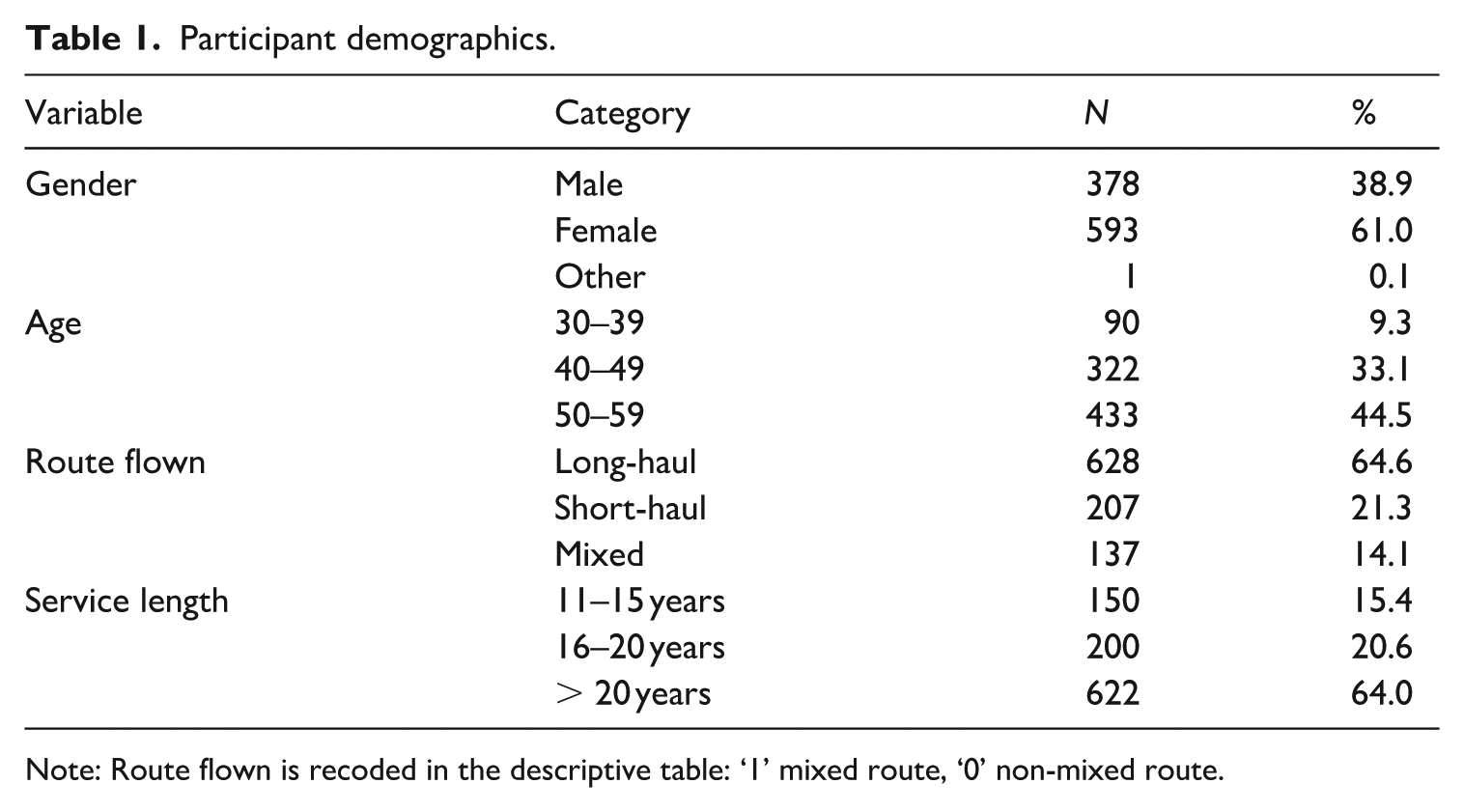
Note: Route flown is recoded in the descriptive table: ‘1’ mixed route, ‘0’ non-mixed route.
Measures
Validated scales ensured construct validity, with full items listed in Appendix 1 for transparency and replicability. We used the UK Health and Safety Executive’s Management Standards Indicator Tool (HSE‑MS IT), which has been validated for assessing workplace stress and wellbeing (Edwards et al., 2008).
An eight-item scale from the UK’s HSE MS-IT was used to measure work demands, which includes items such as ‘I have to work very intensively’. One item was removed due to poor factor loading (α = .787). Items were rated on a five-point Likert scale, ranging from ‘1’ never to ‘5’ always.
The measure for social support was also adopted from the HSE MS-IT. According to the Health and Safety Executive (HSE, n.d.: 3), this standard ‘includes the encouragement, sponsorship and resources provided by the organisation, line management and colleagues’. We used two scales, manager’s support (five items, α = .742) and peer support (four items, α = .732). One item from manager’s support was removed due to low factor loading. Sample items included ‘my line manager encourages me at work’. Items were rated on a five-point Likert scale, ranging from ‘1’ never to ‘5’ always.
Bullying and harassment comprised a four-item scale from the HSE-MS IT (α = .678). One item was removed due to low factor loading. Sample items included ‘I am subject to bullying at work’. These were rated on a five-point Likert scale, ranging from ‘1’ never to ‘5’ always. Instead of choosing the NAQ-R (Einarsen et al., 2009), which focuses on exposure to negative acts behaviours, we decided to adopt the HSE-MS IT scale for B&H as the union who sponsored the study would like to compare the exposure of B&H among UK cabin crew in comparison with UK’s WHS standards. The instrument is also deemed suitable for I/ER research (e.g. Toderi & Balducci, 2015).
The job insecurity measure was taken from the COPSOQ II (Pejtersen et al., 2010). There were four items (α = .803), including ‘are you worried about becoming unemployed?’ The items were rated on a five-point rating scale, ranging from ‘1’ to a very small extent to ‘5’ to a very large extent.
Burnout was measured with four items taken from the COPSOQ II (Pejtersen et al., 2010). Sample items included ‘how often have you been tense?’ and ‘how often have you felt worn out?’ These items were measured with five-point Likert scale, ranging from ‘1’ not at all to ‘5’ all the time (α=.837).
Control variables
Control variables (route flown, gender, age, service length) were included due to their established relationships with psychosocial risks and burnout, as they influence workload, stress exposure and workplace dynamics in aviation (e.g. McNeely et al., 2014). We controlled for route flown (‘1’short haul, ‘2’ long haul, ‘3’ mixed, ‘4’ domestic), gender (‘1’ male, ‘2’ female, ‘3’ other), age (‘1’ < 20 years, ‘2’ 20–29, ‘3’ 30–39, ‘4’ 40–49, ‘5’ 50–59, ‘6’ > 60) and service length (‘1’ < 6 months, ‘2’ 6–12 months, ‘3’ 1–5 years, ‘4’ 6–10 years, ‘5’ 11–15 years, ‘6’ 16–20 years, ‘7’ 21–25 years, ‘8’ 26–30 years, ‘9’ > 30 years). For hypothesis testing, we recoded the route flown into ‘1’ mixed route and ‘0’ non-mixed route.
Data analysis
Data were analysed following rigorous checks for sampling adequacy, data normality, construct validity and reliability to ensure analytical rigour (Podsakoff et al., 2024). The sample size (N = 972) exceeded the 10:1 parameter ratio, with 47 parameters yielding a ratio of 20.7:1 (Nunkoo et al., 2013). A priori power analysis using G*Power 3.1 (Faul et al., 2009) confirmed sufficient power, requiring a minimum sample of 172 for a medium effect size (f² = 0.15), power of 0.95 and 10 predictors (including controls). 1
Common method variance checks
To mitigate common method bias (CMB), we implemented procedural remedies including anonymous data collection, clear instructions, randomized item order and reverse-coded items, and complemented these with statistical diagnostics. Harman’s single-factor test indicated that a single factor accounted for only 25.2% of the variance, well below the 50% threshold typically viewed as problematic. We then estimated a common latent factor (CLF) in AMOS, loading onto all indicators with equal constraints and fixing its variance to 1. The CLF model exhibited excellent fit (χ²(243) = 342.447, χ²/df = 1.41, CFI = .988, TLI = .984, RMSEA = .021, SRMR = .065) and differed negligibly from the baseline confirmatory factor analysis (CFA) (Δχ² = .00, Δdf = 1, p > .05; ΔCFI = .000; ΔRMSEA = .000), indicating minimal method effects. Standardized CLF loadings averaged .15 (range ≈ .10–.19), implying that the CLF accounts for only ~2–3% of indicator variance on average. Substantive factor loadings changed by less than .20 after including CLF, confirming minimal distortion. Because our study did not include a theoretically valid marker variable and given documented misuse and limitations of marker techniques (e.g. bias when the marker is not truly orthogonal and errors in partial-correlation adjustments), we adopted the CLF/ULMC approach, which is a recognized CFA-based method for diagnosing and, where necessary, partialling out method variance (Podsakoff et al., 2024; Collier, 2020; Simmering et al., 2015; Richardson et al., 2009). Collectively, the procedural controls and CFA evidence suggest that any method variance present does not materially bias our substantive conclusions.
CFA was undertaken using IBM AMOS v29, following Anderson and Gerbing’s (1988) two-step approach, to validate a six-factor measurement model (job insecurity, work demands, B&H, managerial support, peer support, burnout), showing good fit (χ²[df = 268] = 452.308, CFI = .978, TLI = .973, RMSEA = .027, SRMR = .034; Hu & Bentler, 1999). Convergent validity was confirmed via significant factor loadings (> .50), and discriminant validity was established through chi-square difference tests comparing the six-factor model against alternative models (see Table 2).
Results of alternate model testing.
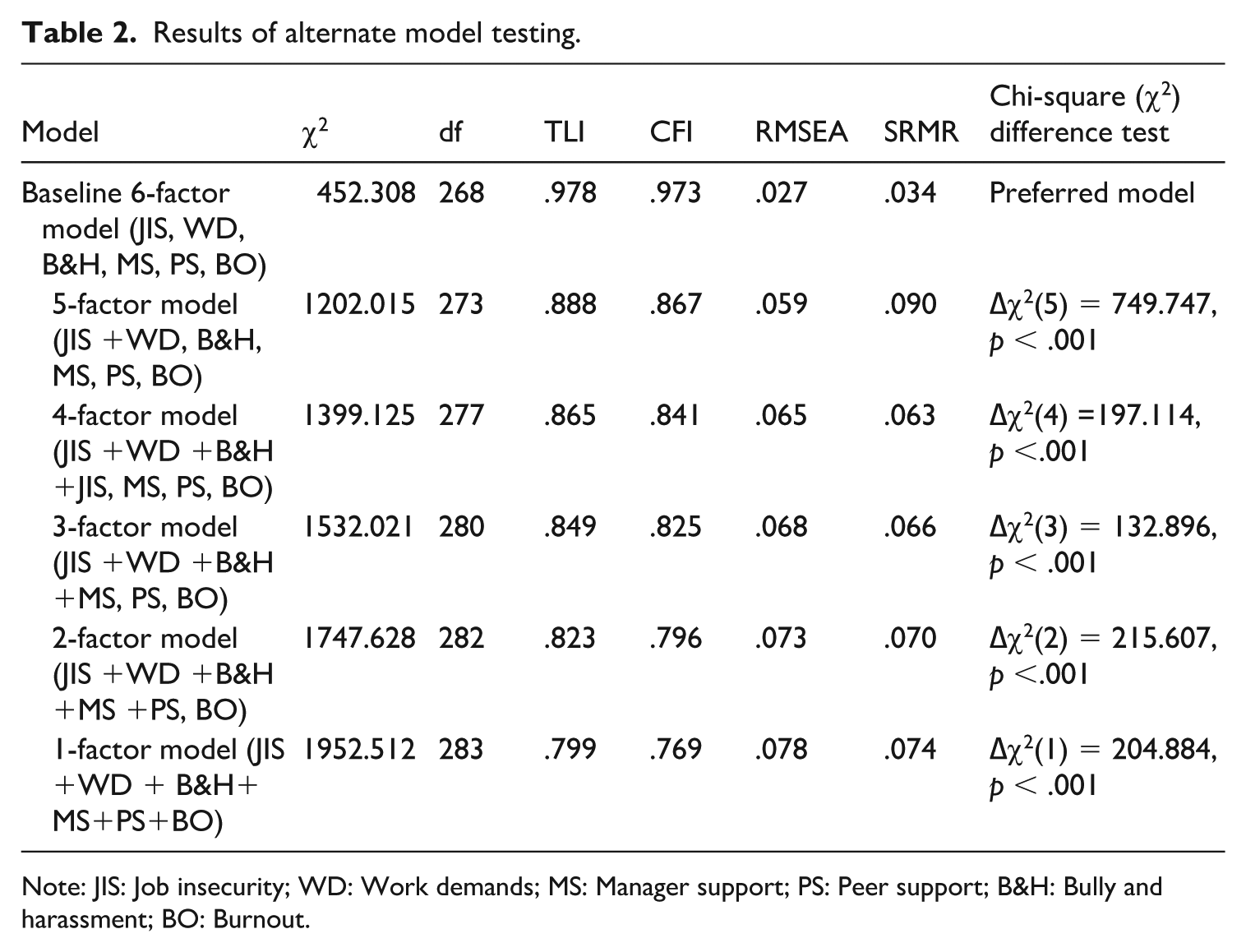
Note: JIS: Job insecurity; WD: Work demands; MS: Manager support; PS: Peer support; B&H: Bully and harassment; BO: Burnout.
Path analysis was conducted using IBM AMOS v30, with variables mean-centred to reduce multicollinearity. Given the single-wave, self-reported design, we interpret directional arrows as reflecting theoretical expectations (COR loss spiral) rather than observed temporal precedence; estimates therefore represent associations consistent with the theory-guided sequence. The model tested direct and indirect effects, with work demands and B&H as mediators and managerial and peer support as moderators, using 5000 bootstrap iterations to estimate conditional effects and R² values for model performance.
Alternative model comparisons (robustness check)
To respond to reviewer concerns about plausible reverse ordering among burnout, B&H and perceived job insecurity, we estimated two reverse-path models in AMOS and compared their global fit against the hypothesized specification. Reverse Model 1 treated burnout as an antecedent of B&H. Reverse Model 2 treated burnout as an antecedent of perceived job insecurity. In both cases, models were specified to maintain identification using the same measurement and control structure as the preferred model. We report comparative goodness-of-fit indices in Appendix 2.
Findings
Descriptive statistics and intercorrelations (Table 3) indicated heightened psychosocial risks and burnout among UK cabin crew with frequent work demands (M = 3.16, SD = 0.69) and burnout (M = 3.07, SD = 0.76), and notable job insecurity (M = 2.89, SD = 1.08) and B&H (M = 2.58, SD = 0.67). Managerial support (M = 2.72, SD = 0.82) was lower than peer support (M = 3.66, SD = 0.66), suggesting stronger collegial support, though transient schedules may limit peer cohesion.
Descriptive statistics and intercorrelations.
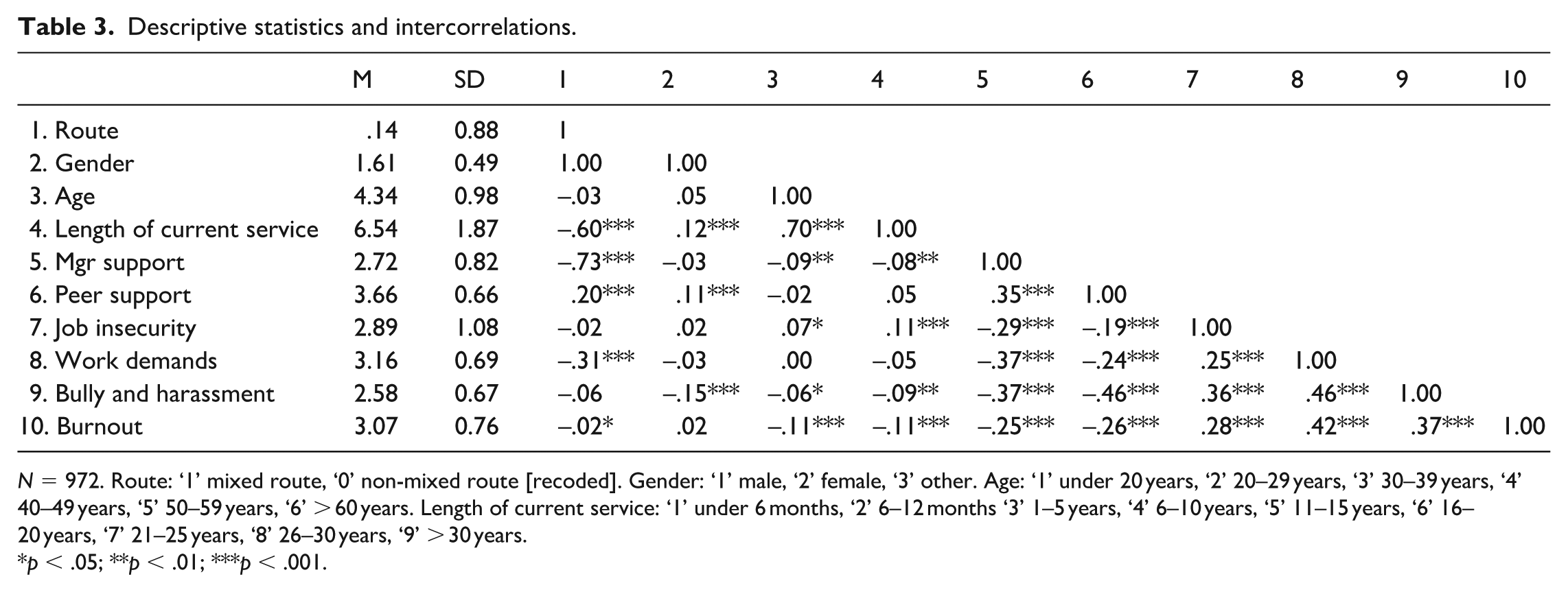
N = 972. Route: ‘1’ mixed route, ‘0’ non-mixed route [recoded]. Gender: ‘1’ male, ‘2’ female, ‘3’ other. Age: ‘1’ under 20 years, ‘2’ 20–29 years, ‘3’ 30–39 years, ‘4’ 40–49 years, ‘5’ 50–59 years, ‘6’ > 60 years. Length of current service: ‘1’ under 6 months, ‘2’ 6–12 months ‘3’ 1–5 years, ‘4’ 6–10 years, ‘5’ 11–15 years, ‘6’ 16–20 years, ‘7’ 21–25 years, ‘8’ 26–30 years, ‘9’ > 30 years.
p < .05; **p < .01; ***p < .001.
Alternative model comparisons
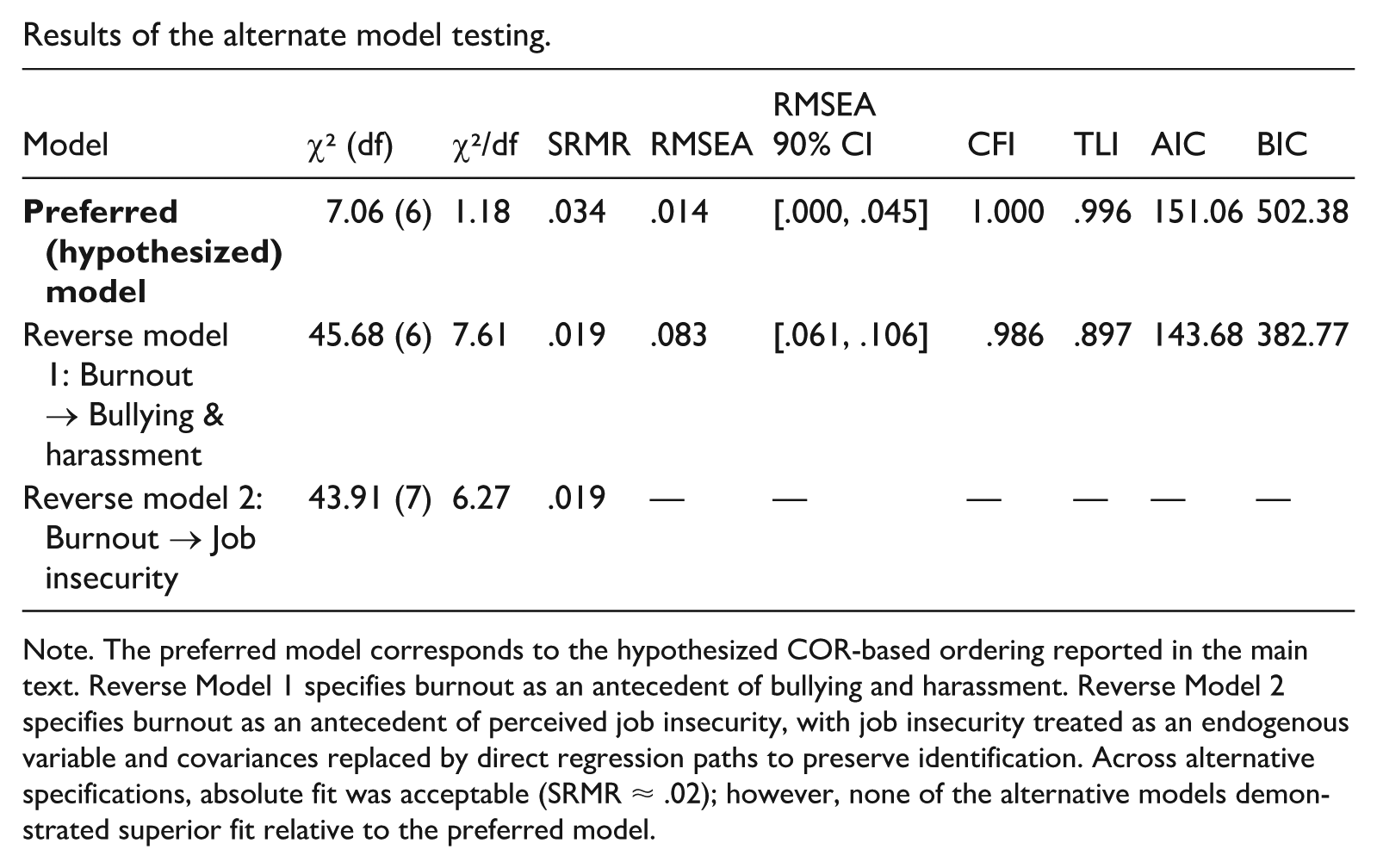
As explained in the Methods section, we conducted a robustness check for alternative directional explanations, by comparing the hypothesized model with two reverse-path specifications. As reported in Appendix 2, the preferred model demonstrated excellent fit to the data (χ²(6) = 7.06, χ²/df = 1.18, CFI = 1.000, TLI = .996, RMSEA = .014 [.000, .045], SRMR = .034). Reverse Model 1 (burnout → B&H) showed weaker fit overall (χ²/df = 7.61, CFI = .986, TLI = .897, RMSEA = .083 [.061, .106], SRMR = .019). Reverse Model 2 (burnout → job insecurity) also failed to outperform the preferred model (χ²(7) = 43.91, χ²/df = 6.27, SRMR = .019). Consistent with a COR-informed ordering, comparative fit favoured the preferred specification, while recognizing that cross-sectional data do not establish temporal precedence.
Direct effects
Direct effect hypotheses were largely supported (Table 4), with effect sizes per Cohen’s (1988) benchmarks. Job insecurity predicted work demands (H1, β = .1352, p < .001) and B&H (H2, β = .1599, p < .001), supporting regime-contingent pathways. Job insecurity also predicted burnout (H3, β = .1488, p < .001). Work demands predicted B&H (H4, β = .2831, p < .001) and burnout (H5, β = .2831, p < .001). B&H predicted burnout (H6, β = .1544, p < .001). Managerial support reduced work demands (H8a, β = –.2730, p < .001) and B&H (H9a, β = –.1599, p < .001). Peer support reduced work demands (H8b, β = –.0873, p < .01), B&H (H9b, β = –.3356, p < .001) and burnout (H10b, β = –.0850, p < .05). Managerial support’s effect on burnout (H10a, β = –.0553, p = .0674) was non-significant.
Results of path analyses: Direct hypotheses testing.
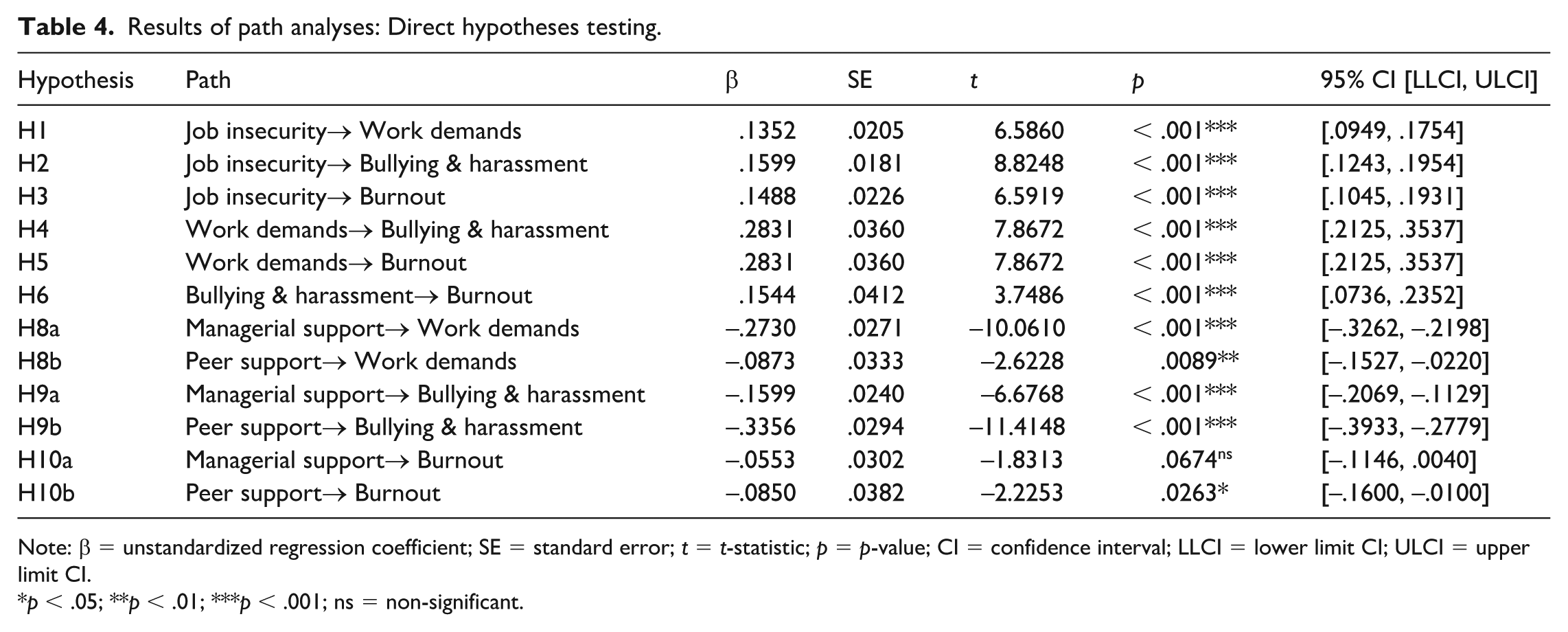
Note: β = unstandardized regression coefficient; SE = standard error; t = t-statistic; p = p-value; CI = confidence interval; LLCI = lower limit CI; ULCI = upper limit CI.
p < .05; **p < .01; ***p < .001; ns = non-significant.
Mediation and moderation analyses
Sequential mediation was supported (H7), confirming a resource loss spiral (job insecurity → work demands → B&H → burnout; indirect effect = .006, SE = .002, 95% CI [.003, .010], p = .002). The direct effect of job insecurity on burnout (H3) remained significant, indicating partial mediation. Only managerial support significantly moderated the job insecurity to B&H relationship (H12a, β = –.0572, p = .0086), attenuating effects at higher support levels (e.g. high: β = .0931, p < .01; low: β = .2267, p < .001; see Figure 1). Other moderations were non-significant (H11, H12b, H13, H14 and H15).
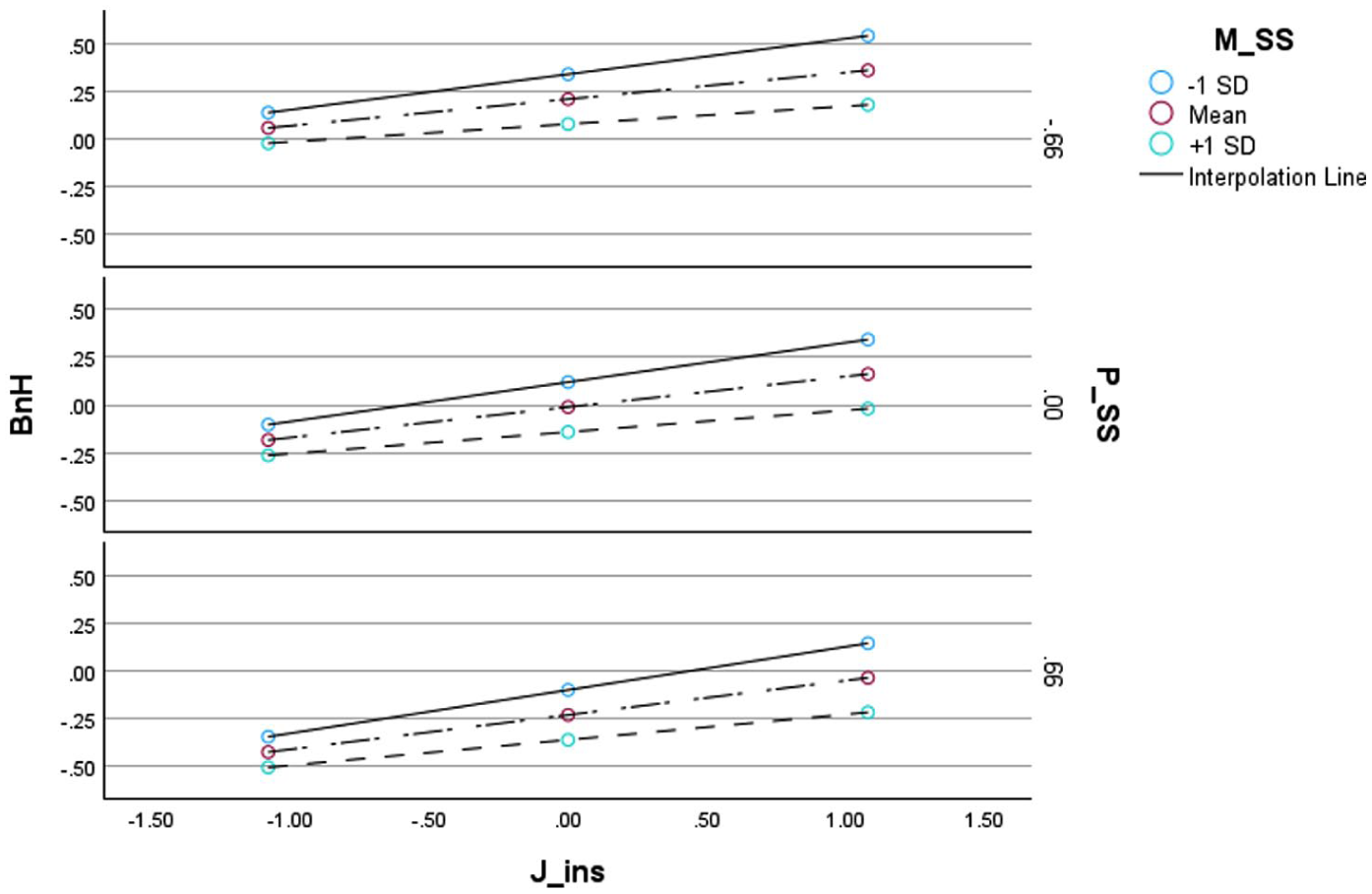
Results of moderation analysis.
Discussion and implications
This study investigates job insecurity, work demands and B&H as psychosocial WHS hazards driving burnout among UK cabin crew, integrating COR theory with an I/ER and WHS lens to test a multi-pathway model in neoliberal aviation regimes. It aims to validate a resource loss spiral, and assess managerial and peer social support’s buffering roles. Findings confirm that job insecurity directly predicts work demands, B&H and burnout; work demands predict B&H and burnout; and B&H predicts burnout. These findings suggest support for a sequential mediation from job insecurity to burnout via a loss spiral from job insecurity through work demands and B&H. Managerial support reduces work demands and B&H, as does peer support, though managerial support’s effect on burnout is non-significant. Only managerial support moderates the effect from job insecurity to B&H.
Theoretical implications
This study advances psychosocial risk research by applying COR theory and industrial relations frameworks to UK cabin crew, demonstrating how neoliberal employment regimes – characterized by casual contracts, volatile rostering and diminished collective bargaining – amplify job insecurity, work demands and B&H, driving burnout in a safety-critical aviation context. The direct effects hypotheses (H1–H3) were fully supported, with job insecurity predicting work demands (H1), B&H (H2) and burnout (H3).
The present findings align with evidence from linked survey–register studies showing that job insecurity and employment instability have durable health consequences beyond subjective distress. For example, Burgard et al. (2012) demonstrate that register-confirmed job instability predicts subsequent health decline, lending support to the interpretation of job insecurity as a structural exposure embedded in employment systems. Our results extend this logic to aviation by showing how insecurity operates in tandem with work demands and relational strain to produce burnout in a safety-critical setting.
The link between job insecurity and work demands aligns with Kalleberg’s (2011) non-aviation study on precarity driving compensatory effort and is supported in aviation by Harvey et al. (2019), who document how insecure contracts increase workload pressures among female-dominated cabin crew roles. The association with B&H supports Salin’s (2003) non-aviation findings on power asymmetries in neoliberal workplaces, while Harvey and Turnbull (2006), an aviation-specific study, show how airline hierarchical structures exacerbate relational strain. The path to burnout aligns with Allan et al.’s (2021) non-aviation review on precarious work’s psychological toll and Standing’s (2011) conceptualization of the precariat’s emotional insecurity. Our findings align with Blom et al. (2018), who show that job insecurity depletes psychological resources and heightens the risk of burnout. They are reinforced by Jorens and Valcke (2025), who report that 63% of aviation workers, including cabin crew, experience exhaustion linked to job insecurity. This study’s contribution lies in empirically validating these pathways, where lean staffing and transient teams intensify resource depletion, threatening cabin crew’s resilience and safety-critical performance.
The downstream direct effects (H4–H6) were also supported, with work demands predicting B&H (H4) and burnout (H5), and B&H predicting burnout (H6). The link between work demands and B&H extends Farley et al.’s (2023) systematic review where demands are identified antecedent to B&H. This is supported by findings from an aviation sample (Nogues et al., 2021) where intense scheduling and passenger-related pressures heighten psychosocial risks and interpersonal strain. The demands-to-burnout path aligns with Cousins et al.’s (2004) non-aviation UK HSE MS on work-related stress (Jorens and Valcke, 2025; Nogues et al., 2021) as rostering pressures consistently driving cabin crew exhaustion. The B&H-to-burnout effect supports Rossiter and Sochos’s (2018) non-aviation study on relational erosion. This aligns with Hutchinson’s (2012) IR framing of B&H as a governance failure, sustained by managerial discretion and weak grievance systems in deregulated employment markets. The current study’s aviation-specific contribution lies in demonstrating how these effects unfold amid cabin crew’s unique stressors – irregular rosters, high workloads and hierarchical interactions, modulated by workforce characteristics like gender and tenure – offering critical insights for WHS interventions to enhance workforce sustainability in safety-critical tourism industries.
Managerial support significantly attenuated the relationship between job insecurity and B&H (H12a), highlighting the protective role of institutional mechanisms such as grievance systems, rostering control and procedural justice (Gollan et al., 2015; Hoel and Beale, 2006). This aligns with UK WHS guidance, which positions managerial support as a core domain for mitigating psychosocial risk (Health and Safety Executive, 2007). Peer support, while negatively associated with burnout (H10b), did not significantly moderate most pathways, likely due to aviation’s transient team structures that constrain relational continuity (Folke and Melin, 2024; Thompson, 2013).
Mixed route exposure was associated with elevated work demands and burnout, while male and newer crew reported greater mistreatment – underscoring precarity’s gendered and tenure-based impacts. These results extend prior research by situating job insecurity and B&H within aviation’s customer-facing environment, where scheduling volatility and passenger aggression amplify strain (Mansour and Azeem, 2024).
This study contributes to COR theory by validating a multi-pathway model of resource loss in a high-risk, under-researched sector. The direct effect from job insecurity to work demands (H1) demonstrates how object resource loss (employment instability) drives energy depletion, intensifying workload for cabin crew where volatile rostering risks fatigue and safety errors (Hobfoll et al., 2021). This pathway is reinforced by Chung and van Oorschot (2011), who show that employment insecurity is not merely perceptual but institutionally contingent, shaped by weakened labour protections and deregulated employment regimes. In aviation, where such protections are minimal, job insecurity becomes a systemic hazard embedded in organizational design. The positive associations between work demands and both B&H and burnout reinforce COR’s principle of energy loss spirals and are consistent with findings that workload escalation predicts verbal abuse and emotional exhaustion in cabin crew (Mansour and Azeem, 2024; Nogues et al., 2021). The link between B&H and burnout supports condition resource erosion logic, validated by studies showing that sustained bullying predicts emotional fatigue even when controlling for demands (Rossiter and Sochos, 2018; Djurkovic et al., 2004). Our findings demonstrate what Gallie et al. (2017) emphasize as the ‘hidden face’ of job insecurity (as shown by the psychosocial hazards in the current study), which initiates resource loss but also destabilizes interpersonal dynamics, compounding burnout risk.
Although prior studies have examined individual links, such as job insecurity predicting role conflict or bullying (Baillien and De Witte, 2009), or bullying predicting burnout (Djurkovic et al., 2004), while others have tested parallel pathways (Farley et al., 2023), no research to date has integrated these constructs into a single, sequential mediation model. While causality cannot be inferred due to the single-wave, cross-sectional design, the sequential mediation model offers exploratory support for a COR-informed loss spiral, with job insecurity escalating both work demands and B&H, culminating in burnout. Our study addresses this gap, capturing the multidimensional nature of resource loss within a structurally precarious, employment regime. This study reframes psychosocial hazards as employment-level threats. Job insecurity, work demands and B&H are institutionalized exposures shaped by employment relations. This challenges psychological models of stress and burnout and supports calls for collective, WHS interventions (Health and Safety Executive, 2020).
Managerial and policy implications
In this study, job insecurity was found to be the direct and indirect predictor of burnout among UK cabin crew, triggering resource loss spirals. Strengthening collective bargaining through job security clauses, transparent redeployment policies and union involvement in restructuring can restore object resources and reduce burnout. Institutional protections, as shown by Chung and van Oorschot (2011), buffer against insecurity-related stress, particularly in coordinated market economies.
Work demands are shaped by rostering, staffing and performance systems. Cabin crew could actively participate in working with their line manager in designing their workload via scheduling and task design. For instance, joint rostering committees could be established, fatigue monitoring and participation in assessing workload intensity – thus, aligning with ISO 45003’s emphasis on collective psychosocial risk management. These mechanisms help reduce energy depletion and reassert democratic control over work organization.
As shown in this study, B&H represent threats to condition resources, often arising in employment contexts with weak procedural justice. Mistreatment tends to flourish where grievance systems are ineffective and managerial discretion is unchecked. The findings support union-backed anti-bullying frameworks, including independent reporting, mandatory training and enforceable sanctions. These measures not only protect workers but also reinforce industrial citizenship by restoring dignity and voice. ILO Convention 190 has been used in parts of Europe to embed enforceable anti-harassment clauses into collective agreements (International Trade Union Confederation, 2024). UK airlines can draw on these examples to strengthen protections. Confidential reporting systems could offer additional insight into relational risks and should be supported through transparent follow-up.
Predictive rostering and stable scheduling can reduce job insecurity and excessive work demands, supporting both employee wellbeing and operational reliability (Mansour and Azeem, 2024). Training managers in conflict resolution helps prevent mistreatment and promotes relational stability (Sender et al., 2017). Anonymous reporting and enforceable anti-bullying procedures are essential in hierarchical settings where power asymmetries persist (Hoel and Beale, 2006). However, bullying persists even in airlines with union collaboration, which raised questions about whether these mechanisms are trusted, independent or enforced. Managerial control and weak procedural justice should be improved to provide cabin crew with a psychosocially safe workplace (Dollard et al., 2012). The distinct roles of managerial and peer support suggest that interventions must be both structurally embedded and socially responsive. Managers should be appraised on relational indicators (using HSE MS-IT scores and grievance rates) in additional to operational metrics. Union-led WHS initiatives are critical to addressing the structural sources of psychosocial risk. Measures should include enforceable rostering standards, grievance procedures and participative governance that restore employee voice and procedural fairness.
Limitations and directions for future research
This study’s single-wave, cross-sectional design could limit causal inference (Podsakoff et al., 2024), especially for the exploratory, sequential mediation finding. Future research should incorporate multi-source data, such as managerial or union representative reports on workplace conditions, or objective indicators like rostering records and grievance filings, to triangulate findings and enhance validity. Future research could use a longitudinal research design or multi-source data to further validate the exploratory sequential hypothesis. Methodological refinements, such as marker variables or temporally separated measures, can enhance robustness against common method bias.
Although our post-hoc diagnostics (Harman’s single-factor test and the CLF approach) indicated negligible method effects, and standardized CLF loadings averaging .15, future studies should incorporate additional methodological refinements, such as marker variables or temporally separated measures, to further enhance robustness against common method bias and strengthen causal interpretations.
The empirical analysis is based on a single UK airline with a predominantly long-tenured cabin crew workforce. While this constrains statistical generalization to the global aviation industry, it supports theoretical and institutional generalization by holding organizational governance, safety systems and employment relations constant. The tenure profile reflects the employment structure of legacy UK carriers rather than sampling bias. Importantly, long tenure does not preclude exposure to insecurity in deregulated sectors; rather, it may intensify perceived loss associated with restructuring, redeployment risk and the erosion of established protections, consistent with research on insider precarity in liberal market economies (Gallie et al., 2017; Chung and van Oorschot, 2011). The findings therefore illuminate psychosocial hazard processes within established internal labour markets, a segment underrepresented in aviation research that often focuses on short-tenure or contract-based workers.
Future research should adopt comparative designs across aviation employment regimes, including low-cost carriers, franchise models and weakly unionized contexts, to examine how institutional arrangements moderate the relationships among job insecurity, work demands, B&H and burnout. Such comparisons would clarify the boundary conditions of the proposed model across heterogeneous labour regimes, staffing models and route structures. The findings should therefore be interpreted as theoretically generalizable to deregulated aviation employment regimes rather than statistically representative of the global airline industry.
Finally, the 2019 dataset predates the COVID-19 pandemic and may not fully capture subsequent shifts in precarity and workload intensification. Updated post-pandemic data are needed (Mansour and Azeem, 2024). Future studies should also examine reverse or reciprocal pathways between work demands and job insecurity (Jiang et al., 2021) and explore additional contextual resources, such as psychosocial safety climate, as potential buffers of B&H, consistent with COR’s resource caravan logic (Dollard et al., 2012).
Conclusion
This study shows that neoliberal precarity in UK commercial aviation, characterized by casual contracts, volatile rostering and weakened collective bargaining, drives job insecurity, work demands and relational mistreatment. These conditions erode cabin crew’s psychological and social resources and heighten burnout. Drawing on COR theory, the path analysis supports a loss spiral in which job insecurity, operating as a regime-level threat, prompts compensatory effort that increases work demands and exposure to mistreatment, ultimately undermining safety-critical performance and wellbeing. A central contribution is the empirical evidence that job insecurity precedes work demands, which challenges existing meta-analytic findings. The study also demonstrates that managerial support moderates the link between job insecurity and B&H, underscoring the structural nature of precarity in aviation’s transient and hierarchical environment. Union-led WHS reforms and more stable rostering systems are essential to interrupt these spirals and strengthen psychosocial safety and workforce sustainability in safety-critical sectors.
Footnotes
Appendix 1
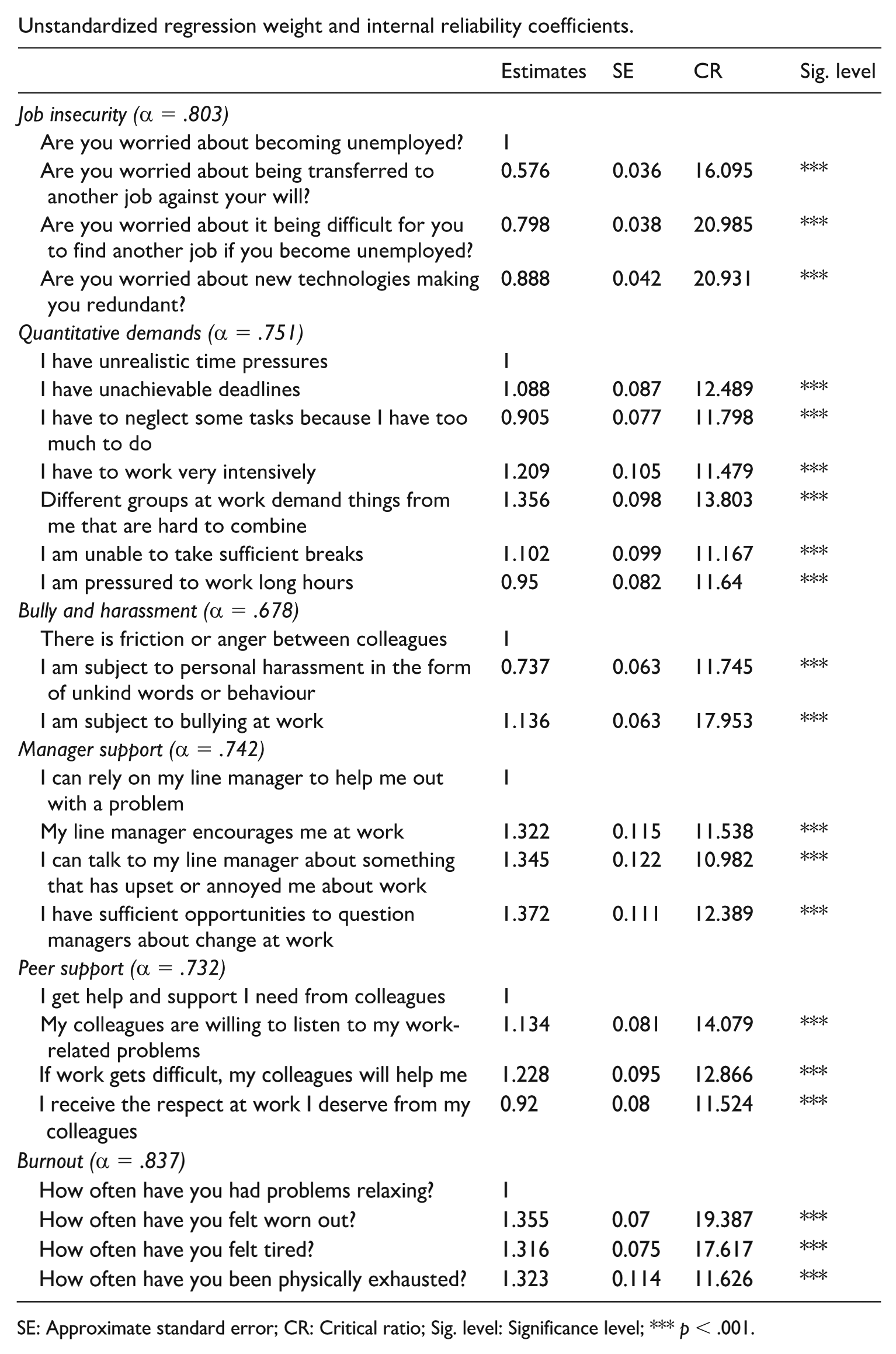
Unstandardized regression weight and internal reliability coefficients.
| Estimates | SE | CR | Sig. level | |
|---|---|---|---|---|
| Job insecurity (α = .803) | ||||
| Are you worried about becoming unemployed? | 1 | |||
| Are you worried about being transferred to another job against your will? | 0.576 | 0.036 | 16.095 | *** |
| Are you worried about it being difficult for you to find another job if you become unemployed? | 0.798 | 0.038 | 20.985 | *** |
| Are you worried about new technologies making you redundant? | 0.888 | 0.042 | 20.931 | *** |
| Quantitative demands (α = .751) | ||||
| I have unrealistic time pressures | 1 | |||
| I have unachievable deadlines | 1.088 | 0.087 | 12.489 | *** |
| I have to neglect some tasks because I have too much to do | 0.905 | 0.077 | 11.798 | *** |
| I have to work very intensively | 1.209 | 0.105 | 11.479 | *** |
| Different groups at work demand things from me that are hard to combine | 1.356 | 0.098 | 13.803 | *** |
| I am unable to take sufficient breaks | 1.102 | 0.099 | 11.167 | *** |
| I am pressured to work long hours | 0.95 | 0.082 | 11.64 | *** |
| Bully and harassment (α = .678) | ||||
| There is friction or anger between colleagues | 1 | |||
| I am subject to personal harassment in the form of unkind words or behaviour | 0.737 | 0.063 | 11.745 | *** |
| I am subject to bullying at work | 1.136 | 0.063 | 17.953 | *** |
| Manager support (α = .742) | ||||
| I can rely on my line manager to help me out with a problem | 1 | |||
| My line manager encourages me at work | 1.322 | 0.115 | 11.538 | *** |
| I can talk to my line manager about something that has upset or annoyed me about work | 1.345 | 0.122 | 10.982 | *** |
| I have sufficient opportunities to question managers about change at work | 1.372 | 0.111 | 12.389 | *** |
| Peer support (α = .732) | ||||
| I get help and support I need from colleagues | 1 | |||
| My colleagues are willing to listen to my work-related problems | 1.134 | 0.081 | 14.079 | *** |
| If work gets difficult, my colleagues will help me | 1.228 | 0.095 | 12.866 | *** |
| I receive the respect at work I deserve from my colleagues | 0.92 | 0.08 | 11.524 | *** |
| Burnout (α = .837) | ||||
| How often have you had problems relaxing? | 1 | |||
| How often have you felt worn out? | 1.355 | 0.07 | 19.387 | *** |
| How often have you felt tired? | 1.316 | 0.075 | 17.617 | *** |
| How often have you been physically exhausted? | 1.323 | 0.114 | 11.626 | *** |
SE: Approximate standard error; CR: Critical ratio; Sig. level: Significance level; *** p < .001.
Appendix 2
Results of the alternate model testing.
| Model | χ² (df) | χ²/df | SRMR | RMSEA | RMSEA 90% CI | CFI | TLI | AIC | BIC |
|---|---|---|---|---|---|---|---|---|---|
|
|
7.06 (6) | 1.18 | .034 | .014 | [.000, .045] | 1.000 | .996 | 151.06 | 502.38 |
| Reverse model 1: Burnout → Bullying & harassment | 45.68 (6) | 7.61 | .019 | .083 | [.061, .106] | .986 | .897 | 143.68 | 382.77 |
| Reverse model 2: Burnout → Job insecurity | 43.91 (7) | 6.27 | .019 | — | — | — | — | — | — |
Note. The preferred model corresponds to the hypothesized COR-based ordering reported in the main text. Reverse Model 1 specifies burnout as an antecedent of bullying and harassment. Reverse Model 2 specifies burnout as an antecedent of perceived job insecurity, with job insecurity treated as an endogenous variable and covariances replaced by direct regression paths to preserve identification. Across alternative specifications, absolute fit was acceptable (SRMR ≈ .02); however, none of the alternative models demonstrated superior fit relative to the preferred model.
Acknowledgements
We would like to thank the cabin crew who took part in this research and the trade union officials who helped to facilitate access.

Ethical approval
Ethics approval was given by Northumbria University on 4 March 2018.
Informed consent statement
All participation was anonymous and voluntary, with individuals self‑selecting into the study. Recruitment occurred through trade union communication channels.
Funding
The authors received no financial support for the research, authorship, and/or publication of this article.
Declaration of conflicting interests
The authors declared no potential conflicts of interest with respect to the research, authorship, and/or publication of this article.
Data availability statement
The data that support the findings of this study are available on request from the corresponding author. The data are not publicly available due to restrictions imposed by institutional ethics review committee, who did not grant approval for data sharing. In addition, participants did not give written consent for their data to be shared publicly.