







Abstract
Sweden is renowned for its centralised wage bargaining system, which has been studied from the point of view of inflation, wage differentials and unemployment. This article studies media coverage of wage bargaining rounds in the 1950s–1960s and in the 2000s–2010s to investigate the social understanding of what the wage bargaining institutions are supposed to do. The results indicate that the operation of the wage bargaining system in the 2000s and of that in the postwar era are in fact understood very differently: while widely shared aims for wage bargaining rounds in the 1950s and 1960s were to a high degree formulated by the trade unions, trade union influence over the agenda was significantly weaker in the 2000s and 2010s, when external experts, not least from the financial sector, were to a much higher degree used to define and formulate what good bargaining outcomes would be.
Introduction
This article explores the embeddedness of wage bargaining in a wider societal context of ideas and expectations about macroeconomics and income distribution. Arguments have recently been made for analysing the role of ideas in industrial relations (Carstensen et al., 2022), and this article contributes to such discussions by way of an analysis of the changes in Swedish industrial relations, more specifically its wage bargaining institutions, since the postwar era. The article makes two contributions: one is to give a fuller understanding of the long run changes of wage bargaining institutions by bringing in the ideational perspective; the other is to speak to the literature on economic policy ideas and bring in the quotidian reality of wage bargaining to shed new light on changing ideas of political economy.
In many ways, the Swedish coordinated wage bargaining system of today resembles the centralised system of the 1950s and 1960s. Wage bargaining is still highly coordinated (ICTWSS, 2019) and about 90% of employees are covered by collective agreements (Kjellberg, 2019: 51). Indeed, Baccaro and Howell (2017: 143–144), in a study which finds widespread liberalisation of labour markets, admit that ‘On the surface at least, Sweden appears to have largely resisted the liberalization of industrial relations institutions.’ However, Baccaro and Howell argue that Swedish industrial relations since the 1980s have in fact been liberalised in several ways. One important way is through the de facto decentralised regulation of pay and working conditions, even when national collective agreements still exist (see also Thelen, 2014: 184), with increased pay inequality as a result. Another form of liberalisation in the formally similar industrial relations of Sweden is that collective bargaining today ‘serves to realize wage moderation’ (Baccaro and Howell, 2017: 169) in a more stringent way than before. Baccaro and Howell (2017: 169) conclude that ‘Institutional change has not primarily taken place through the wholesale destruction of existing institutions and construction of new ones’, but instead through the conversion of existing institutions. The analysis in this article is deeply influenced by the work by Kathleen Thelen (2009, 2014) and collaborators (Streeck and Thelen, 2005) on how institutions might change through processes such as drift – when an increasing share of the relevant field remains unaffected by the institution studied – or conversion – when an institution on the surface looks unchanged over time, but in practice performs differently.
In her seminal book Varieties of Liberalization and the New Politics of Social Solidarity (2014), Thelen also herself offered an analysis of the changes in Swedish industrial relations and the Swedish model. Thelen is more optimistic than Baccaro and Howell on the survival of solidarism in Swedish industrial relations, stressing the high degree of union organisation among relatively disadvantaged service sector workers, but she also sees a dualisation through ‘the top taking off’, when highly-skilled employees are less and less bound by collectively regulated wage growth and in fact have quite decentralised forms of wage setting (Thelen, 2014: 177, 184–187).
This article builds on these contributions. The investigation shows that wage bargaining is a central institution of Swedish society today, as it was in the 1950s, but that its ‘meaning context’ (Schmidt, 2008) has changed. In the 1950s and 1960s, wage bargaining was presented in newspapers as a benevolent administration of wages and other macro variables, performed by well-meaning administrators from trade unions and the employers’ organisation for the benefit of society as a whole. Mainstream newspapers presented wage increases as beneficial, and allotted trade union economists an important role as experts judging the macroeconomic situation. In the contemporary era, coverage is quite different, much more distanced and critical vis-a-vis the wage negotiators, shifting the umpiring of good macroeconomic outcomes to economists from the financial sector, who judge the performance of wage bargaining from the implied perspective of the world market. Thus, the common good is understood less in the national context of the postwar era (see Edgerton, 2019) and much more as an adjustment to the world market (see Fligstein, 1990).
This investigation sheds new light on an old puzzle: on the surface, Swedish industrial relations institutions look rather similar today to those of the 1960s, but in terms of outcome variables such as wage differentials, inflation and the wage share, outcomes are quite different (Baccaro and Howell, 2017; Thelen, 2014). It is the theoretical argument of this article that, beyond the conversion-as-decentralisation of bargaining as mapped by Thelen and Baccaro and Howell, and the drift described by Thelen as ‘the top taking off’, this difference depends precisely on the changing norms and expectations that the labour market institutions are embedded in. This is a kind of institutional conversion through changes in the ascribed meanings.
The Swedish model and its transformation
The wage bargaining round has since the 1940s been an important institution of Swedish society. TL Johnston, who in 1962 wrote a book about collective bargaining in Sweden, described the almost ritualistic seasonality of a bargaining round – from the speculations and floated ideas of the summer until the first meetings on the union side and employer side in the autumn, the concrete statements and demands around December, and then months of demands and counter-demands, arguments and ripostes. ‘The negotiations were and are frequently physically exhausting’, wrote Johnston (1962: 264–267, 271), and this very public wrestling match carried cultural and social significance for the ‘audience’, the Swedish public.
The Swedish wage bargaining system has been amply studied and has been an important case for theories and explanations centring on social coalitions and institutional change (Baccaro and Howell, 2017: ch. 8; Swenson, 2002; Thelen, 2014: ch. 7), and the economic effects of various wage bargaining systems (Calmfors and Driffill, 1988). More specifically, postwar Sweden is the paragon of centralised wage bargaining, analysed in a large body of work by political scientists, economists and industrial relations scholars interested in the consequences of wage bargaining systems for income distribution, inflation and growth (e.g. Bengtsson, 2015; Moene and Wallerstein, 1995). Bargaining was centralised at the confederation level from 1956 to 1983. This meant that for every wage round, typically every second year (the agreements varied in length, typically from one to three years), the trade union confederation LO and the employers’ organisation SAF appointed their own bargaining committees, and these committees were responsible for hammering out the agreements framing the collective agreements for virtually the entire workforce. 1
The era of central bargaining ended in 1982–1983 when the metal workers’ union and its counterparts, the engineering companies, withdrew (Thörnqvist, 1999; Wallerstein and Golden, 1997). This ushered in a 15-year era of sectoral bargaining, which was plagued by wage competition between unions and very high inflation from 1982 to the deep financial crisis that the country experienced from 1991 to 1994. When it receded, the government created a commission to re-order the wage bargaining system, and a new system of sectoral but coordinated bargaining was built. The foundation of the system is that manufacturing industry bargains first and that everyone else follows its norm (see Elvander, 2002; Thelen, 2014: 182–187). Since 1997, as many collective agreements within the coordinated system have become less binding and less detailed, major de facto decentralisations have occurred (Baccaro and Howell, 2017: 161–163; Thelen, 2014: 184).
The transformation of the Swedish model in a wider sense since the 1980s – less trade union influence over labour market and society, lower and less redistributive tax rates, less generous welfare provisions – has been explored in many important studies of the politics of social policy and economic policy (Andersson, 2003; Blyth, 2002; Lindvall, 2004); the changing regimes of capital accumulation (Ryner, 2002); the changing functioning of working-class parties (Mudge, 2018); and other factors. To this debate on the liberalisation among Social Democratic regimes, this article adds something new by studying not political ideas nor the policies which are central but have been treated in several excellent studies, but rather by studying the practice of labour market institutions. Its subject is not principled debates but the daily, ephemeral discussions on what wage bargaining institutions do, in two different contexts: the postwar era and the 2000s.
Theoretical discussion: Ideas and wage bargaining institutions
Recently, researchers have paid increasing attention to the importance of ideas in the analysis of labour market institutions generally, and wage bargaining institutions more specifically. McLaughlin and Wright (2018) show, for example, how the ideational debate among social partners and policymakers has mattered in shaping the degree of liberalisation of labour market institutions in Britain, Australia, New Zeeland and Ireland. Here, as in the theoretical arguments on discursive institutionalism by Blyth (2002) and Schmidt (2008, 2010), ideas are especially important in how they shape political and institutional choices, especially at critical junctures – episodes when momentous political and societal decisions are made.
This is not the design of the present article. I compare the postwar era and the contemporary era but do not trace the change between them. Instead, the ideational dimension is studied here as a dimension of existing institutions. The rich previous literature on changes in social and economic policy in Sweden in the 1980s and 1990s (Andersson, 2003; Blyth, 2002; Lindvall, 2004) has traced shifts in economic policy discourse in those decades, with the shift away from Keynesian agendas central to the analyses. This article studies ideas in another way. Schmidt (2008) in her argument for discursive institutionalism separates three levels of ideas. The first and lowest is certain policies, the second is the general programme or paradigm of policy, such as Keynesianism (see Hall, 1993), and the third is ‘public philosophies’, which Schmidt (2008: 306) describes as ‘worldviews or Weltanschauung that undergird the policies and programs with organizing ideas, values, and principles of knowledge and society’. These views, she says, typically constitute the background of policy debate: shared assumptions that are contested in times of crisis but most of the time are invisible.
The comparative design of two eras serves precisely to highlight these background assumptions, not by studying crises or one worldview’s replacement of another, but instead by comparing the same practices – wage bargaining – in two very different temporal contexts. This comparison reveals, I argue, the ideational context of wage bargaining on the general level of worldviews discussed by Schmidt. More specifically, following recent studies of historians of political economy ideas from the postwar era to the current age (Offner, 2019; Sutcliffe-Braithwaite et al., 2021), the study highlights the shift from economic nationalism in the Social Democratic postwar era, to the globalised mindset of contemporary Swedish wage bargaining. The historian David Edgerton in his analysis of British economic and political history during the twentieth century points out that to properly understand the liberalisation of the final decades of the century, we must understand the role of economic nationalism in the postwar decades. Edgerton (2019: 378) introduces this argument thus: ‘Economic nationalism was an elusive idea which, if it did not exist as formal doctrine, was nonetheless a fundamental aspect of economic discourse, and clearly of practice. Everyday economic discussion in the 1940s to the 1970s was remarkably focused on the nation, on the balance of payments as a national profit and loss account, on exhortations to export or die, on production, efficiency, productivity, science and that new key word, technology, all in a national context.’ As I will show, postwar Swedish wage bargaining was suffused by such an economic nationalist Weltanschauung, and to understand the difference between the postwar Swedish political economy and the contemporary one, this change is important, just as the well-known shift away from the Keynesian policy paradigm (Blyth, 2002; Lindvall, 2004).
Let me take an example of this economic nationalism in the sources studied here. In May 1960, the trade union confederation LO’s chairman, Arne Geijer, turned 50. The newspaper of record Dagens Nyheter celebrated the trade union man in a panegyric mode, stating that Geijer in all functions was ‘praised or respected. People have talked of his calm, balance, judgement and wisdom. . . . He enjoys a compactly good reputation in all camps, it seems’, stated the paper, and speculated that in a time of crisis he could become a landsfader, a ‘father of the realm’ (DN, 4 May 1960). The uncritical praise for a union leader – and the quite explicitly patriarchal allusion to the kind of benevolent national leadership a union leader could exercise – is typical for the postwar age with its reverence for national leaders. Djerf-Pierre and Weibull (2001: esp. 170–174, 240–264) show that Swedish journalism of the 1950s and the first half of the 1960s tended to be rather uncritical, before the journalistic ethos in the years after 1965 shifted from what they refer to as ‘mirroring’ society, to what they term ‘scrutinising’ society (granskning). The scrutinising and more critical attitude of the late 1960s onwards coincided with the rise of popular individualism and a more critical popular attitude towards authorities (Lawrence, 2011; Sutcliffe-Braithwaite, 2018; for a Swedish discussion see Åberg, 2006). As we will see, the scrutinising attitude and the decline of deference to authorities is a difference also between the role of wage bargaining in the political economy today compared to the postwar era.
Method and sources
The methodological approach of this investigation is to use digitalised newspaper materials to study the coverage and interpretations of wage bargaining. I study the 1958–59, 1959–60, 1961–62, 1963–64 and 1965–66 wage bargaining rounds as representative of the postwar period, and the 2006–7, 2009–10, 2011–12, 2012–13 and 2015–16 rounds as representative of the contemporary era. 2
The choice to study and compare the postwar and contemporary eras demands further discussion. Most studies of the politico-economic change in Sweden that we might refer to as neoliberalism have focused on the 1980s and 1990s (beyond the references above, see also Boréus, 1994). Here I have chosen to study not the tumultuous years of the labour market in the 1980s and 1990s, but the presumably more stable periods of the 1950s–1960s and 2000s–2010s. This choice is guided by a sense that, then as now, there is an unexplored dimension to the wage bargaining system: the embedding of wage bargaining practices in social norms and expectations. Thus, the purpose here is not to furnish another explanation of the decentralisation of wage bargaining in the 1980s, but to provide a richer understanding of what the centralised wage bargaining system was and meant in the canonical postwar era, and of what the coordinated system is and does today. The investigation ends in 2016, but neither the Swedish bargaining system nor the overall macroeconomic discussion in Sweden has changed fundamentally since then.
The article builds on materials from the liberal daily Dagens Nyheter, the largest daily newspaper in the country; it represents a mainstream, respectable view of the wage bargaining system. For the bargaining rounds of 1965–66 and 2015–16 the sample is completed with articles from Svenska Dagbladet, the second largest daily, which is politically more conservative and historically has been close to the business community (see Grafström, 2006: 148–150). Dagens Nyheter was and is the leading paper, in terms of circulation but especially in terms of opinion. It became the most widely circulated paper in 1942 and grew from a circulation of 207,000 in 1945 to 341,000 in 1958, when it was outperformed by its tabloid colleague Expressen, owned by the same conglomerate. But, as the history of the Swedish press emphasises, ‘The leading position of Dagens Nyheter as vehicle of opinion, news and advertisement was not affected’ (Engblom, 2002: 67). Maria Grafström (2006: 135–145) in her history of business journalism in Sweden shows that Dagens Nyheter expanded its economic reporting in the 1960s and presents this, along with the parallel change at Svenska Dagbladet, as more generally indicative of economics reporting in Swedish dailies.
Thanks to the digitalisation of newspapers, articles about one topic over time can feasibly be searched using specific words. I tried using several words connected to the bargaining round – kollektivavtal, lönerunda, avtalsrunda, etc. – and by reading articles I concluded that the best search word was avtalsrörelse, literally ‘agreement movement’, a concept denoting the bargaining round and not used for anything else, which was crucial for searching the digitalised newspapers. 3 The frequency of the articles on this topic in Dagens Nyheter and Svenska Dagbladet from 1950 to 2019 is shown in Figure 1. The figure shows a clear temporal pattern, the same for both papers, with one long peak of bargaining round coverage, from the late 1960s to the late 1980s. As discussed above, I do not in fact study the turbulent decentralisation and re-centralisation in the 1980s and 1990s; as can be seen in Figure 1, this was a period when wage bargaining attracted much attention in the newspapers. Media history scholars have also highlighted the strength of ‘the world of labour’ and the trust awarded to union representatives in economics coverage in TV and newspapers in the 1970s and early 1980s (Djerf-Pierre and Weibull, 2001: 246–247; Viscovi, 2006). To specifically study the media context of wage bargaining in this period would be of interest for further research but the intention here is, as mentioned, to study not this period, but periods of greater stability in the postwar and contemporary eras.
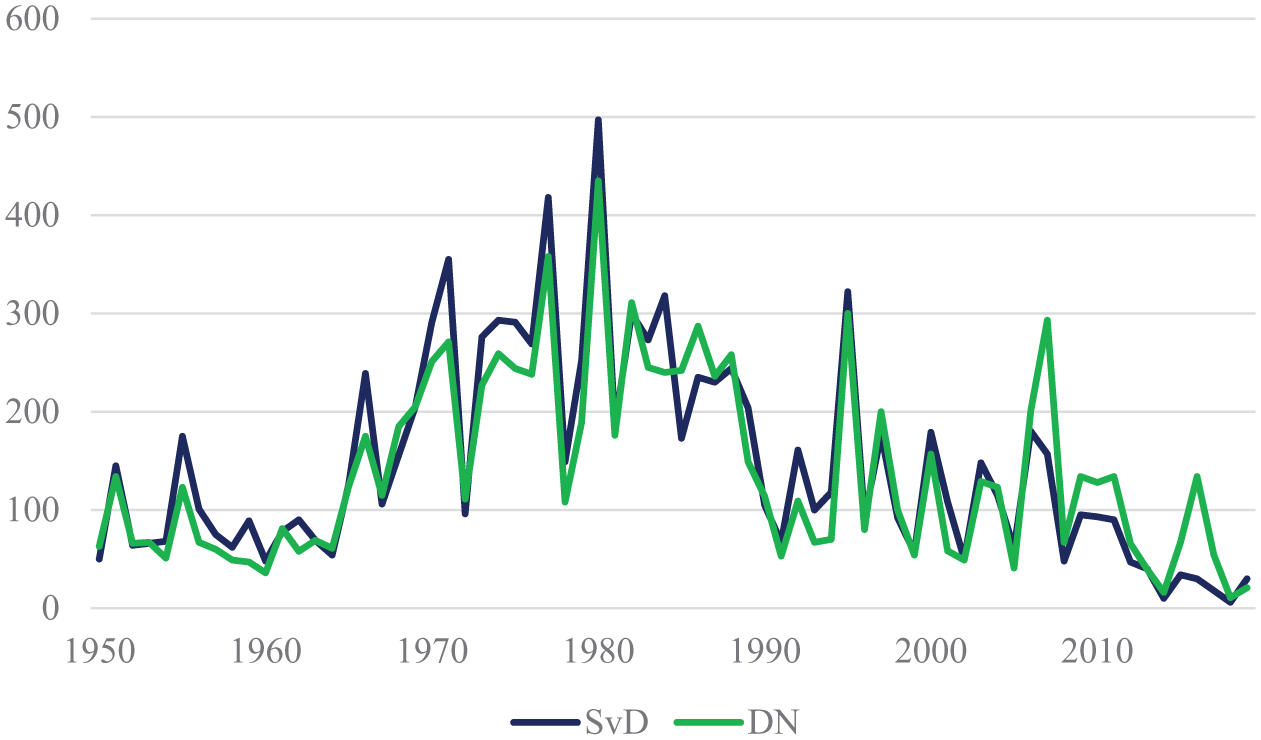
The number of articles containing the word ‘avtalsrörelse’ in Dagens Nyheter and Svenska Dagbladet, 1950–2019.
Wage bargaining in the postwar period
The Dagens Nyheter coverage of the wage bargaining rounds in the 1950s and 1960s was thorough and close to the negotiators. As Johnston (1962: 271) pointed out, wage bargaining was ‘frequently physically exhausting’, and the newspapers in these years reinforced this impression by close-up coverage. As an example, the coverage of the 1963–64 bargaining round began in earnest in October 1963 with coverage of an LO meeting with all 41 member unions, preparing for their first presentation of their demands vis-a-vis the employers. The coverage was quite neutral and comprehensive; on 12 October 1963, the next day, half of the back of the paper (then a broadsheet) was devoted to a rather imposing pictorial coverage of the LO kickstart (uppmarsch) of the bargaining round – see Figure 2.
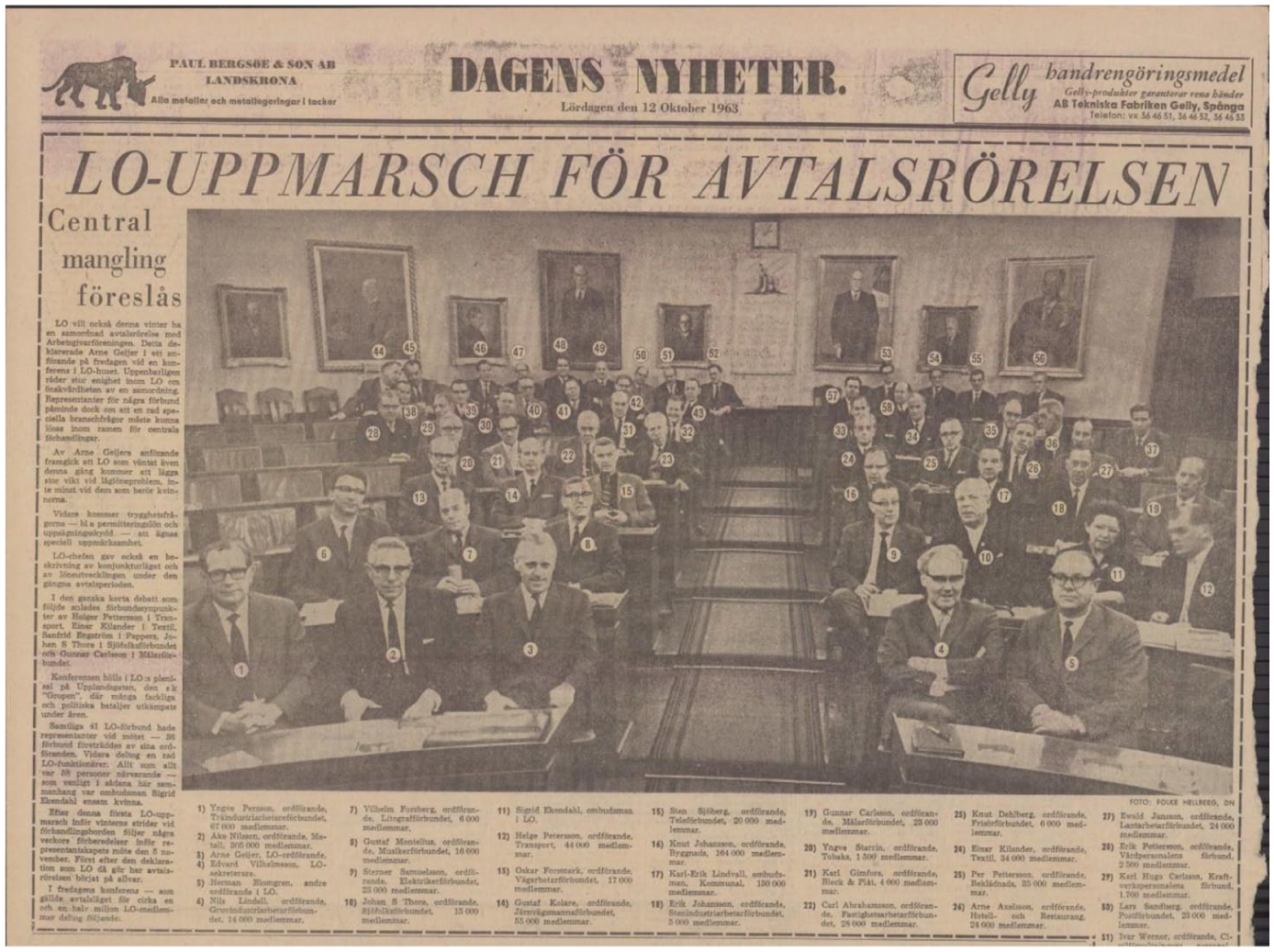
Photo of LO negotiators at the ‘kickstart’ to the 1963–64 bargaining round.
The coverage illustrated in Figure 2 is meaning-laden in that it introduces all the main actors on the trade union side: readers of a mainstream newspaper are assumed to be interested in the chairman of the textile workers’ union, or the pipe-fitters’ union. The newspaper created a sense of community with the negotiators, as with the panegyric coverage of the trade union leader Geijer referenced above. The sense of community with the negotiators was again evident in the 1965–66 bargaining round. In November 1965, Dagens Nyheter presented each person from the 38-man strong LO bargaining delegation, under a headline comparing wage bargaining to boxing: ‘SAF and LO are ready for the first round of negotiation’. 4 Likewise, Svenska Dagbladet prepared its readers this time for the imminent bargaining round with similar metaphors: ‘Today is the real start for the winter’s exciting games to fix the size of next year’s wages. . . . There are signs that it could be one of the most thrilling bargaining games that we have had in the post-war era’ (SvD, 16 November 1965).
Wage bargaining in the 1950s and 1960s was portrayed as important and exciting, and the newspaper coverage encouraged empathy with the people involved, through close-up reporting from the bargaining rooms. When the new collective agreements were due to be finished in March, newspaper headlines spoke of the ‘Long wait for the bargaining delegations’, yielding quotes like ‘We’ll get to the bottom of this tonight’, and alongside photos of coffee-drinking, tired negotiators: Percentages, statistics, proposals, objections. And waiting. Waiting in the so-called large bargaining delegations, groups of 10-20-30 people, for the chief negotiators – those who are in contact with a counterpart – to come back from the small rooms and report about the new arguments and the new situations.
5
A further example of the closeness to the wage negotiators in the newspaper coverage of the 1950s and 1960s is that the concept nattmangling, mangling sheets in the night, as a metaphor for the hard nights’ work of reaching agreements, became a recurrent trope in jokes and cartoons in Dagens Nyheter: a good-tempered way of joking about the powerful but responsible negotiators (a cartoon in DN, 12 February 1959; jokes in DN, 4 April 1962). Another example of the bargaining rounds being used as a metonym for orderly Swedish society is that on 30 November 1963 the newspaper’s cultural page claimed that the editor of the literary magazine BLM, Lars Gustafsson, had argued that time was ripe for a new debate on literary criticism, ‘because it’s been three years’. The DN writer commented sarcastically that ‘As in the usual bargaining round, the social partners (parterna) should sit down in their well-known places and establish their well-known positions.’ That the wage bargaining round could work as a metaphor for literary debates is, I think, indicative of the central role it occupied in Swedish society (and minds) in the 1960s. It is also important to note that coverage was very appreciative of the SAF and LO representatives, with a subtext something like: we should be grateful that these men, and a few women, 6 have taken upon themselves the hard job of bargaining to set our incomes and prices for the coming years.
The rather uncritical tone of Swedish journalism in the 1950s and the first half of the 1960s has been noted above (see Djerf-Pierre and Weibull, 2001: esp. 170–174, 240–264). However, it is still of importance in this context to note the relatively trade union-friendly coverage of these years. The leader page of DN in this period was led by the prominent political scientist Herbert Tingsten, who had had a well-publicised break with Social Democracy and is remembered as a staunch critic of the labour movement in the 1950s and 1960s (see Hadenius, 2002: 279–286, 309–316). This makes it all the more striking that the newspaper’s reporting was quite uncritical of the trade unions, as were its editorials. In the bargaining round of 1958–59, the leader page neutrally stated that the Swedish trade union movement was the strongest in the world, that the metal workers trade union had a 96.5% membership rate; the leader page spoke in defence of a strongly coordinated bargaining round to secure a central agreement for LO, SAF, the white-collar workers’ TCO and the farmers’ organisation (DN, 9 August 1958, 11 August 1958). Equally, in September 1961 the leader page again maintained its defence of the centralised bargaining system: ‘Everyone realises the importance for labour peace that the framework for wage increases is fixed centrally. Many irrational disturbances can be removed in this way’ (DN, 3 September 1961). Trade union research, led by the LO chief economist Rudolf Meidner, was referenced with respect as ‘Dr Meidner’s analysis’, and without his prognoses being questioned (DN, 11 September 1961). The employer organisation SAF was strong and obviously a crucial player in the bargaining system (see also Swenson, 2002), but surprisingly, no SAF economists, equivalents of LO’s Meidner, are visible in the materials from the 1950s and 1960s. In the 1963–64 bargaining round the banking executive Tore Browaldh made a statement, and he was a PhD in economics, but he was cited rather as a prominent executive than as an economist (DN, 24 September 1963). SAF’s calculations on room for wage growth and the like were instead presented by the SAF executive Bertil Kugelberg. 7 The lack of representation of employer-side economists and experts is surprising and deserves further research, given what we already know about the role of expertise in the Swedish postwar political economy (see Blyth, 2002; Katzenstein, 1985; Mudge, 2018). The issue is however left at that here.
The bargaining round of 1965–66 was the toughest of all the postwar rounds investigated here, and also featured more critical newspaper coverage vis-a-vis the LO. The Svenska Dagbladet leader page, financed by Swedish enterprises and generally considered to be close to their interests (Grafström, 2006: 148–150), commented that LO’s demands were overly to the benefit of the workers, but interestingly this was not seen as to the detriment of employers, but rather to academics in the SACO union confederation (SvD, 28 August 1965, 10 October 1965, 17 October 1965, 9 January 1966). However, in the news pages, SvD’s coverage of the LO was still generous, and the analyses and demands put forward by the LO were not treated critically (e.g. SvD, 25 September 1965, 4 September 1965).
To summarise, coverage of the bargaining rounds in the 1950s and 1960s was characterised by closeness to and empathy with negotiators, and an acceptance of the negotiators’ analyses and roles. The finding that coverage was relatively uncritical is in line with Swedish journalism research (Åberg, 2006: 32; Djerf-Pierre and Weibull, 2001) and social history more generally (Lawrence, 2011). But the strong discursive position of the trade unions is indicative of something more specific. In the classic formulations of power resources theory, working-class strength was dependent upon – and to some degree measured as – ‘the extent to which [wage earners] are willing and able to act collectively, something which is expressed primarily through organisations like unions and working class based parties’ (Shalev and Korpi, 1980: 32). The Swedish working class in the 1950s and 1960s was well-organised in terms of unionisation and party membership. But critics and interlocutors of power resources theory (e.g. Ibsen, 2015; Refslund and Arnholtz, 2022; Schmidt, 2008) have pointed to a neglect of the role of ideas in this tradition, and the investigation here indicates precisely the importance of the strong discursive position of trade unions in the 1950s and 1960s as a precondition for the ability to formulate and reach policy aims. As we will see, this is different from the 2000s and 2010s, which in terms of union density are not that dissimilar from the postwar era. The article count for collective bargaining in the 1950s and 1960s is not particularly high (as indicated by Figure 1) but the coverage was attentive and deferential, articles were given a prominent place in the newspapers and when agreements were reached, this was reported with exclamatory headlines like ‘FIVE PERCENT OVER TWO YEARS’ (DN, 8 April 1964).
Wage bargaining in the contemporary era
Newspaper coverage of the bargaining rounds is nowadays very different from the earlier coverage described above. The time dimension is still similar: the bargaining rounds are prepared in October and November, demands are presented, actual bargaining starts after the New Year, and agreements are in the main supposed to be in place by 1 April. But in the common understanding of the bargaining rounds, much is new. There are three important differences.
The first difference is that coverage is much more distanced and critical. This is in line with previous research on the development of economics journalism, which in the 1970s, like journalism in general, took a turn towards more emphasis on critical scrutiny (Grafström, 2006: ch. 7). Coverage in the 2000s lacks the closeness, even intimacy of the 1950s and 1960s and attention to the hard work done by the trade union and employer representatives. Instead, a more critical attitude is in evidence. The erosion of Swedish trade unions’ place in the media has been analysed before (Djerf-Pierre and Weibull, 2001: 246–247; Enbom, 2009; Viscovi, 2006: 199–202); the investigation here too supports the relatively weak position of trade unions in the discursive landscape of Swedish media today. The Dagens Nyheter economics commentators, as well as its leader page writers, often return in the 2000s to the accusation that the trade unions demand wage increases which are too high and that these wage increases will have negative effects on unemployment, inflation, the balance of trade, the integration of immigrants and other macroeconomic and social indicators (see DN, 26 March 2007, 6 September 2011, 2 December 2011, 25 March 2012, 11 April 2012, 8 March 2013, 7 October 2015, 7 November 2015; SvD, 10 December 2015, 14 February 2016). This contrasts with the willingness in the 1950s and 1960s to accept the analyses and demands of the LO, and is very far from the panegyric attitude described in the previous section.
The second difference is related to the first, and concerns the choice of experts to make wage bargaining intelligible to readers. The Social Democratic regime of the postwar period is often associated with the prominent role of experts, not least the statisticians and economists (e.g. Blyth, 2002: 105–113; Katzenstein, 1985; Mudge, 2018: 134–142). However, the coverage of bargaining rounds gives few signs of this prestige, except for the towering role of the LO’s chief economist, Rudolf Meidner. In the 1958–59 bargaining round, the DN coverage did not make reference to a single external expert; in 1959–60, only one economist, from the National Institute for Economic Research (Konjunkturinstitutet, KI), was mentioned; in 1961–62, just one expert from KI and one from the OEEC (Organisation for European Economic Cooperation); in 1963–64, a banking executive once and the board of the central bank once; in 1965–66, a KI economist once and a university professor once. Meanwhile, Meidner was cited four times in the 1961–62 round alone, while the lack of employer-side economists has been noted above.
By the 2000s, however, Dagens Nyheter was using external experts as umpires of the bargaining round to a much greater extent. This can be seen from Figure 3, which shows the number of times that external experts of various kinds – economists from KI, bargaining experts from the National Mediation Institute (MI), academics, economists from private banking, and so on – are cited. It is obvious that external experts (meaning experts not employed by a trade union or employers’ organisation) are used much more frequently in the 2000s. To give an example, it was the deputy head of the central bank who during the bargaining round of 2010 asserted that ‘a one-year agreement would be best’ and that ‘the scope for wage increases is very limited’ (DN, 30 January 2010). A few days later DN let a savings economist from a Swedish bank and fund manager judge as ‘naïve’ the expectation of Swedes, participating in a survey, of wage growth of 3.2% (DN, 4 February 2010). A chief strategist of one of the main commercial banks played a similar role in the 2015–16 bargaining round as he was invoked as support for the minimum wage to be lowered, and claimed that ‘You don’t have to be Einstein’ to understand that the high entry level wages of Swedish collective agreements were incompatible with a generous migration policy (DN, 8 December 2015).
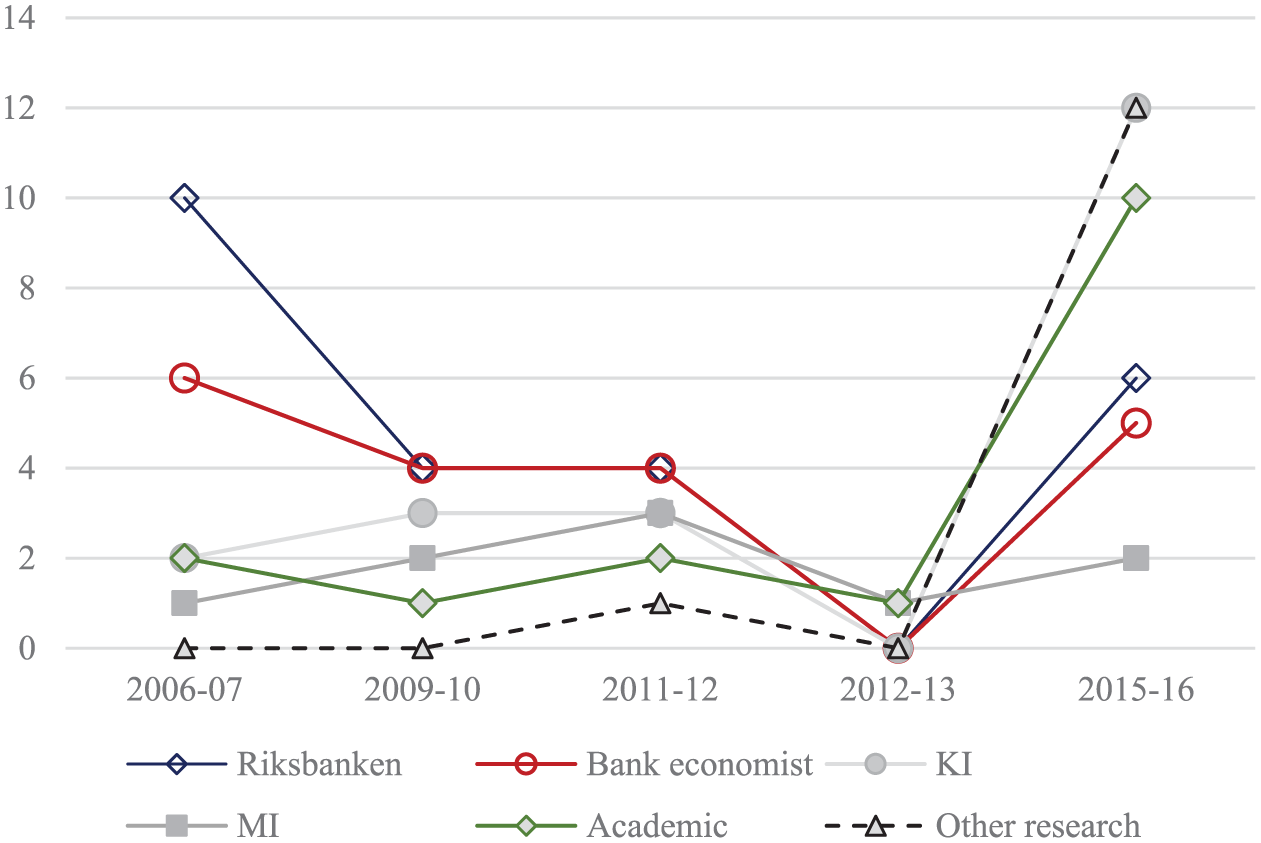
The number of times that external experts are cited in Dagens Nyheter articles on wage bargaining rounds.
Mårtenson (2003: 266), in his study of TV coverage of economic news, more specifically the annual state budget, found that bank employees were increasingly used as experts in the 1990s. It is striking here to see the extent to which bank employees in the 2000s and 2010s became even the umpires of wage bargaining. Another group of experts which play a much more important role in the contemporary era compared to the postwar era is that of the central bank, the Riksbank. This in the 1950s and 1960s was a politically steered institution but since 1994 it has been independent of the government (Jonung, 1999: 225–228; Lindvall, 2021). The shift to central bank independence has been important for the shift to low inflation, and the admonitions to contain wage growth in wage bargaining rounds recorded here is an informal aspect of this change in the Swedish political economy.
Correspondingly, the trade union economists were much less prominent as experts in covering the wage bargaining rounds in the 2000s than they had been in the postwar years. While Rudolf Meidner was a central actor and expert in the 1960s, 8 the LO head economist Dan Andersson was mentioned only twice in the DN coverage of the 2006–7 bargaining round, and his successors were not mentioned at all in the four bargaining rounds that followed. The clear shift in the use of expertise is indicative of the declining agenda-setting power of trade unions (see Enbom, 2009; Ryner, 2002).
The third important difference between the 2000s and the postwar era concerns the implied material interests of the reading public. Previous research on Swedish economics journalism has shown that wage-earner interests were more central to journalistic depictions in the 1970s than in the 1990s (Viscovi, 2006: 202) and that stockowners, pensioners and consumers were prioritised in the 2000s (Haglund and Englund, 2001: 75). As we have seen, in the 1950s and 1960s DN coverage of wage bargaining rounds tended to assume a reader with a wage-earner’s perspective. In the 2000s, the tone adopted to discuss wage growth was much more negative. From the existing literature on the political economy of wage bargaining institutions (i.e. Calmfors and Driffill, 1988; Flanagan et al., 1983; Swenson, 2002) we might expect that when excessive wage increases are criticised, it is because they are assumed to (a) harm profits and thereby investments, or (b) push through to higher prices. However, the negative effects of wage growth in the 2000s newspaper coverage were rather identified as effects on the unemployed, and on interest rates.
The arguments regarding the effect on the unemployed were influenced by insider-outsider theory (Lindbeck and Snower, 1986). DN repeatedly, both in the economics pages and the leader pages, criticised the trade unions for demanding wages which would be so high that they would stifle job creation and increase unemployment, especially for groups with a tenuous hold on the labour market, such as young people and refugees. A leader article during the 2006–7 bargaining round described the trade unions in these words: ‘No to lower unemployment insurance. No to liberalised job protection. No to lower tax on labour income. Yes to markedly raised minimum wages. The message from the LO and TCO trade unions can thus be summarised in advance of this year’s important bargaining round. Thereby the majority of trade unions have clearly shown that they are first and foremost set up for those who already have a job, not for those who try to get a foothold in the labour market’ (DN, 19 January 2007; cf. 7 November 2015, 22 December 2015; SvD, 4 February 2016).
The other major interest to protect was that of borrowers, who would suffer if interest rates were raised. The argument that wage rises would lead to interest rate rises was not put forward at all in the 1950s and 1960s, but its presence in the contemporary period is certainly related to two important macroeconomic changes: the high level of borrowing among Swedish households, and the political independence of the central bank since the mid-1990s. Loans related to households’ disposable income grew from 96% in 1995 to 195% in 2020 (Ekonomifakta, 2022), meaning that the typical household became much more sensitive to interest rate rises. Given this background, it makes sense that houseowners are more important today as a category of economic subjects than they used to be (Adkins et al., 2020). Furthermore, the political independence of the Riksbank since the 1990s most likely means that the central bank policies have become more interesting for the news media, as the Riksbank today is more of an independent decision-maker than it was in the 1960s.
The central bank’s importance in contemporary discussions of wage bargaining in Sweden is exemplified by DN stating in January 2007 that no party – trade unions or employers – wanted to ‘cause wage rises that make the Riksbank raise interest rates and thereby put a brake on growth and raise unemployment’. Similarly on 26 March 2007 the paper’s economics commentator argued that the Riksbank had cause to worry: ‘Wage raises within industry will be slightly higher than expected, and within retail the levels also appear to be higher. This may mean that we inch closer to an interest rate rise, even if the probable decision on Friday is a stable rate of 3.25 percent.’ The economics commentator also posed the question: ‘What are the consequences for borrowers with mortgages?’ The worry over higher interest rates recurred throughout the following bargaining rounds studied here, 9 and what is interesting about it is the recurring threat that if trade unions pushed through excessive wage increases, the central bank would react by raising interest rates, and this would harm house owners with mortgages. The increased importance of the central bank in wage bargaining discussions in the contemporary era compared to the postwar era is an interesting finding, and further research could be devoted to the discursive interactions of the Riksbank and the other actors of wage bargaining widely construed: the trade unions, the employers and the state.
Conclusions
In some ways, Swedish wage bargaining today is similar to how it was in the 1950s and 1960s. Bargaining is still highly coordinated and comprehensive: about 90% of employees are covered by a collective agreement. Similarly, 68% of employees are members of a trade union, which is a comparatively high share. However, the present investigation has also shown important changes over time in the functioning of Swedish industrial relations. We already know from previous research by Thelen (2014) and Baccaro and Howell (2017) that wage bargaining has changed through decentralisation and drift.
Here another layer has been added to the analysis of institutional change in Swedish industrial relations. Thelen (2009: 487) has defined institutional conversion as ‘efforts to reinterpret existing rules’. I would argue that the shift outlined here is also a type of this reinterpretation. Wage bargaining is still highly coordinated, but it is put to use for other purposes than in the 1950s and 1960s. In the 1950s and 1960s the interpretation framework – shared by mainstream newspapers such as Dagens Nyheter, ‘the national arbiter’ (rikslikaren, according to Engblom, 2002), as well as other actors in a relatively consensus-oriented national political economy – allotted great agency to wage negotiators. The national economy could be steered, in this high epoch of technocratic economic power (Mudge, 2018: 218–221; Tomlinson, 2017), and it was widely considered acceptable to determine wages in such a way as to reconcile goals such as purchasing power, income equality (including decreasing pay differentials as well as rising wage shares: Bengtsson, 2015; Erixon, 2011) and export competitiveness. In the contemporary era, newspaper coverage instead stresses the need to circumscribe the agency of wage bargaining: outcomes should be market-conforming, in line with the demands ascribed to the world market and global capital. To give a voice to markets, employees of private banks are frequently brought in as experts and umpires; it is they who judge whether people’s expectations of wage growth are ‘naïve’ and whether trade union demands hurt the unemployed and homeowners. The central bank has also, in the era of central bank independence, become a more important participant in wage bargaining discussions and in the judgements of what reasonable outcomes of wage bargaining rounds should look like.
Kjær (2007) has in the case of Danish economics reporting shown how the postwar national frame of interpreting the economy has been replaced by an interpretation frame where global capital is at the centre, with the Danish events and actors situated at the margins of the global (see Fligstein, 1990). Something very similar has happened in the understanding of Swedish wage bargaining as discussed here, in a shift away from the economic nationalist framework of understanding (Edgerton, 2019) and the heady dose of deference to authorities that marked the postwar era (Sutcliffe-Braithwaite, 2018). The chair of the trade union confederation is today not the kind of authority that he (it most often was a he) was held in broad swathes of society in the 1960s, and the expertise and analyses of trade union economists would today not be presented unquestioned, but instead challenged by other experts: financial economists, the central bank’s economists, the journalists themselves, who take on a more critical attitude today than in the 1950s or the early 1960s. In that sense the degree of corporatism in the knowledge politics of wage bargaining has declined in Sweden compared to the postwar era, and the wider and more contested knowledge politics of wage bargaining in the contemporary era would be a promising area for further research on the importance of ideas for labour market institutions.
In the Scandinavian countries, with their tradition of influential labour movements, the discussion of the achievements of power resources theory (PRT), which places the degree of organisation of the working class at the heart of comparative political economy, is still lively today (Ibsen, 2015; Refslund and Arnholtz, 2022). Since the influential interventions by Blyth and others, the independent role of ideas has been pointed to as a weakness of PRT: even a well-organised actor cannot achieve much if they cannot formulate new policy goals in changing circumstances (Blyth, 2002; Ibsen, 2015; Mudge, 2018). The present study shows one aspect of the loss of the ideological initiative by the Swedish trade union movement – in its national context perhaps once the most influential in the world. Of course, several very important and prominent studies of ideational change in Swedish politics since the 1980s have been written (Andersson, 2003; Blyth, 2002; Boréus, 1994; Lindvall, 2004), but they have often focused on the more intellectually advanced business of macroeconomic policy. Here, the shifts in ideological initiative have been highlighted in a more mundane setting: recurring wage bargaining, and the results have added a new layer of interpretations that stress the fundamental changes of Swedish industrial relations since the 1980s (Baccaro and Howell, 2017; Thelen, 2014). As such, the contextual approach of the article, analysing the ideational embeddedness of wage bargaining practices and how observers make sense of the wage bargaining process and ascribe meaning to it, can open up for further research. Future studies could be devoted to other countries to discern what’s specific and what’s general about the development in Sweden, but further analysis of Swedish institutional change would also be warranted, especially of the tumultuous 1980s and 1990s which saw drastic changes in Swedish wage bargaining.
Footnotes
Acknowledgements
Special thanks to Chris Howell for extended discussion of these themes. The paper was presented at a programme workshop in February 2021, at the Paris School of Economics, May 2021, and at the conference of the Society for the Advancement of Socio-Economics, 3 July 2021; thanks to all the participants for comments and criticisms.
Funding
The article was written within the research programme ‘Neoliberalism in the Nordics’, financed by Riksbankens Jubileumsfond grant M19-0231:1.

Declaration of conflicting interests
The author declared no potential conflicts of interest with respect to the research, authorship, and/or publication of this article.