







Abstract
This study reassesses job segmentation in UK agriculture under post-Brexit migration regulation. Using a qualitative case study of a fruit company, it examines to what extent agricultural work remains organized into distinct job quality segments, how citizenship and visa status shape placement across those segments, and how health and well-being vary across them. Findings identify a multi-tier hierarchy extending beyond a primary–secondary divide, including marginalized subsegments linked to visa dependency, nationality, and language. Health and well-being outcomes become more adverse toward the lower tiers. The study shows that segmentation is institutionally contingent and must be reassessed when migration regulation changes.
Introduction
Although the United Kingdom is an advanced economy with comparatively strong labor protections, agricultural employment has long been organized through segmented job structures sustained by migrant labor. Seasonal and temporary farm work is often excluded from collective bargaining, concentrating job insecurity, physical demands, and limited advancement within lower tiers of employment (McCollum and Findlay, 2015; Ruhs and Anderson, 2010). Segmentation perspectives explain these inequalities by treating jobs not as neutral slots, but as socially constructed positions within hierarchically ordered labor markets shaped in part by differential legal and visa-related rights to work in the UK (Doeringer and Piore, 1971; Kalleberg, 2011; McDowell et al., 2009). A central insight of this literature is that job segments are institutionally produced rather than fixed, emerging through regulation, organizational practices, and labor supply systems that govern access to work and protection (Bauder, 2006; Kalleberg, 2011). From this perspective, the United Kingdom’s withdrawal from the European Union in 2016 and the implementation of post-Brexit migration regulation from 2021 onward represent a major institutional shift in the recruitment and retention of migrant workers. The replacement of free movement with employer-sponsored, time-limited visa routes, including the Seasonal Worker visa, has altered eligibility for work in migrant intensive sectors such as agriculture (House of Commons Library, 2023). Whereas earlier segmentation research developed under relatively open labor mobility, post-Brexit recruitment now depends on more legally differentiated pathways and new origin regions, including for example Ukraine and Central Asia.
This shift raises an important theoretical question: do segmentation patterns identified under earlier migration regimes still apply in the contemporary agricultural labor market? McDowell et al. (2009) showed that lower-tier migrant labor in the UK was not a single homogeneous precarious category, but was internally differentiated by nationality, employment regulation, and differential rights to work. Their analysis demonstrated that agency work, visa status, and legal eligibility produced hidden hierarchies within lower-level employment. Building on this insight, this study contributes to existing theory by examining whether post-Brexit migration regulation has reshaped these internal divisions within UK agricultural employment.
The aim of this study is to reassess how established job segmentation and job quality frameworks apply within UK agriculture under post-Brexit migration regulation. Rather than proposing a new segmentation framework, it revisits existing theories in a context where visa status and differential rights to work may reshape how employment is structured and experienced. More specifically, the study examines whether hierarchies of job quality align with workers’ legal positions in the UK labor market and whether health and well-being remain important downstream consequences of segmentation (Benach et al., 2014; Vives et al., 2010). In doing so, the study clarifies how established segmentation frameworks operate in a changed institutional context and whether legal status has become more important for understanding variation within lower-tier agricultural employment.
Linking job segmentation theory and job qualities
Job segmentation theory conceptualizes labor markets as hierarchically organized systems in which jobs differ systematically in stability, autonomy, rewards, and exposure to risk, rather than as neutral positions allocated through individual characteristics or market forces (Doeringer and Piore, 1971; Kalleberg, 2011). Early dual labor market models distinguished a primary segment of relatively stable and well-compensated jobs from a secondary segment characterized by insecurity, limited mobility, and weaker protections. Later research extended this binary into multi-tier frameworks that identify intermediate and marginalized positions (Kalleberg, 2011; Peckham et al., 2022). A central insight of this literature is that segment structures are institutionally produced through regulation, organizational practices, and labor supply systems, and are therefore contingent rather than fixed over time (Bauder, 2006). From this perspective, migration and visa governance are key mechanisms through which divisions of labor are reshaped, because changes in legal access to work influence recruitment, job allocation, and control within organizations. Research on earlier UK migration governance supports this view by showing that nationality, legal entitlements, and differential rights to work produced internal divisions within lower-tier migrant labor, creating hidden hierarchies rather than a single homogeneous precarious segment (McDowell et al., 2009). This provides a basis for reassessing whether established segment structures remain applicable under post-Brexit conditions.
Large-scale quantitative studies, especially those using latent class analysis, consistently identify multi-tier employment structures differentiated by combinations of job quality dimensions such as security, autonomy, working time, and physical demands (e.g., Peckham et al., 2022). Qualitative studies complement this literature by showing how context-specific practices shape employment hierarchies in everyday work. Building on these insights, job quality frameworks shift attention from segment labels to the bundles of attributes that define hierarchical positions. Across studies, higher-tier segments are associated with greater stability and discretion and lower exposure to physical and psychosocial risk, whereas lower-tier segments are marked by insecurity, heavy workloads, hazardous conditions, and restricted voice, with intermediate positions reflecting mixed configurations of these attributes (Doerflinger et al., 2020; Lukac et al., 2020). Yet variation in the number of segments identified, the labels applied, and the indicators emphasized limits cumulative theory building and can obscure the underlying structures that segmentation models are intended to capture. This supports a deductive coding strategy that applies a consistent set of job quality dimensions across roles and segments, enabling systematic comparison and simplifying labels to reflect structural similarity rather than contextual description.
Institutional change makes this realignment especially important because segmentation structures are shaped by regulatory regimes governing recruitment and mobility and may shift when those conditions change (Deakin, 2013; Kalleberg, 2011). This is especially relevant in UK agriculture after Brexit, and thus makes this a highly relevant sector in which to situate this study. McDowell et al. (2009) showed that precarious migrant labor in the United Kingdom was not a single homogeneous category, but was internally differentiated by nationality, employment regulation, differential rights to work, and English language ability, with related evidence also pointing to uneven treatment through agency recruitment and working time arrangements (Hopkins, 2011; McDowell et al., 2009). However, the UK migration context has been significantly altered since the UK left the European Union, with significant changes to both the nations from which migrant workers are moving, and also to the legal regulation to which they are subject when they are in the UK.
Brexit disrupted these earlier patterns by ending free movement and replacing it with employer-sponsored, time-limited labor routes, thereby changing the institutional conditions under which agricultural employment is organized. These changes are likely to reshape job quality bundles and segment boundaries even where job titles or tasks remain unchanged, making it inappropriate to assume that typologies derived from pre-Brexit data map directly onto post-Brexit employment structures (Doellgast et al., 2009; Eurofound and ILO, 2019). This is especially salient in UK agriculture, where relatively stable managerial and technical roles coexist with field and packhouse jobs marked by seasonality, physical strain, and limited control (Migration Observatory, 2023; Rye and Scott, 2018). Roles once filled by workers with free access to the UK labor market are increasingly performed by workers subject to visa restrictions on sector, duration of stay, pay, and access to employer-provided accommodation. Within this context, a key contribution of this study is to reassess job segmentation by organizing employment segments around their underlying job quality attributes and examining how these bundles map onto roles within a UK agricultural organization. On this basis, we propose the following hypothesis:
Citizenship, visa regulation, and internal stratification in job segmentation
Citizenship and legal status are central to contemporary job segmentation because they shape workers’ access to mobility, protection, and exit, and therefore influence how labor market inequalities are produced and sustained. In the United Kingdom, this sorting role has intensified after Brexit. The end of European Union free movement replaced a relatively flexible migration regime with legally differentiated pathways that distinguish citizens, migrants with settlement-based rights, and workers on time-limited, employer-sponsored visas. In agriculture, this shift is especially important because declining recruitment under free movement has been accompanied by greater reliance on seasonal visa workers whose rights to remain and work are more restricted. This reconfiguration has concentrated visa-dependent and non-permanent workers in lower-quality roles while constraining mobility and advancement (McCollum and Findlay, 2015; Rye and Scott, 2018). Official statistics similarly show declining recruitment from European Union countries alongside increased reliance on seasonal visa recruitment from Ukraine and Central Asian countries (Home Office, 2025; House of Commons Library, 2023). Research on labor migration further shows that recruitment infrastructures and intermediaries help determine who is recruited and into which roles, embedding legal differentiation directly into workplace organization and reinforcing internal hierarchies within precarious work (Findlay et al., 2013; McCollum and Findlay, 2018). From this perspective, citizenship, settlement rights, and visa status shape eligibility for permanent employment, access to training and advancement, mobility between employers, and workers’ ability to exit unfavorable conditions (McDowell et al., 2009; Ruhs and Anderson, 2010; Rye and Scott, 2018).
These legal positions are further shaped by cross-national differences in earnings and employment alternatives. Workers often evaluate job conditions through a dual frame of reference, comparing host country wages and conditions with opportunities in their countries of origin rather than with domestic labor standards (Gelatt, 2013; McCollum and Findlay, 2015). This helps explain why lower-tier agricultural work may still be seen as worthwhile by some migrants, even when job quality is poor by UK standards, and why workers from different sending countries may interpret the same conditions differently. However, the relative attractiveness of employment does not remove the sorting effects of legal status. In the post-Brexit context, citizenship, settlement rights, and visa arrangements shape who can access permanent work, who remains concentrated in temporary roles, and who faces restricted mobility and limited advancement. Post-Brexit governance may therefore have intensified or reshaped internal differentiation within lower-tier work, rather than producing a single uniform migrant experience. Accordingly, the second aim of this study is to examine how citizenship, settlement status, and seasonal agricultural visa status are associated with workers’ placement across job segments within UK agriculture, as put forward with our second hypothesis:
Health and well-being as outcomes of job segmentation
Building on the argument that post-Brexit migration governance reshapes how workers are sorted into differentiated job segments, this study examines health and well-being as downstream outcomes of segmentation. Segmentation theory treats job segments as bundles of job quality exposures rather than neutral categories, implying that systematic differences in stability, control, physical demands, protection, and related conditions produce patterned differences in workers’ physical and psychosocial experiences (Doeringer and Piore, 1971; Kalleberg, 2011; Peckham et al., 2022). From this perspective, health and well-being are not a separate analytical framework, but validating outcomes that indicate whether the empirically derived segment hierarchy corresponds to meaningful inequalities in lived experience.
Job segments and citizenship or visa status jointly shape workers’ placement into roles and tasks, which in turn structure exposure to health-relevant conditions. Higher-tier segments, more often occupied by citizens or workers with secure legal status, involve supervisory responsibility and psychosocial strain linked to workload and accountability, but are buffered by greater autonomy, stability, and access to protections (Kalleberg, 2011; van Aerden et al., 2016). By contrast, lower-tier and marginalized segments, which disproportionately include workers on employer-tied or time-limited visas, are characterized by physically demanding tasks, hazardous conditions, unpredictable schedules, and restricted voice, increasing exposure to injury, fatigue, and stress (Benach et al., 2014; Rye and Scott, 2018; Urrego-Parra et al., 2022).
Precarious and low-quality jobs are consistently associated with poorer physical and psychosocial health through high workload, low control, job insecurity, and limited protections (Benach et al., 2014; Hajat et al., 2024). These risks are compounded when legal dependency constrains workers’ ability to refuse unsafe tasks, report illness or injury, or access healthcare (Anderson, 2010; Hargreaves et al., 2019; Mantouvalou, 2022). Health and well-being, therefore, reflect both exposure to demanding work and the institutional conditions shaping workers’ capacity to respond. Taken together, these dynamics suggest that health and well-being vary systematically across job segments and reflect the combined effects of job quality bundles and the sorting role of citizenship and visa status. Examining health outcomes across empirically derived segments thus provides a focused test of whether post-Brexit segmentation structures correspond to meaningful inequalities in workers’ physical and psychosocial experiences. On this basis, we propose our third hypothesis:
Method
To conduct this study, we developed an initial deductive coding scheme for job segmentation and job quality through an updated systematic literature review. The review identified empirical studies that statistically validated labor market segmentation models with more than two job segments and explicitly linked segment membership to multidimensional job quality characteristics. Consistent with the aims of the study, the review was designed to generate a coherent codebook of job quality dimensions for deductive use in the qualitative case analysis of segment structure (H1) and the sorting role of citizenship and visa status within those segments (H2), rather than to generate segmentation categories inductively. This approach was necessary because the aim was not simply to describe locally observed role differences, but to test whether the case reproduced, extended, or reconfigured segment structures identified in prior research. Coding additional tiers hierarchically was useful because it revealed whether jobs that might otherwise be grouped as precarious or intermediate were differentiated by distinct bundles of job quality, such as instability, legal dependency, restricted mobility, or harassment.
The review was based on the 2020 Preferred Reporting Items for Systematic Reviews and Meta Analyses (PRISMA) guidelines for updated systematic reviews. To reflect contemporary segmentation research, the review focused on English language publications published between 2004, the year of expansion of the European Union to include eight new member states from Central and Eastern Europe, and 2022, the time of data collection. Searches were conducted in EBSCO, Google Scholar, JSTOR, ProQuest Central, and ScienceDirect. Articles were retained only if they empirically identified and statistically validated at least three labor market segments and reported the job quality characteristics associated with each segment. An iterative search strategy using both US and UK spellings of key terms was used to retrieve relevant studies (see Figure 1). Each article was then screened to confirm the use of latent class analysis. Studies based only on conceptual typologies, descriptive classifications, or contract type comparisons were excluded. Latent class analysis was essential because it identifies unobserved subgroups within large datasets by classifying cases according to shared response patterns on observed categorical indicators, such as job insecurity and hours worked (Lanza et al., 2007). This process yielded seven studies that met all inclusion criteria and provided sufficient methodological detail to support development of the deductive coding framework (Doerflinger et al., 2020; Julia et al., 2017; Lukac et al., 2020; Peckham et al., 2022; Seo, 2021; van Aerden et al., 2016; Yoon and Chung, 2016). Table 1 summarizes the included studies and their methodological characteristics.
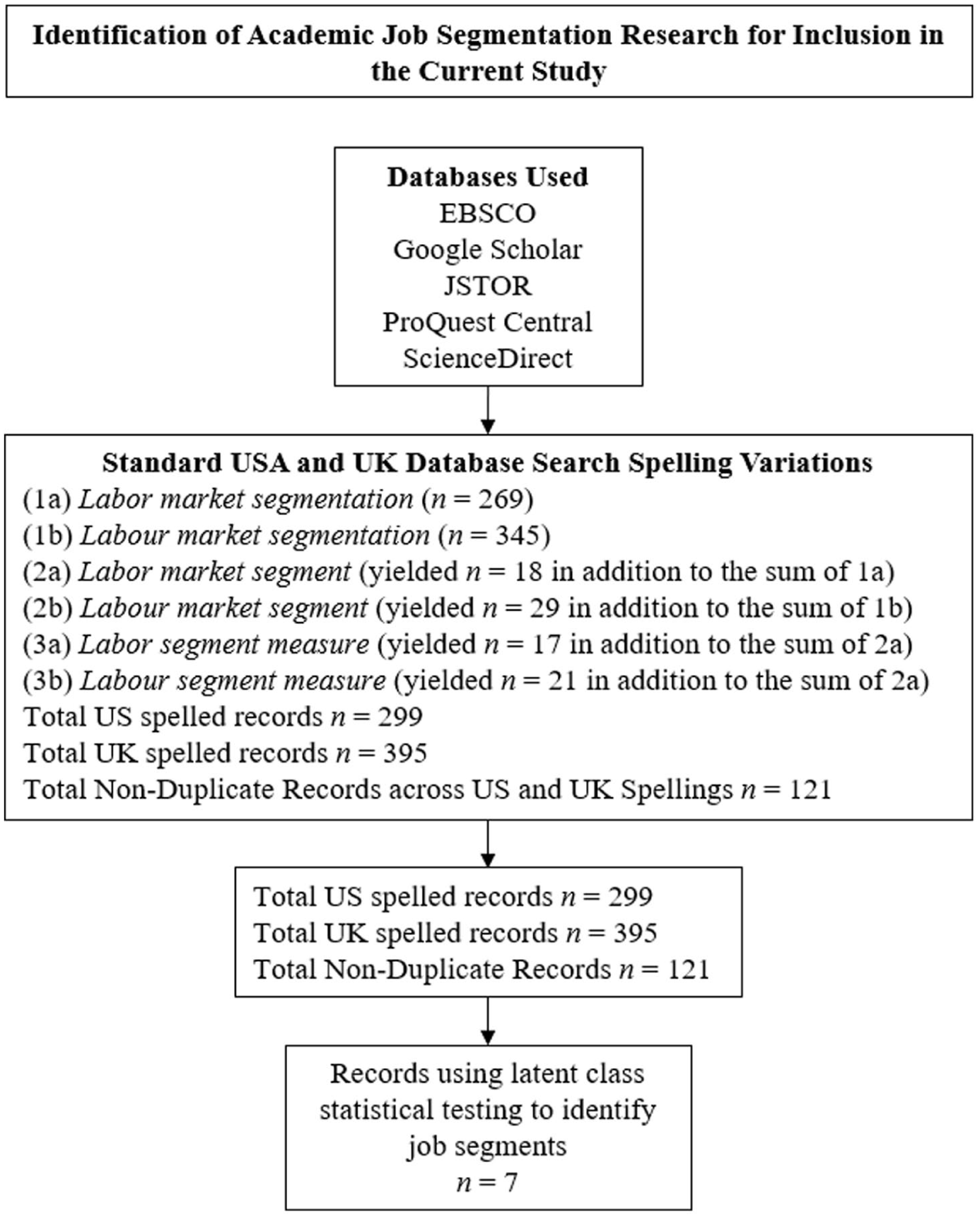
Flow process for identifying job segmentation studies.
Description of studies curated through the PRISMA systematic review methodology that are used to code job segments and their associated job qualities.
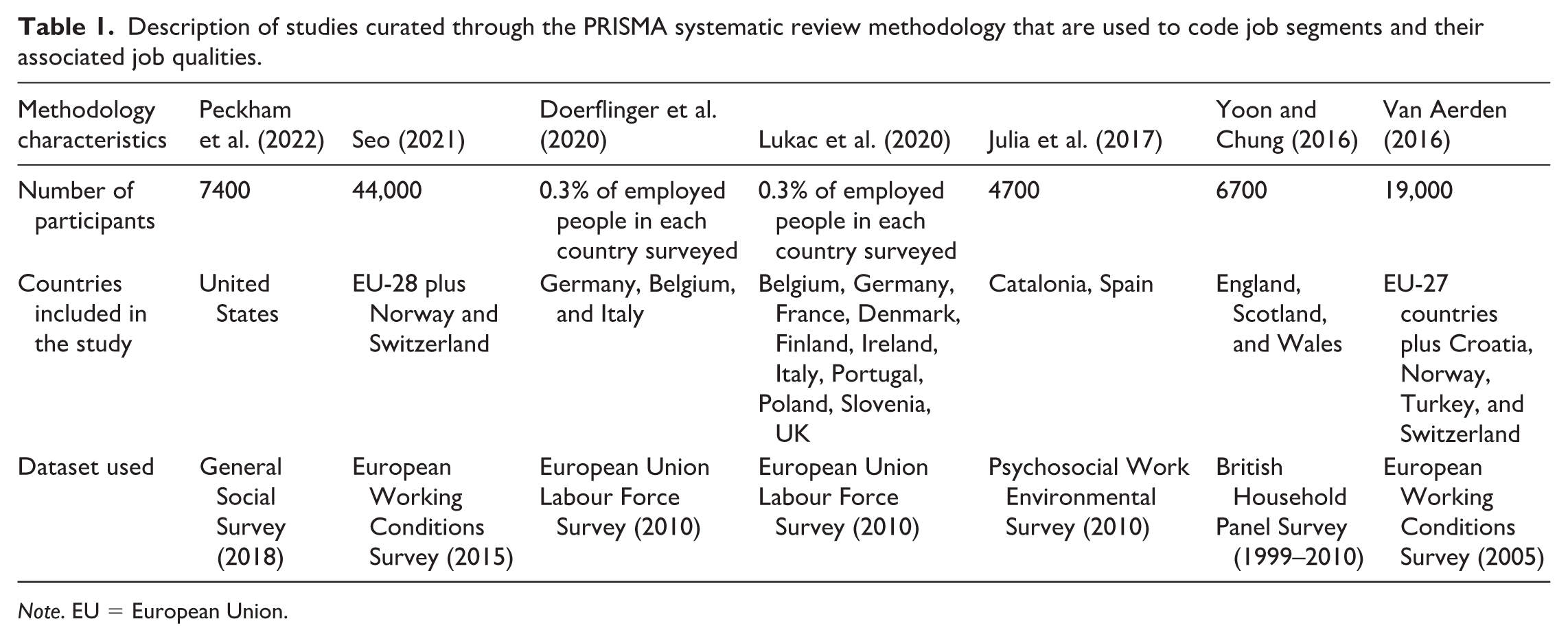
Note. EU = European Union.
Following identification of the seven studies, we extracted the job quality dimensions associated with each reported segment (see Tables 2a and 2b). Because these studies relied largely on latent class analyses of large-scale labor force survey data, segment profiles were defined through patterned combinations of indicators rather than single job characteristics. Recurring dimensions included ergonomic strain, working time instability, autonomy, psychosocial risk, rewards, training opportunities, and harassment exposure. We used these dimensions to build the initial deductive coding framework for the present study. Rather than treating each job characteristic as a separate analytical construct, we treated them as components of multidimensional job quality bundles used to identify and compare segments within the case organization. To operationalize this framework in the qualitative analysis, we translated the relative distinctions reported in the quantitative literature into an ordinal scoring system that enabled systematic comparison across roles at RipeCo (see below). Although this coding strategy simplifies some qualitative nuance and does not weight all dimensions equally, it provides a transparent way to connect prior segmentation research to structured qualitative comparison (Miles et al., 2019).
Articles used to generate initial job segmentation and job quality deductive coding themes.
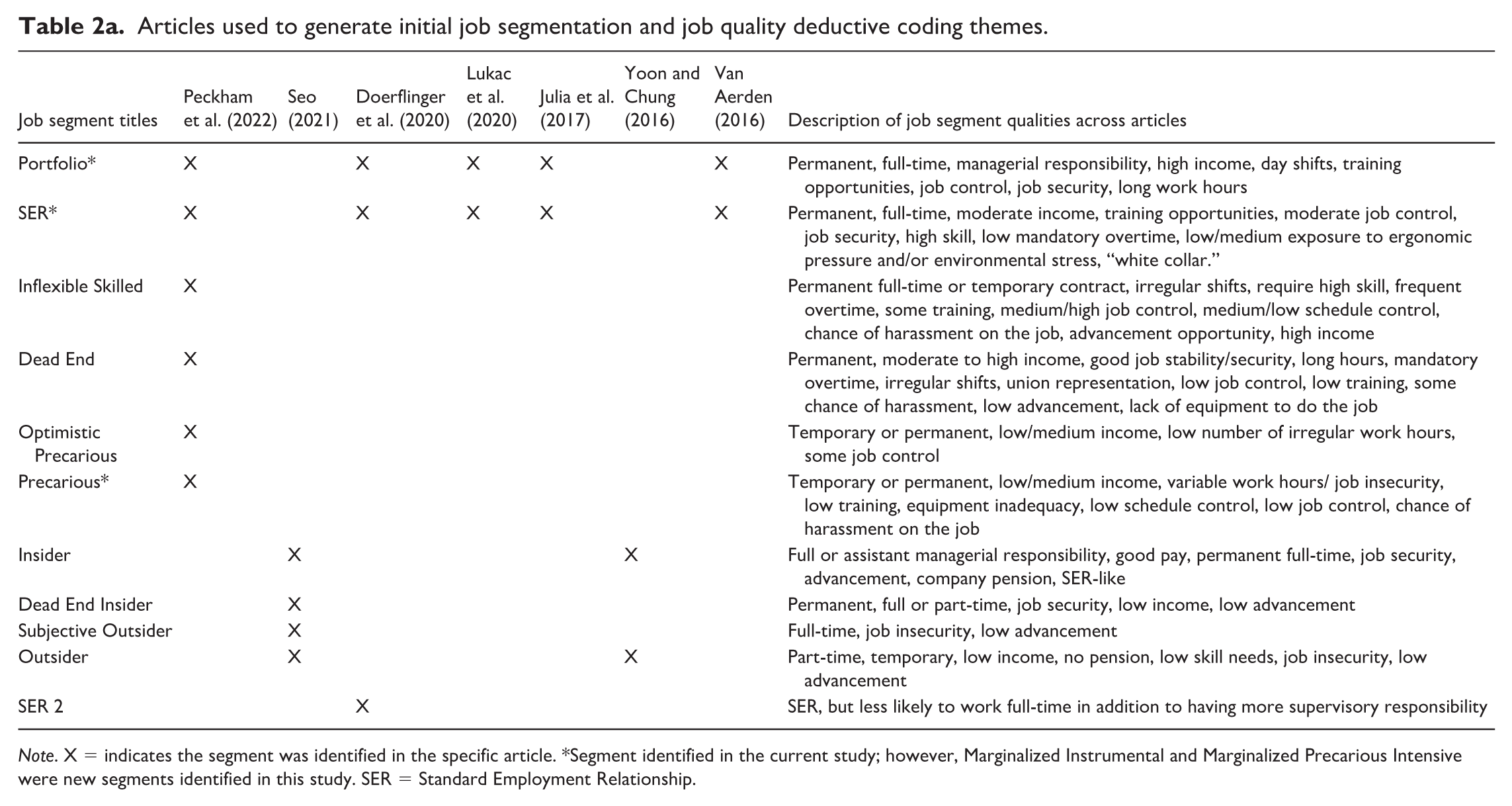
Note. X = indicates the segment was identified in the specific article. *Segment identified in the current study; however, Marginalized Instrumental and Marginalized Precarious Intensive were new segments identified in this study. SER = Standard Employment Relationship.
Articles used to generate initial job segmentation and job quality deductive coding themes.
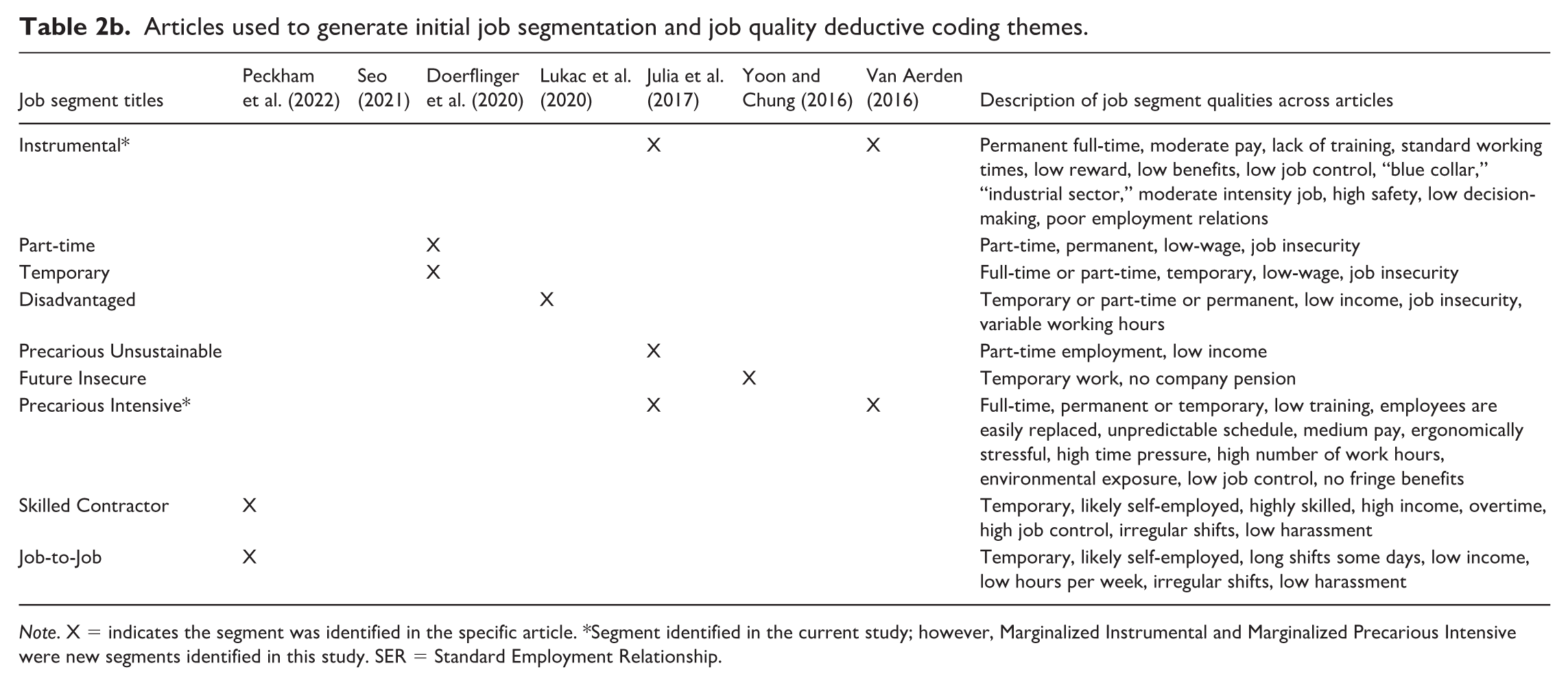
Note. X = indicates the segment was identified in the specific article. *Segment identified in the current study; however, Marginalized Instrumental and Marginalized Precarious Intensive were new segments identified in this study. SER = Standard Employment Relationship.
Analytical strategy for H1 and H2
The analysis proceeded in two sequential but analytically distinct stages corresponding to H1 and H2. We used a hybrid deductive qualitative design in which prior segmentation research provided the initial coding structure, while inductive analysis was retained to identify emergent patterns within the case. This approach is well established in qualitative methodology when researchers apply existing analytic categories to new empirical material without excluding unanticipated themes (Elo and Kyngäs, 2008; Fereday and Muir-Cochrane, 2006), and has more recently been recognized as useful for theory testing and refinement in qualitative and mixed methods research (Fife, 2024; Proudfoot, 2023).
To evaluate H1, we applied the deductive coding framework across all interview transcripts to identify the configuration of job quality dimensions associated with each role in the organization. These dimensions included stability, autonomy, rewards, training opportunities, harassment exposure, and psychosocial and physical risks, which were treated as components of multidimensional job quality bundles rather than as separate analytical categories. Job segments were then constructed by grouping roles that shared similar bundles of attributes rather than by relying on job titles or contract types alone. This stage assessed whether employment in UK agriculture was organized into a hierarchy of distinct job quality bundles extending beyond the classic primary–secondary divide, as predicted by segmentation theory.
To evaluate H2, we applied inductive coding selectively to examine how citizenship, settlement status, and visa dependency shaped workers’ placement within the segments identified under H1. Rather than redefining the segments, this stage examined how legal status operated as a sorting mechanism within the established job quality hierarchy by influencing recruitment pathways, task allocation, mobility constraints, and access to advancement. This allowed us to capture internal stratification within segments, particularly in lower-quality roles, while maintaining consistency with the deductively derived segmentation framework.
Literature review to develop an initial deductive coding scheme for health and well-being for H3
The initial deductive coding scheme for health and well-being was developed through a targeted literature review intended to support analysis of H3 as a validating outcome of job segmentation, rather than to provide a comprehensive review of occupational health research or conduct a meta-analysis within the present study. To ensure that the health-related codes were grounded in synthesized evidence, the review was limited to peer-reviewed meta-analyses and systematic reviews published in English. Searches were conducted in EBSCO, Google Scholar, JSTOR, ProQuest Central, and ScienceDirect using terms related to evidence synthesis, employment, and worker physical and mental health. In this context, meta-analysis refers only to the type of prior studies targeted in the search and not to an analytic technique used in the present research. This strategy aligned with the study’s broader logic: H1 examined job segmentation through deductive coding of multidimensional job quality bundles, H2 examined citizenship and visa status as sorting mechanisms within those segments, and H3 assessed health and well-being as downstream outcomes of segment location. Health and well-being were therefore treated as dependent constructs used to evaluate whether the segment structure identified under H1 and the citizenship-based stratification examined under H2 corresponded to meaningful inequalities in workers’ lived experiences. The resulting health-related codes were treated as provisional and refined through comparison with interview data, walk-along conversations, observations, and field notes, ensuring that the final framework reflected both the literature and the case evidence (see Table 5).
Case study
To address the study aims and test the hypotheses, we selected a case study organization whose workforce reflected a wide range of job segments and nationalities. Selection criteria required that the organization be locally owned and operated, produce and distribute its own products, employ both permanent and temporary workers, participate in the United Kingdom’s Seasonal Worker Scheme (SWS), and maintain a diverse workforce. After discussions with several agricultural firms across England, Scotland, and Wales, we selected RipeCo (a pseudonym), a family-owned company in southern England. The owners are directly involved in daily operations, and the company grows and packages fruit from its own farms, imports and exports across Europe, and supplies major grocers in the United Kingdom and continental Europe through its packaging facility.
RipeCo employs both permanent and seasonal workers, many of whom are recruited through third-party agencies tied to SWS visas. The company employs about 100 permanent staff across director, office, sales, health and safety, accounting, packhouse, distribution, and farm roles. Each summer and autumn, it also hires about 900 seasonal employees, including about 50 from the local community, 50 from elsewhere in the United Kingdom, and 800 from outside the United Kingdom through the SWS six-month visa program. These workers primarily harvest fruit and work on packaging lines. This workforce composition made RipeCo well suited to examining how job segmentation, citizenship, and visa status intersect within a single agricultural organization.
Data collection
Data collection combined formal and informal interviews with permanent and seasonal employees across office settings, the packhouse, distribution center, cold storage facilities, and farm sites. Thirty semi-structured interviews were conducted with the participants listed in Table 3. Interviews ranged from 20 minutes to two hours, were audio recorded with informed consent, and took place either in conference rooms or directly in work settings such as orchards and production lines in order to capture the social and physical context of labor.
Participant characteristics.
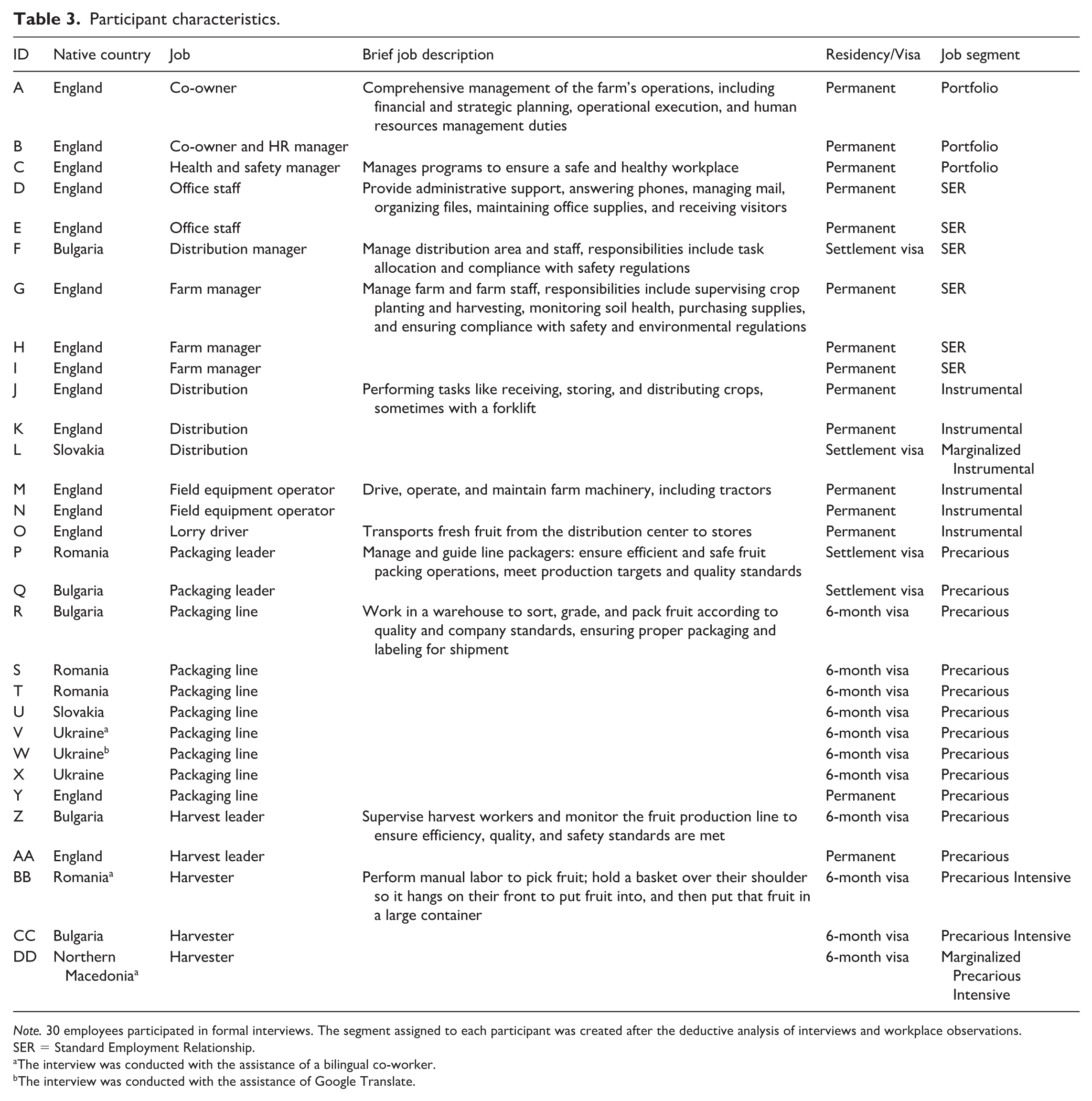
Note. 30 employees participated in formal interviews. The segment assigned to each participant was created after the deductive analysis of interviews and workplace observations. SER = Standard Employment Relationship.
The interview was conducted with the assistance of a bilingual co-worker.
The interview was conducted with the assistance of Google Translate.
The interview protocol was designed to elicit open-ended responses that mapped onto the deductive coding frameworks for job quality and worker health and well-being. Seven broad questions guided each interview, with clarifying and follow-up questions used as needed. Rather than asking participants to identify their own job segment or comment on abstract constructs, the questions focused on concrete employment conditions and daily work experiences that could later be coded using the dimensions shown in the coding tables. For example, job security and replaceability were explored through prompts such as, “Can you describe your contract or employment arrangement and how secure your job feels, including how easily you think someone else could replace you if you left?” Responsibilities and autonomy were examined through questions such as, “What responsibilities do you have in your role, such as supervising others or making decisions, and how much control do you have over how your work is done?” Material rewards and mobility were addressed through questions including, “How would you describe your pay and benefits compared to others, and do you see any real opportunities to move into better roles or advance here?” Additional questions addressed working time, training, physical conditions, treatment, safety, and the effects of work on physical and mental health, including, “In the past six months, have you experienced unfair treatment, harassment, or safety concerns at work, and how has this job affected your physical or mental health?” When requested, language accommodations were provided through bilingual coworkers or Google Translate. Although interpreter-mediated and computer-assisted translation may introduce some risk of misinterpretation (Temple and Young, 2004; van Nes et al., 2010), these methods enabled participation from workers whose perspectives might otherwise have been excluded.
The study also included walk-along conversations during site visits (Kusenbach, 2003), in which researchers accompanied employees through their work environments while participants described tasks, conditions, and interactions in real time. This approach provided contextual insight into work processes and job demands that might not have emerged in stationary interviews alone. These conversations were documented through detailed field notes rather than audio recording. Participation was voluntary, and employees could decline or disengage at any time without consequence.
The interviews and field notes reached thematic saturation, as no new themes emerged during the later interviews and organizational visits. This suggests adequate coverage of the phenomenon under study and is consistent with guidance that saturation is reached when additional interviews yield redundancy rather than novel insights (Guest et al., 2006).
Results
Data analysis
Interview transcripts and field notes were analyzed using the deductively derived coding framework developed from the systematic literature review. This framework specified job quality dimensions and segmentation criteria in advance, allowing empirical evidence to be analyzed consistently in relation to the theoretical constructs underpinning H1 and H2. Two researchers independently coded all materials using this framework, achieving an initial interrater agreement of 83%. Coding discrepancies were reviewed collaboratively and resolved through discussion, resulting in a final agreement rate of 95%. This coding and agreement procedure follows established best practices for rigor and transparency in qualitative content analysis (Fereday and Muir-Cochrane, 2006; Schreier, 2012).
Consistent with the study’s analytical strategy, deductive coding was used to identify job quality bundles and segment structures, while inductive coding was applied selectively to capture how citizenship, visa status, and nationality shaped workers’ placement and experiences within those segments. Inductive insights were used to elaborate mechanisms of internal stratification without redefining the underlying segmentation framework. This approach ensured that findings were systematically anchored in prior theory while remaining sensitive to context-specific processes observed in the case organization.
Results for H1: Job segmentation and job qualities
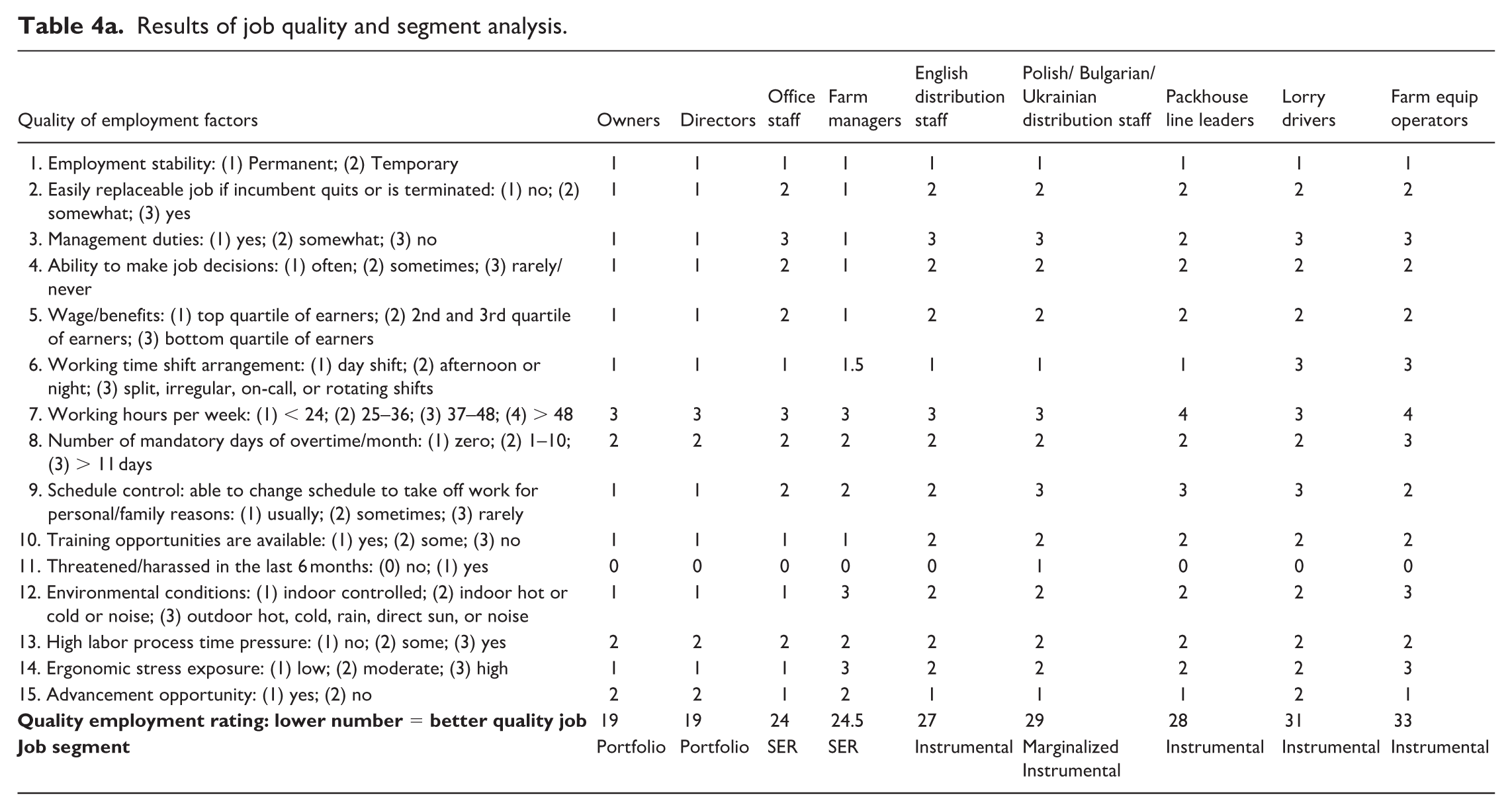
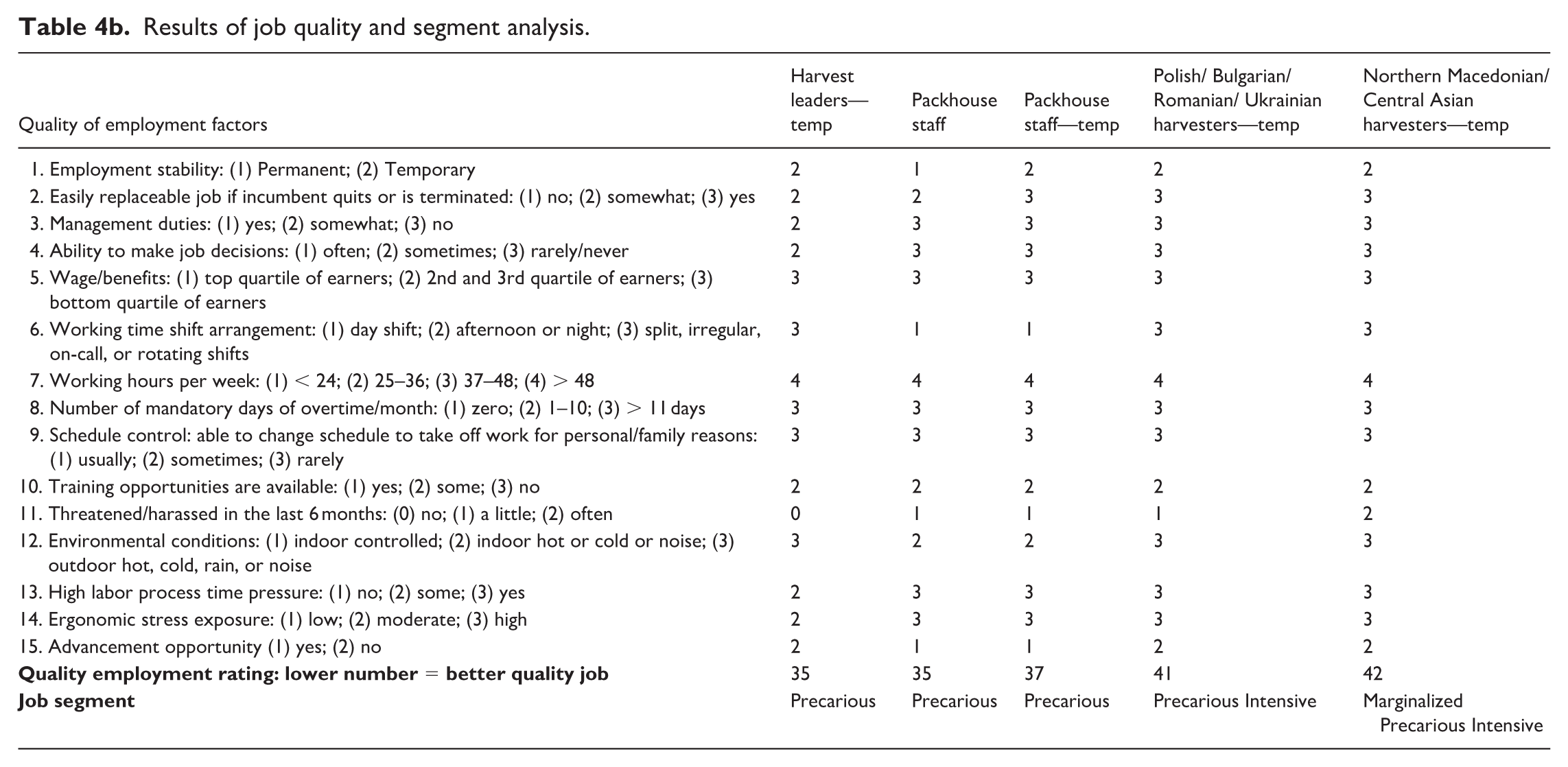
Hypothesis 1 proposed that agricultural employment extends beyond the classic primary–secondary divide, with intermediate and marginalized tiers characterized by distinct combinations of job qualities. Using the coding system described above, job quality ratings for each role at RipeCo were summed to construct a segmentation hierarchy, with scores ranging from 19, indicating the highest job quality, to 42, indicating the lowest. These scores were derived from formal interviews, informal interviews, and detailed field notes. Job segment labels were then assigned through comparison with segment classifications in prior studies and the job quality bundles shown in Tables 4a and 4b. This deductive process allowed the observed scores to be mapped onto established segment categories while remaining responsive to patterns in the data. Five job segments consistent with the literature were identified, along with two additional subsegments that emerged inductively: Marginalized Instrumental and Marginalized Precarious Intensive. These subsegments were analytically important because they showed that lower-tier employment was not a single undifferentiated category, but was internally stratified by distinct bundles of disadvantage linked to job quality and marginalization. A summary of the segments and their associated job qualities is provided below.
Results of job quality and segment analysis.
Results of job quality and segment analysis.
Portfolio
Owners and directors occupied the Portfolio tier and exhibited the highest job quality scores at 19. Their permanent roles were highly stable and characterized by full decision-making authority, top-quartile wages, and extensive training opportunities, as reported by all “Portfolio” informants. Observations of the administrative building further indicated favorable working conditions, including comfortable ambient air and well-maintained workspaces. Informants noted that work schedules were predominantly daytime with limited overtime, a pattern corroborated by field observations showing that many office employees departed at approximately 17:00. To exemplify the overall regularity of hours, the health and safety manager noted demands arose mainly when “there’s an emergency with employees, we need to get involved, otherwise our hours are standard.”
Standard Employment Relationship (SER)
Office staff and farm managers were classified within the SER category, with job quality scores ranging from 24 to 25. These roles were secure and permanent and were characterized by stable hours, and moderate wages, and benefits. Office staff worked under conditions similar to those of Portfolio employees, with the main distinction being shared open-plan offices rather than private offices. Although schedules were generally stable, some variability occurred. As one assistant HR staff member explained, “I go out to them [precarious intensive workers] with an iPad to onboard new employees because they’ve arrived the previous night or in the morning and we need them to get to work right away.”
Farm managers also occupied relatively favorable positions, including private, climate-controlled offices and comparatively strong salaries, but they faced greater physical and environmental demands than office staff. Site visits and interviews showed that their roles involved long hours during the harvest season, especially in August and September, as well as extensive walking and regular exposure to weather conditions. Although autonomy, advancement opportunities, and schedule control were somewhat limited, farm managers were less readily replaceable because of their specialized crop husbandry skills. Despite seasonal intensification, their overall levels of compensation and relative autonomy remained favorable. As one manager noted, “I have a bit of a laugh with them [other managers]. It’s not just a sort of work conversation, no, it’s just a bit of a laugh for me.”
Instrumental
Distribution workers prepared pallets of packaged produce in a large warehouse to fulfill customer orders from multiple continents. Their work involved physical lifting, operating pallet jacks and forklifts, using computers to track orders, and working in a cold environment designed to preserve produce. As one employee explained, “You work in the chiller. You can’t physically get yourself warm. Now the weather’s changed, it’s sunny outside, it’s nice. Then, obviously, coming outside, you could warm up and go back inside.” Lorry drivers similarly occupied permanent but demanding roles. They transported products to grocery distribution centers across Great Britain and had some autonomy because they could take breaks at their discretion, adjust the lorry temperature, use hands free devices, and work without constant supervision. One driver explained, “My main job is we run to Scotland, and we’re allowed to drive for 10 hours and three days, sometimes we’re allowed to drive for nine. There’s also another route where you are allowed to work for 15 hours a day, twice a week.” At the same time, irregular schedules created strain: “My work is on rotas, so this week, I had Monday off with family. And so I have to work Tuesday, Wednesday, Thursday, Friday, Saturday. I sleep in the lorry all work days and then it’s hard to sleep at home.”
Packhouse line leaders also occupied this middle-tier position. They supervised workers on the packaging lines and worked under moderate time pressure to keep lines running smoothly and respond to machinery problems. As one line leader stated, “I have two groups of people to manage for good quality [of work]. If there’s a problem, usually stay with them, and I show him what to do.” This worker also highlighted the value of bilingual skills: “Most of the people here are Ukrainian, like Serbia. Estonia. I speak Bulgarian, and they’re similar languages for speaking [with each other]. If they speak English, it’s good also.” Although line leaders had some autonomy, researchers observed that they worked in noisy conditions requiring earplugs and in cold temperatures maintained to preserve produce.
Marginalized Instrumental
While formally permanent, these jobs involved unpredictable schedules, frequent weekend or late-night shifts, low pay, limited advancement, high noise, and repetitive strain, which made them similar to other instrumental roles. However, this marginalized segment emerged as distinct, with a job quality score of 29, because it combined these disadvantages with physical workspace segregation initiated by managers. This segregation was also linked to nonstandard work hours and was organized along nationality and language lines. UK employees were grouped in a shared workspace where everyone spoke the same language and worked more regular daytime schedules. As the distribution manager explained, “local people going into this kind of industry complain that there’s going to be a lot of migrant workers and it’s really difficult for them to integrate.” This was addressed by “putting everybody from English speakers or local people together, and then the more people that speak good English, you attach them to working here. They know what they like for workspace.” In practice, however, this language-based segregation created more favorable schedules for English workers and shifted less desirable hours onto migrant workers. As one English distribution employee stated, “We do not want to be here until eight or nine p.m., and Ukrainians and Russians thought that was a bit unfair. I would rather work the week, get the hours in, and then enjoy the weekend.” A distribution manager similarly noted, “The foreigners work more hours and on weekends.”
Precarious
Packhouse staff on temporary contracts and field-based line leaders were classified within the Precarious segment, with job quality scores ranging from 35 to 37. These jobs were seasonal and characterized by high replaceability because the duties did not require a high level of skill. Further, these employees received low to moderate pay, dependent on their specific role, and no work autonomy because they had to maintain high productivity. Packhouse workers performed fast-paced, repetitive tasks in cold environments. Although packhouse employees who developed proficiency across multiple machines could apply for promotion to packaging line leader, this advancement pathway was limited and did not substantially reduce ergonomic or environmental strain. As one co-owner explained, “Instead of doing five days a week, we do six days, and it might mean a few hours overtime in the evening.” All employees in this segment consistently described, and researchers directly observed, the pace of work as fast, as reflected in one packhouse worker’s comment, “I can’t do this, it’s too much work.” Related to work intensity, a line leader noted, “I have to move people to other machines if they [employees] are too slow.”
Precarious Intensive
All seasonal harvest workers formed the Precarious Intensive segment and had low job quality scores of 41. Their contracts were short and insecure, wages were low, and advancement opportunities were absent. Pay was based on piecework, with a minimum hourly wage only when output did not exceed the threshold. Hours were long and irregular, often spanning seven days per week. As one harvester explained, “our hours are long, we do 7:30am to 4:30 pm, and it is seven days a week, and that is a lot of hours.” Physical strain was also severe because the work involved repetitive lifting and constant exposure to the weather. Most workers in this segment were migrants, although not from Central Asia. Despite these poor conditions, many still viewed the work through a dual frame of reference. For them, wages in the United Kingdom exceeded available earnings at home, and the combination of higher pay, opportunities to save, and relatively low rent in company-provided caravan housing made the work feel worthwhile. As another harvest worker explained, “It’s harder here [UK farm job compared to jobs in their home nation], but I can send money home. That makes it worth it.”
Marginalized Precarious Intensive
Like Precarious Intensive workers, members of this segment held six-month visas, received only basic task training, and performed physically demanding outdoor work in all weather conditions. However, this segment had the lowest job quality score, 42, because workers were also exposed to intense harassment, discrimination, and conflict from coworkers and supervisors, much of it tied to nationality, particularly among workers from Northern Macedonia and Central Asia. This issue is examined in more detail in the Hypothesis 2 results. Although researchers had only limited conversations with workers in this segment, partly as a result of the English language skills of those workers, those discussions supported the broader pattern of strained relations. In a formal interview, one Northern Macedonian harvester explained, “We argue because maybe somebody is just lazy. Getting late from some breaks. Maybe some showing some attitudes and stuff.” A harvest leader similarly recalled, “I saw the tempers were rising while they were picking and throwing fruit at each other. . . I had to literally step in and separate them.” Another harvest leader described violence and threats affecting Central Asian migrant workers at both work and employer-provided housing, stating, “one guy was taken by the police because he was walking around with a knife and threatening the workers.” These accounts show that social conflict and harassment further deepened the precarious conditions experienced by this segment.
Summary of H1
RipeCo’s segmentation hierarchy revealed a decline in job quality from Portfolio and SER roles to Instrumental and Precarious tiers, with Marginalized segments experiencing the poorest job quality. Again, these results support Hypothesis 1 by showing that agricultural employment extends beyond a job segmentation primary–secondary divide to include intermediate and marginalized tiers with distinct job quality profiles. Importantly, post-Brexit changes have created further marginalization, a key finding in this study and as seen in the experiences of the workers in the Marginalized Precarious Intensive group.
Results for H2: Citizenship and marginalization
Hypothesis 2 proposed that citizenship and visa status are associated with systematic differences in workers’ placement across job segments. In the case study, these differences appeared in unequal access to permanent work, restricted progression under post-Brexit visa arrangements, language-based sorting within roles, and the concentration of six-month visa holders in the lowest-tier segments. The analysis supported this expectation, showing that visa status and nationality strongly shaped workers’ position within the segmentation hierarchy. Employees on six-month visas had limited opportunities for advancement, and training requirements further constrained upward mobility. English language ability, the main language of workplace communication, also emerged as an important factor in segmentation. Table 3 summarizes the legal work eligibility structures associated with each segment.
Portfolio
Owners and directors occupied the Portfolio segment, with entry restricted to UK citizens and permanent residents because these roles required year-round, permanent work availability. Beyond formal work eligibility requirements, access to Portfolio positions was highly constrained. As reported by the owners of RipeCo, aside from a small number of director roles in finance and health and safety, most Portfolio positions were held by members of the family that owned the organization. As all of these were UK citizens, no workplace issues related to visas were reported by people within this group.
Standard Employment Relationship (SER)
Employees in the SER segment, such as distribution managers, were all either UK citizens or had indefinite leave to remain, having moved from EU nations many years previously. As such, this group, like the Portfolio employees, did not report issues related to citizenship status. Related to the post-Brexit changes that now prevent free movement from the EU to the UK for work, a Bulgarian distribution manager explained his path to gaining a full-time permanent job compared to those Bulgarian workers who are now trying to move to the UK for work. Under the free movement scheme, he was able to work in the UK for enough years to establish residency. This residency allowed him to keep his full-time job at RipeCo and, further, be promoted to better jobs once Brexit was implemented. However, now, “they [prospective employees from the EU] have to apply for a visa in Bulgaria, and they only come for six months, you know, just a low-skilled personnel. We’re not really interested in taking someone coming from Bulgaria anymore.” This explanation serves to highlight the blocking of potential exit routes from lower-tier roles to newly arrived workers in the UK, and a significant shift since earlier studies which have taken place in a pre-Brexit context.
Instrumental
Instrumental workers such as packhouse leaders and drivers were also required to have UK citizenship or long-term residency because of the full-time, ongoing, year-round, skilled nature of the work. One example of the need for hiring settled visa-status Instrumental segment workers was related to the worker skill-set and the investment the company made to train employees, as explained by the co-owner/HR manager, “Lorry drivers are high-skilled workers, so it is the intention for these workers to be settled, at least to some extent? If they are not British, should they at least be able to establish their families or their lives here in the United Kingdom because we have dedicated trainers and ongoing training programs for people, and then, suddenly, residency workers leave into the wild.” During walking tours of the areas in which the lorry drivers congregated, it was noted through informal conversations and observations that these were again workers from the UK, or those with longer-term residency in the UK. The similarity of experiences of these workers across the Portfolio, SER, and Instrumental sectors does serve, however, to further highlight the issues faced by workers without these residency statuses who found themselves crowded into the lower tiers discussed below.
Marginalized Instrumental
A Marginalized Instrumental subsegment emerged within the distribution warehouse. Workers from Central and Eastern Europe held the same formal contracts as British staff but reported unequal treatment linked to nationality, language, and visa status. This pattern formed the counterpoint to the preferential treatment described in the previous segment. One co-owner openly acknowledged this disparity, stating, “[We are] actually giving the British special treatment to make their lives easier.” The distribution manager similarly explained that “people with good English language skills want to work alongside with yourselves,” so that “you don’t feel so much of the language barrier.” As he put it, “if you’re British and you’re with five Bulgarians or Ukrainian workers speaking a Russian–Bulgarian mixture,” there is little shared interaction, “You’d like to say a joke, or to ask how Chelsea finished last night. They don’t care, so there is nothing to talk to them about. So, what we try to do is get as many English speakers or local people together [in a separate work area] as possible.”
In addition to this workplace segregation, some migrant employees in this segment experienced heightened insecurity linked to immigration policy and visa requirements. A Slovakian worker described his earlier employment path at RipeCo: “Beginning in 2011, I could get promotions. For a time, I harvested. Then I go to the packaging area. From that, I thought that after five years, I could have applied for residency. But. . . there is a changing law now because of Brexit, and no one can apply for that status, now, to work here.” This account shows how pre-Brexit rules created pathways to settlement and upward mobility, whereas post-Brexit changes curtailed long-term prospects in the United Kingdom. English language proficiency also emerged as a defining feature of this segment. The same worker emphasized its practical importance, stating, “If they [migrant employees] don’t speak English, how can we speak on walkie-talkies for the job?”
Precarious
Lower-scoring segments were those in which the organization struggled most to recruit workers from the United Kingdom, largely because irregular hours and difficult physical conditions were seen as unattractive. As a result, these roles remained concentrated among migrant workers, many of whom viewed the wage differential with their home countries as sufficient to offset the undesirable conditions. Through this dual frame of reference, such jobs were often seen as more acceptable than work available at home, although post-Brexit visa changes and rising wages in parts of Central and Eastern Europe had weakened this logic for some workers. Packhouse staff and field-based line leaders in the Precarious tier generally required only short-term work visas, though a few held UK residency status or citizenship. In this case, short-term visa eligibility appeared to channel many migrants into insecure roles and limit access to higher-tier positions. Field notes also documented nationality-based segregation in these work areas, marking a clear break from the greater social inclusivity of higher tiers. For workers who still found the work attractive, the reason was straightforward. As one co-owner explained, “They’re earning their money and sending it to the older generation.”
Precarious Intensive
Our study suggests an important shift in the composition and experiences of workers in the Precarious Intensive segment compared with earlier research. Before Brexit, this segment was largely populated by European Union workers who benefited from freedom of movement. In the present case, however, workers in this segment were employed on six-month visas that offered little opportunity for advancement. Those European Union workers who remained indicated that the work was still worthwhile because wages in the United Kingdom continued to exceed those available in their home countries. As one Bulgarian harvester explained, “I come here [England] four months to work. At home, I am an IT freelancer for big companies like [company name redacted]. [Name redacted] company calls while I’m here to work, I tell them ‘no,’ I’m busy.” Although the wage advantage may have narrowed, these accounts suggest that, when viewed through a dual frame of reference, employment in the United Kingdom was still seen as comparatively attractive.
At the same time, workers in this segment reported exclusion by UK staff during breaks and interpersonal conflict at work. These accounts suggest that visa dependency constrained mobility and kept many workers in lower-tier roles, where they were also exposed to harassment and strained social relations. A co-owner similarly criticized the short-term visa system, stating, “What the industry needs is skilled people. And the only way you’re going to attract skilled people is by attracting those to come at lower levels and upskilling. And you can’t fill those [upskilled job] jobs with six-month visa staff.” His account suggests that post-Brexit visa arrangements made it harder for the organization to retain workers who could be trained and incorporated into longer-term succession planning. At the same time, while many workers valued the six-month visa as a way to earn relatively high income over a short period, the HR manager expressed frustration that some workers showed limited motivation to increase productivity, noting that “there seems to be no real incentive for the harvesters to pick five bins every day, because they made enough money to take home.”
Marginalized Precarious Intensive
A key finding concerns workers in the Marginalized Precarious Intensive segment, whose position appeared to be shaped by post-Brexit visa changes and shifting recruitment patterns. Under earlier free movement arrangements, workers at the labor market periphery could move more freely across jobs in the United Kingdom. By contrast, six-month work visas constrained mobility and increased dependence on seasonal agricultural work. As fewer European Union workers viewed this work as desirable, the national origins of workers entering these roles shifted substantially. The most severe marginalization was concentrated in this segment, which was dominated by workers from Central Asia and Northern Macedonia, where nationality and language tensions further intensified strain. Farm observations showed that many workers in this segment faced overt harassment and discrimination from supervisors and coworkers based on nationality. A harvest leader openly remarked, in front of employees in this segment, “We [RipeCo] started going to Poland [to recruit migrant workers] . . . Then Bulgarians and Romanians . . . And now we’ve gone down this road [Central Asian employees] this year. It’s not a good road . . . we basically just sort them to the remedial team.” These accounts suggest that the poorest job quality arose not from visa dependency alone, but from the interaction of legal status with nationality, language difference, and workplace group formation.
At the same time, workers in this segment often evaluated these jobs through a dual frame of reference. The work was not necessarily seen as good in absolute terms, but in relation to wages and opportunities in their home countries. In that comparative frame, physically demanding, insecure, and socially marginalizing work could still be viewed as worthwhile because UK earnings made remittances, savings, and major household purchases possible. Informal conversations with workers in this segment indicated that wages in England were the main reason many accepted this type of job. A farm manager observed, “Central Asians will want to buy some, maybe, some more sheep and or some pigs to raise. And then they get their money from the season and never see him again.” Similarly, a farm line leader explained, “It’s doing a lifetime savings for them in one summer. Let’s say, they buy some kind of house with one summer’s work. Another wants to buy a car. It’s safety money for some. And, I think that’s because of the minimum wages in their countries. At one point in the summer, they think it’s enough work and money.” One worker in this segment expressed the same logic directly: “I’m gonna be rich. I’m gonna be a millionaire when I go back [to home nation].” These accounts show that migrants’ perceptions of job quality were shaped not only by the immediate demands of the work itself, but also by transnational comparisons that made highly precarious work appear temporarily acceptable, even though these jobs remained objectively insecure and deeply marginalizing.
Summary of H2
Overall, the H2 findings support the expectation that citizenship and visa status were associated with systematic differences in workers’ placement across job segments. In this case, legal status shaped segmentation through unequal eligibility for permanent work, restricted opportunities for progression under post-Brexit visa arrangements, language-based differentiation within roles, and the concentration of six-month visa holders in the lowest-tier segments. These patterns indicate that citizenship, settlement status, and seasonal visa dependency did not merely distinguish workers formally but structured internal stratification within the organization by shaping access to stability, advancement, and more favorable working conditions.
Results for H3: Health and Well-being
Hypothesis 3 proposed that health and well-being outcomes are stratified across job segments, with higher-tier roles experiencing only mild psychosocial strain, and lower-tier and migrant-intensive roles facing the greatest physical, psychological, and social risks. Table 5 provides an overview of physical and mental health outcomes and work–life conflict.
Health and wellbeing as well as coding paired with job segments.
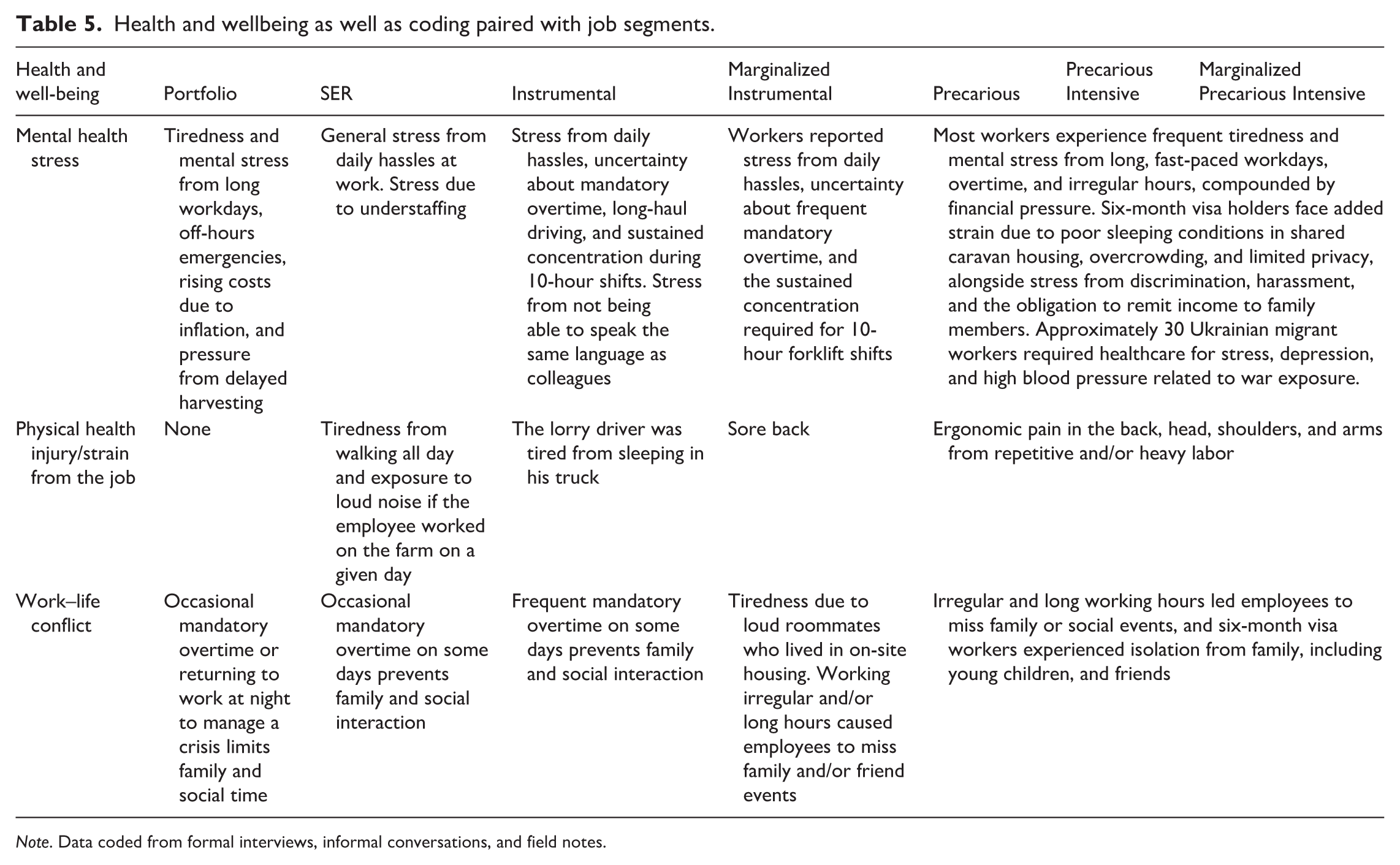
Note. Data coded from formal interviews, informal conversations, and field notes.
Portfolio
All owners and directors reported stress as the primary health-related concern in this segment, which was from the pressures of organizational responsibility. Participants described stress related to recruitment difficulties, budget management, and crisis response, which also interfered with family and social commitments when work extended beyond expected hours. As one HR manager explained, “As a manager, we get anxious to fill farm jobs because people won’t work.” During the same period, a co-owner described the financial pressure associated with rising overhead costs, stating, “The cost of energy this year, with inflation and energy shortage due to the Russia/Ukraine war, is overwhelming: It used to be 1–1.25 million GBP per year. Now, even with the government price cap, it will be 8 million GBP. Without the government price cap, the price would be 12.5 million GBP.” These accounts suggest that the main well-being challenge in this segment was responsibility-driven stress linked to staffing and financial uncertainty rather than direct exposure to harmful working conditions. As observed, employees in this tier generally worked in safe, ambient-controlled environments with minimal ergonomic strain and no reported harassment. Overall, aside from stress associated with organizational oversight, health risks in this segment were low.
Standard Employment Relationship (SER)
A small number of office staff and farm managers occupied the SER segment and generally reported few concerns. Their accounts suggest pressures tied more to responsibility, workload, and practical job demands than to insecurity or exclusion. Office staff most often described sedentary strain and occasional work–life conflict during busy periods requiring overtime. They also reported stress linked to staffing shortages and recruitment difficulties, which were experienced as operational pressures connected to maintaining production. As one assistant HR manager recalled, “Last year it was one of the worst years we’ve ever had [regarding the ability to recruit a full workforce], we couldn’t get the apples picked.” For farm managers, these pressures were combined with outdoor demands such as extensive walking and exposure to machinery noise, which could leave them tired by the end of the day. At the same time, several noted that outdoor work also offered benefits, particularly fresh air and movement, which they preferred to sitting at a desk all day. Overall, the SER segment was characterized less by acute physical or psychosocial harm than by moderate strain associated with responsibility, intermittent overtime, and the mixed demands of administrative and outdoor managerial work.
Instrumental
Half of the distribution staff, lorry drivers, packhouse line leaders, and farm equipment operators report well-being challenges. The concerns raised in this group were more closely related to routine job demands than to cumulative disadvantage or serious exclusion. Drivers occasionally described fatigue associated with irregular schedules, including “sleeping in the truck between shifts,” while line leaders referred to production pressure and discomfort from long hours in refrigerated environments. Distribution workers also noted repetitive lifting and workplace noise as sources of strain. A farm equipment operator similarly remarked, “I’m stressed because some [of the workers’] English not very good, and we can’t make a lot of progress [with getting work done].” Taken together, these accounts suggest that workers in the Instrumental segment experienced manageable physical discomfort and situational stress linked to productivity demands, communication difficulties, and the practical conditions of the job, rather than the more entrenched psychosocial and structural harms evident in the Precarious and Marginalized segments described below.
Marginalized Instrumental
All workers in this subsegment faced physical demands comparable to those of instrumental workers; however, all participants reported heightened psychosocial and physical strain stemming from inequitable scheduling practices and being segregated from English citizens in the work area. Compared with English workers, the employees in this segment experienced irregular schedules and frequent overtime, which contributed to work–life conflict and persistent fatigue. A Romanian distribution worker described being “always tired and never able to plan after-work activities” owing to unpredictable working hours. Work–life conflict was further compounded for Marginalized Instrumental employees living in workplace-owned, on-site accommodation. All such workers reported additional strain associated with shared caravan housing, where overcrowding and disturbance were common. One Bulgarian employee explained that these living conditions exacerbated his health problems, stating, “People are drinking beers and fighting and I can’t sleep.” Related to lifting at work, one interviewee stated “from work, I have my back pain and go to the medical clinic,” with similar soreness reported by others during informal conversations. Together, these accounts illustrate how inequitable scheduling and substandard housing layered onto physical job demands to produce cumulative health risks.
Precarious
Most packhouse workers described persistent fatigue and musculoskeletal pain from repetitive tasks performed in cold facilities, while farm-based line leaders reported heightened stress linked to unpredictable schedules. Although some workers said they enjoyed outdoor work, limited control over pace and scheduling still contributed to strain. One harvester summarized this experience by stating, “it is stressful, you know, stressful because of the fast work,” referring to the pace required to pick fruit each day. Personal and geopolitical pressures further compounded these demands. A Ukrainian harvester explained, “There’s rockets in my city, and I worry . . . nobody knows about future days,” referring to the ongoing war in Ukraine. The health and safety manager similarly reported increased health concerns, noting that “when the Ukraine war started, day two of the war, I had, I think it was 30 Ukrainians, all asking for medical help because they were so stressed. High blood pressure. I had to take all 30 people to the urgent care.” Overall, workers in this segment faced substantial environmental strain, restricted scheduling autonomy, and added stress from crowded living conditions. Several reported sharing small accommodation with unrelated individuals and using a single toilet and shower. Workers on six-month visas also consistently described missing family and friends in their home countries, and some showed researchers photographs of their children.
Precarious Intensive
Interview evidence indicated that seasonal harvesters on six-month visas faced the most intense combination of physical demands and limited recovery time. Workers in this segment described long and irregular hours, mandatory overtime, and repeated heavy lifting, suggesting that health risks stemmed not only from the physical nature of harvesting but also from the intensity and unpredictability of the labor process. One worker stated, “My back hurts every night,” underscoring the cumulative bodily strain of daily harvesting. These pressures were further compounded for workers living in employer-provided caravans, where six employees often shared a three-bedroom unit with a single bathroom. In this context, accommodation did not provide recovery from demanding work, but instead added stress, crowding, and exhaustion. As one harvester explained, “It’s stressful in a caravan with small space. But I don’t have another choice. I just come home, and I go to sleep because I’m tired.” This account suggests that health risks in this segment arose from the interaction of intensive labor demands, restricted housing conditions, and limited ability to recover from work strain. Vulnerability was further intensified by the way healthcare costs were managed. Although RipeCo arranged appointments and transportation when employees needed medical attention, these costs were often deducted from wages, meaning that seeking treatment could itself increase financial pressure. Taken together, these accounts indicate that the Precarious Intensive segment was defined by more than physically demanding agricultural labor alone. Its distinctive pattern of risk arose from the combination of strenuous work, constrained living conditions, limited recovery, and the financial burden associated with accessing healthcare.
Marginalized Precarious Intensive
Workers in the Marginalized Precarious Intensive segment reported the poorest overall health and well-being outcomes in the study. Although they performed the same physically demanding harvesting tasks as workers in the Precarious Intensive segment, their experiences were further worsened by harassment, exclusion, and conflict with coworkers and supervisors. Their disadvantage, therefore, stemmed not from heavy labor alone, but from the combination of physical strain, social marginalization, and limited ability to avoid poor conditions. The health and safety manager observed that many workers in this segment arrived at RipeCo already exhausted or injured after working on other UK farms, noting that “before coming to this farm, [they] work somewhere else where they developed pains or other injuries . . . and then they come to us towards the end of their visa and we have to manage it [health concerns].” This suggests that the six-month visa system could concentrate workers in this segment at a point of cumulative physical depletion, reducing opportunities for recovery and increasing vulnerability to further injury. A Northern Macedonian harvester similarly linked bodily pain to the broader work environment, explaining, “This [picking fruit] is difficult. The basket to hold is heavy and big for eight hours, nine hours every day. You know, that’s some weight, and my back hurts. And there is arguing between workers and bosses.” Here, physical burden and interpersonal conflict appear intertwined rather than separate. The HR manager also noted pressure to keep working despite illness, stating, “Eastern Europeans [preferred nationality of employees] will have a headache, and they leave. But [Central Asians] will have a headache, take a tablet and carry on.” This suggests that nationality, visa dependency, and workplace expectations combined to limit workers’ willingness or ability to withdraw from work when unwell. Taken together, these accounts indicate that the poor well-being observed in this segment was shaped by the interaction of intensive physical labor, accumulated injury, harassment, discriminatory treatment, and constrained opportunities for recovery or resistance, making it the most disadvantaged position in the segment hierarchy.
Summary of H3
Findings support Hypothesis 3, showing that health and well-being conditions among workers are stratified across job segments. While higher job segmentation tiers experienced less psychosocial stress, precarious and migrant-intensive tiers endured severe physical, psychological, and social risks. Providing initial validity, this evidence suggests that job segmentation functions as both an organizational structure and a determinant of health inequality.
Discussion
This study reassessed job segmentation in UK agriculture under post-Brexit migration regulation by examining whether agricultural work remained organized into distinct job quality segments, how citizenship and visa status shaped placement within those segments, and how health and well-being varied systematically across them. The findings indicate that employment at RipeCo extended beyond a simple primary–secondary divide and was instead organized into a multi-tier hierarchy that included intermediate and marginalized positions. This hierarchy was also socially patterned, as workers’ placement across segments was closely associated with citizenship, settlement status, visa dependency, nationality, and language, which shaped access to permanent work, advancement opportunities, and more favorable conditions. These differences were reflected in workers’ lived experiences, with health and well-being becoming progressively more adverse toward the lower and more marginalized tiers. Taken together, the results suggest that job segments are institutionally contingent arrangements that must be reassessed when migration governance changes (Bauder, 2006; Kalleberg, 2011; McDowell et al., 2009).
The findings related to H1 support the argument that agricultural employment is organized through a hierarchy of job quality bundles rather than a simple division between primary and secondary work (Doeringer and Piore, 1971; Kalleberg, 2011; Peckham et al., 2022). Although several segments identified at RipeCo were broadly consistent with prior segmentation research, the analysis also revealed Marginalized Instrumental and Marginalized Precarious Intensive subsegments, indicating that lower tier employment was not internally uniform. Jobs occupying similar labor market positions still differed in meaningful ways according to their combinations of stability, autonomy, rewards, physical demands, harassment exposure, and mobility constraints (Doerflinger et al., 2020; Lukac et al., 2020; Peckham et al., 2022). Rather than treating contract type or occupational title as sufficient indicators of segment location, the findings suggest that segment boundaries are better understood through multidimensional job quality bundles that capture how work is structured and experienced. In this sense, the additional tiers are not merely descriptive, but show why segment structures must be reassessed under post-Brexit conditions, where migration governance has altered the organization of lower-tier work and exposed internal differentiation that a binary model can obscure.
The findings related to H2 show that citizenship, settlement status, visa dependency, nationality, and language did not merely describe worker differences but actively structured placement across job segments. Access to permanent work, advancement opportunities, favorable schedules, and more protected conditions was closely tied to legal status and workplace inclusion, while time-limited visa holders were concentrated in lower-tier roles marked by insecurity, restricted mobility, and greater exposure to disadvantage (McCollum and Findlay, 2015; Rye and Scott, 2018). In this respect, the study connects directly to McDowell et al.’s (2009) argument that lower-tier migrant labor in the United Kingdom is not a single homogeneous precarious category, but is internally differentiated by legal entitlements, employment regulation, and nationality. The contribution of this study is to extend that argument by showing that these hidden hierarchies have been reworked through the replacement of free movement with employer-sponsored and time-limited visa routes (House of Commons Library, 2023; McDowell et al., 2009). Legal status also operated alongside language and nationality through everyday organizational practices that shaped task allocation, social inclusion, and access to better work arrangements (Findlay et al., 2013; McCollum and Findlay, 2018). Although some migrant workers still viewed lower-tier jobs as worthwhile when compared with opportunities in their home countries, this dual frame of reference did not remove the structural constraints associated with visa dependency and restricted mobility (Gelatt, 2013; McCollum and Findlay, 2015).
The findings related to H3 show that health and well-being were material consequences of the segment hierarchy rather than incidental outcomes. Employees in higher-tier segments generally reported more moderate forms of strain linked to responsibility, workload, and seasonal pressure, whereas workers in lower-tier segments faced a more severe combination of physical demands, unstable schedules, restricted recovery, overcrowded accommodation, harassment, and social exclusion. The most adverse outcomes were concentrated in the Marginalized Precarious Intensive segment, where intense labor demands were compounded by discriminatory treatment and limited capacity to withdraw from poor conditions. This pattern is consistent with research showing that precarious and low-quality work is associated with poorer physical and psychosocial health through heavy workload, low control, insecurity, and weak access to protection (Benach et al., 2014; Hajat et al., 2024; Vives et al., 2010). It also supports the view that health and well-being can serve as downstream validating outcomes of segmentation, because the hierarchy identified in the case corresponded to clear inequalities in fatigue, pain, stress, injury vulnerability, and recovery (Kalleberg, 2011; Peckham et al., 2022). In that sense, the study strengthens the link between segmentation theory and job quality research by showing that segment location predicts materially different physical and psychosocial experiences, especially when lower-tier work is structured by legal dependency and constrained mobility (Doeringer and Piore, 1971; Rye and Scott, 2018; Urrego-Parra et al., 2022).
Taken together, these findings show that post-Brexit migration governance has reshaped how lower-tier work in UK agriculture is internally differentiated and experienced. Legal status, nationality, and language were embedded in the organization of job quality itself rather than operating as external background conditions (Bauder, 2006; McDowell et al., 2009; Peckham et al., 2022). Segment location also carried materially different consequences for workers’ physical and psychosocial well-being, confirming that segmentation matters not only for labor market position but also for everyday conditions of life and work (Benach et al., 2014; Vives et al., 2010).
These findings also have practical implications. For employers, formal contract status should not be treated as a proxy for fair treatment or acceptable job quality, because workers on similar contracts may still face very different schedules, advancement opportunities, exposure to harassment, and recovery conditions. Reducing these inequalities requires closer attention to how tasks, shifts, and workspaces are allocated, as well as stronger protections against language-based and nationality-based exclusion. For policymakers, time-limited and employer-dependent visa arrangements do more than supply labor. They also structure vulnerability by limiting mobility, weakening exit options, and concentrating migrant workers in roles with the poorest job quality and health consequences (Ruhs and Anderson, 2010; Rye and Scott, 2018). Addressing these inequalities, therefore, requires regulation that considers not only recruitment needs, but also housing, healthcare access, workplace treatment, and workers’ ability to move out of poor conditions.
Limitations and future studies
This study has limitations that provide avenues for future studies. It is based on a single case study in southern England, which limits statistical generalizability even though the analysis offers broader theoretical insight into how segmentation may operate under post-Brexit migration regulation. The qualitative design also relied on a finite number of interviews, walk-along conversations, and observational field notes, which provided depth and triangulation but could not capture every possible variation in experience across workers or farms. In addition, although language accommodations enabled participation from workers who might otherwise have been excluded, interpreter-mediated and technology-assisted communication may still have affected the precision of some accounts (Temple and Young, 2004; van Nes et al., 2010). Future research should compare agricultural organizations, subsectors, and national contexts to assess how widely these patterns extend, while longitudinal work could examine how workers move across segments over time as visa conditions, recruitment systems, and labor market opportunities change. More multilingual and participatory research would also strengthen understanding of migrant workers’ perspectives on job quality, mobility, and well-being.
Despite these limitations, the study shows that post-Brexit agricultural employment is organized through a stratified hierarchy of job quality bundles in which citizenship and visa status shape workers’ placement and exposure to unequal physical and psychosocial conditions. More broadly, the findings suggest that segmentation must be reassessed when institutional conditions change, because shifts in migration governance can reshape not only who performs lower-tier work, but also how those segments are internally structured and experienced (Bauder, 2006; Kalleberg, 2011; McDowell et al., 2009).
Footnotes

Funding
The authors received no financial support for the research, authorship, and/or publication of this article.
Declaration of conflicting interests
The authors declared no potential conflicts of interest with respect to the research, authorship, and/or publication of this article.