






Abstract
This article examines regulatory disputes in Chile’s retail sector amid sociotechnical change, employing the Regulatory Spaces Approach (RSA) to analyse a functional flexibility plan in supermarkets. Implemented alongside new logistics and sales technologies, the plan redeployed specialised roles into the contentious ‘store operator’ position, leading to wage reductions and work intensification. Drawing on qualitative interviews and documentary evidence, the article makes two contributions to the literature on employment, regulation and digitalisation. First, it extends RSA to sociotechnical change in traditional work settings, showing how firms, trade unions and state actors contest and shape transformation processes even in weak and fragmented industrial relations contexts. Second, it highlights innovative employer strategies of ‘institutional toying’ through which firms restructure work, misclassify labour and leverage labour data to drive change.
Introduction
Discussions on the future of work typically focus on how technological changes affect task automation and unemployment (Doellgast and Wagner, 2022). Recently, attention has shifted to their impact on job quality and the implications for decent work standards (Aloisi and De Stefano, 2022: 8). Legal disciplines like business and labour law are grappling with these challenges, particularly in scrutinising digital labour platforms that disrupt traditional employment models (Inversi et al., 2023; Mazur and Serafin, 2023). However, labour law’s focus on adapting work standards for the gig economy has overshadowed the regulatory challenges posed by new technologies in traditional sectors (De Stefano and Doellgast, 2023). Building on this gap, this research examines the strategies used by employers, trade unions and state institutions in regulating technological transformations in conventional work settings.
This research employs the Regulatory Spaces Approach (RSA) (Hancher and Moran, 1989; Martínez Lucio and MacKenzie, 2017) to examine the complex dynamics of change regulation, wherein multiple actors strive to shape its nature and direction. Transformations in the workplace are conceptualised as sociotechnical change, understood as the co-evolutionary reconfiguration of technologies, organisational arrangements, institutional frameworks and social relations through which technological systems are designed, implemented and stabilised (Geels, 2004). This perspective underscores the interaction between social and technical dimensions, as well as the broader institutional contexts within which these processes unfold, rejecting technologically deterministic accounts (Barley, 2020). Additionally, it highlights the dynamics of power, conflict and negotiation that drive and shape these transformations, drawing attention to their uneven consequences across actors and settings (Boreham et al., 2007).
This study addresses the Chilean retail sector, focusing on a multinational company and the regulatory challenges arising from the implementation of a Functional Flexibility Plan (FFP) in recent years. This has occurred within a context of rapid growth in e-commerce and omnichannel sales models, intensifying competitive pressures from both established retailers and digitally enabled market entrants. In a sector characterised by low wages, limited skill requirements, high labour turnover and a highly feminised workforce, these changes have exacerbated existing risks to job quality (Carré and Tilly, 2022; Garcés Ojeda and Stecher, 2024). These risks are particularly evident in hierarchical institutional contexts, such as Chile, where large business groups wield considerable influence over labour markets and regulatory institutions (Pérez Ahumada, 2023; Schneider, 2009).
Amid the crisis of traditional rules in response to changing labour markets and new regulatory gaps, a fragmented patchwork of rules has emerged, combining statutory regulations with agreements between workers, employers and regulators. Within an environment of growing employer influence over labour regulatory spaces (MacKenzie and Martínez Lucio, 2014), big corporations often exploit this regulatory fragmentation, deviating from prescribed conduct and leveraging regulatory privileges, loopholes, ambiguities and enforcement gaps to implement restructuring plans that compromise job quality (Benassi and Kornelakis, 2021; Streeck and Thelen, 2005). In this context, the research examines the role of different actors in shaping the regulatory space of sociotechnical change, with particular attention to the strategies employed by employers to advance their transformation agendas.
This research offers two key contributions to the literature on employment, new technology and regulation. First, it advances the Regulatory Spaces Approach (RSA) by extending its application to sociotechnical change in conventional work settings, beyond the well-studied case of digital labour platforms. In doing so, it shows how multiple actors – firms, trade unions and state institutions – deploy and contest regulatory strategies to shape transformation processes. The findings demonstrate that, even in weak and fragmented industrial relations contexts such as Chile, trade unions and state actors can partially influence employers’ restructuring agendas, although their capacity to do so is constrained by institutional fragmentation and weak enforcement.
Second, the study contributes to debates on employer strategies under digitalisation by conceptualising how firms actively exploit regulatory ambiguities to advance organisational transformation. Beyond strategic litigation and political lobbying, it shows how big companies may engage in ‘institutional toying’ practices that have not been widely explored by the literature (Benassi and Kornelakis, 2021; Streeck and Thelen, 2005), reorganising work processes to reduce costs, misclassifying core workers as external or temporary, and using labour data to drive change. By situating these strategies within a broader sociotechnical assemblage – shaped by digital infrastructures, organisational restructuring, competitive pressures and permissive institutional environments – the article highlights how ‘loophole entrepreneurship’ (Sirman, 2023) operates as a central mechanism through which firms reshape labour regulation, often at the expense of worker protection.
Regulatory fragmentation in the face of digitalisation in retail
An examination of food retailing reveals significant technological and organisational changes within the sector in the last years. These transformations align with the lean retailing paradigm, which originated in the late 1990s as a response to the retail revolution led by some multinationals (Lichtenstein, 2009). This shift gave rise to a business model emphasising supply chain control, mass product sales at low prices and a low-road labour relations system (Bank Muñoz et al., 2018). Since then, flexibility schemes have been introduced in the retail sector, organising workers into groups with flexible hours and shifts (Carré and Tilly, 2017; Grugulis and Bozkurt, 2011). Among these flexibility schemes, functional flexibility (Atkinson, 1984) requires the core workforce to assume a wider range of tasks in response to changing demand, production methods or technology. In contexts of liberalised employment relations, there is a tendency towards horizontal forms of flexibility grounded in deskilling, which undermine competences and render workers interchangeable (Price, 2011). Far from a virtuous model of multiskilling, such flexibility is associated with work intensification, diminished autonomy (Garcés Ojeda and Stecher, 2024) and the erosion of occupational boundaries, raising challenges for unions based on occupational representation (Blyton and Turnbull, 1998).
These trends towards flexibility have accelerated in recent years due to the sustained growth of e-commerce and the implementation of new omnichannel sales strategies, which have transformed retail stores (Payne et al., 2023). Such changes have often unfolded in a fragmented, disrupted and disordered manner (Tilly and Carré, 2026), including the expansion of online inventory systems, ordering from stores and/or warehouses, customer collection, home delivery and the introduction of ‘contactless’ payment methods. At the level of the labour process, flexible work regimes have increasingly aligned with demand-driven retailing, which in some cases has resulted in both the expansion of flexible contracts with variable hours and schedules and pressures on employees to perform a wider range of tasks without necessarily entailing skill development, thereby contributing to perceptions of work intensification (Garcés Ojeda and Stecher, 2024; Payne et al., 2023; Winton et al., 2025).
Although different cases can be observed to be mediated by the institutional and regulatory framework in place (Doellgast and Wagner, 2022), in general these transformations have been poorly regulated and negotiated with workers’ organisations (Marcolin and Gasparri, 2024; Payne et al., 2023). This entails risks of increased control or supervision, greater organisational flexibility and work intensification (Tilly and Carré, 2026). The limited influence of trade unions in regulating these changes stems from several factors: declining worker power in the retail supply chain; limited union capacity to research and address information asymmetries (Basualdo et al., 2020); the rise of discount retailers and private equity funds; reliance on labour to absorb change (Carré and Tilly, 2022); and persistent challenges to worker representation (Marcolin and Gasparri, 2024).
The potential risks associated with significant transformations in the retail sector prompt questions about the labour regulatory processes accompanying them. Traditionally, labour regulation is understood as the legal norms and principles that seek to protect the working conditions of workers, assuming the existing asymmetrical power relations between capital and labour. These norms and principles typically emanate from different legal sources and regulatory frameworks (Buzbee, 2005), which are subsequently enforced through various mechanisms to monitor compliance with the norms. The pace and context of sociotechnical transformations have led to legal fragmentation and difficulties in law enforcement, as examined in the context of the gig economy (Aloisi and De Stefano, 2022; Inversi et al., 2023; Mazur and Serafin, 2023). Legal fragmentation arises from complex employment models, such as subcontracting, franchising and third-party management, that draw multiple legal disciplines into the regulatory sphere. Buzbee (2005) distinguishes four forms of fragmentation: temporal (dispersed over time), vertical (across political and legislative levels), horizontal (overlapping frameworks and institutions) and institutional (involving diverse actors such as agencies, courts and citizen groups).
The Regulatory Spaces Approach: How different actors seek to influence change
This article explores legal fragmentation through the Regulatory Spaces Approach (RSA), which suggests that shared decision-making rules are shaped by various interests and political agendas (Martínez Lucio and MacKenzie, 2017). RSA considers regulation as a ‘regulatory arena’ involving interactions, cooperation and competition among diverse interests (Baldwin et al., 2012; Hancher and Moran, 1989). In employment relations, this regulatory space includes different actors – e.g. unions, managers, labour inspectors, government officials, consulting firms and social organisations – competing to influence labour organisation using their power resources (Dundon et al., 2014; Inversi et al., 2017). These actors navigate a labour relationship marked by ‘structural antagonism’ between capital and labour, mediated through joint regulation, collective bargaining agreements and state agencies’ legislative and enforcement roles in labour regulation and welfare policies (Martínez Lucio and MacKenzie, 2017).
RSA views the state as a set of institutions with potentially competing projects and agendas that intervene alongside other actors (Martínez Lucio and MacKenzie, 2017). As Jessop (2016) observed: ‘state actions should not be ascribed to the state as an originating subject but should be seen as the emergent, unintended and complex resultant of what . . . competing social forces have done . . . on a complex strategic terrain’ (pp. 85–86). This perspective also recognises that regulation extends beyond state activity, involving a more diverse range of actors than a strictly legal approach assumes (Hancher and Moran, 1989; Inversi et al., 2017). Moreover, regulatory processes are not confined to formal and institutional arenas; they may also involve trust relationships where certain parties play tacit regulatory roles, like trade unions in production management (MacKenzie and Martínez Lucio, 2014).
Regulatory spaces evolve over time (Hancher and Moran, 1989), with actors expanding influence by mobilising power resources (MacKenzie and Martínez Lucio, 2014). Under global transformations, neoliberalism and the crisis of the regulatory state, re-regulation has placed market rules and corporate actors at the centre. This allows powerful actors to colonise regulatory space, as multinational corporations (MNCs) impose rules and management systems that undermine worker representation (MacKenzie and Martínez Lucio, 2014). In this context, mandatory bargaining and co-determination practices, such as German works councils (Doellgast et al., 2023), may be at risk. In countries with less sustainable industrial relations, corporate colonisation results in either unequal social partnerships, where unions bear collaboration risks in competitive markets, or unilateralism, with a single authority imposing rule without negotiation (Inversi et al., 2017). This includes practices like union circumvention and the imposition of working conditions by HRM, as well as corporatist actions like multinational lobbying to shape labour law reforms (Pérez Ahumada, 2023).
The colonisation of regulatory spaces by MNCs can be understood through debates on isomorphism and the diffusion of ‘best practices’ from headquarters to subsidiaries, framed as technological and organisational advantage (Dörrenbächer and Geppert, 2011). Comparative evidence shows how MNCs exploit and shape local regimes where state capacity is limited and unions weak (Ferner and Edwards, 1995). In retail, this appears in expansion strategies that take advantage of weak regulation and fragmented unions (Lichtenstein, 2009). In Latin America, retailers balance global integration with local adaptation, aligning labour policies with weak inspection systems; where unions are stronger, they rely on containment strategies such as subcontracting and part-time work. Often, however, firms exit markets once competition intensifies and regulatory constraints grow (Bank Muñoz et al., 2018).
Major organisational transformations involving new technologies and management techniques often challenge existing regulatory spaces. As Inversi et al. (2017) note, ‘the “regulatory gaps” may help to understand that, where official legal regulation has not been enacted yet, other forms of regulation might be in place anyway’ (p. 293). These gaps are filled by either formal or informal practices, with actors like big companies wielding greater resources to influence regulatory spaces (Streeck and Thelen, 2005). Powerful employers can capitalise on institutional privileges, exploiting gaps and ambiguous legislation (Sirman, 2023), and exerting influence through ‘institutional toying’ practices (Benassi and Kornelakis, 2021; Streeck and Thelen, 2005). For instance, MNCs may use their bargaining power within a decentralised employment relations system, operating in grey areas, gaps or regulatory loopholes (Bellido de Luna, 2022; Pérez Ahumada, 2023). Although they may formally comply with legal requirements, these actors can circumvent the spirit and intended objectives of the law (Sirman, 2023: 39). Benassi and Kornelakis (2021) identify three main institutional toying strategies: manipulating costs related to benefits, wages and working conditions due to casual labour regulation; misclassifying workers as self-employed or subcontracted; and misrepresenting work organisation to complicate the link between contractual agreements and tasks. This poses challenges for labour organisations and state institutions to influence the regulatory space by providing basic protections and addressing wage and working condition issues (Doellgast and Wagner, 2022).
Data handling is also a growing grey area amid these transformations (Ponce del Castillo, 2024). From collecting and processing sensitive personal information to implementing automated decision-making systems, workers face privacy risks and potential infringements on their rights. Balancing employers’ needs for streamlined operations with workers’ rights to privacy and data protection requires robust regulatory frameworks. As an under-regulated area, employers can take advantage by implementing workplace apps and automating processes without proper worker consultation (Jarrahi et al., 2021). In this context, unilateralism is exacerbated by complex networked ICTs, as seen in the gig economy regulated by contract law or platform terms and conditions (Inversi et al., 2023).
In summary, major transformations in the world of work have strained traditional labour standards, resulting in an emerging ‘patchwork of rules’. Employers are gaining influence in regulating workplace changes by exploiting regulatory gaps and weak enforcement of existing standards, particularly in sectors experiencing accelerated organisational transformations and technological disruptions, such as retail. This poses new regulatory challenges for labour and state actors to reach new ‘institutional experimentation’ agreements (Murray et al., 2020).
The multinational retailer in the Chilean context
This study examines the Chilean subsidiary of a major multinational retailer (RetailCo), one of the country’s largest supermarket chains by revenue. Together with three other food retailers, it controls over 90% of the market and operates around nine distribution centres (DCs) and 400 stores nationwide. Despite high labour turnover, union membership is about 88%, though there are over 180 unions and four labour federations across stores. Recently, prominent unions have formed, tackling poor working conditions, anti-union practices and authoritarian management. These efforts have led to improved labour conditions and advancements in the sector (Ratto et al., 2023).
Chile presents a unique context as a hierarchical market economy (Schneider, 2009) with dominant business groups and MNCs heavily influencing capital, technology and labour regulation. Since the neoliberal reforms of 1979, Chile’s employment relations system has been highly decentralised, with collective bargaining limited to workplaces, according to constitutional mandate. High levels of union fragmentation enable multiple unions to negotiate with the same employer, while employers retain certain privileges and procedural mechanisms that serve to limit strikes (Bellido de Luna, 2022). These reforms, imposed during the military dictatorship to reinforce managerial prerogatives, curtailed trade union activity and restricted the redistributive function of collective bargaining (Pérez Ahumada, 2023).
Since the dictatorship, Chile has introduced incremental labour reforms, although pro-worker provisions have been diluted by weak union power and strong business influence (Pérez Ahumada, 2023). By 2022, union density stood at 19.3%, while collective bargaining coverage remained limited at 7.2% (Durán and Kremerman, 2024). Unlike neighbouring Argentina and Uruguay, Chile’s employment relations model remains highly restrictive in its recognition of collective labour rights (Pérez Ahumada, 2023). The state’s ambivalence in this regard has allowed employers to exploit regulations to weaken unions and fragment workplace representation, using practices such as privileging informal and flexible convenios over binding collective agreements, or creating non-union bargaining groups that compete with unions (Bellido de Luna, 2022).
Collective bargaining in Chile is limited to wages and working conditions: Article 306 of the Labour Code, grounded in the constitutional right to free economic initiative, excludes from negotiation issues that restrict an employer’s right to organise, direct and manage the business, including the introduction of new technologies. In addition, the absence of robust national or sectoral social dialogue leaves companies with little incentive to negotiate agreements on matters such as technological change and its implications for working conditions. Despite these constraints, institutional resources expanded during the 1990s and 2000s, with the Labour Directorate and labour courts becoming more professionalised and supporting strategic litigation by workers to address irregularities (Gutiérrez Crocco, 2020). Piore and Schrank (2018) argue that Chile combines liberal labour markets with strong workplace inspection, positioning it as a regional leader in labour regulation. This reflects a legalistic model of employment relations that prioritises state-led mechanisms over trade union action and collective bargaining.
In the context of digitalisation and sociotechnical change in the workplace, data regulation remains a critical yet weakly developed area in Chile (Contreras et al., 2022). Regulation of new workplace technologies and algorithmic management is minimal, with only Law 21,431 addressing digital labour platforms. Law 19,628, enacted prior to widespread digitalisation, provides general principles of data protection but lacks strong judicial safeguards and an independent regulatory authority. Protections for workers’ personal data are particularly limited: beyond general privacy rights consigned in the Article 154 of the Labour Code, no specific provisions exist to regulate large-scale data collection and analysis in today’s digitalised workplace.
Methodology
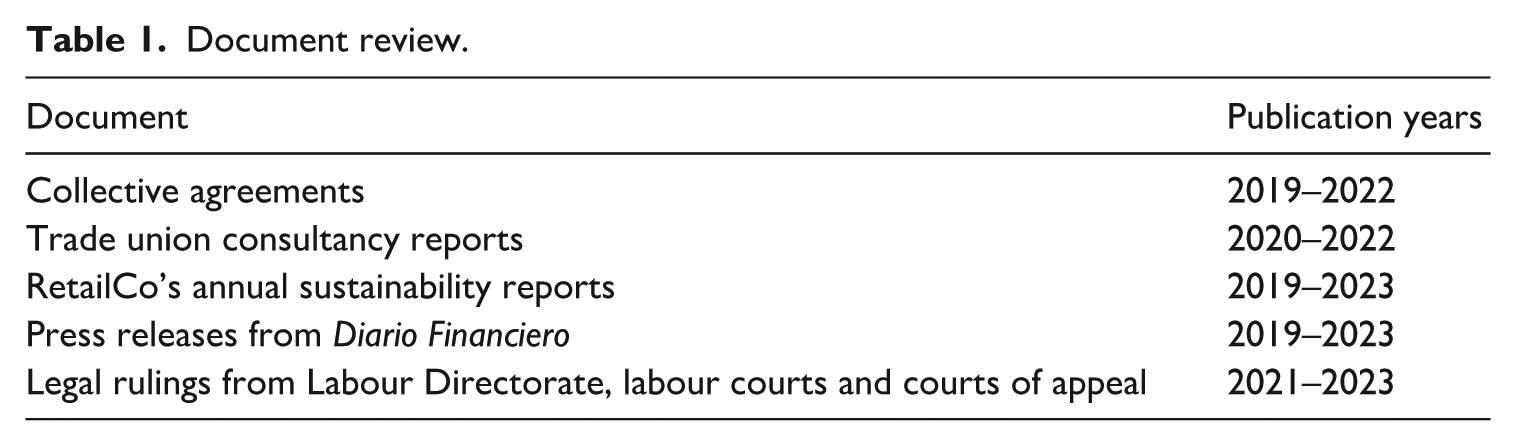
This research adopts a qualitative case study approach (Pritchard, 2012), focusing on the Functional Flexibility Plan (FFP), known as the ‘Tasks by Process’ restructuring agenda, implemented by the Chilean subsidiary of a multinational retailer (RetailCo) between 2019 and 2023. Two qualitative data collection techniques were used between 2022 and 2023: document review and interviews. The documents included collective agreements, press releases, 1 union reports, corporate sustainability reports and legal rulings (see Table 1). The document review followed a flexible categorisation process. For instance, in RetailCo’s sustainability reports, broad categories like ‘General Information on RetailCo’s Structure’ and ‘Staffing Information’ were applied, later expanding to include ‘Omnichannel Agenda’ as reporting on sociotechnical change.
Document review.
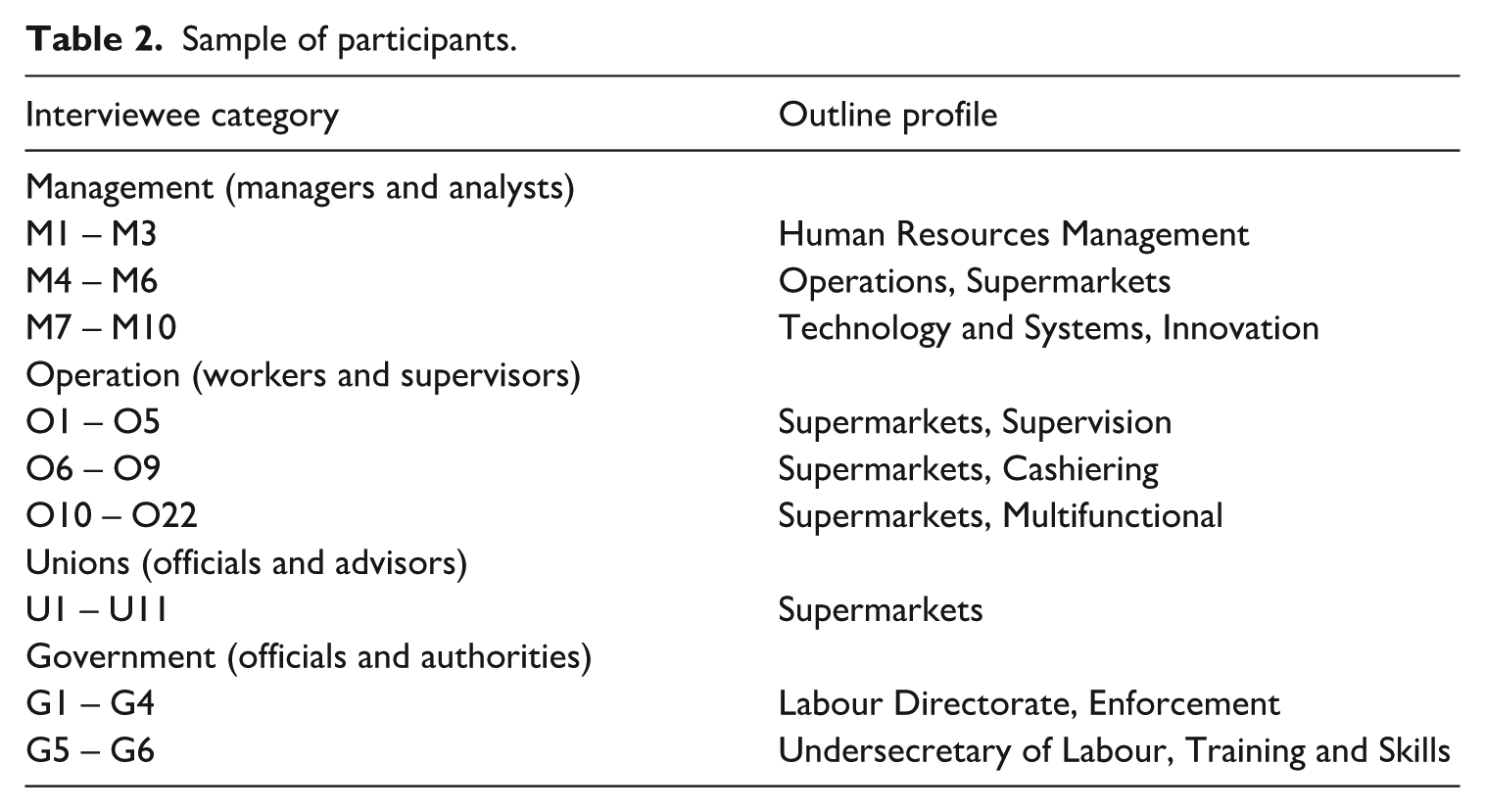
Subsequently, following theoretical sampling criteria (Saunders, 2012), interviews were conducted with the various actors involved in the regulatory conflict, including (N = 49): managers and analysts (10), union leaders and advisors (11), supervisors and workers (2) and government officials (6) (see Table 2). Recruitment consisted of establishing contact with key members from each of these groups of actors and then snowballing. To gain access to managers, it was necessary to obtain ethical approval from the company. All participants were asked to sign an ethical consent form indicating the objectives of the research and the guarantee of anonymity. Interviews were conducted in Spanish (30–120 minutes) and translated for analysis.
Sample of participants.
The topics addressed in the interview varied according to the type of actor interviewed. While the conversation with managers and analysts focused mainly on the restructuring plan, its objectives, its implementation process and the difficulties they have encountered, the interviews with workers dealt more with the consequences of the agenda of transformations in working conditions. The conversation with union leaders and advisors, on the other hand, focused on the mobilisation strategies they have deployed to confront these changes. Finally, the regulatory problems and challenges of these changes were discussed with the government officials interviewed.
The interviews and documents were coded through a qualitative content analysis (Schreier, 2013) using NVivo software. On the one hand, the central concepts of the research question were operationalised deductively, and on the other, emerging categories were identified that gave greater complexity to the original matrix. Thus, in the coding process, different categories were identified related to RetailCo’s change agenda (‘Technologies used’, ‘Schedules and tasks’, ‘Regulatory strategies’), its consequences for work (‘Workloads’, ‘Wages’), union responses (‘Political lobbying’) and normative sources and regulatory issues (‘Labour Code’, ‘Principle of certainty at work’).
Findings
Drawing on the RSA, this section presents the research findings by addressing the role that different actors have played in trying to influence the change agenda implemented by RetailCo. It outlines RetailCo’s sociotechnical change agenda and its implementation challenges, analyses unions’ legal mobilisation strategies, considers the role of state regulators and the employer’s use of institutional toying, and concludes with the corporate strategies adopted to readjust and advance the plan.
The multinational’s plan for functional flexibility
Since 2019, RetailCo has implemented the FFP organisational restructuring plan across all its large supermarkets. This reflects trends observed in various food retail contexts, where in recent decades horizontal forms of functional flexibility have been identified (Price, 2011), in some cases accentuated during the pandemic (e.g. Garcés Ojeda and Stecher, 2024; Winton et al., 2025). Based on the collection and analysis of data concerning task execution times across store sections, in addition to other information on staffing, sales and stock, this plan aimed to convert formerly skilled trades roles, such as bakers, butchers and cashiers, into a single position called the ‘store operator’. This novel, multifaceted role encompasses various responsibilities, initially covering 30 tasks, including shelf replenishment, managing the ‘Click-and-Collect’ section, receiving goods, providing customer service and assisting at sales counters. Store operators have to rotate weekly through different areas of the supermarket, assuming a new set of tasks each time, and are required to collaborate on high-priority tasks as directed by store managers.
A further component of the FFP has been the development, since 2023, of a mobile application designed to automate shift and task allocation in accordance with the plan. The app integrates performance metrics, sales data, stock levels and staff availability to inform its functions (M7 and M9). Building on ongoing algorithmic management pilots still in the testing phase, it is expected to be deployed more widely, following precedents established by RetailCo’s parent company (M5 and M9).
RetailCo officially stated in their annual sustainability reports that this multitasking model aligns with the omnichannel retail strategies, addressing the varied shopping preferences of customers who may buy groceries online or visit the store, paying at either self-checkouts or traditional counters. According to managers from Operations and Technology divisions (M4, M6 and M9), the creation of this role is directly connected to new digital technologies that have ‘liberated’ working time. The FFP is intended to adapt to what RetailCo describes as a ‘more complex and modern supermarket’ (M1). These transformations were not only framed as technological modernisation but also as a response to increasing competitive pressures from e-commerce platforms and digitally enabled retail models (M4).
Since 2015, fresh food sections, including butchers, fishmongers, delis and bakeries, have been restructured, with production and packaging outsourced to specialised suppliers (M3). Building on this, RetailCo has introduced new logistics technologies based on RFID systems, enabling employees to scan items across the store and access online inventories via mobile devices. The manager of a large supermarket posited: ‘the collaborators [workers] at the back end were registering everything on spreadsheets, checking that it was up to date . . . this is not only time saved, but also errors of all kinds’ (M6). Around 2019, RetailCo also introduced technologies to streamline selling and payment, including cash recyclers to automate cash counting and self-checkouts. The company’s Click-and-Collect and delivery services, which saw significant growth during the pandemic, further enhanced the modernisation efforts.
It is not justified to have permanent employees in each section of the supermarket because now the tasks are simpler, they are easier to perform with all the changes. Look at the example of the bakery, now even the bread comes pre-baked and you just need to put it in the oven. Everyone has access to the inventory, and little by little the template records in the warehouses are disappearing. (M5)
Alongside its rationale for modernising supermarkets, RetailCo emphasised that the FFP would benefit employees by preparing them to undertake a variety of tasks across different store sections, thereby fostering upskilling. The company presented the initiative as ‘an opportunity for employees to develop new skills’ (M1). While Human Resource (HR) managers acknowledged the challenges of implementation, describing the process as ‘somewhat messy’, they nonetheless stressed that the plan would enhance the skill set of store operators (M2 and M3). Supermarket unions, however, openly criticised the plan, triggering a regulatory dispute.
The legal mobilisation of trade unions in response to the Functional Flexibility Plan
The trade union world reacted swiftly to RetailCo’s transformation agenda through an intense legal mobilisation (see Castillo et al., 2026), aimed at opening up the regulatory space and bringing government officials and state institutions into the arena. Union leaders’ main criticisms of the FFP highlight three issues: (1) wage cuts due to elimination of former higher-paying roles, like butchers, bakers and cashiers who had commissions; (2) lack of training, leaving employees unprepared for multiple supermarket tasks; and (3) lack of certainty and clarity in job functions, leading to work intensification and stress-related leave. While the study did not explicitly differentiate these impacts by gender, they are likely to disproportionately affect women, given their concentration in lower-paid and frontline retail roles (Carré and Tilly, 2017). A union representative noted these issues threaten workers’ health and safety (H&S) and food safety as well: It has become clear that all this multifunction [FFP] goes hand in hand with more leave due to stress. Imagine that now we have to run from one place to another covering what the boss asks us, and sometimes I have gone to help at the cash register, and I have not even had time to wash my hands when I have to run to the food section. (U2)
In this context, unions pursued legal mobilisation strategies to pursue FFP’s regulation. In 2019, some unions entered collective bargaining to negotiate the ‘store operator’ conditions, including incentives for cashiers converting to the new role. Dissatisfied with the company’s offers, some opted for strike action, demanding improved wages for the increased workload: ‘It is unacceptable that, despite the increased workload and additional responsibilities, there has been no improvement in wages’ (O17).
High union fragmentation and labour turnover, however, limited union bargaining power. Thus, since 2021, unions have turned to strategic litigation, focusing on the individual employment contract as a worker security guarantee. This approach led to multiple Labour Inspectorate decisions and court rulings largely favourable to unions. Unions argued that, per Article 10 of the Labour Code, workplace tasks must be clearly defined and supplementary, limiting the FFP’s task scope. 2 They further contended that the FFP results in increased workload, greater H&S risks and wage reductions, particularly for cashiers, as consigned for example in the lawsuit of one of the main unions against RetailCo before the Labour Tribunal of Concepción.
Procedurally, unions’ legal strategies can be divided in two categories: (1) unions petitioning the Labour Directorate to declare the ‘store operator’ position illegal and enforcing monitoring, with RetailCo often appealing these fines in labour courts; and (2) filing claims of unjustified dismissal or labour protection for workers refusing reassignment to ‘store operator’, arguing that the company is retaliating against the workers for refusing to sign the new contract, thereby violating their freedom to work and their ability to participate in significant changes that affect the nature of their functions. A review of appellate court rulings shows nine cases of unfair dismissal linked to the FFP, with outcomes inconclusive and both sides claiming success.
Beyond litigation, some union organisations have employed more radical forms of protest, including strikes and media campaigns. They have opposed signing the new contract, asserting that cashiers and specialised workers have ‘acquired rights’ due to their years of work in the same position and performing the same tasks (U8). Instances of ‘organisational misbehaviour’ have also arisen (Ackroyd and Thompson, 1999), with union leaders urging new store operators to slow their work rates to demonstrate the FFP’s flaws (U7, O18 and O19). Some unions have declined to use RetailCo’s app for shift and task assignments, insisting that assigned tasks and schedules be outlined in formal contracts (O7, O9 and O12).
In 2023, RetailCo unilaterally advanced the general implementation of the FFP, threatening dismissals in cases of non-compliance. In response, the main unions requested a hearing before the Ministry of Labour and the Labour Directorate, which resulted in a comprehensive inspection plan covering 114 company stores in mid-2023. RetailCo’s refusal to negotiate, combined with the absence of a Supreme Court precedent regarding the legality of the ‘store operator’ role, prompted unions to intensify their regulatory lobbying efforts. As one union leader stated, ‘we must make this problem visible in Chile and exert pressure on as many State institutions as possible to regulate the store operator contract, delimit tasks, avoid disorder, and improve our wages’ (U6). Some unions sought to influence national labour certification and training agencies, including ChileValora and SENCE, by requesting official statements on the store operator position (U8 and U10). Others began lobbying parliamentarians to reform Articles 10(3) and 12 of the Labour Code, which ambiguously regulate functional flexibility (U3). Trade union legal advisors proposed amending these provisions so that tasks are defined as ‘related’ rather than ‘alternative or complementary’, and so that the authority to reassign tasks rests not solely with the employer but also with the workers (U5 and U6).
In sum, union responses to RetailCo’s FFP evolved from bargaining and strikes to strategic litigation, which secured favourable rulings on contractual clarity over workplace tasks and on protections relating to H&S. However, RetailCo’s unilateral rollout in 2023 pushed unions to broaden their lobbying efforts towards state regulators, highlighting the ongoing contest over the scope and legality of functional flexibility. In doing so, unions opened up the regulatory space to enable the involvement of additional regulatory actors in the conflict, an issue explored in the following section.
The involvement of state regulatory agents
Trade unions’ legal mobilisation has prompted state actors to intervene in the conflict over the FFP, seeking social agreements between RetailCo and its workforce. Government policy has largely prioritised training and social dialogue which, according to Labour Directorate officials, has come at the expense of the Labour Inspectorate’s enforcement capacity: ‘Law enforcement has lost incredible strength in matters that have to do with the number of functions . . . about 30% of the people in charge of these functions [labour law enforcement] have been cut’ (G2).
Nonetheless, union-led legal mobilisation compelled the Labour Inspectorate to intervene in response to numerous complaints that have been filed. According to the press review in Diario Financiero press notes, in 2022 and 2023 149 audits were conducted, resulting in 134 sanctions imposed on RetailCo for breach of contract or illegality of the store operator position. Unions sought to expose the legal traps within the FFP as an ‘institutional toying’ strategy (Benassi and Kornelakis, 2021), which restructures the work process and obscures the correspondence between law, contract and actual tasks, an ambiguity that enables employers to exploit regulatory gaps. In 2021 and 2022, the Labour Directorate ruled RetailCo’s new contracts as non-compliant with labour law, setting a precedent for workers by noting the lack of certainty and clarity in job tasks due to the broad range of responsibilities and frequent role rotation.
The employer cannot unilaterally define the main and support areas in which the worker must perform each month . . . and workers cannot be sent to work in different areas of the establishment more than once in the same day. (Labour Directorate Resolution 1722) Numeral 3 of Article 10 of the Labour Code requires that the employment contract contain a clear determination of the nature of the services . . . employment contracts with multiple services, such as those proposed by the company, continue to be prohibited in light of the principle of certainty and security in the employment relationship. (Labour Directorate Resolution 734)
According to officials from the Labour Directorate, between April and May 2023, inspections were conducted at 105 RetailCo stores nationwide. Only three stores were found to be free of legal breaches. The Inspectorate suggests that, per the ‘spirit’ of Article 10, only four or five supplementary functions are reasonable, not over 20 as in the FFP. The Deputy Director of the Labour Directorate also refers to the principle of ‘acquired rights’ or the ‘primacy of reality’, asserting that if a worker has been performing certain tasks for years, it is unreasonable to change them suddenly based on a manager’s discretion: ‘a worker who is restocking is suddenly told “no, you know what, you have to go to cut meat or to cut these ham sausages”’ (G4). Some of the Labour Inspectorate’s decisions have been addressed within the labour judicial system, resulting in rulings in favour of the workers. A review of the appeals court database showed that 18 rulings have been issued on judicial reviews of fines imposed by the Labour Inspectorate on RetailCo for implementing the FFP. Although some fines were initially overturned by labour courts, they were ultimately upheld by the appeals courts. In 2022, a labour court in Santiago ruled that the store operator position was illegal, affecting 8000 workers under that contract. The court noted that the variety of tasks within the store operator role does not share a common nature: These multifunctional contracts stipulated for the same worker integrate[d] tasks of a sales room – such as restocking, charging, selling – as well as other complementary tasks – serving customers, labelling, weighing and packaging – tasks that, from their perspective, do not share the same nature and detract certainty to workers regarding their responsibilities.
Despite these favourable rulings, the absence of a Supreme Court criterion on the store operator contract’s legality remains.
3
As noted by a Labour Directorate official: Different courts of appeals have pronounced in general, the rulings are generally against the plan [FFP], but there have also been cases in the Bío-Bío Region that declared it to be in accordance with the law, so since there is no unification of criteria, we have to wait for the Supreme Court to pronounce.
While awaiting the Supreme Court’s decision, the unions have pushed for regulatory action by other government institutions, including the training and certification institutions ChileValora and SENCE, which, under pressure from the unions, advised RetailCo to limit functions and improve training (G5 and G6). Some progressive parliamentarians have also suggested reforming Article 10 of the Labour Code, but no formal initiative has been proposed. According to a press note, in 2023, the Ministry of Labour intervened, reviewing the dismissals of workers who declined the store operator role and drafting a bill to regulate dismissals. The initiative sought to require employers to consult workers’ organisations before implementing layoffs, identifying ways to reduce redundancies and retrain impacted workers. The Undersecretary of Labour stated: In the retail sector we are facing a situation of massive layoffs. This has generated significant concern in Parliament and at this moment bills are being processed that seek to strengthen the tools of the Labour Directorate and SENCE [National Training and Employment Service] to address these situations of mass layoffs. (Diario Financiero, 25 April 2023)
In 2023, the International Labour Organization (ILO) admitted a union complaint and established a tripartite committee to investigate potential violations of international conventions, including Convention 122 on employment and economic development and Convention 187 on occupational safety and health. The union argued that RetailCo’s flexibility arrangements, not specified in contracts, compelled workers to accept non-consensual conditions under threat of dismissal. While flexibility is not inherently incompatible with decent work, it becomes precarious when it generates instability or uncertainty that undermines workers’ H&S.
In the interim period before a ruling by the Supreme Court or concrete government intervention through labour reform, the enforcement department of the Labour Directorate has promoted a progressive agenda to regulate retail sector organisational changes, addressing functional flexibility and subcontracting under the FFP. The Directorate has been investigating the use of agency workers for long-term core functions as store staffing has declined (G2 and G3). Officials note that these contractors, unregistered with the Labour Inspectorate, often have direct ties to RetailCo and lack compliance with the 2006 law on subcontracting and temporary staffing (G2). This includes requirements to supervise these workers on-site, retain their positions for a set period, and limit the maximum duration of contracts to 90–180 days. Consequently, the Labour Directorate has aimed to push retailers to integrate these workers into the permanent workforce if they are shown to be performing core, long-term functions, like cashiering. According to Article 183-F of subcontracting law, the workers offered by the temporary service company to the parent firm may only perform temporary or occasional tasks. Labour Directorate officials have indicated that repeatedly hiring, firing and re-hiring workers for the same roles could indicate a misclassification of permanent positions as temporary, which is prohibited by law (G2 and G3). Following the FFP, this constitutes a second institutional toying strategy deployed by RetailCo, this time operating through the deliberate misclassification of workers performing central and permanent functions as external agency workers (Benassi and Kornelakis, 2021). By labelling as temporary and peripheral what is in fact stable and core work, RetailCo generates a structural ambiguity that hinders enforcement by the Labour Inspectorate.
We were investigating the case of retail [and] we saw how they have dismissed people, but then they put them back into the supermarket as external, through contractors, and illegally because sometimes they terminate them after a couple of days and then call them again. They call them weekly, on Fridays they ask for no less than 60 or 70 workers per store: ‘I need 30 cashiers, 20 stockers’ . . . that [kind of] supply of personnel by the transitory service companies is illegal in Chile. (G3)
Other dimensions of the FFP, particularly the use of workers’ data in transformation agendas, remain poorly regulated. RetailCo has drawn on employee data to implement the FFP and to develop an app for managing shifts and tasks (M4), often without explicit consent. The data collected go beyond sales and logistics to encompass operational metrics, HR records and task performance (M10). These practices exploit ambiguities in Chile’s limited labour data protection framework (Contreras et al., 2022). Although the Constitution and privacy laws provide general safeguards, and the Labour Code requires employers to protect confidentiality, significant gaps remain. RetailCo’s use of worker data thus represents a third form of institutional toying in its transformation plan, aimed at cutting labour costs and intensifying work demands.
In short, union mobilisation over the FFP has triggered state and judicial interventions, yet the absence of a Supreme Court ruling has sustained legal uncertainty. While labour courts and the Labour Directorate have questioned the new multifunctional store operator position, unions have broadened their efforts to certification agencies, parliamentarians and even the ILO. At the same time, RetailCo has pursued further ‘institutional toying’ strategies, such as misclassifying permanent roles as agency work and exploiting weak labour data protections, underscoring how cost-cutting and work intensification remain central to its transformation agenda.
Rebel compliance: Adjusting while sustaining the change agenda
RetailCo initially sought to obstruct regulation of the FFP by challenging administrative actions through judicial reviews and by managing inspections strategically. The company sought to regularise FFP operations in advance and instructed workers on how to respond during interviews with labour inspectors.
What they are doing is calling the workers and telling them the intention, the benefits of multifunctionality [functional flexibility] and convincing them that they are moving within the legal framework . . . many times they give them instructions and the worker is afraid of dismissal because there are no forms of protection despite everything the law says, if they [RetailCo] want they can fire them. (G3)
In addition, RetailCo has defended itself against unfair dismissal claims by arguing that the FFP reflects the need to ‘adapt to the evolving needs of customers who mix physical and digital experiences in their shopping process’ (M3). While the company has initially prevailed in some cases, for example with the conversion of 270 workers in Concepción into store operators, most higher court rulings have gone against it. In cases where RetailCo did prevail, courts cited Article 161 of the Labour Code, affirming that the FFP meets business necessity criteria for productive reorganisation.
Given the inevitability of adjustments to the FFP, RetailCo revised the store operator contract in line with rulings from the Labour Inspectorate, Labour Court and Appeals Court. These revisions included reducing the range of tasks assigned to store operators, clarifying job roles, and introducing a monthly plan communicated to employees. As pointed out by a Labour Inspectorate official, If we follow the whole judicial conflict, the company has been adapting, they have been lowering the functions to be covered, although they also sometimes raise them again, but in general they have been moderating the plan . . . new positions are invented such as the cashier operator who is only in charge of the sections that are close to the sales area. (G1)
Alongside adjustments to its plan, RetailCo has promoted the shift to functionally flexible contracts – embodied in the new store operator role – amid ongoing sociotechnical change, including the rise of online sales and the automation of logistics and sales processes (M4). This narrative has gained traction with the backing of major business associations, which are closely monitoring the dispute as its outcome could set a precedent for the wider retail sector and beyond. Specialised in-store roles, like cashiers, are portrayed as ‘old-fashioned’, as creating ‘barriers to hiring’, and as ‘reducing productivity’ (M5). As part of its lobbying strategy, this discourse has also permeated government institutions, including the Labour Directorate, which has promoted dialogue with retailers on the grounds that ‘companies are not complying due to ignorance’ (G4).
Lastly, RetailCo’s legal team argued that the ‘Operational Transformation Monitoring Committee’, intended to assess technological changes and composed of company managers and union representatives, has not operated because of the unions’ refusal to attend the meetings required for its establishment. The team further contended, citing Article 306 of the Labour Code, that the obligation to inform workers of changes under the collective bargaining agreement does not grant unions veto power over operational changes or transformations. This shows how Chile’s employment relations model grants employers broad discretion over labour matters, including work organisation (Pérez Ahumada, 2023).
With regard to data use, RetailCo’s collective agreements include a clause that explicitly refers to Law 19,628 on the protection of workers’ personal data and stipulates that ‘the worker expressly authorises the employer to process personal data obtained in the employment relationship’. Although the clause does not specify the potential use of such data for productive organisation or business model restructuring, it effectively enables collection and processing for these purposes. Pending resolution of this regulatory dispute, RetailCo has sought to delay judicialisation, signalling its willingness to bear the costs of litigation. As noted by the Labour Directorate, ‘the company is willing to pay a fine of up to 60 UTM [USD $4000] for each violation found in order to maintain its FFP’ (G3).
Overall, despite regulatory challenges and adverse rulings, RetailCo has adapted while remaining committed to the FFP, reinforced by business associations framing it as work modernisation. Its willingness to absorb fines and exploit legal gaps highlights the enduring predominance of employer discretion in Chile’s employment relations model.
Discussion and conclusions
This research examined the implementation of a transformation agenda in a multinational supermarket chain, underscoring the need to address the regulatory challenges of sociotechnical change beyond the well-studied case of digital labour platforms (Inversi et al., 2023; Mazur and Serafin, 2023). The study showed how different actors sought to shape this agenda by both deploying and contesting existing regulatory frameworks. This dynamic generated uncertainty and fragmented regulation that can open opportunities for institutional experimentation (Murray et al., 2020) but can also be strategically exploited by large MNCs (Benassi and Kornelakis, 2021). Such outcomes are facilitated in employment relations contexts that confer significant institutional advantages on employers, as illustrated in Chile (Bellido de Luna, 2022; Pérez Ahumada, 2023).
The case study highlighted the regulatory disputes surrounding RetailCo’s transformation agenda (FFP), which was partly driven by new logistics systems and front-end sales technologies. Central to the plan was the conversion of formerly specialised supermarket roles into a single cross-functional ‘store operator’ position. RetailCo justified this by arguing that sociotechnical change had ‘freed up working time’ and enabled the creation of a ‘modern supermarket’. In contrast, unions criticised the resulting wage reductions, insufficient training and lack of clarity and certainty in task definitions, all of which contributed to work intensification. Functional flexibility has traditionally been associated with lean production principles, often framed as enhancing the skills of core employees by broadening their tasks and enriching work through semi-autonomous teams (Atkinson, 1984). However, far from embodying a model of multiskilling based on teamwork and participation, some evidence from retail points instead to processes of deskilling and the erosion of autonomy, which render employees easily disposable and interchangeable across roles (e.g. Garcés Ojeda and Stecher, 2024; Price, 2011). As Blyton and Turnbull (1998) observed, such developments raise concerns for unions and employees about work intensification and the dilution of competences, often provoking worker resistance. Although gender was not a primary analytical focus of this study, these dynamics are likely to have differentiated effects, particularly in a sector that remains highly feminised, where organisational restructuring and flexibility schemes tend to reinforce existing inequalities in pay, job quality and working conditions (Carré and Tilly, 2017).
In this vein, this case study has shown how the FFP triggered a regulatory controversy that unions, constrained by limited bargaining power, sought to contest through legal mobilisation beyond the workplace, strategically opening up the regulatory space to involve additional regulatory actors. Alongside strategic litigation, where the Labour Inspectorate and courts largely sided with unions in declaring the store operator role unclear and illegal under Article 10.3, unions also lobbied training bodies, parliamentarians, the Labour Ministry and the ILO. Although RetailCo’s appeals have slowed progress, these actions have broadened the regulatory arena and prompted state institutions to consider reforms on functional flexibility.
In response, RetailCo adjusted the FFP by reducing tasks, narrowing store operator roles and improving training, while remaining determined to implement the plan. The company was willing to litigate, absorb fines and actively press for a shift in the Labour Directorate’s priorities from enforcement to social dialogue. Through these actions, RetailCo advances a soft regulation paradigm that privileges training and dialogue over the enforcement of labour law – the cornerstone of Chile’s legalistic employment relations model (Piore and Schrank, 2018). At the same time, this trajectory exemplifies MNC isomorphism, as subsidiaries reshape local regulatory spaces in order to drive organisational transformation despite union resistance and ongoing regulatory constraints (Ferner and Edwards, 1995).
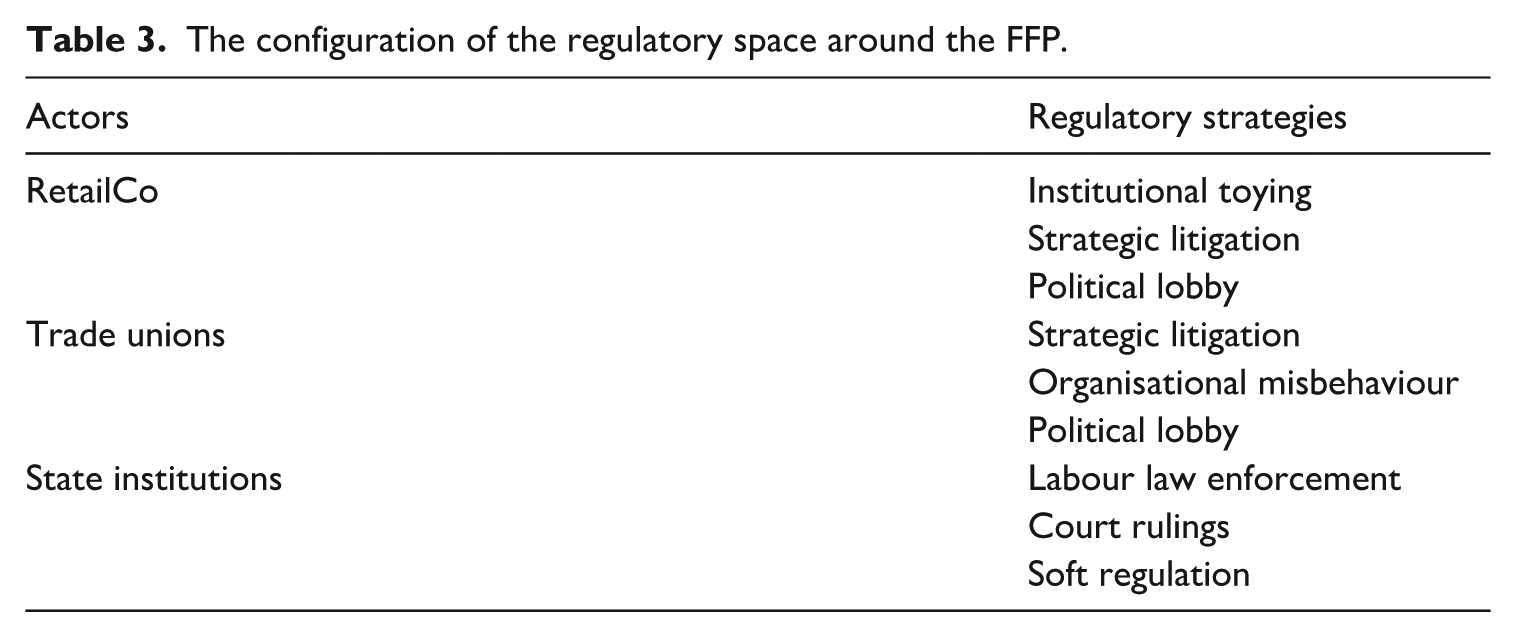
Ultimately, RetailCo’s transformation plan relies on three forms of institutional toying: reorganising work processes by exploiting ambiguities around functional flexibility; reducing labour costs by misclassifying workers in permanent roles as agency staff; and using employee data for organisational restructuring, facilitated by the lack of clear regulations on the processing of personal and employment data (Contreras et al., 2022; Ponce del Castillo, 2024). Table 3 summarises the disputes in the labour regulatory space and the strategies deployed by different actors.
The configuration of the regulatory space around the FFP.
The findings of this research make two key contributions to the literature on regulation and employment relations. First, the case study illustrates how, in a context of rapid sociotechnical change and fragile industrial relations institutions, powerful companies can deploy regulatory strategies to their advantage. These include using strategic litigation to delay rulings, lobbying government institutions and exploiting legislative ambiguities (Inversi et al., 2017; Streeck and Thelen, 2005) through practices described as ‘institutional toying’ (Benassi and Kornelakis, 2021) or ‘loophole entrepreneurship’ (Sirman, 2023). In such contexts, employers are able to shape labour regulation and leverage legal ambiguities to advance transformation agendas with limited resistance, while unions are left to navigate a fragmented regulatory landscape in an effort to expand their influence and protect workers’ interests. This contrasts with countries that maintain centralised industrial relations systems and consolidated works councils, where stronger bargaining power provides greater protection for workers, such as Germany or Norway (e.g. Doellgast et al., 2023; Krzywdzinski et al., 2025).
Building on this, the article highlights the analytical value of the Regulatory Spaces Approach (RSA) for capturing how regulatory processes and conflicts unfold under these conditions. Rather than treating regulation as a fixed institutional framework, RSA foregrounds the dynamic interactions between multiple actors – firms, unions, government agencies, courts and other institutional actors – who compete to shape rules, interpretations and enforcement practices (Martínez Lucio and MacKenzie, 2017). This has been particularly evident in studies of the gig economy, where RSA has been used to analyse how firms operate within fragmented and unsettled regulatory environments (e.g. Inversi et al., 2023). However, this focus on the platform economy has tended to overlook how accelerated processes of digitalisation are also transforming more conventional workplaces, such as retail stores and supermarkets, where employment relations are more institutionalised and collective actors such as trade unions are more firmly embedded. In this respect, incorporating a sociotechnical perspective extends RSA by enabling the analysis of these underexplored traditional settings. By attending to the intersection of digital systems, organisational restructuring and institutional contexts, the framework captures how such transformations reshape not only work processes but also the institutional configurations that shape how rules are established, applied and contested.
Importantly, the article acknowledges that narratives of new technologies and digitalisation can be mobilised discursively by firms to legitimise organisational transformation. However, it argues that this discursive dimension is inseparable from material and institutional processes that have concrete effects on work organisation and its regulation (Boreham et al., 2007; Geels, 2004). In the case examined here, digital systems are embedded within a broader sociotechnical assemblage comprising technological infrastructures, organisational restructuring, competitive pressures from e-commerce and digitally enabled retail models, and a permissive institutional context. This assemblage underpins the reorganisation of the labour process – through new forms of task allocation, monitoring and coordination – while also generating regulatory ambiguities that may be strategically mobilised by firms. In this sense, sociotechnical change operates not only as a framing device, but as a set of material and institutional dynamics that actively reconfigure the regulatory space, including the distribution of capacities to define, interpret and enforce rules. By foregrounding the interplay between discourse and material transformation, the article shows how a sociotechnical perspective brings into view forms of regulatory contestation and organisational restructuring.
Secondly, this research contributes to strengthening dialogue between the employment relations and labour regulation literatures in order to better understand the broader context in which sociotechnical change unfolds. Employers’ regulatory strategies can be contested even in institutional environments that constrain labour influence, as trade unions and state institutions may still seek to steer change and protect labour interests (Doellgast and Wagner, 2022). The RSA provides a useful framework for examining the role of different actors in negotiating employer agendas within specific institutional settings. Although applied in studies of platform work (e.g. Inversi et al., 2023), the framework has not been used to analyse sociotechnical change in traditional work settings, where diverse industrial relations actors deploy regulatory strategies and practices to shape transformation (De Stefano and Doellgast, 2023). RSA highlights the power and agency of multiple actors in driving change (Hancher and Moran, 1989; MacKenzie and Martínez Lucio, 2014), while also revealing how these interactions can generate fragmented and uneven regulatory processes (Buzbee, 2005). The case study showed that the regulatory process has been dispersed over time, across political levels, and through multiple frameworks and institutions.
This ongoing conflict raises wider questions about whether regulatory fragmentation ultimately serves the interests of multinational corporations or, alternatively, opens space for more inclusive institutional settlements (Murray et al., 2020). Realising the latter requires strengthening trade union autonomy and industrial democracy. Historical experience demonstrates that, during the 1970s, co-determination linked to union participation facilitated more inclusive sociotechnical change programmes in response to the rise of information and communication technologies (Fricke, 1986). Contemporary comparative evidence further highlights the value of centralised or multi-level collective bargaining, together with consultative forums that provide unions with an effective role in regulating the use of Artificial Intelligence at work (De Stefano and Doellgast, 2023).
Footnotes
Acknowledgements
The authors wish to express their gratitude to Debra Howcroft, Miguel Martínez Lucio, Stephen Mustchin and Angel Martin-Caballero at the Work and Equalities Institute (University of Manchester) for their valuable comments and insights, as well as to the participants of the CRIMT 2024 conference for their constructive feedback.

Funding
This article received financial support from the National Research and Development Agency of Chile (ANID), through a doctoral scholarship and a research grant (Fondecyt Regular 1262017).
Declaration of conflicting interests
The authors declared no potential conflicts of interest with respect to the research, authorship and/or publication of this article.