






Abstract
Building on labor sociology, labor geography, and politics, this article explores how workers develop a socio-spatial strategy for creating unions under repressive labor regimes in neoliberal contexts. The study uses a comparative multi-case research design, drawing on 46 interviews with union leaders across 30 companies from all economic sectors in Chile—a quintessential example of extreme neoliberalism. The analysis reveals the clandestine and secret processes through which workers orchestrate the formation of unions in a strategy consisting of three tactical phases: initial coordination, withdrawal and institutionalization in external safe spaces, and surprise re-entry. The text contributes to theory-building on union spatial strategies and offers insights applicable across decentralized labor systems.
Introduction
This article explores how workers deploy a socio-spatial strategy during unionization efforts under repressive labor regimes characteristic of neoliberalism, using a multi-case study in Chile. While the intersection of sociology, geography, and politics has enriched our understanding of work, social movements, and capitalism, these approaches remain underutilized in analyzing workers’ spatial agency within labor processes and workplace regimes. Even more, much of the literature on trade unionism has focused on studying established and strong organizations, but has paid less attention to how some workers create unions despite the challenges involved.
Throughout the twentieth century, workers regularly organized unions—with varying degrees of success—to improve their wages, working conditions, and political influence. In the current era of neoliberalism characterized by the global declining unionization rates, many unions and labor communities are engaging in efforts to organize and revitalize their struggles, aiming to increase membership and workplace participation (Frege and Kelly, 2003; Ibsen and Tapia, 2017; Lévesque and Murray, 2010; Sullivan, 2009). These initiatives often include campaigns, community-territorial structures, and new socio-spatial strategies within workplaces and urban areas to strengthen unions and broaden workers’ organizations (Elbert, 2017; MacDonald, 2017; Martínez Lucio and Perrett, 2009; Però, 2020; Roca, 2020; Voss and Sherman, 2000). Despite these advances, however, the literature on unionization often neglects workers’ socio-spatial agency in the workplace during the organizing process, where they face a politically hostile regime dominated by hegemonic private property principles and repressive managements and owners—a typical context in neoliberal and unequal societies, as in Latin America (Pérez-Valenzuela, 2019).
To address these weaknesses and fill these gaps, more critical and explicitly theorized perspectives on space and organizing are required to explain strategies, tactical choices, and political contexts in specific settings, such as struggles over material and symbolic control of space, the spatial organization of production, the production of scales and territorialities, and specially the creation of safe spaces (Baldry, 1999; Herod, 1991; Pérez-Valenzuela, 2019, 2025; Roca, 2020; Stillerman, 2003).
This article contributes to these research problems by analyzing 46 interviews on union formation across 30 cases in all Chilean economic sectors from a socio-spatial perspective. It identifies a strategic approach among organized workers, consisting of three key tactical phases for unionization: (a) discreetly engaging in pro-union activities and talks, while seeking safe spaces to avoid detection; (b) forming unions usually in external safe spaces such as community centers, food establishments, squares, union offices, and homes; and (c) challenging authority by unexpectedly returning and under protection to the workplace. By doing this, the study demonstrates that activist workers have developed a unique political-geographic strategy—a general plan and set of tactics aimed at navigating and influencing production spaces to change power relations—used to establish unions within private companies under neoliberalism. In this manner, this study’s significance extends beyond local contexts to encompass countries within the neoliberal spectrum, especially in unequal societies with legal frameworks in labor relations that promote a decentralized labor system anchored at the firm level, characterized by the absence, fragmentation, and weakening (or disintegration) of unions.
The article is organized into the following sections. The second section introduces the sociological and geographical frameworks on workers’ strategies in anti-union workplace regimes under neoliberalism. The third section outlines the background of unions in Chile. The fourth section details the methodology based on a multi-case study anchored in interviews. The fifth section presents and critically examines the evidence from all economic sectors in Chile. The penultimate section discusses the workers’ spatial agency and its political significance at work. The conclusion discusses the interplay between unions, organizing spaces, and workplace regimes within the context of neoliberalism.
Theoretical framework
Neoliberal labor regime and workers’ power
Neoliberalism is a theory of political-economic practices that promotes entrepreneurial freedoms within an institutional framework characterized by private property rights, robust free markets, and free trade (Harvey, 2005; Herod and Aguiar, 2006) that has significantly impacted the labor regimes, increasing the autonomy of capitalist decisions, as well as decreasing the conditions for the unionization of workers. Politics and space are fundamental to understanding this. Following Labor Process Theory (LPT), capitalist production involves an “internal state” designed to mediate conflicts between capital and labor (Burawoy, 1982), so workers, facing greater flexibility in production and precariat employment, encounter various evolving direct and indirect challenges at the workplace when forming unions—organizations critical for collective action at work. In Latin America, these discussions acquired particular relevance following the neoliberal reforms implemented since the 1970s and deepened during the 1990s up to the present day, which weakened traditional labor relations systems, promoted the individualization of the wage relationship, and restricted workers’ organizational capacities (Medel and Osorio Lavin, 2025).
However, despite the breadth of this body of research, the specific process of union formation has occupied a relatively marginal place within labor studies. Most research tends to assume the prior existence of consolidated unions, subsequently focusing on their repertoires of action, organizational structures, power resources, or institutional strategies. As a result, unionization often appears as a starting point rather than as a social and political phenomenon requiring explanation in its own right. This omission becomes particularly significant in contemporary contexts where the formation of labor organizations constitutes a complex, uncertain, and politically conflictive process.
The presence of a union within the workplace is integral to challenging managerial authoritarianism and promoting more democratic forms of labor governance (Ferreras, 2017). When managing to remain active, unions often act as disruptive forces against oppressive labor regimes. Currently, the labor movement and large unions are losing their ability to retain members and safeguard their conditions (Però, 2020). Global trade union membership stays low, at 17%. However, from 2000 to 2016, there were shifts, particularly favoring developing countries (Visser, 2019). In an era characterized by escalating managerial despotism and authoritarian tendencies (Anderson, 2019; Ferreras, 2017; Pérez-Valenzuela, 2019), expressed in strategies and resources employed to hinder and undermine union activity (Logan, 2021), workers attempting to assert their rights often encounter an environment marked by repression, fear, and frequently intimidation. This hostile atmosphere significantly affects workers’ consciousness, thereby undermining both their capacity and motivation to pursue unionization. Consequently, the formation of a union within an organization—particularly if none previously existed—may signal the weakening of a unilateral political regime, potentially leading to its transformation and the establishment of a more balanced, bilateral relationship between parties, contingent upon the union’s sustainability.
In these adverse environments, workers’ strategies and tactics are vital for union formation and contestation from a spatial perspective. However, there is a notable gap in the literature regarding workers’ micro socio-spatial agency in organizing processes at the workplace. How does space function as a means of control within the labor process, and in what ways do workers assert control over it? Historically, dominated communities and groups have developed traditions that serve as stealthy forms of resistance, often taking place in “safe spaces”: the places where the oppressed can socialize and communicate freely without the surveillance of the dominators (Scott, 1990). Today, this resistance and strategic behavior can be observed significantly in the daily actions and practices of workers as they maneuver through capital, materialized in the space–time of the private workplace.
Union socio-spatial strategies
Union strategies include collective orientations, models, and decisions made by workers to improve their working and living conditions both at work and beyond. This aspect is crucial because organizing strategies and tactics are the only means workers have to navigate the neoliberal environment (Bronfenbrenner and Juravich, 1998). After a significant decline in unionization during the rise of neoliberalism, driven by restructuring toward flexible production, many unions are now focusing on organizing, revitalization, and community efforts to grow membership and participation within the new global neoliberal capitalism. All these approaches and strategies serve as an alternative to business unionism, which mainly aims at economic interests and collective bargaining, often excluding other workers and lacking broader political or social goals (Hyman, 2001).
Numerous studies have identified distinct or emerging sources of strategy within the existing body of literature. Since 1980, multiple cases have demonstrated the emergence of an “organizing” union strategy or model, whereby unionized workers reorient their traditional approaches and strategically align their activities and resources to reinforce their organizational power over the long term or to support a membership-based model. This shift is primarily reflected in increased unionization rates aimed at countering structural transformations (Fiorito and Jarley, 2012; Voss and Sherman, 2000). Some scholars argue that, in response to workplace transformations, higher levels of union affiliation are necessary to challenge adverse macro-institutional and economic conditions (Bronfenbrenner and Hickey, 2004).
Within this context, a broader and interconnected debate concerning union revitalization and renewal emerged within the literature during the 1990s and 2000s, particularly from the Anglo-Saxon perspective, where various unions experienced growth and strengthening through the adoption of new forms of affiliation, decision-making, collective action, and alliances (Frege and Kelly, 2003; Ibsen and Tapia, 2017; Lévesque and Murray, 2010; Sullivan, 2009). By analyzing organizing strategies within these revitalization experiences, studies document campaigns that promote union affiliation among workers through industry-based and community-based initiatives, employing spatial strategies and tactics with new employment sectors, communities, and social movements (Ibsen and Tapia, 2017; Jiang and Korczynski, 2024; MacDonald, 2017; Però, 2020; Voss and Sherman, 2000). In addition, the concept of “social unionism” revived its longstanding tradition of strategically engaging new worker segments and effectively preparing them for negotiations of favorable initial collective agreements, often extending efforts beyond individual workplaces to entire sectors or regions (Tufts, 2009). Even the histories of unemployed organizing are suggestive of the vast potential within communities and the possibilities for dignity and dialogue through a spatial politics of solidarity and resistance (Griffin, 2024).
These debates closely relate to a fourth similar approach: “community unionism” and its literature that connects labor sociology and labor geography. This strategy has been implemented in both industrialized countries and the Global South, emphasizing forming alliances with non-labor organizations to achieve common goals and to innovate in the scope and objectives of direct actions, recruitment methods, and mobilization levels (Elbert, 2017; Holgate, 2015; Jordhus-Lier, 2013; Tufts, 1998; Wills, 2001). Its purpose, as many scholars suggest, is that community and territorial structures of unions and campaigns might be more effective within today’s capitalist context, although no single model dominates (Martínez Lucio and Perrett, 2009; Roca, 2020).
Integrating insights from sociology and geography, the concept of spatiality is essential for understanding union strategies (Roca, 2020). These strategies, including efforts to revitalize unions, mainly serve as a socio-spatial response to current labor geography (Jordhus-Lier, 2013). However, these strategies are difficult to observe, especially in workplaces with anti-union repression. Therefore, in organizational, labor, and social movement research, developing more critical and explicitly theorized ideas about space and organizing actions can improve explanations of differences in strategies, tactics, and context across various settings (Dale, 2005; Roca, 2020; Stillerman, 2003). This highlights the importance of micro-level factors, struggles for both material and symbolic control, the local built environment, safe spaces, and the creation of scales and territorialities in understanding the origins, dynamics, and results of organizing efforts (Herod, 1991; Stillerman, 2003).
The political state enforces the capitalist’s territorial control over the labor process and private property, which leverages the socio-spatial organization of production and its social materiality as a tool of absolute governance over workers, denying them any form of internal democracy and spaces of class autonomy (Pérez-Valenzuela, 2019, 2025). However, workers act and communicate with each other with increased caution and secrecy to avoid detection and potential repercussions, using “safe spaces” both individually and collectively to unionize, as analyzed in such spatially opposite workplaces as mining and supermarkets (Pérez-Valenzuela, 2025).
What is the importance of union organizing spaces? Historically, oppressed individuals and groups have appropriated and controlled certain areas, transforming them into “safe spaces,” which gives them an infra-politics to resist (Scott, 1990). In these safe spaces and in labor contexts, the socio-spatial agency of workers—in practices, strategies, and tactics—can be more accurately identified. For example, safe spaces enable workers to share and disseminate information across various sectors effectively (Kellogg, 2009), union headquarters play a key role in bringing together workers who adapt flexibly in terms of time and space during their shifts (Manky, 2017), and homes and neighborhoods serve as vital safe spaces for organizing and forming unions among domestic workers (Jenkins, 2013). In the context of strikes and mobilizations, workers utilize neighborhoods near their workplaces, where many reside, as strategic locations to regroup and resist police forces and strike-breakers (Stillerman, 2012). As illustrated, unions’ daily efforts are closely tied to place and territorial settings, highlighting the fundamental role that spaces play in labor relations—an importance that could increase under contemporary neoliberal conditions characterized by reduced labor regulation and heightened workplace fragmentation in the service sector (Pérez-Valenzuela, 2025; Tufts, 1998).
While this socio-spatial agency generally has a significant impact, it is especially important for understanding and explaining the low unionization rates in neoliberal countries and extremely unequal societies, as Latin America illustrates. This is because their labor systems are often fragmented at the company or firm level, as is the case of Chile, Peru, Colombia, Honduras, among others. The unionization process is very vulnerable to daily conflicts stemming from resistance to management control and challenging the adverse labor conditions experienced at work.
Research question and context
Chile is a suitable case study for examining labor tensions and workers’ resistance strategies, as it exemplifies a historical instance of moderately strong unionism (Zapata, 2003) alongside some of the most extreme neoliberal policies globally (Madariaga, 2020; Rodríguez, 2019). This economic and political neoliberal system was forcibly implemented in the country during Augusto Pinochet’s dictatorship (1973–1990), which overthrew Salvador Allende’s socialist government. The regime predominantly pursues a market-oriented economy with minimal government intervention. Under this framework, dictatorship-era policies privatized state-owned enterprises, deregulated trade and financial sectors, and attracted foreign capital, fostering competitiveness even within social domains such as education, pensions, and healthcare. These measures promoted entrepreneurial and investment-friendly regulations, widened wealth disparities, and undermined social protections.
Throughout the 1990s and 2000s, Chile’s democratic regime continued and refined neoliberal policies. Many reforms from the dictatorship remain foundational to the country’s economic system, fueling ongoing debates and influencing modern Chilean politics and society (Rodríguez, 2019). The impact on Chile’s private sector and unionism has been significant and layered, with labor laws weakening unions’ influence and bargaining power, increasing union parallelism, and creating bureaucratic obstacles to collective organization (Pérez Ahumada, 2021). In the labor relations system, collective bargaining is mostly confined to the company level, and the right to strike is relatively restricted compared to other countries (Observatorio de Huelgas Laborales [OHL], 2018). However, from the mid-2000s onwards, unions began to resurge, gradually mobilizing against neoliberal policies and gaining momentum in the 2010s through legal and illegal strikes amid rising social protests. Since 2013, unionization in the private sector has increased modestly from 14.2% to 17% in 2018 (Dirección del Trabajo [DT], 2022). That year, on the one hand, the most common union type was the “company union” (sindicato de empresa), comprising 6686 of 11,920 unions (56.1%) (DT, 2022). On the other hand, only 2971 unions (24.9%) belonged to federations (DT, 2022). Thus, Chilean unionism is characterized by low coverage, disarticulation, and focus at the company level, reflecting its high social inequality in an extreme neoliberal context. Currently, Chile’s wealthiest 1% controls 49.6% of the country’s wealth, placing it among the world’s most unequal countries (Chancel et al., 2022).
What socio-spatial strategies and tactics have workers developed to establish unions within workplaces under Chilean neoliberalism? Addressing this question is particularly valuable for workers who support unionization despite confronting adverse social-political regimes and experiencing organizational setbacks after unsuccessful attempts at union formation. It also benefits those awaiting improvements in unionization opportunities at their workplaces but lacking knowledge of key social strategies and tactics. Although the insights derived from this study are familiar to a considerable segment of the private sector unionized workforce, they remain neither transparent nor readily apparent to the broader labor force, which predominantly comprises non-unionized workers.
As background, the Labor Survey (Encuesta Laboral [ENCLA]), Chile’s primary tool for assessing employment types, work conditions, and labor relationships, revealed that as of 2014, only 8.9% of Chilean companies with at least 10 employees had an active union. A significant 86.1% of the companies have never had a union. Among the companies with unions, small businesses accounted for 26%, medium-sized companies 39%, and large companies made up 35% (ENCLA, 2014). Additionally, the survey’s findings show that about half of the workers were not interested in unions as a way to gain benefits, while a third expressed a desire to unionize but cited legal barriers as an obstacle. Notably, a smaller yet important and persistent group, making up nearly 10% of the workforce, identified the company’s authoritarian tactics as the main reason for the lack of unions. They specifically mentioned a negative company attitude (1.2%), fear of reprisals (4.5%), and fear of dismissal (5.5%) as deterrents. This group represents over half of Chile’s unionized workers (ENCLA, 2014).
For Bellido de Luna (2022), one of the main causes in this regard is the resistance of Chilean employers to unions through a broad range of decollectivizing practices, union-weakening strategies, and union-avoidance mechanisms that are aligned with the law and carried out alongside formal structures of collective bargaining. The author argues that employers use different forms of “regulation” at different moments to weaken the union voice, creating a subtle yet complex use of the legal legacy of the Pinochet regime to undermine social dialog and fragment unions in the workplace (Bellido de Luna, 2022). These strategies to avoid unionization, therefore, may explain the smaller size and greater fragmentation of Chilean unions (Baltera and Muñoz, 2017; Bellido de Luna, 2022). Companies engage in both overt and, above all, covert actions to prevent workers from unionizing. In this way, they exert pressure on workers that is difficult to counteract (Baltera and Muñoz, 2017). Thus, the low levels of unionization align with studies on organizational culture and human resource management across Latin America, consistently highlighting management models that feature hierarchical and centralized power control along with discriminatory practices (Castillo, 2018).
Methodology
Design
The research used a multi-case study approach, gathering data from several semi-structured interviews with union leaders across all economic sectors in Chile between 2015 and 2018 (Fondecyt Regular project 1150860).
Analyzing processes of unionization, bargaining, and strikes, workers interviewed consistently emphasized union creation as a central and recurring theme across all economic sectors, sparking our increased interest in this dynamic. The organization and formation of unions appeared as the primary collective conflict experienced and perceived by unionized workers. Furthermore, this challenged the project’s original hypothesis that strike mobilizations were the most significant conflict confronting workers.
In this context, the present study specifically focuses on examining the formation of unions and the underlying mechanisms, considering it the primary challenge faced by organized workers, especially in the context of highly unequal labor relations. To achieve this, the multi-case study methodology enables a systematic examination and comparison of both similar and divergent patterns across various experiences interconnected by a common theme: in this research, the process of union formation. This approach empirically validates the phenomena under investigation within complex and previously unexamined dimensions, employing both qualitative and quantitative data. Consequently, it contributes to the development of mid-range theories, enhancing understanding and providing explanations of the subject and its intrinsic unique dynamics (Yin, 2002), while often emphasizing novelty, testability, and empirical validity (Eisenhardt, 1989).
Sampling and interviews
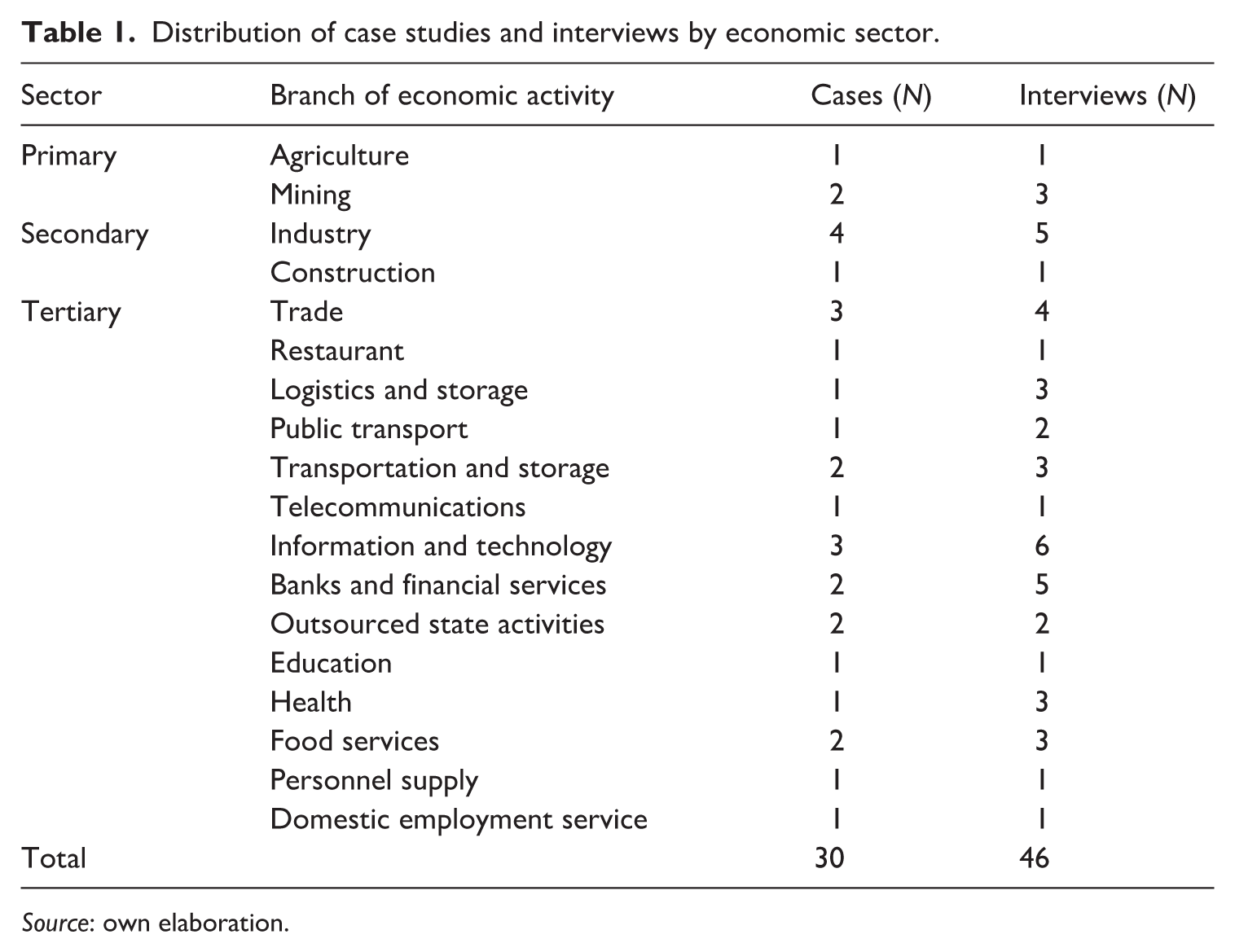
The sample was systematically selected based on three principal criteria. Firstly, it encompassed private companies and workers across all economic sectors. Due to the inherent complexity and ongoing challenges within each sector, some sectors comprised two to three case studies. Secondly, each case involved at least one active union that had experienced a collective conflict, such as organizing efforts, negotiations, or strikes. Thirdly, the selection concentrated on medium and large enterprises, where union presence is more prevalent in Chile (OHL, 2018). This meticulous selection process yielded a total of 30 unions (refer to Table 1). The methodology was designed to comprehensively represent the structure of unionization by incorporating diverse perspectives and testimonies (Taylor and Bogdan, 1992).
Distribution of case studies and interviews by economic sector.
Source: own elaboration.
Participants for the semi-structured interviews were selected based on their leadership positions within unions, specifically targeting individuals such as presidents or board members (with a sample size of three per case). Applicants were required to have more than three years of tenure to ensure they possessed comprehensive knowledge of their organization’s dynamics and prevailing conflicts. Initial contact was typically established through a press survey, email communication with unions, or direct outreach to key unionized informants meeting the sampling criteria. Given the study’s focus on medium and large enterprises, locating union contact information was generally straightforward, primarily via union social media channels. These union leaders were subsequently contacted directly by the lead researcher or co-investigators.
The number of interviews differed by company, depending on availability and the need for detailed information, totaling 46 interviews (see Table 1). Each interview followed a structured script designed to gather in-depth stories about union formation from workers’ viewpoints and experiences. Conducted in person, each interview lasted around 75 minutes and was fully transcribed. The transcripts were systematically analyzed using ATLAS.ti software.
Analysis technique
The data analysis employed the grounded theory method (Glaser, 1992; Glaser and Strauss, 1967) to theoretically induce, based on testimonies from unions, whether a strategy exists and relies on the spaces for organization, thereby contributing to the development of middle-range theories about workers’ organization.
The coding process for each testimony unfolded in three stages: open, axial, and selective coding. During open coding, emergent concepts were identified and categorized through a timeline reconstruction of key events, such as workers’ preparatory actions, the spaces where organization took place, employer responses, the legal formation of the union, and the immediate workplace consequences. A constant comparison process was used to refine categories across different cases. Next, in the axial coding phase, relationships between categories were explored, leading to the identification of three main stages of union formation. These stages formed the core themes—or “major codes”—that organize the findings in the following section. For analytical validity, each core theme had to appear in at least half of the case studies. Finally, during selective coding, the analysis aimed to integrate the core categories into a central overarching concept. This stage involved revisiting the empirical material to deepen and refine conceptual connections. A dominant theme emerged across cases: the strategic, secret, and hidden nature of unionization efforts within restrictive workplace regimes. The quotes illustrating this strategy are presented at the beginning of the analysis below.
Results
Overview
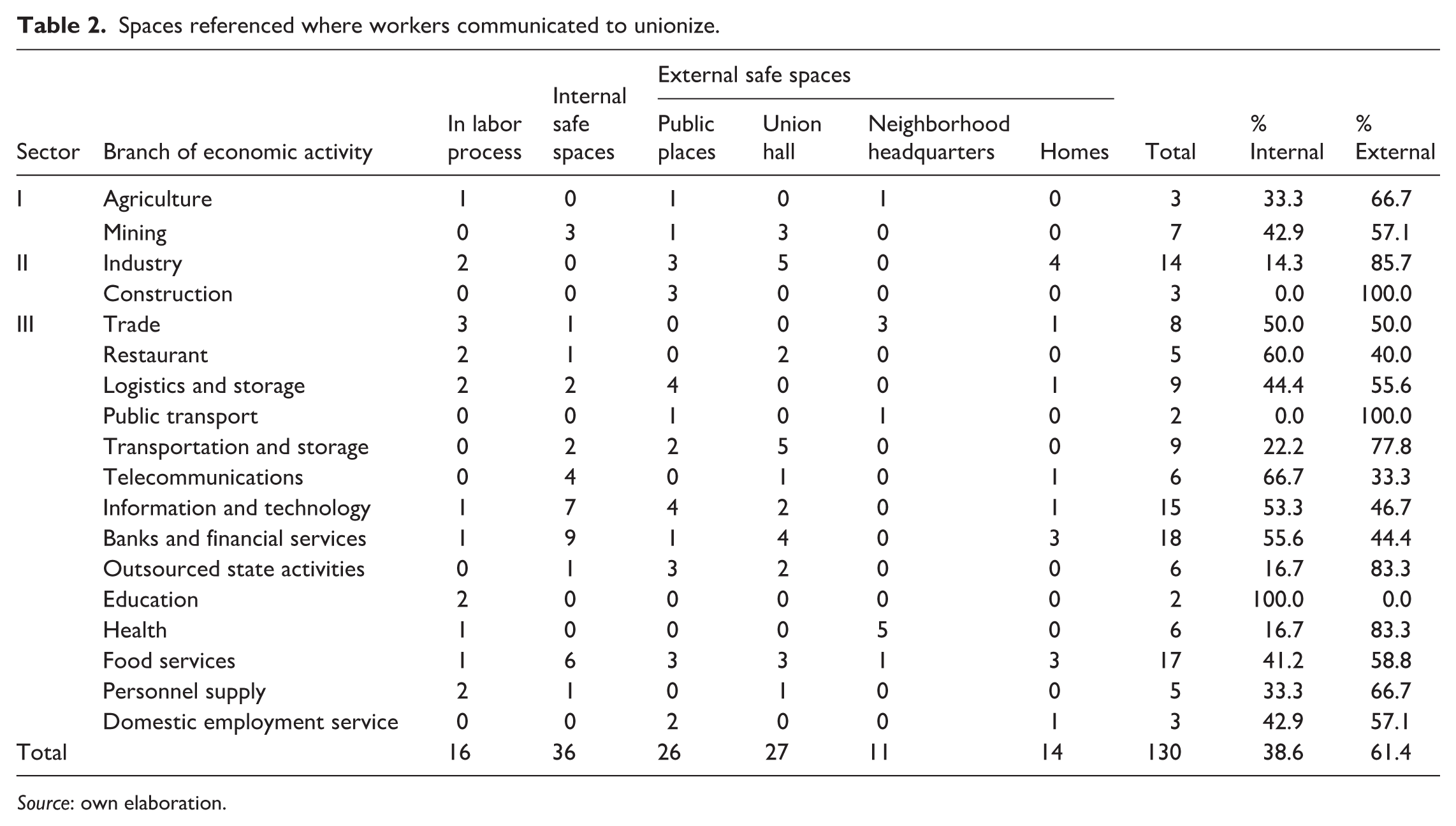
The analysis of the union formation process revealed that workers consistently used specific organizing spaces following a tactical logic. To introduce and summarize the findings, Table 2 presents an overview and a synthesis of the qualitative analysis across all cases. It highlights the types of social spaces that workers used in establishing their union organizations, offering a comparative perspective across sectors and contexts.
Spaces referenced where workers communicated to unionize.
Source: own elaboration.
A comprehensive examination reveals that, across all sectors of the economy—primary, secondary, and tertiary—interviewees consistently emphasize the necessity for the union project’s materiality, expressed as a specific space, to operate secretly. This requirement prompts the union project to shift from workplace settings to public or civic spaces, such as community headquarters, other unions’ facilities, and residential areas, in order to establish its legal status. Notably, a substantial number of testimonies, totaling 78 mentions out of 130, reference “external safe spaces," with the highest concentration in the secondary sector, particularly within industry and construction. Similar patterns emerge in public transportation, transport and storage, outsourced state functions, and healthcare.
In this sense, as explained in the following sections, workers consistently identified three key moments and spaces for communication and action across different cases: (1) getting involved in talks and actions to create a union, which leads them to seek safe spaces; (2) building the union with an emphasis on external safe spaces; and (3) integrating the union back into the workplace to surprise and challenge the employer, now influencing social relationships and the labor regime.
First movement: Seeking key individuals in safe spaces
As work activities and routines evolve, workers build mutual trust within the company by engaging in conversations and socializing, primarily in identified (safe) spaces separated from their routine work activities. These areas became crucial for discussing sensitive issues related to labor relations, challenges, and injustices. Common topics in these discussions included various forms of abuse by supervisors and owners, such as inadequate working conditions, intense exploitation, violation of agreements and norms, verbal mistreatment, and non-payment of bonuses. To address these issues freely, workers therefore intentionally sought locations free from employer oversight, first connecting with their trusted contacts or acquaintances.
These spaces typically included bathrooms, areas outside camera surveillance, lunch breaks, and, more broadly, settings outside the workplace, such as parks, food courts, or commutes on public transportation. In these settings, workers from various job positions initiated conversations, exchanged information, and collectively began to understand more about the company’s broader reality, often leading to regular criticism of their superiors. This transforms the physical settings into safe spaces for workers.
If an organized group (specially a small one) aimed to pursue a union project, these spaces became crucial assets. Union organizers initially used them to identify and connect exclusively with trusted individuals—just enough to evaluate the potential for successful organization.
[He was a despot and a brute. . .] and the annoyance of the workers was so great that they started to consider forming a union—which was quickly silenced—but in a very closed group. . . (Interview No. 15. Branch: Food services) When someone expresses an interest in forming a group of workers affiliated with [the union], it’s like, “here’s the list, but make it quick, short, and ‘under the radar’ [secretly].” If you’re going to appoint a delegate, you need 8 signatures, but they have to be 8 trusted guys, because if one of you goes to [report] before we get the process underway, it’s screwed. (Interview No. 26. Branch: Mining)
The company’s socio-spatial structure influences and controls communication. In enclosed, artificial environments, employer surveillance is almost omnipresent, mainly via audio and video cameras. This extensive monitoring happens across stores, branches, service centers, industrial sites, administrative buildings, and restricted infrastructures. Socio-material infrastructures easily segment and isolate worker interactions over time, a division that management exploits. Overall, the workplace offers workers limited and marginal spaces for autonomy.
Well, you didn’t get to see beyond the warehouse: all that is the “cold” area, from here to there. And, in the past, we were separated; we were colleagues but divided. Before the union started, the cold area had almost all the benefits. So, in a way, that created a wall and isolated us. (Interview No. 7. Branch: Logistics)
- During that period, if there were cameras, how did you manage to pass the list around stealthily?
- We found ways to avoid being seen. We tried not to arouse suspicion from the person monitoring the cameras or those who were patrolling. (Interview No. 7. Branch: Logistics)
A worker’s consciousness shifts when they use safe spaces, as their speech becomes freer and, consequently, the ideas they openly share change. Therefore, due to communication challenges in the labor process, the pre-union group tends to prefer external safe spaces to protect their maneuvers as much as possible, driven by the risk of losing their jobs, and thus begins to form a parallel network of workers eager to organize.
The work was like jewelry-making, ant-like labor [. . .]. The selection of people was done with tweezers because it had to be very quiet; there couldn’t be any noise [. . .]. So, all this led to many people asking, “How do I do it?” “But I don’t want anyone to see me, where do we meet up? How do I sign?” “Where am I going to sign?” [. . .]. So what did we do? [. . .] We met outside on the street, in the square. [. . .] In front of the footbridge, crossing the footbridge: that was our office, that was our secret corner, that’s where our union was formed. (Interview No. 7. Branch: Logistics) Yes, we met up just like here, but in a Schopería [bar]. And we started to talk about the union. We sent emails, tried to send WhatsApp messages, and, when we started to have more people, we began to introduce ourselves in different residences [in the neighborhoods], or in the different areas where there were people. (Interview No. 33. Branch: Information technology and telecommunications)
Reasonably, workers’ ideas and discourses become more powerful when shared outside managerial oversight or under the cloak of invisibility (as is often the case on digital platforms, as noted in the last quote), but this is especially true when workers have safe spaces. Both distance and concealment reinforce the safe spaces. Therefore, the clear benefit of the external safe spaces for unionism, especially within repressive labor regimes, manifests totally where and when the pre-union group decides to establish the union legally. The “pre-union headquarters” is a major strategic resource.
Second movement: Creation of the union from the rear
To establish and fully implement their union project, workers must regularly organize meetings to address coordination activities such as logistics, communications, motivations, and proposals. They also need to ensure they meet the legal requirement for the minimum number of members and invite state inspectors to a secure location to formalize the organization.
Only in rare cases does the formation of the union advance within the company’s socio-physical space, in internal safe spaces, yet harassed by the surrounding environment.
There must have been about eight or nine people. That’s when the whole process began to take on a secretive nature, as if people didn’t want to be seen, as in a ceremony to sign documents. They preferred something like “hey, let’s go to the bathroom because there I can pass you the paper that I have hidden somewhere,” but without any formality, nothing visible, all very under the radar. And so, this union starts, like most unions in this country: hidden and with a lot of fear. (Interview No. 6. Branch: Banking and financial services)
The pre-union group’s effort to maximize safety leads them to favor external “safe spaces.” They have thoroughly tested their minimal territorial power within the company and, as a result, have decided that a temporary “retreat” is necessary.
Four external safe spaces are essential to the organized group’s tactics: public or open gathering locations (squares, restaurants, avenues), workers’ homes, union headquarters, and social hubs (neighborhood associations). Notably, the use of external safe spaces owned by established unions is especially important, as they generously shared their facilities and resources (advisors, practical advice, contacts) with the pre-union group.
When a consolidated safe space merges with an organized group, they often form what can be called the “pre-union”: a reference point where workers’ social influence begins to plan strategies and operates like a de facto union, even if it is not yet legally established.
[Until] one in the group decides that “okay, on such a day, we will meet because we are going to form the union.” We agreed on it, and “on such a day, at such a house” we gathered; we managed to get a Labor Inspector and it was all very clandestine. (Interview No. 15. Branch: Food services) We held our meetings in the office of the [union name], and they advised us on everything, absolutely everything. They were incredibly willing to help us! We couldn’t believe it. It was difficult, because we had been trying to form a union for 35 years, the [companies in this sector] have resources. . . We had gone through many stories, we had been told in the end that several attempts had been made to form [the union], but people would leave, or I don’t know, something happened and it wasn’t formed. We tried to be as quiet as possible. We went one person at a time. (Interview No. 8. Branch: Banking and financial services) - How did you get to that headquarters? - Through a colleague who lives there. It’s a community center, and she lives in a condominium, and that’s the center they rent to us.
- Like a neighborhood association’s headquarters?
- Yes, exactly. Within the same condominium, and we rent it: that’s where we hold our meetings. (Interview No. 24. Branch: Commerce) I remember that after the shift, like at 12 midnight, the Certifying Officer [Ministro de Fe] from the Labor Inspection arrived. Super clandestinely, at the headquarters of a Neighborhood Association very close to [the workplace] [. . .]. There was a worker [. . .], she was the one who got us this headquarters. (Interview No. 19. Branch: Health)
The evidence shows that in Chile, unions generally do not form within private property spaces but rather despite them. The exception is some large companies where leadership actively promotes and influences the design of a union to co-opt it from the start, and in rare cases (such as one observed instance in education) where there was no repression against a workers’ plant union.
The territorial nature of the labor market is also significant. Leadership or management may aggressively intrude into workers’ safe spaces, even external ones, to interfere with union activities. These actions can weaken workers’ defenses, leading to unexpected disbandment and defeat, especially in small towns, as illustrated by the next quote below. Furthermore, companies can target individual workers for suppression within the organization, including adding them to a blocklist maintained by leadership (although they are illegal). This behavior reflects the existence of companies with highly repressive or specialized labor regimes that oppose unionism, where pre-union groups often face severe employer surveillance, threats, and penalties.
To form a union, some colleagues said, “let’s meet up, because now it’s time.” They had made two attempts, and this was the third. And a supervisor hears about it, and when [he] crosses the square of [town], and they see the supervisor from afar, you know [they] ran in panic: some in one direction, others in another, colliding. It was almost ridiculous. Now when they remember it, they laugh. [. . .] [To the union formation meeting] fifteen women arrived, very scared, because we thought we were being followed, a terrible persecution. (Interview No. 15. Branch: Food services) Among the employers, they all know each other, everyone. [So, if you act against them] they start passing around information about the workers they have, and one ends up on the “blocklist.” I haven’t joined that yet, because I have kept – as I tell you – a low profile: stubborn, but not seen. (Interview No. 3. Branch: Agriculture) That’s when I found out that the leadership of [company] saw me standing on the corner of the union. I mean, it’s not even that they saw me at a meeting or knew about it: they saw me standing on a corner of the union, the rumor spread, and also because they added that I had been very opinionated—like advising some old ladies—that was it: “dangerous,” “blocklist,” “goodbye.” (Interview No. 26. Branch: Mining).
Overcoming such problems and establishing a perfectly safeguarded safe space allows the union to become legal. This legal status provides protection to the leaders, usually the pioneering organized workers. Therefore, these extracts of testimonies illustrate how a significant portion of workers have crafted, beyond the spontaneous level of consciousness, an everyday spatial orientation for effectively installing or enhancing their control within the capitalist company. The creation of the union provides essential territorial protection to workers—albeit a minority of them—allowing them to remain strong in a territory open to repression and expulsion. In essence, the legal union marks a qualitative leap from the preceding group, driven by an accumulation of associational agency and spatial resources.
Third movement: Surprisingly revealing the union
Now protected, organized workers typically surprise their employer by returning to the workplace on a designated day to announce the formation of the union and change the work regime. Some workers receive the news about the new union positively, while anti-union workers and superiors often view it as a shock. Capitalists commonly regard the union’s emergence as a conflict of utmost importance, making it a potential target for active repression. Employers usually perceive the establishment of the union as “fatal news,” and usually see it as a “blow” to the company’s history or trajectory without unions. In effect, this event signals a potentially permanent shift in the political structure toward a better balance between the parties.
It was. . . There was even a meeting before, and the manager told us: “Some people met and formed a union. . . and they stabbed me in the back, it felt like being shot.” (Interview No. 36. Branch: Industry) The doctor who owned the company, upon finding out, got angry. She felt betrayed, claiming that “she had given us everything,” accusing us of treachery. She couldn’t understand why we were doing this to her, saying that [this] was something you did when the employer was bad, when the company wasn’t fulfilling its obligations. (Interview No. 19. Branch: Health) So it was hard to gather the 8 people, but I did, and the union was formed. I informed the company, and they didn’t take it well. They threw me out of the office, and there [openly], the union began to form. I started trying to gather as many people as possible, and in turn, the management began telling people that if they joined the union, they would lose money, lose benefits, they started to scare them. (Interview No. 27. Branch: Restaurant)
In Chile’s current political economy, shaped by the foundational neoliberal institutions established during the dictatorship, these findings underscore a pervasive climate of abuse and structural authoritarianism within a significant proportion of companies. Typically, workers seeking to challenge this inequitable landscape resort to clandestine union formation outside the workplace. Subsequently, they re-enter the workplace with this new institutional protection, enabling them to contest territorial limitations and internal relations with enhanced strength.
Workers also engage in self-criticism, recognizing that the high-tension process often requires more preparation and time, as reflected in their ex-post evaluations.
I think that was the mistake: forming the union and immediately going into battle. I believe we should have formed the union, done things as a union, strengthened the union, started with that. Educate ourselves as leaders, educate the union members, train the members, train ourselves as leaders, and then take some time before presenting our demands to the company, the negotiation, the collective agreement. I think it was too fast. (Interview No. 1. Branch: Telecommunications)
The revelation of the union proves to be crucial. The deep-seated aversion of owners and management toward workers often leads to a situation where legislation fails to deter anti-union practices. Despite facing potential sanctions, companies actively engage in these practices as they seek every possible means to undermine the union’s emergence and maintain their original labor regime.
During our processes, we have faced discrimination and violations through numerous anti-union practices. In fact, there have been mass layoffs. For instance, last year, we experienced a massive dismissal of about 200 of our associates, and all these were filed as labor guardianships and taken to the labor court [. . .]. These were resolved in favor of the workers. (Interview No. 2. Branch: Agriculture)
The union’s formation in a hostile environment often marks the start of an escalating struggle, eventually leading to the first legal collective bargaining and, possibly, a strike (whether legal or not). Management’s repression of the union-building process unintentionally fuels the very strike it aims to prevent. During this process, some unions continue to actively strengthen their secretive structure, discreetly recruiting members and withholding this information from employers until collective bargaining begins, at which point they must reveal the list of represented workers. If the union has grown significantly in secrecy by the time negotiations start, its sudden display of power often delivers a decisive blow to the morale and plans of the opposing side.
In addition, this third moment has also been identified in other contexts. In the United States, unions referred to the stage in which organizing rapidly becomes public in order to avoid or minimize management retaliation as a “blitz” organizing campaign. Therefore, considering that employers frequently deploy coercive anti-union tactics once organizing efforts become visible, rapid and intensive campaigns increase unions’ chances of success (Bronfenbrenner and Hickey, 2004).
Figure 1 synthesizes the theoretical foundation and the tactical sequence observed in the process of union formation, as an illustration.
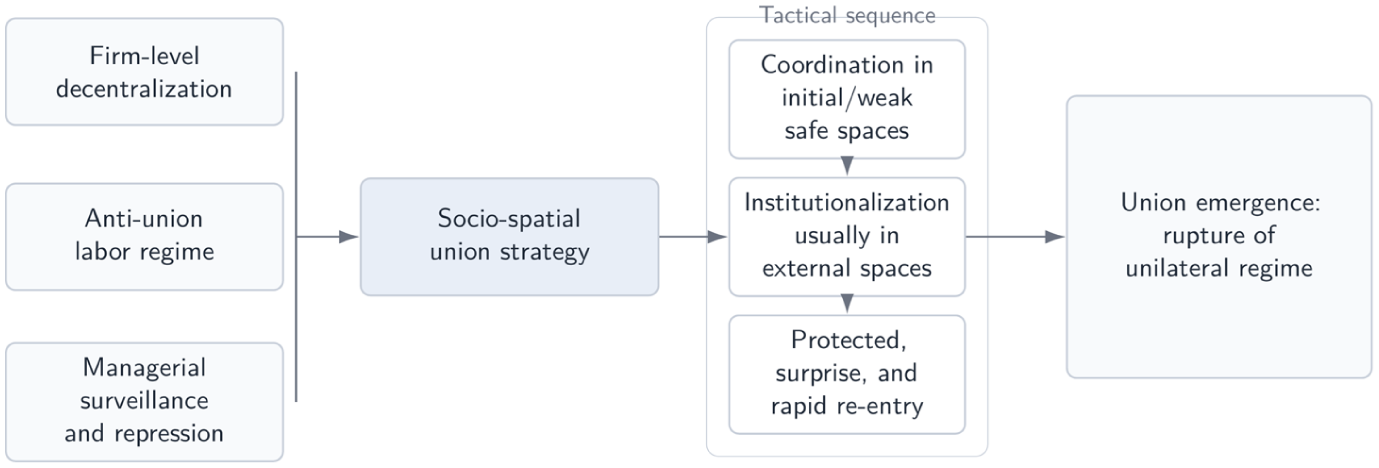
Socio-spatial strategy and tactics of union formation in radical neoliberalism.
To summarize, throughout a three-phase strategic process of union organizing, the analyzed workers actively exercise their spatial agency to transform existing relations. To navigate these stages, the workers, we might say, take “one step back and two steps forward,” moving from retreat to strengthening and then to the offensive. Thus, the emergence of the union strength introduces a new social actor within the space of private property, escalating the complexity that employer control must navigate and crafting a scenario that could be either detrimental or beneficial for management and owners.
Discussion
In Chilean neoliberalism, organized workers within private enterprises harness their limited control to identify internal or external safe spaces. The latter include semi-public recreational places such as squares, restaurants, streets, bars, and footbridges, as well as private and community places such as workers’ homes or social headquarters of neighborhood associations or unions. These locations gradually become refuges where workers can relax away from workplace surveillance, talk, or create spontaneous criticisms of management. Moreover, this can move toward a unionization project.
Over time, safe spaces serve as strategic platforms where pre-union groups can gather, deliberate, and ultimately succeed in establishing a union. As the analysis has shown, the socio-spatial agency of workers reaches a position of power by adopting a particular strategy of three moments. It begins with a retreat to form an organized group, followed by reorganization and a move to officially form the union—usually in an external safe space—and finally, asserts its presence defiantly in the workplace. Therefore, this approach can be encapsulated by the notion of taking “one step back and two steps forward” in confronting the terrain dominated by the capitalist agent. Once a union is formed, usually from the rear-guard, many of these spaces continue to facilitate the growth of the organizational initiative. Given the evolving dynamics of the modern workplace, where workers’ safe spaces within production settings are increasingly restricted, the need for secure spaces in the public realm to socialize, exchange information, and organize could grow in importance (Pérez-Valenzuela, 2025).
Some of the safe spaces mentioned are historically significant in the formation of trade unions, such as squares, headquarters, and homes. The interviews also reveal the emergence of new key channels of communication, particularly digital networks, whose importance has grown considerably in recent years (Morales-Muñoz and Roca, 2022). Nevertheless, this article emphasizes the importance of physical social spaces—whether complemented by digital networks or not—where solidarity and face-to-face strategic conversations (Tapia, 2019) foster the trust necessary to take the risk of creating a trade union with a consistent social base.
From a comparative perspective, some of these secret and hidden unionization processes align with the goals and principles of community unionism, since they focus on expanding membership into corporations, many of which have no union experience, and leverage social alliances in residential and community spaces (e.g., Jordhus-Lier, 2013; Martínez Lucio and Perrett, 2009; Roca, 2020).
Historically, the covert nature of the unionization process originated from the first “despotic” factory regimes (Burawoy, 1985) and the localized scale of the earliest workers’ movements, but it appears to have been passed down and cultivated up to the present. In this context, some experiences of this underground unionization approach against potential or active repression also reflect the experiences of small, financially limited, and independent unions of precarious workers who have built “communities of struggle” (Però, 2020), precisely fighting to establish union jurisdiction. Adding a strategic dimension to the spatial aspects of labor sociology and the literature on social movement unionism in the 2000s and 2010s (Cornfield, 2023), workers’ tactics that mainly use safe spaces to organize can be seen as an underlying form of territorial unionism, which operates clandestinely within the workplace and later extends into class-autonomous external locations (Pérez-Valenzuela, 2025).
By analyzing anti-union and abusive work regimes in a high-inequality country, this study highlights implications that extend beyond local contexts to include Latin American nations within the neoliberal framework, such as Colombia, Costa Rica, Paraguay, and Peru (Castro Méndez, 2019). These countries exhibit decentralized labor systems anchored at the firm level, suggesting the likely presence of similar underground union organizing activities. Evidence from other regions, including examples of key workers establishing safe spaces in the neoliberal contexts of the USA (Kellogg, 2009) and India (Jenkins, 2013), further supports this hypothesis.
The political-spatial analysis highlights the importance of understanding how labor relations are shaped by spatial factors within private workplace regimes under neoliberalism. According to Anderson (2019), modern capitalist businesses operate similarly to corporate “dictatorships.” Landemore and Ferreras (2016) describe governance in capitalist firms as “oligarchic, hierarchical, and unequal.” This study shows that workers’ clandestine strategies emphasize the need to examine how capitalists leverage private property as a tool within the spatial dynamics of capital and labor, creating an “absolutist’ labor regime. This regime restricts workers’ civil organizations, enforces widespread spatial surveillance and control, and suppresses internal discussion—key anti-democratic elements in liberal democracy. In response, workers develop secret internal spaces and community safe zones, strategically avoiding labor controls in daily activities and organizational efforts, ultimately surpassing the company’s boundaries and autonomous regime (Pérez-Valenzuela, 2019, 2025). The formation of a union, if properly implemented—following a careful socio-spatial tactical logic—marks a crucial moment for the regime because such an initiative disrupts the existing socio-labor order and challenges workplace repression.
Conclusions
Much of the literature on labor and trade unions has paid limited attention to workers’ socio-spatial agency within the workplace and, when it has addressed these issues, it has primarily focused on strong and stable unions. However, as we have analyzed, a resilient minority of Chilean workers carve out a distinctive spatial strategy for establishing unions within private corporations characterized by repressive work regimes under neoliberalism. These organized workers deploy socio-spatial practices and tactical maneuvers to evade repression, covertly form unions from the rear-guard in external safe spaces, and ultimately reveal the organization as an unexpected counterattack against their employers.
By examining clandestine, secret, and rear-guard unionization processes, this study highlights the crucial role unions play in challenging and reshaping work regime dynamics under a neoliberal, decentralized labor system. The cross-sectional analysis of the data, which includes cases from all economic sectors, shows a consistent pattern: forming a union signifies a conflict and an unlikely yet pivotal moment in transforming the workplace regime. To accomplish this, workers organizing collectively carefully design complex organizational spaces and political-geographic strategies focused on their workplaces and connected external safe spaces, which prove highly successful. Thereby, this unionization strategy confirms workers’ agency to influence and transform unilateral workplace regimes, characteristic of unequal class societies.
This covert, hidden, and secret method of unionization is well-known among union members, but it remains largely unfamiliar and unclear to most workers who are not part of a union or lack networks with unionized workers. The strategy does not guarantee future success for workers, but it is at least mainly effective in establishing a union against low initial odds. Fundamentally, the effort to form a union revolves around a struggle for control of space. Workers create and utilize safe spaces both inside and outside the production environment to coordinate their efforts (Jenkins, 2013; Kellogg, 2009; Manky, 2017; Stillerman, 2012). Their strategic use of micro-political geography in actions and practices to defend themselves involves tactics against hostile and tightly controlled territories, culminating in their decisive entry into the production space with “union news,” which sparks surprise, disruption, and potential transformation. Furthermore, this socio-spatial strategy aligns with grassroots-focused orientations of unionism. Out of necessity and reflexivity, workers have historically strengthened their capacity for industrial action, social alliances, and community networks and spaces (Jordhus-Lier, 2013; Martínez Lucio and Perrett, 2009; Però, 2020; Roca, 2020; Voss and Sherman, 2000). Notably, the union and/or community headquarters serve as a major strategic resource for both unionized and non-unionized workers (see Elbert, 2017; Manky, 2017; Pérez-Valenzuela, 2025).
Furthermore, workers aiming to improve their conditions and confront abuses see forming a union as a crucial step toward political modernization within the private sector, which faces unilateral regimes rooted in the workplace. Although starting unionization often leads to increased surveillance and repression, successfully establishing a first union marks a major shift. For the first time in the history of many companies, a group of workers gains protection, breaking the unilateral and absolutist regime maintained by capitalists and enabled by neoliberal policies, especially in extremely unequal societies.
Footnotes

Funding
The authors disclosed receipt of the following financial support for the research, authorship, and/or publication of this article: The authors thank ANID for financial support through Fondecyt Regular No. 1150860, Fondecyt Regular No. 1251051, and the Millennium Nucleus on Political Crises (CRISPOL, NCS2024_065).
Declaration of conflicting interests
The authors declared no potential conflicts of interest with respect to the research, authorship, and/or publication of this article.