






Abstract
In many Middle East and North African (MENA) economies, formal systems of employment coexist with informal practices like wasta, using personal connections or intermediaries to secure favors. This article examines the relationship between wasta, informality, and governance quality for sustainable employment. Data reveal that inadequate corruption control systems increase dependency on wasta and informal labor markets, limiting job creation potential. Strong governance mechanisms, however, enhance formal job availability, reducing insider advantages. Wasta operates as both favoritism and relational coordination, filling gaps where formal structures fail. The study frames wasta as a double-edged institution, suggesting that regulation, not elimination, can better balance equity and efficiency in employment systems. This research links informal relational governance to macro-level employment sustainability and offers guidance for policymakers and organizations seeking to align social embeddedness with meritocratic governance in developing labor markets. By addressing informal practices and governance, this article contributes to improving labor market dynamics in MENA economies.
Introduction
Personal intermediation, or wasta as the deeply institutionalized variety is known, continues to govern access to jobs, resources, and opportunities in the Middle East and North African (MENA) region (Alsarhan et al., 2024). With high unemployment, slow formal job creation, and large informal economies, the MENA context has parallel coordination mechanisms that complement and often even substitute for established formal systems of human resource management with relational access. Hiring decisions across public and private organizations are made through a blend of various codified procedures, job posting, competency-based interviews, and merit scoring, with more informal referrals and sponsorships based on kinship/communal trust/favors resulting (Alhussan and Al-Husan, 2022; Horak and Suseno, 2023). Rather than being seen as a mere cultural remnant left over from earlier times when systems of regulation/cooperation/exchange were more strongly formally embedded in society, wasta is better understood as an adaptive institution that sustains cooperation/exchange wherever such systems remain less strongly embedded today (Ali and Weir, 2020).
This relational mode of access bears an enduring duality. On one side, wasta can improve efficiencies by reducing search costs and facilitating trust while mitigating information asymmetries in a low-information environment (Alsarhan et al., 2021; Cunningham and Sarayrah, 1993), meanwhile it operates unambiguously to systematically privilege insiders; this restricts meritocratic mobility and has thus been found to act against perceived fairness (Abid and Alsarhan, 2025; Al-Twal et al., 2024), particularly for female workers (Alsarhan et al., 2021). Scholars (Horak, 2022; Minbaeva et al., 2023) have appealed to broader theories of social capital, informal networking, and moral economy in their attempts to understand such ambivalence. Most analyses are still trapped within the organization level towards presenting wasta as a micro-social phenomenon rather than as a mechanism that bears macroeconomic consequences. Also, how does the practice scale up to affect structural employment outcomes and the institutional conditions they sustain, or to erode the formal economy?
It becomes particularly salient against the background of structural features in MENA labor markets, wherein high unemployment rates are capable of existing with a strong informal sector and uneven governance quality (International Labour Organization [ILO], 2024; Lopez-Acevedo et al., 2023). In such an environment, when institutions are weak, the relational intermediation, i.e., substituting formal recruitment channels, misallocates human capital and weakens the extent to which investment translates into formal job creation. With stronger governance, relational hiring is less dominant, informality subsides, and growth translates more directly into formal sustainable employment (Horak and Suseno, 2023; World Bank, 2024). The difference in institutional quality whereby wasta influences effectiveness is hence very important to analyze to explain such informal equilibria that exist within this region.
To address this question, we integrate organizational and macroeconomic perspectives to see how wasta joins governance and investment in molding employment transitions in 12 MENA economies from 1990 to 2020. Drawing on a panel framework that combines fixed-effect and random-effect models, we analyze how variations in institutional quality, proxied by control of corruption, affect unemployment, informality, and investment. This approach enables us to capture both the within-country and cross-country impacts of governance on labor-market functioning, thus placing wasta as an institutional means that ties organizational deeds with macroeconomic yields (Alsarhan, 2022; Budhwar and Mellahi, 2006).
Lower governance makes wasta more powerful, increasing informality and unemployment. It also lowers the employment yield of both foreign and domestic investment. Higher governance advances the passage from capital accumulation to formal job creation (Williams and Gashi, 2022). It works by limiting discretionary intermediation and thereby supporting more sustainable employment trajectories. These results position wasta not only as a sociocultural practice but also as a structural mechanism through which the quality of institutions channels its effects on labor-market adjustment. These findings also resonate with broader work on structural transformation and diversification in developing countries, which shows that institutional and organizational conditions shape how economies reallocate resources towards more productive and sustainable activities (Amzil et al., 2026). This connection at the micro-level of relational practice to much more macro-level outcomes is theorized here as broadening organizational theory informality and institutional duality to show that informal coordination systems simultaneously enable adaptation and entrench inequality depending on their institutional context (Alsarhan and Valax, 2021; Horak et al., 2024).
More broadly, this study conceptualizes wasta as part of a regionally specific employment tool that is meant to mediate the relations between governance, informality, and job creation. It somewhat reframes the debate about informality in MENA from its common reading as cultural persistence to issues of institutional design and organizational adaptation. Therefore, it further theorizes wasta and informality before moving to develop hypotheses on their interaction with governance and investment, and then subjecting them to empirical tests using fixed-effect and random-effect modeling.
This study combines organizational economics and macroeconomic methods to examine how informal employment networks (wasta) in 12 MENA countries interacted with governance and investment to shape employment trends between 1990 and 2020. By incorporating theoretical perspectives on informal networks and governance quality, this article expands our understanding of wasta and goes beyond microeconomic studies to analyze its macroeconomic consequences. The study empirically examines how differences in institutional quality (measured by anti-corruption efforts) affect unemployment, informal employment, and investment in the region.
Utilizing a unique dataset covering 12 MENA countries, this study provides an in-depth analysis of the relationship between wasta and macroeconomic indicators. The article also proposes policy recommendations aimed at improving labor market outcomes by regulating relational mediation while preserving the advantages of informal networks.
This article is structured as follows. The next section explores the theoretical framework of wasta, governance, and the informal economy, drawing on existing literature. The following section introduces the data, models, and econometric specifications used in the analysis. The fourth section presents the results of the fixed-effects and random-effects models, followed by robustness tests in the next section. The final section presents the policy implications of the results and concludes the study.
Theoretical background and hypotheses
HRM in the MENA region: Organizational hiring practices, informal intermediation, and wasta
Human resource management (HRM) in the Middle East and North Africa operates within a dual institutional order. Accordingly, codified HR architectures coexist with routinized informal practices based on family, kinship, and communal obligations (Abid et al., 2025; Ali, 1996). The same job vacancy announcements, competency models, and panel interviews that exist for recruitment, promotion, and rewards work equally hand-in-hand with referrals and insider sponsorships because in network-based societies it is fundamentally important who gets shortlisted and under what terms (Horak and Suseno, 2023; Hutchings and Weir, 2006).
Sociologically speaking, these fall within the collectivist orientations and multiplex ties of family, tribe, and locality that inform obligation and face-saving norms, thereby normalizing investment in informal networks as a routine means of getting things done (Alhussan and Al-Husan, 2022; Namazie and Venegas, 2016). The individual is self-identified through such networks that transmit job information, reputational endorsements, and access to intermediaries, which mechanism is not inconsistent with classic network theory on the labor-market value of social ties and with contemporary accounts of relational brokerage in MENA workplaces (Alsarhan and Valax, 2021; Granovetter, 1973).
The macro-labor conditions help sustain the private value of insider channels. There is persistently high unemployment in the region, particularly among youth, and a high NEET rate, i.e., the share of youth Not in Education, Employment, or Training (NEET), compared to global benchmarks increases competition for formal posts, thereby increasing returns to networked sponsorship for first jobs and stable placements (ILO, 2024). Formal opportunities have become even more stringently available in several economies since the pandemic due to uneven disinflation and subdued growth since then. This has further strengthened the concept of hiring on the basis of any connection as a credible signal of trust for employers in environments of low information (World Bank, 2024).
Therefore, in the allocation of opportunities between and within both public and private spheres, group interest supersedes a universalistic criterion (Berger et al., 2015; Diwan et al., 2020). In research on international business, specifically situating wasta within the firm’s hiring technology offers an empirically testable bridge between micro-level practices and macroeconomic trends. High unemployment and a large informal economy can mean that selection via networks prevents or slows people from moving between jobs, benefits those already in jobs when they have the opportunity, and shifts the adjustment to shocks towards the informal economy, all of which ought to leave observable traces in country-level behaviors, and that inspired the inclusion of unemployment, informality, investment, and governance factors in our empirical model (ILO, 2024; Lopez-Acevedo et al., 2023). In summary, HR practices in MENA conditioned by informal institutions and macro-labor slack are not just firm-level idiosyncrasies; rather, they form part of the transmission mechanism linking shocks to employment and informality (Ali and Weir, 2020).
Combined, these organizational mechanisms imply a hiring technology in which relational access coexists with formal procedures, a configuration that can scale up to country-level outcomes depending on labor-market slack as well as institutional quality (Alsarhan, 2021; Horak and Suseno, 2023). The testable implications are developed in the Hypotheses section.
Grasping the concept of wasta through an informal network lens
Many previous studies have used a framework based on social capital theory (Bourdieu and Wacquant, 1992; Coleman, 1988; Portes, 1998) to examine wasta as a form of relational capital that facilitates bonding within close-knit networks and bridging across broader social groups (Nahapiet and Ghoshal, 1997). Other studies tried to examine wasta through the traditional social network theory (strong and weak ties) (Granovetter, 1983). Thus, with close friends and family members sharing the same wasta in general, network theory suggests that the stronger the tie between two people, the greater the overlap of their wasta opportunities. On the one hand, when individuals seek wasta through their acquaintances (weak ties), it will provide them with greater access to information than what is available in their own social circle, thus giving rise to more opportunities (Alsarhan and Al-Twal, 2023). However, the aforementioned approaches to studying wasta have been critiqued due to the differences among informal networks (e.g., wasta, yongo, guanxi, etc.), given the fact that social network theory regards weak ties as the most valuable. In many non-Western countries, weak ties are often not relied upon per se for meaningful transactions (i.e., job, promotion, better salary, etc.); in other words relatively strong ties are usually those that fulfill the function that weak ties are said to fulfill in social network theory (Alsarhan et al., 2024, Horak, 2022).
Consequently, and important to note, informal network research extends social network research by highlighting the key features of informal networks, which are, amongst others, rather closed and socially exclusive and culturally embedded (Horak et al., 2020; Minbaeva et al., 2023). We rely on an informal network lens to examine wasta as a practice in this article (Horak, 2022; Horak et al., 2020, 2024). Minbaeva et al. (2023: 560) define informal networks as “culturally embedded channels formed by informal dyadic ties between individual actors,” and regard them as “biographical by-products rather than intentionally accumulated capital” that channel non-market relationships into markets. These dyadic ties rely on the peer pressure of wider informal networks and connections in interactions with others, which can be activated when needed, and they are formed by informal ties between actors, and members of these networks have the privilege of access to favors and gains (Horak, 2022, 2024; Horak et al., 2024).
The economic realities in the MENA region
Labor-market adjustment in MENA is shaped by three persistent features: structurally high unemployment, a large and resilient informal economy, and heterogeneous institutional quality, proxied by control of corruption (CC). These features set the conditions for how shocks translate into sustainable employment, understood here as trajectories consistent with lower unemployment (UE), and into the informal economy as a share of GDP (IO (% GDP)) (Alsarhan and Al-Twal, 2023; ILO, 2024; Lopez-Acevedo et al., 2023; World Bank, 2024). Hereafter, we use UE, IO (% GDP), and CC for brevity.
Where CC is weak, the scope for wasta in both recruitment and promotion increases a matching bias towards insider dealings; where CC is strong, informality decreases and the employment content of growth plus investment increases (World Bank, 2024).
During downturns the informal sector enables a certain shock absorption, but with even lower productivity, it lowers already scarce public revenue and further reduces social protection. These are certainly conditions under which wasta-compatible hiring equilibria tend to persist, supporting H2a and H2b that follows (see Table 1).
Hypotheses and expected signs (country-level shocks).
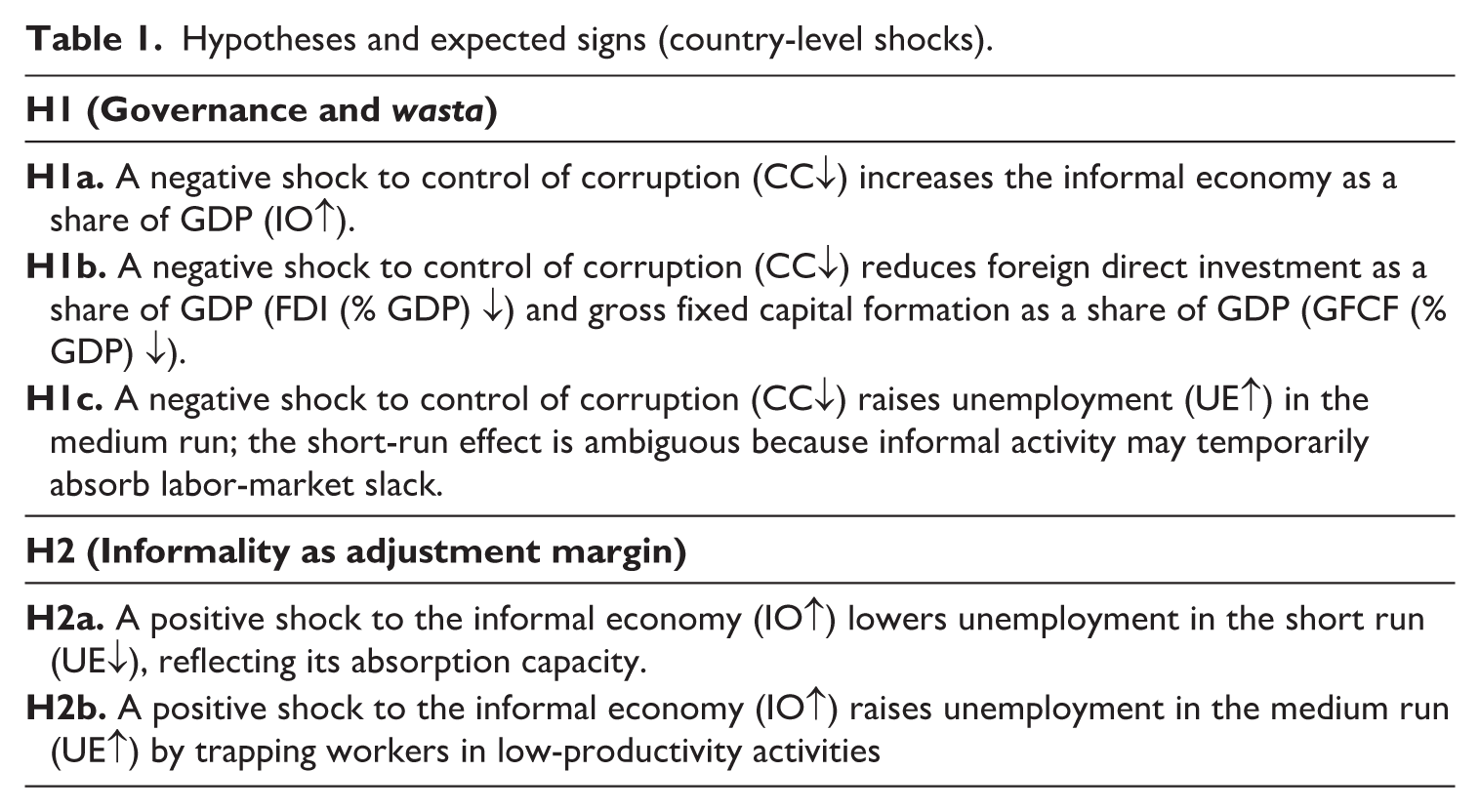
Table 1 therefore lists the mechanisms that motivate our hypotheses. Negative price or activity shocks raise the inflation rate (INF) or lower income and are likely to increase IO (% GDP) with a weak effect on UE, delayed in cases where the informal sector is large and serves as an adjustment margin (International Monetary Fund [IMF], 2023). Investment shocks, whether external (FDI % (GDP)) or domestic (GFCF (% GDP)), reduce UE in the compression of IO (% GDP) more in economies that have stronger CC, consistent with a governance-conditioned passage from increases in the capital–labor ratio to formal job creation (World Bank, 2024). The higher the income level, proxied by log10 GDP per capita, the more it strengthens the formalized response to positive demand shocks and reduces reliance on informal adjustment margins—that is, greater and more persistent falls in UE in those places where there is higher governance (Lopez-Acevedo et al., 2023).
This study examines key economic variables influencing unemployment and the informal economy in the Middle East and North Africa, such as inflation, income economies of scale (GDP per capita), foreign direct investment (FDI), and gross fixed capital formation (GFCF). These factors interact with governance quality, particularly anti-corruption measures, and consequently affect labor-market outcomes. The variables used, UE, IO (% GDP), CC, INF, GDP per capita, FDI (% GDP), and GFCF (% GDP), are available on an annual basis for MENA economies from harmonized sources. Their slow-moving nature—institutions, informality, and unemployment—is consistent with the slow adjustment of labor-market outcomes as well as the relatively sluggish evolution of governance indicators (IMF, 2023; World Bank, 2024). Thus, the article links the regional macroeconomic context with the interactions between wasta, institutional quality, and investment to determine whether employment growth is formal and sustainable or leans towards informal activities. The hypotheses summarized in Table 1 illustrate these relationships and serve as the basis for empirical research using panel structure analysis.
The hypotheses presented in Table 1 are tested using a panel data model, which allows us to examine the relationships between key economic variables and their impact on unemployment and informal employment. The next section explains the data sources and the methods used to empirically analyze these dynamics.
Data sources and methodological framework
Data sources, descriptive statistics, and correlation
The empirical study is based on data drawn from the World Bank’s World Development Indicators (WDI) database, which provides globally comparable macroeconomic and institutional indicators. The WDI compiles data from national statistical systems, administrative sources, and surveys, which are then validated and harmonized by the World Bank to ensure comparability and consistency across countries. The indicators used in the empirical study are constructed according to standardized international methodologies, allowing them to be adapted for panel data analysis.
The sample for this study covers a balanced panel of 12 countries in the MENA region, Morocco, Algeria, Tunisia, Egypt, Jordan, Lebanon, Saudi Arabia, the United Arab Emirates, Qatar, Kuwait, Bahrain, and Oman, over a period from 1990 to 2020, for a total of 372 observations. The primary objective of this study is to empirically investigate the structural determinants of unemployment, conceived here as an inverse indicator of job sustainability, across the MENA region. The empirical strategy is grounded in a panel data framework, which allows capturing the developmental dynamics and institutional heterogeneity that characterize the region, with high-income rentier economies coexisting with middle-income countries and contrasting models of economic governance. Within this analytical framework, the unemployment rate (UE) is utilized as a dependent variable to proxy the quality and durability of employment. Low unemployment would mean better and more stable formal integration of workers into the productive structure; high unemployment sustained over time would indicate structural rigidities as well as an inadequacy in job creation and long-term exclusion of specific social groups, particularly young people and women.
The key explanatory variables in our model capture two structural dimensions that fundamentally shape the functioning of labor markets in the MENA region: the prevalence of the informal economy, and wasta. Expressed as a share of gross domestic product (IO % GDP) the informal economy constitutes a pivotal determinant of labor market disequilibria across the region. Its persistent expansion indicates not solely, on the one hand, inadequate absorptive capacity by the formal sector but also adaptive responses by economic agents to various institutional inefficiencies as well as regulatory rigidities on the other. Increasing informality weighs heavily against employment sustainability since vulnerable conditions for labor precipitate erosion of social protection coverage and make enforcement less feasible regarding labor standards and collective rights. Secondly, the control of corruption (CC) variable is employed as a proxy for wasta, a deeply embedded socio-institutional practice that permeates much of the MENA region’s economic and administrative systems. Wasta operates through pervasive networks of favoritism, nepotism, and clientelism, shaping access to employment opportunities, the allocation of public resources, and the overall quality of economic governance. Accordingly, a low level of CC is interpreted as indicative of a greater prevalence of wasta, which distorts market mechanisms based on competition and erodes the principle of meritocracy, introducing structural inefficiencies in both public and private sectors.
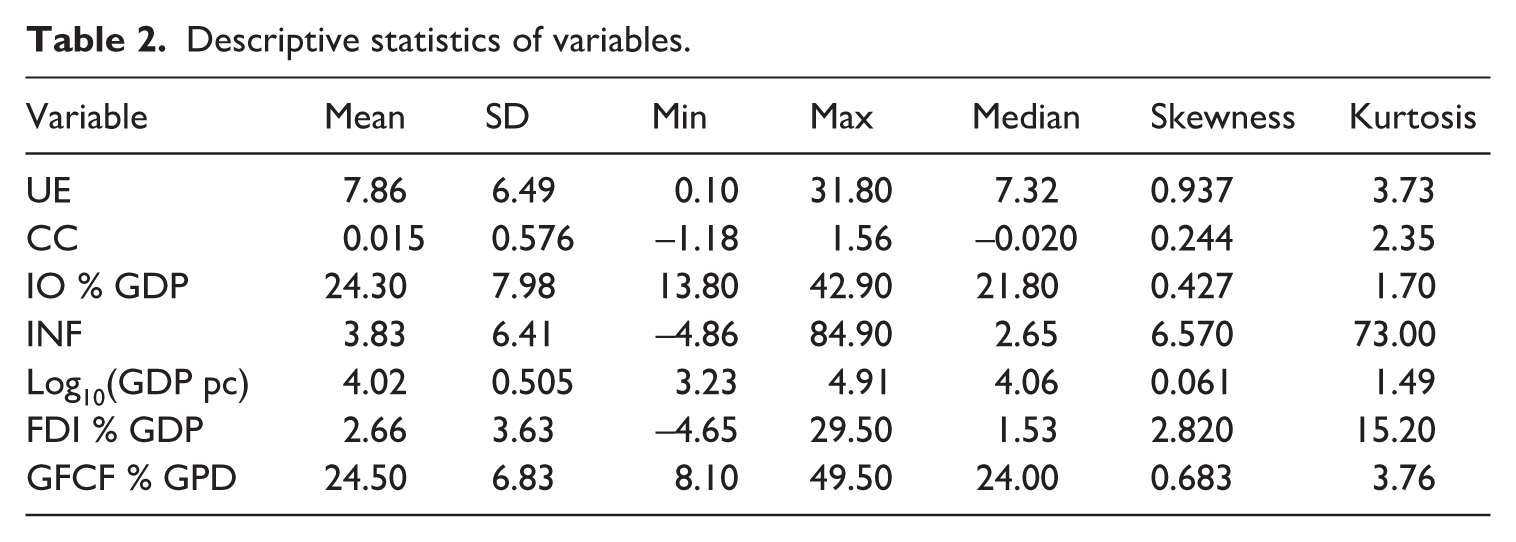
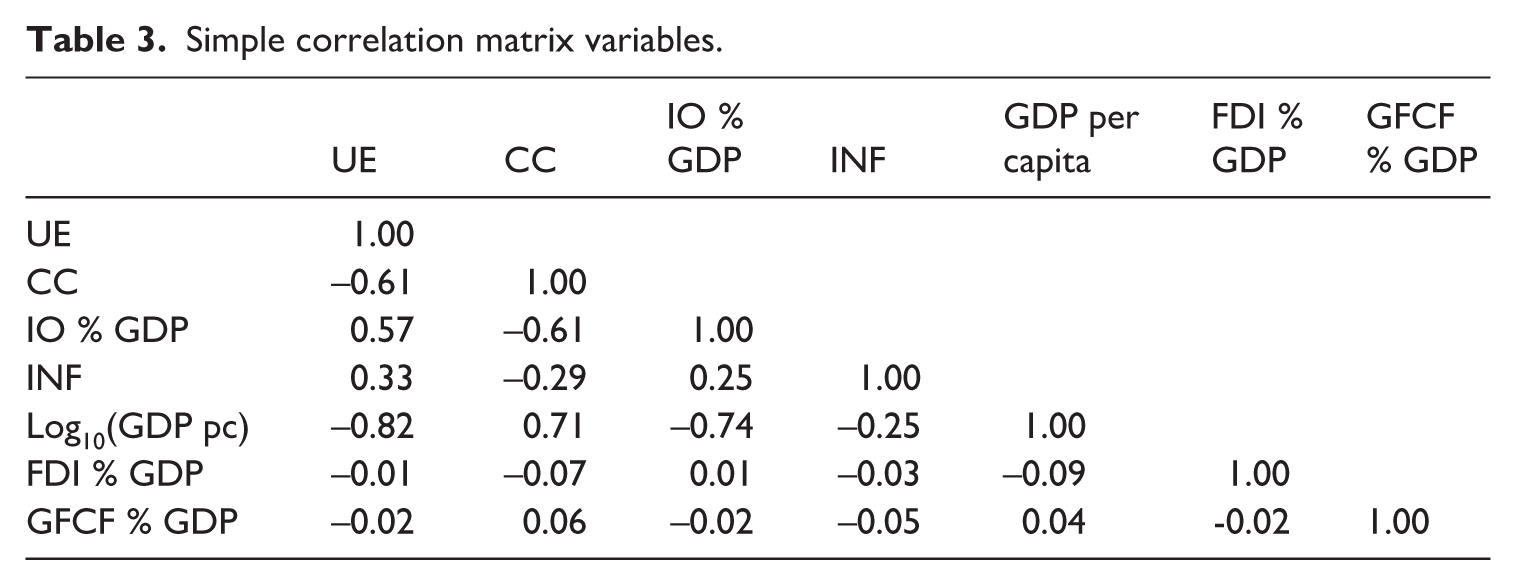
To reinforce the empirical strength of the analysis, a set of control variables has been developed that capture the broad macroeconomic and institutional factors determining labor market performance. The inflation rate (INF) serves as an indicator of macroeconomic stability because, in general, it can affect cost of production, wage dynamics, and investor sentiment. Logarithm of GDP per capita (Log10 of GDP per capita) is also included to control for the degree of economic development and average living standards so as to know how much economic growth gets translated into better labor market outcomes. Foreign direct investment as a share of GDP (FDI % GDP) expresses the dimensions of openness to globalization and the capacity of national economies to attract productive capital infusion, innovation, and sustainable job creation. Finally, gross fixed capital formation as a share in GDP (GFCF % GDP) will express domestic investment dynamics both through the speed of physical capital build-up and through the strategic commitment of economies to broaden their productive capacity. The above-stated variables present an excellent opportunity to delve into the complex linkages between governance quality, informality, and labor market performance. Using this kind of integrated structure results in highlighting how much ambivalence can be instigated by institutional setups and structural economic conditions in steering employment sustainability and inclusiveness across MENA. The descriptive statistics are given in Table 2 for all the above variables, while Table 3 presents the correlation matrix, which illustrates the interrelationships among the study variables.
Descriptive statistics of variables.
Simple correlation matrix variables.
The analysis started with the application of fundamental statistical methods, including descriptive measures such as the mean, median, standard deviation (SD), kurtosis, skewness, maximum, and minimum values, as summarized in Table 2.
As Table 2 shows, the average unemployment rate is 7.86% (SD = 6.49), ranging from 0.10% to 31.8%, suggesting a significant variation among different countries and across time. The mean value of CC is 0.015 (SD = 0.576), showing moderate levels of corruption perception throughout the sample, with values ranging from —1.18 to 1.56. IO % GDP has a mean of 24.3%, indicating a rather high level of informality in the region (range: 13.8% to 42.9%). The average INF is 3.83%, but its large standard deviation (6.41) and unusual maximum value (84.9) indicate that some economies have experienced periods of high inflationary pressure. Log10(GDP pc) averages 4.02 (SD = 0.505), indicating modest income levels with little variation between countries. The average value of FDI % GDP is 2.66%, but the significant positive skewness (2.82) and high kurtosis (15.20) show the presence of outliers with extremely substantial FDI inflows. GFCF % GDP averages 24.5% (SD = 6.83), with a range from 8.1% to 49.5%, highlighting significant differences in investment intensity across the sample. The skewness and kurtosis values indicate moderate deviations from normality, particularly for INF and FDI % GDP, which exhibit high variability. These results confirm strong economic heterogeneity among MENA countries, particularly regarding informality, corruption, and macroeconomic stability.
Table 3 presents the simple correlations among the main variables. UE is negatively correlated with CC (–0.61) and Log10(GDP pc) (–0.82), indicating that higher corruption control and higher income levels are associated with lower unemployment. Conversely, UE has a positive correlation with IO % GDP (0.57) and INF (0.33), implying that higher levels of informality and inflation are associated with higher unemployment rates. CC has strong negative associations with UE (–0.61) and IO % GDP (–0.61), as well as a positive correlation with Log10(GDP per capita) (0.71), indicating that stronger corruption control is connected with reduced informality and higher income. IO % GDP is favorably connected with UE (0.57) and INF (0.25), but negatively correlated with Log10(GDP pc) (–0.74), indicating that nations with larger informal sectors have higher unemployment, higher inflation, and lower incomes.
INF shows a moderate positive correlation with UE (0.33), but lesser relationships with the other variables. FDI % GDP and GFCF % GDP have very low correlations with UE and other factors, indicating that these capital flow and investment variables are relatively unaffected by unemployment and informality in the sample. The correlation matrix shows that unemployment, informality, control of corruption, and income are all substantially connected, although capital investment variables (FDI % GDP and GFCF % GDP) are essentially uncorrelated with labor market and macroeconomic variables. These results provide preliminary evidence that informality and governance are key factors associated with unemployment in the region.
The graphical analysis, in Figures 1 and 2, reveals a clear positive association between control of corruption and unemployment in several MENA economies. Countries such as Egypt, Tunisia, and Lebanon display upward-sloping or clustered points in the upper-left quadrant of Figure 1, suggesting an association between higher perceived control of corruption levels and elevated unemployment rates. This pattern aligns with studies documenting the distorting effects of rent-seeking practices and nepotism (wasta), which undermine merit-based recruitment and fair competition in labor markets (Kubbe and Varraich, 2025; Ouédraogo, 2017a). Prior research suggests that access to formal employment in such contexts often favors personal networks over skills or productivity (Sahnoun and Abdennadher, 2025). This dynamic restricts social mobility and limits the effectiveness of policy reforms aimed at inclusive labor market development, findings that are consistent with broader evidence linking weak governance, informality, and low-quality employment outcomes across MENA (OECD/ILO/UNDP, 2024; Saoudi, 2023).
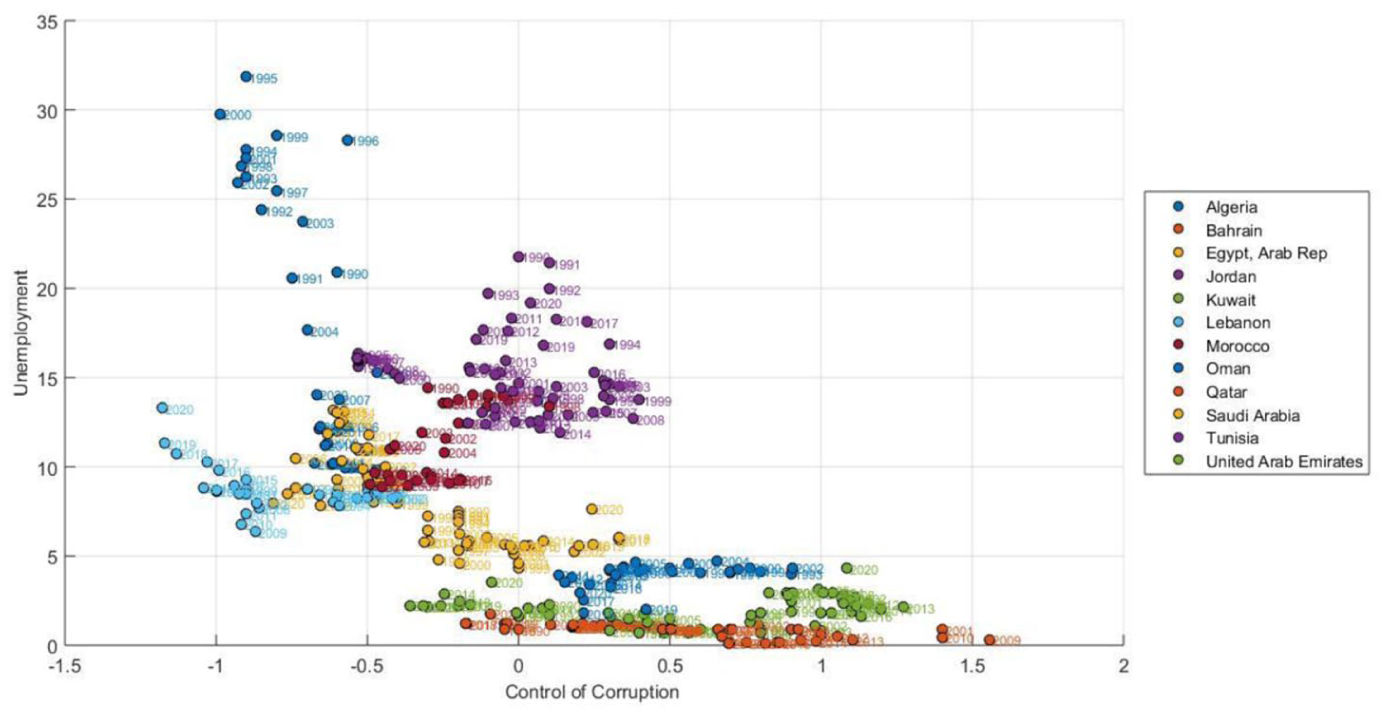
2D evolution of unemployment vs. control of corruption, 1990–2020.
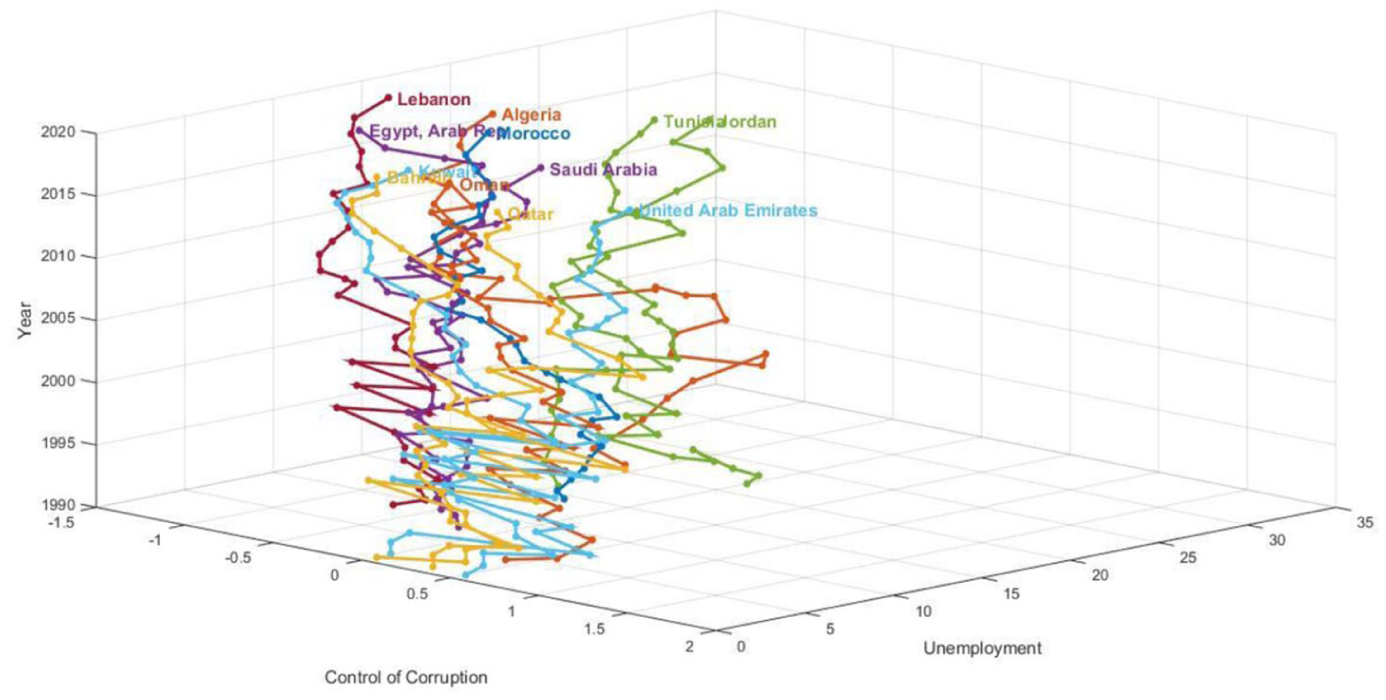
3D evolution of unemployment vs. control of corruption, 1990–2020.
In contrast, Gulf countries such as Qatar, Oman, and the United Arab Emirates have persistently low unemployment rates despite moderate control of corruption. These countries cluster near the plot’s origin, indicating a resource-driven employment equilibrium in which hydrocarbon riches allow governments to retain big public sectors and state-sponsored job creation. However, this apparent stability conceals underlying inefficiencies, such as overreliance on state employment, reliance on expatriate labor, and little private-sector diversity (World Bank/IMF, 2019). Such resource-based employment buffers provide short-term insulation from unemployment pressures but do not necessarily translate into sustainable or inclusive employment, an argument echoed in the literature emphasizing the vulnerability of rentier economies to declining oil revenues and demographic transitions (Sahnoun and Abdennadher, 2025; Shao et al., 2007).
The 3D plot of control of corruption, unemployment, and time (1990–2020) (Figure 2) expands this interpretation by revealing the temporal persistence and cyclical nature of institutional weakness across the region. The trajectories for most countries resemble vertical oscillations, suggesting recurrent cycles of governance deterioration and labor-market distress rather than progressive improvement. Notable inflection points occur around the 2008–2010 global financial crisis and the 2011 Arab Spring, periods marked by rising unemployment and worsening control of corruption (OECD/ILO/UNDP, 2024). These shifts highlight how political instability and economic shocks reinforce informality and strengthen reliance on wasta as a survival mechanism (Kubbe and Varraich, 2025). Meanwhile, North African economies display greater volatility, while Gulf countries remain relatively stable but policy-insulated, raising concerns about the long-term sustainability of rent-based employment models. Overall, the persistence of high unemployment despite varying levels of control of corruption suggests that informality acts as a structural mediator, redistributing opportunities within the labor market without generating real productivity gains or sustainable job creation (Saoudi, 2023; World Bank/IMF, 2019).
The visual evidence from Figures 3 and 4 reveals a clear structural divide between North African and Gulf economies in terms of informality and unemployment. Countries such as Egypt, Morocco, Algeria, and Tunisia exhibit persistently high informality rates (ranging between 25% and 40%) alongside fluctuating unemployment, indicating the limited capacity of formal labor markets to absorb the workforce. In contrast, Gulf Cooperation Council (GCC) countries such as Qatar, the United Arab Emirates, Kuwait, Oman, and Saudi Arabia have relatively lower rates of informality and unemployment rates, reflecting superior institutional capability, large public employment, and reliance on migrant labor. This discrepancy illustrates the region’s unequal development of labor-market institutions, where informality serves as both a coping mechanism and a barrier to economic modernization (ILO, 2021; World Bank, 2019). The continuance of informality in most of the MENA area is directly tied to the role of wasta, or social connections, which have a major impact on access to work possibilities. In situations where formal institutions are weak or viewed as unfair, wasta acts as an informal governance mechanism, offering employment access through personal networks rather than merit-based selection. This trend exacerbates inequality and reduces productivity by distorting labor-market signals (Barnett et al., 2013; Cunningham and Sarayrah, 1993). Figure 4 shows that even when unemployment falls marginally, informality persists, especially during times of political unrest or economic slump (e.g., the 2011 Arab Spring). This persistence demonstrates how social capital and informal hiring practices can support employment in the short term while undermining long-term labor-market sustainability.
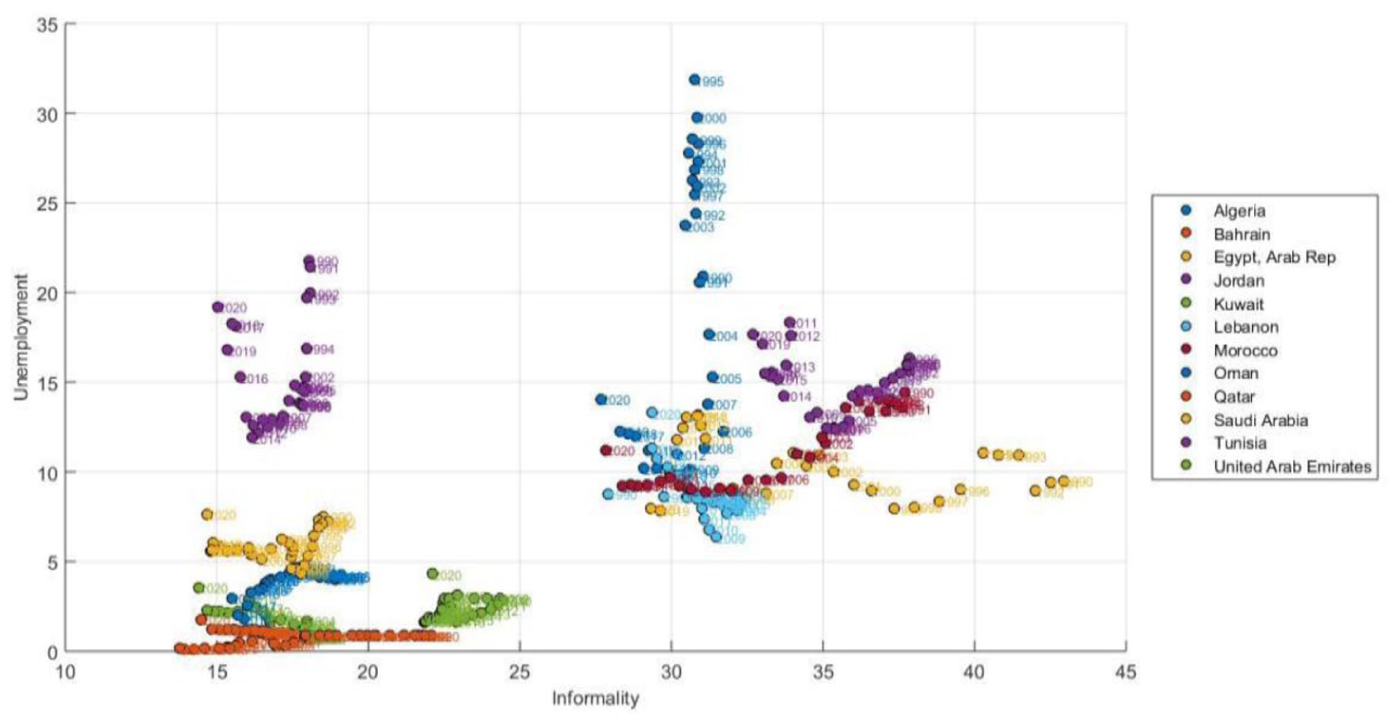
2D evolution of unemployment vs. informality, 1990–2020.
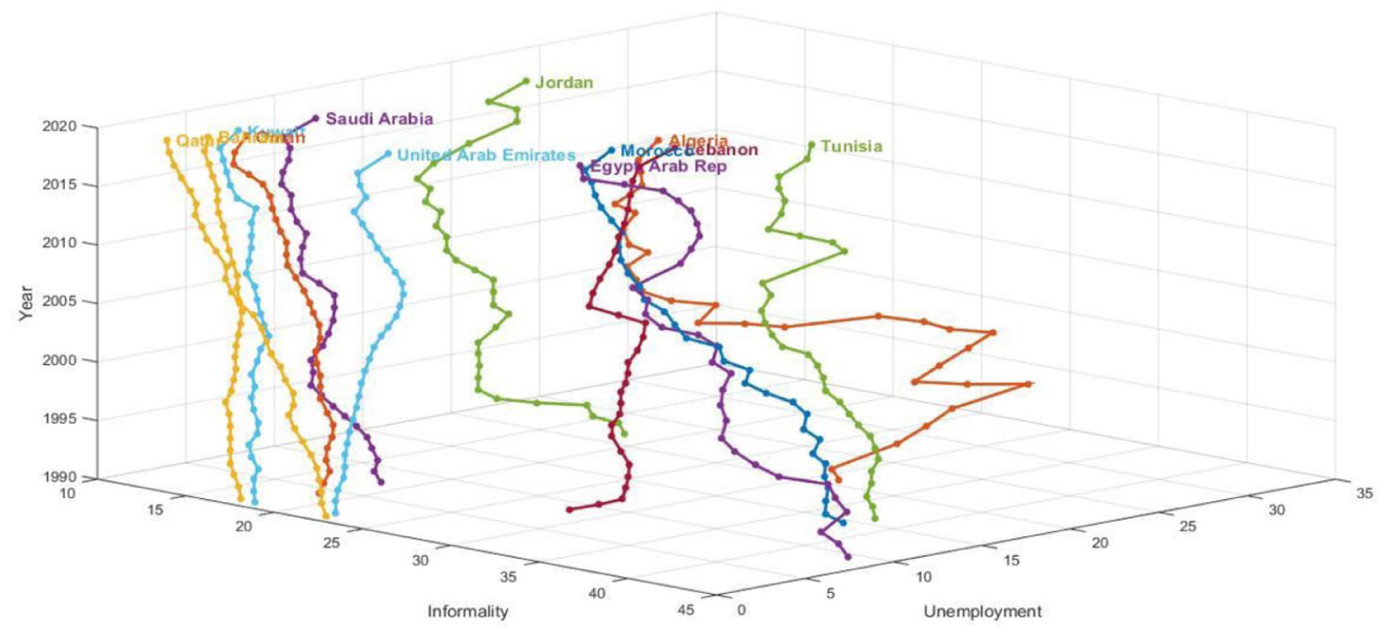
3D evolution of unemployment vs. informality, 1990–2020.
To investigate the influence of control of corruption and informality on unemployment while controlling for major macroeconomic variables, we applied an empirical methodology based on an effective methodological framework. Specifically, the analysis utilizes the fixed-effects and random-effects models, as detailed in the following subsection.
Methodology
This study used a balanced micro-panel data of 12 countries in the Middle East and North Africa (MENA) region over the period 1990–2020. Availability, consistency, and reliability of statistical data were factors considered in choosing the countries and the temporal coverage. Our empirical analysis begins with the estimation of the panel model outlined below:

UEi, t is the unemployment rate at time t in country i by inverse indicator of job sustainability. IOi, t%GDP is the size of the informal economy as a share of GDP; and CCi, t measures the control of corruption that could be used as a proxy measure for wasta to ascertain to what extent nepotism, favoritism, and clientelism have penetrated socio-institutional frameworks. Y′i,t is a vector embodying control variable: inflation rate (INF), the logarithm of GDP per capita (Log10 GDP pc), foreign direct investment as percentage of GDP (FDI % GDP), and gross fixed capital formation as percentage of GDP (GFCF % GDP). μi is the unobserved time-invariant country-specific effects and εi,t is an idiosyncratic error term. All variables are reported annually and sourced from the World Bank’s World Development Indicators (WDI) database, a global reference source offering credible cross-country comparable data.
We begin by running Equation (1) with the fixed-effects (FE) estimator, which does a great job controlling unobserved heterogeneity across countries. Since FE cannot pick up time-invariant effects, we include the random-effects (RE) estimator to detect between-country variation. This mix lets us see how within-country temporal dynamics and cross-country differences in the MENA region combine to disrupt labor-market outcomes. To strengthen robustness further and address potential endogeneity due to reverse causality or omitted variables, we also estimate a dynamic panel data model as follows:

The lagged unemployment rate (UEi, t−1) captures how labor-market trends persist over time. This dynamic specification enables us to test whether current levels of unemployment are based on previous trends and by past performance, which is typically found in structurally rigid labor markets.
Equation (2) is estimated by the two-step System Generalized Method of Moments (System GMM) estimator, as developed by Blundell and Bond (1998). To obtain robust standard errors, we apply the finite-sample correction proposed by Windmeijer (2005), and we perform standard diagnostic tests, namely, the Arellano–Bond test for second-order autocorrelation and the Hansen test for over-identifying restrictions, to verify instrument validity and estimator consistency.
Following a version of the Arellano and Bond (1991) approach, we estimate our model in its dynamic formulation by applying the Generalized Method of Moments (GMM) using lagged endogenous regressors as internal instruments to control for simultaneity and reverse-causality. The Arellano–Bover (1995) and Blundell–Bond (1998) System GMM estimator combines equations in first differences with equations in levels, thereby improving efficiency and enhancing the consistency of the estimator. In line with Roodman (2009a, 2009b), to estimate the dynamic specification, we use the two-step System GMM estimator which has been acknowledged to effectively deal with some major econometric issues including endogeneity, measurement error, as well as unobserved heterogeneity in a short panel. It removes country-specific fixed effects through first differencing all the variables such that the parameters are identified exclusively from within-country variation over time.
In this framework, lagged levels of endogenous variables are used as instruments for the differenced equation, whereas lagged differences are used as instruments for the levels equation.This dual-equation system boosts estimation efficiency and bolsters against possible biases that might come from weak instruments.
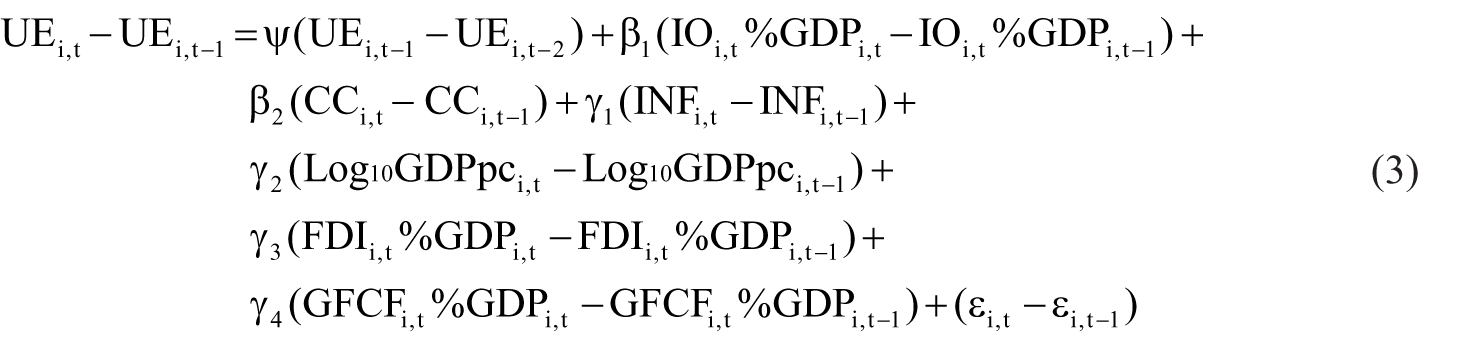
We then estimate the model simultaneously in first differences and levels, employing distinct sets of instruments for each specification. In this framework, lagged levels of endogenous variables are used as instruments for the differenced equation, whereas lagged differences become instruments for the levels equation.
Findings and discussion
Fixed-effects model vs. random-effects model and Hausman test
Table 4 presents three specifications of a fixed-effects (FE) panel data model, each designed to analyze the determinants of a chosen economic or social outcome across 12 MENA countries over a 31-year period (1990–2020). All models account for unobserved country-specific characteristics that remain constant over time, thereby isolating the effects of the explanatory variables within each country. F-Model 1 (Full Model) incorporates all independent variables, including control of corruption (CC), informality (IO % GDP), inflation (INF), GDP per capita, foreign direct investment (FDI % GDP), and gross fixed capital formation (GFCF % GDP). F-Model 2 (No Control Corruption) eliminates the control of corruption indicator to test model resilience when this institutional factor is removed, whereas F-Model 3 (No Informality) removes the informality variable to investigate how results behave in the absence of this structural labor market signal. The consistent panel structure (balanced with 372 observations) ensures comparability across the three specifications, while differences in residuals and R² values reflect the variation explained by the inclusion or exclusion of these key variables.
Fixed-effects model comparison summary.
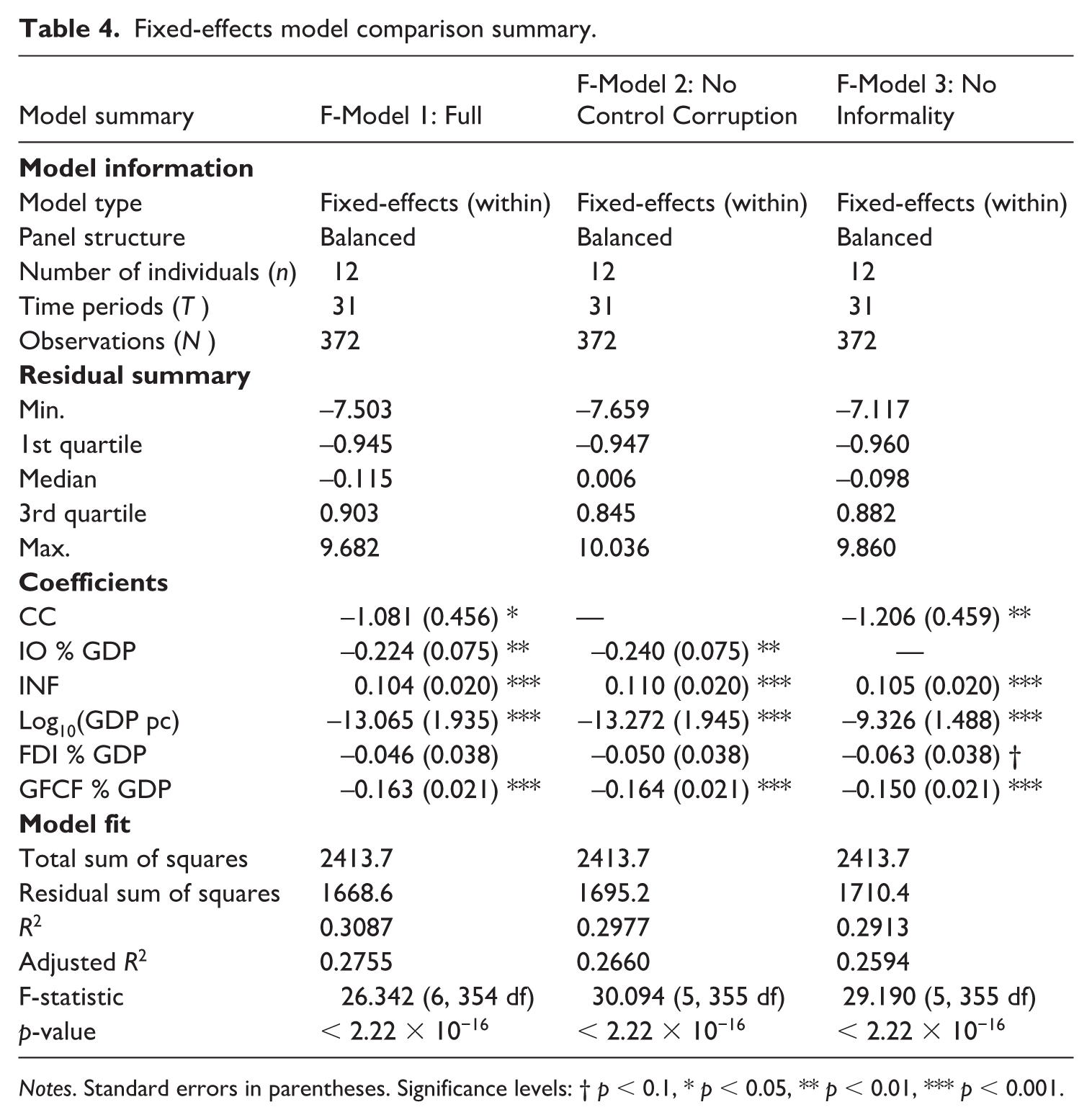
Notes. Standard errors in parentheses. Significance levels: † p < 0.1, * p < 0.05, ** p < 0.01, *** p < 0.001.
Table 5 mirrors the structure of Table 4 but employs a random-effects (RE) specification, which assumes that unobserved country-specific effects are random and uncorrelated with the explanatory variables. As with fixed-effects, three models are compared: R-Model 1 (Full) includes all variables, R-Model 2 (No Control Corruption) excludes the control of corruption indicator, and R-Model 3 (No Informality) removes the informality measure. The RE methodology allows for both within- and between-country heterogeneity in parameter estimate, resulting in more efficient results when its assumptions are met. The provided variance components, idiosyncratic error and individual effect, show how the overall variance is spread across temporal and cross-sectional dimensions.
Random-effects model comparison summary.
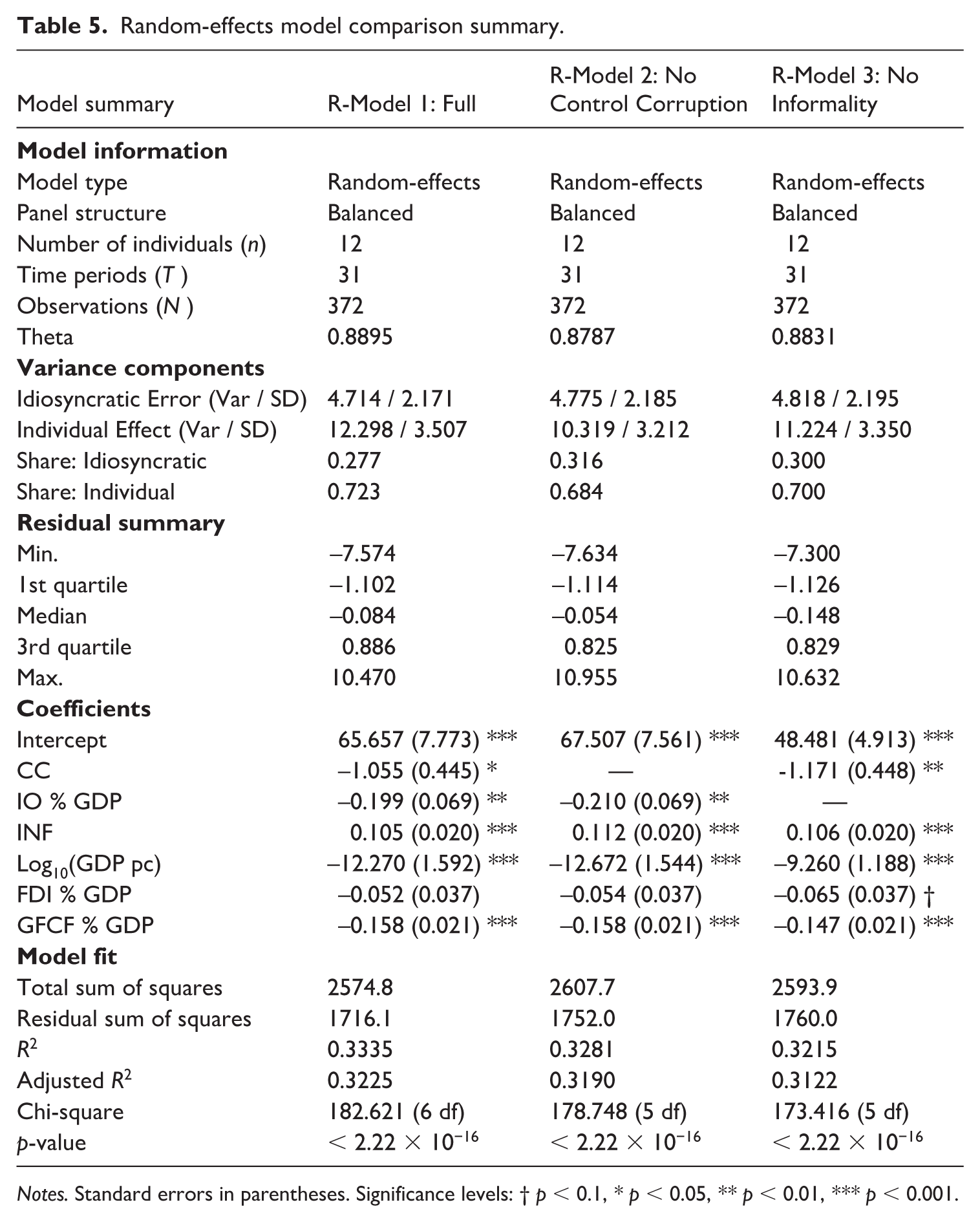
Notes. Standard errors in parentheses. Significance levels: † p < 0.1, * p < 0.05, ** p < 0.01, *** p < 0.001.
The relatively high share of individual effects (around 68–72%) suggests substantial country-specific heterogeneity, reinforcing the importance of considering panel structures in MENA studies.
Table 6 reports the Hausman test, which determines whether the fixed- or random-effects estimator is more appropriate for the data. The null hypothesis assumes that the random-effects model is consistent and efficient, while the alternative favors the fixed-effects model if unobserved country effects correlate with the regressors. In this analysis, all p-values are greater than the 0.05 significance threshold, meaning the null hypothesis cannot be rejected. Consequently, the random-effects models are preferred for all three specifications (Full, No Control of Corruption, and No Informality). This indicates that, for the examined MENA dataset, country-specific effects do not systematically bias the explanatory variables, making random-effects the more suitable modeling approach for subsequent interpretation and policy inference.
Hausman test result for panel data models.
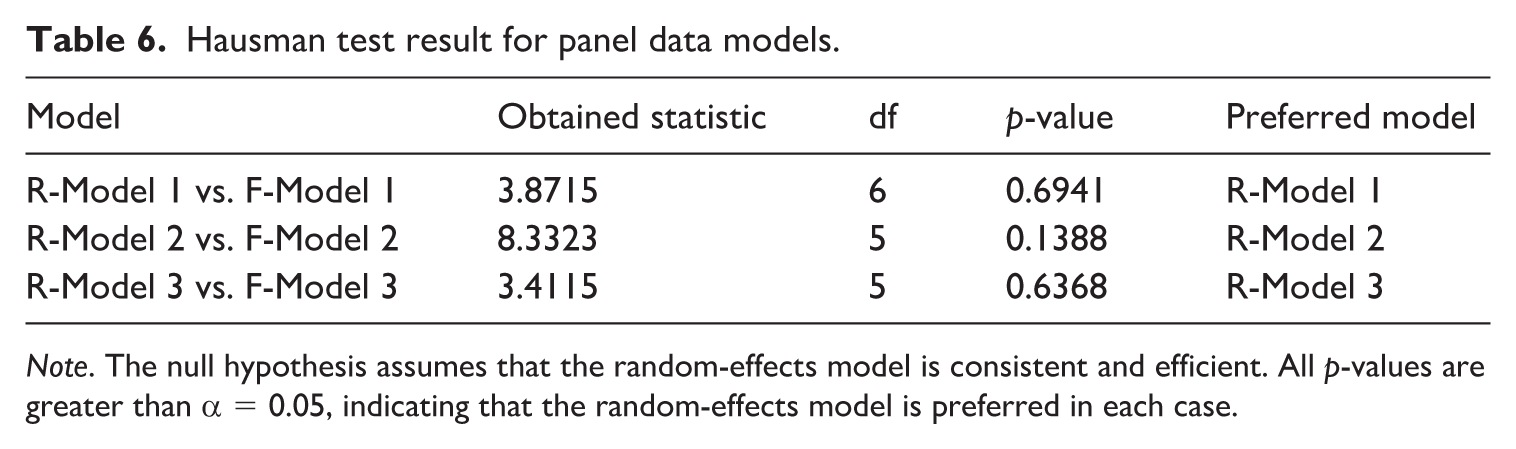
Note. The null hypothesis assumes that the random-effects model is consistent and efficient. All p-values are greater than α = 0.05, indicating that the random-effects model is preferred in each case.
The panel regression results from the random-effects models across the three specifications (Table 5), the full model (R-Model 1), the model without control of corruption (R-Model 2), and the model without informality (R-Model 3), emphasize the central role of macroeconomic and institutional factors in shaping unemployment in the MENA region. The explanatory variables account for roughly 32–33% of the variation in unemployment, indicating a strong fit for macro-panel data. In fact, the results confirm that economic development, institutional quality, and domestic investment are crucial for employment outcomes, whereas inflation and weak governance exacerbate labor market challenges.
Economic development and unemployment
The coefficient on the Log10(GDP pc) is consistently negative, large, and highly significant across all specifications (ranging from –12.27 in R-Model 1 to –9.26 in R-Model 3, with p-values below 0.001). Economically, this suggests that a tenfold rise in per capita income decreases unemployment by around 9–13 percentage points, assuming all other conditions remain unchanged. This strong negative association emphasizes the importance of economic development in labor-market improvement, which is consistent with the development-driven labor reallocation proposed by Kuznets (1955) and Lewis (1954). Previous studies in the MENA region, such as Bakhtiari (2017) and the International Labour Organization (2020), have found that growing income levels reduce unemployment through an increase in the capital–labor ratio, industry diversification, and talent accumulation. The slightly lower magnitude in R-Model 3 suggests that informality moderates the impact of income on official unemployment.
Inflation and labor market stability
Inflation has a positive and highly significant effect across all models (ranging from 0.105 to 0.112, with p-values below 0.001). A 1% increase in inflation raises unemployment by about 0.1 percentage points. This supports the idea that price instability in structurally rigid economies creates labor-market frictions, consistent with the stagflation framework discussed by Friedman (1977) and Bruno (1998). In the MENA region, inflation often stems from supply-side shocks, energy price volatility, and fiscal imbalances rather than excess demand, leading to reduced profitability, wage pressures, and higher unemployment. Similar evidence from Ait Lahcen (2017) and Louhichi (2016) confirms that inflation in developing economies negatively affects formal employment.
Corruption control and institutional quality
Corruption control is negative and significant in the models where it appears (ranging from –1.055 in R-Model 1 to –1.171 in R-Model 3, with p-values between 0.05 and 0.01). A one-unit improvement in governance quality reduces unemployment by roughly 1 percentage point. This result supports the institutionalist view that corruption reduces market efficiency and job generation (Mauro, 1995; Méon and Sekkat, 2005). In MENA countries, corruption frequently emerges as nepotism or wasta, which limits access to formal employment possibilities. The effect is stronger in the model that excludes informality (R-Model 3), implying that informality absorbs some labor that would otherwise be harmed by poor governance. This relationship is consistent with the findings of Ouédraogo (2017b) and Bermudez (2024).
Informality and the absorptive role of the informal economy
Informality, measured as a percentage of GDP, is negative and significant in the full model and in the model without control of corruption (ranging from –0.199 to –0.210, with p-values below 0.01). This implies that a 1% increase in the size of the informal economy reduces official unemployment by about 0.2 percentage points. This emphasizes the “safety-valve” function of informality, in which informal employment absorbs workers barred from formal labor markets (Loayza, 1997; Schneider, 2000). However, the effect may obscure underemployment and low productivity, indicating a trade-off between short-term unemployment reduction and long-term job quality (Elgin, 2019). Excluding corruption (R-Model 2) somewhat raises the coefficient of informality, emphasizing the interconnectedness between governance and informal labor absorb.
Investment and employment creation
Gross fixed capital formation consistently shows negative and highly significant effects (ranging from –0.147 to –0.158, with p-values below 0.001), suggesting that a 1 percentage point increase in domestic investment reduces unemployment by approximately 0.15 to 0.16 percentage points. This aligns with neoclassical growth theory, where capital accumulation boosts productivity and job creation (Blanchard, 2000; Mankiw, 1992). In contrast, foreign direct investment has weak and usually insignificant coefficients (between –0.046 and –0.065), showing low direct employment benefits, most likely due to capital-intensive FDI sectors (Kumar, 2002; Nunnenkamp, 2004).
Throughout the three specifications, the relationship between control of corruption and informality is clear. Excluding control of corruption (R-Model 2) retains the large negative effect of informality on unemployment, although excluding informality (R-Model 3) stresses the importance of corruption control. Adjusted R-squared values range from 0.312 to 0.322, indicating that both variables capture complementary institutional effects. This supports the view that informality and corruption coexist as equilibrium outcomes shaped by governance structures (La Porta and Shleifer, 2014; Ulyssea, 2020). Policies improving governance and gradually formalizing informal labor markets can simultaneously reduce corruption and promote sustainable employment.
The results suggest that economic development, domestic investment, and institutional quality are the strongest determinants of employment in the MENA region. High inflation, corruption, and extensive informality form a structural trap that hampers sustainable job creation. A dual strategy is recommended: improving transparency and reducing wasta, while supporting formalization initiatives that maintain labor market flexibility. Policies that foster domestic private-sector growth and enhance access to finance for formal enterprises are likely to yield long-term employment benefits, consistent with institution-led development frameworks discussed by Rodrik (2008) and Acemoglu and Robinson (2012).
Conclusions and policy implications
This study has significant practical implications for organizations and managers operating in contexts where informal coordination mechanisms coexist with modern governance frameworks. The analysis brings to light the fact that wasta does not constitute merely an impediment to efficiency but rather a relational mode of coordination that can be institutionalized to provide fair access routes to employment. In the process of removing wasta, organizations may turn relational trust into transparent and thus auditable practices adopting public vacancy announcements, standardized assessment rubrics, and integrity declarations—implementing network-based advantages into accountable recruitment procedures (Horak and Suseno, 2023).
At the organizational level, these findings call for the integration of integrity-based human resource management systems. Digitalized tracking of all recruitment stages, structured probationary assessments based on objective criteria, and independent HR oversight committees help transform informal networks ties into productive organizational assets (Alsarhan et al., 2024). In return, this generates procedural justice thereby building up trust between employees and management. This helps to foster HRM systems that integrate transparency and accountability, thus strengthening internal organizational legitimacy and resilience, key elements of sustainable employment systems.
From a managerial perspective, the study highlights the need for reflexive leadership that can harmonize cultural embeddedness with the process of institutional modernization. Leading institutions must have an understanding of what wasta solidarity and partiality embody. Therefore, channeling leadership through the cohesive potentials of wasta while suppressing its exclusionary effects is imperative. Decision-makers can institutionalize relational trust by encouraging fair referral practices and open communications where the ethical boundary is clearly articulated against undermining decisions based on merit. This takes the issue beyond mere moral condemnation to place it within the ambit of ethical regulation such that wasta becomes a lever for inclusion and social cohesion rather than privilege and bias (ILO, 2024).
At a policy and ecosystem level, the findings underscore that improved governance and control of corruption enables investments to create formal long-term jobs. Hence, informality and wasta are seen as adaptive responses to institutional voids rather than simple dysfunctions. Policymakers should try to regulate rather than strike at the heart of such informal arrangements by making transparency, and legal enforceability, integral to labor markets (Lopez-Acevedo et al., 2023; World Bank, 2024).
Sustainable employment in the MENA region depends on an institutional equilibrium between formal governance and relational logics that maintains trust. Through organizational and managerial reforms that formalize and give oversight, and put in the right ethical channel, wasta will turn a culturally rooted practice into a foundation for inclusive and durable employment systems.
Footnotes

Funding
The authors received no financial support for the research, authorship, and/or publication of this article.
Declaration of conflicting interests
The authors declared no potential conflicts of interest with respect to the research, authorship, and/or publication of this article.