






Abstract
This study explores employee voice and participation within small and medium enterprises (SMEs) and non-union contexts. It seeks to better understand how informal relations develop and configure forms of participation, and how the memories of the workforce – in relation to representation and regulation – contribute to the nature of employment relations in SMEs. Drawing from a qualitative enquiry comprising two case studies, the findings illustrate how a diversity of approaches to employee voice within informal spaces may be understood. This variation even within non-union contexts is in part attributable to organisational memories, the experiences of internal management relations, and the idiosyncrasies linked to the composition of the workforce and their previous collective experiences of unionised settings.
Keywords
Introduction
Research concerning aspects of collective voice has traditionally been closely aligned with the role played by trade unions in providing a representative voice (e.g. Freeman and Medoff, 1984). However, a move towards the de-collectivisation of industrial relations, the topic of employee voice and associated streams of research have broadened their conceptual boundaries to incorporate non-union and individualised contexts (Cullinane et al., 2017; Dundon and Gollan, 2007; Dundon et al., 2005; Gollan et al., 2015). This is in addition to aspects of voice in informal and formalised (collective and unionised) settings (Marchington and Suter, 2013; Townsend et al., 2013), alongside parallel research that has contemplated the idea of employee silence (Nechanska et al., 2020; Prouska and Psychogios, 2018) and contributors who have more recently examined voice within the context of a platform economy (Martínez Lucio et al., 2022) (including the gig economy; see Wilkinson et al., 2021), plus the concept of ‘e-voice’ (Bernauer and Kornau, 2024) and the interplay with artificial intelligence (Dutta et al., 2022).
Existing research on human resource management (HRM) and employment relations in the context of small and medium sized enterprises (SMEs) has traditionally highlighted these tensions and the role of non-union or weaker union voice mechanisms. Discussions on HRM in SMEs has viewed work and employment in binary terms: idyllic small firms (Schumacher, 1973) versus exploitative ones (Sisson, 1993). This dichotomy nonetheless has been subject to criticism for being too simplistic (Harney and Dundon, 2006), even if the mainstay of such employment relations is informal and non-union in their approach, unlike larger organisations (Dundon et al., 1999).
The principal objective of this article is to further extend our understandings of voice mechanisms within SMEs in a non-union context, which are credited with being largely informal (Mallett and Wapshott, 2014) in line with the lack of normative HR practices or high-performance work systems (HPWS) that is purported to be typical of SMEs (Harney, 2015). However, for all the discussion of the importance of informal relations within SMEs and employment, this article seeks to better understand how these informal characteristics and processes develop and influence employer–employee relations and representation, particularly when there is a move to construct a more transparent or structured process resulting from organisational growth, and the subsequent tensions that result. Additionally, this article will also consider how these informal dimensions are influenced by the nature and working experiences and memories of the workforce in relation to representation and regulation. This discrete shaping of the nature of employment relations in SMEs will be the basis of the two case studies.
The article focuses on a qualitative enquiry, comprising two in-depth case studies of non-union SMEs operating in the aerospace sector supply-chain within the same region of the United Kingdom. Both organisations can be described as ostensibly similar in respect to their size and recent patterns of organisational growth, a familial ownership dimension, non-unionised status, along with their sector and region of operation. However, the findings illustrate how a diversity of approaches to employee voice within informal spaces may be taken. Different non-union patterns of representation of what could be called a form of collectivism were being developed in each case, but in different ways. This variety across the two cases appeared largely attributable to idiosyncrasies linked to the composition of the workforce, demonstrated by one of the cases being indirectly influenced by a previous or parallel experience of collective voice and the role of employment regulation. This serves to illustrate the impact derived from the specific relations within management and the workforce of each of these cases.
The article points to the discreet influences of a range of external actors occupying the ‘regulatory space’ (Hancher and Moran, 1989; MacKenzie and Martínez Lucio, 2005) of the firm but also the recollection and awareness of collective and regulatory legacies within it. Throughout, the article refers to some of the cultural dimensions of organisations relevant to this discussion, in recognition of how specific contingencies of SMEs shape culture and practice. Consequently, the research calls for employment relations in SMEs to be studied in a broader manner in terms of their indirect influences and the subtle impact of external regulatory and collective cultures and the micro-political dimensions of the firm. SMEs as complex organisations have specific histories and idiosyncrasies which needs to be accounted for and detailed within ethnographic research and which are important to understanding how ‘regulation’ is understood and/or invoked and used in such contexts. The article addresses the need to understand aspects of the informal dimension of industrial relations in SMEs in terms of not just informal behaviours but more complex interactions and references made by particular groups of managers and workers at key times. Hence, we propose the following two research questions. First, for all the discussion of the importance of informal relations within SMEs and employment relations, how do informal relations develop and configure forms of participation? Second, how do the nature and working experiences and memories of the workforce (and management) in relation to representation and regulation contribute to the nature of employment relations in SMEs?
This article begins with a literature review that considers the ambiguous nature of employee voice, the changing landscape of British industrial relations, including the apparent disjointed and uneven relationship between SMEs and trade unions, which tends to favour more direct consultation arrangements with employees or an absence of them (Dundon and Gollan, 2007). In recognition of a more individualised nature of the employment relationship, the characteristics of voice within an SME, and a non-union context, will be analysed with a particular emphasis placed on the informal dynamics of voice. This is undertaken to further understand the apparent complexity, and often tension, in how formalisation occurs in various ways. Latterly, and in recognition of such a perceived complexity, the importance of context will be the point of focus. Hancher and Moran’s (1989) concept of ‘regulatory space’ is applied along with developments of this approach, in recognition of a dispersed and fragmented environment within which the SME resides.
Literature review: Voice, regulation and change in SMEs
The literature review is organised into four sections. The first concerns an outline of the debates on employee voice and the second outlines the relevance of the debate to industrial relations in SMEs. We then try to supplement these debates with two dimensions that underpin the purpose of the article. Whilst debates on voice and SME industrial relations are conscious of informal relations and processes, we try to link these together in our article as a way of drawing out the internal politics and relations salient to debates on employee voice and SMEs. We then focus on a fourth set of literature on the regulatory context/space and organisational memory, which allows us to then see how questions of regulations and voice are evoked within SME workplaces. Hence these four sets of literature allow us to deepen our awareness of informal relations and questions of organisational memory as factors that can shape employee voice.
Defining and interpreting employee voice
Employee voice as a topic of research is ambiguous and contested in nature, largely a result of different academic disciplines adopting differing theoretical foundations (Dundon et al., 2004; Wilkinson et al., 2020). While organisational behaviour literatures on voice have centred in part on the individual dimensions of voice, research aligned with the employment relations field of literature is generally typified by a focus on formal structures for collective voice, where the interests of management and workers may be divergent (Wilkinson et al., 2020). Such an approach is rooted in the legacies of trade unionism and collective bargaining. Wilkinson et al. (2020: 5) developed a broad and inclusive definition of employee voice as: ‘the ways and means through which employees attempt to have a say, formally and/or informally, collectively and/or individually, potentially to influence organizational affairs relating to issues that affect their work, their interests and the interests of managers and owners’.
Alongside union forms of bargaining, other collective forms of employee voice can include institutions such as works councils and joint consultative committees (Wilkinson et al., 2020). According to Ingvaldsen et al. (2020), many forms of voice cannot be easily categorised as either collective or individual, but tend to dovetail with a more complex web of union and non-union, individual and collective or semi-collective group mechanisms including the likes of task involvement and teamworking, workplace partnership, mutual gains voice and non-union employee representation. Indeed, many practices, including those outlined above, typically reflect the history of an organisation and consist of ad hoc adjustments to problems rather than being the outcome of a fine-tuned employee voice strategy (Wilkinson et al., 2020). Thus, a broader approach to the study of voice in a specific context is recommended, and this article will illustrate the subtleties, and complexities, derived from contextual determinants on employee voice within SMEs that draw on key insights into the way the form and degree of engagement in decision-making varies (De Spegelaere et al., 2019; Marchington et al., 1992).
The changing landscape of British industrial relations
The decline and fragmentation of traditional single channel trade union representation, especially in liberal market economies like the United Kingdom, has left a representation gap which is visible in various national contexts (Alsos and Trygstad, 2019). In many circumstances, employers have sought to individualise their relationship with labour and this has been aided by the influence of governments to pass laws to restrict trade union power since the 1980s (Standing, 1999). All the while trade unions have historically been geared towards achieving the needs of a mass and stable core workforce (Howell, 2005). Consequently, collective voice and similar forms of employee involvement have gradually, and to an extent, been replaced or supplemented within many organisations by more direct forms of employee voice that often circumvent trade unions (Wilkinson et al., 2007). By the early 2000s, for example, only 5% of workplaces in the United Kingdom had a union (Willman et al., 2009). Moreover, the fragmentation of work, with developments such as the platform economy and the types of jobs associated with it, has weakened the reach of organised and established forms of worker representation and provides an argument for the locating of voice within the wider political economy and the social structures that constitute its context (Martínez Lucio et al., 2022).
The decline of union voice may in part also be seen as a result of competition between union and non-union voice regimes, with employers investing in HRM that complements non-union voice systems (Bryson et al., 2012). Albeit, a challenge to the success of non-union voice mechanisms is that they can be seen as more susceptible to managerial prerogative, influence and control (Gollan et al., 2015), which could in turn negate the benefits of direct voice, especially if employees determine the relationship is one that is built upon rhetoric and not a genuine relationship (Parry et al., 2019). Thus, forms of non-union employee representation (NER) may be adopted as a union avoidance or ‘suppression’ tactic (Dobbins and Dundon, 2020).
Conversely, different forms of NER may provide a mechanism for employers to deliver positive mutual gains for both employees and employers. Albeit, contextual factors affecting NER mutuality are thought to be crucial, including external macro pressures such as regulatory conditions alongside internal micro-organisational dimensions (Dundon and Gollan, 2007). Direct voice represents an opportunity for management to replace union voice, thus management attitudes, style and context become critical in determining the nature, characteristics and effectiveness of non-union voice at the level of the firm (Holland, 2020). Although, as Dobbins and Dundon (2020) attest, employee behaviour and actions may also influence the characteristics and outcomes of consultation, particularly when occupational identities and work legacies lead to strong workforce solidarity.
Industrial relations and the SME
Despite different potential modes of voice (direct versus indirect, formal versus informal, individual verses collective) available to SMEs, when deliberating industrial relations and the SME, it is normally understood that they are characteristically non-unionised (Matlay, 2002), with smaller businesses often favouring more direct and informal consultation arrangements and individualised labour relations. Such a position has arguably been aided by legislation introduced since the 1970s in the UK which has limited the ability of trade unions to engage with SMEs due to complex recognition laws and anti-trade union bias (McIlroy, 1991). In the UK there is no automatic universal legal obligation to have a trade union represented; however, legally, employers can voluntarily allow a trade union to represent its workforce and if they are reticent a union must prove that the majority of workers desire to have a trade union and the trade union has exceeded the specified minimum legal threshold for membership, although this can be a drawn-out process that absorbs a wide range of trade union resources (Perrett, 2007).
Specific idiosyncrasies linked to the historical, governance and regulatory contexts of organisations may shape their approach to employee voice whereas broader sector or occupational effects may occur based upon the history or level of unionisation within the broader human capital pools from which organisations source labour. When considering industrial relations and the SME, the influence and perspective of the owner/manager is deemed to be of significance, with their experiences shaping their current work-related attitudes, expectations and relationships including the likelihood they will engage with a union (Matlay, 2002). Gunnigle and Brady (1984: 22–23) suggest owner/managers may perceive any trade union presence as a ‘curbing of the management prerogative’ and ‘superfluous’ as ‘smallness facilitates better communication’. Owner/managers ultimately perceive the firm very much as ‘their organisation’ and will often only formalise relations as a way of legitimising authority and behaviour.
In this sense, a ‘power culture’ may occur (Handy, 1976) where employment relations are shaped by the centralisation of power among an owner(s) and integration achieved through informal rather than formal voice methods. Handy’s (1976) model of organisational culture can be used to analyse power cultures in small businesses, key dimensions to culture being the centralisation of power (low versus high) and integration (informal versus formal). For example, a bureaucratic role culture has high centralisation of power in senior management but high formalisation in that the organisation is integrated in terms of formal roles, rules and procedures. Small businesses in contrast typically have high centralisation but lower formalisation (there are fewer bureaucratic rules, roles are more poorly defined, and they lack HR policies). However, as our second case will show, counter-power mechanisms may be apparent due to various cultural or historical factors.
Unionisation may therefore be seen by employers as a challenge to such arrangements. Blanchflower and Bryson (2022) state many small business owners may dismiss labour unionisation as unmotivated employees attempting to negotiate for undeserved compensation and benefit. Gomez et al. (2019) found many small business owners believe industrial relations remain simple matters of lower-level negotiations between themselves and their employees. Owner/manager prerogative may also be important in influencing how the external influences are interpreted or managed within the business (Wapshott and Mallett, 2015). Family-owned SMEs are also seen as being a significant barrier to unionism (see Holten and Crouch, 2014). The 2004 Workplace Employment Relations Survey found union membership to be less common among those working in family-owned firms (5%) than among those working in small firms where a single individual or family does not own a majority of the business (15%) (Forth et al., 2006).
(In)formality in employment relations: Dimensions of voice in the SME
Employment relations change and fragmentation – albeit contested and uneven as a development – has been paralleled by a debate on new forms of direct employee engagement and participation of a more individual nature. Compared to large organisations such as corporate bureaucracies, the organisational integration problems differ in SMEs. Close social and spatial proximity facilitates more direct and informal communication whereas the levels of organisational hierarchy and functional silos within larger bureaucracies require more formalised integrative mechanisms (Burns and Stalker, 1961). Small firms provide a distinctive ‘fertile environment for the persistence and dominance of informal employment relations’ (Marlow et al., 2010: 956). SME-focused research relating to employment relations has traditionally been positioned at the boundaries of the ‘small is beautiful’ (Schumacher, 1973) vs ‘bleak house’ (Sisson, 1993) debate. Either position of the debate can be understood to recognise aspects of voice and participation opportunities in contrasting ways: the more positive view can be characterised as heavily favouring the use of informal communication flows between owner/manager and employees as a means to generate commitment and loyalty (Dundon and Wilkinson, 2004), which contrasts a directive or authoritarian management where employees have little or no involvement in decision-making (Wilkinson et al., 2007).
Existing literature which takes as its focus voice and SMEs acknowledges how SMEs tend to favour individual oriented forms of employee involvement and participation (EIP) that are informal and direct in their approach (Wilkinson et al., 2007). Informality could allow opportunity for owner/managers to ‘develop networks of personal allegiance’ (Scase, 2005: 71). Similar to ‘bleak house’ principles, it was traditionally posited that employment relations in the small firm, in the absence of worker collective voice and formalised procedures such as collective bargaining, were largely autocratic in nature, making an employee’s ability to participate in decision-making heavily constrained (Forth et al., 2006). Contrastingly, informality within SMEs may be indicative of individualised voice arrangements which can maintain and legitimise non-union status (Dundon and Gollan, 2007). Forth et al. (2006) concluded SME managers were more likely to subscribe to the ethos of ‘top-down’ management, but they were actually more likely to involve employees in the decision-making process than large-firm managers. Albeit, such an explanation does not account for the role of context or indirect effects but is seen as a purely organisational or cultural matter. Hence, even within a wider context of de-collectivisation, we still see curious informal collective processes in employment relations and obscure references to the role of external regulatory expectations and legacies – and this leads us to the question of memory.
Finally, a transition from informality to formality through a process of formalisation is not a simple progression through which growing organisations must inevitably pass (Ram and Edwards, 2010). Degrees of informality remain a requirement for their effective functioning, and embedding formality is neither simple nor straightforward (Ram and Edwards, 2010). Different degrees of (in)formality may be deployed in response to particular internal and external demands, and informality and formality could therefore be considered as coexistent (Mallett and Wapshott, 2014; Marlow et al., 2010).
Context and memory as factors in contributing to the nature of voice in SMEs
Furthermore, the role of regulatory context as an influencing factor on employee voice is important. Regulatory space (Hancher and Moran, 1989) is an analytical construct designed to move beyond the command-based view of employment regulation, which is seen as being limited to government regulators. Regulation has become dispersed and fragmented; extending beyond legal systems it is now recognised as the sum of numerous intersecting and conflicting interests and value systems. A multiplicity of sites, spaces and actors, both formal and informal in origin, can be seen to exert influence in a particular area of interest to them, a highly political process; boundaries between these spaces may be constantly renegotiated and regulatory jurisdictions may overlap (MacKenzie and Martínez Lucio, 2005). There is also competition between actors and tensions as they vie for critical positions and try to colonise specific points, thus indicating a more political process and set of tensions within regulatory spaces (MacKenzie and Martínez Lucio, 2014). Only through a comprehensive understanding of the complexities of these relations, of the multiple roles and diverse spaces in which they operate, can we truly understand the indirect and subtle role and impact of regulation, as we cannot simply locate it in the relation between workers and managers in isolation of the regulatory context and previous experiences of them. In particular, how these actors evoke and reference their previous experiences and memories of engagement is also important as they pursue their interests and objectives, as we will discuss further on. This tallies with the emerging demand to look beyond formal organisational structures and look at the reflections and actions of workers themselves (see Alberti and Però, 2018).
Secondly, and more specifically: to what extent are aspects of voice shaped by attributes of the micro-organisational dynamics and macro-environmental factors? This question is firmly aligned with the perspective of Whittington (1988) concerning deep social structures, agency and strategic choice. Arguing that the character of key organisational actors needs to be explored, not only in terms of the internal hierarchy, but also in terms of their positions within, and relations to, external structures stretching beyond the organisation itself, Whittington (1990: 201) points out: ‘rarely. . . do these accounts trace the roots of such organisational phenomena out to their origins in society at large’. Thus, Whittington proposes an account of agency that also considers the organisations’ engagement with plural and overlapping social systems. In application to SME debates, and accounting for the fact that small firms are often saturated with the ideology and culture of the owner/manager (Ram and Holliday, 1993), Whittington’s framework represents an important construct when attempting to understand EIP and voice in the differing sectoral and occupational contexts.
Thirdly, adopting an alternative and flexible understanding of collectivism, McBride and Martínez Lucio (2011) argue that regardless of the extensive literature on the decline of collectivism, it is a much more flexible and richer concept due to diverse social influences and experiences. In addition, there are also reflections and memories of previous employment experiences and collective endeavours. The question of memory has begun to surface within organisational and employment studies. In some senses it links to the current interest in ideational power that is being developed in debates on trade unions and worker representation (Refslund and Arnholtz, 2022). Moreover, generational factors can shape the way experiences of work are developed and recalled. Historical experiences may be important in providing a level of understanding and comprehension that adapts and shapes the experiences of workers to new contexts (Polletta and Jasper, 2001). According to Rowlinson et al. (2010), this historical context is important for appreciating how actors develop actions and the way they may legitimate them: it may also contribute and shape internal struggles. How different workers and managers – and other actors – engage with previous experiences needs to be central to the narrative (Huber, 1991). As stated by Gardiner et al. (2009), the importance of broader occupational and sector cultures must be recognised and appreciated in how they shape questions of voice at work – as must also the memories of a particular work group and how it is recalled (MacKenzie et al., 2006). This dimension, the article will show, plays a curious role in differentiating the cases studies we present. One could argue that industrial relations as a discipline has on occasions concerned itself with memory and action especially in relation to trade unions. Concerns with the actual recording and archiving of union actions and how this varies (Bell et al., 2005) and the way activists within trade unions recall previous actions such as strikes and their impact (Cohen, 2014; Seeliger, 2016) are common. There is an emergent stream of debate which draws from insights on organisational memory and learning, such as that of Huber’s (1991), and which places union innovation and strategy within a broader context of organisational reflection (Hyman, 2007) and debates on modernisation (Stuart et al., 2010). This has become increasingly integral as a feature of union organising debates, but it also needs to be linked into debates on employee involvement and participation more clearly even in non-union environments. It is our view that this was an emerging issue from the research on the cases in this article and that it involves the role of various actors, including the workers themselves and even broader state bodies who can play a role in sustaining the memory of regulation and rights (Stuart and Martínez Lucio, 2008).
The cases below will therefore develop a sensitivity to these various factors in the way that they shape forms of collectivism and understandings of representation. They will try to show how external influences are mediated through internal workplace factors, and interact to contribute to a more dynamic and diverse set of voice mechanisms within these firms. The article contributes to the debates by looking how the gap on organisational memory can be included in terms of an array of informal relations within the workforce and management as well as the management and owners. The study thus attempts to widen the way we see these relations and their relevance for understanding SME industrial relations and questions of voice,
Methods and case study design: Detecting micro-politics and struggles over broader representation of regulation
A case study methodology was considered the most appropriate to fulfilling the research objective of attaining a more holistic understanding of voice and EIP in the small firm. An in-depth, qualitative enquiry of this nature was thought to help best elicit hypothesised complexities and the idiosyncratic nature of voice, alongside causal mechanisms and the role played by contextual determinants in influencing such matters. Ackroyd (2009) recognises one of the benefits of the intensive nature of the case study exercise as being a process which serves to enhance the researcher’s sensitivity to factors that lie behind the operation of observed patterns within a specific context. To that extent, the article concerns itself with the following two research questions which try to unpack the complexity of informal processes. First, for all the discussion of the importance of informal relations within SME and employment relations: how do informal relations develop and configure forms of participation? Second, how do the nature and working experiences and memories of the workforce in relation to representation and regulation shape the nature of employment relations in SMEs?
The data were collected from two in-depth case studies, with both SMEs being non-union and operating within the supply-chain of the aerospace sector. They are both located in the same region, which has a strong industrial relations and trade union tradition. They are approximately similar in terms of scale. This allowed the research to isolate differences in the way informal relations and processes in terms of participation were developed and engaged with (our first research question) and the way the experiences and memories of management and especially the workforce influenced outcomes (as in the second research question), but this second set of issues emerged as the project was executed and the fieldwork done. Differences between SME cases are more obviously explained when there are sector-level and regional differences, hence the selection.
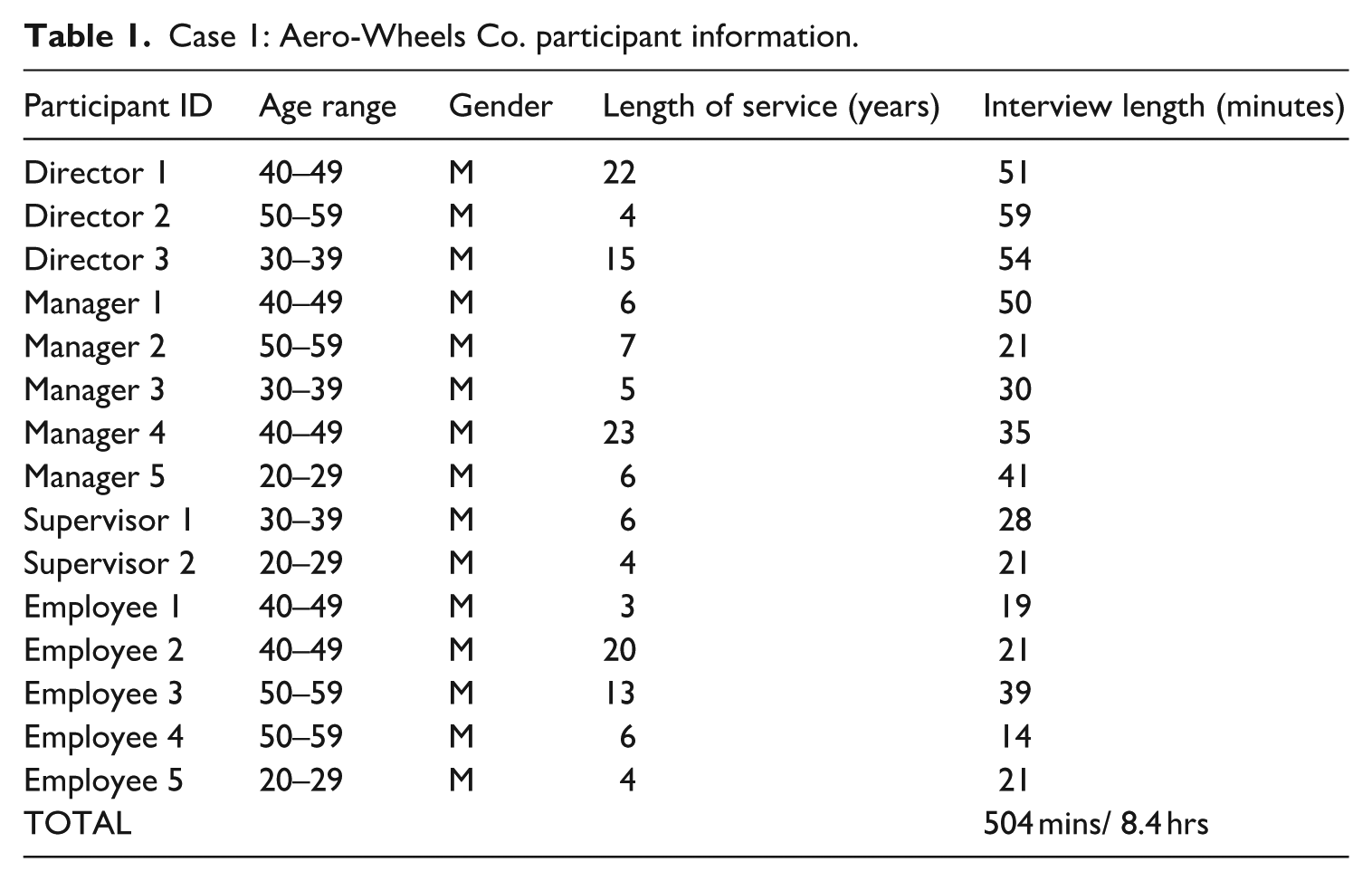
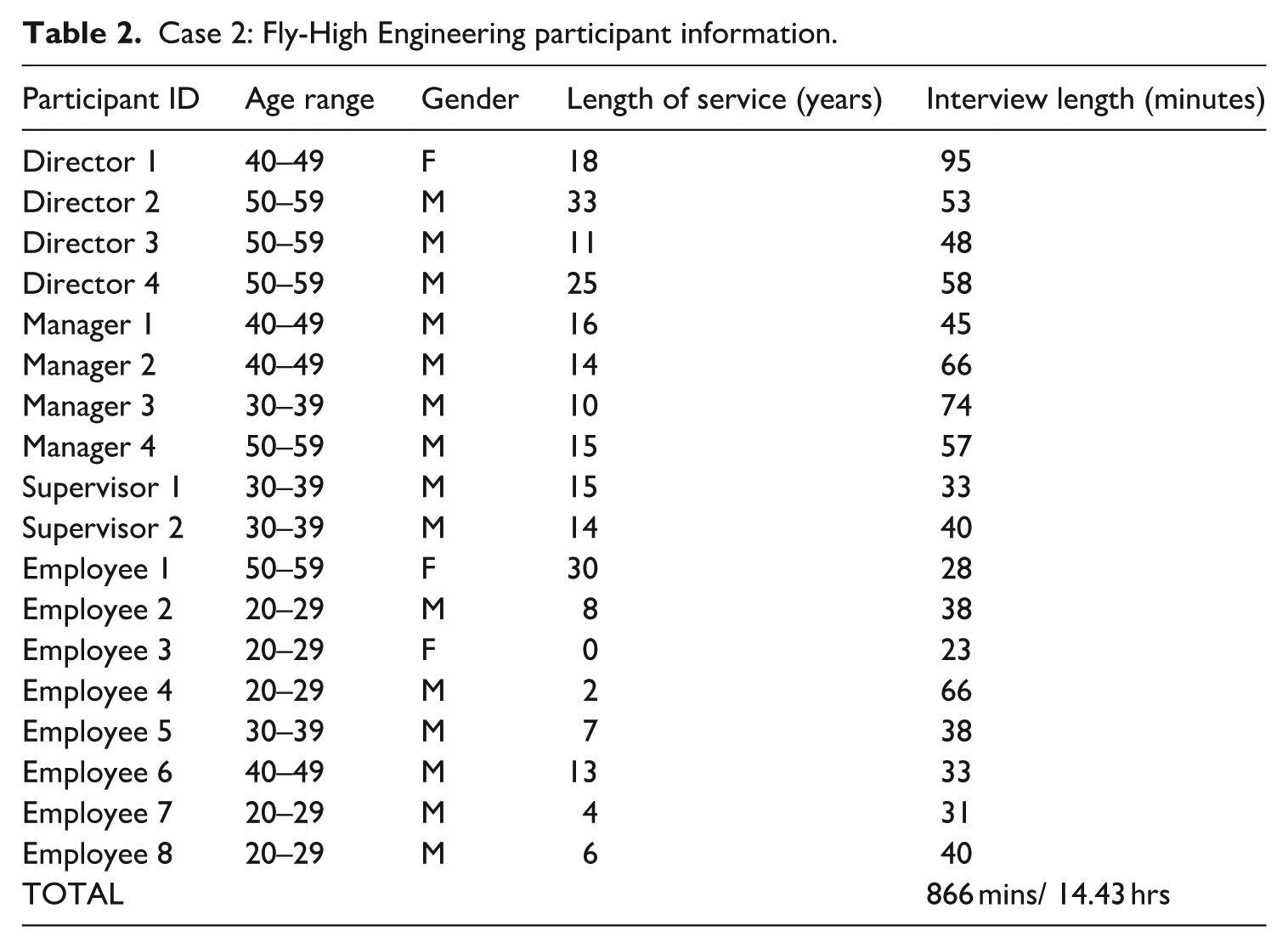
Detailed, semi-structured interviews were conducted in 2018 with a combined 33 employees and management across the two cases. Fifteen interviews were conducted at Aero-Wheels Co., in addition to a further 18 interviews at Fly-High Engineering. Interview candidates were chosen using purposive sampling, with participants selected on the basis of their perceived ability to inform the research questions. Prerequisites to selection included: their level within the company hierarchy; department of operational deployment; and employment tenure. These criteria allowed the research to gain a comprehensive understanding of how informal relations were developed within different areas, and at different levels, of the respective cases. The importance of eliciting worker experience provided the rationale for factoring in employment tenure. The selection criteria helped to ensure a representative sample of each workforce, although not in a statistical sense.
Tables 1 and 2 include a breakdown of the interview participants including key characteristics. When conducting research in Case 1, the average length of interviews was 34 minutes; in Case 2 the average interview time increased to 48 minutes.
Case 1: Aero-Wheels Co. participant information.
Case 2: Fly-High Engineering participant information.
The audio-recorded interviews were transcribed verbatim manually. Guided by Braun and Clarke’s (2006) six-phase approach to thematic analysis, data collected from the interviews were analysed through an inductive approach in which key debates, discussions and factors were identified through an open coding approach by the first author. A manual approach to coding was employed, thought to provide a significant advantage over software-driven forms of coding analysis given researchers’ ability to immerse themselves in the data and assess tacit knowledge that would otherwise be missed by computer-aided forms of analysis. This would allow the interviewees’ experiences to be brought to the fore. After coding application, the themes were reviewed by the authors – to ensure consistency in coding and theme identification – and through a process of delineation and differentiation themes were merged, separated, demoted to sub-theme status or disregarded altogether. This process was undertaken until thematic saturation occurred, when emerging concepts had been fully analysed and no new theoretical insights were being generated. The main topics varied as this article draws from one part of the dataset thematically. Themes relevant to this article included: employee involvement and participation, voice opportunities and communication channels, gossip, individual networks, industrial relations, regulation, memories and small and medium sized enterprises.
Both organisations have been subject to a significant and comparable degree of organisational growth and transition over the preceding five years. As a consequence, this presented a unique opportunity to present findings from an in-depth qualitative case study into two SMEs which are actively experiencing transitional forms of growth and change, with a particular interest in the respective EIP opportunities and voice expectations, thereby seeking to elucidate meaning and experience through ‘thick descriptions’ (Geertz, 1973).
The case study companies: The diversity and complexity of the SME context
Case 1: Aero-Wheels Co
Established in 1991, Aero-Wheels Co. is a maintenance, repair and overhaul facility for aircraft wheel and braking components based in the United Kingdom. The company was described quite aptly by the Managing Director in layperson’s terms as: ‘the Kwik-Fit of the aviation game’. It is based in a region of the UK with a fairly strong trade union history; it operates as a private limited company and is owned by two individuals: the Chairman (who is also a co-founder of the organisation) and the Managing Director, with a 95% and 5% shareholding respectively. Governance structures had at the time of the interviews recently been reformed with the formation of a board of directors. Recent and rapid growth – the result of the procurement of several new contracts with major airlines – has meant that the organisation now employed 55 personnel. Informal recruitment methods were adopted, an approach achievable because of the nature of the product system and consequent skill requirements, with work undertaken at Aero-Wheels Co. being classified as semi-skilled. The benefits of adopting an informal recruitment strategy of this kind include speed and flexibility (Carroll et al., 1999). Moreover, there was evidence to suggest management appear to prefer recruiting employees with no prior experience or with few academic achievements, individuals they can mould and develop. Issues of fit were identified within Aero-Wheels Co., with stories of new employees not fitting in and leaving at lunch time on their first day never to return.
Case 2: Fly-High Engineering
Fly-High Engineering’s growth can be attributed to the organisation’s decision to diversify their workshop outfit, adding to the capabilities or services offered. Fly-High Engineering has been operating since the 1970s and is also a private limited company. Fly-High Engineering is located in the same region of the UK as Aero-Wheels Co. With respect to the governance structure adopted there is a strong familial presence, with the owner/founder being joined on the board of directors, by two of his children: one holding the title of Managing Director and the other holding the title Director of Recruitment. At the time the interviews were conducted, Fly-High Engineering employed 60 members of staff, having recently opened a new aircraft hangar and line station in another region of the UK. The 60 employees are spilt between their principal site and the recently opened site at a ratio of 70:30 in favour of the former; the opening of a second site was aided significantly by local government subsidies. Employee profiles and characteristics in the case study firm sees the engineering-based roles comprise older contractors and individuals with vast experience and qualifications including licences to operate in the sector. Moreover, an apprenticeship at British Aerospace seems like the main route for those seeking entry into aerospace in that region of the UK. These experienced engineers have over recent years been joined by a number of young apprentices, with the organisation having made the conscious decision to train and develop apprentices, bestowing upon them the knowledge of the experienced and skilled engineers prior to their eventual retirement and in the process attempting to circumvent an ever more competitive and challenging job market.
Findings
The results of this qualitative case study exercise indicate voice and EIP to be a more complex phenomenon than has been reported in the existing literature. The findings illustrate how voice is contested and structured in various ways, and how any notion of informality to proceedings needs to be scrutinised carefully as it is itself quite complex and diverse in reality.
Case 1: Aero-Wheels Co. – Formalising EIP mechanisms through an informal approach or an ‘empty shell’?
Aero-Wheels Co. is a non-unionised organisation. In the absence of such forms of indirect representation, informal mechanisms of EIP have taken precedence, favouring more direct, face-to-face communications, achievable within the confines of the smaller organisation, given that close physical proximity encourages closer interactions between management and employees, which is conducive in the creation of discussions between parties across an informal medium: You’ll probably hear about it in word-of-mouth first, because of how small the company is.
This position is historically tenable given the close-knit ‘family’, with an employee voice culture reflecting internal integration needs, which can be met informally in small organisations via face-to-face communications. However, in line with the rapid expansion and the resulting increase in employee numbers, senior management appear to have logically sought to counter any possible deterioration in communication and participation, more generally speaking, through the adoption of formal departmental and management meetings, the distribution of bulletins alongside a suggestion box to aid upward participation. However, shortly after the inception of regular scheduled meetings, line managers reported how they gradually diminished in frequency as they directed their time and attention towards activities directly linked with the completion of the end product and meeting service-level agreements with the customer: Sometimes we’re very active. . . [the] first six months we are very proactive, we have managers’ meetings every month, we were talking to each other and everybody knew what’s going on, and then all of a sudden it fell down, and we haven’t had any meetings since the end of summer, maybe one in [the] last four, five months.
A further and more instrumental reason for why such meetings became less frequent is thought to be aligned to a desired continuity of expectations on the part of the line managers, who were accustomed to a more informal approach, particularly the informal dialogue and ‘chats’ with senior management. Line managers interviewed had reservations about the more quasi-formal employee voice methods adopted by Aero-Wheels Co., illustrated by the following comment made about notices issued by senior management and distributed to the workforce: I generally don’t think they work. Every now and then, something changes, the managers will print it out and get everyone’s name on the back and get everyone to sign it. Everyone signs that and not one single person out there reads what is written on the front, because it’s a full A4 piece of paper and it’s full of words that are far too long. We’re not taking on university graduates; we’re taking on people that were out of work just looking for temporary labour jobs. Management’s happy, they have a sheet full of signed names saying they understand. I don’t believe for one minute they understood.
This serves as an example to illustrate the organisation’s preference towards maintaining outward appearances, specifically in the eyes of the Civil Aviation Authority (CAA) – the aerospace sector’s regulatory body – or their customers, of professionalism and formalisation for quality assurance purposes. At the same time, the informality present within a power culture is bounded by the sector-specific regulatory context. Some aspects of activities require more formal procedures and practices to meet regulatory requirements, such as concerning standards or health and safety. Close similarities can also be drawn to notions of an ‘empty shell’ (Hoque and Noon, 2004), that which illustrates the lack of substantive worth or value underlying the practice or policy although symbolically there is an attempt to mimic certain voice mechanisms.
A further attempt was made to involve employees through the use of a more formalised voice mechanism. Aero-Wheels Co. introduced a ‘Company Reporting Scheme’ (CoRS) whereby employees were given the opportunity to put forward any problems, comments or suggestions in a formal manner. This suggestion box was aligned with CAA regulations and expectations, albeit, and quite importantly, the system was not mandatory. Accordingly, employees found the CoRS system, which is supposed to guarantee a response from management within 48 hours, unsatisfactory, with one employee claiming he waited ‘a month’ for a response and other respondents having never received a response. Drawing similarities with the use of bulletins within the organisation, this suggestion box system appears to be another ‘empty shell’ and is in place for purely presentational purposes – to be perceived, in the eyes of the CAA and their customers (probably the most coercive or demanding of actors), as a professional organisation with robust feedback processes.
Continuing with examples of informal attributes of EIP at Aero-Wheels Co., praise and feedback are given through informal channels, including Facebook. However, there were suggestions that praise is lacking from senior management: I don’t think it carries a lot of weight from me, it’s just a mate saying cheers, in their eyes.
The line manager referring to himself as ‘just a mate’ perhaps provides an insight into the informality of the relationship between line managers (who were promoted primarily upon a time-served basis) and their staff. One senior manager with vast experience across several organisations suggested that attempts to develop formal feedback mechanisms did not diminish the role of rumour or gossip: You will find that people will say ‘don’t say anything’, but. . . and all of a sudden it gets out. You could say well, doesn’t that happen in most organisations? I suggest it does. But I think it happens more so here. And things tend to get a little bit twisted and people can get a little bit frustrated and irate or emotional over things that really. . . putting it very crudely, are not a big deal.
Ironically, one line manager even spoke of holding meetings – a formal dialogue – specifically to quash rumours circulating amongst the workforce.
This informal dimension could be viewed as being a consequence of size, facilitative of a culture or tradition that ensures that informal channels of communication exist and that gossip can flourish. However, it can also be seen to be a reaction to the growing levels of formalisation around feedback mechanisms and growing emphasis on procedure. Thus, despite the introduction of various changes that have sought to introduce a more formalised (albeit non-union) dynamic to EIP, a strong informal culture remains, apparently being developed in a specific way through management actors.
In some senses this case represents an ideal typical case of how direct forms of representation or communication have been developed by management in an attempt to avoid a systematic approach to formalising voice by using diverse and informal mechanisms of communication. Yet, the role of external regulatory expectations and standards was important in terms of industry sector regulatory bodies and agencies (including industrial relations related state bodies related to conciliation and employer support), but these generated an interesting dualism between formal attempts to communicate and facilitate participation and informal ones. Whilst a non-union case, it did consist of a curious tension around upward participation and communication, especially in the light of informal and social forms of communication such as gossip and rumour within the workforce, although this aspect was more subliminal and fragmented. To some extent the second case we turn to now is similar; however in this second case the interaction between supposed external, albeit weak, operational regulatory processes and internal workplace cultures was influenced by questions of organisational memory and greater awareness of external collective cultures of an industrial relations nature within the workforce that brought forth a more concerted set of interventions by management to control the general realm of worker participation.
Case 2: Fly-High Engineering and the curious nature of collectivism
Similar to Aero-Wheels Co., the second case organisation was also non-unionised. However, this position was nuanced by attributes identified that appear to echo a traditional, collectivist industrial relations structure, thought to be attributable to the nature of the workforce and various historical factors. Options varied, as the following suggests.
On the one hand, there seemed to be a top-down culture: in Fly-High Engineering, the company’s Finance Director – and non-family member – suggested the role of the family inhibited the flow of employee communication, involvement and participation to the workforce: Board meetings are very few and far between, the ones I get involved with anyway. They tend to be, you know, it’s the family thing, they have meetings whenever they want a bloody meeting, it’s up to them when they get together. Is that a board meeting, well, who’s to say?. . . They will come to me if it’s finance things generally speaking, not always, which bugs the life out of you, but it’s just something you’ve got to put up with. . . but again there’s no formality about it, occasionally we’ll have proper what you might call board meetings. . . but it tends to be a family thing which goes back to the double standards issue again.
Moreover, the owner/founder and Managing Director, father and son respectively, appear to inhibit a participatory environment, exhibiting a reluctance to delegate. The actions of the two directors are indicative of attempts to maintain control and the degree of power they were used to holding when the organisation was much smaller, and potentially retain control within the family (Ram and Holliday, 1993). This is also in alignment with the characteristics of a ‘power culture’ (Handy, 1976), whereby the power of the owner in the SME provides direct control on the discourse and culture of the organisation through control of communication and information.
On the other hand, this approach contrasted with that of another Director – and also a family member – who saw part of their role as a ‘HR champion’ (Ulrich, 1996) driving a more formalised HR agenda. While the owner/founder and Managing Director are not advocates of the HR function, the ‘HR champion’ is the daughter of the owner/founder. With the ‘HR champion’ holding familial membership, it creates an interesting dynamic: ultimately, her efforts to attain a more formalised HR function are aided by her familial status, allowing her to place pressure on her father, who does not see the need for a formal HR role within the firm. The ‘HR champion’ thus exerted a degree of pressure that likely exceeds what another employee (or director) could conceivably place upon the owner/founder of a firm. Yet beyond these ties and social relations, of interest in relation to the ‘HR champion’ was their ability to connect to anticipated external regulatory expectations and changes in terms of legislation and advisory state bodies, interpreting them and representing them as developments that required attention and more formalised responses. So, the role of key individuals and their informal work was important in questions of communication and engagement. What is more, the ‘HR champion’ drew on the organisational memory and external capacities of the state advisory bodies and other external bodies to secure a different and (rhetorically at least) a more inclusive approach.
Furthermore, within Fly-High Engineering, individual networks were identified as being a fundamental factor for change, with evidence of apparent game playing by the ‘HR champion’ and her ‘generals’, in close alignment with the work conducted by Scase (2005) relating to ‘networks of personal allegiance’, which to some extent represented an organisational subculture. ‘Generals’ include an employee who is an ex-trade union convenor, with vast experience in participation mechanisms. Other members include a new HR assistant and a receptionist/HR assistant, who were both recruited by the ‘HR champion’ under the guise of office admin workers in a bid to justify their hiring to the other directors, namely her brother (Managing Director) and father (owner/founder), who appear to resist formalisation in respect of any form of HR presence within the firm. That being said, the ‘HR champion’ appeared to know full well they would be undertaking HR related activities; she informed the employees of as much upon their hiring, but to get the ‘green light’ from the other directors she needed to modify their job roles to appease other members of the senior management team. This example serves to provide a curious insight into how questions of (anticipated or potential) regulation on voice develop (de Kok et al., 2006; Matlay, 2002; Ram and Holliday, 1993) by drawing attention to the idiosyncratic features and changes amongst sets of managers and their interrelationships (and their reliance on expert advice of regulatory environments amongst some of them which provided informed insights and a broader organisational memory of industrial relations).
In comparison to Aero-Wheels Co., there appeared to be a greater development and complexity of participation and voice mechanisms, even if they remained generally informal, within this second case, driven by the workforce and thought to be a consequence of more internal actors, while also potentially attributable to the overall increase in skill level, as theorised by Goss (1991), and the subsequent demands of the workforce to be kept abreast of developments, given a voice and see their knowledge or expertise fully utilised. More recently, ‘morning prayers’ were introduced: whereby all departments had brief daily meetings to discuss pressing issues and workload, provide updates and communicate up and down the organisational hierarchy: The guys on the shop floor felt it was management and shop floor personnel, it was them and us, they felt like they weren’t being kept in the loop.
Perhaps a development of this nature has coincided with, and was motivated by, the recent expansion into another region and the coordination and integration issues such changes can represent; integration issues change through expansion requiring more formal integrative mechanisms and voice. Moreover, one line manager appears to have astutely recognised the need to adapt how communication occurs in line with organisational growth: A smaller business, you’re just all-round the same coffee table, discussing what you’re doing. The next thing you know, it can’t be like that anymore because we’ve got to disseminate the information in a different way and extract the information back again in different ways. We’re doing more and more classrooms, more and more group sessions, and that kind of stuff. We have a group meeting every day now, so we’re feeding back to a bigger group and giving them a chance to speak.
Despite the apparent recent introduction of more regimented and formalised channels for communication within the firm, there were widespread and historic forms of dissatisfaction from members of the workforce, believing communication or even informal types of participation had not as yet improved: Sometimes I do feel that we don’t get told information in terms of projects. . . there’s a lack of communication. You’re finding things out second hand or when it’s too late.
Others were critical of who would be chosen to participate, suggesting it might not be associated with tenure, position or skill level, but simply if one is ‘flavour of the month’. One further interesting observation was made by a supervisor who believed the poor participation opportunities favoured bigger personalities, being a by-product of scale and a consequent lack of structure: I do think the downside to a small company is that whoever is deemed most relevant, it’s almost, big fish in a little pond syndrome. You’re always going to have big attitudes wherever you go, but I do think in bigger companies, you tend to get a bit less of that, because of how it’s a bigger place, and you need to be doing your role and it’s more structured as a result. So that lack of structure allows people to maybe take it upon themselves to decide who receives what.
Participation, and voice related issues more generally, ultimately appears more contested in respect of Fly-High Engineering; this is determined to be influenced by, in part, the dynamic of contractors who have been employed to work alongside those holding ‘employee’ status, with contractors in positions of authority appearing to stifle opportunities for employee participation. Furthermore, with reference to the nature of the workforce, Fly-High Engineering’s current position, and influences, in respect of participation and voice conditions, is something we can attempt to better understand. In addition to skill level and its associated influences on one’s ability to participate, a distinguishing feature of Fly-High Engineering’s participatory agenda, and a reason for dissatisfaction with current mechanisms, is linked to a greater awareness of collectivist processes and trade unionism within employees, which accordingly heightened expectations in relation to participation and voice opportunities, even if only informal ones. The greater presence of conflict within this case study and level of voice demanded by the workforce are greater than that present in Aero-Wheels Co., a feature that can interestingly be traced back to the memory of the trade union and the voice mechanisms held by engineers working in the firm who had experienced trade unions in the 1970s and 1980s at large unionised aerospace firms such as British Aerospace. This aligns with the argument developed by Dundon et al. (1999), who identify the impact of trade union-derived pressures upon participative voice mechanisms. Memories of unionism accordingly evoke powerful connotations: BAE Systems had in the ’80s lots of strikes. They were very, very proactive at striking. . . But, the days of Red Robbo [the nickname of a well-known workplace trade unionist] are gone. . . I think it’s possibly a little bit like religion, I suppose, people have just moved on. They don’t have the power that they used to have. And it’s almost a bit of a flea in the ear now rather than a threat of all-out action. . . I think it’s probably the capitalist involvement evolution that we’re all in now. It’s not the same world as it was in the 1960s and 1970s. And the employee now has got more say and has got more rights, backed up by the whole of society, including the law, the government, than what you would have had in the ’50s, ’60s and ’70s. I used to be a convenor at Dan-Air; I’ve seen both sides of the fence.
Such expectations – no matter how contradictory – appeared to influence proceedings in a manner that is not apparent in Aero-Wheels Co., born out of the workforce composition of those employed by Fly-High Engineering and their past experiences. Many of the workers held deep-seated memories regarding trade unionism and worker rights. The presence of such individuals in Fly-High Engineering seemed also to provide a link through the workforce to the external sector and regional traditions of unionism which were some of the more advanced in the UK.
The sector’s historical culture reflected in the older workers and their collective memory of a unionised industry, the perceived ‘power culture’ of the owners and the HR culture promoted by a ‘HR champion’ steering through sets of regulatory expectations made for a curious combination of factors that configured a very different set of discussions about voice. It generated a form of micro-political environment where the need to be seen to partially formalise voice without unionising was apparent. The play of participatory politics was more nuanced and wider than the first case in part due to these internal anticipations of external legacies and regulatory actors.
Discussion: Voice and the memory and role of regulatory and collective legacies
Ostensibly, both case study organisations were similar: in terms of scale and familial orientation, their geographical location and the sector of operation, and they had both recently encountered high levels of growth – and have a tendency to wish to sustain a control over the formalisation of HR and voice mechanisms through informal means. The idea and importance of informality in industrial relations is not new, granted, due to the way different voices are located at different levels in an informal manner even in unionised contexts (see Terry, 1977); yet, although there is no union presence in either of the cases here, there are vestiges of informal collective practices. The research supports the assertion of Harney and Dundon (2006) that states HRM and employment relations in SMEs are determined to be more complex and cannot be organised simply around a binary based on the idyllic or authoritarian – and further illustrates the complex interplay between internal dynamics, various actors and external structural and environmental factors (MacKenzie and Martínez Lucio, 2005).
When looking specifically, and in relation to the first research question, at the understanding and engagement with participation and voice mechanisms in the two cases, both organisations have historically encouraged more direct forms of voice albeit in an informal manner, particularly via word-of-mouth, partly due to physical proximities. However, company growth challenged such an approach, providing us with an interesting insight into how that has ‘played out’ across both cases: most noticeably, the heightened levels of expectations of employees of Fly-High Engineering, derived from underlying cultural norms and worker memories and customs aligned with an awareness of a collectivist approach to industrial relations.
Despite the introduction of various changes that have sought to introduce a more formalised dynamic to voice mechanisms in Aero-Wheels Co., a strong informal culture remains, with the formalised approaches accordingly being labelled an ‘empty shell’ in an attempt to illustrate their lack of substantive worth. Within Fly-High Engineering, familial dimensions – or a power culture – appear to inhibit the flow of communication and the degree of even informal participation permitted to the workforce, indicative of attempts to maintain control and a degree of power. But in each case the understanding and perception of management culture and motives vary, which links to the need to recall Whittington’s (1990) seminal work on these factors as they are possible more contested, as one of the cases shows in terms of internal familial relations and views of work relations. We saw more complex internal relations within the familial context itself, ironically, and these were an important factor in the preamble and discussions regarding employee voice and participation even in such SMEs. Management culture can be seen partly as adaptive to specific organisational integrational and environmental challenges, being one that is highly centralised and highly informal, reflecting the internal integration needs of the size and stage of development of the organisation; however ultimately it is confronted by the broader range of actors and practices not just in the external regulatory space (derived from the sector, regulatory bodies and the nature of voice historically or contemporarily in the sector and occupations more broadly shaping employee orientations and expectations regarding voice) but also in the internal social organisational arena.
The importance of intermediary actors that interpret regulatory processes – as in the ‘HR champion’ (and family member) in the second case – created an interesting dynamic, as did the presence of contractors with heightened voice expectations (which relates to our second research question). Ultimately, participation appears more subtle and indirect in this second case, suggesting that SMEs are much more varied in their internal discussions on voice and participation. In this case there appeared to have been signs of a more critical and conflict-oriented, competitive employment relations culture, even in the absence of a trade union. The presence of subliminal or implicit conflict within Fly-High Engineering and relating to the level of voice demanded by the workforce was greater than that of Aero-Wheels Co. and can interestingly be traced back partly to memories or experiences of trade unionism and collective voice mechanisms held by engineers during the 1970s and 1980s at large unionised and high-profile aerospace firms as well as the way worker rights have evolved across various fronts regardless of how unions have institutionally declined. This would add to the growing interest in organisational memory we outlined in our review within industrial relations and HRM but also draws attention to the fact that such factors are present within managers and workers even in some non-union contexts.
This issue of memory needs therefore to be addressed more often if we are to appreciate the ways in which relations are conditioned within workplaces (McBride and Martínez Lucio, 2011; Rowlinson et al., 2010). Consequently, memories of unionism, conflict and regulatory expectations played a discreet role especially in the second case even if a formal collective voice was not present in this context. In part this was due to the differences in skills and occupational identity and their experience of other workplaces (see MacKenzie et al., 2006), thereby explaining why such factors were not as apparent in Aero-Wheels Co. However, both sets of workers and their characteristics and cultures were quite strong, with high levels of social closure. This is despite neither case study having a trade union presence, indicating there to be some curious internal organisational political relations that are apparent even in these smaller companies. This power-related feature we feel is ascribed to the role of organisational and occupational memory and the way external developments and regulatory processes, not matter how weakened, were recalled and referenced: it is almost playing the role of an ideational or cultural power resource within the workplace (Refslund and Arnholtz, 2022) but within a much more informal and less institutionalised industrial relations setting. What we aim to therefore contribute to the discussion is that even within spaces where there is no formal trade union presence there may be factors that instil an interest in workplace rights and regulation. In some senses the interventions by Alberti and Però (2018) on how industrial relations need to deal with worker experience and action without always focusing institutionally on trade unions as a starting point are relevant due to the way workers recollect and reflect on their experiences, but we would argue that this broadening of the way voice and participation is referenced and understood may involve highly complex micro-political processes within even smaller non-union firms. It may, unfortunately, not always lead to the outcomes collectives of workers desire, but it does suggest that not having a formally collective system of representation does not mean there are no complex micro-level relations and tensions.
Hence, we may need to engage more clearly with these ideational dimensions to develop a fuller picture of the way regulations and rights are evoked within workplaces (Alberti and Però, 2018) as well as historical factors (Polletta and Jasper, 2001). The need to link debates on participation to the way previous experiences and memories are perceived by various actors in relation to the role of regulation has to be approached more systematically and regularly within the study of SMEs and participation more broadly, as does the question of informal and even familial relations which are more complex and contested.
Conclusion: Widening the way memory and informal relations frame voice and participation
Occupational identity and memory are therefore apparent and influential, shaped in such a way that the cases vary in terms of worker roles, as are informal and social relationships such as the family. The influence of external factors and internal traditions and links seems to be important when studying these developments as these external factors are acted on and used by different organisational actors within management, owners and workers in the way they evoke previous experiences and external regulatory factors.
Worker participation within an SME context, even when non-union, is a more complex phenomenon as much of the literature points out and it cannot be understood in purely formal institutionalised terms, and so we contribute to the debate by pointing to the role of the social and historical (memory) in relation to it and extending discussions on memory and informality into the politics of such types of firms. There are a set of actors and interrelations internally and externally that need to be considered, and this confirms the need to build on the work of Whittington on formal and informal organisational spaces (1988, 1990) and the work of those engaging with organisational memory (Hyman, 2007; Seeliger, 2016) and to fuse these two strands of debate. There is no singular pattern or understanding of voice within an SME context, as this article has illustrated, even when holding constant, to the best of our ability, factors such as scale, region and sector. Variety and difference, as presented in these two cases, may be due to management culture, intra-management politics and relations and the nature and memories of the workforce with regard to industrial relations (memories that, granted, may change or weaken over time); we need to look more closely at the way those informal processes and relations along with the recollection of regulatory traditions discreetly influence how workplace experiences play themselves out across time. There is importance in considering the technical/employment, cultural and ‘political’ background of workers and how they indirectly continue to shape the process of ‘voice’ even in a non-union context: occupational memory and culture need to be accounted for (MacKenzie et al., 2006). Such companies have their idiosyncrasies, and these can shape the politics of voice in each. In some senses these factors call us to question some of the categories we often use, and it fits with an ongoing deepening of research on worker participation.
Finally, the research contributes by enhancing our understanding of how legacies of collectivism and regulation can be indirectly relevant, and still play a role, even in a context of fragmentation and so-called individualisation of the employment relationship. Collectivism and regulation are terms that have hitherto been mainly used in the sociology of work and industrial relations, but this needs to be broadened and introduced much more in what could be seen as ‘non-collectivised’ workplaces. The research consequently calls for employment relations in SMEs to be studied in a more detailed and ethnographic manner in terms of the indirect and discreet influences, by drawing attention to how regulation, which remains relevant, is nonetheless filtered and used by the referencing of external actors (public and private, regulatory agencies and consultants) by different actors within management and the way the workforce recalls their experiences and memories of work and regulation. Hence, regulation must be increasingly understood as well in the relations and micro-politics of actors and their interrelationships and the way ‘regulation’ and ‘representation’ are invoked at certain moments and contested, especially in SMEs, remains marginalised in the core sociological discussions on worker representation and regulation. Finally, by way of practical implications, the research underscores how organisational memory is shared and calls on different actors, both internally and externally, to understand the role it plays and the need to build on it when attempting to optimise employment relations and generate a more forward-looking dialogue.
Footnotes

Funding
The work was supported by an Economic and Social Research Council (ESRC) PhD studentship.
Declaration of conflicting interests
The authors declared no potential conflicts of interest with respect to the research, authorship, and/or publication of this article.
Data availability statement
The data that support the findings of this study will be available from the corresponding author upon reasonable request, in a highly anonymised and limited format, following the publication of subsequent articles.