






Abstract
This article examines the attitudinal foundations of union membership among non-unionised employees in Czechia, set against the continuing decline of unionisation across OECD and Central and Eastern European countries. Using representative data from the UNIONS2023 survey (N = 1220), cluster and correspondence analyses identify distinct attitudinal profiles and their socio-political correlates. Results show that 24% of employees view unions positively, 38% reject them, and the remainder are ambivalent or indifferent. Positive orientations are linked to left-wing identification, family or workplace exposure to unions and higher education. Only 11% express willingness to join, driven not only by ideological affinity but also by job dissatisfaction, indicating that instrumental motives are crucial in translating pro-union attitudes into membership intent.
Introduction
Across the OECD, trade unions continue to experience a persistent erosion of membership and collective bargaining coverage – a trend that poses a fundamental challenge to labour’s collective power and to the institutions of industrial democracy more broadly. This decline is particularly pronounced in Central and Eastern Europe (CEE), where the transition from state socialism to market economies has profoundly reshaped patterns of worker representation and eroded long-established mechanisms of collective voice. OECD data indicate that union density has fallen from 36.5% in 1980 to 15.8% in 2019, while collective bargaining coverage has declined from nearly half to less than one-third of employees (cf. OECD, 2019). These trends reflect not only structural transformations in labour markets but also the gradual weakening of unions’ institutional embeddedness within systems of employment regulation.
Institutional perspectives have long emphasised that collective bargaining coverage is contingent upon the level at which bargaining occurs and the existence of mechanisms for extending agreements to non-members. Higher (typically sectoral) levels of bargaining and mechanisms for extending agreement validity contribute to broader coverage, particularly among employees in small enterprises where bargaining is rare (cf. Eurofound, 2020). This is the case, for example, in Austria, the Netherlands, France, Spain and Portugal, where the coverage of collective agreements remains high regardless of the size and development of the membership base. By contrast, systems characterised by decentralised, company-level bargaining, as in most post-communist countries, are more vulnerable to membership decline, since bargaining coverage is largely confined to organised workplaces. 1 The result is a self-reinforcing cycle: as membership declines, bargaining coverage contracts, further undermining the incentives for employees to join unions.
Figure 1 illustrates the situation of collective bargaining across EU member states, comparing OECD data on unionisation and bargaining coverage and using Eurofound’s typology based on the dominant level of bargaining (Eurofound, 2020).
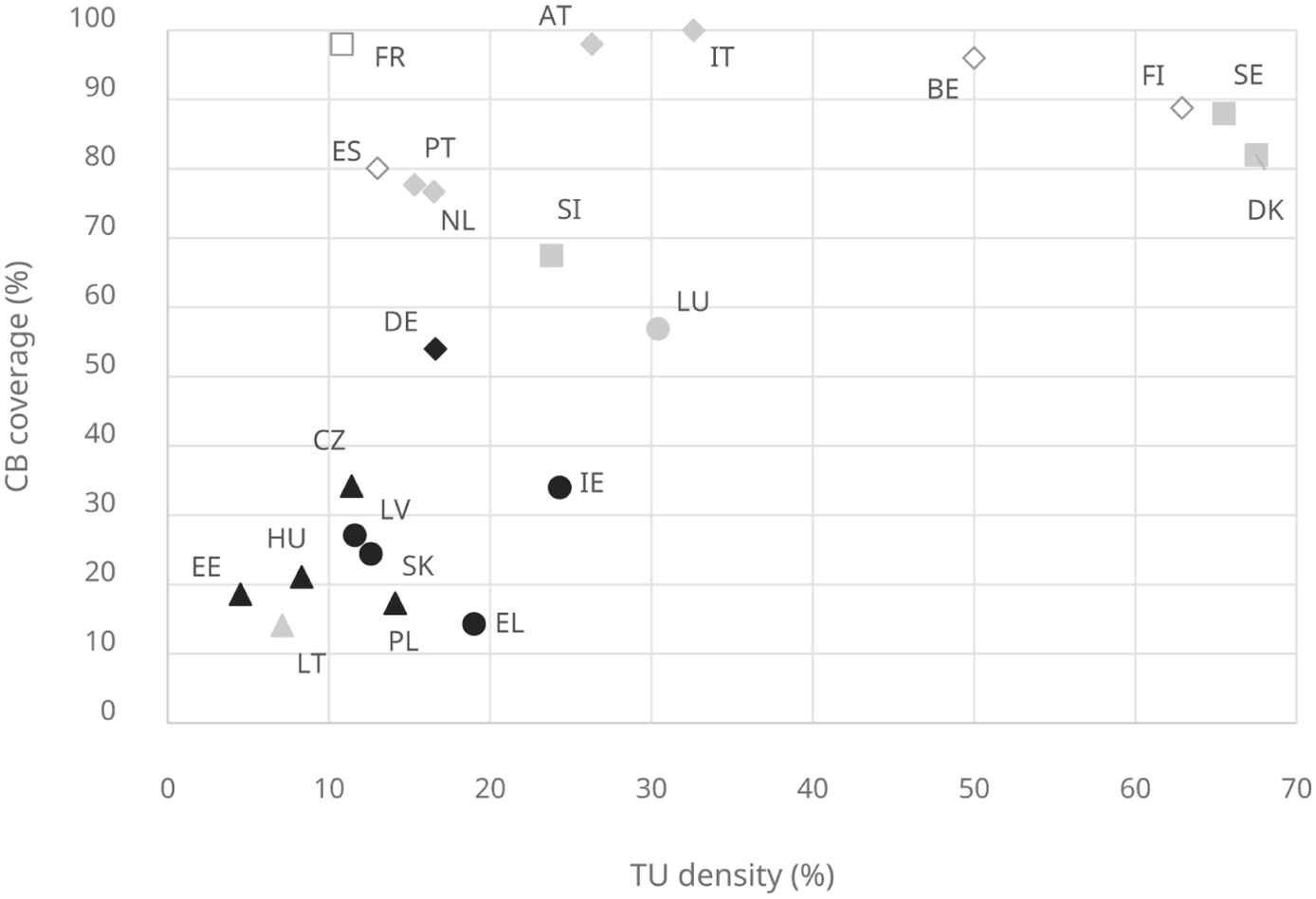
Relationship between collective bargaining coverage and union density according to the prevailing level of collective bargaining in EU-27 countries.
Figure 1 demonstrates that the prevailing level of collective bargaining is indeed closely related to the coverage of collective agreements. Moreover, it is clear that the coverage is decreasing in those countries where it was already at a low level. A cluster of Eastern European countries, together with Greece, is evident, where the state of collective bargaining is critical. Already low coverage and unionisation levels continue to decrease, thus confirming that in those countries where company-level collective bargaining prevails, coverage decreases as unionisation declines. Countries with strong legal mechanisms – such as the extension of sectoral agreements, mandatory bargaining provisions or state-supported social dialogue (e.g. France) – tend to achieve high levels of collective agreement coverage regardless of union density. In contrast, systems with weaker legislative support or more voluntary approaches (e.g. Germany or Ireland) show lower and often declining coverage, more closely tied to union membership levels. Thus, legislation can either reinforce collective bargaining by expanding its reach beyond union members or, alternatively, reduce incentives for unionisation when worker protections are increasingly secured through statutory regulation rather than collective agreements.The decline in union membership has been attributed to a range of factors, which vary across countries, making it difficult to identify universal causes (cf. OECD, 2019; Schnabel, 2002, 2012). A broad array of structural explanations has been proposed to account for this long-term trend. Globalisation, economic restructuring, and the rise of service and knowledge-based employment have diminished the size and cohesion of traditionally unionised sectors (Schnabel, 2012; Western, 1997). At the same time, new forms of work organisation – outsourcing, subcontracting and digital platform work – have fragmented employment relations and encouraged increasingly individualised approaches to workplace negotiation (Harris and Moffat, 2023). Related institutional developments and legislative changes, and economic cycles also contribute to the development outlined (cf. Eurofound, 2015; Gouzoulis et al., 2024; Kroupa et al., 2024; OECD, 2019; Schnabel, 2002). Employers’ adoption of anti-union strategies and the political weakening of mechanisms for collective representation have further constrained union recruitment and bargaining power (Freeman, 2005). Unions themselves have been criticised for insufficient strategic adaptation, limited resources, and a failure to recruit new – especially younger – members (OECD, 2019; Visser, 2024).
More recently, attention has shifted towards the micro-level foundations of union membership and the attitudinal orientations that shape workers’ willingness to join. This focus reflects an emerging consensus that structural and institutional factors alone cannot fully explain cross-national variation in union decline. Workers’ perceptions of union relevance, trustworthiness and effectiveness are increasingly recognised as key determinants of membership dynamics (Bryson and Davies, 2019; Hodder and Edwards, 2015). However, empirical research on these micro-foundations remains limited, particularly in CEE countries.
The Czech Republic presents an instructive case within this regional context. While the institutional framework for social dialogue has remained stable since the early 1990s, union membership has continued to fall, and collective bargaining remains predominantly decentralised. Sectoral-level agreements exist but play only a formal role, rarely extending beyond the provisions of national labour law. Trade unions thus operate primarily at the enterprise level, where their representational capacity is constrained by the small number of active workplace organisations and limited opportunities for recruitment, which lead, among other things, to an ageing membership base. These challenges are compounded by broader labour market developments, including the growth of self-employment, the proliferation of short-term contracts and outsourcing, and sustained pressure on real wages despite low unemployment. In this context, both employers and unions acknowledge the urgent need to strengthen sectoral bargaining and expand collective agreement coverage (Kroupa et al., 2024).
In post-communist countries, as in Czechia, the size of the membership base has been significantly influenced by the dynamic developments of societies in transition (Eurofound, 2015). Trade unions in these countries have had to deal with the stigma of their previous close association with totalitarian regimes and are often perceived as an instrument of state power rather than an independent guarantor of employment rights. Given the lack of research on this topic, it is not clear to what extent the low level of unionisation in the eastern regions of the EU still reflects historical distrust and to what extent the attitudes of employees to unions mirror broader European trends towards individualisation and instrumentalism.
The topic of union organisation has become a key issue in EU countries in light of the EU Directive on Adequate Minimum Wages (2022/2041), which obliges Member States with collective bargaining coverage below 80% to promote its expansion. For Member States where bargaining is primarily at company level it will be crucial how they manage to influence the positive development of union organisation.
Therefore, the following analysis aims to form an understanding of how non-unionised employees in Central and Eastern Europe area view trade unions in the broader context of their socio-demographic characteristics, ideological orientations and the nature of the work they perform, and how their attitudes towards unions are reflected in their readiness to join a union. The analysis addresses four interrelated research questions:
RQ1: How are attitudes towards unions structured among non-unionised employees?
RQ2: Which individual and workplace factors explain these orientations?
RQ3: How do these attitudes translate into considerations of union membership?
RQ4: What other factors, beyond attitudes themselves, influence the willingness to join a union?
The study adopts an exploratory approach, seeking not to test specific hypotheses but to map the terrain of union-related attitudes that precede membership decisions. To address the RQs above, the study combines cluster analysis to identify attitudinal profiles with multiple correspondence analysis to examine the socio-demographic and workplace correlates. In addition, the relationship between attitudes and willingness to join a union is analysed to capture the transition from orientation to behavioural intent. By focusing on non-members, it offers a clearer view of the potential for union revitalisation and the social boundaries of recruitment. More broadly, it contributes to debates on the renewal of organised labour in post-communist Europe, illustrating how ideological identification, occupational experience and individual characteristics intersect to shape the micro-foundations of collective organisation.
Individual-level determinants of attitudes towards trade unions and willingness to unionise – literature review
Theoretical framework: From rational choice to social embeddedness
While macro-level explanations (globalisation, technological progress, industrial restructuring, shifts in management organisation, institutional erosion) have dominated debates on declining unionisation, understanding employees’ orientations towards unions requires attention to the micro-foundations of collective behaviour. At this level, union membership decisions emerge not simply as responses to external structures, but as outcomes of social embeddedness, value orientations and perceived utility. Classical economic approaches, grounded in rational choice theory (Becker, 1976), depict individuals as strategic actors weighing the costs of membership against expected benefits – protection, bargaining leverage or workplace security (Gouzoulis et al., 2024; Schnabel, 2002). Yet, this model alone insufficiently captures the normative and relational dimensions of collective affiliation.
Complementary sociological and socio-psychological perspectives highlight the significance of shared meanings, moral obligations, cultural and social capital (Bourdieu, 1986), and identification processes. Social identity theory (Tajfel and Turner, 1979) and self-categorisation theory (Turner et al., 1987) conceptualise unionisation as a process of group alignment: employees internalise union goals when they perceive value congruence with the collective (Blackwood, 2010; Kelly and Kelly, 1994). These frameworks intersect with relative deprivation (Runciman, 1966) and social dominance theories (Jost, 2011), suggesting that unions function both as vehicles for social justice and as arenas through which hierarchies are contested.
In parallel, social custom theory emphasises the normative dimension of workplace environments. Employees adapt to localised expectations shaped by existing union density, peer influence and informal sanctions against free-riding (Ibsen et al., 2017; Toubøl and Jensen, 2014). Membership thus becomes a socially regulated behaviour embedded in organisational culture rather than a purely instrumental act. Together, these frameworks support a multidimensional reading of union orientation – where economic rationality, normative compliance and identity-based motives converge.
Likewise, findings from empirical research focusing on the influence of individual worker characteristics and workplace (or employer) attributes should be interpreted within the complex, multidimensional environment in which decisions about union membership are made. We assume that worker characteristics and workplace attributes influencing attitudes towards unions and willingness to join them partly align with the conceptual frameworks of organisational theories. The primary aim of the article, however, is not to test specific theoretical models (e.g. social custom theory and social identity theory). Rather, by examining individual characteristics, it indirectly touches on the question of how relevant these theories remain in explaining contemporary motivations for union membership.
Empirical evidence: Individual and workplace correlates
Socio-demographic factors
Age consistently emerges as a key determinant of union orientation, though its effects vary contextually. Studies frequently identify an inverted U-shaped relationship, with middle-aged employees the most unionised (Kirmanoğlu and Başlevent, 2012; Turner and D’Art, 2012). However, the universality of this pattern has been challenged, as Schnabel and Wagner (2008, 2012) demonstrate that the ‘U-shape’ is neither methodologically nor empirically robust, and that empirical evidence varies significantly across contexts. In the Czech case unionisation increases steadily with age (Kroupa et al., 2024), suggesting a cohort effect shaped by generational experience of industrial relations. Older workers often view unions as essential for protecting rights, while younger workers, socialised in individualised labour markets, tend to view unions as less relevant to flexible and project-based careers (Alivin and Sverke, 2000; Høgedahl and Møberg, 2022). In addition to changes in values, young people are more likely to hold non-standard jobs outside union reach (Blossfield et al., 2008). Yet empirical research rarely detects explicit hostility (Vandaele, 2018; Waddington and Kerr, 2002). Rather, low union engagement among youth often reflects informational deficits (Freeman and Diamond, 2003; Hodder and Kretsos, 2015) or reluctance to pay fees in early career stages (Blackburn, 2013).
Until recently, women were less represented in unions than men (Machin, 2004). This was due mainly to the concentration of women in sectors with traditionally lower levels of representation (e.g. services and retail) (Lorenz and Wagner, 1991; Schur and Kruse, 1992). However, these gender patterns have narrowed in recent decades (Batut et al., 2021; OECD, 2019) and in some countries e.g. the UK, the union membership of women is higher than that of men (Batut et al., 2021). Nonetheless, gender rarely operates independently: its influence interacts with employment form, sectoral composition and part-time work prevalence (Ebbinghaus et al., 2011; Kirmanoğlu and Başlevent, 2012). For instance, the rise in UK women’s unionisation is partly due to public sector trends (Harris and Moffat, 2023).
Education presents a more ambivalent relationship. Traditional models posit that higher education reduces dependence on collective protection (Goerke and Pannenberg, 1998; Johnson, 2005; Lorenz and Wagner, 1991; Morissette et al., 2005). However, recent findings suggest curvilinear or even positive effects (Brady, 2007; Ebbinghaus et al., 2011; Kirmanoğlu and Başlevent, 2012), with some evidence of increasing union affinity among highly educated public sector professionals. In addition, some authors find no link (Toubøl and Jensen, 2014). Education’s effect also varies by sector: highly educated employees are less unionised in the private sector (Blanchflower, 2007). These inconsistent findings underscore the need to contextualise education within sectoral and occupational structures rather than treat it as a linear predictor.
Finally, social capital, family tradition, value orientation and political identification substantially shape union orientation. The presence of union members among ‘significant others’ reinforces social norms favourable to membership (Bryson and Davies, 2019; Furåker and Bengtsson, 2013; Kroupa et al., 2024). Ideologically, left-wing orientations remain the most consistent predictor of union support (Deery and De Cieri, 1991; Fitzenberger et al., 1999; Lorenz and Wagner, 1991; Riley, 1997; Schnabel, 2003; Schnabel and Wagner, 2007; Toubøl and Jensen, 2014). Although the political alignment between unions and the left has weakened with growing labour market individualisation (Bauman, 2000; Trentini, 2022), its symbolic power persists across contexts.
Organisational context: sector, firm size and workplace norms
Organisational settings shape both exposure to and perception of union activity. Public sector employment continues to exhibit higher union density across most advanced economies (Schnabel, 2012), reflecting institutionalised bargaining and historical legacies of corporatism. Similarly, large enterprises facilitate recruitment through economies of scale, visible representation and peer influence (Bryson and Gomez, 2003; Fitzenberger et al., 1999; Kersley et al., 2006). Toubøl and Jensen (2014) demonstrate that workplace-level union density operates as a self-reinforcing mechanism: high-density contexts promote normative pressure and habitual membership, while low-density environments perpetuate disengagement. In this sense, the presence or absence of union structures constitutes an independent contextual resource influencing employees’ perceived efficacy of collective representation.
Job satisfaction, workplace climate and professional status
The relationship between job satisfaction and union membership remains contested. The fundamental question is whether unions have a greater chance of attracting new members if the employer treats employees badly, or whether synergistic effects apply, where the employer understands that the presence of unions in the workplace could reap several advantages for the company. Earlier studies associated union membership with lower satisfaction (Gordon and Denisi, 1995; Guest and Conway, 2004; Renaud, 2002). However, the explanation for this relationship is not uniform. One argument is that union members are able to freely express their dissatisfaction, while another suggests that the probability of the unionisation of employees with poor working conditions is generally higher than for those with good working conditions. The latter phenomenon may reflect reverse causality (Bryson et al., 2010; Hammer and Avgar, 2005). More recent evidence, however, identifies positive partial correlations (Blanchflower et al., 2022; Donegani and McKay, 2012), suggesting that constructive union presence may enhance voice and perceived fairness, thereby increasing satisfaction.
Van der Meer and Wielers (2013) analytically expanded the issue of job satisfaction to include the concept of empowerment, with the assumption that autonomous employees are happier in their work (Guest and Conway, 2004; Wheatley, 2017; Zychová et al., 2024). Their results linked empowerment and autonomy at work to job satisfaction and union commitment, suggesting that unions can serve as arenas for collective agency. Thus, union members are more satisfied than non-members since they enjoy a higher level of empowerment.
Autonomy correlates closely with occupation (Ebbinghaus, 2006; Iner, 2023). However, the effect of profession on unionisation also depends on contextual factors, such as on-site presence, which is typical for blue-collar roles and facilitates union recruitment. Blue-collar workers often exhibit more cohesive political and social identities supportive of collective action (Deery and De Cieri, 1991; Ebbinghaus, 2006; Fitzenberger et al., 1999; Goerke and Pannenberg, 1998;). On the other hand, white-collar professionals, particularly in public sector roles (e.g. education, libraries, emergency services) show renewed interest in unionisation under conditions of austerity and workload intensification (Iner, 2023).
Towards an integrative understanding
Taken together, existing evidence indicates that attitudes towards trade unions are shaped by intersecting individual, occupational and organisational dimensions. Economic incentives and rational calculations remain relevant but are filtered through normative climates, social identities and perceptions of fairness. The relative weight of these dimensions varies across institutional contexts, yet their interplay is crucial for understanding the limited success of union recruitment strategies, especially among younger and more individualised segments of the workforce. In Central and Eastern Europe, where union legacies are ambivalent, these dynamics are likely to be even more pronounced. However, especially in this region, the issue remains more underexplored than in Western Europe and North America, largely due to a lack of suitable data.
Finally, existing literature lacks studies with a focus on the potential for recruiting new members – an aspect that is crucial to understanding the possible future dynamics of the union membership base. The most common approach to the study of the sociological context of union membership in the current literature is to compare a group of union members with a group of non-members in terms of their characteristics and to determine the factors that distinguish one group from another (cf. Ebbinghaus et al., 2011; Schnabel, 2002; Toubøl and Jensen, 2014; Trentini, 2022). While these studies bring valuable knowledge, they provide only a static snapshot of the current membership base and fail to capture the heterogeneity of non-members. As a result, they offer little insight into the potential to halt or reverse membership decline. Thus, this article aims to fill the outlined research gaps.
Methodology and data
The analysis draws on individual-level data from UNIONS2023, 2 a nationwide survey representative of the Czech working population (employees and self-employed persons without employees). The reason for choosing a quantitative approach was the effort to detect the distribution of attitudes towards unions in the population of employees who are not union members, and to estimate the proportion of non-members for whom a certain recruitment potential can be identified. The survey focuses on attitudes towards, and experiences with, trade unions. The survey, conducted in October 2023 using CAPI/CAWI (80.2% CAPI), employed quota sampling and included 2348 respondents aged 18–65 of whom 1417 were employees (the rest were self-employed without employees). The sample for each subpopulation (employees and self-employed persons) was constructed using a quota sampling technique based on following characteristics: region, gender, age, education and sectors of the national economy. Data from the Czech Statistical Office were used to determine the structure of the quota criteria. 3 The analysis focuses on 1220 non-union employees, excluding the self-employed and current union members.
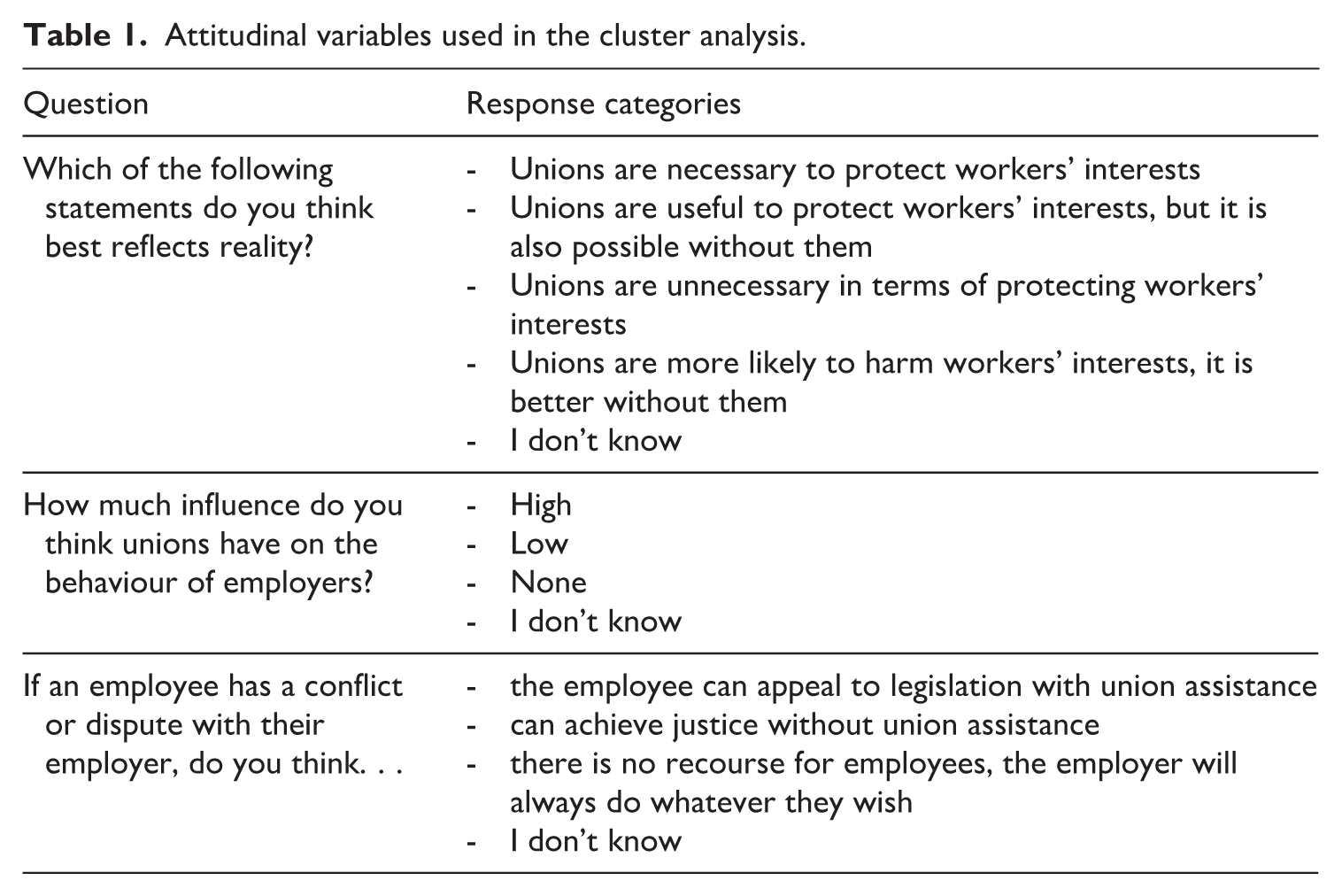
Because the distribution of attitudes towards unions in the population of non-members has not yet been satisfactorily mapped in the context of the Czech Republic, we used an exploratory research approach. Attitudes towards unions were identified employing a two-step cluster analysis, which is suitable for large sets of non-aggregated data. In the first step, it pre-groups the cases into a tree structure, and then in the second step, it hierarchically groups small clusters into larger clusters. The number of resulting clusters was not defined in advance and resulted from the gradual joining of similar groups of respondents. This procedure divided employees into distinct groups based on how they responded to three key questions on attitudes to unions. The exact wording of the questions 4 is shown in Table 1. This typology subsequently made it possible to determine what non-members with similar views on unions have in common, and to predict the behaviour of non-members of unions with given characteristics.
Attitudinal variables used in the cluster analysis.
Attitudes toward unions are shaped by a complex interplay of factors. The context in which opinions are formed can only be understood if one examines the factors as being mutually connected rather than as independent. Aimed at analysing the connections between attitudes towards unions, willingness to join a union and the characteristics of employees and their work activities, we selected the multiple correspondence analysis (MCA) method, which allows for the graphic display of the mutual relationships between attitudes and individual characteristics, thus providing a visual image of the context (cf. Hair et al., 2010). This method appears to be analytically very beneficial in our case, given that we are trying to explore the relationships between a larger number of categorical variables, consisting of demographic, contextual and attitudinal characteristics. Attitudes towards unions are a nominal variable, whose relationships with other variables cannot be simply expressed by a mathematical function, and their nature can therefore be more easily understood by projecting them into a two-dimensional space, in which the context and mutual relations of individual variables may be intuitively revealed. The categories of the analysed variables are projected into a ‘correspondence map’ so that the closer the relationships between them, the further they lie from the centre of the graph and the lines that connect them to the centre of the graph form a smaller angle. The categories are displayed within the space based on their dimensions, which represent a form of latent variables that can be interpreted and used to explain the distribution and mutual connections of the individual categories. 5
The socio-demographic data on the respondents, the variables that related to the basic characteristics of the workplace and the company at which they work, the assessments of the functioning of the workplace and the subjective perception of the work performed (autonomy, satisfaction) were used to map the contexts of attitudes towards unions. The data also included information on the respondents’ political orientation and family union history. The same analytical approach was used for examining non-members’ willingness to join unions.
Since the inclusion of a large number of input categories in such analyses results in a reduction in the interpretation potential of the resulting correspondence map, and the fact that a high number of variables lowers the model total inertia, the number of input items was gradually reduced. Only variables with the strongest associations with monitored attitudes towards unions and intention to join (typically at p < 0.001) were retained. In addition, we maintained items based on their contribution to the inertia (i.e. variance captured by the dimensions) and their importance in interpreting the spatial configuration of attitudes. 6 The final MCA solutions for both analyses included only the most relevant categories, as detailed in Table 2.
Variables employed in the MCA regarding attitudes towards unions and regarding declared willingness to join a union.
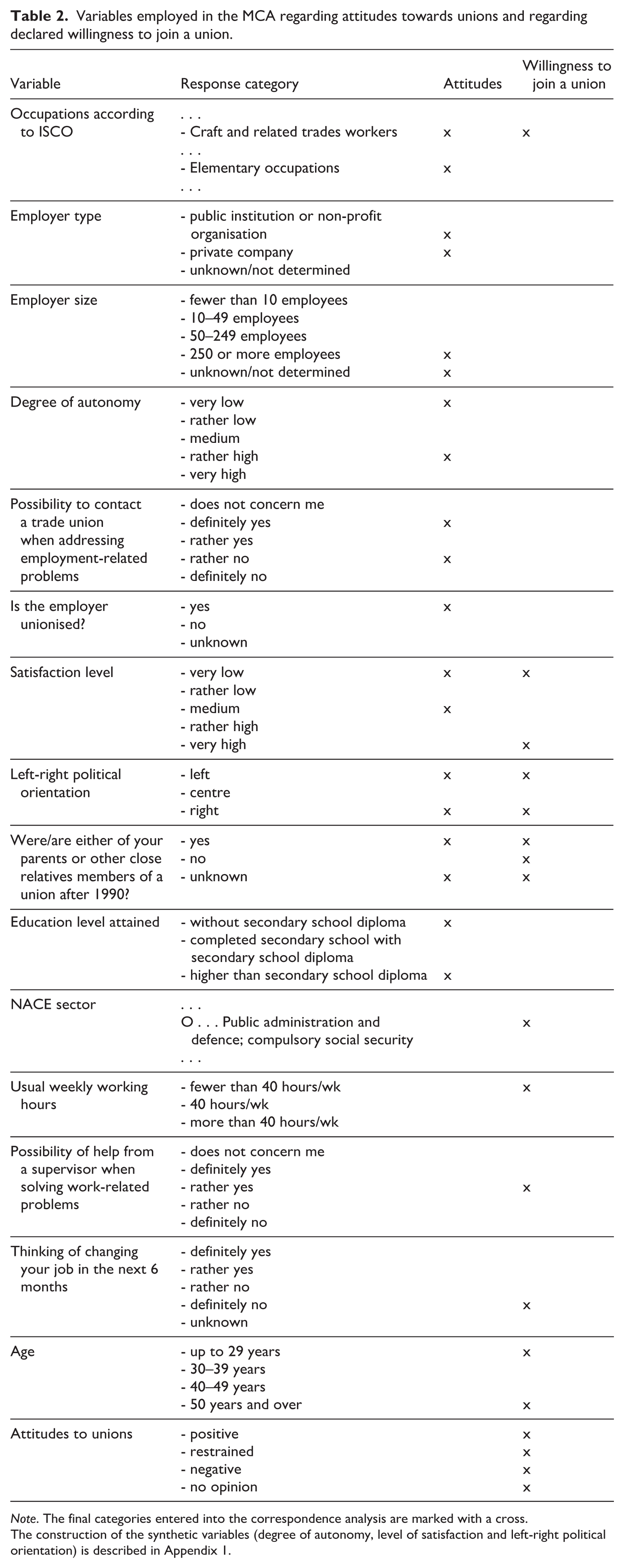
Note. The final categories entered into the correspondence analysis are marked with a cross.
The construction of the synthetic variables (degree of autonomy, level of satisfaction and left-right political orientation) is described in Appendix 1.
Empirical results
Structure of attitudes towards unions in the non-member employee population
To address RQ1, we first examined the structure of attitudes towards unions among non-unionised employees. The cluster analysis distinguished four groups of non-unionised employees according to their attitudes towards trade unions, reflecting varying degrees of alignment with collective representation. Approximately one-quarter of respondents (24.3%) expressed a positive attitude towards unions, marked by trust in unions’ ability to provide legal support and constrain employer discretion. Notably, respondents in this group were in the vast majority of cases (87%) convinced that a worker can achieve justice with the help of unions – an attitude that is practically missing in the other clusters. Most of respondents with positive attitude (59%) also believed that unions can significantly influence the behaviour of employers. Finally, almost two-fifths in this group viewed unions as essential for protecting workers’ interests – again, a position seldom shared in the other clusters (see Figures 2, 3 and 4).
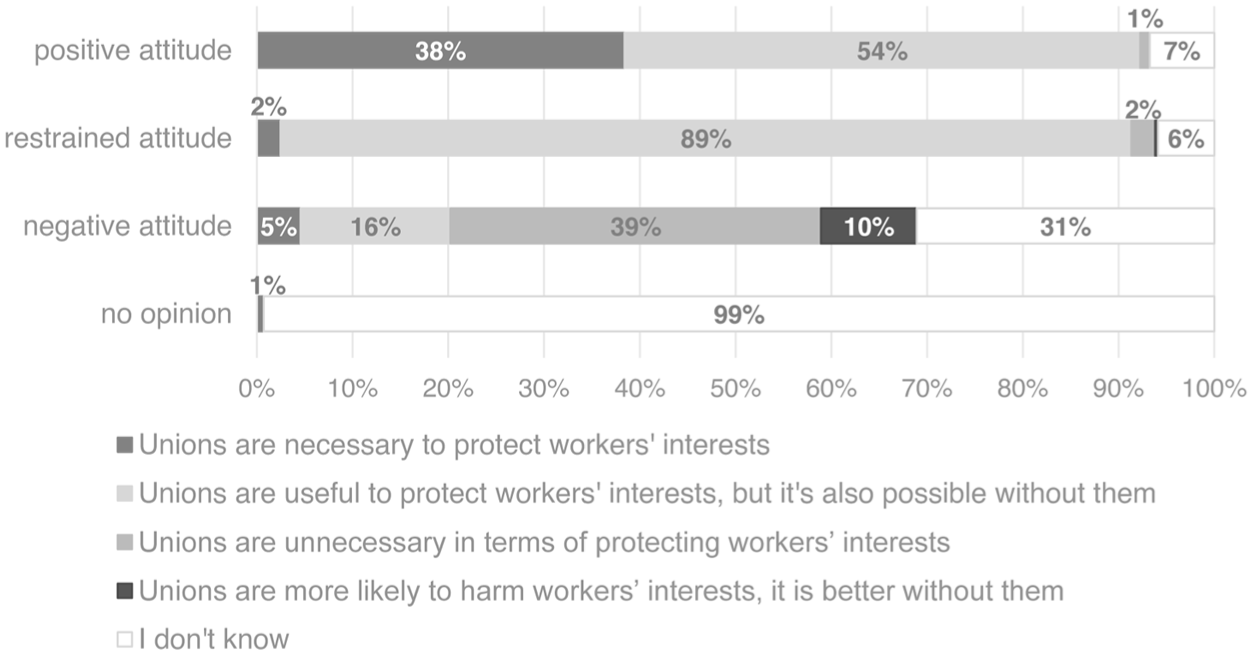
Which of the following statements do you think best reflects reality? (in %).
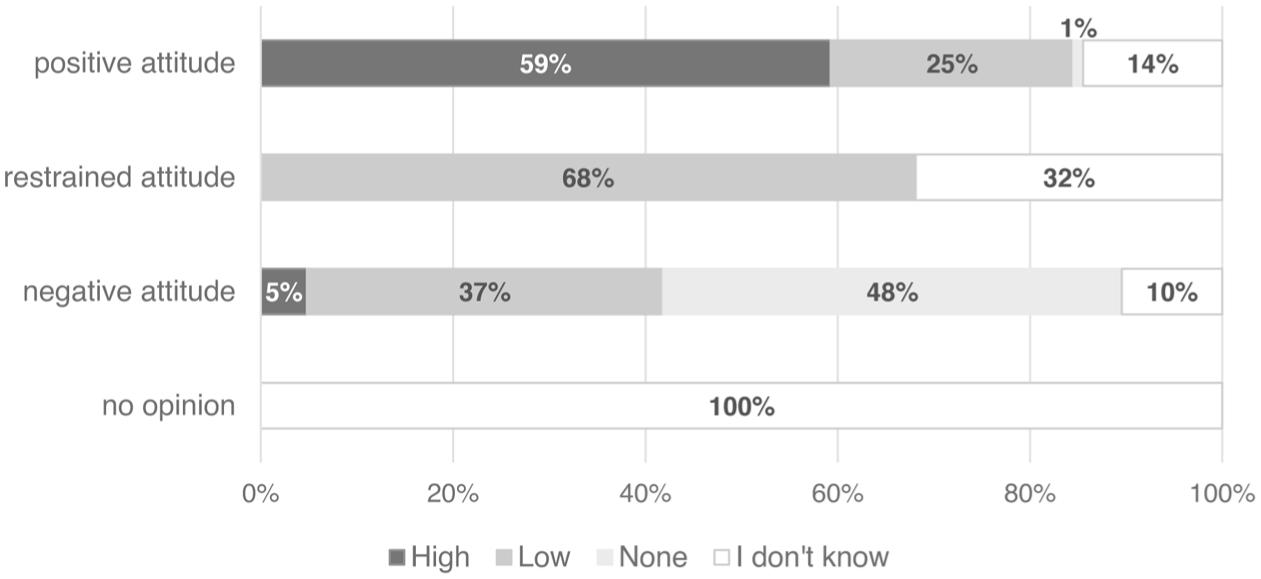
How much influence do you think unions exert on the behaviour of employers? (in %).
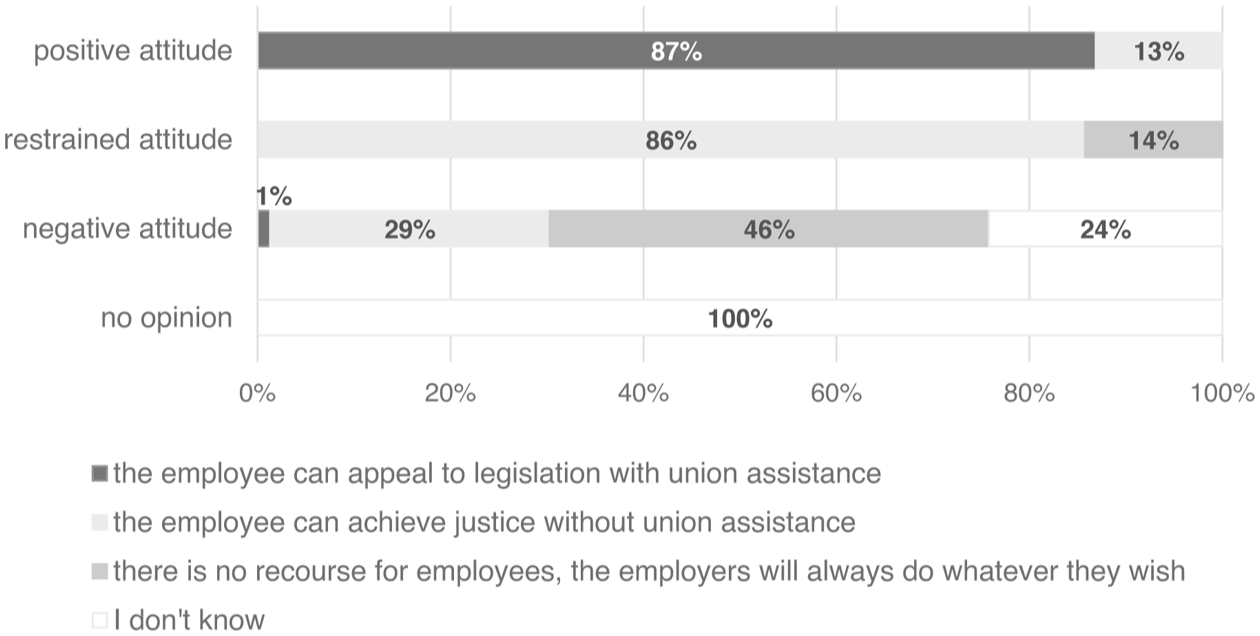
If an employee has a conflict or dispute with their employer, do you think. . . (in %).
The second group, also comprising roughly one-quarter of the sample (26.5%), showed a restrained attitude towards unions. While acknowledging unions’ contribution to defending workers’ rights, they considered such protection achievable without collective representation. This position suggests a partial internalisation of the logic of individualisation in employment relations, where self-reliance and personalised negotiation are seen as substitutes for collective mechanisms. The limited perceived influence of unions among this group (68% rated it as low) further underscores a pragmatic, rather than ideological, disengagement from unionism.
The largest cluster (37.6%) held negative attitudes towards unions. Nearly 40% of this group deemed unions unnecessary, and almost half doubted their capacity to shape employer conduct. Around one-tenth of these respondents even viewed unions as detrimental to workers’ interests. When asked about workplace conflict resolution, 46% expressed scepticism, agreeing that employers always prevail, leaving employees with minimal avenues for redress. This stance illustrates the erosion of confidence in collective efficacy and is a manifestation of union delegitimation in specific segments of liberalising labour markets.
The fourth and smallest group (11.6%) comprised non-union members who expressed no opinion on unions and were unable to evaluate their role and functions. Respondents from this group almost invariably chose the answer ‘I don’t know’ to relevant questions about unions. For them, union-related matters lacked personal relevance. This detachment may signal a growing segment of workers situated outside the traditional union–non-union dichotomy, characterised more by apathy than by opposition.
Context of the shaping of attitudes towards unions
To address RQ2, we analyse the socio-demographic and workplace determinants of these attitudes. Although the group expressing negative attitudes towards unions was the largest of the four, it can be stated that the majority of non-union employees surveyed did not hold negative views, and around one-quarter even expressed explicitly positive attitudes. To better understand the context in which these attitudes were formed, relevant influencing factors were explored using multiple correspondence analysis (MCA) (see Figures 5 and 6).
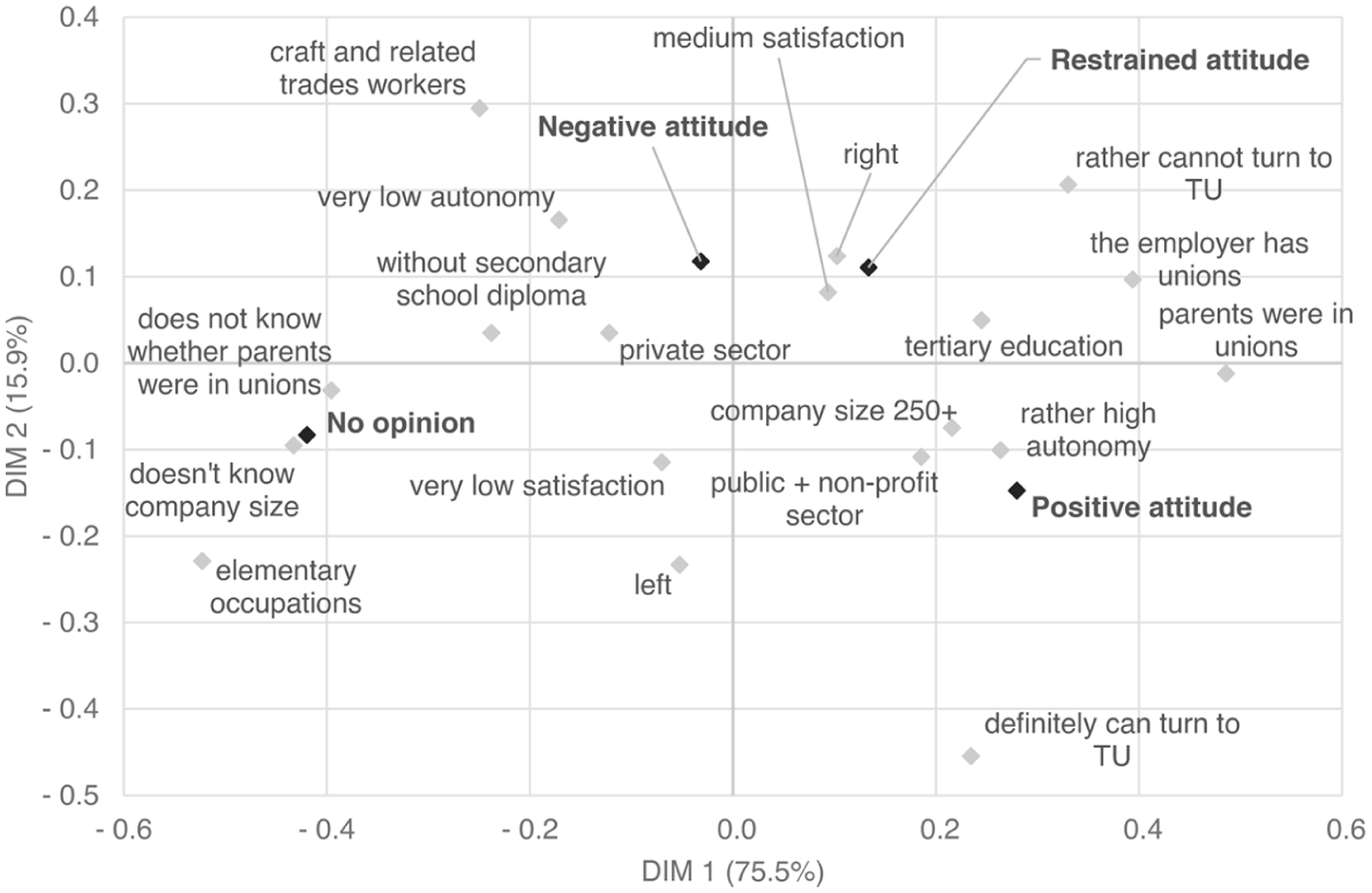
Correspondence map with attitudes towards unions – dimensions 1 and 2.
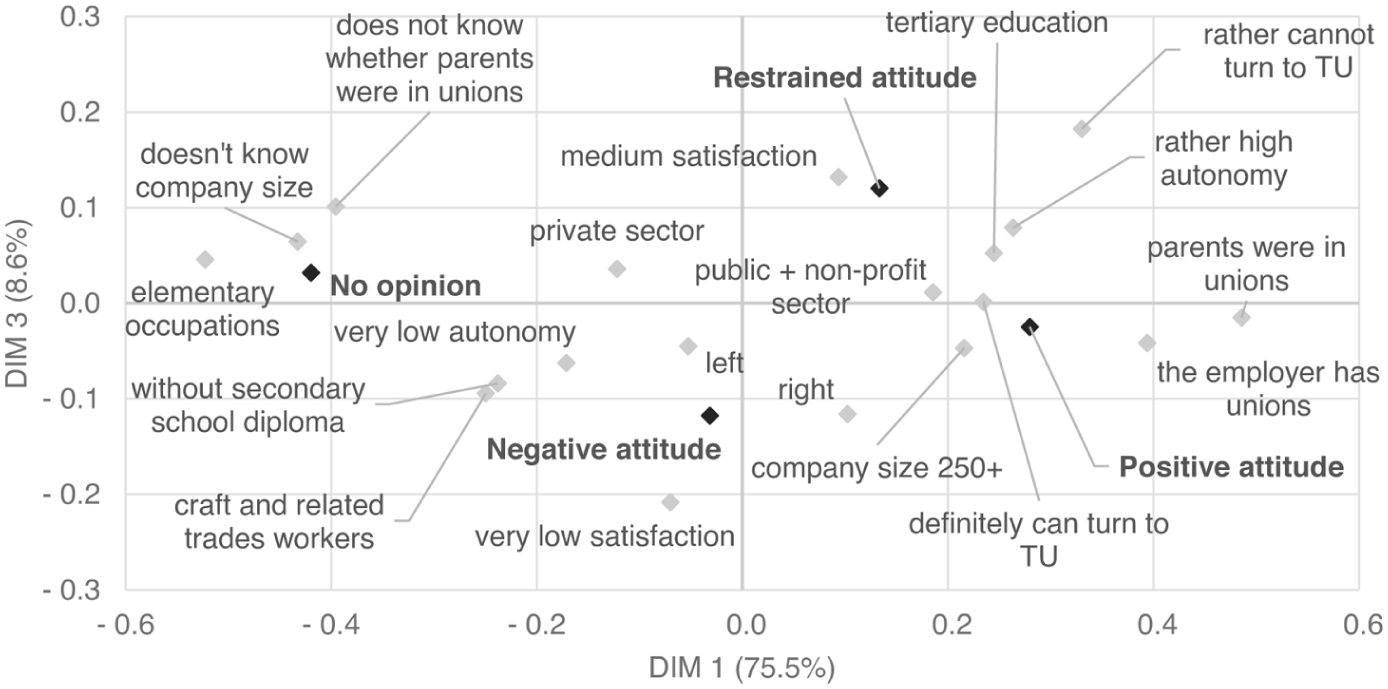
Correspondence map with attitudes towards unions – dimensions 1 and 3.
The MCA on attitudes towards unions explained a total of 8.7% of the chi-squared variability; despite representing a relatively small share, it was considered a satisfactory result in terms of the multivariate analysis. The first dimension accounted for 75.5% of the inertia, making it the key axis for interpreting the attitudinal context. The second dimension contributed 15.9% to the inertia and the remaining third dimension 8.6%. Accordingly, the correspondence map based on the first two dimensions offers the most informative insight.
As shown in Figure 5, dimension 1 primarily distinguishes between employees with positive attitudes and those with no opinion regarding unions. Considering which explanatory variables contribute most to the inertia of this dimension, we find that the categories related to the membership of parents or other close relatives in unions contribute most to it (not only the knowledge that parents were in unions, but also the lack of awareness of whether parents were union members), followed by the presence of unions in the workplace. 7 To a slightly lesser extent, the distribution of categories in dimension 1 is explained by the level of education achieved, and the categories ‘rather high autonomy’ and ‘auxiliary and unskilled workers’. Overall, it appears that whether employees perceive unions positively or whether they are of no interest is related mainly to respondents’ exposure to unions – either indirectly (through family socialisation) or directly (via union presence in the workplace). However, the educational attainment of the worker was also found to play a role in this respect: employees with lower levels of education and those in auxiliary or unskilled positions tended to express no opinion, suggesting limited cognitive engagement with collective institutions. By contrast, employees enjoying greater occupational autonomy were more likely to hold positive views.
The second dimension captured the contrast between positive and negative or restrained attitudes. Key explanatory factors included occupation (specifically the category of craft and related trades workers), political orientation and workplace experience with unions, i.e. the extent to which the employee feels that he or she can turn to the trade union to resolve problems at work. The influence of political orientation was not surprising, given unions’ traditional identification with left-wing values and, in the Czech context, their recurrent cooperation with the Social Democratic Party in shaping political programmes and endorsing their policies. This pattern reflects the continuing ideological embedding of union support within broader value systems of egalitarianism and social solidarity. It is also not surprising that trust in unions and the perception of their reliability in resolving workplace problems contribute to a positive attitude towards unions as a whole, whereas distrust in the local trade union or negative prior experience corresponds with disengagement.
The pronounced anti-union orientation among crafts workers and repair workers lay beyond the explanatory reach of the correspondence map and reflects occupational specificities. This professional group had the highest proportion of self-employed workers (approximately one-third in the UNIONS2023 survey), 8 among whom scepticism towards unions is well documented (cf. Kroupa et al., 2024). Their work environments thus appear structurally less conducive to union involvement or recruitment.
While the first two dimensions did not differentiate employees with negative attitudes from those with merely restrained views, the third dimension (Figure 6) accounted for this distinction. Variation was explained chiefly by job satisfaction: the ‘very low satisfaction’ category explained 30% of the inertia of this dimension and the ‘medium satisfaction’ category a further 11%.
Negative attitudes were closely related to the lowest level of satisfaction, while restrained attitudes were associated with situations in which employees were not dissatisfied. This may be connected to the type of work performed since restrained attitudes were also associated with rather high levels of autonomy, while very low levels of autonomy were more typical for employees with negative attitudes towards unions. Moreover, the ‘without a secondary school diploma’ category contributed more significantly to the inertia of the third dimension, which is again closely related to the employee group with a negative attitude to unions. Restrained attitudes were more closely associated with a higher than a secondary school diploma education. Interestingly, the ‘right’ category, i.e. respondents with right-liberal political attitudes, also contributed to a significant extent to the third dimension inertia. Conversely, the contribution of the ‘left’ category was very low, which implies that in terms of political positions, employees with negative attitudes towards unions differ from those with restrained attitudes only in terms of their more right-wing opinions.
The consideration of joining unions and its context
To address RQ3 and RQ4, we examine how attitudes towards unions translate into willingness to join and which additional factors shape this process. A total of 11% of employees expressed a willingness to join a union. As expected, employees with a positive attitude to unions tended to wish to join a union more than workers with other attitudes. However, the question remained as to whether other circumstances also contribute to willingness to join a union. When non-members with a positive attitude towards unions were asked whether they had ever considered joining a union, only 27.4% answered yes. At the same time, among employees expressing negative attitudes towards unions, 4.8% were found to be rather likely to consider joining a union (see Figure 7).
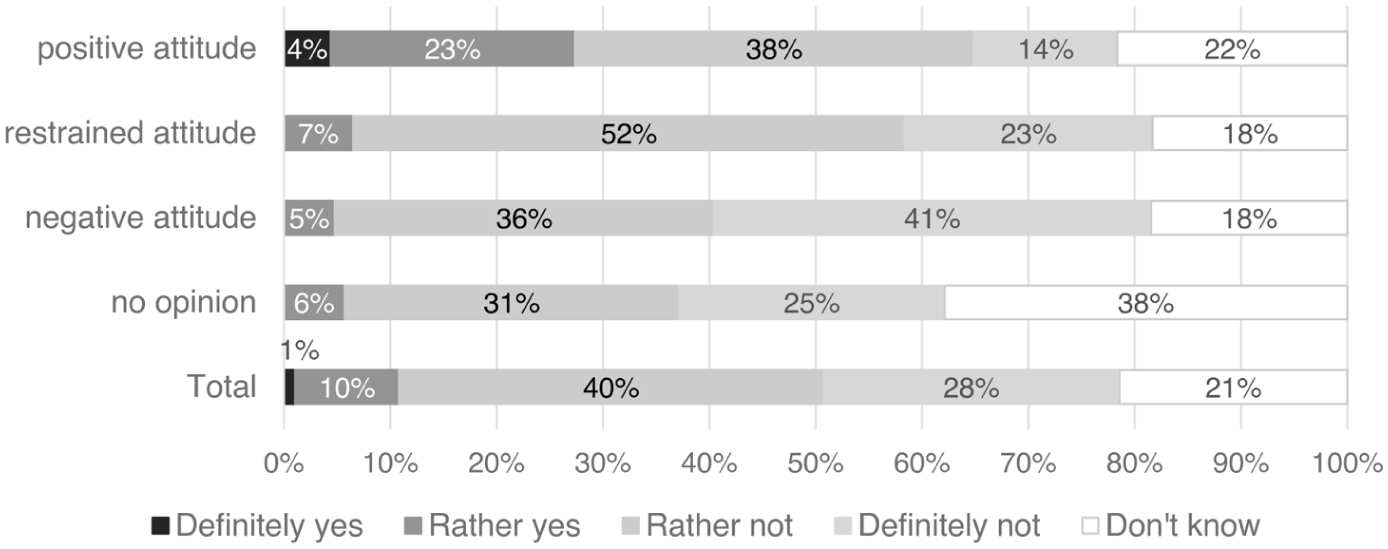
Do you ever consider joining a union (again)? (in %).
We attempted to describe the circumstances in more detail, again applying the MCA approach. In the case of positive answers, we worked with the combined category ‘yes’, since the ‘definitely yes’ category comprised only 13 respondents. Thus, in the case of the variable that determined the degree of willingness to join a union, we considered four categories, which allowed us to obtain a solution with three dimensions. The MCA that focused on considerations concerning joining a union provided a fairly good result, i.e. the results explained 13.2% of the chi-squared variability (contributions to inertia DIM1 = 80%, DIM2 = 13% and DIM3 = 7%).
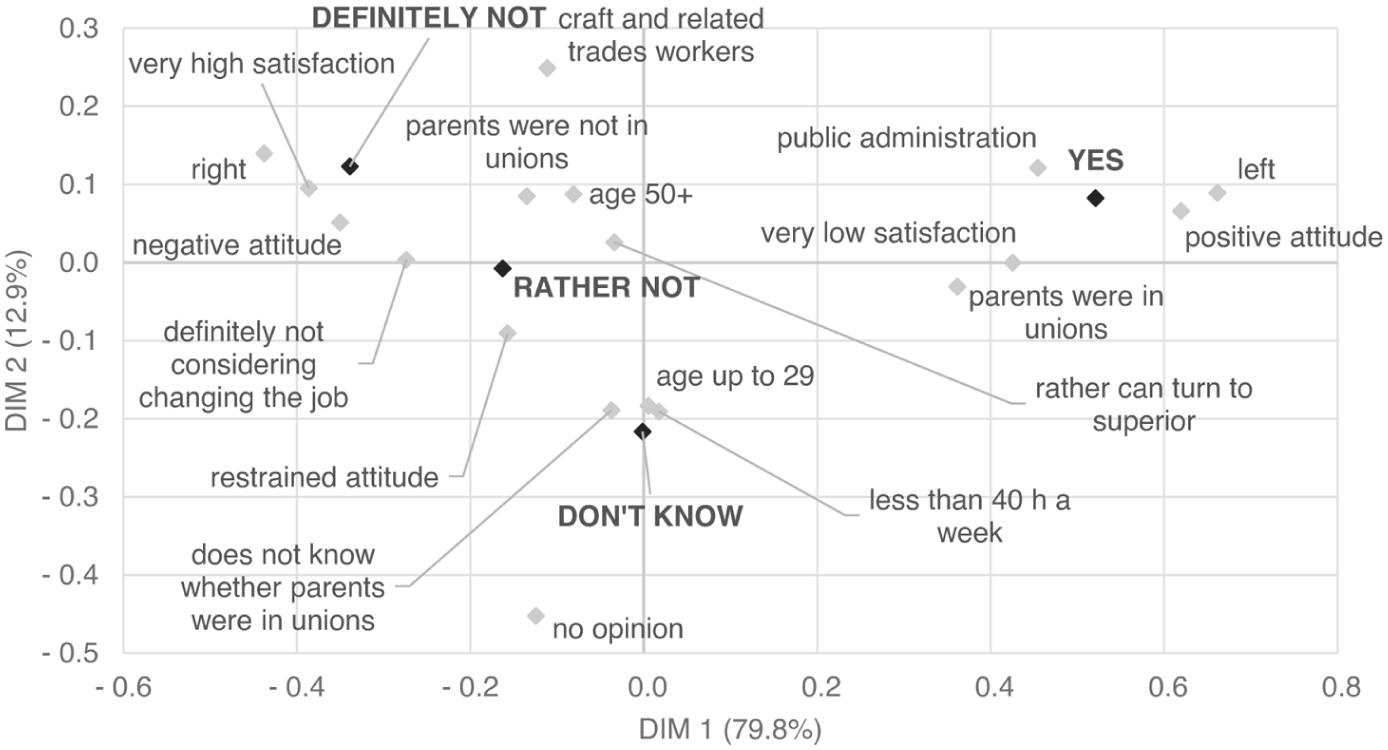
Correspondence map with the consideration of joining a union – dimensions 1 and 2.
Dimension 1 of the correspondence map can be interpreted as a continuum ranging from firm rejection to consideration of union membership (Figure 8). This dimension was strongly associated with general attitudes towards unions, with positive attitude explaining one-quarter of the dimension’s inertia and negative one 9.2%. 9 Political orientation also played a significant role in the distribution of the categories in this dimension: left-wing views explained one-fifth of its inertia and right-wing views 9%. Having a parent or close relative who was a union member further increased the likelihood of considering union membership. Beyond these ideological or socialisation factors, job satisfaction proved very significant. Employees with low job satisfaction were more inclined to consider joining a union, whereas high satisfaction and strong attachment to the current job (i.e. a complete rejection of considering a job change) correlated with rejection of union membership. It is, therefore, reasonable to assume that positive union attitudes and a left-wing political orientation increase the likelihood of considering joining a union; however, it is only in combination with job dissatisfaction that employees begin to seriously consider union membership. From a sector perspective, employees considered joining a union most often (around one-quarter of cases) in public administration and defence, where union presence is widespread and unionisation is a common strategy when dealing with workplace discontent.
Dimension 2 of the correspondence map explained the degree of decisiveness when considering joining a union, distinguishing undecided respondents from those with clear views, whether positive or negative. Unsurprisingly, the ‘don’t know’ response was most frequent among those who have no opinion on unions, for whom unions are of no relevance. The ‘don’t know’ answer was often chosen also by those non-members who did not know whether their parents were in unions. The ‘craft and related trades workers’ category contributed one-tenth of the inertia and was mainly associated with a resolute refusal to join a union, which is consistent with generally negative attitudes towards unions held by this professional group, as discussed above. Employees with liberal-right-wing views also tended to reject membership. By contrast, indecision regarding joining a union was associated with working fewer than 40 hours per week, i.e. especially part-time work, and with young age (up to 29 years). The fact that part-time workers are less engaged in unions than full-time employees and that young workers have often no awareness of unions and thus have no opinions on joining one has been highlighted in previous research (Kroupa et al., 2024).
Finally, dimension 3 accounted for the differentiation between those who would rather not join a union and those who would definitely not do so (Figure 9). Given its low share of the inertia, it is sufficient to state here that this dimension reflects the relations with management and job satisfaction. Employees who tend not to consider joining a union do not hold extremely negative opinions of unions, are neither very satisfied nor completely dissatisfied but feel they can turn to their managers in case of problems, reducing the perceived need for union intermediation. The extreme values on the satisfaction scale are associated with a clear opinion on joining a union. Those who are very satisfied with their work tend to fundamentally reject membership, while those who are not at all satisfied with their work tend to consider joining a union.
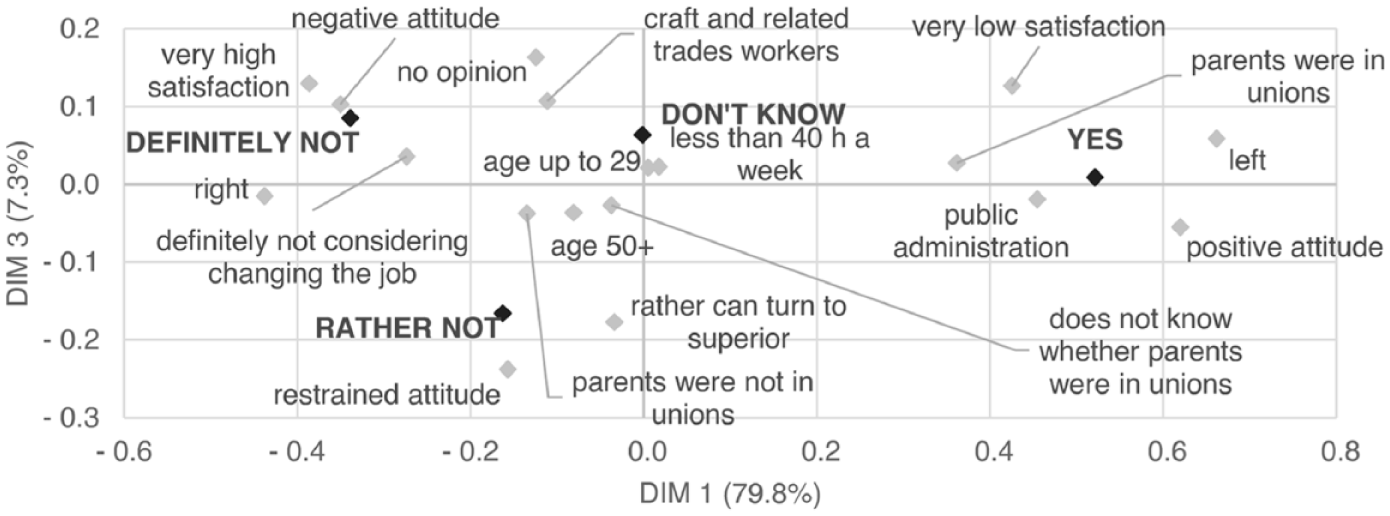
Correspondence map with the consideration of joining a union – dimensions 1 and 3.
Discussion and conclusion: Attitudinal foundations of union renewal in Czechia
This study contributes to ongoing debates on union renewal and membership dynamics by linking macro-level processes of institutional decline with the micro-foundations of unionisation. Specifically, it provides empirical insight into how rational cost–benefit considerations, social embeddedness and identity-based mechanisms interact in shaping union-related attitudes and behavioural intentions among non-members.
It provides rare empirical evidence from Czechia, a context emblematic of the challenges confronting trade unionism in Central and Eastern Europe, a region marked by fragmented industrial relations and limited institutional density. The analysis provides both a snapshot of non-member employee attitudes and valuable insights into the potential dynamics of union membership base development. These findings contribute to anticipating future developments in Czechia and other countries with similar social dialogue system settings and extend the comparative discussion of union legitimacy beyond Western European contexts, where most empirical research has been concentrated.
Despite the widespread concern over declining union membership across the EU, employees’ readiness to join unions has received limited empirical attention. The approach of the article in terms of focusing exclusively on non-unionised employees has been underused to date when approaching the analysis of the decline in the union membership base and the differentiation of supporters and opponents of trade unions. The main potential of this approach concerns the homogeneity of the studied population, which precludes the bias introduced by direct involvement in the union community. Moreover, it enables examination of the pre-membership phase and sheds light on how ideology, trust and instrumentality interact before union membership decisions occur. In this sense, it extends the analytical focus from union decline to the attitudinal foundations of possible renewal. The findings also allow us to revisit the theoretical distinction between instrumental and normative drivers of unionisation. While rational choice perspectives assume that perceived benefits translate directly into membership decisions, our results suggest that this relationship is conditional and mediated by social and contextual factors.
The results are particularly relevant in light of the EU Directive on Adequate Minimum Wages (2022/2041), which is pushing most EU states into increasing their collective bargaining coverage. Strengthening the union membership base constitutes one possible route to achieving this objective.
With regard to RQ1 (How are attitudes towards unions structured among non-unionised employees?), the findings reveal a clearly stratified attitudinal landscape. While the largest group of non-members exhibited negative views of unions, a substantial share expressed either positive (24%) or restrained (27%) attitudes, suggesting that overt hostility is far from universal. This heterogeneity underscores the coexistence of disembedded collectivism and latent solidarity: unions remain normatively recognised but are perceived as institutionally distant. The smallest group identified comprised those who have no opinions on unions. The coexistence of positive, restrained and negative attitudes reflects the broader process of labour market individualisation outlined in the introduction. In decentralised industrial relations systems such as Czechia, the perceived relevance of unions becomes fragmented and contingent on individual experience rather than institutional guarantees.
Addressing RQ2 (Which individual and workplace factors explain these orientations?), the analysis shows that attitudes towards unions are closely related to a number of key socio-demographic, ideological and workplace factors. As expected, educational attainment plays a substantial role: employees with low education levels were most likely to reject or be indifferent towards unions, whereas university graduates were more inclined to express positive or restrained views. These findings are consistent with prior research demonstrating a positive relationship between education and the probability of joining a union (Brady, 2007; Kirmanoğlu and Başlevent, 2012). Highly qualified jobs are often characterised by a high degree of autonomy, a factor that proves to be also related to pro-union attitudes.
Socialisation processes matter, as well. Having family members with union membership, the presence of unions in the workplace and their openness towards employees were associated with more favourable attitudes. This pattern aligns with social custom theory and the idea that collective norms are reproduced through social proximity and routine interaction (Bryson and Davies, 2019; Furåker and Bengtsson, 2013). At the same time, the persistent effect of political orientation indicates that identity-based mechanisms remain central, suggesting that union support is not merely situational but also ideologically anchored. Our finding that employees with left-wing political views in particular have positive views of unions is consistent with previous findings, as well. This reflects the enduring ideological coupling of unionism with egalitarian and redistributive values (Deery and De Cieri, 1991; Fitzenberger et al., 1999; Lorenz and Wagner, 1991; Schnabel, 2003). Together, these findings support a multidimensional interpretation of union attitudes consistent with the theoretical framework combining rational, normative and identity-based explanations.
In relation to RQ3 (How do these attitudes translate into considerations of union membership?), the results indicate that the link between attitudes and behavioural intentions is significant but far from linear. Around 11% of respondents reported considering union membership. While pro-union attitudes and left-leaning views were prerequisites for this intention, they were not sufficient. Only one-quarter of employees with positive attitudes expressed intent to join. The multivariate analysis suggests that job dissatisfaction acts as a catalytic variable that converts latent support into behavioural intent. This finding is theoretically significant, as it challenges the assumption of a direct link between pro-union attitudes and membership decisions. Instead, it points to a two-stage mechanism: normative alignment creates a reservoir of latent support, while instrumental triggers – such as dissatisfaction – activate this support into behavioural intent. In this sense, union membership emerges as a hybrid outcome of identity-based and rational-choice processes rather than being reducible to either (cf. Hodder and Edwards, 2015).
Importantly, these micro-level dynamics must be interpreted within the institutional context outlined in the introduction. In systems characterised by decentralised, company-level bargaining and weak extension mechanisms, such as Czechia, the translation of attitudes into membership becomes crucial for sustaining collective bargaining coverage. This contrasts with more coordinated systems, where institutional arrangements partially substitute for individual membership decisions.
Finally, addressing RQ4 (What other factors, beyond attitudes themselves, influence the willingness to join a union?), the findings highlight the importance of contextual and experiential factors, particularly job satisfaction, workplace conditions and sectoral context. That nearly half of non-members acknowledge unions’ societal relevance suggests a potential to reverse declining membership rates. However, this will require a proactive strategy. Our findings imply that union revitalisation strategies must address both normative and instrumental dimensions of membership. Efforts focused solely on improving union image or ideological appeal are unlikely to succeed without addressing workplace-level grievances that activate membership decisions. Conversely, purely instrumental appeals may fail in the absence of prior normative alignment.
A key challenge lies in understanding why employees with low autonomy and substandard working conditions – traditionally a core constituency – now exhibit strong anti-union sentiments. Notably, crafts workers and repair workers, encompassing skilled blue-collar workers in manufacturing and construction, displayed the most negative attitudes, which suggests a weakening of traditional class-based identities and supports broader arguments about the fragmentation of collective identities under conditions of labour market flexibilisation. The spread of self-employment and subcontracting within skilled trades appears to have eroded the collective identities that once underpinned blue-collar solidarity. Investigating the drivers and dynamics of this shift constitutes a promising avenue for future research that will require, among other things, the involvement of qualitative approaches.
Finally, while the study offers robust empirical insights, its cross-sectional design limits causal inference. Future research would benefit from longitudinal and comparative approaches to trace how attitudinal shifts translate into behavioural outcomes over time. Nevertheless, the evidence presented here underscores that while union disaffection remains widespread, the conditions for renewed mobilisation persist. More fundamentally, the study demonstrates that the decline of union membership in Central and Eastern Europe cannot be explained solely by structural or institutional factors. Instead, it reflects a reconfiguration of the micro-foundations of collective action, in which identity, socialisation and perceived utility interact in more conditional and context-dependent ways than assumed in classical models of unionisation. This contributes to ongoing debates by showing that union renewal depends not only on institutional reform but also on the activation of latent attitudinal support. The challenge for unions in CEE, therefore, is not the absence of legitimacy but the need to reassert relevance and perceived efficacy of collective action within increasingly individualised employment relations.
Footnotes
Appendix 1
Appendix 2
Acknowledgements
The authors thank anonymous reviewers for their valuable comments that have helped improve the quality of the article.

Funding
The collection of the data used in this study was financially supported by Norway Grants 2014-2021 under the programme ‘Social Dialogue – Decent Work – Czech Republic’ and was primarily used in the project ‘Strengthening the Capacity of Trade Unions in the Czech Republic’ (2021/336362) carried out by the Research Institute for Labour and Social Affairs, in 2022–2024. This study was funded via institutional support provided by the Ministry of Labour and Social Affairs of the Czech Republic directly granted to ‘Supporting Trade Unions to Increase the Rate of Coverage by Collective Agreements’ research project (IP70317) conducted by the Research Institute for Labour and Social Affairs in 2023 and 2024.
Declaration of conflicting interests
The authors declared no potential conflicts of interest with respect to the research, authorship and/or publication of this article.
Data availability statement
The data that supports the findings of this study is available from the corresponding author on reasonable request.