







Abstract
Electric vehicles (EVs) are a transformative force in sustainable transportation, but their widespread adoption depends critically on the development of robust and intelligent fast-charging infrastructure. This paper presents a comprehensive review of EV fast-charging station (FCS) operational strategies and analyzes their multidimensional impact on modern power grids, focusing on grid stability, energy optimization, and renewable integration from 2014 to 2024. The review consolidates over 100 high-impact studies and technical databases. Our study identifies that FCS can recharge EVs up to 80% within 20–30 min, which significantly improves user convenience but simultaneously introduces peak demand surges, voltage instability, and transformer stress in distribution networks. Simulation results from referenced studies show voltage drops of up to 12%, with transformer aging rates increasing by 30–40% under uncoordinated charging scenarios. High-power charging stations (>350 kW) pose particularly severe challenges, requiring infrastructure upgrades and intelligent load management systems. This review further explores the strategic placement of charging stations using optimization techniques, including particle swarm optimization (PSO), genetic algorithms (GA), and Monte Carlo simulations. These techniques have demonstrated power loss reductions of up to 33% and improved voltage stability in modeled IEEE 33-bus systems. Additionally, integrating photovoltaic systems with battery energy storage systems can meet up to 69% of the station's energy needs, significantly reducing grid dependency. We also highlight emerging technologies, including vehicle-to-grid (V2G), dynamic pricing models, and AI-based predictive control systems, showing their potential to enhance both grid performance and economic viability. The review concludes by proposing a roadmap that combines operational strategy development, renewable integration, and smart grid control to support scalable and sustainable EV fast-charging infrastructure globally.
Keywords
Introduction
An electric vehicle (EV) is a car that uses electricity rather than diesel or gasoline. A battery powers its electric motor. The automotive industry is transitioning to EVs due to an increasing commitment to environmental sustainability and growing global awareness of environmental concerns. The automotive industry is evolving because people now understand the importance of reducing greenhouse gas (GHG) emissions and mitigating the ecological damage caused by fossil fuels. Furthermore, an analysis by the European Union claims that the transportation sector is responsible for almost 28% of the overall carbon dioxide (CO2) emissions, with road transportation accounting for more than 70% of these emissions. EVs present an alternative power option that substantially reduces emissions when electric utilities utilize renewable energy sources. As a result, most industrialized nations’ governments are promoting the use of EVs to reduce CO2 and other GHGs in the atmosphere. More precisely, they encourage effective and environmentally conscious transportation through various programs, primarily purchasing incentives, tax breaks, and other unique measures, such as free parking and the use of motorways. A comprehensive review of the effects of EV charging on power systems is presented in the paper “Review of Positive and Negative Impacts of Electric Vehicle Charging on Electric Power Systems,” in which the researcher examines both the system's disadvantages and advantages (Nour et al., 2020). The following are some benefits depicted in Figure 1 that EVs have over conventional cars:
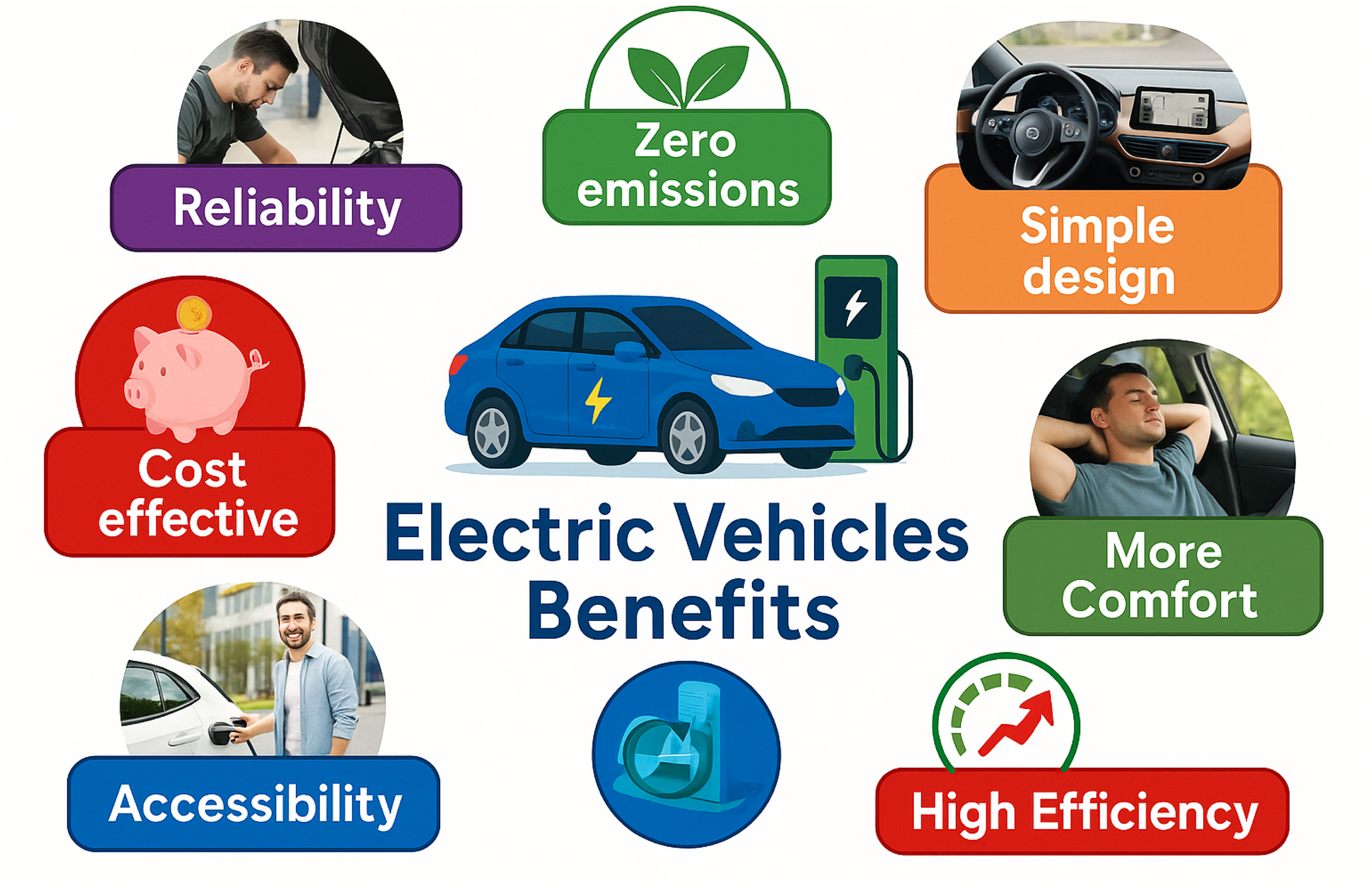
Benefits of EVs.
EVs outperform conventional cars in terms of efficiency, as shown in Figure 2. However, the effectiveness of power plants will also affect total well-to-wheel (WTW) efficiency. For example, the overall WTW effectiveness of diesel cars range from 25% to 37%, while that of petrol-powered vehicles ranges from 11% to 27%. EVs powered by energy generated from renewable sources have an overall efficiency of up to 70%, while EVs powered by gas-powered power stations exhibit a WTW performance that varies between 13% and 31% (Nour et al., 2020).
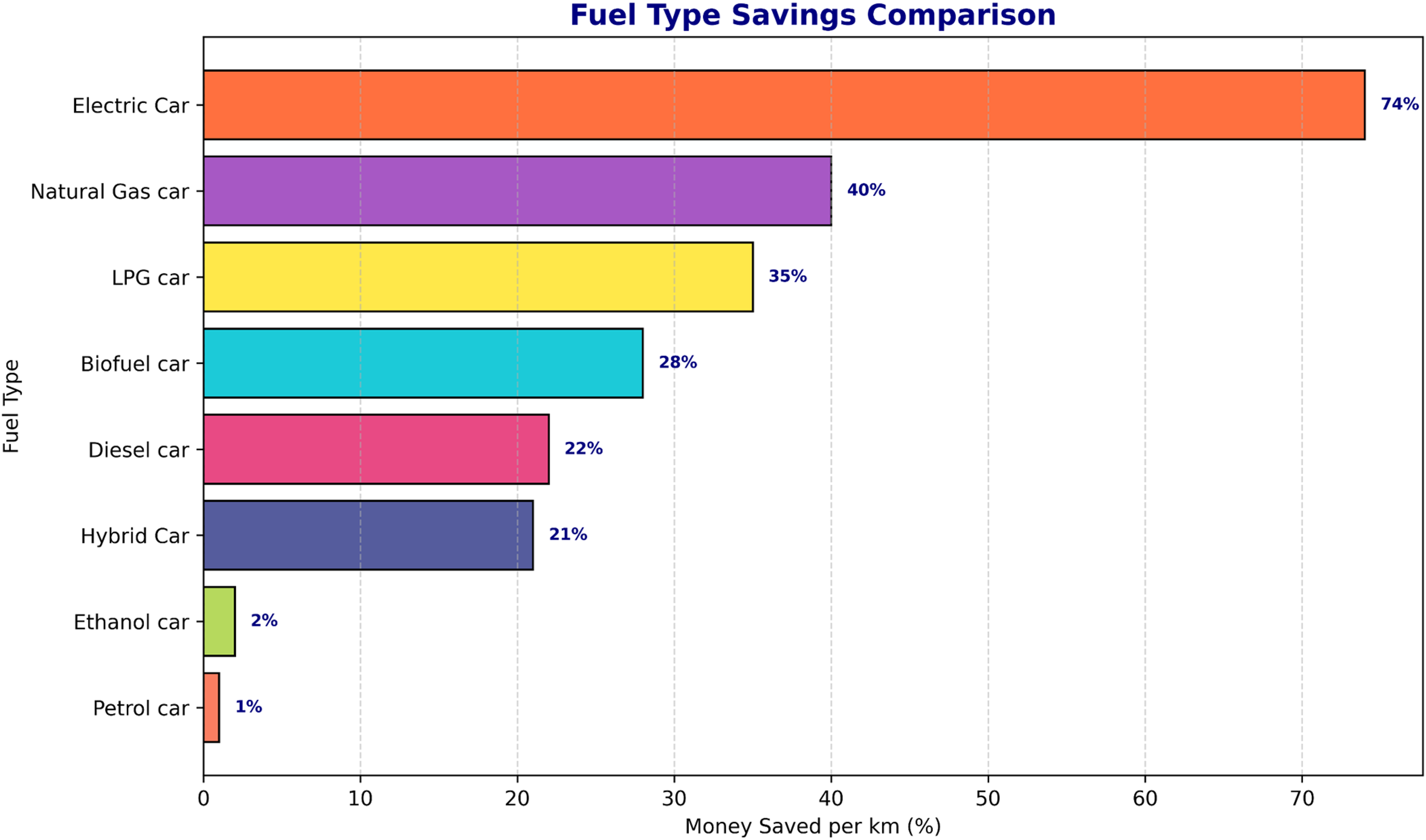
Cost-saving comparison with different types of fuel (Nour et al., 2020).
The general acceptance of EVs relies on building a robust and stable EV charging system, shown in Figure 3, that includes fast-charging stations (FCS) to shorten charging times, thereby enhancing the practicality of EV usage. EVs require FCS because they are essential for their practical use and widespread adoption.
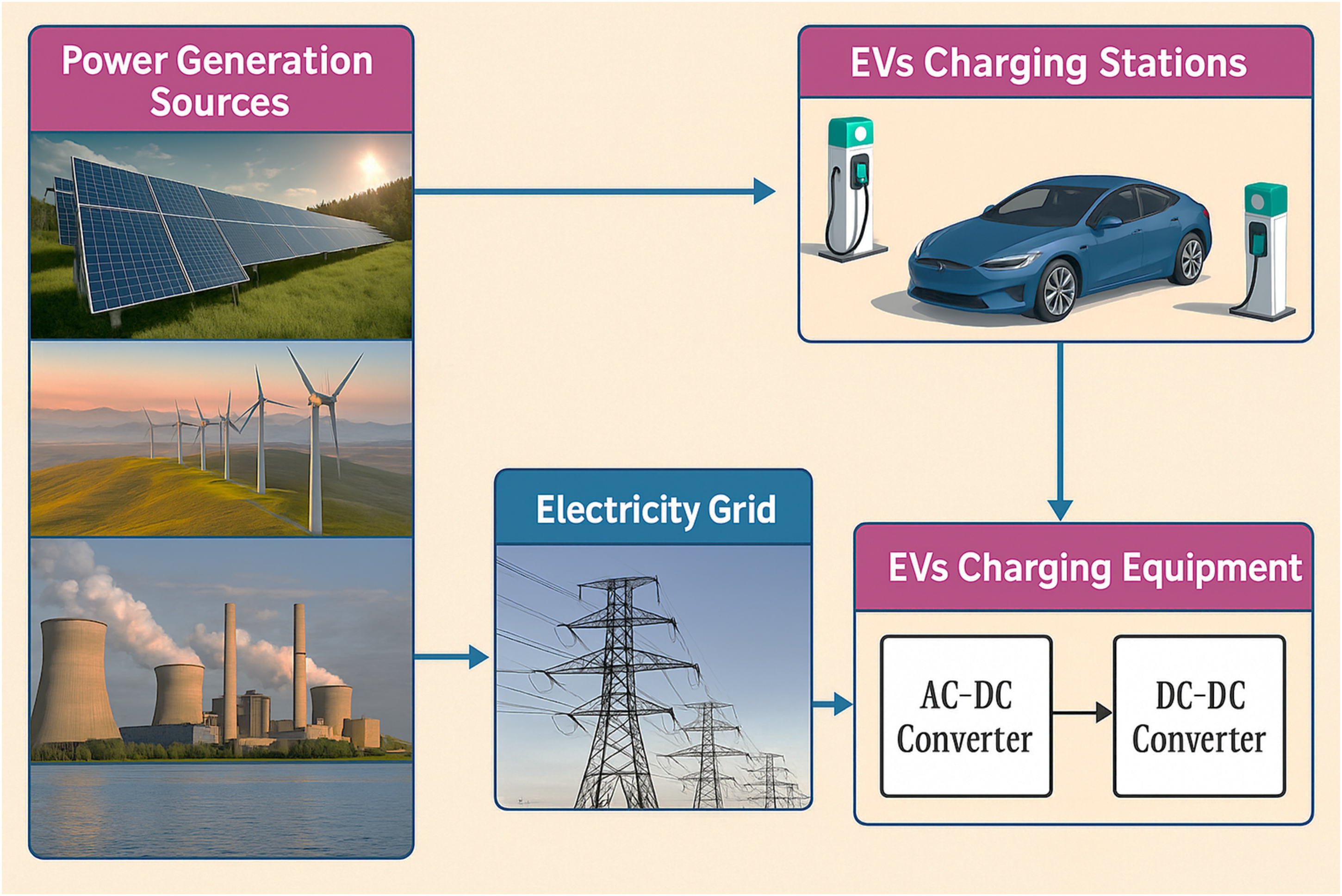
EVs charging through the grid.
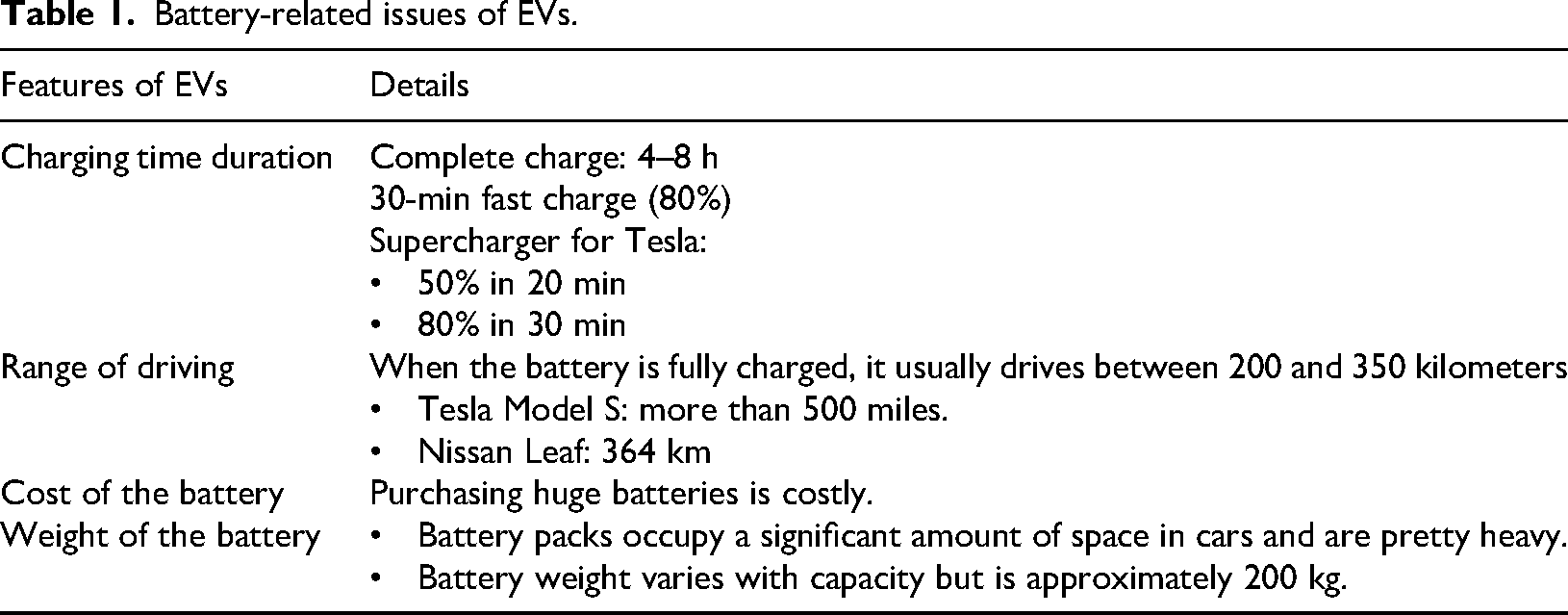
However, there are serious battery-related issues with EVs, which are outlined in Table 1. EV drivers can get an 80% battery recharge in 20 min at fast stations, which resolves the primary obstacle to EV adoption, range anxiety. EV owners need FCS most when driving long distances and lacking home charging capabilities. The worldwide movement toward EV adoption identifies quick recharging stations as fundamental elements of its implementation strategy. Implementing EV FCS creates opportunities for the power system, while also presenting technical challenges worldwide. Excessive electricity demand by fast chargers generates significant problems for the power grid, creating unstable electrical conditions and straining its operational capacity. This part outlines the adverse effects on the power grid, followed by methods for successfully including fast-charging infrastructure (Kumar, 2024). Power grid demand for electricity increases significantly when FCS are in operation, especially during periods of peak energy consumption. The situation puts more strain on electrical grids, leading to worse grid load conditions, particularly in areas with insufficient infrastructure or limited capacity. An effective control system for this electrical load is crucial for maintaining grid reliability and ensuring a continuous power supply.
Battery-related issues of EVs.
Many researchers have published comprehensive assessments of EVs, focusing on significant issues such as driving range, battery technology, charging infrastructure, and environmental impact (Nour et al., 2020). EV sector through detailed discussions of EV evolution, current conditions, and future development prospects. This research paper studies several different EV models, along with market status, environmental consequences and recent technological progress. It is shown that EVs can greatly improve the sustainability of transportation, yet there are still problems with electrical infrastructure, technology and adoption by the market. Study the EV market, identifying what is still unknown and offering solutions that will help the worldwide EV sector advance, aimed at policymakers and carmakers (Samarakoon et al., 2024). Study the reasons why the worldwide EV market is flourishing or struggling, checking how they lower GHG emissions and encourage more energy and economic stability. It focuses on the main hurdles to EV uptake, including the high price of an EV, low battery range and a scarcity of charging locations and also explains the absence of effective policies and the reception from consumers. Three key points under analysis in the research methodology are economic aspects, advances in technology and policy surveys, since incentives from the government, easily found charging points and better battery designs lead to a quicker rollout of EVs. The research studies the benefits of using smart grids with vehicle-to-grid (V2G) technology for improving both energy efficiency and the dependability of power grids. From the concluding analysis, it was found that encouraging more EVs on the roads needs joint efforts by policymakers, innovative technology and collaborations between public and private sectors. The study provides strategic guidance for policy makers, those who plan energy use and automotive manufacturers, which aids in forming a sustainable EV market system (Haddadian et al., 2015).
A thorough look at how EV charging works with the power grid and study of the standards, communications, procedures and possible technical progress. Research looks into the EV charging infrastructure by evaluating it with power system tests, communications capabilities and protocols, considering both its positives and negatives (Kumar, 2024). It looks at different EV standards from various nations, how to charge EVs and power transfer options as it examines the difference between centralized and decentralized control systems for charging. EV aggregators focus on managing energy usage, which improves how the market operates. It states that a common EV charging guideline used across the world will encourage many nations to adopt EVs. EVs being adopted into the power grid in the future is greatly influenced by clever charging, the emergence of energy internet and dynamic wireless power transfer technology. Because of EV charging and integration, policymakers, engineers and researchers are now able to handle challenges and stabilize the grid (Das et al., 2020).
Because EVs are increasingly known for their good impact on the environment and finances, finding it easy to charge them is one of the main issues that needs to be fixed for greater adoption (Kumar, 2024). Some options for better performance are considered such as bringing in renewable energy via energy storage and upgrading the way the grid is managed (Raza et al., 2025). It is important that updated electric power networks are designed to accommodate the additional power that will be needed from all the increased fast charger stations. Strengthening transformers, checking and improving distribution grids and possibly increasing electric power generators are necessary steps. To deal with the unpredictable loads of FCS, policies should require both grid-enhancing tech and advanced metering infrastructure. Putting FCS into use depends on how regulations and policies are handled.
It examines many real-world situations globally to show the effects these problems and solutions have on electric power grids today. It is clear from the evaluated cases that countries make use of fast-charging systems designed according to their resources and the conditions in their country. It all depends on how well infrastructure for fast electric car charging and better grid integration develops. The research ends by exploring latest trends in EV fast-charging places, updates in technical areas, growing markets and suggestions for sustainable management of power grids. As the worldwide EV market grows rapidly, strong rapid charging infrastructure must be built. Because traditional charging methods are slow, cars need FCS, as they can charge up much faster. Putting in place FCS brings several obstacles but also opens up many opportunities for today's grids. A review synthesizes recent academic research to assess the multifaceted impacts of installing FCS. The significance of this review encompasses technological advancements in fast charging, strategies for grid integration, regulatory and policy considerations, as well as the economic viability of these systems. The review combines data from multiple studies to present an extensive overview of FCS optimization for both present and future requirements. The developed methodology provides comprehensive insights into the rapidly evolving status of technology and its impact on power systems.
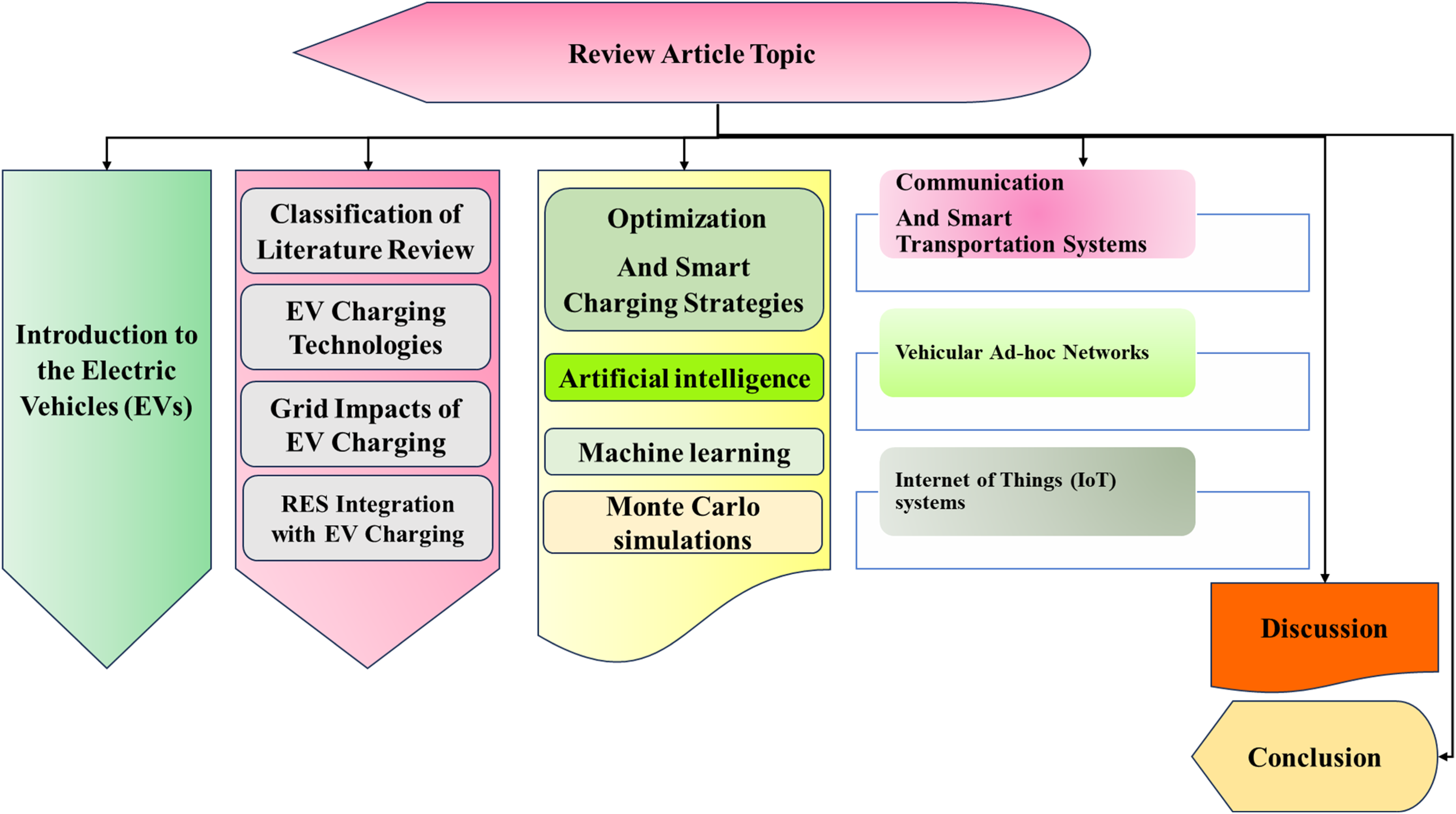
This review thoroughly evaluates the fast-charging infrastructure for EVs and examines its impact on power networks, drawing on the latest information available from 2014 to 2024. Earlier studies have generally focused on just one factor, such as charging methods, the impact on the grid, or connecting renewables; however, this work links them all. Over 100 impressive publications were analysed by the review, which examines how FCS can cause voltage fluctuations in distribution networks, lead to poor transformer health, and result in greater peak loads. It primarily promotes hyper-fast charging (>350 kW), requiring additional effort to manage the power grid and modernize supporting infrastructure. The paper explains that PV systems with battery energy storage systems (BESS) help decrease our reliance on the grid and lower the impact of intermittent renewables. It also focuses on V2G technology, which enables EVs to send energy back to the power grid when needed. Research in this area helps explain the connections between theory and practical applications, which are useful to those who develop and implement policies. Smart charging applications utilizing artificial intelligence (AI) and machine learning (ML) for forecasting, load management, and secure energy transactions are mentioned. The text examines the economic, regulatory, and policy considerations necessary for accelerating vehicle growth. Engaging the fields of technology, operations, and socioeconomics, this study offers a new framework for making EV fast-charging networks more sustainable worldwide. The key topics addressed in this review are summarized in Figure 4.
Topics of our work.
Classification of literature review
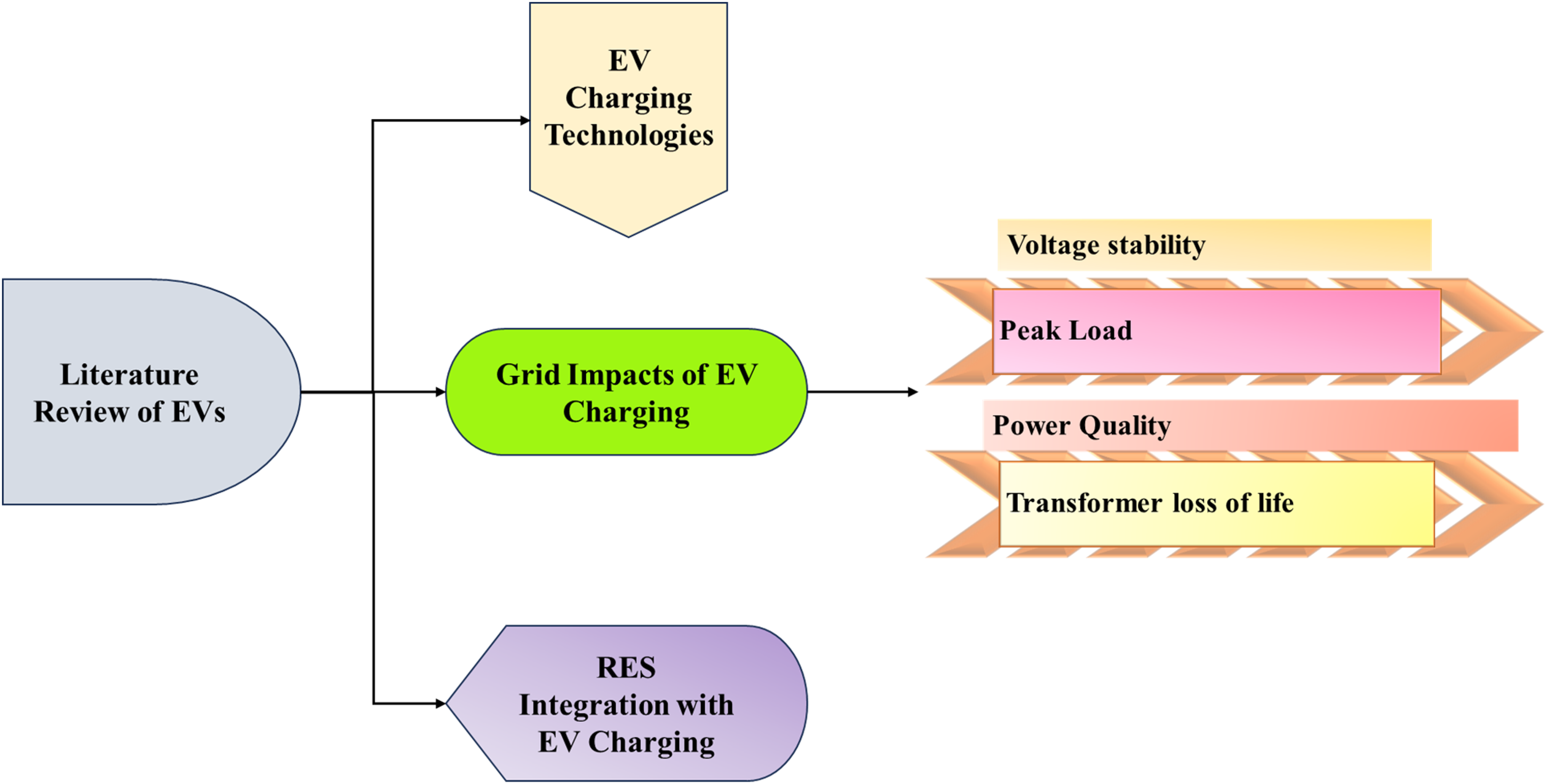
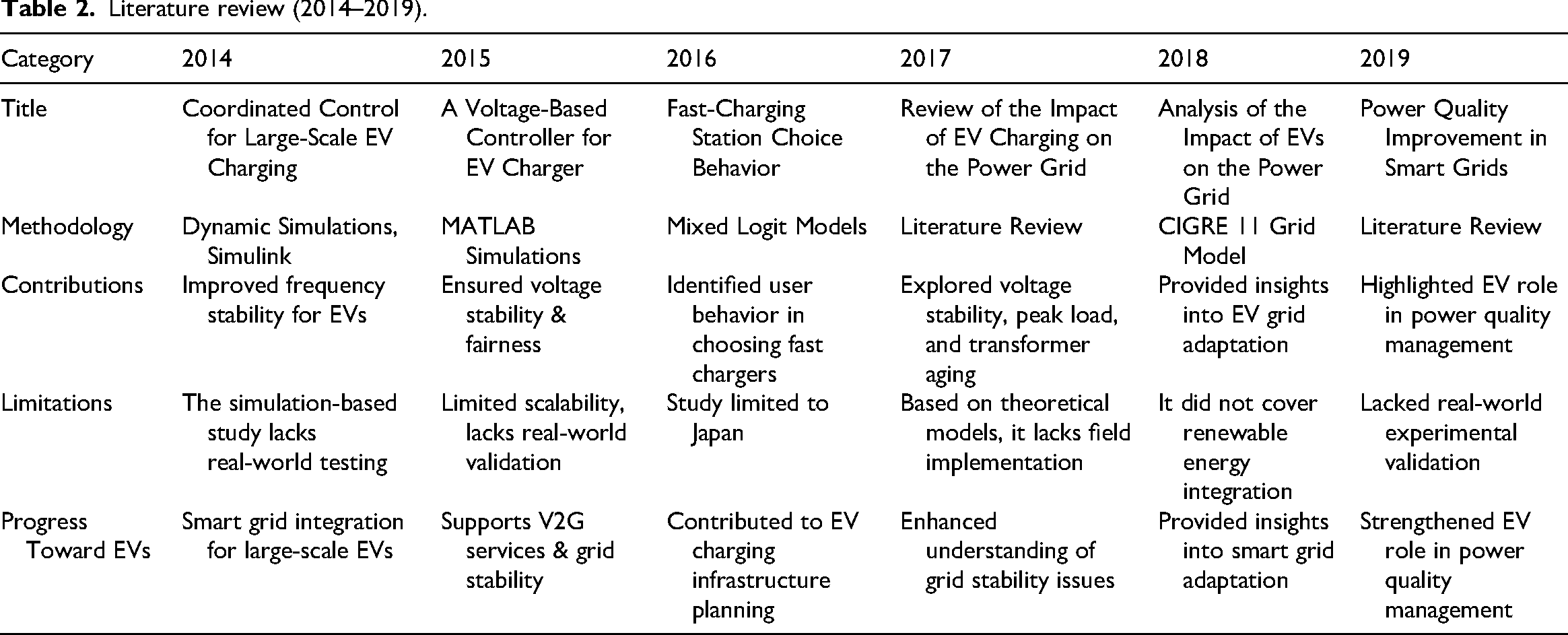
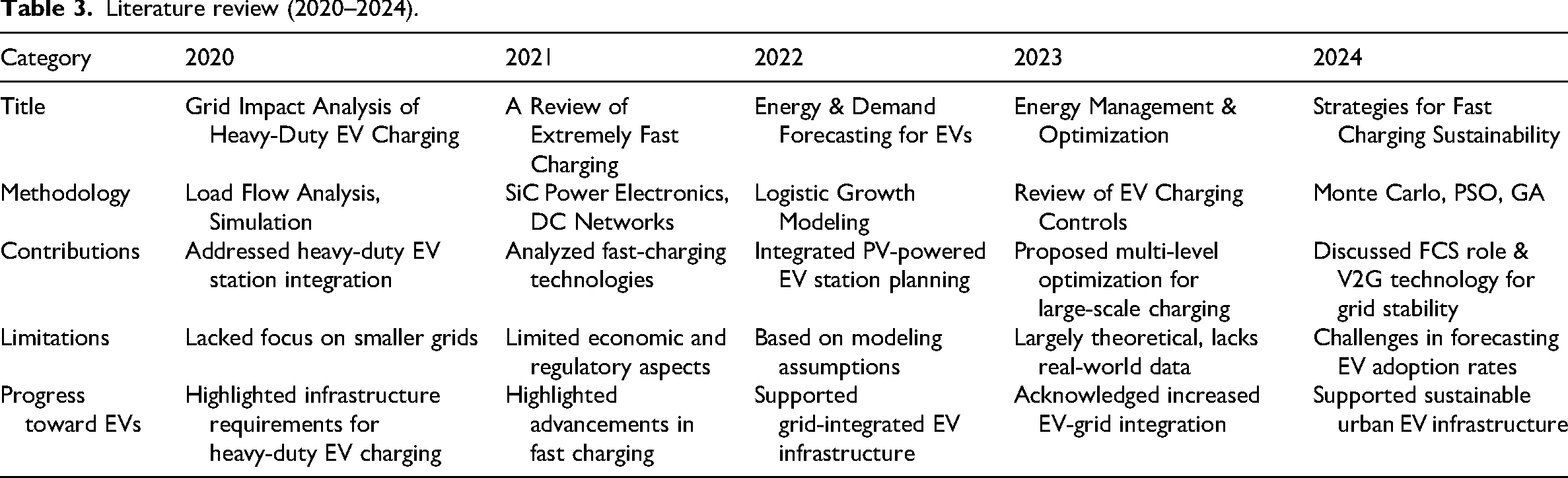
The literature review on EV charging infrastructure and its impact on the power system is presented in Figure 5, which encompasses five key categories. The field of EV Charging Technologies is dedicated to creating faster charging stations and innovative charging management systems that implement multiple ports to reduce waiting times while enhancing operational efficiency. The analysis of grid impact due to widespread EV charging investigates power distribution effects, including changes in power consumption and maximum usage patterns, as well as necessary network upgrades for efficient electrical control measures. EV charging generates multiple power quality issues, including voltage flicker and harmonic disturbances, which can lead to unstable power grid conditions. Voltage Stability studies how energy from EV charging affects the reliability of the power grid. It ensures network integrity by managing through the use of distributed generation (DG) and voltage controllers. It explains how by pairing solar PV panels and battery storage systems with EVs, operators improve how the power grid is supplied by renewable energy and reduce their reliance on fossil fuels. The differentiated classification approach explains both the challenges and the solutions regarding EVs and the power grid. Table 2 provides the information on literature reviews from 2014 to 2019 and Table 3 includes those from 2020 to 2024.
Classification of the literature review.
Literature review (2014–2019).
Literature review (2020–2024).
With more people using EVs and wanting dependable, environmentally friendly charging, there has been a lot of interest in EV charging technology these days. Many books and articles look at topics like different types of EV charging, wireless charging technology, faster chargers and how EVs work with the smart grid. Studies have also explored the effects of charging methods on the stability of the grid, how efficiently energy is used and how long the batteries last. V2G changes have given EVs the ability to both charge and discharge energy, making them more useful for energy management. This will look at the main EV charging methods described in the literature, outlining what makes them valuable, what problems they have and their possible future developments. It will stress how the study deals with the industry's most recent and important developments and trends.
EV charging technologies
Typically, EV chargers fall into one of three categories: one-way, two-way, indoor, and outdoor. Generally classified into three groups, Figure 6 illustrates the various EV charging technologies.
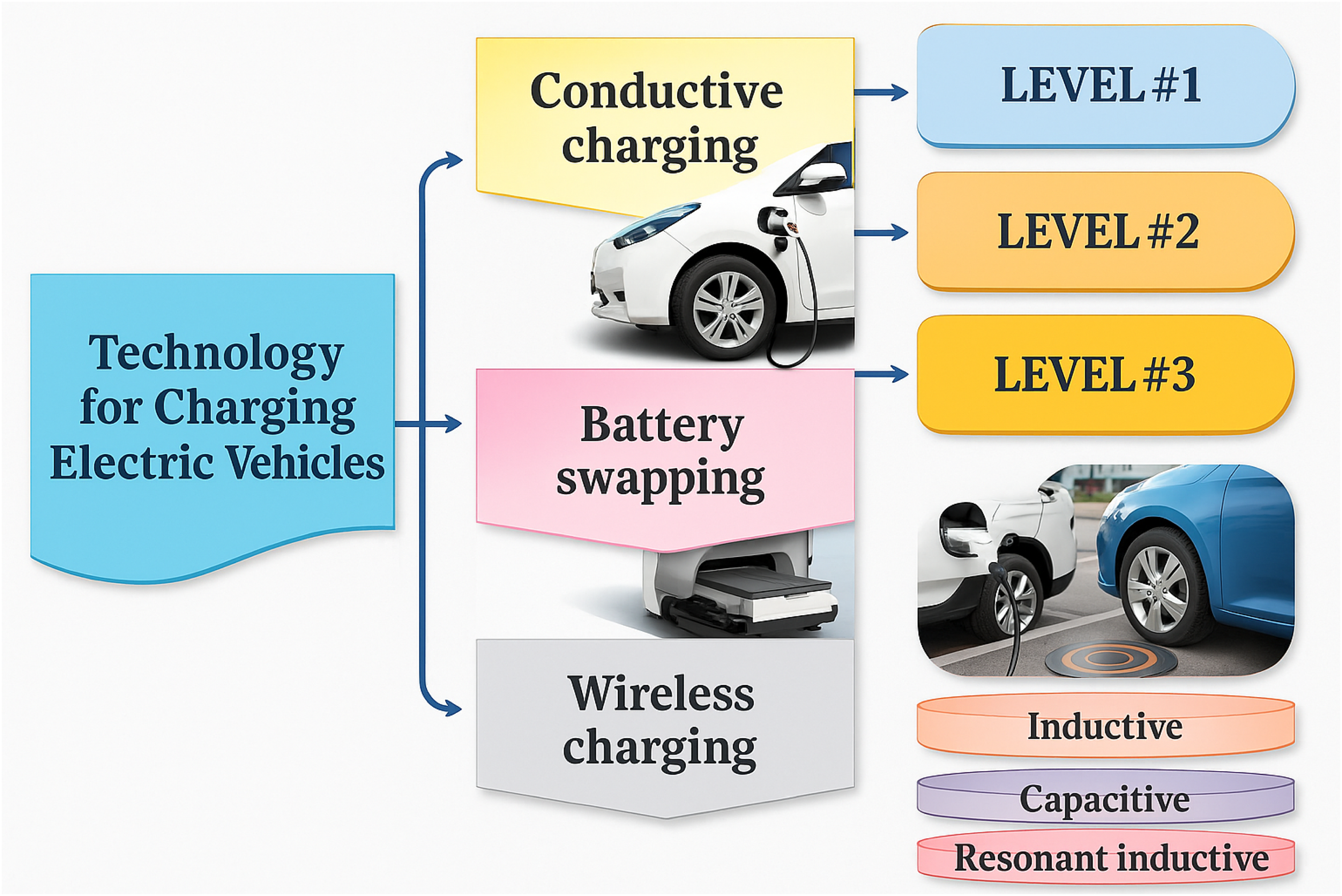
Technology for charging EVs.
Types of EV charging
Three levels of EV charging technology are distinguished by charging speed and power delivery (Taghizad-Tavana et al., 2023).
Level 1 charging is the most accessible and economical option, as it utilizes standard 120V wall outlets. However, it is slow, taking 16–20 h on average to charge fully. Commonly utilized in both residential and business settings, Level 2 charging uses 240 V, drastically reducing the charging time to 8–12 h. The quickest method, Level 3 Using 480 V DC power, Level 3 charging fills an EV battery from 0% to 80% in around 20 to 30 min. Still, you have to use these charging stations and cannot recharge them at home. Depending on what the user needs and how the infrastructure is accessible, every level gives specific advantages.
Resonant inductive, capacitive and inductive charging are the main types of wireless charging used with EVs.
Inductive charging: Inductive charging is possible even without careful lining up or direct contact with the car, making use of electromagnetic induction to charge the EV batteries. Resonant inductive charging resonant inductive charging is meant for applications that demand a lot of energy and usually can reach up to 5 m. EVs with receiver coils and parking spaces with transmitter coils allow for a magnetic field that improves power transmission. Capacitive charging: Consumers claim that you can use physical contact to move power from one phone with a case to another phone wirelessly, relying on moving charges in the space between the phones. The characteristics and uses of every technique vary and factors like the amount of energy, how efficiently it works and the size of the area being heated all impact its application (Taghizad-Tavana et al., 2023).
There have been many research papers on fast charging techniques. Another example is a review of EV charging stations and power distribution networks (Sudev and Sindhu, 2025), that explains both the strains and improvements they bring. EVs being preferred due to their environmental benefits, results in a number of operational difficulties for power systems. Split EV charging facilities into categories, including Level 1 AC, Level 2 AC and Fast Charging DC, according to their required voltage, current and duration of use. This document looks at how wireless charging benefits people driving EVs.
Modern fast-charging systems, which explain the technological barriers to EV adoption, are presented alongside new solutions through advanced power electronic systems. Silicon carbide-based power electronics and the integration of renewable energy sources with DC power networks, as shown in Figure 7, provide essential technological benefits for developing cost-efficient extra-fast charging (XFC) stations. The review thoroughly assesses the necessary infrastructure requirements and international standards that must be met before implementing XFC technology across different regions with distinct regulatory frameworks. XFC stations undergo an environmental impact analysis, and experts believe their EV adoption capabilities lead to lower carbon emissions in the transportation sector. Security guidelines for advanced charging infrastructures are a core component of this work, as researchers outline the necessary safeguards to protect against cyberattacks that could compromise these networks (Deb et al., 2021).
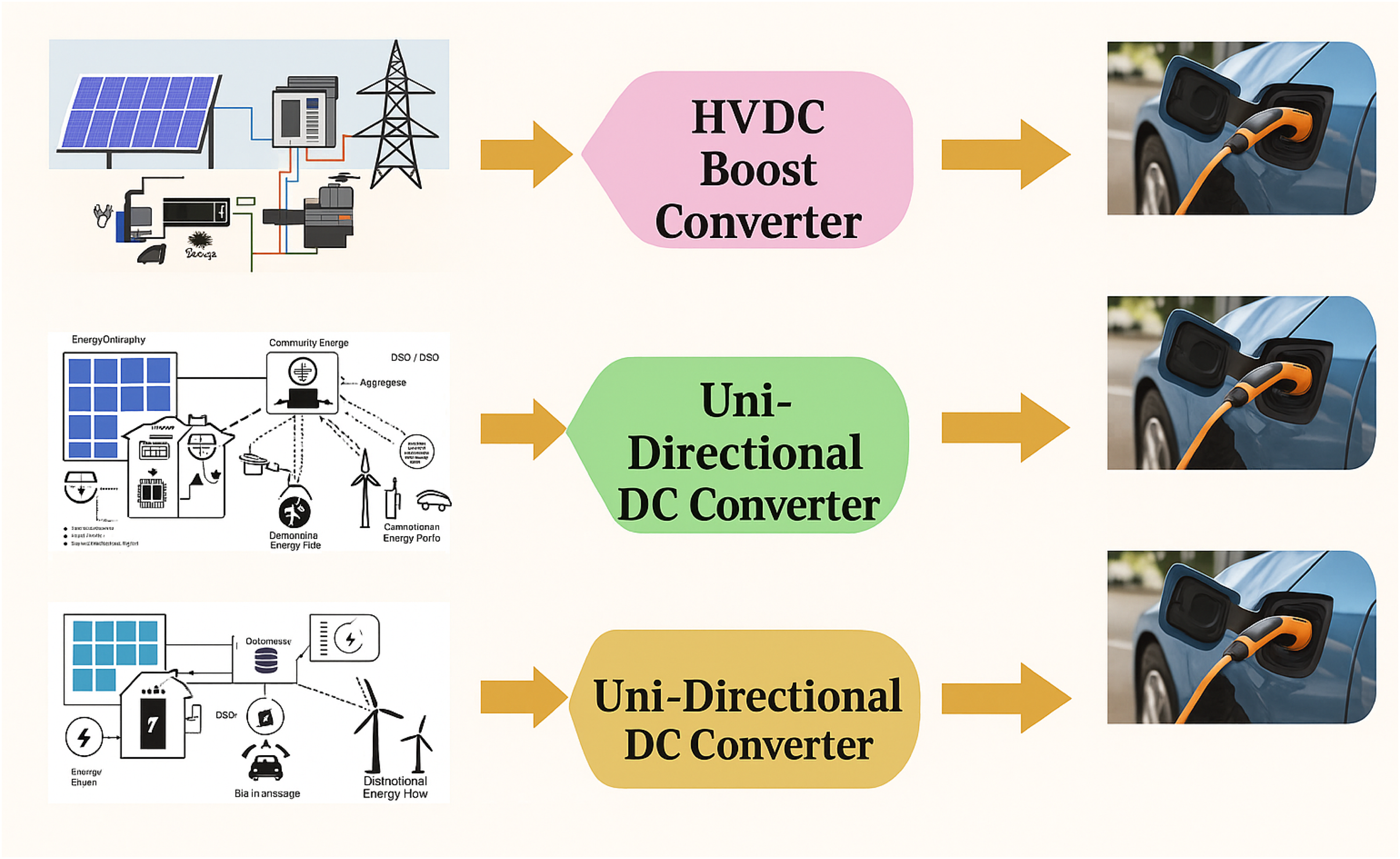
DC XFC charging and renewable energy infrastructure (Deb et al., 2021).
The rising popularity of EVs presents them as an eco-friendly solution to replace conventional internal combustion engine vehicles. Sustainable transportation requires EVs because their environmental advantages include reducing GHG emissions and minimizing noise pollution. The general adoption of electric cars faces resistance due to the difficulty of building dependable, fast-charging facilities throughout regions. According to Figure 7, FCS require strategic development to meet power grid compatibility requirements, including storage and load components. For charging stations to be built, renewable sources like solar and wind along with energy storage should be used. Combined renewables make the electric grid need less charging and they also reduce harm to the environment and reduce demands on the grid system. Relying on tools like Monte Carlo algorithms and particle swarm optimization (PSO), it becomes possible to find the ideal location for stations and boost power grid durability and lessen spending.
Studying V2G is considered a main area of interest. V2G systems help EVs send power back, enhancing grid reliability and cutting down on energy generation plants. Extra investigation of V2G benefits is required to help predict energy flows and user behavior. Limited electricity, slow recharging and not enough stations stop EV makers from attracting all the customers they might sell to. For EV adoption to get better, we also need new battery designs and EV stations to be set up in convenient locations. Improving how EV drivers are able to charge makes them happier and helps give drivers confidence, making more people adopt EVs. The economic base of charging stations depends on how costs for construction, operation and energy are well allocated. The development of new energy systems is required to handle issues related to scalability and the changing nature of clean energy, since such sources are helpful for the planet though may create technical problems. Despite these issues, improvements in FCS and renewable energy integration underline the growth of EV infrastructure. Charging EVs sustainingly by combining engineering, money management and care for the environment (Mohammed et al., 2024).
Making an EV fast charger by using a system with dynamic control to overcome the difficulties in current EV charging stations. The technology collects live data from connected vehicles to help manage EV delays at charging points, lower the cost of facilities and make sure resources are distributed efficiently. One multi-port charger will be used as the central system, so fewer separate electronics converters will be needed and costs can be reduced. It involves forming the mathematical models for fast chargers to make sure they meet the standards set out by EVTECH espresso. Charging operations start with a control system checking SoC readings from the linked cars and deciding on the best current levels. Technologies at levels from 0% to 20% are charged with constant currents which are also used for levels from 80% to 100%. Dynamic adjustments are performed between 20% and 80% by considering the number of vehicles joining. It makes sure that electric power is distributed the same among devices and keeps charging stations in use most of the time. Simulink tests prove the ability of the method to change charging currents when the system operates under different conditions. The process makes certain that each EV is charged properly by reorganizing the charging current based on charge levels they reach, thus giving optimal battery-charging conditions to all connected cars (Naz et al., 2024). Combining a DC-link capacitor with filters enables power stability by decreasing the voltage and current ripples. The research introduces a dynamic control approach that accelerates services and reduces converter expenses to build scalable solutions. The study primarily employs simulations, which yield limited evidence regarding the implementation of this solution in diverse environments. The threshold dependency for State of Charge (SOC) may not function correctly across all vehicle types and various battery chemistries. The proposed charging solution promotes EV adoption through its efficient and scalable design, which effectively addresses the growing need for sustainable transportation. Future investigators should study how modular designs interact with microgrids and BESS, as this would improve system adaptability and performance (Naz et al., 2024).
DC fast charging (DCFC) technologies and their impact on the EV market and electricity networks. It determines their optimal dimensions and suitable placement areas while investigating how direct current power shapes rapid charging facilities. The reviewed data demonstrate how quickly EV charging enabled by DCFC produces benefits against range anxiety but burdens power grid systems with substantial requirements that result in higher operating costs, as well as the need for expensive system upgrades. This research paper assesses the requirements of smart grids and the potential impacts of integrating direct current fast chargers. Implementing direct current fuel cell technologies requires enhanced research to develop better energy storage systems (ESS) and advanced grid management approaches for addressing power requirements at high levels without compromising system stability and operational efficiency (Sawant and Zambare, 2024).
This study looks at what makes EV owners decide on certain FCS. In Kanagawa Prefecture, Japan, mixed logit analysis determines which station factors and costs impact the choice of creating a detour for charging EVs. EV users prefer to go to stations where working-day and non-working-day patterns are similar among all types of cars, according to what the study found. It makes a strong contribution by providing a detailed look at how people select their train stations. The results suggest that strategic planning and high-performing infrastructure for fast charging can help increase EV acceptance and push forward a change to sustainable transport (Sun et al., 2016).
Explore new ways to manage (Sun et al., 2016) EV FCS through research. The decision of an EV user to select a FCS is based on stochastic changes and a logit station choice model that considers costs, waiting and extra distance involved. The management plan uses flexible cost protocols and ensures that stations update their prices as the line waiting gets shorter or longer. The study shows that altering prices based on client demand produces fast-charging solutions and balances station usage, which helps both the system and users. Pre-built software makes it easy for EV charging operators to respond to changing needs in real time and enhances the practicality of their infrastructure for using and promoting EVs and supporting the environment.
Checking PV-grid DC fast chargers for EVs by studying their control, the things they include and the power electronics involved. The analysis checks how power from the PV generators, the grid and the storage devices interact by relying on power electronic devices to optimize energy use. There are optimization algorithms for both battery management systems and charge management systems as part of the evaluation to make the charging process more effective. As proved by research, adding energy storage to DC charging using solar sources supports higher efficiency, less dependence on the grid and better stability for the grid itself. A review on EVs explores three significant elements: designing efficient chargers, using soft-switching DC–DC topologies and checking their effect on power quality when applying PV-grid methods and V2G applications (Ashique et al., 2017).
FCS works through PV technology and an ESS, with power also supplied by the local grid. This new system uses a centralized approach that works by regulating the medium-voltage DC (MVDC) bus supply. Different EV charging situations are set up on the simulation platform in MATLAB-Simulink so that the control system controls the power changes between PV, ESS and grid depending on the MVDC bus voltage and the ESS's SOC. The separate decentralized controls operate by themselves, so they do not need to talk with each other, which results in more adaptability and room to expand. Modeling studies indicate that using this approach maintains a stable voltage on the MVDC bus by fine-tuning solar power production, covering around 69% of the energy needs and helping to cut reliance on the power grid. It states in the conclusion that the developed decentralized EMS can handle EV charging by maintaining a balance of power and running operations without issues. Investigations should pay attention to testing how well the system can sustain faults and unexpected events under grid and DC conditions. Creating a reliable renewable energy solution for charging EVs adds great value by making grids self-sufficient, supporting fast charging and making it possible to introduce more renewable power for sustainable transport (Garcia-Trivino et al., 2016).
The study investigates how battery EV drivers in the Netherlands select their routes considering they have to charge their vehicles. Data from 505 EV drivers, using a stated preference survey, was used to develop models that chose the best ways for EV drivers to move between roads and reach FCS. In the research, Mixed Logit model helps analyze which drivers impact the preferred route using time spent traveling, expenses, the degree of remaining battery and the opportunity to charge on the way. travels on routes with available fast chargers when they initially have little charge in the car, but switch to routes with minimal vehicles when it is time to quickly top up the charge. The findings in the research support better transportation planning strategies by discussing the placement of charging stations and its role in people's travel routines. Thanks to this work, drivers feel less worry when using EVs and the adoption of EVs increases (Ashkrof et al., 2020).
Strategies to connect EV FCS with photovoltaic (PV) solar systems through detailed power prediction procedures that minimize the effects on the power grid. A logistic growth model (LGM) is used in this study to predict EV adoption levels, from which the study estimates charging station energy consumption and power requirements. The scientific investigation takes place in Campinas, Brazil, through a pilot program deploying 12.5 kW PV systems and 50 kW direct current fast chargers with lead-carbon batteries as storage units. This research connects the history of vehicle datasets to LGMs as a tool for projecting future EV fleet development within metropolitan areas. According to the S-shaped logistic curve, EV adoption starts quickly before reaching equilibrium as the market fills up. The optimistic and pessimistic, along with moderate scenarios, show that by 2030, Campinas could have between 28,645 and 65,891 EVs. Research demonstrates that public EV charging infrastructure receives recharges from 15% of users. EV energy usage is determined by combining the average daily travel distance, EV power efficiency, and the rate of public charging station usage. The developed plan relies on local information to establish power-efficient EV charging stations backed by renewable power sources and storage solutions. PV systems integrated into the electricity grid decrease dependence on power utilities while establishing a renewable-based energy source. The study yields practical results that inform policymakers and urban planners on targeted infrastructure planning to align with the level of EV market penetration. However, the research has limitations. This analysis relies extensively on data models and reveals constraints when dealing with Brazilian consumer charging activity, as it has minimal actual data. The analysis fails to account for all elements that influence EV adoption due to differences in economic conditions, technological advancements, and regional characteristics. The implementation of PV systems in city-based charging stations encounters hindrances when scaling up their capacity and energy reserve capabilities. The research suggests that blending renewable energy operations, detailed engineering and localized planning increases the capacity of the power grid and helps expand EVs. Further studies are needed that analyze how the models are applied in practice and the system should be modified so it can fit the needs of diverse city areas. This study backs the drive by nations to select safer and greener ways to move goods and people (Castro et al., 2022).
Grid impacts of EV charging
An overview of detailed research on EV grid integration is given in this section. Connecting the battery storage system of an EV to the power grid is done with the EV charging/discharging system, which is where EVs interact with the power grid. V2G and grid-to-vehicle (G2V) technologies handle the processes of charging and discharging batteries in the power grid. When EVs charge or discharge from the grid, it can shape power quality, grid dependability and energy economics. In the following sections, we explain current EV technology and discuss the problems in integrating EVs into the grid (Tavakoli et al., 2020). The process of EVs being used with the grid is depicted in in Figure 8.
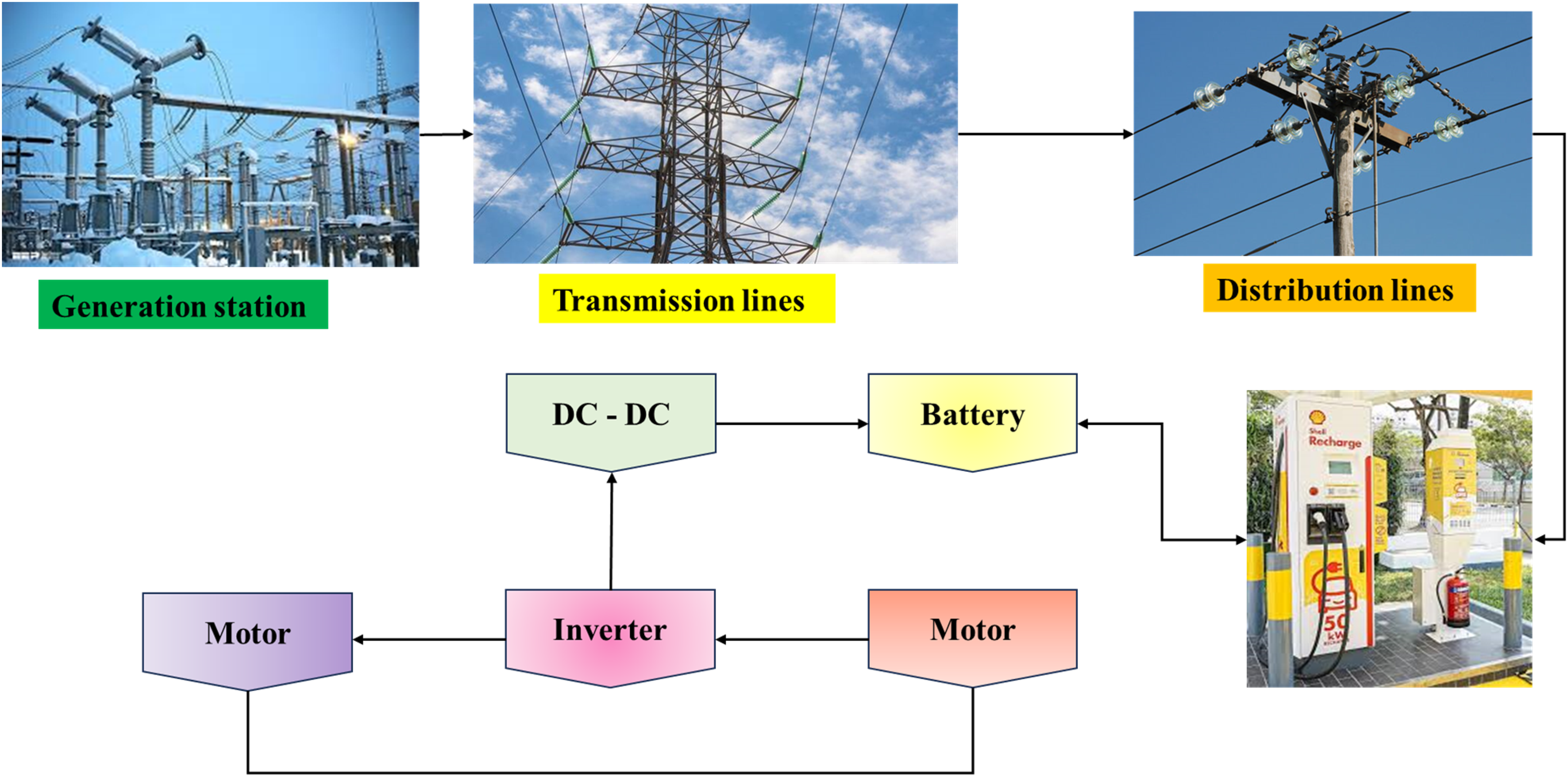
Shows the connected grid with EV.
Studying how EVs work together with electricity infrastructure and their control methods. This part discusses the main role of the power grid, which is to successfully convey electricity to consumers and ensure the power is delivered using effective controls. Finding it hard for energy companies to adjust energy supply and demand when there is low availability of conventional electricity due to very high renewable generation or when usage is higher than the output. In using the CIGRE 11 model, the study uses simulation techniques to consider how adding EV chargers will influence power delivery, voltage changes and magnified line loss. Results from these systems with and without EVs are compared to find out how EVs affect grid operations. This article explains how smart grids enable real-time communication between system operators through standardized protocols, thereby enhancing monitoring capabilities. It dedicates substantial attention to multiple energy storage technologies, such as pumped-storage power plants, compressed air energy storage, and batteries, through their role in EV equipment and their capability to act as supplemental energy components in hybrid systems. Charging stations for EVs are placed where electricity is used less so that demand on the grid is controlled effectively. It is stated here that primary, secondary and tertiary controls are the main methods used under control methods to help keep electricity quality unchanged on power grids according to the instant responses from power and frequency data. Because of these controllers, the grid remains reliable and efficient, even as more variable and sporadic energy sources are introduced, for example EVs. The author focuses on how EVs fit into regular power grids, mentioning the minor effects disruptions might have and how much good it can do. This review explains that in addition to serving as vehicles, EVs have a key role in today's smart grid networks. These grids rely on battery storage to stabilize the grid and offer backup power in emergencies which makes the grid more sustainable (Kasprzyk et al., 2018).
EV charging can destabilize the voltage on the power grid when there are quick rises in load and causes the grid to experience peak demands and problems with power quality because of harmonic distortions and voltage sags. Transformer degradation often happens at the exact same time as different problems with charging sequencing. Several studies suggest that EVs can use V2G technology to add excess power to the grid. As a result of this new system, the grid can handle peak demand, grid voltage is stable and frequency remains constant, so EVs cause fewer issues. Previous studies are assessed using both quantitative and qualitative methods to show how their problems can be addressed. Thanks to charging and set tariffs, adding EVs to the grid produces less strain on it. Set out new ways to advance electricity research, by researching energy providers’ costs and linking those costs to the influence of power grid stability indices (Deb et al., 2017).
In the article “Impact of Electric Vehicle Charging Station Load on Distribution Network” [21], authors analyze how EV charging loads influence voltages, the reliability of power loss indices and economic costs. IEEE 33-bus test system makes it possible for the study team to analyze how FCS impact the network. While evaluation, experts analyze how differently placing charging stations affects the voltage in the network, harmonic distortion and highs in energy demand. The research focuses on simulating charging systems with different values of penetration by using a new metric called the voltage stability, reliability, and power loss index. It is used to spot the best locations for charging stations where they will have a minimum impact on the distribution system. The final part claims that strategically locating EV charging stations helps avoid voltage instability and the consequences of higher peak demand. The smooth operation of EV infrastructure networks depends on using appropriate integration strategies and control systems. The paper takes big steps toward explaining how EVs are handled in power systems. In the paper, important issues are thoroughly studied and proper solutions are proposed; these findings support utility operators, creators of new policies and teachers in the smart grid and electric car technology fields (Deb et al., 2018).
Methods for integrating multiple EVs into power grids, while also exploring solutions for maintaining voltage stability. A unique modeling approach examines EV mobility in conjunction with power grid behavior until it identifies the worst charging scenario that poses the greatest threat to grid stability. Dynamic simulations integrate transportation data with power grid data to predict maximum EV load conditions, enabling the grid to operate under stress conditions. The conclusion stresses that proper planning behind EV charging stations will reduce grid instability risks during their operation. The study presents an assessment model for urban planners and power grid operators who need to enhance grid resilience as the adoption of EVs increases. It illustrates how transportation is connected to power infrastructure within urban areas (Lyu et al., 2020).
Strategies to improve how much energy is used as electric cars become more widespread. The high electricity demand from EV charging operations can upset the power grid which might cause more GHGs because some electricity comes from fossil fuels. Recent research on EV charging control and optimization explores ways to optimize smart charging and lower how much they affect the grid. Because current energy management methods cannot cope with the excess power needed by many EVs charging at once, grid stability is at a high risk as EVs are adopted more widely. Using both controls and optimization correctly allows EVs to give important services to the electric grid that help keep it stable and reliable. The research moves the field forward by suggesting energy management systems that support the sustainable use of EVs in the electric grid. It recommends advanced multi-level optimization since these systems are able to address how complicated and variable EV charging is, thus improving grid reliability and helping more clean transport technologies be used. The support of international environmental goals is provided by the proposal, since it leads to less GHG emissions and strengthening of energy infrastructure (Kene and Olwal, 2023).
Integrating EVs with power systems through optimized charging protocols, designed to protect the power grid while also enhancing benefits for EV users, retailers, and system operators. The computational methods generate performance-based assessments for different implementation strategies, followed by physical laboratory testing. The presented strategies successfully enhance power system operational resilience and flexibility, as outlined in the final section of this work (Depature et al., 2017).
Comparing data from on-site charging and from simulations and developing the Electric Vehicle Charging Grid Impact Index (ECGII). It uses the ECGII to forecast problems with the electrical network, by taking power demand, short-circuit measurements, disturbances from harmonic Muhammad Akmal currents and power factor into consideration. By studying this, it becomes clear that the combination of BESS and solar PV tech can fix some power quality problems. The ECGII is still useful, but it needs to be tested on real operating grids as it does not consider all the differences between grid regions. The information supports utility companies in making power sources consistent and in maintaining a stable grid, which helps build sustainable electric mobility (Vasconcelos et al., 2024).
The way that charging and discharging EVs impacts the power grids in use. To assess the effects of incorporating EVs into the grid, researchers carry out computer simulations and use various models of load, power capacity and quality. By using models that reproduce EV-related qualities in the power grid, it is now possible to check voltage stability, power loss and the impact of harmonic pollution. Two key concerns created by EVs are harmonic pollution and voltage stability and these issues can be properly handled by adjusting chargers and using V2G technology. As a result of this study, it is known that EVs can stabilize grids and overcome power grid challenges which requires better grid control systems as more EVs are used (Li and Han, 2017).
Operating parameters of the grid affected by the EV charging station
The adverse effects of EV chargers on the power distribution network cannot be overlooked, even though electrifying the transportation industry has numerous positive effects, including lower CO2 emissions, reduced pollution, and lower global warming. Nevertheless, the V2G concept can also be utilized to impact the power distribution network through chargers positively. Figure 9 illustrates the impact of the charging station’s positioning on its operating parameters.
Power Quality Issues: The ability of a power distribution network to provide a steady, disturbance-free output that is within voltage and frequency limitations is known as power quality, theoretically. Power quality in grids changes when EVs charge. It focuses on power factor changes and total harmonic distortion (THD) measurements. The research investigates how power plant operations under base and peak load conditions are affected when different numbers of two- or four-wheeled EVs connect to the power grid through MATLAB Simulink simulations. EVs do impact the levels of power factor and THD in the power system, but results change a lot depending on the load placed on the system. For reliability, grid systems should have strategies to handle a rise in EVs so that the power output remains excellent. The findings from this research point out how to adapt power grids as EV use rises by recommending important adjustments (Aggarwal et al., 2020). With G2V and V2G, EVs improve the quality of power in the modern smart grid. Experts can determine the solutions for power quality problems using EVs by analyzing studies on G2V and V2G technologies. Using EVs offers many good results, though the system and laws must be improved to make sure the entire power system can benefit from them. According to the analysis, EVs can resolve power quality problems, but more progress in technology and policies is necessary for them to work best in smart grids (Ahmadi et al., 2019). Studying the impact of high-power FCS on the voltage levels in electrical grids. Simulating EV charging allows engineers to see how the stochastic nature of power consumption might cause voltage flicker. Researchers look into the intensity and timing of voltage flickers from FCSs when there are sudden high-power demands to better know about power fluctuations in the existing electrical networks. A number of simulations are used in the paper to see how high or low battery sizes and the times when charging stations come influence voltage and if this can result in annoying, even hazardous light flickering. Researchers found that many FCS units in operation led to major disruptions in power networks, so changes in the way chargers are set up and upgraded power systems are needed to avoid these problems. The findings enrich electrical engineering by showing new methods of managing the grid and building infrastructure that makes it easier to use EVs (Oubelaid et al., 2024). The power quality modifications that arise from integrating EVs in distribution networks through existing solutions. EV charging and discharging operations can cause voltage imbalances, while harmonic distortion often emerges in conjunction with transformer failure incidents. The research method includes reviewing current and future EV power quality literature and developing a composite transformer disturbance controller with separate evaluations for active harmonic filters and FACTS devices as reactive power compensators. The results demonstrate how the increased adoption of EVs can lead to instability in power grids; however, proper EV integration and specific phase reconfigurations, combined with modern filtering technology, can help maintain system stability. The research makes significant contributions to EV studies by examining the value of intelligent charging strategies, renewable energy management, and AI-enabled grid supervision systems. The paper proposes ant colony and particle swarm optimization algorithms to increase system functionality and decrease transformer life deterioration (Srivastava et al., 2023). The effects of EV FCSs on the grid (Wang et al., 2021). The current trends and standards present issues with strategic solutions. The necessity of fast charging to address EV range anxiety creates grid challenges that result in power quality issues, including voltage instabilities, harmonics, and system instability problems. The article breaks down the technical aspects of fast charging by evaluating existing standards, including CHAdeMO GB/T and CCS, and explains how UFC systems have become essential. The research analyzes performance quality (PQ) complications facing FCSs, including high-power pulse loads, through reviews of voltage imbalance, harmonic distortions, and prohormone emissions. The study examines the PQ standards of IEC and IEEE that apply to FCSs, while proposing practical solutions. Improving stability and harmonics reduction depends on three main techniques: innovative charging strategies, ESS integration, and impedance-based approaches. ESS integration helps balance pulsating loads, minimizing the demand for extensive grid expansions alongside impedance approaches that assist in developing stable charging systems within weak power networks. An analysis of PQ challenges from a business point of view, the assessment of current standards and an outline of mitigation strategies for charging under different conditions. The document points out that systems should be designed to support all kinds of power grid situations and be managed with advanced control systems. It is not possible to validate the hypothesis in real experiments because its approach is only based on models. It covers typical problems with interoperability and the patterns of EV charging load, but focuses on the explored studies, limiting its general usage. The research provided improves the use of EVs in the grid by handling main grid issues that would eliminate unstable power deployment. They should establish specific PQ standards for FCSs and conduct field testing to increase how well the solutions can be put into practice (Wang et al., 2021). Voltage Stability: Voltage stability is one of the most significant adverse effects of EV charging stations. Voltage stability is defined theoretically as the power system's ability to maintain stable voltages at every bus once disruptions have ceased. An abrupt rise in load is one of the leading causes of voltage instability. When charging EVs, the voltage can get affected because of the Earth's charging current. In the paper “Analysis of Impact of Electric Vehicle Charging Station on Voltage Stability Issues and Improvement Using Distributed Generation (DG),” the main concern is how EV charging stations influence electrical networks through voltage stability issues and how DG can help address these issues. The case study uses MATLAB to model an IEEE 33-bus system and researchers study how adding EV charging stations to various buses affects voltage levels and the system's stability. To analyze voltage changes at various parts of the system, simulations are performed together with load flow methods (Forward and Backward Sweep Methods). The report points out that EV charging can affect the stability of voltage and it mainly impacts busses with low electricity capacity. To deal with this, the report suggests relying on DG systems. The paper contributes to the field by carefully exploring how electricity grids are affected by the charging of EVs. It suggests using DG technology to lower the influence on power systems (Aggarwal and Singh, 2021). A detailed approach for managing and optimizing EV charging to avoid instability in power systems is given in “Electric Vehicles Charging Management and Control Strategies.” In this research, analyzing is done by looking at models and improvised data, gathered from real EV charging stations, to assess various charging methods. Researchers can use advanced computer tools to simulate the impact that charging EVs has on the electricity supply. It proves that by using intelligent charging strategies, the grid remains steady and EVs get charged effectively. It helps in building adaptable charging stations so EVs can be integrated into the power system without dropping supply (Fang et al., 2021). Having a built-in battery in the charging station that lets it control and monitor EV battery charging without any real-time exchanges with the grid. The controller makes changes to the charging rate depending on the amount of power going into the car and voltage from the grid so that all vehicles are charged evenly and no voltage rules are violated. The controller is evaluated in detail through simulation of system operations and configurations. With the help of the controller, the energy grid manages to stop any voltage issues, arranges power distribution and guarantees continuous system stability as EVs slow down or switch off when preferred by the owners. Through research, the integration of electric automobiles into the grid is achieved with a method that guarantees all use gas and leaves the power grid's stability unchanged (Al-Awami et al., 2015). How the short-term performance of power networks is affected by using superconducting magnetic energy storage (SMES) together with gridable vehicles (GVs) using V2G technology. The investigator checks how effectively these technologies can maintain voltage and frequency by controlling active and reactive power in case of problems. A system model is created first as part of the methodology and afterward different fault scenarios are evaluated and simulations are run using MATLAB/Simulink. System responses are checked using three tests which involve GV penetration at different levels and with SMES support. The stability advantage exists for both SMES and GVs; still, SMES provides a better performance money can buy with its fast response. SMES installation costs are still high, which means this technology needs to be the right size to guarantee stability when there are not many GV resources. Storing energy at high power levels when the grid is unstable and these technologies are used, as cost is also managed meaningfully. Using V2G might allow EVs to help stabilize power grids and add new features to transportation networks (Wu et al., 2011). Transformer Performance: A significant factor in reducing the transformer's life cycle is the additional pressure that massive EV deployment places on distribution transformers. The transformer's peak temperature rises with increasing load (Godina et al., 2015). EV charging increases the load, thereby raising the ambient temperature of the hot spot. Uncoordinated charging is detrimental to transformer performance. The effects of tariff-based, coordinated, and uncoordinated charges on transformer fatalities (Grahn et al., 2011). Peak Load Demand: The increased demand for EV charging raises the grid's peak load demand, decreasing the reserve margin. The impact of unrestricted EV charging on the everyday load pattern (Varshosaz et al., 2019). The daily load variance with varying EV saturation (Jung et al., 2014). EV FCS on the roads affected the grid's peak load demand, as referenced (Pourvaziri et al., 2024).
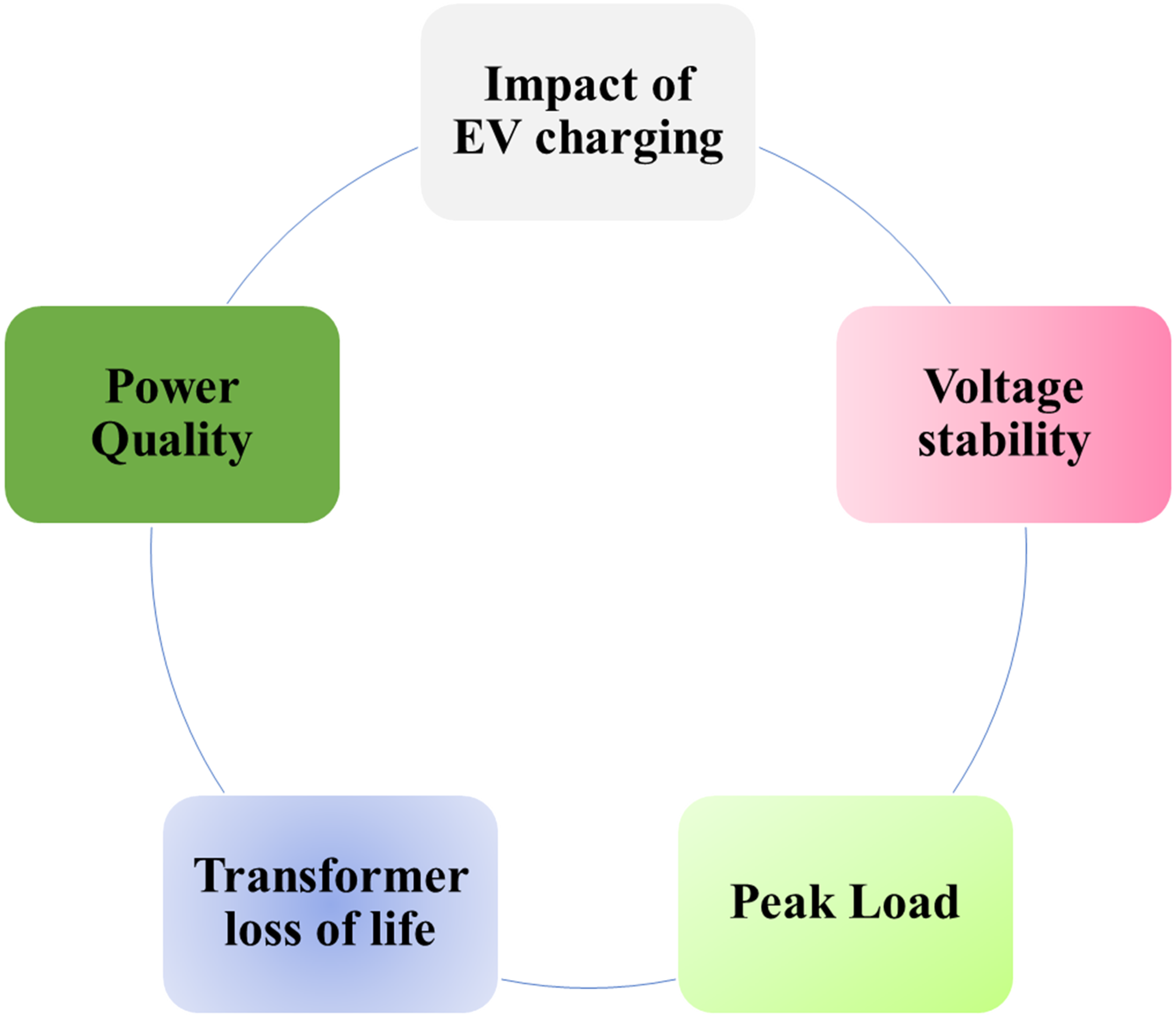
Charging station effects on operating parameters.
Renewable energy integration with EV charging
Governments have reduced their carbon footprints in response to the deteriorating energy crisis, growing environmental awareness, and the adverse effects of climate change (Barman et al., 2023). Utilizing renewable energy sources for charging EVs is one strategy illustrated in Figure 3. According to the US Department of Energy, EVs could consume twice as much energy when driving as conventional vehicles that run on fossil fuels, using approximately 60% of the energy input. Despite their extreme efficiency, the ability of EVs to cut GHG emissions depends on the power source that powers them (Yao et al., 2024).
Options to increase the usefulness of PV and ESS used along with EV charging stations. It studies ways to manage resources and control methods that improve the efficiency of electric grids, avoid fluctuations and make more profit—all based on research studies aimed at optimizing how renewable energy is managed for charging EVs. Having modern capacity management methods that respond in real time is necessary because it helps manage changes in solar power and provides for electric cars. Studying the technologies in detail, the book brings more understanding to the field. It proposes what can be done next with renewable energy and EV charging stations to support the effort to make power grids greener (Habib et al., 2020).
Various ways to lower energy bills in V2G microgrids using renewable resources are detailed in (Habib et al., 2020), Artificial Bee Colony method as the main example. ABC optimization brings together several objectives into one main objective to reduce expenses for operations, pollution and carbon emissions. Because it assesses various approaches under different conditions, the tool gives grid operators better ability to make decisions. The ABC method is proven to outperform Particle Swarm Optimization and others since it produces better cost solutions for minimizing objectives. EV research is helping this field by showing how EV systems operate with power grids, thus reducing costs and lessening their environmental impacts, primarily in microgrids. Both EVs and renewable energy systems are able to function well and sustainably (Deeum et al., 2023).
Proper placement of EV charging stations (EVCSs) in distribution systems powered by PV energy combined with storage batteries (BESS). It confronts the challenging job of placing EVCS so that it leads to fewer electrical losses, less voltage fluctuation and more efficient energy use. The method for optimizing EVCS placements relies on genetic algorithms (GAs) and forward and backward sweep analysis and considers networks with PV and BESS. This test system helps assess how EVCS are working with a large amount of renewable energy present. By using the best locations for the EVCS, which was achieved through the optimization method, 33% less power is lost and voltage stability increases. Sharing a strategy helps because it leads to less impact on the grid by combining different renewable systems to power EVCSs sustainably. With the research, those involved in EVs now have tools to optimize the use of renewable energy systems and EV chargers. It supports improvements to the electric grid as more EVs are used (Pal et al., 2021).
EVs working with the power grid and green energy sources
Working on the connection between EVs and smart grids is important because EVs can significantly improve the way the grid works and remains stable. One important innovation is giving more structure to charging stations and energy management, which are designed to handle the surge in energy usage that comes from EVs. Lately, new advances in charging technology have been seen, aiming to both enhance how efficiently EVs are charged and reduce pressure on power grids. The aim of these optimization algorithms is to manage charging so that demand response methods are used to make sure energy use is balanced and grid stability is ensured (Arif et al., 2021).
The growing complexity of integrating EVs into modern power systems has led to the emergence of interconnected frameworks that merge demand-side intelligence, stochastic behavior modeling, and optimization-driven infrastructure planning. Efforts toward managing EV loads at the residential level have adopted advanced optimization strategies for demand-side management, effectively regulating charging patterns to reduce peak grid impact (Panda et al., 2025; Renhai et al., 2025). Extending this idea further, introducing probabilistic methods into charging infrastructure design with queueing theory is required, as this captures how EVs move randomly from residential stations to high-power public alternatives (Varshney et al., 2025). o overcome the difficulties of handling many different variables, electricity industry experts now use specialized optimization algorithms like the enhanced wombat optimizer which helps keep power load stable on solar and EVs (Nagarajan et al., 2025), In these decentralized systems, combining renewable microgrids with V2G technology may help remote or less-electrified regions have autonomy and the ability to send or receive energy locally (Nadimuthu et al., 2024). Implementing this more widely relies on the correct placement of charging stations and studies have suggested that hybrid evolutionary algorithms can help strengthen the network and reduce power losses (Kumar et al., 2024). Recently, local energy control techniques have been teamed up with infrastructure solutions—for example, hybrid battery systems linked to ML are making it possible for light EVs to adjust their electricity use in real time (Punyavathi et al., 2024), thus allowing a glimpse into better management of whole networks of chargers. When dealing with EV charging, modern planning efforts are improving to handle different user levels and grid issues, which points to the need for energy and transport planning to go hand in hand (Kumar et al., 2024). Because of this synergy between charging and infrastructure, many efforts are now focused on extensively analyzing EV charging and exploring ways to align sustainable actions with technology advances (Singh, Vishnuram et al., 2024). Besides these views, new ideas like zero-energy vehicles produce their own energy from renewables during travel, freeing transportation from dependence on main energy sources (Polat et al., 2024), On the other hand, because charging single vehicles at high speed adds rapid load changes to the grid, researchers are developing new tools to ease both voltage and transformer effects (Aggarwal et al., 2024), Along with technology, the wider adoption of EVs calls for new business practices that promote economic success, involve stakeholders and make charging accessible for users everywhere (Sabyasachi et al., 2024). Real tests of V2G cycles confirm that EV batteries can exchange energy with the grid, play a role in reducing peak loads and help control the grid's frequency (Blazek et al., 2024). Finally, adjusting solar charging schedules by using swarm algorithms gives evidence of how renewable generation can be effectively linked to charging arrangements and lessen reliance on the main network (Chandra et al., 2025). All in all, these studies follow a clear line from setting up EV charging at the local level and random models to designing systems, using various sources for energy and updating infrastructure—which are all major concerns discussed in this paper, with analysis of EV charging strategies, their impact on the grid and renewable energy in fast chargers.
Lately, the V2G system has been the focus of many studies, showing that it can enable energy to move both from and to EVs. Because of this technology, EVs can supply energy to the grid during high-demand hours, which supports grid stability. This combination is vital for handling the grid in the future and important obstacles must be dealt with, like technical issues and rules, for it to work well (İnci et al., 2022).
How smart grid technologies change the efficiency and stability of the grid is another major consideration in incorporating EVs. Having smart grids makes it easier to manage demand and adjust the grid to the inconsistent charging of EVs. With smart grids, it is possible to monitor energy in real time, so usage is more efficient and stability increases (Aslam et al., 2023).
Besides making charging easier and bringing in renewable energy, the effect of EVs on grid stability is now a key focus in smart grid research. EVs benefit the grid by storing extra energy and giving demand-side response when the grid needs it most, during busy times. Because EVs can be a distributed energy resource (DER), it makes managing the grid more effective and reduces the impact of outages and shifting energy demand (Arévalo et al., 2024).
Also, connecting BESS to EV charging stations is becoming a major way to balance the electric grid. Using energy storage and charging EVs deal with the variability of renewable energy and also provide more flexibility to the grid. BESS collects surplus power from renewable energy systems and supplies it to the grid whenever needed which decreases dependence on main power plants and lowers grid peak loads (Oladigbolu et al., 2022).
The role of EVs in the future power grid extends beyond charging and energy storage, encompassing how they can help optimize the entire energy ecosystem. V2G technologies can contribute to demand-side management (DSM), helping stabilize power systems and reduce energy costs. By leveraging V2G capabilities, EVs can act as virtual power plants, supporting the grid by providing ancillary services such as frequency regulation and voltage support, particularly in areas with high penetration of renewable energy sources (Arévalo et al., 2024).
There is a concerning side effect of EVs on smart grids as they can have a major effect on grid capacity. Putting in high-speed charging points could place extra pressure on local electrical grids. Many papers have studied smart charging approaches that help match the amount of electricity cars need to charge with what the grid can supply. When a system adjusts charging to the current capacity of the grid and the use of renewable energy, it makes it easier for EVs to be used without causing problems for the grid (Aslam et al., 2023; Sadeghian et al., 2022).
Besides smart charging, the literature points out that smart grids help in handling EVs as resources that can be flexibly managed. Smart grids help regulate when EVs are charged to work with the changing demands on the grid. Because of this, EVs can be charged during off-peak times, so fewer changes to the infrastructure are needed and risk of voltage spikes is decreased (Sultan et al., 2022).
Lately, EVs playing the role of DERs has been given much attention for strengthening the grid. Vehicles connected to the grid (V2G) can play a crucial role in reducing unpredictable changes in the grid. As there is two-way charging, EVs can help manage the grid's energy levels by charging when usage is less and delivering energy unused back to the grid when usage is high. EVs allow the grid to take advantage of renewable sources, although it adjusts for any changes in energy supply and demand (Mojumder et al., 2022).
In addition, smart grids are seen as an important way to easily include EVs into the energy system. Sophisticated gadgets such as analytics and modeling tools, help smart grids support EV charging as part of DSM. Thanks to these approaches, the amount of electricity needed at peak times does not rise too much and the grid remains safe even with more EVs. Thanks to smart grids, EVs can be charged more easily and safely, depending on how the grid is used and how much renewable power is present (Sadeghian et al., 2022).
Optimization and smart charging strategies
By using both existing optimization and new charging techniques, they accelerate EV charging, help the grid and raise the use of renewable sources. Such methods as artificial intelligence, ML, GAs and Monte Carlo simulations help decide the best places for charging stations, predict demand and manage how much energy is used. Because of V2G, EVs can be used to stabilize the electricity system and are equipped to control how much energy they use, like when paying time-of-use fees or responding to peaks in demand. To be sure about simulated brilliant charging results, laboratory testing is needed since research studies on adaptable, scalable and suite-integrated methods have so far only been tested in research labs. Several practical uses of charging station positioning, future design and V2G optimization are shown in research papers on the topic, research trends indicate.
Faddel et al. (2018) proposed in their research to strategically place EVCSs in distribution networks that intersect with road systems. It implements a weighted methodology that utilizes proximity data from supermarket locations, road junctions, and residential areas to minimize energy wastage and voltage fluctuation while reducing installation expenses and offering maximum service potential for EVs. The two-point estimation method (2m PEM) addresses uncertainty in EV driving patterns. The optimization problem is solved by combining differential evolution with Harris Hawks Optimization. The strategic placement of EV charging stations enables optimal energy efficiency and cost reduction, promoting better adoption of EVs in practice. Integrates uncertainty variables to solve the EVCS location problem, thus improving the reliability and efficiency of EV charging infrastructure planning.
EV power grid charge control and operation strategies. This work encompasses various control and operational strategies as outlined in literature studies. The study evaluates EV real-time dispatch methods within smart grids while considering the unpredictable characteristics of EV driving patterns during the analysis. The research employs a narrative review methodology to integrate a diverse collection of studies, creating a structured summary of modern technology developments and projected growth directions. The paper establishes that EV charging supervision is a fundamental requirement for integrating EVs into power distribution systems through modern control systems that handle EV user unpredictability. The research provides valuable insights into the field through its proposed solutions and active research challenges in EV energy management. It assists future development work on optimal grid control systems while benefiting EV adoption for sustainable transportation (Zhong et al., 2014).
Coordinated Control for Large-Scale EV Charging Facilities and Energy Storage Devices Participating in Frequency Regulation (Said and Mouftah, 2019) To develop a systematic approach to include large-scale EVs and BESS for frequency regulation duties in power grids. The research group developed a dynamic simulation environment based on MATLAB/Simulink, which models the response of EVs and BESS to Automatic Generation Control signals in two-area interconnected power systems under various testing conditions, thereby enhancing frequency stability. The strategic joint control system establishes better frequency control alongside renewable integration through the proper management of EVs and BESSs’ fast dynamic capabilities and their high-power capacities. The research makes a substantial contribution to the field by demonstrating that the extensive deployment of EVs and BESSs enables better power grid control, replacing conventional frequency control methods and accelerating the adoption of renewable energy.
Optimization algorithms for EVs charging station optimal placement
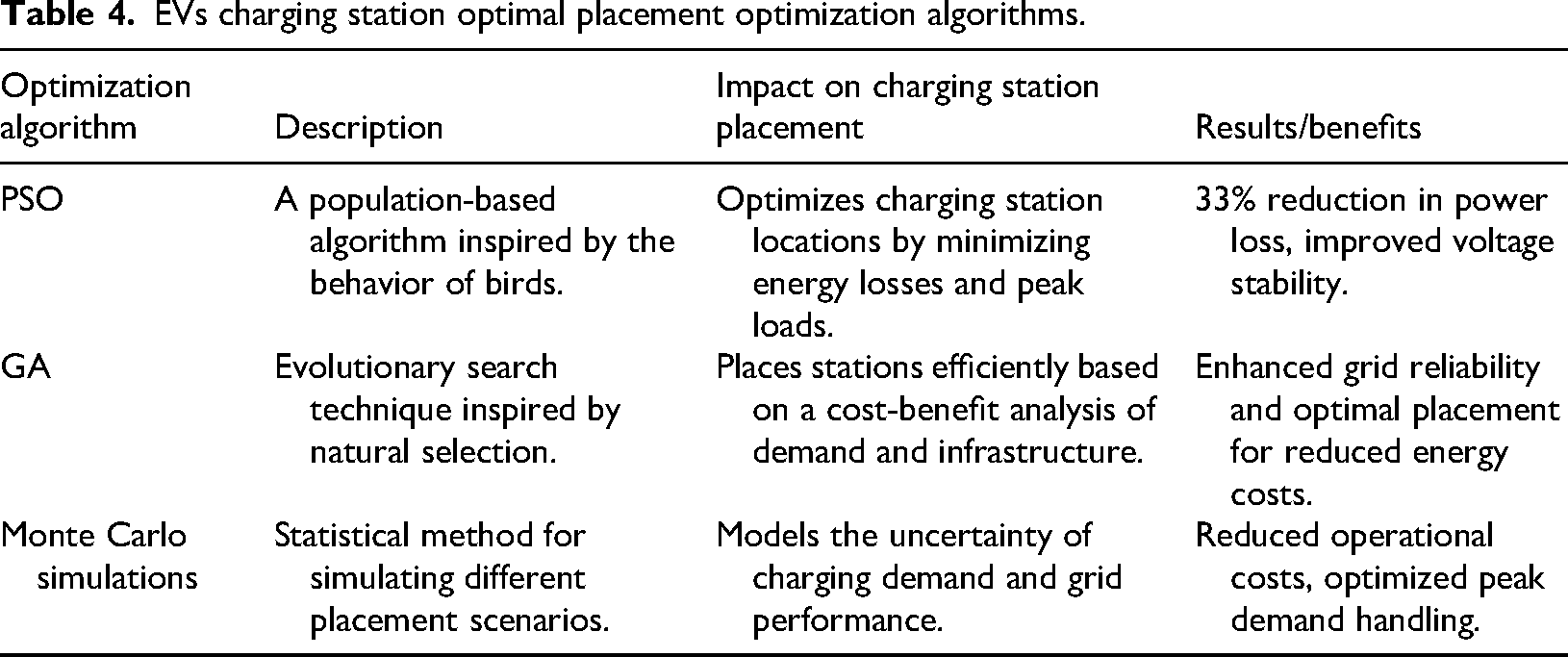
The installation position of EV charging points plays a critical role in delivering efficient power distribution while keeping expenses low and expanding EV user reach. This problem is solved using various optimization algorithms that consider demand distribution, power grid constraints, traffic flow, and economic viability, as shown in Table 4.
EVs charging station optimal placement optimization algorithms.
Recent advancements in intelligent optimization, power electronics, and control strategies significantly enhance the reliability and efficiency of EV fast-charging infrastructure, particularly when integrated with renewable energy sources. A grid-connected hybrid renewable energy system managed by the ant–lion optimization algorithm, optimizing energy dispatch from solar and wind sources to reduce grid reliance and operational costs (Altawil Ia and Ka, 2023). Developed an intelligent multi-objective optimization framework that incorporates stochastic renewables and FACTS devices, demonstrating improved voltage stability and system efficiency, critical elements in mitigating grid stress caused by large-scale FCS (Premkumar et al., 2024). From a hardware perspective, a novel three-input, single-output DC–DC converter has been developed [73], tailored for EV charging stations, enabling multi-source energy handling, which is vital for hybrid systems combining grid and renewable inputs. Proposing an intelligent converter-controller system capable of operating in both grid-connected and stand-alone solar PV modes, enabling flexible and resilient charging infrastructure even in grid-constrained environments (Reddy et al., 2023). Al-Biruni Earth Radius Optimization Algorithm to develop a location-aware voting classifier for predicting EV populations across different zones, which supports the smart placement of charging infrastructure and enhances service accessibility. Choosing suitable sites for charging stations is also very important for a smooth and efficient EV grid connection (Saeed et al., 2023). Optimal spots for EV charging stations are often found with the help of algorithms such as PSO and GAs. These plans take into account the position of power grid nodes, the number of people in each area and what infrastructure is already there to reduce grid jams and make sure energy loads are even (Aljumah et al., 2024; Venkatesan et al., 2022). Several studies have examined how smart charging algorithms support the use of EVs in a more efficient way within the grid. Reducing the operating stress on the grid in peak periods can be done with time-of-use pricing, demand response and load shifting. Using such methods can help decrease the overall energy use in the grid and EV systems (Aljumah et al., 2024).
Placing charging stations in the best locations is very important in EV charging infrastructure. With a rise in EVs, it ' vital to place charging stations at the best spots for a stable grid and comfortable use by everyone. GAs and ant colony optimization (ACO) are some heuristic and metaheuristic algorithms used for determining where EV charging stations must be placed. They use traffic, power usage and power grid ability data to lower the amount spent building infrastructure and improve how many people are reached (Ahmad et al., 2022). Impact of Placing Charging Stations on Circuits that Distribute Power. It stresses that managing when chargers are used can lighten the load on regional power networks. Also, by managing charging stations properly, we can cut down on issues like voltage drops and costly work on the power networks (Adetunji et al., 2022). In addition, much research has gone into developing FCS. High-power charging (HPC) stations and similar technologies solve the issue of lengthy charging by making it possible to recharge EVs faster. HPC allows for fast charging, which is not possible with regular charging methods. With these changes, it is now much easier to use an EV and to expand networks of charging stations (Ghasemi-Marzbali, 2022).
Many proposed research methods have been studied to help improve the way charge station placement is done. More and more, ML is being used to expect need for charging EV chargers. Data on traffic flows, areas where people live and energy consumption are used by these algorithms to decide where to put new stations so that the charging network is easy to access and environmentally friendly (Panda et al., 2022). As more EVs are used such models will be more necessary to prevent congestion at charging stations. Moreover, with an increasing number of EVs, station operators are working to improve station capacity and enhance the service they offer. Making use of multi-objective optimization when allocating charge stations, with the help of parameters such as minimizing wasted energy, ensuring there is enough supply and demand and maintaining good quality service. They are focused on saving costs as well as improving the experience of charging for users (Abdel-Basset et al., 2024). Optimizing charging stations continues to be important for researchers and industrial experts. The use of deep learning tools for planning where and how large EV charging stations should be. These advanced methods review a lot of data about traffic, energy and users to figure out the best locations for future stations. Doing this, algorithms boost users’ access to EV charging and utilize strategic locations for the same to reduce waste and make the most of EV charging (Panda et al., 2022). It is important to improve the capability of charging stations as well as find the right places for them. Trying to solve multiple objectives is important to reduce the cost of infrastructure and to make sure energy is used efficiently. When creating charging stations, these models pay attention to grid load, EV usage and charging speeds as they try to improve both the stations’ efficiency and how convenient they are for drivers (Lazari & Chassiakos, 2023). Charging station networks are also changing. Various charging stations (fast, slow and ultra-fast) now easy to connect with the grid as more emphasis is put on interoperable networks. Using smart chargers that can talk to one another and change their power draw according to the grid makes the grid more stable and improves how users charge their vehicles (Wu et al., 2022).
EV charging infrastructure and optimization
Building enough charging stations is necessary to get more people to use EVs. Many reviewers point out that advances in FCS are intended to cut the charging time and make it easier for EV owners. Thanks to major developments in high-power charging technology, EVs can now be charged very quickly, overcoming one of the biggest drawbacks for potential buyers (Algafri et al., 2024).
Literature also covers how charging stations may affect power distribution. A charging station in the wrong place can destabilize the grid. However, by applying optimization method, one can identify the stations to place that help maintain a steady and efficient distribution of energy (Zimm, 2021).
Using optimization helps find the best spots for charging stations. The use of optimization methods, among them ACO and Simulated Annealing, has been studied to determine the best places for these stations. With these methods, the process of setting up charging systems is made more efficient, by looking at both the amount needed locally and the available energy from the grid (Qadir et al., 2024).
Another important area of research is adding renewable energy sources to EV charging stations. Charging stations relying on renewable energy help cut down the carbon emissions linked to EV uses. Many studies have been done on using solar or wind energy in charging stations, whether by themselves or as part of hybrid renewable energy systems that link solar, wind and battery storage hybrid renewable energy systems (HRES) for reliable and sustainable use (Samadi et al., 2023; Taghizad-Tavana et al., 2023).
Latest improvements in AI-based energy coordination allow smart EV charging networks to use blockchain for safe and distributed ways of balancing electricity demand recorded in data exchanges (Singh, Kumar et al., 2024). At these levels, several-stage systems have been suggested to oversee EV charging together at community parking areas, in an effort to efficiently make use of energy and not strain the grid during busy hours (Chandra et al., 2024). They are mostly based on well-made forecasting models; ML techniques are being used, including K-nearest neighbors and ensemble stacking generalization in real time ( Kumar et al., 2024). At the same time, grid-connected solar EV chargers are now more often fitted with unified power quality conditioners using techniques such as GBDT–JS which fixes power problems and ensures appropriate voltage levels at busy charging points Continuing to review fast-charging infrastructure reveals some crucial issues, like there is a lack of standardization in chargers, converter designs and heat dissipation which are important for the progress of high-power EV networks (Ravindran et al., 2023). Searching for methods to improve electrical qualities during charging brought several design changes and now the Ferdowsi-based converter topology is known to offer better harmony in current outputs and improved voltage management (Kumar et al., 2023). To add to this, forecasting how much energy EVs will need using algorithms has helped match supply with demand which is vital for planning charging stations (Coban et al., 2023). Solar-powered charging methods for unusual EV uses, for example, with inverters that support slow vehicles, show how strategies for connecting to renewables can be applied to many different types of transport (Shanmugam et al., 2023). Wider studying of demand-side management indicates that things like dynamic pricing and direct load control are needed, showing that users and grids must synchronize (Mohanty et al., 2022). Some authors have used concepts from political optimization to help decide where renewable generators and EVCSs should be put to achieve better voltage stability, less energy loss and better location performance in distribution systems (Dharavat et al., 2022). or PV-based EVCSs, researchers have tried using fuzzy logic to manage control systems in DC microgrids (Abraham et al., 2023). By examining battery use over time such studies have improved EV infrastructure by providing data on battery performance, the duration of charge and heat sensitivity during extended charging cycles (Blazek et al., 2023). Combining predictive analytics, intelligent control, power quality conditioning and renewable energy optimization, these studies strengthen EV charging infrastructure for larger and more stable networks.
Renewable energy and EV charging
Specialists have carried out extensive studies trying to use clean power, especially from the sun, to power EV charging stations. It has been explored how combining PV installations with EVCSs results in clean power supply and reduces the need for electricity from the main grid. The use of solar panels at EVCSs helps maintain sustainability and addresses the need for EVs (Barman et al., 2023; Sain et al., 2020). EVCSs can be built using wind-generated energy. Certain regions’ strong wind resources mean that wind energy could help charge vehicles at stations. Researchers have shown that using EV charging with wind energy leads to sustainability and more reliable EV charging stations (Deeum et al., 2023).
BESS are critical for handling the way renewable energy behaves intermittently. BESS delivers renewable energy to electric cars whenever there is not enough generation or more demand for power. The system unites various forms of energy, making renewable-powered charging stations more efficient and less expensive (Amin et al., 2020; Di Fazio et al., 2013).
A move to cleaner vehicles is supported by EV charging that is powered by sources like solar and wind energy. Research study in 2021 of solar-powered charging stations for EVs that looked at PV systems providing electricity. Switching to solar power for the operation of charging stations lessens their expenses and helps them become more independent of regular fuel and electricity. Thanks to this system, the transportation sector is getting cleaned up while sustainable ways to charge remote communities are being provided (Minh et al., 2021). The use of solar, wind and storage allows charging stations to run sustainably and give dependable support. HRES helps make sure EVs are always charged by using solar, wind energy and battery storage. Because the varying energy output is collected, integrated renewable systems are convenient especially in times when regular output is below average (Nazari et al., 2024). EVs and renewable power systems both need focused study for their development. Using HRES for EV charging is another option. To make sure EV charging points can function in all types of weather, the system uses solar power generation, wind power generation and BESS. Both of these sources of power help reduce EV charging emissions and BESS provides a stable energy supply when there is a drop in renewable production (Eid et al., 2022).
EVs are now commonly charged using solar energy systems on charging stations. Adding solar panels at EV charging stations means less load is put on the grid, so EV charging is more sustainable. Because solar power is abundant in these regions, it becomes easy to integrate and helps people save on energy costs for charging (Manousakis et al., 2023). Wind power integration is one of its newer investigational concepts for EV charging systems. Science has investigated wind energy as an alternative clean power source for charging stations when wind resources are plentiful in a region. Literature reveals that wind-powered EV chargers create grid-neutral electricity systems while achieving self-sufficient charging operations in remote regions (Roslan et al., 2024).
Renewable energy systems play a vital role in powering EV charging stations, according to recent publications. Hybrid renewable energy systems, which combine solar power with wind generation and battery storage, could serve as dependable and sustainable power sources for EV charging facilities. Integration creates a system that reduces EV charging dependence on the electric grid when renewable energy generation rates drop low and ensures continuous usage of clean power for charging. HRES reduces the energy load on the power grid, thus making the system more sustainable (Suvvala et al., 2024).
PV systems that harness solar energy reduce transportation pollution by charging EVs at stations. ESS integrated with solar panels enable standalone EV charging solutions through solar-powered chargers, which effectively serve underserved and remote areas. The infrastructure expense decreases as the charging station expands its operational capability, specifically in areas without grid electricity capabilities (Kashani et al., 2022).
Places with plenty of wind energy can really gain from EV stations that can be powered by wind. Wind-powered charging stations are shown by their assessment to help cut emissions and build more opportunities for the grid. Hybrid charging is a solid option that brings a constant supply of energy during anytime, weather or location (Almasri et al., 2024).
EV adoption and policy research
How many EVs are sold on the market depends mainly on government incentives and public policies. Many studies demonstrate that supporting the EV industry with tax rebates, subsidies and vehicle charging infrastructure boosts its growth. When EVs are more affordable because of new policies, more people can buy them and it is easier to integrate EVs into the existing grid (Qadir et al., 2024; Sousa and Costa, 2022). Purchasing EVs can be costly for developing countries, their charging stations are not well-developed and there is not enough help from government schemes. They suggest that low-interest credit, the development of infrastructure and public-private efforts should be used to build more EV charging stations (Sopha et al., 2022; Veza et al., 2024). There is evidence that the right policies can increase EV adoption. EV sales benefit greatly from government subsidy programs. On top of tax credits, many countries provide financial help and toll exemption to customers who buy EVs. In countries where EVs are seen as being more expensive than ICE cars, financial assistance has worked to increase the number of EV users (Macioszek, 2021). Evolutionary vehicles struggle to be adopted in developing countries because of many barriers. Because of insufficient support from the government, lacking charging spots and not enough ways to finance the vehicles, EVs adoption is encountered with barriers in the set regions according to adoption assessments. Combining microfinance loans with public–private partnerships is seen as an effective method to overcome the reasons people are hesitant to use EVs (Bryła et al., 2022). Nations that are developed tend to use more EVs when there is a solid EV network in place from the policies. The government and businesses partner to create more EV charging station networks. These days, governments and private companies are working together on co-financing to ensure charging stations are put up in both rural and urban locations (Pardo-Bosch et al., 2021). Since more EVs are being used, it is important to pay more attention to policymaking. To accelerate the adoption of EVs, governments are now providing incentives such as subsidies and lower taxes, as well as setting up low-emission zones which encourages more EV purchasing and use in urban areas. The analysis shows that developing infrastructure, giving incentives to drivers and updating regulations are vital for higher EV adoption (Srivastava et al., 2022).
EVs need to be considered by developing countries as their main means of transportation. Lot of issues for developing nations are due to the high cost of EVs, limited charging infrastructure and policies that are not suitable for their needs. It suggests that countries not yet industrialized reach out to global alliances for both financial aid and technical resources to address their environmental challenges. Through such alliances, countries may move directly to using EVs without having to go through earlier vehicle technologies (Bryła et al., 2022).
EV adoption must analyze how regulatory systems influence customer purchasing decisions between EVs and conventional automobiles. Official vehicle emission rules and charger station accessibility have a significant impact on the EV purchase decisions of potential consumers compared to those of regular internal combustion engine vehicles. Countries with rigorous emission control standards have achieved better EV adoption rates because policy frameworks substantially affect market development (Brückmann and Bernauer, 2020).
EVs often depend on governmental rules and public rewards for success. Money saved on tax, purchase bonuses and strict rules in areas with low air pollution help people embrace EVs. The availability of friendly customer policies stimulates EV sales, so nations are able to improve their EV market performance (Zaino et al., 2024).
Policies made by local and regional governments play a huge role in building EV infrastructure. Planning with zoning makes it possible for authorities to have EV charging stations in public areas such as commercial centers and residential areas. By setting up charging stations where many people gather, range anxiety is reduced for citizens which encourages them to think about buying EVs (Li et al., 2022). In developing countries, turning to EVs becomes more difficult because of weak infrastructure, high set-up costs, weak government programs and the gradual growth of the EV market elsewhere. Some ways to boost EV usage are microfinancing for car purchases, help with charging station expenses and international teamwork for technology exchange. Overcoming the present problems that stand in the way of adoption will allow developing countries to switch to EVs (Tarei et al., 2021).
Communication and smart transportation systems
Good performance and traffic control of EV charging systems require advanced communication and intelligent systems for transportation. Jointly used, Vehicular ad-hoc networks (VANETs), IoT and AI allow EVs to quickly exchange data with charging stations and the main energy network. With the help of ACO, optimizing transportation systems decreases traffic at the same time as growing the use of EVs. Intelligent charging systems use wireless internet to connect EVs to the grid and create smart systems for arranging when charging happens. There needs to be extra research on security, privacy and ways to scale EV adoption to guarantee stable and secure power supply to EVs.
The study establishes a new procedure to manage EV charging and discharging operations through VANETs. The project involves developing a Distributed Time Slot Assignment (DTSA) system, which creates contention-free channels to enhance the efficiency of EV charging services. This work operates on two levels: first, it develops EV-DTSA-CCH and EV-DTSA-SCH slot assignment protocols that pair with ARSD-CCH through a designed message system, allowing EVs to connect with the smart grid while utilizing VANETs for EVSE supply updates. The paper demonstrates that the proposed scheme offers three primary benefits: enhanced EV satisfaction, reduced latency, and superior performance compared to IEEE 802.11p and VeMAC, as measured by successful channel utilization. It contributes to advancing EVs by choosing the best charging stations, controlling peak demand on the grid and using advanced, flexible and energy-efficient ways to communicate with EV chargers in real time (Singh, Vishnuram et al., 2024).
Created a system for intelligent vehicle routing by linking VANET with Distributed Ant Colony Optimization (DAS), to address congestion and reduce pollution on the roads. Real-time collaborating agent groups named monitoring, vehicle and routing are put in place by the system to review and manage traffic data for routes. VANET allows cars to talk with each other and with roadside infrastructure to figure out the least crowded and shortest route through the use of ACO. Information from roadside units is regularly used to check the traffic situation and revise vehicle routes as often needed. The plan would help relieve traffic congestion, speed up journeys and save fuel because it directs vehicles toward less busy routes. Bio-inspired optimization in the system makes use of current traffic information to speed up traffic and use roads wisely. The findings from the report encourage better transport solutions, using their adaptive routing approach to decrease congestion, support mobility and improve the functions of urban traffic apps (Arévalo et al., 2024).
Send-receive bi-directional converters created for fuel cell-battery electric vehicles (FCBEVs) are suitable for supporting V2G in bipolar hybrid microgrids. Both a quadratic boost converter and a T-type inverter make it possible to efficiently send power back and forth, with the ANN-GA-based MPPT in control ensuring maximum power from the fuel cells despite any environmental changes. The THD is less than 2.35% in the simulation study as mentioned and the system functions well in different loads and conditions. With the new design, grid operations become more stable and use of energy is improved. When EV FCS are used, they can negatively influence the grid by causing big voltage changes, harmonic and suprachiasmatic problems. This report examines the latest fast charging standards and features prominently in technology and brings attention to the lack of clear power quality rules for FCSs. PQ problems by examining theoretical studies and actual site investigations to find out which voltage disruptions are triggered by high-power FCSs. Assessment involves using impedance, smart charging and energy storage with the hope of mending the challenging aspects and meeting the standards of IEEE and IEC (Wang et al., 2021).
Discussion
EVs rely on quick charging stations as a fundamental element for the sustainable mass adoption of electric cars. Integrating FCS with existing power grids presents multifaceted challenges that encompass infrastructure specifications, power grid stability issues, financial considerations, and environmental impacts. The power grids face substantial energy strain from FCS, as peak usage periods lead to unstable grid conditions and transformer overload, causing voltage fluctuations. Sensor-based FCS deployments across different substation areas reduce grid burden by evenly distributing electrical demand among zones. At the same time, DSM, alongside TOU pricing with renewable energy systems, enhances grid load management for increased operational performance. V2G technology offers a promising solution for stabilizing utility systems through the deployment of EV energy. However, its mass deployment requires further development in EV technology, government backing, and dependable EV-to-operator communication systems.
The voltage drop percentages and related case improvements for various scenarios are shown in Table 5. The voltage drop without optimization stands at 12% in the control situation. The application of PSO achieved remarkable results by lowering the voltage drop to 4%, which represents a 66.67% improvement. The integration of PV and BESS successfully reduces voltage drop to 2%, representing an 83.33% improvement. By implementing smart charging methods, the voltage delivered declines to 3.5%, indicating an improvement of 70.83% over the original system. The optimization strategies demonstrated their capability in both reducing voltage drops and enhancing overall system performance, according to this research.
Voltage drop comparison with percentage improvement.
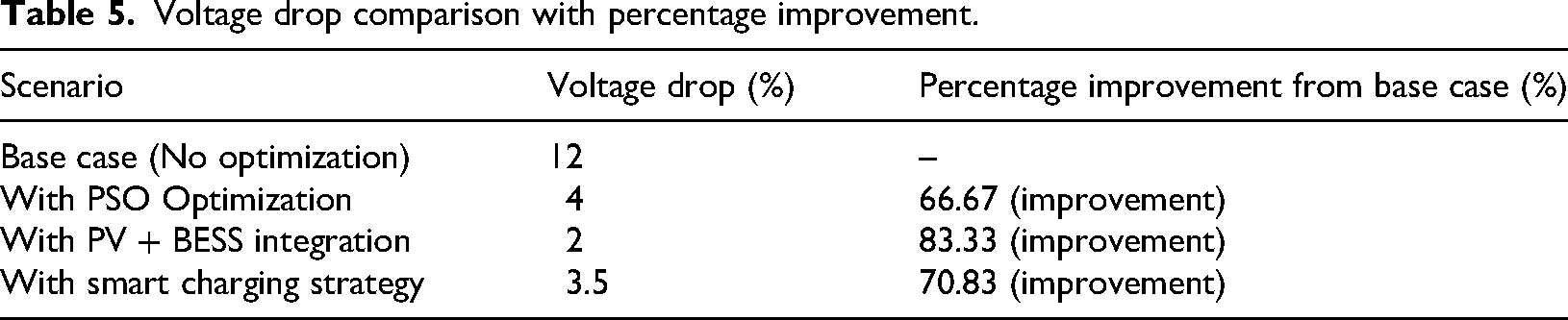
Fast-charging systems must incorporate renewable energy sources, such as solar and wind, for effective distribution and sustainable power management. Solar-powered FCS devices, when paired with BESS systems, offer eco-friendly operations and superior energy security. However, the instability of renewable energy requires sophisticated power management technology for continuous power delivery. Energy management systems, comprising hybrid power systems powered by renewable energy sources and storage solutions, aim to minimize peak demand by integrating power from the grid and localized microgrids. This allows for the discharge of stored energy from surplus during high-demand periods to stabilize power fluctuations. The loss comparison, expressed as a percentage reduction, is evaluated in Table 6.
Energy loss comparison with percentage reduction.
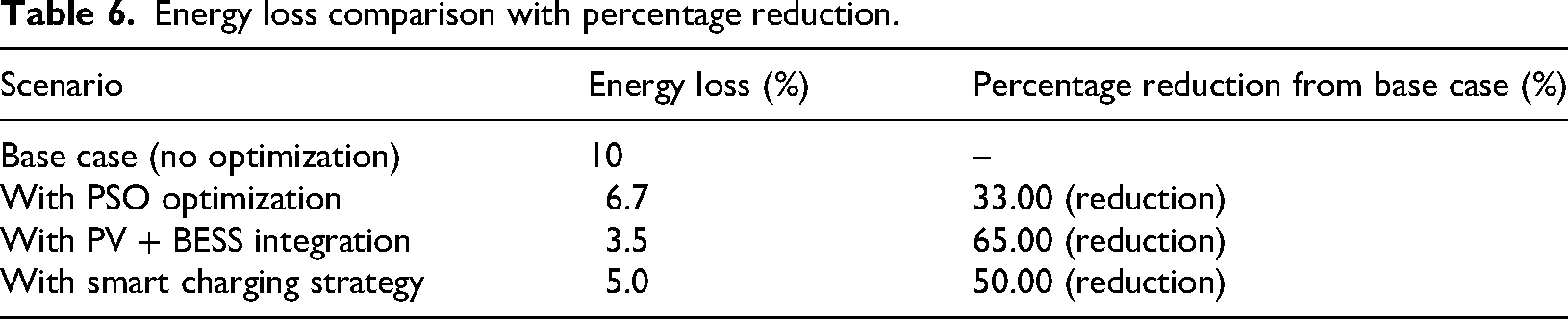
The financial sustainability of fast-charging infrastructure heavily depends on economic aspects paired with proper regulations. Building high-power charging stations requires substantial economic investment, as it involves expenses for grid modernization and property acquisition, which create significant financial burdens. Establishing fast-charging infrastructure requires coordinated support involving public partnerships between governments and private investors who benefit from financial aid, including tax benefits, grants, and subsidies. The development of EV charging networks depends on regulatory frameworks, as essential policies must enforce renewable energy standards and establish connector standards, among other measures that promote competition and enhance market efficiency. Establishing power rate systems that reward users for charging batteries during off-peak hours reduces pressure on the power grid. The multi-factor impact on grid efficiency and charging performance is summarized in Table 7.
Multi-factor impact on the grid efficiency and charging performance.
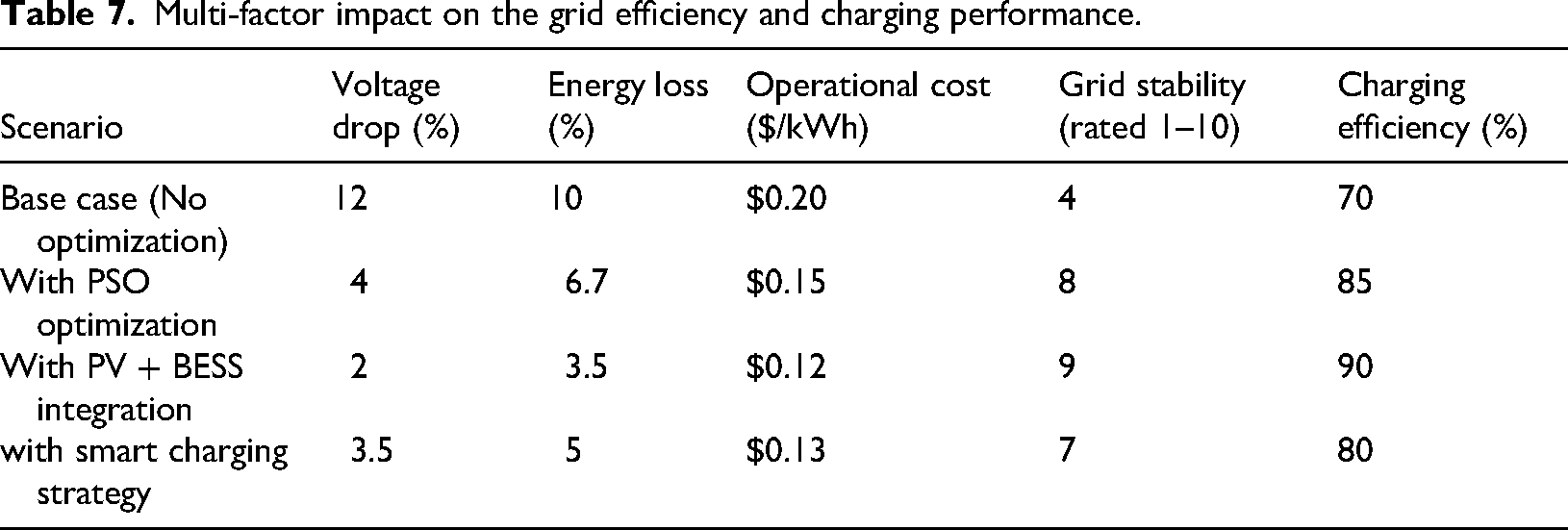
Advancements in batteries and the building of charging networks make it possible for quick charging networks to develop. When EV charging stations provide up to 350 kW of power, this speeds up EV charging as it does for gasoline cars, but it also requires modern cooling systems and improvements to the electrical grid's future capacity. Predictive algorithm models from AI and ML help charge stations use grid power properly, ensure efficient use of electricity and predict how many vehicles will charge at any time. Because of blockchain, EV energy can be traded among its owners safely and securely. Autonomous charging and dynamic wireless charging are under development for the future, so vehicles can draw power as they travel in the air, not having to stop to charge.
Although there has been improvement, some problems continue. Since electricity grid capacity is limited, especially in urban places, there is less room to expand many fast-charging EV stations. The rising power consumption has intensified electricity expenses, necessitating the implementation of optimal demand management systems. User experience is limited by the lack of standardization between EV models and charging networks; therefore, policymakers, manufacturers, and grid operators must establish consensus on unified connectors and protocols to achieve international interoperability standards. The performance comparison across time-based metrics, such as peak and off-peak hours, is detailed in Table 8.
Performance comparison with time-based metrics (e.g., peak vs. off-peak hours).
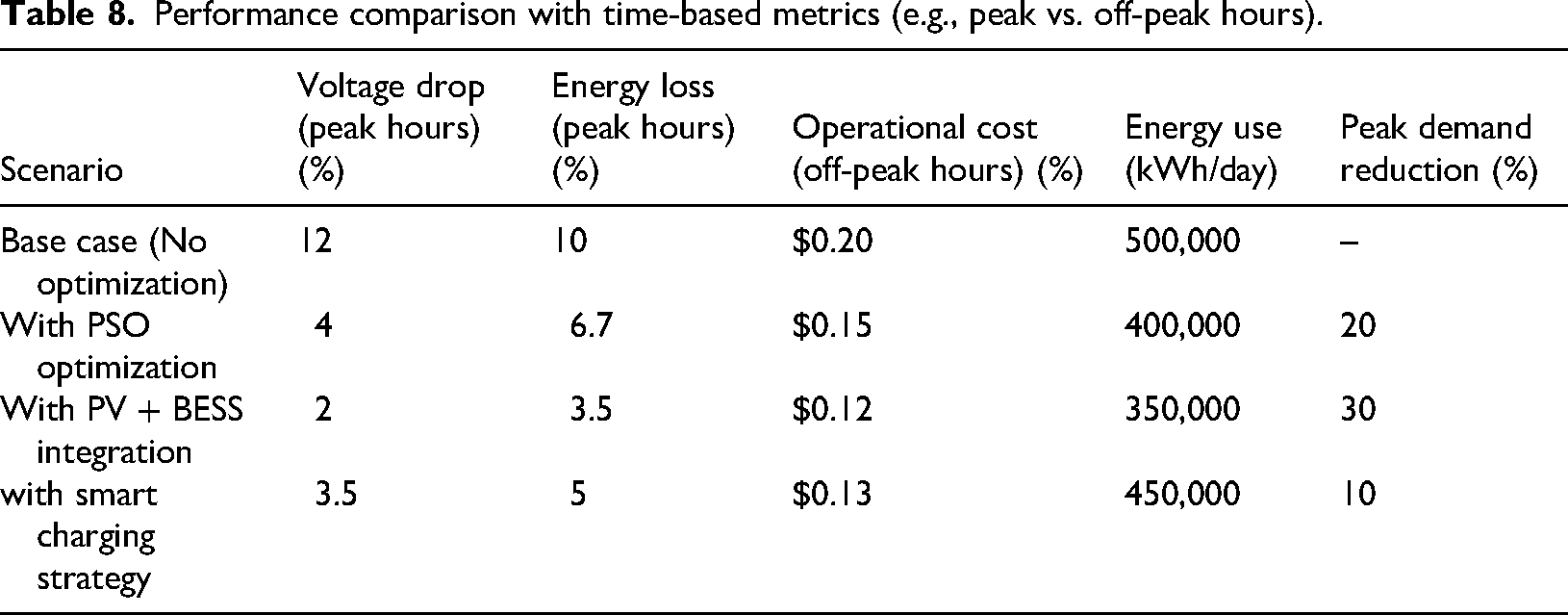
Developing sophisticated, speedy charging systems is crucial in establishing sustainable transportation. Integrating fast-charging networks with existing power systems needs strategic development to resolve technical, economic, and regulatory barriers. Overcoming obstacles in EV charging infrastructure development necessitates strategic grid management strategies, renewable energy integration, and technological innovation. Future initiatives must dedicate attention to power grid modernization, the advancement of battery technology, supportive governance, and cost reduction strategies to ensure the swift success of fast-charging networks worldwide.
Conclusion
The rapid adoption of EVs is a cornerstone of the global shift toward sustainable transportation, driven by the urgent need to reduce GHG emissions and dependence on fossil fuels. Still, a major factor in EV popularity is the availability of quickly working and dependable fast-charging points. The paper reviews the ways EV FCS are operated and examines their effects on the power grid, as well as the opportunities and issues related to their installation. Making FCS available on existing power grids is not easy because of worries about grid systems, having to update infrastructure and making sure it is financially sound. When a lot of fast chargers use high power during peak hours, power fluctuations, overloaded transformers and increased distortion may occur which can harm the stability of the grid. Tackling such issues is best done through managing grids with DSM, setting time-of-use (TOU) prices and integrating more clean sources of energy. Using renewable energy together with BESS helps to balance the grid and shift away from using fossil fuels. Because renewable energy is not continuous, machines are needed to handle energy simultaneously and make sure it is delivered all the time. EVs can use V2G technology to release energy to the grid and help keep it stable when peak demand occurs. Because of this two-way energy exchange, the grid becomes more stable and can provide extra services such as helping with frequency and power levels. Still, for many people to use it, V2G needs modern communication systems, acceptance by authorities and consumer approval.
Making fast-charging infrastructure economically sustainable is very important. Updating the grid, buying land and putting in high-power chargers are all very costly steps for the company. Developing EV charging networks depends on the use of public-private partnerships and government incentives such as tax breaks, grants and subsidies. To make sure all devices are compatible and convenient, standardizing charging ports and connectors is very important. David Beckham is now selling. Fast chargers, delivering over 350 kW, are appearing more often, so charging time is decreasing. At the same time, supporting this technology will take huge upgrades in cooling systems and grid capacity. Efforts to improve how charging stations work involve AI and ML, which can help predict customer usage and effectively manage the grid interacting with charging stations. Although big progress has been made, some issues are still present.
It is not possible to set up many high-power charging stations in cities because the power grid is already full. Furthermore, because each EV is different and charging stations are not all the same, using them can be perplexing to some. Unified standards and protocols can be set by working together between policymakers, manufacturing companies and grid operators.
It is necessary to tackle many challenges such as technical, financial and rules of the road, to integrate FCS into power grids. Bringing in better grid systems, connecting more renewables and updating battery and charging technologies will fuel the rise in EVs. Supportive policies, strong planning and new solutions will play a vital role in setting up a good EV charging network.
Electric mobility will prosper if we solve these challenges and establish a strong, wide-spread and sustainable system for fast charging. If we remove the technical, economic and lawful limitations, EVs will help us build a greener future and save energy through emission reduction. The shift to using EVs on a larger scale requires hard work, but it is achievable with support from stakeholders, the government and those who research renewable energy.
Footnotes

Author contributions
Rehan Babar, Aoun Muhammad, Romaisa Shamshad Khan, and Wajid Khan: conceptualization, methodology, software, visualization, investigation, and writing–original draft preparation. Abdul Aziz, Muhammad Zain Yousaf: data curation, validation, supervision, resources, and writing–review and editing. Mohit Bajaj, Ievgen Zaitsev: project administration, supervision, resources, and writing–review and editing.
Funding
The authors received no financial support for the research, authorship, and/or publication of this article.
Declaration of conflicting interests
The authors declared no potential conflicts of interest with respect to the research, authorship, and/or publication of this article.
Data availability statement
The datasets used and/or analyzed during the current study available from the corresponding author on reasonable request.