







Abstract
Green hydrogen is recognized as a critical energy carrier for deep decarbonization, yet many production pathways remain reliant on fossil fuels or conventional photovoltaic electrolysis. This study presents a comparative performance assessment of a solar thermal-driven hydrogen production system integrating an organic Rankine cycle (ORC) with an alkaline electrolyzer. The proposed configuration comprises solar thermal collectors, a pressurized sensible heat storage tank, an ORC power unit, and an electrolyzer. A dynamic MATLAB-based simulation framework was developed to evaluate eight system configurations under identical meteorological conditions over a full year of hourly operation. The investigated scenarios examined the combined effects of collector technology (evacuated tube vs. parabolic trough), ORC working fluids (R245fa and n-pentane), and system sizing parameters. Performance was assessed based on annual hydrogen yield, overall solar-to-hydrogen efficiency, and productivity per unit collector area. The optimal configuration—employing parabolic trough collectors, an R245fa working fluid, a 180 m2 collector field, and an 8 m3 storage tank—achieved an annual hydrogen production of 752.8 kg·year−1 (4.705 kg·m−2·year−1), corresponding to 25,094 kWh·year−1 of hydrogen energy output. The overall solar-to-hydrogen efficiency reached 7.03%, with a solar-to-ORC efficiency of 10.2%. Results underscore the critical role of thermal availability and storage stability in enhancing ORC operating hours and hydrogen yield, demonstrating the viability of solar thermal ORC–electrolyzer systems for sustainable hydrogen production in high-insolation regions.
Keywords
Introduction
The continued growth of global energy demand—driven by population increase, industrial development, and urbanization—has intensified pressure on energy systems and reinforced the urgency of decarbonization. The increasing reliance on fossil fuels, coupled with environmental concerns, has motivated extensive research into sustainable energy alternatives and integrated renewable systems (Matuszewska, 2024). However, the transition toward low-carbon energy systems remains complex, requiring coordinated technological innovation and system-level optimization. From an economic and structural perspective, the interaction between energy demand growth and fossil fuel dependence continues to challenge the rapid deployment of clean energy technologies, particularly in developing and energy-intensive regions (Zhou et al., 2023). Within this transition, hydrogen has emerged as a promising energy carrier capable of enabling deep decarbonization across hard-to-abate sectors while also providing a flexible means of energy storage and sector coupling. Recent studies highlight that the sustainability of hydrogen strongly depends on the production pathway, with renewable-driven hydrogen systems offering significant potential for emissions reduction (Baral and Šebo, 2024).
Among these pathways, solar-driven hydrogen production has attracted increasing attention, particularly through indirect configurations where solar energy is first converted into electricity and subsequently used for electrolysis. Although photovoltaic-based systems dominate current research, solar thermal pathways provide a compelling alternative due to their ability to deliver heat at suitable temperature levels and to integrate thermal energy storage, enhancing system stability, and dispatchability. In this context, solar thermal organic Rankine cycle (ORC) systems have been widely investigated as an efficient means of converting low- to medium-temperature heat into electricity, enabling their integration with hydrogen production technologies (Alghamdi et al., 2023; Tiwari, 2023). Furthermore, several recent studies have explored the integration of solar thermal systems with ORC-driven hydrogen production. Experimental and numerical investigations demonstrate the feasibility of such systems, highlighting the influence of working fluids, operating conditions, and system configuration on overall efficiency and hydrogen yield (Karabuga et al., 2023).
Solar-driven ORC systems have been investigated using a variety of collector technologies. Evacuated tube collectors are frequently employed in low- to mid-temperature applications due to reduced heat losses and acceptable performance under diffuse radiation. A thermodynamic and sizing analysis of a small-scale solar ORC supplied by evacuated tube collectors delivering hot water at approximately 120°C demonstrated stable operation and meaningful system efficiencies at relatively low temperatures (Hossin et al., 2020), while broader reviews confirm their suitability for decentralized and small-scale applications (Loni et al., 2021). For higher-temperature operation, concentrating solar collectors such as parabolic trough collectors are widely regarded as mature and high-performance technologies, with extensive industrial deployment and strong compatibility with power generation (Tagle-Salazar et al., 2020). System performance is highly sensitive to collector selection, working-fluid properties, and ambient conditions. Hourly and dynamic simulation studies show that ORC power output varies significantly throughout the day and across seasons (Ledbury and Mago, 2015), while simultaneous optimization of collector fields and ORC engines strongly influences annual energy yield and economic performance (Ramos et al., 2018). Working-fluid selection has also been repeatedly identified as a dominant design variable, as matching thermophysical properties to the heat-source temperature is essential for minimizing irreversibility and ensuring stable operation (Rahbar et al., 2017). On the other hand, comprehensive reviews highlight thermal storage as one of the most cost-effective large-scale storage options for mitigating solar intermittency and improving dispatchability (Duffie and Beckman, 2006; Loni et al., 2021). Among thermodynamic power conversion technologies, the ORC has emerged as a suitable solution for converting low- to medium-temperature thermal energy into electricity because ORC systems utilize organic working fluids with low boiling temperatures that enable efficient power generation at temperature levels typically achievable by solar thermal collectors (Rahbar et al., 2017). However, the performance and feasibility of such solar thermal-driven hydrogen pathways remain highly dependent on system integration, operating conditions, and component-level design choices, which are not yet fully understood.
Recent studies have emphasized the importance of integrated and optimally designed renewable energy systems to enhance overall performance and reliability. Advanced polygeneration systems combining solar thermal, photovoltaic, wind, and geothermal energy have demonstrated the capability to simultaneously produce multiple energy vectors, including hydrogen, electricity, and thermal energy, supported by multilevel storage strategies that improve system resilience under intermittent conditions (Saleem and Abas, 2025a). In parallel, smart energy management and demand-side control approaches have been proposed to improve load handling, peak shaving, and system efficiency, particularly in regions facing supply constraints and grid instability (Butt et al., 2021). Furthermore, renewable-based polygeneration systems incorporating hydrogen production have shown strong potential for balancing supply–demand mismatch and enabling large-scale energy storage, with studies reporting significant renewable penetration and hydrogen generation under dynamic operating conditions (Saleem and Abas, 2025b). Solar-assisted hydrogen production systems, particularly those integrated with photovoltaic and hybrid configurations, have also demonstrated the feasibility of producing multiple energy outputs while reducing emissions and supporting sustainable transportation and grid applications (Saleem and Abas, 2024). Additionally, optimization of solar thermal systems and working-fluid selection has been identified as a critical factor influencing system efficiency and thermal performance, particularly in hybrid solar–hydrogen configurations (Saleem et al., 2020).
Building on these advances in integrated and hybrid renewable energy systems, recent research has focused on thermodynamic cycles—particularly the ORC—as an effective intermediate stage for solar-driven hydrogen production. The ORC enables indirect solar-to-hydrogen pathways by converting collected thermal energy into electricity, which is subsequently supplied to an electrolyzer. Experimental assessment of a solar-driven ORC integrated with a polymer electrolyte membrane electrolyzer identified the electrolyzer and heat-collection stages as major sources of exergy destruction (Karabuga et al., 2023). Solar desalination and electrolysis polygeneration systems demonstrate that thermal storage substantially alters overall efficiency metrics (Delpisheh et al., 2021), while hybrid solar–fuel architectures have shown competitive levelized hydrogen cost values (Wang et al., 2022). Hybrid collector concepts such as Photovoltaic Thermal (PVT)–ORC–Proton Exchange Membrane Electrolysis Cel (PEMEC) systems (Salari and Hakkaki-Fard, 2022) and Concentrated Photovoltaics (CPV)/T–ORC–electrolyzer chains (Al-Zoubi et al., 2024) further demonstrate the potential of integrated solar-driven hydrogen production. Multiobjective optimization approaches have also been applied to solar thermal hydrogen plants to balance thermodynamic and economic performance (Alirahmi et al., 2022).
Despite extensive research on solar-driven hydrogen production and ORC-based systems, several critical gaps remain. Most existing studies rely on steady-state or design-point analyses, which do not capture the temporal variability of solar resources and its impact on system performance. Moreover, thermal energy storage is often treated in a simplified manner or neglected, limiting the understanding of its role in stabilizing operation and enhancing system utilization. In addition, the literature lacks systematic and controlled comparative studies that simultaneously evaluate multiple design variables—such as collector technology, working fluid selection, and system scale—under identical operating conditions. As a result, it remains difficult to isolate the true impact of each parameter or to derive generalized design guidelines.
More importantly, prior studies predominantly focus on component-level optimization, whereas real system performance is governed by dynamic interactions between subsystems, including transient thermal behavior, storage response, and operational coupling between the ORC and electrolyzer. Therefore, a clear research gap exists in developing a dynamic, system-level, and comparative modeling framework that captures real climatic variability and integrated system behavior. Addressing this gap is essential for obtaining realistic performance predictions and identifying optimal design strategies for solar thermal hydrogen production systems.
Methodology
The investigated system consists of an integrated solar thermal-driven hydrogen production configuration in which thermal energy is converted into electricity using ORC and subsequently utilized for hydrogen generation via an alkaline electrolyzer. The overall system is designed to enable indirect solar-to-hydrogen conversion while mitigating the intermittency of solar energy through thermal energy storage.
Solar energy is first captured by a solar thermal collector field, where incident solar radiation is converted into useful thermal energy. Depending on the selected configuration, either evacuated tube collectors or parabolic trough collectors are employed to deliver heat at temperatures suitable for downstream conversion. The collected thermal energy is transferred to a pressurized hot water storage tank operating in sensible heat mode, which serves as a thermal buffer between the solar field and the ORC unit.
The thermal storage tank supplies heat to the ORC evaporator, where the organic working fluid absorbs thermal energy and undergoes phase change. The high-pressure vapor expands through an expander or turbine, producing mechanical power that is converted into electrical energy by an electrical generator. After expansion, the working fluid is condensed and pumped back to the evaporator, completing the thermodynamic cycle.
The electrical output generated by the ORC is supplied directly to an alkaline electrolyzer, where water electrolysis occurs to produce hydrogen and oxygen. The integration of thermal storage and ORC-based power generation provides a smoother electrical output compared to direct photovoltaic coupling, thereby enhancing electrolyzer operating stability and utilization. Hydrogen produced by the electrolyzer represents the final energy carrier of the system.
A schematic representation of the integrated system and energy flow is provided in Figure 1, illustrating the interaction between the solar collector field, thermal storage tank, ORC unit, generator, and alkaline electrolyzer.
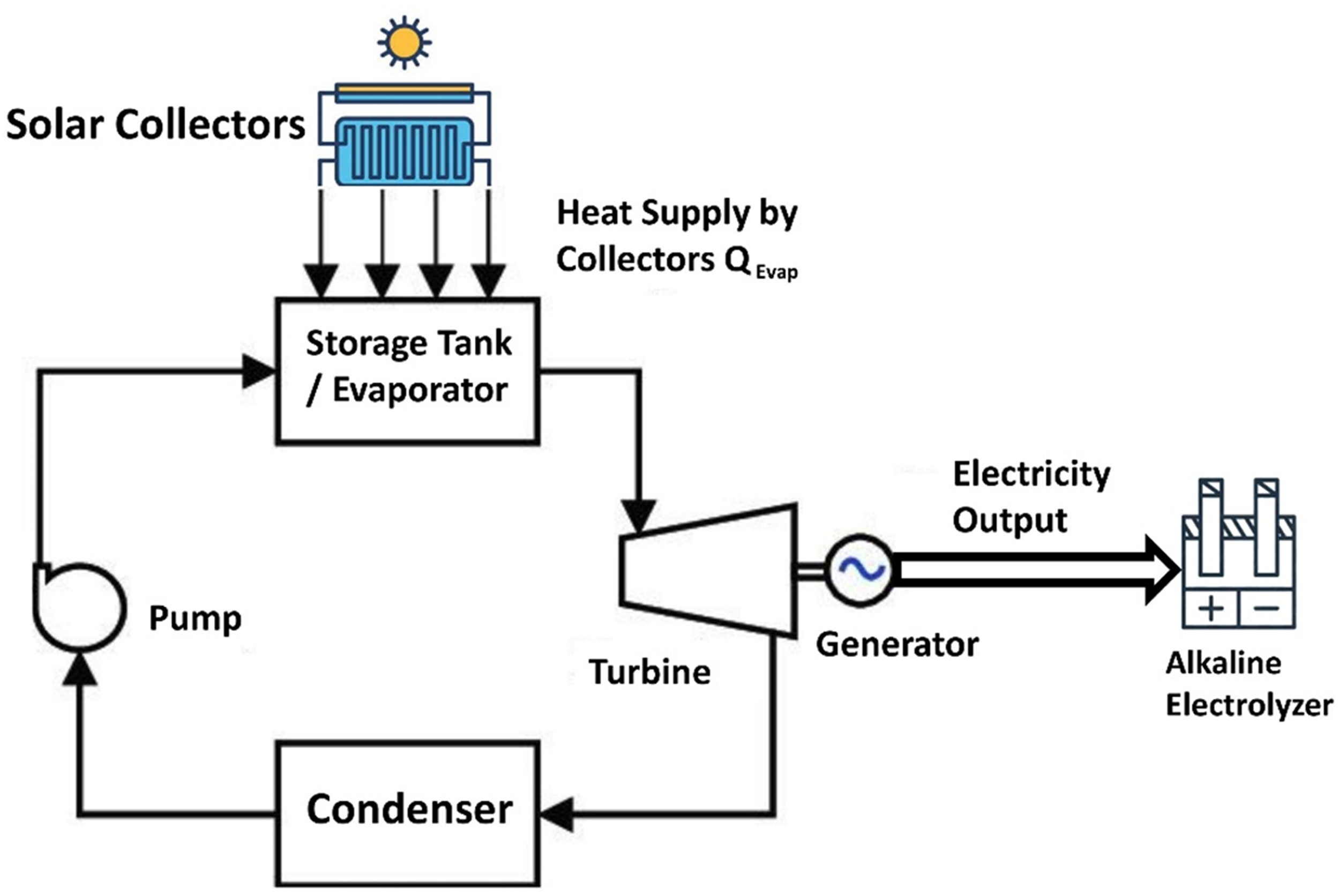
Schematic diagram of the solar thermal ORC–electrolyzer system. ORC: organic Rankine cycle.
Mathematical modeling
Solar thermal collector model
The thermal performance of the solar collector field is modeled using an energy balance formulation that relates incident solar radiation to useful thermal energy delivered to the system. The useful thermal power collected is expressed as in equation (1)

The collector efficiency is calculated using equation (2) which is a standard quadratic efficiency model:

For evacuated tube collectors, the model utilizes global horizontal irradiance (GHI), reflecting their ability to operate under both direct and diffuse radiation conditions. In contrast, parabolic trough collectors are modeled using direct normal irradiance (DNI), as they rely on concentrating direct solar radiation. This distinction ensures appropriate representation of each collector technology under identical meteorological conditions.
The useful thermal energy collected is supplied to the thermal storage tank, where it contributes to raising the tank temperature or is directed to the ORC evaporator when operating conditions permit. The collector efficiency formulation follows standard solar thermal performance models widely adopted in the literature (Duffie and Beckman, 2006; Loni et al., 2021).
Thermal storage tank model
The thermal storage system is modeled as a pressurized sensible heat hot water tank, which acts as a thermal buffer between the solar collector field and the ORC. The tank enables decoupling between solar energy collection and power generation, thereby improving system stability and extending ORC operating hours during periods of reduced or zero solar input.
The transient thermal behavior of the storage tank is described using equation (3)


The tank is assumed to operate under pressurized conditions, preventing boiling and phase change even when temperatures exceed 100°C. The model assumes a fully mixed tank with uniform temperature, which provides a reasonable approximation for system-level performance assessment while maintaining computational efficiency. Thermal energy is supplied to the ORC only when the tank temperature exceeds the minimum operating temperature required by the ORC evaporator.
This modeling approach captures the dominant thermal dynamics governing energy storage, heat delivery to the ORC, and temperature stability within the system.
Organic Rankine cycle model
The ORC is modeled as a lumped thermodynamic system that converts thermal energy extracted from the storage tank into electrical power. The ORC is assumed to operate when the storage tank temperature exceeds a minimum threshold required for evaporation of the selected working fluid. This modeling approach is widely used in system-level ORC studies and provides an accurate representation of performance trends without excessive computational complexity (Bao and Zhao, 2013; Rahbar et al., 2017).
The thermal power supplied to the ORC evaporator is given by equation (5), where

The electrical power output of the ORC is calculated using a temperature-dependent efficiency formulation as in equation (6), where ηORC is the ORC thermal-to-electrical conversion efficiency. The ORC efficiency is assumed to increase with increasing heat source temperature and is bounded by a nominal maximum efficiency corresponding to the selected working fluid. This behavior reflects the strong dependence of ORC efficiency on the temperature difference between the heat source and heat sink, as commonly reported in the literature (Bao and Zhao, 2013; Çengel et al., 2024).

The mechanical power generated by the ORC expander is converted into electrical power through an electrical generator, which is assumed to operate at constant efficiency. Auxiliary power consumption and transient startup losses are neglected to focus on comparative performance trends across scenarios.
This simplified ORC model captures the dominant effects of heat source temperature, working fluid characteristics, and thermal input on electrical power generation, making it suitable for annual performance assessment and scenario-based comparison of solar thermal hydrogen production systems (Loni et al., 2021; Ramos et al., 2018).
Alkaline electrolyzer model
The alkaline electrolyzer is modeled as an electrochemical unit that converts electrical power generated by the ORC into hydrogen through water electrolysis. The electrolyzer is assumed to operate whenever the electrical power supplied by the ORC exceeds a minimum operating threshold, reflecting practical constraints of commercial alkaline electrolyzer systems (Chi and Yu, 2018).
The effective electrical power supplied to the electrolyzer is defined as in equation (7), where Pel is the ORC electrical output and Pmin the minimum operating power required for electrolyzer operation (Wang et al., 2022).

The hydrogen mass flow rate is calculated based on equation (8) the electrical input and the higher heating value (HHV) of hydrogen, where ηel is the electrolyzer electrical-to-hydrogen efficiency and

This modeling approach assumes constant electrolyzer efficiency and neglects transient electrochemical effects, focusing instead on annual hydrogen production and comparative system performance. The use of an alkaline electrolyzer is justified by its technological maturity, low capital cost, and stable operation under moderate power fluctuations, particularly when coupled with ORC-based power generation (El-Shafie, 2023; Shiva Kumar and Lim, 2022). The hydrogen production rate obtained from the electrolyzer is integrated over the simulation period to determine the total annual hydrogen yield, which serves as a primary performance indicator for evaluating and comparing system configurations.
Simulation procedure
The overall system performance is evaluated using a dynamic simulation framework developed in MATLAB. The simulation is conducted on an hourly basis over a full year to capture the temporal variability of solar resource availability and its impact on thermal energy collection, power generation, and hydrogen production.
Hourly meteorological data are first imported as inputs to the model, including solar irradiance and ambient temperature. Depending on the collector technology under investigation, global horizontal irradiance is used for evacuated tube collectors, while direct normal irradiance is used for parabolic trough collectors. At each time step, the useful thermal energy collected is calculated using the solar collector model and supplied to the thermal storage tank.
The storage tank temperature is updated by solving the transient energy balance, accounting for collected solar heat, thermal energy extracted by the ORC, and heat losses to the environment. When the tank temperature exceeds the minimum operating threshold of the ORC, thermal energy is transferred to the ORC evaporator and converted into electrical power. The generated electrical power is then supplied to the alkaline electrolyzer, subject to its minimum operating power requirement, to produce hydrogen. Hydrogen production rates are calculated at each time step and integrated over the simulation period to determine annual hydrogen yield and energy output. Key performance indicators—including solar-to-ORC efficiency, solar-to-hydrogen efficiency, and hydrogen production per unit collector area—are computed for each scenario to enable comparative assessment. A detailed flowchart illustrating the overall process flow, component interactions, and simulation procedure is provided in Figure 2, enhancing the transparency and reproducibility of the analysis.
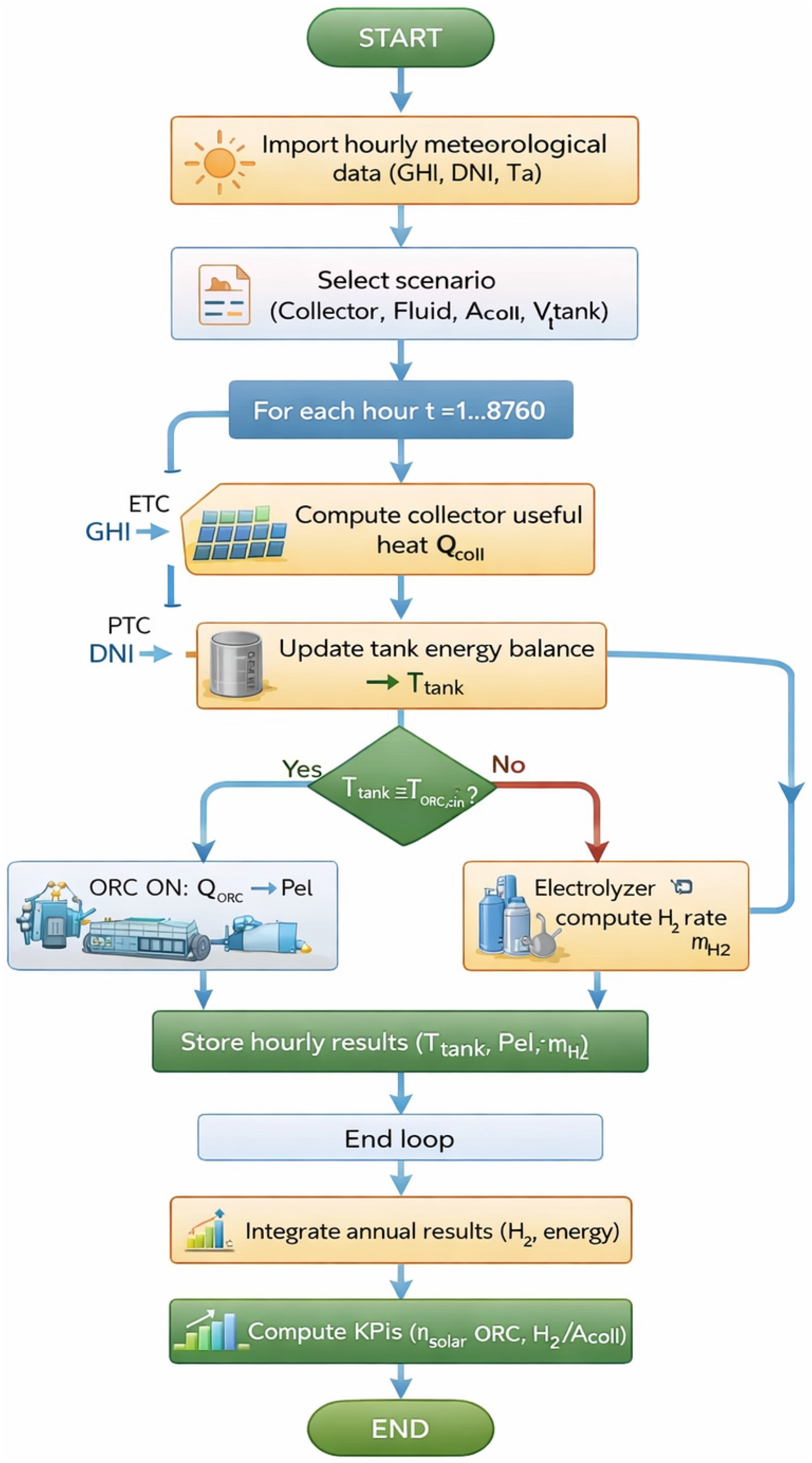
Flowchart of the simulation procedure for the solar thermal ORC–electrolyzer hydrogen production system. ORC: organic Rankine cycle.
The storage tank temperature is updated numerically at each time step using a discretized energy balance formulation as shown in equation (9), where

To systematically evaluate the performance of the proposed solar thermal ORC–electrolyzer system, a set of scenarios was defined based on key design and operational parameters. The scenarios were developed to assess the individual and combined effects of solar collector technology, ORC working fluid, and system size on annual hydrogen production and overall system efficiency. Two solar thermal collector technologies were considered: evacuated tube collectors and parabolic trough collectors. These collectors were selected because of their suitability for medium-temperature solar thermal applications and their different capabilities in utilizing diffuse and direct solar radiation, respectively. Including both technologies enables comparison between nonconcentrating and concentrating solar thermal systems under identical climatic conditions.
The ORC subsystem was evaluated using two representative organic working fluids selected to reflect R245fa and n-pentane thermodynamic behavior. The selection of working fluids is a critical factor influencing ORC performance. In this study, R245fa and n-pentane are selected as representative working fluids to capture different thermodynamic behaviors. R245fa is a widely used refrigerant in ORC applications due to its low boiling point, chemical stability, and suitability for low- to medium-temperature heat sources. In contrast, n-pentane, as a hydrocarbon fluid, possesses a higher critical temperature and favorable thermodynamic properties for higher-temperature applications, enabling improved cycle efficiency under such conditions (Akbari et al., 2024). This selection allows assessment of working-fluid influence on ORC performance without restricting the analysis to a specific commercial fluid and supports generalized conclusions regarding fluid selection in solar-driven ORC systems. System size was varied by modifying the solar collector area and the thermal storage tank volume to represent small- and large-scale configurations. This variation enables investigation of scalability effects and the role of thermal storage capacity in stabilizing ORC operation and hydrogen production. By combining these parameters, multiple scenarios were constructed and simulated over a full year using the same meteorological dataset, ensuring a consistent basis for comparative analysis and enabling identification of optimal system configurations for solar thermal hydrogen production.
To ensure computational efficiency and enable consistent comparison across all scenarios, several modeling assumptions and boundary conditions were adopted. The thermal storage tank is modeled as a fully mixed, pressurized sensible-heat water tank, implying uniform temperature distribution and no phase change within the storage volume. Pressurized operation ensures that water remains in the liquid phase at temperatures exceeding 100°C, and thermal losses to the environment are represented using a constant overall heat-loss coefficient. Solar collector performance parameters, ORC nominal efficiency, generator efficiency, and electrolyzer efficiency are assumed to remain constant throughout the simulation period. Degradation effects, startup transients, and auxiliary power consumption are neglected, as the focus is on comparative performance trends rather than absolute system optimization. The ORC operates only when the storage tank temperature exceeds a predefined threshold, and thermal input to the ORC is limited by its maximum design capacity. The alkaline electrolyzer operates only when the electrical power supplied by the ORC exceeds its minimum operating power, while hydrogen compression, storage, and downstream utilization are excluded from the system boundary. All simulations are conducted under identical meteorological conditions using a full year of hourly data so that performance differences arise solely from system configuration and design choices rather than climatic variability.
To evaluate and compare system performance, key performance indicators were defined to capture the ability of the system to convert solar energy into hydrogen while accounting for conversion losses at each stage. Annual hydrogen production is used as the primary performance metric and is obtained by integrating the hourly hydrogen production rate over the simulation period. Solar-to-ORC efficiency is defined as the ratio of total electrical energy generated by the ORC to the total incident solar energy received by the collector field over the same period. Solar-to-hydrogen efficiency represents the overall system efficiency and is calculated as the ratio of the chemical energy content of the produced hydrogen to the total incident solar energy. To enable fair comparison between systems of different sizes, hydrogen production per unit collector area is also evaluated to quantify land-use efficiency and the effectiveness of each configuration in utilizing the available solar collection area. Together, these indicators provide a comprehensive framework for assessing system behavior, identifying optimal configurations, and analyzing the impact of collector technology, working-fluid selection, and system scaling on solar thermal hydrogen production.
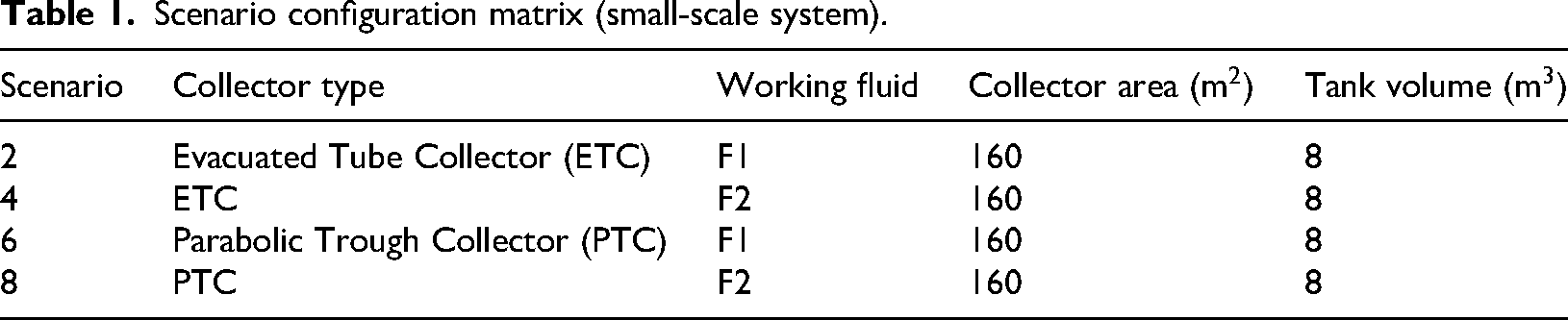
A total of eight configurations were examined, combining two solar collector technologies, two working fluids, and two system scales defined by collector area and thermal storage volume. The resulting configuration matrix is presented in Table 1.
Scenario configuration matrix (small-scale system).
To ensure clarity and reproducibility of the developed model, the key system parameters and operating conditions used in the simulation are summarized in Table 2. These parameters are selected based on typical values reported in the literature for solar thermal systems, ORC units, and alkaline electrolyzers, and are kept consistent across all simulated scenarios unless otherwise specified.
Summary of key model parameters, operating conditions, and assumptions used in the simulation of the solar thermal ORC–electrolyzer hydrogen production system.
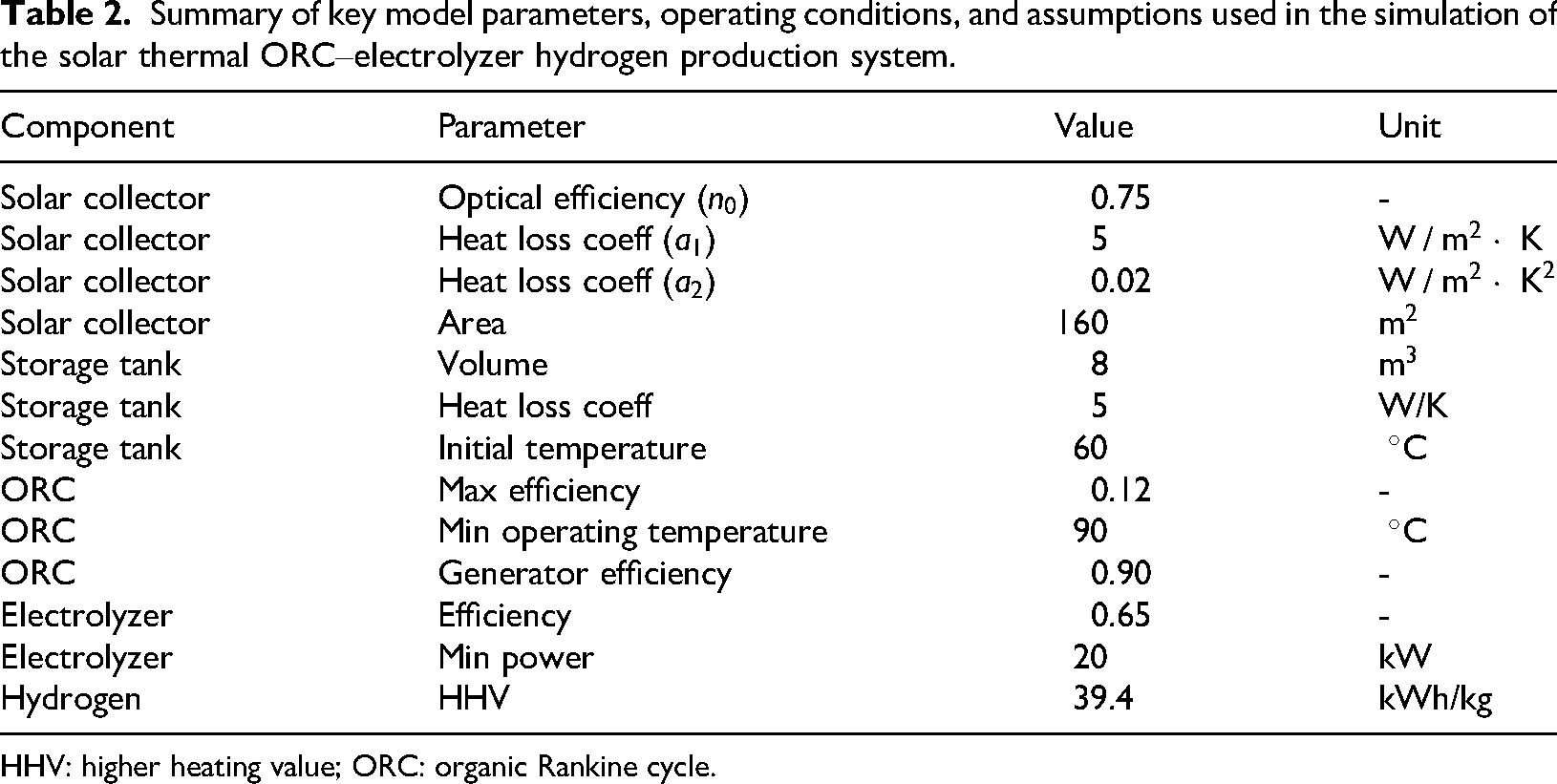
HHV: higher heating value; ORC: organic Rankine cycle.
System optimization framework
To identify the optimal configuration of the proposed solar thermal ORC–electrolyzer system, a parametric optimization framework is adopted based on systematic evaluation of multiple design configurations under identical operating conditions. The optimization aims to determine the best combination of system variables that maximizes hydrogen production while maintaining high energy conversion efficiency.
The primary objective function is defined as the maximization of total annual hydrogen production as in equation (10), where 
In addition to the primary objective, system performance is evaluated using key efficiency metrics. The overall solar-to-hydrogen efficiency is defined as in equation (11), where 
The decision variables considered in the optimization include the parameters shown in equation (12).
The optimization is subject to operational and physical constraints governing system behavior. The ORC operation is constrained by the minimum temperature requirement (equation (13))
The thermal input to the ORC is limited by its maximum capacity shown in Equation (14)
The electrolyzer operation is also constrained by the minimum electrical power input as shown in equation (15). Additionally, system design variables are bounded within practical limits described in equation (16).

The optimization procedure consists of simulating each configuration over a full year (8760 hours) using hourly meteorological data. For each scenario, the objective function and performance indicators are evaluated, and the optimal configuration is selected as the one that maximizes hydrogen production while achieving favorable efficiency values. This parametric optimization approach ensures robust comparison between system configurations and provides practical design insights without the need for computationally expensive iterative optimization algorithms.
Results and discussions
This section presents and discusses the simulation results of the proposed solar thermal-driven ORC coupled with an alkaline electrolyzer for green hydrogen production. Eight system configurations were analyzed, differing in solar collector technology, ORC working fluid, and system scale. Rather than presenting results scenario by scenario, the discussion adopts a comparative performance-based approach to identify dominant trends, tradeoffs, and optimal design configurations. The analysis focuses on annual hydrogen production, solar-to-ORC efficiency, solar-to-hydrogen efficiency, and hydrogen production per unit collector area. Results are derived from MATLAB dynamic simulations and presented using comparative plots to clearly reveal the influence of collector technology, working fluid selection, and thermal storage capacity. While some performance trends may appear qualitatively expected, the objective of this analysis is to quantify their magnitude, temporal variability, and system-level interactions under realistic full-year dynamic operation, which cannot be captured through steady-state or design-point approaches.
Figure 3 compares the annual hydrogen production for all scenarios. The results reveal a strong dependence of hydrogen output on both collector technology and system size. Although configurations employing parabolic trough collectors are generally expected to outperform nonconcentrating systems, the present results quantify the extent of this improvement under dynamic operating conditions, revealing that performance gains are strongly influenced by seasonal variability, storage utilization, and ORC operating thresholds. Increasing collector area and storage tank volume leads to a substantial rise in annual hydrogen production, confirming that system scaling significantly enhances thermal energy availability and prolongs operating hours of both the ORC and electrolyzer. However, the results also reveal nonlinear scaling behavior, where increasing collector area and storage volume does not result in proportional performance gains due to limitations imposed by ORC capacity, thermal losses, and part-load operation. This highlights the importance of balanced system design rather than simple oversizing. The large-scale Parabolic Trough Collector (PTC) configuration using a 160 m2 collector field and an 8 m3 storage tank, coupled with the F1 working fluid, exhibits the highest hydrogen yield of approximately 750 kg per year. This result demonstrates the critical importance of combining high-temperature solar collection with sufficient thermal storage to ensure sustained power delivery to the electrolyzer. The magnitude of the increase between small and large systems also highlights the nonlinear effect of thermal storage, where increased storage volume enables greater retention of excess solar heat and reduces curtailment during high-irradiance periods.
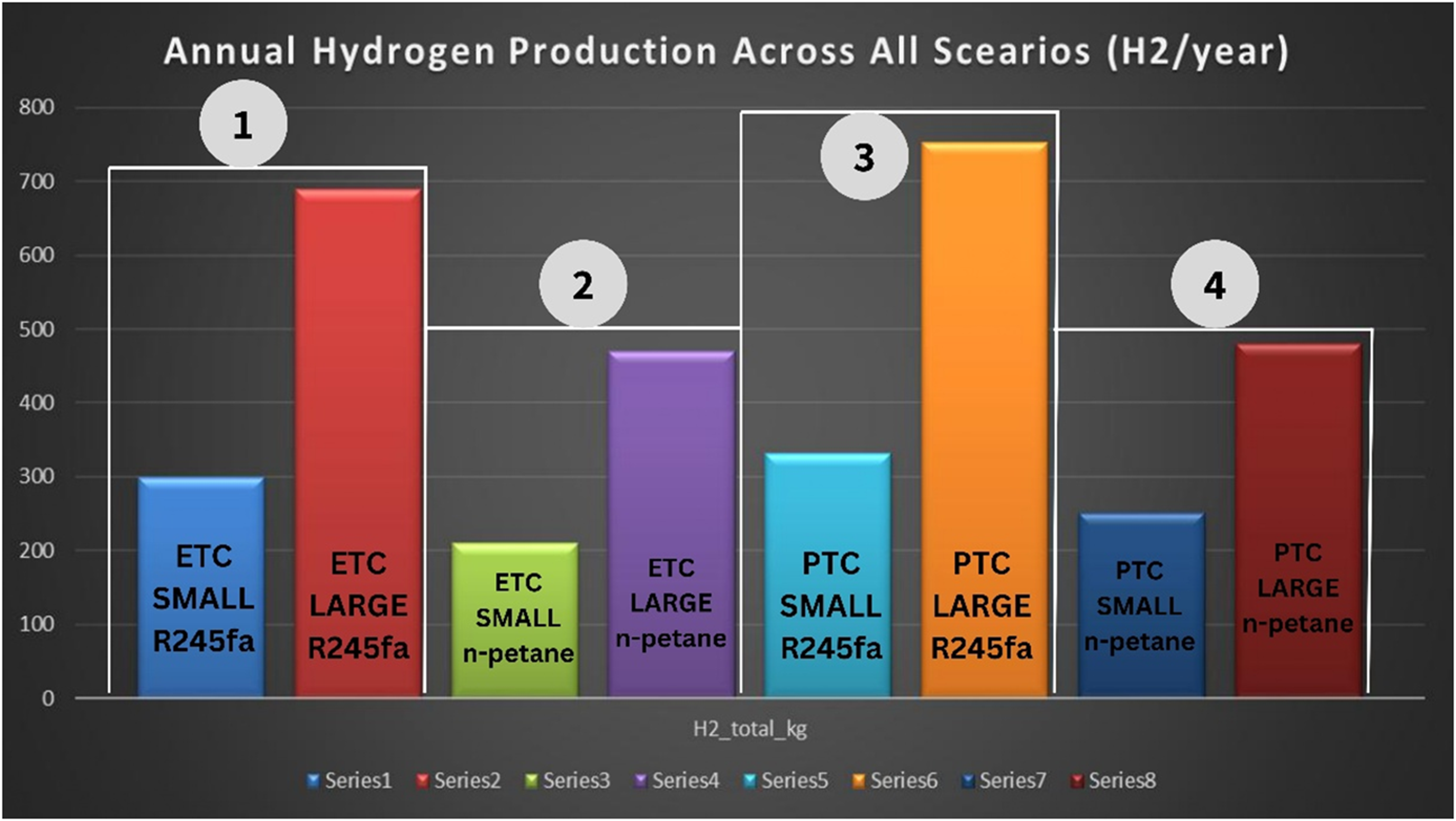
Annual hydrogen production results for all configurations investigated in the study in (kg).
The solar-to-ORC efficiency for all scenarios is illustrated in Figure 4. This indicator reflects the effectiveness of converting incident solar energy into electrical power through the solar thermal ORC subsystem. Parabolic trough-based systems demonstrate consistently higher solar-to-ORC efficiencies than evacuated tube collector systems due to their higher achievable outlet temperatures and lower relative thermal losses. Higher source temperatures reduce irreversibility in the ORC evaporator and improve turbine expansion performance, leading to improved electrical conversion efficiency. Larger systems also show improved efficiency, which can be attributed to enhanced thermal stability and reduced part-load operation of the ORC. When thermal storage is sufficiently large, the ORC operates closer to steady-state conditions, reducing start–stop cycles and improving effective capacity utilization. Although working fluid selection influences efficiency through thermophysical matching with the heat source, the results indicate that collector technology and available thermal input remain the dominant factors governing ORC performance.
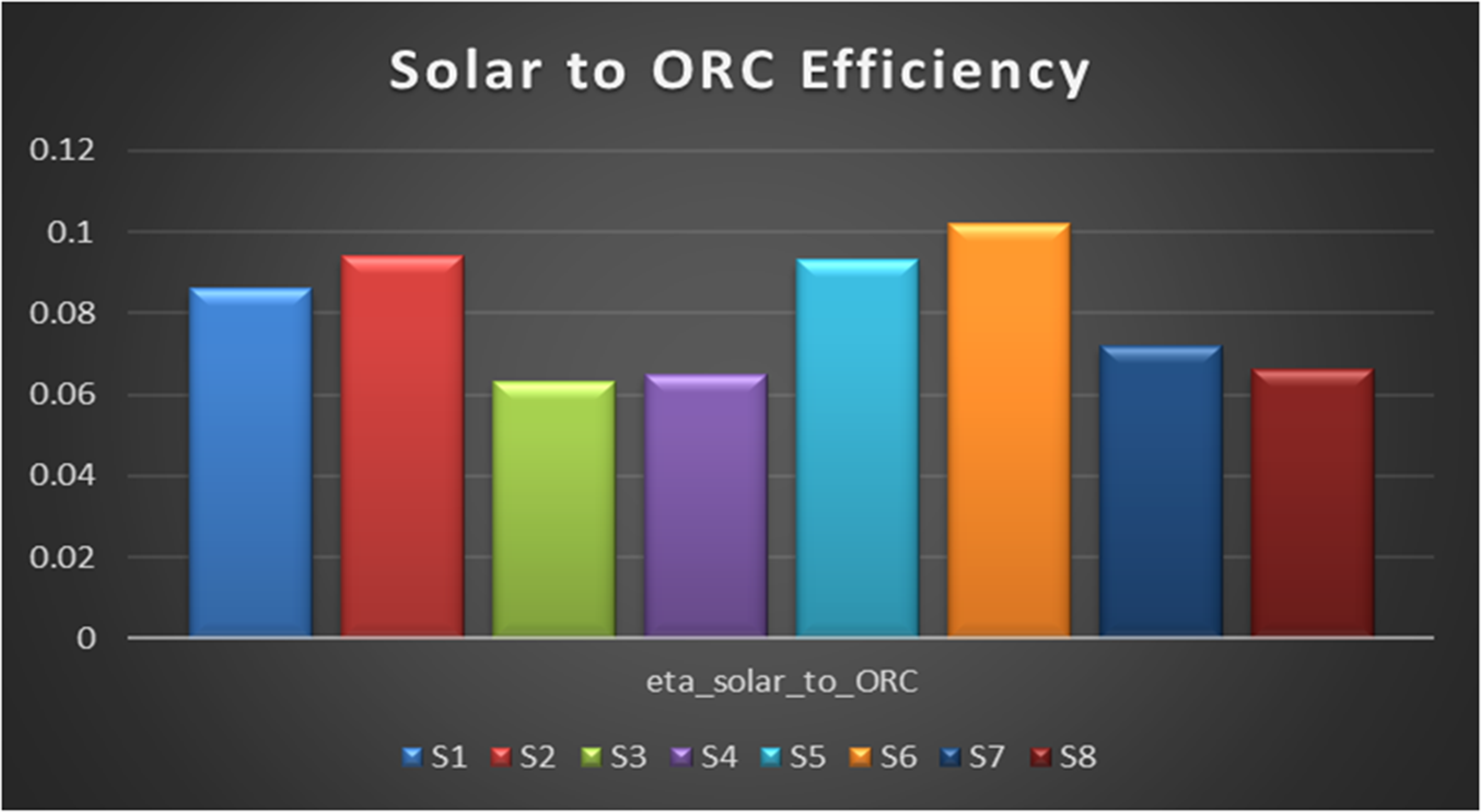
Solar to ORC efficiency comparison for all different configurations. ORC: organic Rankine cycle.
Figure 5 presents the overall solar-to-hydrogen efficiency across all scenarios. This metric captures the cumulative efficiency of the entire energy conversion chain, including solar collection, thermal storage, ORC power generation, and electrolysis. As expected, the absolute efficiency values remain modest due to the multiple energy conversion stages involved. Nevertheless, clear performance trends emerge. Configurations with higher solar-to-ORC efficiency and more stable electrical output achieve superior solar-to-hydrogen efficiency. Large-scale PTC systems outperform smaller configurations, highlighting the importance of thermal inertia and continuous ORC operation in improving hydrogen production efficiency. The results indicate that efficiency improvements occur not only through higher peak performance, but through increased operational continuity over the annual cycle. The integration of thermal storage plays a central role by enabling energy shifting from high-irradiance periods to low-irradiance periods, thereby increasing the effective capacity factor of the electrolyzer.
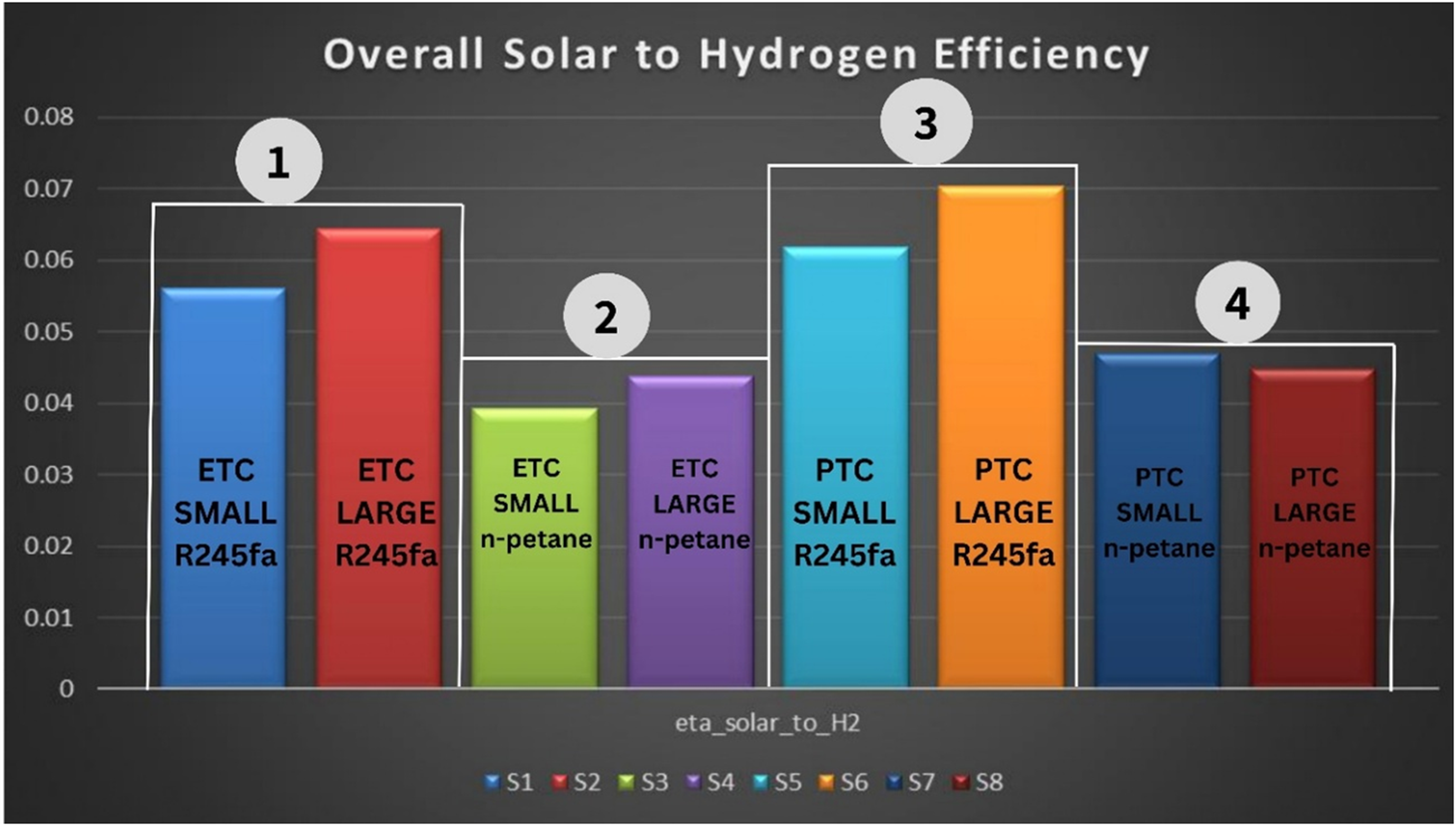
The overall system efficiencies achieved for all configurations.
This metric provides insight into land-use efficiency and the effectiveness of solar resource utilization. Scenario 6 (PTC + F1 + large system) achieves the highest hydrogen yield per unit area at approximately 4.705 kg H₂/m2·year, demonstrating superior utilization of the solar field. This value exceeds those of evacuated tube configurations such as scenario 1 (3.743 kg H₂/m2·year) and scenario 3 (2.633 kg H₂/m2·year), highlighting the advantage of concentrating collectors when coupled with adequate thermal storage and a suitable working fluid. Medium-performing cases such as scenario 5 achieve approximately 4.15 kg H₂/m2·year, indicating that even smaller PTC systems can outperform larger evacuated tube systems in area-normalized productivity. Configurations using the second working fluid show slightly lower normalized yields, confirming the importance of thermodynamic matching between heat source and ORC fluid. Overall, these results demonstrate that collector type and working fluid selection play a more dominant role than system size alone in determining land-use efficiency.
To provide deeper insight into the mechanisms governing optimal system performance, the following analysis focuses on scenario 6, the best-performing configuration. The objective is to explain the physical and operational mechanisms underlying its superior hydrogen production by examining thermal behavior, electrical output, and hydrogen generation profiles (Figure 6).
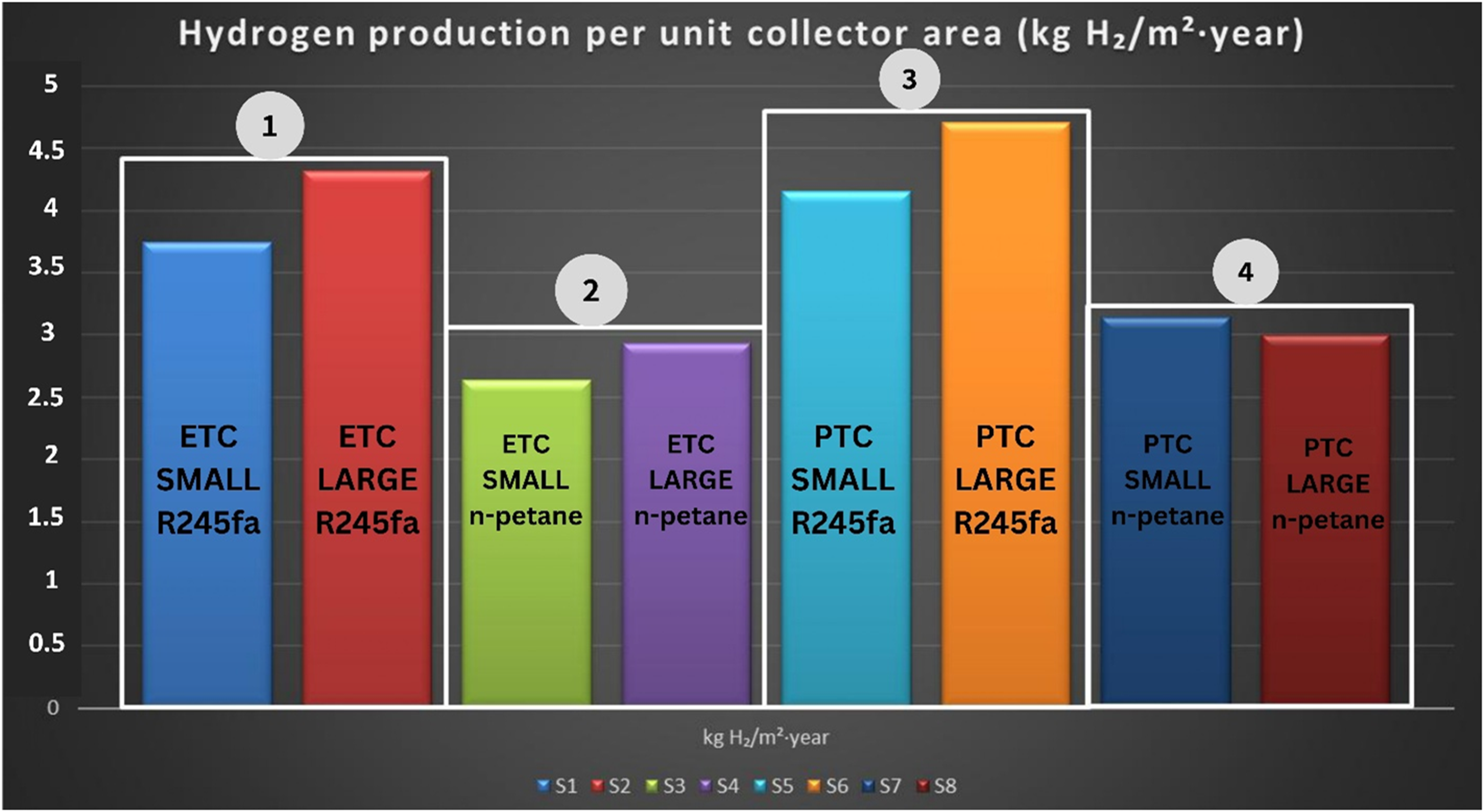
The annual hydrogen production per unit collector area for all configurations evaluated.
Figure 7 illustrates the annual temperature profile of the 8 m3 thermal storage tank. The tank maintains elevated temperatures throughout the year, with an average of approximately 93°C, a maximum near 101°C, and a minimum close to 60°C. This narrow temperature range demonstrates the strong buffering effect of large thermal storage, which dampens short-term solar fluctuations and mitigates rapid cooling during low-irradiance periods. The stored thermal energy allows the ORC to operate for significantly longer durations compared with smaller systems. Seasonal trends show sustained high temperatures during summer and gradual decline during winter, confirming that storage effectively bridges daily and seasonal variability. This stabilization reduces ORC shutdown frequency and minimizes part-load operation, both of which are detrimental to efficiency.
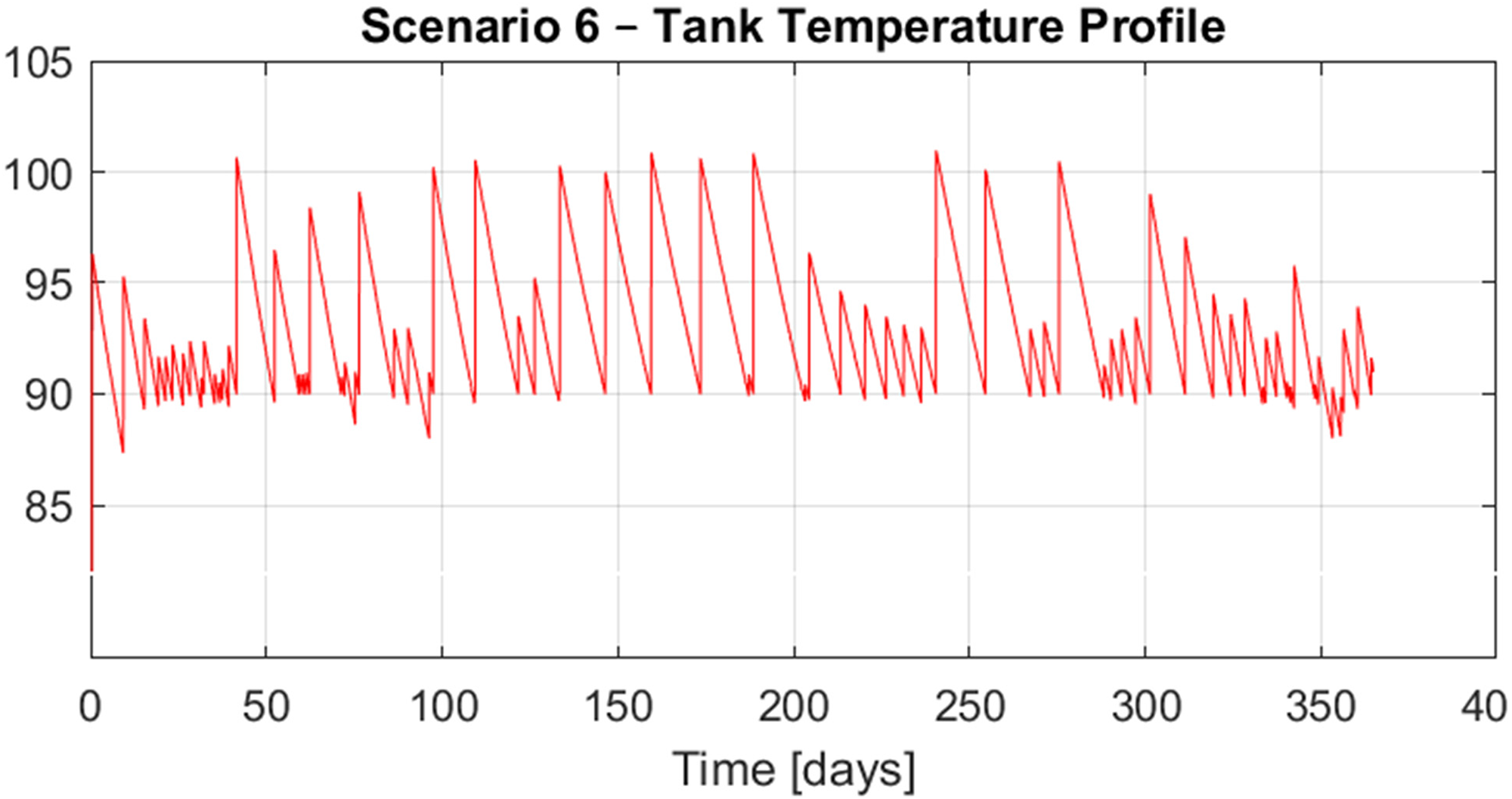
Annual thermal storage tank temperature profile for scenario 6 (PTC–F1, large system), illustrating the effect of increased storage volume on temperature stability and sustained thermal supply to the ORC. ORC: organic Rankine cycle.
Figure 8 presents the annual ORC electrical power output profile, which reflects both the seasonal variation of the solar resource and the mitigating influence of thermal storage on short-term power fluctuations. As shown in Figure 8, the ORC exhibits sustained power generation over extended periods, particularly during high-DNI seasons, where electrical output remains consistently elevated rather than being confined to short peak intervals. The average electrical power output of approximately 415 W, together with a peak output exceeding 5.6 kW, indicates that the ORC operates for long durations under favorable thermal conditions rather than frequently cycling between on and off states. This behavior contrasts with smaller-scale or nonconcentrating collector configurations, where limited thermal input often forces intermittent operation and prolonged part-load regimes.
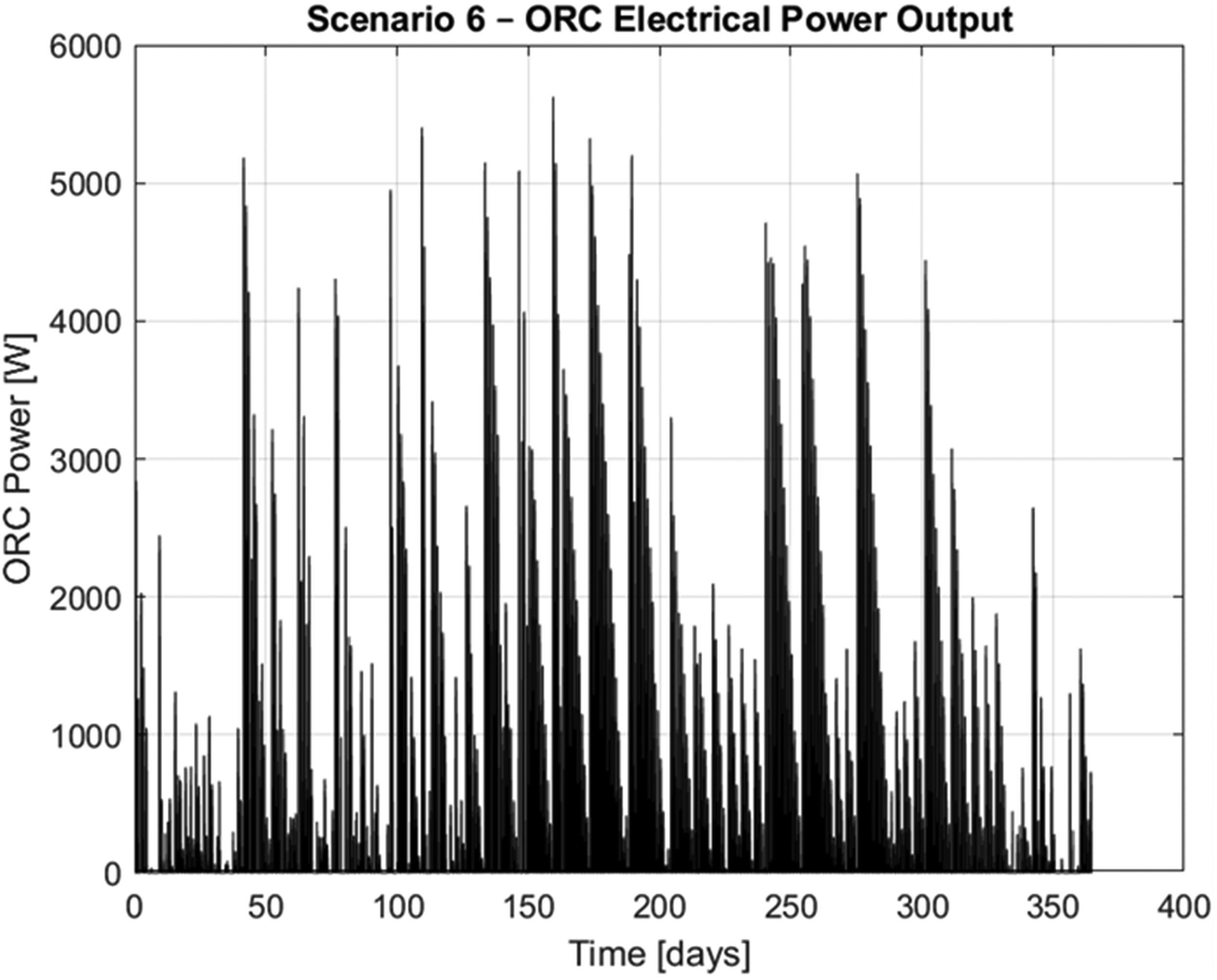
Annual ORC electrical power output profile for scenario 6 (PTC–F1, large system), illustrating sustained power generation enabled by high-temperature solar thermal input and increased thermal storage capacity. ORC: organic Rankine cycle.
The power profile further demonstrates that the increased thermal inertia of scenario 6 allows the ORC to maintain electricity production during periods of reduced instantaneous solar input. Instead of closely tracking short-term DNI fluctuations, the ORC output follows a smoother trajectory governed by the thermal state of the storage tank. This decoupling between solar collection and power generation enhances the effective capacity utilization of the ORC and reduces efficiency penalties associated with transient operation.
From a system perspective, the observed electrical output characteristics are critical for downstream hydrogen production. Stable and sustained electrical power delivery improves electrolyzer utilization and reduces the frequency of low-load operation, which is particularly advantageous for alkaline electrolyzers that perform optimally under quasi-steady input conditions. Consequently, the ORC power output profile of scenario 6 constitutes a key intermediate mechanism linking enhanced thermal management to increased annual hydrogen yield.
The hydrogen production behavior of scenario 6 closely follows the electrical output characteristics of the ORC, reflecting the direct coupling between ORC power generation and alkaline electrolysis. Figure 9 illustrates the annual hydrogen production rate profile, where periods of elevated hydrogen generation coincide with sustained ORC electrical output, particularly during high solar availability seasons.
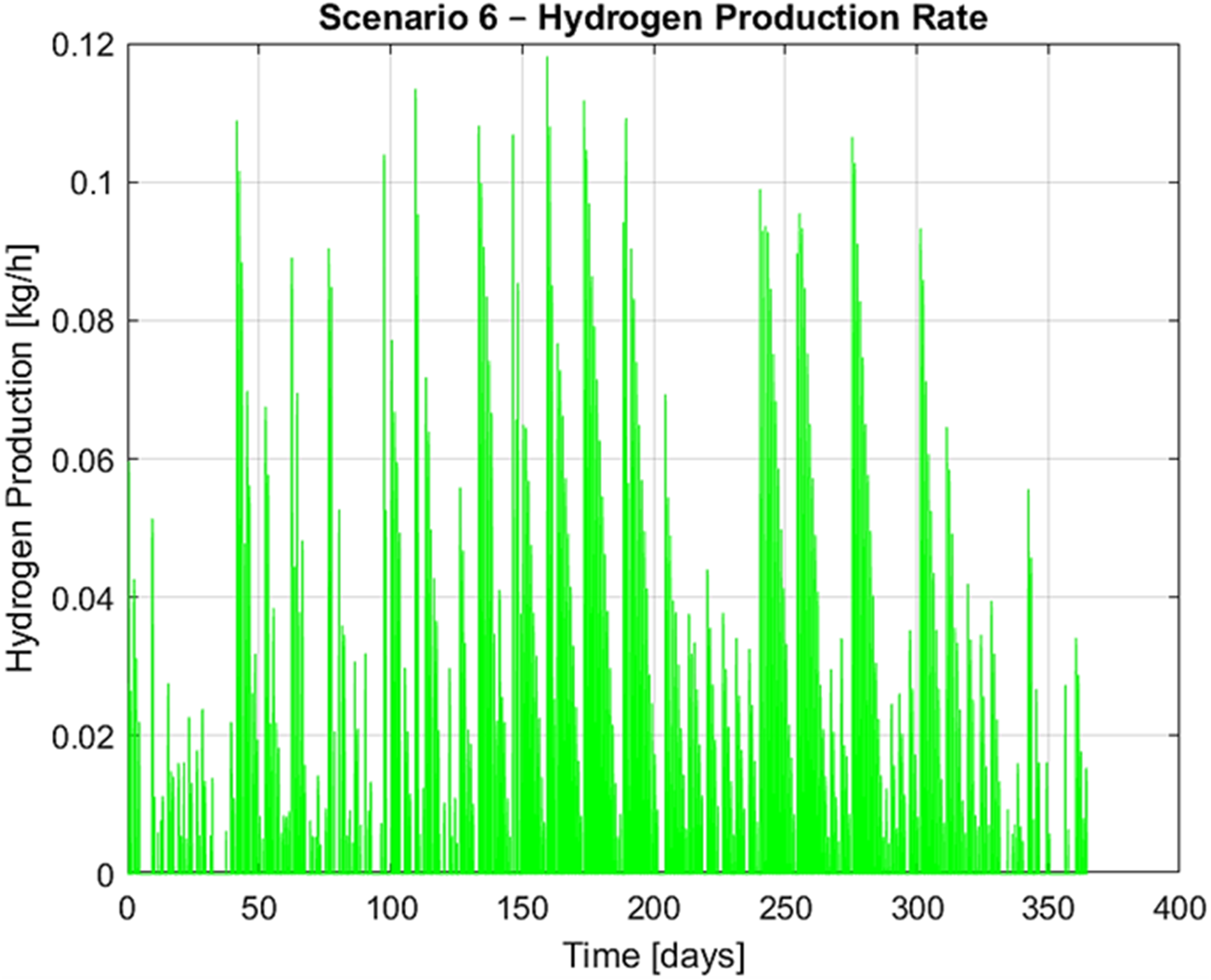
Annual hydrogen production rate profile for scenario 6 (PTC–F1, large system), illustrating the response of alkaline electrolysis to stabilized ORC electrical power output. ORC: organic Rankine cycle.
The relatively smooth hydrogen production profile observed in Figure 9 indicates that the stabilized electrical input provided by the ORC reduces sharp fluctuations in electrolyzer operation. Rather than exhibiting frequent start–stop behavior, the electrolyzer operates for extended durations at moderate to high production rates, which is favorable for alkaline electrolysis systems that perform optimally under quasi-steady operating conditions. This operational stability contributes to improved electrolyzer utilization and enhances cumulative hydrogen output over the annual cycle. Seasonal variations in hydrogen production are evident, with higher generation rates during late spring and summer months when the combination of high direct normal irradiance and elevated storage tank temperatures enables prolonged ORC operation. During lower-irradiance periods, hydrogen production decreases but does not collapse entirely, demonstrating the buffering role of thermal storage in sustaining electrolysis beyond instantaneous solar input. This behavior confirms that hydrogen generation in scenario 6 is governed not solely by solar availability, but by the integrated thermal–electrical management of the system.
On an annual basis, the hydrogen production profile in Figure 9 culminates in a total output of approximately 753 kg, representing the highest hydrogen yield among all simulated configurations. The close correspondence between ORC power output and hydrogen production rate highlights the effectiveness of the solar thermal–ORC–electrolyzer architecture in translating stabilized thermal energy into usable chemical energy. Consequently, the hydrogen production response of scenario 6 provides clear evidence that combining a high-temperature collector technology with sufficient thermal storage is a key enabler of efficient and sustained green hydrogen production.
The detailed analysis of scenario 6 confirms that its superior hydrogen production performance arises from the synergistic interaction between collector technology, thermal storage capacity, and ORC operating conditions, rather than from any single component in isolation. This confirms that system performance is governed by interdependent multi-component dynamics, which cannot be accurately predicted using simplified or steady-state assumptions. The parabolic trough collector field provides high-grade thermal energy during periods of strong direct normal irradiance, while the enlarged thermal storage tank maintains elevated and stable temperatures that extend ORC operating hours and reduce transient behavior.
The stabilized thermal input directly translates into sustained ORC electrical power output, which in turn enables quasi-steady operation of the alkaline electrolyzer. This operating regime minimizes part-load and intermittent behavior, thereby improving electrolyzer utilization and maximizing cumulative hydrogen production over the annual cycle. The resulting hydrogen production profile demonstrates that long-term yield is governed not only by peak solar availability, but by the system's ability to retain and effectively manage thermal energy.
Overall, scenario 6 exemplifies an optimized solar thermal–ORC–electrolyzer configuration in which system scale, storage capacity, and temperature matching are appropriately balanced. The findings from this representative case provide clear physical insight into why large-scale PTC-based systems outperform alternative configurations and establish a benchmark for design strategies aimed at maximizing annual hydrogen production and solar resource utilization.
The comparative analysis of all simulated scenarios demonstrates that system performance is strongly governed by the interaction between solar collector technology, thermal storage capacity, and ORC operating conditions. Parabolic trough collectors consistently outperformed evacuated tube collectors in terms of total hydrogen yield, conversion efficiency, and hydrogen production per unit collector area, owing to their ability to utilize high direct normal irradiance and deliver higher-grade thermal energy to the ORC.
Scaling the system from small to large configurations—by increasing collector area from 80 to 160 m2 and storage volume from 4 to 8 m3—resulted in substantial improvements in ORC electrical output and annual hydrogen production. Larger thermal storage reduced temperature fluctuations, increased ORC operating hours, and improved the stability of hydrogen generation. These effects were particularly pronounced in parabolic trough-based systems, where higher thermal input allowed the ORC to operate closer to its optimal temperature range.
The influence of working fluid selection was secondary compared to collector type and system scale, but remained significant. Fluids with higher thermal efficiency and better temperature matching with the heat source yielded improved electrical output and hydrogen production, particularly under high-temperature operating conditions.
Conclusions
This study presented a comparative performance assessment of a solar thermal-driven green hydrogen production system based on the integration of solar collectors, an ORC, and an alkaline electrolyzer. A comprehensive MATLAB-based simulation framework was developed to evaluate eight system configurations by varying the solar collector technology, ORC working fluid, and system scale under realistic meteorological conditions. The adopted comparative methodology enabled the identification of key performance trends and the determination of the most effective design strategy for solar-thermal hydrogen production. The results demonstrate that system performance is governed by the interaction between solar collector technology, thermal storage dynamics, and ORC operating conditions, rather than individual components in isolation. Parabolic trough collectors exhibited superior performance; however, the analysis quantifies how this advantage depends on thermal stability, storage utilization, and extended ORC operating duration under dynamic conditions. This higher-grade heat improved ORC conversion efficiency, increased electrical output stability, and extended operating hours of the electrolyzer. System scaling improved hydrogen production; however, the results highlight the importance of balanced design, where thermal storage capacity and ORC operation must be matched to avoid inefficiencies associated with oversizing and thermal losses.
The influence of ORC working fluid selection was found to be secondary compared with collector type and scale, but still relevant for performance optimization. Working fluids with better thermodynamic compatibility with the available heat source improved ORC electrical output and consequently enhanced hydrogen production, particularly in high-temperature PTC-based configurations. The best-performing configuration—a large-scale parabolic trough collector system coupled with an R245fa working fluid—achieved the highest annual hydrogen yield and the highest hydrogen production per unit collector area, confirming the importance of proper matching between heat source temperature, ORC design, and electrolyzer operation. The optimal configuration achieved an annual hydrogen production of 752.8 kg·year−1, corresponding to a productivity of 4.705 kg·m−2·year−1 and a total energy output of 25,094 kWh·year−1.
In addition, the system reached an overall solar-to-hydrogen efficiency of 7.03%
Despite the promising results, several limitations should be acknowledged. The analysis relied on simulation-based modeling and assumed idealized component performance and control strategies, while real systems may experience additional operational losses and dynamic constraints. Economic assessment and long-term degradation of system components were beyond the scope of this work and should be addressed in future studies. Further research is recommended to include technoeconomic optimization, dynamic control strategies, hybridization with photovoltaic or wind energy systems, and experimental validation at pilot scale. Expanding the analysis to different climatic regions and incorporating advanced electrolyzer technologies would also provide deeper insight into the scalability and real-world feasibility of solar thermal hydrogen production systems.
Footnotes

Funding
The authors received no financial support for the research, authorship, and/or publication of this article.
Declaration of conflicting interests
The authors declared no potential conflicts of interest with respect to the research, authorship, and/or publication of this article.