






Abstract
This review explores emerging smart technics in enhancing energy efficiency in commercial and residential buildings using systematic and bibliometric approaches from 1990 to 2024. According to the findings, the increase in internet of things applications, like AI and especially machine-learning applications, has enabled smarter buildings in recent years. The advancements of modern data analytics, predictive modelling, and real-time monitoring create a fair base for advancing into new paradigms for energy management. Energy yield prediction and building performance enhancements are ensured through machine-learning techniques, such as ensemble learning, neural networks, and support vector regression. The study found that deep reinforcement learning and fuzzy logic constitute those technologies that automate the consumption behaviors while perfectly balancing efficiency and comfort of occupants. According to the results, smart technologies offer better options toward energy efficiency but encounter major hurdles like poor internet availability, social acceptance, regulatory issues, high upfront cost, scaling issues, and data privacy. Real-time data coupled with smart technology systems should be combined to develop hybrid machine-learning models and predictive energy consumption models. For the attainment of energy efficiency goals, standardization of energy-efficient buildings and greening people's energy practices are key.
Keywords
Introduction
The building and construction industry is responsible for 15% of CO2 emissions and one-third of worldwide energy consumption (EC). It is anticipated that buildings’ energy demands will rise in tandem with population expansion and the growing demand for energy-intensive gadgets. In order to limit the effects on the environment and achieve sustainable development globally, cities are attempting to reduce greenhouse gas emissions and increase energy efficiency. An important issue is accurately measuring the energy usage of buildings. In order to enhance efficiency and better forecast usage, experts are concentrating on energy-saving methods in buildings.1‐3
Digitalized, energy-efficient buildings are becoming more and more popular throughout the world as a sustainable way to lower carbon emissions, especially from the building industry. Artificial intelligence (AI) is essential in many application situations, and energy digitalization technologies may be used in sophisticated model predictive controls, building performance projections, and optimizations.4–9 A system called “smart buildings” uses the adaptability of building entities to give the electrical grid active demand response (DR). This consists of a collection of mechanisms that are separated into price-based and incentive programs. These programmes establish the signals that customers and the grid must exchange in order to shape the power profile. Several studies have tackled this problem at the building level, showing that they can adjust power usage to grid signals while maintaining occupant comfort.10,11
A large number of review papers have been produced to compile the body of knowledge in the fast-increasing subject of smart technologies in buildings. Some of these studies include Farzaneh et al. 12 which reviewed AI applications in smart buildings, with a particular emphasis on DR programs, building management systems, energy usage prediction, and assessment frameworks. Shah et al. 13 reviewed the components, use of machine learning (ML) to improve energy efficiency, and function of internet of things (IoT) devices in smart buildings. Also, 14 reviewed the advantages, difficulties, and possible research directions of the developments in smart energy management in smart cities. Energy management in commercial buildings was reviewed by Hossain et al., 15 who also covered future trends, user comfort, policy, data privacy and security, and active and passive solutions for net-zero energy. Similarly, data collection, building automation, energy digitization, fault detection, fire alarming, and climate change adaptation were all reviewed by Liu et al., 16 which offered a thorough analysis of advanced controls for smart and energy-efficient buildings, including occupant-centric controls, AI-based controllers, and ML-based controls. Furthermore, Papadakis and Katsaprakakis 17 investigated energy efficiency in public nonresidential facilities, such as museums, schools, swimming pools, and hospitals, with an emphasis on the particular patterns and difficulties associated with their energy usage. Also, Al-Obaidi et al. 18 examined IoT applications for reducing building and urban energy use, pointing out gaps in professional development and deployment, and offering compelling reasons for efficient IoT utilization. Finally, Mishra and Singh 19 investigated energy management techniques in IoE-enabled sustainable smart cities, with an emphasis on cloud computing, low-power device transceivers, schedule optimization, and cognitive frameworks. It also looked at effective scheduling, receiver design, and energy harvesting. The study emphasized both possible paths and present difficulties.
Based on the literature review above, several research studies examined various facets of smart technology utilized in smart buildings using the traditional review technique. However, the conventional review methods have a number of demerits, as they are usually unable to provide a complete overview of research done on the topic of study; they are also unable to evaluate a large volume of data in a single study. The bibliometric and systematic review methods are review techniques that have been adopted in recent years to provide a detailed analysis and visualization of studies on a specific subject matter. A bibliometric review is one that analyzes the quantitative aspects of published research, such as citation patterns, publication trends, and networks of authors, to come up with key themes, important papers, and effects of research across a specific field. The systematic review is also a rigorous, structured approach to reviewing and synthesizing relevant studies regarding a particular topic according to predetermined criteria of study selection, data extraction, and quality assessment. Both types are more objective, transparent, and comprehensive than traditional narrative-style reviews, which can be subjective and limited based on the author's point of view. Also, bibliometric and systematic reviews minimize bias while being yet comprehensive and give valuable insights about sources grounded in research trends and gaps in knowledge.20‐22 The purpose of this study is to identify key studies, areas of research interest, and emerging themes in smart technology for enhancing energy efficiencies in commercial and residential buildings. This is because the existing studies as reviewed in the earlier paragraph and Table 1 mostly focused on individual smart technologies such as IoT, AI, ML/deep learning (DL), 5G, digital twins, EMS, and building information modelling (BIM), mainly by using systematic or narrative review approaches. The present study, on the other hand, employs a comprehensive bibliometric and systematic review framework that considers multiple emerging smart technologies together, and combines thematic and content analysis with quantitative bibliometric techniques. It utilizes network visualization, overlay visualization, factorial analysis, evolution analysis, country-level collaboration mapping, and publication trend analysis. This approach gives a wider data-driven and future-oriented understanding of technology trends, research development and the role of smart technologies to improve energy efficiency in residential and commercial buildings.
Smart technologies for building energy efficiency: literature review and research gaps.
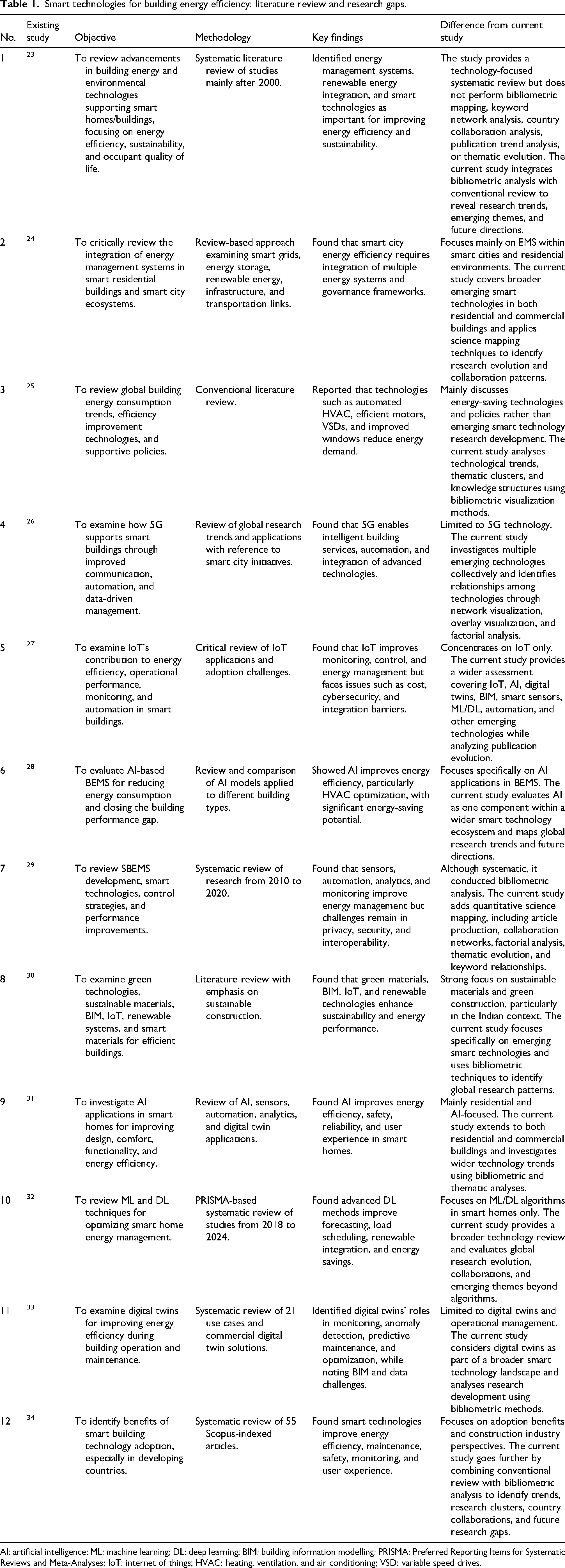
AI: artificial intelligence; ML: machine learning; DL: deep learning; BIM: building information modelling: PRISMA: Preferred Reporting Items for Systematic Reviews and Meta-Analyses; IoT: internet of things; HVAC: heating, ventilation, and air conditioning; VSD: variable speed drives.
The study is divided into five primary components. Theoretical and conceptual framework section presents a brief overview of the theoretical and conceptual framework of the study. The materials and methods section presents the materials and techniques employed in the investigation, while The results and discussion section presents the findings and discussions. The conclusion and some avenues for further investigation are presented in the conclusion and future research recommendations section.
Theoretical and conceptual framework
Several complementary theoretical perspectives, including smart city theory, sustainable energy transition theory, sociotechnical systems theory, and technology adoption frameworks, can be used to understand the adoption and effectiveness of emerging smart technologies to improve energy efficiency in residential and commercial buildings. From the perspective of smart city theory, buildings are fundamental components of intelligent urban infrastructure, integrating digital technologies, data analytics, automation and connected systems to optimize resource consumption and improve environmental performance. Therefore, smart buildings are micro-level components of smart cities that enable real-time monitoring, intelligent control and demand-side energy management using IoT sensors, smart meters, AI, building automation systems, and digital twins. This perspective highlights that advances in energy efficiency are achieved not only by technological innovation, but also by the interaction of digital infrastructure, building operations, occupants and broader urban energy systems.35,36 Likewise, the sustainable energy transition perspective explains the role of smart technologies in moving buildings from conventional EC patterns toward more flexible, low-carbon and efficient energy systems. Smart energy management platforms, renewable energy integration, energy storage systems (ESSs) and intelligent DR mechanisms are facilitating this transition by allowing buildings to adjust EC based on availability, cost and environmental conditions.37,38 Therefore, smart technologies are being developed as enablers for accomplishing sustainable energy transitions by improving operational efficiency and allowing integration of renewable energy resources.
Energy efficiency in buildings is not a technical process but the result of interactions between technological components, human behavior, institutional structures and economic factors. Therefore, a sociotechnical systems perspective is adopted. Smart technologies offer sophisticated features to monitor and control energy use, but their success depends on occupant acceptance, behavioral adaptation, regulatory support, data governance and organizational readiness. This is in line with technology adoption frameworks like Technology Acceptance Model and Unified Theory of Acceptance and Use of Technology, which stress the significance of perceived usefulness, ease of use, trust and social influence in affecting users’ willingness to adopt smart building technologies.39,40 Thus, the conceptual linkages of this review are that the drivers for the emergent smart technologies (IoT, AI, smart meters, digital twins, automation systems, and intelligent controls) influence the energy efficiency outcomes (reduced consumption, better energy management, lower emissions, better occupant comfort) via mediators such as data availability, interoperability, user engagement, infrastructure readiness, and policy support. This framework points out that achieving energy-efficient residential and commercial buildings is not just a technological problem, but also about the alignment of digital systems, human factors, and sustainability goals.
Materials and methods
For reproducibility and methodological rigor, the study applied the Preferred Reporting Items for Systematic Reviews and Meta-Analyses method. The Scopus database served as the main source of data because of its stringent quality control protocols, wide coverage of peer-reviewed scientific literature, and advanced indexing features.41,42 The search query used for identifying the pertinent documents include: TITLE-ABS-KEY ((“Smart Technologies” OR “Smart Systems” OR “IoT” OR “Internet of Things” OR “Artificial Intelligence” OR “Machine Learning” OR “Big Data” OR “Energy Management Systems” OR “Automation”) AND (“Energy Efficiency” OR “Energy Saving” OR “Sustainability” OR “Building Performance”) AND (“Commercial Buildings” OR “Residential Buildings” OR “Building Sector”)). The initial search, conducted on 28 March 2025, yielded 1262 entries across all topic areas between 1990 and 2024. Additionally, we limited the search to the following fields: physics and astronomy, computer science, energy, engineering, and environmental science. As a result, there were only 1228 papers left. A methodical filtering procedure that restricted the document type to peer-reviewed articles and conference papers further reduced the data to 1094 documents; language filtering was then used to include only English-language publications that were downloaded for the analysis, further reducing the data to 1088 documents. The study focused on publication trends, the distribution of regional research output, and topic evolution mapping by analyzing bibliometric data using R Studio's Bibliometrix package 43 and VOSviewer tool. 44
Results and discussion
A detailed analysis of the various findings is presented in this section. It covers a discussion on the various keywords used in the different studies, their co-occurrence and their relationships with the subject matter, the conceptual structure of the topic, and highlights of key studies. Country-level production and collaborations, as well as key sources and affiliations, are also discussed. The summary of the data used for the study, as presented in Figures 1 and 2, points to a notable increase in research interest and output during the last few years. These are indications that energy efficiency and smart technologies are taking increasing importance in the global sustainability architecture. After 2011, as demonstrated in Figure 2, the data shows a relatively constant jump in publications except in 2016 and 2021. This clearly depicts that researchers are focusing on how the supposed emerging technologies, such as IoT, AI, and ML, can optimize EC inside buildings. But the most interesting trend in this regard is a global march toward smarter infrastructures that are highly energy efficient. Urbanization and climate change, coupled with tougher energy regulations, may have contributed to this trend. The relatively high 18.44% annual growth rate further reinforces the expanding horizon of such an area of research, brought about by the advancement of technology and interdisciplinary cooperation, as the same can be manifested by a high number of authors (3505) and diverse usage of keywords (2757). The growing international collaboration (26.47% coauthorship) is also a further manifestation that the nature of this problem is global and that solutions are being sought to find ways to scale energy efficiency efforts in our buildings. The publication of articles regarding smart building systems between 1990 and 2010 was found to be slow. This may be associated with the fact that technology was still very young and not completely focused on energy efficiency in buildings. The present proliferation in research on this topic could be attributed to having matured key technologies such as IoT, AI, and sensor networks, which have opened the doors for more feasible and cost-effective integrations of smart solutions. This urgency relates to climate change and government policies that drive sustainability or efficiency in buildings toward EC. As such issues gain serious consideration for both EC and environmental impacts, the academic community has intensified their research on the topic, which would indeed make the pace for innovation in this area.

Summary of the data.

Annual article production.
In bibliometric analysis, word clouds, as shown in Figure 3, play a key role in unravelling the major areas of interest and focus on relation to a particular research theme. It is a graphic representation of word frequency in written language. The term appears larger in the generated graphic the more times it appears in the article under analysis.41,45,46 The use of words such as residential buildings, smart buildings, IoT, energy management, AI, and DR is a reflection of the growing integration of smart technologies in both commercial and residential buildings for enhancing energy efficiency in recent times. These themes refer directly to the biggest trends regarding the fact that IoT-based systems for real-time energy monitoring and control applications have adopted AI and DL for predictive energy management. At the same time, there is great emphasis on energy-saving technologies such as building automation, smart grid, and energy optimization. The importance of energy savings and DR tags can be established from the integration of smart systems capable of dynamically adjusting their consumption to enhance efficiency and cost savings. Similarly, the growing attention directed toward thermal comfort tends to balance out with energy efficiency and the comfort of occupants, which is something that applies to both residential and commercial buildings. These common themes lead toward a future in which advancements in technology for energy management systems and smart infrastructure will play a vital role in achieving sustainable goals. However, themes less frequently used, such as artificial neural networks (ANNs), renewable energy, genetic algorithm, multiobjective optimization, and home energy management systems (HEMSs) show promising areas for potential future research that could offer support and enhancement to current trends. The comparatively lower frequency of phrases like “building energy efficiency” and “renewable energy” may suggest that, despite their importance to sustainability, these ideas are not as closely linked to new smart technologies in the current research environment. This lacuna provides a background for future exploration of how advanced optimization approaches, such as genetic algorithm or multiobjective optimization, could be enhanced through their integration with renewable energy sources to maximize building energy efficiency. They might also open those areas for machine-learning algorithms to increase the use of “ANN” and “random forest” for enhanced energy prediction models and system optimization within smart buildings. Focusing on these less emphasized topics could establish new synergies through which smart technologies, renewable energy, and advanced ML may push these frontiers into energy-efficient building design and operation.

Keyword cloud for the author keywords.
Co-occurrence network analysis is vital in bibliometric systems since it shows the relationship and trends within research fields from the point of view of keyword, concept, or entity pairs that frequently co-occur with one another for progressing knowledge of research structure and evolution.47–49 In this study, the VOSviewer tool was used to analyze the co-occurrence of the author keywords within the research period. The minimum number of occurrences of keywords used for the analysis is 5. From the analysis, a total of 10 clusters (Figure 4) were identified using the fractional counting approach with a total link strength of 773.

Network visualization for the keywords used by the authors.
A detailed analysis of the various clusters as identified is presented below:

The CNN–BiLSTM network that is suggested. 52 Published under open access.
The findings suggest that the application of AI, ML and smart sensing technologies has greatly enhanced the capability of residential and commercial buildings to monitor, predict and optimize energy performance. A key finding from recent experimental studies is that real-time monitoring provides the essential operational intelligence for energy-efficient building management. IoT-based sensors, smart meters and building automation systems continuously monitor indoor environmental conditions, occupancy variations, equipment operation and electricity consumption patterns, allowing AI models to detect inefficiencies that are hard to spot with traditional methods. For instance, Lee et al. 53 developed a neural-network-based building energy prediction model and showed that data-driven methods can successfully learn complex relationships between environmental variables and building energy behavior, improving the reliability of energy forecasting for operational decision-making. The study showed that neural networks can adapt to changing building conditions with continuous data inputs, which supports more accurate control of energy-consuming systems such as heating, ventilation, and air conditioning (HVAC). Likewise, Liu et al. 54 experimentally compared different ML approaches for building energy prediction and concluded that advanced learning models enhanced prediction accuracy due to their ability to capture nonlinear interactions between weather conditions, building characteristics, and energy demand. The results showed that the energy savings are not achieved through the real-time monitoring alone, but through the processing of the information generated by sensors through intelligent algorithms to allow the automated and responsive operation of the building.
The practical implication is that smart buildings can shift from fixed operating schedules to adaptive energy management. In commercial buildings with frequent occupancy changes, AI-based monitoring can prevent unnecessary cooling, heating and lighting of unoccupied spaces while maintaining acceptable indoor conditions. For example, HVAC systems can receive continuous occupancy and environmental information and adjust operation according to actual demand. Macieira et al. 55 developed an energy management model for HVAC control by using reinforcement learning. They demonstrated that continuous data acquisition and predictive decision-making improved the operation of HVAC by considering occupancy, environmental conditions, and energy demand simultaneously. Their results indicate that smart control strategies can reduce unnecessary EC while preserving building functionality. Predictive modelling has also emerged as a key mechanism for improving energy efficiency by allowing buildings to predict future demand rather than react after the energy has been consumed. Kim et al. 56 applied a nonlinear autoregressive exogenous neural network model for predicting cooling loads. They demonstrated that optimized neural networks can accurately forecast future cooling loads, which can be leveraged to enhance the scheduling of HVAC operations and decrease peak energy demand. Thus, the evidence indicates that the predictive models enhance building performance by enabling the energy systems to operate proactively on the basis of the predicted occupancy, weather and thermal needs.
Furthermore, studies show that optimization of occupant comfort is becoming an increasingly fundamental objective of AI-enabled energy management systems. Previous energy-saving approaches often focused on consumption reduction without considering human comfort, but emerging smart technologies try to balance energy efficiency and indoor environmental quality. AI techniques such as reinforcement learning can continuously evaluate the relationship between energy use and occupant responses, allowing systems to decide the best temperature, ventilation, and lighting conditions. Deng and Chen 57 examined reinforcement learning models for predicting occupant behavior and controlling HVAC and found that AI-based models of occupants can improve understanding of how people interact with building systems, helping to develop more effective energy optimization strategies for a range of buildings. Similarly, Zhao et al. 58 applied a hybrid model-based deep reinforcement learning approach to HVAC control, demonstrating that intelligent controllers can optimize EC while meeting thermal comfort requirements. The results show that AI controllers are particularly useful because they continuously learn from building responses and adjust control actions accordingly, unlike conventional rule-based systems, which have limited adaptability. In general, the studies reviewed suggest that the combination of real-time monitoring, predictive modelling, and occupant-centered optimization provides a more effective pathway to energy-efficient buildings. This technology allows buildings to analyze their operational data, predict future energy needs, and automatically adapt performance to reduce energy waste, increase system reliability, and improve occupant satisfaction.

(a) Consumption of energy by situation. The acronym for business-as-usual is BAU, (b) CO2 emissions by scenario. LEPG is an acronym for low-emission power generation, which aims to reduce emissions from 2020 levels to zero by 2050. The estimated range from the sensitivity study is shown by the lighter color for each scenario, while the darker color represents the average estimate. 62 Published under open access.
Similarly, by using ML techniques, Zheng et al. 63 presented a unique method for estimating whole-life carbon emissions (WLCEs) in buildings. A total of 28 variables from a thorough survey and data from 150 residential houses in Cornwall, UK, were utilized in the study. Random Forest, Decision Tree, and Multiple Linear Regression were among the 10 algorithms that were examined. To assess the models’ appropriateness, performance assessment indicators were employed. The findings demonstrated that nonlinear models outperformed linear models in predicting WLCE and WLCE intensity, whereas all examined algorithms were able to do so. The Random Forest model proved to be more accurate, stable, and effective. According to the research, life cycle studies should be incorporated into early design phases, even when building design timelines are constrained. Also, in order to lower home carbon emissions and energy expenses while raising power sales revenue, Yan and He 64 suggested an HEMS built on the SAN-DRL architecture. Grid system, solar PV system, ESSs, and electric vehicle systems models were all part of the strategy framework. Optimal scheduling methods based on outside temperature, solar radiation intensity, home EC, and system characteristics were solved using the SAN-DRL model. Several power consumption scenarios were simulated using the Monte Carlo approach; the minimum inaccuracy was achieved when 200 possibilities were taken into account. In tasks including the prediction of outside temperature and solar radiation, the suggested RE-Trans model demonstrated excellent accuracy. According to the findings, the SAN-DRL model outperformed the other models in scheduling solutions, resulting in a net income of 38.59 CNY while lowering home carbon emissions and power costs by 83.72% and 72.08%, respectively, under the RT price mechanism.
Furthermore, recent studies show wide use of AI, ML and DL techniques for building energy prediction, forecasting and optimization. In a study conducted by Liu et al., 65 the researchers explored intelligent HVAC control for a single-zone variable air volume (VAV) system, using the Building Energy Simulation Test Verification case900FF building. They implemented Generative Adversarial Imitation Learning (GAIL) with Trust Region Policy Optimization under time-of-use electricity pricing, and compared its performance against RBC, Proximal Policy Optimization (PPO), and model predictive control (MPC). The controlled environment consisted of simulated weather and building data, and the results indicated that GAIL performed close to expert MPC with fewer training epochs, resulting in reduced energy costs and temperature violations. In Zang et al., 66 real residential electricity consumption data from 27 households in China and weather information were collected, Variational Mode Decomposition (VMD) was used for signal decomposition, and the forecasting accuracy was improved by extracting temporal and cross-user patterns using mutual-information-based user pooling and LSTM-SAM model. Appliance-level information was shown to significantly improve short-term load prediction, when energy disaggregation techniques were applied before feed-forward ANNs (FFANN) forecasting, including CO, Factorial Hidden Markov Model (FHMM), long short- term memory (LSTM), Denoising Autoencoder (DAE) and RECTANGLES, using the UK-DALE household dataset and Non-Intrusive Load Monitoring Toolkit platform, as in the study. 67 Also, in a study by Cui et al., 68 a tree-based ML model with SHAP explainability was used to predict EUI and identify energy drivers using the large-scale RECS dataset of thousands of U.S. households, demonstrating strong performance and interpretability. In hot-dry climate regions such as Dubai and Riyadh, a study by Mehraban et al. 69 integrated BIM-generated building scenarios with simulation tools and ML algorithms and demonstrated that GBM accurately forecasted EUI and identified envelope components as the most significant energy influencing factors, such as roofs, walls, and windows. Additionally, in a study conducted by Wang et al., 70 the ANN was combined with nature-inspired optimization algorithms to predict the heating load using building design parameters. The optimized ANN models improved the prediction accuracy and overcame the limitations of training.
The studies differ in the materials and conditions they used, as shown in Table 2: some were based on real-world measured energy datasets (Zang et al., 66 Ebrahim and Mohammed, 67 and Cui et al. 68 ) while others used simulated building models.65,69,70 Control-oriented studies (Liu et al. 65 ) focused on operational optimization, while forecasting studies (Zang et al., 66 Ebrahim and Mohammed, 67 and Cui et al. 68 ) aimed for accurate energy demand forecasting and design-oriented studies (Mehraban et al., 69 Wang et al. 70 ) are concerned with improving building efficiency through parameter optimization. The studies collectively suggest that AI-based energy systems are most successful when the algorithms are matched to the nature of the energy problem. Dynamic control problems are best solved by reinforcement and imitation learning techniques. Time-series forecasting is best handled by DL models. Also, explainable ML helps to better understand energy drivers and optimization-enhanced ANN models can be used for accurate predictions for building design applications. The primary trend across all the studies is the transition from conventional statistical methods to hybrid AI frameworks to enhance prediction accuracy, minimize EC, and facilitate sustainable building operation and design.
Comparative analysis of AI-based building energy studies: materials, methods, conditions, and findings.
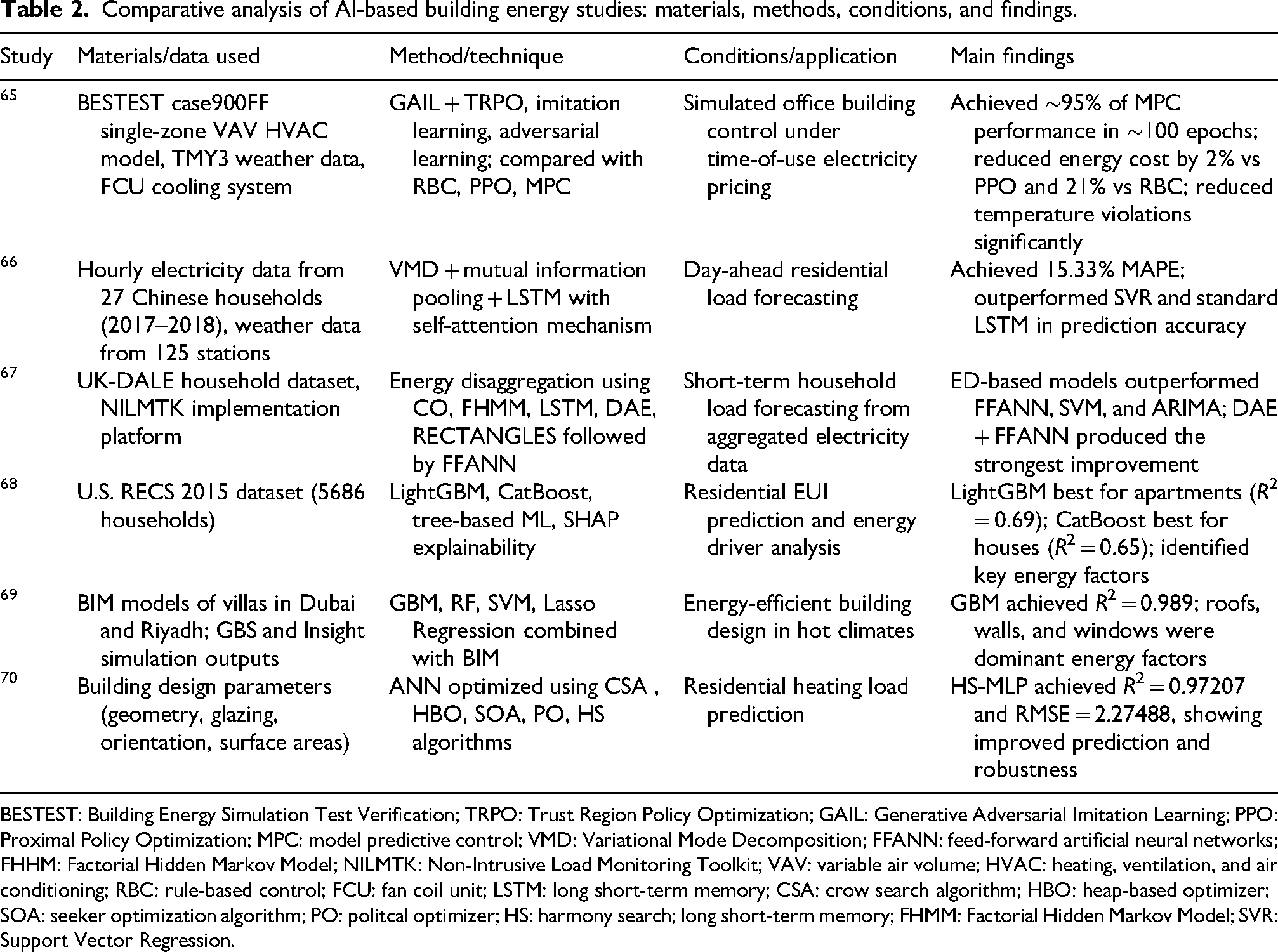
BESTEST: Building Energy Simulation Test Verification; TRPO: Trust Region Policy Optimization; GAIL: Generative Adversarial Imitation Learning; PPO: Proximal Policy Optimization; MPC: model predictive control; VMD: Variational Mode Decomposition; FFANN: feed-forward artificial neural networks; FHHM: Factorial Hidden Markov Model; NILMTK: Non-Intrusive Load Monitoring Toolkit; VAV: variable air volume; HVAC: heating, ventilation, and air conditioning; RBC: rule-based control; FCU: fan coil unit; LSTM: long short-term memory; CSA: crow search algorithm; HBO: heap-based optimizer; SOA: seeker optimization algorithm; PO: politcal optimizer; HS: harmony search; long short-term memory; FHMM: Factorial Hidden Markov Model; SVR: Support Vector Regression.

The energy management system's operational process flow diagram. 75 Published under open access.
Predicting and modelling building occupancy have been important topics in energy efficiency studies. But because of privacy concerns, invasive technologies like camera-based occupancy models have become less popular. One significant research challenge is occupancy overlapping, which has an impact on HVAC operating performance and prediction model accuracy. In order to employ a smart controller to manage HVAC operation under three distinct settings depending on the thermal comfort requirements of the occupants, Abuhussain et al. 76 suggested an environmental sensing method for forecasting room occupancy. A prototype was created and connected to gather building occupancy-related data in order to evaluate the model's efficiency. Additionally, building occupancy was predicted using a random forest regressor. According to the findings, the suggested controller could run HVAC systems to preserve a comfortable level of comfort while conserving up to 45% of energy.
Furthermore, Sulaiman and Mustaffa 82 demonstrated how TLBO-DL, a DL algorithm, may be used to forecast the EC of chillers in commercial buildings. As per the study, TLBO-DL continuously surpassed other optimization algorithms and showed exceptional predicted accuracy. In commercial building management, this precision may result in preventative maintenance, effective scheduling of chiller operations, and lower energy costs. The algorithm's capacity to track real-world chiller energy usage trends was indicative of its promise for DL model optimization for intricate prediction tasks. The study did admit several difficulties, though, including the computer resources needed for TLBO-DL optimization and localized inaccuracies. Subsequent studies may examine ensemble methodologies, adjust parameters, or combine with other optimization methods. Also, in order to automate the design process for detached homes in Florida, 83 created a generative design framework based on ANNs. TensorFlow and Python-based Keras libraries were used to create the ANN model, which was based on a large dataset of 17,000 newly built detached homes between 2009 and 2021. The nondominated sorting genetic algorithm (NSGA-II) was used to create the GD framework using Autodesk Dynamo and the Autodesk Revit GD add-on. In detached homes, the ANN model forecasted the necessary cooling and heating system capacity with R2 values of 0.955 and 0.904, respectively. In comparison to conventional methods, the results produced a completely automated 3-min design process for energy-efficient detached homes, increasing production while lowering costs and time.
Additionally, studies as presented in Table 3 show the increasing use of ML, DL, optimization algorithms and simulation-based approaches to predict building energy performance, thermal loads and occupant comfort. Gao et al. 84 applied Support Vector Regression (SVR), Extreme Gradient Boosting (XGBoost) and optimized ensemble models to a dataset of 768 simulated residential buildings with geometric and envelope parameters under controlled simulation conditions. They optimized XGBoost–Sea-Horse model and achieved a high accuracy, indicating that evolutionary optimization significantly improves load prediction. In Ngo, 85 the authors chose 243 office buildings in Taiwan as the research object, and the cooling loads of the buildings were generated by simulation using TRACE 700. ANN, CART, Linear Regression (LR), SVR, and ensemble learning methods were applied. The bagging ANN model had a better prediction accuracy. The ensemble technique is better than the single model. Moreover, in a study conducted by Cakiroglu et al., 86 the authors integrated BIM, EnergyPlus simulations, and extensive Monte Carlo-generated datasets of 94,310 residential building configurations under Malaysian climatic conditions, applying CatBoost, XGBoost, LightGBM, and Random Forest. The CatBoost attained near-perfect accuracy (R2 = 0.9990), illustrating the promise of BIM-based ML for climate-responsive design. In another study, Mehdizadeh Khorrami et al. 87 used geometric parameters to examine 12 residential building types and tested LR, DT, logistic regression, and ANN models, concluding that Decision Tree achieved the highest accuracy and identified roof area, floor area, height, and compactness as dominant energy factors. Golafshani et al. 88 integrated BIM, ensemble ML, Bayesian optimization, and SHAP analysis based on a large dataset of 66,800 EnergyPlus simulations across various climate zones, where Gradient Boosting (GB) provided the best EUI prediction and identified building shape, climate temperature, and operational schedules as the main factors. In Tien Bui et al., 89 optimized MLP neural networks by Genetic Algorithm (GA) and Imperialist Competitive Algorithm (ICA) were used for 768 samples of residential buildings generated by Ecotect. ICA-ANN improves the prediction accuracy than the conventional ANN.
Comparative findings of machine learning-based building energy prediction studies
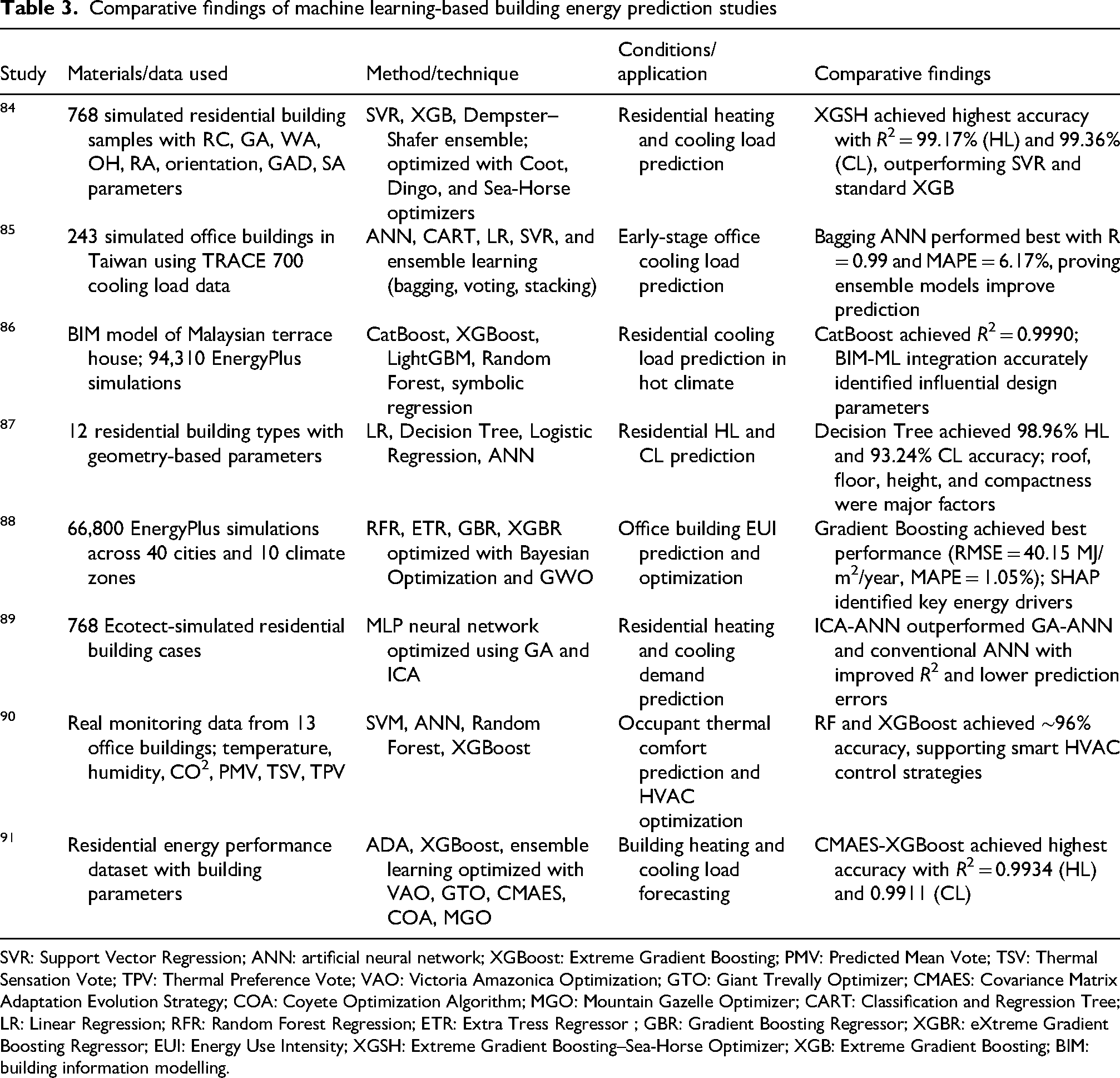
SVR: Support Vector Regression; ANN: artificial neural network; XGBoost: Extreme Gradient Boosting; PMV: Predicted Mean Vote; TSV: Thermal Sensation Vote; TPV: Thermal Preference Vote; VAO: Victoria Amazonica Optimization; GTO: Giant Trevally Optimizer; CMAES: Covariance Matrix Adaptation Evolution Strategy; COA: Coyete Optimization Algorithm; MGO: Mountain Gazelle Optimizer; CART: Classification and Regression Tree; LR: Linear Regression; RFR: Random Forest Regression; ETR: Extra Tress Regressor ; GBR: Gradient Boosting Regressor; XGBR: eXtreme Gradient Boosting Regressor; EUI: Energy Use Intensity; XGSH: Extreme Gradient Boosting–Sea-Horse Optimizer; XGB: Extreme Gradient Boosting; BIM: building information modelling.
Another study Boutahri and Tilioua 90 used real monitored data from 13 office buildings including environmental and occupant data and applied SVM, ANN, Random Forest and XGBoost for thermal comfort prediction. Random Forest and XGBoost showed the highest accuracy demonstrating the effectiveness of AI for occupant-centered HVAC management. In the study conducted by Sadaghat et al., 91 the combination of Adaptive Boosting, XGBoost, ensemble learning, and numerous metaheuristic optimization algorithms was used for the prediction of residential HL and CL and the strongest performance was achieved by CMAES-XGBoost. In general, simulation-based datasets were often used for energy load prediction due to the possibility of changing the design factors in a controlled manner, while real-world monitoring data are more practical for operational optimization. The hybrid approaches that combine ML with optimization algorithms consistently outperform the conventional models by enhancing the prediction accuracy, reducing the computational effort and enabling energy-efficient building design and management. Optimized ensemble ML models (especially XGBoost, Gradient Boosting, CatBoost and Random Forest) generally showed the highest prediction accuracy across the studies, while optimization algorithms improved model stability and generalization. BIM integration, explainable AI and real-time sensing led to improved practical application of AI for sustainable building design, energy management and occupant comfort optimization.

The case study room's implementation of the suggested MPC method. 94 Published under open access.
Also, with a variety of models and optimization strategies, Afzal et al. 95 concentrated on forecasting and optimizing building energy use. Four models, including a regression model (RSM) and three ANN frameworks (MLP, RBF, and ELM), were utilized to forecast cooling and heating demands (Figure 9). The most promising network was selected for additional phases. The selected network's hyperparameters were hyper-tuned using four different approaches (GA, Particle Swarm Optimization (PSO), PBIL, and BBO) to create a novel hybrid model. Additionally, multi-objective optimization was used to determine the ideal building energy utilization conditions. It was discovered that the Biogeography-Based Optimization technique worked very well when combined with the Extreme Learning Machine. Among the four models, the ELM model performed the best, predicting heating loads with an R2 of 0.9850 and cooling loads with an R2 of 0.9916. At an estimated root mean square error (RMSE) of 0.7655, 0.8067, 0.8098, and 0.9015, respectively, the ELM-BBO hybrid model could predict heating and cooling loads more precisely. For residential structures, the TOPSIS-MOBBO technique indicated the ideal cooling load of 37.08 kW, while the LINMAP-BBO approach indicated the ideal heating and cooling load quantities of 29.7046 kW and 37.07 kW, respectively.

Model's architecture for neural networks. Reproduced with permission from Afzal et al. 95 Copyright Elsevier. License number: 6297191442961.
Moreover, recent research shown in Table 4 focused on smart home and building energy management using DL, reinforcement learning (RL), IoT systems and optimization techniques to balance energy efficiency and occupant comfort. In study Yelisetti et al., 96 the authors utilized actual indoor environmental data from India for seasonal conditions and employed several DL models, with Bi-GRU delivering the best performance, and subsequently incorporated PSO for HVAC and lighting control, demonstrating effective comfort-energy trade-offs. Q. W. Khan et al. 97 used IoT based sensor data, Raspberry Pi devices and six months of real time monitoring. LSTM with Whale Optimization and fuzzy logic control was used. It resulted in significant energy cost reductions up to 38.22% with real time pricing. Also, in Chaudhuri et al., 98 an ANN energy model was integrated with a Thermal State Index (TSI) and an Optimal Air Temperature (OAT) control algorithm tested on a real HVAC system in Singapore. The study achieved 36.5% reduction in ACMV energy use while maintaining comfort. In Feng et al. 99 the authors used the ASHRAE RP-884 dataset and applied RF, SVR, Stochastic Configuration Network, and ELM models with ensemble optimization based on Genetic Algorithm, and obtained very low RMSE (∼0.157), demonstrating significant gains from feature selection and ensemble learning. In another study, Somu et al., 100 applied the transfer learning with CNN–LSTM on ASHRAE and Scales datasets and a target office dataset, but only achieved moderate accuracy due to the limited labeled data, which highlights the difficulty of cross-domain adaptation.
Comparative analysis of AI-based smart building energy and thermal comfort control studies.
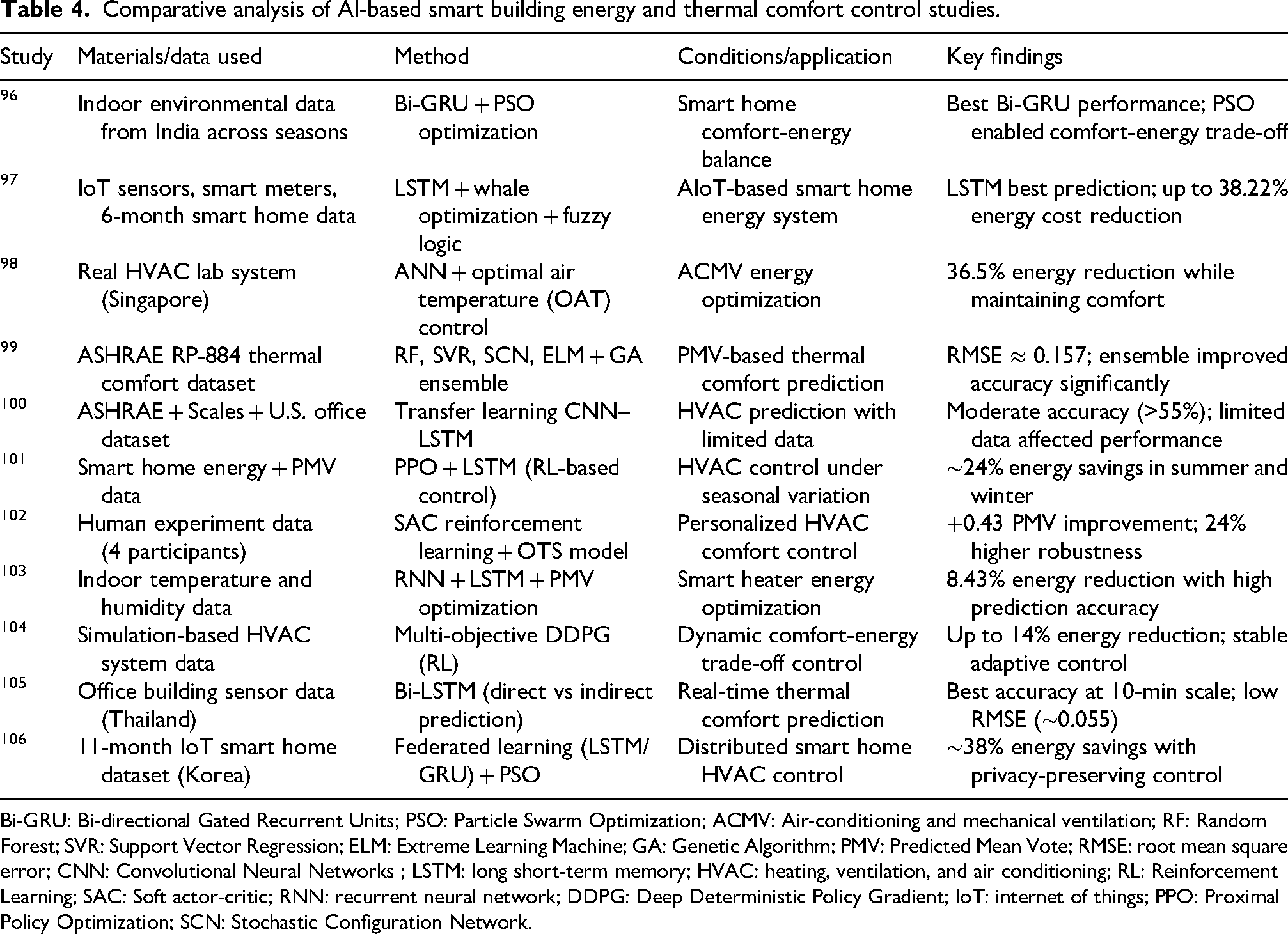
Bi-GRU: Bi-directional Gated Recurrent Units; PSO: Particle Swarm Optimization; ACMV: Air-conditioning and mechanical ventilation; RF: Random Forest; SVR: Support Vector Regression; ELM: Extreme Learning Machine; GA: Genetic Algorithm; PMV: Predicted Mean Vote; RMSE: root mean square error; CNN: Convolutional Neural Networks ; LSTM: long short-term memory; HVAC: heating, ventilation, and air conditioning; RL: Reinforcement Learning; SAC: Soft actor-critic; RNN: recurrent neural network; DDPG: Deep Deterministic Policy Gradient; IoT: internet of things; PPO: Proximal Policy Optimization; SCN: Stochastic Configuration Network.
Additionally, the smart home data was used in Wu et al. 101 to model the HVAC control as a Markov Decision Process, and the PPO reinforcement learning was combined with the LSTM prediction, which achieved an energy saving of around 24% in summer and winter. Lim et al. 102 used human experiment data of four participants to study personalized comfort with SAC reinforcement learning and improved comfort prediction by 0.43 PMV points and higher robustness under uncertainty. In Jin et al., 103 the authors used recurrent neural network (RNN) and LSTM models with PMV-based optimization for the control of a smart heater, achieving an 8.43% energy reduction and high prediction accuracy of indoor conditions. Azimi and Akbari 104 proposed a DDPG-based multiobjective RL framework for HVAC control, which achieved stable performance and energy savings up to 14% compared to baseline methods with different comfort priorities. In a different study, Z. Ma et al. 105 used real sensor data from an office building in Thailand and applied Bi-LSTM models at different time scales; the best results were obtained by indirect prediction methods, especially at 10 min intervals. Finally, in Xu et al., 106 the researchers integrated federated learning with LSTM and GRU models on real smart home IoT data collected from Korea with PSO-based HVAC optimization to achieve around 38% energy savings while maintaining privacy and comfort. These experiments are diverse in terms of materials (controlled simulations, real IoT datasets), methods (DL, RL, federated learning, hybrid optimization) and conditions (lab HVAC systems, smart homes, multibuilding deployments), but all demonstrate that combining prediction models with optimization or control strategies leads to significant improvements in energy efficiency and thermal comfort, with federated and reinforcement learning approaches being the most flexible in real-world dynamic conditions. It can be found from the analysis that optimization techniques (PSO, GA, fuzzy logic) always improve the performance, whereas federated and reinforcement learning methods offer the best adaptability and scalability for real-world smart building environments.

Diagrammatic representation of the suggested load forecasting and disaggregation models. 107 Published under open access.
Moreover, in the study by Alawi et al., 108 intelligent models were created to forecast residential buildings’ yearly heating and cooling loads (HL and CL) based on eight inputs. K-Nearest Neighbors (KNN), RF, SVR, Multilayer Perceptron (MLP), GBoost, and XGBoost were among the models. Scenario-1 (S1) included eight inputs, Scenario-2 (S2) contained five inputs, and Scenario-3 (S3) contained five inputs. These three input combinations were examined. With Kling-Gupta Efficiency (KGE = 0.998) and RMSE (0.501 kW h/m2), the results demonstrated that RF was the best technique in HL for S1. XGBoost had the best performance in CL, with RMSE = 0.922 kW h/m2 and KGE = 0.994. RF outperformed XGBoost for CL in S3 with KGE = 0.976 and RMSE = 1.686 kW h/m2, while XGBoost demonstrated the maximum efficiency for HL with KGE = 0.997 and RMSE = 0.492 kW h/m2. In general, HL forecasts performed better than CL predictions. Also, 109 discovered intricate patterns of consumption in residential structures by employing clustering analysis (Figure 11). It separated the data according to occupant behavior into groups for low and high consumption as well as a weekend subset. RF, XGBoost, and Gradient Boosting Trees (GBT) were bagging and boosting techniques that were employed in conjunction with ensemble models like ANN, KNN, and Decision Trees (DT). Predictions were improved by using a stacking ensemble approach. On a variety of datasets, the stacking strategy continuously performed better than alternative ensemble approaches. Prediction accuracy was increased by optimizing the mix of base learners through the application of a genetic algorithm. For every dataset, GA-Stacking significantly improved MAPE ratings, reaching 90%. According to the study, including this framework in building design procedures may result in well-informed choices, design control, and preconstruction optimization.

A suggested framework for designing ML processes. 109 Published under open access.
Conceptual analysis—thematic map, factorial analysis and evolution of themes
Bibliometric analysis in the Biblioshiny includes conceptual analysis such as factorial analysis, thematic mapping, and theme evolution. This kind of analysis would facilitate understanding and reveal the underlying order and relationships of concepts in large amounts of literature. Factorial analysis indicates the determining factors through which research trends are affected, thematic mapping visualizes how different concepts and topics are interrelated, and theme evolution-resource changes over time offer a dynamic appearance of how certain research areas grow or change.126,127 As such, these instruments of analysis can help reach an understanding of the intellectual landscape and lead to finding emerging trends, gaps in knowledge, and the outcome of a discipline's evolution. In this study, the thematic map of the authors’ keywords was assessed and is presented in Figure 12. A detailed discussion of the thematic map is as follows:

Thematic map for the author keywords.
The evolution of the author keywords during the study period is presented in Figure 13. From the analysis, studies on the subject have been mainly recent as very little was done between the period of 1990–2008. The initial years saw research focused on building automation between the period of 1990–2008. Most of the work on the subject matter started from 2009 with studies looking at themes such as energy efficiency, AI, home energy management, energy savings, energy management, building information modeling, residential building, and big data. The period after 2016 also saw the introduction of new studies with the introduction or focus on themes like smart learning, energy simulations, cooling load, visual comfort, ANN, automation, demand side management, sensors, ensemble learning, and natural ventilation. More advanced themes were also introduced after 2021, some of these themes include IoT, surrogate model, commercial buildings, and model predictive control. It is clear from the analysis that the themes on the topic have, through the years, focused mainly on moving from underlying or fundamental concepts to more advanced and integrated concepts to deal with energy-efficient technologies in buildings. Earlier, one was content with discussing basic building automation systems; however, starting from 2009, research began to extend itself into smarter data-driven approaches with the emergence of technologies such as AI, big data, and energy management systems. The introduction of ever-evolving themes of IoT, model predictive control, and energy simulations after around 2021 signifies the passing of applications into more sophisticated adaptive and interconnected solutions to allow real-time optimization and decision-making for residential and commercial buildings. This evolution indicates an increasing acknowledgment of the need for integrated and smart technologies to tackle energy-efficiency challenges in the built environment, which is an increasingly complex affair.

Overlay visualization of the author keywords.
The factorial analysis is presented in Figure 14. Four clusters of themes were identified, the biggest cluster (violet color) which is more central to the theme, lying on the centre of the quadrant has themes such as TOPSIS, sensors, microgrids, decision support systems, heat transfer, Bayesian optimization, XGBoost, web of things, HVAC control, BAC factors, reinforcement learning, occupancy prediction, wireless sensors, semantic interoperability, random forest, computer vision, and data mining. This cluster which is also the core cluster discusses advanced data-driven methods and optimization techniques for energy management in real-time, pointing to the growing interest in intelligent decision-making systems that optimize building operations relying on sensor data, predictive models, and ML. This further leads to a research gap for enhancing and developing these systems to become more accurate and adaptable to energy optimization strategies. The second cluster (red color) which lies in the negative quadrant of the factorial analysis also has themes such as genetic programming, power consumption, heating load, support vector regression, energy forecasting, neural network, deep neural networks (DNNs), support vector machines, transfer learning, building energy prediction, and time series forecasting. The second cluster emphasizes energy forecasting and predictive modelling, it puts forward an urgent need for better EC and demand prediction tools, thus opening doors toward improving forecasting models and more so using DL and transfer learning methods. The third cluster (dark green color) also has themes like data analytics, supervised learning, building energy performance, ensemble learning, building EC, ML algorithms. This focuses on data analytics and ML for energy performance assessment, points out the increasingly widespread application of these for evaluating and optimizing building energy use and thereby suggests a need for research on improvement of accuracy and scalability of such models. The last cluster (light green) which has the highest dimension also has themes such as energy quantification methods, energy performance certificates, and explainable AI. The fourth cluster, emphasizes on energy quantification and explainable AI, pours into the need for transparency and interpretability of aspects of energy models from performance certification and regulatory compliance points of view, indicating an emerging research gap for developing explainable robust AI models that can comply with regulatory requirements and build trust among stakeholders. All these findings imply a need for future studies to bridge gaps in predictive modeling, optimization techniques, and transparency in order to facilitate the development of smarter, more energy-efficient building systems.

Factorial analysis of author keywords.
Review of top 20 most cited documents
A bibliometric review identifies highly cited studies that are seminal or groundbreaking which may have influenced a field's development. It gives a trajectory of the impact and relevance of a given study in the scientific area, contrasting the most attention-grabbing articles and, hence, the advancement of knowledge. Focusing on these works offers a thorough understanding of the intellectual environment, aids in monitoring the development of research topics, and can direct future investigations by highlighting important areas of interest and persistent research gaps. Therefore, this section provides a brief overview of the findings of the top 20 most cited documents in the order presented in Table 5.
Most cited document (top 20).
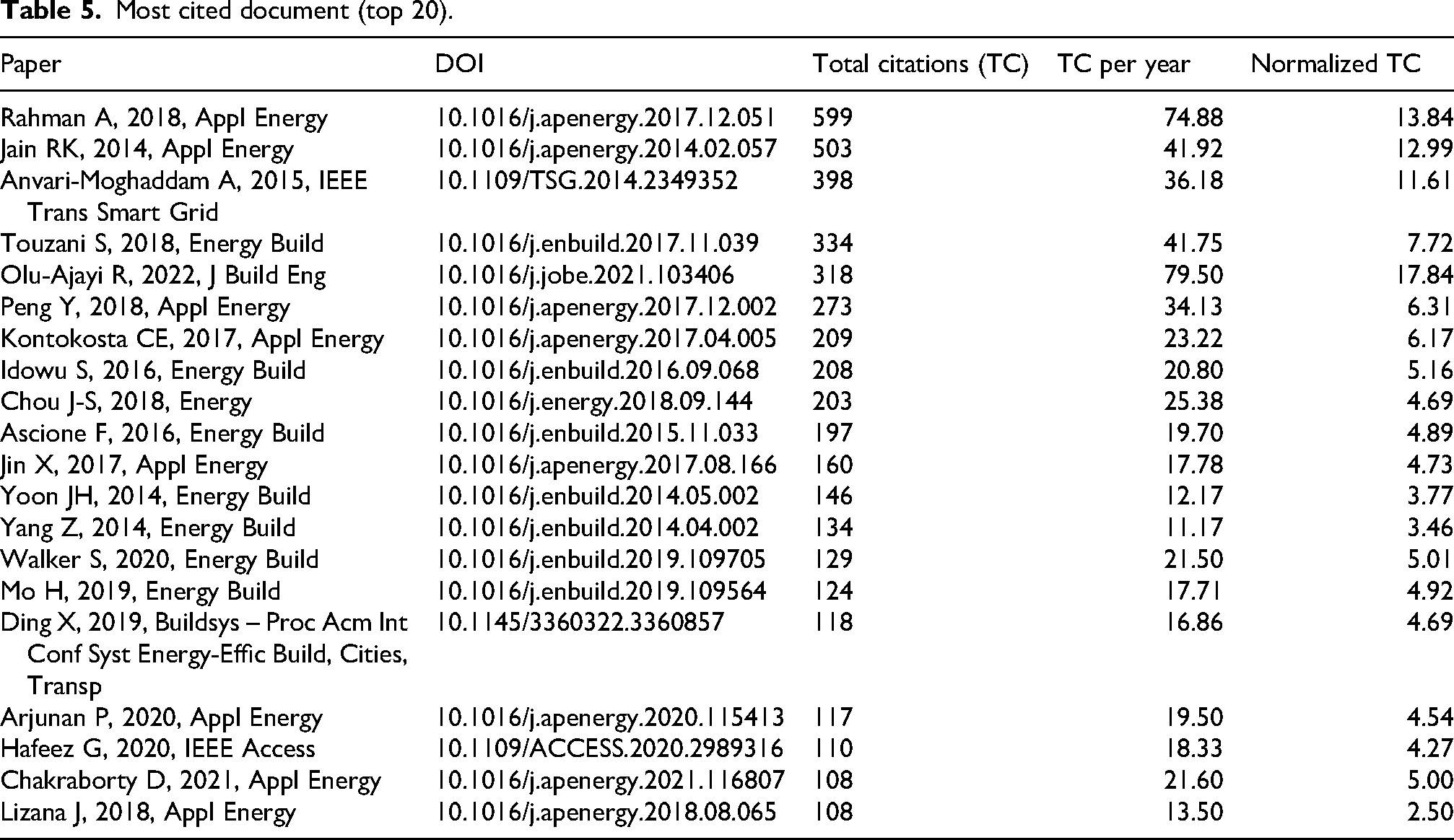
For medium-to-long-term forecasts of electricity consumption profiles in residential and commercial buildings at one-hour resolution, Rahman et al. 137 introduced an RNN model. Their study's primary goals were to create and refine new deep RNN models for medium- to long-term electric load prediction at one-hour resolution, evaluate the model's performance for various patterns of electricity consumption, and apply the deep NN for imputation on a dataset of electricity consumption that included missing value segments. When it came to predicting electric load profiles in commercial buildings, the suggested RNN models outperformed a three-layer multilayered perceptron model. However, they were unable to predict aggregate load profiles over a one-year time horizon. Also, Jain et al. 138 demonstrated a sensor-based forecasting model based on actual data from a multifamily residential building in New York City and SVR. Both temporal and geographical granularity affected the model's prediction ability. The findings demonstrated the applicability of sensor-based forecasting models to multi-family residential structures, with the best monitoring granularity taking place at hourly intervals at the floor level. The results hold practical significance for the advancement of smart metering devices and the creation of household energy forecasting models.
In another study, Anvari-Moghaddam et al. 139 demonstrated a multiobjective MINLP-based smart energy management system for residential settings that makes use of HAEMS to maximize micro-sources and home device scheduling. The model offered thermal comfort zones for residents, minimized household energy use, and guaranteed appropriate job scheduling. Case studies from simulations shown that the algorithm might lower household energy use for a variety of users and systems. Simulations conducted under various heating/cooling conditions were used to confirm the model's resilience and efficiency, and the results were compared with those of traditional models. Similarly, the EC data of actual commercial buildings was subjected to a baseline modelling technique based on a gradient boosting machine (GBM) algorithm by. 140 The GBM model outperformed the RF algorithm and the Time-of-Week-and-Temperature in terms of predicting accuracy. This implies that there is potential for improving the precision of whole-building energy savings estimation and associated analysis using the GBM model. The results demonstrated that the accuracy results based on the 12-month training time often utilized for whole-building M&V applications were marginally higher than those based on a six-month training period for developing GBM baseline models. According to the study, the GBM model has useful benefits over popular regression models, including easier integration of more explanatory factors, enhanced overall accuracy, and the ability to retain accuracy with shorter training times.
Furthermore, nine ML algorithms were examined by Olu-Ajayi et al. 141 in order to forecast the yearly EC of buildings: ANN, GB, DNN, RF, Stacking, KNN, SVM, Decision tree (DT), and LR. Although DNN was the most successful model, other effective models such as ANN, GB, and SVM were also employed, according to the results. When DT trained for 1.2 s, the best outcomes were obtained. The dataset's most prevalent building cluster was used for a sensitivity analysis, and nine ML models were created and assessed. The findings demonstrated that the amount of data significantly impacted the model's performance and that the model's performance was not sensitive to a particular building type. Also, Peng et al. 142 enhanced HVAC systems’ efficiency by adapting to occupants’ actions in real time. It was suggested that occupants’ energy-related behavior be automatically responded to by a demand-driven control method, which lowers energy use and keeps the temperature at room temperature. Both supervised and unsupervised ML techniques were included in the approach to determine real-time room setpoints for controlling the cooling system in the workplace. These techniques learn occupancy-related data. The goal of the learning-based strategy was to minimize human involvement in cooling system operation. Eleven case study offices, which included conference rooms, offices with many people, and offices with a single person, were subjected to the technique. In comparison to cooling systems with traditional scheduling, the testing results showed energy savings of between 7% and 52%.
Moreover, Kontokosta and Tull 143 used training data from energy disclosure regulations and predictors from property and zoning information to create a prediction model of energy usage at the building, district, and city sizes. Using physical, geographical, and energy use characteristics of a subset drawn from 23,000 buildings that are mandated to provide energy use data annually, the model was used to forecast the EC of 1.1 million structures in New York City. To forecast the amount of electricity and natural gas consumed by each property in the city, algorithms for SVM, random forest, and linear regression (OLS) were fitted to the city's energy benchmarking data. SVM had the lowest mean absolute error for forecasting energy usage in the LL84 sample, and the model did best when applied to the entire city. The findings showed that while natural gas usage poses a more complex issue because of the bimodal distribution of consumption and infrastructure availability, electricity use can be accurately forecasted using real data from a comparatively small group of buildings. Similarly, 144 used district heating data from ten residential and commercial buildings in Skellefteå, Sweden, to provide a data-driven method for analyzing and forecasting aggregate space and water thermal load in buildings. Supervised ML methods, such as FFNNs, regression trees, support vector machines, and multiple linear regression were used to create the load forecast models. Forecast horizons ranging from one to 48 hours were used to test the models. The findings demonstrated that multiple linear regression, FFNNs, and support vector machines were better ML techniques with lower performance mistakes than regression trees. For a one-hour forecast horizon, the support vector machine had the lowest normalized RMSE, at 0.07.
In order to forecast building energy usage, Chou and Tran 145 examined a number of time-series forecasting methods. Five AI techniques, i.e. ANNs, SVR, CART, LR, and SARIMA, were employed to create both individual and ensemble models. It was discovered that the hybrid model, SARIMA-MetaFA-LSSVR, was more accurate than the individual and ensemble models. According to the study, ANNs in RapidMiner Studio were the top AI single model, while the ANN-based bagging model in the same software program was the best ensemble model. In comparison to the best single model, the ensemble and hybrid models enhanced the overall performance metric by 9% and 64%, respectively. Also, in order to optimize HVAC system management methods with a 24-h day-ahead planning horizon, 146 offered a simulation-based MPC process as shown in Figure 15. In order to maximize operational expenses for space heating (OC) and thermal comfort, as measured by the expected proportion of dissatisfied (PPD), the process evaluates hourly values of set point temperatures in a multi-zone building. A genetic algorithm that was created through the coupling of EnergyPlus and MATLAB® was used to tackle the optimization problem. Based on the needs of the occupants, the optimal solution is chosen, minimizing OC while staying within a maximum allowable PPD value. It was discovered that the minimum run period was 86% and 53% quicker than that of typical EnergyPlus simulations. The MPC process produced a control plan that adhered to the occupancy profile and weather forecasts and was in line with thermophysical principles.

The created MPC procedure's framework. Reproduced with permission from Ascione et al. 146 Copyright Elsevier, License number: 6298120568109.
Convex quadratic programming was used by Jin et al. 147 to provide a user-centric approach to home energy management that could be implemented on platforms with limited resources or embedded systems. It was possible to solve the multiobjective optimization issue computationally. The SMARTER approach was used to learn user preferences, and the overall objective function now includes weights for several purposes. According to simulation studies, the anticipated HEMS may significantly shift loads in the DR mode using both home battery systems and adjustable building loads, while also lowering EC and CO2 emissions in the EE mode. The flexibility and dependability of DR services for residential buildings might be increased by using Foresee to precisely forecast the availability of DR resources prior to the onset of DR occurrences. Yoon et al. 148 demonstrated a DR controller that lowers peak loads and saves money and power annually. With a notable peak load curtailment of 12.8% to 24.7%, it reduces thermal discomfort for homes of various sizes and floor patterns. For big homes, annual electricity HVAC consumption dropped by 4.3%, while for medium-sized homes, it dropped by 4.0%. Depending on pricing categories, the controller also provided cost reductions, enabling users to save anywhere between 7.7% and 10.8% of their yearly power expenditure. Because the interior air temperature primarily stays within the thermal comfort zone, the controller might result in large power savings during periods of high electricity rates.
Additionally, Yang and Becerik-Gerber 149 spoke about how zone-level HVAC start/stop schedules in office buildings with centrally managed VAV systems may be created using customized occupancy profiles. The study discovered that using these schedules might save up to 9% of energy, albeit this could be constrained by variations in zone occupancy patterns. Along with the profile-based management schedule, the article suggested a way to reassign rooms to standardize start/stop timings at the zone level, which further decreased HVAC energy use by 8%. The study found that the techniques could work well for small office buildings without sophisticated building automation systems, but they might also be used in buildings with individual air conditioners and packaged HVAC systems. Also, with an emphasis on creating group-level predictions, Walker et al. 150 assessed ML prediction algorithms in a campus neighborhood. ANN models fared equally in the prediction stage, whereas boosted-tree and random forest models performed better than other regression techniques. However, because of uneven data collecting, several buildings’ forecasts were unsatisfactory. These issues could be mitigated, and high-accuracy forecasts could result via cluster-level prediction. Cluster analysis is useful for neighborhoods with distinct borders.
Furthermore, Mo et al. 151 modelled and forecasted occupant window behavior in residential buildings using XGBoost, a potent ML algorithm as demonstrated in Figure 16. Window behavior models were constructed using both XGBoost and Logistic Regression Analysis, and data was gathered throughout transitional seasons. According to the comparison, XGBoost is better at modelling than Logistic Regression Analysis, and it should perform similarly for other behavioral types like air conditioning and blind control. Ding et al. 152 introduced OCTOPUS, a unique DRL framework intended to balance comfort and EC in commercial buildings. The framework determined the best control sequences for the window, blind, lighting, and HVAC systems using data-driven techniques. To investigate trade-offs between EC and user comfort, it incorporates a reward system. OCTOPUS was trained using calibrated simulations that matched the operating points of the target building. While keeping human comfort within a targeted range, the system produced energy savings of 14.26% and 8.1% when compared to the most recent DRL-based approach and state-of-the-art rule-based methods in a LEED Gold Certified building.

An illustration of the XGBoost algorithm. Reproduced with permission from Mo et al. 151 Copyright Elsevier, License number: 6298120885120.
Arjunan et al. 153 put out a system that enhances the Energy Star calculating method by adding more model output processing and improving accuracy. We suggested and evaluated two new prediction models: GBT and multiple linear regression with feature interactions (MLRi). Compared to the baseline MLR model, the third-order MLRi models produced a 7.0% reduction in normalized root mean squared error (NRMSE) and a 4.9% improvement in adjusted R2. Adjusted R2 increased by 24.9% and NRMSE decreased by 13.7% in the most accurate GBT models. Hafeez et al. 154 also offered a DA-GmEDE-based approach and a HEMC-based framework for effective residential building energy management in the context of anticipated day-ahead DR price signals and customer preferences as presented in Figure 17. To find the best EC schedule and balance the trade-off between power bills and user discomfort, the energy management problem was stated as an optimization problem with four modes of operation. Because it maximizes the advantages of lower energy rates for customers and minimizes Partial Power Outages (PAR) for utility providers, the suggested framework was advantageous to both parties. Comparing the DA-GmEDE-based approach to without scheduling, simulations revealed that it decreased power expenses and PAR by 23.90% and 47.05%, respectively.

The suggested framework for effective energy management of residential buildings using a day-ahead ANN-based prediction engine is shown schematically, with a single arrowhead signifying one-way flow and a double arrowhead signifying two-way flow. 154 Published under open access.
Also, Chakraborty et al. 155 introduced a novel XAI model that examined how climate change affects building cooling energy usage. Under shared socioeconomic pathway (SSP) climate change scenarios, the model forecasted long-term cooling energy usage and provided an explanation for the projections. The XAI model identified important inflection points of the daily average outside air temperature and demonstrated great accuracy in forecasting cooling energy usage. The model was used to measure the incremental effects of climate change on cooling EC in residential and commercial buildings located in hot-humid and mixed-humid climatic zones. Under all future SSP scenarios, the research found that cooling energy demand will increase in a positive and sustained manner between 2020 and 2100, with the greatest effects occurring in hot-humid and mixed-humid climatic zones. Finally, Lizana et al. 156 demonstrated a clever way to incorporate low-carbon heating technology with flexible energy structures. The system linked smart demand-side management (DSM) with smart grids and coupled an efficient heat storage unit with a high-density latent heat storage unit as shown in Figure 18. The thermal energy storage unit served as a support system for the intelligent DSM controller, allowing for the best possible energy management as well as financial and environmental advantages. When there is a favorable need for energy in the future or when the stored energy is adequate, the system stops charging. The findings demonstrated that the suggested intelligent low-carbon heating system can successfully move the building sector's peak electricity usage times to off-peak times, enabling efficient electrification of heating and cooling demand without necessitating the addition of more electricity generation capacity.

DHW integration and smart heating for flexible energy buildings. Reproduced with permission from Lizana et al. 156 Copyright Elsevier, License number: 6298121363828.
Challenges associated with the integration of these smart systems and future research directions
Despite the advantages associated with smart technologies as demonstrated through literature review in earlier paragraphs, there are some barriers that hinder their large-scale implementation in most countries. Some of these identified barriers in the literature are discussed in detail as follows:
Data quality, privacy, and security issues
The emerging smart building technologies depend on the continuous collection of data from IoT sensors, smart meters, HVAC controllers, occupancy monitoring systems, and intelligent energy management platforms to optimize building operations and reduce EC. But issues of data quality, privacy and security continue to be a major barrier to broader adoption. Low-quality data caused by inaccurate sensors, missing data or communication failures could negatively affect the performance of AI-based energy optimization models, leading to inefficient control decisions and decreased energy savings.29,157–159 In addition, smart building systems gather detailed information on energy usage patterns, occupant behavior and indoor environmental conditions, which can reveal sensitive information about occupants’ routines and preferences. This creates potential issues related to privacy, data ownership, unauthorized access and abuse of personal information. 160 Cybersecurity risks are also growing as the connectivity of multiple IoT devices enlarges the attack surface of building systems, possibly impacting operational reliability and energy management performance. Addressing these issues requires privacy-preserving data analytics, enhanced cybersecurity frameworks, secure communication protocols, edge-based processing, and standardized data governance approaches for smart buildings.
High upfront cost and economic barriers
Interoperability and scalability challenges
Regulatory and policy barriers
The rapid development of smart building technologies presents regulatory challenges because technology development often outpaces policy development. In many countries, there are no clear regulations concerning smart building data management, cybersecurity requirements, interoperability standards and AI-based energy management applications. Inconsistent policies can undermine confidence in large-scale deployment and create uncertainty for investors, technology developers and building owners.29,162,163 Regulatory challenges in developed countries are mostly about updating existing policies to take on new issues such as AI, data privacy, cybersecurity, and the integration of buildings into smart energy grids. But technology uptake is often aided by stronger building codes, more robust institutions and incentive schemes. In developing countries, regulatory barriers are often higher, because of limited institutional capacity, weak enforcement mechanisms and a lack of technical expertise among policy makers. Such constraints could delay the adoption of smart energy technologies and increase reliance on externally developed solutions, which may not entirely address local needs. To address these barriers, comprehensive smart building regulations, harmonized technical standards, cybersecurity policies and supportive government programmes encouraging the adoption of energy-efficient technologies should be developed.
Poor internet availability and digital infrastructure limitations
The operation of emerging smart building technologies depends on reliable digital infrastructure because IoT devices, cloud-based platforms, and automated energy management systems need to communicate continuously and exchange data in real time. Poor internet availability, high communication costs, and unreliable connectivity can greatly impact the efficiency of smart energy systems by creating delays in monitoring, erroneous control decisions, and interruptions in automated energy management processes.27,164 In developed countries the internet infrastructure is usually reliable, and the challenges are mainly about dealing with the large amount of data, reducing latency and improving the cybersecurity of the interconnected systems. But in developing countries, the lack of broadband, the high cost of internet services and unreliable coverage of networks are still important obstacles that limit the use of smart building technologies, especially in residential and small commercial buildings. This digital divide is preventing many regions from achieving the benefits of energy efficiency from smart systems. Possible solutions include edge computing that enables local processing of building data without the requirement for continuous cloud connectivity, low-power communication technologies, increased investment and development of digital infrastructure and smart building solutions designed to operate efficiently in low connectivity conditions.
Country-level production, collaboration, and relevant sources
A bibliometric analysis identifies the most highly productive research and innovation nations; illustrates patterns of collaboration; and monitors field evolution. It shows from which spaces influential publications emerge and international cooperation develops. It also gives an understanding that governs policy making or funding programs or priorities in future research by revealing the collaborative areas and the advancements. In this study, the number of documents published by each country is presented in Figure 19. From the data, the most productive country is the United States of America with a total of 644 documents, followed by China with 441 documents. Italy, India, Germany, United Kingdom, South Korea, Spain, Greece, and Canada also followed with 294, 263, 208, 158, 136, 133, 120, 105, respectively. In terms of collaboration China and United Kingdom recorded a total of 9 collaborations within the study period. The next highest collaboration occurred between China and Singapore with a frequency of 6. China and Australia followed with a frequency of 5, China and Iran; and China and Pakistan; followed with a frequency of 4 each. China and Denmark, Canada, and Iran, China and Japan, also followed with a frequency of 3 each. The analysis makes the case that developed and developing countries play an important role in accommodating scientific discourse toward smart technologies as they emerge and on energy efficiency issues. Transnational collaborations with advanced economies serve as a vehicle for innovation and for addressing global challenges. These collaborations allow advanced research to leverage knowledge, technology, and even data, thus producing a richer research outcome. Other countries that would provide increasing opportunities for collaboration in this context include China, India, Iran, and Pakistan, which should assist developing countries with knowledge transfer and innovation. These partnerships, especially with funding opportunities from the developed economies, could be further strengthened to engage in energy efficiency challenges worldwide for the benefit of less developed countries and local solutions. Joint funding initiatives by international research bodies could hasten this process, closing gaps in technological know-how and making achievements in smart energy solutions available on a much larger scale.

Country-level document production.
The top 10 most relevant sources on the subject matter are presented in Figure 20(a). The journal with the most output is the Energy Build journal which recorded a total of 83. Applied Energy journal followed with 51, Energies (46), Journal of Building Engineering (32), Building and Environment (26), etc. According to Bradford's law of scattering, a subject can be represented as a set of zones that start with a “core” and move outward so that each zone has an equal number of pertinent articles as the core, but each zone also has an increasing number of journals to accommodate those articles. 165 The Bradford's law, as presented in Figure 20(b), confirms the data on the most productive sources, putting the Energy Build journal as a key source for data on the topic of study.

(a) Relevant sources (b) core sources using Bradford's law.
Conclusion and future research recommendations
The optimization of energy performance is seen by policymakers in many economies worldwide as an essential step to save energy and cut cost. Several technics have therefore been developed in recent years to help in the optimization of energy use in both commercial and residential facilities. This study, therefore, reviews the various smart technics and their role in enhancing energy efficiency in buildings using the systematic and bibliometric review approach during the period 1990–2024. A bibliometric and thematic analysis of research on smart technics for energy-efficient buildings shows a rapidly expanding research domain, driven by the global needs for sustainable development, climate mitigation, and better energy management. The results indicate a transition from conventional energy modelling practices toward intelligent, data-driven and adaptive energy systems that have the potential to optimize building operations, forecast energy demand, enhance occupant comfort, and curtail carbon emissions. The main findings of the study are:
Major trends
The research on energy efficiency of smart buildings is growing rapidly worldwide, and the cooperation between countries and disciplines is increasing. The main focus of the research has moved from basic energy monitoring to integrated smart energy management, predictive analytics, automated control and sustainable building design. Currently, the number of studies focusing on integrating real-time sensing, IoT connectivity, AI-based prediction and optimization techniques for low-carbon and energy-resilient buildings is increasing.
Dominant technologies
Core technological drivers are IoT, AI, ML, DL, reinforcement learning, digital twins, cloud computing, BIM, energy simulation tools and advanced optimization algorithms. AI and ML models, particularly neural networks, gradient boosting, random forest, XGBoost, CatBoost, support vector regression, and hybrid ensemble methods, have shown strong abilities in energy forecasting, fault detection, HVAC optimization, retrofit decision making, and occupant comfort management. Also, reinforcement learning and imitation learning methods are found to be increasingly applied for dynamic HVAC control and DR, while digital twins and BIM-based approaches are improving the link between virtual modelling and real-world building operation.
Current limitations
Despite considerable progress, there are several barriers that hinder the widespread deployment of smart energy systems. These include: poor data quality, sensor uncertainties, privacy and cybersecurity concerns, high initial investment costs, limited interoperability between technologies, scalability challenges, regulatory gaps, and lack of digital infrastructure in some areas. Furthermore, many AI models still struggle with explainability, generalizability to different climates and building types, computational requirements, and data requirements. Simulation-based studies offer valuable controlled environments, but may not always reflect real operational conditions. Real-world datasets often suffer from issues of availability, consistency, and privacy.
Promising research opportunities
Future research should focus on developing scalable, low-cost smart building solutions that integrate AI, IoT, renewable energy and smart grid. The key focus areas are explainable AI for increased trust, privacy-preserving approaches such as federated learning, real-time adaptive control, occupant-centric energy management, and climate-resilient design. Additionally, research should focus on the development of standardized frameworks and cost-effective technologies to encourage adoption, particularly in developing regions, where improvements in energy efficiency can lead to substantial environmental and socioeconomic benefits.
AI usage
The authors used AI tools (ChatGPT) for language refinement and presentation. All scientific content and analysis were developed and verified by the authors, who take full responsibility for the work.
Footnotes

Funding
The authors received no financial support for the research, authorship, and/or publication of this article.
Declaration of conflicting interests
The authors declared no potential conflicts of interest with respect to the research, authorship, and/or publication of this article. Also, Ephraim Bonah Agyekum is an Associate Editor of this journal but played no role in the decision process.