







Abstract
Introduction
Do public services leaders need university courses which help develop professional skills? David Walker gave evidence to a House of Commons Select Committee in which he suggested that members of the higher levels of the UK Civil Service should take a compulsory postgraduate qualification in public administration; he also maintained that the necessary intellectual apparatus to develop these did exist, in part, in academe and that it could be mobilised (House of Commons, Public Administration Select Committee, 2007: 15).
The leadership of the UK civil service has in recent years made it clear that it would, in principle, like to make more use of universities as a source of new recruits to the civil service. It has also on occasions described both further education colleges and universities as key partners in the development of the civil service workforce. The success of any attempt by the civil service to engage with educational institutions will be affected by the relevance of the capabilities of universities to the business needs of the civil service and the acceptability to the universities of the financial arrangements.
If universities do want to be part of helping the civil service to become more professional, they will have to increase their understanding of the needs of government services and will have to be prepared to challenge existing assumptions about the design and delivery of education and development. One sign that there is some willingness in universities to develop this understanding and rethink existing approaches was a recent initiative to develop guidance for designing Masters of Public Administration (MPA) programmes. This initiative involved a number of organisations: the guidance was prepared over the course of a year (from late 2008) and was approved by the Public Administration Committee (of the Joint University Council), the Public Management and Policy Association, and the Public Administration Specialist Group of the UK’s Political Studies Association. The preparation work also benefited substantially as a result of the involvement of staff of the National School of Government and of Government Skills (both of which have disappeared as discrete organisations as a result of changes involving the Cabinet Office; see Appendix for extracts from the guidance).
In working in this area it is apparent that, while government often turns to individual academics for advice, academia generally has not had the same sort of access to the workings of central government as it has had in the business sector. Further progress in developing understanding of the government sector requires the universities to think differently about how best to meet the needs of this particular sector, including challenging existing design and delivery assumptions. This progress can be made through collaborative design and delivery of specific programmes. This article contains a case study of a specific collaboration in which both authors participated, and we will be drawing out the issues and lessons from this experience. Before we do that, we consider the environment for universities engaging with education and development in the government sector.
The Environment
As is often the case in government, political priorities which are urgent – for example, deficit reduction being the current number one priority for the UK Government – make it difficult for those directing government services (local as well as national) to have regard for longer term matters of developing the professionalism of those working in public services, including public services leaders and managers. Even if government ministers would like to focus on organisational capabilities and improving public services, managing deficit reductions and all the intended and unintended consequences of deficit reductions will leave little scope for departmental managers to pay attention to the challenges of enabling universities to be effective partners in the development of the civil service.
This is the situation just at the time when government policy on the relationship between government and society has crystallised into the concept of the ‘Big Society’, which the government has identified as requiring very different ways of working by civil servants. David Cameron outlined his ideas for the Big Society, in a 2010 speech: This idea, the big society, is both incredibly ambitious, but also refreshingly modest. Ambitious because its aims are sweeping … But modest too – because it's not about some magic new plan dreamed up in Whitehall and imposed from on high. It's about enabling and encouraging people to come together to solve their problems and make life better. Let me be very clear: the big society does not mean no government … It means a new kind of government. (Guardian, 2010)
It is clear that this agenda for the Big Society calls for a new type of government and new types of civil servants who will enable and encourage rather than use command and control. This would require a new definition of professionalism among civil servants. Leaders and managers of government organisations will need to be skilled in working with civil society, in commissioning, managing public sector competition, and in commissioning services that offer choice to service users.
While we know that internally the government is concerned with working to develop the skills and professionalism of public servants (see for example the recent White Paper Open Public Services), there is little direct engagement with universities in developing the Professional Skills for Government framework and other initiatives in a way that influences the content or design of HE offerings.
Where could universities go with their educational offer?
Ideas for changing university provision can easily run ahead of the development of the capabilities and culture needed to deliver them – both in universities and in employer organisations. This means that there is a need to face the challenge of planning the migration from where university courses are now (generally speaking) to where university courses of the future might be.
We can imagine for example the evolution of more practical courses for public services leaders in terms of their central concern, their core processes, the values they affirm, together with new roles for those who ‘deliver’ the courses, and what is expected of those taking the courses. While it is in danger of being a parody, we could argue that many courses in the past were mostly concerned with academic knowledge and the development of traditional skills; whereas in the future, there could be an additional concern with civil servants and public services leaders learning from and through their professional experience. Similarly, we could argue that courses in the past have transmitted current knowledge and skills to new civil servants and public services professionals, instilled an ethos of honesty and impartiality, organised learning from books, articles and lecturers, and asked learners to be studious in acquiring what is being transmitted; whereas in the future there could be courses that also do the following: develop the abilities and qualities of individuals through personalised approaches to the design and delivery of curriculum; encourage resourcefulness and a can-do attitude; organise learning using coaches, mentors and projects; and challenge learners to actively link their experience to education and to see the educational process as embracing the application of new ideas to public services (see Figure 1).
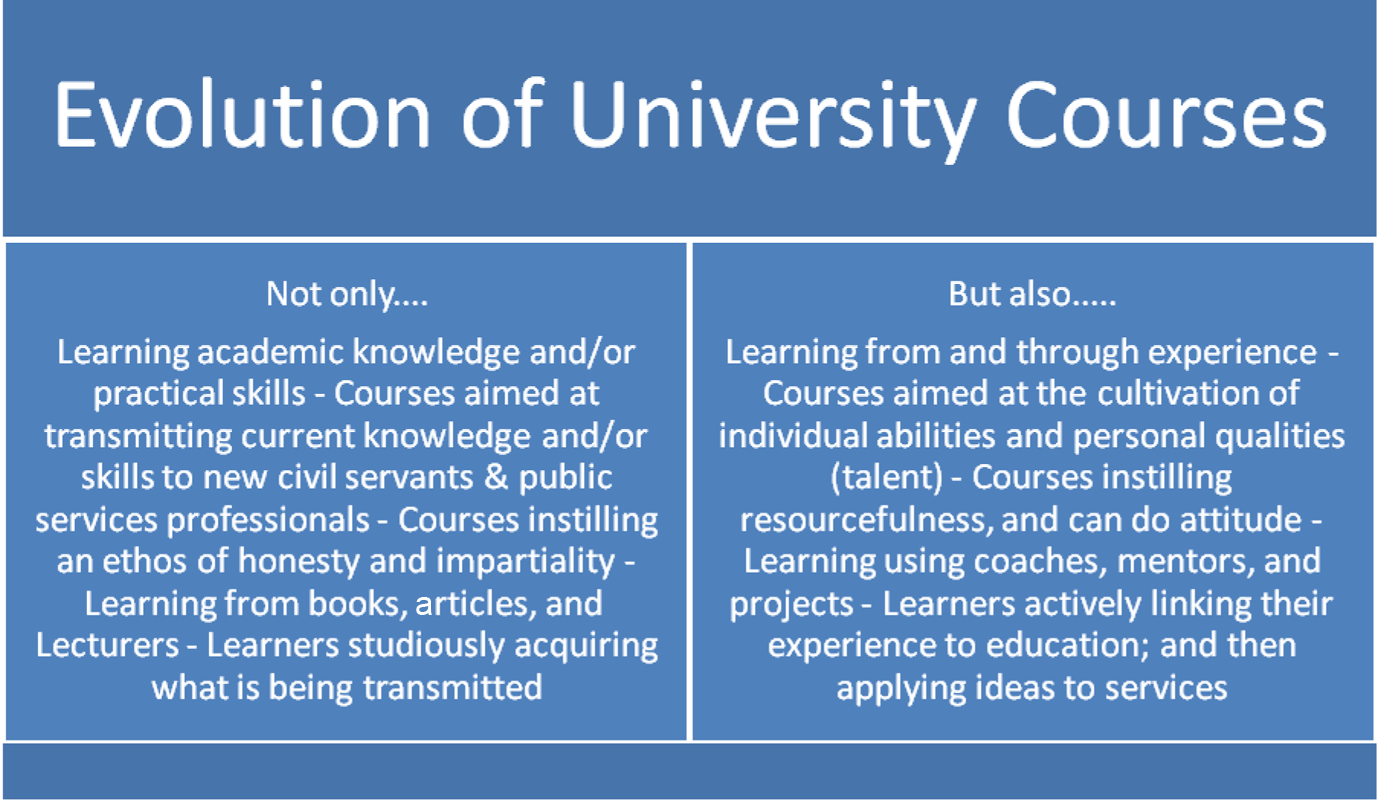
Evolution of university courses
The feasibility of these ideas – foresights – has to be tested primarily by taking advantage of commercial opportunities to design and deliver courses to the civil service and other public services organisations. Bit by bit the ideas can be incorporated into design and delivery – providing that clients are willing to be experimental. Also bit by bit, university providers can develop the skills and technological platforms needed to create the courses of the future. It is unlikely that such developments will take place spontaneously from within academia, but may be achieved by working more closely with the culture of client units and considering their more immediate needs.
Case Study: A Jointly Designed MPA
During 2009 an opportunity emerged for Liverpool Business School to work with the Government Office Network (GON) 1 to design a Masters in Public Administration (MPA) to meet the specific needs of the civil service and the needs of the employers of regional civil servants working in the English regions in a new role of ‘locality manager’. This opportunity was created by the National School of Government (NSG) 2 , which was a non-ministerial government department (previously part of the Cabinet Office).
For more than a year, leading staff in the GON, a member of the NSG, and Liverpool Business School’s Centre of Public Service Management worked on the development of a clear set of programme learning outcomes that included both knowledge acquisition and skills acquisition. The process of programme design was an extremely positive one and was fundamental to the design of a set of programme learning outcomes that were very relevant to employer needs as well as being the basis of the educational rigour required for an HE institution (see the case study box below for more details of the co-design activity in this case).
Case Study Box
The National School of Government (NSG) was party to discussions about the potential for accrediting learning for the Ladder for Development (LfD), an in-house programme of the Government Office Network (GON), which had been been developed to support staff recruited to the new role of ‘locality manager’. Initially, the working group developing the LfD decided not to pursue accreditation but to concentrate on establishing the LfD as an effective part of the GON’s learning and development portfolio. It is very noteworthy that the working group only returned to the issue of accreditation later in response to interest from staff, which could be seen to say something quite important about learner motivation.
A paper was presented to the LfD working group in February 2009 which recommended a work-based higher education qualification as an effective way of achieving a recognised qualification which would be relevant to employer needs. Further meetings followed with GO Learn (the GON’s L&D unit) and with the Centre for Public Services Management at Liverpool Business School. The agenda for the initial meetings centred around the design of programmes, but also provided an opportunity to build relationships in a project team that crossed organisational boundaries. At this stage, the role of the National School of Government (NSG) as a third party was significant in helping both parties identify the challenges and benefits of the project. At times this seemed an indispensable role. The NSG led on understanding employer requirements and took responsibility for mediating between the world of academe and the civil service world of the GON. The NSG was a very active participant in developing the design of the programme and later continued its support in the delivery of workshops which were the key vehicles for the assessment element of the programme.
The NSG was drawing on experience of working with employers and universities in the development of a Foundation Degree in Government, which had involved bringing together representatives from different employer units in the civil service and universities to develop an HE programme for serving civil servants. The GON working group was led by a committed senior manager who had been leading the project to establish the LfD from the beginning. The work had the support of senior management across the network and was supported by a dedicated Learning and Development team who managed a range of providers of courses – which included the NSG.
Arguably, Liverpool Business School’s Centre for Public Services Management recommended itself for inclusion in these discussions because its head was convinced of the importance of working closely with employers and with other universities on the development of postgraduate qualifications in public administration. Like other schools in other universities it also had access to the relevant expertise. This included: expertise in delivering masters qualifications to public service organisations (specifically, in local government) over many years and in which there had been a concern to foster personal credibility in consultancy experience in relation to civil service organisations (which had recently included diagnosing issues in civil service modernisation and public reforms); expertise in delivering educational courses on community leadership and multi-agency processes; and expertise in change management in the public services.
Liverpool Business School, the GON and the NSG began working on creating a clear rationale and working structure. The result was a Masters in Public Administration (MPA) which comprised eight modules and a project module of between 12,000 and 16,000 words. This structure emerged during a long period of discussion and appraisal of options involving the NSG, a senior GON executive, a locality manager, and HR specialists in the GON during 2009 and 2010. Discussions centred on the intended functionality of the MPA and the content of educational and developmental activities. This was scoped in relation to the ‘Ladder for Development’ that had been developed by the GON but was shaped by the need for it to fit within a recognised framework for study at masters level.
Eventually the process engaged with the formal systems for validating courses within the university. The programme design had to be checked against a higher education template for masters level courses and expressed in terms of programme learning outcomes, modules, assessment, and so on. What emerged was a course that was concerned with developing the ability to apply expertise as much as it was concerned with the acquisition of knowledge. It was a course that was concerned to encourage participants to complete assignments by drawing on experiences and lessons from the workplace as much as it was concerned to develop public managers who were proficient in the use of academic concepts, research and theory. The modules were designed to foster analytical and problem-solving skills as well as increase leadership credibility through self-awareness and personal positioning. It paid attention to the professional environment of the public manager, at both national and local levels, including policymaking as well as management processes. Above all, it sought to foster personal reflexivity and a concern for personal impact. Finally, it emerged with a project module that was concerned not simply with research but also with research which an engaged practitioner would find useful.
In conclusion, a new Masters in Public Administration (MPA) had been developed by a partnership between the GON, the NSG and the Centre for Public Services Management within Liverpool Business School. The Masters in Public Administration utilised the in-house delivery of training and development within the GON Ladder for Development programme and the assessment of learning by the academics in Liverpool Business School. It was an original response to the need to offer a formalised qualification in public administration to foster more professionalism in the Civil Service.
A novel feature of this process of programme design was the decision to review and recognise the educational and development experiences that were being delivered through the GON’s in-house programme known as the Ladder for Development (LfD). This in-house programme was partially delivered through external providers such as the NSG, the main provider of development for the senior civil service grade in Whitehall. (So, the NSG was not only involved in the development of the MPA but was an existing provider of education and development to regional civil servants within the LfD programme of the civil service.)
The scope of these educational/development experiences was considered highly appropriate for the programme learning outcomes of the MPA – offering both good learning experiences and practical work. This involved an acceptance by the university of the validity and quality of training offered by the employer. In the longer term, the employer expected this relationship to help drive up standards in delivery and the commitment of the students to using effectively the opportunities provided.
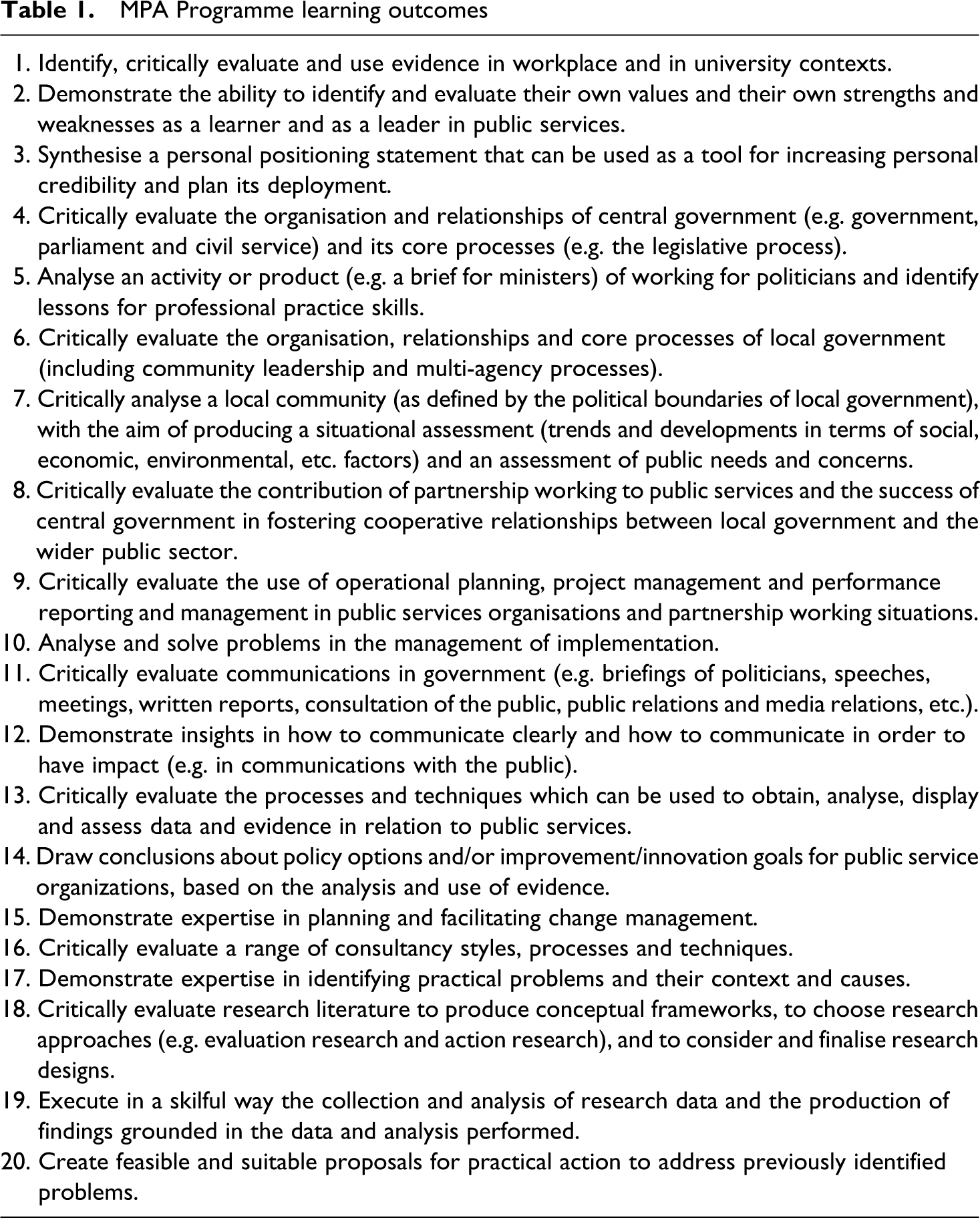
Liverpool Business School therefore designed a set of programme learning outcomes (see Table 1) which reflected the aims and content of the LfD and also drew on broader, academic experience both of effective delivery in executive (i.e. senior managers in post) programmes and also the variety of subject knowledge available to it. The assessment system for monitoring and grading students’ work on the MPA required a particularly rigorous system to ensure that students had met the programme learning outcomes for individual awards by drawing on a balance of their own experience and reflection informed by relevant – sometimes self-identified – academic reading. Students were encouraged to draw on government publications. The staffing, delivery and management of the assessment system was entirely a matter for business school staff. No other organisation was directly involved in the assessment system. In consequence of this, the programme learning outcomes were the key integrating device between the educational and developmental experiences offered within the LfD and the assessment system. It was envisaged that in the future there would be experiments with supplementary ways to integrate the LfD and the MPA.
MPA Programme learning outcomes
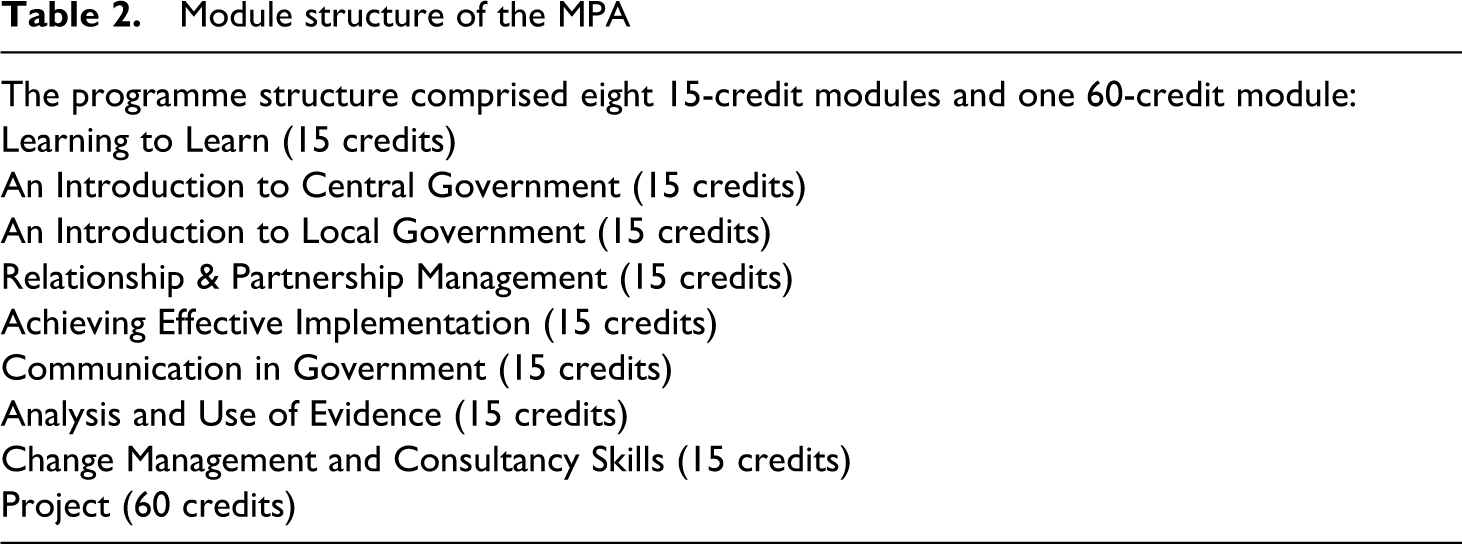
A steering group for the MPA was set up and comprised representatives from Liverpool Business School, the GON and the NSG. This steering group actively managed the integration of the in-house training and development programme and the MPA – including ensuring that appropriate programmes were available for students at the correct time. The feasibility of the integration through the programme learning outcomes and through the support of the steering group was tested through a pilot experience of assessment of one of the MPA modules (see Table 2) which was delivered as a one-module Continuing Professional Development (CPD) programme. The success rate of the first assessment in this pilot was over 90 per cent, demonstrating that the programme learning outcomes had been formulated with sufficient clarity to support the design of an assessment system that was fit for purpose and rigorous.
Module structure of the MPA
The CPD module and the induction workshops were key in developing the skills and knowledge the students needed to draw out learning from their own experience that was relevant to the learning outcomes which had been agreed by the employer. The first of the two induction workshops focused on the contrast and compatibility of academic study and the sort of reflective practice which goes with effective performance in many roles in government. This helped them move away from the idea of education as a way of testing their knowledge and instead helped them to see it as being a way of giving them credit for developing and using their knowledge. Subsequent workshops – which included input from practitioners – were organised in response to demand from students – part of the wider development of them taking greater responsibility as learners and making more use of the full range of opportunities and support available to a student in the workplace (colleagues, reports, mentors, line managers and e-based support for the cohort).
The assignments were crafted to give them a clear structure and criteria against which they were being assessed. The students were required to draw on their own experience, informed by material they identified as relevant (included suggested reading and their LfD products).
In the future the MPA could be developed to enable varying levels of practitioner input into the delivery of the teaching and learning programme, and to enable varying levels of the use of on-line support to learning opportunities within client workplaces.
Education versus training
This case study highlighted a number of challenges, which included managing the different priorities of educational providers and public service organisations. An example of this emerged in the discussions over what should be assessed. The regional government network was interested in its LfD producing behavioural change, whereas the university had a commitment to the provision of education and development rather than training individuals in new work behaviours. This led to a very interesting dialogue about the assessment tasks and assessment criteria used within the MPA.
Employers commissioning educational programmes for civil servants and public services leaders may want to use assessment systems to assess the demonstration of desired behaviours as required by statements of functional competence and job descriptions. While such behaviours may be extremely desirable in the context of work within the employing organisation, are they appropriate as targets of assessment within postgraduate educational programmes? The view taken here, provisionally, is that higher education has a mission to develop capability and that capability and behaviour may be related but they are not the same thing. Capability is one factor in performance of organisationally desired behaviours and operates alongside effort, incentives, and insights into key success factors.
Universities should resist awarding qualifications to individuals on the basis of their exhibiting desired work behaviours and should stay focused on the assessment of the development of capability. Universities will have a big enough task developing their core competencies in delivering a more integral curriculum that includes not only knowledge and expertise but also skills and attitudes, which can be seen as dimensions of individual capability. Assessment of work behaviours is a management rather than an educational process and can be carried out, for example, through performance and development review meetings by individuals and their line managers.
While there are limits to the proper scope of assessment within a higher education programme, the desired behaviours of civil servants and public services leaders identified by employers can be usefully incorporated into defining the subject matter of the knowledge and expertise to be acquired. This is not only possible, but is also desirable, and could be seen as helpful in creating the credibility of higher education programmes in terms of their relevance.
Conclusions
The development of postgraduate courses in public administration has been very tentative in the UK. Why? The recognition of the value of a masters programme in public administration has been slow to develop and many individual public services managers and leaders turn to private-sector focused MBAs, which have not been designed to support the professional development of senior levels of the civil service and of public service organisations.
The steps needed to develop MPAs and to build growing appreciation of them by employers have to begin with universities listening to employers in the public services about what they need. There has to be a willingness to broaden programme learning outcomes so they include professional and personal skills as well as academic concepts, theory and research. Sporadic encounters between the world of academe and public service employers will not be enough and we think the best prospects for progress will arise from the co-design of academic programmes based on a recognition that there is a need to provide a formal academic qualification that is aligned with (or, even better, integrated with) work experience and in-house training and development for those working within the upper levels of the public services.
Co-development initiatives might involve (as they did in the case study above) the university taking on the role of assessor of the programme outcomes and not the deliverer of the training and development. But some initiatives should involve partnerships in the delivery of programmes, with managers and development specialists from employer organisations sharing in the teaching process alongside academics. It has also been argued that however radical the changes that occur, the universities have to remain clear about their broader mission and recognise the limit to what they can and should assess as part of formal programmes.
It has been assumed in this paper that engagement of universities with the professionalism of the civil service and public services leaders will require changes in the capabilities and values of academics and that this will happen fastest through employers commissioning and paying for courses for their staff.
Footnotes
Appendix
A Public Administration Committee working group which met in late 2008 formulated the following aims for a statement offering guidance on the design and delivery of an MPA: to increase the quality of postgraduate programmes in public administration and management to increase their credibility within the practitioner and academic communities to encourage the future development of postgraduate programmes so as to better meet national, regional and local employer needs to focus on the UK situation and also to underpin the international standing of UK programmes in public administration and management.
The working group’s statement was developed over a number of months and approved by the Public Administration Committee (of the Joint University Council), the Public Management & Policy Association, and the Public Administration Specialist Group of the UK’s Political Studies Association.
Section 1 of the Guidance (see below) sets out the general requirements for a Masters of Public Administration (MPA).
The MPA is a course that
aims to contribute to the development of greater professionalism in public services leadership and management; is designed to prepare people for careers in public services leadership and management and/or to help people accelerate their careers if they are already in leadership and management positions; is intellectually challenging and places a high priority on personal development (which includes learning how to think critically and how to be reflective); helps individuals be more effective by fostering skills in evidence-based decision making, interpreting and applying policy agendas, anticipating future trends in public services, and adapting actions and activities to suit specific public services contexts in order to support government (central, regional and local) in the development and delivery of policy goals; is an interdisciplinary programme offering an appreciative understanding of the key elements in the field of study of public administration and public management and their inter-relations; includes opportunities to explore key concepts across institutional boundaries within the public sector; uses student-centred teaching and learning activities; explores the relationship between theory and practice and does this, where appropriate, through the use of action learning methods; has at least one substantial work-focused project concerned with practical outcomes in terms of improvement and/or innovation in public services, and which may in some course specifications form the core of the MPA; is designed and evaluated with the involvement of public services employers and which is supported in its delivery by employers through the provision of guest speakers, access to organisations for purposes of work-based learning, and visits to public services organisations. It is envisaged that in some circumstances teaching and assessment on the course will be organised and provided by a team comprising university academics and public services practitioners.