







Abstract
This article surveys state-owned enterprise director training programmes in Canada at both the national and provincial levels. In Canada director training programmes have emerged to enable good private-sector corporate governance. This trend has been embraced by governments seeking to improve corporate governance among their state-owned enterprises. The article reviews the state of director training in Canadian state-owned enterprises. Considered are the programme delivery models and contents. The article highlights the specific nature of state-owned enterprise boards and how this affects the learning needs of their directors. Accordingly, the article underscores the necessity of providing directors who are new to state-owned enterprises training specific to the public sector. The article concludes by highlighting notable practices and how these may contribute to improving outcomes in public administrations.
This article analyses the main characteristics of models of training offered to directors of state-owned enterprises (SOE), starting from the base perspective that this training is distinguishable from other forms offered to public sector staff. Directors on SOE boards occupy a unique role in the state apparatus. Though their boards are meant to be autonomous from the state and expected to apply the principles of private sector corporate governance, directors soon discover that their decisions are permeable to public policy and political considerations. The director of an SOE therefore operates in a hybrid space where the principles and incentives of public sector governance interfere with those of the private corporate sector.
The main focus of this article concerns the distinctive features of the training programmes that have been instituted for SOE directors in the Canadian provinces of Québec and Saskatchewan, and at the level of the national government. This study aims to highlight a broader discussion about the acquisition of competencies, skills, and knowledge necessary to fulfil a senior public mandate. Though there is a growing literature on education and training in public management and administration, less exists on the professional development needs of serving public officials, and much less is concerned with SOE directors. Yet, SOE directors should be of interest specifically because their roles are so unique within the public sector. This article further highlights the broader debate in the literature concerning the respective place of education and training as a contributor to public sector performance, arguing that while most SOE directors possess the education necessary to assume their roles, they require training in order to become proficient in these.
The study proceeds with a general discussion of the literature on public sector training and education and the anticipated benefits to accrue from SOE director training. This discussion is followed by a summary of the findings of our research on SOE director training, and concludes with observations about the nature and role of SOE director orientation and learning, from which cross-jurisdictional lessons could be applied to the governance of SOEs generally.
Methodology, research limitations and implications
This article presents the results of a Canadian survey of approaches to the training of SOE directors, concentrating on professional development and orientation programmes. We distinguish these from director education programmes offered through degree granting institutions, such the MBA.
The survey was conducted between April 2012 and January 2013 through confidential interviews and exchanges of correspondence with officials involved in SOE oversight of central coordinating agencies, ministries, or holdings in all but three Canadian jurisdictions (British Columbia, Prince Edward Island, and New Brunswick). These interviews were supplemented with the review of documents and websites proposed by the interviewees. The jurisdictions reported in this article were selected principally because of the availability of research interviews and corroborative material in the form of official documents. No claim is made that these jurisdictions are in any way exceptional or should be considered as examples of best practices. They are, however, interesting in the variety of approaches they have applied to SOE director orientation and training.
This study will be of interest to public officials with a role in appointment processes for SOEs as well as to public officials and scholars with an interest in public sector and corporate governance, and SOE performance. Practitioners in professional and curriculum development geared to employees of the public sector may find in this article inspiration for new courses and expanded audiences. This article further serves as a call for research into this relatively neglected area of the public sector.
State-owned enterprises as institutions of government, and the role of their directors
The SOE is one of the oldest forms of government institution. In Canada, the original federal SOE was the Canadian National Railway Company, established in 1922 to develop passenger and freight services across Canada (Canada, 2005). SOEs continue to be critical public and economic actors, responsible for 14 per cent of total Canadian public expenditures and 9 per cent of total employment in the public sector. In spending terms, SOEs are more prominent at the provincial level, accounting for 16.1 per cent of total spending compared to 10 per cent of federal spending (Institute on Governance, 2012).
The role played by SOEs varies across jurisdictions, reflecting preferences about the role of the state in the provision of specific programmes and services. The choice of the corporate form to pursue public policy ends is not accidental, as resort to the SOE model provides for relative independence from direct ministerial control and influence. This introduces an element of complexity into the relation between the corporation and the government as well as greater management complexity in terms of stewardship and accountability than is the norm in the private sector (Australian National Audit Office, 1999; Canada, 2005).
Though boards of SOEs have the outward characteristics of private sector corporations, they differ in several and important ways from these. As a collective body the board plays a determining role in the governance of the SOE, carrying out a function of strategic guidance and monitoring of management. The board is also the sole intermediary between the owner (the state) and the management of the corporation. In this role it translates the public policy purpose that led to the corporation’s establishment into a business model or strategic plan against which management will be accountable (Frederick, 2011; OECD, 2005). As Frederick states, in discharging these roles the SOE board of directors ‘is no different from a private sector board’ (2011: 11).
The challenge for an SOE director lies in navigating an environment marked by often competing financial or commercial imperatives and public policy objectives. Unlike a private sector corporation’s narrow focus on maximizing profits and shareholder value, SOE directors and executives must keep in mind a web of political, economic and social objectives.
Training and professional development
As background to this discussion is a broader one about the role of education and training in public administration. Reichard defines education as ‘pre-entry preparation for future public servants’ while training is ‘a narrower instructional process which takes place after recruiting’ (Reichard, 1998: 181). Where the former is largely acquired through degree-granting institutions or professional academies, the latter is obtained either through on-the-job learning or professional training institutions.
While both education and training result in the acquisition of specified knowledge, concepts, and facts (Clark and Pal, 2011: 15) training is also about the acquisition of skills and behaviours adapted to the public sector context. By way of example, the Canada School of Public Service (CSPS) cites its raison d’être ‘to ensure that public servants have the common knowledge and the leadership and management competencies they require to fulfill their responsibilities in serving Canadians’ (CSPS, 2013: 2).
In Canada, appointments to the boards of federal and provincial SOEs are foremost political appointments made by the governmental executive. In all of the study subjects, candidate selection was made based on a board profile (also termed a competency matrix) developed by the corporation’s board, frequently in conjunction with the appointing authority (research interview). In Québec, recourse to board profiles to guide candidate selection is a legislated requirement (Québec, 2006b: s. 22).
The board profiles outline a matrix of competencies and experience, such as corporate governance experience, business sector–specific knowledge, stakeholder relations, and political astuteness that prospective board members are expected to possess prior to appointment (see in this regard PCO, 2013; Québec, 2013; Saskwater, 2012: 75; and research interviews). In addition, the profiles will also refer to specific needs of the board for particular expertise at a given time; for example, an accounting background. Though the final appointment decision remains one steeped in politics, it is a decision informed by competency-based selection criteria.
Interestingly, though SOEs are public institutions the weight accorded to an appointee’s experience or knowledge of the public sector is but one small factor in the overall matrix of competencies (see for example PCO, 2013). As a result, even experienced directors with backgrounds on private sector boards confront a steep learning curve in their new role on the board of an SOE (research interview). Their professional and educational background may have prepared them well for their private sector director responsibilities, but little prepared for a similar role within the public sector.
Director education is not new. Institutions such as the United Kingdom’s venerable Institute of Directors have delivered training for decades (Institute of Directors, 2013). More recently, the impetus for director professional development and training grew out of the response to high profile corporate scandals (see Patsuris, 2002). In Canada, the Institute of Corporate Directors has seen registration in their programmes grow by 25 per cent a year since 2006 (Immen, 2010) – a trend that is likely to grow in the future. In the Canadian SOE sector, the impetus to invest in director training stems from a reaction to these same events as well as to reports critical of SOE governance (Auditor General of Canada [AGC], 2001; Vérificateur général du Québec, 2006).
Proponents of SOE director training argue that it leads to better performance by directors individually, the board as a whole, and, ultimately, the corporation itself. This is echoed by Saskatchewan’s Crown Corporations Minister Ken Cheveldayoff: ‘[training assists directors] to govern in an increasingly complex business environment’ (The College of Directors, 2009: 1). Training is also deemed to benefit the corporation by ‘professionaliz[ing] the role of directors, many of whom have had no previous experience on boards of any kind’ (AGC, 2001: 18–14).
These arguments, of course, are generic to the role of directors whether in public or private corporations. As McIntyre and Murphy (2009) report, based on their extensive review of the literature, director education is perceived as the key to increase the individual and collective effectiveness and performance of directors and ‘overall competitiveness’ (2009: 350). However, as noted above, the SOE operating context creates very specific learning needs for their directors, especially if these individuals have had little exposure to the public sector in the past. As Tremblay, Morneau, and Pronovost (2012) note in a report authored for the government of Québec, directors joining an SOE board require a sound understanding of the legislation affecting their corporation and the particular nature of the relationship between the board, the corporation, and the government. Even directors with significant private sector board experience often find the transition to an SOE board challenging for this very reason (2012: 23–24).
We see in these considerations echoes of Reichard’s (1998) distinction between education and training, where director training benefits the individual, but also the organization. It can also be said that since SOEs primarily exist to fulfil a public policy mission, the outcomes for citizens are also improved by ensuring that SOE directors are proficient in their roles. In short, we note that the primary purpose of SOE director orientation is to smooth the transition of new appointees into their new role rather than compensate for gaps in the background.
Summary of Canadian director training practices
On the whole the responding jurisdictions agreed that SOE director education was important, and all of them had recently completed or were contemplating changes in the manner in which they approached the matter. Examples of such contemplated or completed actions included: reports on director education, planned partnerships with universities or private-sector training providers, and curriculum development. However, resource limitations and the need to respect the arm’s length nature of SOEs were cited as the factors limiting these efforts. The three cases discussed below each highlight mature examples of the approaches to director education in Canada (research interviews).
The findings are summarized in Table 1.
Summary of state-owned enterprise director orientation programmes (3 reporting jurisdictions).
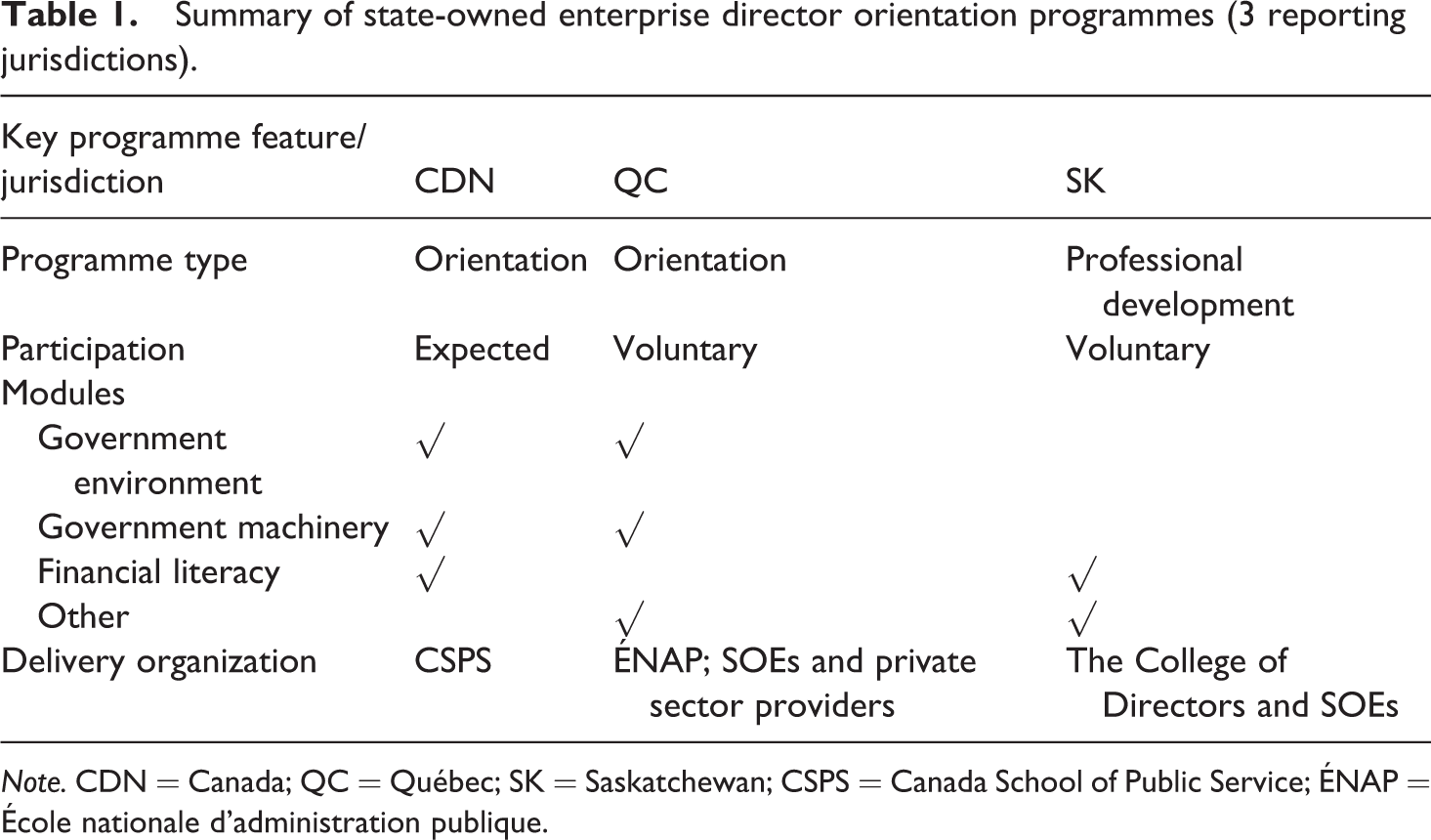
Note. CDN = Canada; QC = Québec; SK = Saskatchewan; CSPS = Canada School of Public Service; ÉNAP = École nationale d’administration publique.
Canada – federal government
The need for Crown corporation directors to receive orientation for their roles and responsibilities was first recommended by Canada’s Auditor General in 1993 (AGC, 1993) and reiterated in its 1995 and 2001 reports (AGC, 1995, 2001). All these reports agreed that while the role of a director on the board of an SOE is in many ways similar to that on a private or non-governmental sector board, the operating environment of the corporation, defined by its existence as a public institution, is sufficient in itself to warrant directors to receive orientation specific to this circumstance (AGC, 2001, 1995, 1993). It is this difference that the government responded to when it established its director orientation programme in 2003.
Initially offered under contract by a private sector governance specialist firm between 2003 and 2008 (Renaud Foster, 2013), responsibility for the programme was transferred to the Canada School of Public Service following the 2005 Crown corporation governance review (Canada, 2005). The choice of CSPS, the government’s training and learning organization, over a private provider was made to ensure consistency in treatment of key topics such as government operations and expectations (research interview). The resulting programme was designed following a learning needs assessment that involved board chairpersons, serving directors and chief executive officers of Crown corporations, as well as officials from the federal Treasury Board Secretariat and the Privy Council Office (CSPS, 2012a). The participation of new appointees in the orientation programme was expected though not mandatory, with little or no consequences if directors opted not to register (research interview).
The CSPS programme consists of three (originally two) courses that are scheduled in sequence to encourage director participation in all three. These are as follows (CSPS, 2012a): Financial Knowledge in a Government Environment – Crown Corporations (Z116); Roles and Accountabilities of Boards and Board Members (Z129); and Understanding the Government Environment and its Impact on Crown Corporations (Z115).
1
The CSPS programme offers new Crown corporation directors a high-level overview of director roles and responsibilities with an entire course devoted to the workings of the federal government and how this affects the board governance (CSPS, 2012b, 2012c). Though CSPS is the federal government’s institution mandated to provide training to federal officials, many directors opt for training provided by other bodies, such as The College of Directors. The deciding factors in opting for another avenue for training appear to be the desire to network with private sector peers and wanting professional advancement in the private sector. The ability to obtain credentials and recognition for participation in programmes offered by, for example, the The College of Directors, also factored in the decision (research interview).
Canada – Québec
The governance framework for Québec’s SOEs changed markedly in 2006 with the publication of the government’s policy statement and subsequent legislation on SOE governance (Québec, 2006a, 2006b). This legislation is unique in that it establishes for SOE boards the obligation to develop and offer both director orientation and continuing professional training (Québec, 2006b: s. 22). How this requirement was operationalized varies from one SOE to the next – most opting for in-house orientation programmes supplemented by externally provided professional development (research interview).
In 2007 the École nationale d’administration publique (ÉNAP) responded to the new Act by establishing a programme geared to Québec’s SOE directors that addressed the priorities of Québec’s legislation (ÉNAP, 2012). Unlike the federal CSPS, ÉNAP is not a designated public sector training institution, though it benefits from proximity to Québec’s public sector as a unit of the Université du Québec network. This provides ÉNAP with a slight advantage in attracting new and sitting directors to its programme. If not the “official” director orientation programme for Québec’s SOE directors, it is perceived as such in many regards (research interview).
The ÉNAP programme is composed of five offerings, though two consist primarily of individualized coaching services and thematic conferences and seminars. The three core elements of the programme are as follows: session d'intégration à l'intention des personnes nouvellement nommées (GOUV1) (Orientation for new appointees); les CA. Y accéder. Y agir. (GOUV2) (the board of directors, how to join, and how to perform); and atelier sur les meilleures pratiques des comités d'un conseil d'administration (GOUV3) (Best practices for committees of the board).
2,3
An interesting feature of ÉNAP’s programme is the emphasis it has placed on meeting Québec’s five-year target of gender parity on its SOE boards. The “Les CA. Y accéder. Y agir” module was specifically designed for women already on an SOE board or who aspire to be appointed to one. The module focuses on issues such as interpersonal relations and power dynamics, influence strategies, and competency development (ÉNAP, 2013). At two days in duration, it is also the longest module. In comparison, the orientation (Gouv 1) and the committee (Gouv 3) modules last only a half day. All of the modules cover the basic principles and practices in SOE governance and the particularities of operating in a public sector institution. Participants in ÉNAP’s director orientation programme also receive continuing education credits that may be applied to their professional memberships.
In 2012 Québec mandated that the ÉNAP undertake a review of the progress in SOE governance since the 2006 legislation. The report recommended that the government provide new appointees with general training on corporate governance, and specific training on the government operating environment. The ÉNAP report is silent as to how the training is to be provided and which organization is best suited to offer this training (ÉNAP, 2012: 23–24).
Canada – Saskatchewan
Saskatchewan’s Crown Investments Corporation (CIC) is a holding company for the province’s nine Crown corporations with a commercial mandate. CIC oversees its subsidiary Crown corporations’ strategic direction and provides a framework designed to strengthen governance, performance and accountability of Crown corporations and to assist Crown corporation boards in discharging their responsibilities (CIC, 2011: 21).
CIC takes an umbrella approach to director professional development, defining the training requirements that apply to the directors of all of its subsidiaries, but leaving the delivery to an outside provider. In 2009 CIC entered into a contractual relationship with The College of Directors to deliver a corporate director development programme, the first and only partnership of its kind in Canada (CIC, 2011: 21) 4 . Through the programme participants would learn concepts and best practices in corporate governance. Though director participation in the CIC sponsored programme is not mandatory, it has met with considerable participant interest (research interview). At the governmental level, CIC’s decision to invest in the training of its directors has also received strong political support (see The College of Directors, 2009).
The participants in CIC’s sponsored programme follow the same curriculum as that provided to participants in The College’s general programme. As a result, CIC’s subsidiary directors have the option of obtaining Chartered Director certification subject to completing the programme and complying with the requirements for certification (CIC, 2011; The College of Directors, 2009). The programme is composed of five modules: Accountability and Change; Leadership and Strategy; Oversight and Finance; Communication and Corporate Social Responsibility; and The Board Simulation.
CIC’s approach to director training has several advantages. The arrangement is relatively cost effective, as CIC need not invest in the infrastructure associated with development of in-house training programmes. It ensures that all of its subsidiary directors receive the same orientation and learning programme and, thus, maintains standards in this regard. Finally the programme offered by The College to CIC’s subsidiary directors is indistinguishable from that offered elsewhere in Canada, so it is attractive to individuals seeking to build peer networks and professional opportunities beyond Saskatchewan. The advantage of participating in a generic director training programme is also the programme’s main shortcoming. Though SOE directors may undoubtedly benefit from general board governance training, it is the specificity of the public sector context where directors most require training. While efforts are made to include faculty with knowledge and experience of the Saskatchewan SOE operating environment, CIC must rely on its staff or that of its subsidiary corporations to provide new directors with orientation specific to the public sector context (The College of Directors, 2009; research interview).
Observations and conclusions
This discussion highlights a number of common approaches and practices to director training across the Canadian jurisdictions.
First, all of the jurisdictions under study have in place orientation programmes for new SOE directors linked to governmental policy statements or legislation. Québec, however, is the only jurisdiction to have legislated in this regard. This highlights the criticality of the appointments as a prerogative of the governmental executive.
Second, we found differing approaches to how orientation programmes are delivered, differences that we explain by differing institutional capacities. In the federal case, the existence of a government learning institution, CSPS, facilitated the decision to assert greater control over the delivery and content of the new director orientation programme. In the case of Québec the decision to leave director orientation in the hands of individual SOEs, departments, and directors underscores the desire to respect the independence of the institutions and the differences in their missions and mandates. However, given ÉNAP’s position, there is an informal expectation that SOEs will consider it, rather than other options, when selecting their training delivery organization.
The Saskatchewan approach mirrors the institutional arrangements for the province’s SOE governance. Though there are several subsidiaries to CIC, these all conform to a single governance framework that is common across the entire holding and, therefore, relatively easy to communicate. Designating a well-recognized institution to offer directors for professional development ensures a continuity of approach and curriculum. This training partnership also underscores the importance assigned to ensuring well-qualified corporate officers – both internally to the holding but also externally to the public.
The Saskatchewan and Québec approach to director orientation are broadly similar in many regards as they both rely on externally provided programmes. This approach ensures that directors benefit from a well-rounded exposure to governance education, thus countering any internally reinforced notions about directors’ roles and responsibilities. Both programmes also include a form of credential for participants that may act as an incentive to attract individuals to public service.
Third, with the exception of Saskatchewan, all of the jurisdictions reviewed included as part of their orientation programmes a segment on the workings of their public sector. In the case of CIC, the public service distinction to serving on an SOE board is addressed by CIC through internal orientation, though this approach itself limits the exposure of new appointees to public sector senior officials beyond CIC. In the case of Québec, ÉNAP’s programme includes segments on this topic. In all of the other instances, whether through briefings or course modules, “how government works” proved a common theme. This is important to note as what distinguishes the mandate of director on an SOE board from a counterpart on a private board is this public service dimension. Many research interviewees mentioned instances where a fundamental lack of understanding of government led directors to take ill-advised positions.
Returning to Reichard (1998), we observe that a balance of both education and training is necessary to ensure that senior public sector leaders possess the right mix of competencies, skills, and knowledge to discharge their duties. In the case of SOE directors, their roles differ from those of other public sector officials and that of peers on private sector boards. In both cases the differences are principally in their operating environment and relationship with the owner (the state). Thus, using Reichard’s terminology, the use of board profiles as a tool in new SOE director selection will principally measure the level of pre-recruitment education. Ensuring proficiency of new appointees must entail post-recruitment training in the one area where a government institution is best suited – the public sector environment, its organization and mechanisms. How jurisdictions approach director training will reflect institutional capacity and resources. Internationally, several models can serve as guides (O’Neill, 2013). In this light, one can observe that the Canadian federal approach to director orientation would be closest to that outlined by Reichard’s framework.
In closing, it is important to remember the observation made earlier in this article concerning the lack of evidence on the benefits of providing directors with an orientation programme. While one is not be opposed to virtue – and there is much virtue in promoting director education in SOEs and the private boards – empiricism in this area is currently lacking. This suggests opportunities for further research.