







Abstract
Building on the concept of Public Service-Dominant Logic (PSDL), this article aims to apply the public service-dominant logic to executive education. We argue that fit-for-purpose and effective executive master programs for public managers (EMPA) need to be designed from a public service perspective. Framing executive education as a service enables the enhancement of the effectiveness of public action as a result of inter-organizational capacity and the co-production of learning outcomes. This article is an invitation to teach what we write, to practise what we teach and to teach through practice, which is what a public manager attending an executive program would expect in terms of public service experience. PSDL was applied to the flagship program at SDA Bocconi School of Management for public sector managers in order to produce the first concrete contribution and to illustrate how switching from a product-logic to a service-logic can have a positive effect on executive education, its structure and curricula. By retrospectively applying PSDL in order to investigate any concrete outcome on revising executive education programs, we show that it is possible to generate a concrete impact in terms of participant satisfaction and the perceived long-term added value of the learning experience by focusing on the education outcome, meeting and anticipating the participants’ needs and expectations, and considering the participants as active stakeholders at the heart of the delivery process.
Keywords
Introduction
This article builds on recent work on Public Service-Dominant Logic (Osborne et al., 2013) and discusses how it can be applied to design executive education programs for public sector managers. The main contribution of Public Service-Dominant Logic (PSDL) in public management studies is to reinforce the New Public Governance paradigm through the contribution of the service-dominant logic literature developed for service industries and offering an alternative to the product-dominant logic derived from manufacturing industries, forming the basis of the New Public Management (NPM) paradigm. PSDL emphasizes that the core of public sector activities are services, not products, and that the service’s effectiveness relates more to the quality of inter-organizational cooperation – instead of the efficiency of each single organization – and to the nature of co-production between professional and users – who are also citizens on account of the public context – rather than the individual performance of the service deliverers.
In line with this purpose, we used PSDL to rethink executive education for public managers at two levels of analysis. First, it suggests how public management curricula can be revised and updated vis-à-vis new paradigms of public administration studies aside from the NPM approach still dominant in public management curricula and courses. We argue that PSDL can support the updating of curricula in terms of program content and dominant issues, avoiding focusing too much teaching on intra-organizational managerial issues, when the effectiveness of public action comes from inter-organizational capacity. Second, executive education is itself a service, and it is a public service – if delivered for public managers – even when the provider is private. Consequently, our framework is also useful for rethinking an executive program as a public service. This contrasts with the currently dominating practice in the business sector whereby executive education is approached more as a product rather than a service. PSDL is a valid framework for conceptualizing an executive program as a public service, whose effectiveness comes from the quality of interaction, the nature of co-production, orientation on outcome (rather than output), and focusing on the professional and individual experience of participants. This framework not only helps to review program curricula, but is also useful for rethinking the whole executive education experience, co-designing the learning experience among all stakeholders, bringing together the core components (teaching methods and courses) of the service with peripherals to enhance the value for participants and faculty members. In other words, this article is an invitation to teach what we write, to put what we teach into practice, and to teach through practice, which is what a public sector manager attending an executive program would expect in terms of public service experience.
After identifying the specific nature of executive education targeting public sector managers, this article will analyse the characteristics of effective education and investigate the contribution of PSDL in designing it. We conclude by applying PSDL to the flagship executive education program at SDA Bocconi School of Management for public sector managers in order to illustrate how switching from a product-logic to a service-logic can have a positive effect on executive education.
Executive education for public managers: the learning model is more important than the brand
Executive education has the specific quality of targeting professionals and managers who already have considerable work experience and are looking for proper preparation for senior management positions (De Déa Roglio and Light, 2009). In the private sector, the flagship program for executive education is the Executive Master in Business Administration (EMBA), which has a long-standing tradition and is well established in all major schools of management and business. Several authors (Manzoni and Ondoli, 2013) have concluded that the main differences compared to a full-time MBA are associated with the age and seniority of the participants and the underlying reasons for their enrolment: the format of the program – it is structured bearing in mind the need for an intense and prolonged study program that is compatible with the work demands of participants (Sheikh, 2007); the curriculum that presumes participants have a sufficiently articulated and structured knowledge of working environments, roles and business dynamics. It is also common for companies to offer their managers financial support if they take part in such programs (Dietz, 1997). The same considerations can be extended to the Executive Master in the Public Administration (EMPA) with a single but significant difference regarding the ‘leitmotiv’ relating to participants: EMBA candidates are professionals in pursuit of tangible career opportunities; in other words, they are looking for career enhancement, career switching and ways to foster their bargaining power (Bruce et al., 2003; Schoenfeld, 2005). Consequently, when applying to attend EMBA programs, candidates focus their attention on the program’s expected return on investment, brand and reputation, overshadowing the need to acquire an effective ‘management tool box’. The private management job market has developed in such a way that the training investment in these types of programs is recognized and rewarded, so much so that EMBA has become a requisite brand in a manager’s curriculum. Some authors have stressed that the positive impact of executive programs on the professional life of their participants, in terms of career development, is not necessarily related to an equivalent impact on the skills required to cover the higher positions they achieve (Pfeffer and Fong, 2002). This point marks one of the most significant differences with executive education in the public domain: in the public sector, especially in countries with a career-based system (such as Italy, France, Germany and Spain) where the job market is different in the public and private sectors, the combination of the extremely formalized recruitment and selection systems, the rigid salary dynamics and the amount of ‘red tape’ make the career developments for public managers less sensitive to the brand value of the executive education. In other words, EMBAs have a strong impact on the career of a private sector manager because the job market recognizes the brand and pays for it in terms of salary and the nature of jobs. On the other hand, the power of EMPAs is less evident in terms of a brand in a public sector career, where other logics are in place, such as the formal criteria for progressing in a career (e.g. the years of experience rather than the intensity of their experience, political posts rather than the appraisal of the managerial profile). This difference is even more significant in the current economic context where the financial crisis has led to cuts in public spending in most European countries, especially in public management education. Therefore, in order to be fit-for-purpose, EMPAs have to offer ‘added-value’ for participants, their organization and sponsors, and prove their relevance and the uniqueness of their academic content (Oldfield and van den Berg, 2013). Furthermore, in a context where public administration is no longer a key employer in the job market, Executive Education (EE) has to be catchy, assure viable career paths and provide the skills and prominent tools needed to manage contemporary public organizations. Therefore, the value of EMPA programs lies not in a brand, but in the actual capacity for learning experiences to improve the candidate’s professional effectiveness, whereas the reputation of the program itself remains in the background. As a result, the learning model should dominate the EMPA experience rather than the brand.
In summary, on the one hand, EMBA participants are managers looking for a prominent brand to add to their curriculum, in a product-based logic. EMPA participants, on the other hand, base their decision to attend a master program on the expected impact on their skills and on the effectiveness of their actions. In other words, brand-logic is more consistent with a conceptualization of EE as a product, whose brand is a critical part of the value proposition. However, in learning model-logic, EE value is not just about the brand, but is also linked to the overall educational experience and the impact it is able to generate on the participants’ skills.
Effective executive education: what makes an EMPA different?
Although public and private sector managers have to face similar challenges, public organizations clearly have a different role to play in modern society, influenced more by politics and social changes (Quinn, 2013) and the multiple meanings and purposes of public management (Osborne, 2010). An EMPA could, therefore, act as an enabling factor to support future public managers in the making-sense process, applying the competences they have acquired for the organization of provenance and to cope with the increased complexity of providing public services in a context of rising needs and decreasing public funds. EMPA programs cannot hope to offer public managers the answers to all of their problems because of the heterogeneous nature of public products and services, but instead can stimulate the learning process, enhance their competences in order to tackle sector-specific issues and questions, and coherently reframe their roles.
The search for a more effective EMPA can benefit from the long history of investigation into executive education designed for the private sector. Han and Liang (2015) recently summed up the benefits of executive education as consisting of four main outcomes – knowing, networking, belonging and becoming – whereby the value of an EMPA lies in the opportunity to: (a) act and reflect on individual professional experiences (knowing); (b) network with engaged peers with a variety of public sector experiences and heterogeneous backgrounds (networking); (c) interact with other professionals, peers and lecturers who share the same mission and passion for the public sector (belonging); and (d) be exposed to concepts that allows individuals to understand and work more effectively within their context (becoming). Various studies have demonstrated that participants of executive education programs often take part in these programs to pursue their own agendas, to develop a better understanding of their role in the society, to look at their own work situations from a new perspective and, consequently, to act and think differently (Kets de Vries and Korotov, 2007; Petriglieri and Petriglieri, 2010; van der Meer and Ringeling, 2010). As a result, EMPA programs should help participants to ‘think outside the box’ and develop new ways of interpreting and relating to the context of their work. According to David Kolb’s (1984) influential theory of experiential learning, people learn in four ways: first, learning occurs by experiencing the real world; second, learning occurs via the reflexive observation of direct or indirect experience (people also learn by observing the experiences of others); third, learning occurs via abstract reasoning with models and theories providing cognitive frameworks to organize and collect information; fourth, learning occurs through active and intentional experimentation of new solutions. This model can be widely applied to education at all levels and the entire sector. Nevertheless, we believe that there are some specific elements that have to be recognized when working with public sector managers in order to apply Kolb’s theory to best effect. We now look more deeply at what this could mean for an EMPA in order to underline why we need a specific framework for public executive education.
The first two steps of Kolb’s theory are integrated, especially for executive programs: the main feature of any executive class is the richness and variety of the managerial experience of the participants and their direct knowledge of the real world. The organizations where they come from are the first place where they learn, and the quality and diversity of previous experience is an asset for any executive program. They have extensive experience of the real world of management and so they need to turn this experience into a learning outcome, reflecting on their own experience and that of their colleagues. Therefore, a program for executive professionals should not only be a place where people can learn new theoretical models and technical tools, but also be a place where the sharing of individual managerial experience is promoted, structured and intentionally guided in order to enhance the opportunity to learn from each other’s experience. However, there is a paradox for managers working in the private sector as they may be more cautious with regard to sharing sensitive information concerning their companies with competitors. The opposite is true for a class of public sector managers who work in a non-competitive environment, as sharing their experience would not only be easier and less critical, but would also be more relevant: collaboration and cooperation among different public bodies or among different governmental levels is a critical competence for public managers. Thus, looking at EMPA programs, the diversity of students in terms of the types of public organizations, levels of government, policy areas, organizational roles and functions, is in itself a source of learning and is also a necessary condition in order to address the issue of the inter-organizational effectiveness of public managers, which represents a major gap with executive education for the private sector.
Third, Kolb recognizes the importance of theoretical models in order to provide cognitive frames to organize and collect information. In general, we can identify the list of the theoretical domains forming the basis of a program by its curriculum, stating the set of courses and linking each one generally to a different subject, with a specific background. An EMPA could be very close to an EMBA in terms of its subjects, especially regarding management courses: the functional approach could be the dominant one (e.g. HRM, Accounting, Finance, Operations, and ICT). When it occurs, this program is reproducing – intentionally or not – a New Public Management paradigm (Hood, 1991) covering the overall approach to the EMPA. There is a paradox here: professors write about the limits of NPM in their articles and about the need for new paradigms explaining and inspiring the public action (the Public Governance paradigm) yet reproduce an NPM reference frame as master directors or as teachers. For this reason, we agree with Kolb that theories are relevant and important, but not neutral.
Finally, according to Kolb’s model, executive programs should provide the opportunity to take action and to experiment with new solutions. Project work and other learning tools have been developed in order to bridge the theory–practice gap (Roberts and Pavlak, 2008). Cross-cut activities such as capstone projects (Ahmed, 2014) are an example of how applied projects provide participants with an opportunity to apply the knowledge, skills and competencies gained during the program, and open up a variety of external networking opportunities. These educational tools have the advantage of creating added value, not just for the students by developing their managerial capacity through the practical implementation of a new managerial solution, but also for the companies where the students are delivering their project work. Generally speaking, students attending an executive program are able to deliver their field project within the company they come from; for companies funding or co-funding the fees, this can be viewed as a direct and short-term return on their investment in education. ‘Service-learning’ is another form of experience-based learning: ‘a form of experimental education in which students engage in activities that address human and community needs together with structured opportunities intentionally designed to promote student learning and development’ (Jacoby, 1996). When students are public managers working for their community, like those attending EMPA programs, any field project is service-learning if we consider their public (or not-for-profit) organizations as being their natural sphere of operation. This consideration suggests we should reframe the concept of service within a learning context for at least two reasons. The first reason is more general and is linked to the approach to education itself: like any educational product, an executive program should be perceived and designed as a service. Thus, the concept of service should be embedded in any educational experience: the categories needed to design and deliver an educational program should come from the service management approach, which is not always the case for the private or the public sector. The idea of an executive education being a place where toolkits are provided is a dominant one (Godfrey et al., 2005) and can be considered evidence of the ‘productification’ of an executive education, instead of focusing on the service dimension of education. The second reason for reframing the concept of service within a learning experience is linked to the domain of public manager education: ‘service’ is the specific sector where public action takes place and where public managers work, since they are expected to manage public services and to produce intangible values (Borgonovi et al., 2009; Normann, 1991). Public managers attending an executive program learn how to manage public services within a service context, that is, the program delivery. The program delivery becomes itself a service model and a service benchmark. Thus, ‘service’ is both the core content as well as the context of an EMPA. Education for the public sector should be more sensitive to these aspects and the EMBA working with managers coming from service industries could learn a lot from this approach. Based on this perspective and in order to develop a framework supporting the process of rethinking the EMPA from a service perspective, we applied Public Service-Dominant Logic (PSDL) to the EMPA program offered by SDA Bocconi School of Management.
Applying Public Service-Dominant Logic (PSDL) to the design of EMPA programs: a new learning model
The notion of PSDL (Osborne et al., 2013) was developed as a bridge between Public Governance literature – developed as a critique to NPM in order to better address the managerial needs of the public sector – and service management literature, developed for business management theory in order to achieve a better match with the needs of the service industry (vs. the manufacturing industry). This combination provides an interesting and unique perspective on public service management, which forms the basis of our interpretation of executive education for public managers as a public service, because it puts the service management approach into the specific context of public administration. The core-characteristics of the proposed approach can be summarized as follows:
Services are intangible elements whose ownership is not transferred in the transaction (Normann, 1991), and the performance measurement of the delivery process is based on the service delivery outcome as well as on user expectation and experience (Lovelock, 1983); The production logic for services cannot separate the production, selling and consumption processes because the former and the latter occur simultaneously (Osborne et al., 2013); The user of services is not passive but acts as a co-producer of the service itself, and co-production is a core feature of the process (Osborne and Strokosch, 2013).
Based on these distinctions, PSDL represents a major change with regard to previous approaches contributing to the definition of a service-specific framework that – based on the service theory and service-dominant logic – delineates and redefines the object of the delivery processes, the production logic and the role of the user.
This new approach, which considers the specific features of services, enables a deeper exploration of the implications of service delivery in the public sector and reveals that performance measurement and management in the public sector is not solely a matter of effective public service design, but rather of user perception and experience in the ‘moment of truth’ (Normann, 1991) when the service organization and the user interact. In this regard, PSDL reveals that a successful, efficient and effective public service management system needs ongoing effort as regards some key elements, namely effective design, meeting user expectations, enhancing user confidence and training/motivating the workforce that interacts with users. These key elements can be simultaneously achieved by defining strategic goals aimed at creating tangible public value (Moore and Benington, 2010). This approach can be summarized as four pillars (Osborne et al., 2013):
Service: enabling strategic positioning and communication of the services delivered from the point of view of ongoing improvements to public services that takes into account their intangible nature and the need to focus on the outcome and user expectations as fundamental elements for the performance measurement of the delivery process (Lovelock, 1983). User needs and expectations are continuously changing and becoming diverse and so it is not possible to standardize the public service delivery process. Instead, there is an emerging need to communicate with users of services, to involve them from the design to the evaluation of public services, to build inter-organizational trust and relationships and to improve public service delivery by means of a process of ongoing improvement aimed at anticipating the future needs of users (McLaughlin et al., 2009); Inter-organization: bringing together operations management and PSDL to promote efficient and effective public services in an inter-organizational context. Operations management is about how public services are designed, delivered and improved to effectively meet user needs and expectations. From a PSDL-perspective, for public services to be fit for purpose, the orientation of the service provider should switch from an inward looking (intra-organizational) to an outward looking (inter-organizational) approach that will lead to a ‘virtuous circle’ of service improvement (Normann, 1991). The latter approach enables gains in terms of internal-efficiency (predominant focus of product-dominant logics) and effectiveness; Co-production: putting co-production at the heart of effective public service design and delivery. From a service-dominant logic that recognizes that the production and consumption of services occur simultaneously at the point of delivery (Gronroos, 2007), co-production – in which the service organization and the service user both actively participate and interact during the production of the service – becomes an intrinsic pillar and an inalienable element of public service delivery processes. Based on this approach, effective public service enhancement and development requires the organizations to unlock the tacit knowledge of users (Von Hippel, 2005) in order to understand their current, latent and future needs (Osborne et al., 2013) and to deliver innovative solutions so that the service ‘promised’ matches the service delivered in the ‘moment of truth’ (Normann, 1991). In addition, the notion of co-production reframes the actual relationship between professional and user (Bovaird and Loeffler, 2012): this relationship can also involve groups, not just individuals, where each member is responsible for the entire community (Bovaird, 2007). In particular, when customers act as community-developers, paternalistic relationships with staff, with other service users and with other members of the public can be avoided (Bovaird and Loeffler, 2013); Strategic orientation: improving the strategic orientation and policy formulation/implementation of public service organizations, with citizen-users considered essential stakeholders. According to Grawe et al. (2009), we refer to strategic orientation as the aptitude to craft-shared values and behaviors by means of an outward looking approach that considers user expectations and the external environment as a significant constituent of the organization’s success. In particular, PSDL-driven organizations have the capacity to meet the current expectations of service users, understand their future needs (Sofaer and Firminger, 2005), and to support effective policy formulation/implementation processes based on this public engagement.
Public Service-Dominant Logic is a quite recent approach and so it needs further empirical investigation in order to consolidate it as a theoretical paradigm. First, the body of literature testing and discussing this theoretical approach is still primitive and it needs to be extended, also in order to identify the limits of this logic in terms of the effective adherence of the model to the reality of public services (for instance, public services may also be coercive or involve users with conflicting interests at stake). Second, PSDL is mainly based on theoretical contributions developed in business management literature, such as strategic service management (Normann, 1991) or the service-dominant logic of marketing (Gronroos, 1978; Lusch & Vargo, 2006) and so there is a risk of underestimating the differences between sectors: there is currently an insufficient body of research addressing this topic. Meanwhile, the main contribution of the set of ideas of Osborne and his colleagues is to provide a new perspective on the NPM critique: according to them, NPM limits do not just originate from a ‘business-like’ dominant framework and the scarce comprehension of public sector peculiarities (starting from the seminal article by Hood in 1991), but also from the fact that NPM is mainly based on the business management theories developed for the manufacturing industry (Porter, 1986), instead of the service industry.
Based on these pillars, we argue that the PSDL framework enables a better understanding of the needs of EMPA participants, a better fit for the context and its trends, and is key for achieving effective public management practice in public service delivery, and executive education in particular. In our understanding of executive education, PSDL enables executive programs to be viewed as services, rather than products. For the specific purpose of this article, we will focus on three of the four pillars, considering strategic orientation as an add-on that may be obtained and depends strongly on the successful implementation and presence of the other three. The three pillars we consider relevant are (a) the service nature of executive education, (b) the need for an outward looking (inter-organizational) approach, and (c) co-production as a critical element for effective public service design and delivery.
(Public) executive education: product or service?
When thinking of Executive Education (EE) as a service, it is important to highlight the main characteristics of service organizations. First, according to PSDL, what distinguishes a service- from a product-organization is the co-production of its offer. Services cannot be explicitly described in terms of purposes and features (i.e. materials, size and weight) nor can they be substantiated before purchase. Hence, service organizations, such as universities, cannot simply structure their EE programs as a specific number of training hours or credits obtained, but rather as a learning experience that grows as a result of the interaction between the students and the faculty, the sharing of experiences among the students, and the interaction of the students with the staff and any other member of the education provider.
Second, services consist of multiple acts, reiterated interaction between the service organization and its customer (after the purchasing phase), and participation in a long-term professional network. Therefore, while the customer’s experience from a product point-of-view is limited to the consumption of what has been purchased, from a service perspective it depends on a complex process in which customized experiences are consumed and reinterpreted. As mentioned above, according to the experiential learning theory, EE requires participants to attend classes, reinterpret what they have learned based on direct or indirect experience, and actively apply or experiment with new solutions in their own reality (Kolb, 1984).
Accordingly, it is possible to identify a third aspect that distinguishes a product from a service perspective: the evaluation of quality. While EE as a product is objectively assessed ex-post based on the quality both of the product (i.e. learning outcome) and of its customer service levels (customer satisfaction survey together with the written assessment of the knowledge acquired), as a service its performance evaluation is subjective (Lovelock, 1983) – based on the expectations of customers and their individual experience of the delivery process – and concurrent with its consumption, or as Normann says (2002a) in the ‘moment of truth’.
If we are to rethink EE as a service, we should bear in mind the four pillars of PSDL and consider ‘learning’ as the predominant but not the only service offered and outcome expected. In particular, it is important to consider EE as a ‘service package’ in which classes represent the core service aimed at enhancing participants’ learning paths and all the other services – such as back-office administration, sponsorships, team-building events and additional amenities – can be considered as peripheral services.
Given the increasing relevance of the quality of subsidiary services in customer-experience paths, the boundaries between core and peripheral services are becoming increasingly blurred and the former have increasing relevance in the purchasing decisions of consumers. Companies are investing in peripheral and, according to Normann (2002b), exceptional services aiming to positively influence the customer experience.
To sum up, there are three clear elements that should be considered when structuring the EE service package (Sasser et al., 1978): facilitating goods (such as academic materials, e-learning supports and rooms for classes), explicit intangibles (e.g. creation of knowledge and learning processes) and implicit intangibles (e.g. becoming part of a professional network and experiencing new and inspiring environments).
Collaboration for effective delivery
In a rapidly changing environment, public mangers are faced with the need to reflect on the unpredictable, handling complexities and providing effective solutions for internal and external stakeholders. As stated by Ghoshal et al. (1992) referring to senior managers, they have to ‘have the knowledge, the sensitivity, and the abilities necessary to lead organizations throughout the uncertain times ahead’. This becomes even more challenging in a context featuring vertical and horizontal interdependencies among public organizations, which determines the inter-organizational nature of public service delivery. EE providers have to adapt to these dynamics and proactively ensure the effectiveness of the service offered. This requires an important shift in the selection criteria of participants, in curricula structure and teaching approach. This was different in the past, when EE programs targeted and were designed for specific categories of public managers who shared a common understanding of public sector values and goals. Now, in the 21st century, public management education has to train heterogeneous individuals who share the same mission but have different professional experiences and backgrounds.
According to the inter-organization paradigm, the setting of the public sector manager learning experience is not limited to face-to-face classes, but is wider and involves all participants’ organizations. In this perspective, the communication and collaboration – from the design phase to the delivery process – between the educational institutions and the public organizations allows the definition of a coherent and convergent vision in terms of the competency framework of public leaders and public sector priorities that can be a valuable element enhancing participants’ learning experience. This collaboration between education institutions and public bodies can be extended to all of the most relevant steps in education delivery (e.g. program design, recruitment and selection process, field project definition, implementation and evaluation). Third, as stated by Mintzberg and Gosling (2002), participants attending a product-dominant program are often asked to approach management via the study of all the main business functions, reinforcing the idea of management studies as a fragmented and activity-specific set of knowledge. PSDL, however, suggests the need to foster strategic, problem-based and inter-organizational thinking that facilitates participants’ learning by means of peer-to-peer exchange of experiences and a deeper understanding of the need for the public sector to deliver as one.
Co-producing the learning experience
Another associated characteristic of services is the higher degree of ‘user-involvement’ and customization compared to products. Effective EE needs to consider the specific needs of participants, revising its structure and curricula to be fit-for-purpose. In this regard, since PSDL considers services to be co-produced, the main input of EE is not input-specific (i.e. faculty prestige and competences) but user-specific. From this viewpoint, the customer has two, apparently conflicting, roles in the service delivery process: a pro-ducer of the delivery system and a con-sumer of the service. As Toffler (1980) indicated, the customer becomes a prosumer of the education process. Although substantial literature examines the concept of co-production (Alford, 2009; Bason, 2010) in public service delivery processes, it is important to emphasize that – in our understanding – co-production does not solely mean that users participate in the process by consuming and evaluating the service. PSDL considers co-production as an unquestionable component of services that envisages continuous and reiterated interaction between the organization and the user during the delivery process (Gronroos, 2007; Osborne et al., 2013). Hence, co-production is not an add-on of the delivery process, but rather a key aspect that has to be managed for public services to be effective. In other words, EE participants have to be considered as part of the production force and the most important input of their learning process consists of their experience, competences and awareness of their own specific educational and personal and/or professional development needs. This leads to a further characteristic of service organizations, namely the high rate of variability of user/participant expectations, experience and backgrounds. While products can be standardized to meet the standard core needs of customers (core courses versus electives), once again services need to be fine-tuned and possibly customized to meet heterogeneous expectations (field projects and a focus on individual learning needs, rather than standardized knowledge). According to this perspective, the learning focus shifts from a knowledge transfer approach (knowledge produced by lecturers who transfer it to students) to a knowledge co-creation approach (students learning depends on their collaboration in the knowledge co-production process: this process can be fostered, incentivized, oriented, but not enforced or standardized). In coherence with this perspective, framing EE as a co-produced service also means shifting the relationship between customers (participants) and professionals (professors, in this case) toward a less paternalistic and asymmetrical relationship. Bovaird and Loeffler (2012, 2013) call this more collaborative and equal relationship a form of community co-production, in the sense that each member of a group works to achieve the development of his own community since he is directly responsible for it, not just delegating this responsibility to external professionals but also collaborating with them. According to this perspective, knowledge co-production can be seen as a form of community co-production, in the sense that it is based on the recognition of user responsibility relating not only to the development of his own knowledge and skills as an individual, but also to that of the entire group: sharing experiences and perspectives forms the basis of the learning process of a group of peers (notion of indirect experience as a source of learning in Kolb’s model).
Applying PSDL to an EMPA: the case of the Executive Master in Management of Public Administration at SDA Bocconi School of Management
In order to test the contribution of PSDL to revise an executive program for the public sector, we will retrospectively apply our framework to reinterpret the changes that occurred in recent years during the revision of the ‘Executive Master in Management delle Amministrazioni Pubbliche – EMMAP’ (Executive Master in Management of Public Administration), the flagship program of SDA Bocconi School of Management for public sector managers.
EMMAP launched its twelfth edition at the end of 2015 and has trained hundreds of public sector managers, making it an interesting case that shows how executive education can be fit-for-purpose according to PSDL. Over the last decade, the program has been reshaped and fine-tuned in order to adapt to the changing needs of participants, governments and context. Whereas the first five editions of EMMAP, called ‘Executive Master in Management degli Enti Locali’ – EMMEL (Executive Master in Management of Local Authorities), targeted managers working for local governments, the program has changed its strategic positioning since then. The emerging need – at both national and local level – to build effective public sector managers together with the shift in the role of public administrations and the increasing need of interaction with external actors and stakeholders, led the EMMAP to expand its catchment area. Today, EMMAP participants are generally public sector managers with an average age of 42 years, and 13 years of professional experience gained in the public sector, working for national, regional or local governments and public agencies operating in all fields. The program is delivered in partnership with external partners, such as the Italian National School of Government (SNA), which offers full scholarships for selected public managers working for central public administrations, the French Ecole National d’Administration (ENA), with which part of international specific module is organized, and other public institutions interested in the program to train their managers (for instance INPS, the Italian National Agency for the Social Security).
To investigate the changes (see also Table 1) that have occurred in the EMMAP in recent years through the lens of PSDL, our data source included interviews with EMMAP instructors and previous directors, together with official documents (e.g. syllabi, course programs, brochures). We also invited six EMMAP graduates – from four different editions – to a focus group in order to explore the perceived value of the program in the long run. Despite these changes, since its first edition in 2004, the service management paradigm has emerged as being dominant and shared by the EMMAP leading team composed of professors of public management. Participants were found to be at the heart of the process set up to renovate and innovate the program’s structure and curricula. What initially appeared as a ‘missing draught’ was a formal paradigm of the learning model. Hence, this article formalizes the vision and principles that inspired and made explicit the reasons for the changes that gradually took place since the foundation of the EMMAP. By applying PSDL as a formal paradigm underpinning the learning model to retrospectively review the EMMAP, we systematized the information collected from the different sources (e.g. focus group with alumni, interviews with faculty members and the former director, and syllabi) and aligned it to the four pillars of PSDL: service, inter-organization, co-production and strategic orientation. The focus of the retrospective analysis of this article is on the results achieved in between the sixth (A.Y. 2009/2010) and ninth (A.Y. 2012/2013) editions of the EMMAP.
EMMAP most relevant changes applying PSDL.
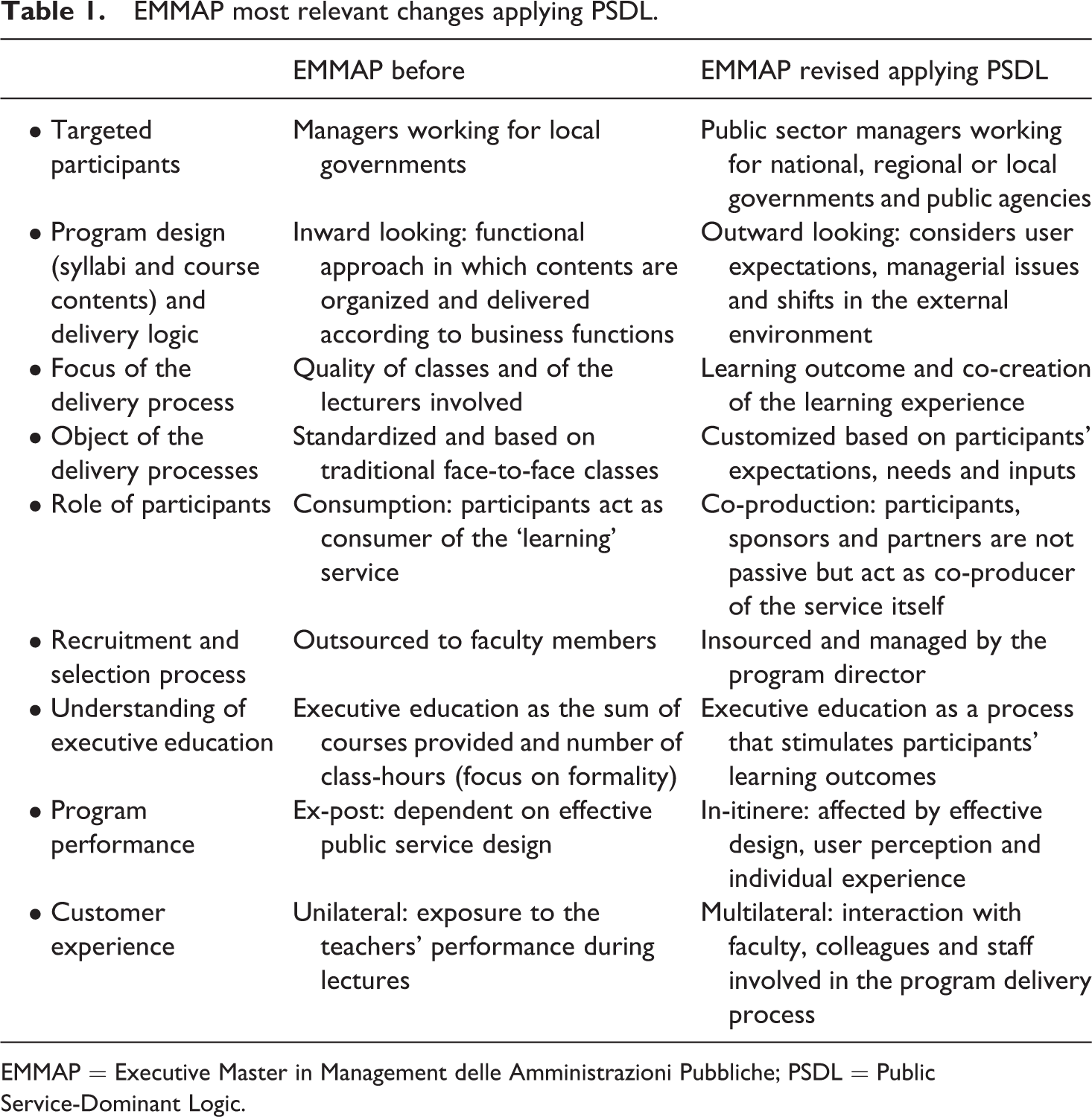
EMMAP = Executive Master in Management delle Amministrazioni Pubbliche; PSDL = Public Service-Dominant Logic.
By retrospectively applying PSDL, it is possible to argue that the EMMAP perceives executive education as a service, thus considering the intangible nature of the education delivery process and focusing on the outcome and user expectations to revise its structure and content. In particular, the interviews with faculty members teaching the EMMAP and the analysis of EMMAP documents spanning an extended period (such as syllabi and program presentation) show that the program has evolved in the last decade, adapting to the emerging needs of customers (e.g. context-specific courses) and to radical shifts in the external environment (including the global financial crisis). As an example, the final project that participants have to submit at the end of their learning experience is no longer a needed assignment taken out of context, rather it became an integral part of the learning experience aimed at meeting participants’ and sponsor organizations’ emerging need to find new solutions to face the emerging complexities of the public sector. To meet the expectations of participants, sponsors and funding organizations the ‘filed project’ has been contextualized and became a way of sharing leading practices within the public sector. In line with this shift, as part of the evaluation on candidates during the admission phase, candidates are asked to propose a challenging managerial issue that they would be willing to face during the EMMAP experience. This enables the positioning of candidates (the participants) at the heart of the learning process from the selection phase and allows the fine-tuning of the course contents based on the class profile. All modules are structured in order to transfer to participants the competences and tools needed to manage the field project and its effective implementation. For instance: the assignment of the performance management module is to set a list of key performance indicators that might be applied to monitor the outcome of their projects. This approach helps to focus the participants’ attention over the practical implication of the courses and incentive them to apply what they learn to a practical context (the field project).
As mentioned above, from a service perspective, executive education is not simply the sum of the courses provided and the number of class hours. In line with this view, based on the desk analysis of the program outline and syllabi, we can say that the EMMAP syllabi and relevant documentation has increasingly focused on the learning outcome of the program experience, the attainable competences, the leadership model underpinning the program, and the co-creation of value for the participants, organization and public sector by means of a concrete and implementable managerial field project that will benefit the participant’s organization of provenance. The syllabi and course contents were organized according to business functions: human resources, accounting, or public relations. This approach was linked to an internal representation of the public sector managerial knowledge: in our department, the professors are mainly grouped by the managerial function they teach, thus we were reproducing the same internal knowledge boundaries we were used to facing in our organizations. The limit of this approach was that this provided a fragmented interpretation of the managerial knowledge, centred on the internal processes more than on the strategic dimension of the managerial work. Using the PSDL lens, we were reproducing an NPM logic in our syllabi, not helping our clients in looking at the big picture, and being focused more on the exchange with the external environment.
For these reasons, we reduced the number of courses focused on the internal functions and we aggregated the courses within wider modules grouped by strategic issues at public organizations – how to manage a spending review (which is about accounting, budgeting, planning, economic evaluation, policy making processes and so on) and how to attract and manage financial resources to fund services and infrastructures (public finance, PPP, fundraising, impact investing, assets management).
Furthermore, from its sixth edition, EMMAP increasingly put the participant at the core of the delivery process, favouring an environment where interaction with the faculty and among peers, the individual learning experience, and the professional outcomes of participants are considered essential for effective learning. The value of EMPA programs lies in the actual capacity of the learning experience to improve a candidate’s professional effectiveness. In the case of the EMMAP, the participants involved in the focus group confirmed that ‘the EMMAP experience has changed my way of working’ and that they ‘had the chance to make this experience a tool for organizational change’. In line with this principle, EMMAP brochures, presentations and building blocks are no longer focused on the profile of faculty members and of the practitioners involved, or on the brand or reputation of SDA Bocconi School of Management. Attention is focusing more and more on the alumni, the networks in which they are involved, their professional achievements after the EMMAP, and how the program has changed their way of thinking and how they face complexities.
Consistent with the second pillar of PSDL, namely inter-organization, the desk analysis and the information collected during the focus group made it possible to observe how each module in the EMMAP educational path has been reviewed, changing the underpinning paradigm of executive education from an inward perspective (typical of a product-dominant logic) to an outward perspective. The latter allows participants to understand their organization’s role in the external environment, to learn concrete tools and practices that are needed to efficiently and effectively manage public administrations today, and to directly apply what they learn in a field project running for the two-year program. The actual service delivery model of EMMAP and its learning outcome are enhanced by the inter-organization nature of both its participants and curricula. As EMMAP participants are public managers working for national, regional or local governments and public agencies operating in all policy fields, the heterogeneity of their profiles – as confirmed by EMMAP participants and lecturers – provides a unique opportunity to share ideas with peers working in the public sector and generates additional value for the EMMAP learning experience. As one of the alumni stated, ‘This sharing of experiences helped us realize how to see ourselves in others, getting out of our solitary confinement, and creating a strong feeling of commitment to our organization’. According to PSDL, the lack of an effective collaboration among public bodies from different administrative level (multi-level governance) or among public agencies addressing entangled issues is one of the most relevant development areas of the public sector effectiveness. For this reason, making public managers from different administrative levels work together can increase the collaboration capacity and address one of the most relevant priorities of the public sector development.
In line with this view, inter-organization is also enhanced by means of communication and collaboration between SDA School of Management, the participant’s organization of provenance, and those funding or sponsoring some participants. This implies putting appropriate attention on the definition of a coherent and convergent vision that enhances the participants’ learning experience and enables participants to define a project that will have a direct impact on their organization of provenance or funding institutions, and so create value. In this view, partner organizations, such as SNA – the National School of Administration in Italy – are not simply funding the educational experience of a public servant, but are contributing to the process of change within the public sector. This shift in the relation with external stakeholders made it possible to reframe the relation between the education provider and its stakeholders with a shift from a dominant client-provider relation where the sponsor organizations were merely financing participants, to a collaborative relation in which sponsor organizations are involved from the selection process to the definition of relevant issues that have to be addressed over the program. Thus the emergent model of collaboration between the education provider and its partners became more intense and focused over a set of clear common goals such as: liaison throughout the selection process, co-production and co-definition of relevant contents, vision to train effective public managers that are able to face the increased complexities of the public sector.
The focus on ‘sharing ideas with your peers’ is enrooted in the EMMAP curricula to the point that a full module has been dedicated to the exchange of experiences with professionals and peers in the ‘places where things happen’ since the ninth edition. This module is called the ‘European Learning Visit’ and consists of a study tour abroad in partnership with ENA and with other European institutions, aimed at fostering self-reflection, benchmarking and the sharing of good practices that can be transferred to the participants’ organizational contexts. As an EMMAP participant stated, ‘the European Learning Visit represented a testing ground to understand the diverse way of thinking of public civil servants working in other national systems and to benchmark our professional and educational experiences’. At the end of the learning visit, each participant is asked to write a short report using the information noted in a learning diary provided at the beginning of the module. All the reports are analysed by the faculty and are fundamental for identifying the main learning outcomes and verifying the coherence between the learning objectives and the learning outcomes. The results of the analysis are presented and discussed in a plenary session and represent the input on which courses, curricula and classes are revised.
This brings us to the third pillar of PSDL: the co-production of the learning experience. It is interesting to note that the collaboration and co-production concepts have been expanded since the sixth edition of EMMAP to include external actors and stakeholders, with constant interaction between sponsors and partners starting from the design of the program to its delivery, in line with this logic. As mentioned above, the individual project – where each participant is asked to identify solutions to a concrete managerial issue – acts as a bridge linking the funding organization of provenance and the EMMAP experience, co-creating change processes in the public sector and creating value for the organization by means of new managerial tools, best practices and the implementation of a project that solves concrete and complex issues. As argued by the director of the ninth edition of EMMAP, there was an important shift in the delivery process in 2011, unlike previous editions where the syllabi were ‘pre-packed’ and based on the desired academic learning outcomes: focus groups and action learning projects with both participants and alumni were introduced in between the needs assessment and content definition of courses. This initiative resulted in co-production being placed at the heart of EMMAP design and delivery, ensuring that the ‘promised’ service met the expectations of participants and supporting a PSDL-driven continuous improvement process. Consequently, the brand and the reputation of the program itself became secondary decision factors for those attending EMMAP unlike executive MBA programs. What is relevant is the co-creation of value and of a culture for learning that involves participants directly, generates a concrete impact in the lives of participants and the setup of their organizations, and focuses on education outcomes rather than its outputs (e.g. a prestigious diploma on the participant’s curriculum). The transition from a focus on ‘delivering knowledge’ to a focus on the ‘co-production of knowledge’, as defined by the director of the ninth edition of EMMAP, is of particular interest. From a procedure-based orientation, we observed an increased level of attention from 2011 regarding: the strategic coordination by the program Director aiming to continuously improve the general organization of the program; the increase in meetings with faculty members to safeguard the sequential order of contents and courses and the significance of the learning experience; the consolidation of the support services offered and of the alumni network to foster the development of a significant network. As we attempted to understand retrospectively how EMMAP has changed in recent years by adopting the co-production pillar of PSDL, we also noted several relevant and remarkable shifts. First, when looking at the recruitment and selection process of the EMMAP, we observed that this function was initially outsourced to faculty members who were specialized in human resources but had scant involvement in the program. Confirmed from a PSDL perspective, this led to a lack of understanding of participant needs and a miscommunication of the program’s values and principles. In recent years, the recruiting process has been revised and now consists of three steps: screening of the curriculum; one-to-one interviews with the program director; shortlist and enrolment. This process applies to self-funded candidates and scholarship applicants and is now considered the cornerstone of the EMMAP experience. The interview with the program director and the recruiting team represents the initial moment of co-production where both the faculty and the candidates have the opportunity to discuss and share what they expect from each other and from the EMMAP experience. As the director of the ninth and tenth edition of EMMAP said, ‘Weeks before the first day of the executive master, almost all participants were clear about what to expect from the EMMAP. For most of them, the interview was the very first day of the EMMAP’.
Second, the service delivery and the evaluation of the EMMAP experience also changed to fit in with the principle of co-production. Whereas the latter was focused on the quality of classes and of the lecturers involved and the former was based on traditional face-to-face classes, today’s evaluation is customer-focused – taking into consideration the outcome, the value generated and the applicability of what has been learned in a real context – and face-to-face classes are enriched by a focus group, discussion and peer-to-peer knowledge exchange aimed at enhancing the mutual learning of both participants and lecturers.
To better understand the results achieved, based on the relevant changes that occurred between the sixth and ninth editions of EMMAP and the impact in terms of the overall satisfaction of participants – measured for each edition by an online survey on a scale from 1 to 10 where 1 is the minimum and 10 the maximum rating, the most relevant data collected is listed below:
+1.4 significance of the learning experience (from 7.96 to 9.36); +0.9 general organization of the program (from 8.19 to 9.09); +0.8 effectiveness of program coordination (from 8.07 to 8.91); +0.8 acquisition of managerial tools (from 8.11 to 8.91); +0.6 quality of the teaching method (from 8.48 to 9.09); +0.6 sequential order of contents and courses (from 8.22 to 8.82); +0.7 development of a significant network (from 8.33 to 9.00); +0.4 structure and contents of the courses (from 8.56 to 9.00).
Based on the interviews, the data collected and the results achieved, we concluded that thanks to the important changes and continuous improvements introduced since 2009, the EMMAP currently represents a prime example of an executive program unintentionally rooted in the principles of PSDL. It considers EE a service, bearing in mind the inter-organizational nature of modern public administrations, and the role of users as key actors actively engaged in the delivery process of the educational service (co-production) by means of an outward-looking approach that has led to the development of a program that crafted common values and behaviors, able to satisfy the participants’ expectations and anticipate their future needs, and making the external environment a constituent of the success of EMMAP (strategic orientation).
Conclusions
The aim of this article is to inspire the design and delivery of effective EMPAs and other executive education programs targeting the public sector, seen through the lens of the service paradigm, developed for the public sector in the Public Service Dominant Approach (Osborne, 2010).
In our understanding, framing an executive master program as a service rather than a product generates benefits at two levels.
The first benefit is that it focuses attention on the most relevant aspects of the executive master program: (a) the overall student experience, consisting of the in-class and the outdoor dimensions, and not just the knowledge set to be acquired; (b) the outcome of the program in terms of the competencies developed, and not just the outputs provided in terms of teaching hours or a list of courses on the curriculum; (c) the co-production of these outcomes, giving students an active role in the learning process with the possibility of reflecting on their own experience and discussing the experience of their classmates, seen as a rich source of knowledge, and experiencing different solutions, instead of treating them as a passive recipient of external knowledge developed in academia.
The second benefit of this approach is that public sector managers are asked to manage services, not products. As seen in literature (Osborne et al., 2013), the NPM paradigm is the dominant managerial paradigm among public sector managers, deeply enrooted in the industrial approach to organizational issues (rather than inspired by the tertiary industry) and is strongly focused on intra-organizational issues, such as the development of managerial functions (e.g. HR, ICT, Accounting, Finance and Operations), rather than on the strategic dimension of the managerial work, such as exchange with stakeholders, inter-organizational issues and collaborative practices among public bodies and among the public and the private sector. Framing an executive master program as a product instead of a service bears a risk of making the same kind of mistake that public managers do in their job, focusing on outputs rather than outcomes and on internal processes instead of users’ needs. Running an executive master program for public sector managers and emphasizing the service dimension makes it more coherent with the learning goal of the executive master program and gets people learning by experiencing a top level (public) service and not just by reading books or attending classes.
In order to test our intuition, we used an EMPA program that has been running for several years, the EMMAP – Executive Master of Management of Public Administrations from SDA Bocconi School of Management – as an explanatory case study to illustrate the insights of this article. In particular, we used the learning model described in this article and built up based on the PSDL contribution in order to reflect on our experience of the EMMAP and explain retrospectively the main changes and their impacts. We do not know if EMMAP can be considered best practice but it may well be an interesting practice for professors and schools of public administration who want to rethink their mission and educational challenges.
Footnotes
Declaration of conflicting interest
The authors declared no potential conflicts of interest with respect to the research, authorship, and/or publication of this article.
Funding
The authors received no financial support for the research, authorship, and/or publication of this article.