







Abstract
Future public administrators are predominantly entering the field as practitioners, and therefore, classroom work should have relevance in the field. Public administration educators need to find engaging ways to connect theory to practice, as well as creating culturally competent, ethical decision-makers, capable of sifting through information to make decisions for the public good. Film – specifically television and movies – as a pedagogical tool, can accomplish these goals. While fiction and storytelling have been common tools in education (literature and fictional case studies), film is increasingly used by educators. There is a multitude of outcomes for using film in the public administrators classroom. This research provides a comprehensive analysis of film as a pedagogical tool, and links outcomes to the development of three types of public administrators: skilled, responsible, and responsible in the information age.
Keywords
Introduction
Public administration (PA) education aims to cultivate professionals who can enter the workforce and competently implement public policy. The Network of Schools of Public Policy, Affairs, and Administration (NASPAA) sets accreditation standards for academic programs around PA knowledge and skill development. Public administrators require skills to build trust with the communities they serve and “pursue fairness and to incorporate and value principles of democracy and public transparency within their decision-making process” (Haupt et al., 2017: 614). This entails capabilities beyond professional skill development to cultivate students into responsible administrators who are empowered to enact social change despite bureaucratic and political pronouncements (Lebovits and Bharath, 2019; Marshall, 2003).
Public administration functions in challenging times where citizens are deeply divided along political lines, and there is a lack of consensus building in policymaking and implementation. Public opinion and perceptions are impacted by the information made available through the media (McCurdy, 1995). Widely disseminated “fake news,” comprised of misinformation and/or disinformation, has become a means to further deepen the political divide. The proliferation of digital sources has made it difficult for information-consumers to ascertain and assess valid information (Musgrove et al., 2018), recognize fake news (El Rayess et al., 2018; Musgrove et al., 2018), and even separate reality from the screen (Barnett and Kafka, 2007). Students, as information consumers, face these challenges which PA education must address.
While NASPAA accredited curricula produce skilled administrators, additional skills are needed to develop responsible administrators who can address fake news. NASPAA provides clear guidelines on expectations for PA outcomes, but educators decide their pedagogical tools. Film (any audiovisual recording) is a useful tool in PA classrooms as its multitude of beneficial outcomes can potentially develop three levels of public administrators: skilled administrators, responsible administrators, and responsible administrators in the information age. Film enhances student development by cultivating public service values that bridge the political divide, and media literacy, which promotes critical thinking and analysis skills in students who learn how to critically examine information. First, film use meets NASPAA requirements and develops skilled public administrators. Second, it increases public service values in students by fostering cultural competence and ethical decision-making skills, developing responsible administrators. Finally, film develops responsible administrators in the information age by cultivating media literacy skills.
The three levels of administrators suggested from film use in PA classrooms (see Figure 1) engender responsible administrators who function at the intersection of their subjective personal attitudes, beliefs and values, and the bureaucratic institution and rules where they work (Abel, 2009). Students not only learn the core competencies of PA and meet NASPAA requirements but also become socially conscious, media literate, lifelong learners who do not passively consume information but actively assess material presented to them. A logic model for using film in classrooms is presented, and outcomes are linked to the competencies needed for three types of administrators.
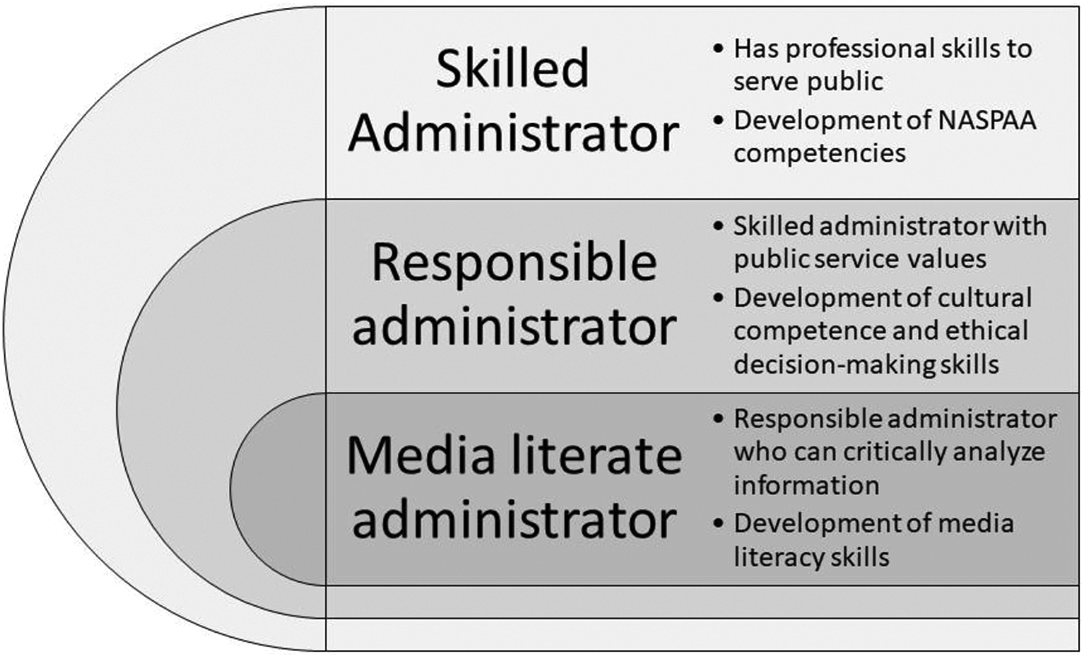
The different levels of administrators that can be developed through the use of film.
Film as a teaching tool
PA students predominantly enter the field as practitioners; as such, their coursework should connect to practice. PA educators can find engaging ways to connect theory to practice and shape responsible administrators. Pedagogical tools engage students in higher-order thinking (Stoddard and Marcus, 2010) though not every student learns the same way, and teaching styles should accommodate these differences (Pappas, 2007). However, film – specifically television and movies – is increasingly utilized as a rich teaching resource (Brown, 2011; Champoux, 1999b). In the “television generation,” students have grown up with easy access to film (Kellner and Share, 2007; Sprau and Keig, 2001), spend the majority of their time in front of screens, and are more familiar with audiovisual materials compared to print materials and communications (Burroughs et al., 2009; Koltay, 2011; Kuzma and Haney, 2001). These trends impact students’ thoughts and perceptions about themselves and society (Tisdell, 2008) and guide curricula that appropriately utilize film, and address challenges to its use (Pescosolido, 1990).
Film as praxis learning bridges theory and practice, and fosters critical thinking and active learning to combat passive learning (Borry, 2018a, 2018b; Pescosolido, 1990; Sprau and Keig, 2001), leading to better understanding and recall of learning objectives (Smith, 2009). Theoretically, film can provide insights at five levels: (a) theory; (b) values; (c) leadership; (d) policy; and (e) teaching – the last point provides support for its use in training/educating public administrators (Goodsell and Murray, 1995 as cited in Marshall, 2012). Moreover, the use of film in the classroom links to Kolb’s experiential learning cycle, where learning is a process by which transformative experiences create knowledge (Kapucu and Knox, 2011). This cyclical theory connects concrete experiences (doing/having an experience) to reflective observation (reviewing/reflecting on the experience) to abstract conceptualization (concluding/learning from the experience) to active experimentation (planning/trying out what you have learned) (Kapucu and Knox, 2011; Sprau and Keig, 2001). Film follows the cycle as students experience watching the film, reflect on the content of the film, learn from it, and practice what they have learned.
Uses
Film materials can be integrated into developed lectures, exercises, discussions, and graded assignments, though as an illustrative tool instead of the main focus (Proctor and Adler, 1991). It is ineffective if used as a reward or control mechanism, pure entertainment or a way to take a break from or “babysit” the class (Hobbs, 2006; Marshall, 2003). Media clips, film reviews, case studies (described later) or other creative ways (Edwards, 2014; Marshall, 2003; Tisdell, 2008) provide information or allow students to find the linkages between the film and class content (see Fluitt-Dupuy, 2001; Sprau and Keig, 2001 for examples). Educators can challenge students to move from critique to creativity by examining how films can be changed or can be used to create messages of equity or other pressing issues (Tisdell, 2008).
Case studies that focus on significant issues involving a problem or decision situation are a compelling usage of film. Commonly used in public management classes and other professional fields (Menzel, 2009b), they connect theory to practice through analysis of scenes and use the course material for problem-solving, decision-making or development of analytical skills, all under the guidance of the educator (Champoux, 1999a; Pescosolido, 1990). Through the depiction of reality, students develop an openness for others by accessing moral/emotional resources to view different perspectives to make decisions and form opinions (Abel, 2009; Brown, 2011; Menzel, 2009b). These can be long, structured narratives that deal with “wicked problems” with no clear solutions or guidelines for knowing when an answer has been determined; instead, there is a focus on learning by discovery (Menzel, 2009b). By using engaging stories to connect the characters to complex dilemmas and relevant course topics (Marshall, 2003), film/case studies create opportunities for students to research the subject for proper resolution (Ormsby and Williams, 2010). They promote both inductive and deductive reasoning where students analytically identify, deconstruct, and reconstruct the elements of the case to understand the issue at hand (Menzel, 2009b). Deconstruction fosters learning by “deepening meaning, explicating conflicting values, and elucidating opposing beliefs” (Abel, 2009: 156). However, educators need training for maximum impact (Menzel, 2009b). Used correctly, film as case studies move students from passively receiving information to intellectually stimulating students for deeper understanding of materials (Brown, 2011).
Best practices
Identified best practices for utilizing film in the classroom are suggested or film risks “miseducating” students (Tisdell, 2008). Film can be instructor assigned (no/minimal input from students), student-selected (no/minimal input from educators) or an outcome of the co-production of knowledge with students and educators working together to identify and select appropriate materials. Regardless, content must relate to PA issues to provide a way to gain insights and view reality (Hatcher, 2006). Selections should be culturally and politically relevant (Abel, 2009) and relevant to the demographics of the class (Sementelli, 2009). For example, both Parks and Recreation and Mr. Smith Goes to Washington portray filibustering, but Parks and Recreation might be more relevant to students today. Film should be skill-level appropriate; for example, be accessible enough to introductory students, if used in their classes (Laz, 1996). Student interest is vital as materials that are considered dull or boring will not capture students’ interests and engage them in the learning process (Fluitt-Dupuy, 2001; Hatcher, 2006). While meaningful content lends context to support analyses, film should be problematic enough to foster deep learning, and critical thinking in students, that is, the film should not provide the answers but multiple ways to view issues and foster fruitful discussion (Brown, 2011; Champoux, 1999a; Hobbs, 2006). Films with strong storylines, well-developed main characters, and even star-power should be included while those with lots of dialect, slow plot lines, and lengthy monologues should be avoided (Fluitt-Dupuy, 2001). Finally, while film is currently widely accessible and relatively inexpensive (Fluitt-Dupuy, 2001; Funderburk, 1978), some students may lack access or resources to film assigned outside of the classroom. For equity, required materials must be accessible to all students.
There is a significant time commitment needed to prepare for using film, particularly in integration with course materials (Marcus and Stoddard, 2007; Pescosolido, 1990). Educators must take time to screen films to assess their relevance to the topic (Diez et al., 2005; Proctor and Adler, 1991) to justify the use of classroom time, and connection to course materials and theoretical content (Kuzma and Haney, 2001; Stoddard and Marcus, 2010). Educators must have interest in the film that will be viewed multiple times for class preparation and application (Fluitt-Dupuy, 2001). They must identify a variety of themes, details, and perceptions to explore that are open to interpretation, and concepts they expect students to observe and evaluate (Diamentes and Ovington, 2003; Fluitt-Dupuy, 2001; Smith, 2009) to prepare students to analyze film critically and enhance learning (Barnett and Kafka, 2007; Stoddard and Marcus, 2010).
Strategies for success include fostering constructive discussion and generating relevant questions (Marcus and Stoddard, 2007; Stoddard and Marcus, 2010) such as through the use of case studies (Diamentes and Ovington, 2003). These complex situations have multiple solutions; thus, the instructor needs to avoid groupthink or consensus in the class but also ensure that suggested outcomes are feasible and satisfactory (Menzel, 2009b). Educator-facilitated discussions allow students to connect concepts to real-world applications (Smith, 2009) while controlling the direction, pace, and ending of discussions (Diamentes and Ovington, 2003). Dialogs can produce co-created knowledge from sharing perspectives through dialogic teaching and reflections, and students learn from each other, the educator and all together as a class (Brown, 2011).
Challenges
The main concern with using film is the time commitment (Borry, 2018a; Fluitt-Dupuy, 2001; Moore, 2011; Smith, 2009) as studying complex issues increases time commitment both in and out of class (Menzel, 2009b) especially with full-length movies. Shorter movie clips can be used to lessen time commitment, but educators need to be aware of and prepare for the added time. Film has the power to educate or miseducate the public through its portrayal of issues and characters, and educators must arm their students with tools to be active and critical consumers of media to avoid miseducation (Tisdell, 2008). Film can lack credibility and present a distorted view of public service (McCurdy, 1973) as they are created to entertain and are not geared towards classroom learning goals (Hobbs, 1998a; Kuzma and Haney, 2001). The film industry distorts reality (Champoux, 1999a), creates drama, humor, and romance to make the film appealing to wider audiences and more profitable (Stoddard and Marcus, 2010) with happy endings that resolve issues despite reality (Marshall, 2003). Moreover, there is often a Western-centric bias which stereotypes people of color, white-washes differences, fails to recognize cultural and racial diversity and thus, dampens the voices of the minority (Kuzma and Haney, 2001; White, 2004). These factors disconnect reality from fictionalized versions (Dubnick, 2000) and distract from learning (Marshall, 2003).
Educators and students need training when utilizing film. Students who lack experience in film analysis may find the experience disorienting and need extra training and other tools such as proper movie citation formats (Moore, 2011). Film contains scenes that can be offensive or triggering to students. Emotional reactions can promote learning but also promote fear, which reduces students’ attention and inhibits the learning process (Kuzma and Haney, 2001). Students have their own stories, experiences and emotional baggage (Zeemering, 2019), which film content can impact (Kuzma and Haney, 2001) and hinder learning. Educators must handle potentially heated debates in the classroom as controversial topics are discussed (Menzel, 2009b), have an awareness of their personal biases, and demonstrate empathy and open-mindedness when using film in the classroom (Hobbs, 1998b).
Outcomes
The importance of using film in the classroom lies in the results. PA courses provide a foundation for competencies needed by public administrators as per NASPAA standards but also play a role in developing responsible administrators. Both during the class and beyond, students and educators are impacted positively. Beyond the classroom, benefits are passed on to the academic field, community, and the public.
Classroom Outcomes – Students
Film is an enjoyable and compelling way to connect entertainment and learning, and engage students’ attention around topics that may seem less appealing or more complicated in texts, and connect theory to practical situations (Barnett and Kafka, 2007; Bivins, 2007; Borry, 2018b; Champoux, 1999b; Hobbs, 1998a; Kuzma and Haney, 2001; Smith, 2009; Sprau and Keig, 2001; Stoddard and Marcus, 2010). Students learn and retain information better when they find the material interesting (Atkinson and Beer, 2010; Sexton, 2006; Smith, 2009) and film can make dull topics interesting. It is an innovative, exciting, stimulating, and engaging way for students to study and learn ethical values and the consequences of unethical behavior (Hatcher, 2006; McCurdy, 1973). It provides an understanding of the complexity of the subject in question, such as trust, ethics, integrity and public interest (Menzel, 2009b) and their importance in current affairs (Diamentes and Ovington, 2003).
Film is advantageous to student learning as it “engage[s] both the right and left hemispheres of the brain as well as various intelligences, which include verbal/linguistic, visual/spatial, and musical/rhythmic” (Borry, 2018a: 236). It creates and engages intellectual and emotional responses in students, which fosters long-term memory storage and higher rates of retention and recall to assist with the learning of abstract concepts (Kuzma and Haney, 2001; Smith, 2009). This learning cannot happen in the traditional lecture format or by merely reading texts. It increases student participation, empowers students to engage in material more critically and confidently, and have ownership over the content making them partners in the course and taking greater responsibility in their learning (Marshall, 2003).
Film provides background information on new topics, details to delve into discussions on moral dilemmas (Marshall, 2003), historical contexts to transport students to different times (Kuzma and Haney, 2001), exemplifies points or themes (Brown, 2011), and provides concrete examples of situations students may never experience, such as extreme violence (Marshall, 2003). Psychologically, it creates viewers who are empirical observers of stakeholder experiences (Bivins, 2007; Smith, 2009) who view reality with new eyes, making lessons more meaningful (Lee and Paddock, 2001; Wielde and Schultz, 2007). Complex, interweaving stories invite identification of and with characters, and viewers assume roles in the story to become a part of a community where they have to consider options and make decisions (Brown, 2011; Kuzma and Haney, 2001). Students bring their subjectivity and experiences to what they are viewing (Marshall, 2012) and suspend belief and accept stories as real (Sementelli, 2009). Unforgettable stories help frame experiences by making relevant issues believable and relatable (Brown, 2011; Pappas, 2007). Students can then challenge accepted norms and have the potential to use this new perspective to affect change.
Film contains authentic stories with authentic lessons (McCurdy, 2006) which test the validity of existing administrative theory, provide insight on ethical decision-making, show real-world bureaucratic messiness and public administrators’ role in addressing public issues (Domoracki et al., 2011; Marion, 1988; McCurdy, 1973). Overall, film (as fiction) fosters “respect for diversity and the importance of a life of civic action, and for many, it makes lessons about federalism, bureaucracy, and social welfare policy more accessible because it makes connections between the material and students’ own lives” (Pappas, 2007: 39). This develops skills around multicultural issues and diversity sensitivity (Diez et al., 2005), and cultivates humanity by developing empathy and tolerance for different people (Brown, 2011; Pappas, 2007). Collectively, these skills are needed by responsible administrators as effective change agents.
Classroom outcomes – Educator
Using film in classes can improve educator evaluation scores (Kuzma and Haney, 2001) and improve relationships with students through co-production of knowledge (Marshall, 2003). Educators have the potential for publications and conference presentations, presenting work on how film was used in the classroom, potential outcomes from its usage, and how it links with specific subject areas. There are a plethora of academic works detailing the beneficial use of film in the classroom, and a growing number of these are in PA. Educators have published works on lessons from film including the role media plays in shaping, changing or sustaining social relations (Lambert, 2011; McCurdy, 1995), perceptions of public administrators and the field (Domoracki et al., 2011; Holley and Lutte, 2000; Lee and Paddock, 2001; Norman and Kelso, 2012; Pautz and Roselle, 2010; Sementelli, 2009; Wielde and Schultz, 2007), political ideas, values and concepts (Funderburk, 1978), workforce diversity (Champoux, 1999b), evaluation of public policy and government decisions (Pappas, 2007), integrity (Bivins, 2007), and critical thinking skills and ethical decision-making (Bharath, 2019; Borry, 2018b; Dubnick, 2000; Edwards, 2014; Lambert, 2011; Laz, 1996; Smith, 2009). Research is linked to related fields such as urban studies (Atkinson and Beer, 2010), organizational behavior (Smith, 2009) and public relations (Lambert, 2011; Lee, 2001). Even entire classes and syllabi have been dedicated to integrating film (movies and television shows) into the classroom (see Moore, 2011 for short list). Additionally, motivated educators can co-produce work with students to develop publishable academic pieces or public/non-academic outlets such as blogs.
Beyond classroom outcomes
While a less researched area in PA, there are academic and practical outcomes beyond the classroom that can be derived from the literature.
Academic
Primarily, students who critically analyze films and connect them to relevant concepts become lifelong learners who make these connections throughout their lives (Ormsby and Williams, 2010; Sexton, 2006). Academics further the field by contributing to the literature and developing the links to theory and practice. Not only are they contributing to the academic community with the addition of peer-reviewed journal articles but also to the development of the field in showing innovative ways that a popular media, such as film, can help address wicked problems and engage students around specific topics. Publications in non-academic channels further connect theory to practice and are more accessible to the public.
Non-academic
Film shapes public opinion on social issues (Alvarez, 2017; McCurdy, 1995; Pescosolido, 1990) and popularizes perceptions about topics (Hobbs, 1998a). Specific to PA, film demonstrates the pervasiveness and importance of the field in the world and influences students’ perceptions around government (Pautz and Roselle, 2010). This impacts policy communities who are faced with knowledgeable citizens and shifting perspectives (McCurdy, 1973). Film defines generations by creating and reflecting trends of the time, creating a perceived reality of the time and its administration (Wielde and Schultz, 2007). Used correctly, it challenges assumptions and stereotypes, allowing students to understand and empathize with different perspectives. Finally, through media literacy, it holds the media accountable for false information and thus, impacts participatory democracy (Kellner and Share, 2007; Tisdell, 2008).
Logic model
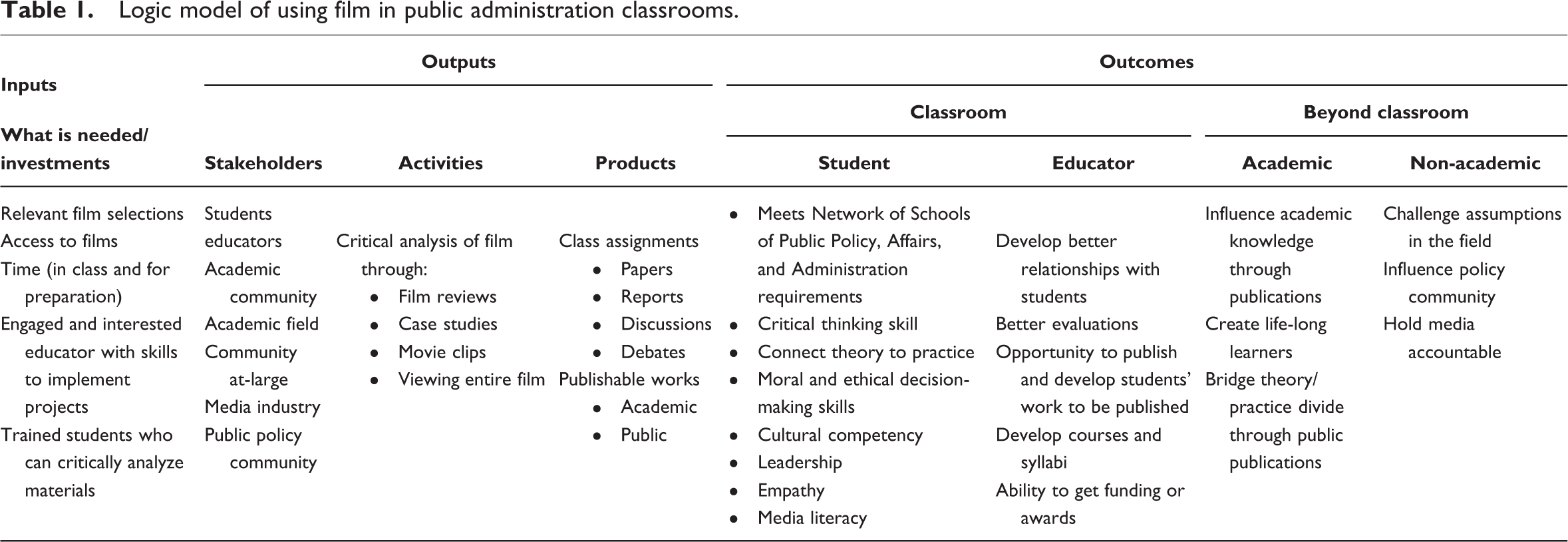
The following logic model (Table 1) summarizes the inputs, outputs, and outcomes of using film in the classroom. Inputs are requirements to use film in the classroom and include accessible and relevant films, time to plan and implement (both in and out of the classroom), an engaged and trained educator, and adequately prepared students who can critically analyze film. The stakeholders are those who benefit from use of film: students (learning outcomes); educators (teaching outcomes and publications); academic community (innovative teaching methods); academic field (development of new knowledge in the field); community-at-large (better trained citizens); media industry (increased accountability); and public policy community (engaged citizens who participate actively in policy cycles). Outputs are classroom activities such as papers, reports, discussions, debates, and publishable works. Outcomes vary from increased learning to media literacy, all needed for PA. The remainder of the paper connects film outcomes to the education of the three levels of administrators.
Logic model of using film in public administration classrooms.
PA education: Skilled public administrators
Public administrators are the first responders of public service (Shand and Howell, 2015) and thus, the connection between government and its citizenry. How they implement government impacts the way people perceive government, where inefficiency, ineffectiveness, or unethical behavior reflects poorly on government. PA programs train future leaders with professional skills to work effectively in their communities (Haupt et al., 2017) to produce public value for society (Shand and Howell, 2015). However, care is needed to ensure government and the bureaucracy are well-functioning, and public servants are prepared to serve effectively.
The NASPAA highlights five core competencies for accredited Master of Public Administration (MPA) programs: (a) leading and managing in public governance; (b) participating in and contributing to the policy process; (c) analyzing, synthesizing, thinking critically, solving problems and making decisions; (d) articulating and applying a public service perspective; and (e) communicating and interacting productively with a diverse and changing workforce and citizenry (Network of Schools of Public Policy, Affairs, and Administration, Commission on Peer Review and Accreditation, 2014: 7). Educational competencies provide students with PA principles and practices; government and governance structures, and bureaucracy; community values and professional standards; impacts of civic engagement and citizen participation; statistical analysis; foundations of economic study; laws, due process, legal constraints and practices; importance of transparency and accountability; human resource management; develop written and oral communication skills; social equity, responsiveness and accountability; sustainability; and policy issues (Bryson et al., 2014; Haupt et al., 2017; McCandless and Larson, 2018; Menzel, 2009a; Miller et al., 2010; Ormsby and Williams, 2010). Specific courses such as leadership and ethics, public management, organizational behavior and theory, policy processes, human resources, administrative law, etc. provide a foundation for studying PA and meet NASPAA measures. NASPAA criteria develop skilled administrators who can succeed in chaotic situations, make rapid decisions based on incomplete and/or biased information, build working models, collaborate, and problem-solve for new solutions by identifying patterns and manipulating abstract information (Abel, 2009).
Traditional pedagogical tools (lectures and PowerPoints) build students’ skills and meet NASPAA requirements, but the use of film intensifies learning. Film enhances student learning outcomes and provides examples of and learning scenarios for lessons in leadership and management, communication, the policy process, decision-making, and the concepts of public service and PA. Students are more engaged, learn, and recall information better, and practice PA lessons in the safe space of classrooms. However, NASPAA skills are not the only competencies needed. Cram and Alkadry (2018) discuss cultural competency skills and virtue ethics, which are integral in developing skilled administrators into responsible administrators. Students are taught professional skills to serve as administrators but need guidance to perform responsibly.
The responsible administrator
The responsible administrator is an interesting but ambiguous role. NASPAA describes the public administrator’s role as “pursuing the public interest with accountability and transparency; serving professionally with competence, efficiency, and objectivity; acting ethically to uphold the public trust; and demonstrating respect, equity, and fairness in dealings with citizens and fellow public servants” (Network of Schools of Public Policy, Affairs, and Administration, 2014: 2). Administrators have the dual role of citizen and public servant and straddle the line between democracy and bureaucracy (Burke, 1989). They have their own lives, beliefs systems, and moral stances against policy decisions they must implement (Zeemering, 2019) but are expected to perform their duties despite their personal beliefs (Bivins, 2007). For example, border patrol employees are expected to follow immigration policy on separating families, despite their own views on the issue. The dual role as citizen/administrator even presents legal challenges such as protection of freedom of speech right (Mead, 2018). Responsible administrators, however, foster the public’s trust by working toward the public good instead of self-interest (Wright et al., 2016) or blind loyalty to administrations. They serve the public and not political leaders or parties and engage their public for increased effectiveness (Cram and Alkadry, 2018: 522). The division between citizens and public servants can be blurred, but good policies and actions are enacted through consensus (Plant, 2018), the platform where responsible administrators perform. Responsible administrators require empathy and a willingness to examine and consider the perspectives and experiences of others who are drastically different from themselves to make ethical decisions.
Public administration is a political enterprise, experienced and implemented by policy actors who interpret laws, policies, executive orders, and judicial decisions differently (Abel, 2009). Administrative focus has shifted from efficiency and effectiveness of public service delivery to include values (Wright, 2015), which vary between administrators and citizens, and within groups. Normative ethics perspectives call for administrators to competently address issues of right and wrong, “to be benevolent, equitable, civil, just, fair, and all the other standards to which public servants should aspire” (Dubnick, 2000: 150). Normative ideals, however, are tested by subjectivity where similar situations have opposing outcomes (Abel, 2009), a challenge PA education can address.
The tension between the citizen/administrator role is linked to Simon and Waldo’s debate on the supposed disconnect between administration/politics (Menzel, 1999) which supports an ethic of neutrality in public administrators who will have little cause to exercise personal judgment (Plant, 2018; Spicer, 2015). However, neutrality may be diminishing in the current polarized environment where political affiliations shape policy implementation; that is, how public servants perceive government impacts policy implementation. It is challenging to accommodate competing interests of bureaucracy and democracy (Burke, 1989; Marion, 1988). Instead, responsible administrators must be socially conscious, democratic citizens, aware of injustices and prepared to be agents of change for social justice (Lebovitz and Bharath, 2019; Pappas, 2007). By understanding their roles as citizens, they are better equipped to actively co-create public value and public good (Bryson et al., 2014) as responsible public administrators.
Responsible administrators differ from moral administrators who base decisions on their views of morality even when different from the law. Moral values require a “disinterested perspective” (Thompson, 1985) but moral administrators have a self-interested perspective, that their morality supercedes others.These outliers do not obey or conform to prevailing norms or rules, have strong convictions, and carry out their beliefs despite high social risks or costs (Press, 2018). Citizen/administrators’ religious differences (even within religious groups) further complicate this issue (Bisesi and Lidman, 2009). Despite the division of state and church, some administrators may consider their religious beliefs at odds with policies. Moreover, dominant religious traditions such as Christianity in American society, can “dominate public life as to threaten the dissenting beliefs of other beliefs and of the nonreligious” (Bisesi and Lidman, 2009: 19) where those in the religious majority believe that their values supersede others. The moral administrator is exemplified by Kim Davis, a Kentucky clerk, who refused to perform her administrative duty to issue marriage certificates for gay couples after same-sex marriage laws passed, on the grounds that it infringed on her religious beliefs (Bharath, 2019). Actions such as this threaten social equity, and human rights as administrators’ morality supplants others’ rights.
Moral administrators threaten PA as they disrupt policy processes, and there is potential for moral courage to spread, making moral decisions less frightening to other administrators (Press, 2018). However, democratic, responsible public servants implement policy despite their morality (Slack, 2002). Public administrators must decide which community they are serving: the general community comprising of diverse perspectives based on a democratic policy-making process or their community based on like-minded individuals who are similar to themselves in some fashion such as religious affiliation. While the responsible administrator conflicts with the moral administrator, democratic values support the development of the former.
Competencies for the responsible administrator
Democratic values can nurture the development of the responsible administrator through focus on a public service perspective as detailed in the NASPAA guidelines. Educators can create and implement curricula aimed at achieving social equity (Cram and Alkadry, 2018), which is becoming more relevant in PA education programs (McCandless and Larson, 2018). Social equity and democratic values are inherently linked to public service values, a key competency in developing the responsible administrator.
Public service values
Accredited MPA programs develop public service values: “important and enduring beliefs, ideals and principles shared by members of a community about what is good and desirable and what is not” (Network of Schools of Public Policy, Affairs, and Administration, 2014: 2). In this service-based path, administrators serve the interests of citizens and communities above self-interest and strive for ethical reasoning and democratic participation (Haupt et al., 2017). This perspective is intrinsic to the field but is challenging to develop due to its broad definition and a lack of consensus on what values drive public service (Zeemering, 2019). This paper distills public service values down to cultural competency and ethical decision-making skills (Cram and Alkadry, 2018; Haupt et al., 2017).
Cultural competency
Network of Schools of Public Policy, Affairs, and Administration (2014) requires public affairs programs to prepare students to communicate and interact productively with a diverse and changing workforce and citizenry; thus, cultural competence becomes integral in PA curricula (Carrizales, 2010). Cultural competency is a set of congruent attitudes, behaviors, and policies that allow groups to work effectively in cross-cultural conditions in an agency or organization (Cram and Alkadry, 2018; White, 2004). “It is the acceptance and respect for difference, a continuous self-assessment regarding culture, and attention to the dynamics of difference, the ongoing development of cultural knowledge, and the resources and flexibility…to meet the needs of minority populations” (White, 2004: 112). Cultural competence fosters social equity and diversity skills (Lopez-Littleton and Blessett, 2015), develops open-mindedness and empathy (Spicer, 2015), and promotes understanding and relationship building between citizens and administrators for better performance (Cram and Alkadry, 2018). All these traits are essential for responsible administrators who perform their duties while advocating for and serving diverse populations (White, 2004).
Film allows educators to raise awareness about the importance of cultural competence, create an atmosphere where participants can freely share cultural knowledge and experiences, and enhance students’ knowledge and understanding of their own and different cultures (Carrizales, 2010). Reflexivity – “basic assumptions, discourse and practices used in describing reality” (Cunliffe and Jun, 2005: 227) – help students shed assumptions about citizens and the roles of public administrators, ultimately becoming more open-minded (Norman and Kelso, 2012). Reflexivity allows for critical thinking in public servants to avoid becoming blindly loyal, obedient administrators who fulfill public policy without thought of the public good (Cunliffe and Jun, 2005). Reflection and reflective capabilities are integral when “integrating leadership, interpersonal communication, and motivations within professional competencies” (Haupt et al., 2017: 615). With cultural competence, administrators recognize that situations and values differ, but the consequences of their actions impact all citizens. In addition, administrators also need skills to act ethically to attain social equity (Cram and Alkadry, 2018).
Ethical decision-making
Students must become independent thinkers who can critically analyze, synthesize information to solve complex dilemmas, and make appropriate decisions in the workplace (Haupt et al., 2017; O’Boyle and Sandonà, 2014). One of the underlying assumptions about decision-making and problem-solving is that they are being done ethically to ensure the public good. Students require reasoning skills to address ethical quandaries they may face professionally or personally (Ormsby and Williams, 2010). When ethical reference points shift from a public good focus to a more self-serving focus (Dubnick, 2000), then ethical behavior must reconnect to public service values, with the public interest as a moral compass superseding self-interest (Thompson, 1985; Wright et al., 2016). Different value systems lead to questions on administrators’ decisions, causing conflicts, powerful emotions, and polarizing views; thus, students must articulate and defend their ethical stance through logical reasoning and carefully considered decision-making (O’Boyle and Sandonà, 2014).
Developing ethical thinking is no easy feat as moral behavior is not a private enterprise, but one that is community-driven and legally regulated (Abel, 2009). Various factors play into moral and ethical decision making in PA: human behavior, normative values and the sociocultural setting (Wright, 2015) as well as moral attitudes that determine views of public service (Shand and Howell, 2015) which cannot be mandated by the government. Ethics involves subjective decisions that cannot be resolved by a set of pre-determined, uncompromising rules, where public servants must be trained to creatively make ethical decisions (Abel, 2009; Dubnick, 2000). This education is further confounded by the value-laden language around morality and ethics (these words themselves are not neutral) and hinders impartial decision-making (Spicer, 2015). Moreover, topics of ethics, values, and morality for students are broad and hard to define (Kuzma and Haney, 2001; Miller et al., 2010; Ormsby and Williams, 2010; Wright, 2015).
Ethical reasoning is a process that can be both taught and learned (Menzel, 2009b). However, while training and experience can help prepare students to behave ethically, it is not an assurance that students will not succumb to the temptation for personal reward (Borry, 2018b; O’Boyle and Sandonà, 2014). Educators, though, would be remiss in their duty by not providing students with the skills and tools to make decisions with integrity despite the chance of self-gratification over personal responsibility (Shand and Howell, 2015). Training students in a particular process (such as budgeting) is less complicated than building analytical and critical skills (Shand and Howell, 2015) but PA programs must develop future public servants who act ethically, morally, and legally (Abel, 2009; Menzel, 1999). Past research has found that students’ moral reasoning scores are impacted by different pedagogical tools (Borry, 2018b); thus, educators need to find innovative and engaging ways to develop critical thinking and analytical skills to enhance students’ decision-making and problem-solving processes (Haupt et al., 2017).
Film fosters the additional competencies needed by responsible administrators by the development of public service values through cultural competency and ethical decision-making. Film provides a neutral backdrop to discuss potentially heated topics, a doorway to view and experience other perspectives and thus, develops empathy and cultural competence. However, in current times, it is not enough to be a responsible administrator. With the rise in fake news and mis/disinformation, public administrators also need skills to assess and challenge information presented to them critically. This can be accomplished by using film to develop media literacy.
Environment of PA – Fake news
Technological advances have forced PA to function in an increasingly challenging environment. Geographical boundaries are blurred, weakening institutional, state, and political boundaries as well as increasing the distance between citizens and public servants (Lebovits and Bharath, 2019). Foreign governments engineer election results through media hackers and their control of information (Peters, 2018) undermining democratic beliefs and practices. Media, especially social media, can open government and generate civic participation but also has the potential to spread fake news, hindering connections between government and its citizens, and increasing distrust (Lebovits and Bharath, 2019).
Fake news is proliferated and rampantly disseminated through mainstream media (film, videos, movies, television, etc.) as well as social media (El Rayess et al., 2018; Podger, 2019). Fake news primarily assumes two forms: misinformation or disinformation, which need to be defined for clarity (Ginsberg, 2018). Misinformation occurs when the information receiver is given incorrect information though not always deliberately (for example, the spreading of rumors or hoaxes that are misinterpreted as truth by the receiver) (Musgrove et al., 2018; Podger, 2019). Conversely, disinformation is the deliberate and potentially harmful misleading of information receivers for the benefit of the information provider (governments, agencies, individuals, institutions, etc.) such as shaping public policy or damaging someone/something’s reputation or image (El Rayess et al., 2018; Figueira and Oliveira, 2017).
The motivation to create and share fake news is financial or ideological (Tandoc et al., 2018). In business, it earns profits through advertising (for example, clickbait) by generating interactions or web traffic on social media and other platforms (Figueira and Oliveira, 2017; Musgrove et al., 2018). Ideologically, suppliers of fake news manipulate data to support or attack partisan agendas causing political divide (McGrew et al., 2017). For example, the 2016 false story that former President Obama signed an executive order to ban the pledge of allegiance in schools is still shared even though it was proved fake (Fader, 2016). Similarly, a widely disseminated, bogus story claimed that Donald Trump called Republican voters dumb in a People magazine interview was believed true (LaCapria, 2015). Ideologically, stories such as these show political leaders in a poor light to sway public opinion. Lastly, ideological and financial reasons are typified by media outlets that skew data to support funding sources or affiliations without revealing their connections. For instance, when media sources financed by biotechnical companies disseminate information in support of genetically modified foods without publicizing their relationship to the company (McGrew et al., 2017).
Fake news seems more prolific currently but has been occurring for centuries (De keersmaecker and Roets, 2017). Various mechanisms facilitate the increased ease at which it is spread. Source blindness (remembering information but not its sources), familiarity (receiver has previously encountered the information whether legitimate or not), availability (easily recalled information), and confirmation bias (easier to believe information that reinforces your beliefs) (Musgrove et al., 2018) aid in the rapid spread of fake news. It is exacerbated by satire news provided by popular media outlets such as The Onion and Borowitz Report which produce off-the-wall articles that are mistaken for truth by those who do not understand the satirical content. Satire news adds to source blindness, familiarity, and availability of false information. Newer “native advertisements” that resemble news stories but are revenue-generating advertisements are becoming more commonplace (McGrew et al., 2017), further blurring the lines between fact and fiction. The ease by which fake news spreads is important in understanding the severity of its outcomes.
Regardless of how and why it is created/shared, the strategy casts doubt on the validity of genuine news and information, which threatens the broader social fabric by undermining the democratic process (McGrew et al., 2017; Podger, 2019). False information shapes perspectives of the public and public administrators and increases tensions between groups about decision-making and policy implementation. Moreover, biased information increases polarization around sensitive topics (abortion, immigration, lesbian, gay, bisexual, transgender, QUEER, intersex, and asexual issues, etc.). Information is socially constructed and thus, carries different meaning based on its portrayal (Hobbs, 1998b; Tandoc et al., 2018). Media outlets can portray the same information from different viewpoints as the truth. Recently, photos of Congresswoman Alexandria Ocasio-Cortez crying at a chain-link fence outside of a detention center, has been shared by sources on both sides of the political divide. While the left used this to portray Ocasio-Cortez’s compassion for refugees in detention centers, the right suggested it was a staged event designed to spread fake news about the detention centers (Palma, 2019). Here, the same image elicited different stories impacting public opinion.
Citizens, consciously or not, use mass media as an information source which guides their behavior (Koltay, 2011; Lambert, 2011). Currently, the public perception around bureaucracy (which garners the least amount of respect compared to other branches of government) is low (Miller et al., 2010). This poor image is heightened by media that perpetuates and reinforces negative portrayals on the screen (Miller et al., 2010), which in itself is a source of fake news. Portrayals enter the public consciousness and become part of the cognitive base for decision-making impacting policies and policy implementation (McCurdy, 1995). Students as citizens/administrators are affected by these portrayals, which affects how they serve or view government. Developing students’ cognitive abilities (remembering, reasoning, understanding, and problem-solving) and capabilities for sound social judgments counters fake news (De keersmaecker and Roets, 2017) and promotes democratic decision-making (McGrew et al., 2017).
Educators cannot control the information presented by media but can cultivate students’ skills to evaluate the information they receive critically. However, despite the availability of fact-checking sites such as Snopes.com and PolitiFact.com (McGrew et al., 2017) countering false narratives is harder than disseminating them (De keersmaecker and Roets, 2017). Gingberg (2018) calls for self-regulation to counter fake news where individuals: stop creating false equivalences (giving credibility to a minority opinion which often lack evidence such as climate-change deniers or anti-vaxxers); call out fake news (fact-checking and openly calling out lies); and support media literacy (questioning the accuracy and trustworthiness of information). In this information age, responsible administrators need media literacy skills. As shown in the logic model, film can be an advantageous tool for preparing future public administrators to function in the environment where fake news abounds through its potential to develop media literacy.
Media literacy
Responsible administrators in the information age must recognize and contest false information. Advances in technology and media necessitate media literacy skills to “empower students and citizens to adequately read media messages…to be active participants in a democratic society” (Kellner and Share, 2007: 3). Teaching media literacy skills (in addition to other competencies) develops administrators who recognize, critically assess and contest information to ensure authentic, valid, and accurate information for decision-making (El Rayess et al., 2018; Gray, 2005; Musgrove et al., 2018). Media is an evident tool for teaching media literacy by using film that fosters critical viewing skills for engaged learning (Gray, 2005).
Media literacy is defined as “the ability to access, analyze, evaluate, and create messages in a variety of forms” (Kahne et al., 2012: 3). Its importance is heightened partially because of the increased quantity and accessibility of media outlets but also because these outlets serve as a source of public information which has implications for democracy, active citizenship, cultural participation (Koltay, 2011), and PA. Media literacy is instrumental in creating and maintaining an educated, responsible, participatory, informed, and democratic citizenry (Burroughs et al., 2009). Serving as a cognitive defense against fake news it promotes critical analysis of media produced visual messages (Hobbs and Jensen, 2009; Tisdell, 2008) to increase work effectiveness, efficiency, and the endurance of democratic institutions (Ormsby and Williams, 2010). Moreover, it exposes the motivations and impacts of media conglomerates who use media to spread biased and untrue information hindering democratic processes (Burroughs et al., 2009; Hobbs, 1998b). Media literacy prepares people to: “critically evaluate information, understand the power and influence of the media, and become informed and discriminating media consumers” (Burroughs et al., 2009: 164).
Faculty are in the unique position to develop these skills in PA students and promote informed citizenship and self-advocacy, by creating citizens who are skeptical of information and who verify facts by questioning motives and sources (Burroughs et al., 2009; Hobbs, 1998b; Musgrove et al., 2018). Media literacy leads to transformative learning where students connect personal and sociocultural issues to the broader environment (Tisdell, 2008) to develop more ethical and culturally competent public administrators; decision-makers creating public good, challenging oppression and strengthening democracy (Kellner and Share, 2007). For this type of democratic citizenship education to be effective, students must be given tools and opportunities to practice these skills in the classroom (Burroughs et al., 2009) which film provides.
Discussion and conclusion
The field of PA is changing with advances in technology; this impacts the educating of future responsible administrators who are more connected digitally and are stimulated by media and audio-visual materials. PA classrooms can no longer depend purely on the traditional teaching methods of PowerPoint presentations and lectures (whether online or in-class) but need to find innovative ways to engage the students. Film can fill this role. Research shows that film brings classroom material to life and connects theory to practice in engaging ways.
Educators can use film to develop skills needed for responsible administration by allowing students to critically think about complex issues and limiting the possibility for emotion-laden topics. For example, present-day United States Immigration and Customs Enforcement tactics in the separation of families can be a value-laden topic which provides more of a distraction in the classroom, than a constructive discussion on immigration policy. Instead, film depictions of similar situations on screen and provide a more neutral ground for discussions. The current citizenry is polarized on political and social ideologies that topics that connect directly to current events may cause more rifts in the class than honest and open dialog.
Film can be used to develop the competencies of and train responsible administrators as citizens/public servants who do not blindly accept information presented to them and serve without question. Instead, they have the skills to critically analyze the information and base their decision-making on that analysis despite their personal preferences or biases. While the former may be a goal of those in powers – those below serve with no resistance – democracy needs a populace who questions and challenges potentially unethical tasks. No longer can excuses such as “my boss made me do it” be accepted. Instead, public administrators need to be responsible and held accountable for their actions. Educators need to train future public administrators who can tell right from wrong and make difficult ethical decisions to promote equity, equality, and fairness. If NASPAA required skills are geared towards efficiency and effectiveness, then innovative methods can increase other competencies. Film can have the outcome of creating citizens who critically analyze, and challenge provided information creating a more engaged but more responsible citizenry. It removes the passivity of receiving information and moves citizens from casual consumers of media to critical analysts.
Public administration needs to move past the era of blind policy implementation and neutral administration and toward an era of equitable public service. PA education needs to develop professionals in the field who can challenge proclamations and edicts in order to protect the public and public good. Cultural competency, ethical decision-making, and media literacy skills are not only crucial in the field but also for democracy. The populace cannot passively accept the information provided to them but must themselves be willing to challenge the spread of incorrect information and irresponsible decision-making. In the United States, political party affiliation divides citizens which leads to a lack of consensus in policymaking and passing of laws. Divided citizen groups are given biased information that conforms to the values of their political party, increasing the difficulty in decision-making. As a democracy, consensus making needs to occur, and instead of further polarizing citizens, there need to be ways to form bridges to connect the divided fractions. This is developed through empathy and the willingness to come together to understand others’ perspectives on issues which film use in classrooms can produce.
Footnotes
Declaration of conflicting interests
The author declared no potential conflicts of interest with respect to the research, authorship, and/or publication of this article.
Funding
The author received no financial support for the research, authorship, and/or publication of this article.
