







Abstract
Communities of Practice (CoPs) have emerged as key collaborative environments for professional development and knowledge generation across diverse organisational contexts. This qualitative study examines how CoPs function by identifying patterns in leadership, interpersonal relationships, conflict management, the outputs they produce, and their institutional impact. An interpretive qualitative research design was employed, using six focus groups as the primary data collection method. Participants’ testimonies were analysed thematically, allowing the identification of factors that facilitate or hinder the success of CoPs. The results indicate that distributed leadership promotes autonomy and shared learning, while interpersonal relationships enhance group cohesion. Effective conflict management fosters collective resilience, and the outputs suggest high potential for impact, although with limitations in institutional recognition. The study concludes that CoPs represent an effective strategy for organisational innovation and collaboration, highlighting the need for institutional support to ensure the sustainability and recognition of their contributions.
Keywords
Introduction
Communities of Practice (CoPs) have emerged as a key strategy for promoting professional collaboration, organisational learning, and the improvement of practices in complex environments. A CoP is formally defined as a group of people who share a concern or a passion for something they do and learn how to do it better as they interact regularly (Wenger, 1998). This conceptual framework involves three essential dimensions: mutual engagement (interaction), a joint enterprise (shared goal), and a shared repertoire (communal resources). Originally conceptualised by Lave and Wenger (1991) within the framework of sociocultural learning theories, CoPs have expanded beyond the educational sphere, finding increasing application in the public sector in response to the need for innovation, knowledge management, and improved institutional effectiveness (Jackson, 2011; Wenger et al., 2002).
In recent years, CoPs have gained prominence as part of knowledge management strategies within public administrations, establishing themselves as collaborative structures capable of generating shared learning, organisational innovation, and institutional improvement (Barrera-Corominas, 2018; Gairín Sallán et al., 2012; Jørgensen et al., 2021). These self-organised and horizontally structured communities allow professionals to address common challenges through participatory and reflective approaches, promoting professional development and collective knowledge (Valbuena Antolínez and Vernaza Trujillo, 2023).
In an environment marked by complexity, structural rigidity, and constant regulatory changes, such as public administration, CoPs represent an innovative alternative to traditional vertical models (Bolisani and Scarso, 2014; Chaparro Aljure, 2022). Various studies have indicated that their success depends not only on methodological design but also on relational, organisational, and cultural factors that affect their daily functioning and the sustainability of the outputs they produce (Aljuwaiber, 2016; Corso et al., 2009; Valbuena-Antolínez and Acero-Ramírez, 2023).
Despite the growing popularity of these initiatives, significant challenges remain regarding their institutionalisation, the continuity of their internal dynamics, and the difficulty of securing recognition for their outputs (Barrera-Corominas, 2016; Martínez Marín, 2012; Martínez Marín and Muñoz Moreno, 2015). The literature emphasises the need for deeper exploration of the conditions that enable or hinder their development (García-Holgado et al., 2015), especially in hierarchical and rigidly regulated contexts (Fernández de Álava et al., 2012; Laihonen et al., 2024).
In this context, the present study aims to analyse the operation of several CoPs promoted by the Andalusian Institute of Public Administration (IAAP). The IAAP program provides a strategically significant case study, as it represents a deliberate institutional effort to ‘cultivate’ social learning within a traditionally hierarchical Mediterranean administration. The research focuses on five key dimensions derived from the ‘Expanded Collaboration’ framework: (1) distributed leadership, (2) interpersonal relationships, (3) conflict management, (4) outputs generated, and (5) institutional impact (including organizational resilience). Studying these dynamics is crucial for public administration as it uncovers how informal learning structures can survive and add value in rigidly regulated environments (Agranoff, 2008). Using a qualitative approach based on focus groups, the study explores participants’ perceptions and experiences to identify the factors that influence the success, sustainability, and legacy of these communities.
The remainder of this manuscript is structured as follows. The Literature Review section reviews the literature on CoPs in public contexts and theoretically frames the five analytical dimensions. The Method section outlines the qualitative methodology, including purposive sampling, coding procedures, and methodological limitations. The Results section presents the empirical findings, organised according to the five aforementioned dimensions. The Discussion section considers these findings in relation to public administration theory. Finally, the Conclusion section synthesises the theoretical contributions, management implications, and directions for future research.
Literature review
Communities of practice in public organisational contexts
CoPs have been widely recognised as valuable tools for fostering organisational learning, knowledge management, and innovation, both in business environments and public institutions (Agranoff, 2008; Gairín Sallán et al., 2012; Martínez Marín, 2012; Valbuena Antolínez and Vernaza Trujillo, 2023). These communities mobilise distributed human capital through voluntary participation and collaborative work, strengthening institutional improvement processes (Agranoff, 2008). Accordingly, Garzón Castrillón (2020) stresses that the design, implementation, and sustainability of CoPs require proper planning of key components, the active role of a facilitator, and recognition of the contextual factors that influence their success.
These communities operate as active, horizontal social networks in which shared practice, knowledge exchange, and collective reflection contribute to developing context-specific solutions for for complex administrative challenges (Meeuwesen and Berends, 2007; Rodríguez-Gómez and Gairín, 2014; Rowe et al., 2023). Their value lies in the creation of flexible peer learning environments that transcend vertical structures, defined as traditional, command-and-control bureaucratic hierarchies, and foster practical, innovative knowledge through horizontal models based on peer-to-peer collaboration.
In the public sector, this approach is especially relevant as it encourages employee involvement in continuous improvement processes, increasing motivation and strengthening institutional knowledge (Laihonen et al., 2024; Pee and Kankanhalli, 2016). CoPs promote a contexualised logic of collaboration that transforms regulatory frameworks into opportunities for administrative innovation.
Distributed leadership and self-organisation
One of the key factors influencing the success of CoPs is the type of leadership practised within them (García-Martínez et al., 2018). In contrast to traditional hierarchical models, CoPs promote forms of distributed leadership defined by horizontal facilitation, shared empowerment, and member autonomy (Kimble and Hildreth, 2005; Ojasalo et al., 2023; Valbuena-Antolínez and Acero-Ramírez, 2023). This type of leadership not only facilitates internal coordination but also helps maintain cohesion in the face of organisational challenges (Garavan et al., 2007; Martínez Marín, 2012).
From an organisational perspective, leadership capacity does not reside in a single figure but is shared according to the knowledge, initiative, and commitment of the participants (Barrero Fernández et al., 2020). This dynamic strengthens the sense of belonging and legitimates collective decisions (Aljuwaiber, 2021; Corso et al., 2009), promoting a participatory governance model that is essential for the sustainability of CoPs in complex institutional contexts (Jagasia et al., 2015).
Interpersonal relationships as a basis for cohesion and motivation
The quality of relationships among CoP members is crucial to their consolidation. Recent studies highlight that mutual trust, professional recognition, and empathy are the foundations upon which commitment and collective identity are built (Juriado and Gustafsson, 2007; Rowe et al., 2023). The creation of positive emotional bonds enhances participation and reinforces group cohesion, even during times of organisational difficulty or fatigue (Hernández-Soto et al., 2021).
Moreover, these relationships often extend beyond the professional realm, forming interpersonal support networks that contribute to participants’ well-being and help build communities that are resilient in the face of change (Hatmaker et al., 2011; Laihonen et al., 2024; Meeuwesen and Berends, 2007). The relational dimension thus becomes a strategic component that transcends operational concerns and enters the emotional and affective sphere of communities.
Conflict management and organisational resilience
Although CoPs are collaborative spaces, they are not immune to tensions and conflicts. The diversity of perspectives, levels of involvement, and working styles can lead to internal frictions. However, recent studies indicate that proper management of these conflicts can offer an opportunity for learning and improving collaborative dynamics (Bučková, 2015). Thus, conflict should not be seen as a threat, but rather as a resource to strengthen the community.
The development of participatory governance mechanisms within CoPs, such as rotating roles, consensus-based decision-making, or the formation of subgroups, facilitates the negotiation of interests and strengthens the sustainability of the community (Álava and Barrera-Corominas, 2013; Kimble and Hildreth, 2005). In this framework, organisational resilience is understood as the institution’s capacity to adapt and learn through its knowledge networks rather than through rigid directives (Agranoff, 2008). CoPs function as support structures that maintain institutional memory and operational continuity when formal hierarchies are overwhelmed by complexity (Gairín Sallán et al., 2012). By acting as self-regulating systems, these communities allow for bottom-up innovation, ensuring that administrative practices remain robust and adaptive in the face of external crises or internal reallocations.
Outputs generated
One of the main indicators of a CoP’s success is its ability to produce transferable outputs, such as protocols, guides, glossaries, or best practices, that can be used both within and beyond the community (Harris, 2013; Martínez Marín, 2012; Wenger et al., 2002). These outputs, beyond their practical utility, serve to codify the tacit knowledge shared among participants, transforming it into explicit resources that are accessible to the broader administration. By documenting their collective expertise, CoPs create tangible assets that act as vehicles for legitimation within institutional structures, making visible the knowledge generated and encouraging its adoption at the organisational level (Smith, 2016). However, producing outputs is only the first step; the ultimate challenge lies in ensuring these resources generate a structural effect on the administration itself.
Institutional impact
While outputs represent the tangible products of a CoP, institutional impact refers to the structural and cultural transformations these communities trigger within the broader public administration. Institutional impact transcends individual learning; it occurs when the informal knowledge generated by a CoP is formally adopted policies, reshaping standard operating procedures and establishing new ‘best practices’ (Barrera-Corominas, 2018).
According to the value creation framework for communities and networks, institutional impact aligns with ‘transformative value’, a stage where informal learning challenges and redefines formal organisational strategies (Wenger-Trayner and Wenger-Trayner, 2020). In highly regulated and hierarchical environments like the public sector, this impact is particularly crucial but challenging to achieve due to rigid structures and limited political support (Chaparro Aljure, 2022; Meijer et al., 2012). Nevertheless, when successfully integrated, CoPs serve as strategic mechanisms that bridge the gap between frontline operational knowledge and top-down policy design (Agranoff, 2008).
Furthermore, institutional impact directly correlates with improved public service delivery. The collaboration fostered within CoPs reduces the duplication of efforts and accelerates problem-solving, which ultimately strengthens the efficiency and legitimacy of the public institution before its citizens (Martínez Marín and Muñoz Moreno, 2015; Martínez-Marín, 2012). Ultimately, the true institutional impact of a CoP is measured not merely by the implementation of specific guidelines, but by its capacity to transform the institutional fabric into a more resilient, collaborative, and innovative entity capable of sustaining knowledge beyond the lifecycle of individual participants (Gairín Sallán et al., 2012).
Method
This study adopts a qualitative approach based on an interpretive phenomenological design, which forms part of a broader project entitled ‘title omitted for anonymous review (ref.)’. This approach was chosen to gain an in-depth understanding of the lived experiences of participants within the CoPs, exploring their perceptions, practices, and the meanings they attribute to their participation in these collaborative settings.
Research objective
The aim of this study is to analyse the operational dynamics of CoPs in public sector organisational contexts, specifically within institutions of the Andalusian Regional Government (Junta de Andalucía), with particular emphasis on distributed leadership, interpersonal relationships, conflict management, the generation of outputs, and institutional impact. The study seeks to identify the factors that facilitate or hinder the sustainability and effectiveness of these communities, as well as their implications for the professional and organisational development of their members.
In particular, the study explores: (1) The configuration of leadership patterns and their impact on member collaboration and participation; (2) The influence of interpersonal relationships on group cohesion and the continuity of initiatives; (3) The strategies employed for conflict resolution and their effect on community resilience; (4) The nature and projection of the outputs generated, as well as the obstacles to their institutionalisation; and finally, and (5) The effects of participation in CoPs on members at both a personal and professional level, especially in relation to the strengthening of networked work.
Research context
This research is set within the context of CoPs in the Public Administration of Andalusia (Spain), specifically under the framework of the ‘Expanded Collaboration’ programme promoted by the Andalusian Institute of Public Administration (IAAP). This programme supports the creation and facilitation of CoPs as collaborative spaces aimed at the continuous improvement of public services through shared learning and organisational innovation (FAMP; Andalusian Federation of Municipalities and Provinces, 2019). The selection of IAAP-endorsed CoPs provides an analytically strategic case study: the Andalusian Public Administration represents a traditional, highly regulated, and hierarchically structured bureaucracy. By examining CoPs within this specific environment, the study observes how horizontal knowledge networks navigate and survive against rigid institutional boundaries.
The CoPs within the Junta de Andalucía address a wide range of topics and sectors, including employment, civil service, elderly care, school nursing, and digital archive management. These communities are characterised by a horizontal and voluntary approach, where professionals from different hierarchical levels and departments collaborate to generate practical knowledge to address shared challenges (IAAP, 2025). For example, one of the shared challenges tackled by a participating CoP involved standardising protocols for elder care monitoring across different provincial delegations, a task that formal hierarchical channels had previously struggled to unify.
The organisational context of CoPs within the Junta de Andalucía is part of a broader institutional strategy aimed at public innovation. In February 2023, the Regional Government approved the Strategy for an Innovative Public Administration 2023–2030, which seeks to improve citizen services and the effectiveness of public policies through digital transformation, the elimination of administrative bottlenecks, and improved governance. Within this strategy, CoPs play a fundamental role as living laboratories that generate knowledge applicable to the improvement of public services (Instituto Andaluz de Administración, 2025).
Within this framework, this study focuses on analysing how CoPs contribute to knowledge management and organisational innovation in the Andalusian Public Administration, exploring the factors that support or hinder their success and sustainability.
Participants
The study was conducted with members of six CoPs linked to various areas of the Andalusian Public Administration, in sectors such as the environment, social care, health, and social policy. Participant selection was carried out through purposive sampling, prioritising diversity in terms of roles undertaken within the communities, prior experience, and the types of projects developed. The specific analytical aim of this purposive approach was not statistical representativeness, but rather to identify ‘information-rich cases’ (Wenger et al., 2002) capable of illustrating the internal dynamics of mature communities. Consequently, selection criteria required CoPs to have been active for at least 1 year.
The identification of CoPs was informed by a cluster analysis drawing on data from a self-assessment questionnaire completed by 224 individuals across 25 CoPs. This analysis enabled the classification of communities into four distinct groups, according to the degree to which expectations were met, participation, perceived institutional support, and project visibility. For this study, six CoPs were selected, ensuring representation from all four groups.
Description of the communities of practice participating in the study.
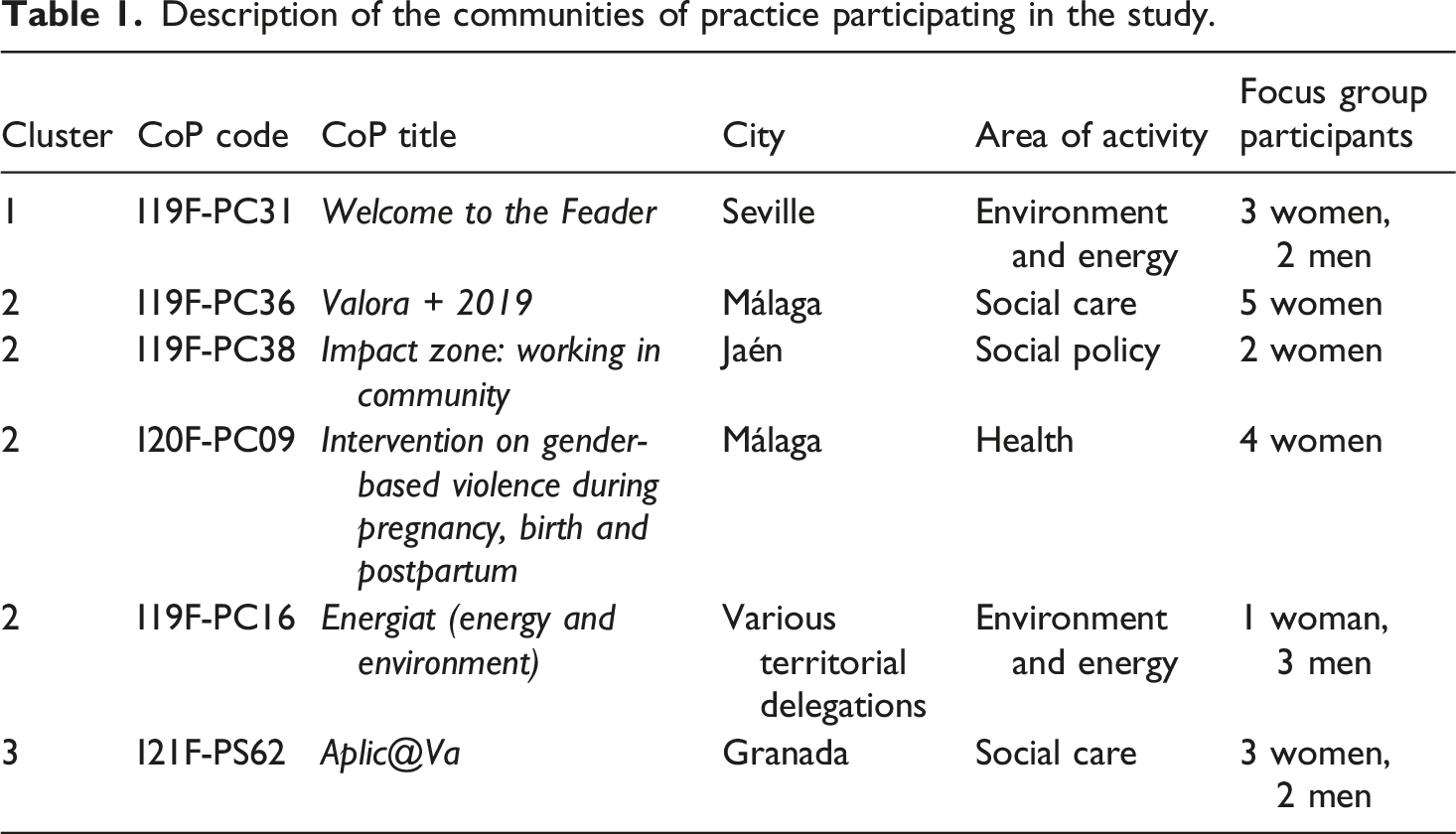
The purposive approach to sample composition sought to capture a broad and diverse representation of the realities of CoPs in terms of their trajectory, internal dynamics, and outcomes achieved. It is important to note that the sample composition exhibits a highly skewed gender distribution, with a disproportionately high number of female participants. This imbalance reflects the actual demographic reality of the specific public sector areas analysed in Andalusia (e.g., social care, health), which are heavily feminised professions. While representative of these specific sectors, we acknowledge that gendered participation patterns may influence relational dynamics and conflict experiences within the CoPs, a factor to consider when interpreting these findings.
Instruments
To address the study’s objective, a semi-structured focus group interview was designed and implemented, centred on eight main thematic areas: the origin of the CoP, the relevance of the topic addressed, the working style adopted, the methodology used, the learning outcomes obtained, the challenges encountered, available support and resources, and the results and outputs achieved. The interview included 41 questions aimed at exploring in depth the experiences and perceptions of community members.
Data collection was carried out through six focus groups, each consisting of two to five participants, depending on the availability of CoP members. The choice of this qualitative technique was driven by the need to create a space for open and reflective discussion, enabling the emergence of diverse, complementary, and at times contrasting perspectives, and fostering a rich and nuanced understanding of the internal dynamics of the Communities of Practice.
All focus group sessions were audio-recorded with prior informed consent from participants and later transcribed verbatim for qualitative analysis. This procedure ensured the accuracy and integrity of the collected data and enabled a rigorous examination of the emerging narratives.
Data analysis
Data analysis followed the methodological framework proposed by Miles and Huberman (1994), specifically applying their techniques for data reduction (first-cycle iterative coding) and data display (using matrices to enable cross-case comparison). The unit of analysis for coding was operationalised at the level of ‘thematic units’, narrative segments conveying a single cohesive idea regarding community operation. First, the focus group interviews were fully transcribed. Once the information had been shared with and validated by participants, an exhaustive reading of the transcripts was undertaken to interpret the data as a whole.
Code system used for data analysis.
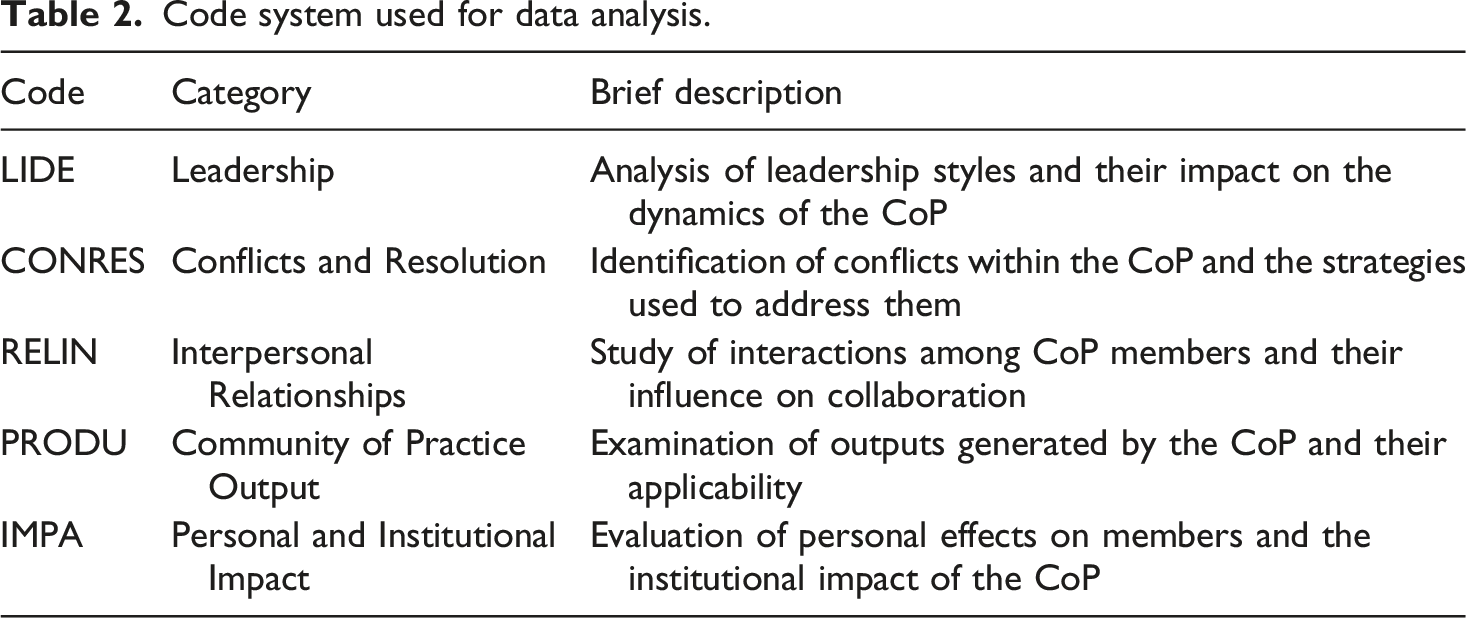
Coding was carried out independently by two researchers to ensure analytical triangulation. Any discrepancies during the coding process were resolved through deliberative consensus in weekly meetings, ultimately achieving a high degree of inter-coder agreement. Although an inter-coder reliability coefficient was not calculated, the iterative, consensus-based approach prioritised interpretive depth over statistical agreement (Braun and Clarke, 2006), and the systematic nature of the process ensured consistent and trustworthy coding across all transcripts. To facilitate information management and analysis, the specialised software MAXQDA® was used.
Ethical considerations of the research
The research complied with ethical principles throughout all stages. Informed consent was obtained from participants, ensuring confidentiality, anonymity, and the right to withdraw at any time without consequences. The study was conducted in accordance with ethical standards applicable to the Social and Educational Sciences, particularly Organic Law 3/2018 on the Protection of Personal Data and the Guarantee of Digital Rights.
To protect the identity of the 25 participants, a coding system was used consisting of the letter “P” followed by a number. This coding was structured by participants’ affiliation with one of the six analysed CoPs: CoP 31 included participants P1 to P5; CoP 36, P6 to P10; CoP 38, P11 to P12; CoP 09, P13 to P16; CoP 16, P17 to P20; and CoP 62, P21 to P25.
Methodological limitations
While the qualitative design provides in-depth insights into the factors influencing the success of CoPs, several limitations should be acknowledged. First, the purposive sample was restricted to six CoPs within the Andalusian Institute of Public Administration (IAAP), which, although suitable for analysing a rigid bureaucratic context, limits the generalisability of the findings to other administrative settings.
Second, data collection relied exclusively on focus groups. While appropriate for exploring shared meanings and collective dynamics, additional methods, such as individual interviews or document analysis, could have strengthened data triangulation.
Third, the sample shows a highly skewed female composition and includes several small focus groups (two participants). Although this reflects the reality of the sectors studied and the small ‘core groups’ of CoPs, it constrains the observation of broader group dynamics and requires caution when generalising relational patterns.
Finally, the cross-sectional design captures CoP dynamics at a specific point in time. The lack of a longitudinal perspective limits the assessment of their long-term sustainability and institutional impact.
Results
The analysis of the CoPs has enabled the identification of characteristic patterns that explain both the internal functioning of these groups and the outputs they produce. The results reveal how distributed leadership, interpersonal relationships, conflict management, the outputs generated, and institutional impact together shape a complex yet effective collaborative dynamic.
Each analytical category offers a specific perspective on the factors that facilitate or constrain success within CoPs. The findings below highlight the most relevant emerging themes and their implications at both personal and organisational levels.
Distributed leadership
The analysis of the CoPs indicated that leadership in these settings is expressed in diverse ways, ranging from horizontal models to more structured approaches. Most communities display collaborative leadership, where decisions and responsibilities are shared among members, promoting autonomy and collective learning.
In CoP 16, a horizontal leadership style was evident, in which the facilitator supports progress without imposing authority: “It was totally horizontal, although obviously the facilitator was the one who kept an eye on the objectives” (P17, CoP 16: 105).
In CoP 31, rotating roles ensured equitable participation: “Yes, what happened was that at each meeting there were roles, sometimes rotating ones, which we assigned among ourselves” (P3, CoP 31: 106). This approach was seen to foster collective responsibility and intrinsic motivation among participants.
However, some CoPs demonstrate a more defined leadership structure. In CoP 9, although the main leader organises the work, the other members retain significant autonomy in decision-making: “Look, we’ve been quite autonomous […] but we were the ones leading the project” (P13, CoP 9: 86). Similarly, in CoP 62, leadership adapts to the team’s needs based on individual competencies: “In a project heavily guided by a strong technological component, I sometimes took on that role” (P24, CoP 62: 66).
The results suggest that shared and flexible leadership encourages collaboration and commitment in CoPs, aligning with the literature on distributed leadership, which highlights the importance of dynamic structures that promote participation and collective learning.
Interpersonal relationships
Understanding the personal circumstances of members emerged as a key factor in fostering collaboration within CoPs. Flexibility in workload and respect for individual paces prove essential for strengthening group cohesion. In CoP 9, this approach translated into sustained commitment without excessive pressure: “The others weren’t demanding, we said, well, this is as far as we’ve come… collaborate, if it doesn’t come out in one year and takes two, then it takes two” (P15, CoP 9: 57).
Furthermore, ongoing interaction and long-term collaboration foster relationships that go beyond the professional sphere, creating networks of mutual support. In CoP 9, this emotional dimension is reflected in a sense of belonging and personal enrichment:
“By now we’re a group of friends, and professionally it has contributed a lot and enriched me” (P16, CoP 9: 93). This emotional closeness serves as an intrinsic motivational factor, driving long-term participation and commitment.
External stimulation also plays a key role in strengthening interpersonal relationships. Shared motivation around a specific goal fosters cohesion and reinforces the sense of belonging, as seen in CoP 9: “We all got excited quickly, we all threw ourselves into it” (P13, CoP 9: 57). Likewise, in CoP 38, mutual learning and interaction with experts enhanced collaborative dynamics: “You were always working towards the output, but you learned a lot during the sessions” (P11, CoP 38: 50).
However, interpersonal relationships also involve challenges. A lack of progress on projects can lead to demotivation and withdrawal, as seen in CoP 31: “It was very hard to admit that nothing was moving forward and that we weren’t doing anything” (P2, CoP 31: 106). To mitigate these effects, some CoPs developed strategies such as role rotation and the fair distribution of responsibilities, contributing to stability and sustained commitment: “At each meeting there were roles, sometimes rotating, that we assigned among ourselves” (P4, CoP 31: 286).
Conflict management
Conflicts within CoPs, far from being obstacles, functioned as opportunities for learning and continuous improvement. Tensions arising from differences in working approaches, division of responsibilities, and workload expectations were effectively managed through strategies such as subgroup formation and organisational flexibility. In CoP 62, breaking into smaller teams improved communication and working dynamics: “We were a bit overwhelmed because it was really difficult with so many people taking turns to speak, until we discovered breakout rooms and used them for small working groups” (P23, CoP 62: 164).
The adaptability of CoPs also supported conflict resolution without compromising group cohesion. In CoP 16, a willingness to engage in dialogue and strong interpersonal ties facilitated the resolution of critical moments: “In this sort of thing there are always moments of crisis… but truthfully, they were resolved quite well” (P18, CoP 16: 159).
Despite differences in working styles, as in CoP 16: “Everyone worked differently. Reaching agreement was a bit complicated” (P20, CoP 16: 169), or in CoP 36: “Not everyone could dedicate themselves equally” (P7, CoP 36: 118), the commitment of participants helped mitigate the negative impact. In CoP 16, the reorganisation of work into subgroups was an effective strategy: “Despite the tensions, resolution was managed through the creation of parallel groups and commitment” (P19, CoP 16: 177).
These findings reinforce the idea that negotiation, flexibility, and organisational adaptation are key to effectively managing conflict in collaborative settings, consistent with conflict resolution theory in learning and teamwork contexts.
Outputs generated
The outputs generated within CoPs are notable for their versatility and adaptability to various organisational contexts, giving them practical utility beyond the groups that created them: “We created a product that would be valid for everyone” (P12, CoP 38: 100). However, despite their value, dissemination and institutional recognition remain problematic. In CoP 9, the lack of formal recognition was apparent: “The work was a collective effort, but there was never any official recognition” (P14, CoP 9: 104).
Similarly, in CoP 16, the product’s usefulness is acknowledged, though its institutional impact has not yet received adequate recognition: “The product is good, and it’s still being used, but what’s been done isn’t sufficiently recognised at the institutional level” (P18, CoP 16: 135).
Difficulties in consolidating these products within organisational structures were evident in CoP 31, where efforts lacked continuity: “We presented it and then it was gone… it was left hanging and has never been taken forward again” (P5, CoP 31: 215).
Despite these barriers, some outputs have transcended their communities of origin, such as in CoP 38, where implementation at the regional level proved highly impactful: “The product was implemented at regional level and had a big impact” (P12, CoP 38: 137).
These results underscore the need to establish institutional mechanisms that support the sustainability and recognition of CoP outputs, ensuring their effective implementation and long-term integration into organisational practices.
Institutional impact
Participants reported that involvement in CoPs led to a significant transformation in their professional skills and career perspectives. The development of new competencies and stepping outside their comfort zones were among the most notable impacts. As one participant put it: “Personally, it helped me a lot because it showed there’s another way of working… stepping outside our comfort zone” (P13, CoP 9: 91). Although structural limitations were acknowledged, CoPs supported the creation of replicable models and inter-institutional networks that enhanced collaboration across entities and facilitated knowledge flow, improving organisational practices. One participant remarked: “This is improving, let’s say that social media and WhatsApp are helping that knowledge flow to other delegations” (P17, CoP 16: 340).
In terms of personal impact, the results indicate positive professional growth and strong group cohesion. As mentioned in CoP 9: “It’s made me grow a lot… our working group is super close-knit” (P14, CoP 9: 91). However, in some cases, a lack of continuity negatively affected the long-term development of initiatives: “It kind of faded out…” (P2, CoP 31: 98).
At the institutional level, CoPs have driven meaningful changes, although their sustainability has been inconsistent. In CoP 9, there was tangible impact through updated protocols, as noted by one participant: “Screening was extended… the protocol has been updated” (P16, CoP 9: 118). In contrast, in CoP 31, a lack of follow-up prevented the continuation of outcomes: “At no point were we asked… whether we had finished the community of practice” (P1, CoP 31: 180).
Discussion
The results of this study confirm that Communities of Practice (CoPs) represent an effective strategy for knowledge management and organisational transformation within the Andalusian public sector. The five dimensions analysed, distributed leadership, interpersonal relationships, conflict management, outputs generated, and institutional impact, have emerged not only as essential elements for the success and sustainability of these communities, but also as closely aligned to the specialised scientific literature on the subject.
Firstly, our data indicate that distributed leadership fosters greater member engagement and sustained commitment over time, in line with the findings of García-Martínez et al. (2018). Horizontal dynamics and the rotation of roles, as observed in CoPs 31 and 16, allowed for greater autonomy and equitable participation, echoing the work of Garavan et al. (2007) and Valbuena-Antolínez and Acero-Ramírez (2023), who emphasise that shared legitimacy strengthens the sustainability and resilience of CoPs. This finding aligns with the perspective of Kimble and Hildreth (2005), who advocate for dynamic leadership structures as facilitators of collaborative learning.
Secondly, the relational dimension has proven to be a fundamental pillar. Strengthening interpersonal ties within CoPs creates an emotionally safe environment that enhances collaboration, belonging, and mutual learning, even in the face of organisational or personal challenges. The literature supports this conclusion, noting that trust, recognition, and empathy are core elements of collective commitment (Juriado and Gustafsson, 2007; Rowe et al., 2023). This empirical evidence is consistent with the findings of Hernández-Soto et al. (2021), who highlight the complexity and richness of personal and contextual factors in participation within both virtual and face-to-face communities.
Thirdly, the study confirms that conflict does not inherently pose a threat, but rather represents an opportunity for growth when appropriately managed. Experiences from CoPs such as 62 and 16 demonstrate that forming subgroups and engaging in active negotiation can transform tensions into operational improvements. This outcome aligns with the work of Bučková (2015) and Álava and Barrera-Corominas (2013), who argue that participatory governance and structural flexibility are effective tools for collaborative problem-solving.
Fourthly, the outputs generated by CoPs show high transformative potential when they are linked to specific organisational needs. The usefulness and adaptability of protocols, guides, and best practices developed in communities such as 38 and 9, however, are not consistently matched by institutional recognition. This gap between production and visibility has also been documented in previous studies (Martínez Marín, 2012; Smith, 2016), which highlight the importance of establishing formal legitimation mechanisms and integrating such outputs into administrative structures. Viewing these results through the value creation framework (Wenger-Trayner and Wenger-Trayner, 2020), the study reveals that while CoPs successfully achieve ‘immediate’ and ‘applied’ value, extracting ‘transformative’ value requires deliberate institutional mechanisms to legitimise these outputs within administrative structures.
Finally, the testimonies collected reveal a significant personal impact on CoP members, both in terms of professional development and enhanced self-efficacy, motivation, and collective sense of purpose. Individual trajectories, particularly in communities such as 9 and 16, show how CoPs act as catalysts for deep learning processes, identity transformation, and the consolidation of inter-institutional networks. These findings reinforce evidence presented by authors such as Jackson (2011) and Rodríguez-Gómez and Gairín (2014), who underscore the capacity of CoPs to mobilise human capital within the public sector.
Nevertheless, the results also highlight notable limitations. The lack of continuity in some CoPs, the limited institutionalisation of their outputs, and the dependence on facilitators to maintain group cohesion all reveal persistent tensions between the horizontal logic of CoPs and the dominant vertical structures in public administration (Bolisani and Scarso, 2014; Martínez Marín and Muñoz Moreno, 2015). Furthermore, there remains a need to strengthen institutional sustainability mechanisms, as Laihonen et al. (2024) caution, especially in contexts where regulatory changes or shifting political priorities may erode organisational commitment to these initiatives.
In summary, this study provides empirical evidence on the factors that contribute to the success of CoPs in public sector environments. The findings suggest that distributed leadership, trust-based interpersonal relationships, strategic conflict management, and the generation of useful outputs are interdependent dimensions that help explain the impact of CoPs on both organisational and professional development.
Conclusion
The main contribution of this study is empirically demonstrating how Communities of Practice (CoPs), acting as informal social learning structures, navigate and survive within highly regulated, hierarchical public administrations. By applying the ‘Expanded Collaboration’ framework and integrating the concept of ‘transformative value’, this research moves beyond traditional pedagogical analyses. Instead, it positions CoPs as strategic instruments for organisational resilience and institutional change in the Mediterranean administrative context.
To translate these theoretical insights into tangible institutional improvements, public managers and knowledge management designers must adopt specific enabling strategies. First, leadership must be distributed and dynamic. Recognising diverse skills and encouraging broad participation without relying on strict hierarchies is essential for success. Second, fostering relational environments based on trust and mutual support is critical for sustaining collective commitment over time.
Additionally, participatory governance mechanisms are necessary to manage conflicts constructively and distribute responsibilities equitably. The outputs and achievements of these communities must be formally recognised, ensuring their institutional visibility and facilitating their transfer across different administrative levels. Ultimately, CoP activities should align with the organisation’s strategic goals without compromising their horizontal logic and creative autonomy.
The intelligent institutionalisation of CoPs does not mean bureaucratic control. Rather, it requires designing supportive frameworks that legitimise and consolidate their transformative potential. Integrating these communities into the public sector ecosystem not only enhances institutional learning capacity but also empowers public employees as active agents of change.
Future research should focus on the longitudinal evaluation of CoP impacts and the adaptation of these collaborative models to increasingly complex and digitised administrative contexts. Ultimately, for public administrations to remain adaptive and resilient in the modern era, they must look beyond formal hierarchies and learn to systematically cultivate the collective intelligence of their workforce.
Footnotes

Ethical considerations
All procedures performed in studies involving human participants were in accordance with the ethical standards of the institutional and/or national research committee and with the 1964 Helsinki declaration and its later amendments or comparable ethical standards. The research ensured compliance with the principles of the Spanish Organic Law 3/2018 on the Protection of Personal Data and the guarantee of digital rights.
Consent to participate
Informed consent was obtained from all individual participants included in the study. Participants were informed of the study’s objectives and procedures, and they were assured of their confidentiality, anonymity, and the right to withdraw from the study at any point without any consequences.
Author contributions
Funding
The authors disclosed receipt of the following financial support for the research, authorship, and/or publication of this article: This research was conducted with external financial support from the Regional Government of Andalusia – Ministry of University, Research and Innovation, under the PAIDI 2021: R&D&I Projects programme (Ref. PROYEXCEL_00838).
Declaration of conflicting interests
The authors declared no potential conflicts of interest with respect to the research, authorship, and/or publication of this article.
Data Availability Statement
The datasets generated and analysed during the current study are not publicly available due to confidentiality agreements with participants and institutional restrictions. However, they are available from the corresponding author on reasonable request.