







Abstract
With artificial intelligence (AI) integration continually increasing in public service, there is growing pressure on public administration instructors to learn more about how the technology works and how to apply it in the classroom. While current literature examines how instructors use it in their courses, less is known about how they pursue AI literacy. The reflection addresses the following question: Through which channels, do instructors in NASPAA-accredited public affairs programs seek to learn about AI for teaching? Drawing on an original survey distributed by NASPAA with 92 respondents, the authors provide an exploratory analysis of how instructors are learning about AI. Findings indicate that instructor engagement in AI learning is widespread and consistent across both gender and rank, with most respondents participating in at least one training opportunity, particularly through university teaching and learning centers, while conferences and professional associations are used less frequently. Given the exploratory nature of this study combined with its smaller size, the authors do not make sweeping assessments, but rather a contribution to the ongoing conversation of AI knowledge acquisition by public affairs instructors. The study highlights that the public administration field would benefit from more information, specifically via interviews, to gain a deeper understanding of how AI literacy is developed among public affairs instructors across the world.
Keywords
The demand for artificial intelligence (AI) is ever-increasing, as the European Institute of Public Administration (EIPA) observes that “we need AI literacy in the public administration to ensure that government officials are equipped to make informed decisions regarding the future of AI on society, politics, and economics” (Sullivan-Paul 2024, n.p.). As scholars explore how public organizations are implementing AI, its incorporation into how we use it and the extent to which we learn is of utmost relevance, with Walter (2024: 1) calling the current period “a transformative shift, stipulating a new era in learning and teaching methodologies.”
In higher education institutions (HEIs) across the world, scholars are exploring the extent to which AI should be embedded into public affairs education since the turn of the decade (Kamukapa et al., 2025; McQuiston and Manoharan, 2021). Despite initial glances into public affairs education specifically, the academic field’s literature lacks an explicit foundation, with Baracskay’s (2024) work on generative AI usage in undergraduate classrooms in the United States emerging as one of the few studies. Kamukapa et al. (2025) echoes recent calls to feature AI competencies in academic programs, including public administration, but since 2019, we have lacked an extensive overview of how public affairs instructors are learning about AI 1 .
The purpose of this comment and reflection article is to contribute to the ongoing conversation about the use of AI in public administration education, but with a focus on how people (instructors 2 , hereafter) charged with teaching public affairs courses are learning about AI. We do so by offering and answering the following question: Through what mechanisms, do instructors in NASPAA-accredited public affairs programs seek to learn about the use of AI in teaching? Relatedly, is there any variation in how instructors learn this content based on gender or instructor rank? The conversation extends work by Thomas et al. (2026), which examines how instructors in NASPAA-accredited public affairs programs use AI in the classroom.
To gain a better understanding of how we arrived at our results, we offer an abridged literature review, followed by an outline of the research methodology used. We then provide an explanation of the results and conclude by offering insights from our findings and spotlighting relevant takeaways for instructors teaching in public affairs classrooms at HEIs across the globe.
Literature review
A long elusive endeavor for scholars is defining AI (Hjaltalin and Sigurdarson, 2024). Wirtz et al. (2019: 599) introduce a definition applicable to this research setting, depicting it as “the capability of a computer system to show human-like intelligent behavior characterized by certain core competencies, including perception, understanding, action, and learning” (p. 599). This serves as the core part of generative AI (“GenAI” hereafter) which is characterized as “artificial intelligence that can create original content such as text, images, video, audio or software code in response to a user’s prompt or request” (Stryker and Scapicchio, 2025, n. p.).
Perhaps, the most significant impact that generative AI is making is on how knowledge is produced and in the way that we communicate, especially with large language models (LLMs) which are programs such as ChatGPT and others (Jacques et al., 2024; Li et al., 2025). These are described as “a computer program that has been trained with very large amounts of text to understand how language works” (Li et al., 2025: 10).
The impacts of GenAI and LLMs vary across the world, in part due to their uneven integration. An obvious setting to see this is in education systems. In economically wealthy countries such as the United States, student exposure to programs like ChatGPT is becoming increasingly common, as 58% aged 12–18 reports using the program for their own academic endeavors (Klein, 2023). Similarly, the Harvard Center for Digital Thriving (2024) reported that over half (51%) of individuals aged 14–22 had engaged with generative AI tools at least once. With school as a setting to gain exposure to GenAI and LLMs, children residing in less economically wealthy countries are less likely to gain that exposure. In 2022, 244 million kids were not attending school, with a vast number of them living in the Global South (UNESCO, 2023).
AI usage appears to be on the rise among staff and faculty in the United States. In a 2025 study of 1800 higher education members across a variety of institutions conducted by the Tyton Partners consulting firm, the number of instructors reporting daily or weekly use of GenAI increased nearly eightfold to 30%, up from 4% in Spring 2023 (Snow et al., 2025). When examining the rates for AI adoption for writing among social scientists in Serbia, Galjak and Budić (2025: 9) observe little to no differences in AI adoption by gender, with approximately 28.2% of female researchers reporting using AI for research and 26.3% of males doing the same. In terms of their sample by academic rank, Galjak and Budić (2025: 9–10) highlight an “inverted U-shaped pattern with junior researchers showing the highest adoption (46%) and full professors the lowest (22%). The scholars attribute this likely to pressure associated an “adopt-generative-AI-or-perish dilemma” felt by non-tenured instructors (Galjak and Budić, 2025: 11). Relating to political science instructors specifically, Thomas et al. (2025: 12) find nearly three-fourths of respondents (74.6%) in an American Political Science Association (APSA) survey have sought out at least one learning opportunity.
Existing research illustrates varying degrees of AI integration within education, especially within programs focusing on public administration. Although prior research has examined how AI is adopted and applied by instructors, less is known about the sources in which knowledge is obtained. We address this by asking public affairs instructors how they obtain information on AI utilization. While our survey primarily focuses on respondents from NASPAA-affiliated institutions in the Global North (especially the United States), our findings may offer preliminary insights with applications that hold relevance within the Global South 3 . The following section details the methods and data collection process used to examine how faculty members undertake this task.
Methods
To accomplish this task, a 20-question survey written by the authors and distributed by NASPAA (with their final approval given beforehand) was administered to current and former contacts at three separate times from December 2024 to June 2025. 92 survey responses were collected from 4208 emails received, yielding a response rate of 2.19%. Anonymity was promised to all survey participants. The survey includes non-demographic and demographic questions and was approved by Western Kentucky University’s Institutional Review Board (IRB) 4 . The response rate specifically compares to Thomas et al.’s (2025) survey research, which focused on AI usage among political science professors. It is also consistent with McGrath et al.’s (2023) heavily cited work, which explores AI use among collegiate professors.
There are two questions specifically from the survey that we use to shed light on the extent to which instructors are learning about AI utilization: First, we ask a binary question, “Have you engaged in opportunities to learn more about AI?” The respondent has the option of “yes” or “no.” We use a follow-up question for people selecting “yes” by asking: “If yes, where did you engage in opportunities to learn more about AI if you decided to do so? (Please select all that apply)”. The respondent is provided with four options, including “An academic conference,” “Your university teaching/learning center,” “A professional organization,” and “Other, please list”. An analysis of the “Other, please list” category was not completed in this manuscript, as there were no clear themes out of the responses, and only 26 individuals elected to provide a text response to the questions. Some examples of responses included “textbook, “nothing,” and “grading rubrics”.
The respondents were asked to identify their gender through the question, “What is your gender?” Not all respondents indicated their gender (n = 76), but among those who did, there was a perfect 50–50 split between the two. To determine the instructor’s rank, the respondents were given eight different options, including an “Other, please list” category. To streamline analysis options, “Assistant Teaching Professor” and “Assistant Professor” were combined into a single category. A similar approach was taken with both associate and full professor options. There was no clear theme in the other category, so they were left as a separate option for purposes of analysis.
Given the prior existing literature’s mixed findings regarding differences in learning about AI by gender and instructor rank, cross-tabulations were calculated for each of the two survey questions focused on AI utilization: one on gender and one on rank in the profession. Chi-square statistics were calculated for each cross-tabulation table to determine whether differences were statistically significant.
Findings and takeaways
Prior learning opportunity pursued to learn more about AI by gender.
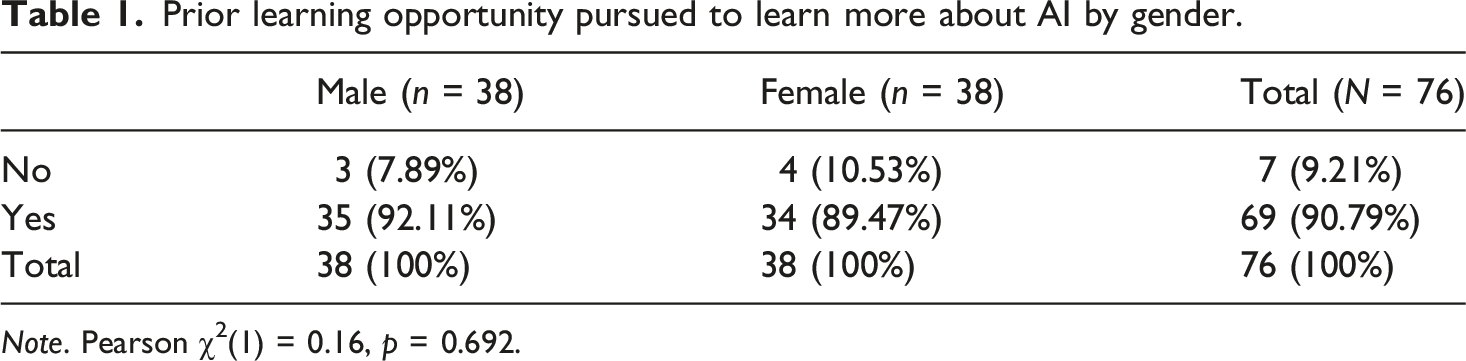
Note. Pearson χ2(1) = 0.16, p = 0.692.
Prior learning opportunity pursued to learn more about AI by faculty rank.
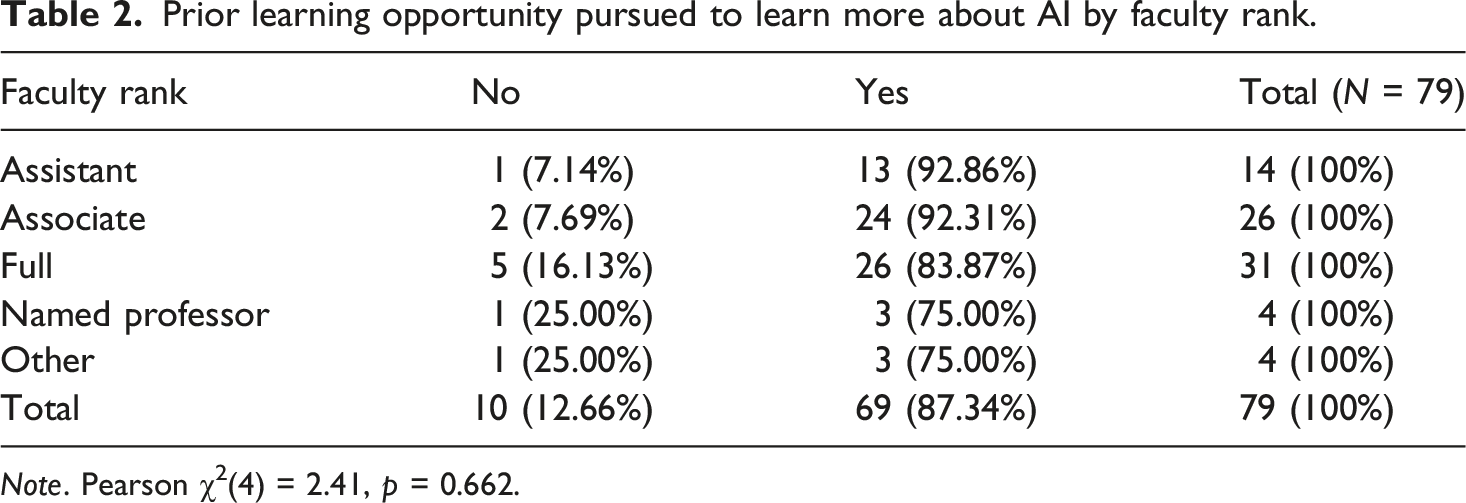
Note. Pearson χ2(4) = 2.41, p = 0.662.
Given the findings in Tables 1 and 2 that a vast majority of respondents have received training opportunities to learn more about AI, exploring the avenues they have pursued for this training seems appropriate for the respondents of this survey. As this research is exploratory in nature, there is a lack of prior literature that would suggest which avenue(s) public affairs and policy instructors would use to pursue learning opportunities in AI. In addition, there may be differences in the types of training offered by these locations (academic conferences, university teaching/learning centers, and professional organizations), as training at academic conferences may be more hands-on and in-person, more directly related to instructor subject-matter expertise. In contrast, the training provided by a university teaching/learning center may be more general, as the center aims to offer training across all disciplines. Again, as this research is exploratory, the analysis aims to understand respondents’ behaviors in public administration and policy programs.
Engagement in AI learning opportunities at academic conferences by gender.
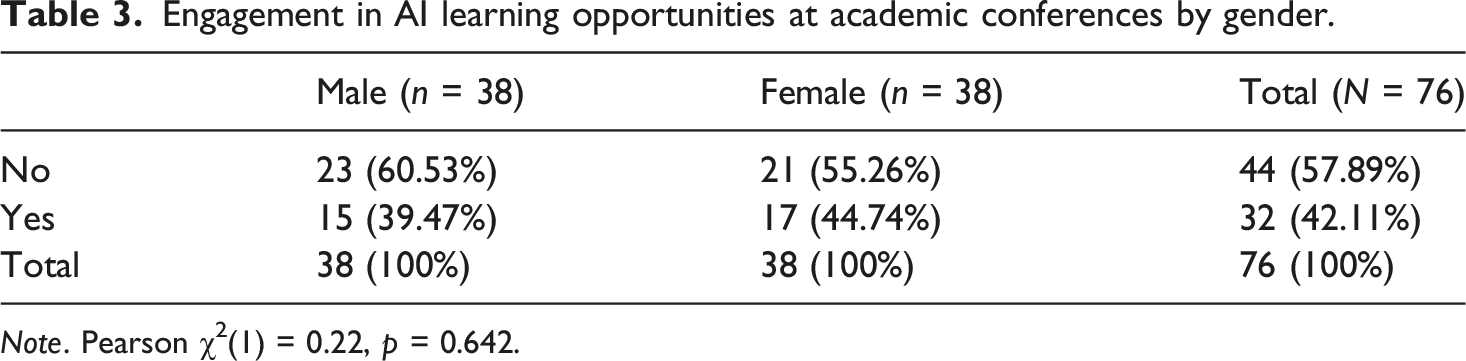
Note. Pearson χ2(1) = 0.22, p = 0.642.
Engagement in AI learning opportunities at academic conferences by faculty rank.
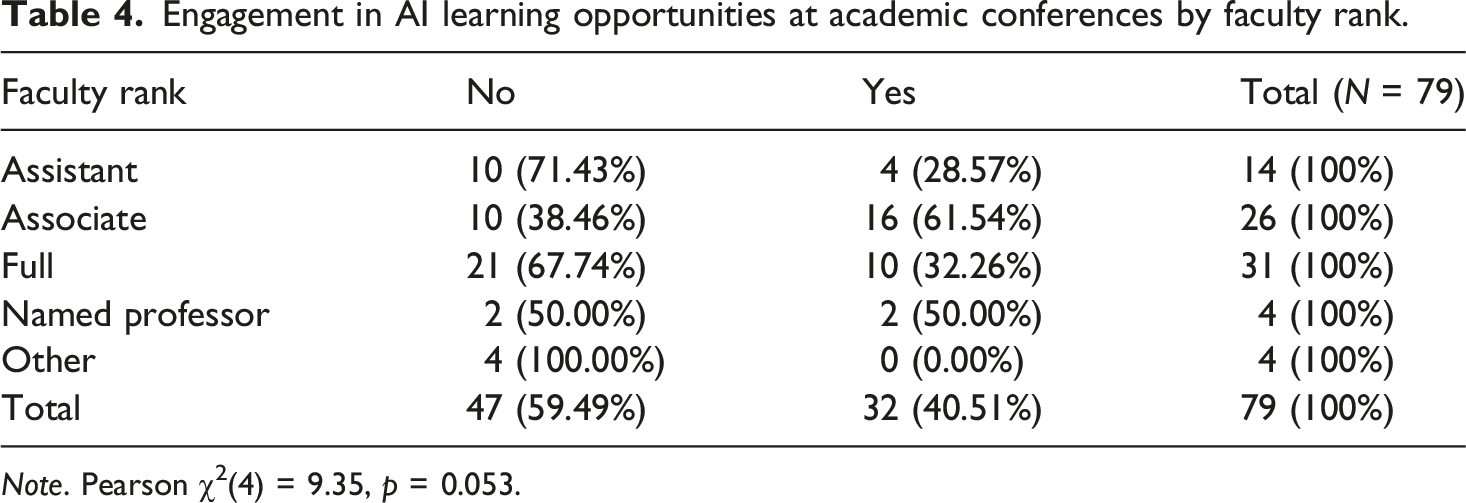
Note. Pearson χ2(4) = 9.35, p = 0.053.
One potential limitation to this finding may be that we did not ask respondents their frequency or date of last conference attendance. Therefore, our results could be impacted by individuals who do not regularly attend conferences but completed the survey.
Engagement in AI learning opportunities through university teaching and learning centers by gender.
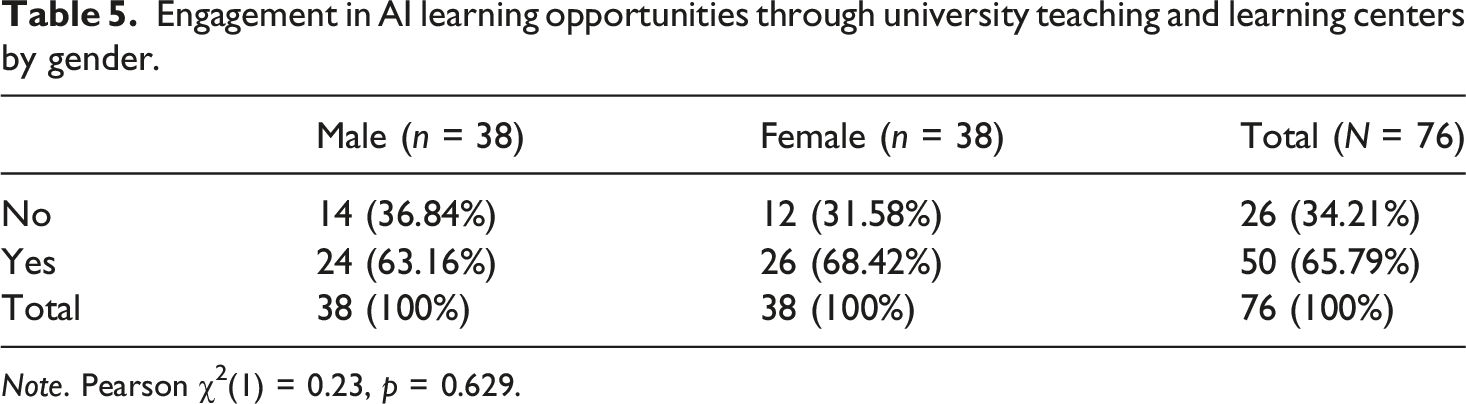
Note. Pearson χ2(1) = 0.23, p = 0.629.
Engagement in AI learning opportunities through university teaching and learning centers by faculty rank.
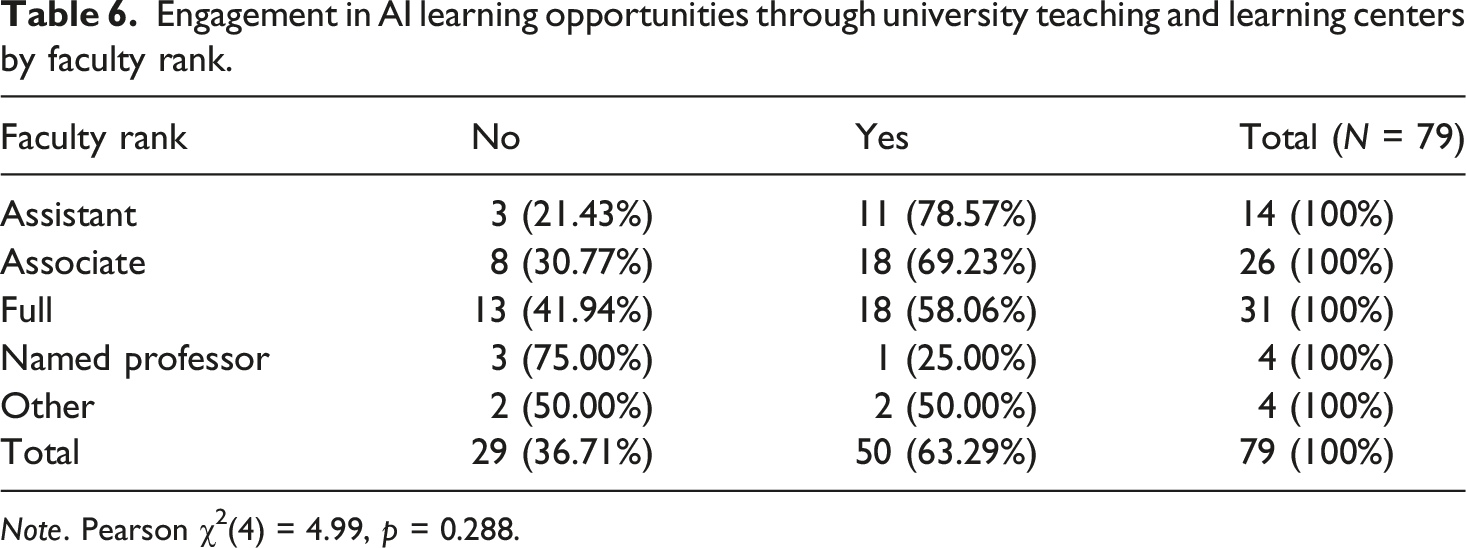
Note. Pearson χ2(4) = 4.99, p = 0.288.
Engagement in AI learning opportunities through professional associations by gender.
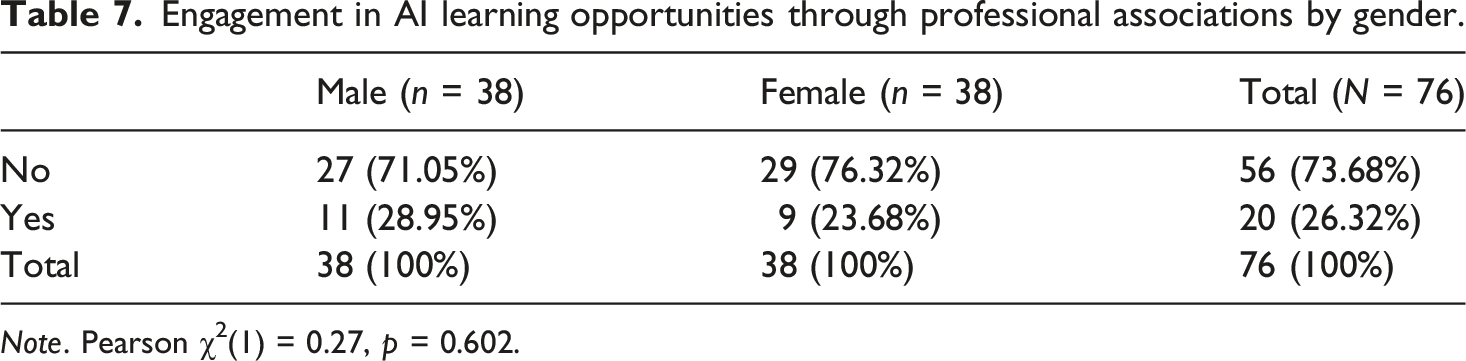
Note. Pearson χ2(1) = 0.27, p = 0.602.
Engagement in AI learning opportunities through professional associations by faculty rank.
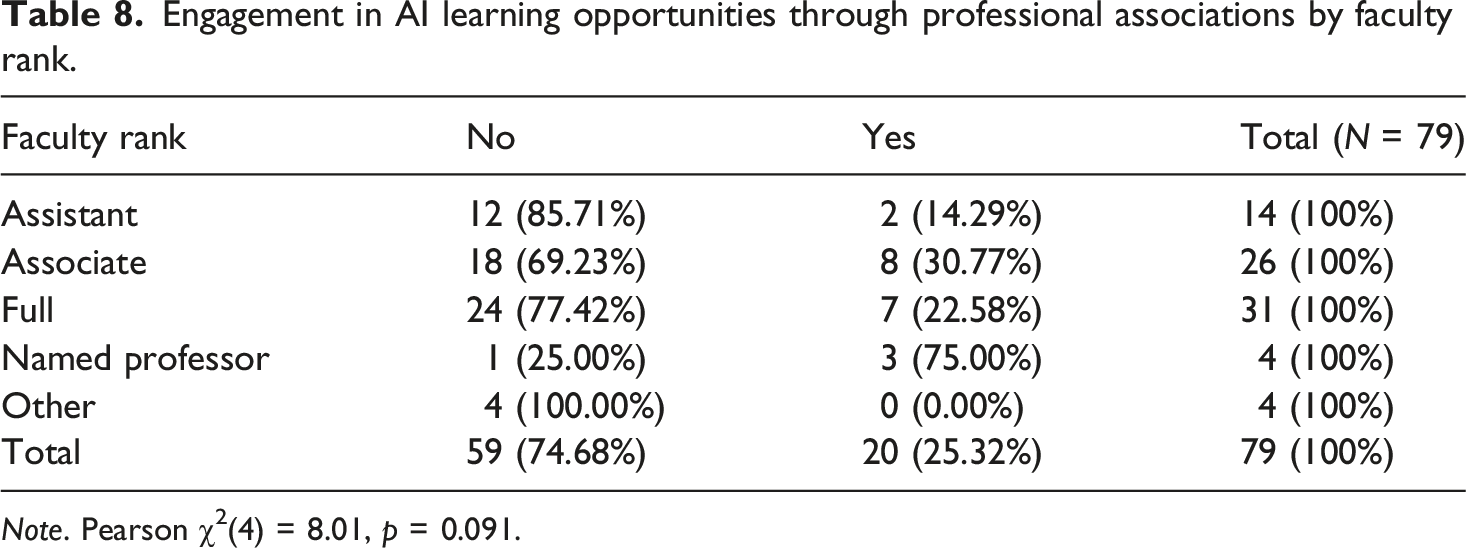
Note. Pearson χ2(4) = 8.01, p = 0.091.
Two important limitations to these findings should be noted. First, we did not provide the survey respondents with a definition of a professional association. Therefore, their responses and our broader findings could be limited by differences in personal definitions of a professional association versus, say, a learned society. Second, as the survey question did not ask the respondents if AI training had been available via their professional associations, the results cannot speak to whether this lower percentage of usage, less than a quarter, was due to a lack of desire to obtain training through professional associations or a lack of availability. This lack of follow-up questions is a limitation of our study. However, professional associations, such as NASPAA, might be well served by asking their members whether they want the association to provide AI training opportunities.
Engagement in count of AI learning opportunities by gender.
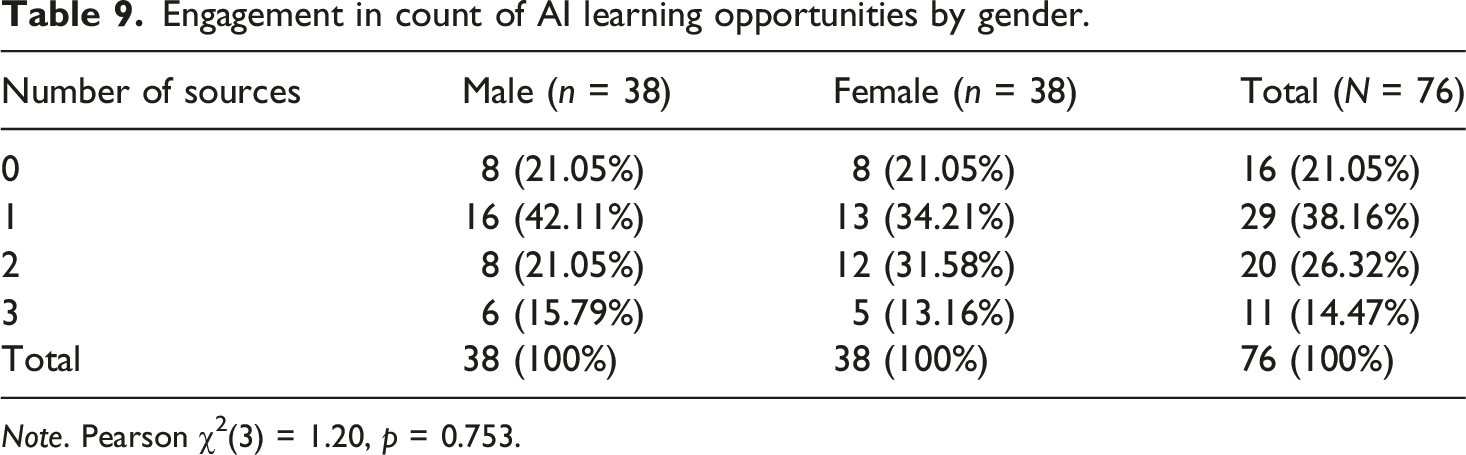
Note. Pearson χ2(3) = 1.20, p = 0.753.
Engagement in count of AI learning opportunities by faculty rank.
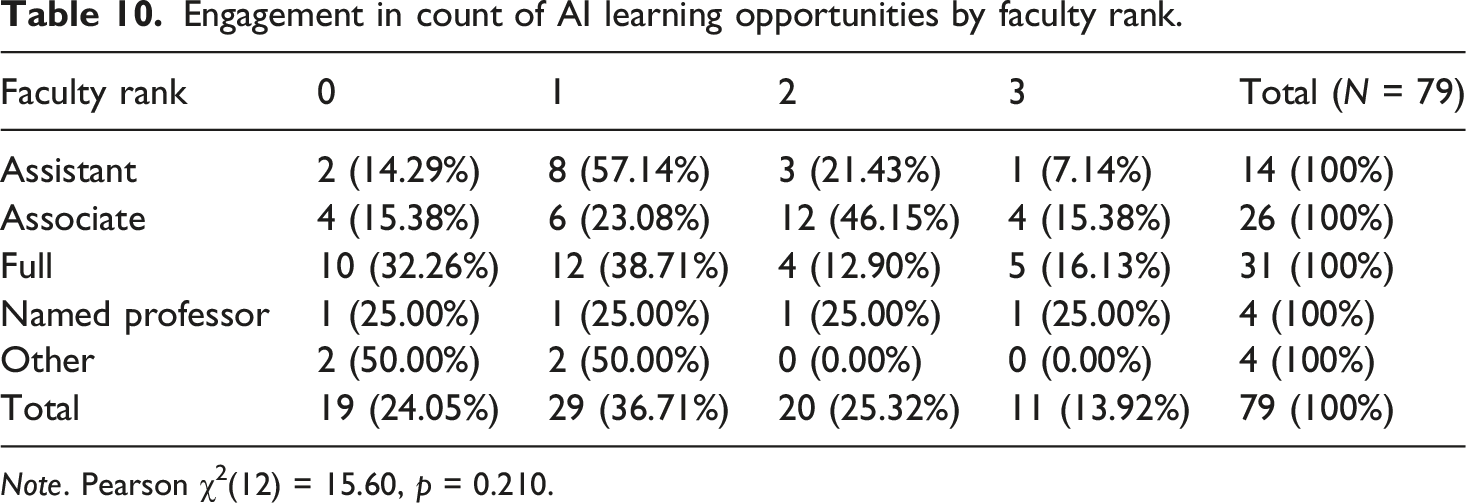
Note. Pearson χ2(12) = 15.60, p = 0.210.
Again, the respondents were not asked follow-up questions about whether their lack of usage of various locations (academic conferences, university teaching/learning centers, and professional organizations) was due to a lack of training provided, a lack of desire to obtain training through that avenue, or some other reason. Therefore, we cannot speak to if the observed frequencies are due to a lack of programming provided on AI training in those locations or some other reason. The lack of follow-up questions should be viewed as a limitation of our study.
Conclusion, limitations, and future research
The goal of this reflection is to provide a conversational piece about how public affairs instructors are learning about GenAI. Although much of the survey data reflect Global North trends, it may offer preliminary insights with application to the Global South, especially as technological advances allow AI to become more accessible. Nearly 88% of respondents had participated in at least one AI learning opportunity, indicating strong instructor interest in developing AI-related knowledge. University teaching and learning centers were the most used source of AI training, followed by academic conferences, with professional associations used least frequently. It may not be possible for Global South counterparts to witness these types of rates in their regions due to technological limitations. This does not mean, however, that there is a complete absence of opportunities.
Most notably, public affairs scholars could use professional conferences in the U.S. to expand their knowledge and understanding. Outside of HEIs in the United States and Global North, given that public affairs conferences are now taking place globally, instructors in the Global South could have an increasing number of opportunities to learn more about AI while their counterparts are not. Fewer than one-quarter of respondents used professional associations for AI training, though it is unclear whether this reflects limited availability or limited demand.
Limitations exist in this reflection, notably the low response rate to our survey and its potential impact on external validity. Findley et al. (2021: 366) describe the concept as “the extent to which inferences drawn from a given study’s sample apply to a broader population or other target populations.” We acknowledge that low response rate limits the generalizability of our findings, however, this does not diminish the study’s value. As a commentary piece, this research does not aim to make broad generalizations, but rather to highlight emerging patterns among political science instructors and to promote further inquiry into AI in political science education.
We also recognize that our thoughts are based largely on instructors affiliated with professional organizations, specifically NASPAA, which excludes access to instructors domestically and globally, especially instructors in part-time positions or those facing monetary constraints. In addition, all training participation was self-reported, which may introduce recall error or social desirability bias, particularly given the high visibility of AI in higher education. Finally, differences in institutional resources, AI policies, or administrative support were not measured, though they likely shape training access and behavior. As a field, we lack core research that enables scholars to provide a broader analysis of how instructors are learning about AI, how they are using it, and the rationale behind their decision-making. These three elements are all relevant avenues for scholars to explore.
Footnotes
Acknowledgements
The authors would like to thank the NASPAA research team for their cooperation. The authors acknowledge the use of ChatGPT (v.5.3) for limited editorial assistance. All content, analysis, and conclusions in this research are the authors’ own.

Funding
The authors received no financial support for the research, authorship, and/or publication of this article.
Declaration of conflicting interests
The authors declared no potential conflicts of interest with respect to the research, authorship, and/or publication of this article.