







Abstract
Classroom management in dual immersion classrooms includes unique challenges. The teacher must instruct and correct in the L2 language, in which students are beginning learners, and effective classroom management strategies appropriate to the L2 context. Class-Wide Function-Related Intervention Teams (CW-FIT) is a positive classroom management program that teaches social skills and uses group contingencies to improve behavior. The present study examined the ability of French immersion teachers to implement CW-FIT in the L2, including the effects of CW-FIT on teacher praise and reprimand rates and as well as on students’ classroom behavior. Social validity was also assessed. A single-subject multiple baseline design with embedded reversals was used to evaluate impact in second-, third-, and fourth-grade dual immersion classrooms. Results indicated that dual immersion teachers were able to implement CW-FIT in L2 with fidelity. The intervention significantly increased teacher praise and improved classroom on-task behavior. Changes in teacher reprimand rates were inconsistent. Students and teachers reported CW-FIT to be socially valid.
Dual immersion programs, in which academic instruction is divided between a primary language (L1) and a target language (L2), can provide students with a high level of proficiency in a second language (Howard, Sugarman, Christian, Lindholm-Leary, & Rogers, 2007; Johnson & Swain, 1997). Immersion programs have been found to produce significant linguistic, academic, and cognitive benefits (Lazaruk, 2007). According to Genesee (2004), students in bilingual programs develop better proficiency in their L2 than they would in a conventional language learning setting, such as taking a language class. Bruck (1978) found that dual immersion can also have beneficial effects on students with academic learning problems: Those in immersion progressed academically more than students with similar issues in an L1-only environment. A review of research evidence by Genesee (2007) found that elementary and secondary students in French immersion scored similarly to students in English-only classrooms on English assessments. In addition, “below average students in early immersion scored just as well as average and above average early immersion students on speaking and listening tests” (p. 659) in L2.
Challenges of Implementing Dual Immersion
There are, however, some challenges with implementation of dual immersion programs. There tends to be a high dropout rate in dual immersion programs: Approximately half of the elementary school students drop out of immersion programs by the sixth grade, often due to academic or behavioral problems (Cummins, 1998). Another disadvantage is the commitment: Schools usually ask for students and their families to commit to 7 years in the dual immersion program (Drozdowicz, 2012).
Elementary school dual immersion students may have a limited ability to speak in their second language. Consequently, when a teacher gives specific instructions or corrections in the L2, students may not respond according to the directions given (Macaro, 2001). This can create challenges in classroom management and general behavior of children when communicating only in the second language. Some believe that students who engaged in challenging behaviors should be kept in an L2 setting once they have started the program. In a review by Genesee (2007), it was found that students who engaged in challenging behaviors and were consequently moved to an L1-only classroom engaged in higher rates of challenging behaviors; developed more negative views and attitudes toward schooling, their own success, and immersion programs; and had lower self-esteem than students who remained in the L2 classroom.
While it may be advantageous to retain students with academic or behavioral problems in an L2 environment (Genesee & Fortune, 2014), it brings up some unique classroom management issues, including the decision to manage the classroom in the L1 or L2 due to the likelihood of inadequate language comprehension and difficulty of communication. According to a study by Macaro (2001), it is common for new immersion teachers to return to using L1 when dealing with classroom management issues. However, Macaro also notes that some believe that the L2 rather than the L1 should be the language in which all class work is completed and managed. However, we could find no studies specifically examining how to effectively manage dual immersion classroom behavior in L2. Below we address some components of classroom management which have been found to be effective in nondual immersion classrooms, specifically social skill instruction and group contingencies, which may also be effective in dual immersion classrooms. Preservice training would be the ideal setting to prepare L2 teachers to manage challenging behaviors (Peacock, 2009).
Social Skills Instruction
Proactive instruction in social skills is an important component of effective classroom management, as students must know what behavior is expected of them and why. Social skills are behaviors needed for students to successfully interact with others, including teachers and peers. As noted by Young, Caldarella, Richardson, and Young (2012),
The common assumption that students know how to behave in school may be inaccurate. It may be safer to assume that students need instruction regarding appropriate social behavior; a way to provide this instruction is through school-wide teaching of social skills. (p. 63)
Social skills are crucial to overall school success, including academic achievement, particularly for students with developmental, academic, or behavior problems (Gresham, Sugai, & Horner, 2001; Kerr & Nelson, 2006; Malecki & Elliott, 2002; Walker, Ramsey, & Gresham, 2004), whether in an L1 or L2 setting.
Walker and colleagues (2004) identified several guidelines for effective social skills instruction. First, social skills are best taught in naturalistic settings and situations such as school classrooms. Second, these skills should be taught by the same procedures and principles used to teach academics (e.g., direct instruction, modeling, practice, feedback, and reinforcement). Third, a positive relationship should be evident between social skills instruction and changes in students’ social behavior. Finally, if student behavior does not improve, social skills instruction should be supplemented by other strategies such as behavioral rehearsal, performance feedback, and contingency systems to promote use, fluency, and mastery of the skills taught. Merrell and Gimpel (1998) noted that students learn social skills best when the skills are taught and practiced daily. Preteaching of social skills, which includes explicitly defining and modeling specific steps for expected behaviors, can also be implemented before problem behaviors occur in the classroom (LeGray, Dufrene, Mercer, Olmi, & Sterling, 2013).
Group Contingencies
Managing student behavior effectively in the classroom often includes use of group contingencies, which place students in groups where they work together to behave appropriately and earn points to exchange for a reward (Kerr & Nelson, 2006). Group contingencies provide positive peer influence to help students at risk for problem behavior avoid displaying it, as well as motivating appropriate classroom behavior among all students (Hulac & Benson, 2010; Ling, Hawkins, & Weber, 2011). Three types of group contingencies are generally used: (a) independent, in which reinforcement is contingent upon individual students’ behavior; (b) dependent, in which reinforcement is provided to a group contingent upon the behavior of a single individual; and (c) interdependent, in which reinforcement is provided contingent upon the behavior of all members of a group (Litow & Pumroy, 1975).
Group contingencies have been shown to decrease disruptive behavior and increase compliant behavior in students of all ages (Maggin, Johnson, Chafouleas, Ruberto, & Berggren, 2012; Poduska et al., 2007; Stage & Quiroz, 1997; Swiezy, Matson, & Box, 1992). Applying group contingencies appears to help students become more aware of their own behavior, particularly its effect on others, thus supporting development of social skills (Poduska et al., 2007). Group contingencies and social skills instruction form the basis of Class-Wide Function-Related Intervention Teams (CW-FIT; Wills et al., 2010).
CW-FIT
CW-FIT is a multitiered program of positive behavioral intervention and supports designed to improve classroom management and student behavior through social skills instruction, group contingencies, and teacher praise (Wills et al., 2010). The goals of CW-FIT are to (a) increase the use of social skills, (b) reduce student problem behavior, (c) eliminate teachers’ reinforcement of problem behavior by substituting praise for appropriate behavior, (d) teach and reinforce alternatives to negative behaviors, and (e) encourage self-management—thereby, improving student performance. CW-FIT is implemented under the direction of the classroom teacher in conjunction with academic instruction. During the first 3 to 5 days of Tier 1 implementation, students are taught the select social skills, which outline how to correctly get the teacher’s attention, how to follow directions the first time, and how to ignore inappropriate behavior of classmates. These social skills are displayed on posters that include pictures as visual reminders for the students. After the first week of direct instruction of the social skills, the teacher briefly reviews the skills with the students at the beginning of each CW-FIT session. Following the review, the teacher starts the CW-FIT program.
The classroom is divided into three to six groups of two to six students (based on conditions and convenience) to establish an interdependent group contingency. The teacher sets a timer at intervals between 2 and 5 min. If every student in the group has been exhibiting the appropriate social skills when the timer goes off, then that group receives a point. The students are given an achievable class goal for the number of points to earn a contingent reward during each session. Every group that reaches the goal is rewarded at the conclusion of the session (Kamps et al., 2011).
CW-FIT Tier 2 includes self-management charts and help cards for students who need additional support. CW-FIT Tier 3 uses functional assessments for students who do not respond favorably to Tier 1 and Tier 2. The present study focused on CW-FIT Tier 1.
CW-FIT has been shown to be effective in improving elementary school classroom behavior. Specifically, its implementation has been found to result in increased rates of student on-task behavior, improved use of teacher praise, decreased use of teacher reprimands, and improved behavior of students identified as at risk for emotional and behavioral disorders (Caldarella, Williams, Hansen, & Wills, 2015; Kamps et al., 2011; Kamps, Wills, et al., 2015; Wills, Iwaszuk, Kamps, & Shumate, 2014; Wills, Kamps, Fleming, & Hansen, 2016).
Purpose of This Study
Previous research suggests that CW-FIT can help elementary school students be more accountable for their own behavior through social skills instruction and group contingency components. But it has not been studied in dual immersion settings. The aim of the present study was to implement CW-FIT in French dual immersion classrooms to assist with classroom management during the L2 segments, evaluating the effects on teacher and student behavior with particular focus on classroom challenges common in dual immersion programs, including inadequate comprehension, communication difficulty, and resulting behavioral problems.
Limited research has examined the use of group contingency in dual immersion classrooms or with different cultures. One group contingency program, the good behavior game, has demonstrated effects across cultures (Nolan, Houlihan, Wanzek, & Jenson, 2014); however more work is needed in this area.
Two specific research questions were addressed:
Method
Setting and Participants
The study took place in an elementary school located in Utah. As of the 2014-2015 school year, the student population of the school was 636 (44% male and 56% female; 81% Caucasian and 11% Hispanic). Of those students, 54% participated in the school’s French immersion program. Most of these participants were native English speakers learning French; only two students, both children of one of the native French teachers, spoke French as their native language. Three classes participated in the study: a second-, a third-, and a fourth-grade class, with a total number of 74 students (46% male, 54% female). Three female teachers, all Caucasian, participated. They had been teaching for an average of 12.67 years (range, 1-32 years). Two had bachelor’s degrees, and the third had a doctorate. The average age of the teachers was 47.33 years (range, 25-59 years).
The school was one of the 13 elementary schools in the state that had a French dual immersion program (Utah State Office of Education, 2014). As outlined in the immersion program guide, students could choose to enter this program at the beginning of first grade. The school had English-only classes to accommodate students who elected not to learn French or who moved into the area after they began first grade. Students in the dual immersion program spent half of each day in an English classroom and half in a French classroom. The order of instruction varied based on teacher preference: The third- and fourth-grade classes switched the order each month: In October, the French class was in the morning with the English class in the afternoon, then in November the English class was in the morning and the French class in the afternoon, and so on. The second-grade class switched each day, with Friday being spent in one setting all day: On Monday and Wednesday, the French class was taught in the morning with English class in the afternoon; on Tuesday and Thursday, English class was in the morning with French class in the afternoon; and on every other Friday, the students would be in the English class all day.
Research Design
The study used a multiple baseline design implemented across classrooms. Reversal conditions were embedded in Grades 2 and 3, and a maintenance phase was included in Grade 4. When Grade 2 demonstrated change following the intervention, it was implemented in Grade 3. Grade 4 functioned as a comparison classroom for a randomized controlled trial, so the intervention was delayed until after the reversal conditions were completed for Grades 2 and 3. All initial phases, including observations prior to implementing the intervention condition, included a minimum of five data points, consistent with the Institute of Education Sciences What Works Clearinghouse standards for single case design (Kratochwill et al., 2010). Subsequent conditions met the standards with reservations, as they had a minimum of only three data points instead of the recommended five.
Data Analysis
Two methods of data analysis were conducted in the classrooms. Visual analysis of graphic data was achieved by observing levels, trends, and variability of on-task behavior within phases along with consistency and magnitude of changes between the phases. To supplement visual analysis, an effect size for comparing baseline and intervention conditions was calculated utilizing a web-based calculator. Tau-U, a nonoverlap metric described for single case data, was used (Parker, Vannest, Davis, & Sauber, 2011; Vannest, Parker, & Gonan, 2011). Tau-U provides single case researchers with an effect size for changes in level and trend. In addition to a nonoverlap effect size estimate, significance (p values) and confidence intervals are calculated. In addition to Tau-U effect sizes at the classroom level, the online calculator provides researchers the ability to combine multiple participants or settings effect sizes in a weighted average. For the present study, we combined all baseline and intervention phases for all participants.
Independent Variable and Procedures
Before the study began, approval was obtained from the school district and the collaborating university’s institutional review board, and all research staff were trained in ethical and responsible conduct in regard to research practices. Participating teachers completed consent forms and sent consent forms to parents of all students in the classes.
In the French immersion classrooms, CW-FIT Tier 1 was performed in the same manner as it had been in previous studies in English classrooms (Wills et al., 2010), with one major difference: All instruction was in French. Social skills posters and other materials were translated into French (see Figure 1) so the students could focus on learning French and the teacher could continue to instruct in the L2. The language used for the social skills posters was suitable for elementary students to understand, as determined and verified by two French-speaking dual immersion teachers. The pictures on the posters helped provide nonverbal reminders of the social skills.
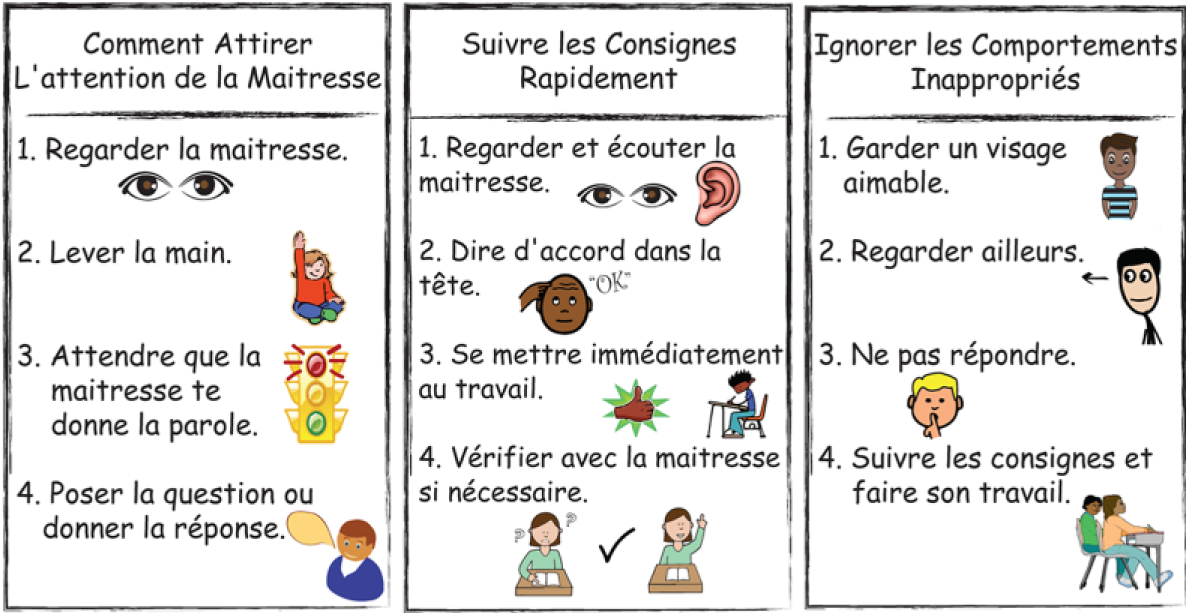
CW-FIT social skill posters in French.
Prior to collecting baseline data, teachers identified the time of day that was most challenging, based on frequencies of disruptive student behaviors and low task engagement. After a baseline period of data collection during which the second grade teacher continued her standard classroom management practices, she was trained to use CW-FIT in a 1-hr meeting after school. She began implementing the program during the same time of day that she was observed during the baseline condition. French-speaking observers were present to ensure fidelity of implementation. After some coaching, the second-grade teacher was able to implement CW-FIT with fidelity. When visual analysis of graphed data indicated improvement in student on-task behavior, the third-grade teacher then received a 1-hr training on CW-FIT. The fourth-grade teacher received a 1-hr training on CW-FIT and began implementing the intervention after improvements in on-task behavior were demonstrated in the third-grade classroom.
Dependent Variables and Measures
A university-based research coordinator who had been involved with the study for 2 years trained observers and scheduled observations throughout the year. Five undergraduate students majoring in education, French language, or mechanical engineering were taught the definitions of each observed behavior during a 30-min training. Observers passed a quiz about the definitions at 90% or higher accuracy prior to coding practice. Following the training, they practiced observations using a precoded video until they reached a minimum of 90% agreement with the original coder three times. They then conducted observations with the research coordinator in a classroom until they reached a minimum of 90% agreement three times.
Direct observation
One of the dependent variables was student group on-task behavior. For the purpose of the group contingency component of CW-FIT, groups included two to six students. During 20-min observation periods, data for this variable were collected via paper/pencil methods using a momentary time sampling procedure. For purposes of data collection, the observer assigned numbers to existing student groups (e.g., tables, rows). The location of the groups was likely to change in the classroom as students transitioned through activities. Every 30 s, the observer would scan each group of students and record a plus (+) if everyone in that group was on task or a minus (−) if anyone in the group was off task. Thus, there were 40 intervals recorded for each group during the observation period.
Student group on-task behavior was defined as a response class of behaviors that included working on assigned or approved activities. This definition included (a) attending to the task and materials, (b) engaging in appropriate responses (e.g., reading aloud, looking at the teacher, writing), (c) requesting assistance in an acceptable manner, and (d) waiting after assignment completion or between activities by remaining seated and quiet. At the end of the 20 min, the total number of pluses was added up for each group and divided by the total number of observed increments for each group. Subsequently, the totals for each group were combined and converted to an on-task percentage of the classroom during that observational period.
Data for the dependent variables of teacher praise and reprimand were also recorded on the student group on-task data collection sheet. Any time a praise or reprimand statement was addressed to an individual student or group of students, a tally mark was recorded in appropriate boxes. Teacher praise was defined as verbal statements that followed a behavior indicating approval of the behavior beyond acknowledgment of a correct response (e.g., “nice work!”). Teacher reprimands were recorded when verbal statements that followed a behavior commented negatively about the behavior or reprimanded an individual or group of students (e.g., “that is a mistake, try again!”). Praise and reprimands were frequency measures and reported as the number of praise statements per 20-min CW-FIT observation.
Interobserver agreement (IOA) was collected for 32.6% of the classroom observation sessions. To calculate IOA, the number of agreements concerning student group on-task behavior was divided by the total number of agreements plus disagreements. The mean group on-task IOA was 93.6% (range, 77.5%-98.7%)
After each observation, a procedural fidelity form (see Figure 2) was completed to monitor the number of CW-FIT components completed and to assess their quality. The form included 17 items that were used to identify the use of the CW-FIT intervention components (e.g., skill posters were displayed, teacher precorrects were used before the game, skills were reviewed, point goal was determined, points were awarded to teams at appropriate intervals). The 17 items on the form were scored yes or no. For each component scored as yes, a quality rating would be given, ranging from 1 indicating low/partial quality to 3 indicating high/full quality. Teachers were able to implement CW-FIT with 86.1% fidelity (12.1% low quality, 17.4% moderate quality, 70.5% high quality).
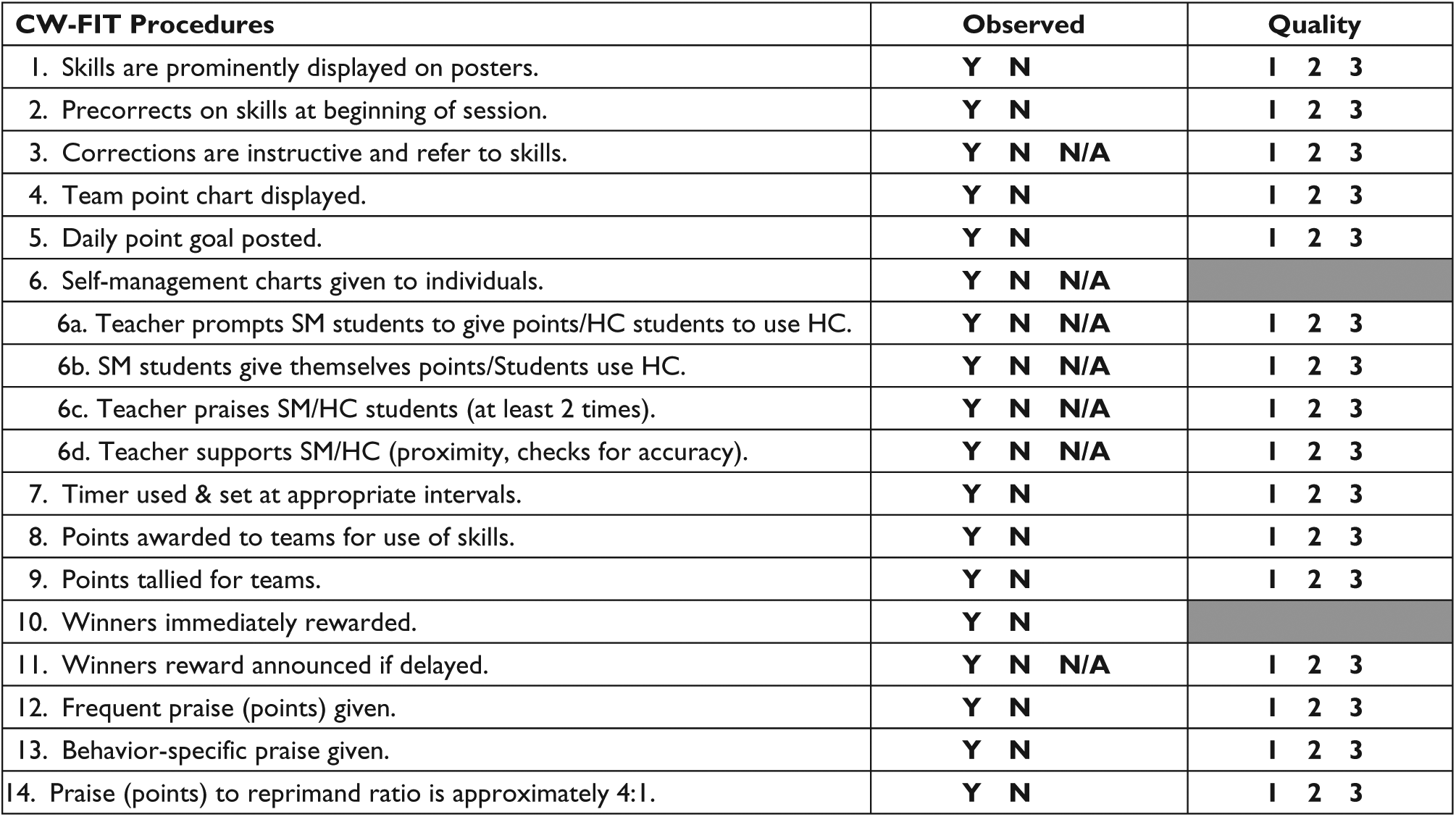
CW-FIT fidelity procedures checklist.
At the conclusion of the study, social validity was assessed in each classroom with students and teachers using questionnaires. The students indicated what they liked or did not like about CW-FIT with two yes/no questions and three open-ended questions. The teachers rated the acceptability of the components, the ease of implementation, the feasibility of self-management or help cards, and their perceptions of the effectiveness of the intervention on an 18-item questionnaire. All questionnaires were administered in English, so students could easily express their opinions.
Results
Group On-Task Behavior
Grade 2
The upper panel of Figure 3 shows student on-task data for Grade 2. At baseline, these students displayed on-task behavior on average 48.7% of the intervals (range, 45.0%-60.5%). When the intervention was first implemented, the change came about gradually. The intervention ultimately resulted in an average of 69.6% of intervals with on-task behavior (range, 52.0%-88.1%). When CW-FIT was removed, the class average decreased to 42.7% of intervals on task (range, 37.5%-48.13%). When the intervention was implemented a second time, the class average for on-task behavior was 69.9% (range, 63.8%-76.25%).
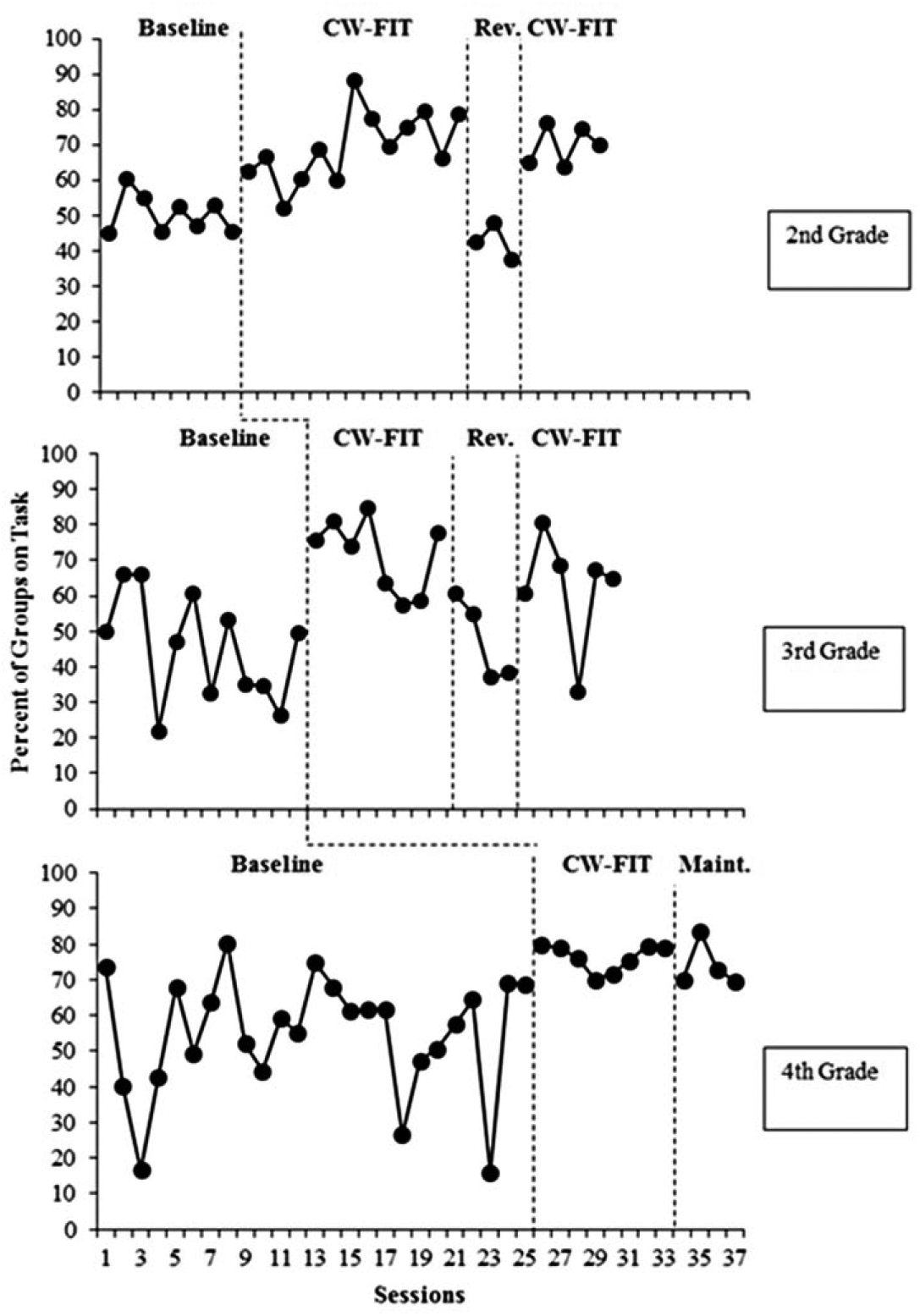
Effects of CW-FIT on group on-task behaviors across second-, third-, and fourth-grade dual immersion French classrooms.
Grade 3
The middle panel of Figure 3 shows data for Grade 3. At baseline, these students displayed on-task behavior on average 40.1% of the observation intervals (range, 21.9%-66.3%). The intervention increased the average to 71.5% of intervals with on-task behavior (range, 57.5%-84.6%). When CW-FIT was removed, the class average decreased to 47.7% on task (range, 36.9%-60.6%). When the intervention was implemented a second time, the class average of on-task behavior did not increase to its initial intervention level: It was 62.6% (range, 33.1%-80.6%).
Grade 4
The lower panel of Figure 3 shows the Grade 4 students’ on-task behavior data. At baseline, Grade 4 students displayed on-task behavior an average of 54.9% of the intervals (range, 15.8%-80.5%). The intervention raised on-task behavior to 76.4% of the intervals (range, 70.0%-80.0%), and during the maintenance phase, it remained at 80.0% (range, 69.7%-83.3%).
Effect size
Tau-U was calculated for each condition in all classrooms then combined, providing an effect size estimate for all three classrooms. Grade 2 baseline to intervention effects were very strong at 0.90 (p < .001). When Grade 2 reversal was compared with Grade 2 intervention, the two phases showed replication and a strong effect, 1.00 (p = .02). Grade 3 baseline to intervention effects were strong at 0.83 (p < .01), but reversal was not significant, 0.67 (p = .088). Baseline to intervention effects were also strong for fourth grade at 0.88 (p < .001). The combined effect size across the four conditions of Grades 2 and 3 and the first two conditions of Grade 4 was very strong, 0.86 (p < .001).
Treatment Fidelity
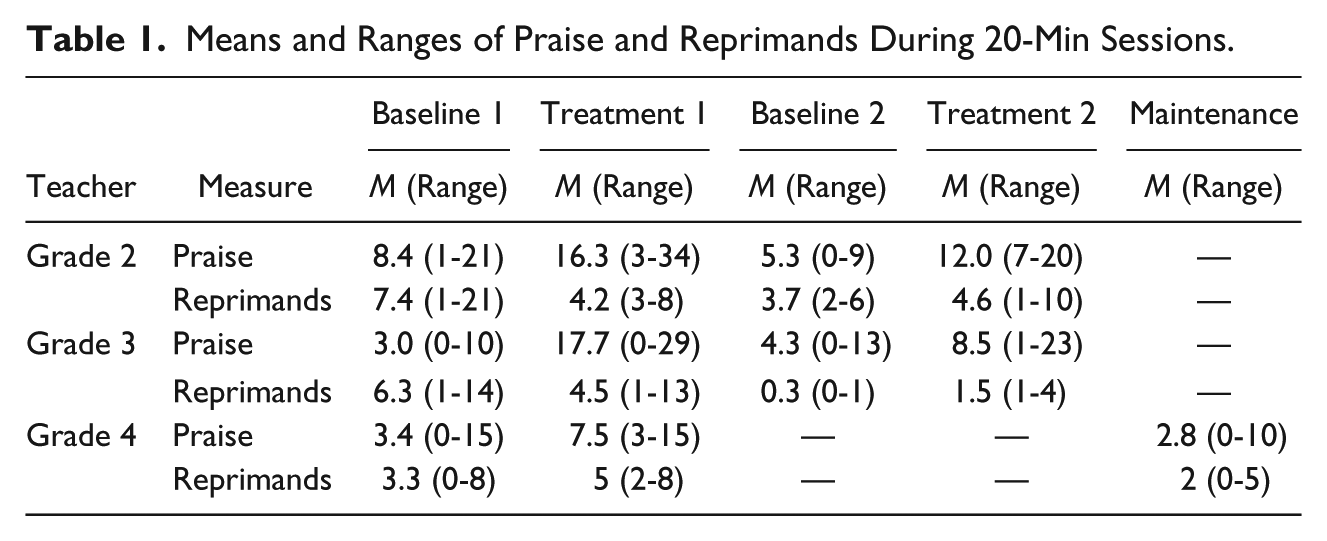
The second-grade teacher implemented CW-FIT with 92.8% fidelity. The component most often missed was precorrecting on skills at the beginning of session (missed 36.8% of the time). During baseline and reversal phases, fewer than 12% of intervention components were observed. The third-grade teacher implemented CW-FIT with 84.9% fidelity. The components she most often missed were precorrection of skills at the beginning of the session (missed 25.0% of the time), instructive corrections referring to the skills (missed 56.2% of the time), and points tallied for teams (missed 31.2% of the time). During baseline and reversal phases, fewer than 5% of intervention components were observed. The fourth-grade teacher implemented CW-FIT with 88.8% fidelity. The steps sometimes missed were precorrection of skills at the beginning of a session (50.0%) and instructive corrections referring to the skills (50.0%). During baseline and reversal phases, fewer than 3% of intervention components were observed. Increased praise and decreased reprimands were counted using a frequency count measure on the on-task observation form. Means and ranges from each condition and teacher are shown in Table 1. Each teacher increased praise on average during the CW-FIT conditions over baseline conditions. In addition, teachers decreased reprimand statements during the CW-FIT conditions.
Means and Ranges of Praise and Reprimands During 20-Min Sessions.
Social Validity
Teachers of all three grade levels reported that the CW-FIT program was easy to use and that issuing points to teams for appropriate behaviors was helpful in keeping students on task. Two teachers reported that it was very true or mostly true that they could easily manage the timer during instruction, and one teacher reported that it was somewhat true. All teachers reported that they learned new skills to help manage students’ behaviors and that they will use skills they learned with future classes. Two of the three would recommend the program to colleagues. All reported that their students were more focused and engaged when they implemented CW-FIT. Teachers reported that the most helpful elements in learning CW-FIT were receiving in-person instruction and having their questions answered, observing the modeling by the researchers, and being reminded of the importance of repetition of rules. While two teachers reported nothing that could have been more helpful, one commented that she would need to plan activities that were more conducive to measuring the CW-FIT social skills. The teachers provided suggestions for potential modifications: “Get a timer that vibrates instead of ringing,” “have rewards prepared ahead of time (no winging it).” One noted, “I wish I could accomplish/teach as much material as I would normally when using CW-FIT.”
In addition, students responded positively to CW-FIT: Of the 65 out of the 74 participating students (87.8%) who completed satisfaction surveys, 60 (92.3%) reported liking the CW-FIT intervention. The majority (67.7%) reported that they liked earning the rewards, and 24.6% noted that the intervention helped improve behavior in their classroom. When asked if there was anything about the intervention that they did not like, 32 students (49.2%) said there was nothing they did not like about CW-FIT, and 14 students (21.5%) reported they did not like the times when they did not get the reward or when another team member would prevent their team from earning the reward. When asked if other students should have a chance to use CW-FIT, 87.7% responded in the affirmative: 50.8% of the students said others should try CW-FIT because they liked it and it was fun, while 35.4% reported that their peers should try CW-FIT because it would help improve their behavior.
Discussion
The purpose of this study was to evaluate the effects of CW-FIT, a positive behavioral intervention including a group contingency program, in three French dual immersion classrooms. The effects of this intervention were measured on group on-task behaviors, teacher praise and reprimand rates, and perceived levels of social validity. Fidelity of implementation was also measured and considered.
The primary goal of the CW-FIT intervention was to increase on-task behavior. In each grade, students’ on-task behavior increased significantly. When on-task data were aggregated for all classes, changes from baseline to intervention conditions were socially and statistically significant, similar to changes found in CW-FIT studies conducted in elementary classrooms that did not teach with dual immersion (Caldarella et al., 2015; Kamps et al., 2011; Kamp, Wills, et al., 2015; Wills et al., 2014, Wills et al., 2010).
Another goal of this research study was to evaluate the extent to which teachers in French dual immersion classes implemented the CW-FIT intervention with fidelity. Teachers in this study also demonstrated fidelity throughout the program, similar to teachers in past studies. This is significant, given language and communication challenges of the L2 environment in which CW-FIT was implemented. This is the first such study with a dual immersion program.
Results indicated that teachers increased their use of praise, similar to results of past studies of CW-FIT. Changes in reprimand rates were not as consistent. The second- and third-grade teachers showed decreases in reprimand rates after the initial introduction of CW-FIT, followed by a further decrease in reprimands when CW-FIT was removed. However, the fourth-grade teacher’s reprimand rates were higher with CW-FIT; she gave more reprimands during the intervention condition, but she also gave more statements of praise, communicating more with her class concerning their behavior during the intervention phase. In addition, results showed that when CW-FIT was reintroduced following reversal in the second- and third-grade classrooms, reprimand rates tended to increase, similar to results of a CW-FIT study conducted in a music classroom (Caldarella, Williams, Jolstead, & Wills, 2016). It is unclear why reprimand rates tended to be more inconsistent than in other CW-FIT studies, which have shown more predictability (Caldarella et al., 2015; Kamps et al., 2011; Wills et al., 2010).
In terms of social validity, teachers found the intervention to be useful and effective at improving students’ behaviors. However, time concerns were mentioned by one teacher, who commented about having to prepare rewards ahead of time and not being able to cover as much academic material as she did without CW-FIT. This may have been due to starting CW-FIT toward the end of the school year with the additional demands on time by such necessities as state testing and end-of-year projects. Another teacher was somewhat uncomfortable with an audible timer. In spite of these challenges, teachers rated the intervention socially valid, which is important as teachers who place value and importance on an intervention are more likely to implement that intervention with fidelity (Gresham, Gansle, & Noell, 1993; Sanetti, Dobey, & Gritter, 2012). Students also found the intervention socially valid, as they enjoyed it and noticed that it helped improve the behavior in the classroom.
This study adds to the research literature on dual immersion classroom management interventions in the following ways. First, it demonstrated how an existing classroom intervention can be effectively adapted for use in dual immersion classrooms. The skills were translated by a French speaker, and the praise statements were those that native French speakers typically use. Second, results showed that this model of classroom intervention was effective at increasing students’ time on task. Across all three classrooms and conditions, student on-task behavior increased an average of 23%. This difference is considerable in language teaching situations where careful attention to speaking and listening is extremely important.
Limitations and Future Directions
Despite the positive results of the present study, some limitations need to be considered. First, this study was conducted at one elementary school with just three dual immersion French classes. Future studies in additional dual immersion classrooms, including those in other languages, would further validate the study findings. Second, phase changes (from baseline to treatment) were not consistent, because some of the students were also participating in another study occurring at the school. Also language and academic skills were not assessed; thus, we do not know whether the intervention would contribute to improved student learning, which would be a deciding factor in choosing to adopt it. As this study focused only on CW-FIT Tier 1, no information was considered on whether Tiers 2 and 3 of the program could also be successfully implemented in dual immersion classrooms.
Conclusion
In conclusion, this study evaluated a classroom management program in three French dual immersion classrooms in the Utah. The results indicated that students increased on-task behaviors and that teachers could implement the intervention with fidelity. On social validity surveys, both students and teachers reported positive reactions to the intervention. These results point to an effective intervention that can be used in a dual immersion setting. More research is needed, particularly using larger sample sizes and considering the extent to which this intervention affects the language skills of participating students.
Footnotes
Declaration of Conflicting Interests
The authors declared no potential conflicts of interest with respect to the research, authorship, and/or publication of this article.
Funding
The authors disclosed receipt of the following financial support for the research, authorship, and/or publication of this article: The research reported in this article was supported in part by a grant from the Institute of Education Sciences and the U.S. Department of Education (R324A120344) awarded to the University of Kansas.