







Abstract
Interventions aimed at increasing communicative response variability hold particular importance for individuals with autism spectrum disorders (ASD). Several procedures have been demonstrated in the applied and translational literature to increase response variability. However, little is known about the relationship between reinforcer magnitude and response variability. In the basic literature, Doughty, Giorno, and Miller evaluated the effects of reinforcer magnitude on behavioral variability by manipulating reinforcer magnitude across alternating relative frequency threshold contingencies, with results suggesting that larger reinforcers induced repetitive responding. The purpose of this study was to translate Doughty et al.’s findings to evaluate the relative effects of different magnitudes of reinforcement on communicative response variability in children with ASD. A Lag 1 schedule of reinforcement was in place during each condition within an alternating treatments design. Magnitudes of reinforcement contingent on variable communicative responding were manipulated across the two conditions. Inconsistent with basic findings, the results showed higher levels of variable communicative responding associated with the larger magnitude of reinforcement. These outcomes may have potential implications for interventions aimed at increasing response variability in individuals with ASD, as well as future research in this area.
Keywords
The presence of repetitive and restrictive behaviors and communication deficits are core characteristics of autism spectrum disorder (ASD; American Psychiatric Association, 2013). The presence of restrictive behaviors in children with ASD may be interpreted as an issue with response variability (Rodriguez & Thompson, 2015). Invariable communicative responding can create complications for individuals with ASD. For example, individuals’ ability to access reinforcement may be hindered when previously reinforced communicative responses contact extinction (Rodriguez & Thompson, 2015). In addition, repetitive communicative responding can be stigmatizing (Lee & Sturmey, 2006) and might limit individuals’ ability to contact more complex social interactions and maintain social reinforcement from others during social interactions (Heldt & Schlinger, 2012; Lee & Sturmey, 2006). Therefore, the identification of procedures, variables, and conditions that affect communicative response variability continues to be an important pursuit.
Findings of studies in the applied literature have suggested that children with ASD and other developmental disabilities may not vary their communicative responding unless procedures are incorporated specifically aimed at promoting communicative response variability (e.g., Adami, Falcomata, Muething, & Hoffman, 2017; Betz, Higbee, Kelley, Sellers, & Pollard, 2011; Duker & Van Lent, 1991; Esch, Esch, & Love, 2009; Heldt & Schlinger, 2012; Koehler-Platten, Grow, Schulze, & Bertone, 2013; Lee, McComas, & Jawor, 2002; Lee & Sturmey, 2006, 2014; Muething, Falcomata, Ferguson, Swinnea, & Shpall, 2018; Silbaugh & Falcomata, 2019; Silbaugh, Falcomata, & Ferguson, 2018; Susa & Schlinger, 2012). Previous studies have demonstrated the effectiveness of behavior-based interventions for addressing invariable communicative responding in individuals with ASD and other developmental disabilities across a variety of communicative behaviors including mand frames (e.g., Betz et al., 2011), phonemes (e.g., Esch et al., 2009; Koehler-Platten et al., 2013), verbal responses to social questions (e.g., Lee et al., 2002; Lee & Sturmey, 2006; Susa & Schlinger, 2012), tacts (e.g., Heldt & Schlinger, 2012), intraverbals (e.g., Contreras & Betz, 2016), mands or requests (e.g., Duker & Van Lent, 1991; Silbaugh & Falcomata, 2019; Silbaugh et al., 2018), conversational responses (e.g., Lee & Sturmey, 2014), and functional communicative responses during functional communication training (FCT; E. G. Carr & Durand, 1985) in the treatment of problem behavior (e.g., Adami et al., 2017; Falcomata et al., 2018; Muething et al., 2018). A variety of procedures have been demonstrated to effectively increase response variability, both in the basic and applied literature across communication and noncommunication-based behaviors. These procedures include the application of extinction (e.g., Duker & Van Lent, 1991; Grow, Kelley, Roane, & Shillingsburg, 2008); the combination of script training, reinforcement of novel responses, and the application of extinction (e.g., Betz et al., 2011); percentile schedules of reinforcement (e.g., Galbicka, 1994; Miller & Neuringer, 2000); delays to reinforcement (e.g., Grunow & Neuringer, 2002; Muething et al., 2018; Odum, Ward, Barnes, & Burke, 2006; Wagner & Neuringer, 2006), and lag schedules of reinforcement (e.g, Adami et al., 2017; Contreras & Betz, 2016; Esch et al., 2009; Falcomata et al., 2018; Heldt & Schlinger, 2012; Koehler-Platten et al., 2013; Lee et al., 2002; Lee & Sturmey, 2006, 2014; Silbaugh & Falcomata, 2019; Silbaugh et al., 2018).
There are several examples in literature in which researchers have manipulated dimensions of reinforcement (e.g., quality of reinforcement, Lee & Sturmey, 2006; delay to reinforcement, Muething et al., 2018) to evaluate their effects on communicative response variability in individuals with ASD . For example, Lee and Sturmey (2006) examined the effects of quality of reinforcement on variable communicative responding. Specifically, Lee and Sturmey incorporated high-preferred items as reinforcers and reinforced varied responses to social questions on Lag 0 and Lag 1 schedules, respectively. The authors embedded a multielement design within an ABAB design (comparing the effects of the Lag 0 and Lag 1 schedules) in which they incorporated a different number of preferred items within trials per session (i.e., 0%, 50%, 100%). The results showed that (a) all three participants exhibited invariable responding during the Lag 0 condition regardless of the presence of high-preferred items, (b) the Lag 1 schedule produced varied responses with two out of three participants, and (c) responding in the two participants for whom the Lag 1 schedule produced response variability in did not appear to be affected by the proportion of trials in which high-preferred items were used. The authors observed, however, that although the proportion of trials with high-preferred items did not appear to affect variable responding, the content of the participants’ responses suggested an effect in that they emitted responses that were specific to the high-preferred items even when they were not present.
Basic research may provide further insight with regard to the effects of dimensions of reinforcement on response variability. Specifically, two studies have focused on the relation between response variability and reinforcer magnitude (Doughty, Giorno, & Miller, 2013; Stahlman & Blaisdell, 2011). Doughty et al. (2013) tested the theory that larger reinforcers may produce higher levels of behavioral repetition than smaller reinforcers (based on the concept that smaller reinforcers may strengthen behaviors more effectively than larger reinforcers) by manipulating the magnitudes of reinforcement provided to pigeons under a relative frequency threshold contingency. The relative frequency threshold contingency required pigeons to vary their responding, with each response sequence reinforced if its relative frequency was below the established threshold values of 0.05 (i.e., higher variability requirement) and 0.30 (i.e., lower variability requirement). Across the two threshold contingencies, the magnitudes of reinforcement were varied (i.e., 2-second or 6-second access to feed). The results from Doughty et al. extended the findings of Stahlman and Blaisdell (2011), with pigeons emitting more variable responses in the small magnitude trials. Given the current focus of research and clinical efforts aimed at increasing communicative response variability in individuals with ASD, these basic results could have potential implications for both future research and interventions.
The purpose of this study was to translate the work of Doughty et al. (2013) to evaluate the effects of reinforcer magnitude on communicative response variability exhibited by individuals with ASD. Specifically, we evaluated participants’ use of variable manding when varying magnitudes of reinforcement (i.e., 1 or 4 pieces of an edible reinforcer) were provided contingent on variable manding under a Lag 1 schedule of reinforcement.
Method
Participants, Settings, and Materials
Two men and two women diagnosed with ASD participated in this study. All four participants were referred to the study based on their communication skills deficits (i.e., limited use of functional or variable communication). Adam, Victoria, Cole, and Amy were 3, 12, 11, and 13 years old, respectively. Victoria had an additional diagnosis of tuberous sclerosis and Amy was diagnosed with a rare chromosomal malformation. Care providers reported that all four participants had no vocal communicative responses in their repertoires and each used iPad®-based communication programs (e.g., Proloquo2go™) to communicate. Victoria, Cole, and Amy had a long history of using iPads to make requests and answer questions both at the school they attended and at home. Victoria was also able to navigate through pages to form short sentences combining two symbols. Given Adam’s young age and recent diagnosis, he was only exposed to communication on the iPad 2 weeks prior to the study. Adam had no other communication system in place. Care providers also reported that Victoria, Cole, and Amy also had histories of multiple maintained problem behavior (i.e., aggression, SIB).
All sessions were conducted at the participants’ school in an empty classroom or hallway that contained a table; two chairs; video recording equipment; a plate; AAC devices including an iPad with MyTalkTools™, iPhone® with MyTalkTools, and microswitches; and reinforcers (pretzels for Adam, wafers for Victoria, and fruit snacks for Cole and Amy) identified via a multiple stimulus without replacement (MSWO; DeLeon & Iwata, 1996) preference assessment. Researchers (i.e., doctoral students with master’s degrees and Board Certified Behavior Analyst credentials) from our research team implemented the study procedures during all sessions.
Response Measurement and Interobserver Agreement
Trained observers used laptop computers to record frequency data. Communicative responses included pressing a red microswitch, pressing a yellow microswitch, touching a communication button in the MyTalkTools application on an iPad, and touching a communication button in the MyTalkTools application on an iPhone. All responses were equal in response effort. Each device displayed one button with a photograph of the edible identified via preference assessments. When pressed, each device emitted 1 of 2 vocal responses when pressed (e.g., “pretzels please” or “I want pretzels”). Multiple communication attempts were counted only if the mands were emitted more than 1 second apart. If two communicative responses were emitted simultaneously, the communication materials were removed for 3 seconds and re-presented; no data were recorded for trials in which two responses were emitted simultaneously. Percentage of variable communicative responding (i.e., communicative responses that differed from the previously emitted communicative response) was calculated by dividing the number of variable responses by total mands emitted.
A second observer collected data for 33% of all sessions during each condition. To calculate agreement data, we divided each session into successive 10-second intervals and then calculated agreement on an interval-by-interval basis by dividing the smaller number of responses recorded within the interval by the larger number recorded. Overall percentage agreement was then calculated for each session by averaging the resulting agreement data across all intervals with the resulting number multiplied by 100. Agreement averaged 97.6% (range = 85.3%-100%) for communicative responses across participants during the small magnitude condition and 99.1% (range = 93%-100%) during the large magnitude condition.
Experimental Design
A multielement design was used to evaluate the effects of differing magnitudes of reinforcement on response variability. Two experimental conditions were included in the design including small magnitude and large magnitude. Similar to Doughty et al. (2013), we used a schedule of reinforcement that differentially reinforced communicative response variability (i.e., Lag 1 schedule in both conditions). The lag schedule was implemented to establish a threshold for variable responding as the participants alternated between conditions with varying magnitudes of reinforcement (see also Doughty et al., 2013).
Preexperimental Procedures
Mand topography assessment
Prior to the experiment, we conducted a mand topography assessment (Ringdahl et al., 2009) to select communicative responses to be included in the experiment. We assessed five mand modalities (i.e., red microswitch, yellow microswitch, iPad with MyTalkTools, iPhone with MyTalkTools, picture card) with each participant. Each mand topography was presented individually during 10 trials. During each trial, a four-step prompting procedure (time delay, vocal prompt, gestural prompt, and physical guidance) was implemented, in which the participant was guided through the mand topography; reinforcement was provided following all emissions of the mand topography regardless of prompt level. Data were collected on the level of prompt required. The four most proficient mands (i.e., mands requiring the lowest level of prompts) were selected for use in the study. The results of the mand topography assessment are displayed in Figure 1. For all participants, the highest proficiency mands were the red microswitch, yellow microswitch, iPad, and iPhone.
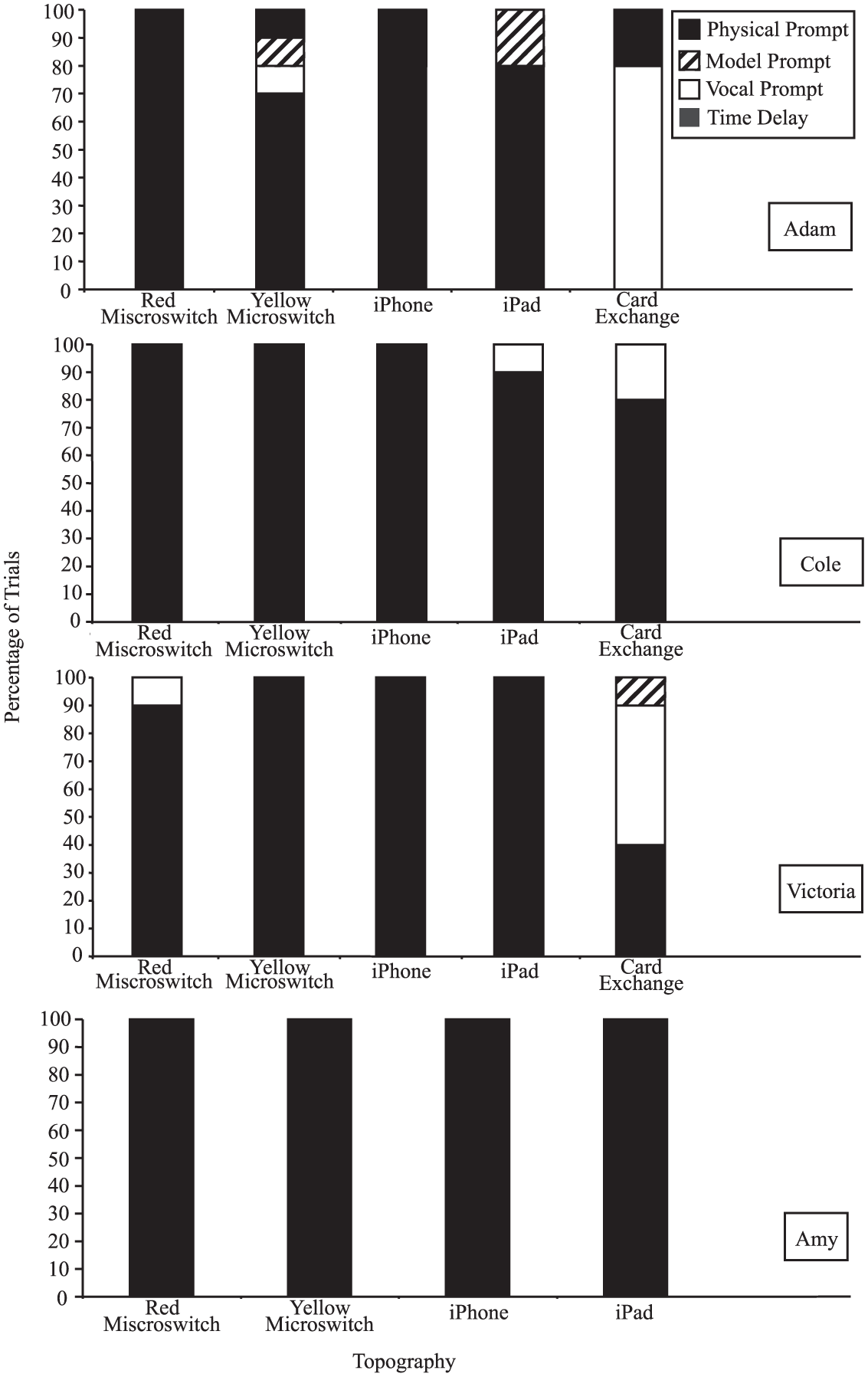
Percentage of communicative responding during the small magnitude and large magnitude conditions for Adam (top panel), Cole (second panel), Victoria, (third panel), and Amy (bottom panel) during the mand topography assessment.
Training/Lag 1 schedule
Similar to Doughty et al. (2013), we conducted preexperimental training with the schedule of reinforcement (i.e., Lag 1 schedule) to be used during the experiment, in which we tested the effects of varying magnitudes of reinforcement. Specifically, we implemented sessions, consisting of 11 trials, to establish consistent variable responding under a Lag 1 schedule. During each trial, the four communicative responses were arranged approximately 1 in. apart on a plastic tray in front of the participant.
Communicative responses were reinforced on a Lag 1 schedule (i.e., access to the same high-preferred edibles were provided contingent on responses that differed from the immediately preceding response). We implemented a 20-second intertrial interval (ITI) following each trial to allow time for researchers to rearrange the communicative responses and prepare edibles for the next trial. It also allowed the participant to take a drink of water after consumption of the reinforcer, if needed. Repetitive responses were ignored and communicative materials were removed during reinforcement and the ITI; they were rearranged between trials. The communicative response during the first trial was not scored as variable or invariable. Training was conducted for a minimum of three sessions and until consistent variable responding was observed (three sessions for Cole; four sessions for Amy, Victoria, and Adam; data available upon request).
Experimental Procedures: Small Magnitude Versus Large Magnitude
Small magnitude
The procedures for the small magnitude condition were similar to those used during the training/Lag 1 schedule, except that one edible reinforcer was provided to the participant (e.g., one small piece of a fruit snack) contingent on variable communicative responding. As with the training/Lag 1 schedule, 20-second ITIs were used, sessions consisted of 11 trials, and the communicative response during the first trial was not scored as variable or invariable. If the participant did not respond within 10 seconds of the presentation of the mand materials, the experimenter removed the communicative materials, withheld reinforcement, implemented a 20-second ITI, and then implemented the next trial. This was not necessary, as each participant emitted responses within 10 seconds on each trial across conditions throughout the study.
Large magnitude
The procedures for the large magnitude condition were similar to those used during the small magnitude condition except that four edible reinforcers were provided to the participant (e.g., four small pieces of a fruit snack) contingent on variable responding.
Results
Figure 2 shows the percentage of variable communicative responding during the alternating treatment sessions for Adam (top panel), Cole (second panel), Victoria (third panel), and Amy (bottom panel). Adam exhibited consistently higher levels of variable communicative responding in the large magnitude condition (M = 82%) than the small magnitude (M = 54%) condition. Stable data paths were observed in the respective conditions, and no overlap between data of the two conditions were observed. Cole also exhibited consistently higher levels of variable communicative responding in the large magnitude condition (M = 85%) than the small magnitude (M = 63%) condition. Stable data paths were observed in the respective conditions and no overlap between data of the two conditions were observed. Victoria also exhibited consistently higher levels of variable communicative responding in the large magnitude condition (M = 91%) than the small magnitude (M = 67%) condition. A stable data path was observed in the large magnitude condition while an increasing trend was observed initially in the small magnitude condition that subsequently decreased. No overlap between the data paths was observed with the exception of Sessions 1 to 3. Amy exhibited consistently higher levels of variable communicative responding in the large magnitude condition (M = 86%) than the small magnitude (M = 61%) condition. Stable data paths were observed in the respective conditions, and no overlap between data of the two conditions were observed.
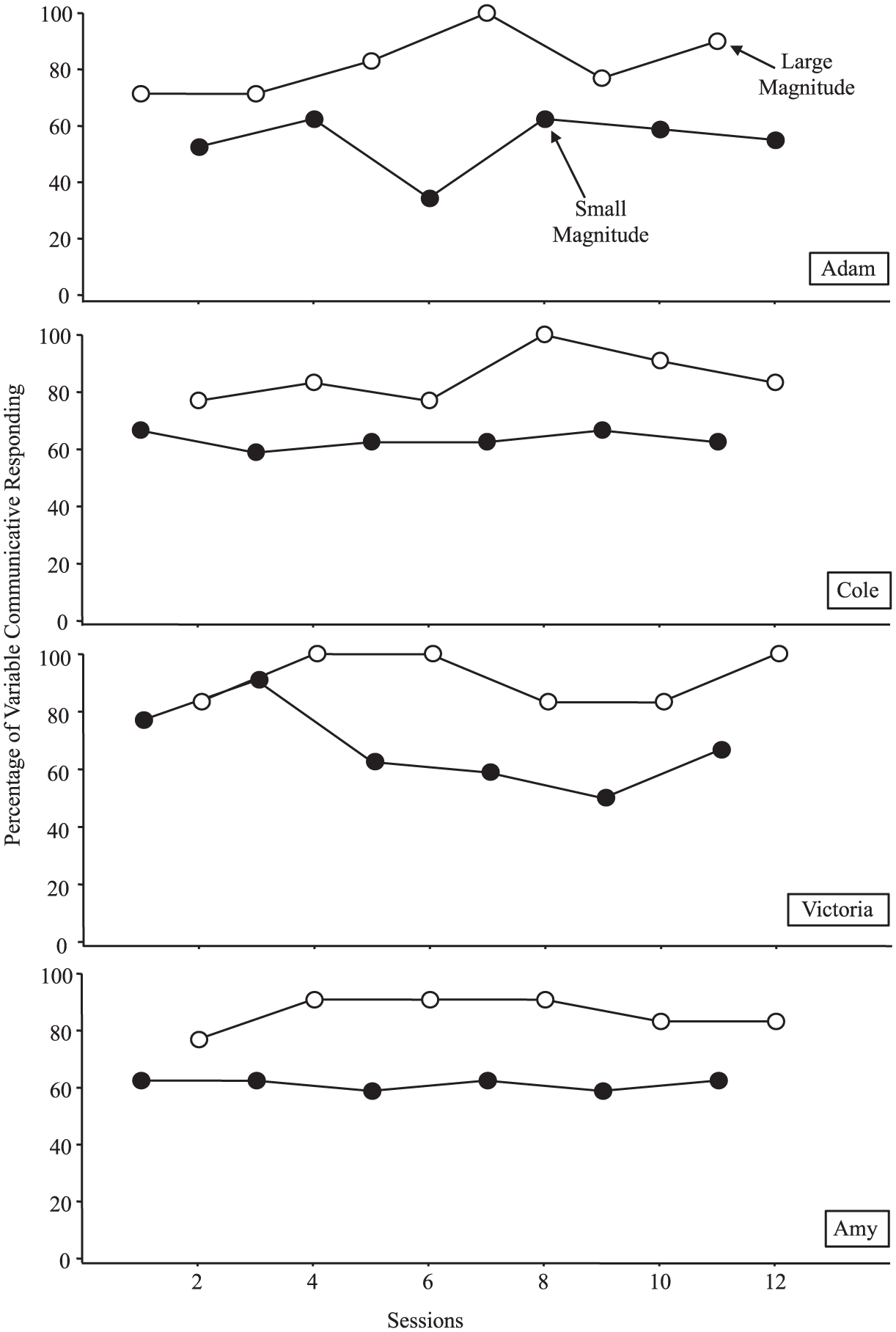
Percentage of variable communicative responding during the small magnitude and large magnitude conditions for Adam (top panel), Cole (second panel), Victoria, (third panel), and Amy (bottom panel) during the small magnitude vs. large magnitude evaluation.
Discussion
We evaluated the effects of varying magnitudes of reinforcement on communicative response variability. The results demonstrated that larger magnitudes of reinforcement increased response variability with all four participants. Smaller magnitudes of reinforcement decreased response variability in comparison to the larger magnitudes; all four participants engaged in moderate levels of response variability during the small magnitude condition.
This study extends the literature pertaining to communicative response variability by demonstrating the effects of magnitude of reinforcement on this outcome. Specifically, the manipulation of dimensions of reinforcement in the form of magnitude may be added to the list of variables or procedures that can impact or be used to increase communicative response variability (e.g., extinction [e.g., Duker & Van Lent, 1991; Grow et al., 2008] script training, reinforcement of novel responses, and the application of extinction [e.g., Betz et al., 2011]; lag schedules of reinforcement [e.g., Adami et al., 2017; Contreras & Betz, 2016; Esch et al., 2009; Falcomata et al., 2018; Heldt & Schlinger, 2012; Lee et al., 2002; Lee & Sturmey, 2006] delays to reinforcement [e.g., Grunow & Neuringer, 2002; Muething et al., 2018]). Second, although not a primary aim of the evaluation, the current results also add to the growing number of studies demonstrating the positive effects of lag schedules for increasing communicative response variability in individuals with ASD. Thus, this study provides additional evidence for the application of lag schedules to increase communicative response variability including an extension to the literature with regard to the magnitude of reinforcement component. As discussed, all four participants demonstrated higher levels of communicative response variability during the lag schedule when large magnitudes of reinforcement were provided. Thus, increasing the magnitude of reinforcement provided during communicative response variability training may help increase variability exhibited by individuals who present low-to-moderate levels of response variability. It may also be that during instances in which lag schedules alone do not produce satisfactory levels of communicative variability, a manipulation of magnitude may be beneficial. For example, both Lee et al. (2002) and Lee and Sturmey (2006) showed positive results with 4 of 6 participants in terms of increased communicative response variability using lag schedules. Although their results were positive, they also showed that for some individuals, supplemental procedures might be necessary to enhance the effects of lag schedules for some individuals with limited communicative response variability repertoires. It is possible that manipulating magnitudes of reinforcement may assist lag schedules to increase communicative response variability in cases in which lag schedules alone do not produce positive outcomes. Future studies could evaluate the effects of combining larger magnitudes of reinforcement with lag schedules when lag schedules alone fail to produce variable communicative responding in individuals with invariable behavior.
This study also adds to and extends the more general literature pertaining to response variability in several ways. Specifically, this study adds to the small but growing number of studies (i.e., Doughty et al., 2013; Stahlman & Blaisdell, 2011) demonstrating the effects of magnitude of reinforcement on response variability. Prior to this study, the effects of reinforcer magnitude on response variability had only been evaluated in the basic literature with nonhuman subjects (i.e., Doughty et al., 2013; Stahlman & Blaisdell, 2011). This study is the first to evaluate the relation between reinforcer magnitude and response variability with a clinically relevant population (i.e., individuals with ASD diagnoses) and applied behaviors (i.e., communicative responses and mands). The current results also add to this literature base with regard to the patterns of responding we observed relative to the previous studies from the basic literature. Specifically, Doughty et al. (2013) showed that higher magnitudes of reinforcement induced repetitive responding; a finding that supported the theory that larger reinforcers inhibit behavioral variability. The results of this study were inconsistent with the findings obtained by Doughty et al., in which higher levels of communicative response variability occurred when reinforced by the larger magnitude of reinforcement. We are unable, within the context of this study, to identify or isolate the mechanism(s) responsible for the discrepancy between the current results and those obtained in the basic literature (i.e., Doughty et al., 2013). There are several possible sources for the discrepant findings between the current results and those obtained in the basic literature including (a) the basic study’s (i.e., Doughty et al., 2013) use of a relative frequency threshold contingency (as opposed to the lag schedule we used in this study) to evaluate the effects of magnitudes of reinforcement on behavioral variability and/or (b) the possible role of verbal or rule-governed behavior unique to human populations. Future studies could further evaluate the potential mechanisms responsible for the differences between the observed effects of magnitude of reinforcement on response variability in the basic and applied contexts.
The current results also extend the applied literature pertaining specifically to magnitude of reinforcement. The manipulation of magnitude of reinforcement has been shown to impact a variety of outcomes including preference for work arrangements (Ward-Horner, Pittenger, Pace, & Fienup, 2014), the effects of noncontingent reinforcement (NCR; J. E. Carr, Bailey, Ecott, Lucker, & Weil, 1998), behavioral persistence (McComas, Hartman, & Jimenez, 2008), choice responding during play activities (Hoch, McComas, Johnson, Faranda, & Guenther, 2002), skill acquisition with differential reinforcement (Fiske et al., 2014), allocation of responding between problem behavior and mands for breaks (Peterson, Frieder, Smith, Quigley, & Van Norman, 2009), and reinforcer efficacy and preference during treatments for problem behavior (Trosclair-Lasserre, Lerman, Call, Addison, & Kodak, 2008). Although other dimensions of reinforcement (i.e., quality, Lee & Sturmey, 2006; delay to reinforcement, Muething et al., 2018) have been shown to affect communicative response variability, the current results are the first to have demonstrated such effects produced by magnitude of reinforcement. Future studies could manipulate the parameters associated with magnitudes of reinforcement under similar conditions to evaluate whether different magnitudes might produce different levels of communicative response variability relative to the current arrangements.
There were several limitations associated with this study. First, it is not known if the communicative response variability outcomes were generalized or maintained outside the research setting. Therefore, future studies evaluating generalized effects and maintenance of communicative response variability resulting from direct training based on the current procedures are warranted. Second, in this study, we manipulated magnitude by differing the quantities of edible reinforcers (i.e., one or four pieces of a preferred edible item); use of specified quantities of reinforcement may not be ideal in some applied situations (relative to duration-based manipulations of magnitudes of reinforcement). Furthermore, it is possible that time-based reinforcement intervals, when magnitude (i.e., duration of reinforcement) is manipulated, may result in different effects than those observed in this study. Future studies might evaluate potential differential effects of magnitudes of reinforcement when time-based intervals are used versus specified quantities of reinforcement. Third, we limited the schedule in place to a Lag 1; it is possible that different levels of communicative response variability might be observed with different magnitudes of reinforcement at different lag schedule arrangements. Future studies could evaluate potential interactive effects between different lag schedule arrangements and varying magnitudes of reinforcement in regards to communicative response variability.
Other future studies might evaluate the effects of different magnitudes of reinforcement on communicative response variability within the context of FCT. As with FCT, we focused on communicative responses in the form of mands. However, we did not include problem behavior as a variable of interest. Results of recent studies (i.e., Adami et al., 2017; Falcomata et al., 2018) have suggested that programming for communicative response variability during FCT might enhance persistence of manding, potentially mitigating resurgence of problem behavior in the face of challenges to treatment. Future studies could evaluate the effects of magnitude of reinforcement within the context of FCT, as it pertains to the possible mitigation of resurgence of problem behavior.
Footnotes
Declaration of Conflicting Interests
The author(s) declared no potential conflicts of interest with respect to the research, authorship, and/or publication of this article.
Funding
The author(s) received no financial support for the research, authorship, and/or publication of this article.
