







Abstract
In the current investigation, we reviewed the literature on communication interventions for individuals with intellectual and developmental disabilities (IDD) on college campuses. Eight studies met our inclusion criteria. Data were extracted related to participant demographics (e.g., disability, response form, type of postsecondary program) and study variables (e.g., design, settings, intervention). We evaluated the methodological quality of each study using the National Technical Assistance Center on Transition’s Quality Indicator Checklist for single-case design studies. Results indicated a dearth of literature in this critical area and that extant literature reflected a primary research emphasis on the use of multi-component packages to teach communication skills to students with mild or no intellectual disability. Limitations and implications for research and practice for transition professionals and university campus providers are discussed.
Keywords
Introduction
Communicative competence is essential in achieving high quality life outcomes as it is required to access the full range of experiences, including access to reinforcers across home, school, and community environments (Skinner, 1957). Unfortunately, many individuals with intellectual and developmental disabilities (IDD), including autism spectrum disorder (ASD), often have difficulty acquiring critical communication skills. As a result, these individuals are more likely to have difficulties in developing and maintaining relationships (Feldman et al., 2015; McCausland et al., 2018), obtaining meaningful employment (Wei et al., 2018), and living independently from their caregivers (Friedman et al., 2013; Shattuck et al., 2012). Further, these individuals may engage in more frequent aberrant behavior as they may not have conventional communication skills sufficient to access reinforcing stimuli or escape aversive conditions (Lauderdale-Littin et al., 2013).
In educational settings, individuals with IDD and complex communication needs may face barriers in accessing high quality educational programming. First, researchers have demonstrated these individuals may require highly specialized procedures to access grade aligned academic content and acquire essential academic skills (Boyle et al., 2019; Singh et al., 2020; Spooner et al., 2019). This may be due in part to students’ difficulties in acquiring the broad range of speaker and listener repertoires required of many traditional instructional activities (e.g., asking questions, applying strategies in response to complex conditional stimuli). Second, data indicate these students are less likely to be engaged during academic instruction (Pennington & Courtade, 2015), receive few opportunities to respond, and have limited supports for communicative interactions (Chung et al., 2012; Kurth et al., 2016). Finally, students with IDD are more likely to receive instruction in restrictive settings where they may have less access to academic instruction and fewer opportunities to learn from, and alongside, peers without disabilities (Kleinert et al., 2015).
Fortunately, researchers have demonstrated the efficacy of numerous intervention procedures in expanding the communication repertoires of individuals with IDD, many of which have garnered sufficient research support to be deemed as evidence-based (e.g., functional communication training, picture exchange communication system, discrete trial training, Steinbrenner et al., 2020). Further, the efficacy of a range of augmentative and alternative communication (AAC) systems have been evaluated to support those students for which vocal responding is limited, unintelligible, or does not emerge (Walker & Snell, 2013). These practices and supports for promoting positive communication outcomes have been recognized widely as an essential component of educational programming for students with IDD (Council for Exceptional Children [CEC], 2014; Peckham-Hardin et al., 2018; Pennington et al., 2016), and much of the research supporting their use has been conducted in school settings (e.g., Pennington et al., 2016; van der Meer & Rispoli, 2010). As a result, teacher education programs in the area of IDD have commonly adopted content related to communication intervention and supports as essential components of their curricula (Pennington et al., 2020).
Despite the field’s acknowledgment of the importance of communicative competence and its well-established tools for promoting positive communication outcomes, many students with IDD do not have access to high quality communication programming in classroom settings. For example, Kurth et al. (2016) observed 19 students with IDD across five high schools within four different districts. Overall, the students only interacted with teachers and peers during 5% and 11% of the observations, respectively. Researchers also noted a “worrisome” lack of supports for facilitating students’ communicative interactions. Similarly, Chung et al. (2012) observed nine elementary and seven middle school AAC users with IDD and reported that students had “somewhat passive roles (p. 362)” during interactions and limited access to their AAC devices. Three of the students had no access to their devices during observations. Likewise, Mellman et al. (2010) conducted a total of 18 classroom observations across three students that used AAC and noted few opportunities for interactions and limited use of their speech generating devices. The authors concluded by highlighting their sense of pervasive missed opportunities across observations. In light of these discouraging findings, it is no surprise that some students with IDD graduate high school with little to no conventional communication repertoire (Kearns, Kleinert, et al., 2011).
As aforementioned, a failure to develop students’ communication repertoires prior to high school graduation may produce negative impacts on a range of potential postsecondary outcomes in adulthood. On the other hand, research suggests that facilitating communication skill development in high school leads to positive postsecondary education and employment outcomes for youth with disabilities (Mazzotti et al., 2020; Rowe et al., 2015; Test, Mazzotti, et al., 2009). One of the primary outcomes emphasized by the Individuals with Disabilities Education Act of 2004 (IDEA, 2004) is postsecondary education and training. Access to postsecondary education is especially critical for students with IDD given its relation to positive employment outcomes (Migliore & Butterworth, 2008), receipt of higher earnings (Migliore et al., 2012), and increased independence (Ross et al., 2013). In 2008, federal legislation was enacted that established a new pathway (i.e., Comprehensive and Transition Postsecondary Programs) and financial supports for students with IDD to seek academic, career and technical, and independent living instruction on college campuses (Higher Education Opportunity Act, 2008) generating an increased emphasis on providing individuals with IDD access to and supports within postsecondary education settings (Grigal et al., 2013). As a result, the number of students with IDD enrolled in programs on college campuses has significantly increased (Grigal et al., 2020).
In the campus environment, students often are expected to engage in routines with higher levels of independence than in K-12 settings, using their communicative repertoire to negotiate essentially every aspect of campus life. As students with IDD increasingly enter the college campus environment, many will require communication instruction and supports for meaningful participation in the myriad of available learning, social, and employment opportunities. The college campus offers a unique environment for supporting students’ communication skills including access to a range of communicative partners, opportunities to communicate across multiple environments and purposes (e.g., classes, social gatherings, community transportation), and potential access to university specific supports (e.g., disability focused centers, specialized teacher or therapy programs, membership in Greek organizations). College campus environments also are likely subject to many of the same barriers present in K-12 settings (e.g., resources, training, technical assistance) and, in some instances, these barriers may be exacerbated by the lack of training and lower expectations for students with IDD held by members of the college community (Gibbons et al., 2015). Further, students on college campuses may have less access to personnel specialized training in providing communication supports that are commonly available in K-12 settings (e.g., speech language pathologists, assistive technology specialists).
In light of the increasing number of students with IDD accessing college campuses and the importance of communication supports to their success in these settings, there is a need to identify interventions implemented on college campuses that have been demonstrated to be effective in producing positive communication outcomes for this unique population of students. The purpose of this investigation was to review and evaluate the extant literature on teaching communication skills to students with IDD on college campuses and to provide guidance on the application of communication supports for college-based support personnel. We addressed the follow research questions:
What interventions have been used to teach communication skills to students with IDD on college campuses?
What are the implementation parameters of those interventions?
What quality indicators for experimental research have been met by the studies included in the review?
Is there sufficient research evidence to establish a practice as evidence-based for teaching communication skills to students with IDD on college campuses?
Method
Inclusion Criteria
To be included in the review, studies met the following criteria: (a) published in a peer-reviewed journal or as a dissertation in English between January of 2000 and May of 2020; (b) used a group or single-case experimental design; (c) included at least one participant with an intellectual or developmental disability, including ASD; (d) evaluated an intervention to increase communication skills among individuals with IDD; and (e) was conducted on a college campus. We included studies that were both implemented on community and 4-year college campuses with participants enrolled in any type of postsecondary educational program including Transition and Postsecondary Programs for Students with Intellectual Disability (TPSID), degree seeking programs, and secondary transition programs housed on college campuses. Dissertations not published in peer-reviewed journals (i.e., gray literature) also were included because these sources may include non-effects, informing conclusions drawn from the review (Ledford & Pustejovsky, 2020).
Literature Search Procedures
Prior to the literature search, we generated a list of terms to capture studies related to our research questions. We used terms related to specific disability categories (i.e., intellectual disability, developmental disabilities, autism, mental retardation), communication (i.e., communication, speech, language, augmentative, social), college settings (i.e., campus, college, university, postsecondary), and experimental design (i.e., randomized controlled trial, experiment, quasi-experimental, ABAB, single-case design, control group, comparison group, post-test, pre-test, baseline, changing criterion, intrasubject replication, multielement, single-subject, alternating treatment, reversal design, withdrawal design). Next, a university librarian with extensive experience in conducting systematic literature reviews and meta-analyses worked with the team to identify databases most likely to generate relevant studies. Databases included APA PsycINFO (EBSCO), CINAHL (EBSCO), ERIC (EBSCO), Educational Administration Abstracts (EBSCO), Education Research Complete (EBSCO), Web of Science (Clarivate), and PubMed. After identification of databases, the librarian conducted an electronic search in EBSCO using truncation and phrase searches as appropriate.
The initial electronic search generated 387 articles for review. Two members of the research team reviewed titles and abstracts of the 387 articles independently and both identified the same eight articles for inclusion in the review. In addition, an ancestral search of reference lists from all included articles was conducted, as well as a review of recent literature reviews focused on teaching communication skills to students with IDD (Gevarter et al., 2013; Pennington et al., 2016; Rispoli et al., 2010). The ancestral search yielded 747 articles for review. Finally, we contacted 10 experts in the areas of postsecondary education, IDD, and/or communication interventions to potentially nominate studies that were not previously included in our search procedures (i.e., articles in press). Two experts recommended a total of five studies not previously identified in our search process, but none of these studies met the inclusion criteria. Therefore, the ancestral and expert nomination process generated no additional articles. See Figure 1 for a study inclusion flow chart. Eight single-case studies met our full inclusion criteria and were coded for content and quality. No group design studies met our criteria for inclusion. Four studies were published in peer-reviewed journals and four were dissertations.
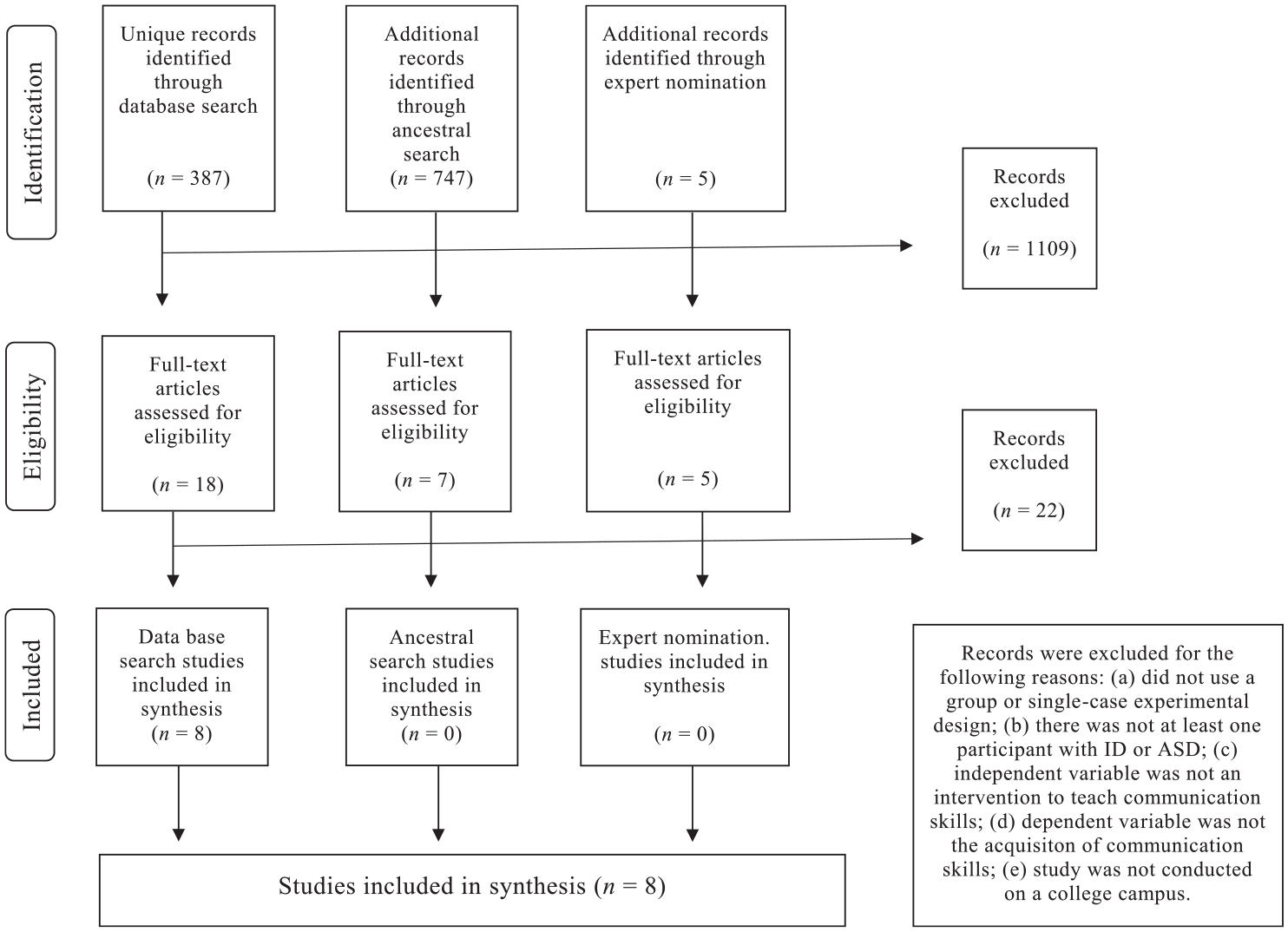
Review of literature inclusion flow chart.
Coding Procedures and Interrater Reliability
For the identified eight studies, we coded for descriptive participant and intervention variables, as well as research quality indicators. In studies that included multiple participants, we only extracted data related to participants with IDD.
Descriptive coding
For each study, we coded several participant variables including (a) gender, (b) age, (c) disability category, (d) response topography taught, (e) type of post-secondary program enrollment, and (f) communicative partner. In addition, we coded whether the intervention produced (a) improved performance over baseline conditions, (b) maintenance of target skills, (c) generalized responding, and (d) socially validity for each participant. Data also were extracted on several study variables including: (a) setting, (b) instructional arrangement (i.e., one-to-one, group), (c) change agent, (d) intervention components, (e) research design, (f) communication skills taught, (g) independent variable reliability, and (h) dependent variable reliability. The first author independently coded all descriptive variables, and the second author coded three articles (37%) for interrater reliability. Interrater reliability was calculated by dividing the number of disagreements by the number of agreements and disagreements, and then, multiplying by 100. Interrater reliability was 97.9%.
Quality indicator coding
Additionally, we coded the studies that met our inclusion criteria for methodological rigor and quality using a checklist developed by the National Technical Assistance Center on Transition (NTACT). The NTACT Quality Indicator Checklist was originally developed by Test, Fowler, et al. (2009) and adapted from Horner et al. (2005) and Kratochwill et al. (2013). We selected the NTACT Checklist rather than other special education quality indicator guidelines (e.g., Cook et al., 2014; Kratochwill et al., 2013) because of our focus on postsecondary education. The Checklist is available for free on the NTACT website (http://transitionta.org/effectivepractices) and contains 20 operationalized indicators across seven categories. These categories included (a) participants, (b) setting, (c) dependent variable/measure, (d) independent variable/intervention, (e) procedures, (f) design/graph/results, and (h) social validity. Lastly, an overall quality determination score was calculated. A study that met all 20 indicators demonstrated “high quality.” A study that met the first 16 indicators and at least one indicator related to social validity demonstrated “acceptable quality.” Studies that met less than 16 or fewer indicators “did not meet quality.” The second author independently coded all quality indicator variables, and the third author coded 37% of the studies with 88.3% reliability. The second author was trained in the Council for Exceptional Children’s Standards for Evidence-Based Practices in Special Education, and the third author participated in the development of the NTACT Quality Indicator Checklist. Prior to coding the eight articles, the second and third authors independently scored three training articles with 85% overall reliability.
Interventions within each study were reviewed and scored as high or acceptable quality to identify evidence-based practices for teaching social or communication skills to students with IDD on college campuses. We examined the number of times each intervention appeared across the eight articles and compared to Horner et al.’s (2005) criteria for deeming a practice as evidence-based (e.g., a minimum of five studies, three independent research teams across three geographic regions, and 20 participants). Only criteria for single-case studies was used because, as described, no group studies met our inclusion criteria.
Results
Participant Variables
Table 1 provides participant demographics. The participants across the eight studies included 13 males and 14 females with ages ranging from 18 to 28 years. Nineteen participants (70%) had ASD, including one participant with pervasive developmental disorder-not otherwise specified. The other eight participants (30%) had an ID. Two participants (7%) were reported to have ASD and ID. Of the participants reported to have an ID, three had a mild ID, four had a moderate ID, and for two participants, the level of ID was not reported. Thirteen participants (48%) were enrolled in a traditional degree seeking program at a university or community college. Eleven student participants (41%) were in postsecondary programs for individuals with disabilities, and three participants (11%) were enrolled in a high school transition program housed on a college campus.
Participant Demographics.
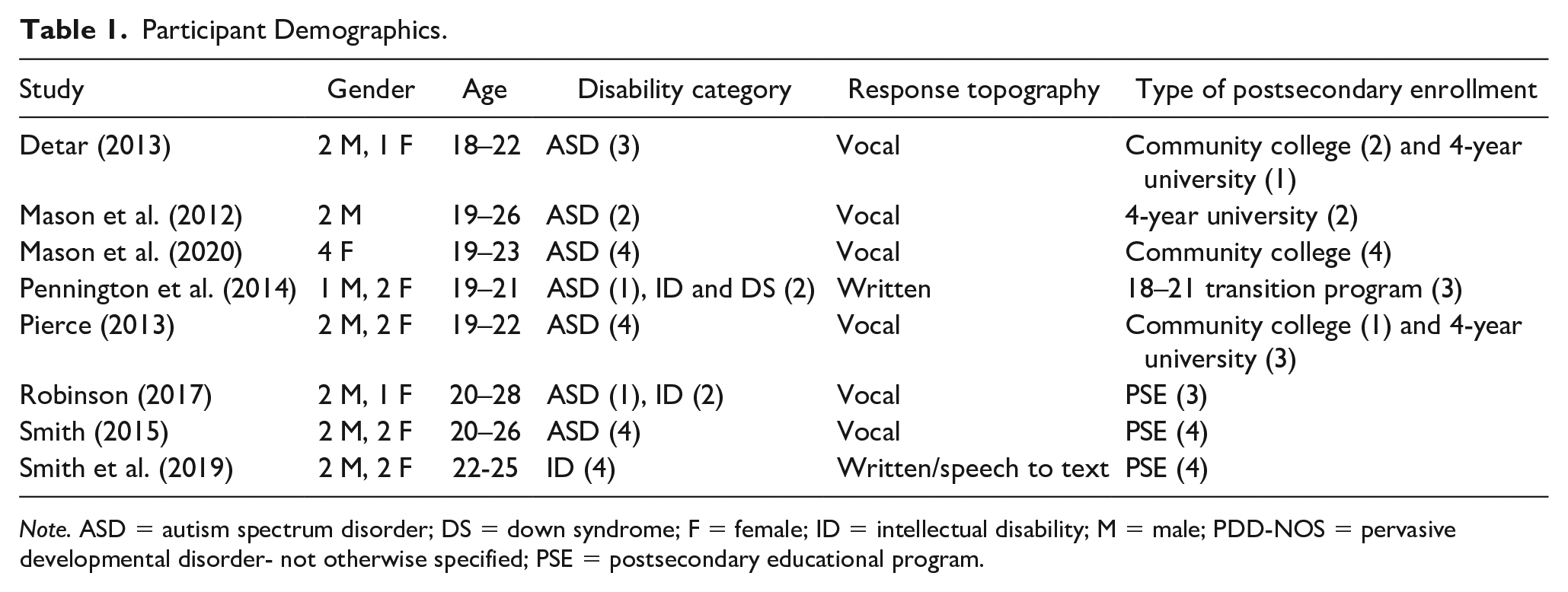
Note. ASD = autism spectrum disorder; DS = down syndrome; F = female; ID = intellectual disability; M = male; PDD-NOS = pervasive developmental disorder- not otherwise specified; PSE = postsecondary educational program.
All participants were taught to emit either vocal (74%) or text (26%) responses. Twenty-four participants (89%) demonstrated improved performance following the introduction of intervention strategies. Mixed results were observed in one study (Smith, 2015). Of the 15 participants for which generalization data were collected, 13 participants (87%) demonstrated some generalized responding. All seven participants (100%) for which maintenance data were collected demonstrated maintenance following termination of intervention procedures. Finally, of the 10 participants for which social validity was assessed, nine indicated the intervention, goals, or outcomes were socially valid.
Study Variables
Table 2 presents study variables. Three research teams (37%) conducted studies in classrooms on a college campus. Three studies were conducted in campus common areas (e.g., coffee shops, dining halls), and two were conducted in therapeutic settings (i.e., therapy room, ASD center). Researchers implemented instructional strategies in one-to-one arrangements in five studies (63%) and in-group arrangements in three studies (37%). Across all studies, researchers implemented instructional procedures with the exception of one (i.e., Smith, 2015) in which a researcher and a program coordinator implemented procedures. In half of the studies, students were taught to emit communicative responses that were reinforced by a researcher. In the other half of the studies, students emitted communicative responses to peers with and without disabilities. Five research teams reported the length and frequency of intervention sessions. Four teams indicated intervention sessions occurred at least weekly (i.e., between 1 and 3 sessions), and one team reported sessions occurred at least once a month. Sessions ranged between 10 and 90 minutes in duration.
Study Variables.
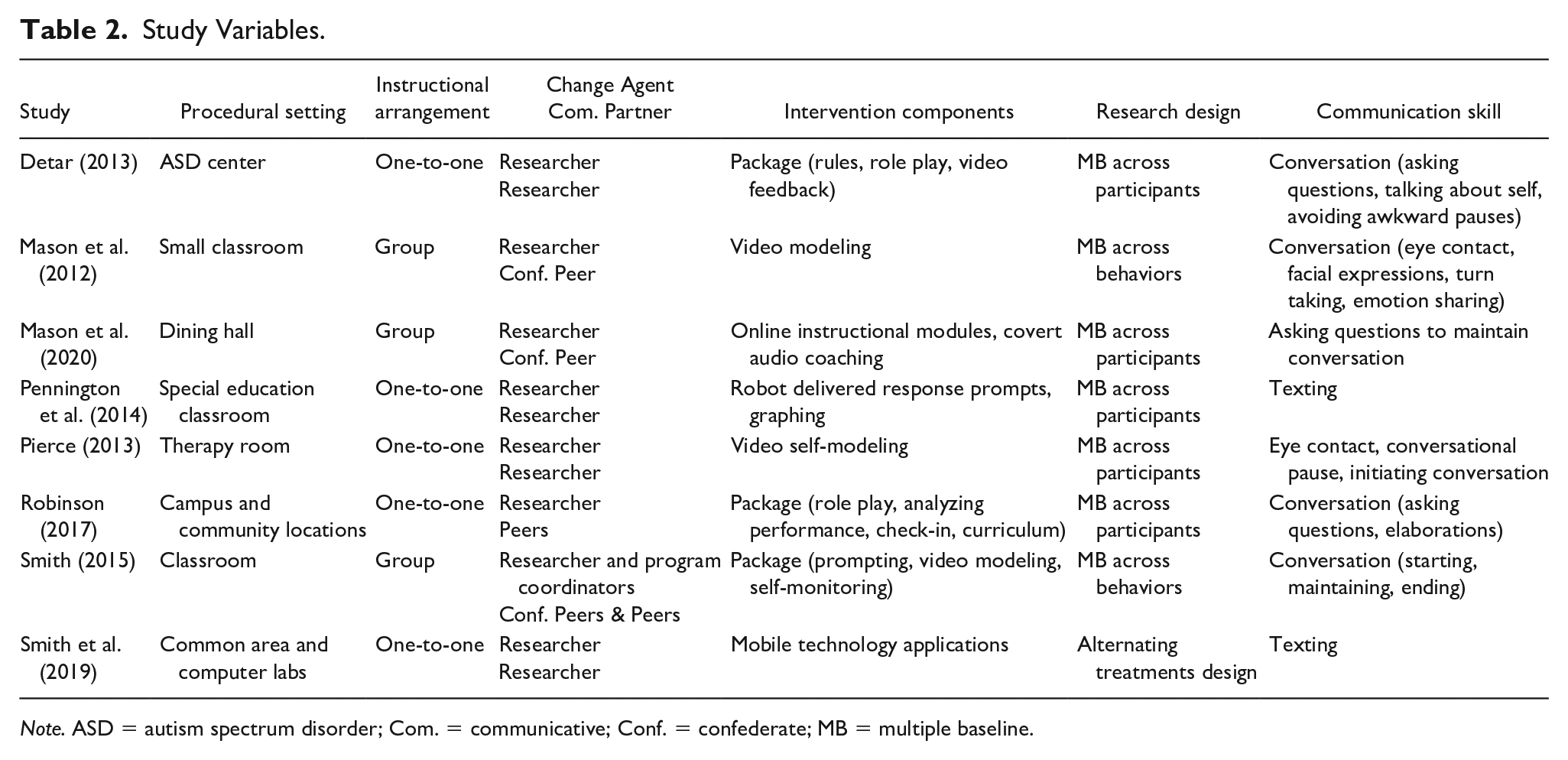
Note. ASD = autism spectrum disorder; Com. = communicative; Conf. = confederate; MB = multiple baseline.
Six of the research teams targeted multiple conversation skills for intervention (e.g., starting a conversation, waiting an appropriate response interval, eliciting eye contact, asking questions). Two teams targeted electronic text messaging (Pennington et al., 2014; Smith et al., 2009). Only one team targeted asking questions to enhance conversation skills (Mason et al., 2020).
The majority of research teams, with the exception of one (video modeling only, Mason et al., 2012), implemented intervention packages containing multiple components. Six research teams (75%) incorporated technology into their instructional programs. Three of the teams (37%) used either video or video self-modeling strategies (Mason et al., 2012; Pierce, 2013; Smith, 2015). One team, Mason et al. (2020), evaluated the effects of online instructional modules and covert audio coaching. Pennington et al. (2014) used a small humanoid robot to deliver simultaneous prompting procedures to participants.
Four research teams (50%) incorporated response prompting strategies (i.e., time delay, system of least prompts, simultaneous prompting). These procedures generally involved the presentation of a natural or programmed instructional stimulus (i.e., instructor directives, peer proximity), the delivery of a response prompt (e.g., vocal model, gestural prompt, physical assistance) to ensure the learner responds accurately and contacts reinforcement, and the subsequent fading of the prompt by inserting a delay interval, or introducing a hierarchy of less intrusive prompts. One team, Smith et al. (2019), reported using a model-lead-test procedure. The researchers provided participants with a demonstration of text messaging (model), used response prompts to assist participants in completing text messaging steps (lead), and then provided an opportunity for participants to send text messages without prompting support (test). Four of the studies (50%) included strategies for self-evaluation. Two teams reported the use of self-monitoring strategies (Pennington et al., 2014; Smith, 2015). One team provided participants the opportunity to review video recording performances (Detar, 2013), and one reported to check in with participants to provide opportunities to analyze their performance (Robinson, 2017).
Seven research teams used a multiple baseline across participants design (Baer et al., 1968) and one used an alternating treatments design (Barlow & Hayes, 1979; Smith et al., 2019). Five of the teams reported acceptable levels of procedural fidelity (i.e., 88–100%), and all teams reported acceptable levels on interrater reliability (i.e., 80% or above). One team, Mason et al. (2012), reported 79% agreement on one of the multiple dependent variables in their study (i.e., turn taking).
Quality Indicators
Table 3 presents the NTACT quality indicator (QI) coding results. Five of eight studies met NTACT’s criteria for being deemed as acceptable quality (i.e., meets QIs 1–16 and at least one of 17–20). One study (Mason et al., 2012) did not meet QI 11 (i.e., measurement of the fidelity of implementation for independent variable) and another did not meet QI 2 (participant description; Pierce, 2013). Smith (2015) met only seven total QIs. As a result, three studies were determined to be of unacceptable quality.
NTACT Quality Indicator Coding Results.
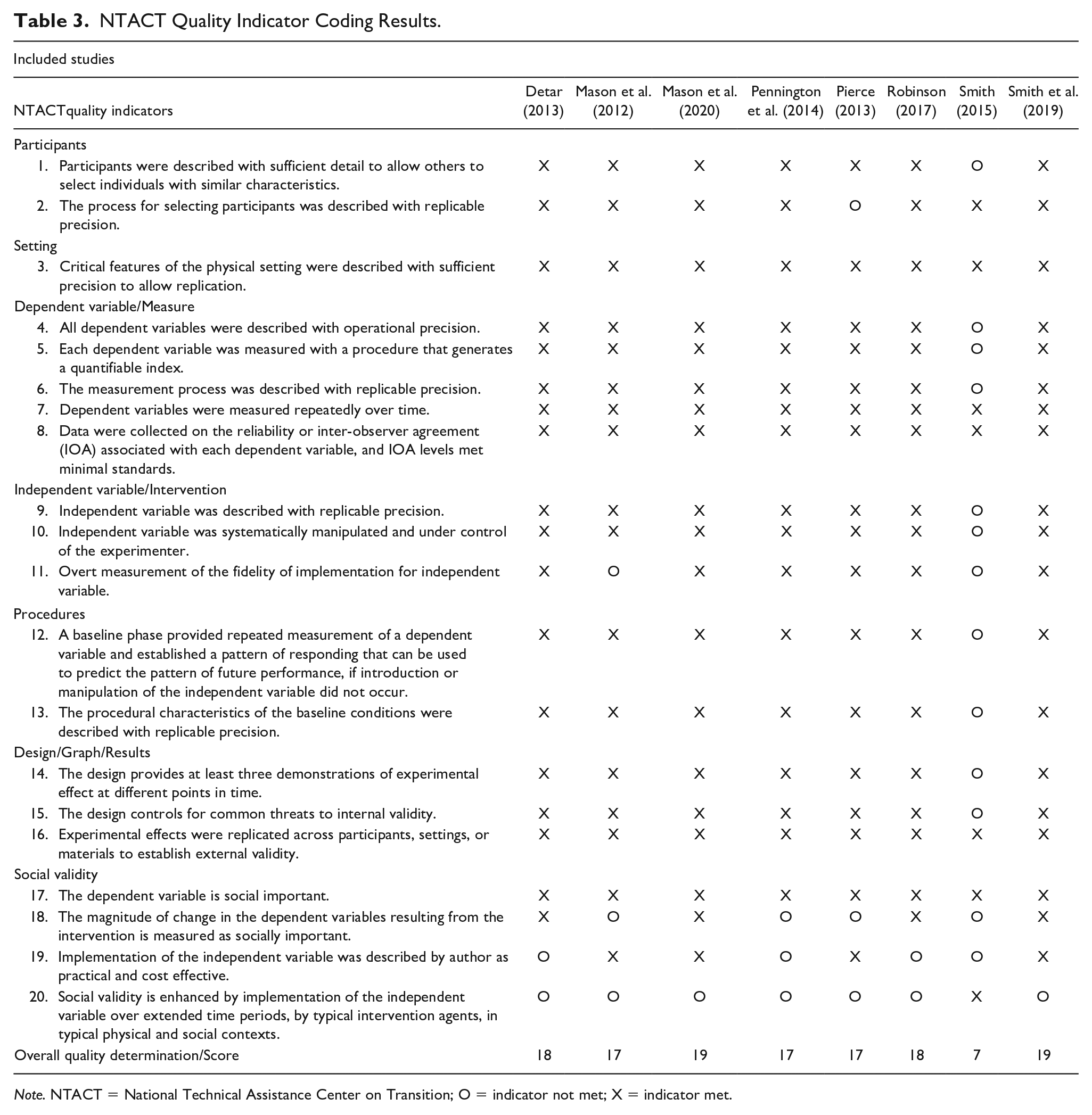
Note. NTACT = National Technical Assistance Center on Transition; O = indicator not met; X = indicator met.
Across the five studies scored as of acceptable quality, research teams employed intervention packages containing multiple components. Components included robot-delivered instruction, video modeling, response prompting, self-monitoring, role play, and teaching rules. No package or single intervention component met the Horner et al. (2005) criteria to be deemed an evidence-based practice for teaching social or communication skills to students with IDD on college campuses.
Discussion
As students with IDD increasingly access the opportunities afforded by enrolling in programs on college campuses, communication instruction and supports will be needed to maximize their positive outcomes. The purpose of the current systematic literature review was to examine the literature on teaching communication skills to students with IDD on college campuses, identify and evaluate intervention studies, and potentially identify evidence-based practices. Unfortunately, our review yielded few studies that met our search criteria and cast light on the dearth of research in this critical area. As a result, our review generated a new function, which is to highlight a critical area in need for research and to potentially serve as a catalyst for new investigations.
The current review produced only eight studies, the majority of which evaluated instructional packages that comprised multicomponent interventions (e.g., robot technology + response prompts + self-evaluation, Pennington et al., 2014). Several of the components have previously been identified as evidence-based practices for teaching communication skills to individuals with ASD ages 15 to 22 years (i.e., response prompting, technology-aided instruction, video modeling, Steinbrenner et al., 2020). One practice, self-management, was included in four studies and has been previously deemed an evidence-based practice for teaching communication to individuals with ASD aged 6 to 14 years (Steinbrenner et al., 2020). Overall, the research teams employed these practice components within an explicit instruction framework (Archer & Hughes, 2010) as they presented models of or prompts for correct performance, opportunities to practice skills, and then performance feedback. It is not surprising that researchers applied practices in college settings previously deemed effective in other contexts and for other age groups, as the variables that effect the occurrence or nonoccurrence of communicative behavior are likely similar for individuals across the lifespan (i.e., motivating operations, discriminative stimuli, reinforcement). Therefore, the difference between communication instruction in high school and postsecondary settings is likely less about the particular instructional strategies that manipulate these variables but, rather, more about how and by whom they are implemented.
In seven of the studies, researchers implemented all intervention procedures, thus providing little information related to the capacity and training required for typical change agents (e.g., faculty, teachers, disability resource center staff) to effectively deliver communication supports. Because the inclusion of students with IDD on college campuses is relatively new, many university-based programs may have less experience in planning and programming for communicative supports. As a result, there is a need to investigate innovative programs implemented by indigenous support personnel available across a range of institutions, including universities, community colleges, virtual programs, and secondary transition programs housed on college campuses. Further, there is a need for research on the use of peer-delivered interventions and supports in the postsecondary educational environment. In our review, four research teams used confederate or naturally available peers as communicative partners during their investigations. Suggestions for future researchers include training these same-age communicative partners to implement instructional strategies as a natural, inclusive support. Since a growing body of research reflects the efficacy of peer-supports in public school settings (Brock & Huber, 2017; Carter et al., 2016), we purport the college setting, ripe with increased student autonomy, may provide a fertile environment for the development of effective peer support programs.
Five studies in the current review targeted supports for participants with ASD and no reported comorbid ID. The remaining three studies included participants with ID, including two with ASD. Of the 10 participants, four were reported to have a moderate level of ID. Further, all participants in the reviews had functional vocal repertoire and none were reported to use AAC systems. These findings are troubling in that our review yielded little information from which to extract guidance on providing communication supports, including AAC, to students with the most complex communication needs. As described, these students may graduate from high school with communication repertoires insufficient for navigating complex postsecondary environments and are increased risk for isolation, exploitation, and harm (Kearns, Towles-Reeves, et al., 2011; Myers et al., 2015). This void of literature is inconsistent with the trend in students with more severe disabilities entering programs on college campuses and highlights the urgent need for increased research attention to the application of interventions for teaching full range of communication skills to these learners.
Though researchers in the included studies targeted a small set of communication skills, they did teach skills that are critical for success in the college environment (e.g., conversation, text messaging). Six of the studies focused on improving conversation skills related to starting, maintaining, and ending conversations. The researchers targeted both overt skills (e.g., asking questions, elaboration, emotional sharing) and subtle conversation skills (e.g., talking about a conversational partner’s interest, reducing awkward pauses, eye contact). Investigators commonly used modeling, role play, and feedback during instruction. Notably, the researchers that targeted subtle skills provided opportunities for students to observe correct performance through video models or video feedback. As aforementioned, there also is need for researchers to demonstrate the effectiveness of intervention in teaching more basic communicative functions (e.g., mands, tacts) within the campus settings. These settings present unique and complex challenges that may differ from K-12 settings. For example, in K-12 settings, students’ responses may come under control of a restricted audience because access to some reinforcers (e.g., edible, assistance) are controlled by particular change agents (e.g., teachers). In university settings, students must learn to respond in the presence of an extended audience as reinforcers may be more freely exchanged between students as instructors’, role as sole arbiters of programmed reinforcers is diminished.
Two research teams taught participants to emit electronic messages to a communicative partner. Messaging is an important skill for success in college settings as students often use this form of communication to interact directly with peers, schedule meet ups for face to face interactions, and obtain class- related information (Skierkowski & Wood, 2012). The two teams targeted different message topographies: Pennington et al. (2014) taught students to type text messages, whereas Smith and colleagues taught students to communicate with peers using a range of messaging topographies (i.e., text, audio, video). Both research teams taught students to emit simple messages using explicit instructional strategies (e.g., model-lead-test, response prompting strategies). Future research is needed to develop strategies for college students with IDD to emit more complex text responses, such as initiating, maintaining, and terminating digital conversations. In addition, researchers should evaluate the efficacy of strategies for teaching students to incorporate mixed media into messaging (e.g., gifs, pictures, emojis), as these are age-appropriate for many young digital media users.
Though our review provides some insight into effective interventions for teaching communication skill to students with IDD, our findings should be viewed with caution. Of the eight studies identified in our review, only four were published in peer-reviewed journals, and the other four were unpublished dissertations. We included dissertations in this review to gather a potentially deeper understanding of the literature and to identify potential null intervention effects, but also acknowledge the potential pitfalls of drawing conclusions from articles not submitted to peer review. It also is important to note that only five of the studies included in the review were scored as of acceptable quality. Of those five studies, none met the standards for high quality because they failed to meet one or more quality indicators on the NTACT Quality Indicator Checklist related to social validity. This is unfortunate as the field might benefit from a greater understanding of the acceptability of communication interventions and supports on college campuses.
Finally, it is important to note that though the introduction of intervention was effective for a majority of participants, researchers collected limited maintenance data. Researchers collected maintenance data at 1 to 4 weeks following intervention for only seven of the participants (26%). Data indicated that all seven of those participants maintained performance at levels higher than baseline. Researchers collected generalization data for 17 (63%) of the 27 included participants. Thirteen participants (48%) generalized responding to novel communicative partners, and seven (26%) to different settings. In light of the researchers’ use of atypical change agents, and in many cases atypical social settings (i.e., special classes, therapy room, ASD center), this current body of literature is limited in its capacity to evaluate the durability and generalizability of interventions on college campuses.
One half of the investigative teams (n = 4) calculated an effect size measure. All four of the studies used an effect size measure that was determined by overlapping methods (Detar, 2013, such as PND (percentage of non-overlapping data; Mason et al., 2012; Smith et al. 2019) or IRD (improvement rate difference; Smith, 2015). Detar also reported using an additional effect size measure, Cohen’s d. Different effect size measures yield different outcomes, so summary statements about effect size for studies included in this review would be inappropriate.
Limitations
There are several limitations to the current review. First, it is plausible that despite our best efforts to search the literature, we may have failed to locate other studies that would have met our inclusion criterion. For example, though we included “social” and “communication” as search terms, we may have missed studies describing communicative behaviors using different terminology. Therefore, it might be accurate to view results of this review as an approximation or estimation of the total body of literature on teaching communication skills to students with IDD on college campuses. Second, data were extracted, reported, and interpreted from a body of literature, tenuous in terms of quality. With that said, only four studies were subject to blind peer review, and only five (63%) met standards to be deemed as acceptable quality. As a result, any conclusion drawn from the review should be viewed carefully and with skepticism. Finally, we did not calculate effect size for the studies due to concern that reporting an effect size statistic might overshadow the lower quality of several of the studies.
Footnotes
Declaration of Conflicting Interests
The author(s) declared no potential conflicts of interest with respect to the research, authorship, and/or publication of this article.
Funding
The author(s) received no financial support for the research, authorship, and/or publication of this article.
