







Abstract
Behavioral parenting interventions have been shown to decrease early childhood behavior problems by improving parenting skills. Few studies have examined the impact of therapist coaching statements on parenting skill acquisition, especially among ethnic minority families and non-English-speaking families. In this study, we examined therapists’ use of responsive and directive coaching statements during the first coaching session in a brief parenting intervention, the Infant Behavior Program (IBP), on changes in parenting skill acquisition. Participants were 24 mothers of 12- to 15-month-olds, with elevated levels of behavioral problems from primarily Latinx and low-income backgrounds. Mothers who heard more responsive coaching from their therapist showed greater increases in positive parenting skills. Spanish-speaking therapists used fewer responsive coaching statements and more commands, however, language spoken did not moderate the effect of these statements on changes in parenting skills. Responsive coaching statements in English and Spanish had a positive impact on parenting skill acquisition.
Externalizing behavior problems in children are one of the most common reasons for parents to seek psychosocial treatment for their young child (Keenan & Wakschlag, 2000). Early externalizing behavior problems affect about 15% of children 2- to 3-years-old (Carter et. al., 2004), with higher rates among children from low-income families (Holtz et al., 2015), and are associated with later impairments in academic functioning and peer socialization, as well as an increased risk for antisocial behavior (Shaw et al., 2003; Silva et al., 1987; van Lier et al., 2012). Research has demonstrated support for the use of behavioral parenting interventions, such as Parent-Child Interaction Therapy (PCIT), in reducing child externalizing behavior problems by targeting parenting behaviors (Eyberg et al., 2008; Thomas et al., 2017). However, few studies have examined the impact of therapist behavior on changes in parenting behavior.
Previous studies examining therapist behavior have focused on the role of the therapist-child or therapist-parent alliance during treatment. For example, a meta-analysis examining treatment for internalizing and externalizing disorders found therapeutic alliance was a significant predictor of child treatment outcome (Shirk & Karver, 2003). Similar results were found when examining behavioral parenting interventions for oppositional, aggressive, and antisocial behavior (Kazdin et al., 2006). However, previous studies included measures of alliance based on therapist or client report, which tends to be biased (Shirk & Karver, 2003), and have not examined the effect of specific therapist statements on treatment outcome, which would provide a more objective measure of therapist behavior during sessions. For example, the number of questions therapists asked during the initial interview and teach session of PCIT predicted treatment dropout (Harwood & Eyberg, 2004). The current study aims to build on previous research by examining therapist statements during parent coaching and how these statements influence parenting skill acquisition.
Parent Coaching
PCIT is unique in that therapists use in-vivo parent coaching to change parent behavior. In-vivo parent coaching refers to coaching parents live during the session. During the first phase of treatment, the Child Directed Interaction (CDI), therapists coach parents to use positive parenting skills or do skills that include labeled (i.e., specific) praises, reflections of the child’s speech, and descriptions of the child’s behavior. In addition, therapists coach parents to avoid don’t skills, which include asking questions, giving commands, and criticizing the child. Therapists use specific statements to guide parents during coaching sessions: these are categorized as directive or responsive statements specific to parents’ contributions (Borrego & Urquiza, 1998). Directive coaching statements tell the parent what to do (e.g., “Describe what your child is doing”), while responsive coaching statements reinforce the parent’s use of the skills (e.g., “Great labeled praise!”). In general, the use of in-vivo coaching during behavior parenting interventions has been associated with increased parenting skill acquisition (Shanley & Niec, 2010) and improvements in child behavior (Kaminski et al., 2008).
To date, only two studies have examined therapist coaching statements in PCIT and their effect on parenting skills. These studies used the Therapist-Parent Interaction Coding System (TPICS; Barnet et al., 2014), a behaviorally based coding scheme of therapist coaching statements. First, Barnet and colleagues (2014) examined therapist statements during CDI and found that therapists modeled speech (i.e., providing statements for parents to use) and used specific labeled praises (e.g., “great job describing what your child is doing”) more frequently than drills (e.g., “Try to use as many labeled praises as you can in the next 2 minutes”) and corrective criticisms (e.g., “Oops, that was a question”). Additionally, results suggested directive coaching was negatively associated with parental use of labeled praises, whereas responsive coaching was positively associated with parental use of labeled praises. In the second study, Barnet and colleagues (2017) showed responsive coaching predicted a higher likelihood of treatment completion.
To our knowledge, these were the only two studies examining the effect of therapist coaching statements on parenting skills. These studies included only brief observations of coaching (i.e., 10 minutes), which limits our knowledge of how therapist coaching statements influence parenting skill acquisition. Additionally, these studies included primarily White and English-speaking families and therapists. The current study aims to replicate the findings found by Barnett and colleagues in a study examining the Infant Behavior Program (IBP), an adaptation of PCIT for infants at risk for externalizing behavior problems (described in more detail below), to examine if therapist coaching statements influenced parenting skill acquisition in families from primarily low-income and Latinx backgrounds.
Language Differences
The Latinx 1 population in the United States has increased substantially, with 22% of the population in 2018 identifying as Latinx (U.S. Census Bureau, 2018). PCIT has been shown to be effective for Latinx families (Borrego et al., 2006; Matos et al., 2006, 2009), including the use of cultural adaptations of PCIT for Mexican-American families (McCabe et al., 2012; McCabe & Yeh, 2009). However, Latinx parents needed more time to acquire parenting skills taught during treatment compared to their non-Latinx counterparts (McCabe and Yeh, 2009) and expressed less verbal approval and more verbal disapproval of their children during play (McCabe et al., 2012). Furthermore, research showed that Spanish-speaking Latinx parents used higher levels of negative parenting skills during child-directed play (e.g., commands) compared to English-speaking Latinx parents (Ramos et al., 2018). To our knowledge, however, no study has examined therapist statements and their effect on parent skill acquisition among predominately Latinx families and Spanish-speaking therapists and parents. Thus, we will examine differences in coaching statements between English- and Spanish-speaking therapists, and whether language spoken during coaching moderated the effect of therapist coaching statements on parenting skills.
Current Study
The goals of the current study were to examine how therapist coaching statements impacted do and don’t parenting skills (described above), as well as differences in coaching statements between English- and Spanish-speaking therapists and whether language spoken during coaching moderated the effect of therapist coaching statements on parenting skill acquisition. Specifically, we examined the effect of therapist statements during the first coaching session on changes in parenting skills between the first and second coaching sessions. Based on previous work by Barnett and colleagues (2014, 2017), we hypothesized that: (1) higher levels of responsive therapist coaching statements would predict increases in do skills and decreases in don’t skills; and that (2) higher levels of directive coaching would predict decreases in do skills and increases in don’t skills. Additionally, we hypothesized that Spanish-speaking therapists would use less responsive coaching statements and more directive coaching statements than English-speaking therapists, and that the use of Spanish during treatment would attenuate the effect of therapist coaching statements on parenting skill acquisition.
Methods
Participants
Participants were 24 parent-infant dyads randomized to receive the IBP as part of a larger randomized controlled trial (Bagner et al., 2016). Families were recruited from a large pediatric primary care clinic primarily serving ethnically diverse and low-income children and provided informed consent prior to screening for the study. Families were eligible for the study if their infant was between the ages of 12 and 15 months and scored above the 75th percentile on the problem scale of the Brief Infant-Toddler Social and Emotional Assessment (BITSEA; Briggs-Gowan et al., 2004), a parent-report screening measure of infant behavior problems. Primary caregivers, who were all mothers in this study, were required to speak either English and/or Spanish and score a 70 or higher on the estimated full-scale IQ score based on the vocabulary and matrix reasoning subtests of the Weschler Abbreviated Scale of Intelligence (WASI; Wechsler, 1999) for those who spoke English (50%), or an average scaled score of 4 or higher on the vocabulary and matrix reasoning subtests on the Escala de Inteligencia Wechsler Para Adultos-Third Edition (EIWA-III; Pons et al., 2008) for those who spoke Spanish (50%).
Intervention
The IBP is a home-based adaptation of PCIT for high-risk infants. During the IBP, parents learn to follow their infant’s lead in play and ignore safe but disruptive behaviors (e.g., temper tantrums). Therapists coached caregivers to increase their use of positive parenting skills and decrease their use of negative parenting skills. Families received up to 7 weekly 1-hour sessions with an average of 6.1 sessions in their home. The first session was a teach session, where caregivers learned to use positive parenting skills, which included providing specific praises for appropriate infant behavior (e.g., playing gently with the toys), reflecting the infants speech, attempts at speech, and sounds, describing and imitating their infant’s play, and using enjoyment throughout the play. They also learned to ignore any disruptive or inappropriate behaviors (e.g., whining, yelling) and direct the positive parenting skills to appropriate infant behaviors. The remaining sessions were coach sessions. Each coach session started with a 5-minute parent-infant observation during which the therapist collected data on the skills the caregiver(s) used with the infant. This observation was used as a guide for therapists to coach parent(s) for the remainder of the session. The intervention was provided in either English or Spanish based on the preference of the family. All therapists in this study were doctoral students in clinical psychology trained by a PCIT Master Trainer and the developer of the IBP. See Bagner and colleagues (2013) for more details about the development of the IBP and Bagner and colleagues (2016) for the randomized controlled trial (RCT) demonstrating the effect of the IBP on changes in infant and parent behavior.
In the RCT, families were randomized (using a random number generator) to receive IBP (n = 31) or standard pediatric primary care (n = 29). Of the 31 families randomized to the intervention, 24 (77%) families completed the first coaching session and were included in this study. Most of the primary caregivers reported living in poverty (50%) and identified as Hispanic or Latino (91%). Infants (42% male) were, on average, 14 months at baseline (M = 14.04, SD = 1.30). Fifty percent of the treatment sessions were conducted in Spanish by native Spanish-speaking therapists.
Outcome Measures
Therapist coaching statements
The Therapist-Parent Interaction Coding System (TPICS; Barnet et al., 2014) is a behavioral coding system that measures therapist statements used to coach parents in their skills. We assessed therapist statements throughout the entire duration of the first coaching session. TPICS codes included in the current study were classified as responsive and directive coaching statements consistent with previous research (Borrego & Urquiza, 1998). Responsive coaching follows the parent’s behavior and includes praises (e.g., “Good behavior description”), constructive criticisms (e.g., “Oops, that was a question”), reflective descriptions (e.g., “That was a behavior description”), and process comments (i.e., a statement that ties the child’s behavior to the parent’s response). Directive coaching instructs the parent to use the skills and includes modeling (e.g., providing statements for parents to use), prompting (e.g., “Good job for what?”), direct commands (e.g., “Ignore that behavior”), indirect commands (e.g., “Let’s ignore him”), or drills/exercises (e.g., “I want you to reflect everything he says in the next minute”). Rate per minute of each statement was calculated due to differences in coaching time across participants and sessions, which ranged from 12 to 39 minutes per session (M = 23.50, SD = 7.16). Twenty percent of the sessions were coded a second time for reliability, which was strong for responsive coaching statements (Kappa range from 0.96 to 1.0) and directive coaching statements (Kappa range from 0.97 to 1.0).
Parenting skills
The Dyadic Parent-Child Interaction Coding System—Fourth Edition (DPICS-III; Eyberg et al., 2013) is a behavioral coding system that measures the quality of the interaction between the parent and child, including the use of parenting do and don’t skills. We measured parenting skills during the 5-minute observed parent-infant interaction at the beginning of each coaching session. The DPICS categories coded in this study included do skills (i.e., labeled praises, reflections, and behavior descriptions) and don’t skills (i.e., negative talk, questions, and commands). The proportion of each skill was calculated to account for the total number of each parent’s verbalizations, which included parent neutral talk. Proportions were calculated by dividing the total number of do or don’t skills by the total number of parent verbalizations. Therapists coded these skills at the beginning of each session, and 20% of the segments were coded a second time for reliability and yielded moderate to strong reliability estimates for do skills (Kappa range from 0.77 to 1.0) and don’t skills (Kappa range from 0.77 to 1.0).
Statistical Analysis
Analyses were conducted in SPSS version 25. To estimate the impact of therapist coaching statements on parenting skills, we used linear regressions to examine the effect of therapist statements on changes in parenting skills from the first to the second coaching session. Separate models were conducted for responsive and directive coaching, as well as for each individual therapist coaching statement codes. Child age, therapist total utterances, and parenting skills during the first session (to model change in parenting skills from the first to second coaching session) were used as covariates in each model.
To examine differences in coaching statements between English- and Spanish-speaking therapists, we conducted t-tests for responsive and directive coaching statements, as well as for individual coaching statements. We also conducted moderation analysis (PROCESS 3.0; Hayes, 2017) to examine if language (i.e., Spanish or English) moderated the effect of coaching statements on parenting skills, and we included child age, total therapist utterances, and parenting skills during the first session as covariates.
Results
Missing Values Analysis
Twenty-four families completed the first coaching session and were included in the analyses. Twenty families completed the second coaching session, and there were no significant differences on demographic measures or outcome measures between families that only completed the first coaching session and families that completed the first and second coaching sessions. Missing value analysis showed that missingness was not associated with any demographic or outcome measures, and that data was missing completely at random (MCAR). Multiple Imputation was conducted with 20 imputations to estimate the missing data for these four families.
Direct Effects
The first series of linear regressions tested the direct effect of therapist coaching statements on parenting do skills. There was a statistically significant effect of therapist responsive coaching statements on parenting do skills, F(4,19) = 10.61, p = .042, R2 = 0.67, such that higher rates of responsive coaching predicted a higher proportion of parenting do skills at the subsequent session. However, there was no significant effect of therapist directive coaching statements on parenting do skills, F(4,19) = 8.27, p = .305, R2 = 0.62. When examining individual therapist statements, higher rates of praise predicted a higher proportion of parenting do skills at the subsequent session, F(4,19) = 11.00, p = .029, R2 = 0.68, and higher levels of indirect commands predicted a lower proportion of parenting do skills at the subsequent session, F(4,19) = 13.01, p = 0.009, R2 = 0.72.
The second series of linear regression models tested the direct effect of therapist coaching statements on parenting don’t skills. Rates of responsive coaching, F(4,19) = 1.19, p = .100, R2 = 0.20, and directive coaching, F(4,19) = 0.40, p = .935, R2 = 0.08, did not significantly predict proportion of parenting don’t skills. When examining individual therapist coaching statements, no therapist statement significantly predicted proportion of parenting don’t skills. See Table 1 for all regressions.
Effect of Therapist Coaching Statements on Parenting Skill Acquisition.
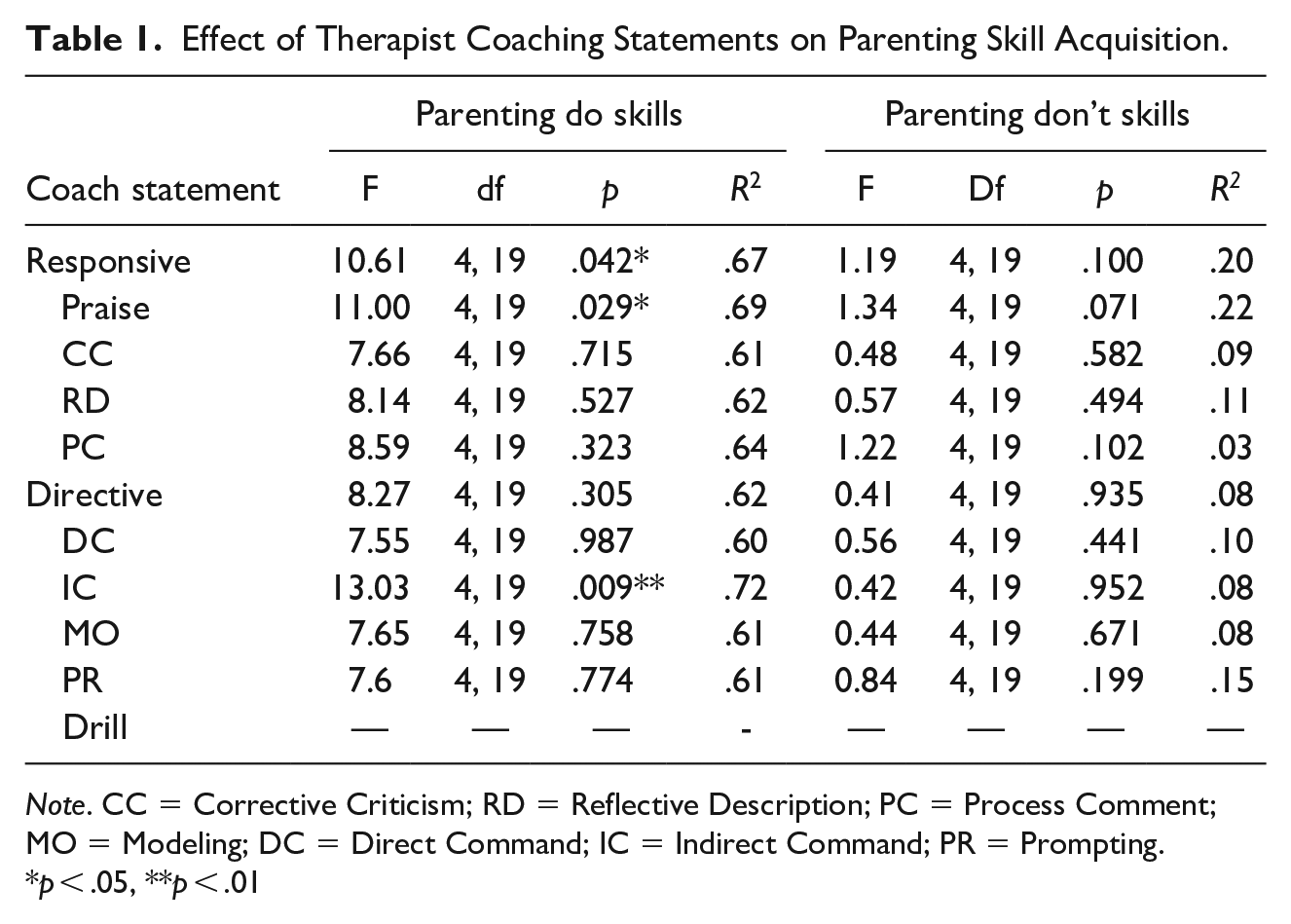
Note. CC = Corrective Criticism; RD = Reflective Description; PC = Process Comment; MO = Modeling; DC = Direct Command; IC = Indirect Command; PR = Prompting.
p < .05, **p < .01
Language Differences
Independent samples t-tests were conducted to examine differences between English- and Spanish-speaking therapists on coaching statements. There were significant differences in responsive coaching statements, t(22) = 2.168, p = .041, praises, t(22) = 2.216, p = .037, and direct commands, t(22) = 2.071, p = .050. For all significant differences, English-speaking therapists used a higher rate of these statements compared to Spanish-speaking therapists (see Table 2).
Differences in Therapist Coaching Statements in English and Spanish.
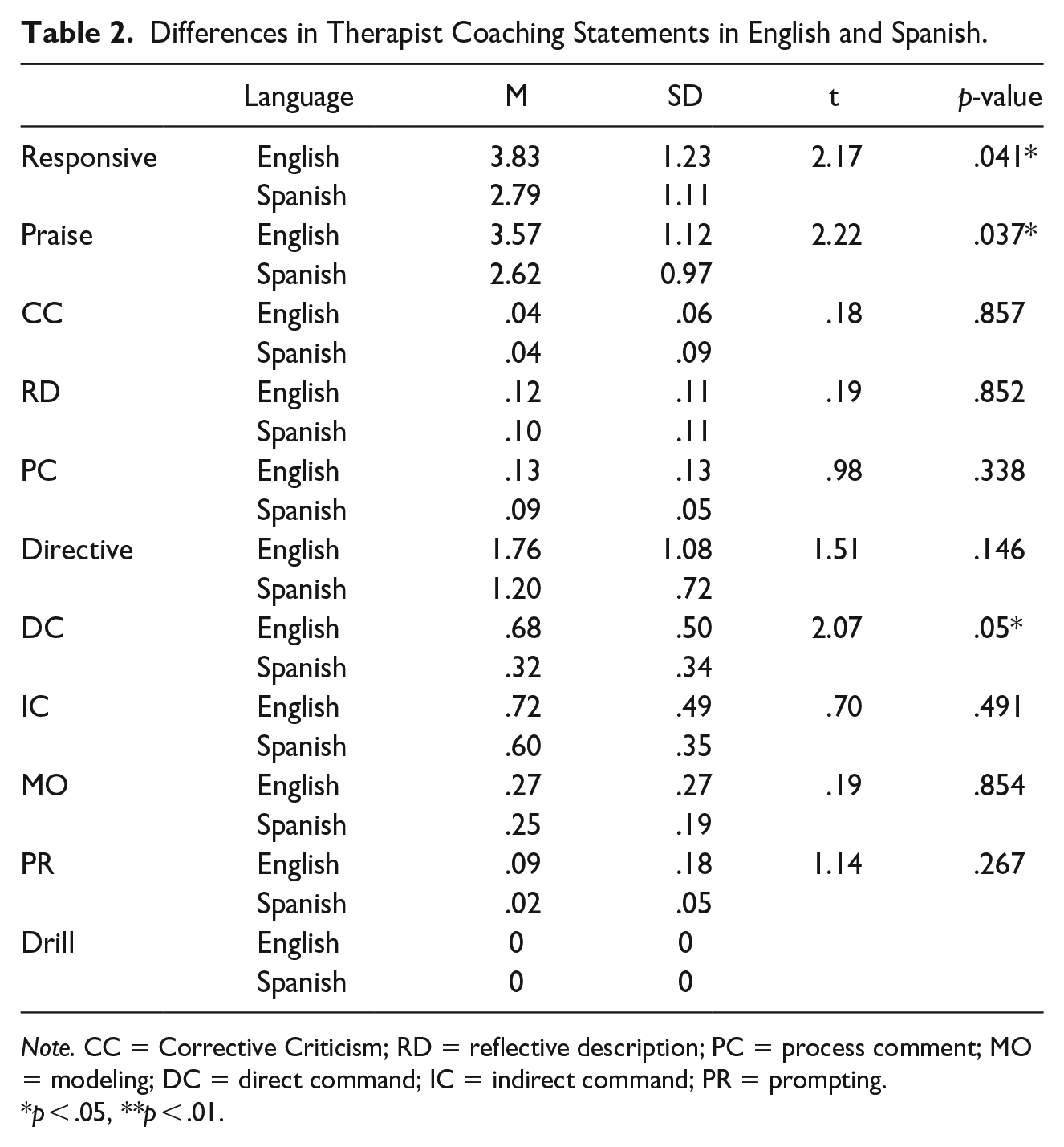
Note. CC = Corrective Criticism; RD = reflective description; PC = process comment; MO = modeling; DC = direct command; IC = indirect command; PR = prompting.
p < .05, **p < .01.
Moderation analysis were conducted to examine the moderating effect of language on the associations between therapist statements and the proportion of parenting do and don’t skills. There were no significant moderating effects of language on the association between responsive and directive coaching, nor on the association between individual therapist coaching statements and parenting do and don’t skills.
Discussion
In the current study, we examined the effect of therapist coaching statements in a brief parenting intervention on parenting skill acquisition from one session to the next in English- and Spanish-speaking therapists and parents. Previous research studies have examined the effect of therapist coaching statements over a brief period of time on parenting skill acquisition from one session to the next in English-speaking families. However, no study has examined the effect of therapist statements during the entire coaching period on changes in parenting skills from one session to the next. Additionally, no study has examined the effect of therapist statements on parenting skills in a primarily Latinx sample and among non-English-speaking families and therapists. Consistent with previous research, we found that therapists responsive coaching during the first coach session predicted an increase in rate of positive parenting skills from the first to the second coach sessions. When examining specific therapist statements, therapists’ use of praise also predicted an increase in rate of positive parenting skills. These results highlight the importance of therapists’ use of positive social reinforcement to optimize treatment outcomes.
When examining the effect of directive coaching on parenting skills, the current results add to previous findings (Barnett et al., 2014) and suggest that therapists’ use of indirect commands are associated with lower rates of parenting do skills. However, there were no associations between therapist responsive or directive coaching statements and changes in parental use of don’t skills. These findings indicate the importance of therapists following the parent’s lead while they are playing with their child, especially during the first coaching session when parents may be getting used to being coached and practicing the new skills while playing with their child. In addition, understanding the impact of therapist coaching statements on the acquisition of parenting skills may be important for future therapist trainings. For example, parent coaching is not only used in PCIT and adaptations of PCIT but is also increasingly being used in Part C early intervention services (Friedman et al., 2012). However, implementing parent coaching in Part C early intervention services has been challenging due, in part, to providers not fully understanding the behaviors or statements to use to coach parents (Fixsen et al., 2005). Our results in combination with previous findings from Barnett and colleagues (2014, 2017) suggest that therapist training and support should focus on the use of responsive coaching to maximize positive parenting skill acquisition during the first couple of sessions. Therapists could monitor their use of responsive coaching skills in early sessions because these skills may be especially important for caregivers displaying lower rates of do skills in the first session.
In addition to the impact of therapist coaching statements on parenting skill acquisition, we examined differences in coaching statements between English- and Spanish-speaking therapists. Results showed that Spanish-speaking therapists used fewer responsive coaching statements, praises, and direct commands compared to English-speaking therapists. Although there were differences in the rate of coaching statements between Spanish- and English-speaking therapists, the effect of coaching statements on parenting skill acquisition did not differ based on language spoken. Thus, therapist coaching did not differentially impact parental skill between English- and Spanish-speaking families. These results indicate that training and supervision guidelines to promote responsive coaching statements, as suggested above, should not differ for therapists proving treatment in Spanish or English. However, our findings suggest rates of therapist coaching statements differ between English- and Spanish-speaking therapists, which may be impacted by differential use of parenting skills between Spanish- and English-speaking families (McCabe et al., 2012; Ramos et al., 2018). Thus, future research should explore how differences in parenting skills and therapist statements across Spanish- and English-speaking parents and therapists affect child behavior and other related outcomes.
Strength and Limitations
The current study had several strengths, including the use of an objective and innovative coding scheme that examined what therapist behaviors occurred during coaching and yielded strong estimates of interrater reliability for all therapist coaching statement codes. Additionally, we coded all coaching statements during the entire coaching portion of the session (range of 12 to 39 minutes), which allowed for a full observation of the statements made throughout the session. Furthermore, the sample included predominantly low-income Latinx families, which are under-represented in studies examining behavioral parenting interventions (Ortiz & Del Vecchio, 2013), especially in studies examining therapist behavior. Thus, this study contributes to the understanding of therapist behavior on the impact of parenting skills change for underserved and bilingual families and how coaching statements differ between Spanish- and English-speaking therapists.
Although there were several strengths of this study, there were some limitations that warrant attention. First, the sample was relatively small, which may have reduced power to detect a significant moderating effect of language on the association between therapist statements and changes in parenting skills. In addition, all therapists in this study were native Spanish speakers, so future research should examine if there are differences in coaching statements between native and non-native Spanish-speaking therapists. Second, the sample of families was homogenous, with most (91%) identifying as Latinx, and a more heterogenous sample in future studies would increase generalizability to other ethnicities. Third, although we examined the impact of therapist coaching statements on changes in parenting skill from one session to the next, the time between sessions was relatively short (about 1 week). Thus, future longitudinal studies should examine therapist coaching statements and parenting skills over multiple sessions and explore the bidirectional associations between therapist coaching statements and parenting skills, as well as the potential impact of therapist statements on child behavior.
Conclusion
Despite the limitations, this study has important implications in understanding the role that therapists play in affecting change in parenting skill acquisition. The current results suggesting that therapist responsive coaching statements had a positive influence on parenting skill acquisition are important to inform therapist trainings and ongoing support to optimize outcomes for families. These findings are especially important when intervening with Spanish-speaking families, who show lower baseline levels of positive parenting skills, poorer treatment engagement, and higher drop-out rates. Although Spanish-speaking therapists showed different rates of coaching statements compared to English-speaking therapists, the effect of coaching statements on parenting skill acquisition was not different between Spanish- and English-speaking therapists and suggest guidelines for training of and ongoing support for therapists can be similar across different languages.
Footnotes
Declaration of Conflicting Interests
The author(s) declared no potential conflicts of interest with respect to the research, authorship, and/or publication of this article.
Funding
The author(s) received no finanical support for the research, authorship, and/or publication of this article.
