







Abstract
Preference for augmentative or alternative communication (AAC) systems has received growing interest in work with individuals with developmental disabilities. An individual may choose a modality based on technological (e.g., auditory-output) or aesthetic features of a system; however, it is ideal that functional features (i.e., effectiveness in producing a reinforcer) affect preference to a much greater extent. Prior research has treated preference as a static variable and may commonly report a lack of preference for a modality or control by irrelevant features of the assessment (e.g., position of the modality in an array). The current study assessed the preference for AAC modalities of a teenager with autism spectrum disorder and intellectual disability using a concurrent-chains procedure. This study extended prior research by including additional methods to ensure accurate assessment of preference (i.e., a control condition) and a reinforcer manipulation to determine whether preference was controlled by non-functional (e.g., aesthetic) or functional (i.e., reinforcer quality and availability) variables. Preference was found to be functionally related to reinforcer availability, including when rapidly alternated between modalities. Moreover, the participant consistently allocated responding away from the control condition. Implications for self-determination and suggestions for future research on preference for AAC systems are considered.
Keywords
Considerable evidence supports the use of augmentative and alternative communication (AAC) systems as a functional communication method for individuals with autism spectrum disorder (ASD) and intellectual disability (Flippin et al., 2010; Mirenda, 2003). Common AAC systems include picture exchange (PE), manual sign, or speech-generating devices (SGD) (Gevarter et al., 2013; Mirenda, 2003). In clinical programming, selecting an AAC system for an individual requires the clinicians to consider a number of interrelated variables, including features of the system, the individual’s skill repertoire, and the participant’s preference for an AAC modality (Sigafoos & Iacono, 1993).
AAC Preference
Participant preference has received growing attention in the AAC literature. A review by Gevarter et al. (2013) found that preference for AAC modality differed across studies, although SGDs were more frequently preferred by participants. Interestingly, a number of the reviewed studies reported inconclusive results. Inconclusive findings of preference may suggest that (a) the participant does not prefer a particular modality or (b) the participant’s selection is affected by features of the assessment that are irrelevant to functional aspects of the system. The latter is likely more concerning as it may lead to inappropriate conclusions regarding preference. That is, if a participant’s selection is affected by some irrelevant feature of the assessment (e.g., position), it may appear as though no preference exists. In actuality, the experimenter is not assessing preference as that is not what is controlling the participant’s responding. For example, Bourret et al. (2012) observed position biases exhibited by five individuals with developmental disabilities during a paired-choice preference assessment. This pattern of responding was characterized by exclusive selection of the stimulus presented in either the left or right position of the array. As a result, it appeared as though the participant did not prefer a given stimulus, although responding was actually affected by an irrelevant feature of the assessment (i.e., position of the stimulus). Subsequently, the authors manipulated reinforcer quality and eventually observed differentiated responding by stimuli, not position, for all participants.
Given inconclusive findings of preference, it is important to conduct additional analyses of the conditions that may be affecting the individual’s selection of a modality. In one example, Sigafoos et al. (2009) conducted a two-part study in which Trevor, a 15-year-old boy with Down syndrome and ASD, was taught to emit a generalized mand “want” using PE and SGD modalities when a plate of food was presented (Study 1). Following acquisition, the researchers assessed Trevor’s preference for either modality. During the initial assessment, Trevor’s selections appeared to be affected by the placement of the devices as he consistently selected the modality placed nearest to him or on the left side of the array. The findings of Sigafoos et al. (2009) may be particularly concerning as clinicians may not conduct similar exploratory assessments of the conditions that affect responding. This may lead to inappropriate conclusions regarding an individual’s preference due to insufficient consideration of variables that were affecting the individual’s choice.
Prior research on preference for AAC modality has commonly included the presentation of the systems in a multiple stimulus array. In these arrangements, each modality, or a stimulus paired with a modality (e.g., a drawing of a manual sign; Achmadi et al., 2014), is placed in front of the participant. Alternating the position of each modality across presentations may reduce control by irrelevant features of the arrangement; however, this procedure is inconsistently reported (e.g., Couper et al., 2014; Son et al., 2006). Although position alternation may be considered best practice when using stimulus arrays (Green, 2001), further analysis is necessary to ensure inconclusive findings are not actually a result of this alternation (e.g., selecting based on position). That is, if the position of the modality is alternated on every presentation, selecting from a single position may result in an equal number of selections to each modality (Bourret et al., 2012). In one example, Achmadi et al. (2014) reported alternating the placement of the stimuli associated with each modality in their assessment. For three of the four participants, all three of the modalities were selected during the preference assessment. It is unclear whether the participants did not prefer one modality or if responding may have been affected by other features of the arrangement (e.g., position).
Including a control condition allows for greater analysis of conditions affecting preference when using multiple-stimulus arrays. Control conditions are commonly included in concurrent-chains assessments, which are used to measure a participant’s preference for an intervention (e.g., Hanley et al., 1997; Kodak et al., 2016). Typically, selection of the control stimulus results in extinction contingencies (e.g., Hanley et al., 1997). Persistent selection of the control condition may suggest a lack of discrimination between conditions. In contrast, undifferentiated selection of the AAC modalities without selecting the control condition may suggest a lack of preference. Without the control condition, the variables controlling participants’ selections during preference assessments may be difficult to elucidate. As one example, Sigafoos et al. (2009) endorsed that their participant did not prefer a particular modality, but instead preferred whichever modality was easier to access due to its placement in the array. The authors did not include a control condition in their preference assessment, thus it is unclear whether the participant would have selected the control condition if it was the easiest to access. The authors’ conclusions regarding preference based on ease-of-access would have been bolstered if the participant instead allocated responding away from the control condition and to whichever AAC modality was most easily accessed. Nevertheless, the extent to which the participant’s selection was based on functional or nonfunctional features of the preference assessment are unclear.
The position of a stimulus in an array is a nonfunctional variable that has been found to affect responding by individuals with developmental disabilities (Bourret et al., 2012). Although responding to a particular position may be a result of reduced response effort, as suggested by Sigafoos et al. (2009), it is ideal that a number of variables beyond response effort affect preference to a much greater extent. Indeed, other non-functional features of the AAC system should have little effect on preference if the modality is associated with reduced reinforcement. As such, preference may be affected by a combination of nonfunctional and functional variables (e.g., reinforcement schedule, quality, immediacy, or magnitude), although the latter should affect preference to a much greater extent.
Self-Determination
A growing area of consideration in work with individuals with intellectual or developmental disabilities is self-determination. Self-determination has been defined as “the ability of a person to consider options and make appropriate choices regarding residential life, work, and leisure time” (Schloss et al., 1993, p. 215). Determining whether a participant is “considering options” and the inherent subjectivity of “appropriate choices” may require additional analyses than those typically used in preference assessments for AAC systems. Selecting an alternative system that results in greater access to reinforcement would likely be endorsed as an “appropriate choice” and doing so from a multiple-stimulus array may suggest that the participant is “considering options.” Previous research on preference for various AAC modalities has done little to consider variables that affect preference and those that should affect preference.
Purpose
The current study extends prior research on preference for AAC systems by including a control condition and manipulating the quality and availability of reinforcers associated with each modality for a teenager with ASD and intellectual disability. Using these manipulations, the variables affecting preference may be further elucidated. In selecting an AAC system based on reinforcement history and current contingencies, the participant may be exhibiting critical decision-making skills necessary for self-determination.
Four research questions guided this work:
Does preference differ across modalities?
Will the participant respond away from the control condition, suggesting discrimination between modalities even if no preference is observed?
Will the participant’s preference for an AAC system be functionally related to reinforcer quality and availability?
Will the participant differentially select AAC modalities with greater reinforcement when reinforcer availability and quality rapidly change across choice opportunities?
Method
Participant, Setting, and Materials
Robert was a 14-year-old African-American male with ASD and intellectual disability receiving behavior analytic services in a small clinic in the southeastern United States. Robert’s clinical intervention sought to establish functional communication and daily living skills. He also received special education services in a self-contained classroom in a local middle school. He had no reported hearing or vision impairments, which was confirmed during clinical intervention. All procedures were approved by an Institutional Review Board and consent was provided by Robert’s legal guardian before the study began. Experimenters included graduate and undergraduate students enrolled in practicum or research experiences. The first author was present for all sessions.
Upon admission, Robert communicated only by reaching and emitting a single sound (e.g., “ahh”). He echoed approximately 15 sounds, matched 2D and 3D identical (non-reinforcing) stimuli in messy arrays of 8 that included similar stimuli, imitated approximately 10 different gross motor movements, and followed 2 verbal instructions (e.g., “sit down”). Previous attempts to expand his echoic and vocal requesting repertoire were unsuccessful, so an alternative communication system was introduced.
At the time of the study, Robert consistently exchanged more than 15 pictures on a PE system from an array of 20. Robert also had a GoTalk 20+ device, although he had not been taught to use this system before enrolling in behavior analytic services. The GoTalk 20+ is an SGD that includes preset locations of pictures in an array of 25. Following mastery of the PE system, we introduced the GoTalk 20+ device and Robert demonstrated consistent and successful use of both systems. After the initial comparison of preference for the GoTalk 20+ and PE modalities, the caregiver reported a preference for Robert to exchange playing card-sized stimuli for items in the home as carrying the GoTalk 20+ or PE binder was considered burdensome. As a result, a second comparison using identical procedures to the first was conducted using the PE and card modalities. Robert demonstrated consistent use of the card modality before the second comparison.
All sessions were conducted in an individualized space in a small clinic, which included a table, chair, tangible items, and data collection materials. When opened, the PE binder included an array of 20 stimuli on a 29.2 cm by 20 cm laminated sheet of white paper. Each stimulus was 2.5 cm by 2.5 cm and was attached to the laminated page by Velcro dots. Centered at the top of the page was a green square with a piece of Velcro. Robert was required to select an icon, remove it from the page, and place it on the green square. The position of stimuli in the array were changed unsystematically after an average of three mand opportunities. The GoTalk 20+ is an SGD with an auditory output recorded for each stimulus and depressing a stimulus produces the recording. The cards modality included identical pictures to those on the PE and GoTalk 20+ arrays, but were larger (i.e., 5.08 cm by 7.62 cm) and presented in a staggered stack on the table in front of Robert. The stack was spread approximately 10.16 cm so that multiple stimuli were visible. Robert was required to sort through the stack, select a stimulus, and hand it to the experimenter. An additional 29.2 cm by 20 cm laminated sheet of white paper was included in the preference assessment as a control condition. Selection of this card resulted in the removal of the other stimuli and the experimenter turning away from Robert for 20 seconds. This was included to ensure that Robert’s selection of a modality was not due to some irrelevant feature of the assessment (e.g., position) and is commonly used in concurrent-chains arrangements (c.f. Hanley et al., 1997; Kodak et al., 2016).
Response Measurement, Interobserver Agreement, and Procedural Integrity
Selection of an AAC modality during an initial link presentation was scored when Robert’s hand contacted a stimulus associated with a condition (i.e., GoTalk 20+, PE, or control card in comparison 1; cards, PE, or control card in comparison 2). If Robert’s hand contacted more than one modality, the trial was re-presented. Observers were trained on the data collection system until 100% interobserver agreement was observed for at least two initial links. Two independent observers recorded data during 96.3% of initial links during the first comparison and 74.6% of initial links during the second comparison. Exact agreement was calculated on each initial link. Agreement was 100% during all initial link selections. Procedural integrity was scored if the experimenter conducted all procedures in accordance with the intervention protocol and was recorded by each observer. Procedural integrity and exact agreement on the procedural integrity measure were 100%.
Preference and Rejection Assessments
Preferred and non-preferred stimuli were presented on each AAC modality. Before beginning the study, preferred stimuli were identified based on caregiver report using the Reinforcer Assessment for Individuals with Severe Disabilities (RAISD; Fisher et al., 1996). These stimuli were then included in an engagement-based free operant preference assessment and a multiple stimulus without replacement preference assessment (DeLeon & Iwata, 1996). All stimuli that were selected during either preference assessment were included as preferred stimuli.
Non-preferred stimuli were identified using a rejection assessment. Including non-preferred stimuli in stimulus arrays is commonly recommended in training with PE and other AAC systems to ensure discrimination between pictures in a given array (Carr & Felce, 2008; Frost & Bondy, 1994). Six items that were hypothesized as non-preferred were presented randomly along with three items previously identified as preferred (see above). In the rejection assessment, the experimenter placed a tangible item on the table approximately 0.33 m in front of Robert. He was given 30 seconds of access to the item with no experimenter attention. Non-preferred items were those in which Robert emitted a rejection response, defined as throwing, dropping an item off of the table, pushing an item away, or handing the item back to the experimenter within 10 seconds of the item being presented on two consecutive presentations. Three items were identified as non-preferred during the rejection assessment. The PE, GoTalk 20+, and card arrays included the same preferred and non-preferred stimuli based on the preference and rejection assessments.
Procedure
A concurrent-chains assessment (Hanley et al., 1997) was used to assess Robert’s preference for a communication modality. In a concurrent-chains procedure, responding on the initial link (e.g., selection of an AAC modality) produces access to a terminal link (e.g., differential reinforcers). Responding on the initial link therefore serves as a measure of preference for the terminal link. Concurrent-chains procedures are commonly used in experimental research on choice (e.g., Oliveira et al., 2014; Squires & Fantino, 1971) as well as applied research assessing participants’ preference among two or more interventions (e.g., Hanley et al., 1997; Kodak et al., 2016).
In the current study, the initial link included the selection of the PE, GoTalk 20+, or the control card (Comparison 1) or the PE, cards, or the control card (Comparison 2). The three target modalities were presented on the table in a straight array approximately 0.33 m in front of Robert. The position of each system in the array varied across initial links to control for responding based on position. Each modality was always presented so that the arrays were visible. That is, the binder was open and the cards were staggered vertically in front of Robert. He was instructed to “pick one.” If Robert selected the PE binder or GoTalk 20+ device (Comparison 1) or the PE binder or cards (Comparison 2), he was allowed to mand for a specific item from the chosen modality and the item was delivered for 20 seconds. During this interval, the experimenter interacted with Robert regardless of the item selected (e.g., singing along to a preferred song). Following the initial selection, five additional mand opportunities were presented using the selected modality. These mand opportunities were interspersed among additional instructional demands that were previously mastered by the participant (e.g., imitation, echoic, or body-part identification). Mand opportunities were presented after an average of three mastered instructional demands were completed. After five mands were emitted using the selected modality, the initial link was re-presented. If Robert selected the control card, the experimenter moved all materials out of Robert’s reach and turned away for 20 seconds. After 20 seconds elapsed, the initial link was re-presented.
A single forced-choice initial link was presented for each modality at the beginning of each day or when a change in conditions (i.e., phase change) occurred. During forced choice, the AAC systems were presented and Robert was immediately prompted to select a predetermined modality (i.e., initial-link) using gestural or physical prompts. He was then allowed to independently mand for an item using the modality. The selected item was delivered for 20 seconds before the array was re-presented and another forced-choice was conducted until each modality was presented (i.e., three initial links were presented with a forced choice). During forced-choice to the control condition, the experimenter removed all materials and her attention for 20 seconds. Forced choices to initial links is commonly used in concurrent-chains arrangements as it allows the participant to contact the contingencies associated with each initial link (c.f., DeLeon et al., 2014; Hanley et al., 1997; Ingvarsson & Le, 2011; Kodak et al., 2016). In doing so, the participant receives a preview of the terminal links. This exposure may increase the likelihood that the participant selects the AAC system during subsequent initial links based on the terminal link and not some other variable (e.g., past consequences available on that AAC system, side biases, or other non-functional features of the modality/assessment).
Reinforcer Availability and Quality
Following an initial concurrent-chains arrangement in which all reinforcers were available on each modality, the array for one modality (e.g., PE) was altered such that only a single non-preferred stimulus was available if selections of this modality occurred. This modification was included to ensure that Robert’s selections of a AAC modality was under control of the available reinforcers in a given modality and not some non-functional variable of the system (e.g., auditory-output). During the reinforcer availability and quality manipulation, the S+ modality included the full stimulus array and was arranged on a single modality. In the S− modality, a single stimulus, previously identified as non-preferred in the rejection assessment, was presented. Once a shift in selection of the S+ modality was observed, the contingencies were reversed with the S+ modality becoming the S−. Following this manipulation, we returned to the initial concurrent chains assessment with both systems under S+ conditions.
After consistent responding to the S+ modality was observed and both systems were again presented under S+ conditions, we introduced a rapid alternation condition. During rapid alternation, the modality assigned to the S+ condition was determined using a random number generator; however, no modality was assigned to the S+ condition for more than two consecutive initial links. That is, the modality with the full stimulus array changed across initial-links. If Robert selected the modality assigned to the S− condition, the condition did not change until he selected the modality assigned to the S+ condition. Thus, it was possible that a modality was assigned to the S+ condition for more than two initial links, although Robert could only contact an S+ condition on a single modality for two consecutive presentations.
Results
Figure 1 shows the cumulative selections of the initial link across reinforcer availability conditions for Comparison 1 (PE and GoTalk 20+). In the first panel, little differentiation was observed across modalities until initial link 16. Overall, PE was selected a total of 13 times and the GoTalk 20+ was selected seven times. Two selections to the control condition occurred within the first four presentations of the initial-link with no other selections of the control condition for the remainder of the study.
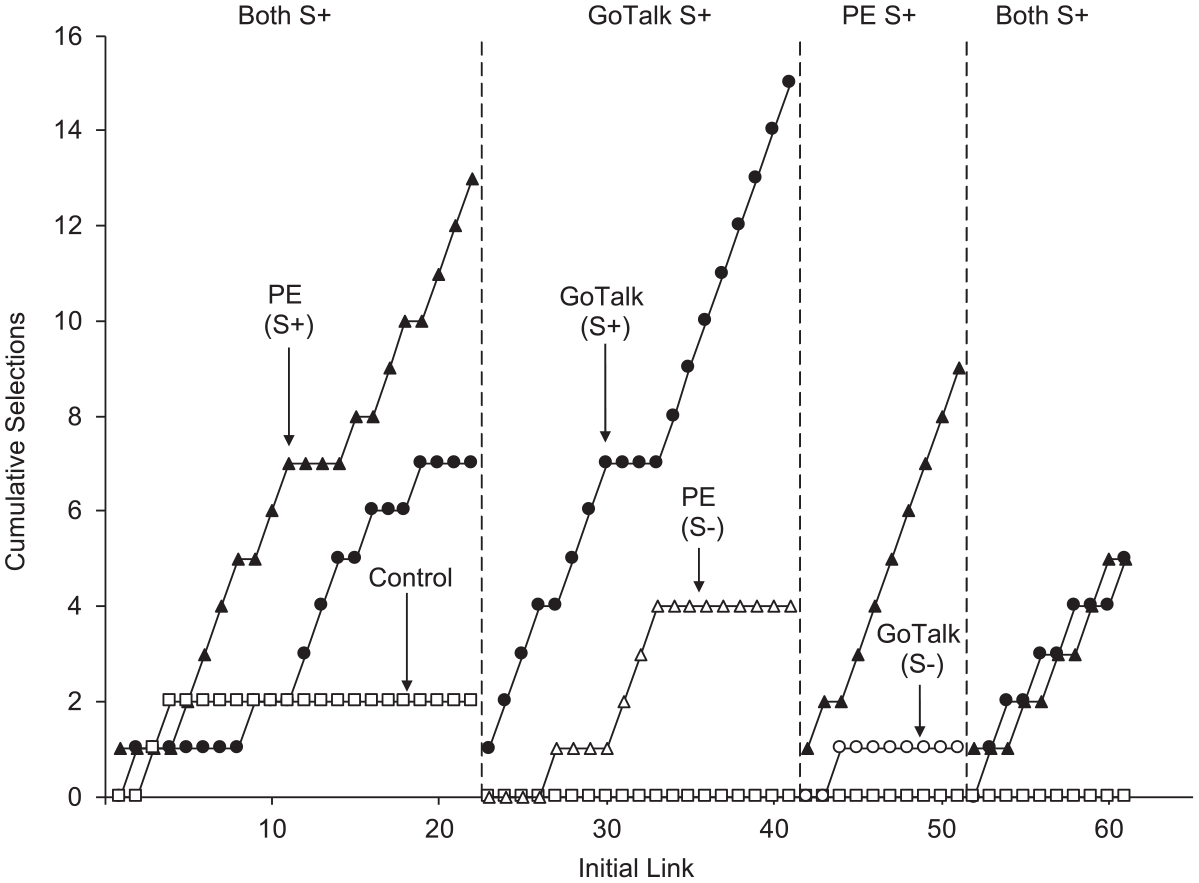
Cumulative selections in the initial link of PE, GoTalk, and control conditions across S+ manipulations.
After the initial comparison with full stimulus arrays on both modalities, the GoTalk 20+ modality was presented with a full reinforcer array and a single non-preferred stimulus was presented on the PE modality. Robert emitted a total of 15 selections of the GoTalk 20+ modality (S+); yet, four selections were made to the PE modality (S−). When the conditions were reversed in the third phase, a clear preference for the PE (S+) modality was observed with a total of nine selections. A single selection was observed to the GoTalk 20+ (S−) modality with no selections of the control condition. In the fourth phase, both modalities were presented with full stimulus arrays (i.e., both S+) and no differentiation between modalities was observed. As in the prior two phases, no selections to the control condition were emitted.
Figure 2 shows Robert’s selections on initial links in rapid alternation sessions which occurred immediately following the comparisons shown in Figure 1. Robert selected the S+ condition during 15 of the 19 initial-link presentations. Instances in which he did not select the S+ adhered consistently to a win-stay and lose-shift response pattern. That is, he selected the modality previously assigned to the S+ condition, but shifted responding to the newly assigned S+ modality in the subsequent initial link. This occurred in initial link 64, during which he selected the PE (S−) and then immediately shifted responding to the GoTalk 20+ (S+) in initial link 65. This same pattern of win-stay and lose-shift responding was observed in links 66 and 67. During subsequent links, Robert consistently selected the S+ condition with a single selection to the S− condition on link 76. No responses to the control condition were observed during rapid alternation sessions.
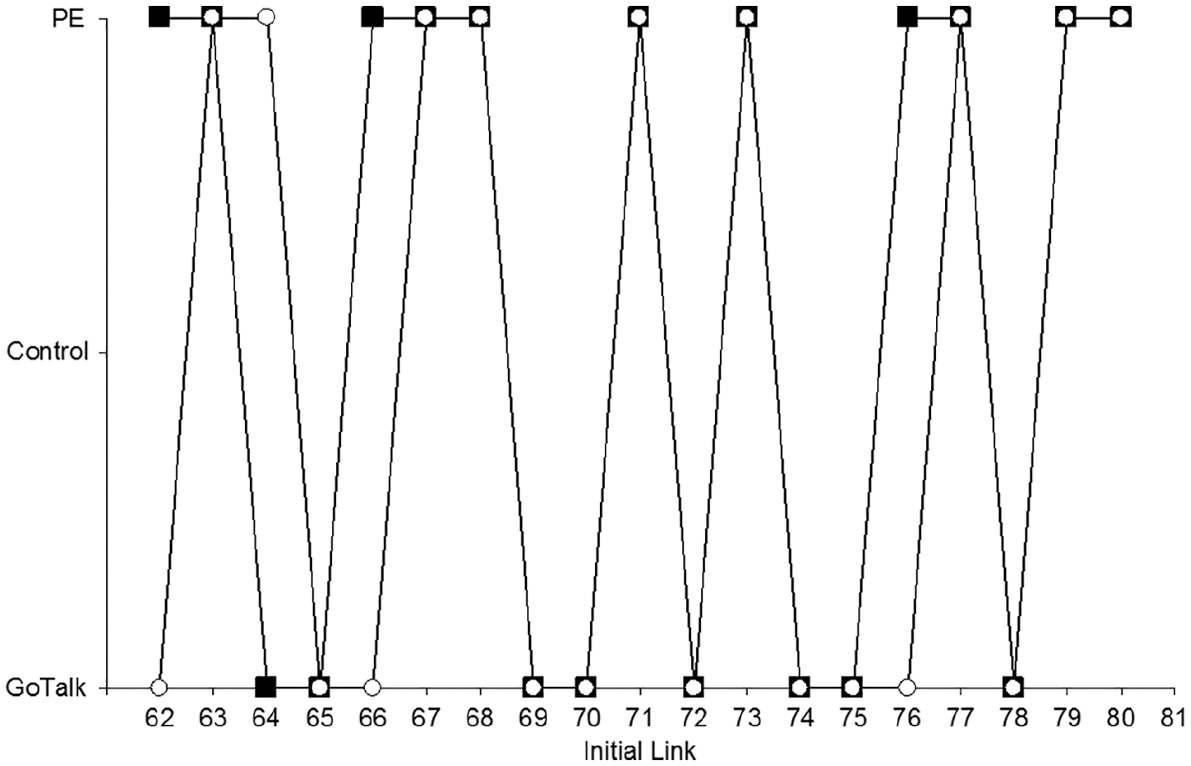
Rapid alternation between S+ modalities and Robert’s selection for the first comparison.
Figure 3 shows initial link selections in Comparison 2. When both modalities were exposed to S+ contingencies, Robert selected the PE modality exclusively. In the next phase, the contingencies were altered with cards and PE assigned to the S+ and S− conditions, respectively. Robert selected cards (S+) eight times and the PE (S−) modality two times. The contingencies were reversed in the third phase and the PE (S+) modality was selected exclusively. The contingencies were reversed for a second time and we observed a total of 9 selections of cards (S+) with three selections of PE (S−). Finally, we returned to the initial concurrent-chains assessment with both modalities exposed to S+ contingencies and we observed nine total selections of the PE modality and five selections of cards, suggesting a moderate preference for PE. Throughout all comparisons, Robert never selected the control condition. Following the comparison in Figure 3, we rapidly alternated the S+ modality (Figure 4). Robert always selected the S+ modality and never selected the control condition in this phase.
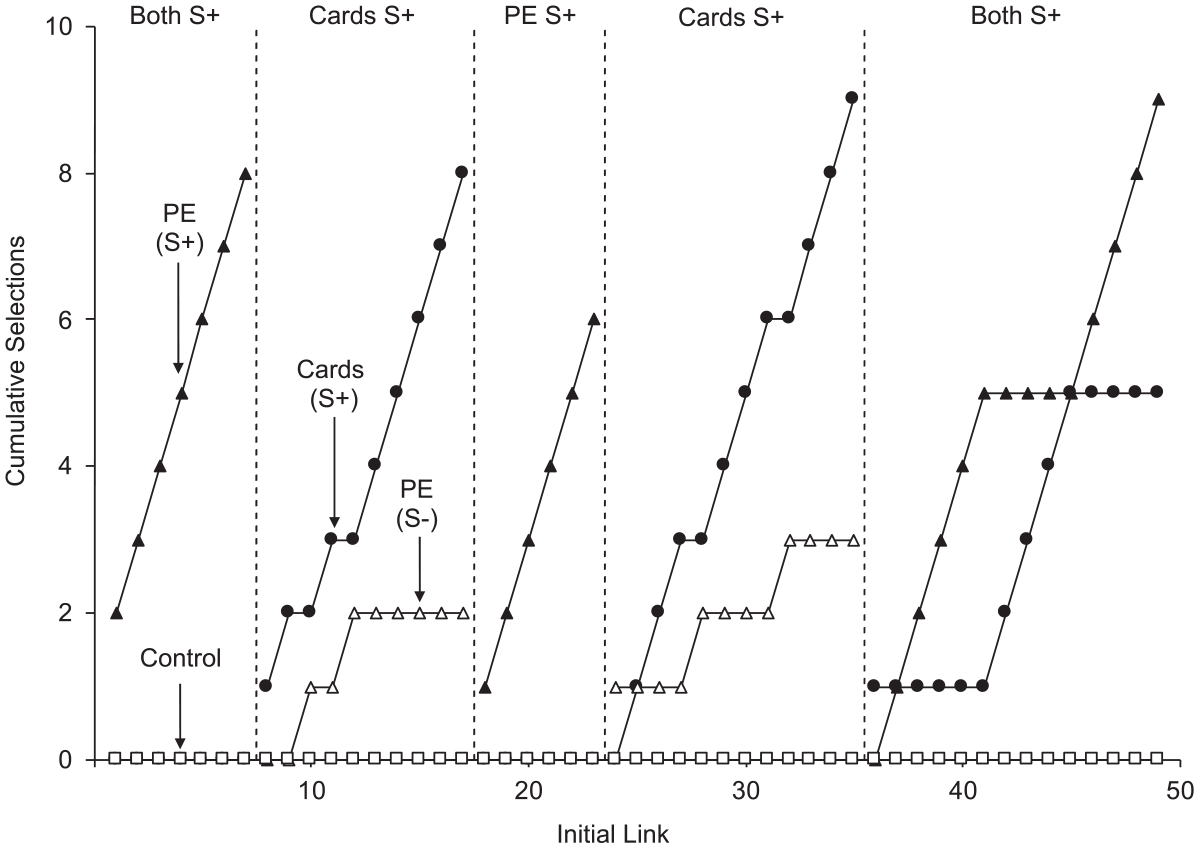
Cumulative selections in the initial link of PE, Cards, and Control conditions across S+ manipulations for the second comparison.
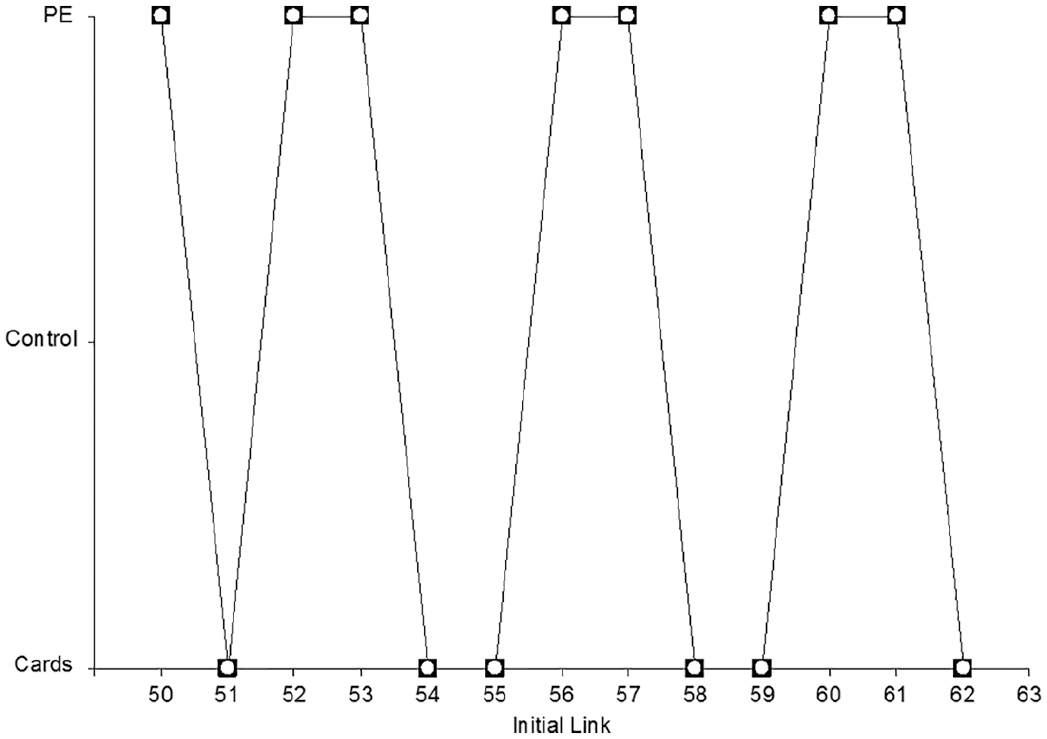
Rapid alternation between S+ modalities and Robert’s selection for the second comparison.
Discussion
The current study sought to contribute to the extant literature on evaluations of preference for AAC modalities across four research questions. In addressing the first research question, Robert differentially preferred the PE modality in both comparisons (first phase of Figures 1 and 3). This finding was more pronounced in the second comparison as Robert never selected the cards when both modalities included full reinforcer arrays (Figure 2). Interestingly, when identical conditions were arranged during the final phase of each comparison, no preference or only a slight preference for PE was observed. This may suggest that Robert’s initial preference for an AAC modality may have changed over time.
Throughout the preference evaluation, Robert only selected the control condition twice during the study, both of which occurred during the first phase of the initial comparison. This finding suggests that Robert’s selections were controlled by the AAC modalities and not some irrelevant feature of the assessment (e.g., position). This was further confirmed by Robert’s consistent selection of the AAC modality associated with greater reinforcer availability.
Robert’s selection of an AAC modality was shown to be functionally related to reinforcer availability. This suggests that Robert’s selection of a modality was related to functional (e.g., effectiveness in producing a reinforcer at the terminal link) rather than non-functional (e.g., aesthetic features) variables. Moreover, Robert continued to differentially select the S+ modality when reinforcer availability shifted rapidly across modalities (Figures 2 and 4).
Preference for AAC modality has largely grown out of research from the past two decades, yet it remains unclear what features of an AAC system may affect preference. Prior research has reported relatively stable preference over time once proficient responding on each AAC modality was observed (van der Meer et al., 2012), while other research has shown no clear preference (Son et al., 2006). Notably, van der Meer et al. (2012) reported that participants’ preference prior to training did not correspond to preferences at post-assessment. The authors suggest that initial preference was likely a result of certain features of the AAC systems (e.g., auditory-output), which may lose their appeal over time. Similar changes in preference were observed in the current study. Some have suggested that easier access to a system (Sigafoos et al., 2009), faster acquisition (Couper et al., 2014), or more immediate products of a system (e.g., auditory-output; Achmadi et al., 2014) may affect preference. While this may be the case, it is ideal that other variables affect preference to a greater extent. Since the AAC device is a communicative tool, preference for certain features would hopefully only persist as long as they are functional. That is, the effectiveness of an AAC system in producing a reinforcer should likely be the variable that affects preference most reliably. In addition, it is ideal that an individual will select and use those systems that are likely to contact reinforcement under a given circumstance. In doing so, the individual may be exhibiting early forms of self-determination by making an “appropriate choice” from the available options under those conditions.
Limitations and Future Directions
The current study provides a novel demonstration of variables that may affect preference for an AAC system. We were able to demonstrate a shift in preference by manipulating reinforcer availability. Nevertheless, selection of the S− modality occurred in both comparisons. Robert selected the PE (S−) condition four times and the GoTalk 20+ (S−) one time in the initial comparison (Figure 1). During the second comparison (Figure 3), he selected the PE (S−) condition five times, but never selected the cards (S−). Higher rates of selecting the PE (S−) relative to the other modalities may suggest (a) a lack of discrimination of the conditions or (b) some variable other than reinforcer availability affected his preference for a given modality. We do not believe that Robert’s selection of the PE (S−) condition was a result of discrimination issues as he reliably responded away from the control condition. It is notable that Robert selected the PE (S−) condition on three consecutive initial links in the first comparison. This may suggest that variables other than reinforcer availability (e.g., fatigue or satiation) may have affected his selections.
One potential variable that may have influenced Robert’s selection of the PE modality even when it was associated with reduced reinforcer availability is the molar reinforcement history with this system. For approximately 3 months prior to beginning this study, Robert communicated exclusively with the PE modality. Although this history may have affected preference, we would have expected exclusive selection of the PE system when both modalities were exposed to S+ conditions. A preference for the PE modality was observed during the initial concurrent-chains assessment in both comparisons; however, this preference was diminished when both S+ conditions were arranged again at the end of each comparison.
Response effort may have also affected preference under different conditions in the current study. Specifically, the increased effort required to emit a choice from the larger (S+) array may have led to selections of the S− condition. Previous research has shown that the number of options presented in a choice paradigm may be inversely related to preference (Reed et al., 2012). In one example, Reed et al. (2012) found that participants preferred having multiple options over single- or limited-option alternatives; yet, as the number of options increased in the multiple-options condition, preference for this condition decreased. Future research might evaluate the potential effects of these variables in a few ways. Researchers might manipulate the availability of preferred items in a smaller array or they may increase the size of the array for one modality to determine whether a deleterious effect on preference is observed, similar to Reed et al. (2012). Arranging conditions in this way may allow for a means to equate response effort and ensure that selection of a modality is occurring based on the available reinforcers. Furthermore, including arrays of similar sizes may require greater observing of the stimulus arrays to ensure that the modality with the preferred stimulus is being selected.
Response effort may be implicated in Robert’s selection of the PE (S−) modality in the second comparison. During our initial comparison, the response effort for either modality was similar (i.e., each selection required similar response topographies). However, during the second comparison, the card modality required Robert to move each card in the stack before handing the preferred stimulus to the experimenter. Nevertheless, when the PE and card modalities were simultaneously exposed to the S+ condition, Robert selected both. This may suggest that response effort was not the primary variable affecting his selection of either modality, as seen in the study by Sigafoos et al. (2009).
Robert’s selection of an AAC modality was reliably affected by the reinforcers available. This manipulation might serve as an assessment of Robert’s ability to differentially select interventions that may be more likely to produce reinforcement. Indeed, preference may sometimes be considered intransigent; however, choice should be affected by a number of stimuli or a history of consequences. In the current study, each modality included different sized arrays. These visual stimuli should control selection of the modality with the larger array as this modality would be associated with (a) more stimuli to choose from and (b) higher quality reinforcers. Nevertheless, a limitation of the current study is that we included forced-choice exposures, which may not require control by the visual arrays during initial-links. Forced-choice exposures are commonly included in concurrent-chains procedures (Hanley et al., 1997; Kodak et al., 2016) and allow for the participant to contact the contingencies associated with each condition before selecting independently. It may be ideal that Robert’s selection of an AAC system is controlled solely by the visual stimuli (i.e., the available reinforcers) as this may be more consistent with other naturalistic choice opportunities in which proximal exposure to the contingency is unavailable. We did not, however, include forced-choice exposures during the rapid alternation comparison. His consistent preference for the S+ modality under rapid alternation suggests that his selections were controlled by the visual stimuli. Nevertheless, instances in which the S− modality was selected during rapid alternation in the first comparison may have served the same function as the forced-choice presentations as his responding always shifted to the S+ modality during the subsequent choice opportunity, consistent with a lose-shift pattern of responding. Additionally, it is unclear whether the recent history of differential reinforcer availability with each AAC modality would be necessary for Robert to select the S+ modality under rapidly alternating conditions. Future research might begin with a rapid alternating comparison to identify whether changes in preference are controlled by the visual stimuli or exposure to the contingencies is required.
Additional research might evaluate alternative arrangements that may influence preference for AAC systems. Variables such as reinforcement schedule, quality, or delay may affect preference, or should affect preference, beyond superficial features of the modality or assessment procedures. Moreover, control conditions or systematic evaluations of variables affecting the selection of an AAC system should be included in future research. Some commonly used methodologies may lead to inaccurate conclusions regarding an individual’s preference, which has significant implications for effective and ethical programming. The current study serves as an initial example of methods to systematically arrange for opportunities to make choices based on functional features of a communicative system. Future research might also consider how arranging these decision-making opportunities may serve as a prerequisite for more complex decision-making tasks.
Implications for Practice
The current study may have several implications for practice. First, practitioners conducting AAC modality preference assessments should consider methods to ensure that participants’ selections are affected by the modality and not some irrelevant feature of the assessment (e.g., position in the array). Including control conditions and forced-choice exposures may increase the likelihood that practitioners are accurately assessing participants’ preference for a modality and should be considered best practices when assessing preference in clinical settings. In addition, practitioners should consider methods to further assess those variables that affect participants’ preference. In the current study, we evaluated reinforcer availability and quality; however, other dimensions of reinforcement may be relevant as well. Further, practitioners should consider whether training across multiple AAC systems is ecologically valid. That is, although a particular AAC modality may be used in the home, educational, or clinical environments, participants may also be required to use other communication systems in other settings (e.g., restaurants). Training using multiple systems may be an important skill and allow for greater independence in a variety of settings. Finally, practitioners and researchers alike might consider how best to arrange for a diverse range of choice opportunities so that individuals with complex communication needs may actively participate in decisions made throughout the day. Teaching individuals with disabilities to alter their choices under more complex conditions may serve as a necessary prerequisite for “considering options” and making “appropriate choices” in the future.
Footnotes
Declaration of Conflicting Interests
The author(s) declared no potential conflicts of interest with respect to the research, authorship, and/or publication of this article.
Funding
The author(s) received no financial support for the research, authorship, and/or publication of this article.
