






Abstract
In a recent (2005) edited volume not one chapter or section was dedicated to the call of God as a soteriological category. Indeed there appeared to be only three sentences dedicated to the topic in the whole volume. The scant reference to the call of God in this volume and in others reflects its humble position in the strata of concepts related to salvation. By examining the soteriological use of kaleō by various NT writers this article draws the following conclusions: (1) kaleō language is an important concept in the soteriologies of Paul, Luke, 1&2 Peter, James, Jude and the writer to the Hebrews; (2) although there are contrasts, there are a number of points of comparison in the soteriological use of kaleō by the NT writers. Crucial to this common understanding is the association of kaleō language with the OT covenants, election, motivation for transformation, and community; (3) as a result of this prominent and consistent usage by Paul and Luke, the language of kaleō deserves a higher place in the Christian understanding of salvation. This has implications for Christian life and practice.
Although most commentaries make passing reference to kaleō (call) as a soteriological term, the “call of God” does not share the same status as other soteriological categories such as adoption, justification, or redemption. For example, in the 2005 edited volume, Salvation in the New Testament: Perspectives on Soteriology (van der Watt), not one chapter or section was dedicated to the call of God as a soteriological category. Indeed there appear to be only three sentences dedicated to the topic in the whole volume (de Villiers: 314). The scant reference to kaleō in this volume and in others reflects its humble position in the strata of concepts related to salvation.
However, this article will argue that the call of God deserves greater awareness as a soteriological category. This assertion is based on the argument that kaleō is used soteriologically by 1&2 Peter, the author of Hebrews, Paul, James, Jude, and Jesus himself. This breadth of use demands that the call of God be considered as a more significant soteriological term.
A greater awareness of kaleō as a soteriological term brings the potential to broaden and deepen our understanding of salvation through the elevation of a different category. In particular, the concept of call provides a powerful connection to the OT categories of salvation, as will be demonstrated. As such it contributes towards a more holistic and satisfying conception of salvation.
The Meaning of Kaleō
With reference to its classical usage Arndt, Danker and Bauer (502–04) identify that kaleō can be used in four ways:
To identify by name—to name. To request the presence of someone at a social gathering—to invite. To use authority to have a person or group appear—to summon. From the meanings “summon” and “invite” there develops the extended sense
of choice for receipt of a special benefit or experience. For example,
“And no one takes this honor on himself, but he receives it when called
by God, just as Aaron was” (Heb 5:4).
It is this last usage which has soteriological overtones.
Old Testament Background
The concepts of election and call were fundamental to Israel's self-identity. In the LXX kaleō is used for the Hebrew word qārā. According to Koehler et al. (1128), in the OT qārā means:
To call someone, call someone over. To call, shout. To name a name for, give someone a name. To appoint. To call, summon.
To proclaim the name over something was also a legal act by which ownership was claimed and established (Christensen: 673). And so, qārā is used in Genesis 2:20: “The man gave names to all livestock and to the birds of the heavens and to every beast of the field.” Adam's naming of the animals was the designation of his dominion over them.
In Genesis 17:5,
Subsequently the call of God is extended to the nation of Israel in Deuteronomy 28:9–10. So, in Isaiah 43:1:
But now thus says the Lord,
he who created you, O Jacob,
he who formed you, O Israel:
Fear not, for I have redeemed you;
I have called (qārāt̠î, LXX: ekalesa) you by name, you are mine.
The link between “caller” and “creator” is apparent. Because Y
The related concept, election, finds explicit expression in many places in the OT and is presumed in many others. Normally bāḥǎr (elect) is translated eklegomai (choose) in the LXX. However, seven times it is translated as klēsis (“called”) (Quell: 145). This suggests a close relationship between these two terms. The parallelism of Isaiah 41:9 also demonstrates the relationship between “called” and “chosen”:
You whom I took from the ends of the earth,
and called from its farthest corners,
saying to you,
I have chosen you and not cast you off.”
However, kaleō also has connections with covenant. In Genesis 17:19,
by telling Sarah that she shall “name” him Isaac, Y
We have become like those over whom you have never ruled,
like those who are not called by your name.
Y
Associated with the concept of covenant in both the Ancient Near East and the Bible is the covenant meal. Covenants were traditionally sealed with a meal (Smith). Out of this tradition of covenant meals, a new eschatological expectation arose in Second Temple Judaism—the Messianic or kingdom banquet. D. S. Russell concludes in his study of Jewish apocalyptic that the idea of an eschatological banquet was “a familiar one” in ancient Judaism (quoted in Pitre: 134). Multiple passages in the Jewish Scriptures (e.g. Isa 49:9–12; 55; 65:13–16; Zech 9:9–17) use the image of a banquet or feast to describe the joy of the coming age of salvation. The most significant of these passages is Isaiah 25:6–9:
6 On this mountain the Lord of hosts will make for all peoples a feast of rich food, a feast of well-aged wine, of rich food full of marrow, of aged wine well refined.
7 And he will swallow up on this mountain the covering that is cast over all peoples, the veil that is spread over all nations.
8 He will swallow up death forever; and the Lord God will wipe away tears from all faces, and the reproach of his people he will take away from all the earth, for the Lord has spoken.
9 It will be said on that day, “Behold, this is our God; we have waited for him, that he might save us. This is the Lord; we have waited for him; let us be glad and rejoice in his salvation.”
The messianic note is struck in v 9. These events are heralded by one who has been waited for and who brings salvation. The kingdom banquet theme was developed in the intertestamental period especially with respect to the role of the Messiah, but somehow the idea that the Gentiles would be invited to attend came to be muted.
This brief summary of calling, election, covenant and covenant meals in the OT and the intertestamental period has highlighted the close relationship between these concepts in the mind of first century Jews like Jesus, James, Jude, Peter, and Paul. As Stendhal has demonstrated, Jesus certainly understood the connection between call and election as evidenced in Matthew 22:14: “Many are called but few are chosen.”
The relationship can be summarized in this diagram:
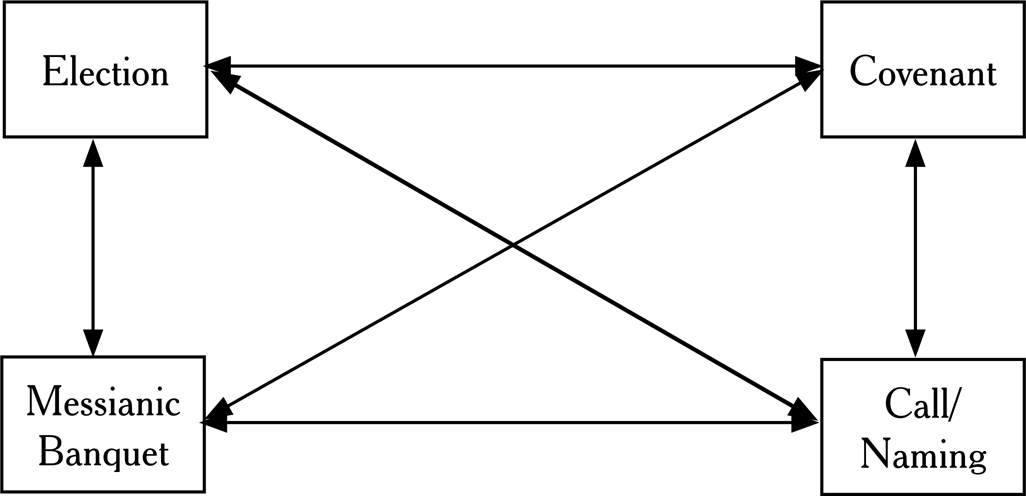
The conflation of these ideas meant that the first century Jew would have lived in eager expectation of an invitation/call to a great eschatological banquet to be hosted by the Messiah to mark the arrival of salvation for Israel. It is with this rich background that the NT writers use the term kaleō.
The soteriological use of language in the NT is widespread, suggesting its importance.
The Soteriological Use of kaleō in the Epistles
James
When highlighting the sin of partiality, the author asks in 2:7, “Are they not the ones who blaspheme the honorable name by which you were called (epikaleō)?” The use of the kaleō cognate alludes to the ancient occasion when the name of someone is “called” over someone else so as to designate the latter as property of the former (Martin: 66–67). Here in James, God is the one whose name is invoked over Christians (the aorist passive of the verb suggests that this has already happened in an initiatory or declarative way). The believers are thereby God's covenant possession. As we have seen, the idea that God actually gives his name to his people is an OT concept related to their salvation. Hence, here in one of the earliest voices of the NT, we see kaleō used soteriologically.
Jude
In the first verse of his epistle, Jude states, “Jude, a servant of Jesus Christ and brother of James, to those who are called (klētois), beloved in God the Father and kept for Jesus Christ.” The adjective klētois is placed last in the Greek sentence for emphasis. It is these “called ones” who are described, in almost Trinitarian language, as beloved (by the Father) and kept (for the Son). The language of “kept” echoes Isaiah 42:6 and the notion of covenant:
I am the
I will take you by the hand and keep you;
I will give you as a covenant for the people, a light for the nations.
Clearly, for Jude, call was the primary metaphor for describing the relationship between his readers and God and a technical term for the process of Christian salvation.
1 Peter
In urging his readers to holiness, the author says in 1:14–15,
14As obedient children, do not be conformed to the passions of your former ignorance,
15 but as he who called you is holy, you also be holy in all your conduct.
Their identity rests in the fact that they have been “called” by a holy God and consequently they belong to “him who called you out of darkness into his marvelous light” (2:9; cf. 5:10). They are Gentiles invited to stand before the God of Israel with the same privileges as the Jews (Michaels: 59). The absolute use of the verb “called” indicates it had become a terminus technicus for the process of election and salvation (Elliot: 44).
The author's next use of the term is in 2:9–10:
9 But you are a chosen race, a royal priesthood, a holy nation, a people for his own possession, that you may proclaim the excellencies of him who called you out of darkness into his marvelous light.
10Once you were not a people, but now you are God's people; once you had not received mercy, but now you have received mercy.
Conversion from paganism to Christianity was commonly viewed by the early Christians as a passage from darkness to light (cf., e.g., Acts 26:18; 2 Cor 4:6; Col 1:12–13; 1 Clem 36.2, 59.2; Barn. 14.5–7) (Michaels: 111). The association of call with this clearly soteriological image is suggestive of a conceptual relationship.
All four of these titles of honor are adaptations of titles from either Exodus 19:6 or Isaiah 43:20–21 and originally designations of Israel as the people of God and hence the heirs of salvation. Elliott (219–26) demonstrates that all these metaphors, including priesthood, highlight that the new elected society is collective, corporate, and applicable only to a community, and not to individuals. In this he echoes Stendahl (69): “Election in Christ not only constitutes a new society; its meaning is to be found in the new society, and not in the status of individuals.” Hence, this call/salvation is a corporate matter.
2 Peter
The soteriological use of kaleō appears at least once in the book of 2 Peter. In his opening words the author writes,
3His divine power has granted to us all things that pertain to life and godliness, through the knowledge of him who called us to his own glory and excellence.
Some think the “us” are not Christians in general, but the apostles called by Jesus during his ministry (Bauckham: 178). However, 1:10 surely refers to all believers because of the reference to election: “Therefore, brothers, be all the more diligent to confirm your calling and election, for if you practice these qualities you will never fall.” Clearly, by the time of the NT this understanding of “election” and the term “call” had become virtually synonymous, both being strongly related to salvation. The reality of the call to salvation is used as a motivation for observing the “qualities” described in 1:5–7.
Hebrews
Although call language is used nine times in Hebrews, it is largely used vocationally rather than soteriologically. However, in 3:1 the author writes, “Therefore, holy brothers, you who share in a heavenly calling, consider Jesus, the apostle and high priest of our confession.” The phrase, “sharers in a heavenly calling,” is unique in the NT. However, “sharers” occurs in 3:14 (“sharers in Christ') and in 6:4 (“sharers in the Holy Spirit”), both in a clearly soteriological sense. Its use in 3:1 suggests call is also being used soteriologically there.
In the section where the author is arguing the superiority of Christ over the High Priest, we read in 9:15:
Therefore he is the mediator of a new covenant, so that those who are called may receive the promised eternal inheritance, since a death has occurred that redeems them from the transgressions committed under the first covenant.
An awareness of the OT connection between “covenant' and “call' suggests that the proximity of these terms to one another and to redemption is no accident. The use of the term without specifying to what the call is issued, again suggests it is a technical term for salvation.
Paul
Paul uses kaleō in about 22% of its NT occurrences, and in 30 of these 33 uses the action of the verb is performed by a divine agent (Klein 1984: 53). In other words, Paul almost always uses kaleō to describe God's activity. Space does not permit an exhaustive examination of Paul's use of kaleō. However we will survey some of his typical and important usage.
Upon hearing of reports of false teaching in the Galatian church, and the acceptance of it by some in the church, following the mandatory greetings, Paul moves straight to his issue with the Galatians in 1:6: “I am astonished that you are so quickly deserting him who called you in the grace of Christ and are turning to a different gospel.”
There are many metaphors that Paul could have used to describe what the Galatians were doing in “turning to a different gospel.” He could have said they were repudiating their justification by faith, or rejecting their adoption as sons. Given that Paul emphasizes justification by faith so strongly in the epistle, this would not have been unexpected. However, when Paul seeks to describe what it meant when the Galatians were listening to the false teachers and turning away from the gospel, he introduces the language of call.
Paul seeks to highlight the difference between those who desire to add circumcision to Christianity and true believers who trust Christ alone (5:7–8):
7You were running well. Who hindered you from obeying the truth?
8This persuasion is not from him who calls you.'
Paul is here using kaleō as a technical term for salvation. Without specifying (at least on the surface) an agent or goal, or any other information, he could employ the term in a meaningful way. As in Galatians 1:6 Paul describes God as “the one who calls you” rather than “the one who justifies you” or “the one who saves you.”
Either just before his epistle to the Galatians, or shortly after, Paul writes to the Thessalonian church for quite different reasons. There is no threat of false teaching; yet Paul again introduces the language of calling early in the epistle (2:11–12):
11 For you know how, like a father with his children,
12 we exhorted each one of you and encouraged you and charged you to walk in a manner worthy of God, who calls you into his own kingdom and glory.
Paul refers to the kingdom of God only eight times in his epistles. Here God “calls” the Thessalonians into “his kingdom and glory.” Paul's references to the kingdom of God typically relate to ethics (Gal.5:19–21; 1 Cor. 6:10). In general, these references are less about grace and more about ethical failing excluding some from the kingdom. Hence, they could reflect the presence of covenantal nomism (Sanders: 75) in Paul's thinking. For those called into salvation through the new covenant, holiness is an essential sign of belonging, just as it was for those who had been saved by membership in the OT covenants. Hence, covenant-call imagery is not a peripheral element of Pauline soteriology but a primary motivator for correct conduct.
As with the Galatian epistle, Paul could have used any one of a range of soteriological metaphors here, but he chooses the language of calling. Indeed, he uses calling in 1 Thessalonians when he does not mention justification or adoption.
Characteristically, Paul begins the first epistle to the Corinthians by naming himself and also by identifying his position as an apostle of Jesus Christ:
1 Paul, called by the will of God to be an apostle of Christ Jesus, and our brother Sosthenes,
2 To the church (ekklēsia) of God that is in Corinth, to those sanctified in Christ Jesus, called to be saints together with all those who in every place call upon the name of our Lord Jesus Christ, both their Lord and ours.
If one counts ekklēsia, kaleō and its cognates appear four times in his opening two verses. Just as in his correspondence to the Galatians and Thessalonians, Paul introduces the language of call early in his epistle to the Corinthians. He does not mention justification until later (1 Cor. 6:11).
One must be careful to avoid placing too much authority in meaning derived from etymology because meaning changes over time (for example the English word cup-board). However, given that ekklēsia is originally derived from kaleō one should not rule out the possibility that Paul is deliberately using ekklēsia and kaleō in close proximity. It is quite plausible that Paul was implying that the “ekklēsia of God” is composed of the “called out” ones.
Paul then designates his readers as those sanctified in Jesus Christ (v 2). But they are also called to be saints. The structure suggests the two are related, if not synonymous. The call is not just to salvation but also sanctification.
In 1 Corinthians 7:24 Paul writes, “So brothers, in whatever condition each was called, there let him remain with God.” It is estimated that about a third of the urban population of Corinth were slaves (Bartchy). God calls people to salvation while they are situated in a calling or circumstance (married, unmarried, circumcised, uncircumcised, slave or free). He calls people to be saved “in Christ” (1:9) but the call comes in a given socio-economic setting. God's call in Christ renders those settings irrelevant. Because of this, one may live out the Christian life in whatever setting the call took place. If a change of situation does take place, that too is irrelevant. The call to Christ has created such a change in one's relationship with God that one does not need to seek to change other relationships. The latter relationships are transformed and given new meaning by the former (Moo: 307).
Again, right at the beginning of his epistle to the Romans (1:6–7), Paul introduces a concept which will be a major one through the epistle: the call of God:
1Paul, a servant of Christ Jesus, called to be an apostle, set apart for the gospel of God …
6 including you who are called to belong to Jesus Christ.
7To all those in Rome who are loved by God and called to be saints: Grace to you and peace from God our Father and the Lord Jesus Christ.
In this greeting Paul is seeking to clarify his apostolic relationship with the Romans. Paul's readers were not called, as he was, to apostleship, but were called “to belong to Jesus Christ” and to be “saints,” the common term designating believers (Harrison: 15).
It should also be noted that Paul's usage of “saints” was always plural, except in Philippians 4:21 (Utley). Being called to be a saint is a corporate matter. To be a Christian is to be part of a community, a family or a body.
The author reports his prayer for the Ephesians in 1:18: “… having the eyes of your hearts enlightened, that you may know what is the hope to which he has called (lit. ‘the hope of his calling’) what are the riches of his glorious inheritance in the saints.”
That which believers hope for, the “glorious inheritance,” is clearly the consummation of their salvation. But the believer's hope has its source in their earlier calling. As in Galatians, 1 Corinthians and Romans, Paul (or the one writing in his name) has quickly introduced the language of call and used it soteriologically. Further, he has used kaleō in a place where he could easily have written “that you may know what is the hope of his salvation' or “the hope of his justification.' Again, we cannot be categorical about the reasons calling is used here, but its usage is suggestive of the importance of call in Pauline soteriology.
The Soteriological Use of Kaleō in the Gospels and Acts
The soteriological use of call is rarer in the Gospels and Acts than in the rest of the NT. However, it will be demonstrated that Luke, in particular, uses kaleō soteriologically in his Gospel and in Acts. Luke's soteriological use of this word can be identified in three passages in the Gospel (5:32, 14:12–14, and 14:15–24) and three passages in Acts (2:21, 39, 15:17). The kaleō words are usually translated as “invite” in the Gospels, reflecting a non-soteriological usage. However, it will be demonstrated that in these passages in Luke and Acts the word is probably being used in a technical and soteriological sense.
To begin, it must be acknowledged that Luke does not use kaleō in one notable instance where the other synoptics do. In Mark 3:13 the evangelist uses proskalētai (“called to him”) to describe the calling of the Twelve, and Matthew (10:1) uses proskalesamenos in the same context. In contrast, Luke (in 6:13) substitutes Mark's proskalētai with prosephōnēsen (“called out to his disciples”). However, Luke does use the technical term for election (eklexamenos) in his description of the appointing of the apostles in 6:13. There are no clear reasons why Luke deliberately chose to avoid using kaleō here. Nolland (269) describes it as “unmotivated.” However, it could be that Luke wished to reserve the term for its technical and soteriological usage later in his Gospel. Given that “choice has meaning'”(Lyons: 414) this is a plausible explanation for Luke's choice of words here.
Jesus' first soteriological use of “call” is recorded in Luke 5:27–32, where Jesus shares in a meal hosted by the tax collector, Levi. In Luke's Gospel, Jesus is often described as a guest at someone's table and many of his most memorable parables are told during and around a meal. The themes of abundance and hospitality characterized these mealtime parables (Keifert: 67). Jesus often entered the banquet as one who needed hospitality, but as the banquet proceeded, the role of guest and host were reversed. The meals became places of repentance (5:27–39), reconciliation (7:36–50) and salvation (19:9).
However, Luke's mealtime stories also draw on the imagery of an eschatological
banquet in which
Luke's emphasis is evident in that of the evangelists, only he describes this event as a “great banquet” (dochēn megalēn). Mark speaks only of reclining and eating (Mark 2:15–16), while Matthew (9:9–19) speaks only of Jesus reclining with tax collectors. Luke's choice of this idiom, used in Genesis 21:8 (“And Abraham made a great feast (LXX: dochēn megalēn) on the day that Isaac was weaned”) points to the grandness of the banquet. Jesus, in evocative fashion, placed himself as would-be Messiah in a context where people ate, drank, and celebrated freely (Luke 7:34), bringing to the minds of his audience the promise of the great eschatological banquet.
In the context of this “great banquet” Jesus uses “call” terminology: “I have not come to call the righteous but sinners to repentance' (5:32). “Call” could just be thought of as “invitation.” However, as we have seen, “call” is a loaded term, especially in this dochēn megalēn (great banquet) setting. The atmosphere of the banquet is so charged with salvation imagery that the use of “call” in a technical sense is probable.
Jesus could have used different terminology. For example, he could have simply said, “I have not come to save the righteous,” or—to pick up the language of 19:10—“I have not come to seek the righteous.” This would have been especially tempting given the salvific content of the preceding verse (5:31): “Those who are well have no need of a physician, but those who are sick.” Instead he uses “call,” which, for those gathered, would have brought associations with the covenant naming of Israel and the covenant banquets associated with its establishment and consummation.
Nolland suggests that while it would be “tempting” to consider Jesus' call as an invitation to the great eschatological banquet of God, Luke's insertion of “call to repentance'”means that only a more general sense for “call” may be claimed (Nolland: 247). However, even though Luke wishes to highlight the concept of repentance, this does not eliminate the clear eschatological banquet and soteriological flavor of this scenario in which the use of call would have been evocative. The call to repentance is a call to salvation.
However, Luke's most strategic use of kaleō language is in chapter 14. The kaleō cognates (14:7, 8, 9, 10, 12, 13, 16, 17, and 24) link the elements of Luke 14:7–24 into a unit. “Kaleō is the key word which holds the whole of this section together”(Marshall: 581). Certainly the parables require the non-technical use of the term. However, the prevalence of kaleō language throughout these units means that it is also being used as a connecting thematic motif. This suggests that it is being used in a technical and soteriological sense.
Although the parable of the Great Banquet may be interpreted as just a lesson in
kingdom social ethics, there is an underlying theme of election. Luke's purpose was
to show his readers why the Pharisees' lack of repentance led both to their
exclusion from the people of God and to the events of
This sense of superiority not only colored the Pharisees' attitude to the Gentiles, but also to their fellow Israelites. The Gentiles were, of course, excluded from the inner courts of the temple. However, the outcasts of Israel, including the poor and crippled and blind and lame, were also excluded from the temple (Lev 21:17–23, 2 Sam 5:8) and the atoning sacrificial system associated with it. The elitism of the Pharisees was not only sociological but also religious. Hence, Jesus' inclusion of such people in the banquet and the lessons he draws from the banquet have a distinctly soteriological flavor.
In the Nazareth Manifesto (Luke 4:17–19; Isa 61) Luke reports that Jesus' mission is to proclaim the gospel to the poor, captive, blind, and oppressed. The hypothetical host's invitation/call of the poor, crippled, lame, and blind in 14:13 resonates with Jesus' salvific mission statement. The call of these “nobodies” echoes God's election of the Israelites, who were at one time just a throng of slaves in Egypt. Israel is described in Isaiah 41:9 (LXX) as: “you whom I took from the ends of the earth, and called from its farthest corners.” Yet the Pharisees had forgotten this aspect of divine election. The result was the sharp clash of ideologies between the Pharisees and Jesus.
This underlying theme of the misunderstanding of election is further developed in Luke's next episode, 14:15–24. The mention of the resurrection in v 14 prompts one of the guests to comment on the happy situation of the people who would share in the heavenly banquet (v 15): “When one of those who reclined at table with him heard these things, he said to him, ‘Blessed is everyone who will eat bread in the kingdom of God!’” Two key messages can be discerned from the parable in Luke 14:15–24: the concept of Israel's misunderstanding of election and that the messianic meal had begun.
Luke's message in this chapter is that rejection of Jesus and the kingdom by “the elect” (14:24) leads to the call/salvation of Israel's outcasts (4:18; 7:22) and the Gentiles (Acts 13:47–48; 18:6; 28:25–28). Israel has rejected her election call and now God has elected the outcasts and the Gentiles.
This is certainly Matthew's interpretation of the incident. Matthew adds to the end of the story in 22:14: “For many are invited (klētoi), but few are chosen.” The “many” is probably a universalizing Semitism, which can be translated “everyone” (Hagner: 632). Thus in keeping with the opening of the call to all, “as many as you find” (v 9), the point is that “everyone is invited/called.” However, “few are chosen.” The word “few” is probably also to be understood as a Semitism meaning “fewer than” in the sense of “not all.” This is something well known to Matthew's readers: not all are receptive to Jesus and his message. Tragically, the people who had long been known by the adjective “chosen” lose their privilege through their unresponsiveness to the call.
However, this is not the only message in the parable of Luke 14:16–24. Alongside the theme of election in the parable is its eschatological flavor. Although the meal in this parable is not specifically identified as a messianic banquet, the comment of the diner in verse 15 indicates that the sayings and meal setting have clearly brought it to mind. And although Jesus corrects the diner, he focuses on correcting assumptions about the character of the kingdom, not rejecting the observation that the setting has eschatological implications. While sounding devout, the statement assumes that God's kingdom is a future abstraction rather than, as Jesus had been teaching, a present reality brought about by his coming (Stein: 392).
Regarding the parable, Bailey (89) concludes: “Here as elsewhere the banquet is a symbol for salvation.” The messianic banquet promised by Isaiah (Isa 25:6–9) is inaugurated in the table fellowship of Jesus. Indeed, the “hour of the banquet” (14:17) has come. But those who seek to “eat bread in the kingdom of God” must initially seek to eat bread with Jesus (Bailey: 99). Yet there are a series of excuses from the characters in the parable and the Pharisees who listen to it. The Pharisees reject the invitation to the banquet of salvation set for them through the presence of Jesus in their midst because Jesus eats with, and welcomes, sinners and does not keep the Sabbath.
The communal nature of this messianic banquet is also worth noting. Braun (1–7) draws on social and literary evidence regarding the Greco-Roman elite banquet scene and on ancient prescribed methods of rhetorical composition to argue that the episode in Luke 14 is a crafted rhetorical unit in which Jesus presents an argument for Luke's vision of a Christian society. The picture of the banquet in Luke 14 is paradigmatic of the kingdom. It is an egalitarian gathering of a very “mixed' collection of people enjoying the hospitality of the Messiah. The socio-economic status of the participants is no longer relevant.
Hence, Luke uses kaleō language in his Gospel with a distinctly soteriological flavor. In Luke 5:32 he uses kaleō in parallel with salvation and chooses it instead of a range of other words. In Luke 14:7–24 kaleō language is prevalent; it unifies the three sections in which it is used and suggests its technical use. The sequence of events is charged with eschatological and soteriological imagery. He particularly portrays the meal in Luke 14:1–24 as the eschatological messianic covenant banquet. Luke's message through this imagery is that the kingdom of God has arrived. To reject Jesus' announcement of the arrival of the kingdom is to miss sharing in both its present realization (the banquet where the parable is spoken) and its future consummation (the messianic banquet).
Further, God continues to call the unlikely to salvation in his sovereign program of election. The newly redefined messianic banquet is composed, not of the Jewish elect but of the outcasts of Jewish society and the Gentiles. The ethnic and social boundaries that once discriminated and excluded have been dissolved.
The product of the dissolution of these boundaries is a community of the called. Certainly an individual must repent to be saved, but apart from the few references to God's choice of Jesus and the Apostles, individual election does not occur (Klein 1990: 103–13). People are called to a messianic banquet, and banquets, by their very nature, are communal. And so, salvation for Luke is a call to a community united around the table of Jesus, with the story of Zacchaeus (Luke 19:1–9) and the imagery of the banquet in Luke 14 as the type examples.
Although Luke does not use the language of sanctification, he does use a related concept. For Luke salvation, and its related concept, call, are connected to repentance (Luke 5:27–32). However, Luke's concept of repentance means more than turning away from sin; it means embarking upon a new life in accordance with the kingdom as illustrated by the story of Zacchaeus.
Conclusion
The following conclusions can be drawn from this examination of the soteriological use of kaleō in the NT:
kaleō language is an important concept in the
soteriologies of Paul, Luke, 1&2 Peter, James, Jude and the writer
to the Hebrews. This is demonstrated by its early and technical use by
each of these writers. Although there are contrasts, there are a number of points of comparison
in the soteriological use of kaleō by the NT writers.
Crucial to this common understanding is the association of
kaleō language with the OT covenants, election,
motivation for transformation, and community. As a result of this prominent and consistent usage by the NT writers, the
language of kaleō deserves a higher place in the
Christian understanding of salvation.
This brief survey has demonstrated the widespread early and consistent soteriological use of kaleō by a breadth of NT writers. The writers use call language in places where they could easily have written “salvation,' “justification,” or “adoption.” Again, we cannot be categorical about the reasons “call” is used where it is, but its extensive usage is suggestive of its importance in NT soteriology.
Further, not only is it used extensively, there is a degree of commonality in its usage. The first commonality in the usage of kaleō by the NT writers is its connection with election. Although using proposition instead of story, James (2:7), Paul, 1 Peter (2:9–10), 2 Peter (1:10) Jude (1) and the author of Hebrews (9:15) all link call to election and the covenants as Luke does in his narratives. This reflects the contemporary Jewish understanding of the close relationship between call, election and salvation.
The authors also use different language to describe the imperative for Christian transformation, but “call' is again a common thread. Paul and 1 Peter (1:14–15) say that the call is to be holy or sanctified. 2 Peter links call to certain virtuous qualities. Luke says that the call is to repentance (Luke 5:27–32). The concepts are not too far apart. The desire to be holy and sanctified, using Peter and Paul's terminology, is a response to being aware of one's call to salvation. Similarly, the desire to repent, using Luke's terminology, which means not only verbally to apologize but also to change one's life, also emerges from an awareness of one's call to salvation. All are advocating changed behavior as a consequence of call.
Both Luke and Paul also use “call' language in association with the kingdom of God. The kingdom is far more prominent in the Synoptic Gospels, especially its imperative towards ethical behavior. In the parable of the great banquet kaleō is clearly linked to the kingdom through the great messianic banquet. But in the Thessalonian correspondence Paul also links the kingdom to “call' and draws ethical imperatives.
For the NT writers, the call to salvation supersedes one's ethnic or socio-economic status. In the parable of the great banquet Luke demonstrates that the social and religious outcasts and even the Gentiles are now the “elect” and the “called.” Paul communicates the same truth propositionally in Romans 9 to 11. In 1 Corinthians 7:15–24 he highlights that one's status in life is made irrelevant by God's call. In Galatians he argues that ethnicity is also irrelevant.
The writers discussed also indicate that the soteriological call of God is corporate and communal. This emphasis on community sits squarely within the OT understanding of election to salvation. Election is a social conception. It is only rarely that we see the idea of election connected with an individual, such as a prophet, and then for a special task. Certainly, Jesus' use of the messianic covenant banquet as a symbol for salvation comes from OT theology, but it is likely that he and Luke also wished it to convey this message about community to the called. It is the same message that Jesus himself manifests in his own behavior and words in the communal banquet setting. God's salvation is an inclusive communal one. 1 Peter emphasizes the communal nature of call and salvation in 2:9–10. Paul's use of ekklēsia, his indication that believers are called into the fellowship of Christ (1 Cor. 1:9), and his teaching that believers are called to love and serve one another (Gal 5:13), suggest that Paul also saw that the call to salvation was a call to community. His metaphors for the church, like body, would strongly support this assumption.
There are differences in the way that the NT writers use kaleō language and the concepts which they associate with it. However, this article has demonstrated that there are significant points of connection between the majority of the NT writers in their usage of this term.
One suggestion to explain the prominent place that kaleō has for the NT writers is the accessibility of the concept for Gentiles. Kaleō language had a rich tradition in the Jewish faith. However, Chester (70–77) shows that “called” language was analogous to “conversion” language in antiquity and that in conversion a god called something into existence. The philosopher Epictetus recognized his “call” to his teaching service as a divine act. Hence the “call of God” could well have been a very attractive option because it had relevance to both a Jewish and Gentile audience.
The New Perspective on Paul has moved covenant more towards the center of Paul's soteriology. A greater appreciation of the importance of kaleō language is consistent with this development. Salvation for Paul is a much broader concept than the imputation of righteousness, and greater attention should be paid to metaphors such as adoption, covenant and calling.
Kaleō language brings its own unique contribution to the rich tapestry of soteriology in the NT. In particular, the call of God in the NT builds on a soteriological category with deep roots in the OT. As such it provides a satisfying metaphor of salvation because of its connection with the covenants and the eternal plan of God and because of its communal connotations, which stand in critique of western individualism. Call language also brings with it the expectation of call to something. It is thus a more “active” category of salvation than, say, imputed righteousness, “calling” the recipient to something more than enjoying a status.
A greater prominence for the soteriological category of call emerging from the purposeful use of kaleō by the NT writers has implications for Christian life and conduct. The reason for this is that the various metaphors of salvation give Christians varying ideas of self-identity. For example, the metaphor of adoption is powerful because it gives a clear illustration of the status of sonship. However, the metaphor of being “called” is also pregnant with meaning. The notion of being called means the Christian is named, summoned and set apart. Those who were nothing are now part of the people of God. As Christians reflect on the significance of call as a direct descriptor of salvation, so their identity is strengthened, and so their behavior and thought are transformed.