







Abstract
This article explores the narrative structure of Mark 4:35–8:21 based on geographical arrangement, literary parallelism, and boat and bread motifs, identifying two cycles (4:35–6:44 and 6:45–8:10) and a conclusion (8:11–21), and presents theological implications of its cyclic structure. The structure of Mark 4–8 seems to be loose in its arrangement of episodes and geographical descriptions. These problems, however, are caused not by Mark's arbitrary collection of sources but by his literary techniques and theological purposes. My proposed structure is based on geographical distinctions; it focuses mainly on tracing Jesus’ geographical movement composed by Mark's literary technique and motifs. In the former cycle, Jesus’ ministry was mostly for the Jews; in the latter cycle, for the Gentiles. A conclusion manifests Jesus as the mighty Savior of God's people. In a Christological view, Jesus’ missional (geographical) movement between west (Jewish territory) and east (Gentile territory) demonstrates his identity as the deliverer, healer, and feeder of both the Jews and the Gentles, regardless of their ethnicity.
Keywords
Elsewhere in Markan scholarship, however, there have been many attempts to analyze the structure by finding the pattern of arrangement, source distinction, or segmentation (Petersen: 192–93). On the basis of the assumption of pre-Markan sources, scholars have attempted to discover cyclic patterns, especially of two parallel cycles or catenae. Two feeding stories, which present an explicit doublet, provide a ground for proposing various cyclic patterns. By including one or both of the feeding miracles in the structure, some have tried to find the cyclic patterns in Mark 6–8, others in Mark 4–6, and still others in Mark 4–8 (Fowler: 5–6). For a structure of Mark 6–8, the parallelism between Mark 6:30–7:37 and 8:1–26, on the basis of the two feeding miracles, has long been recognized by many scholars. Geert Van Oyen presents a well-summarized survey of the history of interpretation of the doublet structure in these two pericopae in terms of pre-Markan miracle cycles (Oyen: 1–19). For Mark 4–6, Rudolf Pesch proposes a chiastic structure in 3:7–6:56, arguing that Mark here received a series of miracles in which Jesus is described as the eschatological prophet who delivered the people of God from distress (Pesch: 277–81). For Mark 4–8, Paul J. Achtemeier suggests two groups of miracle stories in the form of two catenae in 4:35–6:44 and 6:45–8:26, showing that they share a similar pattern in terms of the arrangement of episodes (Achtemeier: 265–91).
At the finalized form of a text, a cyclic pattern has also been investigated by using compositional or narrative approaches in Mark 4–8. Using a compositional approach, Norman R. Petersen proposes a compositional structure of Mark 4:1–8:26 and discussed its hermeneutical significance (Petersen: 185–217). He argues that this section is organized into triadic clusters consisting of three minimal units (three cycles), with two intervals between the clusters. Using a narrative approach, Elizabeth Struthers Malbon presents a narrative structure of Mark 4–8 by focusing on sea-crossings (Malbon 1984: 363; 1993: 219–22; 2002: 35). With an emphasis on “geographical distinctions and recurring events,” she divides Mark 4:35–8:26 into two sub-sections: the first journey (4:35–6:44) and the second journey (6:45–8:26).
Among diverse structural understandings, a structural analysis based on geography may contribute a fresh hermeneutical lens in interpreting Mark 4–8. According to Charles W. Hedrick, there is an obvious difference between Mark 1–13 and Mark 14–16 in terms of “formal narrative literary features”: while the literary style of Mark 1–13 is too “episodic” to be integrated, Mark 14–16 is well organized in a “chronological framework” (Hedrick: 256–60). The episodic events in Mark 1–13, however, can be bundled into distinct groups on the basis of geographical and spatial distinctions. Mark carefully designed geography and space to reveal the theological purpose of Jesus’ itinerary. In particular, the geographical description is structured by his favorite literary device, namely repetition, producing a cyclic pattern and theological themes.
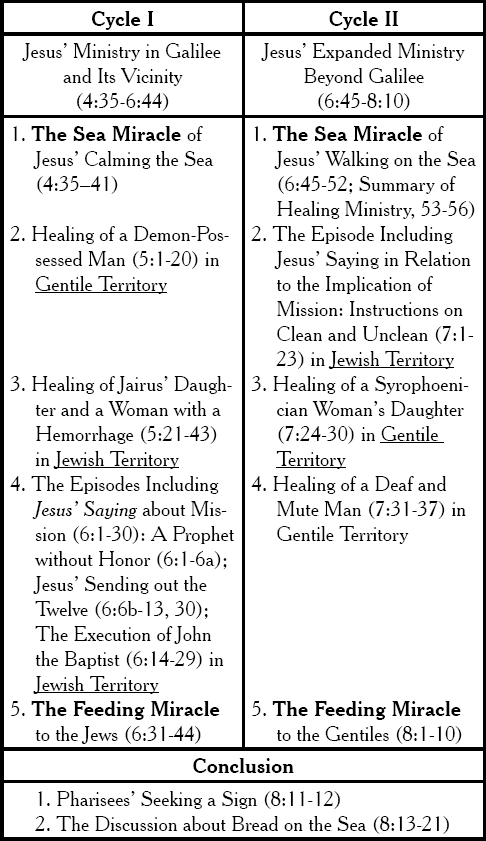
The structure that I propose in Mark 4:35–8:21 is based on geographical distinctions; it focuses mainly on tracing Jesus’ geographical movement constructed by Mark's literary technique and motifs. My structural analysis has significance for its integrative approach. Diachronically, the geographical movement of Jesus’ itinerary will be traced in the process of the narrative development; synchronically, the episodes of his ministry will be investigated in the light of Mark's literary technique of parallelism (repetition); thematically, boat and bread motifs will be explored in terms of Mark's theological intention. All of these approaches will serve to construct a structure, presenting a cyclic pattern. With these approaches, I divide Mark 4:35–8:21 into two cycles (4:35–6:44; 6:45–8:10) and one conclusion (8:11–21), in which Jesus’ missional movement is expanded to the Jews and the Gentiles by breaking down the barriers between them. Two sea miracles (the departure of a boat toward the east: 4:35–41; 6:45–52) and two feeding miracles (6:31–44; 8:1–10) mark the beginning and end of each cycle, and the final boat trip serves as a conclusion (8:13–21). The table at the top of the following page identifies the two cycles as parallels based especially on geographical analysis.
Setting up the Boundary
To begin with, I divide Mark into four parts on the ground of Jesus’ geographical movement: Jesus’ early ministry in Galilee (1:1–4:34); his expanded ministry in and beyond Galilee (4:35–8:21); his ministry on the way to Jerusalem (8: 22–10:52); and his final ministry in Jerusalem (11:1–16:8). The boundary of the second part (4:35–8:21), on which the present study is focused, is determined by the geographical expansion of Jesus’ ministry and a boat motif.
First, the first voyage of Jesus and his disciples across the Sea of Galilee is the turning point of Jesus’ ministry beyond Galilee and to the Gentiles; the second part of Mark's Gospel therefore begins with 4:35. Jesus’ ministry is performed only in Galilean areas in 1:1–4:34, but after 4:35 Jesus expands his ministry by journeying into Gentile territory. Geographical references, such as “to the other side” (4:35) and “to the country of the Gerasenes” (5:1), indicate that Jesus attempted to travel out of Galilee. Jesus made trips in and beyond Galilee by means of five crossings of the Sea of Galilee between Jewish and Gentile territories (4:35; 5:21; 6:45; 8:10; and 8:13) and two overland journeys, one in Jewish territory (6:6b) and the other in Gentile territory (7:24). His itinerary consists of: the first boat trip to Gentile territory (4:35–5:20); the return to Jewish territory (5:21–43); the overland journey in Jewish territory (6:1–44); the second attempted but aborted boat trip to Gentile territory (6:45–52); the return to Jewish territory (6:53–7:23); the overland journey to Gentile territory (7:24–8:9); the return to Jewish territory (8:10–12); and the final boat trip (8:13–21).
Next, in this section (4:35–8:21) Jesus frequently crosses the Sea of Galilee for his missional journeys by boat, and a boat motif plays a significant role in contouring the structure of this section. The word “boat” (ploion) appears 17 times in Mark (1:19, 20; 4:1b, 36a, 36b, 37a, 37b; 5:2, 18b, 21b; 6:32, 45b, 47a, 51, 54; 8:10b, 14), and “small boat” (ploiarion) appears once (3:9) (Malbon 1986: 53). Though images of a boat as a setting in Mark's narrative occur before 4:35, the actual use of a boat to cross the Sea of Galilee as part of a voyage begins in 4:35. The boat trips end at 8:21 with a discussion between Jesus and the disciples about bread in a boat (8:13–21). This serves as the conclusion to the second part of Mark (4:35– 8:21), and no further references to a boat appear after this episode (Lührmann 1987: 139). Instead of a boat motif, “the way motif” prevails in the following part of Mark (8:22–10:52).
Two Cycles Based on Jesus’ Geographical Movement and Literary Parallelism
A cyclic pattern can be constructed by Mark's geographical arrangement, which is investigated by tracing Jesus’ geographical movement and examining Markan literary parallelism. For this study, narrative settings (i.e., time, space, and social circumstances) that serve as a framework of a narrative will also be considered.
Tracing Jesus’ Geographical Movement
Three voyages across the Sea of Galilee function as a framework of this section (4:35–8:21): Jesus’ calming the sea (4:35–41), walking on the sea (6:45–52), and discussing bread on the sea (8:13–21) (Malbon 1984: 363). This section consists of two literary building blocks (4:35–6:44; 6:45–8:10) and one concluding section (8:11–21). The two sea miracles (4:35–41; 6:45–52) are placed at the beginning of each block, and the two feeding miracles (6:31–44; 8:1– 10) are located at the end of each block. These two blocks establish two cycles, exhibiting a cyclic pattern. The pattern of geographical movement is similar in the two cycles, though the routes of the two journeys are different.
In the first cycle, Jesus traveled from the western seaside across the Sea of Galilee to the region of the Gerasenes (4:35–5:20). After healing a Gerasene demoniac, Jesus returned to the western shore in a boat and cured Jairus's daughter and a woman with hemorrhage (5:21–43). Jesus then left the west coast of the Sea of Galilee, took an inland journey to Nazareth, where he was rejected by his own hometown (6:1–6a), and then traveled among villages teaching (6:6b). The execution of John the Baptist is inserted into the episode of Jesus’ sending out the disciples (6:7–30). After finishing their mission to Galilee the disciples returned to Jesus, who then performed the miracle of feeding the five thousand in the wilderness along the west coast of the Sea of Galilee (6:31–44).
In the second cycle, Jesus set out to sail to the eastern port city of Bethsaida, but this attempt was aborted, and he landed on the western shore at Gennesaret, where he healed many people (6:45–56). Jesus engaged in a controversy with religious leaders from Jerusalem about clean and unclean, and in Galilee he declared that all foods are clean (7:1–23). After this proclamation, Jesus took an overland journey toward the northwest, entered a house in the region of Tyre, and healed a Syrophoenician woman's daughter (7:24–30). The region of Tyre (v 24) generally refers to the territory under the control of the city of Tyre, which was located above the north of Galilee (Guelich: 384; Dalman: 195–208). Jesus crossed over the frontier of northern Galilee and went into the region of Tyre in southern Syria.
The important, though confused, summary of the route of Jesus’ round trip from northwest to southeast is described in 7:31: “And again departing from the region of Tyre, he went through Sidon toward the Sea of Galilee, through the midst of the region of the Decapolis” (my translation). The following two episodes—the healing of a deaf and mute man (7:31–37) and the feeding of the four thousand (8:1–10)—share the geographical information from 7:31.
Scholars have suggested diverse interpretations of 7:31. In this verse, the phrase “through Sidon” indicates that Jesus’ journey was a roundabout one because he took a detour to reach the southeast area (France: 301–02). According to James Brooks, “the expression ‘through Sidon’ is shorthand for ‘through the region of Sidon’ and does not necessarily indicate that Jesus entered the city itself. Sidon's territory probably extended at least twenty miles to the east of the city itself. It was important for Mark to show that Jesus spent some time in Gentile territory—also the Decapolis—in order to provide some justification for the Gentile mission in his own day” (Brooks: 122). Jesus set out northward to Sidon from the region of Tyre, then reached south to the Sea of Galilee “in the midst of” (ana meson) the region of the Decapolis. Robert Guelich suggests two options for understanding ana meson tōn horiōn Dekapoleōs (“in the midst of the region of the Decapolis”) (Guelich: 392). The first is simply to interpret the phrase as “within the region of the Decapolis,” which implies that the Sea of Galilee is within the region of the Decapolis (e.g., Cranfield: 250; Lane: 256). This rendering, however, is weak on lexical grounds because ana meson does not mean “within” but “in the midst of” (Lang: 152–54). The second is to insert “through” in front of “in the midst of” to form “through the midst of the region of the Decapolis.” Though this rendering also has a lexical problem, it keeps the meaning of “the midst of” and provides an understandable route to the Sea of Galilee. Jesus reached the Sea of Galilee by going through the midst of the region of the Decapolis (e.g., Marxsen 70; Pesch 393). I believe the latter option is better in that it may properly explain the route of Jesus’ roundabout journey without damaging the meaning of “‘the midst of” and indicate that Jesus’ missional ministry was performed in more extensive areas of Gentile territory as he visited the region of the Decapolis. For a possible route of Jesus’ roundabout trip, Guelich also suggests two options (Guelich: 392–93). The first is “a route from Tyre via Sidon across to Caesarea Philippi and down through Philip's territory to the sea at Hippos” (e.g., Dalman 1935: 200–01). It is difficult, however, to include the route going though “the midst of the region of the Decapolis.” The second is a travel “from the territory of Tyre north to Sidon then across Lebanon to the territory of Damascus, which bordered the eastern territory of Sidon and then southeast through perhaps the Decapolis cities of Dium, Abila, Gadara and eventually through Hippos to the sea” (e.g., Lang: 152–54). I believe the second route presents a better description because it may satisfy the expression of “the midst of the region of the Decapolis.” The route of this journey consequently leads Jesus and his disciples to reach the east side of the Sea of Galilee. In addition, they are described as staying near the east coast of the Sea of Galilee when the feeding of the four thousand was performed (8:1–10).
The purpose of the geographical description in 7:31 is to show that Jesus took a mission to the whole of Gentile territory on the way to his final destination on the east coast of the Sea of Galilee. In the description of Jesus’ movement—Then he left the region of Tyre and went through Sidon—Mark carefully presents Jesus’ itinerary in Syria. While Matthew simply describes Jesus as entering the region of Tyre and Sidon (Matt 15:21), Mark divides Jesus’ visit to Syria into two steps: entering the region of Tyre (Mark 7:24), and departing from Tyre to go through Sidon (v 31). In addition, while Matthew does not mention the return route to reach the Sea of Galilee (Matt 15:29), Mark describes the return itinerary to the sea in detail (Mark 7:31). Moreover, Mark could have combined Tyre and Sidon into one expression while portraying Jesus’ entrance to a house in Syria in 7:24 (compare his earlier use of the expression “Tyre and Sidon” in 3:8), but instead he carefully separated Jesus’ visitations between Tyre and Sidon in 7:24, 31 for the purpose of presenting his wide circuit journey from northwest to southeast in Gentile territory (Gundry: 378). Mark's detailed description of Jesus’ return to the Sea of Galilee appears in two expressions. First, if we assume that 7:31 demonstrates Jesus’ extensive ministry over Gentile territory (Donahue & Harrington 2002: 239), the phrase ana meson may imply that his ministry was performed in region of the Decapolis while sojourning there. Second, the Markan expression “he came to” (ēlthen eis; 1:14, 29, 39; 5:1; 6:53; 8:10; 9:33; 14:16) indicates that “the following incident/event takes place in the location described by the ‘to’” (eis) (Stein: 357–58). After ministering in the region of Decapolis, then, Jesus reached arrived at the Sea of Galilee.
If we connect Jesus’ itinerary around the region of the Decapolis in 7:31 with the expression “during those days” in 8:1, the miracle of the feeding of the four thousand (8:1–10) happened on “the east side of the Sea of Galilee” in Gentile territory (Edwards: 229). In the light of Jesus’ extensive journey in 7:31, some of the crowd who came “from a great distance” (apo makrothen hēkasin) in 8:3 might be the Gentiles who followed Jesus from the regions he visited earlier (Guelich: 404). F. W. Danker argues that the expression apo makrothen hēkasin may allude to the Gentiles, reflecting Joshua 9:6 LXX and Isaiah 60:4 LXX (Danker: 215–16). In addition, the fact that the two episodes (7:31–37; 8:1–10) have Gentile characteristics indicates that these events took place in Gentile territory (Iverson: 57–77). The two episodes thus share the geographical information from 7:31, taking place on the east side of the Sea of Galilee in Gentile territory. After feeding the four thousand, Jesus returned west to the region of Dalmanutha by boat (8:10).
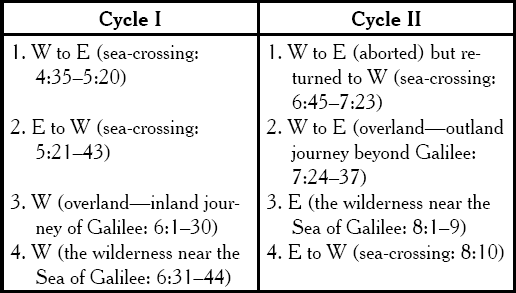
Tracing Jesus’ geographical movement in each cycle establishes four aspects of the cyclic pattern. First, each cycle includes two sea-crossings from west to east and back from east to west. The four references to crossing over the sea appear in 4:35, 5:21, 6:45, and 8:10. In the first cycle, Jesus traveled over the sea by a boat from west to east (4:35) and then returned from east to west (5:21). In the second cycle, Jesus attempted to cross over from the west to Bethsaida in the east, but this voyage was aborted and he landed on the west side at Gennesaret (6:45, 53). Jesus then journeyed by land in the areas of Tyre, Sidon, the coast of the Sea of Galilee, and the region of the Decapolis (7:31) and finally reached the east side of the Sea of Galilee, from where he returned west to Dalmanutha (8:10).
Second, Jesus took an overland journey in each cycle. In the first cycle, after being rejected by his hometown (6:1–6a) Jesus went around teaching from village to village in Galilee (6:6b) and sent his disciples out into Galilee with mission commandments (6:7–13, 30). In the second cycle, after a controversy with Jewish religious leaders about the law of purity and his proclamation that all foods are clean (7:1–23), Jesus ventured into Gentile territory, traveling toward the northwestern cities of Tyre and Sidon and the region of the Decapolis before coming down to the east side of the Sea of Galilee (7:24–37).
In addition, the pattern of Jesus’ overland journey is similar in the two cycles: seaside (seashore)/land/seaside (wilderness) (cf. Petersen: 188). In the first cycle, after sea-crossings back and forth (4:35–5:20), Jesus healed Jairus's daughter and a woman with a hemorrhage at the seashore (5:21–43). He then traveled inland to Nazareth (6:1–6a). After being rejected by his hometown people, he took an overland tour, giving his disciples a mission commandment and sending them to the villages of Galilee (6:6b–30). Finally, Jesus and his disciples withdrew to the wilderness, and Jesus fed the five thousand along the western seaside (6:31–44). In the second cycle, after aborted sea-crossings back and forth (6:45–52), Jesus healed many people at the seashore (6:53–56) and discussed distinctions between clean and unclean, proclaiming that all foods are clean (7:1–23). He then traveled overland into Gentile territory, progressing toward the region of Tyre, through Sidon, and through the midst of the region of the Decapolis, then reaching the Sea of Galilee (7:24–36). Finally, Jesus fed the four thousand in the wilderness along the eastern seaside (8:1–10). The following table presents the cyclic pattern of seaside/land/seaside centered on an overland journey in each cycle.
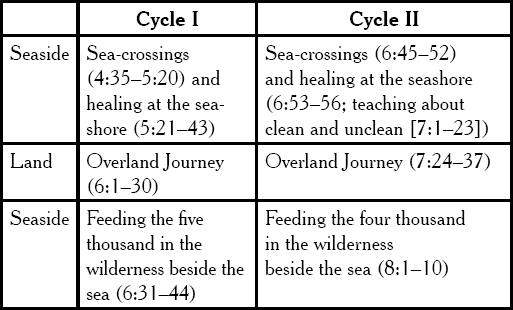
Third, in each cycle Jesus began his ministry at the sea and ended it in the wilderness. In each cycle, Jesus began his journey by sailing to the east; the miracles of calming the sea (4:35–41) and walking on the sea (6:45–52) took place in the process. His final destination in each cycle is the wilderness (6:32; 8:4), where he fed the five thousand on the west side of the Sea of Galilee (Jewish territory) and the four thousand at the east side of the Sea of Galilee (Gentile territory).
Finally, the Decapolis, which is the focal point of Jesus’ Gentile mission, plays the role of connecting the two cycles. In the beginning of the first cycle, Jesus visited the region of the Gerasenes and met a demon-possessed man (5:1–20). Jesus expelled the demons from the man and healed him; the man then proclaimed in the Decapolis how much Jesus had done for him. In the end of the second cycle, Jesus reached the region of the Decapolis (7:31) and healed a deaf and mute man (7:31–37). Mark establishes a pattern where a report about Jesus spreads in Gentile areas and then Jesus performs miracles there (Donahue & Harrington: 239). Here the healed Gerasene demoniac plays the role of “a prototype of the Christian missionary” in the region of the Decapolis. According to Eric K. Wefald, the demon-possessed man serves as a forerunner for the preparation of Jesus’ ministry in Gentile territory as John the Baptist did in Jewish territory (Wefald: 13–14). Those who lived in the region of the Decapolis and heard about Jesus in the first cycle were able to see his mighty works in the second cycle. The Decapolis becomes the first and last stop for the Gentile mission in the two cycles.
The two cycles differ, however, according to their varying territorial emphases. In the first cycle, Jesus’ ministry was performed mainly in Jewish territory, with the exception of the healing of a Gerasene demoniac in the Decapolis (5:1–20). On the contrary, in the second cycle his ministry occurred mostly in Gentile territory, with the exception of the controversy with religious leaders in Jewish territory (7:1–23). Jesus’ geographical movement in each cycle can be outlined as follows:
Parallels between the Two Cycles
A cyclic pattern previously examined by tracing the route of Jesus’ geographical movement will further be explored by investigating parallelism between the two cycles in similar situations, namely settings—space, time, and circumstances. The spatial settings in each cycle largely consist of three parts: the sea (4:35–41; 6:45–52), the land (5:1–6:30; 6:53–7:37), and the wilderness (6:31–44; 8:1–10). In each spatial setting, Jesus performed the nature miracles of calming the storm and walking on the water in the midst of the sea, the healing miracles of exorcism and curing sickness on the land, and the feeding miracles of the five thousand and the four thousand in the wilderness.
In the first miracles of each cycle (sea miracles: 4:35–41; 6:45–52), similar situations are discovered. In both episodes, the spatial setting is the sea. Geographically, the voyages are sea-crossings (“to the other side”: 4:35; 6:45) from west to east. The time is the evening (“when evening came”: 4:35; 6:47), which alludes to a terrifying situation at night. The circumstance is the disciples’ desperate struggle against a furious wind (“a great windstorm”: 4:37; “a wind against them”: 6:47).
In the last miracles of each cycle (the feeding miracles: 6:31–44; 8:1–10), we can also find similar situations. In both episodes, the spatial setting is the wilderness near the Sea of Galilee. Reference to time indicates the critical need for food or the state of starvation. The phrase “the hour is already late,” repeated twice in 6:35, creates a sense of crisis regarding the need to feed the people; the length of the journey with Jesus (“already three days”) in 8:2 highlights that the crowd might be hungry (Donahue & Harrington: 244). The circumstance is the predicament of the crowd, which arouses Jesus’ compassion. In the account of the feeding of the five thousand Jesus was moved with compassion because the people were like sheep without a shepherd (6:34); in the feeding of the four thousand Jesus had compassion because the people had nothing to eat (8:2).
In the middle part between sea and feeding miracles, namely the episodes in the land (5:1–6:30; 6:53–7:37), it is more complicated to discover parallelism between the two cycles and arrange them with a repetitive form. Nonetheless, a cyclic pattern with parallelism can be consistently tracked through these episodes. Though there is little reference to time settings in these episodes, spatial and circumstantial settings and other elements such as characters, themes, and verbal expressions can be examined for parallelism. Within the frame of the sea and feeding miracles, the remaining episodes in each cycle present a chiastic structure at a narrative level as follows:
[The sea miracle of Jesus’ calming the storm (4:35–41)]
A—A demon-possessed man (5:1–20)
B—Jairus's daughter and a woman with a hemorrhage (5:21–43)
C—Jesus’ saying about mission to the Jews, including some episodes (6:1–30)
[The feeding miracle of the five thousand (6:31–44)]
[The sea miracle of Jesus’ walking on the water (6:45–52); healing summary (6:53–56)]
C′—Jesus’ saying in relation to the implication of mission to the Gentiles (7:1–23)
B′—A Syrophoenician woman's daughter (7:24–30)
A′—A deaf and mute man (7:31–37)
[The feeding miracle of the four thousand (8:1–10)]
First, the similarity between a demon-possessed man (5:1–20) and a deaf and mute man (7:31–37) is discovered in the narrative settings. In the first cycle, Jesus met a demon-possessed man who lived among the tombs in the region of the Gerasenes after the first crossing the Sea of Galilee to Gentile territory (5:1–3). Jesus healed the demon-possessed man, who proclaimed how much Jesus had done for him in the Decapolis (5:20). In the second cycle, Jesus arrived at the Sea of Galilee through the midst of the region of the Decapolis by way of Tyre and Sidon (7:31) and met a deaf and mute man who had a speech impediment (7:32). This miracle took place before the last sea-crossing back to Jewish territory. We may thus observe the similar settings of the two episodes. They took place near the Sea of Galilee (5:1; 7:31) and are related to the region of the Decapolis (5:20; 7:31) (Williams: 45–46). In addition, the Decapolis serves as the connecting point between the two episodes. The formerly demon-possessed man proclaimed Jesus’ mighty work to the people of the Decapolis at the beginning of the first cycle (5:20), and those who lived in the region of the Decapolis brought a deaf and mute man to Jesus at the end of the second cycle (7:31–32).
A similar response to Jesus’ healing miracles appears in both episodes. At the end of each episode, people were astonished by Jesus’ mighty work (5:20; 7:36–37). In the first cycle, the healed man “began to proclaim” (5:20) how much Jesus had done for him, and all were “amazed” (5:20). In the second cycle, the intensity of the proclamation and amazement increases with the healing of the deaf and mute man. The more Jesus commanded people to tell no one, “the more zealously they proclaimed it” (7:36), and those who heard it were “astonished beyond measure” (7:37).
Second, the interwoven story of Jairus's daughter and the woman with a hemorrhage in the first cycle (5:21–43) is compared with the account of the Syrophoenician woman's daughter in the second cycle (7:24–30). The geographical settings of the two stories are different, however. The episodes of Jairus's daughter and the hemorrhaging woman took place on the west shore of the Sea of Galilee (5:21) right after a sea-crossing from the east; the episode of the Syrophoenician woman's daughter occurred in the region of Tyre (7:24)—northern Gentile territory—during an overland journey. Though the geographical settings differ between the episodes, the spatial setting of the miracles is the same: both took place in a house. In the first cycle Jesus entered Jairus's house (5:38) and healed his daughter; in the second, Jesus entered a certain house (7:24) and conversed with a Syrophoenician woman who found her daughter healed when she returned to her own house (7:30).
The social circumstances of the two episodes are also similar. Two characters, a woman and a daughter, play an important role in both episodes in a similar way: women show sincere faith and daughters are healed. In particular, the hemorrhaging woman (5:25–34) and the Syrophoenician woman (7:24–30) serve as exemplary figures who show true faith, despite the fact that both were isolated and excluded from the Jewish community by reason of their impurity. In the first cycle, the woman with a hemorrhage suffered not only from physical illness, but also from social and religious discrimination. Menstruation was regarded as a source of ritual impurity (Lev 15:19–27; Josephus, J.W. 5.227), and the woman who discharged blood for twelve years might be isolated from her community. The woman's reticent and circuitous approach to Jesus in the crowd implies her ritual impurity, because she should be away from the public: “Her impurity places her ‘outside’ of the chosen people of God” (Moloney: 107; see also Marcus: 357; Guelich: 296; Strauss: 230). In the second cycle, Mark describes the woman with a demon-possessed daughter with the double expression “a Greek, a Syrophoenician by birth” to describe her ethnicity—she is introduced as a Gentile woman of Syrian Phoenicia (7:26). Verse 26 can be read as a “crescendo of demerit”: “she is a woman, a Greek Gentile, from infamous pagans of Syrian Phoenicia” (Edwards: 218). Two-step progressive description, which is Mark's favorite literary technique, is applied to portray her identity. The first description, a Greek, is used to refer to a Greek-speaker, more broadly a Hellenized person, but this term in early Christian mission refers to a Gentile (e.g., Rom 1:16; 2:9–10; 3:9; 1 Cor 1:24; 10:32; Gal 3:28). The second description, “a Syrophoenician by birth,” specifically explains her ethnicity. This description is meant to point out that she is a Gentile, not a Jew. Jesus compared the Gentiles to dogs (v 27)—an insult to the Gentile woman. Moreover, this portrayal is used to describe her ritual impurity (Guelich: 358; Stein: 351; Strauss: 312). Julian C. Smith suggests a chiastic structure—“C. Controversy with Pharisees over purity laws (7:1–16); D. Jesus teaches disciples, declaring all foods clean (7:17–23); C’. Controversy with a Syropheonician woman over healing (7:24–30)”—in which a new understanding of ritual purity in Jesus’ saying, “all foods are clean” (v 19), is applied to this Gentile woman (Smith: 465–66). As the hemorrhaging woman, who was a Jew, was isolated from Jewish community because of her impurity, the Syropheonician woman, who was a Gentile, was excluded from the Jews because of purity laws. It is clear, then, that the women in the two cycles both experienced exclusion from the Jewish community due to their social conditions in terms of Jewish purity laws; yet both overcame adversities and obtained what they sought by faith.
Finally, though it is hard to discover similarities in the settings of Jesus’ saying about a mission to the Jews (6:1–30) and his saying about clean and unclean with its implications for a mission to the Gentiles (7:1–23), the similarity between these two episodes can be found, in that they contain Jesus’ saying and share the common theme of “mission.” In the first cycle, after Jesus was rejected by his hometown (6:1–6a) he went around teaching from village to village in Galilee and sent out his disciples with a mission commandment (6:6b–13, 30). In this section, the episode of Herod's execution of John the Baptist (6:14–29) is inserted by stealth, seeming irrelevant to the mission theme. As James R. Edwards points out, however, the two episodes of Jesus’ sending of the Twelve with mission commandment and the execution of John the Baptist are connected in a sandwich structure (Edwards: 189). The death of John the Baptist points to martyrdom, which serves as pre-figuration of the death of Jesus and his followers. By inserting the episode of John the Baptist's death (6:14–29) into their mission activities (6:6b–13, 30), Mark intended to show that the disciples’ mission should involve sacrificial commitment to the point of death. The section as a whole, therefore, deals with mission to the Jews.
In the second cycle, after Jesus engaged in a controversy about Jewish tradition with the Pharisees and some of the scribes (7:1–13), he explained what is clean or unclean (vv 14–23), teaching that people are not made unclean by what goes into them, but by what comes out of them. In his instruction about purity and impurity, Jesus declared that all foods are clean (v 19). This means that all people, regardless of their ethnicity, are clean and can be the people of God (Phelan: 224). With this proclamation, Jesus took an overland journey toward Gentile territory to the north (v 24), where he met the Syrophoenician woman (vv 24–30). Jesus’ instruction about clean and unclean thus serves as a theological ground of the Gentile mission, and indeed the following episodes (7:24–30, 31–37; 8:1–10) show Jesus’ mission to the Gentiles.
The Final Section as Concluding the Two Cycles with Boat and Bread Motifs
The concluding section (8:11–21) contains two episodes: the Pharisees’ request for a sign (8:11–12) and the discussion about bread on the sea (8:13–21). In the first episode, Jesus returned to the west, the region of Dalmanutha (8:10), where he met the Pharisees. The fact that Jesus met Jewish religious leaders indicates his coming back into Jewish territory: “Jesus’ encountering Jewish religious leaders” functions as the narrative signal to show that Jesus is in Jewish territory” (Wefald: 12–13). Like the first and second cycles, this concluding section begins in Jewish territory.
The first episode (8:11–12) is located between the two voyages in 8:10 and 13, in which Jesus encountered his opponents in Jewish region. The Pharisees ask Jesus for “a sign from heaven” (8:11). Here a “sign” does not simply mean a miracle, but “a public, definite proof that God is with him”: in the OT and Second Temple Jewish literature, the concept of a sign implies a “token which guarantees the truthfulness of an utterance or the legitimacy of an action” (Lane: 276–77). The Pharisees could undoubtedly know about Jesus’ miraculous works, because his reputation as a miracle worker had been spread not only to the Jews but also to the Gentiles (1:32–34, 45; 3:7–12; 5:19–20; 6:53–56; 7:25, 32) (Guelich: 413). Their request for a sign from heaven is seeking not the reproduction of a miracle but some kind of “authentication” that Jesus’ activity comes from God.
Jesus’ refusal of the Pharisees’ request implies that the miracles he has already performed truly came from God and so no more sign is needed to prove their authenticity. In 8:12, Jesus refused to give a sign to the Pharisees due to their unbelief and dishonest motive. The unfaithful and rebellious generation seeks a sign, “since they have rejected the ‘signs’ that God has already given them through Jesus’ ministry” (Guelich: 414). Only those who have faith can recognize that Jesus’ previous ministry came from God. This episode (8:11–12), therefore, serves as the conclusion, indicating that his miraculous works and sayings in the two cycles were manifested by God and that one can know the authenticity of Jesus’ ministry only through faith.
In the second episode (8:13–21), the discussion between Jesus and his disciples about bread on the sea is connected to both the sea miracles (4:35–41; 6:45–52) and the feeding miracles (6:31–44; 8:1–10) and delivers the theme that Jesus is the Savior who feeds both the Jews and the Gentiles. This episode (8:13–21) includes boat and bread motifs which play the role of connecting the previous sea and feeding miracles. There are four connecting points between the discussion about bread on the sea and the previous sea and feeding miracles.
First, this episode (8:13–21), like the two sea miracles (4:35–41; 6:45–52), is set on the sea. Just as three passion predictions (8:31; 9:31; 10:32–34) function as the central axes of 8:22–10:52 with its “way motif,” three sea events (4:35–41; 6:45–52; 8:13–21) serve as a framework of 4:35– 8:21 with its “boat motif” (Malbon 1993: 214). The two sea miracles and the discussion about bread on the sea have a boat motif and a sea setting in common.
Second, over the course of the three sea episodes, the disciples’ incomprehension becomes worse in a sort of “downward spiral,” and this too connects the episodes (Boring 2006: 225). In the first sea episode (4:35–41), Jesus rebuked the disciples’ lack of faith (4:40), and they asked each other with fear, “Who then is this?” (4:41). In the second episode (6:45–52), they mistook Jesus for a ghost as he walked on the sea, “for they did not understand about the loaves and their heart was hardened” (6:52). In the third episode (8:13–21), the disciples’ lack of understanding is intensified by Jesus’ twofold reproaches: “Do you still not perceive or understand? Are your hearts hardened?” (8:17). The first charge about the disciples’ lack of understanding (“Do you still not perceive or understand?” 8:17) is related to the first sea episode (“Who then is this?” 4:41). The second charge about the disciples’ hardened heart (“Are your hearts hardened?” 8:17) is connected to the second sea episode (“for their hearts were hardened,” 6:52).
Third, the disciples’ fearful rhetorical question about Jesus’ identity in the first sea episode (4:35–41) was answered by Jesus’ rebuke-laden rhetorical question in the discussion about bread on the sea (8:13–21). Malbon says that Jesus and the disciples are the main characters of the three sea events (4:35–41; 6:45–52; 8:13–21), and “the theme of the disciples’ response to Jesus and their understanding of his person and his actions is central in each case and is twice highlighted in a concluding rhetorical question (4:41; 8:21)” (Malbon 1993: 214). In the first sea episode, the disciples who saw Jesus calm the sea asked each other, “Who then is this?” (4:41). In the conclusion, Jesus asked his disciples—who still failed to realize Jesus’ identity despite having experienced the two feeding miracles—“Do you still not understand?” (8:21). Though Jesus’ saying to the disciples takes the form of a question, it is a rhetorical question designed to make the disciples recognize who Jesus is. Jesus’ question in 8:21 thus serves as the answer to the disciples’ question about his identity in the first sea miracle in 4:41. In this section (4:35–8:21), the first question (4:41) is answered by the last question (8:21). Jesus’ rhetorical question in 8:21 not only exposes the disciples’ lack of understanding but also discloses his identity as the Savior.
Finally, this episode explicitly mentions the two earlier feeding miracles. Aware of the disciples’ discussion about having no bread among them, Jesus reminded them of the miraculous feedings (8:19–20). By referring to each of the two feedings, this episode is connected to both these miracles with a bread motif. Though the disciples’ lack of understanding is highlighted in this episode, the narrative also reveals who Jesus is: the Savior who feeds both the Jews and the Gentiles. This episode thereby concludes the two cycles, not only by alluding to the two sea miracles and mentioning the two feeding miracles but also by contrasting the disciples’ incomprehension with Jesus’ greatness who delivered his disciples from danger and fed all the people regardless of their ethnicity.
Conclusion
Scholars differ in their interpretation of the main theme of Mark 4–8. Petersen argues that Mark 4:1–8:26 is primarily concerned with “the disciples’ incomprehension despite Jesus’ expectation of them and despite his attempts to explain things to them” (Petersen: 217). His interpretation of Mark 4–8 focuses on discipleship (for an emphasis on discipleship in Mark 4–8, see also Tyson; Weeden 1968; 1971; Tromcé; Kelber 1974; 1979; 1983; Best; Fowler). Malbon, on the other hand, claims that the central theme of 4:1–8:21 is “the search for understanding—understanding of who Jesus is and thus of what following him entails” (Malbon 1993: 227–28). She thus identifies a Christological perspective as key to understanding Mark 4–8 (for an emphasis on Christology in Mark 6–8, see also Matera).
I believe that Christology and discipleship are combined and interact with each other in Mark 4–8. As David R. Catchpole notes, the disciples’ incomprehension is “inevitable and christologically conditioned,” and humans can know who Jesus is only “through revelation” (Catchpole: 327). However, I would give more weight to Christology than to discipleship. The emphasis on the disciples’ incomprehension of Jesus’ identity inversely exposes his mercy and greatness as he consistently performed mighty works despite his followers’ ignorance. In addition, Jesus’ rebuke of the disciples’ lack of understanding serves as a way to press them to recognize who he is.
Mark 4:35–8:21, therefore, focuses on Jesus’ identity as disclosed in his mighty works. As with the way motif in 8:22–10:52 Jesus is revealed as the suffering Messiah who redeems his people from sin, with boat and bead motifs in 4:35–8:21 Jesus is manifested as the mighty Savior who redeems the people of God from every danger, disease, and deficiency. Jesus’ geographical movement between west (Jewish territory) and east (Gentile territory) and his repetitive and similar miraculous works in both regions demonstrate his identity as the deliverer, healer, and feeder of all the people regardless of their ethnicity, presenting two cycles—one for the Jews and the other for the Gentiles.